Monday, December 29, 2025
Home Blog Page 5001

The enemy uses hypocrisy rather than coercion

Saeed Jalili
Saeed Jalili

Saeed Jalili, Gholamali Haddad Adel, and Mohammad Bagher Ghalibaf – three politicians who ran for president along with Hassan Rouhani in 2013 – were supposed to deliver speeches at a gathering dubbed “We are here as long as the struggle continues”, a ceremony organized by the Student Basij of Tehran University to mark national Student Day.

But Tehran Mayor Bagher Ghalibaf did not attend the gathering because he was in neighboring Iraq, Karbala to be more exact, to run the Shiite city as part of an agreement between Iran and Iraq which entrusts Tehran Municipality with administering the city’s affairs in the week leading to Arba’een [a Shiite Muslim religious observance that occurs 40 days after Ashura, which marks the martyrdom of the grandson of Prophet Muhammad on December 13].

According to Etemad, a daily, the following is what Saeed Jalili, a former Secretary of the Supreme National Security Council who previously led the Iranian nuclear negotiating team, had to tell the gathering:

The West seeks to use the weapon of coercion and hypocrisy to challenge the rights, values and interests of nations. The experience of the past 35 years shows that our nation has emerged victorious on all fronts. Our nation has been able to advance its cause at all times, and today the West is worried about the determination of the Iranian people which is helping bring about progress.

Universities should turn into bases for resistance economy. The sedition of 2009 [the unrest that erupted following the presidential election] had its root in failure to believe in the will of the people. Our enemy seeks to turn opportunities to threats and the sedition of 2009 was a glaring example of such policy.

The enemy knows that it has been unable to contain us, so it is now trying to contain our determination. The threats they issue are meant to throw our achievements and our struggle into doubt.

The enemy has used its first weapon, which is nothing but military action, against the Iranian nation. We were dragged into a war that Saddam’s Iraq imposed on our nation for eight years. The enemy knows that such weapons are too hollow. Now it is targeting the will of the Iranian nation which holds the key to our success. It knows that continued struggle would translate into back-to-back victories for the Iranians, so it seeks to eliminate the struggle itself.

In its bid to eliminate struggle the enemy would resort to means other than coercion, because it knows that such tactic won’t work in dealing with Iran. A third method the enemy employs is to promote what it describes as realism among Iranians. They want to instill realism in our foreign policy. They want us to see things the way they are. Hegemonic powers are not invincible; isn’t it the reality?

After the multiplication of the Iranian example, the enemy admitted that the losing streak of the Zionist regime has started. Isn’t this the reality? Why don’t they allow the reality to be seen?

Rouhani has changed the university atmosphere

Sadegh Zibakalam

Fararu, a news website, on December 7 featured an interview with Sadegh Zibakalam, a university professor and political analyst, on the election promises of President Rouhani and on whether he has been successful in remaining committed to what he vowed to do after being elected president. The following is the translation of what Zibakalam had to say in the exclusive:

What President Rouhani promised to do on the campaign trail in 2013 can be studied from three angles. First, his promise to settle Iran’s nuclear dispute [with the West] and to cut the Gordian knot which had squeezed the country’s economy and foreign relations for more than a decade.

Second is what Rouhani repeatedly underlined in the pre-election televised debates which concentrated on economic issues: efforts to improve the country’s economic conditions and ameliorate its business environment.

What he said implicitly about ending the house arrest [of presidential candidates who challenged the results of the 2009 election], [releasing] political prisoners and opening up the political atmosphere are the third aspect of his election promises.

I think some of these pledges have been partially fulfilled. The government is trying to materialize some, but some others have yet to come true.

It is not an easy job to make good on the promises that fall into the third category, because the president is not the only decision maker on those issues.

To remove the house arrest, release political prisoners and allow political openness in the country all need extensive consultations and formation of [national] consensus between all government branches, institutions and decision-making bodies. That’s why such promises can’t be readily kept.

The fact that Rouhani underscores that he has honored his promises shows that the president has not forgotten what he vowed and that he is still holding consultations to that end.

Mr. Rouhani may not have done all he said he would on June 14, 2013, but he has lived up to at least one of them, one about [changing the security] atmosphere in universities. The change in universities is evident.

The fact of the matter is that in the four years that followed the 2009 presidential election, universities were like a ghost town and the doors of multiple student bodies remained padlocked.

In those years, a large number of student activists were summoned to on-campus disciplinary committees or to off-campus institutes. Active students were singled out as “starred students” and thus banned from continuing their studies. On the whole, a highly charged security atmosphere prevailed in universities where students preferred to keep a low profile in order not to run into any problem.

In that four-year period, only organizations which were acting in line with principlists were allowed to get engaged in [political] activities in universities. None were independent and were linked to currents outside the universities.

In all fairness, we can say that since late September 2013 when universities reopened after the inauguration of President Rouhani, a vibrant atmosphere has returned to universities where independent student organizations such as the Islamic Associations of Students have been reactivated and lectures and debates are held.

The presence of Mohammad Farhadi, [who has recently secured parliament’s nod to take over as the minister of science, research and technology], will bring about no change to university atmosphere [in place since the election of President Rouhani]. Mr. Farhadi seems unlikely to dance to the tune of the authoritarians and change the status quo.

Even if that is not the case, neither the minister nor anybody else can reverse the current trend. The university atmosphere has changed thanks to the 2013 presidential elections. It is a psychological change; guidelines and directives can do nothing to change it, because it has reached a point of no return.

Iran will stand by Iraq until end of anti-ISIL fight: Zarif

Iran-Iraq-Zarif

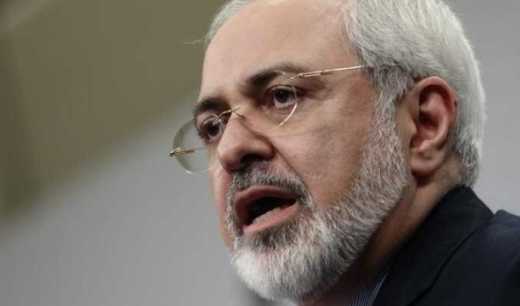
Iran will stand by the Iraqi nation until the end of its campaign against the ISIL Takfiri militants, Iranian Foreign Minister Mohammad Javad Zarif says.

Speaking in a joint press conference with Iraq’s Foreign Minister Ibrahim al-Jaafari in Tehran on Sunday, Zarif added that all the Iraqi people are fighting a common enemy.

“The Islamic Republic of Iran realized the danger of violence and extremism in Iraq since the very first day and stood by the Iraqi nation, and we will stand by the Iraqi people including Shias, Sunnis, Kurds and Arabs until the end of [their] fight against extremism and terror,” Zarif said.

He added that Iran calls for amicable ties with all regional countries and believes that Takfiri and extremist groups are threatening the entire region.

“Today, the world has understood the reality that the first country to rush to the help of the Iraqi people in the battle against extremism and terror was the Islamic Republic of Iran, which countered these common threats,” the Iranian minister said.

The Iraqi foreign minister, for his part, said Baghdad calls for further cooperation and assistance from Tehran to fight the ISIL Takfiri terrorists.

Jaafari added that regional nations must beware of the spillover of the ISIL militants’ threats.

The Iraqi minister arrived in Iran on Sunday at the head of a delegation to attend an international conference on the World Against Extremism and Violence (WAVE) in Tehran.

The WAVE conference will be held on December 9 and 10 and will be attended by envoys from 40 countries.

The conference comes against the backdrop of the growing threat of violence and extremism across the Middle East, particularly the atrocities committed by ISIL Takfiri terrorists in Syria and Iraq.

The Takfiri militants have seized swathes of land in Iraq and Syria. They have carried out horrific acts of violence in the two countries, including public decapitations. ISIL has also killed people from Shia, Sunni, Kurd, Christian, and Izadi Kurd communities in Iraq.

Western powers and some of their regional allies – especially Qatar, Saudi Arabia, and Turkey – are reportedly supporting the militants.

Iran makes electronic artificial hand

electronic artificial hand

Iranian researchers have designed and built an electronic artificial hand which costs one fourth of the German model.

The artificial device is made of two motion sensors, an electronic circuit, mechanical sections and chargeable batteries, said Kavian Parvaresh, one of the researchers of the project.

The sensors would turn movements of upper arm muscles to electronic commands and transfer them to the electronic section which acts like hand fingers, he said, adding the mechanical section which plays the role of three fingers of a hand can open and close, making it possible for the disabled person to hold different objects and even write easily.

Sensitivity of prosthesis sensors of the artificial hand can be adjusted and the person can take delicate things such as a cup of tea and a pen only after 30 minutes of training.

According to the researcher, fingers of the artificial hand can take 50 50 Newton force.

The German model of the electronic artificial hand costs 7,000 euros. When mass-produced the locally-made new product would save hundreds of thousands of euros in import costs annually.

He also said that the artificial hand has not been mass produced.

Iranian engineers develop edible insulin nano-drug

Medical-research.0jpg

Iranian researchers have built a nano-medicine system which increases insulin permeability from intestinal wall and makes the peptide hormone less vulnerable to the destructive effect of enzymes.

Diabetes is one of the most common diseases worldwide which is of two types. Daily insulin injection is one of the frequently-used methods to control the disease, said Kobra Omid-Far, a faculty member of Tehran Medical Sciences University and lead author of the project.

She added ways of preserving insulin as well as its painful injection are some problems in using the drug.

The main goal of the study is to find edible drugs to facilitate use of insulin for the patients.

The drug prevents insulin destruction by means of trypsin which improves insulin penetration from intestinal wall.

It also causes delayed release of insulin which improves insulin permeability from the intestinal wall, and makes the peptide hormone less vulnerable to the destructive effect of enzymes.

The method reduces patients’ pain caused by injections. The results of the study have been published in Materials Science and Engineering.

Rouhani: Nuclear Talks Serious, Progressive

Rouhani-news

Iranian president Hassan Rouhani described the talks between Iran and the six world powers over Tehran’s nuclear energy program as “serious and progressive.”

“Today, the world has come to the conclusion that the negotiations are serious, logical, and progressive…. It has accepted that the Islamic Republic of Iran is equipped with the weapon of logic and rationality,” said president Rouhani in an address to a gathering of Iranian students in the capital Tehran on Sunday.

Rouhani reiterated that his administration will continue to safeguard the rights of the Iranian nation and the national interests and is not afraid of facing criticism.

In their last round of talks in Vienna, Iran and P5+1, including the US, Britain, France, Russia, China and Germany, wrapped up a week of closed-door intense nuclear negotiations on November 24 and decided to extend their discussions for seven more months.

Elsewhere, in his speech, the Iranian president pointed to Iran’s efforts to tackle violence and said the Islamic Republic has always been against violence and extremism.

“Today, everyone agrees that the Islamic Republic of Iran is opposed to violence and extremism and if it were not, its proposal for World Against Violence and Extremis would have never been approved at the UN general assembly by consensus,” Rouhani noted.

Meanwhile, representatives from 40 countries will take part in an international meeting in Tehran to seek new strategies to curb the menace of violence and extremism in the world, the secretary of the WAVE conference announced.

The main subject of the conference, slated for December 9-10, includes ways to address the “global concern about the violent conditions in the cotemporary world.”

[…]

On December 18, 2013, the United Nations General Assembly overwhelmingly voted to approve Iranian President Hassan Rouhani’s WAVE proposal.

Iran criticizes racial discrimination in US

Iranian Foreign Ministry Spokeswoman Marziyeh Afkham

Iran has criticized profound racial discrimination in the United States, saying the ongoing tensions in the US society indicate a clear gap between the country’s political realities and its claims about democracy.

“Massive protests by the American people against racial discrimination and the institutionalized violent behavior toward the colored people show the continuation of chronic wounds in the US community,” Iran’s Foreign Ministry Spokeswoman Marzieh Afkham said on Sunday.

She slammed the US police’s mistreatment of minorities and the people of color and the implicit support of the country’s judicial system for racial segregation and violence against them, adding, “The US policymakers and rulers need a profound approach to their country’s domestic situation.”

Afkham noted that the US has used human rights as a tool to constantly criticize other countries over the past decades while it ignores its own domestic conditions.

The Iranian spokesperson said the issue of human rights is a broad issue and applies to all human beings, saying time is ripe for applying human rights norms to all countries without discrimination and political considerations.

The US administration and judicial system are expected to fulfill their responsibility and treat the American citizens based on justice and law and prevent any racial profiling and inhumane approach, she pointed out.

Afkham’s remarks came after US President Barack Obama on Monday acknowledged that the United States is suffering from racial discrimination amid protests over a jury decision not to indict an officer who killed an unarmed black American.

Angry protesters took to the streets across the United States after a jury decided not to indict police officer Darren Wilson who shot dead unarmed black teenager Michael Brown in August.

Iran’s taekwondo team grabs bronze in world cup championships

taekwondo

Iran’s national taekwondo team was defeated by Mexico in the 2014 World Cup and grabbed bronze in the tournament.

The 18th Taekwondo World Cup kicked off in Mexico on Saturday December 6, 2014 with eight teams vying for coveted medals.

In the semifinals on Sunday evening, Iran’s national taekwondo team took on former world champions Mexico and was defeated 43 to 39 to stand in 3rd place.

On the first day of the tournament, Iran defeated Ivory Coast (17-14), South Korea (21-19), and Germany (23-8) to become the top team of Group 1 on nine points and make it to the semifinals.

Pamuk’s first novel to be rendered into Persian

Orhan-Pamuk
Orhan-Pamuk

Mr. Cevdet and His Sons’, the first novel written by noted Turkish novelist and recipient of the 2006 Nobel Prize in Literature Orhan Pamuk, will be translated into Persian by Alireza Seifuddini and published in Iran.

Orhan Pamuk is a novelist, screenwriter, academic and the recipient of the 2006 Nobel Prize in Literature. As one of Turkey’s most prominent novelists, his books have sold over eleven million copies in sixty languages, making him the country’s best-selling writer.

Besides winning the Nobel Prize in Literature (the first to be awarded to a Turkish citizen), Pamuk is the recipient of numerous other literary awards. His ‘My Name Is Red’ won the 2002 Prix du Meilleur Livre Étranger, 2002 Premio Grinzane Cavour and 2003 International IMPAC Dublin Literary Award.

Iranian translator Alireza Seifuddini said on Sunday that ‘Mr. Cevdet and His Sons’ is Pamuk’s first novel which hasn’t been translated into Persian yet.

It tells the story of three generations of a wealthy Istanbul family living in Nişantaşı, the district of Istanbul where Pamuk grew up.

Seifuddini is also translating Pamuk’s ‘My Name Is Red’, explaining that the novel was already rendered into Persian before, but since they were not precise he decided to translate it again.

A look at Iranian newspaper front pages on Dec. 8

Iranian Newspapers Headlines

Comments by President Rouhani at a ceremony to mark national Student Day dominated the front pages of the Iranian newspapers on Monday. In those comments the president reassured the public that he was committed to the promises he made on the campaign trail. Also splashed on the front pages of the dailies was the image of President Rouhani presenting next year’s spending package to Parliament Speaker Ali Larijani.

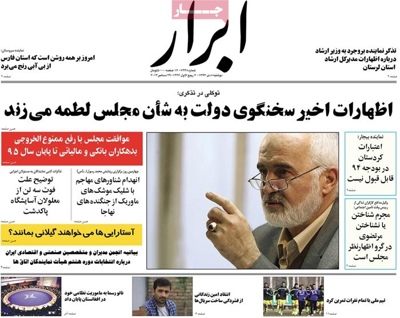
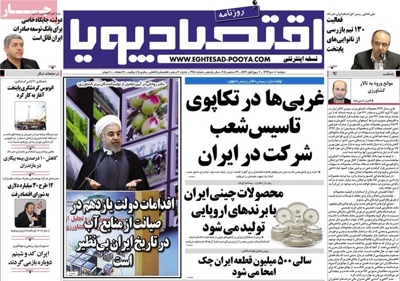
Abrar-e Eghtesadi: Under next year’s spending package, oil revenues will be down by $3 billion and the government will reduce the bread and energy subsidies it offers to the public.


Abrare eghtesadi newspaper 12 - 8


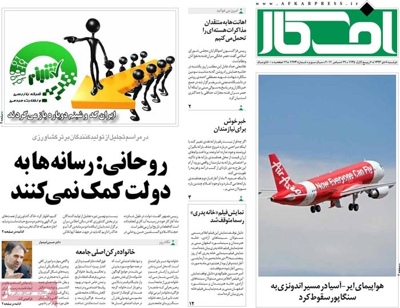
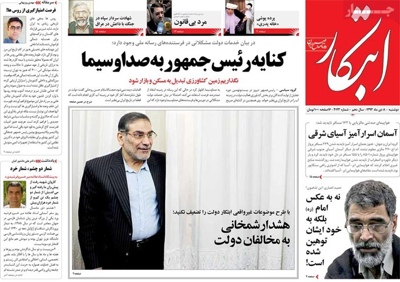
Afkar: “Tehran Stock Exchange has shed 500 points.”


Afkar newspaper 12 - 8


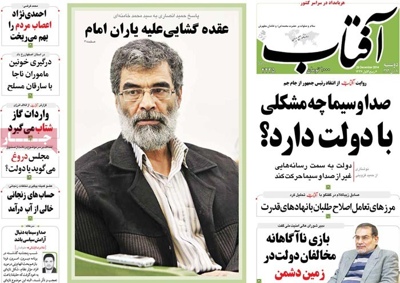
Aftab-e Yazd: “The promises I made to the people are not breakable,” said President Rouhani in a speech to mark national Student Day.


Aftabe yazd newspaper 12 - 8


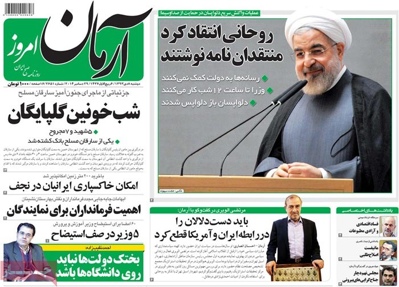
Arman-e Emrooz: “We need to promote the culture of volunteerism,” said Mahtab Keramati, a famed actress and UNICEF goodwill ambassador.

Arman-e Emrooz: “Students should not allow backwardness interfere with national progress,” said Chairman of the Expediency Council Akbar Hashemi Rafsanjani.


Armane emruz newspaper 12 - 8


Asr-e Iranian: “We have no plans to order any bank dissolved,” said the governor of the Central Bank of Iran. [His comments came weeks after the Central Bank released the names of financial institutes, including a key private bank, operating illegally.]


Asre iranian newspaper 12 - 8


Asr-e Rasaneh: Italian oil giant Eni has expressed readiness to hold talks to return to Iran’s market.

Asr-e Rasaneh: “The rise in the official rate of foreign currencies is not designed to help swell government coffers,” said the minister of economy.


Asre resaneh newspaper 12 - 8


Asrar: A group of political science and law professors have praised Maj. Gen. Ghasem Soleimani, the commander of the Quds Force, an affiliate of the Islamic Revolution Guard Corps, for the role he plays in regional developments.


Asrara newspaper 12 - 8


Ebtekar: “Students need to strive to institutionalize righteousness in the country,” said former President Mohammad Khatami.

Ebtekar: “The new science minister will follow the same path, others [who failed to get confirmation from parliament] would have taken,” President Rouhani told a Student Day gathering.


Ebtekar newspaper 12 - 8


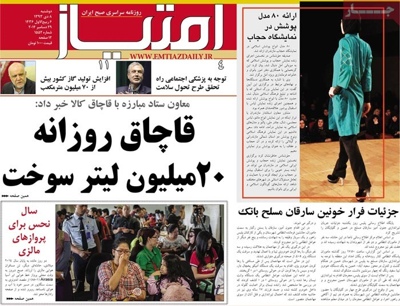
Emtiaz: Italy has expressed willingness to contribute to the development of Darkhovin Oil Field.


Emtiaz newspaper 12 - 8


Etemad: “Reformists are to present as many as 300 candidates on their ticket for the parliamentary elections [in 2016],” said Mohammad Reza Aref, vice-president under reformist Mohammad Khatami.


Etemad newspaper 12 - 8


Ettela’at: “Introducing a single foreign currency rate and taming inflation are on the agenda of the Central Bank of Iran,” said the governor of the bank.

Ettela’at: Israeli planes have bombarded Damascus Airport.


Ettelaatt newspaper 12 - 8


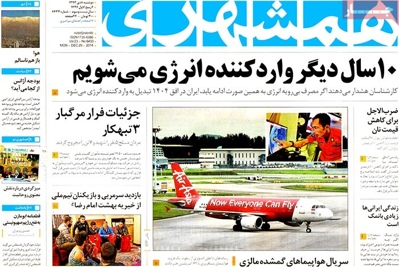
Hamshahri: Foreign ministers of Iraq and Syria are in Iran to attend a World against Violence and Extremism (WAVE) conference.


Hamshahri newspaper 12 - 8


Iran: German businessmen are in Iran for the first time in 20 years.

Iran: “Free flow of information helps tame corruption,” said the minister of communications and information technology.


Iran newspaper 12 - 8


Iran Daily: Iran is to launch anti-cancer campaign.


Iran daily newspaper 12 - 8


Jahan-e Sanat: Talks between Iran and Turkey to settle differences over transit of goods remained inconclusive.


Jahane sanaat newspaper 12 - 8


Javan: “We will never roll out the red carpet for the United States,” said Gholamali Haddad Adel, a principlist MP and a onetime speaker of the Islamic Consultative Assembly.


Javan newspaper 12 - 8


Kar va Kargar: Iranian researchers have used nano-particles to develop edible insulin.


Karo kargar newspaper 12 - 8


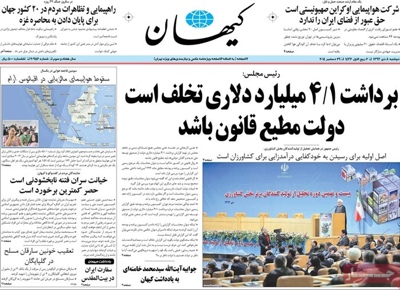
Kayhan: “Upstarts” is the new term the Government of Prudence [a reference to President Rouhani’s government] uses to describe its critics.

Kayhan: “Reformists sought to pit the student movement against the establishment,” said Tehran MP Gholamali Haddad Adel.


Kayhan newspaper 12 - 8'


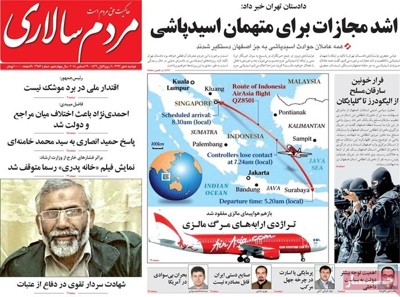
Mardomsalari: “National resolve to settle the problems women are facing is conspicuous by its absence,” said the vice-president for women and family affairs.


Mardom salari newspaper 12 - 8


Payam-e Zaman:The ban on imports of gasoline and diesel by the private sector has been lifted.


Payame zaman newspaper 12 - 8


Qods: “A cultural Google will be launched [in Farsi],” said Minister of Culture and Islamic Guidance Ali Jannati.


Ghods newspaper 12 - 8


Rah-e Mardom: “Upstarts do not need to be worried about revolutionary values,” said President Hassan Rouhani.

Rah-e Mardom: The population of the disabled in Iran increases by 60,000 a year.


Mardom salari newspaper 12 - 8


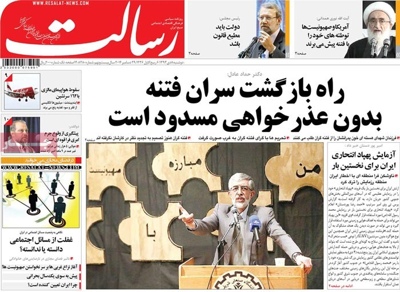
Resalat: “Removal of sanctions will be at the center of future talks,” said Ali Akbar Velayati, an advisor to the Supreme Leader and a former foreign minister.

Resalat: “Calling off the speeches of critics is not in line with law and the policy of moderation,” said Ahmad Tavakoli, a principlist MP.


Resalat newspaper 12 - 8


Roozan: “Application of social networks is not illegal,” said the minister of culture and Islamic guidance.


Ruzan newspaper 12 - 8'


Shahrvand: Next year’s spending package [just presented to parliament by the president] shows that a third phase of the Targeted Subsidies plan won’t be implemented for now.


Shahrvand newspaper 12 - 8


Sharq: “Some 772 hectares of protected area has been taken back from land grabbers,” said the director of the Environment Protection Organization.

Sharq: The country’s operating budget will rely on tax revenues by as much as 50 percent next year.


Shargh newspaper 12 - 8


Taadol: “A special court is to be set up to hear cases involving banking fraud,” said the governor of the Central Bank.


Taadol newspaper 12 - 8


Tafahom: Turning Iran’s only island in the Caspian Sea into a tourist spot will create 10,000 jobs. But it is not worth the damage the move will cause to the environment.


Tafahom newspaper 12 - 8