Friday, January 2, 2026
Home Blog Page 4954

Iran rejects US anti-terror call of help over Washington insincerity

Abdullahian-1

“The US asked Iran for help in the fight against terrorism. However, we believe the US lacks sincerity [in its anti-terror bid] as some of these terrorist groups are simultaneously supported by the US,” said Iran’s Deputy Foreign Minister for Arab and African Affairs Hossein Amir Abdollahian on Tuesday without mentioning the time of the request.

The presence of foreign military troops in the region over the recent years has shown that having a military approach toward undeveloped countries not only fails to solve the issues of terrorism and instability, but may even exacerbate the problems, he added.

The Iranian diplomat also slammed US policies with regard to the Syrian crisis, noting that the presence of terrorist groups in Syria is the result of the wrong policies of the US and its allies.

Amir Abdollahian is currently in the Ethiopian capital city of Addis Ababa to attend an African Union summit.

Since late September last year, the US and its allies have been conducting airstrikes against ISIL Takfiri terrorist group inside Syria without any authorization from Damascus or a UN mandate. The airstrikes are an extension of the US-led aerial campaign against ISIL positions in Iraq.

This is while Washington has been supporting the militants operating against the government in Syria since March 2011. Many ISIL terrorists have reportedly received training by the CIA in Jordan and Turkey. Saudi Arabia and Qatar have also been staunch supporters of militants fighting the Syrian government.

The ISIL militants have seized large swathes of land in Iraq and Syria, terrorizing all communities, including Shias, Sunnis, Kurds and Christians, in the areas they are controlling.

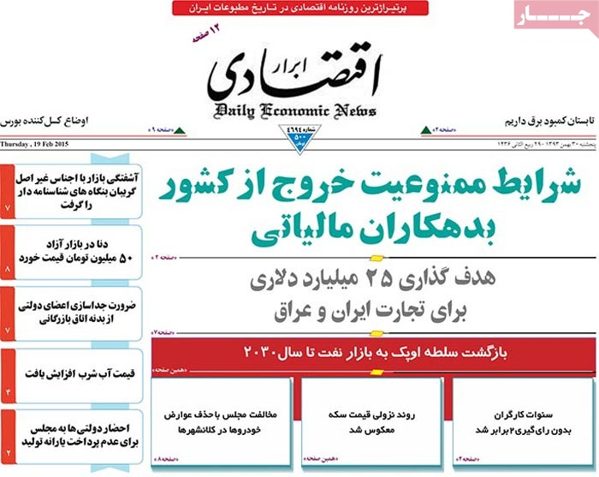
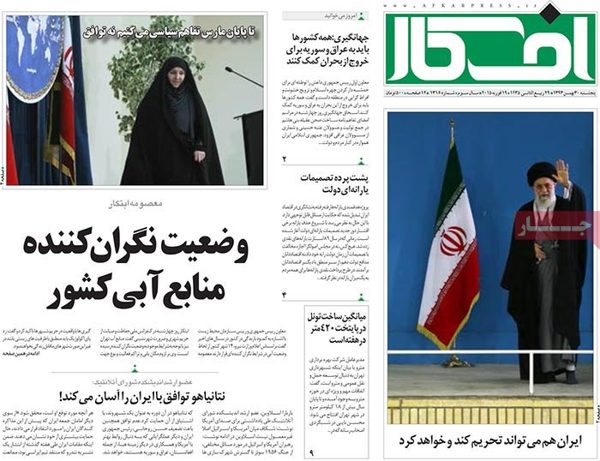
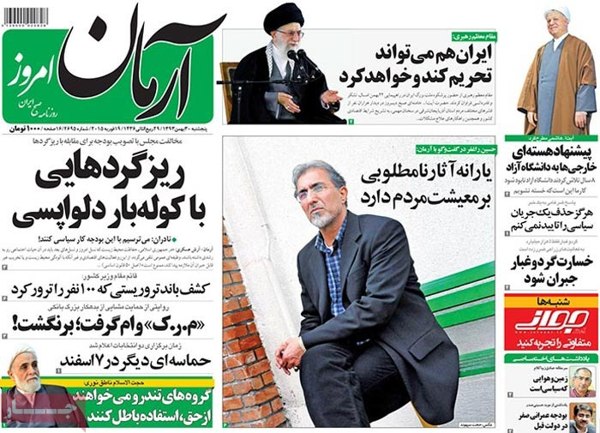
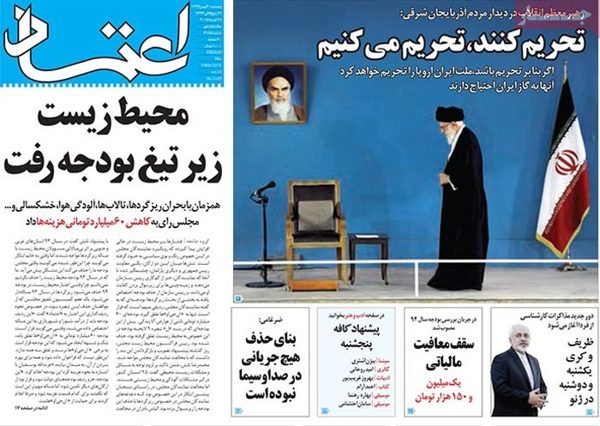
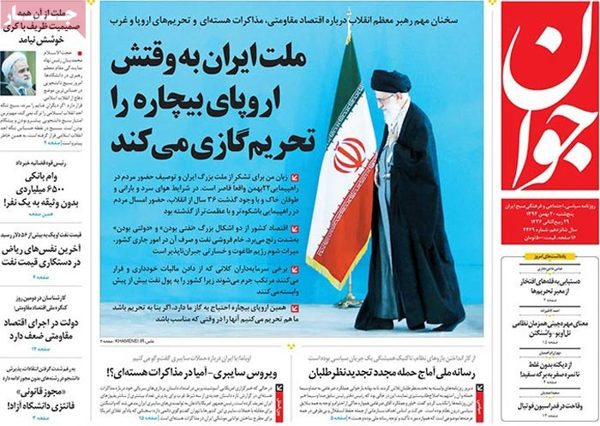
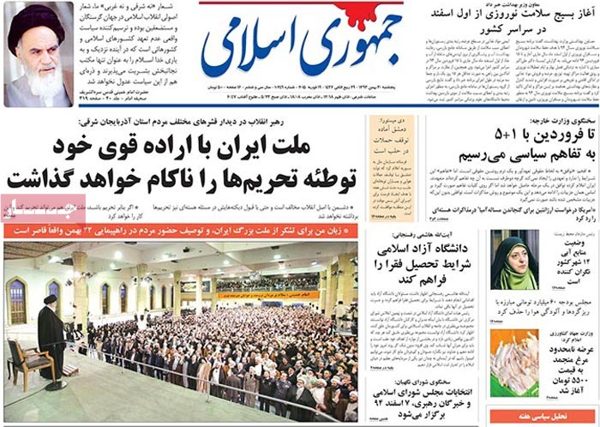
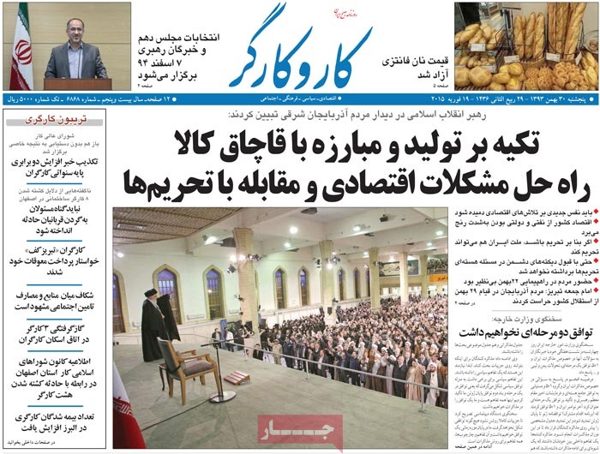
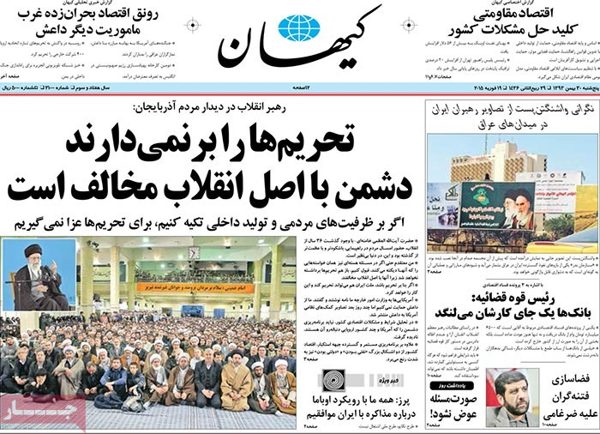
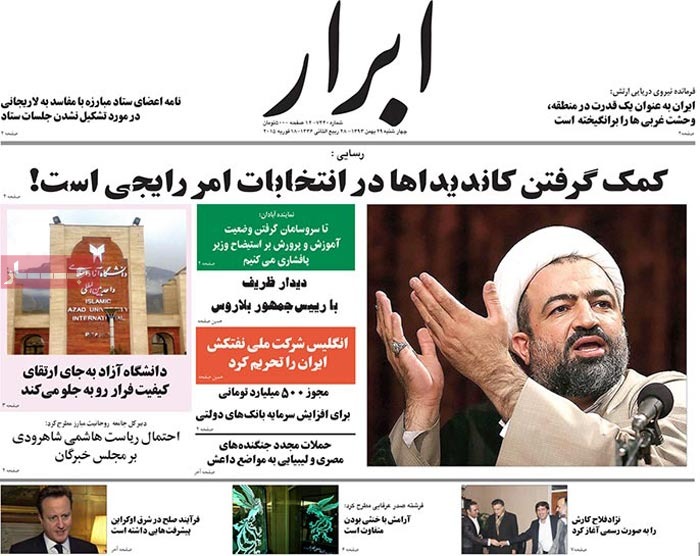
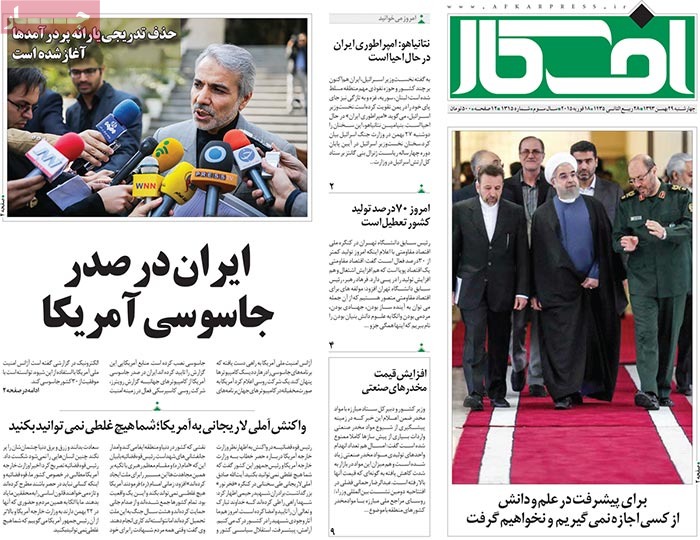
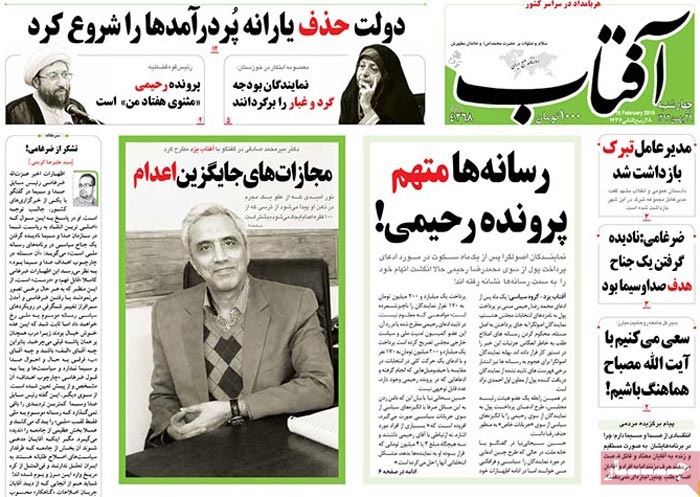
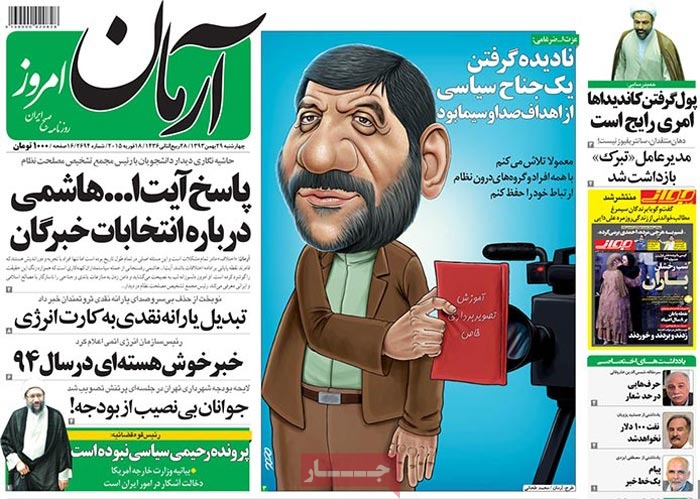
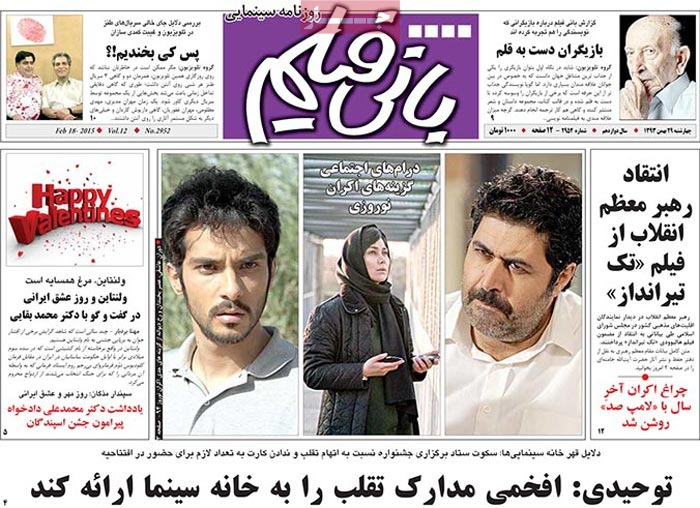
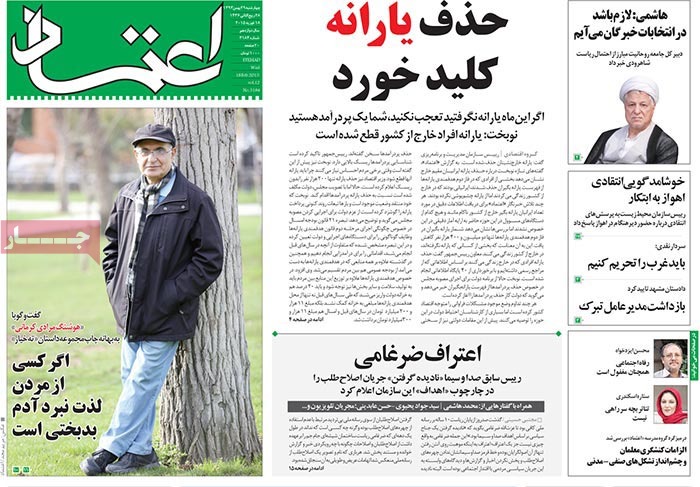
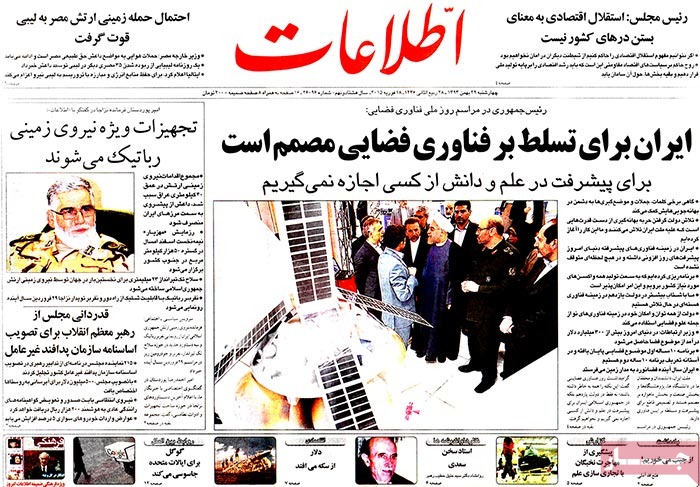
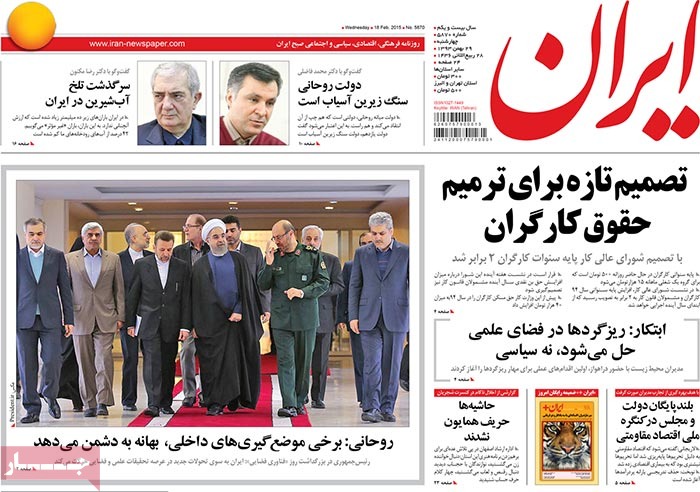
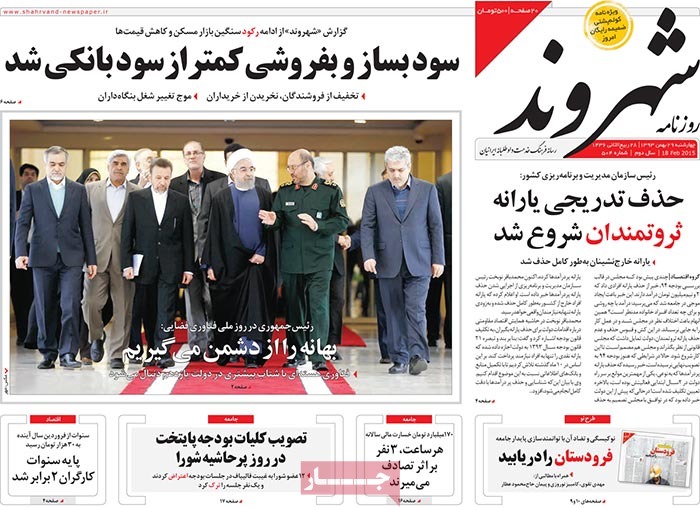
A look at Iranian newspaper front pages on Feb. 4

Iranian Newspapers Headlines

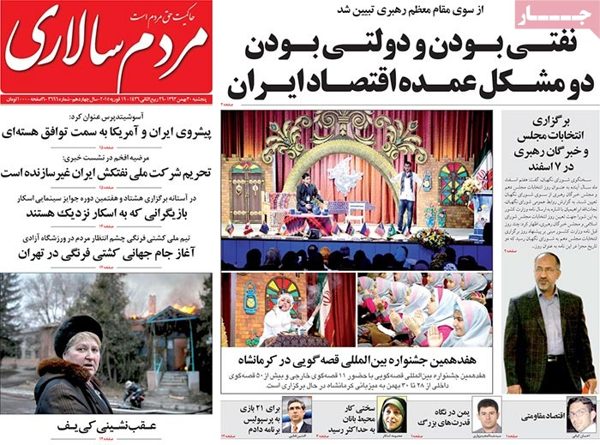
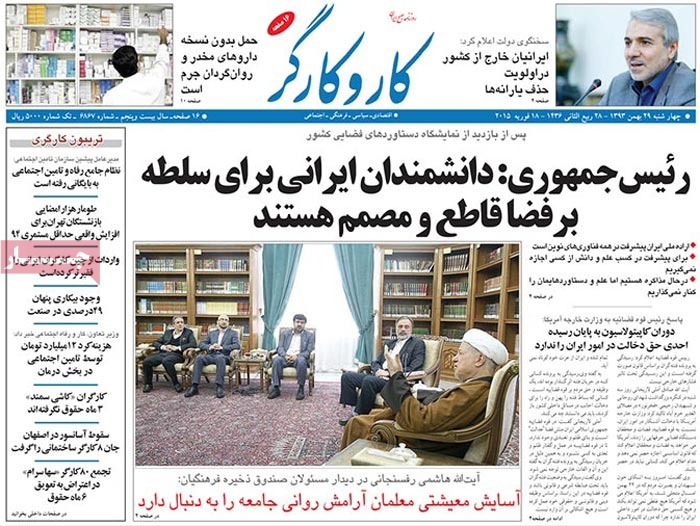
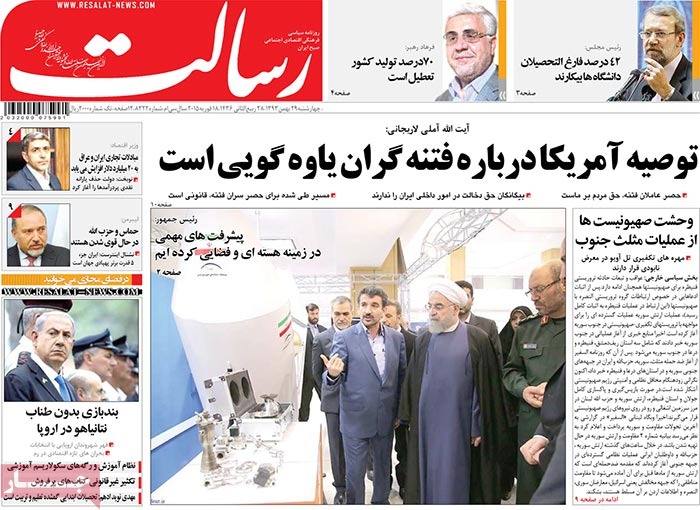
President Rouhani’s announcement that gaps have narrowed in nuclear talks between Iran and the West dominated the front pages of Iranian newspapers on Wednesday. Also on the covers of dailies were the comments of the economy minister during his appearance in parliament to answer the questions of MPs. Principlist dailies focused much of their front-page attention on the decision of parliament to require the government to scrap the Geneva deal in case any new sanctions are imposed on Iran.


Arman-e Emrooz: “Let the Europeans know that Iran seeks to interact with the whole world,” said the chairman of the Expediency Council at a meeting with visiting former Irish Prime Minister Bertie Ahern.

Arman-e Emrooz: Oman has said that a nuclear deal with Iran is certain to happen. President Rouhani said [after talks with the parliament speaker and the judiciary chief] that gaps between Iran and the West [on the nuclear issue] have narrowed.


Armane emruz newspaper 2 - 4 - 2015


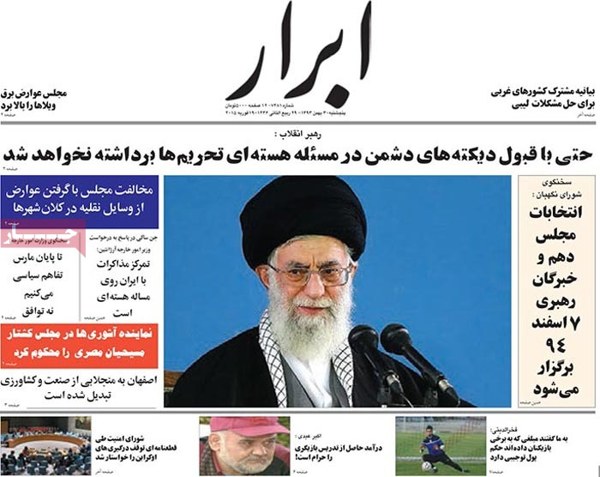
Asrar: “Withdrawal of $1.2 billion was normal and authorized,” said the governor of the Central Bank [in reaction to critics who accuse the government of taking unauthorized money from public funds.]


Asrar newspaper 2 - 4 - 2015


Ebtekar: The cash subsidies of some 9 million high-income individuals are likely to be cut as of next year [starts March 21, 2015].


Ebtekar newspaper 2 - 4 - 2015


Etemad: “When I attended a session of parliament’s Economic Committee, I was told that Messrs. Rouhani and Zarif are the target, not me,” said the economy minister after being yellow-carded by the chamber.


Etemad newspaper 2 - 4 - 2015


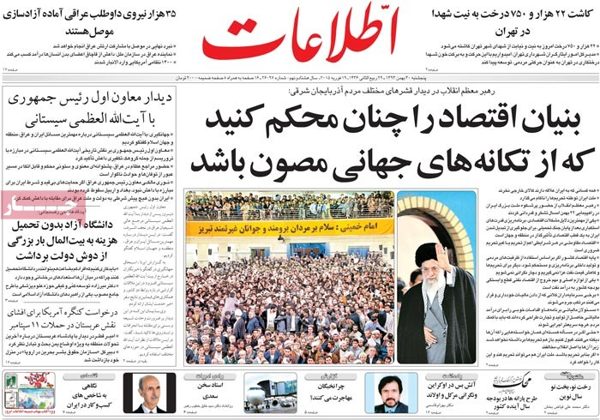
Ettela’at: More than 670 education and sports projects were inaugurated across the nation Tuesday on the third day of ceremonies marking the victory of the Islamic Revolution 36 years ago.

Ettela’at: “Some 220 cancer treatment centers will be set up across the country,” said the health minister.

Ettela’at: An official market where foreign currencies are traded will be set up.


Ettelaat newspaper 2 - 4 - 2015


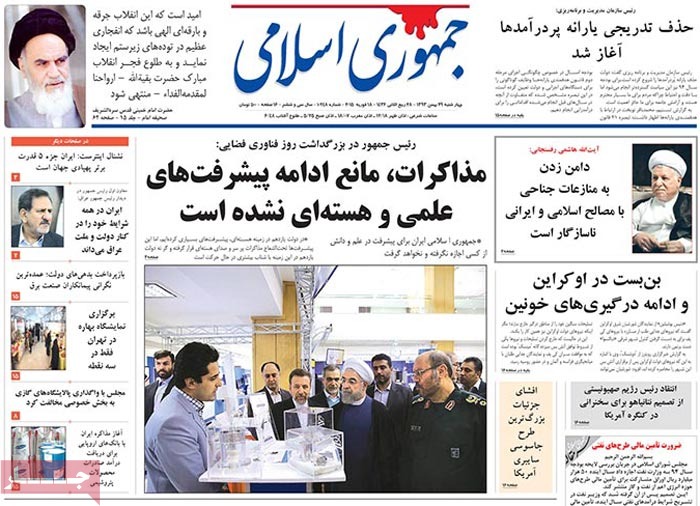
Jomhouri Islami: “The Americans make mistakes and the Europeans follow their lead,” said Akbar Hashemi Rafsanjani at a meeting with visiting former Irish Prime Minister Bertie Ahern.


Jomhorie eslami newspaper 2 - 4 - 2015


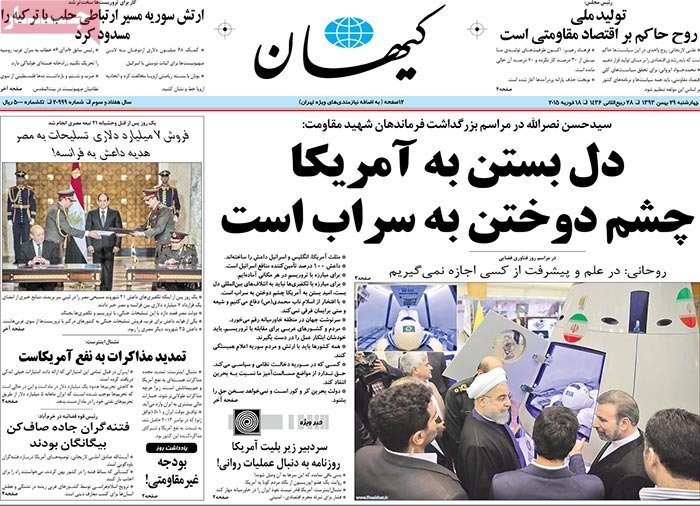
Kayhan: The Islamic Consultative Assembly has conditioned Iran’s acceptance of a comprehensive nuclear deal with P5+1 on removal of all sanctions.


Kayhan newspaper 2 - 4 - 2015


Khorasan: According to a decision by Iranian MPs, in case of new sanctions, the Geneva Deal would be scrapped and enrichment at any level Iran chooses would be resumed.


Khorasan newspaper 2 - 4 - 2015


Shahrvand: Iranian Health Minister Hassan Hashemi has warned that the number of cancer patients in the country will register a 70 percent rise within 15 years.


Shahrvand newspaper 2 - 4 - 2015


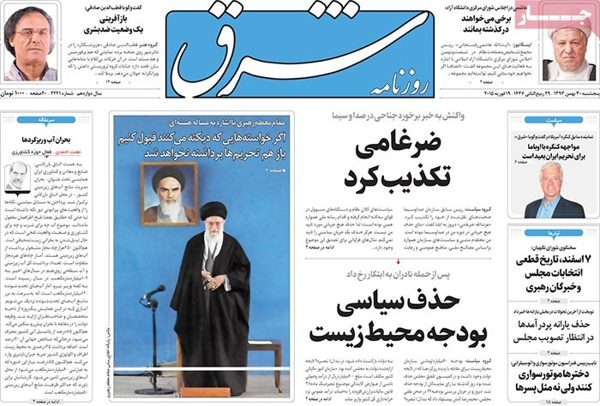
Sharq: The research center of the Guardian Council has said that appointment of Saeed Mortazavi as director of the Social Security Organization and the influence Mohammad Reza Rahimi wielded there were both against the law.


Shargh newspaper 2 - 4 - 2015


SMT: First Vice-President Eshagh Jahangiri has vowed that hurdles standing in the way of non-oil exports will be removed.


Samt newspaper 2 - 4 - 2015


Iran raps Europe for following US sanctions policies

Hashemi-Irland

“While economic problems have plagued many European countries, how can they justify their policy of following unsuccessful US programs?” said Ayatollah Akbar Hashemi Rafsanjani during his meeting with Ireland’s former prime minister, Bertie Ahern, in the Iranian capital city of Tehran on Tuesday.

He noted that the West’s sanctions against other countries have impacted detrimentally on the European economy, causing a massive economic slump.

Iran’s nuclear program

Ayatollah Hashemi also blamed the West for lacking a strong will to solve the issue of Iran’s nuclear program.

“Iran is serious in negotiations and defending its nuclear rights. However, it seems there are some problems in the US that even sap the European countries’ will [in the nuclear talks],” he said.

Iran and the six world powers are in talks to secure a final full-blown deal over Tehran’s nuclear program.

Since an interim deal was agreed in Geneva in November 2013, the negotiating sides have missed two deadlines to ink a final agreement.

The two sides now seek to reach a high-level political agreement by March 1 and to confirm the full technical details of the accord by July 1.

Rise of leftist parties in Europe

Ayatollah Hashemi also referred to the rising popularity of leftist parties in Europe which culminated in the victory of anti-austerity party Syriza in Greece’s parliamentary elections, saying the trend is the result of the European statesmen’s disregard of economic problems, especially the growing rate of unemployment.

“It is not far-fetched that Greece’s incident may permeate other countries as well,” he stated.

Syriza is a fierce opponent of Greece’s bailout deal with the International Monetary Fund and eurozone countries, and has vowed to reconsider the austerity measures that have caused mounting dissatisfaction in the country.

Gaps between Iran and P5+1 have narrowed: Rouhani

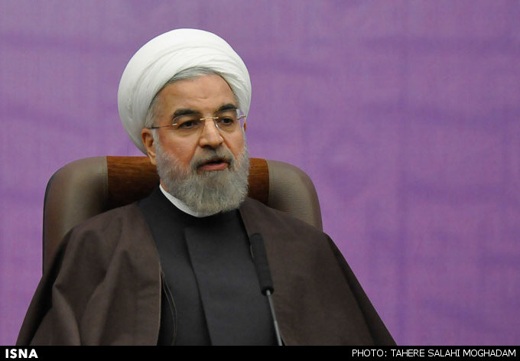
President Hassan Rouhani said the West feels that it needs to recognize the rights of the Iranian nation and the wide gaps that initially existed in nuclear talks have now narrowed.

After a meeting with the heads of the other two branches of government Tuesday, the president told reporters the nuclear case was one of the issues that came up for discussion at the meeting. “Fortunately, the nuclear case is progressing within the framework the Islamic establishment has set. The negotiating team has the backing of all senior state officials and the Supreme Leader has on occasion praised the members of the team.”

The president also said next year’s budget, banking and business issues, air pollution and investment in transportation as well as regional questions were also discussed at his meeting with the parliament speaker and judiciary chief.

Iranian religious minorities enjoying freedom, respect: Bishop Mirm

Bishop Mirm

The Assyrian, Chaldean Catholic Church Bishop of Orumiyeh Thomas Mirm said on Tuesday that complete freedom and respect were the results of Iran’s 1979 Islamic Revolution for religious minorities of the country.

Speaking in a ceremony to commemorate the 36th anniversary of the Islamic Revolution victory in the northwestern city of Salmas, the bishop said the Revolution had caused great changes in the economic, cultural and social aspects of the Iranians lives including those of the followers of different religions.

One of the remarkable blessings of the Islamic Revolution for the Iranian people was a peaceful coexistence between different ethnic and religious minorities of the country.

Ethnic and religious minorities in Iran enjoy a high degree of freedom and security which does not exist in any other country of the world, Bishop Mirm stressed.

Iraqis have not torched Iran’s flag

Iraq university-Iran

On February 2, Alef, a news website, posted a report about rumors that some Iraqis have set Iran’s flag on fire in the aftermath of Iran’s elimination from the AFC Asian Cup 2015. The following is a partial translation of the report the website published in reaction to such unsubstantiated rumors:

In their four showdowns at the Asian Cup, Iran’s national soccer squad lined up against teams from the country’s Arabic-speaking neighbors. These countries which have been involved in sporting rivalry with Iran for years have at times scarred the Iranian squad. The biggest such scar came in the form of delight displayed by the Bahrainis – waving the Saudi flag – when Iran failed to qualify for World Cup 2002.

A long history laced with recent political issues and occasional defeats of Iran’s national soccer team on the pitch has prompted Iranian soccer fans to view such showdowns as something beyond a 90-minute encounter. That was why every Iranian was absolutely elated over the wins of Iran in the group stage against Bahrain, Qatar and the UAE. The same mentality made it difficult for the Iranians to get over the defeat of their team at the hands of Iraq in the games.

Of course, the result of the last match was not digestible for the Iranian fans who didn’t expect their men to get a drubbing from the team representing a country which has been wrestling with civil war with a soccer league in disarray. The defeat caused many to sway public emotions through inappropriate analyses.

At the same time as the Asian Cup was underway, the College of Foreign Languages at the University of Baghdad played host to a soccer competition between squads from different language departments. Interestingly, the team which represented the Persian Language Department found their way to the final where they squared off against the German Language Department.

The Persian Language Department team asked Iran’s cultural attaché in Baghdad to provide them with Iran’s national jerseys for the final match. The Iranian embassy obliged and the Persian Language Department emerged victorious in the final and lifted the trophy. Throughout the final match cheers of Persia, Persia could be heard in the stadium.

It came as some tried to capitalize on the hurt feelings of the Iranians whose side had failed to stay in the competition and spread rumors that Iran’s flag had been set ablaze in Baghdad.

In national security matters, please don’t make noise!

187971_839

In an analysis on February 2, the Islamic Republic News Agency lashed out at those who oppose a nuclear deal with the world powers and said moderation is an irreversible path Iranians have stepped on. The following is a partial translation of the analytical article that underlines the electoral promise of candidate Rouhani to interact with the rest of the world has been fulfilled:

In April 2013, before Hassan Rouhani was elected president, he said, “The world of diplomacy does not simply provide you with a platform to make your positions known; rather you need to have constructive interaction with the rest of the world.” This sentence represents the approach of his moderate government to foreign policy. When Rouhani’s predecessor was in office, nuclear talks were held just for the sake of holding talks.

Back then when it was still possible to use the talks to prevent Iran’s nuclear case from being referred to the UN Security Council, our officials were content with reading out statements. National interests and security are a fundamental principle, particularly when it comes to foreign policy. They are among the top priorities of every country and one of the agencies which promote these interests on a regional and global level is the diplomacy apparatus.

[…]

The following statement by Hassan Rouhani may shed light on the significance of diplomacy and efficacy of negotiations for some: “Following the Khobar Towers bombing [in Saudi Arabia] the country came close to being attacked by the enemy in 1997. On orders of the leaders of the establishment I traveled to Saudi Arabia.

“My evening talks with Saudi officials continued well into the next morning. At 5 a.m. the Saudi representative Prince Nayef said he would sign any deal drafted by the Iranian representative. That was exactly what happened. The talks which had gotten off to a tough start with little hopes of being conclusive, paved the way for a deal. That was simply the result of reasoning, logic and the art of negotiating.”

In other words, no two countries would remain hostile against each other forever. When candidate Rouhani hit the campaign trail, he openly talked about the transparency of Iran’s stance on the foreign policy front and said those dealing with Iran know that continued disagreements wouldn’t serve their interests. Iran is a powerful great nation, and if we set aside uncalculated, illogical deeds, we can talk with all countries and reach a deal.

Another issue that can be mentioned about post-revolution Iran in which the Islamic Republic Iran has maintained logic, reasoning and wisdom and has followed its foreign policy based on dignity, expediency and sagacity is its relations with Saddam.

Iran never forgot the crimes Saddam’s Baathist Iraq committed against its people. It put up resistance for eight years. Finally, on August 14, 1990 Iraqi President Saddam Hussein sent a letter to the then Iranian President Akbar Hashemi Rafsanjani to accept all the terms Iran had in mind for peace between the two countries. In order to secure peace with the Islamic Republic of Iran, Saddam accepted the same deal he had once dismissed to wage war against Iran.

Another historical point worth mentioning here is that after Iranian Hajj pilgrims were subjected to a bloody crackdown in 1987, the late Imam released a message which said, “We may someday forget the misbehavior of Saddam, but we’ll never forgive Al-Saud family for what it did.” The two countries maintained relations afterward and Iranian pilgrims continued to visit the country.

Why is it that some are making ballyhoo now, but failed to find fault in the past? Why are some tying their survival to opposition and noise-making? To make fuss, they are using speeches, cartoons and news stories reported by sources whose animosity is an established fact.

Some want to entangle a government that has been given a strong mandate by a majority of people to handle a great deal of problems and revive an economy crippled by inflation, recession and sanctions. A government that ran on a platform of moderation. They want to distract the government so that it could not put the Islamic Republic on track to securing the goals stipulated in the Outlook Plan.

Why is it that some regard low-level nuclear talks as excellent, but fail to pay attention to tough, complicated talks currently underway? Why are they making fuss about issues such as the walk in Geneva between Zarif and Kerry to place pressure on those who are trying on the diplomatic front to maximally serve our national interests?

Doesn’t this amount to contribution to efforts by those who seek to overshadow the talks and slap more sanctions or to the efforts of countries which are using every diplomatic and economic tool available to foil the talks?

There are some individuals among those critical of the diplomatic apparatus who have never been abroad. But all of a sudden they are worried about lack of respect for the Iranian passport.

1942760_Page__2One day they capitalized on the secret wording of the Geneva Deal. They penned numerous articles that suggested the deal amounted to concession. “Otherwise, there was no reason to keep it under wraps,” they argued.
Another day they went one step further and characterized the negotiators as compromisers; the same individuals who were putting on brave resistance on the diplomatic front. Eventually, the Supreme Leader rushed to the defense of the negotiators and described them as sons of the revolution. “The negotiators are all sons of the revolution on a mission. They are trying hard to accomplish their assignment. No one should undermine them; no one should insult them; no one should label them as compromisers.” […]

In this regard, Foreign Minister Zarif has said, “Today no one is talking about the enrichment itself. The extent of enrichment is under discussion. Today our march toward industrial enrichment is a proven fact and no one doubts it. That is thanks to the resistance of the public, and the endeavors of nuclear scientists and their spilled blood. May their souls rest in peace.”

Another achievement of the nuclear talks was the isolation of the Zionist regime. This is how the Iranian top diplomat has put it. “In the past Netanyahu used a drawing to mobilize the world against Iran at the United Nations. Whenever he visited Washington he secured one new anti-Iran resolution in the US Congress. That trend has stopped for two years now. In short, we take pride in the fact that the Zionist regime has failed to secure its ugly goals against Iran, Islam and the entire region. We played a small role in this victory.”

Thanks to the same solid logic which is used in nuclear talks by our negotiators, when Zarif appeared on parliament floor to answer questions, deputies rejected the stance of a fellow MP who insisted on his opposition to the foreign minister. So the chamber which was presided over by Mohammad Reza Bahonar voted in favor of the top diplomat.

The vote proved that those who are critical of extensive efforts by the government to interact with the rest of the world are a minority. And through the votes the majority of Iranians cast in presidential elections in 2013 they showed that they want moderation, interaction and economic progress.

That vote also proved that the Iranians do not want sanctimoniousness. As President Rouhani told a Seventh International Farabi Festival the other day, “Sloganeering does not settle our problems.” People don’t want to hear slogans. They don’t want extremism. It is the awakening age and the path the Iranian nation has chosen is not reversible, whether or not a bunch of hardliners accept it.

As the Supreme Leader in a meeting with state officials on July 6, 2014 said, “We trust our nuclear negotiators and we are certain they won’t allow others to harm Iran’s interests.”

Nahavandian consults with Turkish envoy on preferential tariffs

Nahavandian
Nahavandian

Expressing satisfaction over political ties between Tehran and Ankara and efforts of new Turkish ambassador to Tehran to expand economic relations, President Rouhani’s Chief of Staff Mohammad Nahavandian said that expansion and consolidation of economic relations between Iran and Turkey will guarantee the continuation of political and cultural ties.

Mohammad Nahavandian in a meeting with Turkish Ambassador to Tehran Hakan Tekin referred to implementation of the preferential trade agreement between the two countries and said that Iran’s economy should be competitive to progress and in this regard the private sectors of the two countries should feel balanced benefits.

He said that Iran is pleased with implementation of the preferential trade agreement between Iran and Turkey adding that of course it needs removal of a number of existing obstacles in the way of exports of some items from Iran to Turkey.

Nahavandian said that mutual visits between officials of the two countries will facilitate and accelerate expansion of trade.

He said that President Rouhani underlined especially development of transport between the two countries in the field of railway and land roads.

Iran is interested in transport cooperation with Turkey and countries in the east of Iran to have access to Europe through Turkey, Nahavandian said that in case of expansion of roads and railways connections between Iran and Turkey ports, the route could be a substitute for transit route from south of Iran.

The friendly relations between Tehran and Ankara would play an important role in settling problems in the region, especially at a time when both countries are facing similar dangers.

Tekin, for his part, by referring to historical and deep cultural ties between Iran and Turkey, expressed hope that during his tenure in Tehran he would consolidate economic ties between the two countries.

He said Turkey intends to establish free trade zones between the two nations.

Nuclear negotiations nearing sensitive stage: Iranian negotiator

Abbas Araghchi-Iran-official

A senior Iranian nuclear negotiator said Monday that the talks have approached a sensitive stage, adding that negotiations will gather pace in coming days.

Abbas Araghchi made the remarks on the sidelines of a ceremony at mausoleum of late Imam Khomeini.

Araghchi told IRNA that there are still differences of opinion between the two sides in the process of the negotiations, but, he was quite hopeful and optimistic about the future of the talks.

‘Achieving a final, comprehensive nuclear agreement depends on the other side’s good faith and respect for Iran’s nuclear rights in accordance with (nuclear) Non-Proliferation Treaty.’

The deputy foreign minister said that Iran seriously will proceed with nuclear talks, emphasizing that if the Western governments come to the table with rationality, satisfactory outcome will be easily at hand.

Meanwhile, Iranian Foreign Minister Mohammad Javad Zarif said on Monday in Nairobi that he believes a comprehensive nuclear agreement can preserve Iran’s entire nuclear rights.

‘By respecting all of Iran’s nuclear rights, the nuclear talks can go ahead with the sextet (Five permanent members of UN Security Council plus Germany) to attain satisfactory results,’ said Zarif after his talks with his Kenyan counterpart Amina Chawahir Mohammed.

He said that it is possible to assure the other side that Iran’s nuclear activities are exclusively for peaceful purposes and such an agreement is quite possible.

‘P5+1 have concluded that the best way, and better to say, the only way to resolve this issue is to respect the Iranian nation’s rights,’ he said.

Attack on Shia Lebanese in Syria serves Israel: Iran

Afkham-Syria

Iran has denounced the terrorist attack against Shia Lebanese pilgrims in Syria, saying the crime has been committed in line with the goals of the Israeli regime and terrorist groups to take revenge on the resistance movement.

“The main perpetrators of such crimes are those who are providing terrorists with logistic and financial support,” Foreign Ministry Spokeswoman Marzieh Afkham said on Monday.

She added that support is continuing for terrorists under the guise of arming and training so-called moderate militants.

The Iranian spokesperson called on the United Nations to carry out its duty to seriously confront terrorism and oblige countries, which are supporting terrorism, to fulfill their commitments as stipulated in the resolutions of the UN Security Council.
At least seven people were killed and 20 other injured when a bomb blast hit a bus carrying Lebanese Shia pilgrims in the central district of Souq al-Hamadiyeh in the Syrian capital of Damascus on Sunday.

No individual or group has claimed responsibility for the deadly incident which took place near an ancient citadel. However, such attacks on civilians are usually carried out by Takfiri militants operating against the Syrian government.

Syria has been grappling with a deadly crisis since March 2011. The violence fueled by Takfiri groups has so far claimed the lives of over 200,000 people, according to reports. New figures show that over 76,000 people, including thousands of children, lost their lives in Syria last year.

The Takfiri terrorist groups, with members from several Western countries, control swathes of land in Syria and Iraq, and have been carrying out horrific acts of violence such as public decapitations and crucifixions against all communities such as Shias, Sunnis, Kurds, and Christians.