Saturday, December 27, 2025
Home Blog Page 4927

Agreement soon with Russia on atomic power plants

Ali Akbar Salehi

Director of the Atomic Energy Organization of Iran (AEOI) Ali Akbar Salehi said on Monday that agreements are to be finalized in the near future with Russia for constructing two new nuclear power plants in Iran.

Speaking to reporters, Salehi expressed hope that construction of the two future power plants will soon begin after finalization of the agreements between Tehran and Moscow.

“Talks are underway with Russians for the construction of the power plants which will generate 1,000 MW [of electricity],” he added.

Salehi, also a vice-president, estimated that construction of one of the two power plants will start before the end of the current Iranian calendar year (March 20, 2015) while the second one will begin in two years.

Rejecting claims that Russians are not reliable, Salehi said, “Russians are not unreliable partners. They shouldn’t be considered like that.”

Russia helped Iran construct its first nuclear power plant in the southern city of Bushehr based on a contract signed between Iran and the Russian Ministry for Atomic Energy in 1995. Russia’s Atomstroyexport was named as the main contractor.

However, the work was delayed several years because of technical and financial challenges as well as political pressure from the West.

The plant became officially operational and was connected to Iran’s national grid in September 2011, generating electricity at 40 percent its capacity.

In September 2013, Iran officially took over from Russia the first unit of its first 1,000-megawatt nuclear power station for two years.

Iranians produce anti-wrinkle cream from pomegranate extract

wrinkles
wrinkles

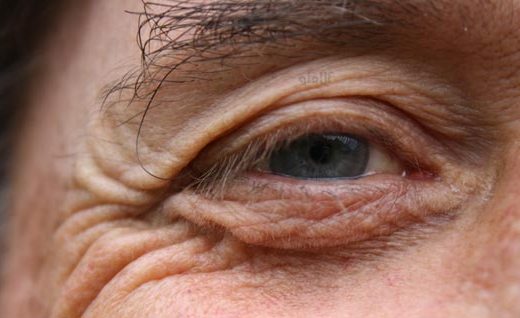
Tehran Medical University researchers have developed an anti-wrinkle cream from pomegranate extract which also rejuvenates skin.

The cream combines intense moisturizing with powerful defense against the sun’s harmful rays.

Dr. Jamaleddin Jamali, who led the research, said pomegranate contains antioxidant and collagen, which prevent elastin fibers from breaking.

He added that the researchers are also developing a cream and pill for treating acne from beehive.

Previously, Dr. Jamali’s team had produced a herbal antidepressant called Safromod from saffron flower and Safrotin, which reduces the symptoms of Alzheimer’s disease.

Elastin is a protein in connective tissue that is elastic and allows many body tissues to regain their shape after stretching or contracting. It helps skin to return to its original position when it is poked or pinched. In humans, elastin is encoded by the ELN gene.

Vitamin B and minerals found in pomegranates give nutrition and vitality to the skin and aid in the composition of collagen. It is effective in soothing and providing nutrients to help the skin remain supple and wrinkle-free.

A look at Iranian newspaper front pages on Oct. 21

Iranian Newspapers Headlines

The comments of the Judiciary spokesman about recent acid attacks in Isfahan caught the attention of Iranian dailies on Tuesday. Meetings between Iranian officials including President Rouhani with the visiting Armenian prime minister were also among top stories of the day. Snowfall in a dozen provinces of the country also generated some headlines and put snapshots of snow-covered streets on the front pages of some dailies. Drawing as much attention was news that The New York Times has reported Obama will bypass Congress on Iran’s sanctions if a nuclear deal is reached.

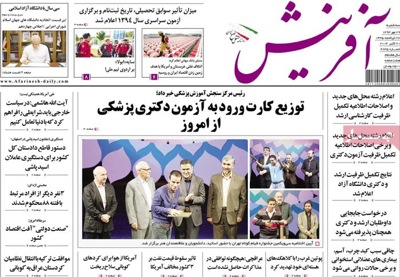
Afarinesh: “As far as foreign policy is concerned, the stage should be set to interact with the rest of the world,” said Chairman of the State Expediency Council Ayatollah Akbar Hashemi Rafsanjani.


Afarinesh newspaper 10 - 21


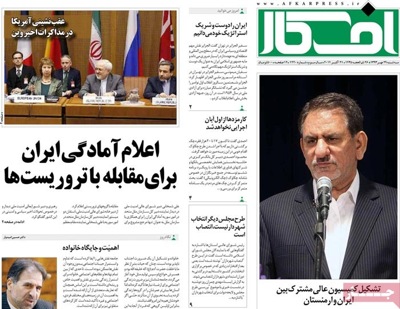
Afkar: “Secretary of the Supreme National Security Council Ali Shamkhani in a meeting with the UN special envoy to Syria has expressed Iran’s readiness for the fight against terrorists.”

Afkar: “We view Iran as a friend and a strategic partner,” said the Algerian ambassador to Tehran.


Afkar newspaper 10 - 21


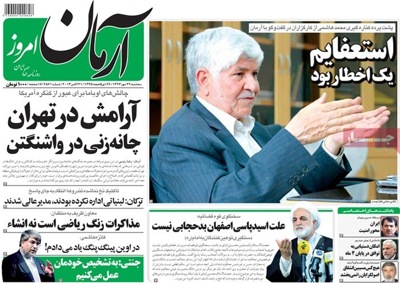
Arman-e Emrooz: “Violation of Islamic dress code is not behind [recent] acid attacks,” said the Judiciary spokesman.

Arman-e Emrooz: “Nuclear talks are more like a math course than a composition class,” an Iranian deputy foreign minister said in a statement aimed at the critics of the government’s handling of nuclear negotiations with P5+1.


Armane emruz newspaper 10 - 21


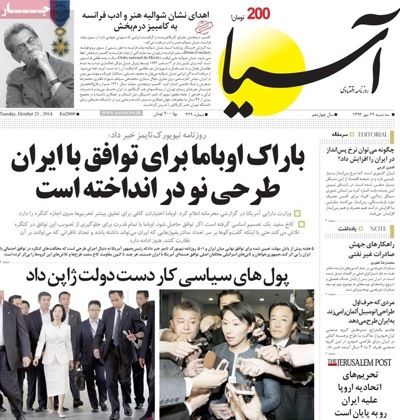
Asia: “The Ordre national du Mérite (The National Order of Merit) has been awarded to world-known Iranian illustrator, cartoonist and graphic designer Kambiz Derambakhsh.”


Asia newspaper 10 - 21


Asr-e Rasaneh: “Some 20,000 checks are bounced daily across the country,” said the secretary general of the Central Bank of Iran.

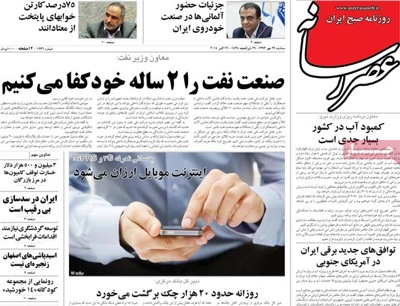
Asr-e Rasaneh: “We will make the oil industry self-sufficient in two years,” said the deputy oil minister.


Asre resaneh newspaper 10 - 21


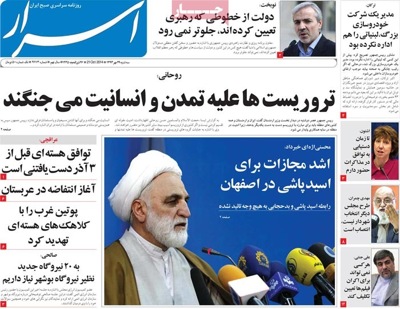
Asrar: “The government won’t cross the boundaries set by the Supreme Leader; it will draw on the views of clerics to devise its plans,” said Vice President for Supervision and Strategic Affairs Mohammad Bagher Nobakht.

Asrar: “We need 20 more power plants similar to Bushehr,” said the head of the Atomic Energy Organization.


Asrar newspaper 10 - 21


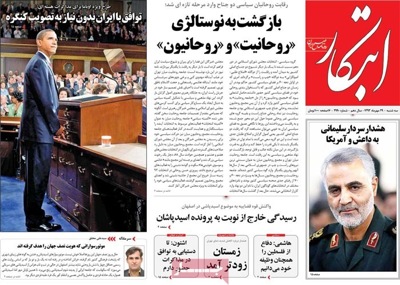
Ebtekar: “US military action and acts of terror committed by IS are doomed to failure,” said Major General Ghasem Soliemani, who heads the Quds Force of the Islamic Revolution Guard Corps.

Ebtekar: “The Judiciary will put the acid attacks case on a fast track.”

Ebtekar: “[European Union foreign policy chief] Catherine Ashton will continue leading nuclear talks with Iran until a deal is clinched.”


Ebtekar newspaper 10 - 21


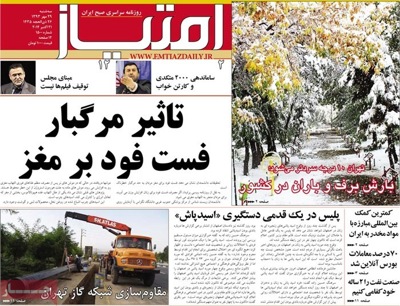
Emtiaz: “Tehran will see temperatures fall as much as 10º Centigrade, the Islamic Republic of Iran Meteorological Organization (IRIMO) reported. A cold front has swept the country.”

Emtiaz: “Police are one step away from arresting the one(s) behind acid attacks.”


Emtiaz newspaper 10 - 21


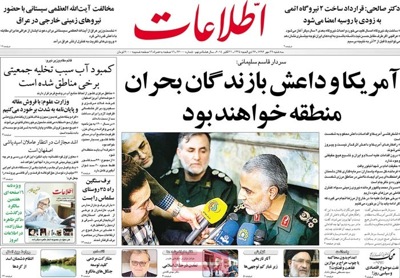
Ettela’at: “A deal on construction of two atomic facilities will be shortly signed with Russia,” said Director of the Atomic Energy Organization Ali Akbar Salehi.

Ettela’at: “Water shortage has prompted a number of people to evacuate their place of residence,” said the deputy energy minister.

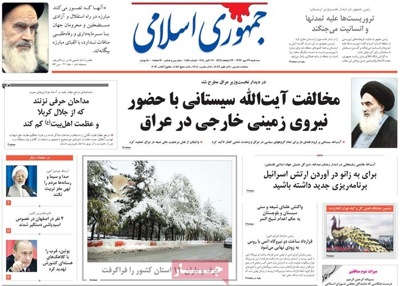
Ettela’at: “Ayatollah Sistani is opposed to foreign troop presence in Iraq.”

Ettela’at: “Heavy snowfall has cut off 35 villages around Salmas, a city in West Azerbaijan Province.”


Ettelaat newspaper 10 - 21


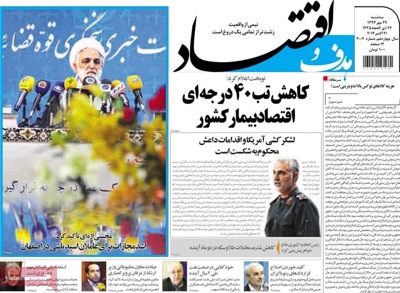
Hadaf va Eghtesad: Hossein Entezami, the deputy minister of culture and Islamic guidance, has paid a bedside visit to Erfan Parviz-Ansari, the former editor-in-chief of Tehran Times, an English-language daily.


Hadafo eghtesad newspaper 10 - 21


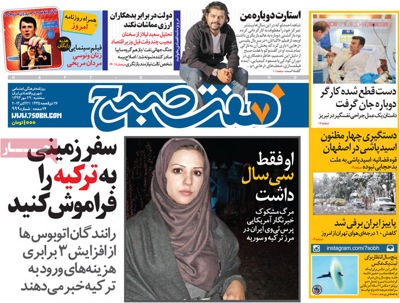
Haft-e Sobh: “The suspicious death of the American correspondent of Press TV along the border of Turkey and Syria.”

Haft-e Sobh: In a marathon reattachment operation, surgeons in Tabriz have given back a worker his severed hand.

Haft-e Sobh: Entry tariffs at the border with Turkey have increased 3-fold, Iranian long-haul bus drivers have complained. “Forget overland trips to Turkey,” the daily advises the readers.


Hafte sobh newspaper 10 - 21


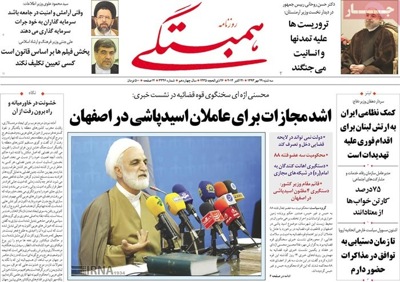
Hambastegi: “Terrorists are fighting a battle against civilizations and humanity,” said President Rouhani in a meeting with the Armenian prime minister.

Hambastegi: “Whether or not movies should hit the screen is determined by laws; we don’t need people to tell us what to do and what not to,” said Minister of Culture and Islamic Guidance Ali Jannati. His comments came after the head of parliament’s Cultural Committee appealed to the ministry to stop the screening of a few films.


Hambastegi newspaper 10 - 21


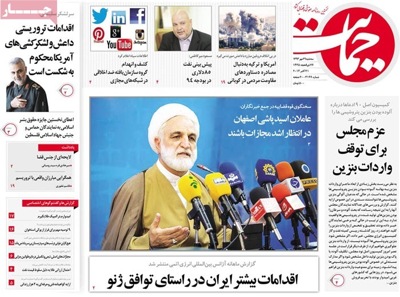
Hemayat: “Parliament is utterly determined to pull the plug on gas imports.”

Hemayat: “Death sentence is awaiting those behind acid attacks in Isfahan,” said Deputy Judiciary Chief Gholamhossein Mohseni Ejei.


Hemayat newspaper 10 - 21


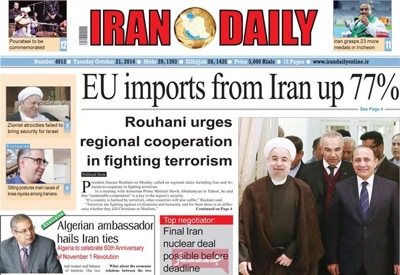
Iran Daily: “EU imports from Iran up 77%.”


Iran daily newspaper 10 - 21


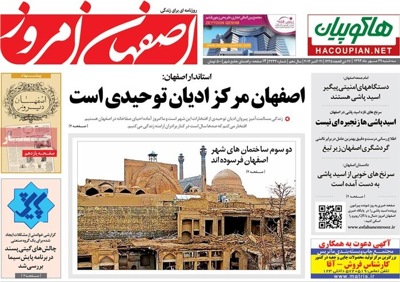
Isfahan-e Emrooz: “Isfahan is home to different monotheistic religions; the peaceful coexistence of the followers of these religions is the source of honor for this city and today we stand ready to revive “Safakhaneh” [an old congregation hall located in a predominantly Christian neighborhood of Isfahan where followers of divine faiths used to gather for debate]. We are honored to have lived with our Christian brothers for hundreds of years here in Isfahan,” said the provincial governor of Isfahan.

Isfahan-e Emrooz: “Security agencies are monitoring the acid attacks,” said the Friday prayer leader of Isfahan.


Esfehan emruz newspaper 10 - 21


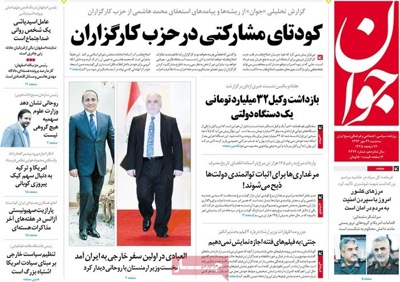
Javan: “Iraqi Prime Minister Haider al-Abadi has arrived in Iran on his first overseas trip as premier.”

Javan: “Armenian Prime Minister Hovik Abrahamyan has met with President Rouhani.”


Javan newspaper 10 - 21


Jomhouri Islami: “Four individuals have been arrested in Isfahan in connection with the recent acid attacks,” said the deputy interior minister.


Jomhurie eslami newspaper 10 - 21


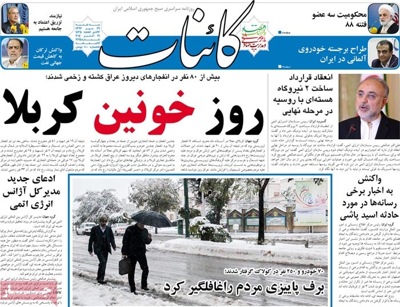
Kaenat: “Three individuals have been convicted of sedition for what happened after the 2009 presidential election.”

Kaenat: “A bloody day in Karbala: Eighty people were either wounded or sustained fatal injuries in a series of blasts in Iraq on October 20.”


Kaaenat newspaper 10 - 21


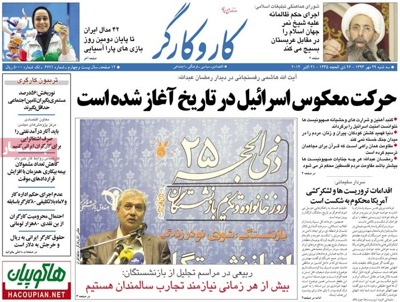
Kar va Kargar: “Iranian athletes have bagged 42 medals two days into the 2014 Asian Para Games in Incheon, South Korea.”


Karo kargar newspaper 10 - 21


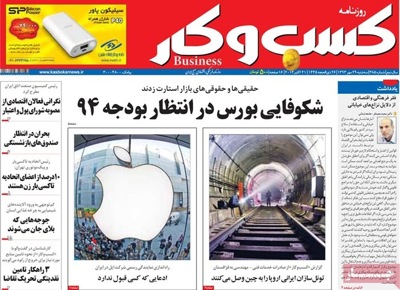
Kasb va Kar: “Iranian tunnel constructors establish a link between Europe and China.” The daily has picked this headline to highlight exports of Iranian technical and engineering services to Kazakhstan.

Kasb va Kar: “Implementation of this unjust verdict against [senior Saudi cleric] Sheikh Nimr al-Nimr will mobilize the world of Islam against Saudi Arabia,” the Coordination Council of the Islamic Propagation Organization said.


Kasbo kar newspaper 10 - 21


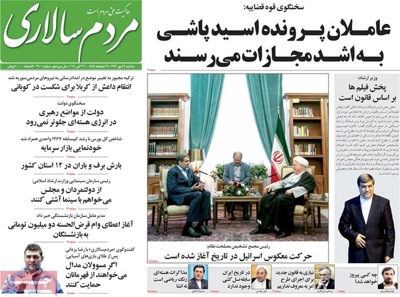
Mardomsalari: “Israel has started taking retrogressive steps in history,” said Chairman of the State Expediency Council Ayatollah Hashemi Rafsanjani.


Mardom salari newspaper 10 - 21


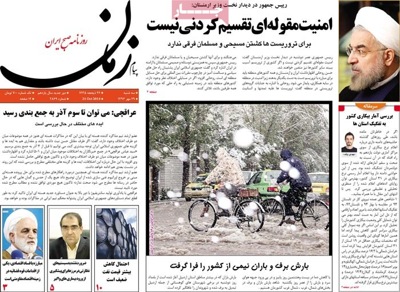
Payam-e Zaman: “Monitoring procedures should be intensified at border crossings to prevent contagious diseases from finding their way into the country,” highlighted the health minister.


Payame zaman newspaper 10 - 21


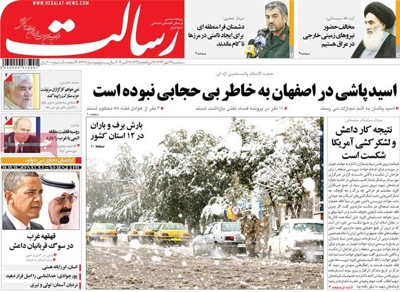
Resalat: “I do not want the Executives of Construction Party to share the fate of the Islamic Participation Front,” said former spokesman of the party Mohammad Hashemi, who has recently quit the post.

Resalat: “Enemies have failed to inflame insecurity along [Iran’s] borders,” said Commander of the Islamic Revolution Guard Corps Major General Mohammad Ali Jafari.


Resalat newspaper 10 - 21


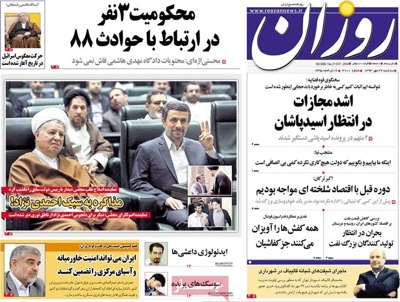
Roozan: “Under the previous government, the country’s economy was haphazard; a person who had no experience of running a grocery shop was put in charge of an auto-making corporation,” said Akbar Torkan, the chief advisor to President Rouhani.

Roozan: “Iran can ensure the security of the Middle East and Central Asia,” a member of parliament’s National Security Committee said.


Ruzan newspaper 10 - 21


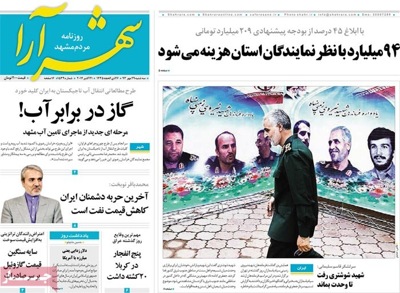
Shahrara: “Lowering oil prices is the last tool Iran’s enemies are resorting to,” said government’s Spokesman Mohammad Bagher Nobakht.


shahre aara newspaper 10 - 21


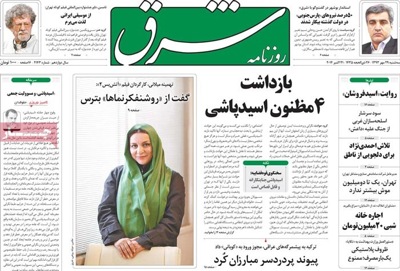
Sharq: “Half of South Pars’ personnel lost their jobs when Ahmadinejad’s government was in office,” said the provincial governor of Bushehr.


SHARGH newspaper 10 - 21


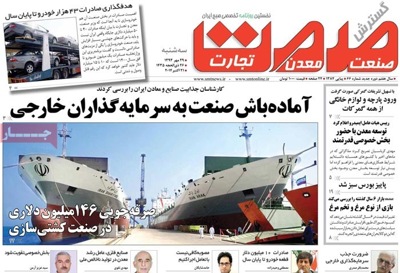
SMT: “The new budget appropriated to vessel-building projects and revocation of ship leases will save the shipbuilding industry as much as $146 million.”


Samt newspaper 10 - 21


Tafahom: “Seventy percent of stock transactions are done online,” said the head of the Securities and Exchange Organization.


Tafahom newspaper 10 - 21


Tehran Times: “Iran and Armenia are to form a joint commission to boost trade ties.”


Tehran times newspaper 10 - 21


Vatan-e Emrooz: “Reports by [Iran’s] Press TV correspondent Serena Shim that [Turkish President] Recep Tayyip Erdogan supports IS have cost the journalist her life.”


Vatane emruz newspaper 10 - 21


Radicalism will return to the US and Europe (Part One)

West-ISIS
West-ISIS
Davood Feirahi
Davood Feirahi

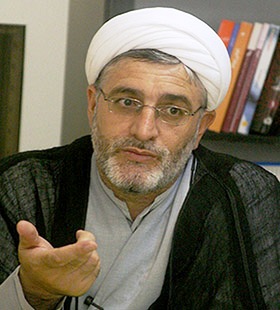
Dr. Davood Feirahi, a political science researcher, says that ISIL has its roots inside the Muslim community, blaming a lack of religious development among Muslims for the emergence of radicalism at this level.

On October 12, Khabar Online posted an analysis of the current state of affairs in the Middle East followed by an interview with Dr. Feirahi which mainly revolves around the emergence of the Islamic State of Iraq and the Levant and the crisis which has swept the region. The following is PART ONE of the translation of the analysis and the Q and A:

ISIL has created a situation in the Middle East as a result of which many are offering prayers for the soul of [Osama] bin Laden, viewing Al-Qaeda as an organization far more honorable than the so-called Islamic State (IS). The sympathizers of Abu Bakr al-Baghdadi, the self-proclaimed Caliph of Muslims, have painted a new image of radicalism for the people around the world, portraying an extremely distorted picture of Islam in civilizational and religious concepts.

Different theories have been floated to explain the reasons behind the formation of such a dangerous phenomenon, and, as it is usually the case, the most striking and perhaps the most popular one is this: blame all problems on the enemy and denounce the West, the US in particular, as the mastermind of the recent crisis which has swept the Middle East, a precarious trend which seems unlikely to be confined to the Middle East.

However, Dr. Davood Feirahi’s take on that question differs. He is, for sure, one of the greatest, if not the most outstanding, professors of the Islamic political thought in Iran. Feirahi, a University of Tehran professor who had come to Café Khabar [the venue for holding interviews as well as exclusive and analytical round-tables at Khabar Online], argues that ISIL has taken roots inside the Muslim community, saying that failure on the part of Muslims to become developed religiously has given rise to radicalism allowing it to grow extensively.

Hojatoleslam Feirahi maintains that airstrikes unleashed by the US and its allies only help radicalism spill over, and this complicates efforts to keep the extremist current in check.

He underlined that to counter ISIL, Muslims should change their religious conduct. Such a change of heart should allow the opposing currents inside the governments to speak their mind, force authoritarian states to involve people in the administration of their homelands’ affairs, and ask various religious currents to do more to promote tolerance and moderation among themselves.

The Arab Middle East has turned into the cradle of religious extremism in the world, a region which is today witnessing Middle Ages-like behaviors. Various theories have been floated to explain why such a phenomenon has emerged, but these societies seem to have developed a special interest in extreme acts and radicalism. Why do the extremist theories resonate with people in the Middle East?

The Middle East is a special region and its governments and movements do not fit into any category. A separate file should be specifically opened for this region. The reason: this region is [viewed as] hegemony in the world. It means that global powers have interests in it, and events in this region soon translate into domestic developments in world powers.

It has caused the Middle East to be always gripped by interference, which either shapes a new order or disrupts the old world order. There are three reasons for this quality of the Middle East.

The first has to do with geopolitics. Needless to say, the Middle East carries much weight from this perspective. Secondly, this region’s economy and its oil are also an issue, and last but not least is the fact that this region is a place where a large number of emigrants head for the outside world; that is to say, crowds of people hailing from this region are living in developed countries such as the US, France, England, etc. These immigrants are the reason why any crisis in the Middle East can spread into developed world.

The three questions explained above are the reasons why this region has been globalized. Another important point is that the governments which have risen to power in this region have been extremely military, more or less secular and somewhat failed.

There are two problems associated with a failed state; first, it controls society and under the pretext of establishing social justice does not allow the democratic process to run its course. Moreover, the organization of their institutions allows corruption to thrive. Consequently social justice fails to prevail in society.

These states are failed whether they are religious or not. What matters is that these systems have, for some reasons, activated forces who tended to be part of the corridors of power, but have denied them the opportunity to flourish.

To elaborate more, I should say that the Iranian people used to not interfere in the administration of affairs prior to the Constitutional [Revolution] because they did not see it within their rights to get engaged. With the passage of time as national governments rose to power, people still remain unable tobe part of their country’s national and public affairs not because they don’t see it their right to do so but that they are not allowed to.

The non-interference in these two cases is not of the same nature. The latter has sparked off the radicalization of [political] currents, or has caused them to have secular leanings or radical religious tendencies. Religious currents are drastically radical because the failed states have had secular orientations. That’s why resistance found its way to the religious literature and words such as Jihad, Takfir [one Muslim declares another an unbeliever] and Hejrat [departure or emigration] were given added weight.

Mulling over how the concept of Jihad was put into active use during the course of history, we come to a point in time when [Anwar] Sadat and [Hosni] Mubarak were leading totalitarian regimes, and it could even be extended to the final days of [Gamal Abdel] Nasser [in Egypt].

Thus, we can hold up the hegemonic nature of the region and the presence of failed states as the two significant reasons why regional movements are playing a more active role. When the failed states are given support by the outside powers, the opposition makes use of religious literature in the first place; and secondly in launching an offensive against regional governments it attacks their Western supporters too.

It could be said that the connection between authoritarian systems in the region has manifested itself in two ways: opposition to the West and opposition to regional governments, which are the social and political foundations of radicalism in the Middle East.

The religious literature you just talked about could be acceptable, but the question that arises here is: What pushes such religious literature to opt for violence and radicalism?

People in the region have, for long, tried to advance their own will through ballot boxes, but this has proved a failure in most of the countries. Let me illustrate my point with the Algerian example or a Syrian crackdown in 1986, riots in Saudi Arabia, the recent crisis in Egypt, and the like.

You can see that the public will have always met with a heavy hammer. The hammer here has been a military force with no justification. This shows that radicalism has fallen asleep in countries where the governments are more likely to open up the [political] atmosphere.

Accordingly, I see a clear link between the [emergence of] ISIL, the failure of Mohamed Morsi [in Egypt] and the current crises in Libya. In most of these countries democratic efforts failed to serve as a [fitting] template to channel the energy the opposition was emitting. They failed. This energy is like a closed pot [on the stove]. They would, in the end, find some justification [for their failure] and that justification here comes in the form of radicalized measures rooted in religion.

If we seek to establish a relationship between a religious government and a secular state, we come to the conclusion that the two models have been both unsuccessful. Neither religious governments nor secular systems have fared well. In both models people have not played a remarkable role in the political process, and the two models ultimately lead to the rise to power of totalitarian dictatorships. What is the root of this?

This hinges mainly on the nature of governance in the Middle East and it doesn’t matter whether it’s religious or non-religious. When it comes to the religious model, experience has shown that as long as the governments in the region are led by Shiites, it can provoke a backlash among the Sunnis. In other words, the latter comes up with its own solution which is the formation of non-religious authoritarian governments led by Sunnis. Therefore, they seek an anti-Shiite and anti-Western version [of government].

There are no precedents for this. At the time of Al-Qaeda [when it was spreading terror across the world] the fight against Shiites hadn’t reached this [alarming] proportion. They were trying to portray the family of religion as an interrelated and united system.

I think it was predictable that radicalism was gathering pace. The current crackdowns rekindle the spread of radicalism. US airstrikes would not bring radicalism under control; rather they would create small uncontrollable cells which couldn’t be monitored. Radicalism seems likely to make a comeback to Europe and the US.

Experience suggests that concentration is to the detriment of these groups. They are again heading for Europe and we should wait for news [of attacks] coming out from towers or metros in Europe. Radicalism has struggled to fill the void created in the Middle East to establish a permanent territory for itself. However, if it senses that it couldn’t be the case, it would change, because radicalism comes with some rationality and it is nowhere near injudicious.

Once radicalism feels that concentration in a geographical location is not the solution, it would expand its efforts to swell its ranks. Although social currents cannot be meticulously defined, the bombing missions [of the US] seem to take the war back into the West.

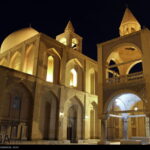
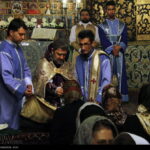
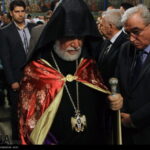
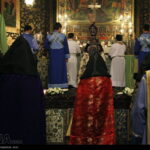
Christians in Isfahan celebrate the 350th anniversary of a famous church

Iran-Isfahan-Vank church

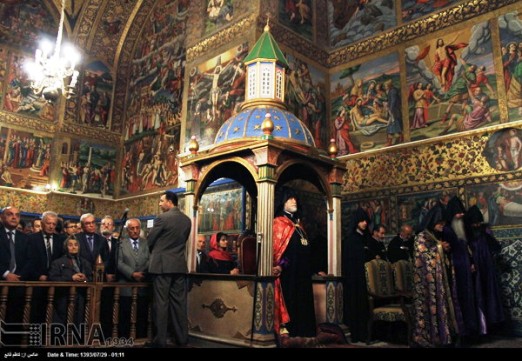
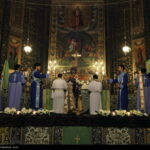
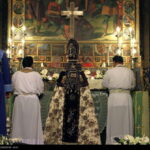
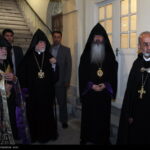
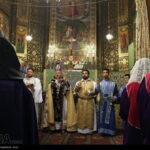
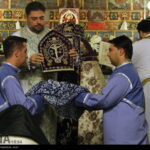
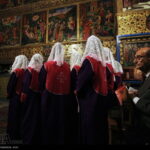
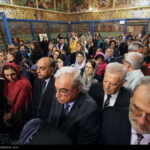
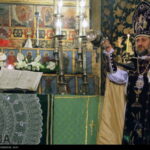
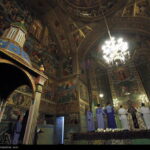
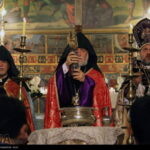
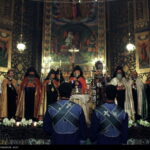
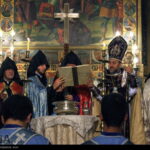
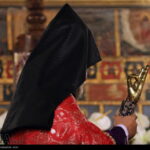
A function was held in the predominantly Christian Jolfa neighborhood in Isfahan, central Iran on Monday to mark the 350th anniversary of the city’s Vank Cathedral. A senior Lebanese Christian cleric was on hand for the ceremony that brought together hundreds of the faithful. The following photo gallery contains images the Islamic Republic News Agency has released of the event:


Esfehan emruz newspaper 10 - 21Isfahan-e Emrooz Daily Front page: “Isfahan is home to different monotheistic religions; the peaceful coexistence of the followers of these religions is the source of honor for this city and today we stand ready to revive “Safakhaneh” [an old congregation hall located in a predominantly Christian neighborhood of Isfahan where followers of divine faiths used to gather for debate]. We are honored to have lived with our Christian brothers for hundreds of years here in Isfahan,” said the provincial governor of Isfahan.

Terrorists waging war against humanity: Rouhani

Rouhani-Abrahamyan
Rouhani-Abrahamyan

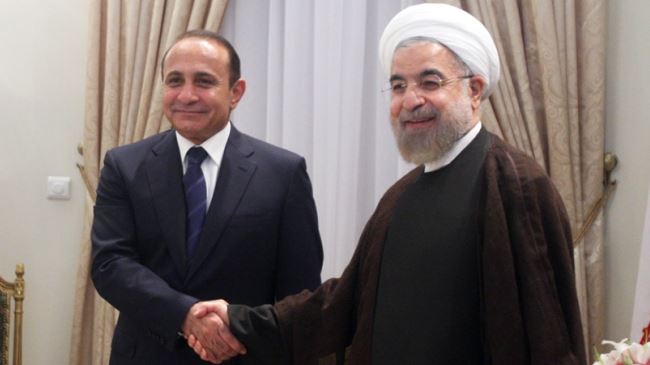
“Terrorists are fighting against civilizations and humanity; and murdering either Christians or Muslims makes no difference for them,” Rouhani said at a Monday meeting with Armenian Prime Minister Hovik Abrahamyan in Tehran.

“Iran and Armenia along with other regional countries should join hands to fight against terrorism, because security can be established in the region under the aegis of cooperation,” he added.

The remarks come as ISIL terrorists have been wreaking havoc in the Middle East in recent months.

The ISIL terrorists, initially trained and sponsored by some regional and extra-regional countries to destabilize the Syrian government, control large parts of Syria’s northern territory. ISIL sent its militants into Iraq in June, quickly seizing a vast expanse of land straddling the border between the two countries.

The ISIL terrorists have threatened all communities, including Shias, Sunnis, Kurds, Christians and Izadi Kurds, in Iraq and Syria. They have been committing heinous crimes in the areas they have taken, including the mass execution of civilians as well as Iraqi and Syrian army troops and officers.

Rouhani warned that the ramifications of terrorism in one country can spill over into other states and noted, “The Islamic Republic of Iran supports political and peaceful solutions within the framework of international laws for resolving the regional issues.”

The Iranian president also underlined the need to use all the existing potentials to expand Iran-Armenia relations and praised the two countries’ cooperation on different international issues and Yerevan’s positive stance toward Tehran.

Abrahamyan, for his part, praised the historic Tehran-Yerevan relations and expressed Armenia’s preparedness to cooperate with Iran in different political and economic arenas.


A look at Iranian newspaper front pages on Oct. 20

Iranian Newspapers Headlines

A ceremony to celebrate the National Exports Day in Iran, attended by the first vice-president, and comments by senior nuclear negotiator Seyyed Abbas Araghchi that the parties involved in the talks are determined to finalize a deal by November 24 made headlines in several newspapers on Monday. The stellar performance of Iranian athletes and the colorful medals they pulled off on day one of the 2014 Asian Para Gamesin Incheon, South Korea were also in the news.

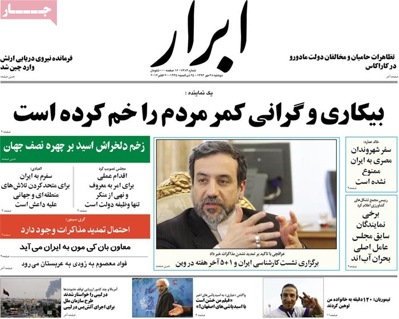
Abrar:“Commander of Iran’s Navy Rear Admiral Habibollah Sayyari has arrived in China.”

Abrar: “The heart-wrenching scar of acid on the face of Nesf-e Jahan (Half of the World),” wrote the daily in reference to recent acid attacks in the historical city of Isfahan.

Abrar: Iran’s parliament has adopted a bill which says the responsibility to take practical measures to promote virtue and prevent vice only lies with the Government.

Abrar: “My trip to Iran aims to unite regional and global efforts to take on the Islamic State of Iraq and the Levant (ISIL),” said Iraqi Prime Minister Haider al-Abadi.
 

Abrar newspaper 10 - 20


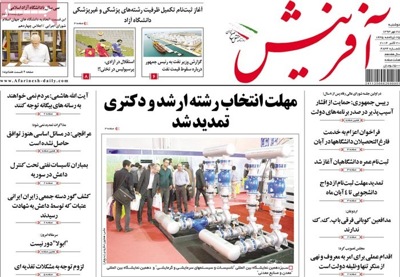
Afarinesh: “A mass grave containing the bodies of Iranian pilgrims has been discovered in southern Baghdad.” The Iranian nationals who were in Iraq to visit holy sites were killed by ISIL militants.

Afarinesh: Turkish President Recep Tayyip Erdogan has said that those who support Kobani are by no means different from Kurdistan’s People Party (PKK) militants.
 

Afarinesh newspaper 10 - 20


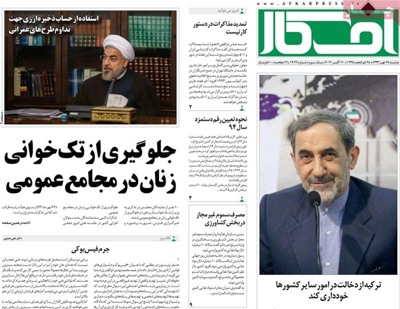
Afkar: “Turkey should not meddle in the internal affairs of other countries,” said Ali Akbar Velayati, a senior foreign policy adviser to Supreme Leader Ayatollah Seyyed Ali Khamenei.
 

Afkar newspaper 10 - 20


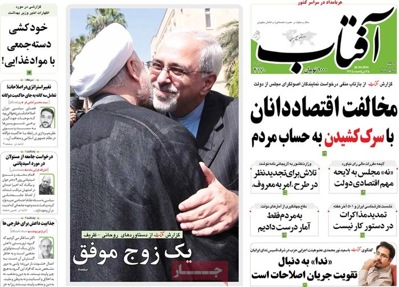
Aftab-e Yazd: “Economists have objected to a request by Iran’s Principlist MPs to [authorize the government] to pry into people’s bank accounts.

Aftab-e Yazd: “Neda is after bolstering the Reformist movement,” said Saeed Nour-Mohammadi, a member of the Executive Committee of soon-to-be-launched Nedaye Iranian (Call of the Iranians) Party, which is led by Sadegh Kharrazi, a former Iranian ambassador to France.

Aftab-e Yazd: “We’ve provided people with correct stats,”the daily quoted First Vice-President Eshagh Jahangiri as saying in defense of the statistics the eleventh government releases periodically on the performance of different organizations and agencies.
 

Aftab newspaper 10 - 20


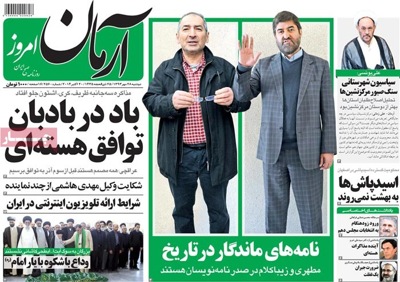
Arman-e Emrooz: “The defense lawyer of Mehdi Hashemi, the son of the chairman of the Expediency Council, has lodged a complaint against some MPs,” reported the daily. According to the lawyer, a number of Iranian deputies have written an open letter asking for an open trial of his client, but he cited distortion of his remarks in the letter as the reason behind his complaint.

Arman-e Emrooz: “Tailwind blows in the sail of nuclear talks,” is the daily’s pick on its front page, reporting that the three-way meeting between Iran’s Mohammad-Javad Zarif, EU’s Catherine Ashton and US Secretary of State John Kerry will be held sooner than agreed on.

Arman-e Emrooz: “Everlasting historic letters,” is the banner headline of the daily, explaining that Ali Motahari, a Tehran MP, and Sadegh Zibakalam, a university professor, are top on the list of those who show reaction in their letters to what plays out in Iranian society.

Arman-e Emrooz: The Communications Regulations Commission has said the companies that seek to launch Internet TV should be based in Iran and secure permissions from the ministries of Communications and Information Technology, Culture and Islamic Guidance as well as IRIB before starting their online broadcast.
 

Arman newspaper 10 - 20


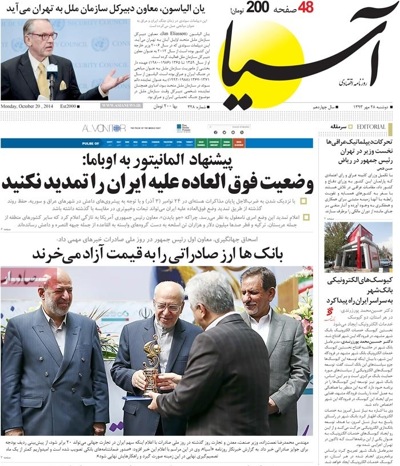
Asia: “Jan Eliasson, the deputy UN secretary general, is due in Tehran in late October.”
 

Asia newspaper 10 - 20


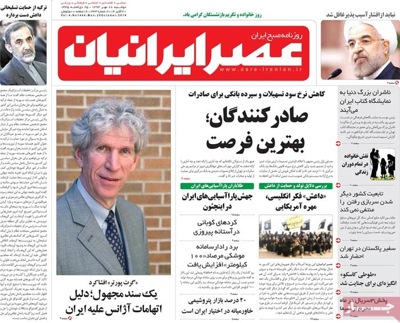
Asr-e Iranian: “The world’s top publishers will take part in Tehran International Book Fair in 2015”.
 

Asre iranian newspaper 10 - 20


Asrar: “The Cabinet gives top priority to efforts to support the vulnerable classes of society,” said President Hassan Rouhani.
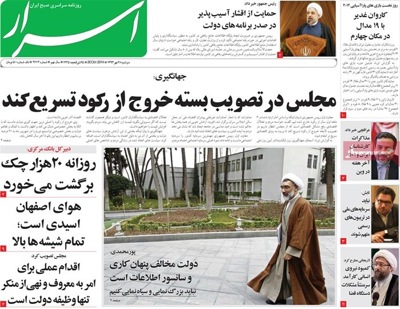
 

Asrar newspaper 10 - 20


Ebtekar: “In quest of a successor to Ezatollah Zarghami,” writes the daily on its front page about speculations on who will succeed the incumbent president of Islamic Republic of Iran Broadcasting, Iran’s national broadcaster.

Ebtekar: “Nuclear talks will not be extended,” said Iranian nuclear negotiator Seyyed Abbas Araghchi.

Ebtekar: “A first session of the Supreme Welfare and Social Security Council is held in eight years.”

Ebtekar: “The average worker’s wage for the next Iranian calendar year (starting March 2015) will increase in keeping with the hike in inflation,” said the minister of labor and social affairs.
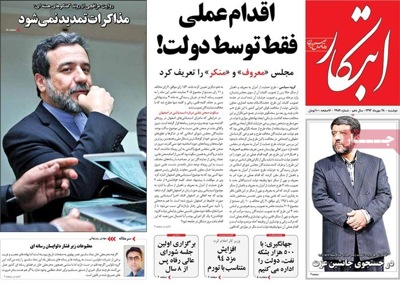
 

Ebtekar newspaper 10 - 20


Eghtesad-e Pooya: President Rouhani has said the government would tap into the Foreign Exchange Reserve Fund to carry out more development plans in the country.
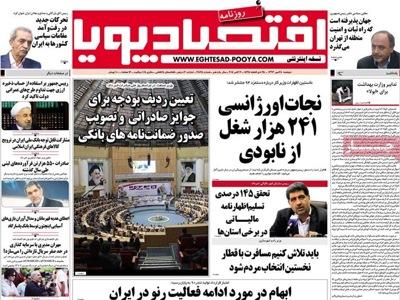
 

Eghtesade puya newspaper 10 - 20


Emtiaz: “Iran and Armenia hold talks to develop their oil cooperation.”

Emtiaz: “Breast Cancer is on the rise in Iran.”
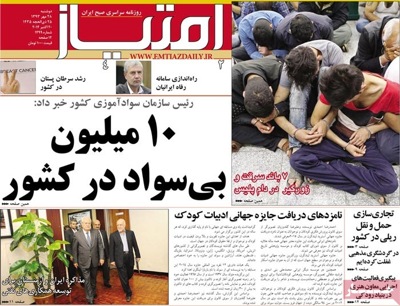
 

Emtiaz newspaper 10 - 20


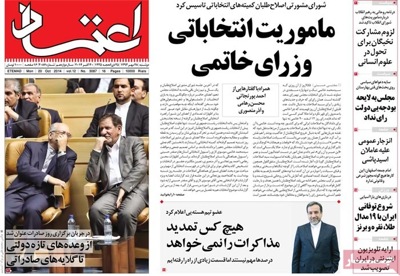
Etemad: The Reformist Consultative Council has decided to launch electoral committees [15 months ahead of parliamentary elections] to be headed by the ministers who served in former President Mohammad Khatami’s Cabinet.

Etemad: “A recent series of acid attacks [on women in Isfahan] have met with public resentment in society.”
 

Etemad newspaper 10 - 20


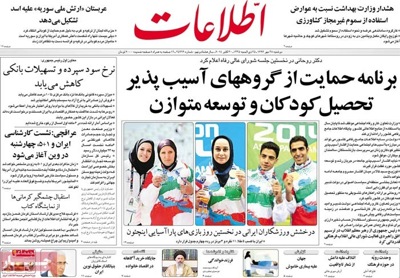
Ettela’at: “An expert meeting between Iran and P5+1 will be held in Vienna on October 22,” said Iran’s Deputy Foreign Minister Seyyed Abbas Araghchi.

Ettela’at: “Iranian athletes shine on day one of the 2014 Asian Para Games in Incheon, bagging five gold, eleven silver and three bronze medals.”

Ettela’at: “Iran’s health minister warns of the side effects of unauthorized pesticides used in the agriculture sector.”

Ettela’at: “The interest rate for bank deposits and loans will decrease,” said Iran’s first vice-president.

Ettela’at: “Saudi Arabia forms an army in Syria to fight President Assad.”
 

Ettelaat newspaper 10 - 20


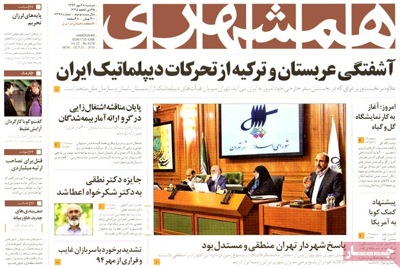
Hamshahri: “The sixth seasonal Flowers and Plants Exhibition opens in the capital on Monday October 20.”
 

Hamshahri newspaper 10 - 20


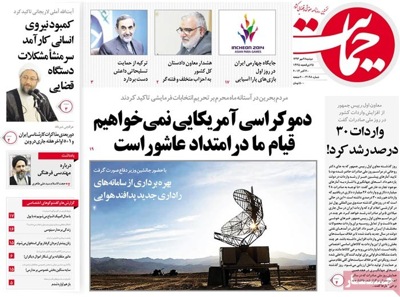
Hemayat: “A lack of efficient human resources is to blame for the problems the Judiciary is grappling with,” said Judiciary Chief Ayatollah Sadegh Amoli Larijani.
 

Hemayat newspaper 10 - 20


Iran: “Iran’s capital has set a new record in terms of having healthy air,” said the daily, explaining that the number of days Tehran residents have breathed clean and healthy air in an almost seven-month period this year (March to October 2014) stands at 132 days.
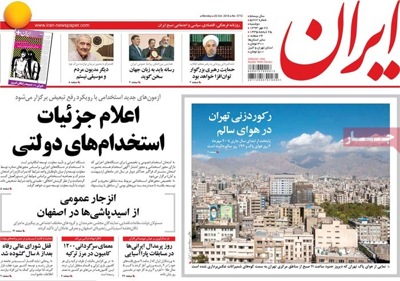
 

Iran newspaper 10 - 20


Iran News: Tehran is to host an international conference on ‘A World Free of Violence and Extremism’, reports the English-language daily.
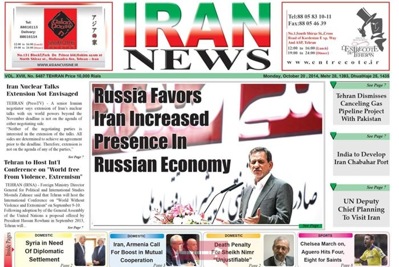
 

Iran news newspaper 10 - 20


Javan picked “The state lobby for familiar private hands,” as its banner headline to quote Ahmad Tavakkoli, a Tehran MP, as saying that Minister of Industry, Mines and Trade Mohammad Reza Nematzadeh has a seat on the board of directors of 20 petrochemical companies.
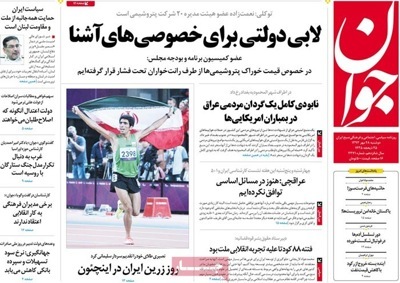
 

Javan newspaper 10 - 20


Jomhouri Islami: “All parties to the nuclear talks are determined to arrive at a final deal ahead of the target date [November 24],” said Iran’s nuclear negotiator Seyyed Abbas Araghchi.
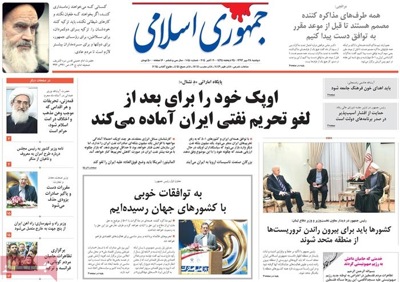
 

Jomhurie eslami newspaper 10 - 20


Kaenat:“The biggest cyber prostitution ring in Iran has been busted.”
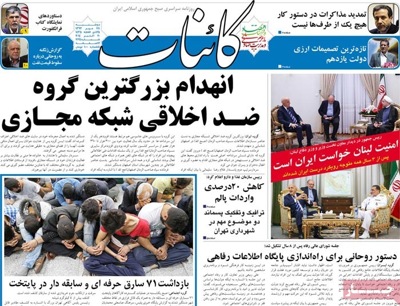
 

Kaeenat newspaper 10 - 20


Kar va Kargar: “Support for Lebanon’s army and resistance [groups] is on Iran’s agenda,” said Secretary of the Supreme National Security Council Ali Shamkhani.
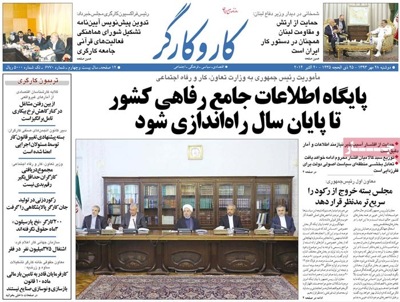
 

Karo kargar newspaper 10 - 20


Payam-e Zaman: “Iran has posted a 20 percent surge in goods exports in the March-September period this year,” reported the daily, citing officials speaking at a ceremony to mark Iran’s National Exports Day.
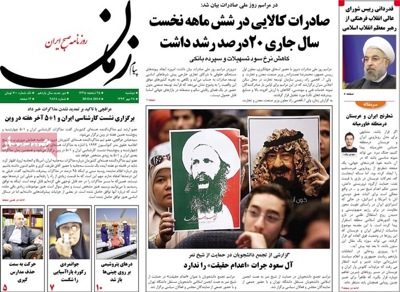
 

Pyame zaman newspaper 10 - 20


Rah-e Mardom reported that Parliament has asked the Judiciary to identify the perpetrator(s) of a recent spate of acid attacks [on women].”
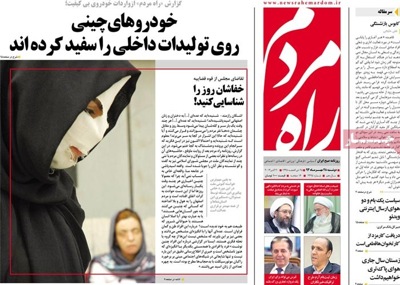
 

Rahe mardom newspaper 10 - 20


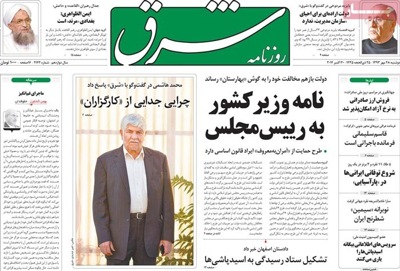
Sharq: “Al-Baghdadi is an apostate,” said Al-Qaeda leader Ayman al-Zawahiri in a reference to Abu Bakr al-Baghdadi, the self-proclaimed caliph of the so-called “Islamic State”.

Sharq:“The bill to support those who engage in promotion of virtue runs counter to the provisions of the Constitution,” the interior minister said in a letter to the parliament speaker.
 

Shargh newspaper 10 - 20


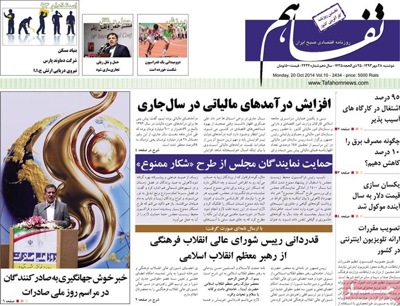
Tafahom: The deputy head of the Environment Caucus in Iran’s parliament has welcomed a motion on imposing a seven-year ban on hunting in the country.
 

Tafahom newspaper 10 - 20


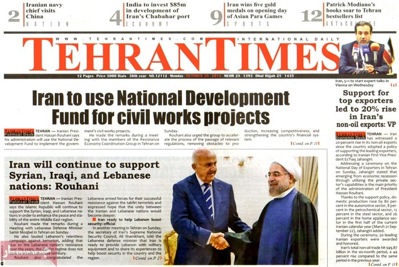
Tehran Times: “Iran will continue to support Syrian, Iraqi, and Lebanese nations: Rouhani.”
 

Tehran times newspaper 10 - 20


A sentence that should not be carried out

Nimr Al-Nimr

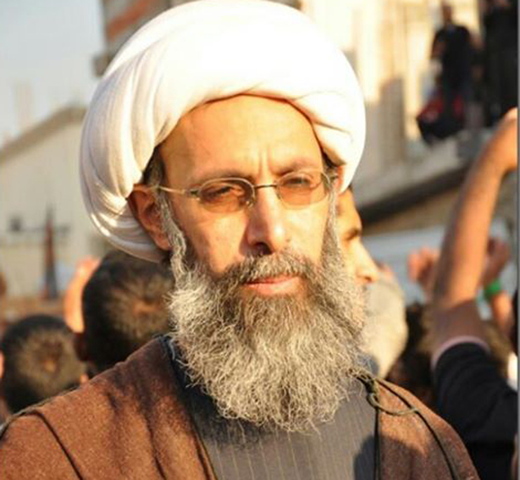
The death sentence a Saudi court has issued for Sheikh Nimr al-Nimr, a top Shiite cleric, has provoked a huge public uproar in the Muslim world. It has also drawn a backlash from outstanding Shiite clerics and sources of emulation, who have, with one voice, denounced the sentence, warning of the consequences of such an inhumane decision.

The outburst of anger and condemnation also swept across Iran, especially at Qom Seminary School where different statements were put out to question the wisdom of the Saudi court ruling.

The death sentence and the reactions it has triggered off were extensively covered by media outlets in Iran and across the world. The following is part of what Fars News Agency reported on October 17, three days after the court ruling:


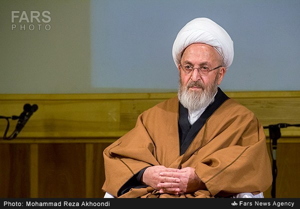
Ayatollah Jafar SobhaniAyatollah Jafar Sobhani said in a statement that Sheikh al-Nimr did nothing wrong, adding he has always spoken up for the trampled rights of Shiites and called on the ruling government to disapprove of and reject discrimination.

He further said that the decision to execute Ayatollah al-Nimr would not put an end to protests raging in the country, adding that the blood of the Shiite cleric would give birth to would-be protesters who would firmly shake the foundations of the Saudi monarchy.


Ayatollah Seyyed Mohammad-Ali Alavi Gorgani

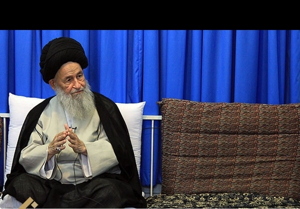
Ayatollah Seyyed Mohammad-Ali Alavi Gorgani said in a message that although Shiites proudly welcome martyrdom in their fight against injustice and oppression, it is regrettable to see that the Saudi [Royal] Family resorts to merciless acts instead of treating its citizens justly.

These acts will only undermine the Saudi position in the region and among its own people, he said, adding that such verdicts will do nothing to soothe the protests of the Saudi people, stressed the ayatollah.


Ayatollah Hossein Nuri-Hamadani

In a separate message, Grand Ayatollah Hossein Nuri-Hamadani said that such harsh measures would hurt the feelings of Shiites all over the world, underscoring that the Saudi officials should respond to public demands.

The ayatollah also urged human rights organizations not to keep silent over the heavy-handed sentence and help people reclaim their lost rights, saying that the clerical body would not tolerate the death penalty which was handed down to the Saudi cleric.


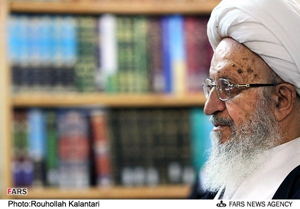
Ayatollah Naser Makarem Shirzai

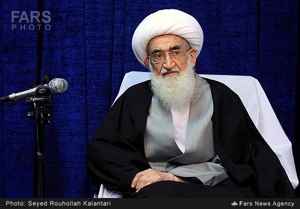
Ayatollah Naser Makarem Shirzai, for his part, condemned the death sentence as unjust and said that Saudi Shiites are under intense pressure and are denied freedom to practice their own faith.

He said that Riyadh would pay a heavy price for its decision regarding the prominent Shiite cleric, warning that it would arouse the resentment of all Shiites and freedom-seeking Sunnis against the kingdom.

The grand ayatollah then took a swipe at double-standards practiced by the US and those who hide behind human rights, and disputed the silence of the US Congress in reaction to the breach of Shiite rights in Saudi Arabia.

He said this proves their talks about democracy and human rights are sheer lies, underlining this decision would come with unanticipated consequences for Saudi Arabia.


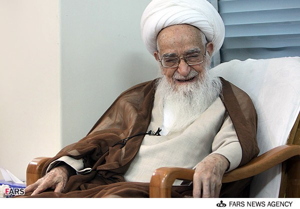
Ayatollah Lotfollah Safi Golpaygani

Also, Ayatollah Lotfollah Safi Golpaygani said in a meeting with Mohammad Nahavandian, President Rouhani’s chief of staff, that the Foreign Ministry should take immediate measures and let the officials in Riyadh know that Muslims deeply regret the ruling by the Saudi court against Ayatollah al-Nimr.

A statement released by the Society of Seminary Teachers of Qom read in part that the news of Sheikh al-Nimr death sentence has enraged Muslims all over the world, saying that the ruling tends to counter the Islamic Awakening at a time when key regional developments have tipped the balance in favor of the world of Islam.

Victories by Muslims in Yemen, failure by the US and its allies in Syria, Lebanon and Iraq, and the imminent downfall of Takfiri groups such as ISIL militants have caused Washington to pile more pressure on Riyadh unaware of the fact that the Shiites in the world will stand up to colonial powers and their regional lackeys, the statement said, calling for the release of al-Nimr.


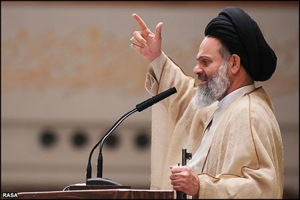
Ayatollah Seyyed Hashem Hosseini Bushehri

In his Friday prayer sermons in Qom, Ayatollah Seyyed Hashem Hosseini Bushehri urged international circles and human rights advocates to get a first-hand account of what’s going on in Saudi Arabia, saying the verdict meted out by the Saudi court fully contradicts human rights, the rights of minorities and the political freedom of people.


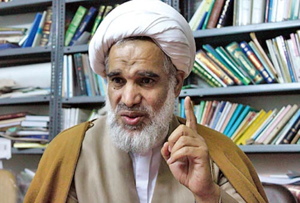
Ayatollah Abbas Kaabi

Ayatollah Abbas Kaabi said that the death sentence which has drawn condemnation from the world’s freedom seekers showed how the US-style Islam is different from the true Islam.

The ayatollah further said that if the Saudi government overturns the ruling and releases the cleric, it would bring stability for the Al-Saud Family and the entire region. If so, he pointed out, it will help open dialog and deescalate the situation.

In support of the Saudi cleric and in condemnation of the controversial verdict, the Basij Student Organization organized a rally on Sunday October 19.

Iran Arrests Police Killers

Iran Arrests Police Killers

Commander of the Law Enforcement Police in the Southeastern city of Saravan GeneralMohsen Davoudi announced on Sunday that his forces have arrested the terrorists who had killed two police officers in the same region two years ago.

“The police forces, with their round-the-clock efforts and people’s cooperation, succeeded in identifying and capturing two outlaws who had martyred two police officers of Saravan’s 111 commando units in 2012,” Davoudi said.
“The suspects were hiding in one of the villages of Khash region, but they were arrested and handed over to the judiciary officials” as a result of the efforts of popular forces and police crime detection units,” he added.

Davoudi explained that two years ago as the culprits were seeking to smuggle 120kg of illicit drugs to Iran, they killed the two policemen and fled the scene when they came across the police units in the region.

In a relevant development earlier this month, Iranian security forces in the Southeastern province of Sistan and Balouchestan identified and arrested several suspects in relation to the killing of four police officers in Saravan, the provincial police chief said.

Brigadier General Hossein Rahimi said that three of the officers were killed when they, along with other patrol police forces, came under attack by armed bandits while on a mission in the city of Saravan.

Following the incident, he added, the police immediately blocked routes used by terrorists, which led to a shootout between the gunmen and police forces at a checkpoint.

According to the police chief, a number of perpetrators were identified and arrested in a surprise attack on the gunmen, which prompted them to fire rockets, in retaliation, at a police station in Saravan. Another police officer was killed in the incident, he added.

The police would use everything in their power to seriously confront thugs and armed bandits in the province, he warned.

Sistan and Balouchestan Province has been the scene of a number of terrorist attacks in recent years.

Iran Renews Support for Political Solution to Syrian Crisis

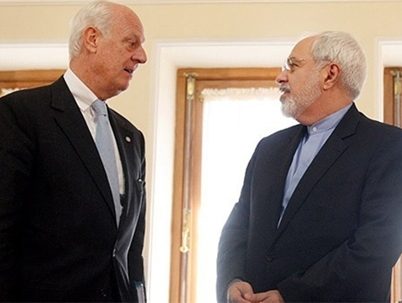
Zarif-Staffan de Mistura

Iranian Foreign Minister Mohammad Javad Zarif in a meeting with United Nations Envoy for Syria Staffan de Mistura on Sunday stressed that Tehran still believes that the Syrian crisis can be soothed only through a political solution.

“The international and regional players should do their utmost efforts to reach a political solution to the Syrian crisis on the basis of the existing realities in Syria,” Zarif said during the meeting in Tehran today.

At the meeting, Zarif and Mistura reviewed the latest regional developments, particularly the Syrian crisis.

The two sides also reiterated the threat of the Islamic State of Iraq and the Levant (ISIL) Takfiri terrorists to the entire region.

Zarif wished success for Mistura during his tenure as UN envoy on Syria.

Mistura arrived in Tehran on Sunday morning to confer with senior Iranian officials on ways to settle Syria’s over-three-year-long crisis.

Mistura, who was appointed by UN Secretary General Ban Ki-moon as the new UN envoy for Syria in mid-June to replace Lakhdar Brahimi arrived in Iran to expand consultation with Tehran officials who on many occasions have stressed peaceful settlement of crisis in Syria.

On Friday, Mistura in a meeting with Iranian Ambassador to Beirut Mohammad Fathali praised Tehran’s constructive role in resolving the Syrian crisis.