Saturday, December 27, 2025
Home Blog Page 4920

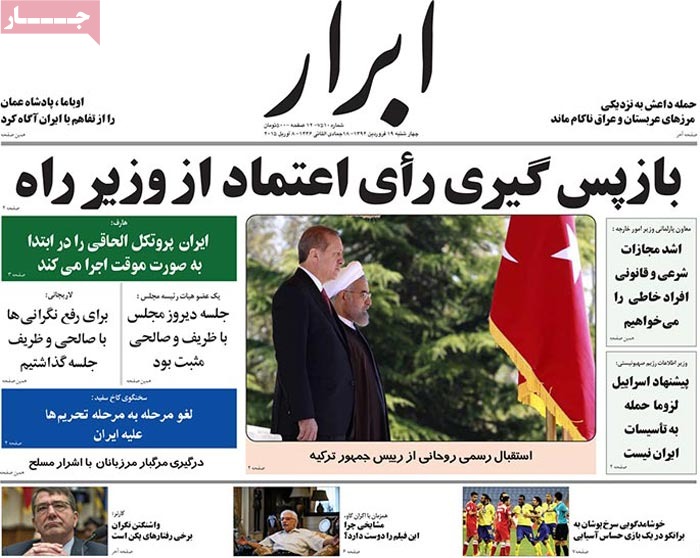
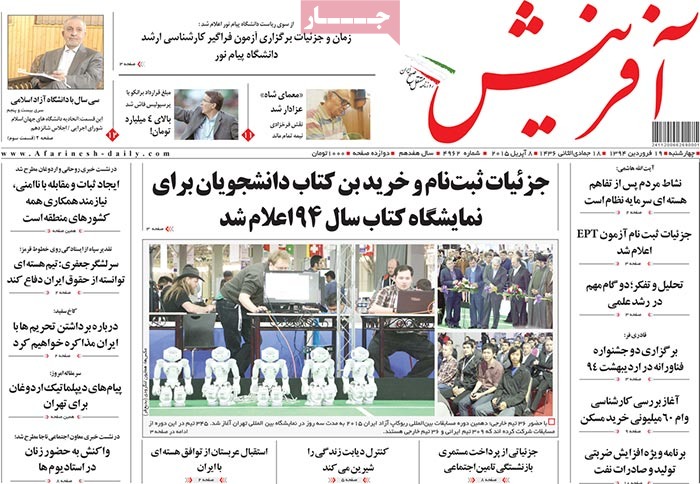
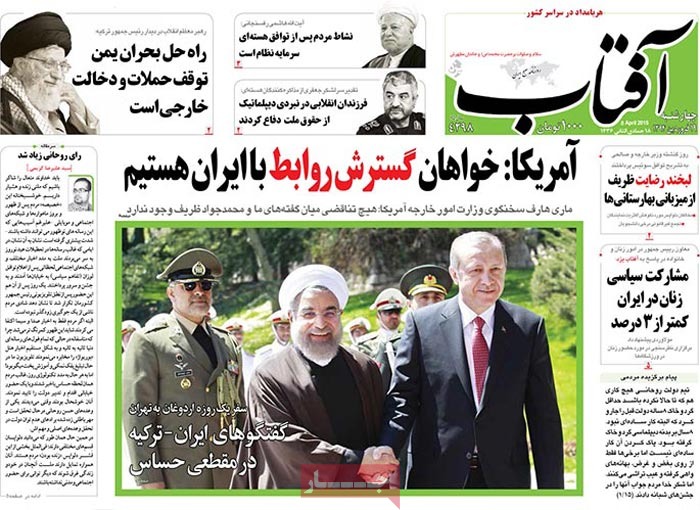
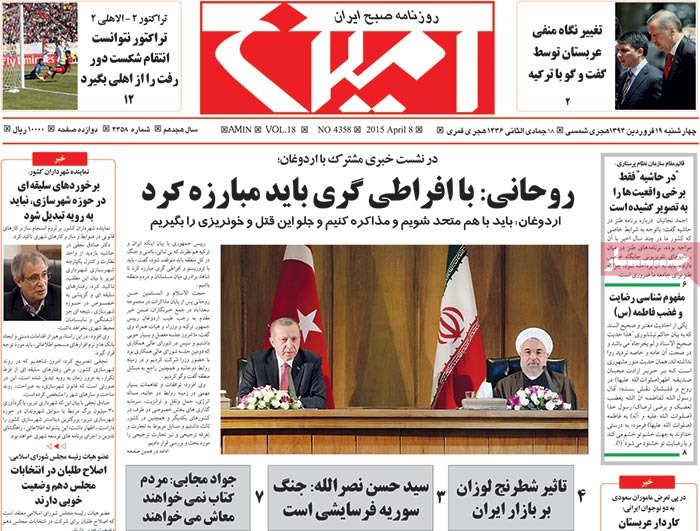
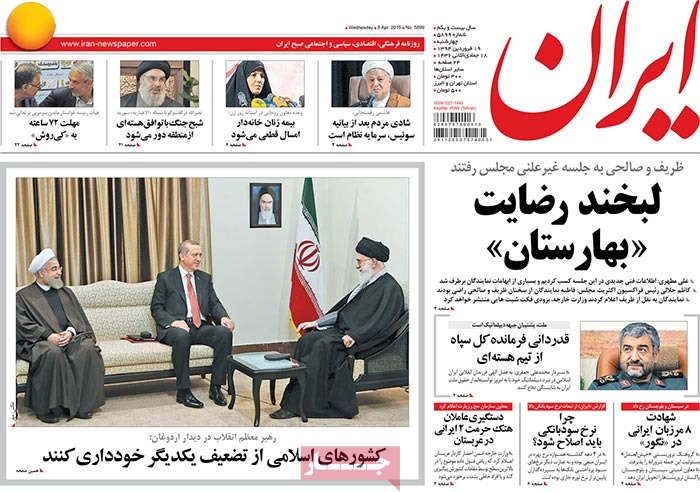
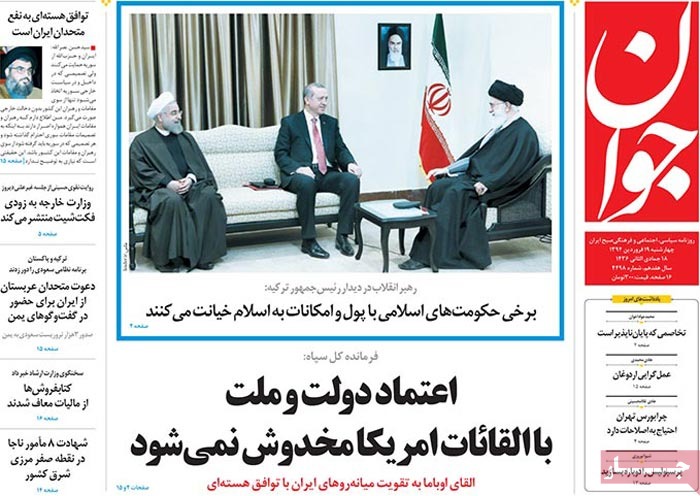
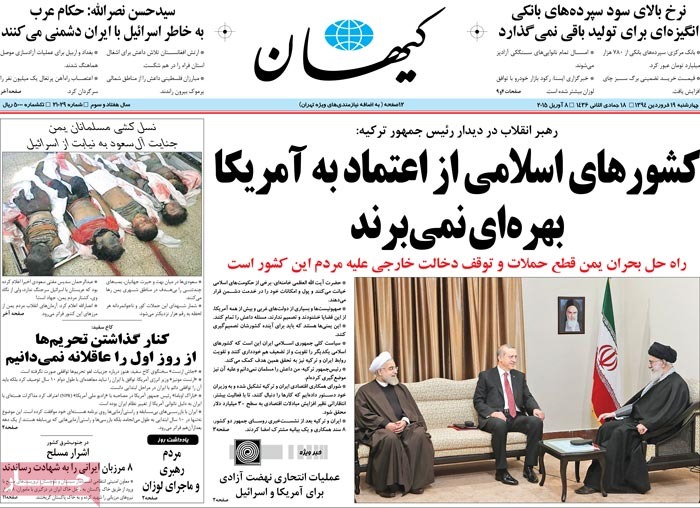
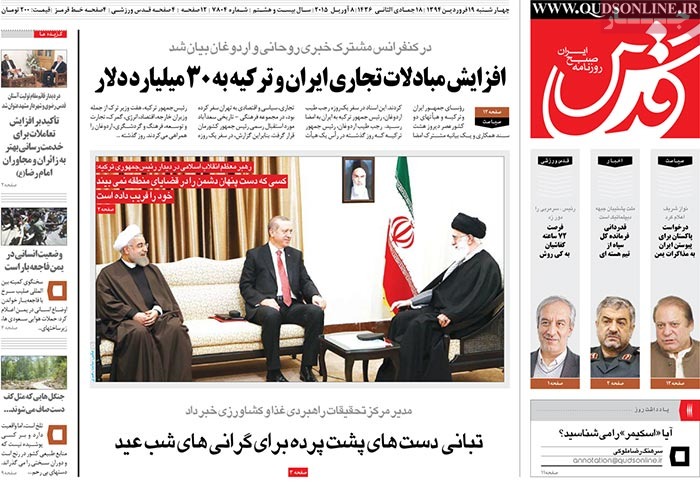
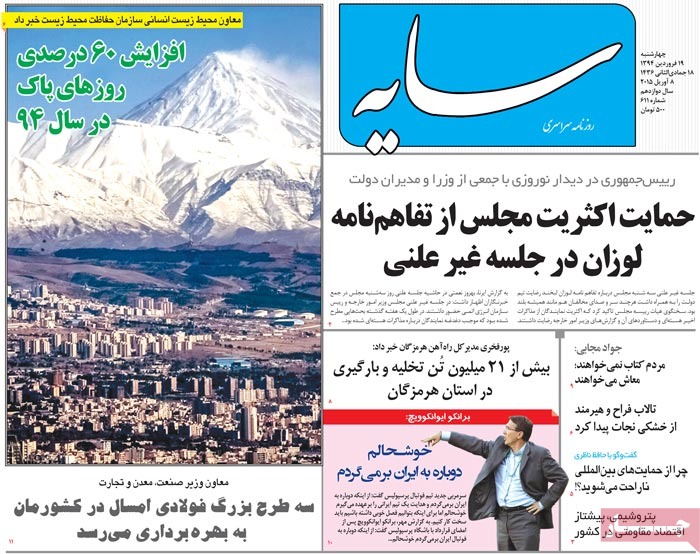
A look at Iranian newspaper front pages on March 4

Iranian Newspapers Headlines

Reaction to the deceptive remarks of Israeli Prime Minister Benjamin Netanyahu in the US Congress where he warned American officials of what he claimed to be a bad deal with Iran dominated the front pages of most Iranian newspapers on Wednesday. Day two of the talks between Iranian and US delegations was also in the headlines. And, reformist-leaning newspapers quoted Chairman of the Expediency Council Ayatollah Hashemi Rafsanjani as criticizing the hardliners at home for their opposition to anything President Rouhani’s administration does.


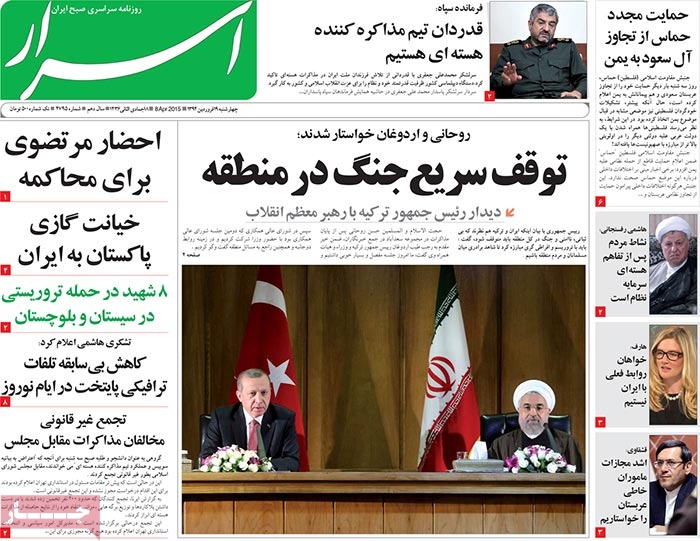
Abrar: Terrorist defense lines have been shattered in Tikrit, Iraq.


A look at Iranian newspaper front pages on March 4


Afkar: Reports that a senior Oil Ministry official has fled to Canada have been denied.


A look at Iranian newspaper front pages on March 4


Aftab-e Yazd: Iran’s share of the Turkish market is less than five percent.


A look at Iranian newspaper front pages on March 4


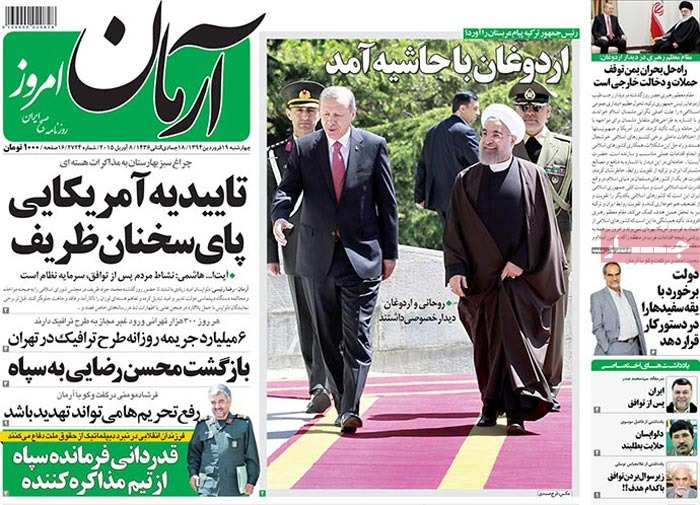
Arman-e Emrooz: Different comments by the spokesman of the Guardian Council

It is possible for candidates who have been qualified before to be disqualified [in upcoming elections].

Arman-e Emrooz: “As for the saddening incident of Kahrizak, we have nothing to say but apologize,” said the police chief.


A look at Iranian newspaper front pages on March 4


Asr-e Rasaneh: “Iran’s daily oil production capacity stands at four million barrels,” said the managing director of the National Iranian Oil Company.


A look at Iranian newspaper front pages on March 4


Ebtekar: “The first round of secret talks between Iran and the US took place when Salehi was in office [at the helm of the Foreign Ministry],” said Hamid Reza Asefi, [a former FM spokesman].


A look at Iranian newspaper front pages on March 4


Emtiaz: The attorney general has said that an investigation is underway into a $2.2 billion loan.

Emtiaz: The amount of fines poachers will have to pay has increased.


A look at Iranian newspaper front pages on March 4


Etemad: Parliament has required the government to cut the cash subsidies of 5.5 million high-income individuals.

The government also has to register any new recipient of subsidies in cash.

Etemad: Efforts are underway to untie the technical knots of [nuclear] talks.

Iran and the US explore ways of pushing the talks forward.


A look at Iranian newspaper front pages on March 4


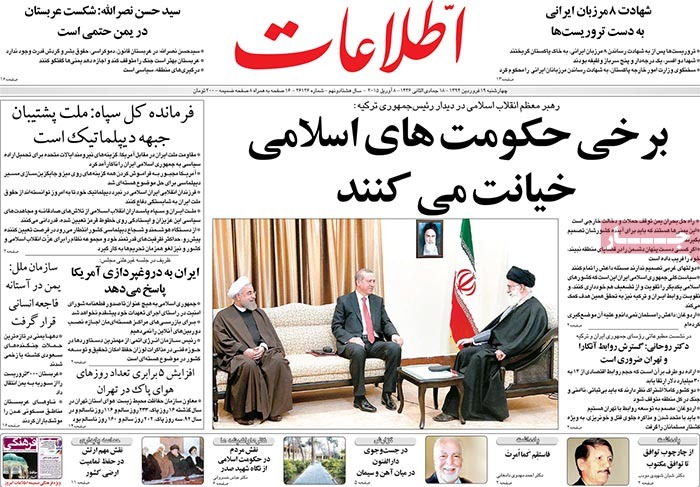
Ettela’at: The US has stopped intelligence cooperation with Israel over Iran’s nuclear program.

Ettela’at: Plans have been made public to stop particulates affecting people’s lives and health across the country.


A look at Iranian newspaper front pages on March 4


Hemayat: A famous US analyst has said that Iran owes its achievements to “the Genius of its Supreme Leader”.


A look at Iranian newspaper front pages on March 4


Iran: Women have a three percent share of parliament seats.


A look at Iranian newspaper front pages on March 4


Jomhouri Islami: After a second day of talks between Iranian and US delegates, hopes of clinching a nuclear deal have increased.

Jomhouri Islami: Netanyahu has expressed frustration with Iran’s regional and global authority.


A look at Iranian newspaper front pages on March 4


Kaenat: Parliament has wrapped up its review of the budget bill which has now been sent to the Guardian Council for final approval.

Kaenat: World petrochemical giants are poised to work in Iran.


A look at Iranian newspaper front pages on March 4


Kar va Kargar: “Judicial officials have no right to override the permissions issued for music concerts,” said the minister of culture and Islamic guidance.


A look at Iranian newspaper front pages on March 4


Kayhan: The nonsense of a speech Netanyahu delivered [in the US Congress] cost those who were overexcited [about the Geneva deal] a lot.


A look at Iranian newspaper front pages on March 4


Khorasan: Winners of the 28th Kharazmi International Festival have been named.


A look at Iranian newspaper front pages on March 4


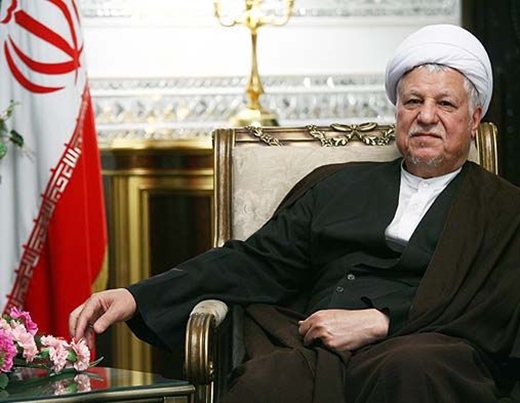
Mardomsalari: “Worriers [Ahmadinejad supporters] have joined the Netanyahu chorus,” said the chairman of the Expediency Council.


A look at Iranian newspaper front pages on March 4


Sharq: A committee has been formed to cross out the rich from the list of individuals eligible for cash subsidies.


A look at Iranian newspaper front pages on March 4


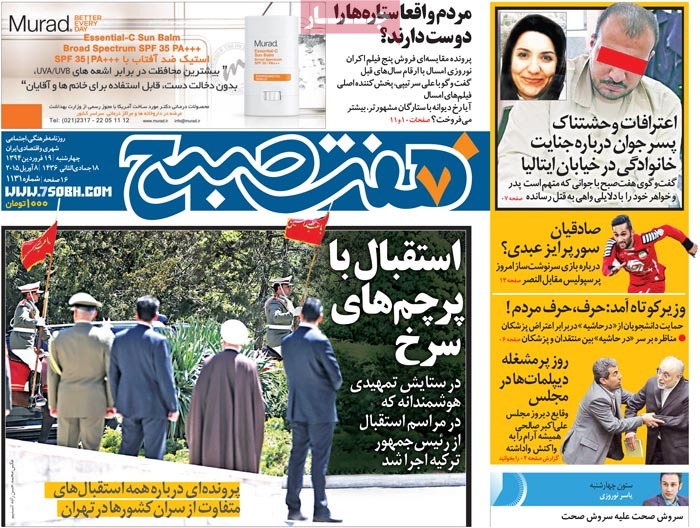
Sobh-e Eghtesad: “Sanctions offered an opportunity to rebuild the country,” said the first vice-president.


sohbe eghtesad newspaper


Kharazmi International Award announces winners

Khwarizmi

Director of the Atomic Energy Organization of Iran Ali Akbar Salehi and Prof. Fu-Tong Liu from Taiwan were among winners of a 28th edition of Kharazmi International Award named on March 3.

During the closing ceremony of the Kharazmi International Award which took place on Tuesday, the jury selected seven accomplished foreign researchers as winners of the prestigious award. The winners were awarded by President Hassan Rouhani.

Prof. Fu-Tong Liu for his research on the role of galectins in health and disease; Prof. Claudio Hetz from Chile for targeting protein homeostasis to treat neurodegenerative diseases; and Prof. Andreas Manz from Switzerland for lab on a chip technology for use in analytical chemistry and applied biosciences were the foreign winners.

In the national section, the winners included Dr. Homayoun Kanouni for his studies on cold tolerance on chickpea and nuclear chief Ali Akbar Salehi for his endeavors to launch a nuclear plant to produce radiopharmaceuticals.

In 1987, the leading Iranian Research Organization for Science and Technology (IROST) decided to launch an award to acknowledge the outstanding achievements in the field of science and technology.

IROST proposed the creation of the Kharazmi International Award in memory of Abu Jafar Mohammad Ibn Mousa Kharazmi, the great Iranian Mathematician and Astronomer (770-840 C.E).

During a fifth edition of the festival a foreign section was also launched.

Afkham slams Netanyahu anti-Iran speech at US Congress

Iran-Afkham
Iran-Afkham

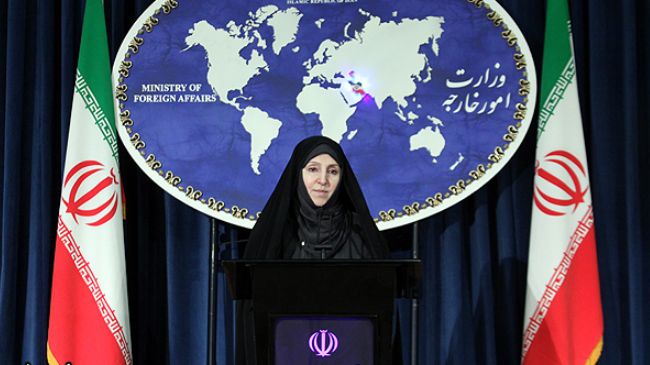
Spokeswoman of the Foreign Ministry Marziyeh Afkham made the remarks while commenting on the anti-Iran address of Benjamin Netanyahu to the US lawmakers which was made coincidentally with the ongoing nuclear talks between officials of Iran and the Gtoup 5+1 in Switzerland.

It was a completely “deceitful show and a part of electoral campaign made by radicals in Tel Aviv,” Afkham said.

She added that Netanyahu’s speech has “indicated his weakness and extreme isolation of the radical groups even among their supporters.

“This is also an effort to impose their radical and irrational agenda on international policy.”

“There is no doubt that the world public opinion gives no value or status to a child-killer regime,” Afkham stressed.

She said ‘constant lying of Netanyahu about goals and purposes of Iran’s peaceful nuclear program is very much boring and not new.’

The policy of Iranophobia has faced serious problems following the continuation of the nuclear talks and due to Iran’s firm intention to resolve the fabricated nuclear crisis. It also led the creators of those crises and propaganda to resort to desperate efforts.

In his address to the US Congress today, the Zionist leader warned them of what he claimed to be making a bad deal with Iran.

However, the White House described his controversial statements as unhelpful.

Shortly after the Israeli prime minister ranted against the ongoing Iran nuclear talks, President Barack Obama told reports that Netanyahu ‘did not offer any viable alternative.”

The US President said there was ‘nothing new’ in Netanyahu’s speech.

Netanyahu trying to have disruptive effect on nuclear talks: Zarif

Zarif-Iran FM

Iran’s foreign minister says the Israeli prime minister is trying to have a disruptive effect on the Islamic Republic’s nuclear negotiations with world powers.

“He’s trying to,” Mohammad Javad Zarif said on Tuesday, asked by the CNN if Benjamin Netanyahu was trying to have such effect on the talks.

“But I don’t think trying to create tension and conflict helps anybody,” the Iranian top diplomat noted.

Also on Tuesday, Netanyahu addressed the US Congress, calling on the United States not to negotiate “a very bad deal” with Iran over its nuclear energy program. He said, “We’ve been told for over a year that no deal is better than a bad deal. Well this is a bad deal, a very bad deal. We’re better off without it.”

Iran and P5+1 – Russia, China, France, Britain, the US and Germany – are negotiating to narrow their differences over the Islamic Republic’s nuclear energy program ahead of a July 1 deadline.

Netanyahu said that it is not true that “the only alternative to this deal is war.”

“The alternative to this deal is a much better deal. A better deal that doesn’t leave Iran with a vast nuclear infrastructure and such a short breakout point,” he added.

He said that the ongoing nuclear negotiations would provide Iran “with a short breakout time for a bomb.”

“According to the deal not a single nuclear facility would be demolished,” he said.

“So this deal won’t change Iran for the better, it will only change the Middle East for the worst,” he noted.

US President Barack Obama said there was “nothing new” in the speech.

He told reporters that Netanyahu “did not offer any viable alternative.”

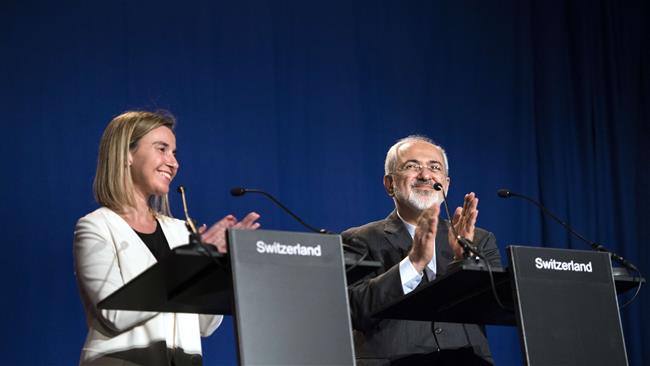
Speaking to reporters in the Swiss city of Geneva on Tuesday, EU foreign policy chief Federica Mogherini warned against “spreading fears” about a final nuclear deal that is being negotiated by representatives from Iran and the six states.

“Spreading fears is not helpful at this stage,” Mogherini told reporters, adding, “We are getting closer” to a comprehensive accord aimed at ending the longstanding dispute on Tehran’s nuclear dossier.

Reflecting on the talks, Zarif also said “we’re starting to move forward, but it’s a lot of work.”

Spreading fears on Iran nuclear deal unhelpful: EU

EU foreign policy chief

The European Union says “spreading fears” about an emerging deal between Tehran and P5+1 on Iran’s nuclear program is unhelpful.

Speaking to reporters in the Swiss city of Geneva, on Tuesday, EU foreign policy chief, Federica Mogherini, warned against “spreading fears” about a final nuclear deal that is being negotiated by representatives from Iran and the six states.

“Spreading fears is not helpful at this stage,” Mogherini told reporters, adding, “We are getting closer” to a comprehensive accord aimed at ending the longstanding dispute on Tehran’s nuclear dossier.

Her remarks came just as Israeli Prime Minister Benjamin Netanyahu, who has repeatedly attacked the emerging Iran deal, began his speech at US Congress.

The senior EU diplomat further said Tehran and its negotiating partners have taken “significant steps in the last weeks, with a lot of political will that I see on many sides.”

“(In) the talks of this last round, including the one of today, (there) were encouraging signs,” Mogherini said, adding, “I would like to make an appeal, a plea to all public actors to facilitate rather than put in danger diplomatic efforts that have been extremely difficult.”

Mogherini also stated that she had held a phone conversation with US Secretary of State John Kerry on Tehran’s nuclear issue and was set to discuss the matter with Iranian Foreign Minister Mohammad Javad Zarif later on Tuesday.

The EU foreign policy chief made the comments as officials from Iran and the United States are holding a second day of discussions in their latest round of talks over Tehran’s nuclear program in the Swiss city of Montreux.

Zarif and Kerry, who are heading the Iranian and American delegations, sat down for more than two hours of nuclear discussions on Monday.

The new round of talks in Montreux comes as representatives from Iran and the United States held three rounds of intense negotiations in the Swiss city of Geneva on February 22-23 to bridge their differences ahead of the July 1 deadline for Iran and P5+1 to reach a comprehensive nuclear deal.

The two sides have missed two deadlines since an interim deal was signed in November 2013.

Irked by the interim accord between Tehran and P5+1, Israeli authorities have been lobbying over the past year to hinder a permanent accord on Tehran’s nuclear case.

In his latest attempt to sabotage a lasting nuclear agreement, the Israeli premier told US congressmen on Tuesday that a future accord would benefit the Islamic Republic, accusing Washington of negotiating a “bad deal” with Iran.

Netanyahu claimed that the nuclear agreement would provide Iran “with a short breakout time for a bomb,” adding, “According to the deal not a single [facility] would be demolished… because Iran’s [facilities] would be left largely intact.”

Financial losses claim; forgotten but not gone

A piece of pazel

Iran’s nuclear team has been involved in marathon talks with P5+1 for over one and a half years. Prior to this, the eighth, ninth and tenth governments held similar inconclusive negotiations. Despite the flexibility shown by the Iranian side, the West has refrained from accepting a deal and remaining committed to its obligations.

Resalat daily on March 1 dedicated its editorial to Iran’s right to compensation for the losses it has sustained over the years because of the unjust sanctions of the West. The following is a partial translation of the editorial by Mohammad Kazem Anbarlouei:

[…]

For more than a decade, the Western side has acted like an “interrogator”, treating Iran like a “defendant”. It has made allegations which have been repeatedly rebutted, with the International Atomic Energy Agency confirming their groundlessness in its [periodic] reports.

To act in good faith, Iran has met their illegal demands which go beyond the provisions of the Nuclear Non-Proliferation Treaty (NPT), and the IAEA has verified Iran’s measures.

In return, nothing has happened. The Western side has neither dropped its unsubstantiated claims, nor has it offered apologies for the invalidity of its previous allegations.

For more than a decade wicked measures by the US and certain Western governments have inflicted billions of dollars in losses on the [Islamic] establishment. They have caused Iran to pay hefty prices for its nuclear program. They have sabotaged our nuclear program by selling us contaminated parts. That is not all; they have even assassinated five Iranian nuclear scientists in a despicable way.

What is absent in nuclear talks between Iran and P5+1 is the question of Iran’s financial losses claim; the losses they have imposed on Iran which have taken a toll on our public funds.

[…]

Iran should lodge serious financial and calculational claims against the Western side and ask for compensation for numerous losses, among them:

Compensation for the cost Iran has paid to master peaceful nuclear technology

Compensation for those who lost their lives to the sanctions imposed on radiopharmaceuticals

Compensation for the assassination of nuclear scientists for whose training Iran had invested millions of dollars

Compensation for the staggering costs of redesigning the nuclear facility in Arak

Compensation for Iran’s frozen assets in the European and US banks

Compensation for [the West’s] procrastination tactics and foot-dragging in the talks

The Iranian nuclear team does not include a negotiator who can present these loss claims. So a representative from the Supreme Audit Court and one from the Economy Ministry’s treasury office should pursue the demands of the Iranian nation in the talks.

In the early years after the Islamic Revolution, a few Americans were targeted and killed by a Lebanese resistance movement in the Arab country. Their families took the case to the court, asking for compensation. They lodged a complaint against the Iranian government, arguing that Tehran had lent [financial] support to the resistance group in Lebanon. They called on the US administration to give them compensation from Iran’s assets frozen in the US and Europe!

The Iranian negotiating team provides an answer to any false, baseless claim the US makes, but it has yet to put on the table the [legitimate] demand of the Iranian nation for compensation for the losses Iran has sustained as a result of unjust sanctions.

The American and French sides have put forward the most outrageous demands and claims in nuclear talks; that is one reason why the talks are held behind closed doors. If they are made public, Iranians from all walks of life would pour onto the streets [in protest] and would no longer tolerate the presence of their representatives in the talks – in which the other party makes audacious claims – even for a few minutes.

[…]

In the recent history of the Iranian nation over the past century, the name of a clergyman has never appeared in a deal with a colonial power. The Iranian nation has stood up to bullying of any sort over the past 36 years and pursued its own agenda.

The nation who stands up today should reclaim its rights from the bullying powers. Any deal in March should recognize Iran’s right to peaceful nuclear technology in line with the NPT.

Compensation should be paid to the Iranian nation, and unjust sanctions should be lifted once and for all, without technical and legal bargaining. If all this happens, Iranians can turn yet another golden page in the history of their resistance.

Borzoo, a 3rd Persian leopard fitted with GPS tracking neckband

Persian leopard-Borzoo-4

The website of Iran Environment and Wildlife reported on February 24 that a third Persian leopard has been captured alive in Tandooreh National Park and fitted with a GPS tracking neckband.

At stages one and two of the project, which is the doctoral thesis of Mohammad Sadegh Farhadinia, Borna, and Bardiya [two male Persian leopards] were equipped with similar neckbands.

A third stage of the project saw researchers set traps in late January to capture more leopards alive. One day after the traps were laid, a third leopard was caught. In order to carry out some tests and examination, the feline was given a dose of aesthetic through a blowpipe.

The subsequent examination of the big cat showed that he was about 11 years old and weighed 57 kg, which is not much for an adult Persian leopard.

Dr. Iman Memarian, a veterinarian who conducted the medical examination, said, “Although some of his teeth were decayed, he still has enough healthy teeth to hunt. To ease the tracking of this old and experienced leopard, we named him Borzoo.”

A few days after Borzoo was released into the wild, a picture of him was captured by a camera installed in the park. The following is a photo gallery posted by www.iew.ir of the operation during which Borzoo was equipped with the tracking neckband:


Radicalism won’t last in the world of Islam: Expert

Egypt Revolution

Four years after the dawn of the Arab Spring, there are many theories and analyses as to what triggered the uprisings that have since swept the Arab world.

Some blame the emergence of extremism and fanatical groups like IS on the popular uprisings; others believe the fact that regional revolutions have been hijacked shows the Arab Spring was the brainchild of Westerners.

KhoramshadMohammad Bagher Khorramshad, a former director of the Islamic Culture and Relations Organization who is a now a political science professor at Allameh Tabatabai University, has shared his take on the Arab Spring with Mehr News Agency. The following is a partial translation of his comments:


The developments in Arab countries which started in Tunisia and continued in Egypt were typical of neither classical nor color revolutions. They stood somewhere in between.

It has been almost two decades since it was acknowledged by circles specializing in the Middle East and the Arab World that Arab countries are in a political deadlock, and aside from calls for democracy, there is another [popular] demand: political Islam.

Over the past 20 years, another fact has been established: the first step toward democracy is the holding of free and fair elections, and in any Arab country where this first step is taken, demand for political Islam has emerged from the ballot box.

With regard to developments in the Arab world, there were two major camps in the world: The West led by the US who deemed themselves as the flag bearers of democracy, and those who were known as the torchbearers of political Islam with the Islamic Republic of Iran and its revolution being in the lead. Either side tried to pick a name for the developments based on what they represented.

As a result, the movement ended up having two names. Westerners called it the Arab Spring, whereas the Islamic Republic of Iran dubbed it Islamic Awakening.

In Tunisia the Ennahda Movement emerged as a perfect image of political Islam; in Egypt, the Muslim Brotherhood surfaced and in Libya Islamist groups representing a wide spectrum took the lead.

In such conditions, the views of major powers, particularly America, and their regional allies were far from convergent.

Regional allies, especially Saudi Arabia, which viewed themselves as protectors of traditional Arab monarchies, did not see eye to eye with the US about the alternative. The Americans believed that democracy could pacify the disgruntled masses and offer a way out of the gridlock.

One can argue that over the past few years, the Americans entered into talks with the unmistakable manifestation of political Islam in Arab countries: the Muslim Brotherhood.

The Americans agreed that the Muslim Brotherhood be part of the future of the region. That was meant to leave the state of emergency behind and introduce democracy through elections. They also agreed to see the Brotherhood rise to power after making a compromise with Washington.

Cynics would argue that the Muslim Brotherhood was bought off by the Americans; optimists would say the Muslim Brothers tricked the Americans. A third theory is that the two sides met halfway. In other words, they both got on board a train in hopes of being able to push the other off the speeding train somewhere down the road and assume power.

So in Arab revolutions political Islam and democracy arguably emerged victorious and the Brotherhood won the vote.

Interestingly, those who sought to maintain traditional Arab policies in the region, spearheaded by Saudi Arabia, offered safe haven to Zine El Abidine Ben Ali and Hosni Mubarak the day after their ouster in Tunisia and Egypt.

Consequently, in opposition to the ideology floated by the Muslim Brotherhood, the political Islam boosted an orthodox and radical current of the Salafist movement within itself and contrary to expectations, democracy was marginalized. In other words, political Islam failed to yield democracy. Building on pressure and exertion of influence, outside factors, especially in Egypt and Tunisia, pushed the revolutions to make a U-turn.

Although a similar incident took place in Yemen in case of Ali Abdullah Saleh, the smoldering fire of the revolution kept burning beneath the glowing ashes. Today the Houthis are forging ahead with an all-out revolution.

As for Libya, there has been no turning back to the past, yet this country has turned into a stage where regional, Arab and international powers flex their muscle.

In Bahrain, what is unfolding involves lots of ups and downs and is different from what is happening in other places. Another thing about Bahrain is that Western countries are heavily present in this country to help the current political system put its house in order. That’s why the British and the Americans have set up bases there.

Still, that is not the end of the story. Since the world is undergoing change and the region is rife with developments, we cannot say that we are at the finish line. In fact, we are at the end of one stage and need to wait for future developments.

There is no denying that on the political landscape, Arab traditions, which in some of those countries are based on tribal principles, have had their impact along with other parameters and modern factors such as democracy. It can even be said that they have somewhat offset democracy and political Islam.

The dominance of radicalism within political Islam cannot be sustainable. After eight decades, the Muslim Brotherhood reached a point where it was unable to preserve its legacy. Within the ranks of Brothers, it was assumed that there would be a more modern model. However, the opposite took place and took them off guard.

Probably, Salafist dominance rendered it feeble on the inside and thus it tried to rekindle what was practiced in a caliphate which dated back to the time Islam had been just introduced. Maybe, it can be said that this was the product of heavy investment made, especially by Saudi Arabia, over three decades.

If it’s inferred as a defeat for Islamists, particularly the Brotherhood, it will result in revisionism and a breath of fresh air into it. If it amounts to failure of democracy, the demand for public contribution to politics cannot be averted. Definitely, it’s an experience which will have an impact on the future of politics in these countries.

If the West had not pretentiously insisted on backing despotic political systems at any cost for years and had not deeply humiliated the world of Islam, especially over the question of Palestine, a humiliation experienced by billions of Muslims, the world of Islam would not have been dealing with radicalism.

Such humiliation and others gave a chance to potential radicals inside the world of Islam to go down the path of extremism. What is worth noting is that not only the West did nothing to take on this phenomenon, but it tried to make the Muslims bear the brunt of its eruption.

The Islam which could have contributed to coexistence and development in Islamic communities presented itself in the form of a violent, radical phenomenon.

The West tried to build on radical militants to cause the world of Islam to implode. In other cases, however, the West had always tried to tip the balance in the favor of its own dominance.

In this special case, it has offered authority to armed groups and as a result, the Syrian army which was closest to the Israeli army has been destroyed. So has the Iraqi army. The Egyptian army is teetering on the brink. In fact, all the armies that could have once lined up against the Israeli army have been destroyed by civil war; the war within which was overwhelmingly backed by the Americans and Westerners through a number of measures among them shipment of arms and conferences in Paris and other places.

In short, they paved the way for radicalism which finally reared its ugly head. However, radicalism cannot be described as an original part in the structure of the Islamic world. When its shelf life comes to an end, it will lose steam. It could carry years of frustration with itself, or it might be capable of reconstructing, because the genuine Islam lies dormant in it which is of course a different subject for discussion.

Undoubtedly, it can be said that the West tried to manage a phenomenon which was already underway but was not necessarily initiated by it, in a way that would serve its own interests. In doing so, it was rather successful in some countries.

That elections were put on hold in some countries to allow pro-Western groups to regroup is a clear indication that the West took such measures.

Vilification of Islamists was another measure taken by the West to sway the public opinion against Islamists in the elections.

In our world, a small-scale operation by a dozen Palestinian or Lebanese fighters against Israel is condemned by the Security Council, but nothing is done in condemnation of IS which has 30,000 forces from 70 different countries.

All factors at play confirm the assumption that everyone was poised for explosion in the region, and when those developments unfolded, the West took the upper hand and acted in two stages.

At the first stage, they brought things under control in dealing with the Brotherhood and then capitalized on its strategic mistake and its inexperience in the face of plots. During the second stage, it was the Muslim Brothers who were checkmated.

With every day passing, the atmosphere prevailing Islamic countries assumes more complexity and the chasm between Islamic nations and the West widens.

If Muslim intellectuals reach this conclusion, they will find out that the blow that Muslims have suffered at the hands of the West over the last two centuries was a heavy one. The world of Islam will suffer from this blow for years and will never forget the role that the West played in inflicting it.

Third exhibition of games and toys opens in Tehran

Iran game exhibition

The exhibition aimed at presenting toys designed by Iranian producers and local games gives families a chance to get their children great New Year gifts. This is the perfect place to find toys and gifts for a 4 year old.

Toys importers, producers and distributors are participating in the exhibition held at the Institute for the Intellectual Development of Children and Young Adults in Tehran.

The exhibition will work until Friday March 6.

Iran ready to boost cooperation with UN human rights commissioner

Zarif-Un-Human-Rights

Iranian Foreign Minister Mohammad Javad Zarif on Monday voiced Iran’s readiness to boost cooperation with UN human rights commissioner.

He made the remarks in a meeting in Geneva with UN High Commissioner for Human Rights Zeid Ra’ad al-Hussein.

Zarif expressed concern over the spread of Islamophobia in the West and said that Tehran is concerned about the arrival of terrorist agents from Western countries in the Middle East.

He emphasized the need for identification of the root causes of terrorism and extremism and for an unbiased campaign against the phenomenon.

The foreign minister criticized double standards employed by Western governments and misusing the issue of freedom of expression to desecrate the religious sanctities.

Meanwhile, the UN commissioner for human rights said the UN agency is ready to do its best to promote international cooperation and dialogue and welcomes every effort which helps promote human rights.