Sunday, April 19, 2026
Home Blog Page 4918

A look at Iranian newspaper front pages on April 11

Iranian Newspapers Headlines

Comments by the Supreme Leader and President Rouhani about the nuclear talks and removal of sanctions dominated the front pages of Iranian newspapers on Saturday.


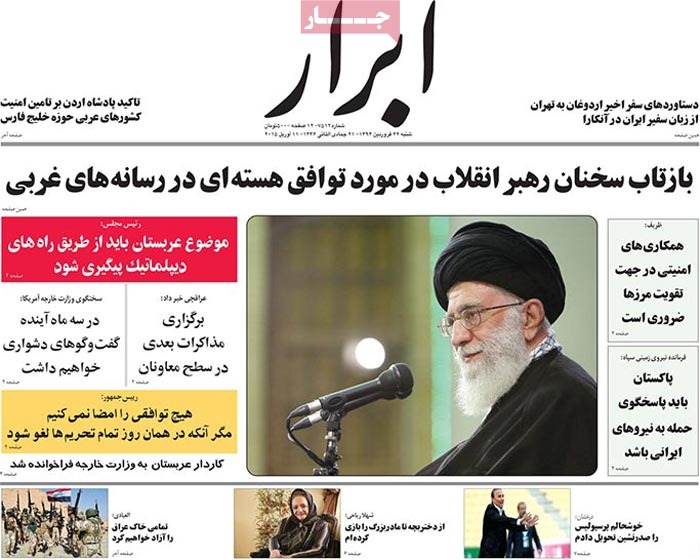
Abrar: A senior Revolution Guards commander has said that Pakistan should be held accountable for cross-border attacks on Iranian forces.


A look at Iranian newspaper front pages on April 11


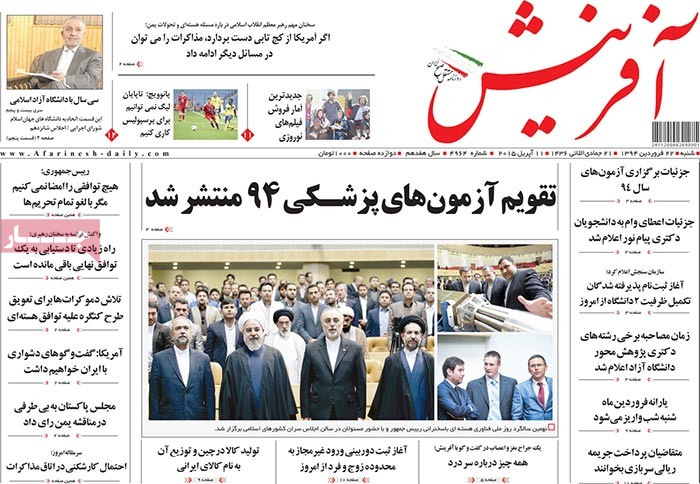
Afarinesh: “We won’t sign any deal unless all sanctions are lifted,” said President Hassan Rouhani.


A look at Iranian newspaper front pages on April 11


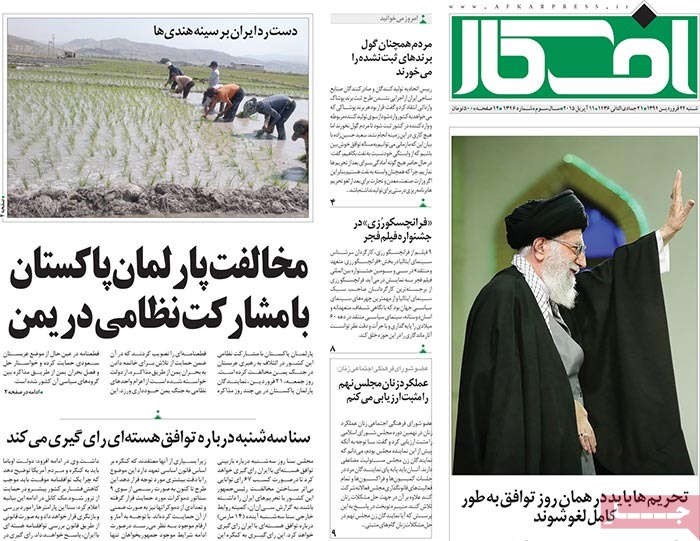
Afkar: The Pakistani parliament has voted against Islamabad’s military involvement in Yemen.


A look at Iranian newspaper front pages on April 11


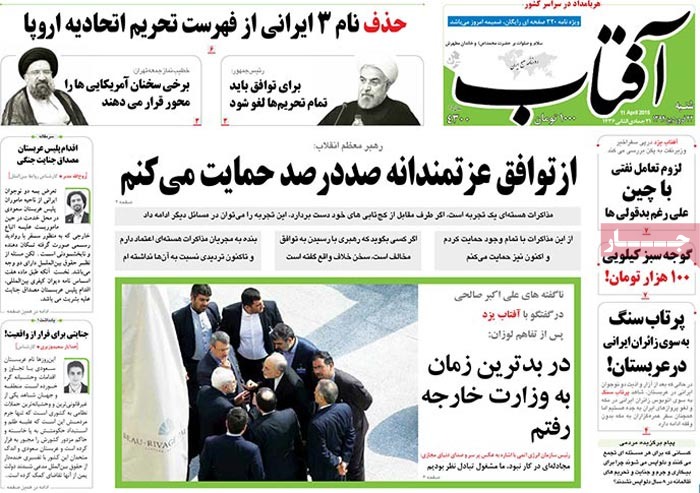
Aftab-e Yazd: The names of three Iranian nationals have been taken off the EU sanctions list.


A look at Iranian newspaper front pages on April 11


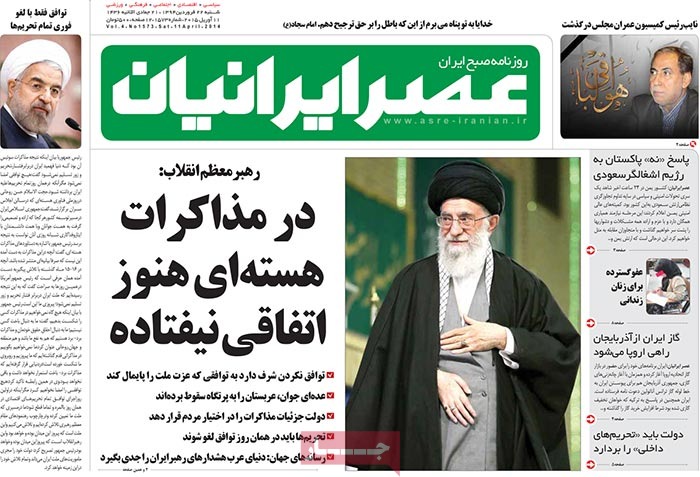
Asr-e Iranian: The vice-chairman of parliament’s Development Committee has passed away.

Ali Akbar Aghaei died of a heart attack on Thursday morning.


A look at Iranian newspaper front pages on April 11


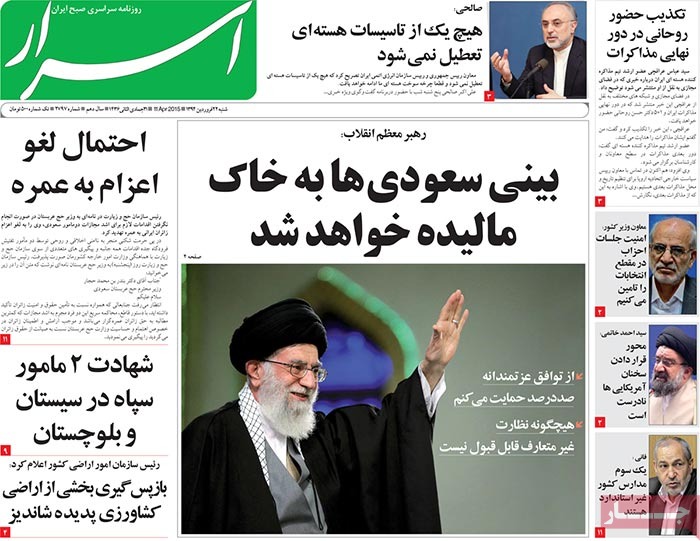
Asrar: Minor Hajj pilgrimage may be called off.

It comes after two Iranian teenage pilgrims were recently subjected to sexual harassment at Jeddah airport by Saudi security forces.


A look at Iranian newspaper front pages on April 11


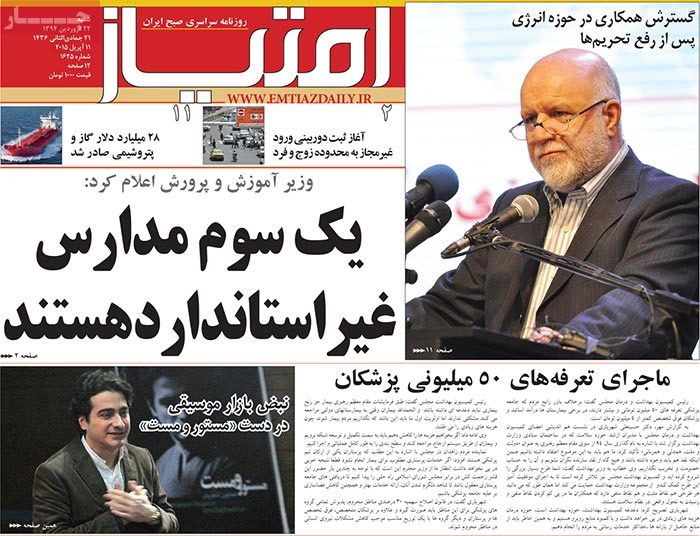
Emtiaz: “Up to one third of Iranian schools do not measure up to standards,” said the education minister.


A look at Iranian newspaper front pages on April 11


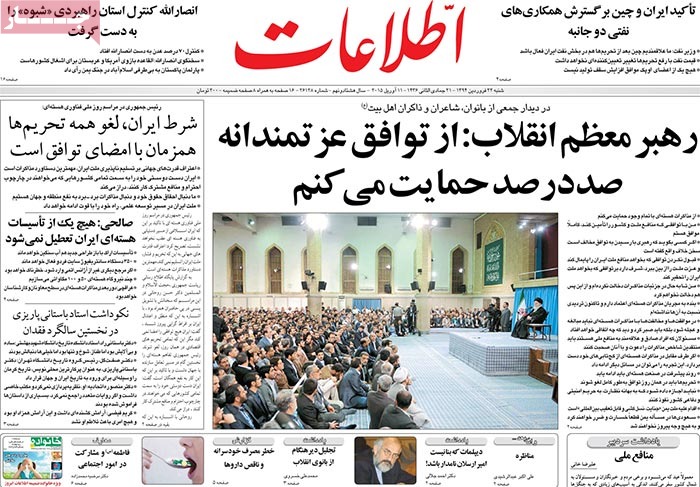
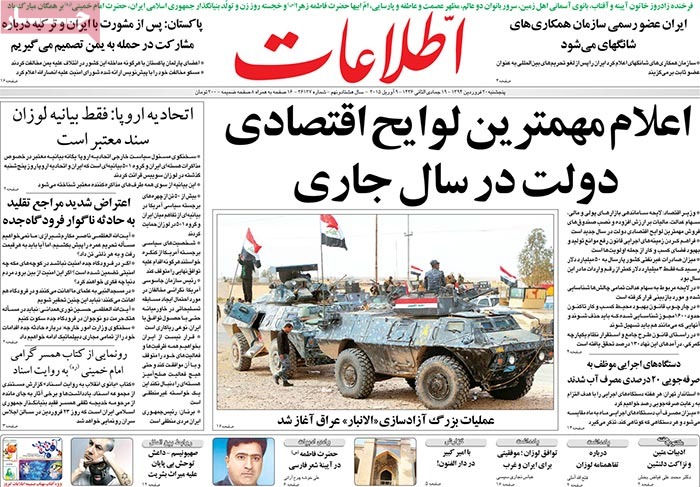
Ettela’at: Iran and China have underlined closer oil cooperation.

Ettela’at: “A deal which protects [the Iranian nation’s] dignity will have my unqualified support,” said the Supreme Leader.


A look at Iranian newspaper front pages on April 11


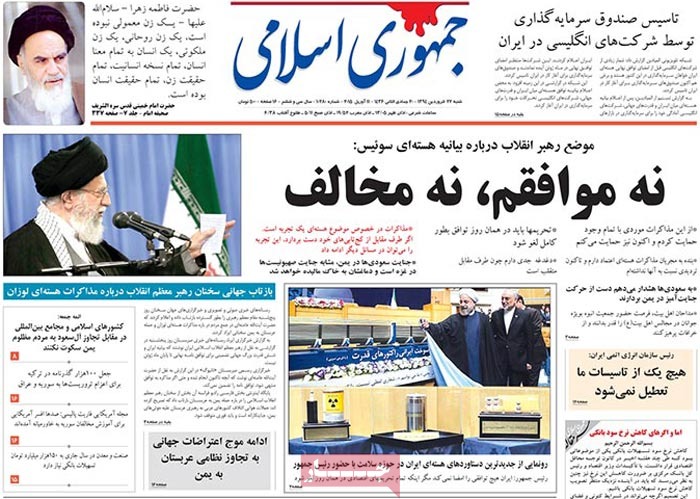
Jomhouri Islami: Brits are to set up an investment fund in Iran.

Jomhouri Islami: “None of Iran’s nuclear facilities will be shut down,” said Ali Akbar Salehi, the country’s nuclear chief.


A look at Iranian newspaper front pages on April 11


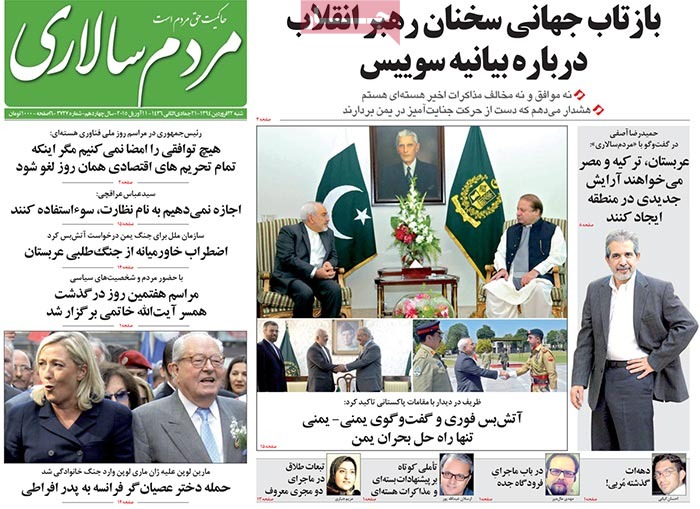
Mardomsalari: “Saudi Arabia, Turkey and Egypt seek to establish a new regional order,” said Hamid Reza Asefi, a former Iranian FM spokesman.

Mardomsalari: “We won’t allow inspections to be abused,” said Iranian nuclear negotiator Abbas Araghchi.


A look at Iranian newspaper front pages on April 11


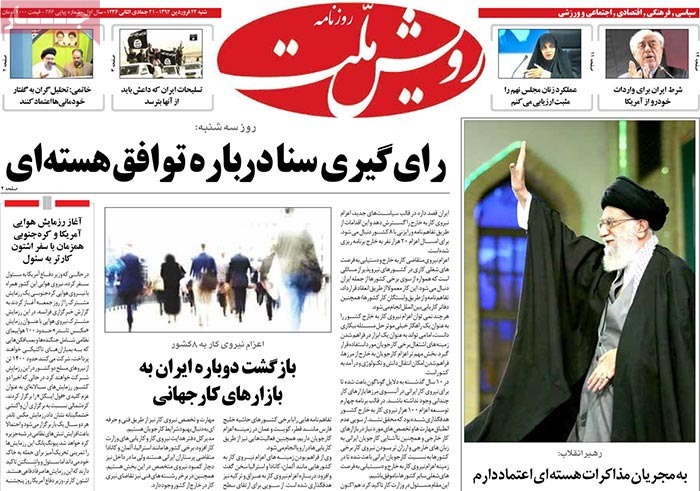
Rooyesh-e Mellat: Iran has returned to world labor market, sending workforce to eight countries.


A look at Iranian newspaper front pages on April 11


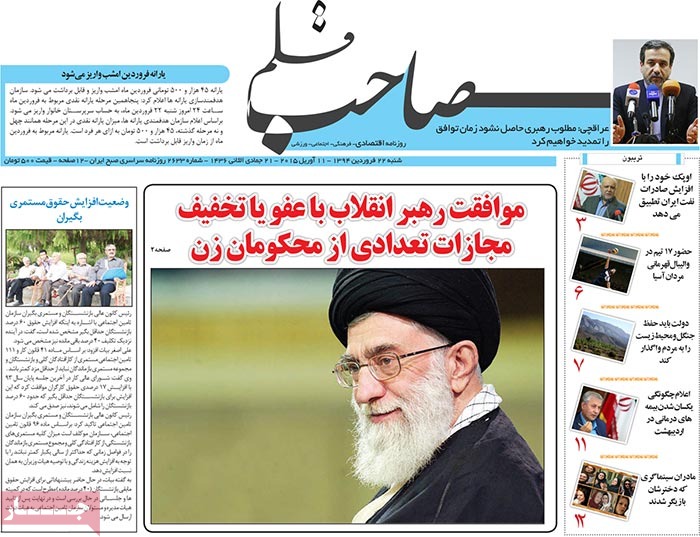
Saheb Ghalam: “We’ll push back the timing of the nuclear deal if the leader’s ideals are not met,” said Iranian negotiator Abbas Araghchi.


A look at Iranian newspaper front pages on April 11


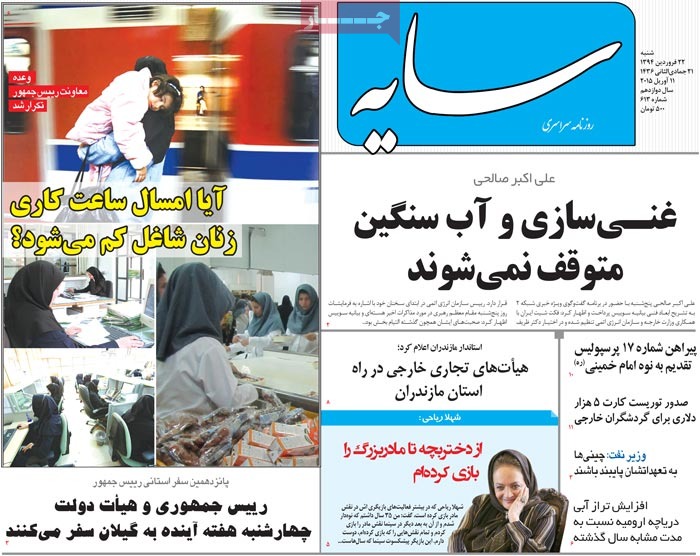
Sayeh: The President and his Cabinet will travel to Gilan Province on Wednesday.


A look at Iranian newspaper front pages on April 11


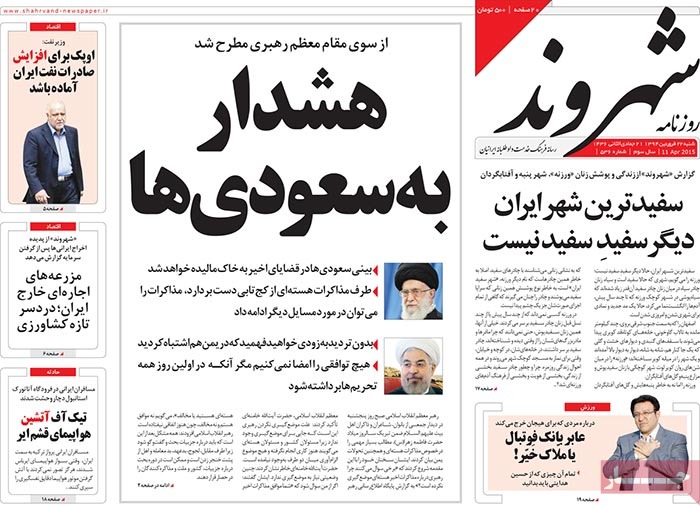
Shahrvand: “OPEC should brace for an increase in Iranian crude output,” said the oil minister.

Shahrvand: Fiery takeoff of a Qeshm Air airliner in Istanbul, Turkey.

The plane was taxiing when a loud boom was heard and its right engine went off before pieces of the engine fell onto the tarmac.

The captain skillfully called off the takeoff and brought the plane into a standstill.

No one was injured in the accident.


A look at Iranian newspaper front pages on April 11


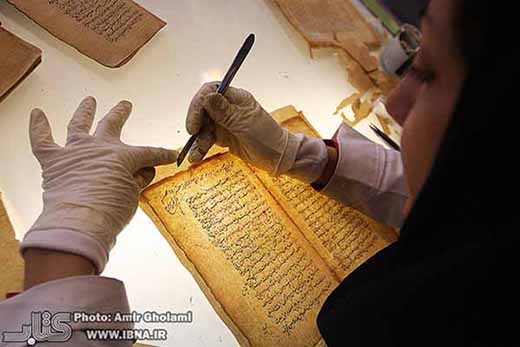
Book, Paper Conservation-Restoration Center at parliament’s library

Book and Paper Conservation1

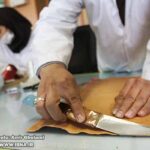
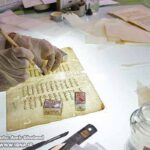
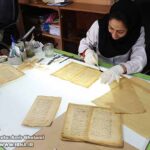
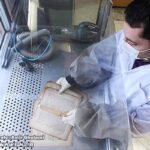
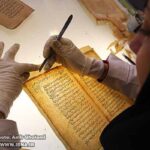
At the Book and Paper Conservation-Restoration Center at the library of the Islamic Consultative Assembly, hundreds of old handwritten books, thousands of historical documents and different periodic journals and books are restored and preserved every year.

Using advanced equipment, experts at the center try to protect the documents against destructive environmental factors such as light, humidity, temperature, biological factors like fungi, molds and microbes as well as physical damage.  

The following is a photo gallery Iran’s Book News Agency (IBNA) placed online on April 8 of experts at work at the center:

AEOI chief stresses no halt to Iranian nuclear sites’ activities

salehi

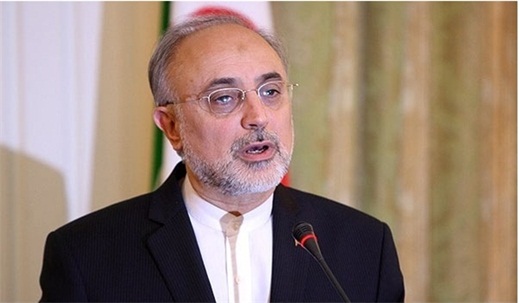
Director of the Atomic Energy Organization of Iran (AEOI) Ali Akbar Salehi underlined that there will be no halt to the operation of Iran’s nuclear sites.

“None of Iran’s nuclear facilities will cease activity,” Salehi said on Friday.

He also reiterated that Iran will continue its nuclear enrichment activities like before.

President not to attend negotiations personally: Araghchi

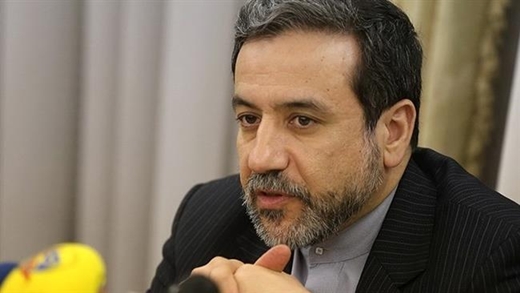
Iranian senior negotiator Abbas Araghchi said President Hassan Rouhani does not intend to attend nuclear negotiations personally.

Araghchi told IRNA he had said the president would direct the talks which does not mean being present at the negotiating table.

Iran and six world powers (US, Britain, France, China, Russia, and Germany) will resume their negotiations shortly.

The two sides will resume talks to draw up a final agreement on Tehran’s nuclear program within days, Catherine Ray, spokesperson for EU foreign policy chief Federica Mogherini, says.

At a press briefing in Brussels on Friday, she added that the negotiating sides were maintaining contact by phone and e-mail.

Ray said she would inform the media on the exact day of the talks as soon as it has been agreed upon.

Saudi chargé d’affaires summoned over Riyadh’s anti-Iran comments

Iran Summons Swiss Envoy over US Accusations
Iran foreign ministry

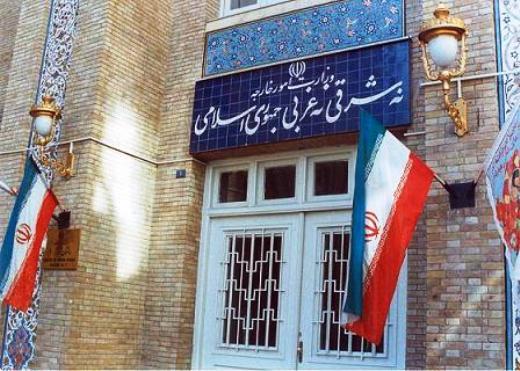
The Iranian Foreign Ministry summoned Saudi Arabia’s chargé d’affaires to voice Tehran’s protest at recent comments made by a Saudi commander who accused Tehran of alleged interference in the internal affairs of Yemen.

In a meeting with the Saudi chargé d’affaires in Tehran on Wednesday, a top Iranian official at the Foreign Ministry voiced Tehran’s anger over the recent remarks by Ahmed al-Asiri, the spokesman of the Saudi-led coalition in Yemen.

The Iranian Foreign Ministry official described the remarks as “untrue”, saying that the Islamic Republic of Iran denounces any use of force in Yemen and emphasizes the political resolution of problems in the Arab country.

During his daily military briefing on Wednesday, Asiri had said that the coalition reserved the right to respond to any attempt by Iran to arm Houthis, Al-Arabiya reported.

The Saudi commander had claimed that Iran is training Ansarallah forces in a bid to harm the Yemeni people and destroy the infrastructure of the country.

The remarks came as Saudi-led air strikes in Yemen have continued for the 15th day, with intense fighting occurring in the southern city of Aden, where rockets have reportedly landed on houses.

The World Health Organization said at least 643 people have died and more than 2,200 have been injured in the attacks on Yemeni soil by Saudi Arabia and its allies since March 19.

Annulment of Lausanne agreement, the only way forward

Shariat madari

The nuclear agreement Iran and P5+1 arrived at in Lausanne, Switzerland in early April has been open to debate around the world, with opponents and proponents powerfully making their cases.

“There is no doubt about US failure to honor its commitments, but what is more important is the fact that the US does not need to go back on or overlook its obligations. After all, it has already included all it wants in the Lausanne agreement,” says Hossein Shariatmadari, the managing editor of Kayhan.

In an editorial on April 9, the influential principlist daily published a critical analysis of the Lausanne statement, calling for the annulment of what Iran has agreed to in Switzerland. The following is the translation of the editorial entitled “Beneath the inner layers of the Lausanne Agreement”:

Although the Lausanne agreement has ignited heated debate these days among those who are for and against it, there are many issues that have yet to be weighed up. And there are still several points which have been given least attention, or they have not been discussed as thoroughly as they deserve. They are as follows:

1. The Additional Protocol mentioned in the Lausanne agreement allows IAEA experts to conduct no-notice inspections of Iranian [nuclear] sites – the ones they seek to inspect – anywhere, anytime.

No doubt, signing the protocol seriously threatens the nuclear and military security of the Islamic Republic of Iran. In response to a question as to why you have accepted the Additional Protocol as an extra protocol [to the treaty, demanded by the International Atomic Energy Agency, which would allow spot checks on Iran’s nuclear facilities], the esteemed members of Iran’s nuclear team say that the singing of the Additional Protocol is voluntary.

On the other hand, critics of the Lausanne agreement stress that Iran’s signing of the protocol should get the approval of the Islamic Consultative Assembly. It looks logical at first sight, but a point which has been overlooked needs to be taken into account: the use of the term “voluntary” is meant to circumvent parliament because when the Additional Protocol is said to have been accepted on a voluntary basis, it means no agreement or treaty has been signed to be later approved by parliament as required by Article 77 of the Iranian Constitution.

Pay close attention to remarks by Mr. [Abbas] Araghchi, a senior Iranian nuclear negotiator, on a TV news bulletin (on April 4): “The [Additional] Protocol has not passed parliament. The decision is the chamber’s [to ratify it]. During the talks we said that we – as representatives of the government – can promise to voluntarily and temporarily implement the provisions of the Protocol until parliament gets ready to adopt it.”

Mr. Araghchi underlines that acceptance of the Additional Protocol is voluntary and does not need parliamentary approval. It should be noted that the temporary, voluntary acceptance [of the Protocol] until parliament’s approval is not what he says; rather he says, “We voluntarily and temporarily implement the provisions of the Protocol”.

The good intentions of the country’s nuclear team, including Mr. Araghchi, cannot be doubted, but the other party, who knows the implementation of the Protocol needs the go-ahead of parliament, has taken advantage of the negligence of the Iranian team and – excuse my French – has imposed the term “voluntary” on the Iranian negotiators.

At first sight, the term “voluntary” might be viewed as a concession granted to Iran, but a closer look shows that the mention of such a term would put the Additional Protocol outside the parliament’s purview. In other words, the other party has bypassed Iran’s parliament and MPs. Isn’t it the case?

Besides the nuclear team, Iran’s military officials, including the defense minister, have reiterated that the other party will not be permitted to run checks on the country’s military centers; such stances make their religious and revolutionary zeal all the more praiseworthy. The point is that the other party has been given such permission by the Iranian team’s agreement to implement the Additional Protocol in a way which goes beyond its provisions.

This comes as Russian Foreign Minister Sergei Lavrov said in an interview the other day, “Iran will be the most controlled, the most inspected state if those principles agreed on in Lausanne are translated into the language of practical agreements, [and this language can only be mutual, so we have to listen to what our American colleagues have to say regarding sanctions relief”].

The only solution here is the annulment of the Lausanne agreement, something I will later discuss in this article.

2. Some individuals draw on the undeniable fact that “the US is not trustworthy” and wonder if there is any guarantee the US will live up to its commitments in the Lausanne agreement. They offer plentiful evidence for their concerns, among them American failure to keep its promises in the past and instances of its untrustworthiness.

In response, the proponents of the agreement say if and when the US backtracks [on its commitments], Iran will ignore all the things that parties to the talks have agreed to and return to the pre-Lausanne agreement stage. It sounds sensible, but parts of Iran’s commitments under the Lausanne agreement – and some in the Geneva deal – are irreversible after they are put into effect, something which should be expounded elsewhere.

On the other hand, the American untrustworthiness critics of the agreement cite is a genuinely logical concern, and a quick review of US record leaves no doubt whatsoever about it.

Another crucial point – which has been largely neglected – is that the US does not need to ignore or infringe on its obligations! By that I do not mean that the US does not backtrack on its promises, because untrustworthiness and recantation on the part of the US cannot be denied. The US does not need to break its promises in the Lausanne agreement! Why?

Because the US has included everything it wants in the Lausanne agreement and does not need to break its promise. The US is the one who should be concerned that Iran may recant on what it has agreed on in Lausanne and fail to implement it! It brings us to the conclusion that the US untrustworthiness and recantation will remain a reality for good.

The key – if not all – provisions of the Lausanne agreement are to the US benefit. Why should it refuse to enforce an agreement in which it has included all its demands?

3. The Lausanne agreement, by the admission of the country’s nuclear team, is just a press statement and is not legally binding, but because it entails preliminary frameworks (read the first stage of a two-stage agreement), legally it is referred to as “agreement”, not “statement.

In any case, the hands of Iranian officials are not tied. They can build on Articles 77 and 125 of our Constitution to refrain from accepting the Lausanne agreement.

Although the other party has driven the implementation of the Additional Protocol out of the jurisdiction of Iran’s parliament, the Lausanne agreement involves other commitments which can be accepted and implemented – as required by the Constitution – only after parliament’s approval and the Guardian Council’s confirmation.

The country’s esteemed officials can and should refuse to accept the Lausanne agreement, citing the fact that the agreement’s requirements have yet to be ratified by the Islamic Consultative Assembly and later by the Guardian Council, and announce it nullified before it gets too late.

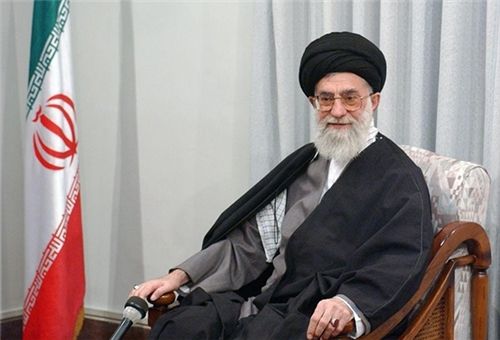
Supreme Leader pardons several female Iranian prisoners

Iran supreme leader
Iran supreme leader

Supreme Leader of the Islamic Revolution Ayatollah Seyyed Ali Khamenei has pardoned or commuted the prison terms of several women inmates on Mother’s Day which is celebrated on the birth anniversary of Hazart Fatima-Zahra (SA) [Prophet Muhammad’s daughter].

The decision, announced on Friday, was in response to a request by Judiciary Chief Ayatollah Sadegh Amoli Larijani.

According to Article 110 of the Constitution, the Supreme Leader has the authority to pardon or commute prison terms of convicts upon a recommendation from the head of the Judiciary.

Zarif: Military attack not to help Yemen

Zarif-Paki Speaker

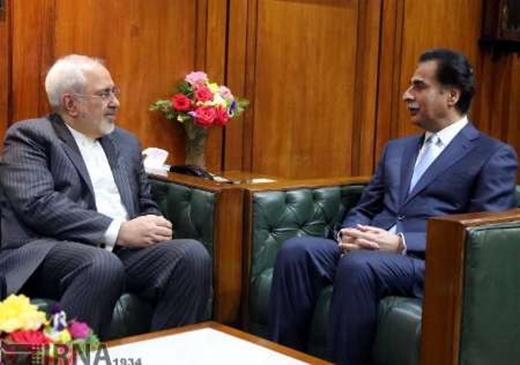
Foreign Minister Mohammad Javad Zarif said on Friday that military attacks, bombardment and destruction of infrastructure would not help Yemen.

Zarif made the remark in a meeting with Pakistan’s National Assembly Speaker Ayaz Sadiq.

Touching on the Iran-Pakistan cordial relations, Zarif described terrorism, extremism and smuggling as concerns shared by the two countries.

The Iranian minister also appreciated Pakistan for his stance toward Tehran nuclear issue.
Sadiq, for his part, underscored that Pakistan and Iran could play a pivotal role in settling regional problems.
Pointing to the current developments in Yemen, he added all parties should be invited to the negotiation table, emphasizing that dialogue is a sole way to settle the dispute in this Arab country.

The Pakistani official also called for expansion of parliamentary cooperation between the two countries.

[…]

Everything lies in details, says Leader on nuclear talks

Supreme leader

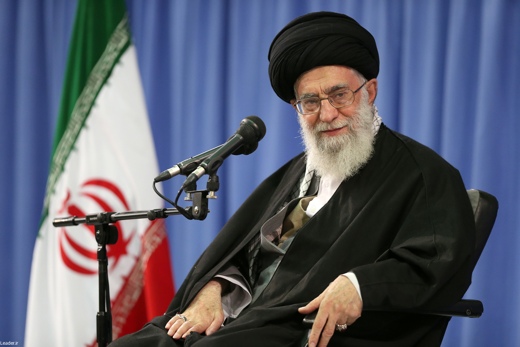
“Everything lies in the details,” said the Leader in an address on Thursday.

“The other side which is known for backpedaling on its commitments may want to corner our country when it comes to the specifics [of the negotiations],” said Ayatollah Khamenei.

“So, it is pointless congratulating me and others at this point,” the Leader underscored.

Ayatollah Khamenei suggested that what has been done so far cannot ensure a final deal.

“What has been done so far neither guarantees [the clinching of] an agreement itself and its contents, nor ensures that the negotiations would proceed to the end,” the Leader highlighted.

Ayatollah Khamenei then pointed out that “he has never been optimistic about negotiations with the US,” but that he “has supported and will support the negotiators” in the current talks.

The Leader underlined that any deal would have to “ensure the interests and dignity of the [Iranian] nation.”

Iran and P5+1 group of countries – Russia, China, France, Britain, the US and Germany – along with officials from the European Union reached a mutual understanding on Tehran’s nuclear program after eight days of marathon talks in Switzerland last week.

The two sides will now work on drawing up a final accord by the end of the self-designated June 30 deadline.


‘Saudi making mistake’

Touching upon the developments in Yemen, the Leader denounced the Saudi aggression against the Arab country as a “mistake,” saying the invasion has “set a bad precedent in the region.”

The Saudi aggression against Yemen compares to Israeli atrocities against Palestinians in Gaza, Ayatollah Khamenei noted, slamming Riyadh’s attacks against the Yemeni people as a “crime and genocide” which could be prosecuted in international courts.

He said the aggression against Yemen will be to the detriment of Saudi Arabia, adding Riyadh will, by no means, emerge victorious in its aggression.

Ayatollah Khamenei touched upon Washington’s backing for Saudi Arabia in attacking Yemen, and noted the US always sides with the oppressor rather that the oppressed.

The Leader strongly denied the allegation that Iran is interfering in Yemen, taking a swipe at the Saudi-led air campaign against the Arab country which has “made the skies over Yemen unsafe.”

He said the “ill-wishers” hatching plots against Yemen have sought to create a power vacuum in the country like what happened in Libya, but “they have failed to achieve this objective.”

A look at Iranian newspaper front pages on April 9

Iranian Newspapers Headlines

Condemnation by Iranian officials of sexual assault against two Iranian teenage pilgrims in Jeddah, Saudi Arabia dominated the front pages of newspapers on Thursday. Completion of a report on an attack on an MP in the city of Shiraz in March was also on the covers of the dailies.

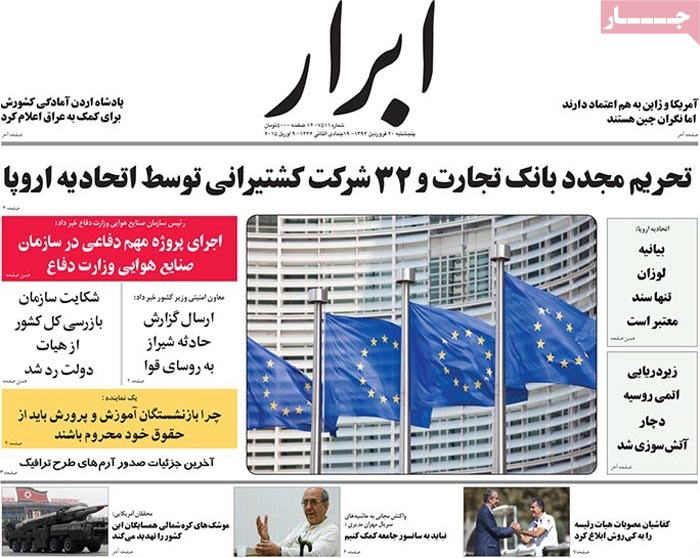
Abrar: The European Union has re-imposed sanctions on Iran’s Tejarat Bank and 32 shipping companies.

Abrar: A report on the Shiraz incident has been sent to the heads of the three branches of government.

In the incident in March assailants on motorbike attacked Tehran MP Ali Motahari who was in the southern city for a planned speech.


A look at Iranian newspaper front pages on April 9


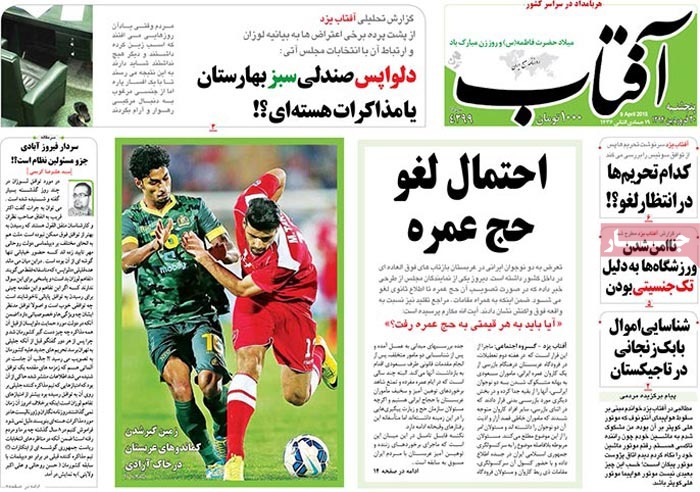
Aftab-e Yazd: The assets of Babak Zanjani [an Iranian billionaire who stands accused of massive corruption] have been located in Tajikistan.


A look at Iranian newspaper front pages on April 9


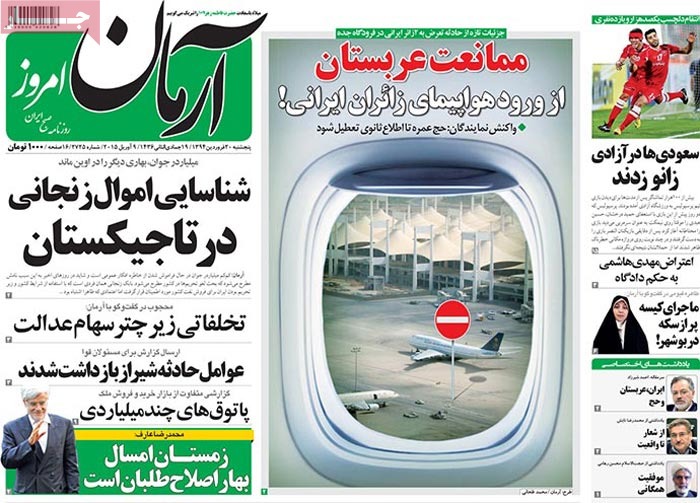
Arman-e Emrooz: Saudi Arabia has not allowed a plane carrying Iranian Hajj pilgrims to land on its soil.

In reaction, Iranian MPs have called for the minor Hajj to be put on hold until further notice.

Arman-e Emrooz: Those involved in the Shiraz incident have been arrested.

In the incident Ali Motahari, a principlist MP, was in the southern city in March to deliver a speech when his car was attacked. The speech was called off.


A look at Iranian newspaper front pages on April 9


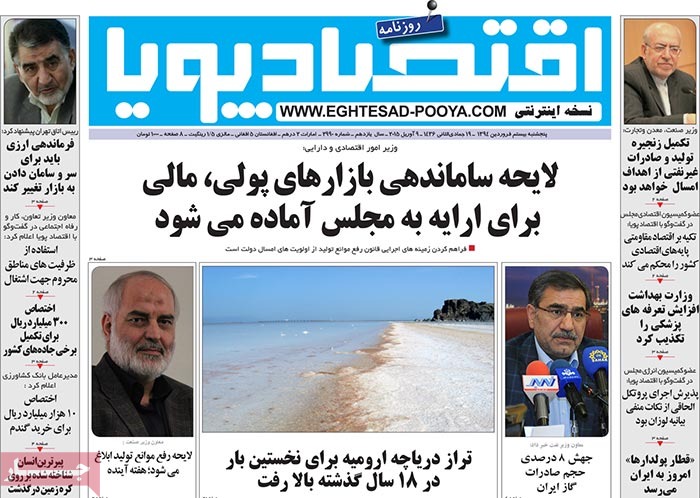
Eghtesad-e Pooya: The level of water at Orumiyeh Lake has increased for the first time in 18 years.


A look at Iranian newspaper front pages on April 9


Ettela’at: Iran is to become an official member of the Shanghai Cooperation Organization.

Ettela’at: Executive institutions have been required to cut back on water consumption by 20 percent.

Ettela’at: Pakistan has said that it will decide about joining the Yemen offensive after consultations with Iran and Turkey.


A look at Iranian newspaper front pages on April 9


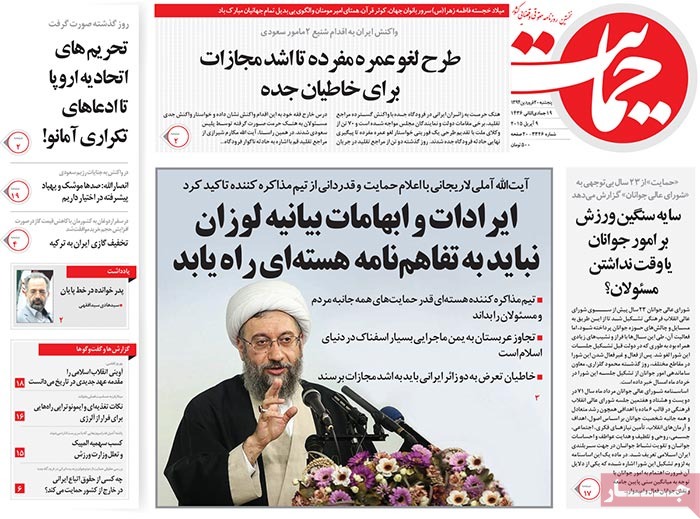
Hemayat: “The flaws and ambiguities of the Lausanne statement should not find their way into the nuclear deal.”

Judiciary Chief Ayatollah Sadegh Amoli Larijani made the comment as he supported the Iranian nuclear negotiating team and appreciated its efforts.


A look at Iranian newspaper front pages on April 9


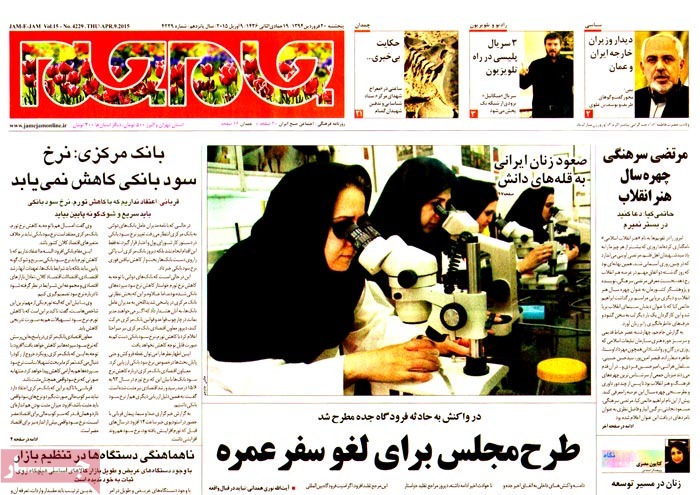
Jamejam: The Central Bank of Iran has said that interest rates won’t increase.


A look at Iranian newspaper front pages on April 9


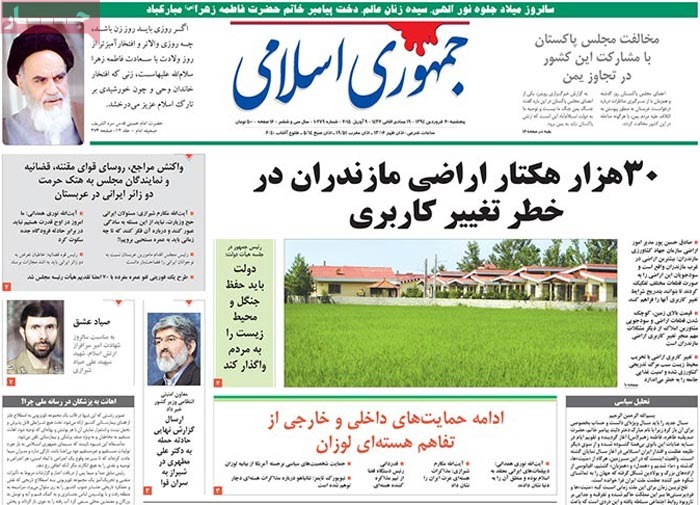
Jomhouri Islami: The nuclear statement of Lausanne continues to draw local and foreign support.

Jomhouri Islami: The sexual assault in Saudi Arabia on two Iranian pilgrims has drawn condemnation from Iranian officials and clergymen.

Senior Shiite clerics, the parliament speaker, the Judiciary chief and MPs have lashed out at the incident at Jeddah airport.


A look at Iranian newspaper front pages on April 9


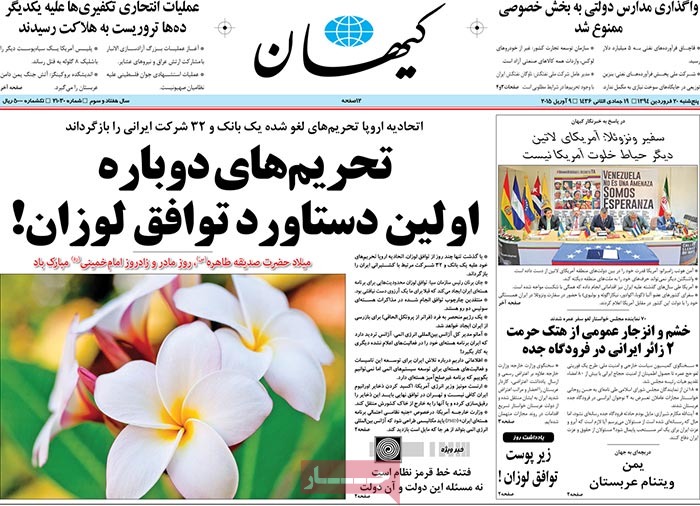
Kayhan: New sanctions are the first achievement of the Lausanne deal!!


A look at Iranian newspaper front pages on April 9


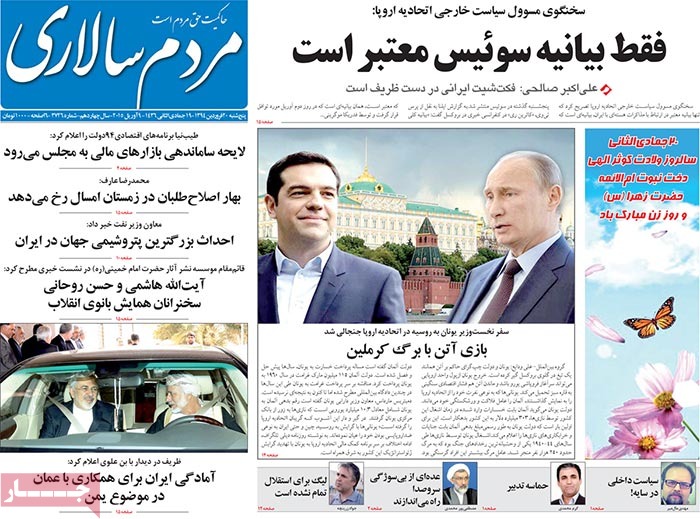
Mardomsalari: The world’s largest petrochemical complex is to be built in Iran.


A look at Iranian newspaper front pages on April 9


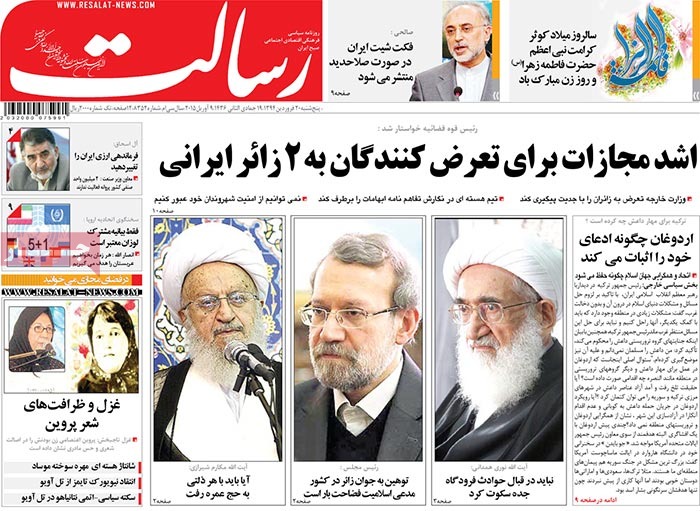
Resalat: “An assault on young pilgrims in a country which claims to be [the cradle of] Islamism is shameful.”

Parliament Speaker Ali Larijani made the comment in reaction to sexual assaults against two teenage Iranian pilgrims in Saudi Arabia.


A look at Iranian newspaper front pages on April 9


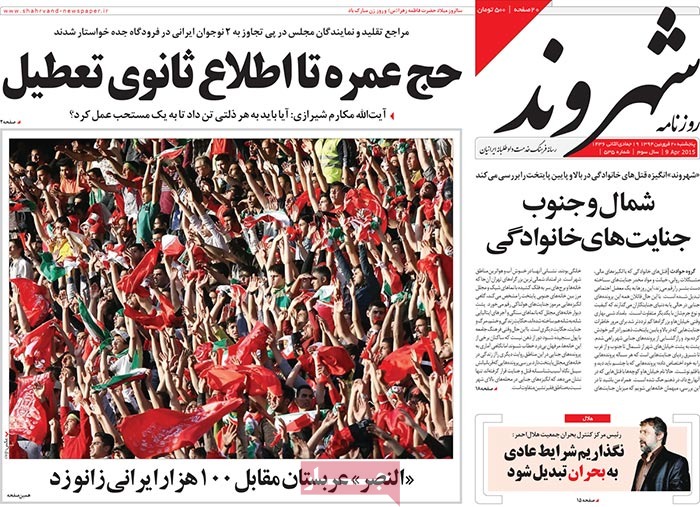
Shahrvand: Al-Nassr from Saudi Arabia were brought to their knees at a packed Azadi Stadium in Tehran.

The capital’s Persepolisclub edged the Saudi team 1-0 in Group A of AFC Champions League on Wednesday.


A look at Iranian newspaper front pages on April 9


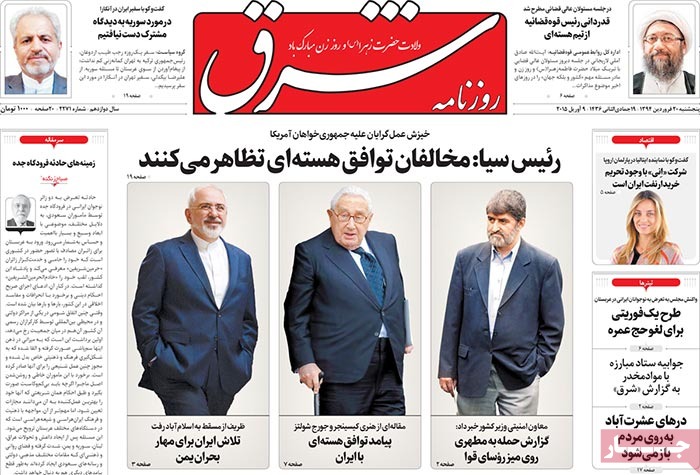
Sharq: Iran is trying to contain the Yemen crisis; Zarif flew to Islamabad from Muscat.


A look at Iranian newspaper front pages on April 9