Tuesday, January 13, 2026
Home Blog Page 4914

Charting the course toward a better nuclear deal, dos and don’ts

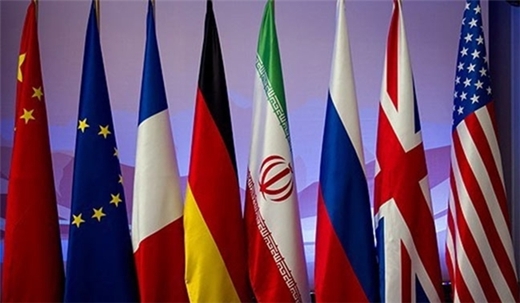
Laussane Statement

Iran is midway through the nuclear negotiations and another deadline [July 1] is looming. What Iran should do in the critical three months ahead is hotly debated in the country these days with some saying the Islamic Republic should stay the course and others suggesting otherwise.

Javan daily, which reflects the viewpoints of the Islamic Revolution Guard Corps, has – in its editorial on April 12 – divided the dos and don’ts of the nuclear talks into two categories, explaining that the first category deals with general principles or what it calls “presuppositions” or “prerequisites”.

The second category, it says, entails the principles the country’s nuclear team has been recommended to pay attention to and respect during the talks.

The following is a brief translation of the editorial written by Abdollah Ganji, the daily’s managing editor:

[…]

Up until recently, only officials and negotiators of the two sides as well as the Zionists were in on the content of the [nuclear] talks, but the Supreme Leader called for information floodgates to be opened for the public when he said “We have nothing to hide”. In order to keep members of the public informed of the future roadmap on a two-way, narrowing road, the Leader revealed what the president or foreign minister had told him.

The Leader offered strategies for the country to move forward on the path – which has been somewhat paved – it has taken. The nation has learned about these strategies and the enemies have heard them publicly and will keep hearing them during the talks.

There are some dos and don’ts [in the Leader’s remarks] which have nothing to do with the talks and the commitments of [the parties to the talks]; rather, they are [in part] an introduction to or a prerequisite of what the Iranian team should do before it enters the talks. The other part is related to the atmosphere of the talks. In other words, dos and don’ts are about: 1) prerequisites of the talks and 2) strategies of interaction, decision making and commitments in the talks.

Dos and don’ts of the prerequisites

1. Distrust of the other party: […] We are in talks with our enemy. This reminds us of the fact that the enemy can derail the talks through deception or illogical methods, and that the Americans have a long record of breaking their promises and failing to implement their commitments. Palestine, Iraq, Afghanistan and Iran are good examples, proving America’s untrustworthiness.

[…]

2. Trust in Iran’s team: […] Any suspicion of and a political look at the country’s nuclear team could cause the critics to close their eyes to the deceptiveness of the enemies and internalize the challenge [of the nuclear dispute]. In that case, the enemies can capitalize on possible rifts [in Iran] to sap the country’s potential.

3. Unfulfillment of a principle which makes it [honoring commitments] mandatory: In light of the fact that such a principle has not been fulfilled, it makes no sense to show opposition to and feel overjoyed about [a deal]. The road ahead is not a place to pass judgment [on what has happened]; rather, we are walking down a path along which we need to pay close attention to hurdles as well as road and warning signs. The slippery points on this road should be re-highlighted by those who have already trodden this path.

The potential of today’s critics and yesterday’s negotiators should be exploited as an opportunity and we should enter the talks as we steer clear of political questions and take a look [at the talking points] through a national lens.

4. Rejection of a bad deal is the common denominator when it comes to Iran and the US: […] We need to pursue a deal we deem “good” because we do not care about what they call a “bad” deal.

5. Sole-topic talks: Talks should solely focus on the nuclear issue. Existence or non-existence of the Zionists, ballistic missiles, human rights as Western standards prescribe, Iraq, Syria and Yemen will not be on the agenda of the talks.

[…]

6. P5+1 is not the whole world: Iran is in talks with six countries. […] The international community [that the US president refers to and some Iranian officials echo his remarks] includes more than 200 countries and Iran is in talks with only six of them and is being challenged by only four of them.

If we view these four states as the international community, we will be unknowingly overawed by their influence and power and ignore other nations.

7. Valuability of nuclear achievements: Some downplay this principle – laid down by the Supreme Leader – to rid themselves of challenges. […] One should be out of their mind if they say that the Zionists and the West have assassinated Iranian scientists over a worthless issue. Otherwise, they might be putting on an act to show they are intellectuals. On this, posterity will pass sound judgment.


Dos and don’ts of the strategies

1. Talks will result in a breakthrough and respect for the dignity of the Islamic Republic of Iran if they can make the other party agree to and meet the establishment’s demands.

Iran’s insistence on the elimination of sanctions – once and for all – in exchange for the commitments the Islamic Republic is to honor is a sign of Iran’s might; such insistence also emphasizes the fact that Iran will remain undeterred by continuation of the existing sanctions. […]

2. Iran’s undeclared or military sites remain off-limits to [UN] inspections. The ban was publicly communicated by the Supreme Leader to the commanders of the armed forces. That’s why the enemies should put the option [of running checks on these sites] off the table as the talks proceed. The Iranian team too is expected not to approach that option.

3. Supervision – which excludes Iran from its fellow NPT members – is forbidden, and the path of unconventional supervision – which leads to disrespect for the Iranians and to the outflow of information – should remain blocked.

The Iranian team needs to devise ways to deal with these three challenges. On the Iranian side, the Supreme Leader has given the green-light to the extension of talks after a July deadline in case they fail to produce the intended results. This will provide the Iranian team with enough time [to work on the thorny issues].

Harmony and unanimity between the government and people – underscored by the Leader – together with the president’s emphasis on the removal of sanctions on the very day a [final] deal is struck are all indicative of national solidarity on the road ahead.

The Iranian team is expected to publicly disclose the hurdles in the way of nuclear talks in order for the country to win over the support of those who give a bargaining edge to Iran in the negotiations.

The objectives Saudis pursue in airstrikes against Yemen

Saudi-Yemen-map

The editorial of Sharq daily on April 13 focused on the goals Saudi Arabia is pursuing through airstrikes on Yemen. The following is a partial translation of the piece penned by Seyyed Mohammad Sadegh Kharrazi, a former Iranian diplomat:

[…]

A realistic look at regional developments helps us realize that the gravest threat facing the Persian Gulf, Gulf of Aden and Red Sea are extremism and radicalism stoked in the past and at present by Saudi Arabia, the UAE, Qatar, and Bahrain on the one hand, and Turkey and Egypt on the other.

The experience of the past five decades shows that occasional instability in the region has given rise to interference by trans-regional powers, and that Riyadh, other powers and Israel – through its overt and covert role in regional developments – have taken a high-risk gamble, undoubtedly too difficult to ride out gracefully.

History in the Middle East shows that non-governmental militias wield substantially greater influence than a regular army which does not enjoy popular support. For instance, Afghan fighters gained victory in their fight against the Soviet Union, or Lebanon’s Hezbollah won the 33-day war that pitted it against one of the world’s most terrifying armies. The Israeli army failed to defeat Hezbollah fighters in an expanse of land no bigger than 340 square km in area and suffered an abject defeat.

[…]

Saudi airstrikes in Yemen have brought about yet another calamity for the latter. Ansarallah is a group made up of millions of Shafi’i and Zaidi Muslims as well as other Yemenis who have coexisted peacefully for centuries. They have now united in the face of foreign aggression. The Houthis are armed with all kinds of military equipment and weaponry and a major part of the Yemeni army’s equipment is now in the hands of Ansarallah.

[…]

Given all facts on the ground in Yemen, now the question is why Riyadh has acted upon the half-baked idea of attacking Yemen and taken a massive risk?

This abrupt shift in Saudi policy came after the demise of King Abdullah. Up until the eve of his passing, Houthi representatives were the special guests of the Saudi government, negotiating the future of Yemen and a replacement to take the helm of the country. Now the question is what changes the death of King Abdullah has brought about to prompt Riyadh to supersede negotiations, a logical settlement and dialog with war and airstrikes.

The division between Saudi leaders is so clear. There are disagreements between Nayef bin Abdulaziz Al Saud [Saudi crown prince] and Bandar bin Sultan over airstrikes and military action on the ground in Yemen, so much so that the US has tried to act as an intermediary to settle the difference.

Currently, Saudi Arabia is unable to bring things under control in its backyard. It has also failed to contain different resistance and revolutionary movements. Besides, every offer floated by the Saudi regime has been turned down by the Houthis.

On two fronts, Riyadh has come across a grave crisis in the court of public opinion: Its support for al-Qaeda and IS beyond its borders and the legitimacy of its new rulers which has become a serious crisis gripping the country. A new generation who does not buy the idea of one family being at the helm of the country has presented the government with a legitimacy crisis.

The Saudis are under the impression that involvement in Yemen’s war can bring the national unity back to the establishment and the House of Saud.

However, the Saudi show of force has not only sparked off more crises in the region, but it has exposed the Saudi foreign policy.

Regional strategists have long described any security crisis in the region as a threat to national security of regional nations. One such example has been al-Qaeda, whose threat to national security has been experienced firsthand.

The Saudi intelligence agency has denied the region security for several years by lending long-term support to al-Qaeda as well as its recent backing of IS. And in an unwritten deal with Arab terrorists, Riyadh has ensured its internal security.

But we are talking about a serious war here. It is no longer possible to stir up insecurity in the region and buy security at home. Security is a concept to which a lot of factors contribute. Half-hearted attempts to ensure security like the establishment of puppet governments will shortly turn into a danger and a threat to security.

A hardworking female Iranian rice farmer (PHOTOS)

rice farmer

Aunty Nesa, a rice farmer who leads a simple life with her husband in the northern Iranian city of Amol, is so fond of farming. She has a hopeful approach to life and believes that work is a cure for all health problems.

The following is a photo gallery that Mehr News Agency placed online on April 8 depicting her at work and home:

A bridge with an interesting function in northern Iran (PHOTOS)

bridge

A village in northern Iran is home to a bridge which has an interesting structure. Water passing below the bridge goes down to farms to be used for agricultural purposes and the channel over the bridge makes it possible to collect rain water.

What appears below is the snapshots that khazarnama, a website, put online of the bridge:

Car, motor racing in suburban area (PHOTOS)

motor racing

Motorcyclists who are interested in popping a wheelie and riding their expensive motorbikes at high speed go to the suburbs of Lamerd in the southern province of Fars to perform acrobatic feats. The area also attracts drivers who are crazy about racing.

What appears below is a number of photos that Mehr News Agency released online on April 12:

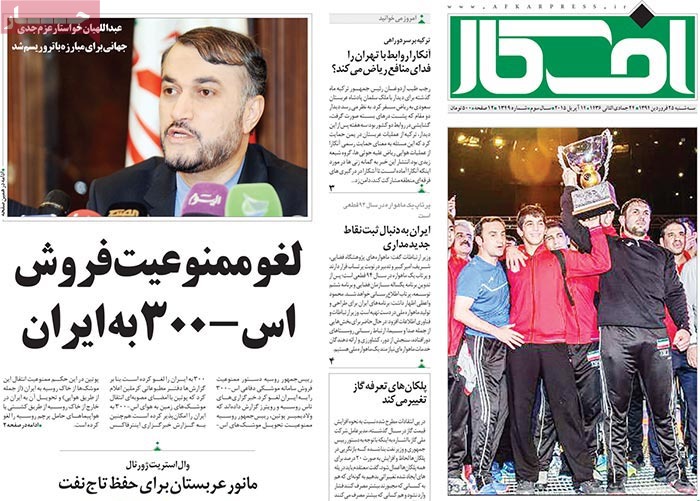
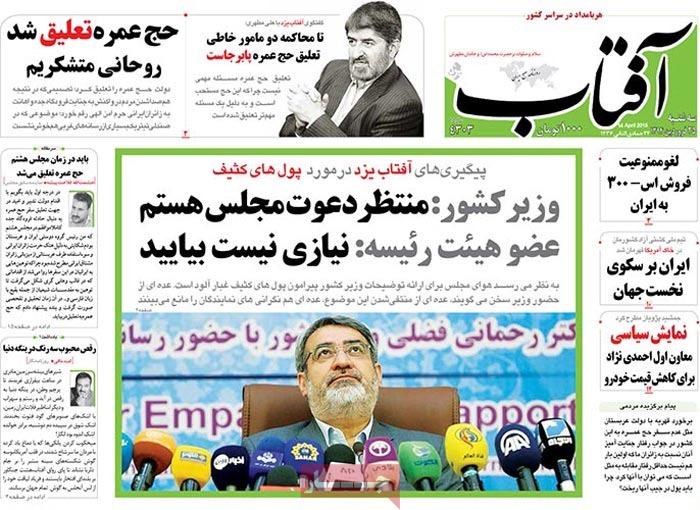
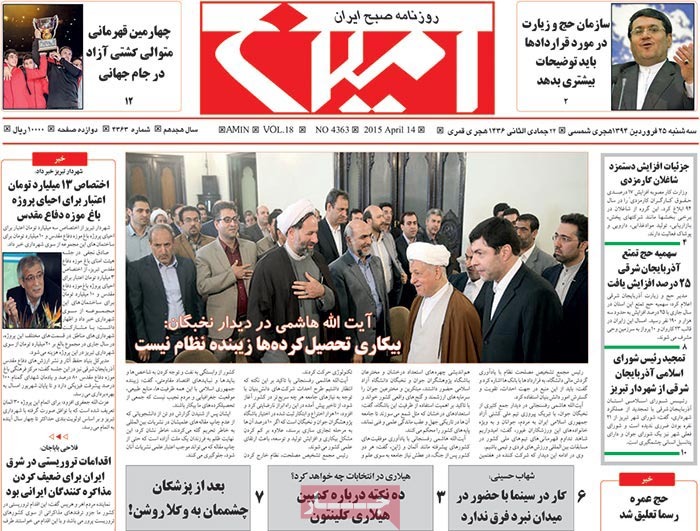
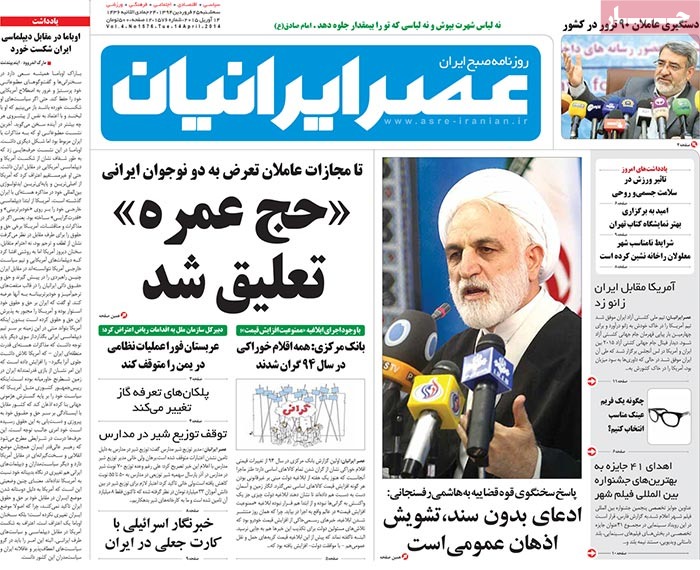
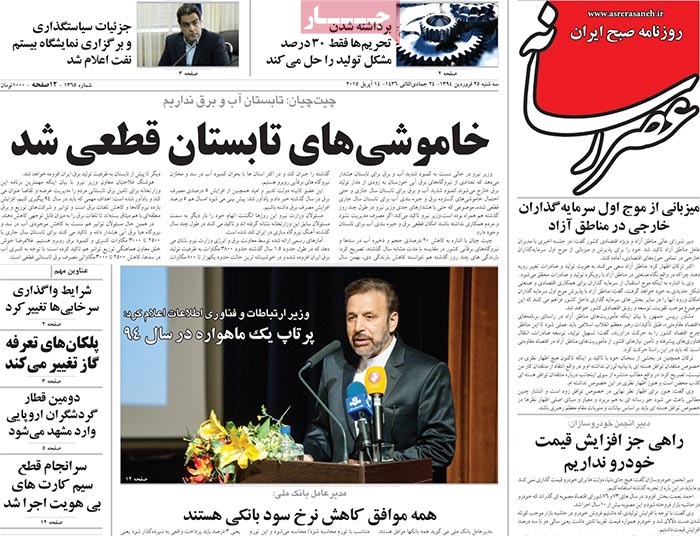
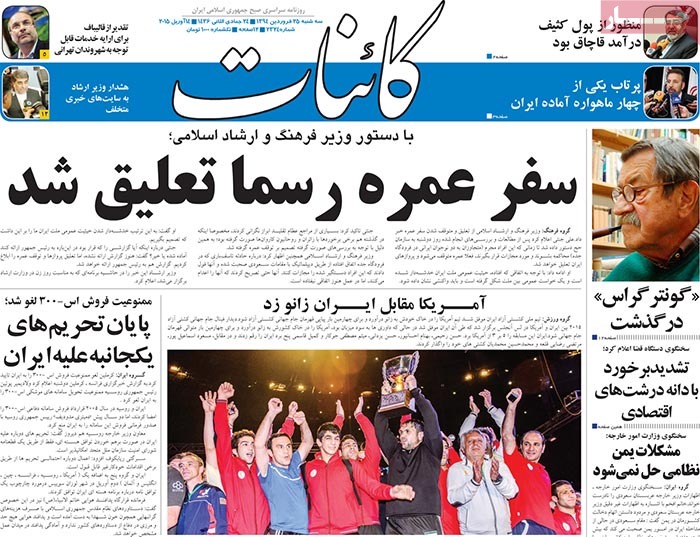
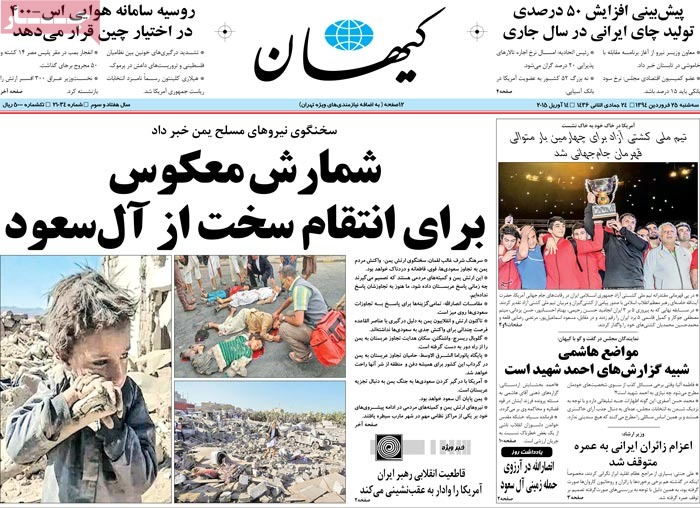
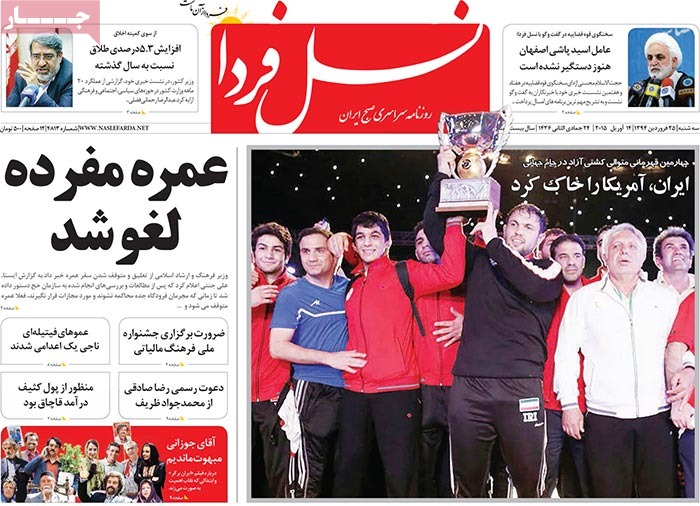
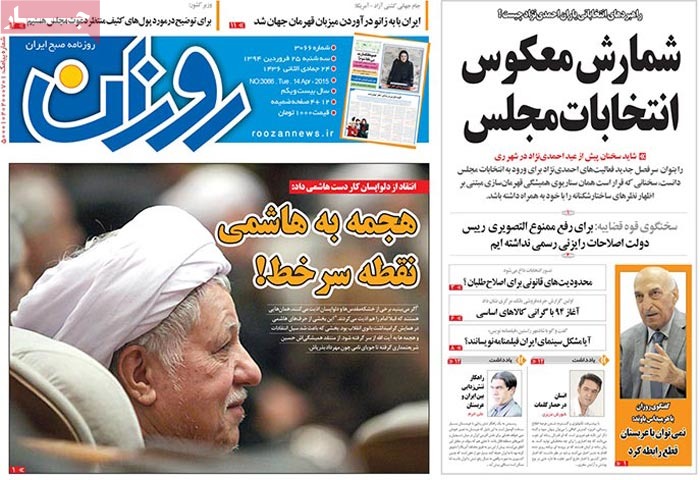
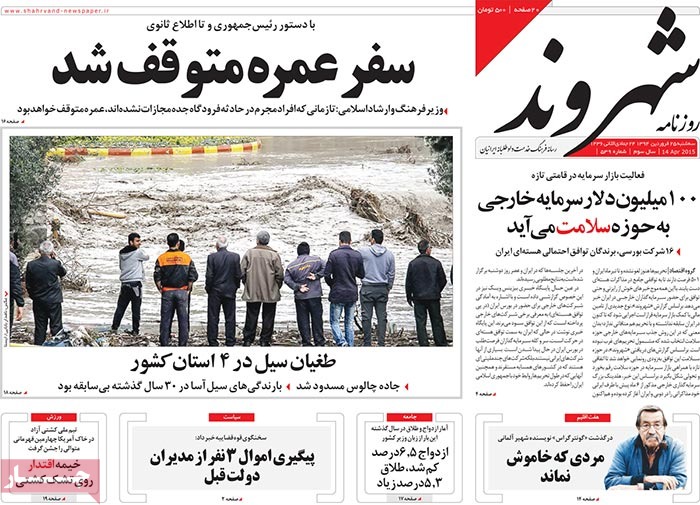
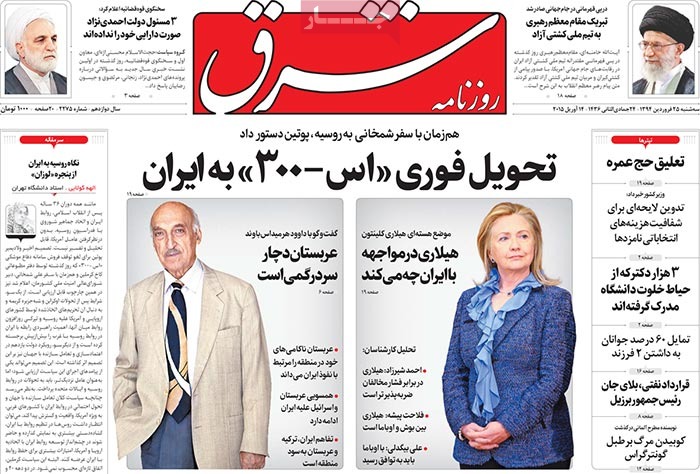
A look at Iranian newspaper front pages on April 13

Iranian Newspapers Headlines

Comments by President Rouhani at a gathering to honor the memory of the late wife of the founder of the Islamic Republic dominated the front pages of Iranian newspapers on Monday. In his comments, the president took a swipe at those who limit the principle of preventing vice to women on the streets.


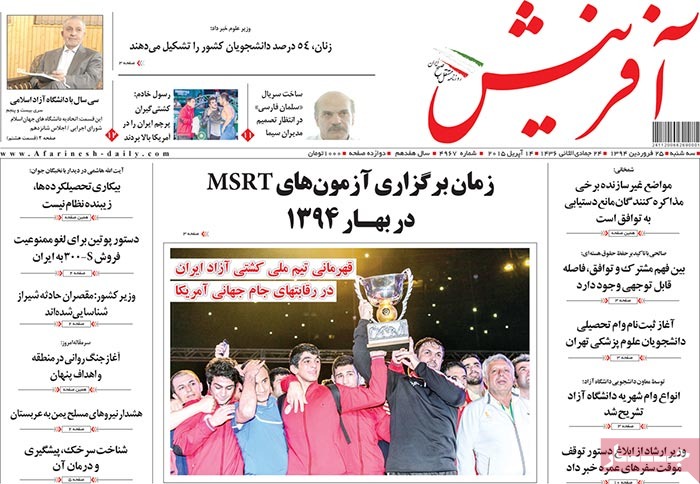
Afarinesh: The Supreme Leader has met with sources of emulation in Qom.

Afarinesh: The Iranian oil minister has held talks with officials of three Chinese oil and energy giants.


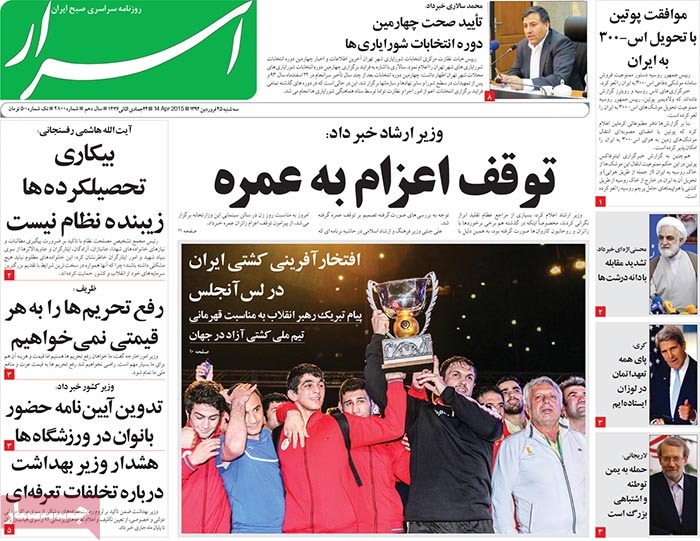
A look at Iranian newspaper front pages on April 13


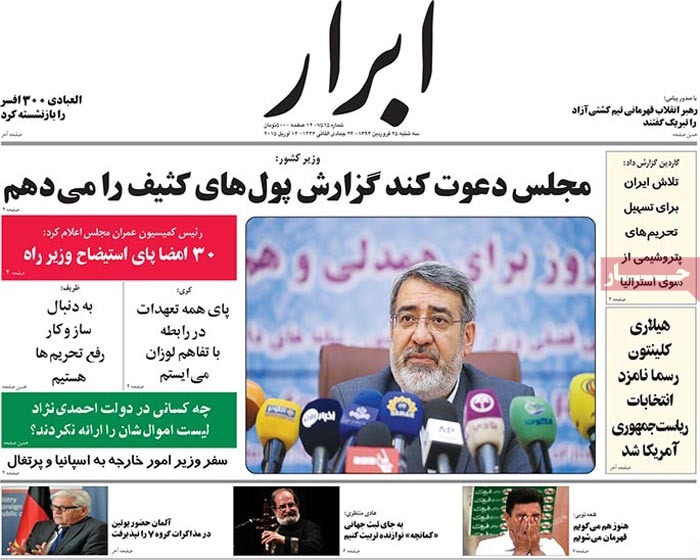
Asrar: “The Worriers got under the skin of the late Imam too,” said the chairman of the Expediency Council.

[Ayatollah Rafsanjani was referring to those who keep opposing President Rouhani’s domestic and foreign policy].


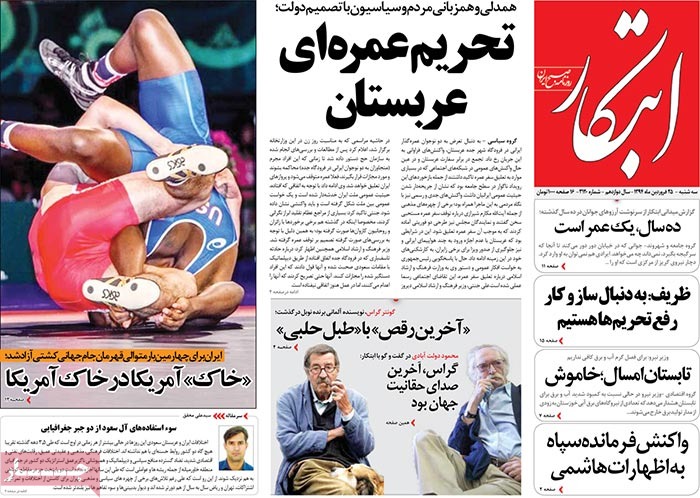
A look at Iranian newspaper front pages on April 13


Emtiaz: Sixty-two petrochemical projects are set to absorb foreign investment.

Emtiaz: As part of efforts to streamline banking, interest rates are likely to decrease.


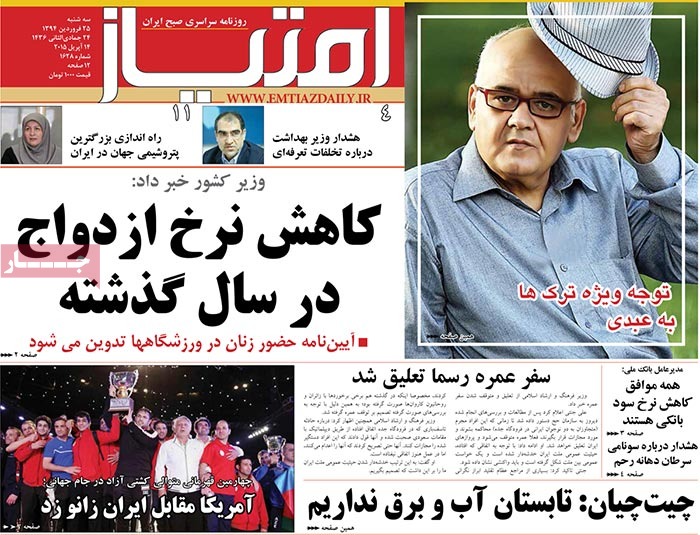
A look at Iranian newspaper front pages on April 13


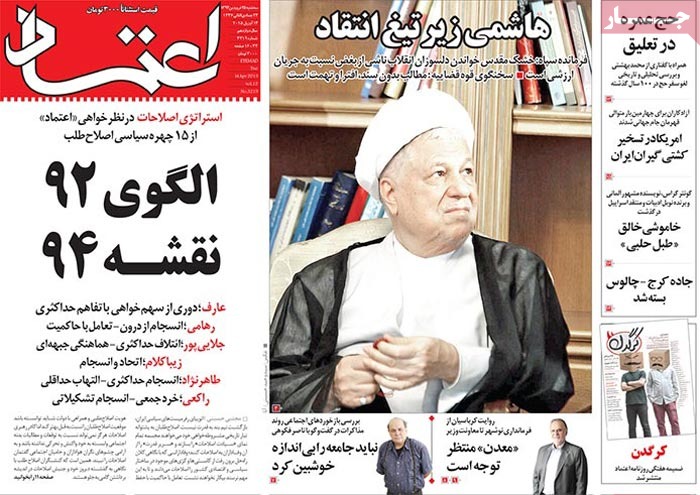
Etemad: “The late Imam’s wife urged me to run for president [in 2005],” said Ayatollah Hashemi Rafsanjani.


A look at Iranian newspaper front pages on April 13


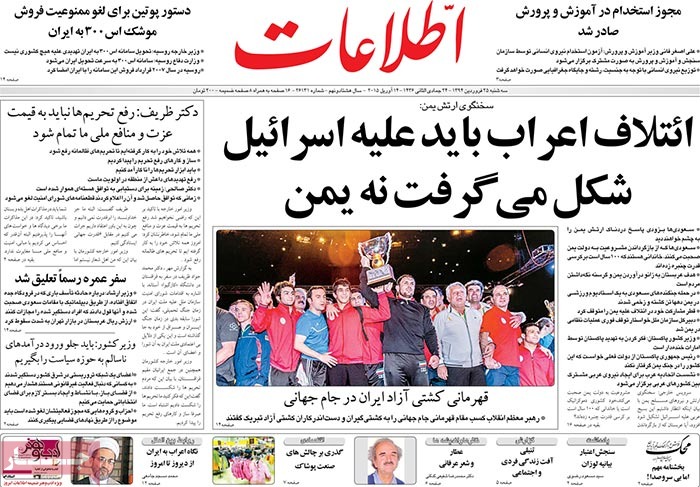
Ettela’at: “Women should have equal rights with men,” said President Rouhani.

Ettela’at: The return of flamingos suggests that efforts to revive the Orumiyeh Lake are on track.


A look at Iranian newspaper front pages on April 13


Farhikhtegan: “We can’t lock up 50 percent of the population at home,” said President Rouhani.

The president made the comment at a gathering entitled “The Lady of the Islamic Revolution”.


A look at Iranian newspaper front pages on April 13


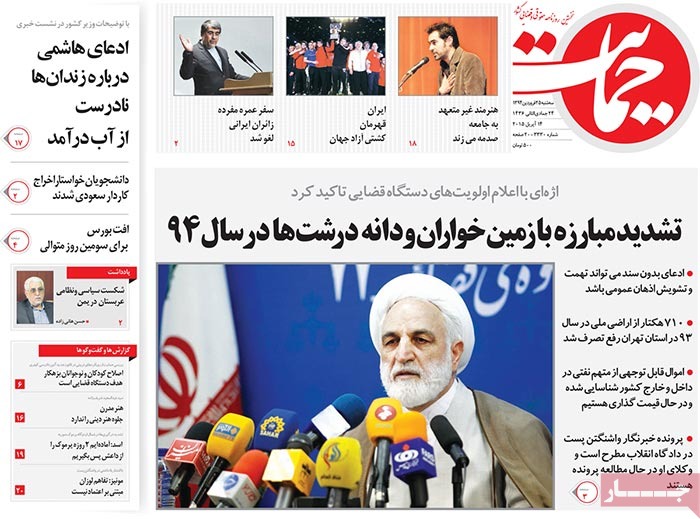
Hemayat: An Iranian tank that rolls on wheels will be unveiled later in April.

The announcement was made by the commander of the ground troops of the Iranian Army.

Hemayat: “Release the Iranian fact sheet of the Lausanne statement,” some 212 MPs have asked the Iranian negotiating team.


A look at Iranian newspaper front pages on April 13


Jomhouri Islami: Those who attacked Tehran MP Ali Motahari have yet to be hauled before court.

Jomhouri Islami: “All primary schools are to come under dental care coverage,” said the Iranian health minister.


A look at Iranian newspaper front pages on April 13


Kayhan: “IS Takfiri [terrorists] are too weak a force to pose a threat to Iran,” said a senior Iranian Army commander.


A look at Iranian newspaper front pages on April 13


Mardomsalari: “Those who disrupt the security of parties will be seriously dealt with.”

The warning was made by the deputy interior minister for security affairs.

Mardomsalari: Some 25,000 Iranians are on an organ transplant waiting list.


A look at Iranian newspaper front pages on April 13


Qods: “The two Saudi officers who have sexually abused two Iranian teens should be executed,” said Alaeddin Boroujerdi, a senior MP.


A look at Iranian newspaper front pages on April 13


Sharq: “Non-oil exports are poised to make a 20 percent jump this year,” said a deputy trade minister.


A look at Iranian newspaper front pages on April 13


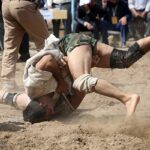
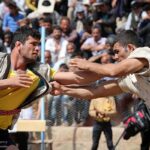
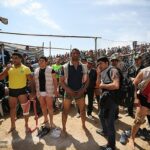
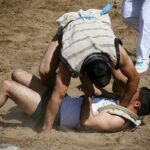
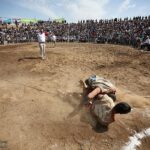
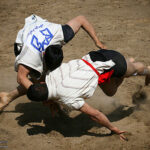
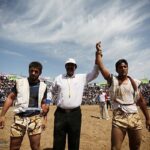
Iran beat US to win 2015 Wrestling World Cup

Wrestling

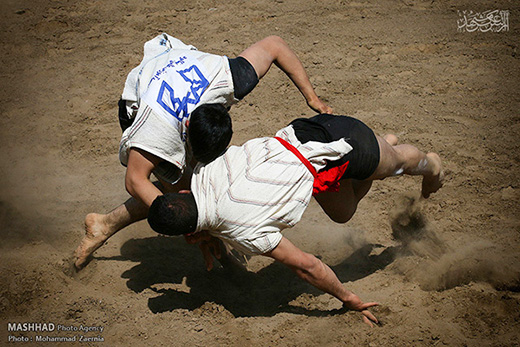
Iran beat the United States to win the 2015 Freestyle Wrestling World Cup. Iranian wrestlers defeated the US squad competing on home soil to win the tourney.

Iran’s wrestling team beat the Americans 5-3 on Sunday in Los Angeles to win the prestigious international title for a fourth time in a row.

Behnam Ehsanpour and Meysam Mostafa Jowkar played a major part in Iran’s victory against host America while US Olympic gold medalist Jordan Burroughs once again remained an untouchable target for Iranian wrestlers at 74 kilogram.

The victory came as a cheering Iranian crowd filled the venue to applaud the world-class Persian wrestlers.

Iranian wrestler Komeil Qassemi waved the Iranian flag after beating one of his opponents in the 2015 Freestyle Wrestling World Cup in the United States.

Before the final, the consolation match to determine the third-place team was held in which Azerbaijan and Russia leveled on points in the consolation match, but Azerbaijan pushed its way through by technical points with 34 to 28.

Iran beat Belarus and Turkey 8-0 and 7-1, respectively before topping Azerbaijan 7-1 in the pre-final match.

Iran has won five editions of the international competition, including the three last rounds. The tournament, which has been held annually since 1973, features the top teams in the global ranking from the previous year of the competition, Press TV reported.

Meanwhile, in a message, the Supreme Leader has congratulated the team on their stellar performance and championship in the event.

Rouhani says ‘tough road’ ahead of final nuclear deal

Rouhani

In a joint meeting of his administration and parliament on Sunday, Rouhani said that Iran regards the recent agreement as only the beginning of a long and complicated road to a comprehensive deal.

“In these negotiations, we agreed on solutions and we have a very tough road ahead before reaching the final outcome,” Rouhani said.

The Iranian president further warned the Western powers that they must stick to their commitments in case a permanent agreement is achieved.

“The assumption that the US and EU are big powers and therefore can do anything is wrong. And their reputation and prestige would be jeopardized in case they violate their commitments,” Rouhani said, adding “Our diplomats, legal experts, and politicians are formidable and the other side could not overpower us.”

Rouhani said the world has come to realize that the Iranian nation and government would in no way yield to pressure in nuclear negotiations, adding “the other side clearly knows that this government and nation are not used to submissiveness.”

The president further vowed that his administration would do its best to safeguard all the Iranian nations’ rights including the right to nuclear technology.

[…]

Iran’s Larijani praises nuclear negotiators’ efforts

larijani

Parliament Speaker Ali Larijani has praised the nuclear negotiators’ hard work during the talks between Iran and P5+1.

“One of the nuclear talks’ achievements is resolving a fabricated negative atmosphere against Iran,” said Larijani during a joint meeting of the government and parliament on Sunday.

He further warned of the stumbling blocks in the talks, which he said are created by a number of states trying to hamper the finalization of an agreement.

“Iran is independent in all regional and international issues and despite disagreements from some governments, nations have constantly supported us thanks to the essence of the Revolution,” Larijani said.

[…]

Iran’s Melbourne to be screened in Portugal, Belgium

Melbourne

Iranian feature film Melbourne will attend two international film festivals in Portugal and Belgium.

Iranian director Nima Javidi’s debut feature movie Melbourne will participate at the competition section of IndieLisboa and Belgium International Film Festivals held in Portugal and Belgium.

Melbourne is the only representative of Iran which will attend the festivals on May, 2015. The movie will be also screened at this time at the Iranian Film Festival held in the University of California, Los Angeles.

So far, Melbourne has bagged two awards at the Stockholm International Film Festival. The film has received critical acclaim at the 71st Venice International Film Festival in Italy.

The work also attended the 10th edition of Zurich international Film Festival and the 27th Tokyo International Film Festival. It also participated at the competition section of the 15th International Film Festival Bratislava and the Cairo International Film Festival.

The 8th Asia Pacific Screen Awards (APSA) has nominated Javidi for the Best Screenplay, to be held in Australia’s Brisbane on 11 December.

The film recounts the story of a young couple on their way to Melbourne to continue their studies. However, just a few hours before the departure of their flight, they are unintentionally involved in a tragic event.