Thursday, December 25, 2025
Home Blog Page 4908

Sanctions do not erode hope and prudence: President

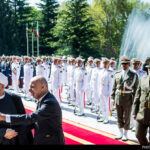
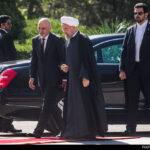
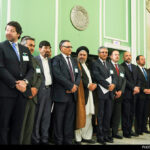
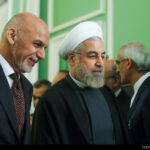
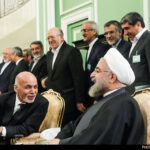
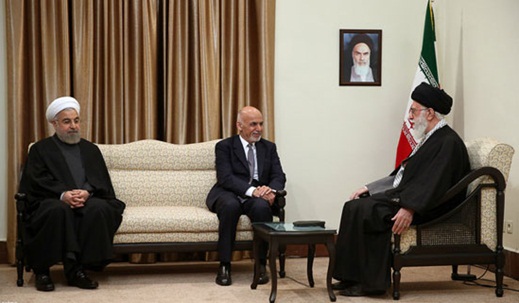
The Iranian nation is walking down the path of self-reliance, economic independence and knowledge-based progress which are the building blocks of the resistance-based economy, President Hassan Rouhani told reporters Tuesday after the inauguration of Phase 12 of South Pars gas field.

The following is a partial translation of the president’s comments as reported by the website of the presidential office:

In comments aimed at P5+1, the president said inauguration of a megaproject like Phase 12 of South Pars shows that sanctions were not the reason why Iran decided to sit at the negotiating table. [If sanctions had been effective] Such great projects would not have come on stream. We managed to complete these great projects when we were subjected to sanctions.

The president admitted sanctions created some problems for the country, but said they were unable to interfere with its overall progress. “The reason why we agreed to hold talks was to serve everyone’s interest. Conclusiveness of the talks would serve the interests of the region, P5+1 and the entire world.”
President Rouhani further said, “Inauguration of this project proves to the world that gone are the times when sanctions and pressures were effective on the international stage.”

Later at a gathering of oil and gas industry officials, the president said his government pins hope on no one other than God and members of the public and that sanctions do nothing to erode hope and prudence.

He said local experts have implemented the better part of the project on their own and that when foreign contractors stopped honoring their end of the bargain, Iranian experts pitched in and picked up the work where it was left off by foreigners.

President Rouhani said he has told leaders of five countries engaged in talks with Iran over the nuclear issue that sanctions are illegal and against human rights principles.

In conclusion, he said nuclear talks will produce results sooner or later.

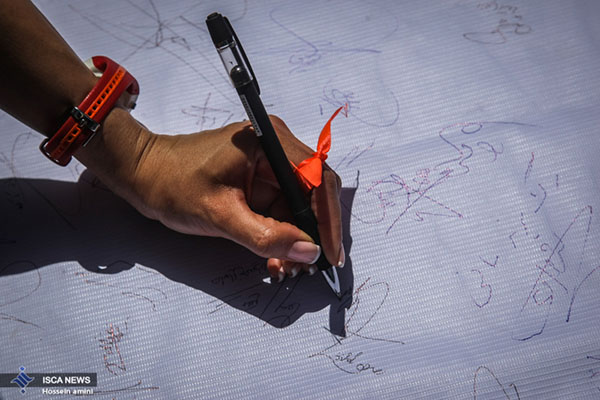
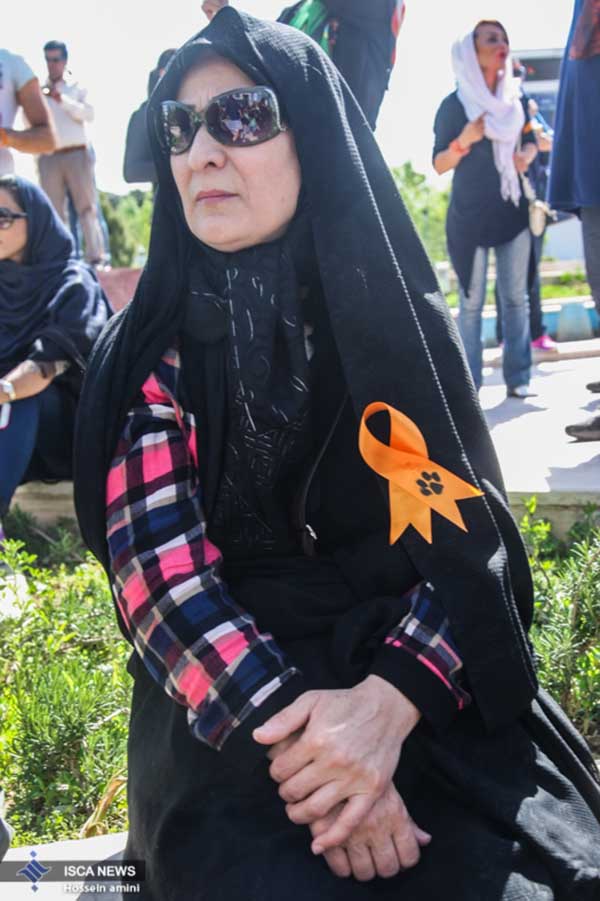
Fatemeh Motamed-Arya joins campaign to help the homeless

Fatemeh Motamed Arya

Iranian artistsFatemeh Motamed-Arya, a well-known Iranian stage and screen actress, has offered the “most prestigious award” she has won for her part in Gilaneh from the International Resistance Film Festival to a campaign to build shelters for the homeless.

Khabaronline, a news website, reported on Tuesday that Motamed-Arya is the third Iranian artist who has joined the campaign launched by Rakhshan Bani-Etemad, an internationally and critically acclaimed director and screenwriter, and Reza Kianian, an well-known actor, after they put up their awards for sale, so that the proceeds could go to a charity to build accommodations for the homeless.

The campaign is dubbed “Sarpanah, an 8th S:” in reference to an Iranian New Year tradition called “Haft Seen”[According to this tradition, Iranian families put seven items starting with the letter “S” in Farsi either on a table or on a piece of cloth spread on the floor. Each of the items represents an important concept reminding people of their significance at the turn of the year. The proposed campaign whose name starts with the letter of “S” – Sarpanah, meaning shelter – is meant to remind people of helping the homeless at the beginning of the New Year.]

Describing the move as one to promote peace and humanitarian causes, Motamed-Arya said, “I will offer my prize to this campaign, because I think it has humanitarian roots and can bring people with different beliefs and various financial backgrounds together to rally behind a lofty social cause. Amid wars, violence and conflicts over power, there are still some people with kind hearts across the world who launch campaigns to promote humanity in return for nothing.”
She added, “Building accommodations for the homeless cannot be done solely by the public or by the authorities alone; rather, cooperation between the two is necessary to make it happen.”
Energy cooperation with China ‘strategic’: Zanganeh

Zangeneh-Oil Minister

Iran’s Minister of Petroleum Bijan Namdar Zanganeh has described energy cooperation with China as “a strategic decision,” reiterating that Tehran is ready to expand ties with Chinese companies after anti-Iran sanctions are lifted.

Zanganeh described China and Russia as Iran’s “strategic partners” saying that “countries which cooperated with us under sanctions will be given priority in post-sanctions era.”

He also pointed to the cooperation with China National Petroleum Corporation (CNPC) in developing phase 11 of massive offshore South Pars gas field and said the contract was terminated due to sanctions imposed on Iran over its nuclear program.

The Iranian minister also said completion of all phases of South Pars gas field needs $20 billion in investment which is to be financed through domestic resources.

“If the finances are provided, South Pars gas field will be completed within three years,” Zanganeh was quoted as saying.

South Pars covers an area of 9,700 square kilometers, 3,700 square kilometers of which is in Iran’s territorial waters in the Persian Gulf. The remaining 6,000 square kilometers is situated in Qatar’s territorial waters.

The gas field is estimated to contain a significant amount of natural gas, accounting for about eight percent of the world’s reserves, and approximately 18 billion barrels of condensate.


Boost in gas exports

Zanganeh also announced that Iran wants to boost gas exports to regional countries including Turkey, Iraq, Azerbaijan, Afghanistan, Pakistan as well as Persian Gulf Arab states.

He pointed to the issue of gas exports from Iran to Pakistan and said Iran has already completed its share of the pipeline under the agreement and will use it to supply gas to southeastern parts of the country.

“Pakistan has announced that it cannot build the gas pipe line due to sanctions… The issue of fines and other articles of the contract still hold and any change in this regard should be discussed,” Zanganeh noted.

Iran and Pakistan signed an agreement for the construction of the gas pipeline in 1995. Later, Iran made a proposal to extend the pipeline from Pakistan into India. In February 1999, an accord between Iran and India was signed.

But due to US pressures, India withdrew from the project in 2009.

Iran has already built its 900-kilometer share of the pipeline on its own soil and is waiting for the 700-kilometer Pakistani side of the pipeline to be built.

The Iran-Pakistan pipeline aims to help Pakistan overcome its growing energy needs at a time when the country of over 180 million people is grappling with serious energy shortages.

The United States has long been threatening Islamabad with economic sanctions if it goes ahead with the plan.

Iran eyes tariff increase to boost production

Nematzadeh

Iran says it considers increasing import tariffs in an effort to protect domestic production.

“Import tariffs should be increased to dissuade people from importing goods,” Tasnim News Agency quoted Mohammad Reza Nematzadeh, Minister of Industries, Mines and Trade as saying.

Nematzadeh said supporting production units as well as projects which contribute to the expansion of non-oil exports top the agenda of the government.

He also called on Iranian consumers to purchase home-grown products to boost the country’s economy.

“By buying Iranian goods, people can contribute to improving the country’s per capita income, as well as employment rate. Iran is getting industrialized and to be successful on this path, it needs the nation’s sacrifice,” said Nematzadeh.

Boosting domestic production

Back in February, Iran’s government spokesman announced that the country will counter foreign economic pressures via relying on domestic capacities.

Nobakht-1“I, as the spokesman of the government, officially declare that as the enemies pile up pressures, we will run the country properly via reliance on domestic capacities and boosting unity among people, the government and parliament,” Mohammad Bagher Nobakht said.

He pointed to the ‘unprecedented’ plunges in oil prices in recent months and said dependency on oil revenues was cut by 8% in the budget proposed by the government.

“Despite all difficulties imposed by the enemy, we managed to decrease the budget,” said Nobakht.

Resistance-based economy

The head of Iran’s Management and Planning Organization also reiterated that the budget has been planned in line with principles of resistance-based economy.

Last year, the Leader of Iran’s Islamic Revolution Ayatollah Seyyed Ali Khamenei outlined general policies of the resistance-based economy and called on the three branches of the Iranian government to implement the general policies of the resistance-based economy.

This economy is aimed at promoting knowledge-based economy and domestic production, especially in strategic products and services, slashing dependence on imports and oil revenues.

Iran’s Zarif, UK’s Hammond meet in Brussels

ZArif-Hammond

Iranian Foreign Minister Mohammad Javad Zarif has held talks with his British counterpart Philip Hammond over Tehran’s nuclear program and the latest developments in the Middle East.

Held in the Belgian capital city of Brussels on Monday, the talks were focused on mutual efforts on the part of Iran and P5+1 to narrow their gaps with the aim of reaching a deal to resolve the dispute over Iran’s nuclear issue.

Zarif and Hammond emphasized the significance of coming up with mutually-agreed solutions to the outstanding issues surrounding Tehran’s nuclear program, noting that the negotiating sides must make the most of the remaining time ahead of the July 1 deadline for a final deal.

They also called for further consultations between Iran and the European Union.

Also on Monday, Zarif and EU foreign policy chief Federica Mogherini engaged in key talks about the latest developments regarding Tehran’s nuclear issue and the country’s relations with the 28-nation bloc.

The chief Iranian negotiator emphasized that there will be no agreement between Tehran and the P5+1 countries unless the two sides agree on all topics.

Mogherini, for her part, said all sides should make efforts to bridge their differences on the nuclear issue.

She added that European countries are highly motivated about a nuclear agreement between Iran and P5+1 and will play an effective role in helping the two sides reach the deal.

After sitting for talks with US Secretary of State John Kerry, Zarif left for Brussels to discuss Iran’s nuclear issue with his German, French and UK counterparts, respectively, Frank-Walter Steinmeier, Laurent Fabius, and Hammond.

Mogherini was the host to the Brussels talks, which were described in a last-week statement by her office as “part of the ongoing nuclear negotiations with Iran.”

Iran and P5+1– the United States, Britain, France, China, and Russia plus Germany – are seeking to seal a comprehensive nuclear deal by July 1.The two sides have already missed two self-imposed deadlines for inking a final agreement since they signed an interim one in the Swiss city of Geneva in November 2013.

Tehran Symphony Orchestra back from hiatus

Tehran Symphony Orchestra

Tehran Symphony Orchestra is officially shaken out of a long hiatus under the management of Iranian maestro Ali Rahbari.

The orchestra returned to life after a 25-month break on Monday night with live performances conducted by Rahbari in the presence of various political figures and prominent artists in Tehran’s Vahdat Hall.

In a demonstration of his dexterous capabilities, Rahbari conducted Ludwig van Beethoven’s Symphony No. 9, a seminal piece in D minor, also known as “the Choral.”

Following the performance, Rahbari said, “Tonight is one of the best nights of my life, because I saw the Tehran Symphony Orchestra back on stage.”

He added, “This orchestra’s members are the country’s cultural and artistic assets,” and thanked all those who helped restore the ensemble.

“Tehran Symphonic Orchestra has nothing less than the world’s famous orchestras and with constant practice can live up to international standards,” he said.

The orchestra also preformed Iran’s national anthem during the ceremony.

Senior officials, including Culture Minister Ali Jannati, First Vice President Eshagh Jahangiri, and Deputy Culture Minister for Artistic Affairs Ali Moradkhani, were present among the audience.

Rahbari was invited from Austria to restructure the orchestra in 2004, but he quit the job in the following year due to a number of problems, including low salaries paid to the orchestra’s musicians.


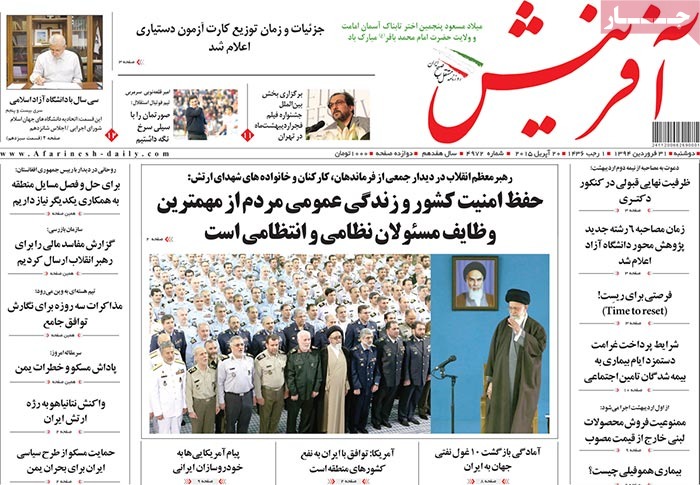
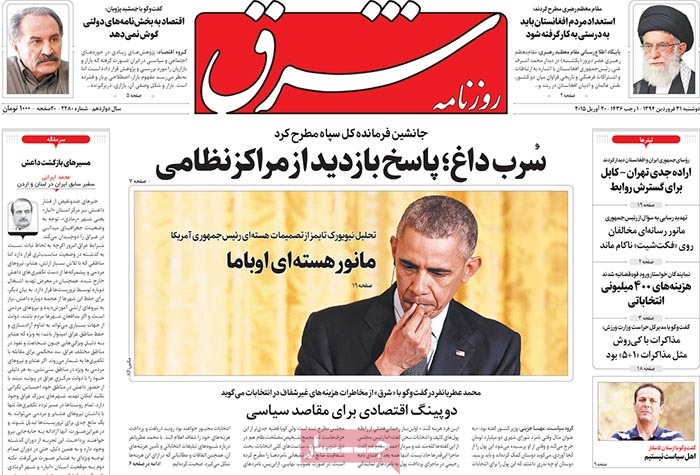
A look at Iranian newspaper front pages on March 17

Iranian Newspapers Headlines

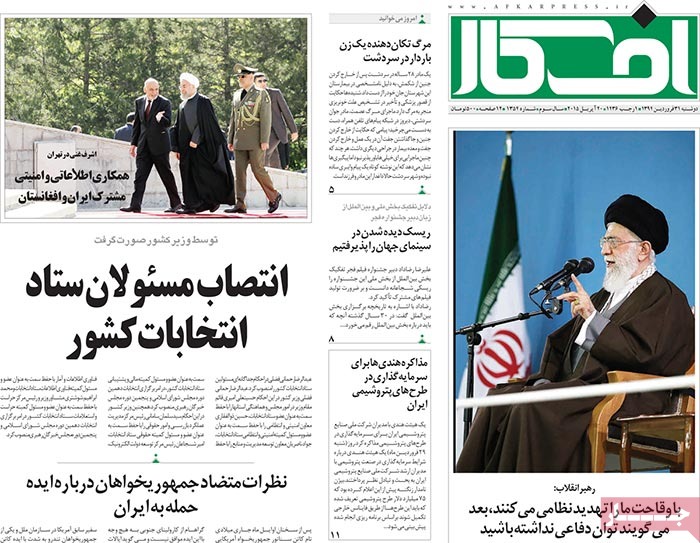
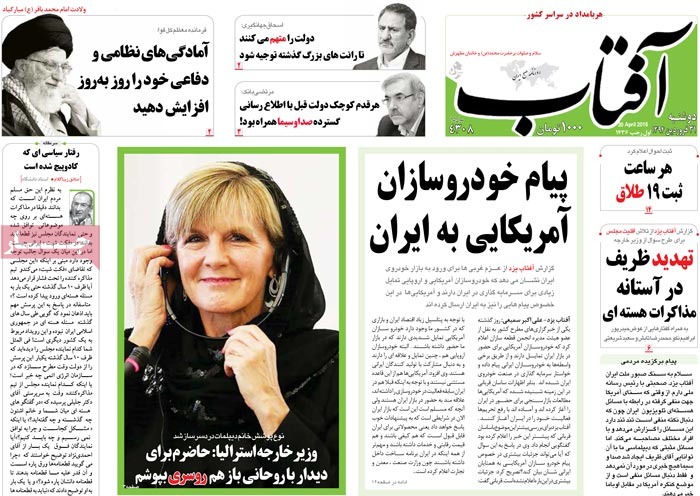
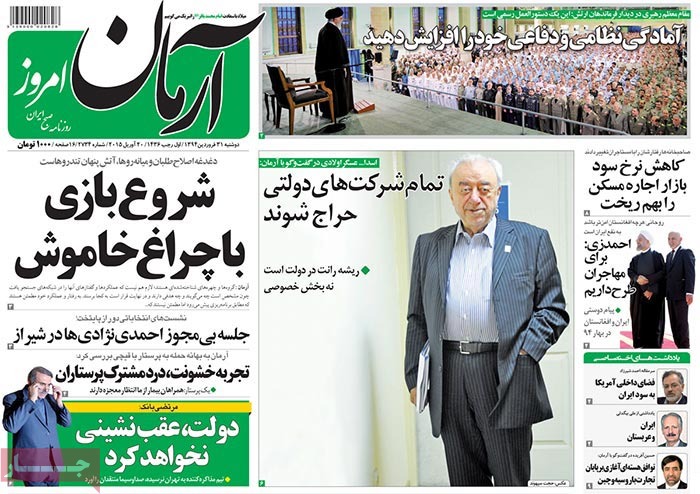
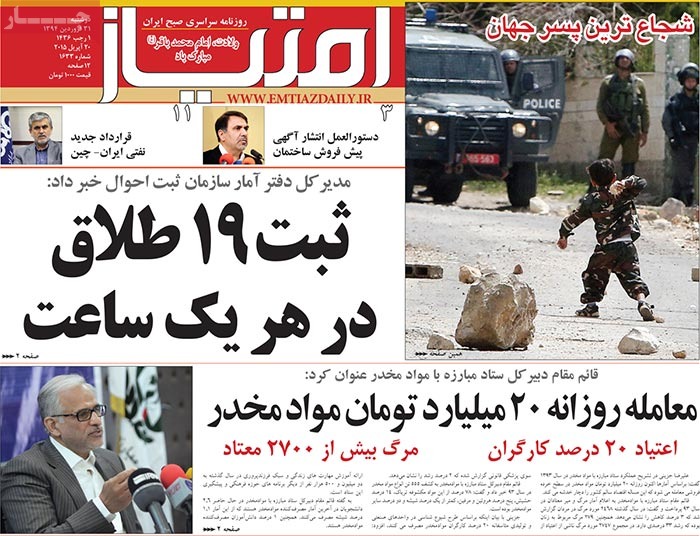
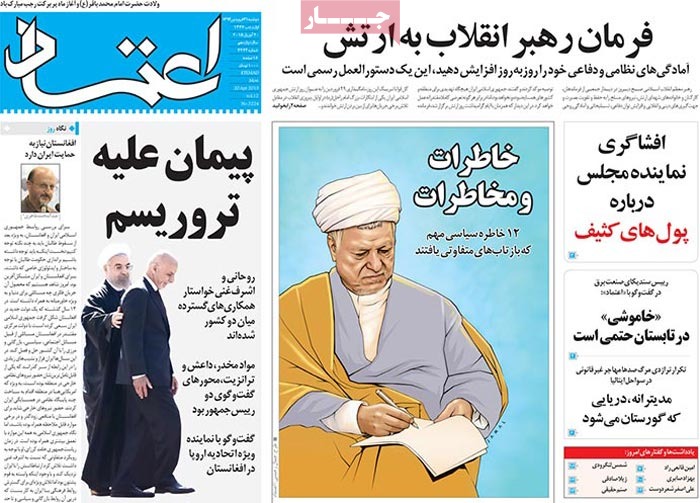
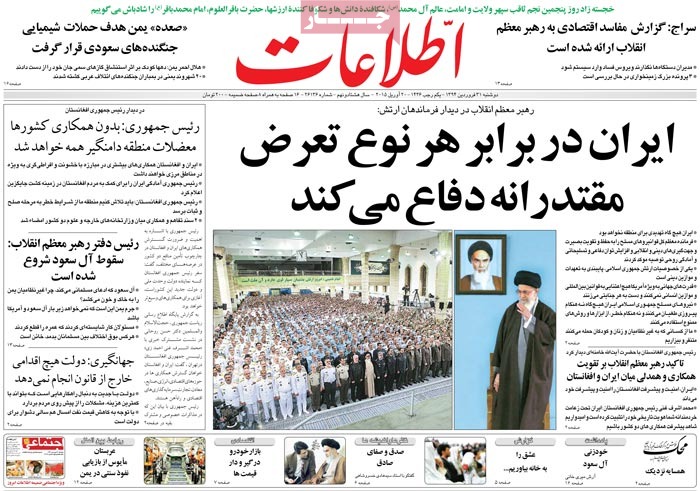
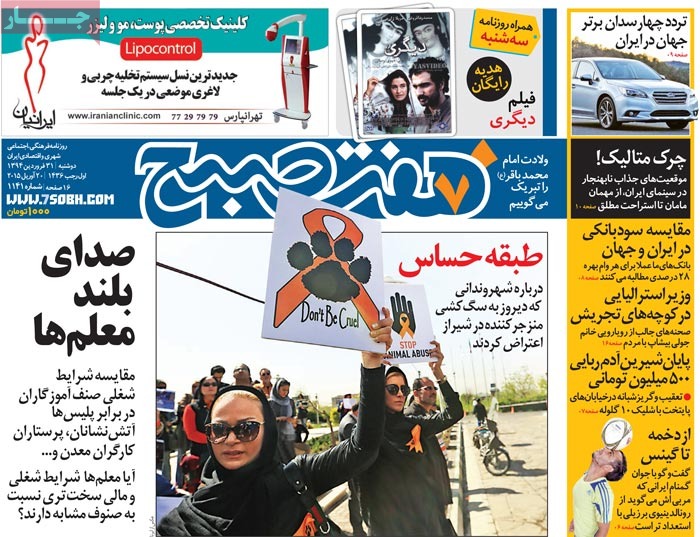
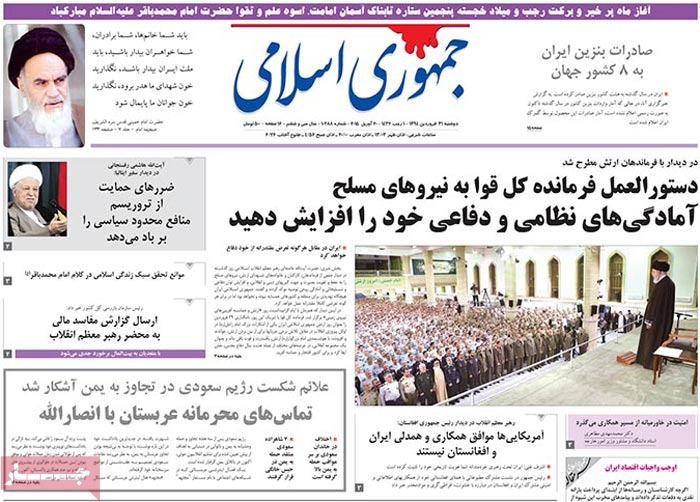
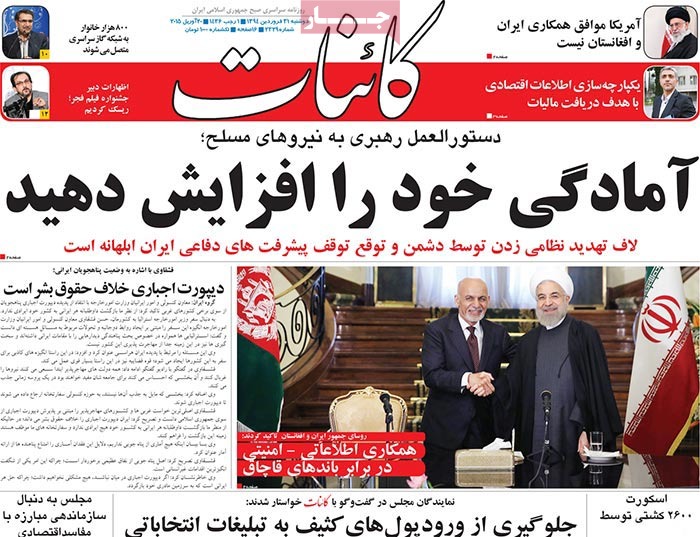
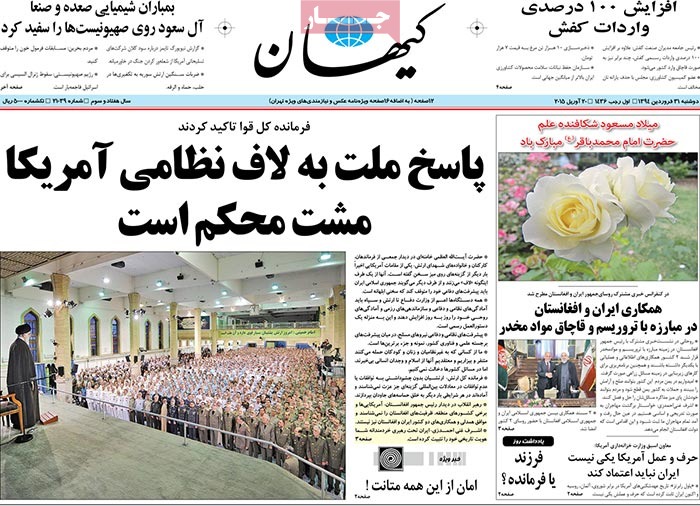
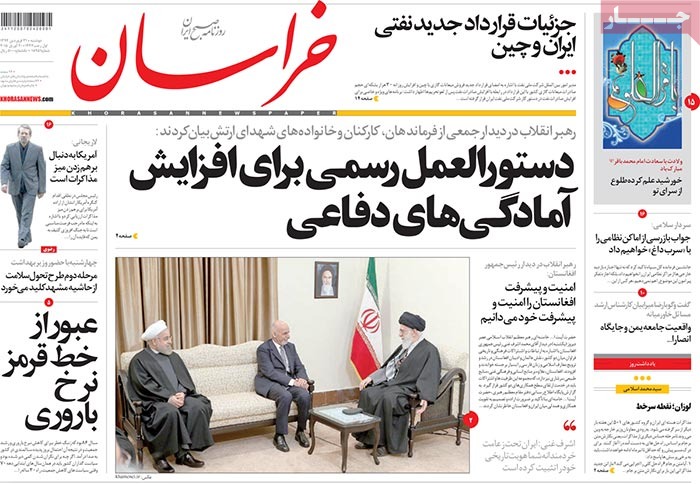
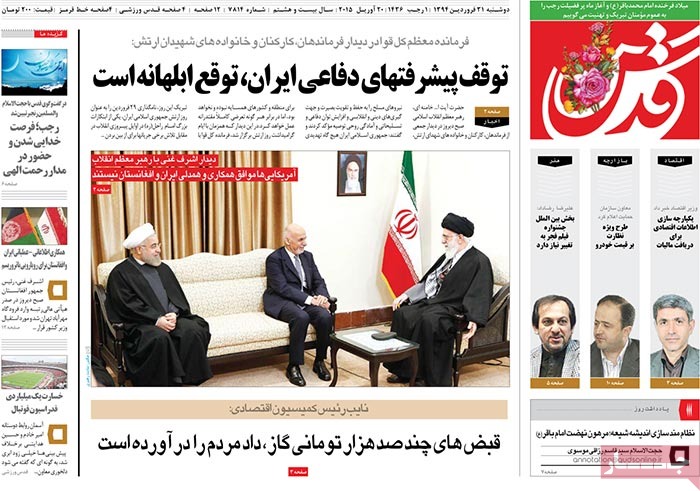
Another round of nuclear talks between Iran and members of P5+1 in Europe dominated the front pages of Iranian newspapers on Tuesday. The fallout of an attack on Tehran MP in Shiraz last week and the comments of the parliament speaker at a year-end press conference also appeared on the covers of dailies.


Abrar: The US [intelligence] has taken Iran and Hezbollah off the list of terrorist threats.

Abrar: Tehran has announced readiness to admit Iraqi students.


A look at Iranian newspaper front pages on March 17


Afarinesh: The Interior Ministry said no one has been arrested so far in connection with the incident in Shiraz.

Afarinesh: The Guardian Council has approved next year’s budget bill passed by the Islamic Consultative Assembly.


A look at Iranian newspaper front pages on March 17


Aftab-e Yazd: The Interior Ministry is weighing the dismissal of Fars provincial governor.

It came after assailants on motorbikes attacked a Tehran MP who was in the provincial capital of Shiraz for a planned speech at a university.

Aftab-e Yazd: “We cannot call off concerts simply because some individuals do not like them,” said a deputy Judiciary chief.


A look at Iranian newspaper front pages on March 17


Arman-e Emrooz: The sheikh of Nour [a northern Iranian city] rolls up sleeves.

Ali Akbar Nategh Nouri [a former parliament speaker and presidential contender from the principlist camp] has said he is ready to work with moderates.

Arman-e Emrooz: Foreign Minister Mohammad Javad Zarif has held talks with four foreign counterparts in one day.

Arman-e Emrooz: The hunt is on for three suspects [in an attack last week on Tehran MP Ali Motahari] who are on the run.


A look at Iranian newspaper front pages on March 17


Asrar: “A good deal will be supported by the Islamic Consultative Assembly,” said Parliament Speaker Ali Larijani.


A look at Iranian newspaper front pages on March 17


Ebtekar: The countdown is on for the grand [nuclear] deal [between Iran and P5+1].

Ebtekar: The Ayatollah warns hardliners

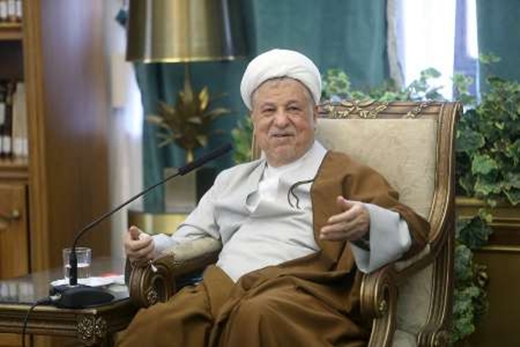
“Political and religious diversion poses a threat to Islamic countries,” said Ayatollah Hashemi Rafsanjani.


A look at Iranian newspaper front pages on March 17


Emtiaz: There are plans to raise oil exports by one million barrels a day.


A look at Iranian newspaper front pages on March 17


Etemad: “In certain areas we are closer to a deal; in some others differences still remain,” said the Iranian foreign minister of the stance of Iran and P5+1 on the nuclear issue.


A look at Iranian newspaper front pages on March 17


Ettela’at: “Four new phases of South Pars gas field will be inaugurated in the summer,” said the Iranian oil minister.

Ettela’at: Next year will see an across-the-board 17 percent wage hike for laborers.

Ettela’at: “Clampdown on corruption should turn into a national project,” said the Iranian parliament speaker.


A look at Iranian newspaper front pages on March 17


Farhikhtegan: The moribund Tehran Symphony Orchestra has been resuscitated.


A look at Iranian newspaper front pages on March 17


Hemayat: Following a call by the Supreme Leader on officials to protect the environment, the Judiciary is to fast-track land-grab cases.

Hemayat: “That images of the former president [Mohammad Khatami] should not be published in the press is in line with a decision of the Supreme National Security Council,” the parliament speaker told a news conference.


A look at Iranian newspaper front pages on March 17


Iran: “It is my hope that no publications will be shut down next year,” said the minister of culture and Islamic guidance.


A look at Iranian newspaper front pages on March 17


Jomhouri Islami: “Iran’s economic growth in the first three quarters [year ends on March 20, 2015] stood at 3.6 percent,” reported the Central Bank.

Jomhouri Islami: Parties to nuclear talks have had a positive view of the negotiations. A deal is within reach.


A look at Iranian newspaper front pages on March 17


Kayhan: “Supervising the nuclear talks is part of parliament’s duty,” said parliament speaker.


A look at Iranian newspaper front pages on March 17


Mardomsalari: Some 6,000 traffic cameras keep an eye on the roads across the nation as people hit the road for the New Year holiday season.


A look at Iranian newspaper front pages on March 17


Iran slams Lahore’s church bombings

Marziyeh-Afkham
Marziyeh-Afkham

Iran’s Foreign Ministry Spokeswoman Marzieh Afkham has condemned the bombings targeting two churches in the eastern Pakistani city of Lahore by Pakistani militants that claimed 14 lives and left many injured.

Afkham said on Monday that Islam is a religion of kindness, peace and mercy and strongly opposes terrorism and violence.

“The Islamic Republic of Iran has always stressed peaceful coexistence among followers of divine religions and believes that the spread of violence and strengthening of radical groups will have an unfavorable impact on peace, stability and peaceful coexistence,” she said.

Afkham also expressed condolences to the Pakistani government, nation and relatives of the victims of the terrorist attacks.

At least 14 people were killed and nearly 70 others were injured on Sunday when the twin blasts hit an area near two churches in Youhanabad area, where over 100,000 Christians live.

Jamaat-ul-Ahrar, a Pakistani Taliban (TTP) splinter group, claimed responsibility for both the attacks.

Iranian MPs set conditions for comprehensive nuclear deal

Iran-Pariliament
Iran-Pariliament

As many as 260 Iranian MPs released a statement Monday [March 16] which sets conditions for a comprehensive nuclear deal with P5+1 to take hold.

The following is a partial translation of the statement which was read out in the chamber by Zargham Sadeghi, a member of the Presiding Board of the Islamic Consultative Assembly, as reported by the Iranian Students News Agency:

[…]

While emphasizing the previous statements and decisions of the Islamic Consultative Assembly, especially the one that requires the government to stick to the nuclear achievements of the nation, we, members of this assembly, urge the nuclear negotiators to bravely and wholeheartedly shield the dignity of the Iranian nation – which has a very important position in regional and global equations – against American tricks and acquisitiveness.

The nuclear negotiators are expected to take account of the following as the absolute rights of the nation:

1. Removal of sanctions all at once and termination of Iran’s nuclear case at the UN Security Council should be a precondition for the implementation of a comprehensive nuclear deal.

2. Holding on to the nuclear achievements and fully restoring the nuclear rights of the nation under Article 4 of the NPT is what the Iranians unanimously want.

3. In case the other party fails to live up to any of its commitments, the deal should be scrapped and enrichment should be resumed at any level the country needs.

In light of the expression of concern by the Supreme Leader, confronting the US tricks which come in different shapes and forms undoubtedly requires more vigilance on the part of Iranian negotiators.

The world needs to know that extremism cannot be treated arbitrarily

Khorasan daily - Zarif

Foreign Minister Mohammad Javad Zarif has said that the world should wake up to the fact that extremism has to be seriously dealt with.

In its New Year supplement, Khorasan daily published an interview with the Iranian top diplomat on different issues, including talks with P5+1 and Iran’s ties with neighboring countries. The following is a partial translation of the highlights of Mr. Zarif’s remarks:

[…]

In the past the West assumed or acted as if Iran’s enrichment program was geared toward making a bomb. Although those allegations are still repeated, now experts with the International Atomic Energy Agency and Western political, technical and scientific circles acknowledge that there is a technical way to make sure enrichment does not lead to development of nuclear weapons. This is an achievement and now it is up to the other side to carry the ball and display political will.

In recent years, Iran has had the greatest cooperation with the IAEA. Perhaps nowhere else in the world – Japan excluded – has the IAEA been that much active; this comes as Iran has only 17 atomic sites and Japan is home to 170 nuclear facilities.

If you take a look at the agency’s 2013 report, you will learn that Iran’s reported negligence equals that of Japan which is below one percent. In the case of some countries that figure is as high as 20 or 30 percent. There are a couple of cases where the negligence figure is 100 percent. […]

I believe we can hold talks with the US and produce the [intended] results from such talks.

If we fail to arrive at an agreement, the US miscalculation would be to blame; the Americans [wrongly] thought that they could pursue their agenda though piling pressure [on Iran]. There is still one good opportunity to reach a deal, one which allows Iran to hold on to its rights and maintain its interests.

[…] I have repeatedly said that we do not hold talks only with the US. There are two reasons why negotiations with the US have been highlighted: First, it is the first time the Islamic Republic of Iran has entered official talks with the US; second and more importantly, the nuclear issue is the only subject about which we hold talks with the US.

[…]

If the talks result in a breakthrough, it won’t mean that all problems have been removed. From the start, I told my colleagues at the Foreign Ministry that conclusion of the Geneva deal marked the beginning of our job and that it would increase the problems and challenges down the road. In case talks break down, we have made other arrangements.

Mr. Obama said in a speech in [the Brookings Institution’s annual] Saban [Forum in December], ‘If I had an option, if we could create an option in which Iran eliminated every single nut and bolt of their nuclear program, and foreswore the possibility of ever having a nuclear program, and, for that matter, got rid of all its military capabilities, I would take it. But that particular option is not available.’

His remarks [back then] were viewed as an affront to Iran. They could have been viewed as inevitability, on the US part, to get along with the Iranian people. This is how I read Mr. Obama’s remarks, although I am not under any illusion that the US has changed course.

The Supreme Leader gets involved [in the nuclear issue] any time he deems it expedient. That the leader gets involved does not mean that the Foreign Ministry has failed to undertake its responsibility.

I’m sure that when [Secretary John] Kerry was taking a walk [in Geneva] with me, he felt that he was talking with a man who had strong belief in his country’s establishment and revolution. During the talks I repeatedly went to a corner in the negotiating room to say my prayers and later said [to the other parties to the talks] that I said my prayers to remember that there is one superior power in the world and other powers are not as mighty as Him.

I do not think that the American or other delegations could find any moment in the talks in which my colleagues or I have dropped our revolutionary principles and beliefs. In addition, the other side is convinced that Iran is after interaction, dialogue and logic to stick to its rights. Iran is not after war, conflict or tension, but we will stand up to bullying.

I hope the world will come to its senses next year [Iranian New Year that starts on March 21] to confront extremism and realize that acts of extremism cannot be treated selectively.

[…] I am certain that the West, including the US, has no option but arrive at a deal with Iran which is based on dialogue and mutual respect. They may make mistakes. Even in that case, I hope the Iranian people are not affected by their possible mistakes.