Sunday, December 28, 2025
Home Blog Page 4901

Anti-ISIL campaign needs political plan: Larijani

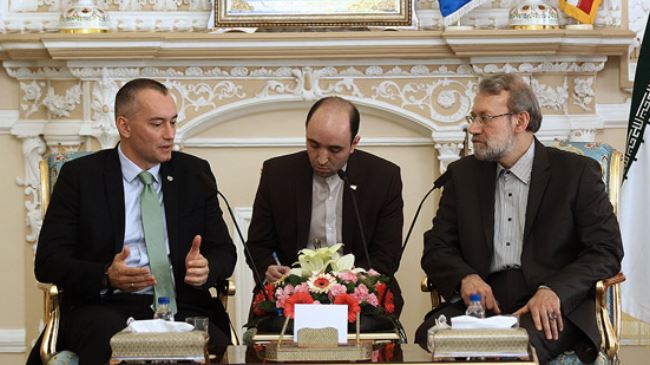
Larijani-Mladenov
Larijani-Mladenov

Iran’s Parliament (Majlis) Speaker Ali Larijani has underscored the need for a political roadmap in any campaign against ISIL Takfiri terrorists.

At a meeting Monday with UN special envoy to Iraq Nikolay Mladenov, in Tehran, Larijani pointed to the so-called US-led coalition formed to fight against ISIL in Iraq and Syria and noted, “In the absence of a definite political plan against ISIL, military operations and airstrikes will not help establish security in Iraq and, in practice, will strengthen the terrorist group.”

Larijani pointed to economic and social problems as key elements leading to insecurity in Iraq, saying, “Eradication of poverty and unemployment and participation of all Iraqi political factions in the country’s new government can contribute to security and progress in Iraq and the UN shoulders a heavy and difficult responsibility in this respect.”

He warned of the spillover of the Iraqi crisis to the entire Middle East and reaffirmed Iran’s determination to devote every effort to help restore calm to Iraq.

Mladenov, for his part, praised Iran’s assistance to the Iraqi nation and government in different areas, particularly against the backdrop of the recent developments in the country, and stressed that Tehran’s measures have always been aimed at creating stability in Iraq and resolving the economic problems of Iraqi people.

[…]

Peugeot holding ‘intense’ talks to return to Iran

Peugeot-Citroen
Peugeot-Citroen

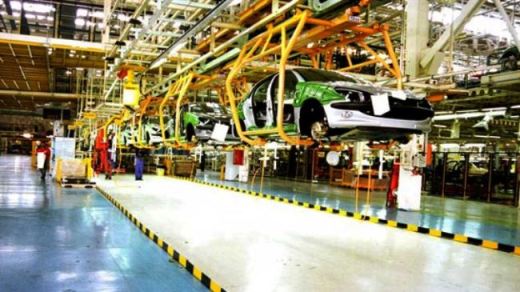
French automaker PSA Peugeot-Citroen is holding negotiations to resume its activities in Iran, two years after they were halted due to the West’s illegal sanctions against Tehran.

A top representative of the giant carmaker said in Tehran on Monday that the company is holding “intense” talks about the issue.

In late July, Iran’s leading auto manufacturer, Iran Khodro Company (IKCO), announced plans to cooperate with French automakers, Renault and PSA Peugeot Citroen, to produce four new vehicles in Iran.

IKCO Chief Executive Officer Hashem Yekkeh-Zare said the Iranian carmaker will produce Peugeot 301 and Peugeot 2008 as part of its mutual cooperation with PSA Peugeot Citroen.

He added that Iran Khodro and Peugeot will establish a joint venture with equal shares for car manufacturing.

IKCO will also manufacture Clio4 and Capture under an agreement with Renault, he said.

The developments came after the two French automakers showed interest in taking back the significant market position they enjoyed before the US-led sanctions on Iran were toughened in 2012 over the country’s nuclear program.

In February 2012, PSA Peugeot Citroën stopped its trade with Iran when the sanctions against the Islamic Republic were extended to the automobile sector. It also halted its exports of vehicles to Iran, which accounted for around 13 percent of the firm’s global deliveries in 2011. It cost the automaker an annual sales loss of half a million car and an estimated 1.5 billion euros in lost revenue last year.

Renault was forced in July 2013 to halt completely-knocked-down (CKD) shipments to Iran. It reported a huge fall in profits for the first half of 2013 after writing off the entire value of its business in Iran. The firm suffered a loss of 512 million euros (USD 680 million) after halting its activities in the Islamic Republic.

The automakers hope to return to Iranian market as Iran and the five permanent members of the UN Security Council – China, Russia, Britain, France, and the United States – plus Germany are drafting a final deal on the Islamic Republic’s nuclear program with a view to easing sanctions against Tehran.

Sectarian rifts colonial means of fomenting insecurity: Rafsanjani

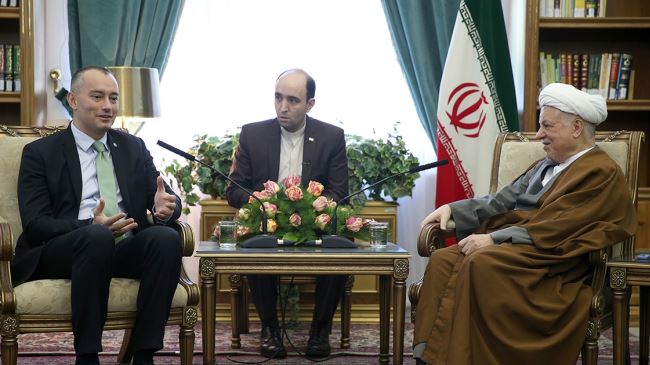
Rafsanjani-Mladenov

Chairman of Iran’s Expediency Council Akbar Hashemi Rafsanjani has warned about plots by colonial powers and authoritarian regimes to use sectarian rifts as a means of creating insecurity.

In a meeting Monday with UN Special Envoy to Iraq Nikolay Mladenov, Mr. Rafsanjani said, “Unfortunately, dictatorships, colonialism and terrorism provoke the people to create insecurity by capitalizing on [their] sectarian and religious differences.”

He pointed to the role of authoritarianism and colonialism in the creation of terrorism and noted, “As long as these two factors exit, terrorists will be around and they even grow more in such an environment.”

The veteran politician argued that countering terrorism requires a comprehensive plan and taking heed of all political and social strata, adding, “The presence of ISIL in Iraq is not permanent, but planning is needed to prevent the infiltration of this ideology and similar deviant thoughts.”

Rafsanjani underlined the need for tackling terrorism at its root as an intrinsic responsibility of the UN and pointed out that the aim can be achieved by showing real respect for human rights and avoiding discrimination and politicization of issues.

Mladenov, for his part, noted that, contrary to the existing claims, ISIL can be defeated very easily through military means, as the group has no popularity among the public.

He called for efforts to bridge the sectarian and religious rifts in Iraq and noted that the Iraqi National Guard should be deployed across the country’s provinces and borders to tighten the noose on terrorists.

The ISIL terrorists launched an offensive in Iraq in June and took control of the country’s second largest city, Mosul, before sweeping through parts of the country’s Sunni Arab heartland.

The extremist group has threatened all communities, including Shias, Sunnis, Kurds and Christians, during its advances in the violence-torn state.

Israeli agents training MKO terrorists in Jordan: Report

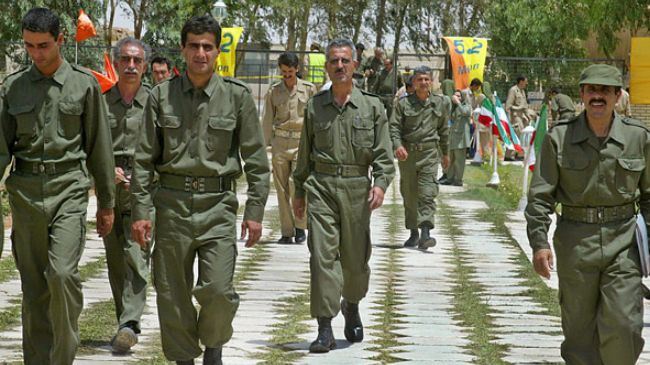
MKO-terrorists
MKO-terrorists

Israel is training members of the anti-Iran terrorist Mujahedin-e Khalq Organization (MKO) in Jordan along the border with Saudi Arabia in order to carry out acts of terror inside Iran and neighboring Iraq, Press TV has learnt.

According to sources, who declined to be named, the MKO terrorists are undergoing training on how to conduct terrorist operations in Iran and Iraq and receiving technical as well as information technology (IT) training from Israeli agents.

This is the first time it is revealed that anti-Iran MKO terrorists are being trained in Jordan along the border with Saudi Arabia.

Earlier reports had revealed that radical extremists are receiving terror training in Jordan before being sent into Syria and Iraq to carry out bomb attacks and join the ranks of the al-Qaeda-affiliated al-Nusra Front, ISIL Takfiri militants and other terrorist groups operating inside both violence-plagued Arab countries.

The MKO fled to Iraq in 1986, where it enjoyed the support of Iraq’s executed dictator Saddam Hussein, and set up its camp near the Iranian border.

The group is also known to have cooperated with Saddam Hussein in suppressing the 1991 uprisings in southern Iraq and carrying out the massacre of Iraqi Kurds.

The MKO has carried out numerous acts of violence against Iranian civilians and government officials.

Out of the nearly 17,000 Iranians killed in terrorist attacks since the victory of Iran’s 1979 Islamic Revolution, 12,000 have fallen victim to the acts of terror carried out by the MKO.

Iranian newspaper editorials and columns

IFP News symbol
IFP News symbol

On Monday two newspaper editorials focused on Iran’s foreign relations and an opinion piece in a third focused on why famous composer and musician Hossein Alizadeh turned down the French title of Chevalier of Legion of Honor. The following is a partial translation of the three items:


Arman-e Emrooz: Eastward movement following pressures from the West

By Bahram Amir Ahmadian, expert in international relations
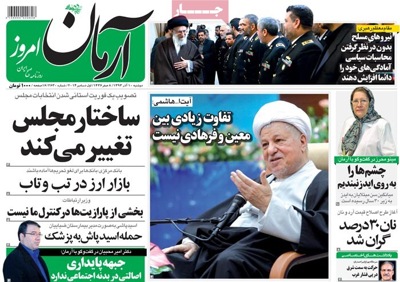
 

Armane emruz newspaper 12 - 1China and Russia – two veto-wielding powers at the UN Security Council which hold remarkable sway – have always supported Iran’s peaceful use of nuclear technology and have even given assurances that Iran’s nuclear program is geared toward civilian purposes.

So far the West’s claims that Iran is using its atomic program as a cover for a broader goal of developing a nuclear weapon have remained unsubstantiated. This comes as Iran has already shown that it is advancing its entire nuclear program under the supervision of the International Atomic Energy Agency (IAEA) and in line with the provisions of the nuclear Non-Proliferation Treaty (NPT).

In other words, as the West struggles to pitch its unproven charges that Iran’s nuclear plan is nowhere near peaceful, Iran tries its utmost to demonstrate that it is forthcoming and its peaceful program has no deviations.

In the interim, China and Russia have always sought to grab the attention of the international community and the court of public opinion. Thus, it comes as no surprise that these two powerful countries show interest in the removal of Iran’s sanctions so that Tehran could fully tap into its potential to forge closer cooperation with them.

On the other hand, pressures by the West against Iran will see the latter gradually move toward creation of a security and military bloc with Russia and China in defiance of US unilateralism. We should admit that this has somewhat shown itself in the framework of the Shanghai Cooperation Organization (SCO).

Whenever the West seeks to exert more pressure on nations, show its superiority and impose its hegemony on them, formation of regional treaties gains momentum.

Iran has a handful of reasons for its reluctance to march toward nuclear militarism, chief among them, the fact that militarism will result in bitter regional rivalry [arms race], something which will certainly destabilize the region. That’s why Iran is favoring the establishment of a security body in the Middle East in cooperation with regional states and without the interference of trans-regional countries.

However, the point is that certain countries, including Saudi Arabia, are not much interested in seeing Iran play a big role in the region. To prevent it from happening, they are more willing to expand their ties with the West. The West, too, is interested in attracting their attention through pushing its agenda of Iranophobia which would help it sign military contracts in the Middle East and consequently sell its weapons.

In the meantime, Iran tends to cooperate with Saudi Arabia to be given a bigger say in regional issues. It is hard to predict what happens next, so we should wait and see. Perhaps Saudi Arabia changes course and comes to the conclusion that cooperation with regional nations, and not alliance with trans-regional states, will earn countries and governments more benefits. […]


Ebtekar: “Saudi” crisis in Iran

By Mehdi Rouzbehani
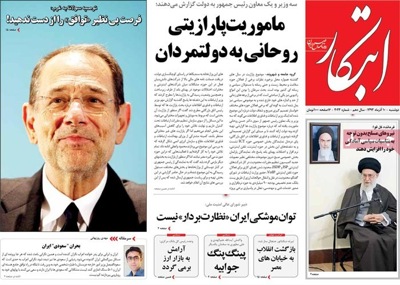
 

Ebtekar newspaper 12 - 1Iran and Iranians are a cause for concern for the godfather of Arabs and this is the very reason why Saudi footprints are seen whenever a case of Iran’s international questions opens.

The deep concerns of Arabs took Saudi Foreign Minister Saud al-Faisal onboard his jet to Vienna to obstruct the conclusion of a comprehensive nuclear deal between Iran and P5+1. The list of issues the Saudis have with Iran is by no means short, and they throw money at the problem.

Nuclear talks, the OPEC session, oil prices and other regional issues in which Iran is somehow involved (the crises in Bahrain, Syria, Lebanon and Yemen) are among the international questions over which Arabs have resolutely lined up against Tehran.

The strategic interests of the two powerful players – Iran and Saudi Arabia – have pushed them to the edge of direct confrontation on many issues. This has made Saudi officials base their regional planning on rivalry with Iran. The role the Saudis play when it comes to Iran’s interests is no secret. Clearly they try to increase their power and credibility on the one hand, and spare no effort to make Iran sustain loss and diminish the influence of Iran on the other. […]

Given the challenges Saudi Arabia has created for Iran on the international and regional stage, one can say that Iran is facing a diplomatic crisis masterminded by Riyadh. The measures Riyadh will take do not matter; what Iran plans to do to defuse the Saudi-provoked crisis and how logically it implements that plan is of importance.

The government of Mahmoud Ahmadinejad lacked basic logic to handle ties between Iran and Saudi Arabia. The former president would adopt repulsive policies which failed to serve Iran’s interests and soured mutual relations more than before. […]

The rise to power of the government of President Rouhani saw Iran try a different approach. Drawing on consultations with many experts, the government favored bilateral interaction as the first step the foreign policy machine was to take as it stuck to rivalry between the two neighbors.

Since the regional interests of Iran and Saudi Arabia are at times interlocked, it is hoped that constructive interaction is taken into account as far as ties with Saudi Arabia go. A win-win attitude can benefit the two countries more than destructive rivalry.

Reports of a trip by Iran’s Foreign Minister Mohammad Javad Zarif to Saudi Arabia helped raise hopes that the two sides might try to ease tensions, sit around the negotiating table to patch up differences, and as a result, the power of the two neighbors would grow in the whole region giving foreign players fewer opportunities to intervene in the region. But the developments of the past month and the cancellation of the Iranian top diplomat’s trip have nourished the theory of a Saudi crisis.

Proposals inside Iran that Akbar Hashemi Rafsanjani play as a go-between thanks to his amicable ties with Islamic heads of state show that diplomatic potential to solve this crisis is losing momentum and that the two countries need to tap into their potential outside the government – public diplomacy – to make the existing differences a thing of the past.

What matters here is that efforts to set a framework for ties with Saudi Arabia are hitting a snag. Extremists on both sides see religious divisions as a serious obstacle in the way of expanded Tehran-Riyadh interaction, but strategic interests need more conditions to be met.

Therefore, the first priority for Iran’s foreign diplomacy should come in the form of striking a balance between these two groups. The bottom line: as long as Iran fails to devise a long-term plan for its interaction with the kingdom, which has currently created a crisis for Tehran, the crisis would deepen.


Aftab-e Yazd: Let’s not give wrong directions

By Mehrdad Khadir, journalist
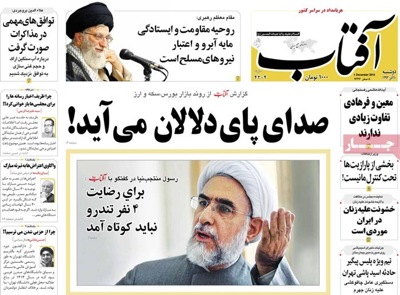
 

Aftabe yazd newspaper 12 - 1Reports that Hossein Alizadeh, a leading Iranian composer and musician, has turned down France’s Chevalier of Legion of Honor have been met with mixed reactions.

Those reactions have come from two groups: those who expected him – like his fellow artists – to accept the Honor and be named a Chevalier but got surprised by his refusal; and certain media which praised him only to criticize the artists who had previously been given the same honor, vowing to reveal “the hidden part” of the Chevalier of Legion of Honor, and consequently tarnish the image of big names who accepted the award.

On the list of the recipients of the Chevalier award, the following names are conspicuous: Mohammad Reza Shajarian and Shahram Nazeri, vocalists; Jalal Sattari, mythologist; Abbas Kia-Rostami and Asghar Farhadi, filmmakers; Leila Hatami, actress; Mohammad Ali Sepanlou, poet and writer; Reza Seyyed Hosseini, translator; and Pari Saberi, drama and theater director.

Several private gatherings in the residence of the French ambassador to Tehran have made new additions to the list in recent weeks: Kambiz Derambakhsh, cartoonist; Dariush Mehrjui, filmmaker; Madmoud Dowlatabadi, writer; and Lili Golestan, translator and gallery owner.

Although the question [of whether to accept the Chevalier or not] was first raised by Ali Rahbari, a Vienna-based composer and conductor of Orchestra, the reason as to why Alizadeh turned down the award is none of the four reasons Mr. Rahbari has explained:

1. Formerly a number of French figures such as Maurice Ravel, composer, Jean-Paul Sartre and Albert Camus, Nobel laureates, and Catherine Deneuve, actress, have refused to accept the award.

2. The French mission in Tehran is distributing this prize among Iranians extremely fast. That is likely to dent the greatness of Hossein Alizadeh’s name.

3. It defies common sense to see that a singer in Iran is named “the Chevalier of Iranian music”. The title stands in stark contrast with the nobility of the Iranian music.

4. How come dozens of world-famous French musicians and master music players from countries like China, India and Russia have yet to be granted this honor?

However, Hossein Alizadeh, has other reasons for his refusal:

“If official attention to and understanding of music, a noble art, had been like those of the public, a single gift and a foreign title would have not been given so much coverage. In the absence of enough light in an artistic climate, a small lamp is like the sun.”

[…]

What comes into focus here is that the Iranian singer wants to draw the attention of office holders to music. A case in point is his interview back in February 2014 with Tajrobeh (Experience), a monthly magazine, in which he expressed his grievances about the state of music in Iran, saying, “Music has yet to be given recognition.”

In so saying, the best reward to appreciate his move would be official recognition of music in the real sense of the word and attachment of profound significance to it.

That some try to use Alizadeh’s decision as a pretext to lash out at those who received the French award is not a reward. Other Chevaliers of music share Alizadeh’s concerns when it comes to the standing of music in Iran.

Put simply, if Mohammad Reza Shajarian and Shahram Nazeri accepted the Chevalier of Legion of Honor to help Iran’s national music capture the attention of the outside world, Alizadeh finds it more appropriate to draw the attention of “officials” inside Iran to the same topic through turning down the honor.

[…]

The message Hossein Alizadeh seeks to convey [to arts and culture officials within the government] is quite clear: “Be kinder to music.” This is what Shajarian and Nazeri said and still say; one relays the message by accepting the Chevalier title and the other by rejecting it. They have one goal: to raise an issue to prod those inside Iran.

[…]

HIV/AIDS in Iran

December 1 marks World AIDS Day. It is an opportunity for people around the world to form a united front in the fight against HIV, show their support for people living with HIV and honor the memory of those who have died of the disease.

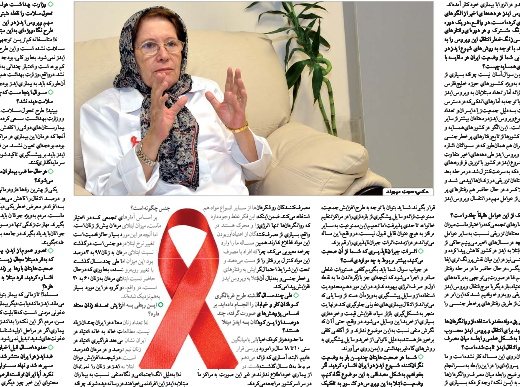
To mark the occasion, Arman-e Emrooz, a daily, dedicated one full page of its Monday issue to HIV/AIDS. The coverage featured brief comments by Abbas Sedaghat M.D., who leads the HIV/AIDS Control Office of the Ministry of Health, in which he said, “In Iran, the increase in the number of people who develop AIDS is not too steep, but failure to take the change in HIV/AIDS transmission patterns seriously will steepen the increase in the years to come.”

Abbas Sedaghat M.D.

He further said, “As of September 22, nearly 28,600 HIV/AIDS patients were registered across the nation. Unprotected sex was to blame for as much as 38 percent of infections in the 12 months to March 21, 2014. We believe the public should be educated about high-risk behaviors. Experts estimate that the number of individuals suffering from HIV/AIDS stands at around 90,000. Failure to do something serious is bound to see that figure rise to 120,000 in three years.”

The daily also cited a Ministry of Health report as saying that men account for as much as 88.7 percent of individuals infected with HIV. Injecting drug use tops the list of infection causes on 67.7. Unprotected sex is second on 13.4 percent and mother-to-child transmission comes in a distant third on 1.2 percent.


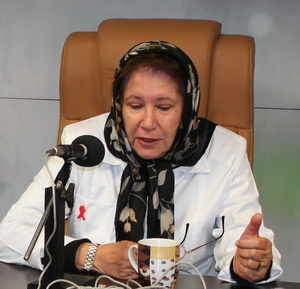
Minoo Mohraz
Professor Minoo Mohraz

A Q and A with Professor Minoo Mohraz, the head of the HIV/AIDS Research Center at Imam Khomeini Hospital covered much of the page. The following is a partial translation of what she had to say in the exclusive interview titled “Let’s not close our eyes to AIDS”. Obviously, the format of the interview has been changed to fit this IFP report.


On Iran’s position in relation to regional countries

In light of the fact that unlike Iran many Persian Gulf countries do not release official reports on the number of their citizens suffering from AIDS, one cannot compare the status of Iran with other regional countries. But what is certain is that Iran’s population is bigger than its neighbors and naturally there are more addicts in Iran, so the spread of infection among Iranian drug users is faster than other countries on the Persian Gulf.

On modes of transmission  

In Iran, transfusion of infected blood was the initial mode of transmission which was brought under control fast. Later HIV reached epidemic proportions among injecting drug users in prison facilities. Presently, high-risk behaviors top the list of transmission modes.

Recent years have seen a drop in the age of HIV infection and high-risk behaviors have contributed to such decline. In other words, we are currently at a stage when high-risk behaviors are the primary culprit. Failure to pay enough attention to harm reduction programs will give rise to another wave of transmission among injecting drug users which in turn will see the number of individuals who get infected through high-risk behaviors swell.

On population policies worked out by parliament

Parliament’s decision to limit the provision of contraceptives can increase the number of at-risk individuals. The problem is that some people take a certain measure without thinking in advance about its potential side effects and solely focus their attention on the main scheme. I know that the Ministry of Health has tried its best to ensure the continued provision of [barrier] contraceptives that help prevent the spread of diseases such as AIDS.

In line with plans to lend momentum to population growth one can accept a ban on the supply of contraceptives in Family Planning Centers, but taking the ban to other centers is not acceptable at all. In fact, such a policy does irreparable harm in the long run.

Such a ban, particularly when it applies to items that can stop the spread of infectious diseases, helps create a black market and thus a rise in prices. As a result of the price hike, even those who are well-informed and do not hold a negative view of contraception cannot afford contraceptives and begin to display unsafe and unhealthy behavior.

On male-female ratio of patients

In the past men accounted for 97 percent of all HIV/AIDS patients. Over the past few years the number of female patients has increased dramatically. The rise in question cannot be blamed on the increase in the ranks of female addicts which is too meager to trigger such a drastic increase.

In countries around the world, the number of men and women with the disease is roughly the same. In the absence of another addiction wave, the number of female patients will rise to the same level as male patients.

On the number of HIV/AIDS patients

So far some 28,000 patients have been identified. Our estimates put the actual number closer to 100,000. We have so far identified almost a third of them. The remaining individuals do not know about their condition, otherwise they would have visited our centers across the country. That they have not come forward already is because they cannot afford treatment is not correct. Because all medical services and care at such centers are free.

On failure of media and education system to disseminate information

Over the years I have worked in this field, the media has had a negative attitude toward the disease which is very alarming. For instance, IRIB shows commercial crawls whenever its widely-watched programs hit the airwaves, but it fails to provide viewers with information on ways of preventing the transmission of HIV.

The Education Ministry has done nothing noteworthy, either. For a brief period of time, it provided children with limited information on the disease. But it stopped when the education minister was replaced, with officials saying such measures might have bad influence on students.

On the future of the disease in the country  

If the current trend persists, the disease will be difficult to contain. In order to prevent that, we need to slow down the spread of the disease and raise awareness. We need to admit that our youth are falling victim to lack of awareness for which we are to blame, not them.

On NGOs and HIV/AIDS institutes

There are a couple of HIV/AIDS NGOs in the country. They are not much active because the infrastructure for active involvement of NGOs in society is lacking. And those who launch non-governmental organizations do not receive proper training. The HIV/AIDS Research Center has recently launched a Positive Club which offers training to HIV positive individuals. It has 14 branches across the nation and that number is expected to rise to 20 shortly.

On stigma associated with HIV/AIDS

Lack of knowledge about the disease is to blame for HIV still being viewed as a taboo in society. Thanks to such unawareness, many, including the family of HIV-positive individuals, still believe the slightest contact with the patient is enough to develop infection. That slows down the efficacy of treatment. When a patient is down and feels the lack of support, they become less motivated to commit themselves to treatment. Thirty years after the emergence of the disease, we still have to teach people that they can live with HIV-positive individuals and keep infection at bay through self-care.

On efforts to prevent the spread of the disease among drug users

Recent years have seen a change in strategy on the part of the Drugs Headquarters. In the past it would distribute free syringes among drug users, now it is rounding up addicts and placing them in compulsory rehabilitation centers, a practice which has turned out to be a failure all over the world. When you bring drug users together, the end result would be what happens in prisons.

Some 15 percent of injecting drug users in Iran are HIV-positive. In prisons some 2 percent of inmates are infected. Studies suggest that a great percentage of injecting drug users in correctional facilities develop the infection as a result of sharing needles.

On Healthcare Transformation Plan

Unfortunately, the Healthcare Transformation Plan does not cover HIV/AIDS at all. Under this plan, the Ministry of Health seeks to reduce the amount of co-pay in public medical facilities. Since HIV/AIDS-related services are free of charge, the plan does not enshrine any budget for HIV/AIDS.

On what needs to be done

To counter HIV/AIDS, we need to focus on prevention.To that end, raising awareness among at-risk individuals is important. We need to teach life skills to youngsters. They should learn to say no to promiscuity and drugs.

What has been done over the past year

Plans to test pregnant women and thus prevent mother-to-child transmission have been implemented in the country over the past year. But thanks to failure to offer training to youngsters and injecting drug users and a rise in the consumption of psychedelic drugs, infection has been on the rise. And neighboring countries which send a large number of laborers, both legal and illegal, across the border to Iran have done nothing to stem the tide of infection, and this has made the situation all the more difficult for Iran.

Iran hosts int’l auto parts exhibition

Iran-car-exhibition
Iran-car-exhibition

The 9th Auto Parts International Exhibition which kicked off on Tehran’s Permanent International Fairgrounds on Friday closed today, Press TV reports.

The exhibition is known as the largest international market of auto spare parts in the Middle East.

Nearly 800 Iranian and foreign companies have flocked to this year’s fair to share their latest achievements and capacities.

The foreign representatives include 400 companies from 20 countries such as Britain, Germany, Japan, India, South Korea, China and Sweden.

Mercedes Benz, Volkswagen, Renault, Peugeot, Kia and Toyota are among the participating companies.

The event also aims to promote investment opportunities in Iran’s light and heavy vehicles industry and identify new export markets.

Iran’s automotive industry is the second most active industry of the country after oil and gas, accounting for 10% of the country’s Gross Domestic Product (GDP).

The Islamic Republic of Iran currently ranks fifth in the world in terms of car production growth, standing after China, Taiwan, Romania and India.

The 9th Auto Parts International Exhibition kicked off on November 28 and will come to an end on December 1, 2014.

Poll shows majority of people supports extension of N-talks

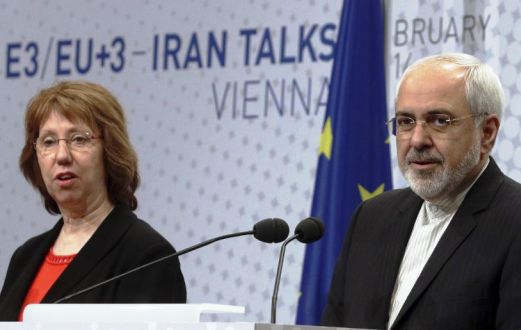
Austria-Iran-Nuclear

According to a recent poll conducted by the Islamic Republic News Agency (IRNA), 81 percent of Tehran residents are in favor and 19 percent against the extension of Iran’s nuclear talks with P5+1.

The IRNA poll was carried out by random telephone calls made in all 22 neighborhoods of Tehran on November 25 and 26.

59.1 percent of the respondents were men. The youngest respondent was 19 years old while the oldest one was an 83-year-old man. The average age of the respondents was 40.5 years.

A Majority of the questioned believed that the latest agreement reached between the negotiating teams of Iran and the six world powers (US, Britain, France, Russia and China plus Germany) to continue nuclear talks for another seven months ‘would benefit Iran.’

Only 19 percent of those polled said the agreement ‘will not benefit’ the country.

79 percent of those asked said they believed prospects of the future nuclear talks were ‘positive’ while 21 percentbelieved otherwise.

33.6 percent said extension of nuclear talks would give both sides more opportunity to reach a win-win situation.

17.3 percent said they believed continuation of the talks will benefit Iran as the West needed Tehran’s economic and security cooperation.

8.2 percent said they supported extension of the talks because they believed Iran was moving in line with restoring its nuclear rights.

Among other positive views held by the respondents were as follows:

5.5 percent are in favor of gradual release of Iran’s blocked assets

5.5 percent are for economic stability in Iran

3.6 percent are for improving Iran’s international image

2.7 percent are for growing foreign investment.

Meanwhile, those who held a negative outlook about extension of the nuclear negotiations included:

10.9 percent for lack of West’s cooperation towardcomplete and lasting removal of sanctions which could block a final agreement.

6.3 percent considered the victory of the Republicans and pressures exerted by the Zionist lobby as main obstacles in the way of nuclear talks while 2.7 percent said holding nuclear talks was totally a mistake.

The respondents’ suggestions for the Iranian negotiating team included:

29.6 percent called on them to defend rights of the nation

25.9 percent asked them to continue their efforts

23.1 percent said they prayed for the success and health of the Iranian negotiating team

9.3 percent called on them to show more flexibility in talks to the extent that will not threaten national interests

2.8 percent reiterated Iranians will always support the negotiating team

1.9 percent asked them to halt the negotiations as they were useless and

0.9 percent urged the nuclear negotiating team to be independent and transparent


A look at Iranian newspaper front pages on Dec. 1

Iranian Newspapers Headlines

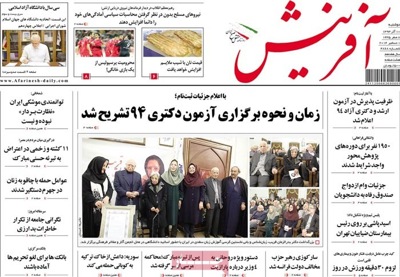
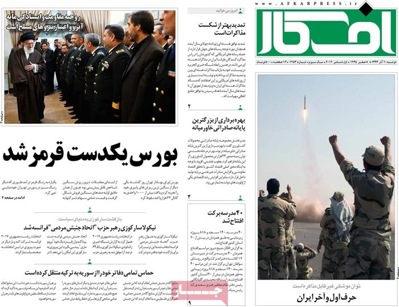
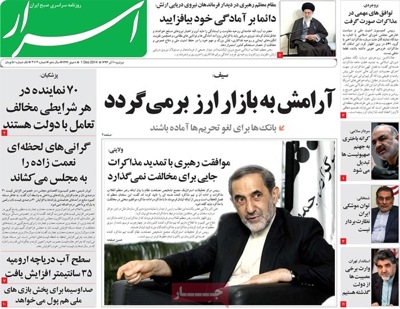
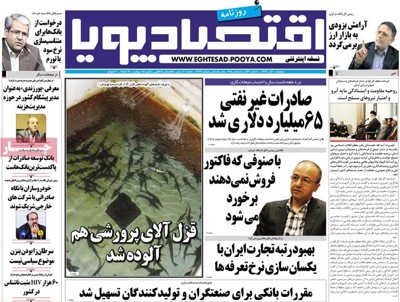
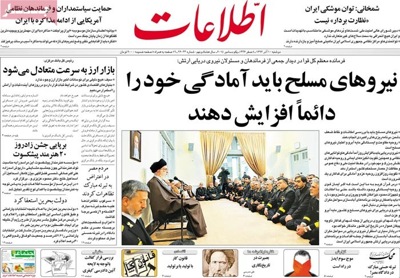
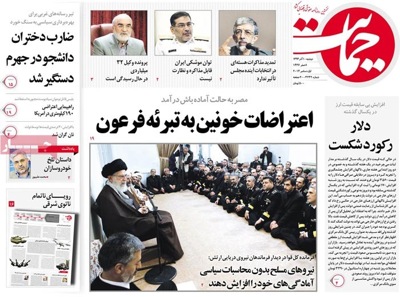
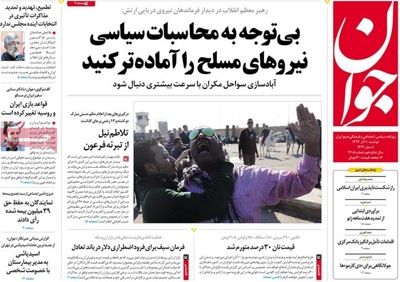
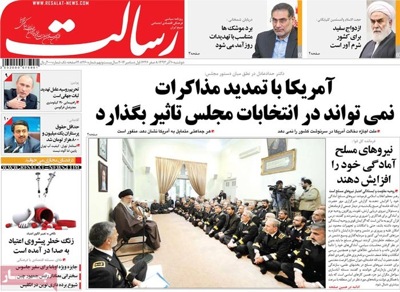
Remarks of the Supreme Leader in a meeting with a group of senior Navy officers in Tehran generated headlines in Iranian dailies on Monday. The hike in the value of dollar against rial was another top story of the day. Drawing as much attention was an acid attack on the administrator of the capital’s Ziaeian Hospital Dr. Siamand Anvari.

Abrar: “Iraqi President Fouad Masoum has lauded Iran for its role in helping the Iraqis [take on terrorists].”

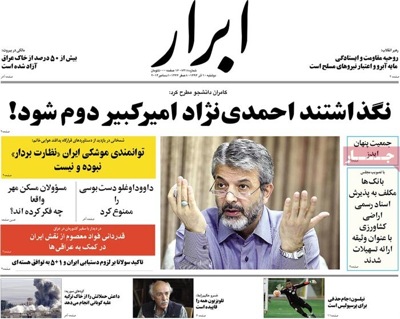
Abrar: “They did not allow former President Ahmadinejad to become a second Amir Kabir! [a 19th century chief minister who is widely respected as Iran’s first real reformer],” said Kamran Daneshjoo, who served as the minister of science under Ahmadinejad.


Abrar newspaper 12 - 1


Afarinesh: “Iran’s missile capabilities couldn’t and cannot be subjected to surveillance,” said Secretary of the Supreme National Security Council Rear Admiral Ali Shamkhani.

Afarinesh: “Banks should be prepared for the lifting of sanctions,” said the Central Bank of Iran.


Afarinesh newspaper 12 - 1


Afkar: “Yesterday, Tehran Stock Exchange experienced one of its most dramatic falls this fall, shedding 1,000 points.”


Afkar  newspaper 12 - 1


Aftab-e Yazd: “There is not much difference between Dr. Mostafa Moeen [the minister of culture and higher education under former President Rafsanjani] and [current Minister of Science, Research and Technology] Mohammad Farhadi,” said Chairman of the Expediency Council Hashemi Rafsanjani.

Aftab-e Yazd: “A special police team has been tasked with investigating the acid attack on Dr. Siamand Anvari in Tehran.”

Aftab-e Yazd: “To please a handful of hardliners, we should not back down,” said Rasoul Montajabnia, a reformist politician.

Aftab-e Yazd: “Important agreements have been reached in nuclear talks. As for Arak heavy water and the scope of enrichment we are close to a deal,” said Chairman of parliament’s National Security and Foreign Policy Committee Alaeddin Boroujerdi.


Aftabe yazd newspaper 12 - 1


Arman-e Emrooz: “With 133 votes for, 64 against, and 11 abstentions, MPs took the first step toward ratifying a bill that proposes that the geographical area of a province determine its constituency in parliament and thus each voter can choose a representative for all provincial seats in the chamber. The bill will introduce change to the make-up of parliament.”

Arman-e Emrooz: “We do not have control over part of satellite-jamming signals,” said the minister of communications and information.


Armane emruz newspaper 12 - 1


Asrar: “Calm will make a comeback to the foreign currency market,” Governor of the Central Bank of Iran Valiollah Seif said.

Asrar: “The approval of the Supreme Leader for nuclear talks doesn’t leave any room for opposition [to the negotiating process],” said Ali Velayati, an advisor to the Supreme Leader.

Asrar: “Under any condition, 70 MPs are opposed to interaction with the government,” said Masoud Pezeshkian, a parliamentarian.

Asrar: “The water level of Lake Orumiyeh has gone up 35 cm.”


Asrar newspaper 12 - 1


Ebtekar: “Javier Solana, the former EU high representative for foreign and security policy, has advised the West not to miss a unique opportunity for a deal [with Iran].”

Ebtekar: “President Rouhani has tasked three ministers and his deputy with handing in a report to the government about satellite jamming.”


Ebtekar newspaper 12 - 1


Eghtesad-e Pooya: “Non-oil exports, natural gas condensates included, brought in $65 billion between March 21 and November 21, 2014.”


Eghtesade puya newspaper 12 - 1


Ettela’at: “American politicians and military officials have backed the continuation of nuclear talks with Iran.”

Ettela’at: “Iran’s Veteran Artists Institute has thrown birthday parties for 20 veteran artists.”


Ettelaat newspaper 12 - 1


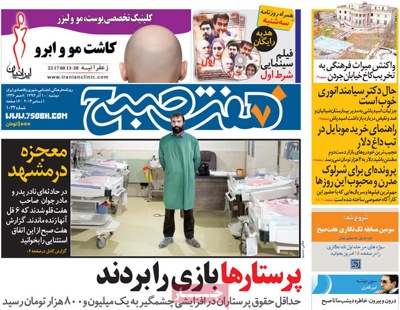
Haft-e Sobh: “In a rare incident, a young woman in Mashhad [a city in Khorasan Razavi Province]gave birth to septuplets of which six survived.”


Hafte sobh newspaper 12 - 1


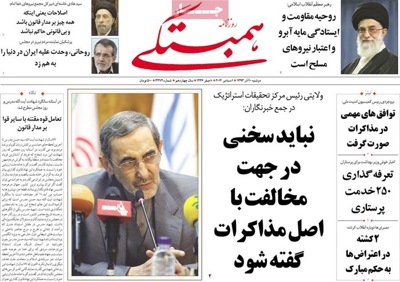
Hambastegi: “President Rouhani has shattered the global anti-Iran alliance,” said Masoud Pezeshkian, an MP representing Tabriz [the capital of East Azerbaijan Province].


Hambastegi newspaper 12 - 1


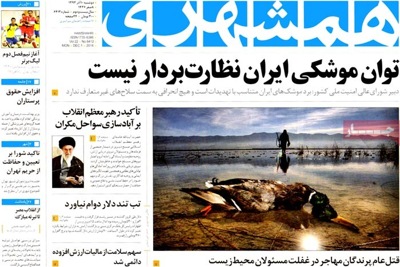
Hamshahri: “A mass killing of migratory birds as a result of the negligence of environment officials” is a headline that refers to the unbridled hunting of birds that have flown to Caspian provinces of Iran to spend the winter there.


Hamshahri newspaper 12 - 1


Hemayat: “An individual who attacked female university students in Jahrom, a city in Fars Province, has been arrested.”

Hemayat: “There have been bloody protests against Hosni Mubarak’s acquittal in Egypt.”


Hemayat newspaper 12 - 1


Javan: “In a meeting with Iran’s Navy commanders, the Supreme Leader advised them to enhance their preparedness regardless of political calculations.”


Javan newspaper 12 - 1


Resalat: “White marriage [illegal cohabitation] is shameful for our country,” said Supreme Leader’s Chief of Staff Ayatollah Mohammad Mohammadi Golpayegani.

Resalat: “America cannot influence Iran’s upcoming parliamentary elections by extending the nuclear talks,” said Gholamali Haddad Adel, a Tehran MP and a former speaker of the Islamic Consultative Assembly.


Resalat newspaper 12 - 1


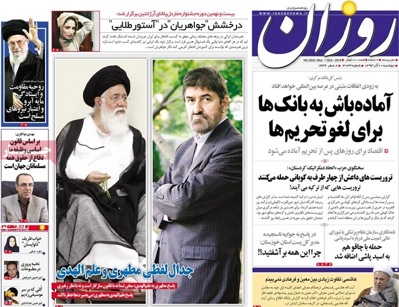
Roozan: “A war of words between Ali Motahari, a Tehran MP, and AyatollahAhmad Alamolhoda, the Friday prayer leader of the northeastern city of Mashhad and a member of the Assembly of Experts, over the duties of the assembly” is the headline that the daily put on its front page. After Motahari told Alamolhoda that his remarks that the Assembly of Experts does not supervise the performance of the leader are neither Constitutional nor in line with the opinions of the Supreme Leader, Alamolhoda argued back that those who lack wisdom are dangerous.


Ruzan newspaper 12 - 1


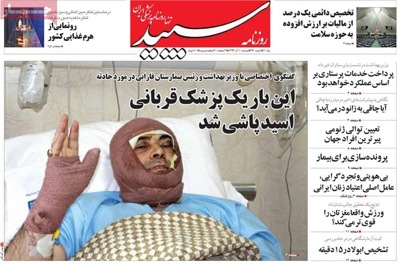
Sepid: “This time around, a doctor has fallen victim to an acid attack.”


Sepid newspaper 12 - 1


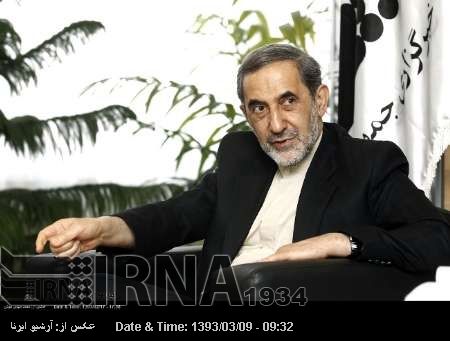
Velayati urges UN to identify countries backing terrorism

Ali Akbar Velayati
Ali Akbar Velayati

Head of the Strategic Research Center of Iran’s Expediency Council Ali Akbar Velayati called on the United Nations to name those countries that support terrorist groups in the region.

“Given its responsibility, the UN ought to identify the countries that support terrorists (such as) ISIL in the region because without foreign backing, ISIL would be defeated by Iraqi forces,” Velayati said Sunday in a meeting with UN Special Representative for Iraq Nickolay Mladenov.

The Iranian official stated that some Western countries in cooperation with certain regional states have helped terrorist groups emerge”.

He added that groups like the so-called Islamic State in Iraq and the Levant (ISIL) were created, trained, financed and armed by countries that claim to be fighting terrorism.

Velayati also voiced Iran’s readiness to cooperate internationally in the fight against ISIL.

The ISIL terrorists currently control swaths of territory across Syria and Iraq. They have been committing heinous crimes in the captured areas, including mass executions and beheading of local residents as well as foreign nationals.

The Western powers and their regional allies- especially Qatar, Saudi Arabia, and Turkey- are believed to have been supporting terrorist groups in the region.