Monday, December 22, 2025
Home Blog Page 4893

A man who hires the unhappy and miserable

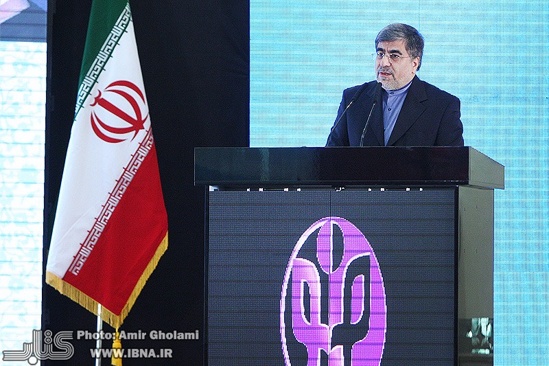
Alireza Nabi

The footprints of certain people are as unique as their fingerprints. What makes people like Alireza Nabi unique is that they look at the world differently and serve the interests of those who have led painful lives and those who are always turned down by others. Normally, employers are loath to hire ex-cons, even those who have been tossed in jail for unintentional crimes.

The factories Alireza Nabi has founded are manned by ex-cons and are now exporting olive to the world. He credits his success to the aspiration and perseverance of those who’ve suffered a lot.

Jamejam daily has conducted an interview with this entrepreneur. The following is a partial translation of the interview:

Fear is the only reaction people show when they are told about prisoners, but it was not the case with you. Why?

Fear has its roots in ignorance. When you lack knowledge about a person, place or situation, your mind shows automatic reaction. I have no fear because I’ve socialized with these people for years and listened to them.

By fear, I mean lack of trust. Why did you decide to trust them?

I always wondered how I could help and serve people. A hadith from Imam Ali (PBUH): “Silence would prevail in the world if everybody’s words and deeds were the same,” inspired me.

I’ve always talked in the capacity of a university teacher and now it is time for action, I thought. I decided to do something to help my religion, country and people.

I wanted to establish an industrial unit to employ people with disability, but it was not something new. I decided to do something for female breadwinners, because they are in dire need of help. I think a society grows if women are respected. On the other hand, women are the best in the workforce due to their intelligence, strength, creativity, faithfulness, commitment and emotional intelligence. […]

How many people are working for you?

We are a 400-member family. Women, who account for 85% of the workforce, work in four plants. Only machinery operated by humans is used in these plants.

How come you went after the [newly] released prisoners and people with criminal record?

Some of the women who work for us are there to fill the vacuum created by the absence of their imprisoned husbands. Four years after we employed women breadwinners, we decided to develop our business; thus we thought we could support those who were behind bars for unintentional crimes. We hired the husbands of our female workers.

Then we reached out to well-wishers since we could not handle the job single-handedly. They accepted to have those individuals who were in prison for financial wrongdoings freed, and we accepted to employ them after their release.

[…]

We’ve set up a fund in which the employees invest. After five years, they can earn dividends. […]

On which system have you modeled your work?

It is not a copy of others. This is the fruit of our own thoughts. I go to the production hall twice a week and talk with the employees. We confide in each other. I want to eliminate the boundaries.

Iran, Pakistan stress peaceful resolution of Yemen crisis

Iran-Pakistan-Yemen

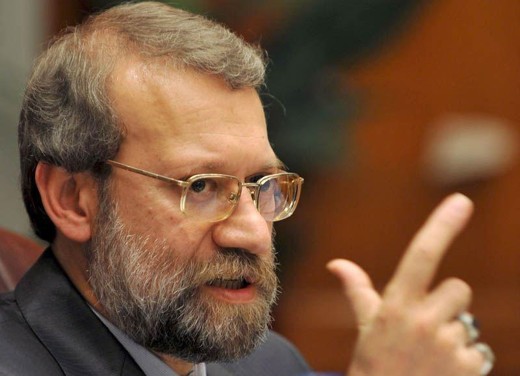
Iranian Parliament Speaker Ali Larijani and Speaker of Pakistan National Parliament Ayaz Sadiq have stressed the peaceful resolution of the Yemen crisis.

During a phone contact with his Pakistani counterpart on Saturday night, Larijani said Iran believes that the Yemen crisis should be resolved through national dialogue among all Yemeni political factions.

He praised Pakistan’s stance on Iran and the Muslim World, noting that Iran will use the nuclear agreement as a tool to boost regional stability and Muslim unity.

Destruction of Yemen’s infrastructure is in the interest of the Zionist regime and they should learn a lesson from Soviet and NATO aggression against Afghanistan, Larijani said.

He said Yemen’s crisis should be resolved through dialogue and military interference will only complicate the situation.

Speaker of the Pakistani parliament, for his part, welcomed the nuclear agreement between Iran and G5+1.

He voiced hope for removal of all sanctions against Iran.

The official said that Islamabad has no intention to interfere in the Yemen crisis and believes that peace in Yemen is the best interest of the whole Muslim world.

Saudi Arabia has been striking Yemen for ten days now to restore power to fugitive President Mansour Hadi, a close ally of Riyadh. The Saudi-led aggression has killed at least 860 Yemenis, including hundreds of women and children.
[…]

We shouldn’t have agreed to signing the Additional Protocol in Lausanne statement: MP

Hossein Nejabat

Hossein Nejabat, a member of parliament’s Energy Committee, described the recognition of Tehran’s right to enrichment on its soil as a positive point about the Lausanne statement, and said termination of sanctions when the deal takes effect would be regarded as another advantage of the statement.

“There are some drawbacks with the statement, though, among them the use of ambiguous terms. Given America’s record, the US is capable of turning ambiguous terms in its own favor. That Washington might breach the agreement based on its own interpretation leaves room for worry,” the MP was quoted by Tasnim News Agency as saying on April 5.

He added, “The termination of sanctions after [IAEA-] verified implementation by Iran of its key nuclear commitments is another problem with the statement.”

Nejabat went on to say, “That Iran’s negotiating team has agreed to the implementation of the Additional Protocol is another negative point about the framework agreement, because in fact such agreement does not come within the purview of the government and requires approval by the Islamic Consultative Assembly. Therefore, the government should not have agreed to the implementation of the Additional Protocol. Instead, it should have said that it would try to convince parliament to approve the protocol.”

The deputy concluded, “The guidelines by the Supreme Leader that all sanctions have to be lifted as the deal takes effect should be taken into account by those who draft the final accord in the upcoming months.”

Zionist-led media will act as a mouthpiece for nuclear deal opponents

Hashemi Rafsanjani

The chairman of the Expediency Council has hailed the strenuous efforts of the Iranian nuclear negotiating team, taking a swipe at those who oppose the nuclear agreement between Iran and P5+1.

“Make no mistake, the Zionist-led media outlets will act as a mouthpiece for the opponents of the nuclear agreement between Iran and P5+1, because they can easily press ahead with their crimes when the West is in conflict with Iran and the region is plagued by a policy of Iranophobia,” the Islamic Republic News Agency quoted Ayatollah Akbar Hashemi Rafsanjani as saying on Saturday.

He thanked the Iranian nuclear negotiating team for their tireless efforts and congratulated the officials on the country’s nuclear achievements, saying that logic has been the Iranian nation’s weapon of choice over the course of history, especially in the struggle which led to the victory of the Islamic Revolution.

Rafsanjani further said that such logic convinced world powers that the impeccable security and stability in Iran is unmistakably true despite brewing tensions in many parts of the world, especially in the Middle East region.

The top councilor then pointed to US President Barack Obama’s mention of reaching a ‘historic understanding’ with Iran and said many world countries have now developed such understanding of Iran and Iranians.

He also highlighted the importance of the three months ahead [before the July first deadline] and said, “No doubt, Israel and its lobbies together with firebrands, hardliners, war hawks and those who fear peace and calm will go to great lengths, using their pens and measures, to throw a wrench into the works [of the nuclear talks in the coming three months].

Rafsanjani then praised the Supreme Leader’s guidance of and support for the Government of Prudence and Hope and the negotiating team, saying, “The Islamic establishment has gone through three dangerous periods, but we managed to negotiate all rocky paths. We need to stay vigilant and be careful not to be filled with smug self-satisfaction after crossing the dangerous passes”.

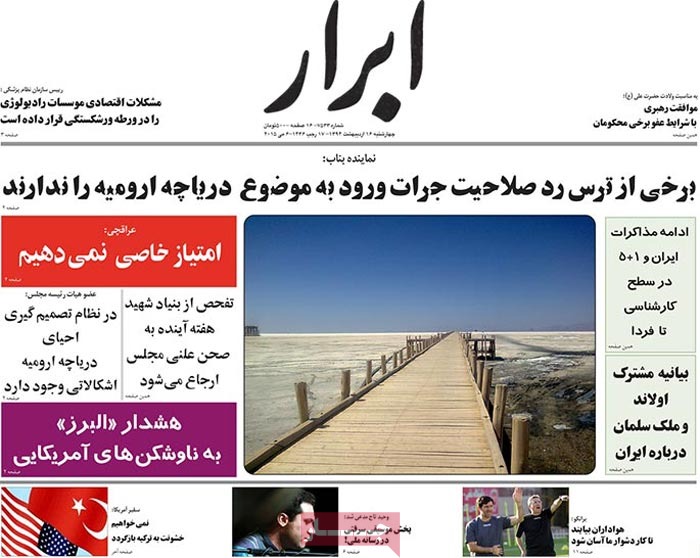
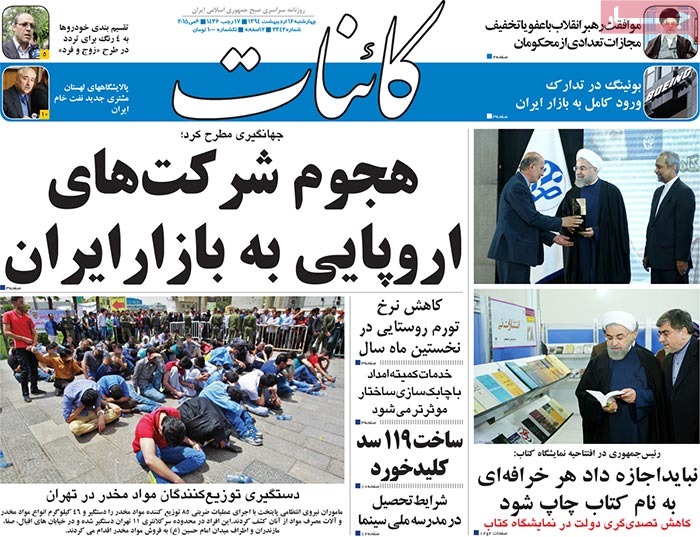
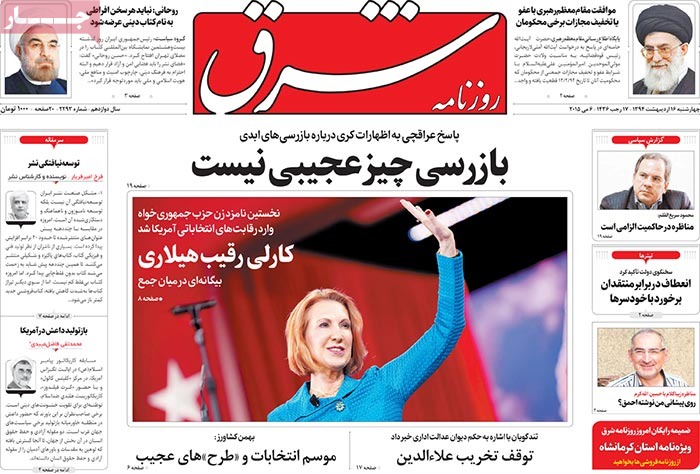
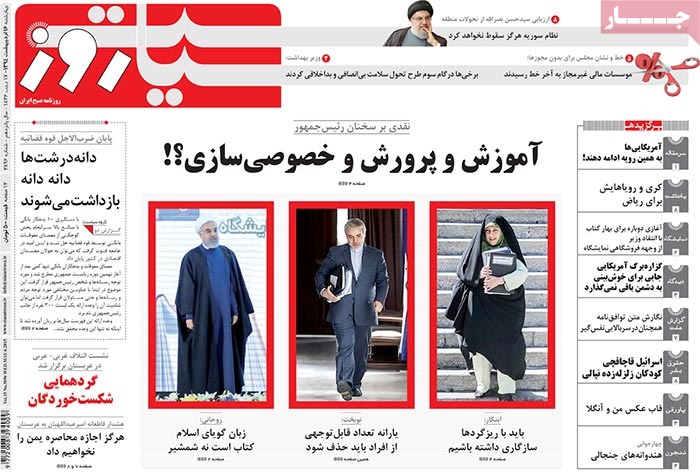
A look at Iranian newspaper front pages on April 5

Iranian Newspapers Headlines

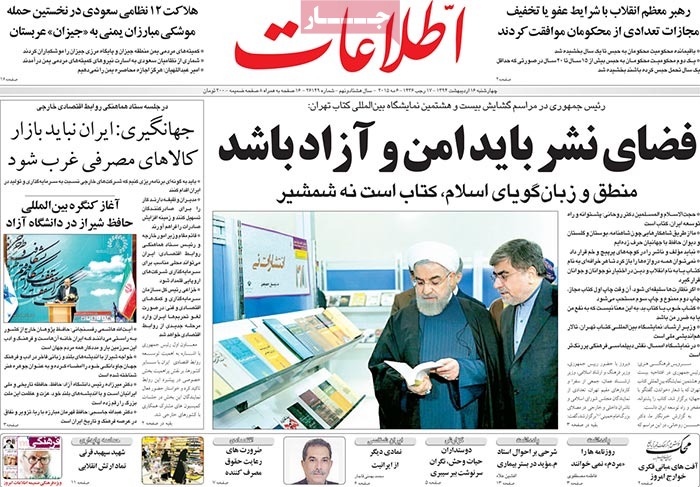
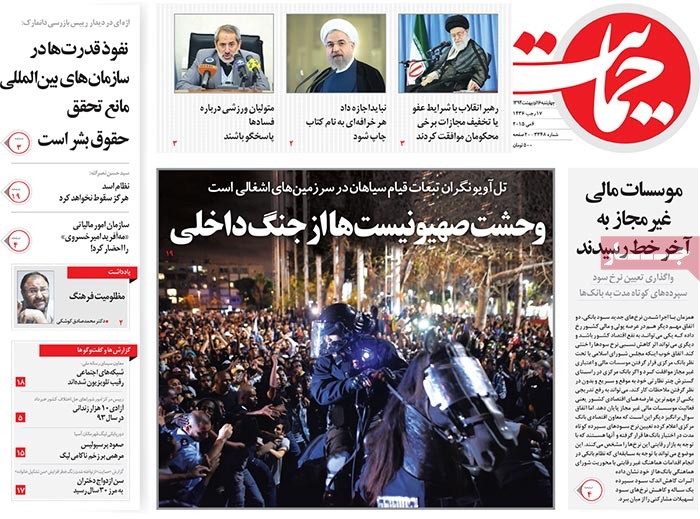
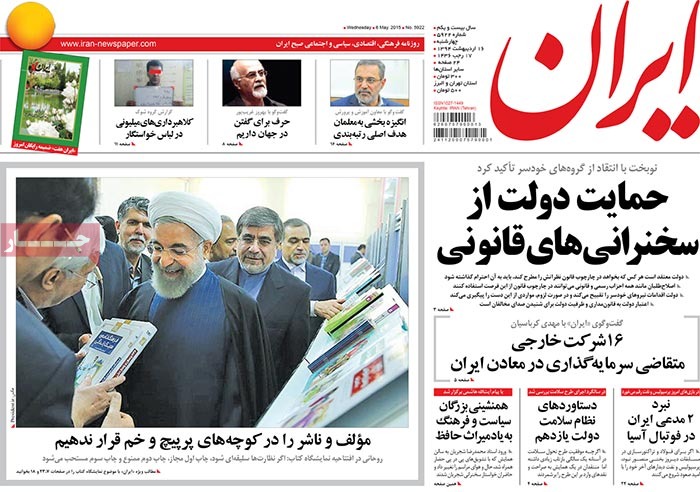
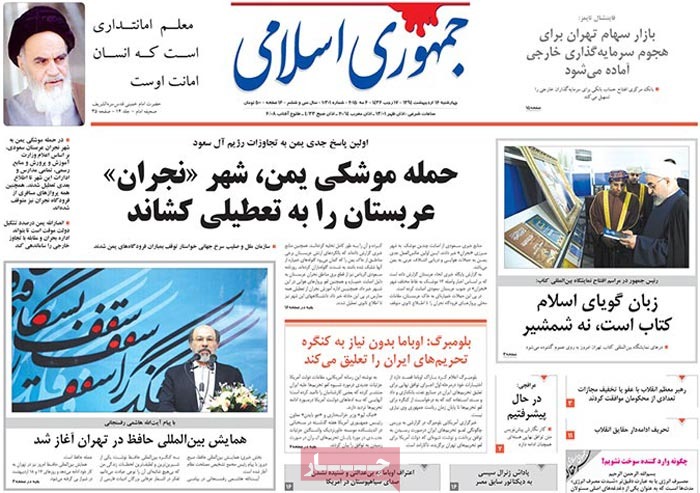
Reaction to the release of Lausanne nuclear statement continued to dominate the front pages of Iranian newspapers Sunday. Also in the news were the comments President Rouhani and Ayatollah Rafsanjani made about the nuclear talks and the road that lies ahead.


Afarinesh: Brigadier General Eskandar Momeni, who leads the Traffic Division of the Law Enforcement Force, has been named deputy national police chief.


A look at Iranian newspaper front pages on April 5


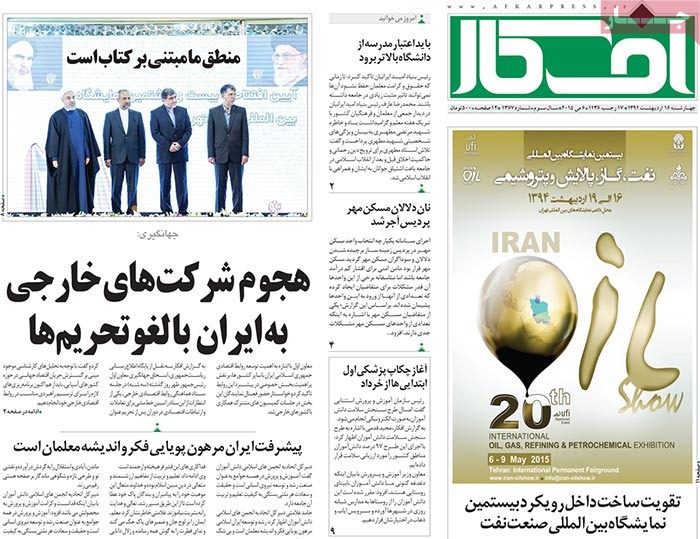
Afkar: The US Senate has backpedalled on plans to impose new sanctions on Iran.


A look at Iranian newspaper front pages on April 5


Arman-e Emrooz: “With the Lausanne nuclear statement, the Islamic Revolution has entered a new phase,” said Tehran principlist MP Ali Motahari.


A look at Iranian newspaper front pages on April 5


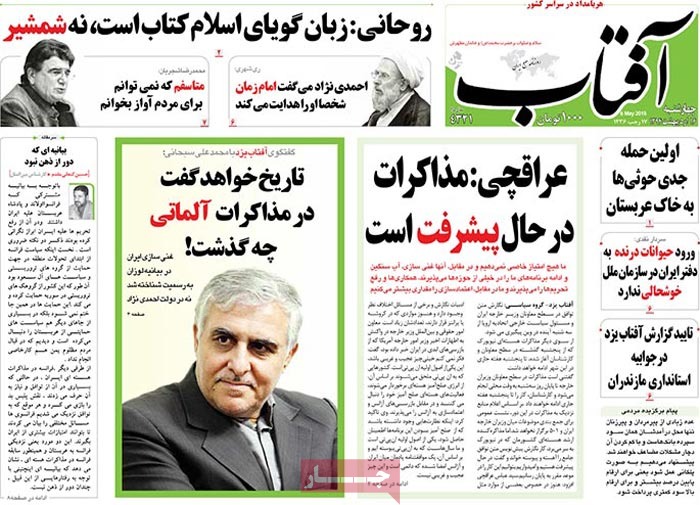
Asrar: “All red lines were respected in the Lausanne statement,” said Iranian nuclear negotiator Abbas Araghchi.


A look at Iranian newspaper front pages on April 5


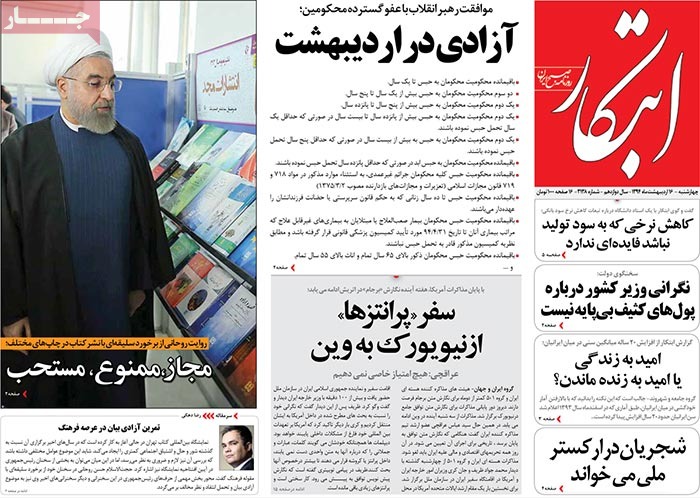
Ebtekar: “Oil production will return to the levels of the pre-sanctions era,” said the Iranian oil minister.


A look at Iranian newspaper front pages on April 5


Etemad: Ayatollah Hashemi has welcomed the Lausanne statement and warned about the impact of local pressures on the talks.

The chairman of the Expediency Council also said that the three-month period that lies ahead is vital.


A look at Iranian newspaper front pages on April 5


Ettela’at: “National cohesion will increase our strength in taking the final step in the nuclear deal,” said President Rouhani.


A look at Iranian newspaper front pages on April 5


Resalat: “The statement released in Lausanne is not a one-stage deal [Iranians have been insisting on],” said Morteza Nabavi, [a senior principlist figure].


A look at Iranian newspaper front pages on April 5


Sharq: The Islamic Republic of Iran Medical Council has lashed out at “Hashiyeh” a comic TV series directed by Mehran Modiri.


A look at Iranian newspaper front pages on April 5


Taadol: The stock exchange gained more than 2,000 points after the release of the Lausanne statement.


A look at Iranian newspaper front pages on April 5


Iran artworks sold at Christie’s Dubai Auction (Photos)

Christie's 18th sale season

The New Year got off to a good start for Iran’s visual arts as Iranian artworks – 27 items in all – were sold at the Christie’s auction of Modern and Contemporary Arab, Iranian and Turkish Art which was held in Dubai on March 18.

The auction proved a success for Iran which for the first time managed to auction off all its items. It was not the case for the Arabs and Turks, though; at least 30 of 131 works up for auction by Arab and Turkish artists remain unsold.

Christie’s five-day Auction opened in Dubai on March 15 and welcomed over 500 art collectors and enthusiasts to its 18th consecutive sale season in the region.

The following is a series of photos honaronline.ir released online on April 4 of the Dubai Sale:


Iran’s crude steel production up by 8 percent

steel

The volume of crude steel produced in Iran in the first 11 months of the last Iranian calendar year (March 2014 to February 2015) witnessed a growth of 8 percent, according to official reports.

A recent report by Iranian Mines and Mining Industries Development and Renovation Organization shows that Iranian steel manufacturers have produced 15,421,059 tons of steel in the said period.

The figure shows an 8-percent rise compared with the volume of steel produced in the same period the previous year, which amounted to 14,310,590 tons.

The report also indicates that 15,685,291 tons of different steel products were manufactured in the country from March 2014 to February 2015, showing a 4-percent increase compared with the 15,148,558 tons produced in the same 11 months the year before.

Earlier last week, a report by the World Steel Association also showed that Iran’s steel production output in January-February 2015 increased by 15 percent from 2.4 million tons in the same 2-month period last year.

Iran is reportedly the biggest steel producer in the Middle East and North Africa. The country’s main steel production facilities are located in Isfahan and Khuzestan provinces.

UNSC to kill anti-Iran resolutions upon final deal: Zarif

Mohammad Javad Zarid

The UN body will adopt a new resolution, terminating all the six nuclear-related resolutions as soon as Tehran and the group, comprising Russia, China, France, Britain, the US, and Germany, strike the accord, Iran’s Foreign Minister Mohammad Javad Zarif told Iranian state television late Saturday.

Iran and P5+1 along with officials from the European Union reached a mutual understanding on Tehran’s nuclear program after eight days of marathon talks in Lausanne, Switzerland, on Thursday.

According to a joint statement, considered the basis for a final nuclear deal, the two sides have devised a mechanism to lift sanctions after the agreement, known as the Joint Comprehensive Plan of Action (JCPOA), is reached by the end of June.

The joint statement read by Iranian Foreign Minister Mohammad Javad Zarif in Persian late Thursday stipulates implementation of the JCPOA shortly after its adoption as a United Nations Security Council resolution.

It has been clearly stated that all UNSC resolutions will be terminated from the day of agreement, Zarif said, in his joint statement with the EU foreign policy chief Federica Mogherini.

He also said all United States sanctions, including banking and oil sanctions, would be lifted as soon as the final deal comes into effect. “They thought that, through adoption of the strictest and heaviest United Nations, US, and EU sanctions, they (could) force Iran to surrender.”


Incongruity in US factsheet

The Iranian senior diplomat stressed that sanctions will be terminated, not suspended, and criticized the US, saying the fact sheet Washington released is different from the joint statement.

“We officially protested to [US Secretary of State] Mr. [John] Kerry for the statement of positions countering the Lausanne statement. The EU representative has also protested to [US Under Secretary for Political Affairs] Ms. [Wendy] Sherman why they have spoken contrary to their positions,” Zarif said.

“In fact, the Americans brought what they desired in the fact sheet,” he said.


Enrichment to go on

The Iranian minister said, based on the understanding reached in Switzerland, Iran would continue its enrichment program with five thousand centrifuges in the Natanz nuclear facility and a thousand centrifuges will also be in Fordow.

He described the talks as very intense and difficult.

Supreme Leader’s recommendations account for achievements in nuclear talks: Rouhani

Rouhani-1

President Hassan Rouhani said on Saturday that the advice of Supreme Leader Ayatollah Ali Khamenei to Iranian nuclear negotiating team accounted for significant achievements in nuclear talks.

Designation of the current Iranian year as Year of ‘Harmony and Unanimity’ by the Supreme Leader has coincided with the significant achievements made by Iran in nuclear fields, he said.

President Rouhani made the remarks in a meeting with a group of cabinet ministers and executive managers Saturday morning.

Referring to recent intensive nuclear talks in Lausanne, he said the government welcomed the views of Iranian officials in the three branches of governments and believed that the guidelines of the Supreme Leader of the Islamic Revolution Ayatollah Seyyed Ali Khamenei led to these achievements.

Nuclear talks at international level were very tough and complicated, he said, adding that the success of the Iranian nuclear team in talks with P5+1 was due to harmony and unanimity of the Iranian people and the efforts of the Iranian nuclear negotiators.

Nuclear talks once again legitimized Iran’s uranium enrichment on its soil, he said, adding that Arak heavy water reactor is to continue its operation with a most updated technology and so are other nuclear installations in Fordo and Natanz.

Sitting with six world powers at the negotiating table to defend the country’s rights should be considered as a great achievement, he said.

Final deal will also ensure a promising situation for exercising resistance-based economy in the country as world powers have reached this conclusion that their continuation of sanctions would never bear any fruit, said President Rouhani.

Remote diagnosis of disease via smart phones

Hadi Shafii

A team of researchers, among them Dr. Hadi Shafiee, Ph.D., an Iranian instructor in medicine at the Division of Biomedical Engineering at Brigham and Women’s Hospital, Harvard Medical School, has developed a new smart phone application which helps detect a variety of bacteria in blood and the diseases they cause.

The following is the translation of a report Mehr News Agency posted online on April 4 about how this application could help doctors detect various diseases:

Among other conditions, the technology is aimed at detecting HIV and E-coli. There is hope that in the not-too-distant future this remarkable biosensing platform could swiftly and remotely diagnose those who have most likely contracted such diseases only by using a drop of blood from a fingerprick.

The platform is also capable of accurately detecting pathogens from plasma. More interestingly, the results can be transmitted via mobile phones or other telecommunication means to anywhere in the world.

Dr. Shafiee and his fellow researchers hope that this new technology will be used to promote healthcare worldwide.