Sunday, April 26, 2026
Home Blog Page 4893

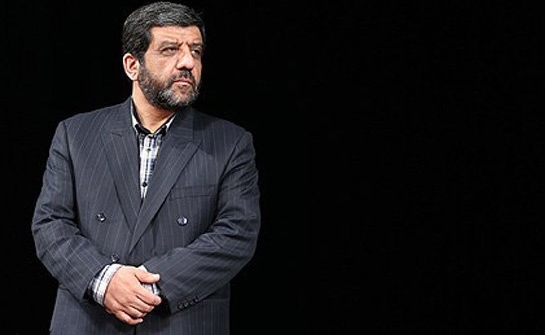
Has former IRIB chief set his sights on Speaker’s chair?

zarghami2

As a medium, Islamic Republic of Iran Broadcasting (IRIB) is the fourth estate of democracy and a key forum inside the country, mandated to guide the public opinion.

In recent remarks, former IRIB chief Ezzatollah Zarghami has demonstrated an about-turn from his hardline stance on reformism, saying that the majority of reformists are part of the [Islamic] establishment. This comes as the share of reformists of airtime during Zarghami’s presidency at IRIB was somewhere in the neighborhood of zero.

Arman-e Emrooz daily on May 6 published a piece on Zarghami’s potential run for parliament in 2016, analyzing the shift in his stance. The following is the translation of excerpts from the piece:

[…]

Has Zarghami been gripped by election fever?

At a time when all [political parties and] factions are looking for a household name on their ticket for the [2016 parliamentary] elections, Zarghami seems to be just the ticket for principlists.

The principlists need a moderate face to be their candidate in the elections; certain figures of their ranks believe that the former chief of the national broadcaster – who has recently articulated words which have the hallmarks of moderation – can be the right figure to help them achieve their goal in the elections for the tenth parliament.

It is no secret that Ali Larijani [the incumbent speaker of the Islamic Consultative Assembly] made his way to parliament and its top seat after leading IRIB [for ten years].

Now Zarghami has taken a stand he thinks is in line with the country’s current mood and people’s demands. Since he has the support of traditional principlists and those principlists who are part of the Islamic Revolution Stability Front, as well as the advocates of [former President Mahmoud] Ahmadinejad, Zarghami thinks he can take the seat of the incumbent parliament speaker.

That’s why the former IRIB boss thinks he can get the better of his rivals if he makes a run for parliament in the March elections; he even imagines that he can make the dream of the principlists affiliated to the Islamic Revolution Stability Front come true and enter the chamber as top MP.
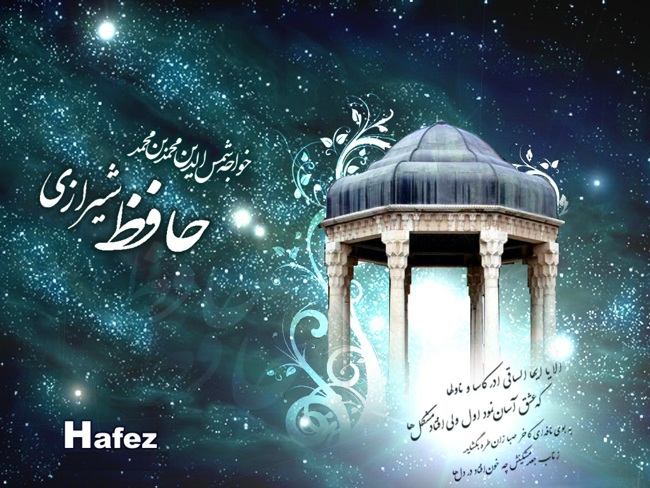
In memory of the spokesman of Iranian people and history

Hafez-1

An International Conference on Hafez Shirazi – organized by the Islamic Azad University – opened simultaneously in Tehran and Shiraz Tuesday (May 5) with a focus on protecting and promoting the Persian language.

The international event, which will run through May 8, has brought together a number of scholars from Iran and other countries – among them Mohammad Reza Shajarian, a well-known Iranian classical vocalist.

Farhikhtegan daily on May 4 published an interview with Shahin Avani, a philosophy researcher and a member of the Islamic Azad University’s Socio-Cultural Council. The following is the translation of excerpts from her remarks:

Hafez is [part of] Iran’s national and cultural heritage. […] Ferdowsi, Khayyam Mowlana and Hafez are Iranian answers to the West’s Homer, Dante, Shakespeare and Goethe. Their works have been reprinted, critically reviewed and edited several times before their final versions have come out.

Hafez is the spokesman of the Iranian people and history. No doubt, the future generations will study and work on Hafez and his works. […]

I usually compare conferences held on Hafez in Iran with those in Germany which focus on Goethe. Like in Iran, the German youth are the ones who benefit from such get-togethers in which the scientific experience is passed down through generations.

[…]

[Hans-Georg] Gadamer – who is a 20th century German philosopher, follows the line of thinking Hafez had in the 14th century. It was Hafez who incorporated practical wisdom [phronesis] into physical and spiritual beauty, helping the Iranian thinking rise to its peaks.

[…]

Hafez has taken into account the artistic demands of humans and has regarded art as a driving force [behind human perfection].

[…]

Recipe for Dizi, Famous Traditional Persian Food

Recipe for Dizi, Famous Traditional Persian Food

Iranian dishes excel at making people who have never tried them fall in love at the first bite. The unique combination of spices and flavorings with a wide range of vegetables, herbs, fruit, grains, nuts, meat and most importantly rice only needs the wand of Iranian cuisine to perform magic and leave an explosion of unforgettable tastes in the mouth.

The delectable smell, delicious look and perfectly pleasant taste make it almost impossible to resist them. To share the gastronomic delights of Iran, IFP has decided to file a series of mouth-watering recipes for Iranian dishes.

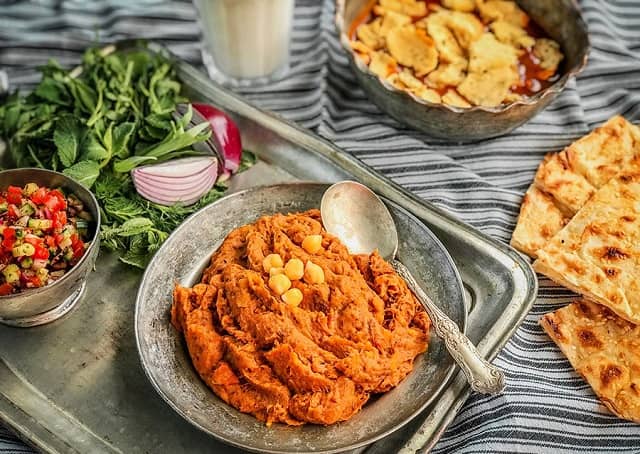
dizi

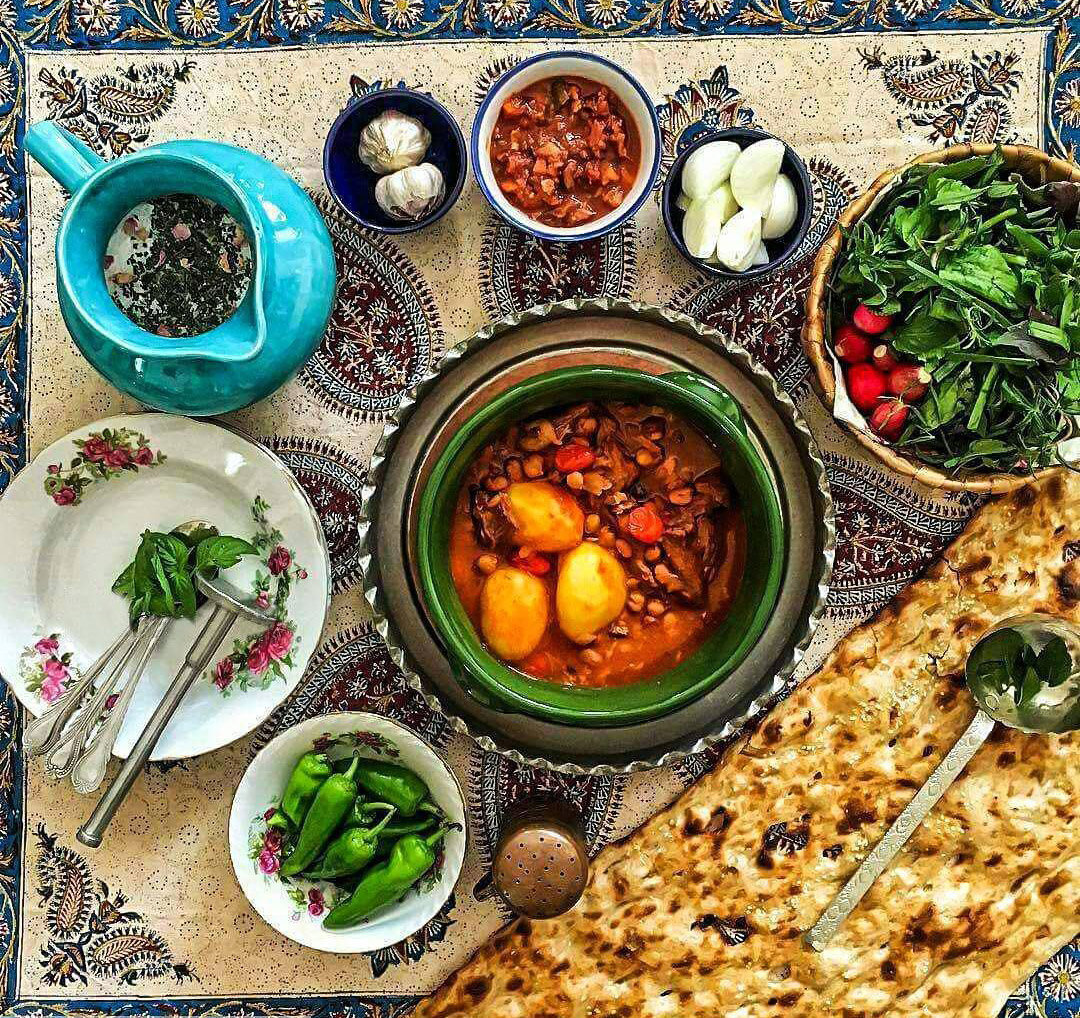
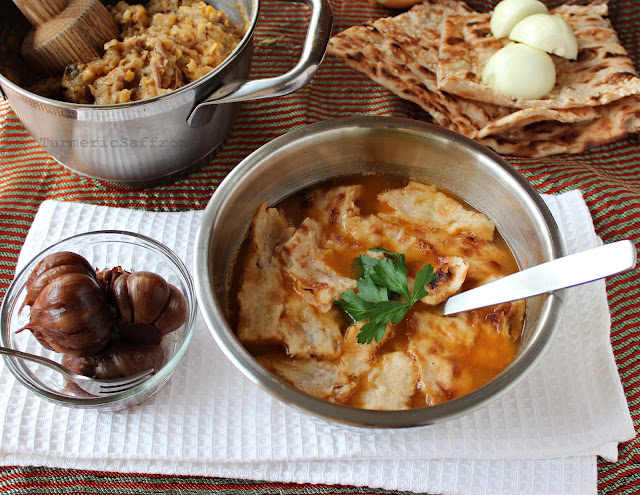
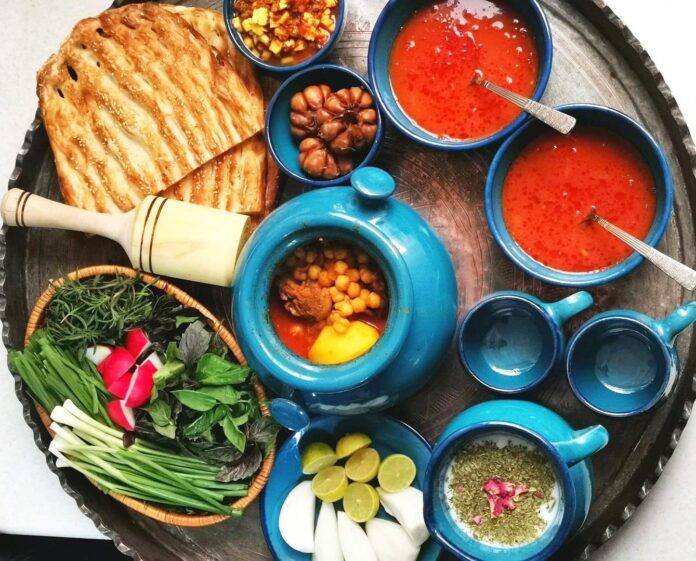
Dizi is a traditional, nutritious Iranian dish which looks like a soup served in two stages. Traditionally, small pieces of flat bread are mixed and eaten with the broth in the first stage. You can skip this part if you don’t like it. Other ingredients are later mashed and served with side dishes of pickles, fresh herbs [garden cress, wild leek, basil, squaw mint, scallion and radish], Doogh [a savory yoghurt-based beverage], raw onions and most importantly freshly-baked flat bread.

dizi

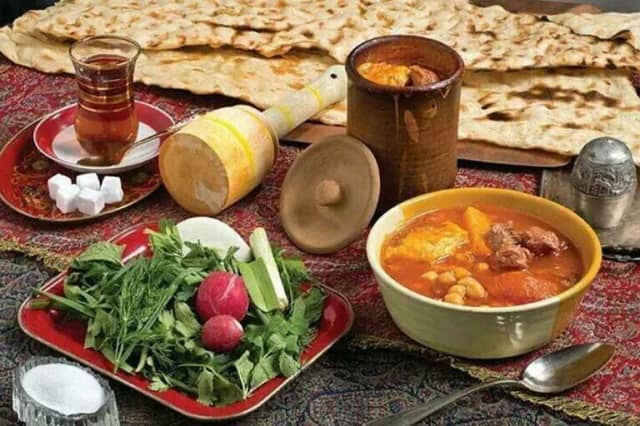
In Persian, Dizi refers to clay or stone pots in which the dish is cooked and served. In fact, in Iran, the dish is still served in small crocks in traditional restaurants where customers are provided with a masher to crush the meat and other ingredients after separating the solid part from the broth, known as Abgoosht.

Recipe for Dizi, Famous Traditional Persian Food
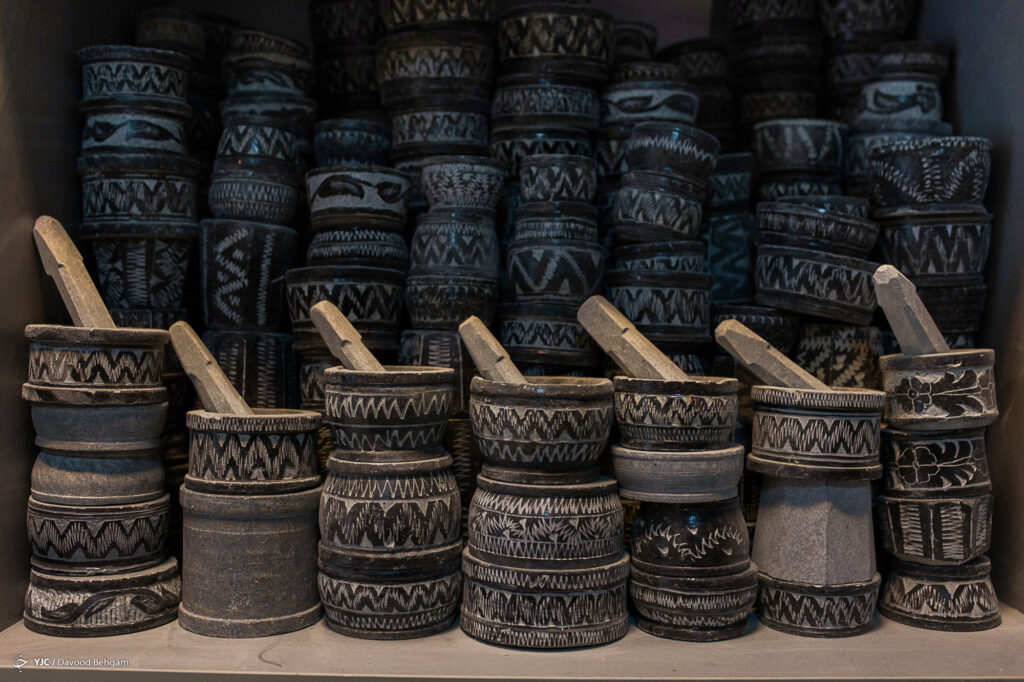
Dizi stone pots (source)

Ingredients for Persian Dizi

(Serves 6)

  1. 750 grams lamb shank/shoulder of lamb on the bone [Don’t remove the fat from the meat; the meat used should be fatty.]
  2. 100 grams chickpeas – Rinse and soak them for 24 hours
  3. 100 grams navy beans – Rinse and soak them for 24 hours
  4. Six small potatoes
  5. Six small tomatoes – chop them into pieces
  6. Two large onions which should be peeled and sliced.
  7. Two heaped tablespoons tomato paste
  8. Oil
  9. Water
  10. Salt, ground black pepper and turmeric to taste
How to Make Iranian Dizi
Dizi is a traditional, nutritious Iranian dish.

 Cooking Steps for Iranian Dizi

    • Fry the onions in a frying pan with ground black pepper and a liberal amount of turmeric until they turn golden brown.
    • Add in tomato pieces and fry them lightly for a few minutes. Put the chickpeas and navy beans in the pot and sauté them.
    • Cut the meat into bite-size pieces, add them to other ingredients in the pot and fry them until browned on all sides. [You can use a pressure cooker to let the dish cook by the pressure of hot steam over a low heat. To have a tasty final dish, you need to give the dish enough time to be cooked gently.]
    • Tomato paste should be fried with the mixture until it turns deep red; stir it frequently to prevent it from burning. Cooking Steps for Iranian Dizi
  1. Pour 10 to 12 cups of water into the pot and bring it to a boil. Then, turn down the heat to let it simmer. The pot should be tightly covered, so if you don’t use a pressure cooker, opt for a pot with a close-fitting lid.
  2. Wash the potatoes well, but do not peel them [the skin prevents them from falling apart in the pot; they should be peeled later before being mashed]. By the time the meat and the grains are tender and cooked, add salt – toward the end of cooking to stop meat from toughening and prolonging the cooking time – and the potatoes to the pot.
  3. When the potatoes are cooked, drain the broth and pour them into serving bowls. If you want to mash the solid part before serving, do not forget to remove the bones.

Bon Appétit!

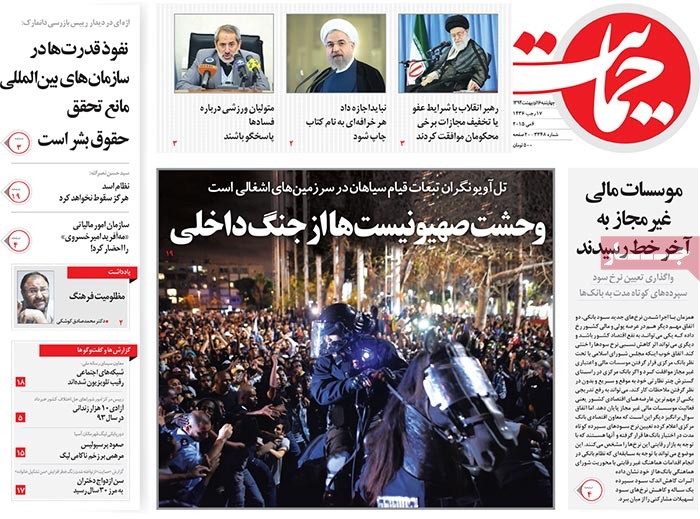
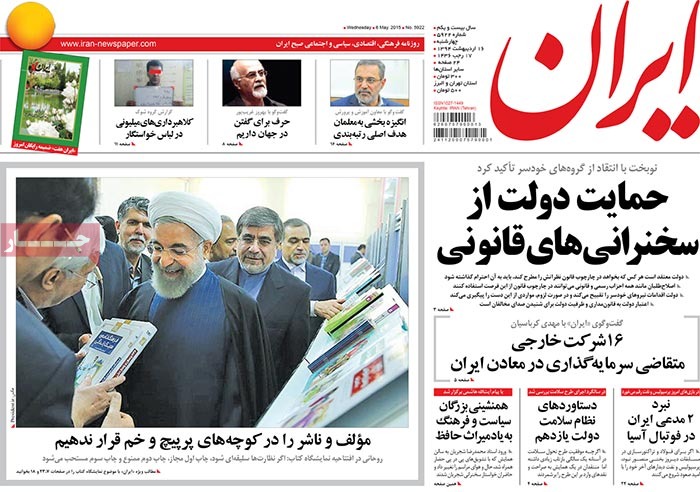
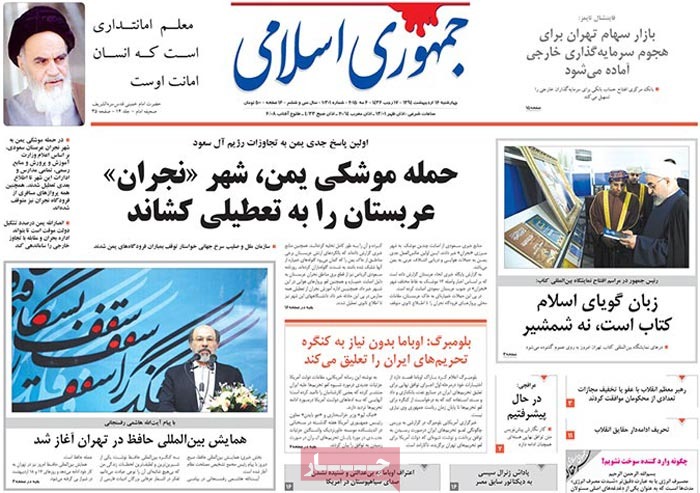
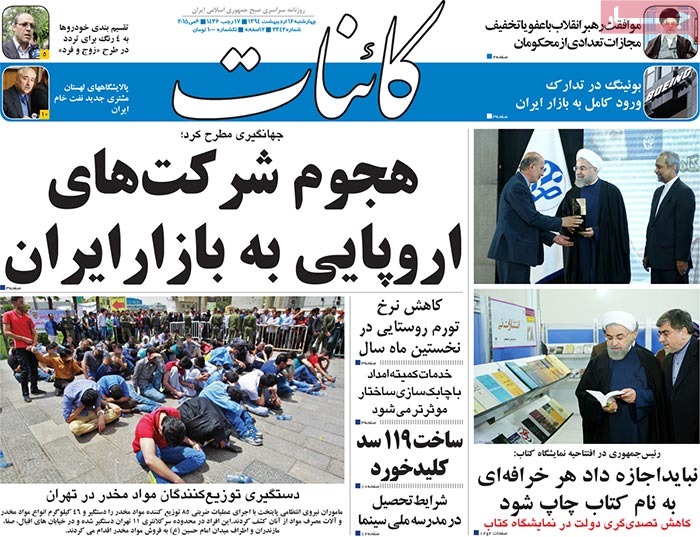
A look at Iranian newspaper front pages on May 6

Iranian Newspapers Headlines

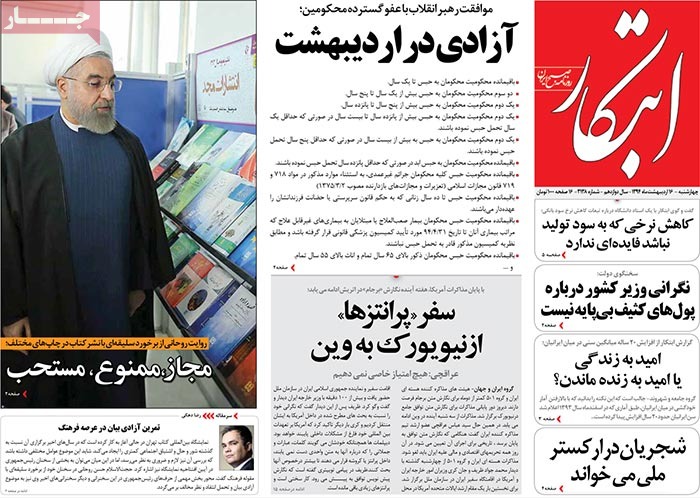
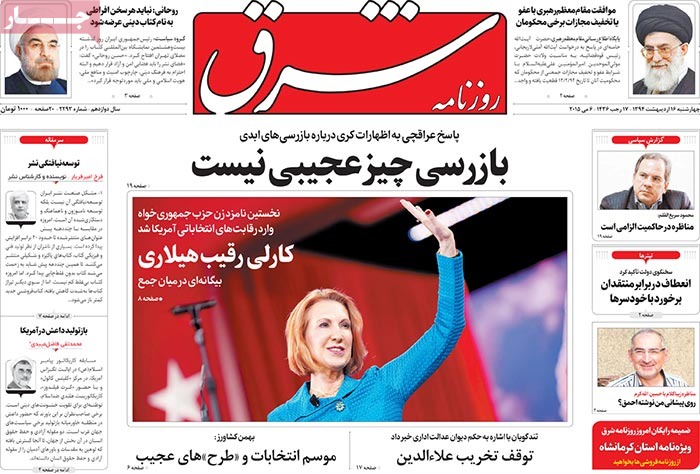
President Rouhani’s comments at the inaugural of Tehran International Book Fair and the Supreme Leader’s decision to pardon and or commute the sentences of a number of convicts dominated the front pages of Iranian newspapers Wednesday.


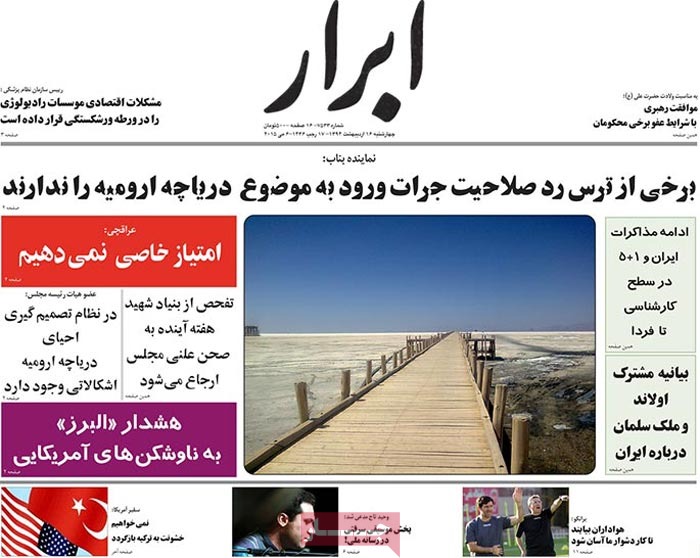
Abrar: “Some [MPs] do not dare enter any debate on the Orumiyeh Lake, fearing they might be disqualified [for the upcoming elections],” said a deputy representing Bonab in the Islamic Consultative Assembly.


A look at Iranian newspaper front pages on May 6


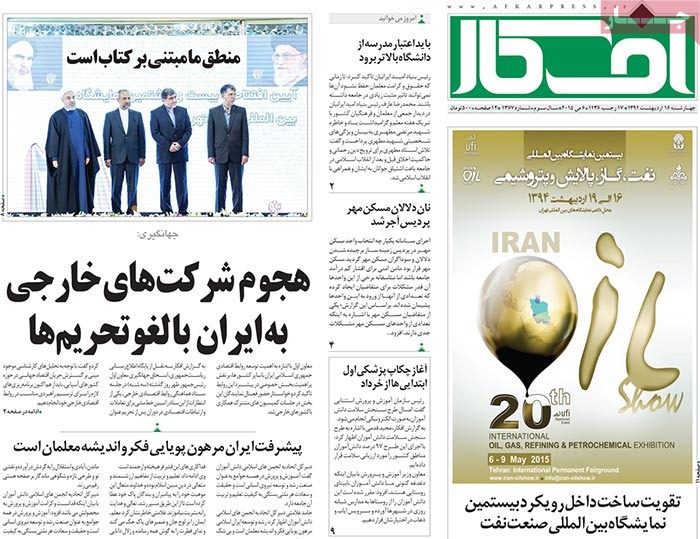
Afkar: A 20th International Oil, Gas, Refining and Petrochemical Exhibition opens today.


A look at Iranian newspaper front pages on May 6


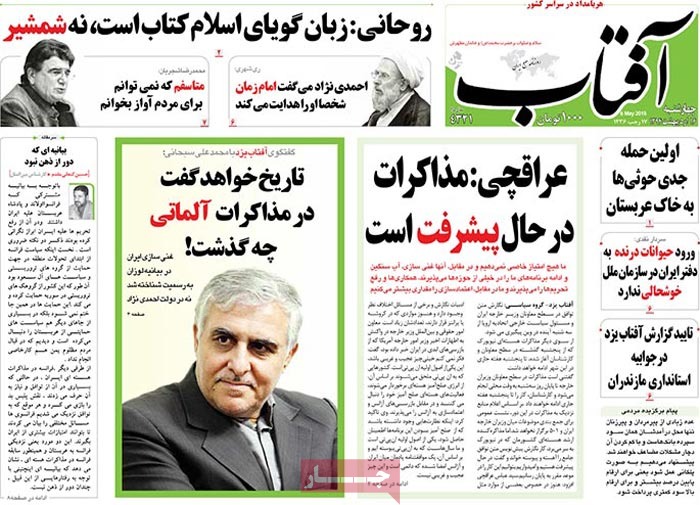
Aftab-e Yazd: “Islam talks to its audience through books, not swords,” said President Rouhani.

The president made the comment at a keynote speech at the inaugural of Tehran International Book Fair.

Aftab-e Yazd: “[Former President Mahmoud] Ahmadinejad claimed he was being personally directed by the Imam of the Time [the 12th Shiite Imam who disappeared from sights centuries ago and his return will see true justice administered in the world],” Mohammad Reyshahri has written in his memoir.

Aftab-e Yazd: “I am sorry I can’t sing for my fellow Iranians,” said renowned vocalist Mohammad Reza Shajarian.

Aftab-e Yazd: “History will judge what happened in Almaty talks,” said Mohammad Ali Sobhani, a former Iranian ambassador to Lebanon and Jordan.

“Iran’s right to enrichment was recognized in the Lausanne statement, not when Ahmadinejad was in office,” the former diplomat further said.


A look at Iranian newspaper front pages on May 6


Ebtekar: “The concerns of the interior minister about dirty money [finding its way into electoral campaigns] are not unfounded,” reiterated the government spokesman.


A look at Iranian newspaper front pages on May 6


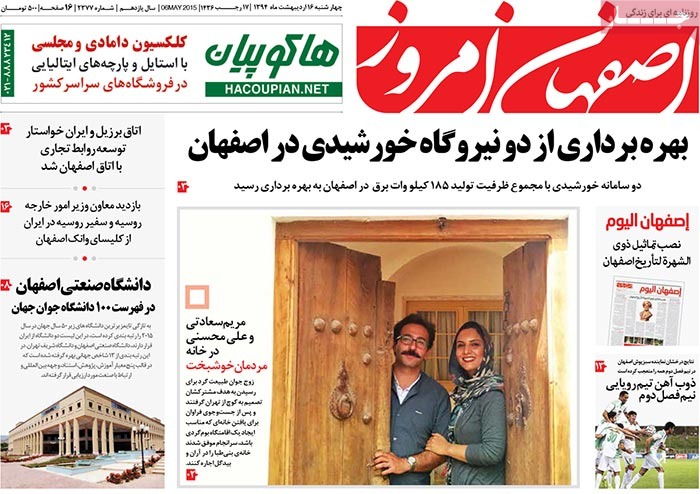
Esfahan Emrooz: Two solar power plants have opened in Isfahan.

Esfahan Emrooz: The Russian deputy foreign minister and ambassador to Iran have paid a visit to Vank Cathedral in Isfahan.


A look at Iranian newspaper front pages on May 6


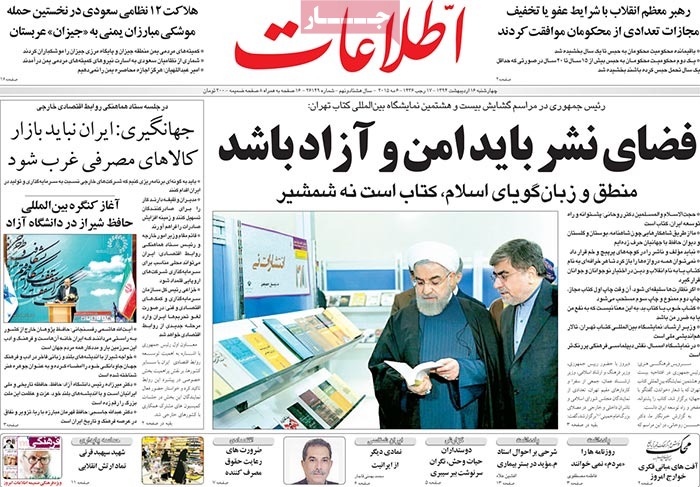
Ettela’at: “Iran should not turn into a market for Western goods,” said the first vice-president.


A look at Iranian newspaper front pages on May 6


Hemayat: Unauthorized financial institutes are at the end of the line.


A look at Iranian newspaper front pages on May 6


Iran: “Sixteen foreign firms are interested in investing in Iran’s mining sector,” said the deputy minister of industries, mines and trade.


A look at Iranian newspaper front pages on May 6


Jomhouri Islami: A missile attack from Yemen has resulted in the shutdown of the Saudi city of Najran.


A look at Iranian newspaper front pages on May 6


Kaenat: In a lightning operation Tehran police have arrested 85 drug dealers, seizing 46 kg of drugs.


A look at Iranian newspaper front pages on May 6


Sharq: The Supreme Leader has pardoned or commuted the sentences of a number of convicts.


A look at Iranian newspaper front pages on May 6


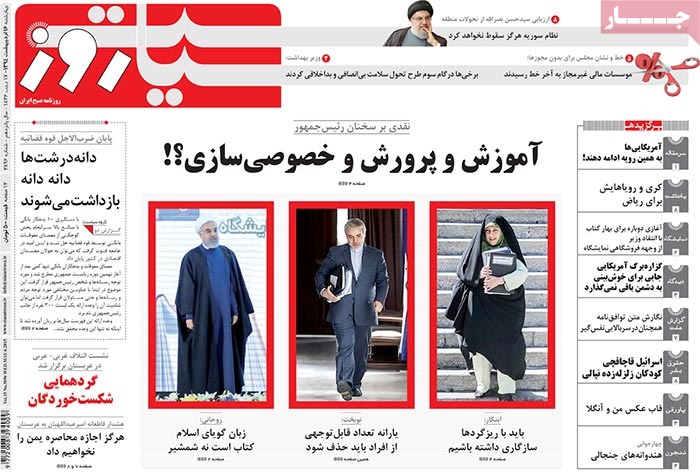
Siasat-e Rooz: “The cash subsidies offered to a sizeable number of individuals should stop,” said Government Spokesman Mohammad Bagher Nobakht.


A look at Iranian newspaper front pages on May 6


Iran closely monitoring Takfiri movements: Intelligence minister

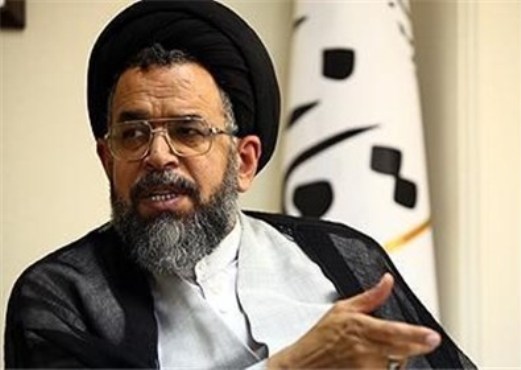
Iran's Intelligence Minister Seyyed Mahmoud Alavi

Intelligence Minister Seyyed Mahmoud Alavi underlined that his forces closely monitor the movements of the Takfiri and counterrevolutionary forces.

“The intelligence ministry’s forces vigilantly and rigorously monitor all movements and plots of the enemies of Islam, including the Takfiri groupings,” Alavi said, addressing a group of people in Karaj city, near Tehran, on Tuesday.

He pointed to the round-the-clock efforts of the Intelligence Ministry to restore security in the country, and said, “Many plots have been foiled in the country due to the efforts of the Intelligence Ministry.”

Larijani reiterates Iran’s peaceful stance on Yemeni Crisis

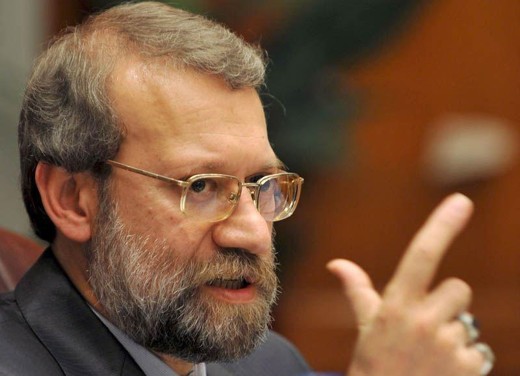
Parliament Speaker Ali Larijani in a meeting with Iranian Ambassador to Riyadh Hossein Sadeghi in Tehran on Tuesday underlined that the Islamic Republic of Iran supports a political solution to the crisis in Yemen.

“We can be hopeful about ending this crisis only through holding national talks,” Larijani said.

The Iranian parliament speaker expressed hope that the Saudi-led attacks on Yemen will come to a halt soon.

Sadeghi, for his part, briefed Larijani on the latest developments in Yemen.

Nuclear talks to continue on May 12: Iranian diplomat

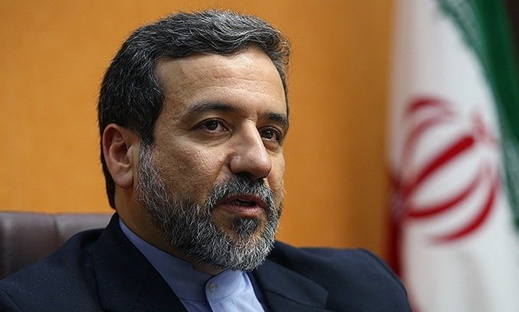
Abbas Araghchi

A senior Iranian negotiator says talks over Iran’s nuclear program will continue on May 12 in the Austrian capital Vienna.

Iran’s Deputy Foreign Minister for Legal and International Affairs Seyyed Abbas Araghchi made the remarks in an interview with IRIB on Tuesday night following four days of intensive negotiations in New York.

Negotiations with EU Political Director Helga Schmid will start on May 12 and representatives of P5+1 would join the talks on May 15 to complete the process of drafting a final agreement on Iran’s nuclear program, Araghchi said.

The Iranian official added that the drafting process is moving on well but slowly, and expressed hope that a final deal could be reached even before an end of June deadline.

Araghchi noted that immediately after a possible final agreement all economic and financial sanctions will be removed, and Iran will increase the level of its global cooperation in nuclear industries, such as building new nuclear plants and water desalination units with nuclear power.

He also insisted that his country would prefer no agreement to a bad agreement.

Iran and P5+1 – the United States, Britain, France, Russia, China and Germany – reached a mutual understanding on the parameters of a comprehensive agreement over the Islamic Republic’s nuclear program in Lausanne, Switzerland, on April 2.

Iran, Russia call for halt to Saudi aggression against Yemen

tt

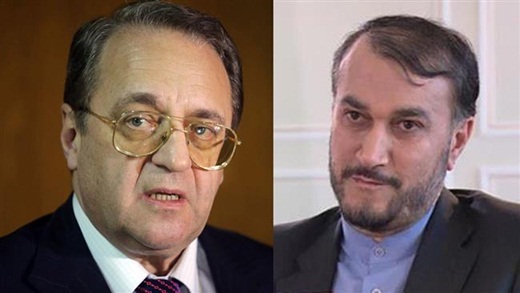
An Iranian deputy foreign minister and his Russian counterpart have called for a halt to Saudi Arabia’s onslaught on Yemen so that humanitarian aid could be sent to the war-torn country.

In a phone conversation on Tuesday, Iran’s Deputy Foreign Minister for Arab and African Affairs Hossein Amir Abdollahian and Russian Deputy Foreign Minister Mikhail Bogdanov also stressed the need for a political solution in Yemen.

They also expressed their concerns over a surge of terrorist activity in the Arab country.

Both diplomats went on to reaffirm their countries’ mutual support for negotiations among all concerned parties in the Yemen conflict at a location accepted by those involved in the crisis.

Saudi Arabia is continuing its brutal airstrikes against Yemen despite the deteriorating humanitarian situation in the impoverished country.

Riyadh launched its military aggression against its impoverished neighbor on March 26 – without a United Nations mandate – in a bid to undermine Yemen’s Houthi Ansarullah movement and to restore power to the country’s fugitive former president, Abd Rabbuh Mansur Hadi, who is a staunch ally of Saudis.

Saudi Arabia has also been blocking aid to Yemen.

Last month, it prevented two Iranian civilian planes from delivering medical aid and foodstuff to the Yemeni people.

Tehran Book Fair is a national forum: Culture chief

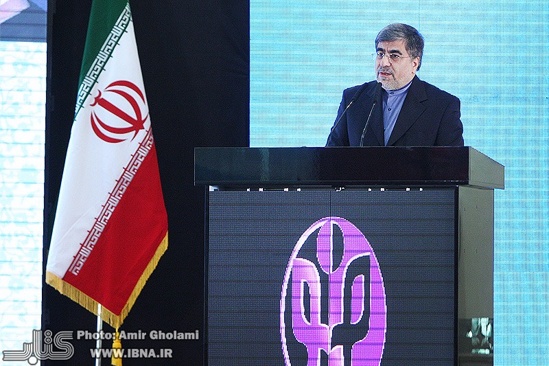
Ali Jannati-Book fair

Tehran International Book Fair is a national forum where government and members of the public can compare notes and seek ways to secure harmony and unanimity, Culture and Islamic Guidance Minister Ali Jannati was quoted by the Islamic Republic News Agency as telling the opening ceremony of a 28th edition of Tehran International Book Fair Tuesday.

He added, “Over the past 28 years, Tehran book fair has transformed into a big cultural event and the government has tapped into all potential at its disposal to promote it.”

On the participants at the expo this year, Jannati said, “Over 70 state organizations such as the municipality, ministries of science, health, education, foreign affairs and energy have taken part in the exhibition which is also attended by thousands of local and hundreds of foreign publishers. The number of book titles on display has grown by 20 percent over previous years.”

The culture chief expressed hope that organization of the event will be completely handed over to the private sector in the coming years.

Jannati went on to say, “The book fair should give priority to newly-published books. Putting on display a number of foreign books does not necessarily render the exhibition international. That’s why cultural diplomacy has been highlighted at this year’s fair, and Oman is also present at the event.”

The minister said, “Each day of the expo has been allocated to one country so that it can present its programs to visitors.”

“Reading, dialogue with the World” is the motto of the 28th edition of Tehran Book Fair, Jannati said, adding, “Efforts have been made this year to allow books published by ethnic groups and followers of different faiths to make their presence felt in the exhibition. Also, scientific and cultural discussions to evaluate the country’s publishing industry and to compare notes on scientific questions are to be held at the expo.”

The culture minister concluded, “There is hope that the exhibition will turn into the most effective means to fulfill the cultural objectives of the Islamic Republic.”

The expo which offers some 500,000 book titles in two local and foreign sections opened at Imam Khomeini Prayer Ground in Tehran earlier on Tuesday and will run through May 16.

The inaugural ceremony was attended by President Rouhani, the Iranian and Omani culture ministers, some foreign ambassadors based in Tehran, a number of MPs as well as national and foreign publishers.

Leader pardons, commutes sentences of convicts

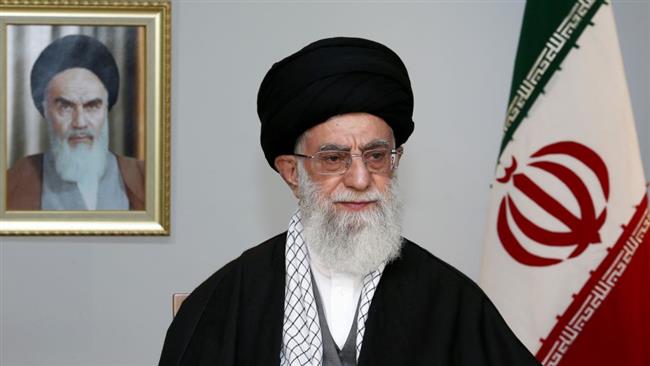
Leader-Iran

Leader of the Islamic Revolution Ayatollah Seyyed Ali Khamenei has granted clemency or eased the sentences of a number of convicts.

The Leader on Tuesday agreed to a request by Judiciary Chief Ayatollah Sadegh Amoli Larijani to pardon some convicts on the occasion of the birth anniversary of Imam Ali (PBUH), the first Shia Imam.

This year, Imam Ali’s birthday anniversary in Iran fell on May 2.