Wednesday, December 24, 2025
Home Blog Page 4824

Fair nuclear deal must serve Iran interests: Leader

Supreme Leader

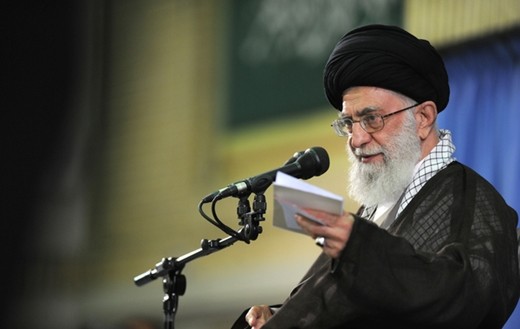
Leader of the Islamic Revolution Ayatollah Seyyed Ali Khamenei says Iran seeks to reach a fair deal with P5+1 over its nuclear program, one that will serve the country’s national interests.

“All Iranian officials, while insisting on [the country’s] red lines, are pursuing a good deal which is fair and honorable and in line with Iran’s interests,” the Leader said in a meeting with the heads of the three branches of government and other senior officials on Tuesday.

A study of the American demands shows that they intend to turn Iran’s nuclear industry into a “caricature” after dismantling it and abolishing the country’s nuclear identity, the Leader added.

Ayatollah Khamenei stated that the Americans are also making efforts to deprive the Iranian nation of the great advantages of nuclear industry while maintaining pressure and sanctions against the Islamic Republic.

The Leader said Iran has always made rational demands since the beginning of the talks with P5+1 and emphasized that all “cruel sanctions” on Tehran over its nuclear program must be lifted.

Ayatollah Khamenei commended the Iranian nuclear negotiating team for its faithfulness and bravery in the talks, and said the negotiators are meticulously making efforts to settle the outstanding issues.

The Iranian negotiators have managed to bravely announce Iran’s stance on the nuclear issue, the Leader said, adding that they may possibly make some mistakes but they are “brave and faithful”.

He pointed to all nuclear powers’ refusal to sell 20 percent enriched fuel to Iran for the production of nuclear medicine at the Tehran Research Reactor and said young Iranian scientists have succeeded in producing the fuel and confounding the opposite side.


Iran’s red lines in nuclear talks

Ayatollah Khamenei reaffirmed the Islamic Republic’s red lines in its nuclear negotiations with P5+1 and said, “Despite insistence by the Americans, we do not accept long-term restrictions [on nuclear activities] for 10 or 12 years. We have told them how many years of restrictions is acceptable to us,” the Leader said.

He stressed that proceeding with research and development in the field of nuclear technology even during the time of restrictions is another red line for the Islamic Republic.

The Leader further emphasized that all economic, monetary and banking sanctions imposed by the United Nations Security Council and the United States against Iran must be immediately lifted on the day of signing a possible final nuclear deal while other bans must be terminated based on a rational timetable.

“The lifting of sanctions must not be contingent on the implementation of Iran’s undertakings. They should not say that you (Iran) should fulfill your commitments and the [International Atomic Energy] Agency (IAEA) should then verify it in order for the sanctions to be lifted. We do not accept this issue at all,” Ayatollah Khamenei stated.

He said Iran opposes the P5+1 group’s fulfillment of its commitments after the IAEA’s report “because the agency has repeatedly proven that it is not an independent and fair body and so we are pessimistic about it.”

The Leader further expressed Iran’s firm opposition to “unconventional inspections, questioning Iranian figures, and the inspection of military sites” as other red lines for the country.

Nuclear deal possible if excessive demands not pressed: Rouhani

Rouhani-Leader

Iran’s President Hassan Rouhani says a comprehensive nuclear deal with the P5+1 group of countries is possible if the six world powers do not put forward excessive demands.

“If the opposite [negotiating] side makes no excessive demands, the deal will be attainable,” Rouhani said during a meeting hosted by Leader of the Islamic Revolution Ayatollah Seyyed Ali Khamenei in Tehran on Tuesday.

Parliament Speaker Ali Larijani and Judiciary Chief Ayatollah Sadegh Amoli Larijani as well as other senior officials were on hand for the meeting.

The president added that Iran’s foreign policy is based on constructive interaction with other countries while maintaining national independence and dignity as the country’s red lines.

He said the settlement of the nuclear issue within the framework of safeguarding the country’s nuclear rights is among the Iranian administration’s priorities.

The Iranian nation’s resistance against ill-wishers’ pressure and failure of sanctions against Tehran have brought powerful countries to the negotiating table with Iran, the Iranian president added.

Rouhani emphasized that the bans have failed to yield the results expected by the West, and noted that the Iranian nation is capable of solving its social, economic, political and cultural issues even when sanctions are imposed on the country.

Despite sanctions, Iran has succeeded in bringing down inflation and increasing the investment rate in cooperation with the nation, he stated.

[…]

What is blocking a nuclear deal between Iran and P5+1? An expert view

Negotiators of Iran and six world powers face each other at a table in the historic basement of Palais Coburg hotel in Vienna

KhorramAli Khorram, an expert in international affairs, says disagreements between Iran and P5+1 over the inspections regime and how the Additional Protocol of the Nuclear Non-Proliferation Treaty (NPT) should be implemented are preventing the two sides from striking a final comprehensive deal over Tehran’s nuclear program.

On June 23, Fararu.ir, a news website, published a report featuring excerpts from an interview with Khorram, an academic and former Iranian diplomat. The following is the translation of that report:

Ali Khorram, a university professor, said the implicit positions adopted by diplomats and negotiators suggest that the main hurdle separating the two sides from a deal before an end-of-June deadline has to do with inspections and the way the Additional Protocol should be carried out.

He further said that P5+1 want Iran to implement the Additional Protocol in a way that officials in Tehran do not approve of, adding: “The Additional Protocol allows inspectors with the International Atomic Energy Agency to conduct snap inspections of suspected undeclared sites. At the same time, the same Protocol says that if the suspected sites are located in areas about which the host nation is sensitive, like a military site, inspections should respect the national sovereignty and other considerations of the host nation.”

In other words, Khorram said, the Protocol does not guarantee IAEA inspectors access to sites anytime, anywhere. “The fact that P5+1 put forth any such demand [access anytime, anywhere] is not negotiable.”

The former diplomat further said Iran’s rejection of a demand that is not prescribed by international law as far as implementation of the Additional Protocol is concerned does not mean that Iran is placing the Protocol off its agenda.

“Basically, nuclear talks are being held to remove ambiguities surrounding Iran’s nuclear program through more transparency and confidence-building on the one hand, and have Iran’s nuclear program recognized as fully peaceful on the other. That would not be possible unless certain Additional Protocol restrictions and inspections which go in scope beyond previous inspections are accepted,” he said.

Khorram further said, “When Iran says that its nuclear program has not had and does not have any diversion, there should be a way for the international system to substantiate it. The international system in question does not mean P5+1, but an organization that works under the auspices of the UN: the International Atomic Energy Agency.

“Some countries and institutions with links to Israeli lobby are trying to force Iran to accept the Additional Protocol and inspections of military sites. That is an example of going too far. The fact that some inside the country claim that signing the Additional Protocol is a red line and should be forgotten altogether is an example of not going far enough.

“Iran’s concerns about the way the Additional Protocol should be implemented can be eased, because the protocol itself addresses such concerns by saying that environmental sampling of sensitive sites such as military centers can be done from afar which makes inspections of military sites unnecessary.

“So Iran can say that it implements the Additional Protocol in keeping with the NPT provisions and won’t go above and beyond what is mentioned in the treaty. To keep saying that Iran won’t allow inspections of its military sites will only generate more sensitivity.”

He further said that the other 124 countries that have signed the Additional Protocol do share the concerns of the Islamic Republic of Iran when it comes to inspections of military sites, but their concerns have not resulted in their opting out of the treaty.

On whether Iran and P5+1 will be able to clear the hurdles before the June 30 deadline, Khorram said that he believes the two sides will clinch a deal that addresses the concerns of the Islamic Republic of Iran.

In conclusion, he said that over the past two years, the two sides have cleared bigger hurdles. This latest obstacle is unlikely to divert the talks from a deal to deadlock.

Possible Failure in Nuclear Talks No Big Deal, Iran’s FM Says

zarif

Iran’s Foreign Minister Mohammad Javad Zarif said if nuclear talks between Tehran and world powers fail, it would not be a disaster.

If the diplomacy fails, “It won’t be the end of the world,” Zarif told the New Yorker.

But in that case, “The US will have lost a major opportunity, probably unique,” Iran’s top diplomat added.

“But, for us, our population is accustomed to making necessary sacrifices to preserve its dignity and its rights.

“It’s not about nationalism or chauvinism. It’s simply about having historical depth. Several years are a brief period in the history of a country with millennia as its depth.”

Zarif’s comments come as Iran and P5+1 continue negotiating to hammer out a lasting accord that would end more than a decade of impasse over Tehran’s civilian nuclear program.

Meanwhile, the Iranian parliament on Tuesday approved the details of a bill requiring the government to safeguard the country’s nuclear rights in a possible deal with the five permanent members of the UN Security Council – the United States, Britain, China, France and Russia – plus Germany.

During an open session of the parliament, the bill was approved with 213 votes in favor, 10 against and five abstentions. It demands that the total removal of anti-Iran sanctions be included in the text of any final nuclear agreement with the six countries, and urges the lifting of all sanctions imposed on Iran on the same day that the Islamic Republic starts to fulfill its obligations under a final accord.

Major change in regional relations is in the offing: Leader’s advisor

Ali Akbar Velayati

Head of the Strategic Research Center of the Expediency Council Ali Akbar Velayati said on Tuesday that Iran and Syria enjoy brotherly, historical relations.

Velayati made the remarks in a meeting with visiting Syrian Interior Minister Major General Muhammad Ibrahim Al-Sha’ar.

“The relations between Iran, Iraq and Syria, with a long history of civilization, are exemplary,” he said, adding a major development in regional relations of the three countries will unfold next week”.

Al-Sha’ar, for his part, conveyed the warm greetings of Syrian President Bashar Al-Assad to Supreme Leader of the Islamic Revolution Ayatollah Seyyed Ali Khamenei, Iranian nation and officials.

“Iran has always stood by Syria,” he said, reiterating that Damascus and Tehran are fighting terrorism in the region.

Syrian interior minister arrived in Tehran on Sunday. He met with his Iranian counterpart Abdolreza Rahmani Fazli in Tehranon Monday.

During the meeting, the two ministers reviewed regional developments and explored ways of expanding mutual relations. They also focused on the need to fight terrorist groups.

They also signed an agreement on mutual cooperation in security and police areas.

Iran buys ‘most advanced’ oil vessel

Oil

Iran has bought an acid treatment vessel used to improve oil and gas productivity, for which the country relied on major energy companies.

“With this purchase, the Iranian oil and gas industry has been equipped with one of the world’s most advanced oil vessels for the first time,” a statement by the National Iranian Oil Company (NIOC) said on Monday.

Drilling services, such as acidizing of Iranian wells, were provided by US and British companies but they unilaterally suspended cooperation with the Islamic Republic after sanctions were imposed on Tehran.

The purchase of the acidizing ship is the second major procurement in Iran’s energy industry since NIOC bought a vessel crane for installation of giant oil and gas platforms in the Persian Gulf.

According to NIOC, the vessel called Deep Cleaner logged a record after improving productivity from gas wells at Phase 16 of the giant offshore South Pars gas field 2.5 times.

Deep Cleaner is “the most advanced ship of its kind” in the Middle East, the company also said.

Acidizing involves pumping of acid into geologic oil and gas formations to improve the stimulation of wells. It is performed on new wells to maximize initial productivity and on aging wells to boost recovery of resources.

Years of sanctions have hampered Iran’s development of its huge oil and gas fields. The country owns the fourth biggest oil and first gas reserves in the world.

Recent openings in the wake of nuclear negotiations have raised hopes among international companies for return to Iran, but officials say new tie-ups would require active partnership of Iranian firms and transfer of technology.

On Monday, an energy official said as many as 30 European and Asian companies have held negotiations with Iran in recent months for participation in the country’s oil and gas investment plans.

“Over the past few months, a number of big delegations from European and Asian companies have traveled to Tehran in groups of eight to 10 people and started technical and contractual negotiations with Iran,” the Ministry of Petroleum’s Mehdi Hosseini said.

US companies are also greatly interested but no direct talks have been held with the Americans so far, he added.

Deputy Minister of Petroleum Abbas Shari Moqaddam said negotiations have been held with German, Dutch, Swiss, Italian, Indian, Japanese and French companies.

Iranian MP: Nuclear deal should clear parliament

alaedin-broujerdi

The chairman of parliament’s National Security and Foreign Policy Committee says that under the bill the chamber passed on safeguarding the country’s nuclear achievements, the results of nuclear talks should secure parliament’s approval.

Alaeddin Boroujerdi said this to reporters on the sidelines of a parliamentary session on Tuesday and added that the government’s representative at the session was expected to rally behind the parliamentary bill. The following is the translation of what else the MP said as reported by Mehr News Agency:

He said the bill, which requires government to protect the country’s nuclear rights and achievements, lends fresh support to nuclear talks, adding the Supreme National Security Council has [set and] communicated the red lines to the nuclear negotiating team and they are obliged to respect the red lines.

Today parliament came to the aid of the negotiating team so that the other side can understand that Iran attaches great significance to the case, he said.

As for speculations that a bill put forward by the Supreme National Security Council would tie the hands of negotiators, Boroujerdi said that the bill underwent some modifications so that it does not tie their hands.

The question [approval of the result of the talks] has been envisioned in the Constitution’s Article 77 [International treaties, protocols, contracts, and agreements must be approved by the Islamic Consultative Assembly] and Article 125 [The President or his legal representative has the authority to sign treaties, protocols, contracts, and agreements concluded by the Iranian government with other governments, as well as agreements pertaining to international organizations, after obtaining the approval of the Islamic Consultative Assembly], he said.

The constitutional articles were not directly mentioned in the bill since they are clear, he said, adding that a mention of these two articles would mean that the results of the talks should be debated on the floor.

The MP further said that in addition to parliament’s approval, two constitutional articles were also included in the bill, adding it was a move to highlight the need for the implementation of the Constitution.

“The government’s representative did not comment in the session. I think a number of MPs had some views to share with the chamber, but they accepted not to make comments since we were supposed to speak with one voice,” Boroujerdi said, adding the Cabinet’s envoy too should have come on board.

Asked about the strident tone in the parliament speaker’s voice, Boroujerdi said that the top MP asked fellow deputies not to make comments and show solidarity – although it is part of their legal rights to express their views in parliament, adding the government’s representative too should have followed suit [by making no remarks on the bill].

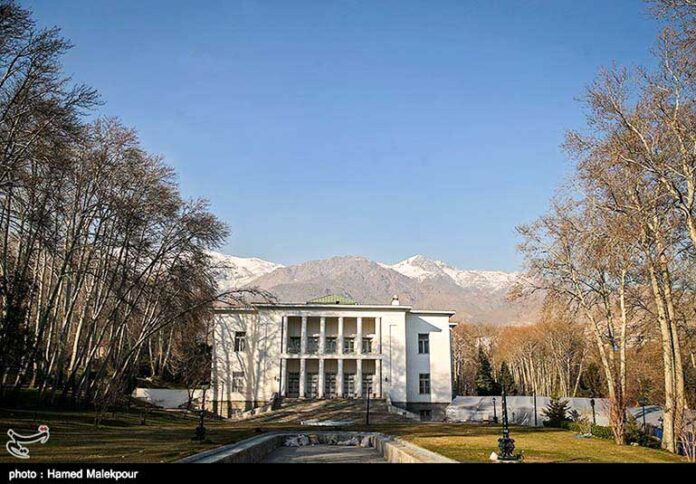
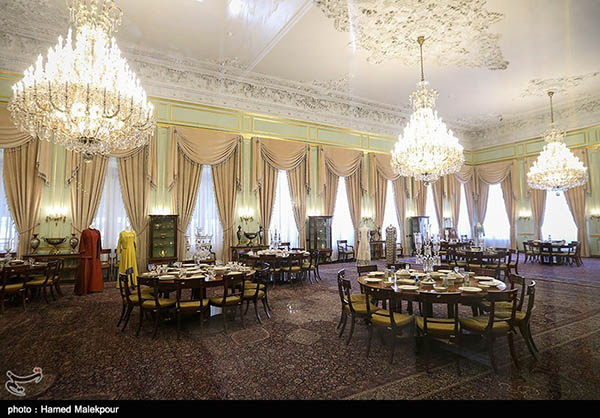
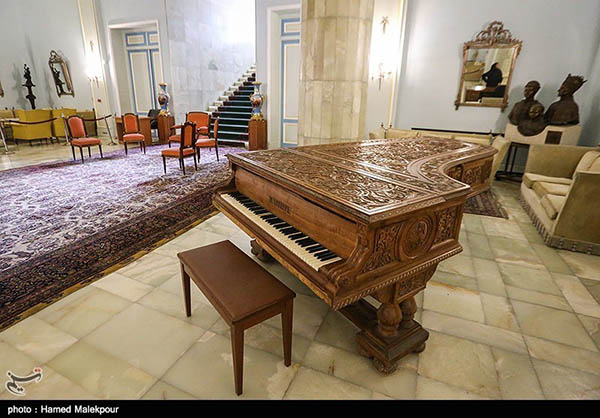
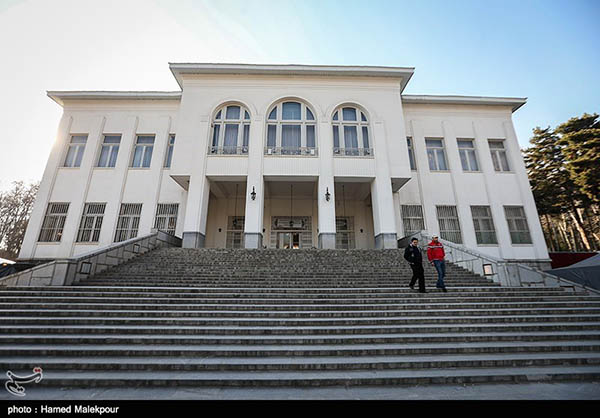
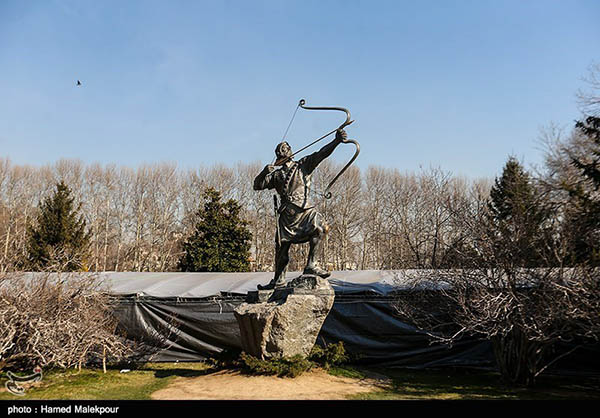
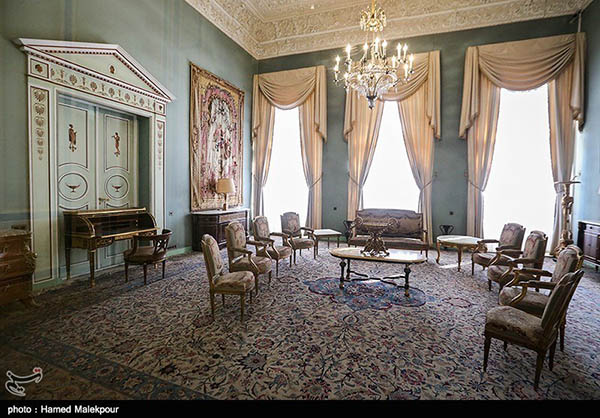
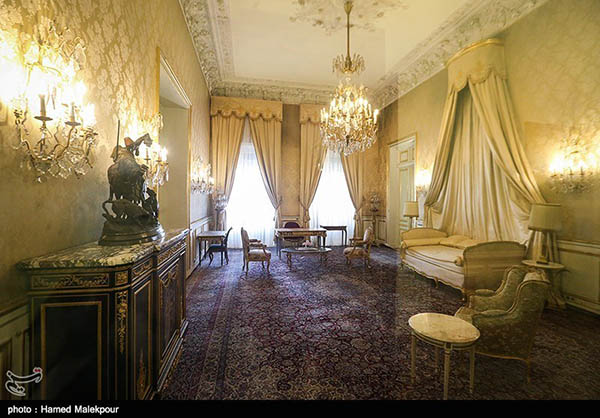
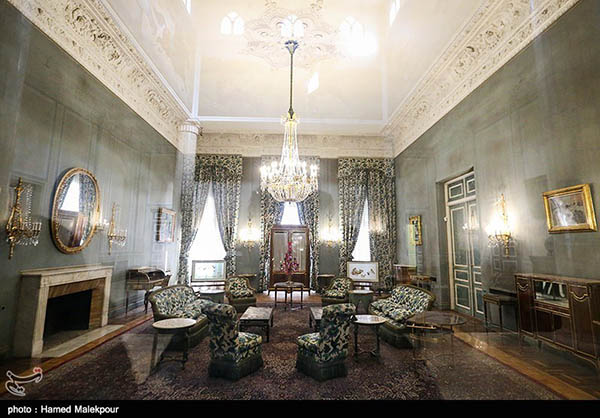
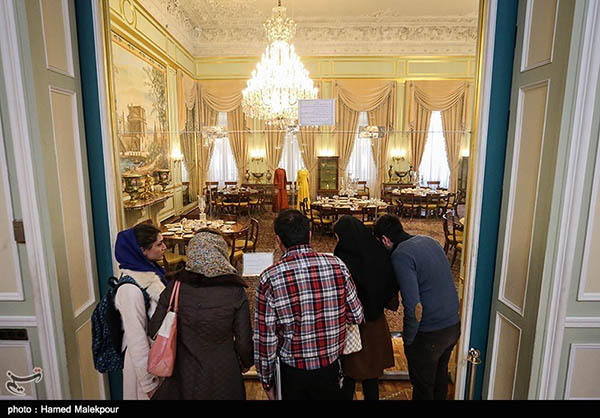
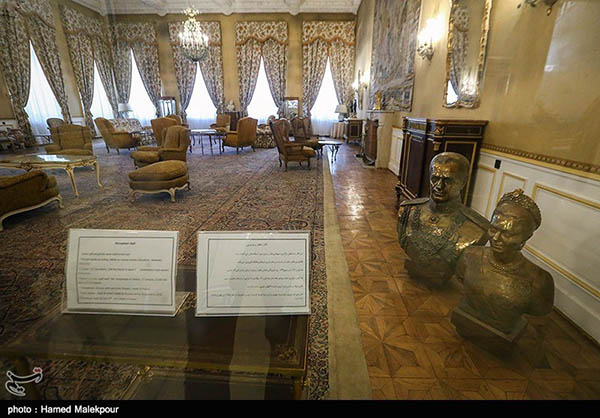
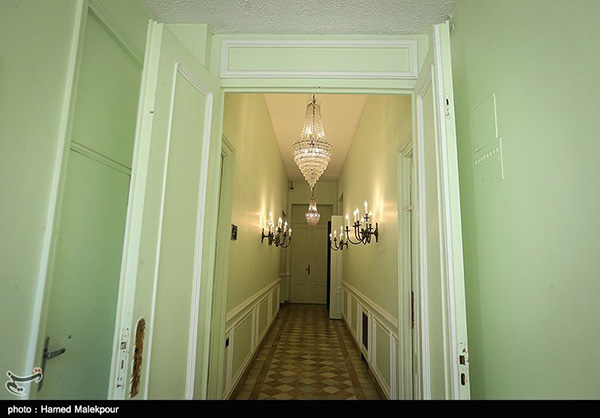
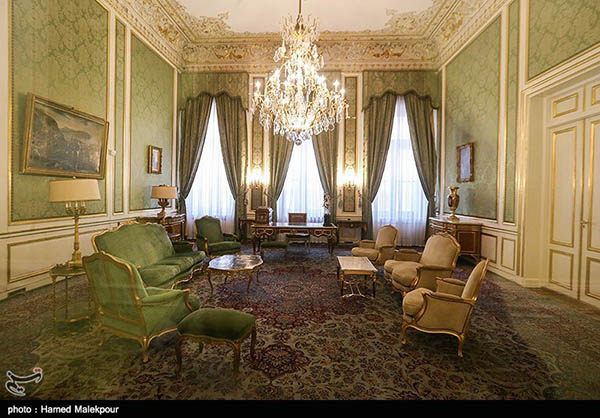
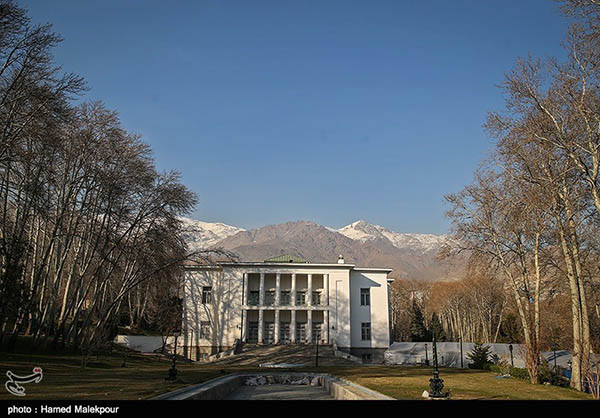
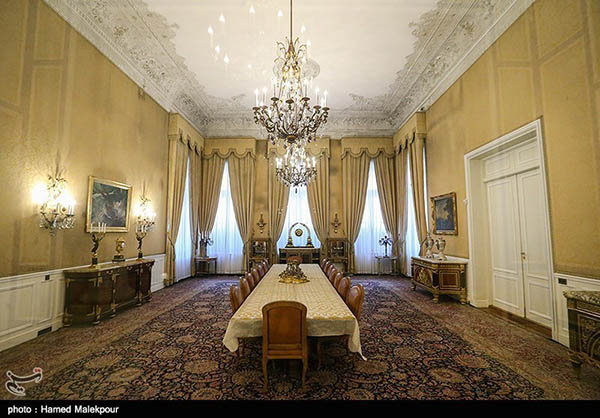
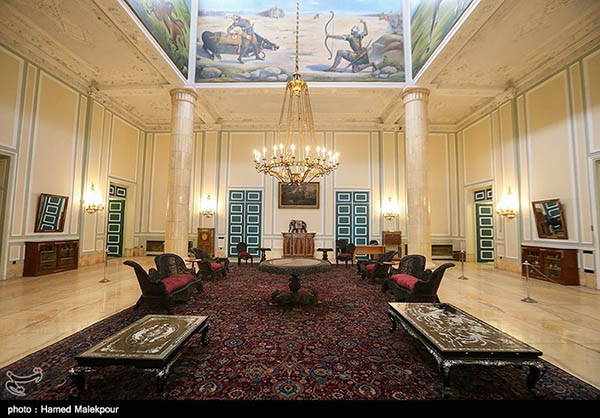
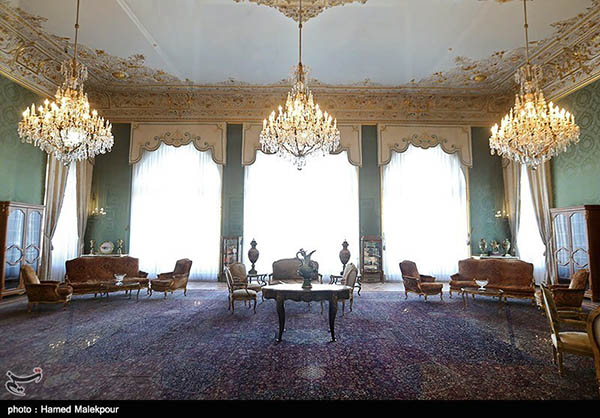
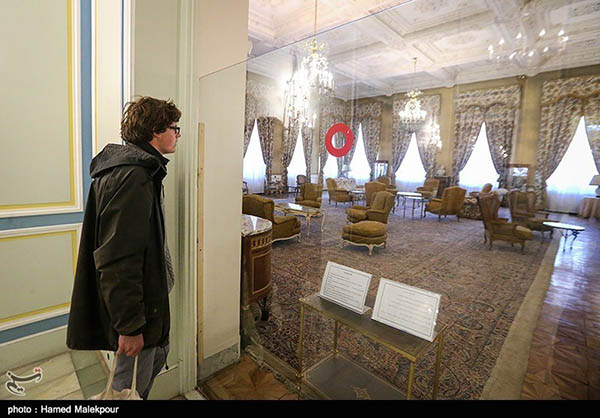
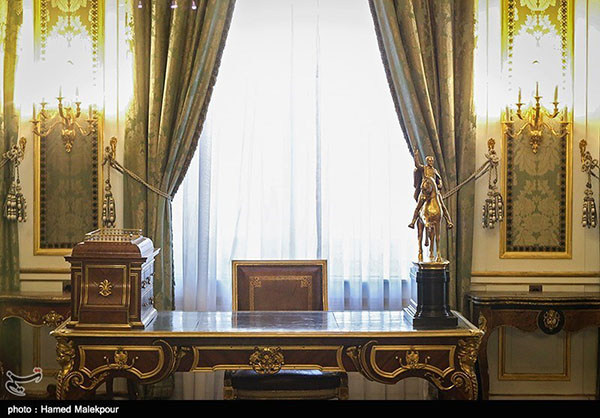
Iranian architecture makes a splash

2

Iranian-Islamic architecture dating back centuries draws the attention of visitors to historical sites.

The following images released by Mehr News Agency have been shot by foreign photographers visiting Iran:


Rouhani hecklers released after vowing not to interrupt public speeches again

139403140021289115427394

An official with the Interior Ministry has said that the IRGC has identified 11 suspects who interrupted President Rouhani’s speech at the Imam Khomeini Mausoleum in early June, adding that the hecklers have been released after one day in custody on a promise not to interrupt public speeches again.

The following is the translation of a report by entekhab.ir on June 22 on what else Javad Zarrinkolah said in a news conference on Sunday about the one-day detention of those who shouted down the president back on June 3:

Javad Zarrinkolah, who is in charge of security affairs at the Interior Ministry, said that those who were taken into custody had acted on their own and were not led by any [political] group, adding since 2009 [presidential elections] marginal issues have plagued the ceremonies to mark the demise of the late Imam.

He further said the ministry is trying to reduce these marginal issues to zero.

As for the funeral procession of 175 martyred Iranian divers and disruption of the ceremony [by some who hurled insults at the president and parliament speaker], he said that the funeral procession had not been coordinated with the Interior Ministry and Tehran’s Governor-General Office, adding the ministry will pursue the event and its incidents.

Asked about an illegal gathering outside the Ministry of Sports and Youth [over a plan which could possibly allow women to attend sporting arenas], Zarrinkolah said that the question of banned gatherings is on the ministry’s agenda.

He said the secretariat of the Supreme National Security Council is drawing up the guidelines which could plug the [legal] loopholes of the Authorized Assembly Act, adding it would be ready after the holy month of Ramadan so that we can put an end to lawlessness in this regard.

The Interior Ministry official also touched upon the 2014 acid attacks in Isfahan and said that one suspect was arrested two days ago and that the case is still under investigation.

He then talked about insult by a eulogist to Ayatollah Hashemi Rafsanjani and President Rouhani and said that an investigation would be launched into the case if those insulted pressed charges.

[…]

Zarrinkolah concluded that the number of crimes committed across the country in the year to March 21, 2015 posted a 20 percent decrease, adding that larceny registered the sharpest drop last year.

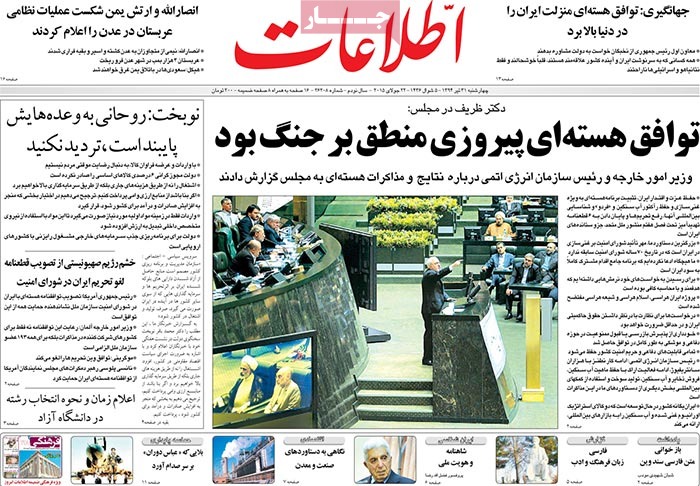
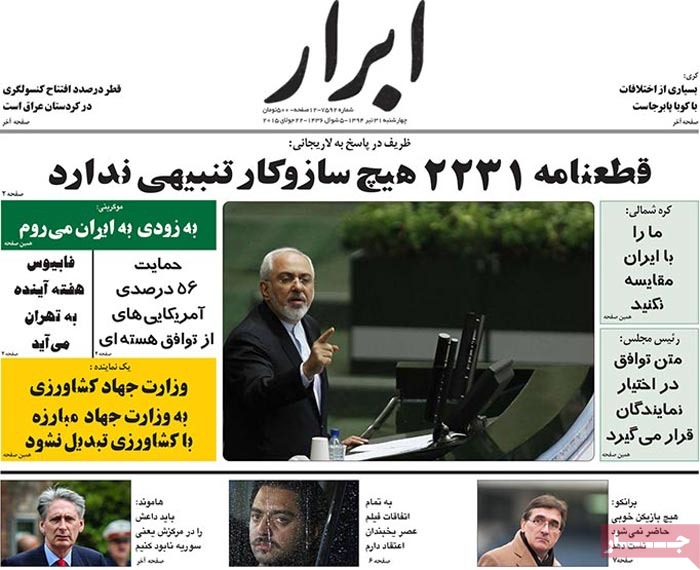
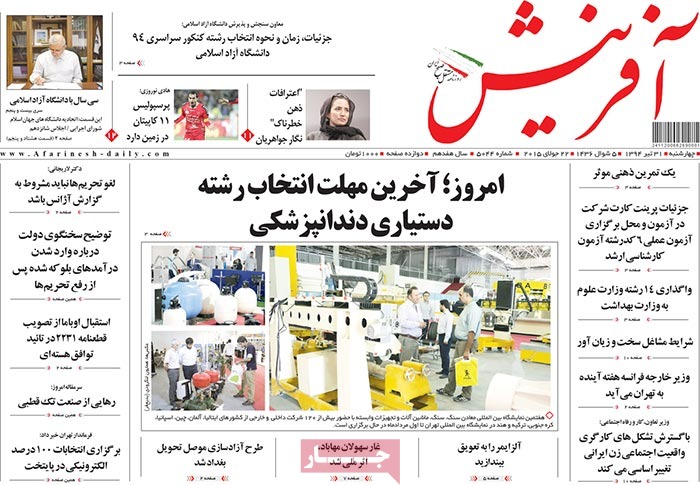
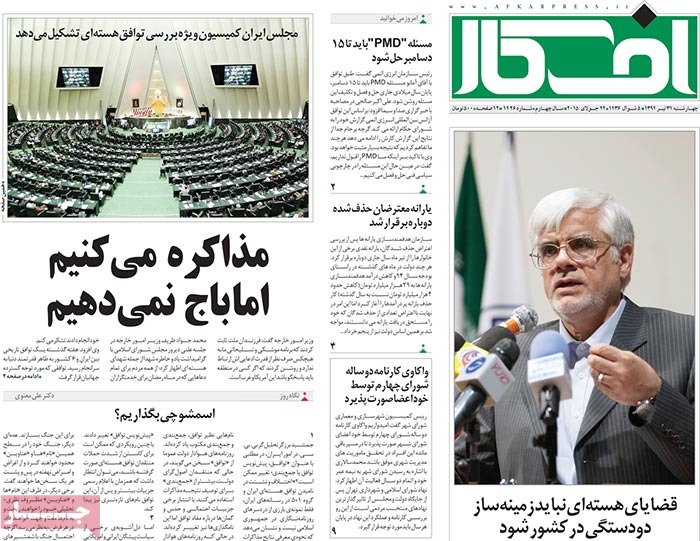
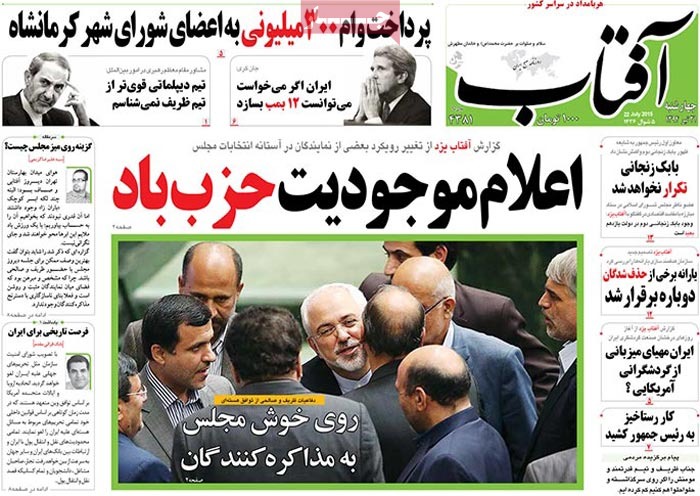
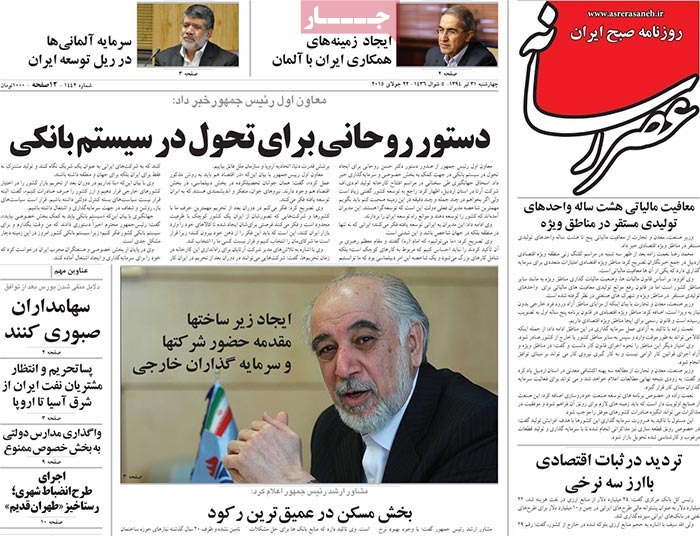
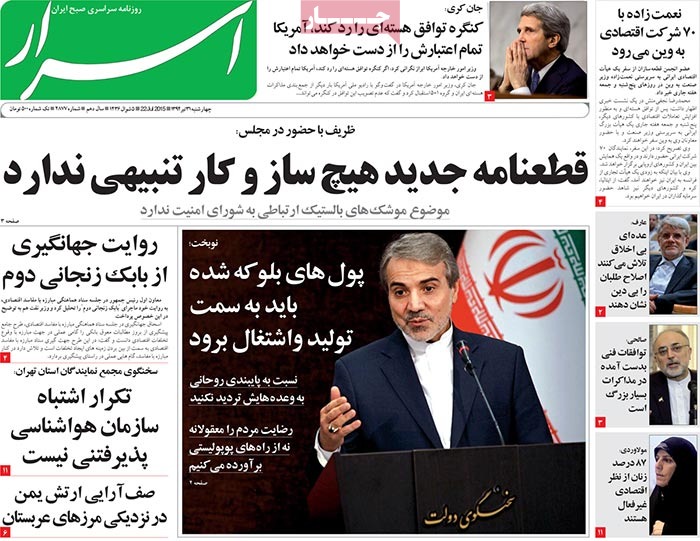
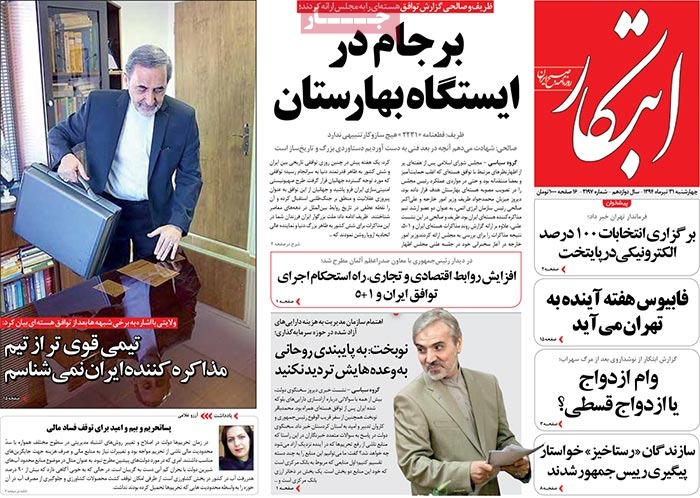
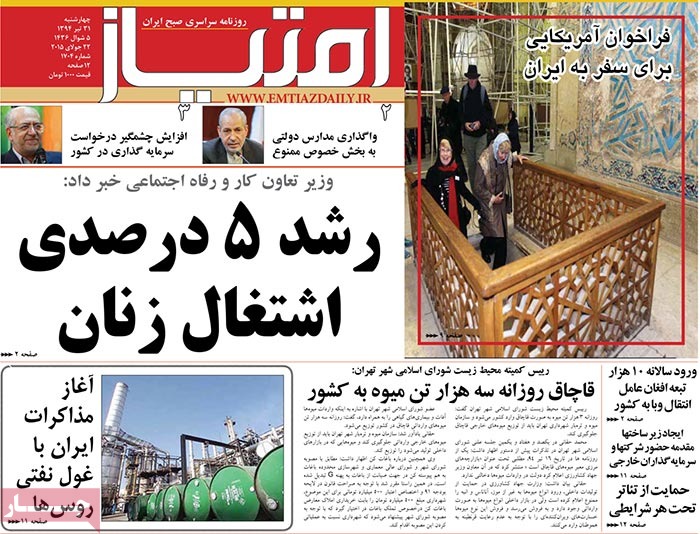
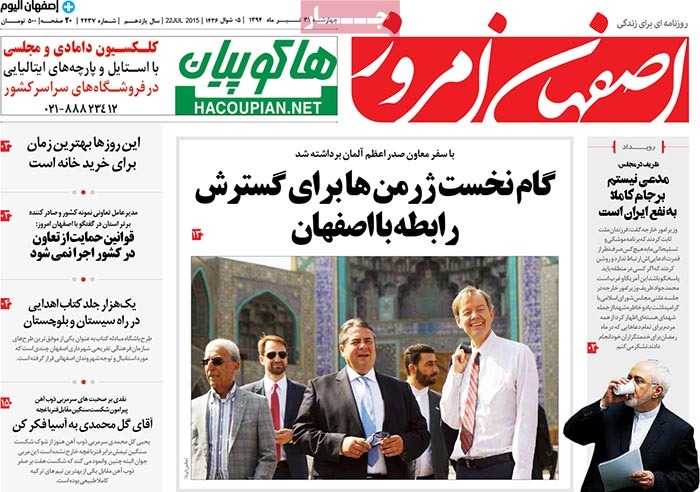
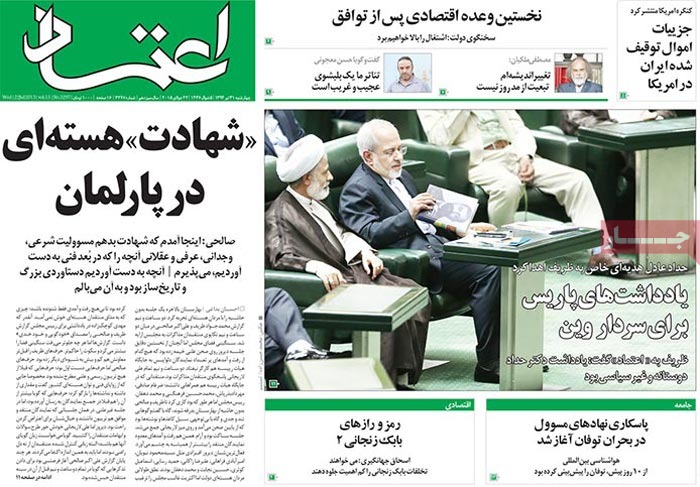
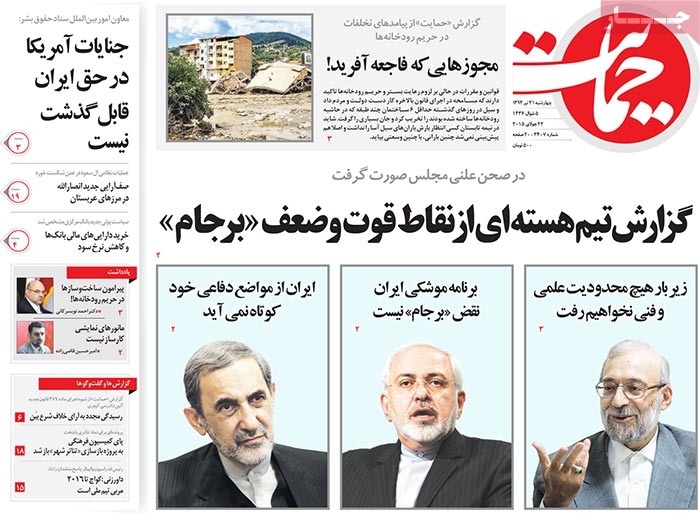
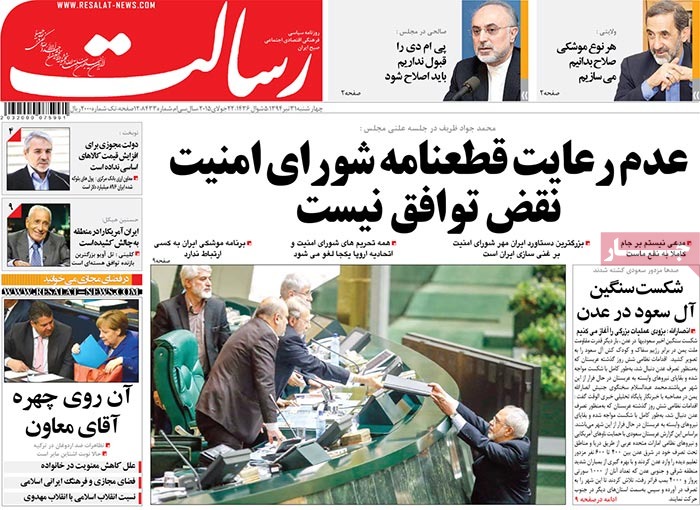
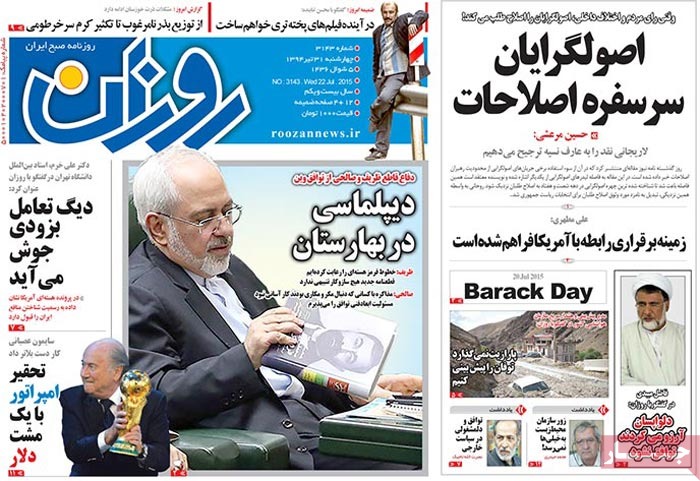
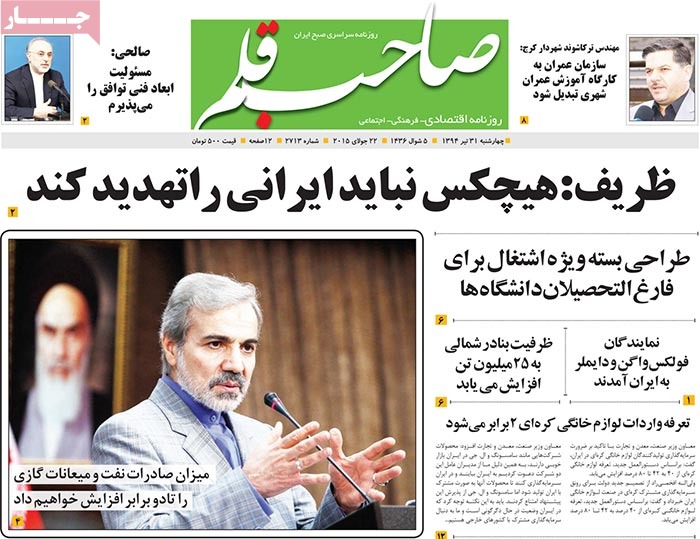
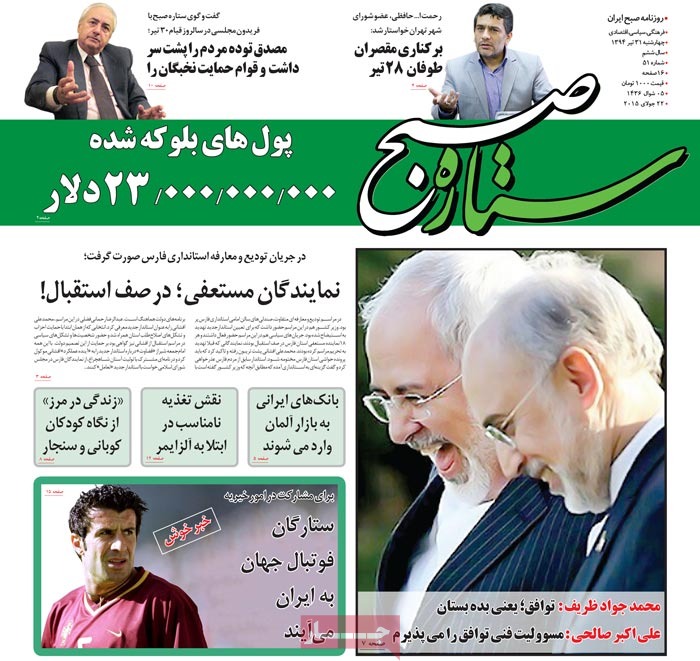
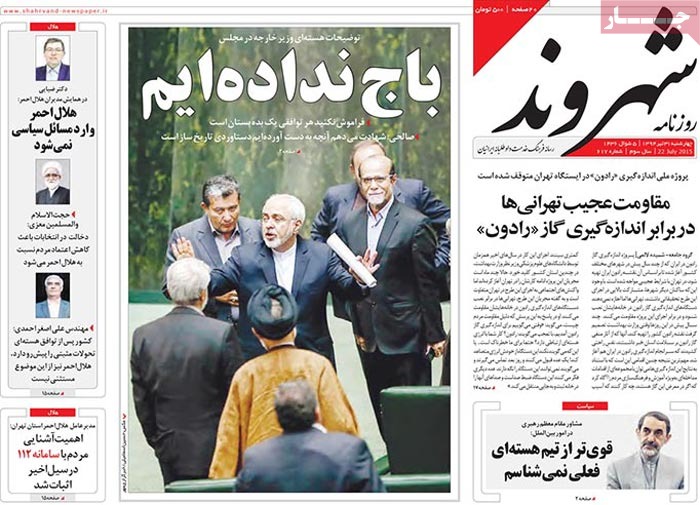
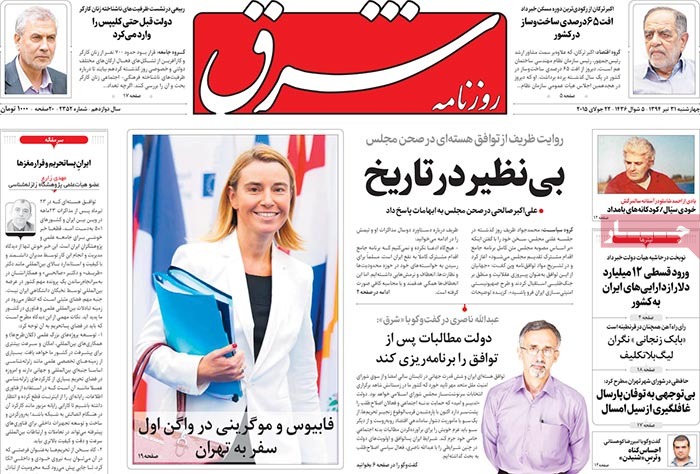
A look at Iranian newspaper front pages on June 23

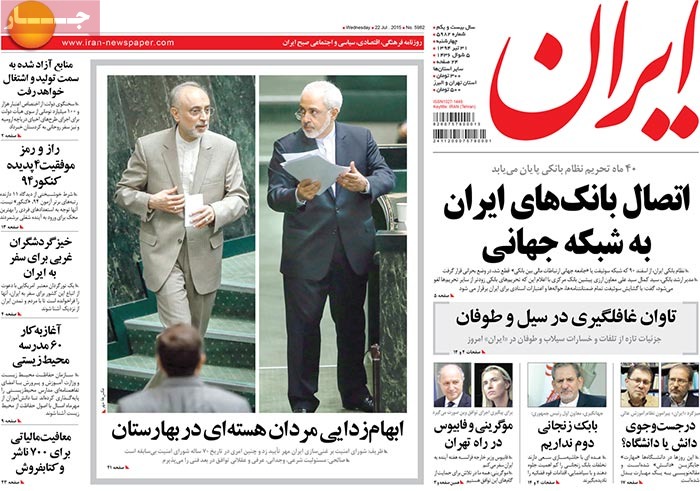
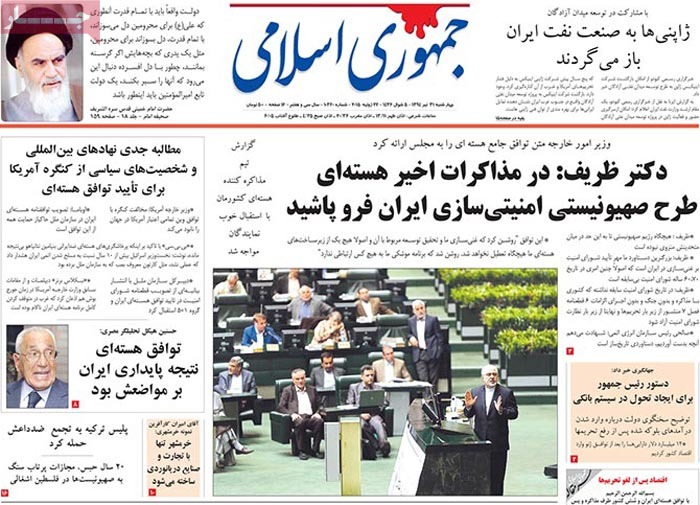
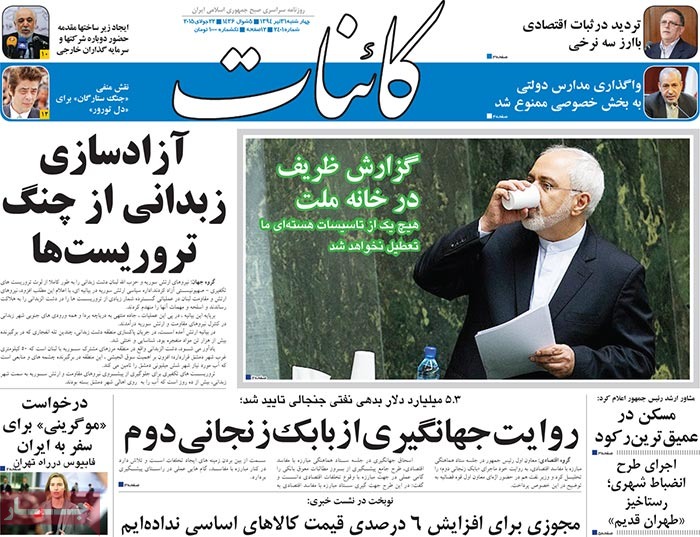
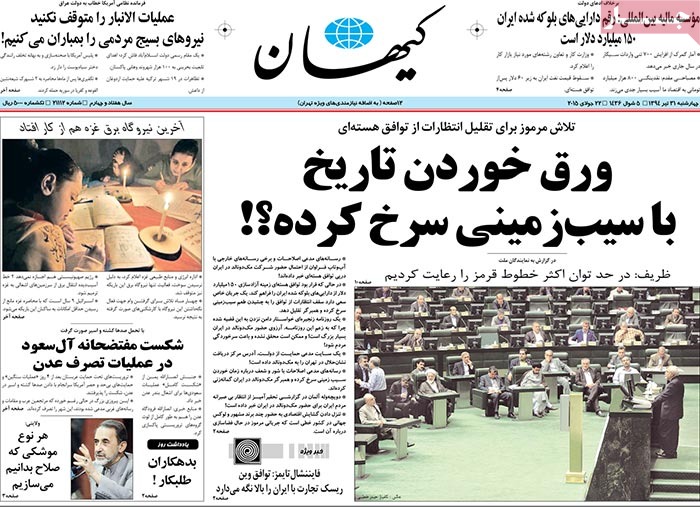
Iranian Newspapers Headlines

Nuclear talks between Iran and P5+1 and the comments of Foreign Minister Zarif and his deputy Abbas Araghchi about the negotiations dominated the front pages of Iranian newspapers on Tuesday. Also on the covers of the dailies was a suicide attack by the Taliban on the Afghan parliament in Kabul.


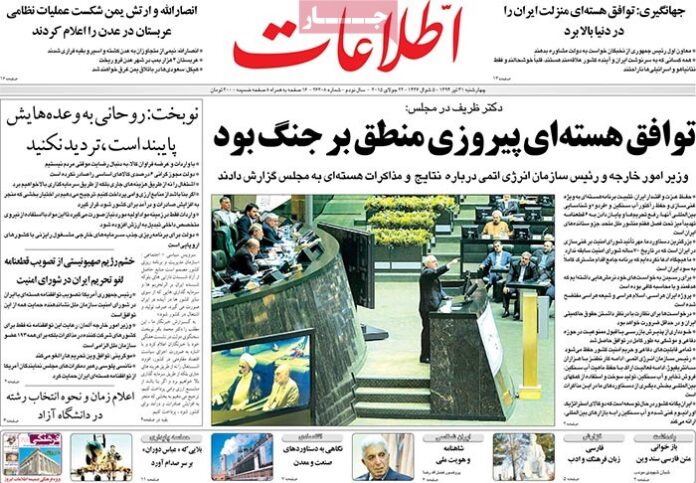
Ettela’at: “Negotiators act within the framework set by the Supreme Leader,” President Rouhani said.

“At the current juncture, we need to support each other more to settle the problems the country is facing,” the president said at a joint meeting of the executive and legislative branches.

Ettela’at: “Parties to the talks should stop making excessive demands in order for a deal to be clinched,” said Iranian Foreign Minister Mohammad Javad Zarif.

“There are still gaps to be filled, but we are trying to finish the job at the earliest time possible,” the top diplomat added.

Ettela’at: A 158-km highway linking Varamin [to the southeast of the capital] to Qazvin [to the northwest of Tehran] is to be built.

Ettela’at: The United Nations has said Israel has committed war crimes.

It came as the Arab League said the measures taken by Israel have made it possible to work out a two-state solution.

Ettela’at: The services of top guilds have been praised at a ceremony [among others attended by Parliament Speaker Ali Larijani].

Ettela’at: Tax evasion is to become a crime punishable by prison term and fines.

New amendments to the taxation law would turn up the heat on tax evaders.

Ettela’at: Tap water bills to increase incrementally soon.

A deputy energy minister said more than 72 percent of Iranian customers use more than the standard 20 cubic meters of water.

[The move comes as the country grapples with drought and water scarcity is around the corner.]


A look at Iranian newspaper front pages on June 23


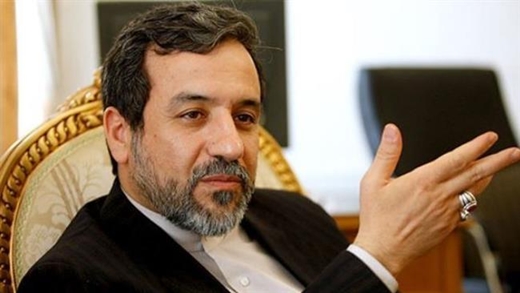
Abrar: “Progress at talks does not meet expectations,” Iranian nuclear negotiator Abbas Araghchi said.


A look at Iranian newspaper front pages on June 23


Afarinesh: The interior minister has said that Iran, Iraq and Syria will hold a trilateral meeting on the fight against terrorism.

Afarinesh: “Our talks may go a few days beyond [the end of June] deadline, if necessary,” said Abbas Araghchi, an Iranian nuclear negotiator.


A look at Iranian newspaper front pages on June 23


Aftab-e Yazd: More than $33 billion in debts is the legacy of the Ahmadinejad government for the Rouhani administration.

Aftab-e Yazd: “Ahmadinejad was summoned to the court but failed to show up,” said the chairman of Parliament’s Article 90 Committee.


A look at Iranian newspaper front pages on June 23


Amin: “We should not make decisions for the public behind closed doors,” said Parliament Speaker Ali Larijani.


A look at Iranian newspaper front pages on June 23


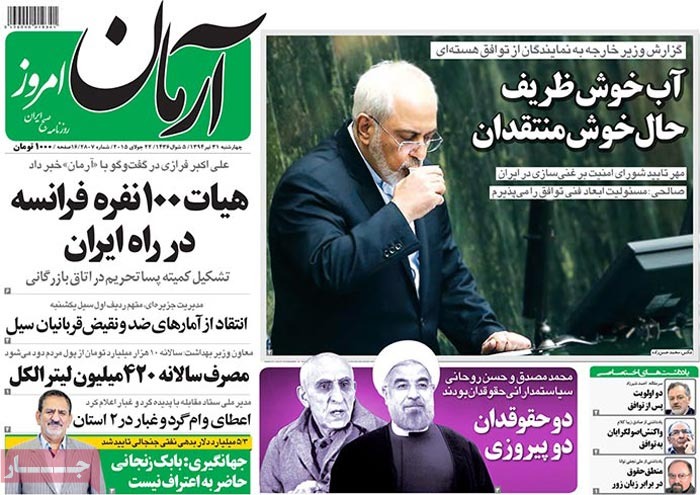
Arman-e Emrooz: The science minister on board a bus bound for Baharestan [a Tehran square where parliament building is located].

A visit to Iran by an American [academic] delegation has raised eyebrows among MPs.


A look at Iranian newspaper front pages on June 23


Asrar: “A bill that calls for heavier punishments in cases involving acid attacks has been presented to the Cabinet,” said Vice-President for Women and Family Affairs Shahindokht Molaverdi.


A look at Iranian newspaper front pages on June 23


Ebtekar: An Interior Ministry official has said those who disrupted a speech by President Rouhani at the Mausoleum of Imam Khomeini and staged an illegal rally of late were acting on their own.


A look at Iranian newspaper front pages on June 23


Emtiaz: Precipitation levels in the country have fallen by 18 percent.

Water shortage in nine provinces has reached an alarming level.


A look at Iranian newspaper front pages on June 23


Iran: Zarif has held talks with the European Three at the beginning of the final round of talks.

It came as a survey conducted by the Islamic Republic News Agency found that 87.5 percent of Tehran residents trust the negotiating team.


A look at Iranian newspaper front pages on June 23


Jomhouri Islami: The Saudi town of Najran has been besieged by the popular forces.


A look at Iranian newspaper front pages on June 23


Kaenat: “Khatam al-Anbia Headquarters [a contractor affiliated to the Islamic Revolution Guard Corps] should not act as a rival for the private sector,” said First Vice-President Eshagh Jahangiri.
 

A look at Iranian newspaper front pages on June 23


Kayhan: The US has expressed concern over the Iranian parliament’s say in nuclear talks.


A look at Iranian newspaper front pages on June 23


Khorasan: “We are suffering more from inaction and mismanagement than from enemy pressures,” said Tehran Mayor Mohammad Bagher Ghalibaf.


A look at Iranian newspaper front pages on June 23


Mardomsalari: The Taliban flexed their military muscle in Kabul by mounting a suicide attack on the national assembly.


A look at Iranian newspaper front pages on June 23