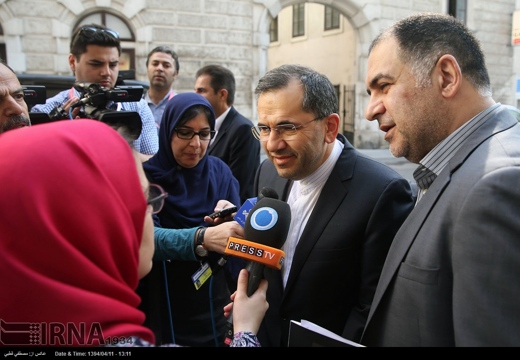
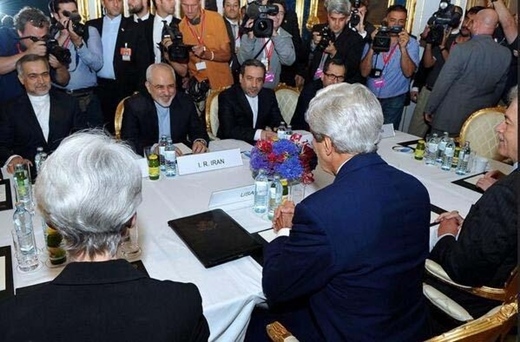
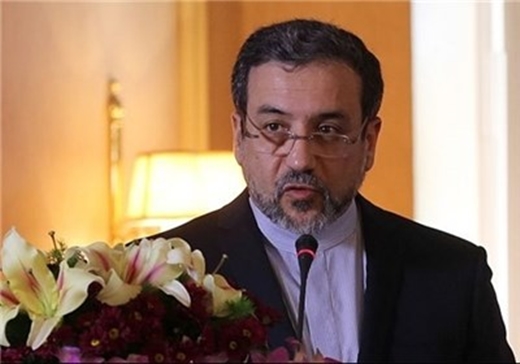
Speaking to reporters in Vienna, where the nuclear talks between Iran and the six world powers are underway, Takht-e Ravanchi said, ‘it is almost the last days of talks and we don’t exactly know on what day they would be ended. We are at a stage now that the talks are very intensive.’
‘Meetings begin early in the morning and continue until late at night. Even after the meetings with the other side, our private meetings begin at the end of the night,’ Takht-e Ravanchi said.
Deputy Foreign Minister for European and American Affairs Majid Takht-e Ravanchi told reporters here that the expert-level talks have ended but discussions will be further held at the level of deputy foreign ministers.
He declined to elaborate on the issues due to be discussed by foreign ministers. He just said that they are key issues that cannot be concluded in talks at the level of experts or deputies.
Takht-e Ravanchi said that a particular date has not been set yet for a meeting between Iran and the Group 5+1.
Noting that the foreign ministers and the European Union foreign policy chief Federica Mogherini will come to Vienna on Thursday, the diplomat said however, meetings will be held bilaterally.
He noted that the foreign ministers will leave Vienna later in the day and will later decide on their return to the talks.
Addressing a group of academics here, Ayatollah Rafsanjani said Iran has achieved the world’s most complicated technology which is the nuclear technology through major strides taken by its scientists and youth.
‘We have never been seeking nuclear weapons as Supreme Leader has issued a Fatwa banning production of atomic bombs and weapons,’ the Ayatollah said.
Iran only wants to develop nuclear technology for peaceful, health and agricultural purposes, he stressed.
Ayatollah Rafsanjani added that the world have realized in order to solve their issues they have no other way but to respectfully negotiate with the Islamic Republic of Iran.
Underlining the need for forging unity among the Iranian nation in the current situation, he said that division is a deadly poison that could cause many burdens for the Muslim Ummah.
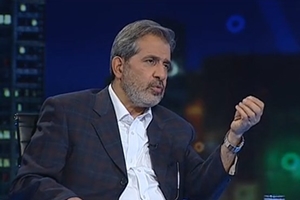
A former Iranian Foreign Ministry spokesman says that an honorable agreement is likely to be reached unless the Americans make miscalculations and upset the balance at the negotiating table in a way that makes a final deal elusive.
Hamidreza Asefi, who was also a former Iranian ambassador to Germany prior to the fall of the Berlin Wall and unification of Germany, made the comment in an interview with a TV news bulletin on the latest developments and future of nuclear talks and added that the country’s nuclear negotiating team, whose self-confidence has been boosted by the Supreme Leader’s praising remarks, should forget about the time limit in nuclear talks and stand their ground when it comes to the rightful stances of the Islamic Republic of Iran.
The following is the translation of excerpts from his remarks in the interview as reported by Khabaronline.ir on July 1:
[…]
Is it true that the other side needs an agreement more than Iran?
Yes, Messrs. Obama and Kerry as well as a US Deputy Assistant Secretary of State have made comments which show they believe Iran will not bow so they should reach an agreement with Iran. The Zionist regime is enraged, part of it is a sales presentation and the other part is that the regime is really vexed.
The Center for Security Studies (CSS), which is an international think tank in Zurich, has said that nuclear energy has been linked with national pride in Iran and that the Iranians are highly unlikely to let go of it. The country’s nuclear team should go ahead with the talks without paying attention to the war of words waged and pursued by the Americans, Zionists and Saudis.
A media blitz is in overdrive trying to sell this idea that Iran has to give up its red lines. What exactly is the West seeking to achieve from this media and psychological warfare?
They [the Western countries] are seeking to gain more concessions. They know about the clear red lines of the Islamic Republic of Iran. The way your stance is treated diplomatically when you openly announce your red lines differs from when you speak indirectly and implicitly. They have got a grasp on the question and are trying to say that they are not to blame if the talks – one in a ten thousand or one in a million – produce no results and to shift the blame onto Iran.
To date, Iran has the world public opinion on its side with all people having faith in Iran’s legitimacy and rightfulness. Nuclear talks are positive on both sides: in case an agreement is struck, Iran will reap its benefits; and if the talks produce no result, [Iran can prove that] the US and fellow P5+1 members are to blame for the inconclusiveness of the talks. If Iranian negotiators insist on their stances, the other side will be more pressed for time.
[…]
The American side says that some restrictions will be imposed on Iran for good. How does it harm Iran?
If the restrictions will be in place for a long time, they will slaughter the country’s nuclear industry. Iran’s scientists will lose their interest and motivation. If a sports team is said that they can simply do preparation exercises but are not allowed to take part in a competition, everything [they enjoy] will be lost. If the indigenized nuclear industry is to be brought to a halt, it would grow weaker [over time].
Secondly, when you accept long-term restrictions, you make yourself limited or deprived without knowing what will unfold on the international stage after five years. Iran sees no reason – logically and legally – to accept such restrictions. They want to make sure that there is no diversion in Iran’s nuclear program. They know about it, but feign sleep. They have always said that the [International Atomic Energy] Agency is not in a position to fully verify Iran’s [nuclear] measures. We are not supposed to prove this. The burden of proof is on the one who claims there are diversions in Iran’s program.
Why do we need to stand up to the other side’s acquisitive demand that decisions can be made after the UN nuclear agency’s verification?
They [the IAEA inspectors] may prolong the verification process for Iran up to ten years and then release a statement saying that they cannot verify [Iran’s activities]. There seems to be no end in sight spatially and temporally.
The agency did not pass its test on Iran in the past. Drawing on no sound reason, the agency referred Iran’s case to the UN Security Council. There was no reason for that. Iran is concerned about the inspections which may go beyond what has been envisioned in the [Additional] Protocol [of the NPT] because the IAEA did not pass its test with flying colors in the past.
Which scenario do you think will become a reality: the inconclusiveness of the talks or an agreement with some sort of restrictions?
I do not like to say something and correct myself afterward. […] But I think an honorable agreement which meets minimum expectations [of the two sides]. As for the extension of the talks, if they do not drag on for more than one month, that would not bother me. But if the Americans make miscalculations and turn the tables in a way that an agreement is not reached, it would translate into a political suicide for the other side.
I think an agreement should be arrived at unless the Americans seek to commit a political suicide. It is too hard to predict the events on the political front. We are now in Tehran and far from Vienna [the venue of the nuclear talks].
[…]
How do you think the Supreme Leader’s choice of words for the country’s negotiators – among them trustworthiness, bravery, piety and zeal – can help Iran’s nuclear team?
These characteristics are what is needed for this job. If one is engaged in a war on the diplomatic front, they have to enjoy such traits. The Supreme Leader’s words obviate the need for us to talk on that. […]
The negotiating team has boosted its self-confidence drawing on the Supreme Leader’s praising remarks. Self-confidence earns you courage and calms you down. Building on the [Leader’s] trust, the negotiators are trying to produce results. What is our destiny will lead to blessings for the country. The Supreme Leader’s remarks helped the negotiating team greatly. Those who were worried are now at ease.
You were not a worrier, were you? [A reference to the so-called Worriers who are the fervid supporters of former President Ahmadinejad and harsh critics of President Rouhani’s government and its policies]
I’m not in that particular sense of the word, but I am concerned about the gamesmanship of the Americans.
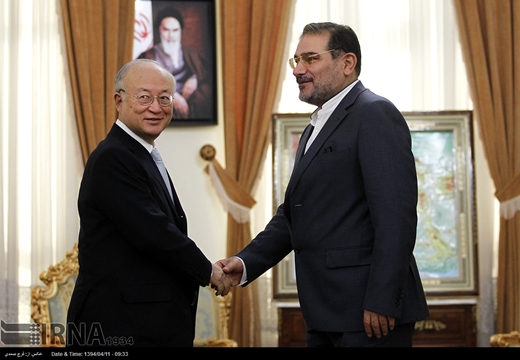
Director General of the International Atomic Energy Agency (IAEA) Yukiya Amano and Secretary of Iran’s Supreme National Security Council (SNSC) Ali Shamkhani discussed issues of mutual interests in Tehran on Thursday.
According to a statement issued by the IAEA on Thursday, Amano is currently in Tehran to accelerate the resolution of all outstanding issues related to Iran’s nuclear program.
The statement further said during his visit, Amano will meet with President Hassan Rouhani and other senior Iranian officials on Thursday.
Discussions are expected to address ongoing cooperation between the IAEA and the Islamic Republic of Iran under the Framework for Cooperation, the statement added.
It said that the visit takes place in the context of the IAEA’s continued engagement with Iran and E3/EU+3 countries as they work towards a Joint Comprehensive Plan of Action.
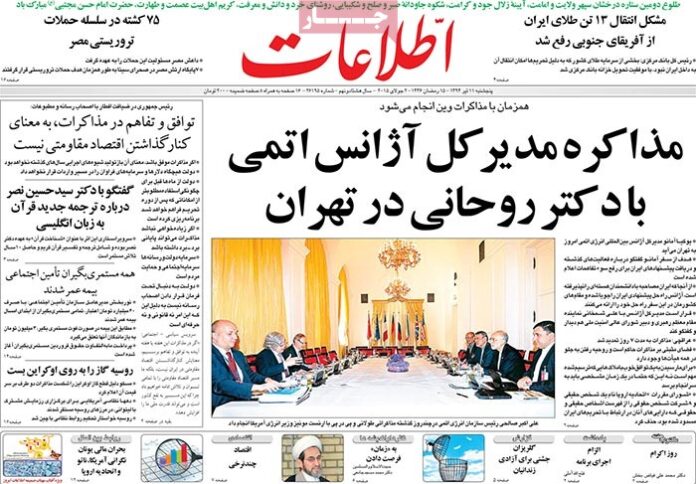
♦ The director of the International Atomic Energy Agency will meet in Tehran with Dr. Hassan Rouhani as nuclear talks progress in Vienna.
Since Iran did not accept interviews with its nuclear scientists, the UN nuclear agency inquired about what solution Iran had in mind. During the visit, Iranian officials are expected to put forth their proposals.
♦ The problem associated with the return home of 13 tons of Iranian gold has been solved.
The governor of the Central Bank of Iran said that part of the country’s investment overseas – which had proved impossible to return home because of sanctions – has been handed over to the bank.
♦ A spate of terrorist attacks in Egypt left up to 75 people dead.
The Egypt branch of IS terrorist grouping claimed responsibility for the attacks on a military base on the Sinai Peninsula.
♦ “Agreement [with P5+1] does not amount to scrapping Resistance-based Economy,” said President Rouhani at an Iftar [fast-breaking] meeting with representatives of the press.
At the same meeting, the president vowed not to waste the country’s capital on excessive imports.
♦ An interview with Seyyed Hossein Nasr about the new English translation of the holy Koran
The translation, which is coupled with exegesis, has taken 10 years to complete.
♦ All Social Security pensioners have been offered life insurance.
The managing director of the Social Security Organization has said that under the new arrangement when an insured individual passes away, their family receive around $1,000.
♦ Russia has stopped natural gas exports to Ukraine.
The decision came after a breakdown in price talks between the two sides.
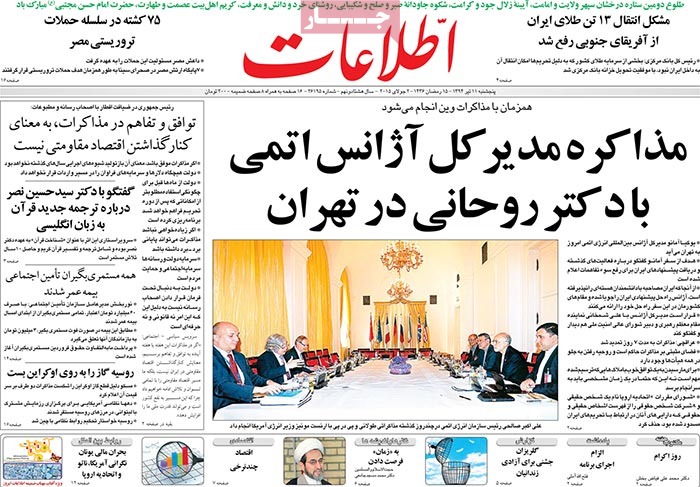
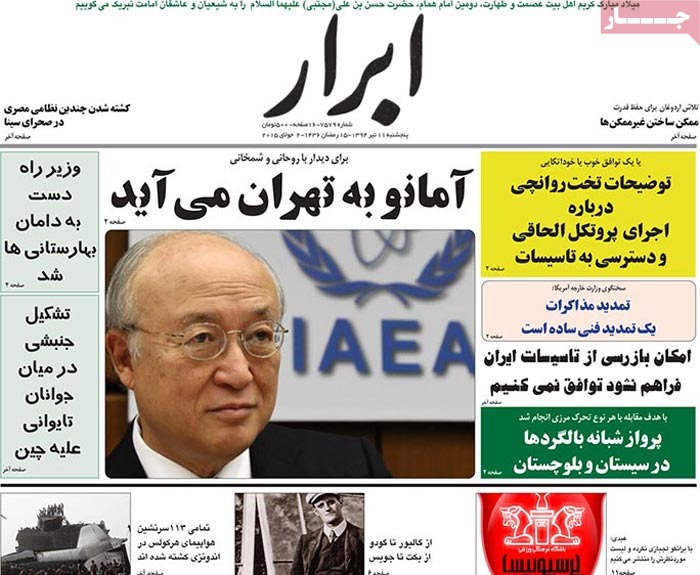
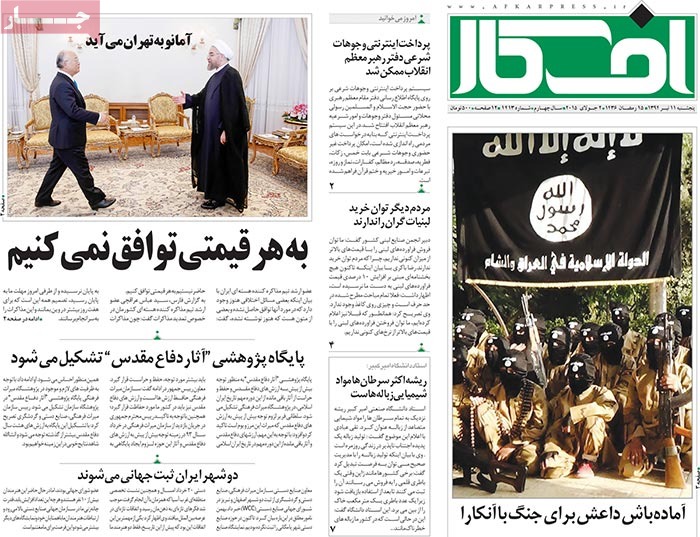
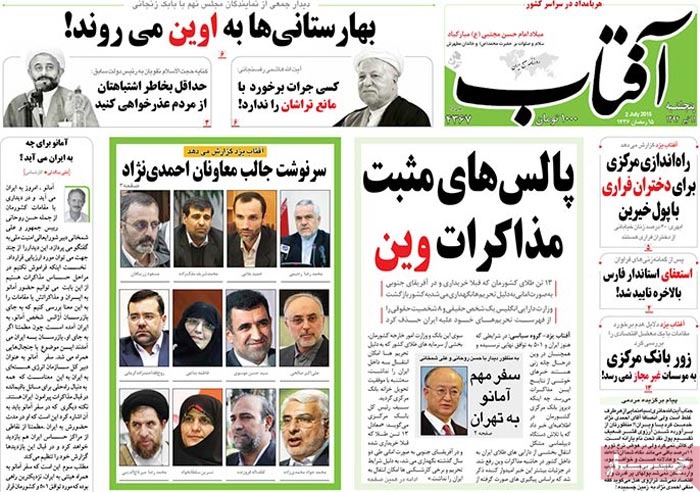
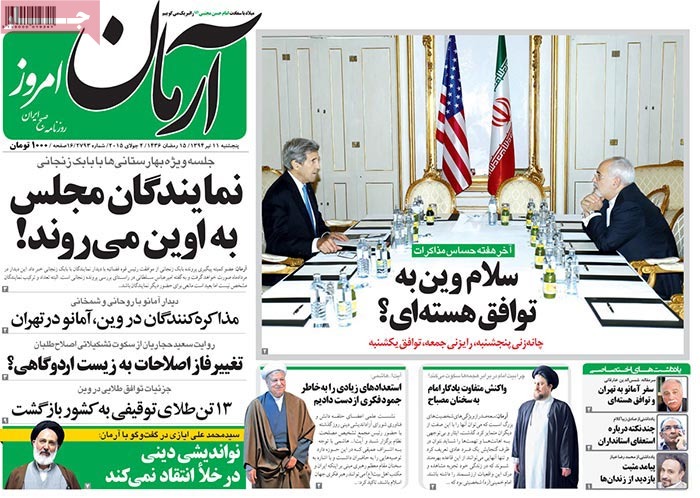
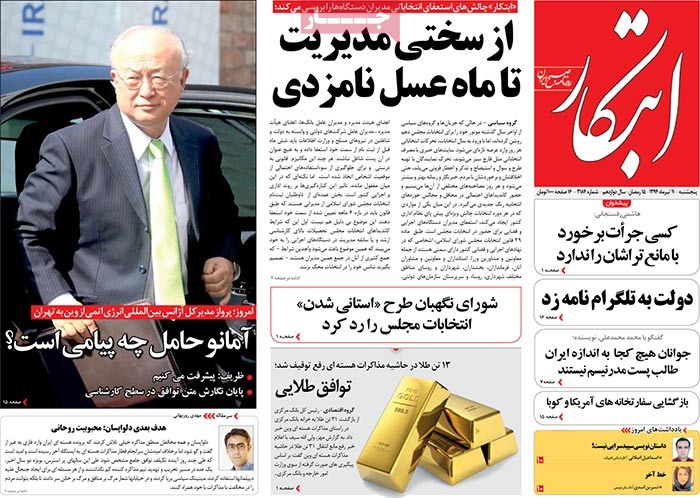
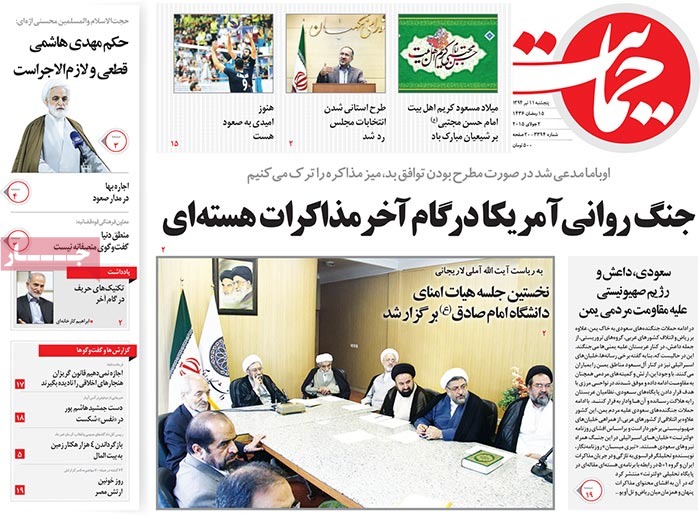
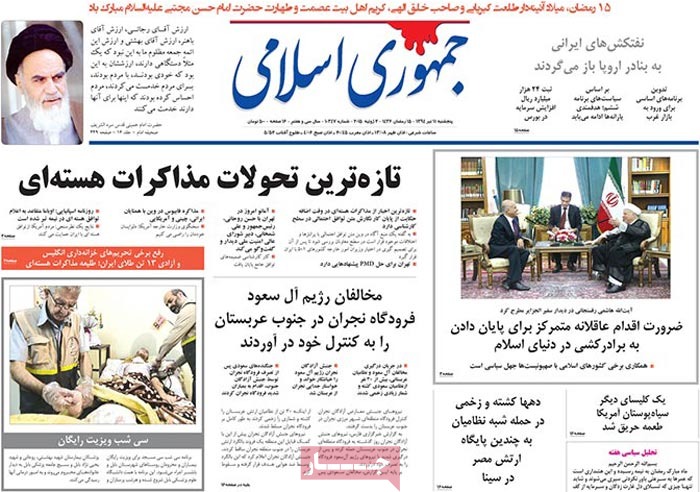
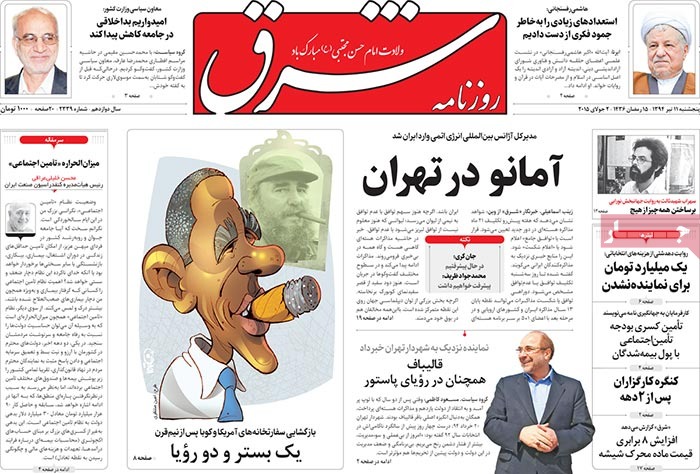
The expected arrival in Tehran of the UN atomic chief and the return home of 13 tons of Iranian gold blocked in South Africa dominated the front pages of Iranian newspapers on Thursday.
Ettela’at: The director of the International Atomic Energy Agency will meet in Tehran with Dr. Hassan Rouhani as nuclear talks progress in Vienna.
Since Iran did not accept interviews with its nuclear scientists, the UN nuclear agency inquired about what solution Iran had in mind. During the visit, Iranian officials are expected to put forth their proposals.
Abrar: Yukiya Amano, the director general of the International Atomic Energy Agency, arrives in Tehran for talks with President Rouhani and Secretary of the Supreme National Security Council Ali Shamkhani.
Afkar: Iranian cities of Isfahan and Tabriz are to be registered with the World Crafts Council.
Afkar: IS terrorist grouping is on alert to confront Turkey.
[It comes after Ankara reportedly ordered the deployment of troops to Syria.]
Aftab-e Yazd: “At least be man enough and apologize to the public for your mistakes,” said Nasser Taghavian [a clergyman] in comments aimed at the former president.
Aftab-e Yazd: The resignation of the governor of Fars Province was finally confirmed.
Aftab-e Yazd: A charity center to accommodate runaway girls has been set up.
Arman-e Emrooz: Parliament deputies will visit Evin Prison for a meeting with Babak Zanjani [who stands accused of siphoning off massive amounts of money when Ahmadinejad was president].
Arman-e Emrooz: “We have lost a large number of talented individuals because of ossification,” Chairman of the Expediency Council Ayatollah Akbar Hashemi Rafsanjani said.
Ebtekar: The Guardian Council has rejected a motion to hold parliamentary elections at a provincial level.
Ebtekar: “No one dares to deal with those who throw a wrench in the works,” said the chairman of the Expediency Council.
Hemayat: “The verdict handed down in the case of Mehdi Hashemi [Ayatollah Hashemi Rafsanjani’s son] is final,” said the Judiciary spokesman.
[Mehdi Hashemi was found guilty on charges of receiving bribes.]
Jomhouri Islami: Iranian oil tankers are to return to European ports.
Jomhouri Islami: At a meeting with the Algerian ambassador to Tehran, Ayatollah Hashemi Rafsanjani has underlined concentrated measures to end fratricide in the world of Islam.
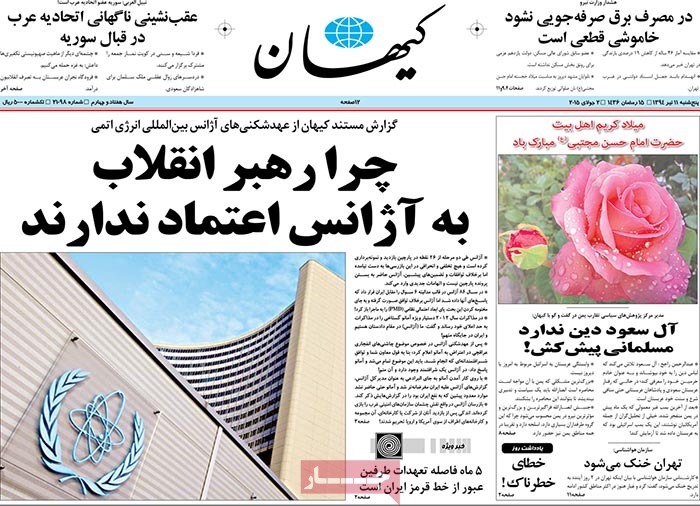
Kayhan: Why doesn’t the Leader trust the UN atomic watchdog? A report by Kayhan on the past failures of the International Atomic Energy Agency to live up to its commitments
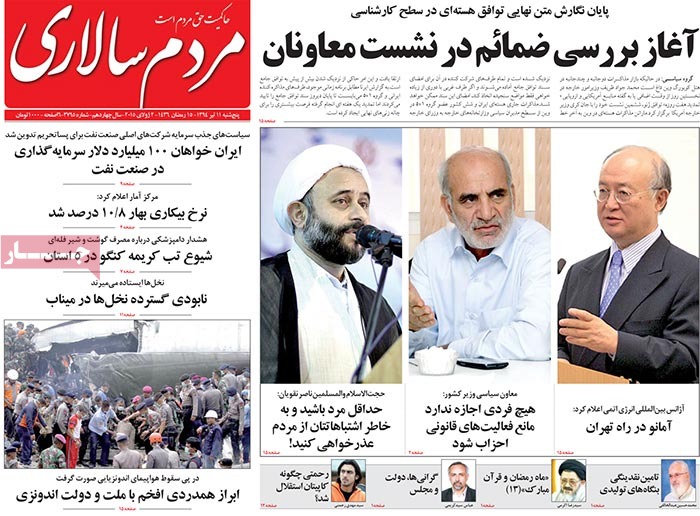
Mardomsalari: Iran wants $100 billion in investment in its oil industry in the post-sanctions era.
Mardomsalari: Following the deadly plane crash in Indonesia, the Iranian Foreign Ministry spokeswoman has offered condolences to the Indonesian government and people on the loss of life caused by the tragic accident.
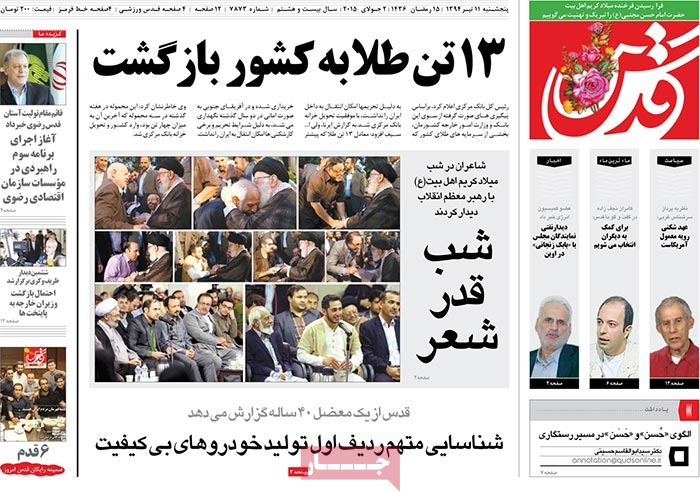
Qods: Iranian poets have had a meeting with the Supreme Leader.
Qods: Foreign Minister Mohammad Javad Zarif and Secretary of State John Kerry have held a sixth meeting.
The foreign ministers are likely to return to their capitals for consultation.
Sharq: “Mohammad Bagher Ghalibaf still dreams of finding his way to Pasteur [a Tehran street where the Presidential Office is located],” an MP close to Tehran Mayor said.
Iran’s Foreign Ministry has severely condemned Israel’s recent attack on a Swedish-flagged ship heading to the Gaza Strip as part of an aid flotilla to break the regime’s long-time blockade on the coastal sliver.
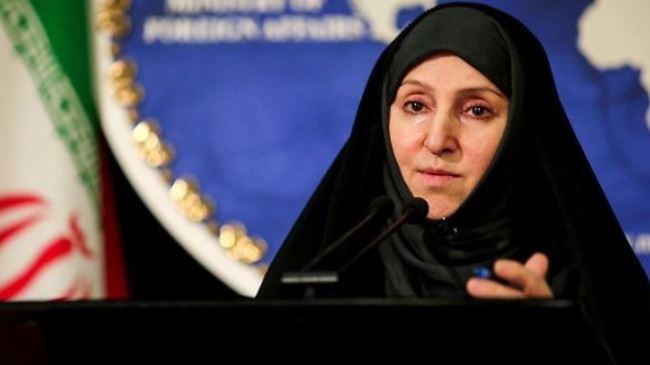
The seizure of the Marianne of Gothenburg by the Israeli navy in international waters, the inhumane blockade imposed on the people of Gaza, and last summer’s war in the Gaza Strip are all completely against international law, IRNA quoted Iranian Foreign Ministry Spokeswoman Marzieh Afkham as saying on Wednesday.
She called on international organizations and governments to break the silence on Israeli atrocities in the Gaza Strip, stressing that the blockade on Gaza must be lifted.
On Monday, Israel seized Marianne of Gothenburg that was part of the Freedom Flotilla III carrying nearly 20 pro-Palestinian activists from nine countries to Gaza.
The ship was then directed to the Israeli port of Ashdod, prompting the three other vessels to turn back over fears that the Israeli navy would use deadly force.
The flotilla had planned to arrive at Gaza despite concerns over possible attempts by Tel Aviv to disrupt its mission as it did to the first flotilla in 2010. Back then, Israeli naval forces attacked the Turkish Mavi Marmara ship, which led to the death of 10 activists.
The blockade on Gaza, in place since 2007, has caused a serious decline in the standard of living, unprecedented levels of unemployment and unrelenting poverty in the impoverished territory.
Over 2,140 Palestinians, most of them civilians, were killed during the 50-day war on Gaza last summer.
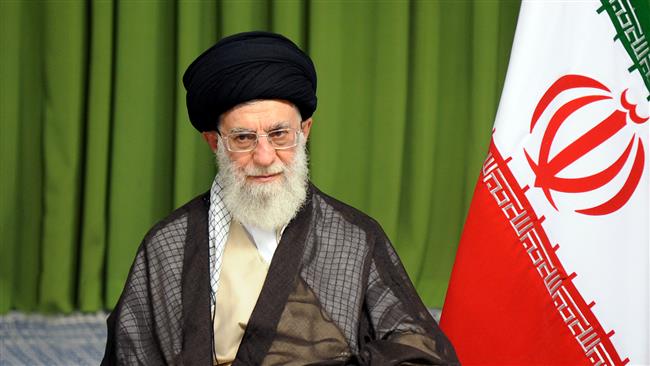
Supreme Leader of the Islamic Revolution Ayatollah Seyyed Ali Khamenei has denounced the Western media blackout towards atrocities committed in the Middle East, including Saudi Arabia’s endless bombardment of Yemen.
Ayatollah Khamenei made the remarks during a meeting with poets and scholars in Tehran on Wednesday.
“The world’s media that are dominated by the US, Britain, and the Zionists sometimes launch a propaganda campaign over an animal’s life while they keep outrageously quiet towards these crimes… such as the bombardment of Yemen these days as well as the past years’ aggression on Gaza and Lebanon,” the Leader said.
“What should a dignified person do in the face of such bias and evil?”
Despite incessant bombardment of the impoverished Arab country, mainstream media are mostly ignoring the US-backed aggression by Riyadh.
Earlier in the day, the Iranian deputy foreign minister for Arab and African affairs, Hossein Amir-Abdollahian, called for an end to the deadly airstrikes in a meeting with Omani Foreign Minister Yusuf bin Alawi bin Abdullah in Muscat.
According to the United Nations, over 2,600 Yemeni people have been killed and at least 11,000 others injured in Saudi Arabia’s airstrikes.
Yemen’s Ansarullah fighters have also been launching missile strikes in retaliation.
The International Atomic Energy Agency (IAEA) has released a confidential report on Iran’s nuclear program, attesting to Tehran’s commitment to what has been agreed with the global powers.
The report, obtained by The Associated Press, was circulated among the 35-nation IAEA board and the United Nations Security Council on Wednesday as IAEA Director General Yukiya Amano left for Tehran.
It confirmed that, as of Tuesday, Iran’s low-enriched uranium stockpile was just below what had been agreed under a November 2013 interim deal reached between the Islamic Republic and the Sextet of world powers – the United States, Britain, Russia, China, France, and Germany.
With the nuclear talks between Iran and P5+1 extended until July 7, the report could function as a benchmark for talks over a comprehensive nuclear deal between the two sides.
During planned talks with Iranian President Hassan Rouhani on Thursday, Amano hopes to “accelerate the resolution of all outstanding issues related to Iran’s nuclear program,” the Vienna-based IAEA said in a statement.
“We have made progress and we will make progress and we will use every opportunity to make progress,” Iranian Foreign Minister Mohammad Javad Zarif said earlier on Wednesday in Vienna where the nuclear negotiations with P+51 are being held.
A senior Iranian negotiator in nuclear talks with world powers underlined that Tehran is not under the pressure of time to clinch a final nuclear agreement.
While Iran and 5+1 (Russia, China, the US, Britain, France and Germany) on Tuesday gave themselves an extra week to nail down details of a long-awaited nuclear deal beyond an end-June deadline, Abbas Araghchi expressed hope for good results within the additional seven days.
The senior negotiator, however, explained that Iran is not and will never be restrained by time limits, even if the talks fail to produce results.
“For us, reaching a good agreement –with the defined criteria- is important, not the notion that it (the talks) must end at a definite time,” Araghchi added.
He further said the negotiating parties are seriously working round the clock in Vienna in a “positive atmosphere”.
The spirit of moving ahead is there among all parties, Araghchi said, but noted that it does not mean that the delegations, including the Iranian one, are ready to make agreement at any price.
High-profile diplomatic meetings over a lasting deal on Tehran’s nuclear program have resumed in the Austrian capital on Wednesday after the two sides agreed to continue talks for more 7 days in the hope of clinching a deal.
Back on April 2, Iran and the six nations reached a framework nuclear agreement in Lausanne, Switzerland, that provides outlines of a final agreement, known as the Joint Comprehensive Plan of Action (JCPOA).