Tuesday, December 23, 2025
Home Blog Page 4785

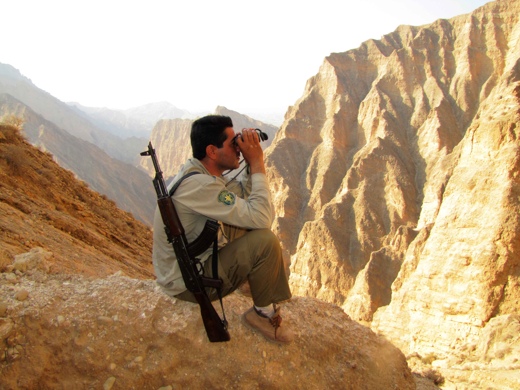
Ranger sets two conditions for forgiving his assailant

Ranger

A park ranger in West Azerbaijan Province forgave an illegal fisherman who had attacked him after the latter agreed to meet his two conditions.

The following is the translation of an excerpt of a report Setareh Sobh published on July 29 about the incident:

Karim Khezri, the head of the Environment Department in Sardasht, a city in West Azerbaijan, said, “Azad Ghaderi, a park ranger, was attacked a few months ago by illegal fishermen who had been trying to catch fish in the Zab River in Mirabad Protected Area.

Fearing arrest and confiscation of their electricity generator after being caught in the act, the fishermen started pelting the ranger with rocks which caused Ghaderi to pick up severe injuries in his leg.”

Khezri added that after a complaint was filed, judicial investigation into the case revealed that the poacher was a repeat offender who had been caught twice already for breaking environmental rules.

After the legal proceedings, the court sentenced him to two years in jail and fined him over $600.

The environment chief went on to say, “After the offender showed remorse, the good-natured park ranger said that he was ready to forgive his attacker if he promised to give up illegal fishing forever and become an environmentalist. The convict was forgiven after he agreed to fulfill those two conditions.”

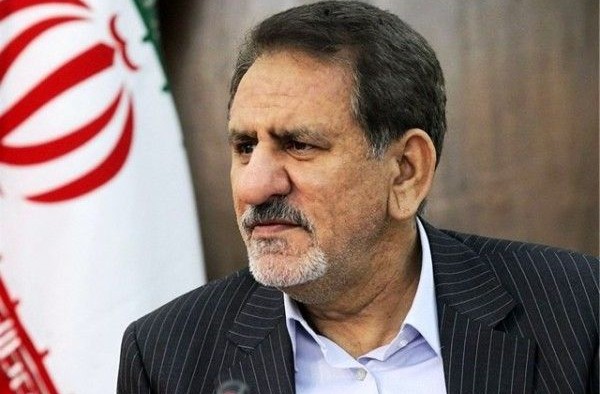
Iran ready for energy cooperation with Armenia: Veep

vice- president , eshagh jahangiri

First Vice President Eshagh Jahangiri in a telephone conversation with Armenian premier said that Iran is ready to expand its cooperation with Armenia in different fields.

According to a Presidential Office report, Eshagh Jahangiri in a telephone contact with Armenian Prime Minister Hovik Abrahamyan on Saturday discussed collaborations in energy, generation and transfer of electricity, goods and passenger transit.

Jahangiri also wished success and prosperity for the Armenian people and government.

He underlined the necessity for the expansion of ties between the two countries and added that by developing relations and expansion of cooperation an effective step will be taken in the direction of national interests for both countries.

Abrahamyan renewed his invitation to Jahangiri to visit Armenia and expressed pleasure for the removal of a number of obstacles blocking bilateral cooperation in the sector of energy and gas transfer, calling for upgrading cooperation.

The Armenian prime minister also wished success and honor for the Iranian government and nation and expressed his country’s readiness for trilateral cooperation between Iran, Armenia and Georgia in the field of transit.

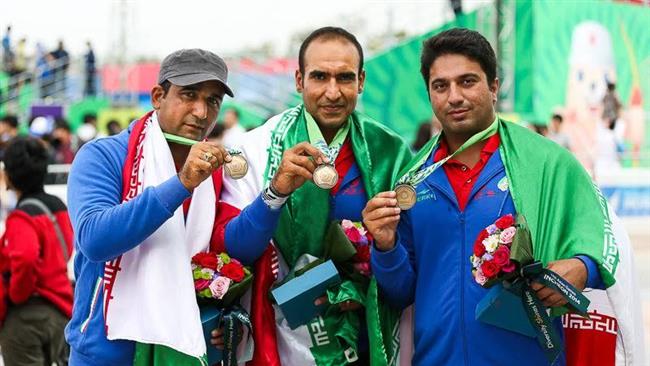
World Archery Championships: Iran compound team wins title

139405101717084725794524

Iranian compound men’s team defeated Canada to win gold medal in the Copenhagen 2015 World Archery Championships on Saturday.

Iran’s trio – Esmaeil Ebadi, Amir Kazempour and Majid Gheidi – won their first two matches against Venezuela and Colombia by one point, 228-227.

In the semis, the trio beat Italy by two, 226-224.

Drawn at 226, the final match went to a tiebreaker.

In the shoot-off, Canada started with a nine, then Esmaeil Ebadi had a 10 for Iran – and those first arrows set the tone, worldarchery.org reported.

While the Canadians would follow with 10-10, neither Amir Kazempour nor Majid Gheidi – Ebadi’s Iranian teammates – would miss the middle either.

Ebadi, Kazempour and Gheidi won the tiebreaker with a perfect 30 points, for just the second time in the match, to Canada’s 29 – and won Iran’s first ever world title.

The World Archery Championships 2015 was the biggest championship in history. More than 600 archers from 96 nations were competing for glory in Copenhagen.


5fc866cf-ec29-467d-9a04-a8941c6200a6

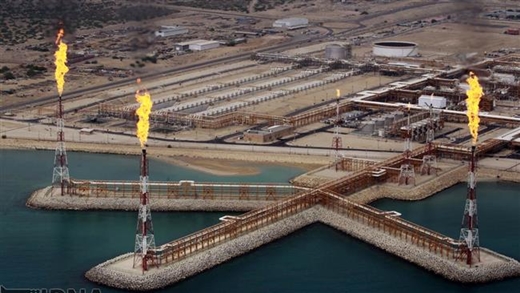
Iran says piping gas to EU not economical

63060276-cc27-4333-8b30-47ea0c0aa464

The recent breakthrough in Vienna by Iran and P5+1 over the country’s nuclear energy program triggered hopes that many of Iran’s energy projects that had been suspended due to sanctions could be revived. One such project is to pipe Iran’s natural gas to Europe. However, Iranian officials are now voicing skepticism over whether this is today any more feasible given the various complications involved.

Alireza Kameli, the managing director of the National Iranian Gas Export Company (NIGEC), has been quoted as saying by Iran’s domestic media that piping natural gas to Europe is not economically justifiable under the present conditions.

Kameli has emphasized that neighboring states as well as Asian markets are today the prime target of Iran’s gas export plans.

Exporting gas to nearby countries, the official said, is much more cost-effective than taking it to Europe through a pipeline several thousand kilometers in length.

“Besides, taking the pipeline through the territory of each host country will require paying transit fees. That comes on top of other technicalities involved,” Kameli has been quoted as saying by the Persian-language newspaper Afarinesh. “These will eventually reduce Iran’s profits from the whole scheme.”

Iran had for years pursued plans to export natural gas to Europe. A tentative scheme that was developed in cooperation with Nabucco – a consortium led by Austria’s OMV – envisaged piping Iranian natural gas from the southern energy hub of Assaluyeh to Turkey and thereon to Europe.  However, Nabucco eventually abandoned Iran in 2008 after the emergence of complications such as US-engineered sanctions against the Iranian energy sector.

A parallel plan to export Iranian gas to Europe – again through Turkey – has been pursued by Switzerland’s EGL, also known as Elektrizitaetsgesellschaft Laufenburg.

Based on the EGL scheme, the Iranian natural gas would be taken to Greece and Albania through Turkey. From there it would flow to Italy through a pipeline under the Adriatic Sea before reaching Switzerland. This scheme had a fate similar to that of Nabucco.

Different parties involved in both projects have recently tried to revive them, specifically in light of Vienna developments.

Even though doubts have been lately emerging over the feasibility of piping Iranian gas to Europe, officials in Tehran have not openly announced that it will be totally off the agenda.

Analysts believe that Iran will continue to view Europe as a potential gas market but at the same time will wait for more modern supply mechanisms to reduce costs and increase profit margins.

An example of such mechanism could include turning natural gas into LNG and shipping it overseas. Iran’s access to the related technology for liquefying natural gas is banned under the current sanctions regime and many are already hoping that the breakthrough in nuclear talks with P5+1 would lead to the lifting of sanctions on LNG technology to open the way for Iran’s ambitious gas export plans.

Iran warns IAEA against leakage of confidential data to US Senate

4784f7a8-0cce-4709-b211-dae0ae6e36b2

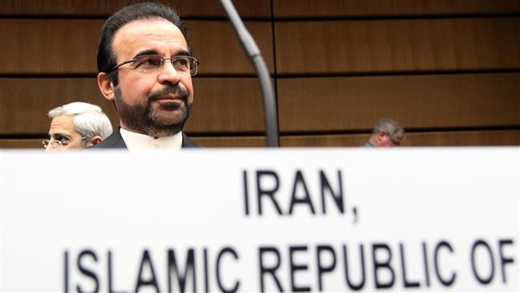
Iran has warned the International Atomic Energy Agency (IAEA) of the repercussions of disclosing to the US Senate the confidential data on the recently signed roadmap between Tehran and the UN nuclear agency.

Reza Najafi, the Iranian ambassador to the IAEA, told IRNA on Saturday that the confidential texts between Iran and the IAEA have not even been provided to the US government and can certainly not be given to the Senate either.

“Definitely, the agreements between a country and the [UN] agency, which are classified, can by no means be presented to any other country,” Najafi said.

IAEA Director General Yukiya Amano is set to travel to Washington next week to meet with members of the US Senate Committee on Foreign Relations to speak about the agency’s role in verifying and monitoring nuclear-related measures in Iran.

On July 14, Iran and the IAEA signed a roadmap in the Austrian city of Vienna for “the clarification of past and present issues” regarding Iran’s nuclear program.

After signing the agreement, Amano said the roadmap “sets out a clear sequence of activities over the coming months, including the provision by Iran of explanations regarding outstanding issues.”

He added that the roadmap enables the IAEA to “issue a report setting out the agency’s final assessment of possible military dimensions to Iran’s nuclear program, for the action of the IAEA Board of Governors, by 15 December 2015.”

The signing of the agreement came on the same day that Iran and P5+1– the United States, Britain, France, China and Russia plus Germany – finalized the text of an agreement, dubbed the Joint Comprehensive Plan of Action (JCPOA), in Vienna.

Under JCPOA, limits are put on Iran’s nuclear activities in exchange for a set of commitments by P5+1, including the removal of all economic and financial sanctions against the Islamic Republic.

Some members of the US Congress have asked that more information be made public on the IAEA’s role in verifying Iran’s implementation of the agreement.

A trip to Tehran

tourisme1

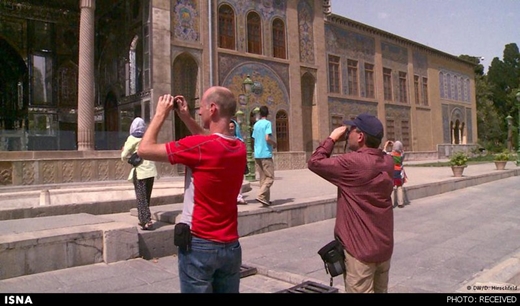
The Iranian Students’ News Agency (ISNA) on July 31 released the translation of a report by Deutsche Welle’s Dan Hirschfeld on his weeklong trip to Tehran. IFP found the original report on the website of the German international broadcaster. The following is the original report in its entirety:

Now that an agreement has been reached on Iran’s nuclear program, economic sanctions against the country should be lifted soon. This could give tourism a new boost. DW’s Dan Hischfeld shares his experience in Tehran.

“What, you’re going to Iran? Are you crazy?” That’s how my friends reacted to my plan to go to Tehran for a week. For 13 years, the country and its 75 million inhabitants have been internationally isolated. There is a lot of ignorance and a lot of prejudice as well.

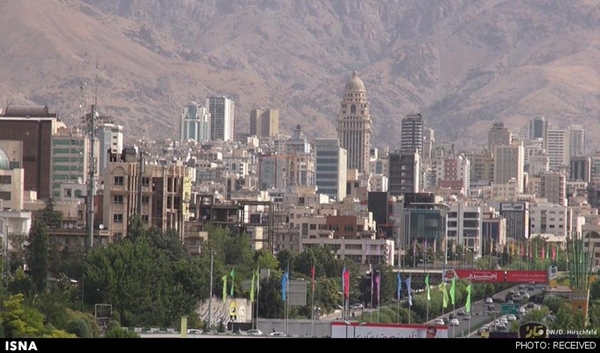
If you have the abbreviation “IKA” on your flight ticket, you will be landing at the relatively new Imam Khomeini Airport in the 15-million metropolis of Tehran. The taxi ride to the center takes about an hour. The first thing you notice is that something is missing. Even the rush-hour traffic lacks the chaos that we know from Arab countries and from mega-cities such as Bangkok or Mumbai. No weaving cars or pedestrians risking their lives to get to the other side of the street. Everything seems somehow European.


tourisme3


Friendly and helpful

On the way to the hotel, I noticed how many young people there were here. Most of the population is under 30. They are not afraid of contact with strangers and welcomed me, the visitor from the West, with an openness and friendliness that would surprise even a well-traveled globetrotter.

Strangers on the street invited me for tea. Someone offered me his mobile phone – me, a foreigner who had obviously got lost – so I could call my hotel. He even rang an acquaintance that spoke a smattering of English and might have been able to help me.

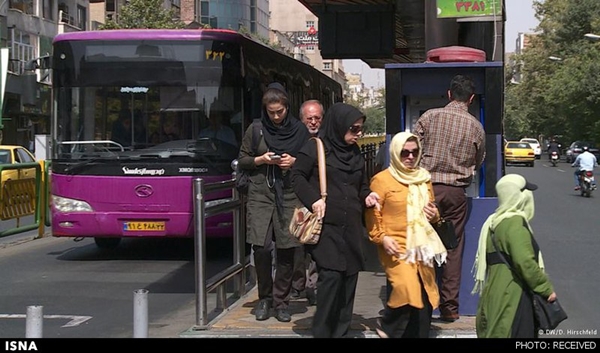
Tehran is a modern metropolis where I quickly felt at home. There is a well-developed public transport system. Buses run to all corners of the city and a subway was built a few years ago.

But I soon noticed I was in an Islamic country too. The subway carriages are divided by glass doors into male and female compartments – and of course I got in the wrong side! No problem, I just switched to the men’s section. But another passenger told me that hardly anyone paid attention to the segregation of the sexes in the metro anyway and that nobody got upset when someone sat in the “wrong” place. In fact, it’s a sort of protest.

Tradition and progress

There’s also a measure of public protest as far as Islamic dress code is concerned. In public, women in Iran have to wear the “hijab,” a kind of headscarf, or the black “chador,” which covers the entire body – only the face is left exposed. But I saw only a few women all dressed in black. And even the headscarf, which is supposed to cover the entire hair, tends to be worn in the capital as a scarf. If the religious police show up, then they say the wind has just blown it down.

Young women in particular love to wear pink jeans and modern-cut clothing. Tehran is undoubtedly a modern metropolis. And, although it seems quite normal to me as a European to see women sitting behind the wheel of their cars, compared to other Islamic countries, it’s quite progressive. In Saudi Arabia, a woman driving without special permission can be punished by caning.

Propaganda and censorship


tourisme2


Strolling through the city, I was enchanted by the beautiful ornate houses and palaces from the time of ancient Persia. Here I got an idea of how magnificent this country once was. But the people impressed me most. They have a huge interest in world events. Although anti-American propaganda is on walls and billboards everywhere, most people in Tehran think differently and talk openly in the restaurant in the evenings. Thanks to satellite TV (which is actually prohibited, but somehow everyone has it anyway) and the Internet (whose government firewall censorship can be circumvented in just a few clicks), many Iranians now have their own opinions on world events, corruption and politics.

After a day in the city, I usually got back to the hotel completely exhausted. Speaking of which, there’s plenty of accommodation, at least in Tehran. From backpacker hostels to five-star hotels – and friends with experience in Iran had warned me about the main snag: paying. Because of the sanctions, Iran was cut off from the international financial system, and foreign credit cards don’t work yet. You need enough cash.

Tourism as an opportunity

But everyone I spoke to hoped this would soon become a thing of the past after the agreement with the West. People have high hopes for the end of sanctions. They told me they want to open their own businesses when the economy improves. All share the desire for a better life. Unemployment is still high and many well-educated young people cannot find a job.

After all, the number of tourists visiting Iran has doubled within a year. And this country, where I encountered forests, deserts, beaches and high mountains, is just waiting to be discovered.

In Tehran, for example, I took a cable car to more than 4,000 meters above sea level and experienced what climbers call “altitude sickness.” In any case, a week was far too short. For this country, you have to take your time. Or maybe just come back.

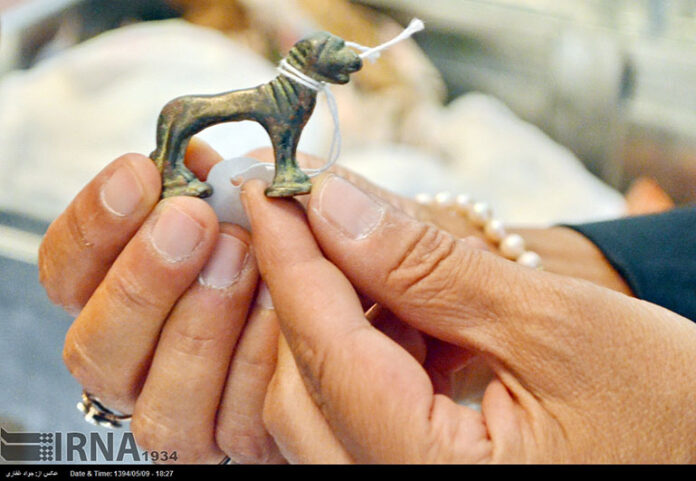
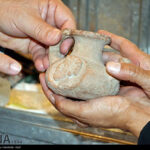
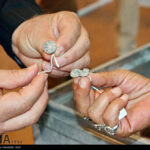
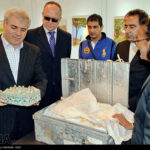
Iran secures return of stolen artifacts from Italy (PHOTOS)

stolen artifacts 0

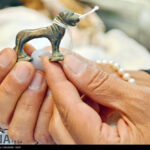
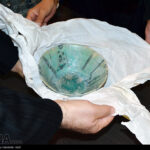
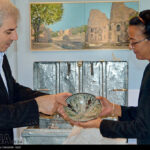
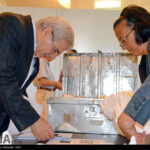
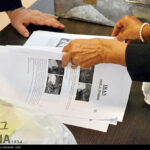
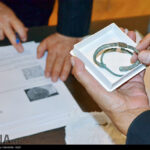
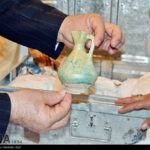
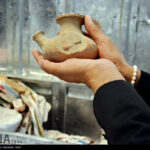
An appeals court in Italy has ordered the return of 30 artifacts smuggled out of Iran over the past decade.

The following are the images IRNA has released of the items Italy has returned to the country:

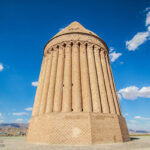
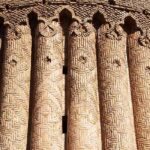
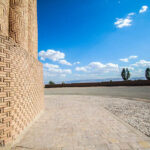
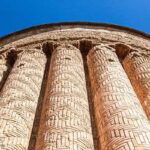
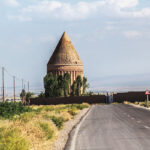
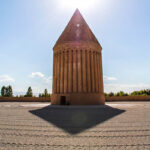
Radkan Tower (PHOTOS)

Radkan Tower11

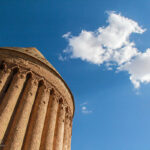
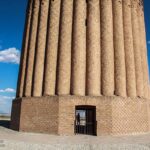
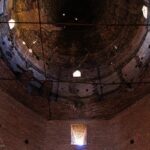
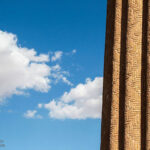
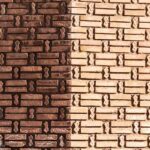
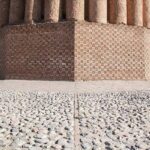
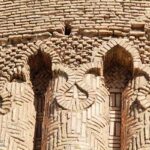
Radkan Tower, in northeastern Iran, was a structure which helped residents determine the beginning of the four seasons, leap years and Nowruz.

The structure seems to have been completed in 1261 AD.

The following are images of the tower released online by Mehr News Agency:

A look at Iranian newspaper front pages on August 1

Iranian Newspapers Headlines

President Hassan Rouhani’s call for measures to seize the opportunities that arise in the post-sanctions era; Foreign Minister Zarif’s appeal for creation of a nuclear-free world in an opinion piece in The Guardian; and comments by the director of the Atomic Energy Organization that the Vienna accord does not need the approval of the Islamic Consultative Assembly dominated the front pages of Iranian newspapers on Saturday. The tragic burning alive of a Palestinian child at the hands of Israeli settlers also appeared on the covers of dailies.


Ettela’at: Foreign Minister Mohammad Javad Zarif has said that it is now time to review the threat posed by the nuclear arsenal of the Zionist regime.

In an opinion piece in The Guardian, the Iranian top diplomat wrote, “The nuclear deal reached in Vienna this month [July] is not a ceiling but a solid foundation on which we must build.”


Abrar: The deputy chairman of parliament’s Economic Committee has urged the welfare minister to “rid the country’s economy of inexperienced individuals”.
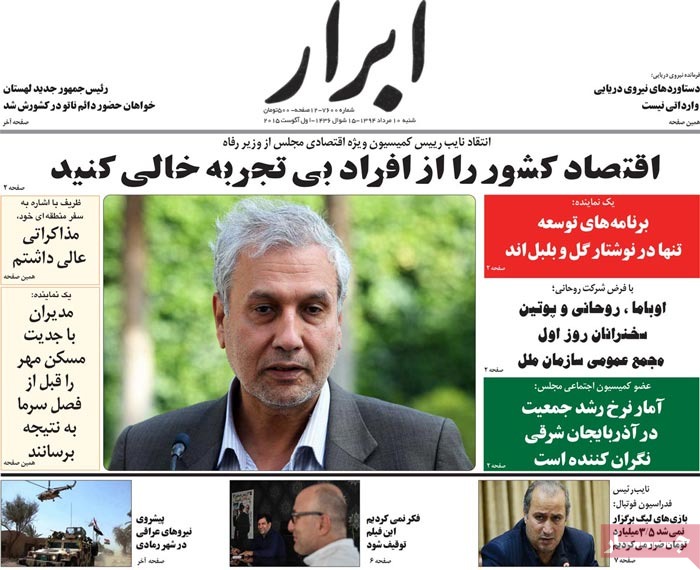
 

A look at Iranian newspaper front pages on August 1


Afarinesh: The health minister has said that heart attacks are to blame for 50 percent of deaths in Iran.
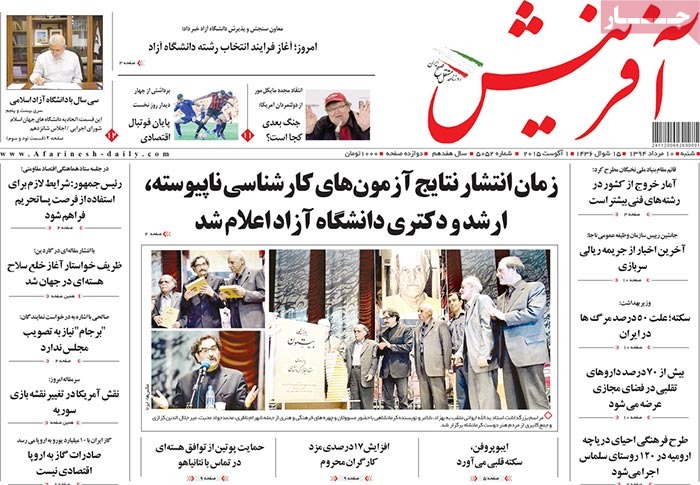
 

A look at Iranian newspaper front pages on August 1


Aftab-e Yazd: Western media speculate that Presidents Rouhani and Obama are likely to meet on the sidelines of the UN General Assembly in New York.

Aftab-e Yazd: Tehran Mayor Mohammad Bagher Ghalibaf still feels bitter.

The daily takes a look at the political behavior of the mayor of the capital.
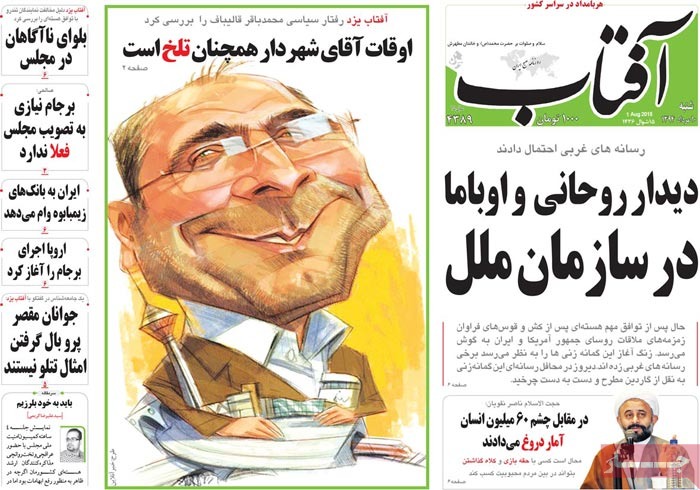
 

A look at Iranian newspaper front pages on August 1


Arman-e Emrooz: “Reformists are not worried about being barred from running for parliament,” Mohammad Reza Aref, a reformist leader and former first vice-president said.

Arman-e Emrooz: Reports that meteorites have hit a couple of Iranian provinces have been both confirmed and denied.

Arman-e Emrooz: New York is to roll out the red carpet for Rouhani.

Presidents Rouhani and Obama will deliver speeches on the first day of the 70th General Assembly of the United Nations.
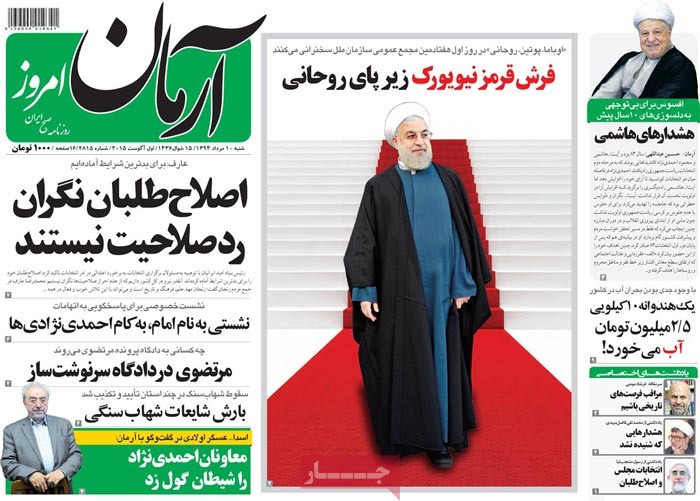
 

A look at Iranian newspaper front pages on August 1


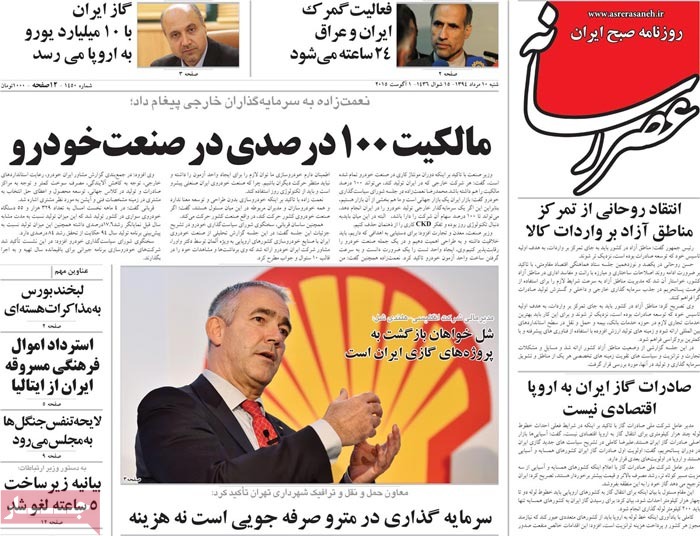
Asr-e Rasaneh: The project to take Iranian natural gas to Europe carries a staggering 10 billion euro price tag.
 

A look at Iranian newspaper front pages on August 1


Asrar: Royal Dutch Shell has expressed interest in returning to Iran’s gas projects.

Asrar: “Some 47,000 female employees have been dismissed after taking maternity leave,” the deputy director of the Social Security Organization said.

Asrar: In light of the fact that the problems the Guardian Council has found with the motion to hold elections on a provincial scale cannot be fixed, the plan will be shelved.


A look at Iranian newspaper front pages on August 1


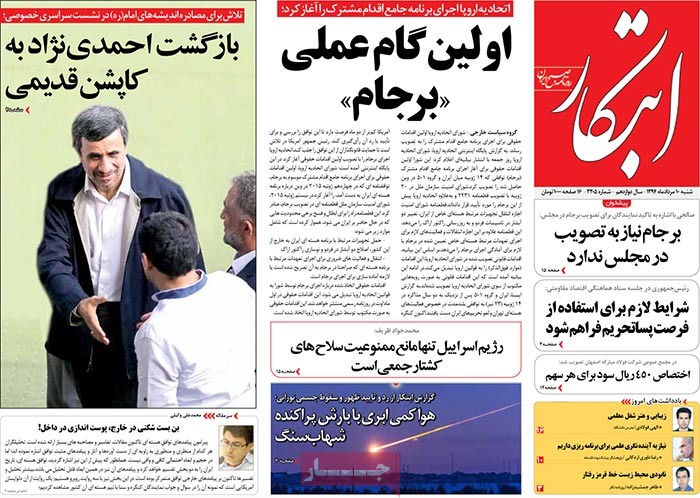
Ebtekar: The first practical measure in line with the Vienna accord

The European Union has started implementing the Joint Comprehensive Plan of Action (JCPOA).

Ebtekar: “The Joint Comprehensive Plan of Action (JCPOA) does not need to be approved in parliament,” the director of the Atomic Energy Organization of Iran said.
 

A look at Iranian newspaper front pages on August 1


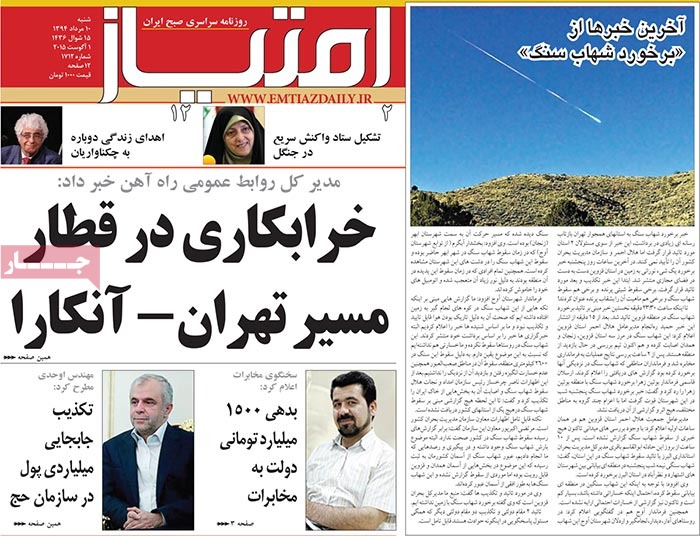
Emtiaz: Sabotage in the train en route from Tehran to Ankara
 

A look at Iranian newspaper front pages on August 1


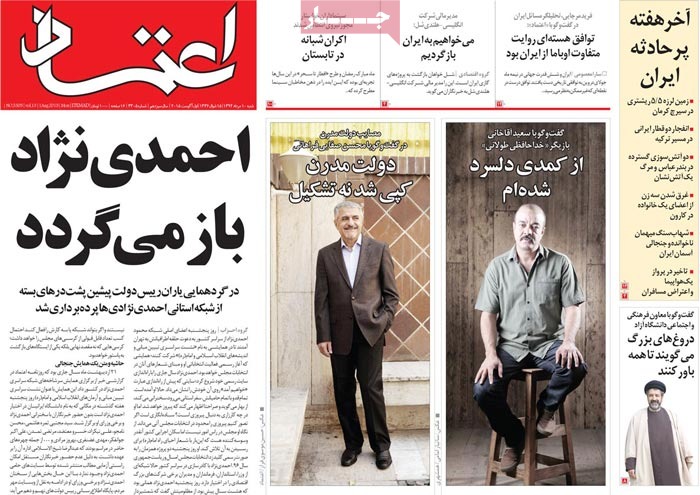
Etemad: A weekend rife with accidents

There were explosions on board two Iranian trains en route to Turkey; two massive fires erupted in Bandar Abbas and a firefighter died as he was trying to contain the flames; three members of a single family drowned in the Karoon River.

An earthquake measuring 5.5 on the Richter scale hit Kerman; the delay in the takeoff of a plane sparked passenger protest; and a meteorite was the unwelcome, controversial guest of the Iranian sky.
 

A look at Iranian newspaper front pages on August 1


Hambastegi: “Had it not been for Iran’s cooperation and consultation, IS would have been in Baghdad today,” said Ali Akbar Velayati, the director of the Center for Strategic Studies affiliated to the Expediency Council.
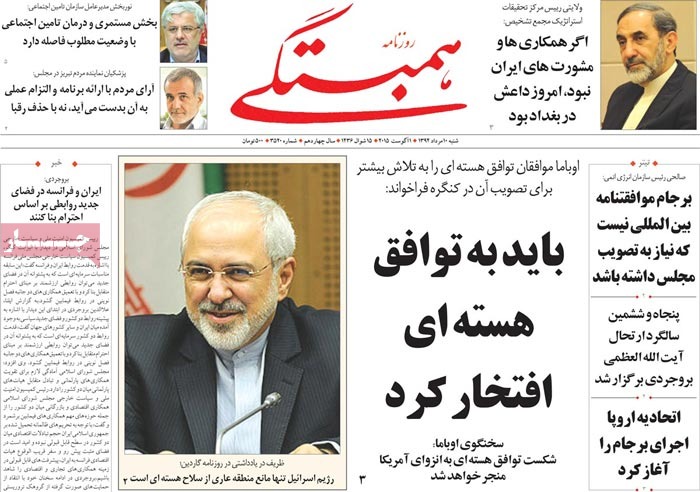
 

A look at Iranian newspaper front pages on August 1


Iran: Iran and France have reached an agreement that covers the oil, aircraft and automobile sectors.
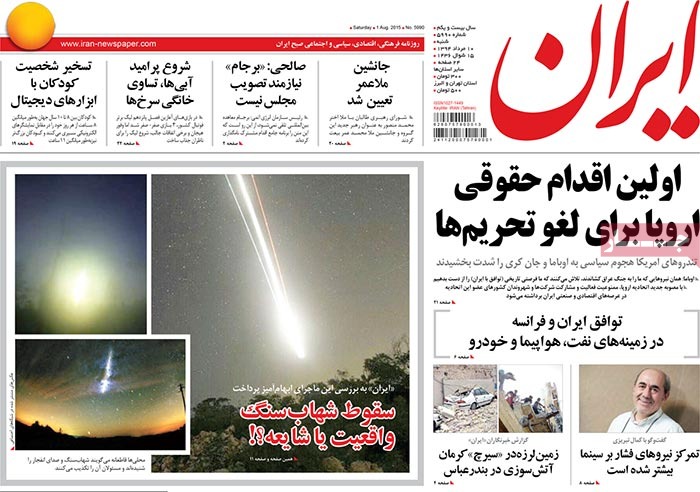
 

A look at Iranian newspaper front pages on August 1


Jomhouri Islami: Mahshahr has experienced the hottest day in the world ever registered.

Temperatures surged to 62° Celsius in the southern Iranian city on Thursday.
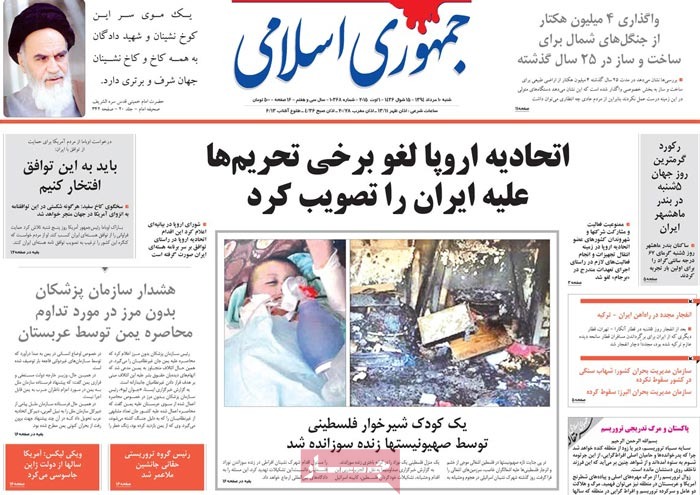
 

A look at Iranian newspaper front pages on August 1


Kayhan: The Vienna accord amounts to a blow to Iran’s security; take this report seriously.
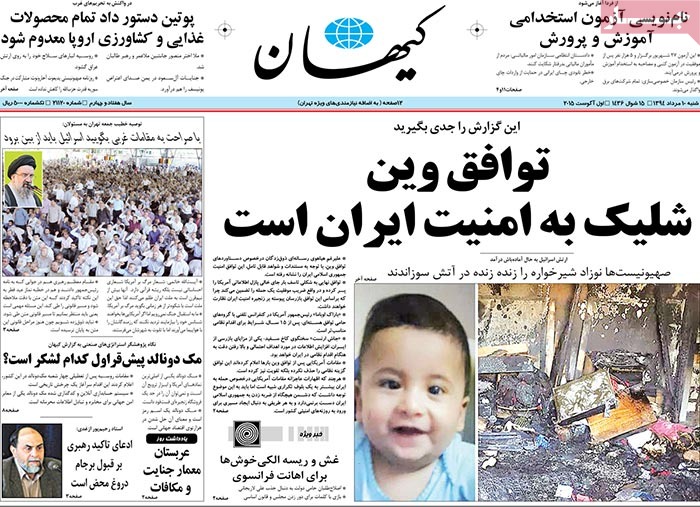
 

A look at Iranian newspaper front pages on August 1


Mardomsalari: The Iranian Foreign Ministry has condemned the Israeli crimes [the burning of a Palestinian child alive].
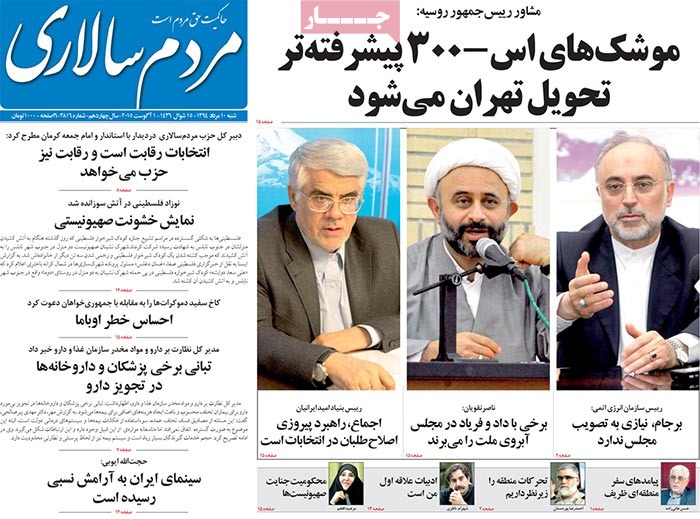
 

A look at Iranian newspaper front pages on August 1


Payam-e Zaman: Tehran’s Friday prayer leader has said that the Iranians appreciate the efforts of the president and the negotiating team.
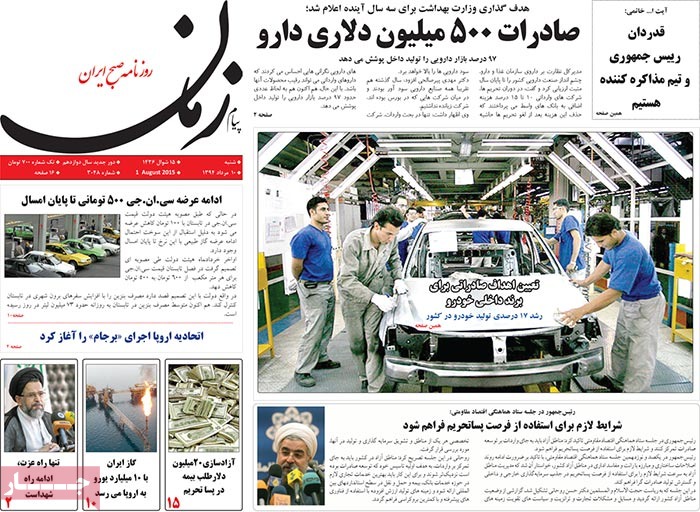
 

A look at Iranian newspaper front pages on August 1


Resalat: “France should pay compensation for the tainted blood it exported to Iran in the 80s,” said the chairman of parliament’s National Security and Foreign Policy Committee.

Resalat: “Concerns about inspections of military sites have been removed,” said Deputy Foreign Minister Abbas Araghchi.
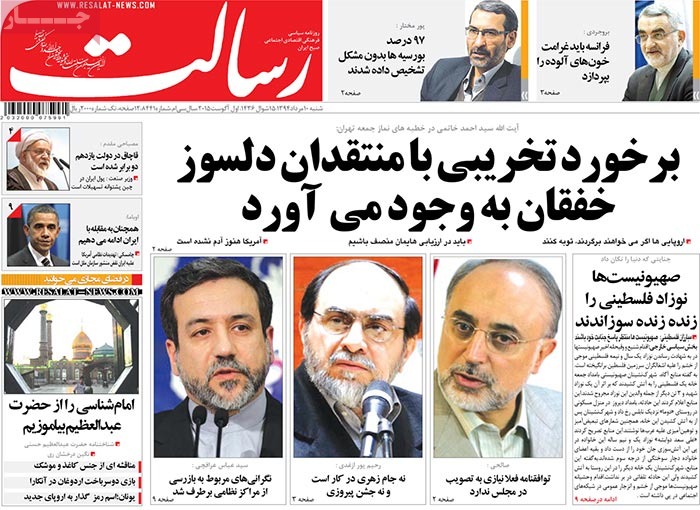
 

A look at Iranian newspaper front pages on August 1


Sayeh: “Automotive production in Iran has registered a 17 percent hike,” said the minister of industries, mines and trade.
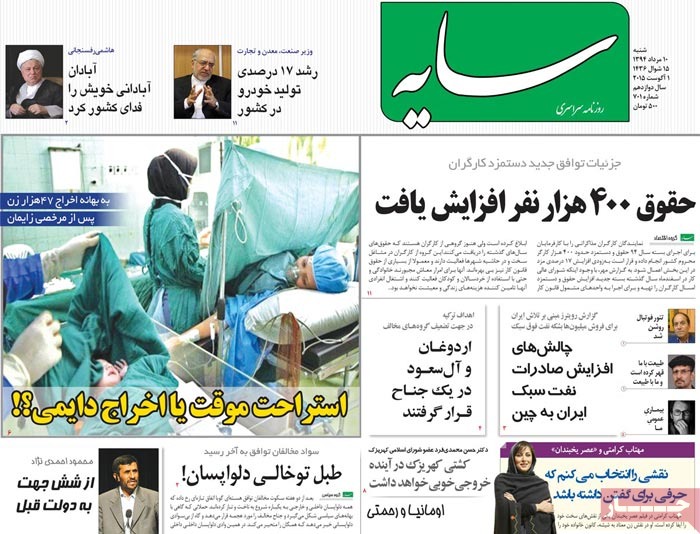
 

A look at Iranian newspaper front pages on August 1


Setareh Sobh: Ahmadinejad has launched an electoral campaign.
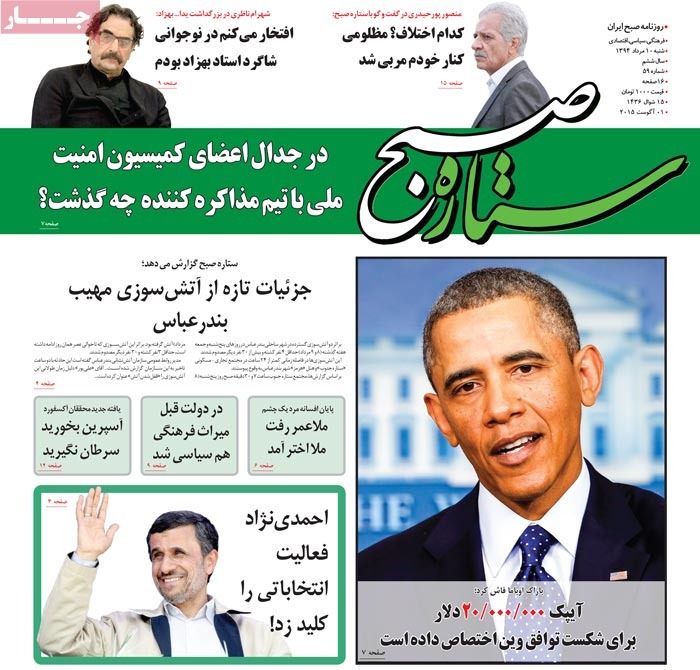
 

A look at Iranian newspaper front pages on August 1


Sharq: Supporters of Ahmadinejad have been ordered to launch a blitz against the government on the diplomacy front.
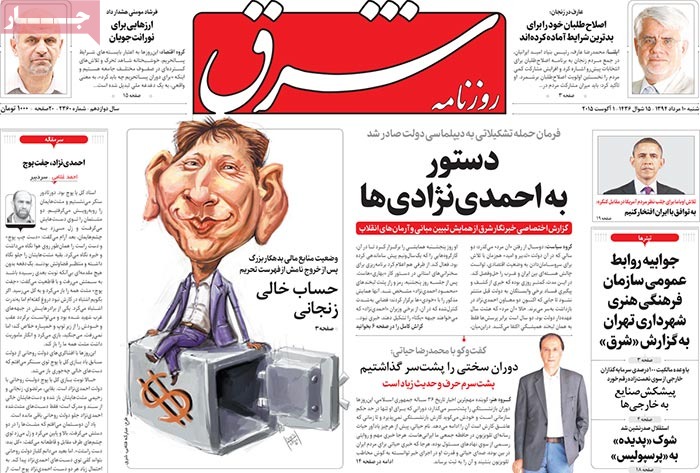

 

A look at Iranian newspaper front pages on August 1


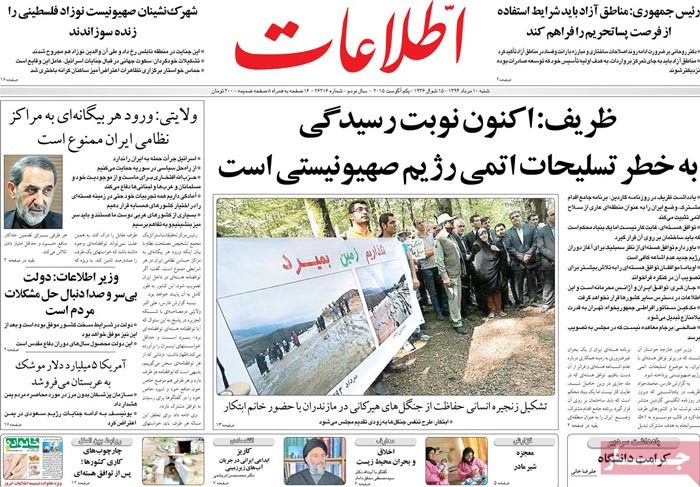
Highlights of Ettela’at newspaper on August 1

Ettelaat-August 1

 Foreign Minister Mohammad Javad Zarif has said that it is now time to review the threat posed by the nuclear arsenal of the Zionist regime.
In an opinion piece in The Guardian, the Iranian top diplomat wrote, “The nuclear deal reached in Vienna this month [July] is not a ceiling but a solid foundation on which we must build.”

 The president has called on the body that runs the free trade zones to set the stage for the opportunities that arise in the post-sanctions era to be seized.

President Rouhani has stressed the need for continued efforts to introduce structural reforms and fight corruption in free zones.

 Zionist settlers have burned a Palestinian child alive.

The Palestinian Authority has blamed the crime on the silence of the international community in the face of Israeli measures.

 “Foreigners are not allowed to enter Iran’s military sites,” said Ali Akbar Velayati, an advisor to the Supreme Leader.

The former foreign minister further said that Israel does not dare attack Iran and that Tehran supports a political solution to the crisis in Syria.

 Activists have formed a human chain in Hyrcania in Mazandaran Province to protect forestland.

Director of the Environment Protection Organization Masoumeh Ebtekar was on hand.

 The intelligence minister has said that government is quietly trying to settle the problems of the public.

“This government has been successful in tough times; it will remain successful from this point forward,” Mahmoud Alavi said.

 The US is to sell $5 billion worth of missiles to Saudi Arabia.

Doctors without Borders (MSF) has warned about the conditions of the Yemeni people under siege, and UNICEF has objected to Saudi measures in Yemen.

OPEC: World market ready to absorb Iran’s oil after sanctions