Thursday, January 1, 2026
Home Blog Page 4776

Two Iranian banks to start operating in UK soon: CBI head

Iran-UK-Banks

The governor of the Central Bank of Iran (CBI) says two Iranian banks will start operating in Britain soon, increasing the number of Iranian banks active in the UK to four.

Speaking to IRNA following a meeting with visiting British Foreign Secretary Philip Hammond in Tehran on Sunday, Valiollah Seif noted that the two banks include the London branch of Bank Melli Iran and the Persia International Bank.

As for his meeting with Hammond, Seif said during their negotiations, the two sides discussed past cooperation as well as the existing capacities for the expansion of that cooperation.

He added that the British top diplomat indicated willingness of his country’s banks to operate in Iran, saying that facilitation of banking operations in the two countries was another point of discussion between the two sides.

“During negotiations, we discussed major obstacles to raising the volume of trade between the two countries, which are mostly related to banking, insurance and transportation restrictions. The two sides emphasized their serious will to remove these obstacles,” he noted.

Iran’s CBI governor stated that the two sides also decided to exchange banking delegations in order to pave the way for cooperation between Iranian and British banks.

According to IRNA, during his meeting with the CBI governor, Hammond emphasized that the two countries should do away with bureaucratic obstacles that hamper expansion of their trade and economic ties.

He added that Iranian banks will be able to restart their activities in the UK once sanctions against Iran’s financial sector are removed.

The British foreign secretary noted that Britain’s embassy in Iran should take necessary measures to facilitate trade and economic exchanges between the two countries.

Hammond arrived in Tehran earlier on Sunday to reopen the UK embassy and hold talks with high-ranking Iranian officials.

During his two-day trip, Hammond is scheduled to hold talks with Iranian President Hassan Rouhani and Parliament Speaker Ali Larijani. He has already met and conferred with Iran’s Foreign Minister Mohammad Javad Zarif, Governor of the Central Bank of Iran Valiollah Seif, and Iran’s Oil Minister Bijan Zanganeh.

He is accompanied by a politico-economic delegation, including representatives of major British companies such as the Royal-Dutch Shell.

Zarif, Hammond hold joint press conference in Tehran

Zarif-Hamond

Zarif said Iran and Britain could resolve “differences through interaction and reaching a mutual understanding.”

He noted that Tehran and London share views about fighting “extremism, Daesh” and drug trafficking in the region.

For his part, Hammond said he felt “delighted” about the reopening of Iranian and British embassies, saying they serve as “important practical channels” to engage on “many issues we have shared interests.”

He said that there has been “improvement between the two countries step-by-step” since President Hassan Rouhani was elected in July 2013.

“Iran is and will remain a very important country in a strategically but volatile region,” he said.

Hammond noted that “our embassies play an important role in maintaining” dialogue between Tehran and London.

The British top diplomat also referred to his talks with Iran’s petroleum minister, Bijan Zangeneh, saying the business delegates accompanying him are “more than willing” to invest in Iran once sanctions against the Islamic Republic are lifted.

He said Iran’s petroleum industry has shown “openness” to foreign investment.

Hammond arrived in Tehran on a historic visit earlier on Sunday, and went to the embassy’s premises to reopen the headquarters of the British diplomatic mission to Iran, which had been closed since November 2011.
Back then, Britain closed the embassy and withdrew its diplomatic staff after hundreds of Iranian students staged a protest outside the diplomatic premises in Tehran against the expansion of UK sanctions on Iran, pulling down the UK flag and demanding the expulsion of the British ambassador.

Later in November that year, Iran’s Parliament (Majlis) approved a bill to downgrade the diplomatic ties between Tehran and London to the level of chargé d’affaires.

Iranian police make arrests to prevent a protest gathering against British embassy reopening

iran-uk-embaccy

Several protestors were arrested in front of the British embassy in Tehran which was reopened on Sunday morning in the presence of Foreign Secretary Phillip Hammond.

A number of Iranian people and students who wanted to hold a peaceful gathering to protest at the reopening of the British embassy in small groups were arrested by the law enforcement police forces in front of the British mission in Tehran today.

The streets near the embassy compound were heavily guarded since early morning by the special police and law enforcement troops who dispersed the people to avoid any protest gathering.

Many Iranian university students formations, political figures, officials and elites had slammed the reopening of the British Embassy, and called for a gathering in front of the mission to protest at what they called as ‘Black Sunday’.

Relations between Iran and Britain hit an all-time low in November 2011, when the two countries shut down their diplomatic missions.

Iran recalled all its staff and closed its embassy in London in November after Britain recalled its diplomatic mission in Tehran due to massive protests in front of the British embassy complex by thousands of Iranian students who demanded ties with London be severed.

The Iranian students’ November protests at the British mission came after the Iranian legislators in an open session of parliament in November approved a bill to downgrade relations with Britain. After parliament’s approval, Iran expelled the British ambassador from Tehran.

The parliament approval came a week after the US and Britain targeted Iranian financial sectors with new punitive measures, including sanctions on the Central Bank of Iran (CBI) and petrochemical industry.

The sanctions against the CBI and Iran’s petrochemical industry were adopted in a unilateral move by the US, Canada and Britain outside the UN Security Council as other council members, especially Russia and China, had earlier warned against any fresh punitive measure, including sanctions, against Iran.

[…]

A review of a failed plan to shut down the British embassy

1180308_827

A former Iranian MP has said that the reopening of the British embassy in Tehran shows London has woken up to realities, but to see a real change of heart, Iran needs to wait for future approaches of London.

Iran newspaper on August 23 published an opinion piece by Heshmatollah Falahatpisheh, a former MP, on the closure of the British embassy in Tehran. The following is the translation of the piece:

In 2010, when a number of MPs introduced a motion in the Islamic Consultative Assembly to oblige the government to shut down the British embassy, I talked against it. The motion failed to clear parliament thanks to the opposition of a number of deputies.
Back then, opponents of the motion argued that a move such as closing the embassy is like playing in a court designed by the Brits. If Iran had opted for such a move, according to the European Union’s laws, all European countries had to follow suit and close down their embassies in Tehran.

Iran had no issues with many of these [European] countries, but Britain was seeking to make fellow European countries follow its lead in dealing with Iran. This motion [closure of the British embassy] was shelved, and after a while the Islamic Consultative Assembly approved a bill on downgrading ties with Britain. The bill was never put into effect because of what unfolded [in the country] and later the British embassy was shuttered in Tehran in the wake of protests by Iranian university students.

Now the two countries have once again resumed efforts to improve their ties and open their diplomatic missions. The reopening of the British embassy does not require parliamentary legislation, because under a parliamentary act, ties between the two countries had to be downgraded to charge d’ affaires level, something which – as the Foreign Ministry officials have put it – is now being materialized.

Furthermore, the new development in Iran-Britain ties – reopening of embassies is one clear manifestation of it – has taken place mainly because of the acceptance by the Britons of the existing realities, and not a change of heart in London. To see a change in London’s behavior, we need to wait for objective progress, especially because there are still misgivings and concerns about Britain’s change of policy and its approaches in the future. Perhaps, they [the Britons] can in practice develop a better understanding of the ground realities and change course in dealing with Iran.

Misgivings and concerns about the performance of Britain have their roots in historic realities. In the course of history, anytime the Iranian nation needed or tried to create positive changes, Britain failed to play a positive role; rather, it assumed a negative role and practically caused long hiatuses in Iran’s positive developments.

For instance, Britain contributed effectively to the August 18 [1953] coup [during which the legitimate government of Prime Minister Dr. Mossadegh was overthrown]. After [the victory of] the Islamic Revolution, this country topped the list of 26 countries which supported Iraq in the 1980s imposed war. So what it did helped opportunities for improvement of bilateral ties slip away.

Britain reopens its embassy in Tehran

Britain reopens its embassy222574_736

Foreign Secretary Philip Hammond was on hand in a ceremony Sunday to reopen the British embassy in Tehran. The reopening was given extensive coverage by a host of foreign reporters.

The following are images of the ceremony released by Fararu.com on August 23:


240 tons of narcotics seized in four months: Iranian official

qmgin

Some 240 tons of narcotics was seized in different Iranian provinces between March 21 and July 22, 2015, Deputy Head of Iran’s Anti-Narcotics Headquarters Assadollah Hadinejad said.

The following is the translation of an excerpt of his remarks on the anti-drugs campaign Ettela’at, a daily, published on August 23:

Some 60 percent of imprisonments, 55 percent of divorces and 45 percent of petty larcenies in Iran are drug-related.

Given that Afghanistan is a major narcotics producer and Europe is the main consumer of drugs in the world, Iran is an ideal transit route for drug traffickers operating in these two regions. To stem the Europe-bound flow of narcotics, Iran has taken measures such as the blocking of its eastern borders [with Afghanistan].

Those efforts have curbed drug trafficking through Iran to 35 percent and there is hope that the blocking of the Iran-Pakistan border will send the figure down to 15 percent by March.

The Taliban and Western forces have played a significant role in the increase of drug production in Afghanistan which accounts for up to 90 percent of traditional narcotics in the world.

When US forces were deployed in Afghanistan in 2001, yearly narcotics production stood at no more than 180 tons. The figure had risen to 6,400 tons when they left.

Factors such as support by terrorists, lack of appropriate agricultural infrastructure and enormous investments by drug mafias contribute to narcotics production in Afghanistan

The fight against drug-dealers is among the priorities of the Anti-Narcotics Headquarters.

Navab Bath in Tehran (PHOTOS)

Navab Bath0

Navab Bath, which dates back to the Qajar era, is in the vicinity of Tehran’s Grand Bazaar.

To save energy and tap into groundwater sources such as qanats and springs, the structure was built below ground level.

Originally, bricks, lime, stones and tiles were used in the construction of the public bath, during its renovation, however, cement was added to the building to strengthen its structure.

Photos of the old public bath in southern Tehran posted online by tpaa.ir:

Britain’s Hammond arrives in Iran to reopen embassy

Hammond

British Foreign Secretary Philip Hammond has arrived in the Iranian capital, Tehran, for a landmark two-day visit to reopen the UK embassy.

Hammond arrived in Tehran on Sunday at the head of a high-ranking politico-economic delegation to attend the reopening ceremony of the British embassy in the first visit to Iran by a British foreign secretary since 2003.

During his stay in Tehran, the British foreign secretary will also hold talks with Iranian President Hassan Rouhani, Foreign Minister Mohammad Javad Zarif, Minister of Petroleum Bijan Zanganeh, Parliament Speaker Ali Larijani and Governor of the Central Bank of Iran Valiollah Seif.

The Iranian embassy in London will be also reopened at the same time in the presence of Iran’s Deputy Foreign Minister Mehdi Danesh-Yazdi.

The reopening of the British embassy is seen as the biggest shift in the West’s policy toward Tehran after Iran and P5+1 reached a nuclear agreement in Vienna in July.

Iran and the six countries – the United States, Britain, France, Russia, China and Germany — succeeded in finalizing the text of the nuclear agreement called the Joint Comprehensive Plan of Action (JCPOA) on July 14.

Under the JCPOA, limits will be put on Iran’s nuclear activities in exchange for, among other things, the removal of all economic and financial bans, against the Islamic Republic.

Britain shut down its embassy in Tehran in November 2011 and withdrew its diplomatic staff after hundreds of Iranian students staged a protest outside the British embassy in Tehran against the expansion of UK sanctions on Iran, pulling down the UK flag and demanding the expulsion of the British ambassador.

In late November 2011, Iran’s parliament approved a bill to downgrade the diplomatic ties between Tehran and London to the level of chargé d’ affaires, and limit all economic and cultural collaborations to the minimum level.

Nearly two years after their diplomatic ties were severed, Iran and Britain agreed in October 2013 to appoint non-resident chargés d’ affaires as a first step toward reestablishment of their ties.

This would have been a bad deal if Iran had sought an A-bomb

Rouhani

President Rouhani has said that the whole world, excluding a usurping regime [a reference to Israel] and a group of political hawks in another country [the US], are happy with the nuclear deal Iran and P5+1 clinched on July 14.

The president made the comment in a ceremony in Tehran on Saturday to mark National Defense Industry Day. Tasnim News Agency on August 22 covered the president’s remarks at the ceremony and the following is the translation of parts of what he said:

A weak country which cannot defend itself against its rivals cannot claim to be seeking peace. Such a country should always brace for being occupied and see its national interests jeopardized.

During the talks, Iranian diplomats were sensitive about the country’s defense industries. People will learn about the details of the talks when their documents are made public. The only thing that is included in the deal is that Iran does not build a missile which can carry a nuclear warhead. Iran has never been after that.

Today the country’s conditions are better than one or two years ago, because the nation has managed to build on its political capabilities to reach an agreement with which all world nations are happy, except a warmongering regime and a group of hawks in another country.

In one sense, if a country is after weapons of mass destruction, this agreement [the Iran nuclear deal] would be a bad deal. If Iran had sought to develop an atomic bomb, the Vienna accord would not have been a good deal. If a country is not seeking to kill the innocent people and – in line with logic, wisdom, its religious principles and its leader’s fatwa – is after peaceful technology, not WMDs, the Vienna accord would be a good deal with no shortcomings.

When a dependent country gains power, it turns into a regional gendarme. A country which obeys the orders of a superpower, its power fails to bring about peace.

At a time when the region is insecure and strangers are in Iran’s surroundings, we cannot sit idly by and not care [about the country’s fate]. At a time when big powers have launched a proxy war through terrorists who create tensions in the region in the name of Islam and Jihad, we cannot remain ignorant of the country’s defensive power. We have to be ready, equipped and powerful.

It took the world centuries to change the word ‘war’ into: ‘defense’. But Islam replaced war with defense [from day one]. All Jihads in Islam had defensive purposes: defense of lands or defense of faith and freedom.

In Iran too, we had a ministry of war. It changed into the ministry of defense when the late Mossadegh was in power. Those behind the [1953] coup [which overthrew the Mossadegh government] could not stand a name which was chosen by a legitimate government and re-changed it into the ministry of war. After the victory of the Islamic Revolution, this ministry was once again renamed as the Ministry of Defense and Armed Forces Logistics.

This [ministry of war or defense] is not just a name; it has a rich content. Iran’s ideal is defense, not war. Iran’s religion and establishment is democracy-based, not war-based. We are not after war and aggression. There are countries in the world whose military doctrines prescribe war and aggression. […]

Iran’s defense industries are geared for defending our territories, establishment and interests. We have not been and won’t be after aggression. […] Once we were attacked by Iraq, but when this country plunged into troubles, Iran did not take action against it. […]

After the collapse of the former Soviet Union, Iran went to the help of its northern neighbors instead of taking action against those [newly independent] republics. This shows Iran favors culture, art and civilization.

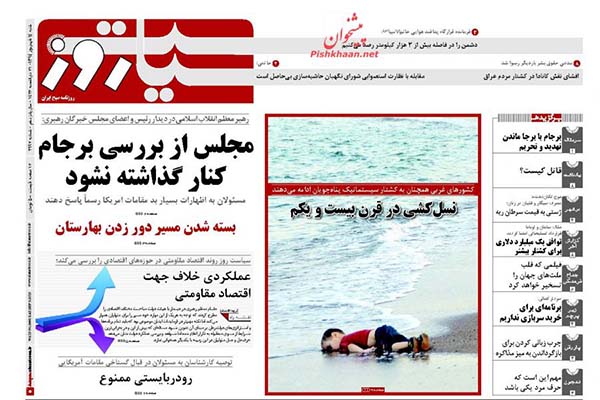
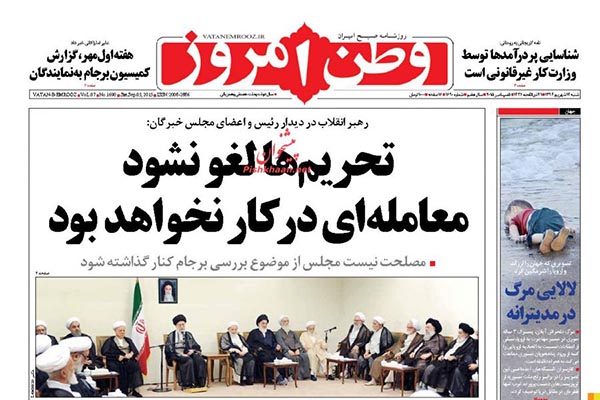
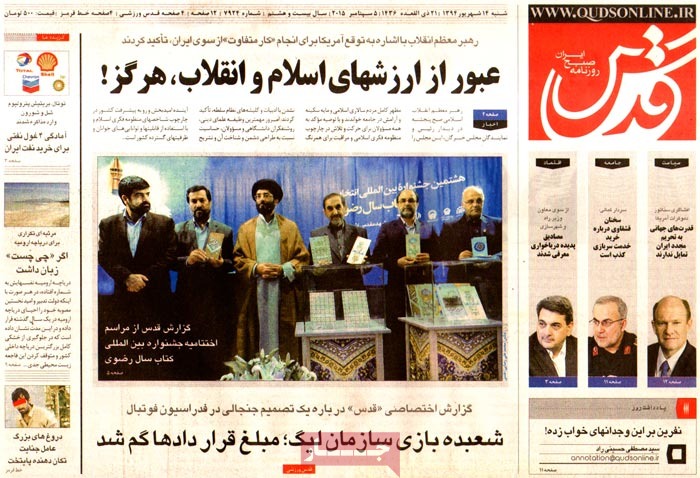
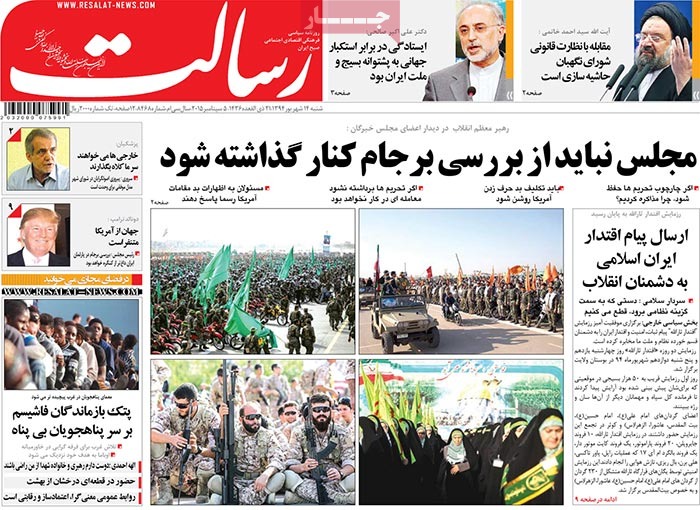
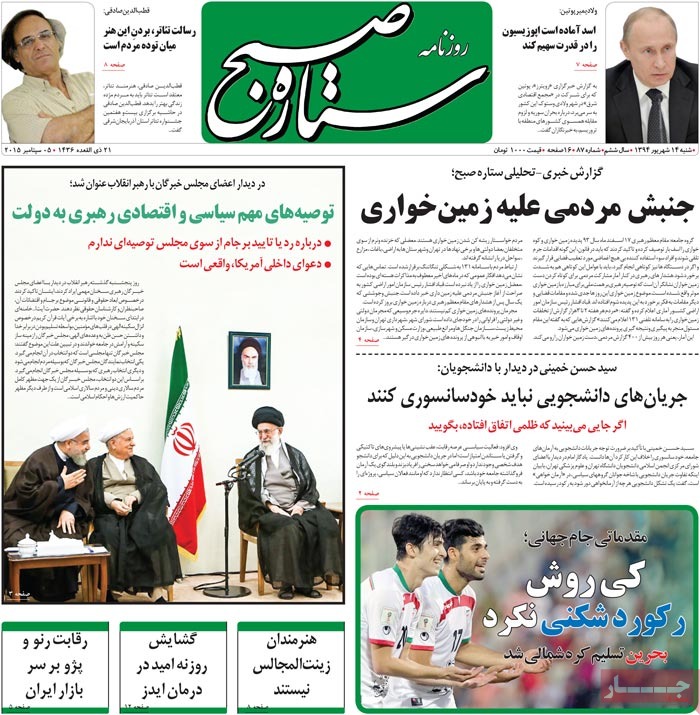
A look at Iranian newspaper front pages on August 23

Iranian Newspapers Headlines

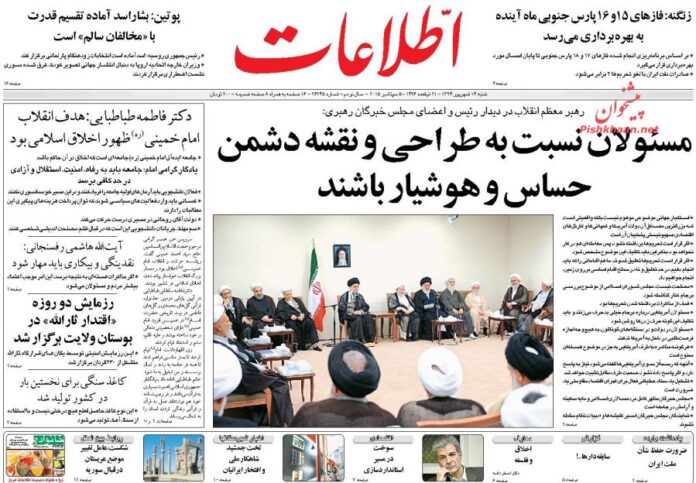
The call by the Supreme Leader for Muslim unity at a meeting with Hajj officials and the comments of the president on Iran’s military capabilities dominated the front pages of Iranian newspapers on Sunday.


Ettela’at: “Global bullies are pursuing violence and division in the name of Islam,” said the Supreme Leader at a meeting with Hajj officials.

Ayatollah Khamenei further said that Hajj offers a genuine opportunity for the manifestation of Islamic unity.


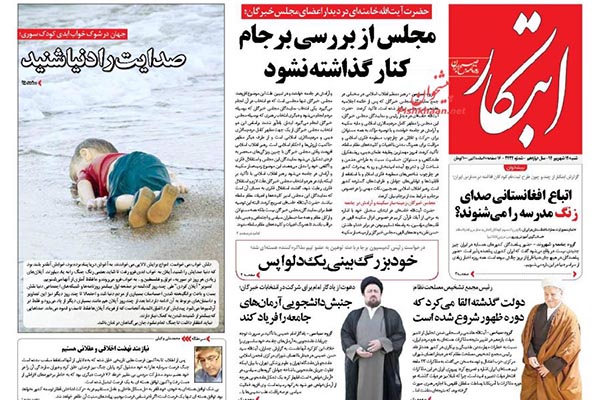
Abrar: The first session of the JCPOA Review Committee will be held on Sunday.


A look at Iranian newspaper front pages on August 23


Afkar: “Some Islamic groups are mistaking friends for enemies and vice versa,” the Supreme Leader said.


A look at Iranian newspaper front pages on August 23


Aftab-e Yazd: “Force these 2,000 or so [elites] from the country and the problems of the establishment will be resolved,” Brigadier General Ahmadi Moghaddam, the former police chief, has quoted former President Mahmoud Ahmadinejad saying.


A look at Iranian newspaper front pages on August 23


Arman-e Emrooz: Supporters of Ahmadinejad release electoral statements

Tehran MP Ahmad Tavakoli has said that if Ahmadinejad is held accountable, he wouldn’t entertain the idea of returning to power.


A look at Iranian newspaper front pages on August 23


Asr-e Rasaneh: “Government honors the commitments it has made to the youth,” said the first vice-president.


A look at Iranian newspaper front pages on August 23


Asrar: “We are ready to be part of an anti-terror coalition in the region,” President Rouhani said.

Asrar: “Some 80,000 cars are gathering dust in the warehouses of a local carmaker,” said the minister of industries.


A look at Iranian newspaper front pages on August 23


Ebtekar: “Sometimes I regret my decision to accept to take over as foreign minister,” said Mohammad Javad Zarif.


A look at Iranian newspaper front pages on August 23


Hemayat: “Drug addiction is to blame for some 40 percent of all divorces,” said a deputy to the judiciary chief.


A look at Iranian newspaper front pages on August 23


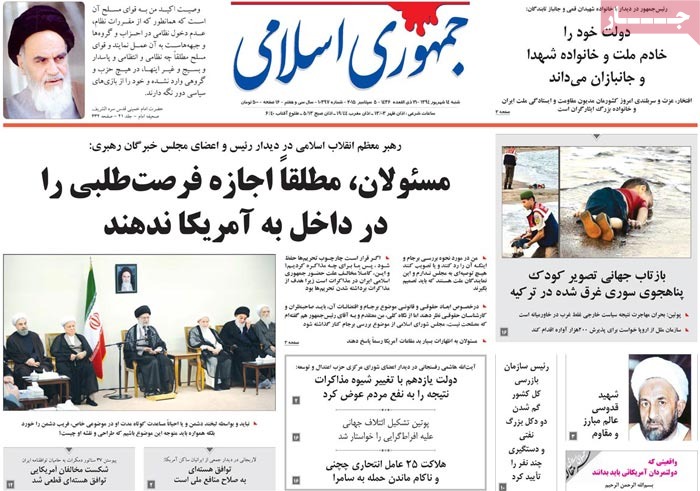
Jomhouri Islami: “Iran’s might serves as a guarantor of regional stability,” said President Rouhani.

Jomhouri Islami: Hamas’ political leader has talked of indirect talks with the Zionist regime.


A look at Iranian newspaper front pages on August 23


Kayhan: Fateh precision-guided missile has been unveiled at a ceremony attended by President Rouhani.


A look at Iranian newspaper front pages on August 23


Payam-e Zaman: More than 1,100 projects will be inaugurated across the nation during Government Week.


A look at Iranian newspaper front pages on August 23


Resalat: “We don’t need anyone’s permission to buy and sell arms,” President Rouhani said.


A look at Iranian newspaper front pages on August 23


Shahrvand: “Iran receives one foreign investment application every 60 hours,” said the head of the Foreign Investment Unit of the Chamber of Commerce.


A look at Iranian newspaper front pages on August 23