Wednesday, December 31, 2025
Home Blog Page 4695

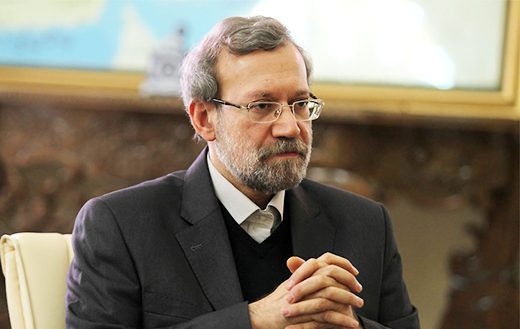
Larijani condoles with France, Lebanon on deaths caused by terror attacks

larijani

Parliament Speaker Ali Larijani expressed condolences to the French and Lebanese parliaments over the deaths caused by terror attacks in the countries.

The top MP also sent separate messages of condolences to his French and Lebanese counterparts as well as to the secretary general of the Lebanese Hezbollah.

Larijani called for a collective international campaign in the fight against terrorism.

In a message to French National Assembly President Claude Bartolone, Larijani deplored the terrorist attacks as crimes against humanity.

He denounced the inaction of the international community in the face of the menace of terrorism and said that unfortunately, the world has seen such inhuman crimes for several years.

The massacre of defenseless people, insecurity and unrest requires the world community to adopt a decision to fight the ominous phenomenon, he said.

“The Islamic Republic of Iran has always voiced outrage and condemned terrorist attacks in any form and in any region,” he said and stressed the need for countries and nations to take collective measures to confront terrorist acts.

He extended condolences to the French nation, parliament and government and expressed hope that the international community will fight terrorism to bring about stability and security to all nations.

He also condemned the terrorist attack in southern Beirut, which led to the martyrdom and injury of a group of innocent people.

Larijani sympathized with the families who lost their loved ones in the terrorist attacks.

“Such hateful crimes show once again the need for unity and collective steps to fight extremism and terrorism.

“The blood of the dear martyrs will lead to stronger resolve of the brave people of Lebanon and Muslim nations to continue the campaign until the elimination of terrorism.”

[…]

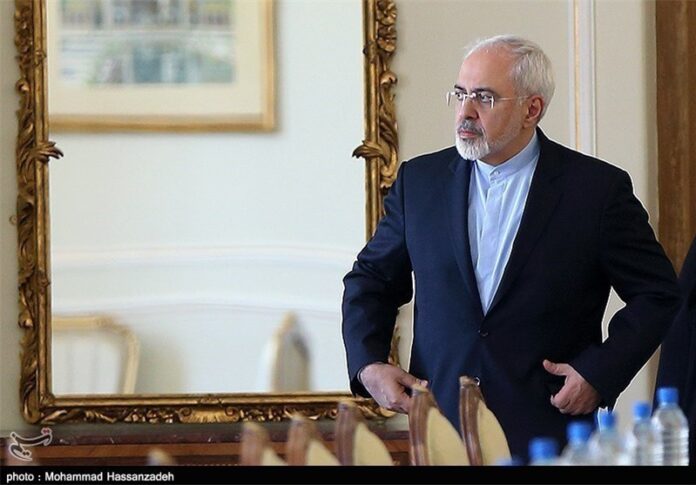
Iran’s FM on diplomacy, domestic politics and future (PART ONE)

zarif1

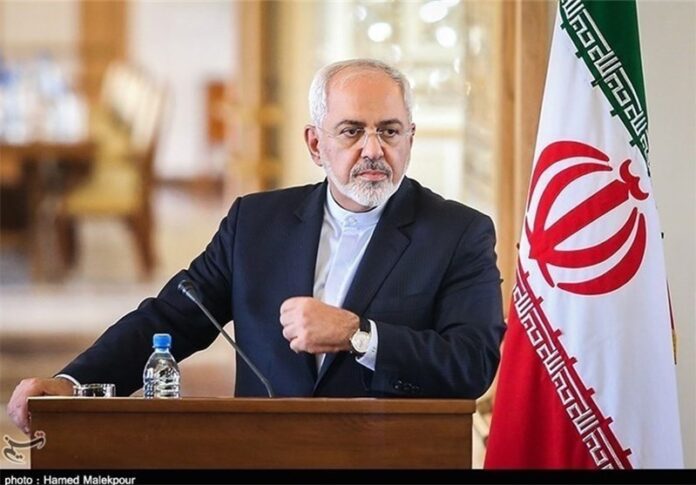
Iran’s foreign minister says any measure he takes comes with a price for him. The head of Iran’s diplomacy machine weighs in on what the opponents of the Joint Comprehensive Plan of Action (JCPOA) have done to counter his efforts at home, and says that the Worriers [opponents of the president’s policy of moderation and interaction] have one main objective: “to attack the diplomatic team of the Rouhani administration”.

For the Worriers simply “attacking” is important; and the content of JCPOA, the stroll with the US secretary of state in a Geneva street, or the unplanned handshake with US President Barack Obama on the sidelines of the UN General Assembly are merely what they need to use as a pretext to target the most powerful part of the eleventh government: the Foreign Ministry and the diplomat at its helm.

Mohammad Javad Zarif has had different firsts during his two years in office, among them the appointment of the first spokeswoman of the Foreign Ministry and appointment of the Islamic Republic of Iran’s first female ambassador. Zarif has appeared in parliament to defend his performance more than all of his predecessors in post-Revolution Iran. He has held more than 50 meetings with his US counterpart.

Conducting an interview with Zarif is ironically an easy, tough task. It is easy since there are multiple questions – thanks to a barrage of criticism unleashed by his opponents – to ask him about, and it is tough since his response to a seemingly simple question may play into the hands of his opponents to launch a torrent of fresh attacks against the foreign minister.

shargh-zarifSharq daily’s Maryam Yousefi was given face time with the foreign minister on the day he was expected to induct the new spokesman of his ministry. Her questions covered a wide range of issues including the Worriers, their threats and JCPOA and Zarif answered all of them despite his busy schedule. The following is PART ONE of the full translation of what Zarif said in the interview:


Following the conclusion of the Joint Comprehensive Plan of Action (JCPOA), three groups opposed the nuclear deal: One group at home, another in Israel, and the third were leaders of some Persian Gulf states, especially Saudi Arabia. The reason behind the opposition from hardline Israelis and the Likud Party is completely clear. Riyadh has also had a foreign policy shift after the passing of King Abdullah and the rise to power of King Salman. But, what objective do the opponents of JCPOA at home pursue and who are they opposed to?

You cannot be privy to people’s intentions, but the fact is that because of long-running disagreements between Iran and the West, a sizable number of Iranian officials, elites and the Iranian nation are suspicious of Western intentions.

For the very reason, it’s natural for concerns to grow when a deal is struck, particularly over an issue which has been the bone of contention for quite a while.

The Americans and Westerners have done a great deal of injustice to the Iranian people and when a deal as such is cut, it’s very natural of the people who are suspicious of US objectives to take the agreement with a pinch of salt. I think such opposition has its roots in this fact.

Those who were not part of the negotiations knew little about the atmosphere and details of the talks and were thus concerned about the outcome of the process.

I think once we enter the implementation phase of JCPOA in earnest – and with God’s grace, we allow the international atmosphere to take a turn for the better – the Iranian mistrust of the Americans won’t interfere with the proper implementation of the deal.

We can create the conditions in a way that even if the Americans sought to throw obstacles in the way of the deal’s implementation, the international atmosphere wouldn’t allow them to do so.

For instance, in the 1990s, when the Americans were at the height of their power, they tried to slap sanctions against Iran, but nobody in the world listened to them.

At present, we have no trust in US behavior, but the difference between my friends present at the talks and I on the one hand and opponents of the deal on the other is that we believe we can create conditions which won’t allow hardline Americans to violate their obligations.


Are you saying the grave concern of the opponents of JCPOA in Iran is establishment of relations with the US?

They might be concerned about it, too, but their major concern is that the Americans may renege on their obligations and fail to implement JCPOA; that’s their real source of concern.

Worries that JCPOA may turn into an excuse for establishment of ties with America might seem real to some, but the fact of the matter is that Iran’s foreign policy is defined based on the opinion of high-ranking officials and nobody needs to be worried that for an issue of such great importance, measures which are against the wishes of officials might be taken.

I assure the opponents that the Foreign Ministry and the country’s diplomacy apparatus do not seek to go down that path.


At a time when the implementation of JCPOA is nearing, the Middle East has turned more insecure. Yet, Iran plays a more courageous role in Middle East developments and a new regional balance has emerged. How was the new balance struck?

There is not just one reason behind the emergence of an international phenomenon, rather several contributing factors must be taken into account. Iran has always been a powerful country. Its might has external dimensions, including vast geography, abundant natural resources and valuable human resources.

On top of that, Iran’s power has internal, spiritual dimensions such as the message of the Revolution, public resistance in the face of pressure and their support for the establishment.

In addition to these two, the country has external, spiritual powers, too. Iran’s support for [Lebanon’s] Resistance [Movement] and avoidance of aligning with regional dictators over the past 35 years are some of the factors in the latter group.


What is your take on the role of JCPOA in increasing Iran’s power at this juncture? 

The things I just mentioned are dimensions of Iran’s authority that have always existed, but there have been some obstacles in the way of Iran wielding power and asserting influence. One such barrier is a plot by Israel, some regional countries and hardline Americans to cast Iran as a security threat. JCPOA has foiled their plot.

In other words, it cannot be said that JCPOA is the main reason behind Iran’s power in the region. The talks that were held after the Government of Prudence and Hope took office gave more power to Iran, but it does not mean that these sources of power were non-existent in the past.

Iran had genuine sources of power, both physical and non-physical, but JCPOA has helped the country clear the hurdles that wouldn’t allow its power to turn into influence.

PART TWO

A look at Iranian newspaper front pages on Nov. 14

Iranian Newspapers Headlines

Comments by sources of emulation on the performance of the Foreign Ministry and praise for its achievements in meetings with FM Zarif dominated the front pages of Iranian newspapers on Saturday. Also in the spotlight were remarks by President Rouhani on sanctions and ties with the US as well as terrorist bombings in Beirut.


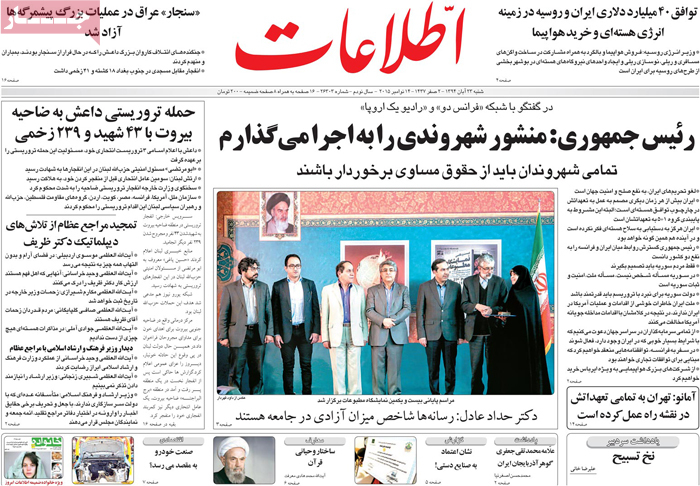
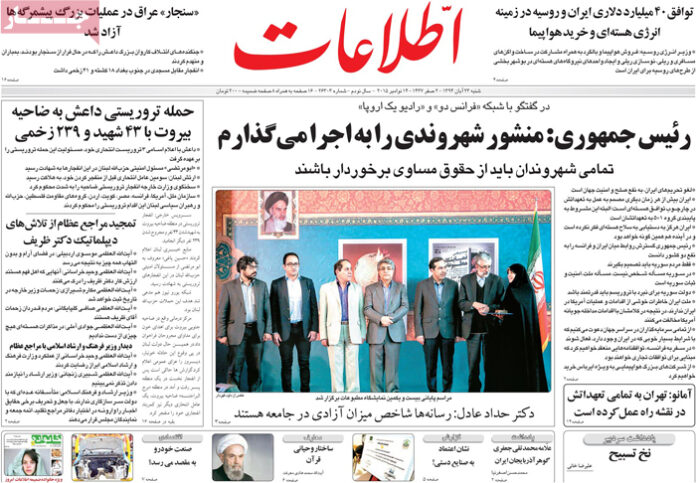
Ettela’at: “I will enforce the Civil Rights Charter,” said President Rouhani in interviews with France 2 TV channel and Europe 1 radio network, adding that all citizens should enjoy equal rights.

The president also called on investors all over the world to get more active [in Iran] following “the good conditions” that have been created in the country.


Abrar: Deputy Foreign Minister Hossein Amir-Abdollahian and Omani top diplomat Yusuf bin Alawi have held consultations in Muscat.

Abrar: “I have no trust in news agencies affiliated to Hezbollahi groups [fervent supporters of the Islamic Revolution],” said Hassan Rahimpour Azghadi, a [principlist] scholar and theorist.

[Azghadi, who is a member of the Supreme Cultural Revolution Council, made the remark on Friday, adding that these news agencies lack knowledge].
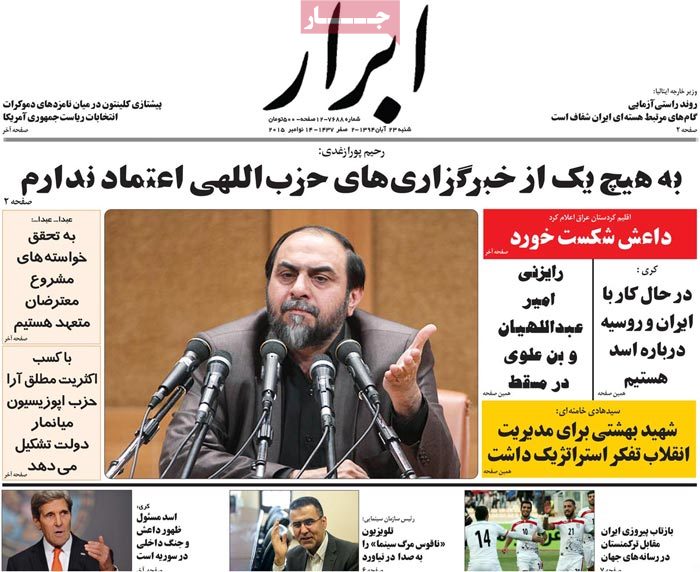
 

A look at Iranian newspaper front pages on Nov. 14


Afkar: A flurry of international condemnations following terrorist attacks in Beirut  

Afkar: The 21st edition of the Press and News Agencies Exhibition came to an end [on November 13].
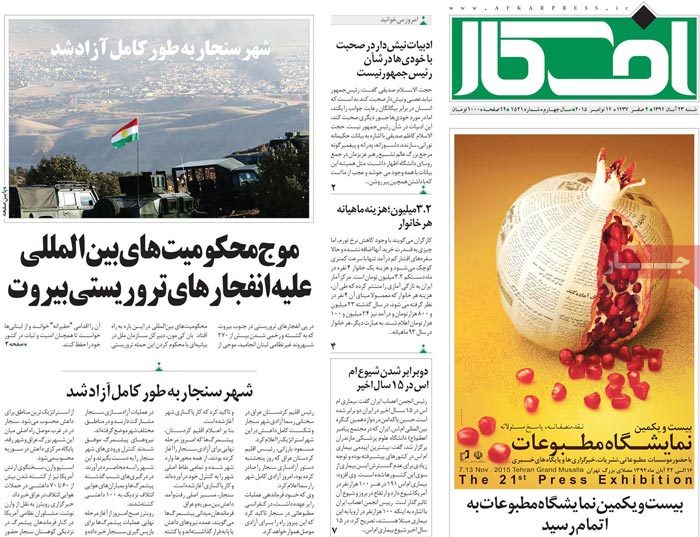
 

A look at Iranian newspaper front pages on Nov. 14


Aftab-e Yazd: Qom praises Zarif

Ayatollah Nasser Makarem Shirazi: Zarif made the impossible possible.

Ayatollah Lotfollah Safi Golpaygani: People understand the value of your work.

Ayatollah Abdollah Javadi Amoli: Handshake with the enemy is a sign of courtesy and decency.
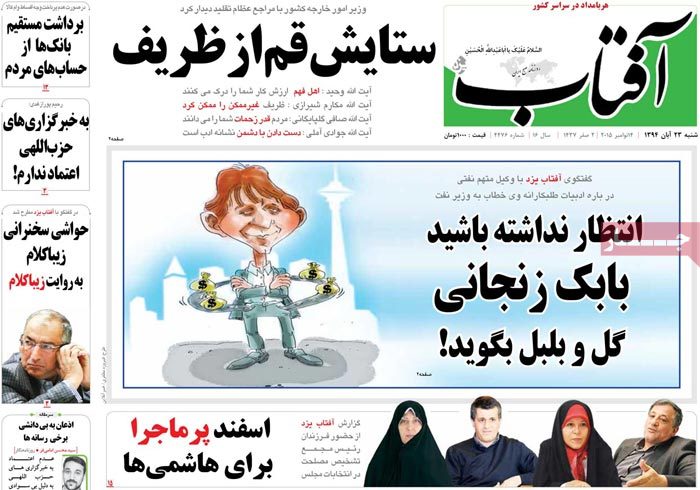
 

A look at Iranian newspaper front pages on Nov. 14


Amin: In a telephone call, Iraqi Parliament Speaker Salim al-Jabouri has invited his Iranian counterpart Ali Larijani to take part in the 11th Conference of Parliamentary Union of the OIC Member States (PUIC) in Baghdad.
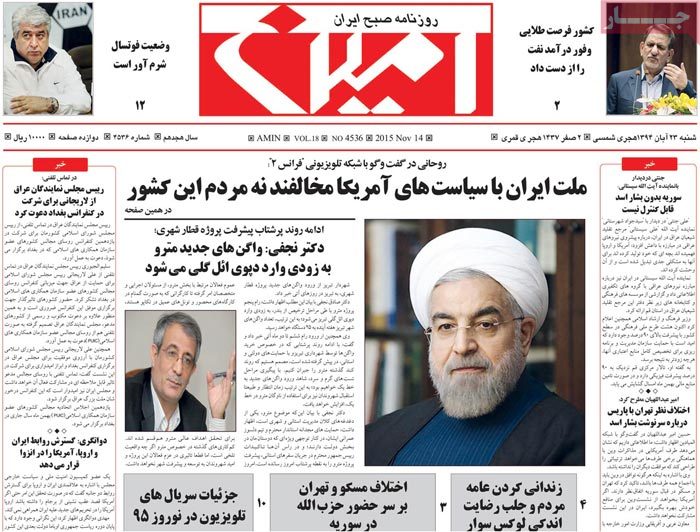
 

A look at Iranian newspaper front pages on Nov. 14


Arman-e Emrooz: Meaningful welcome for the Commander of the Diplomacy Front

Unprecedented praise by sources of emulation for Zarif

Grand Ayatollah Vahid Khorasani told FM Zarif: Those who are reflective will realize the value of your work.

Arman-e Emrooz: The justice minister has said that government will pursue the case of the recently arrested reporters.

Mostafa Pour-Mohammadi further said that the arrest of those involved in media and civil activists run counter to the government’s approach of moderation.
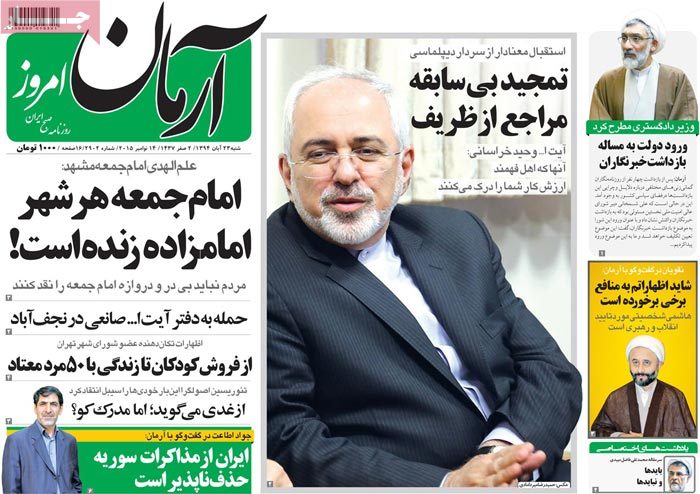
 

A look at Iranian newspaper front pages on Nov. 14


Asrar: “I will sound a warning if the Constitution is harmed,” said President Rouhani.  

Asrar: The approach of IRIB [the national broadcaster] is factional and arises from political confusion, said a statement released by the office of Ayatollah Akbar Hashemi Rafsanjani.  

Asrar: President Vladimir Putin to visit Tehran [in late November].
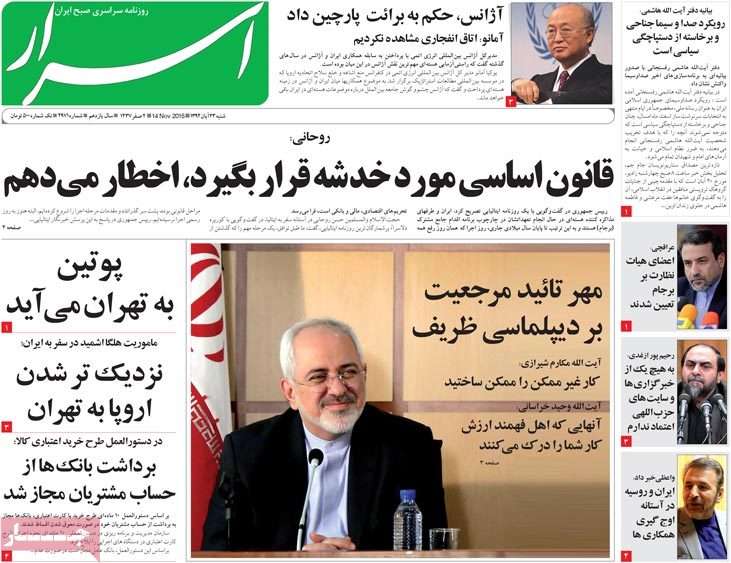
 

A look at Iranian newspaper front pages on Nov. 14


Ebtekar: The key to reopen the US embassy [in Tehran] is in the hands of the Americans, said President Rouhani in interviews with European media in the build-up to his [now delayed] trip to France and Italy.
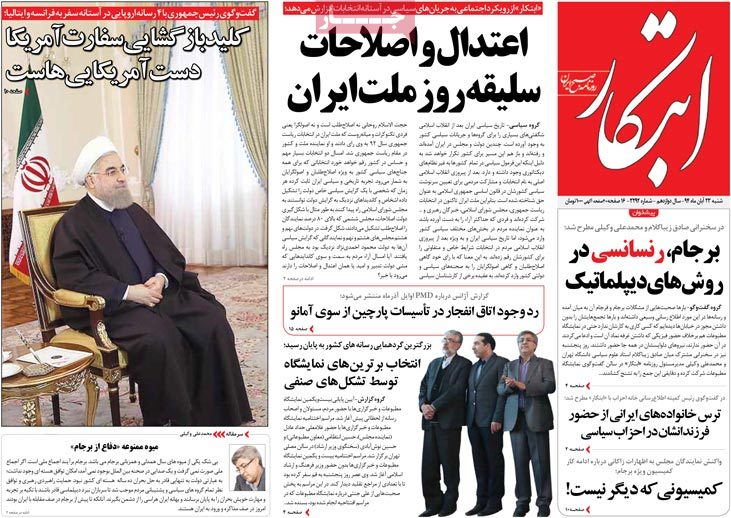
 

A look at Iranian newspaper front pages on Nov. 14


Emtiaz: “Kissing the Koran was the dreamiest moment of my lifetime,” said Andranik Teymourian, the Christian captain of the Iranian national soccer team.
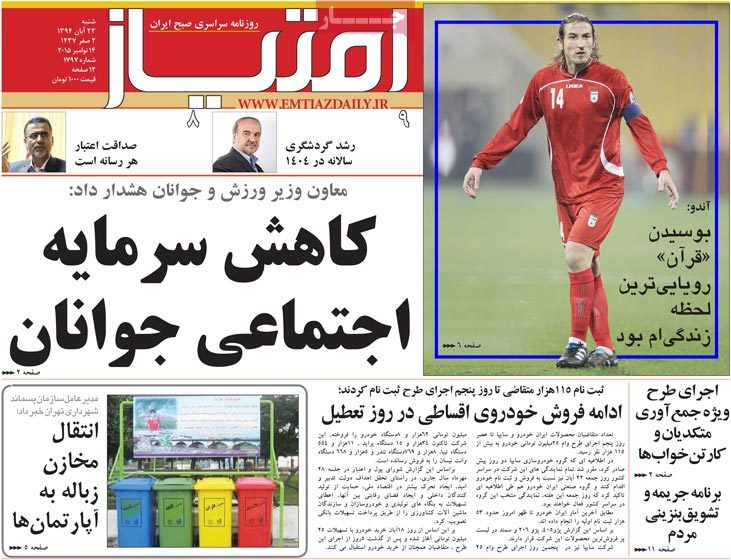
 

A look at Iranian newspaper front pages on Nov. 14


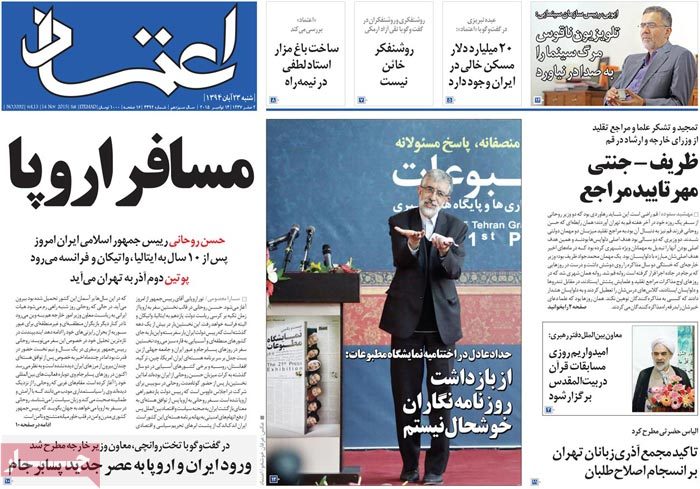
Etemad: “I am not happy with the arrest of journalists,” said Gholamali Haddad Adel, a former parliament speaker, in the closing ceremony of the 21st Press and News Agencies Exhibition.  
 

A look at Iranian newspaper front pages on Nov. 14


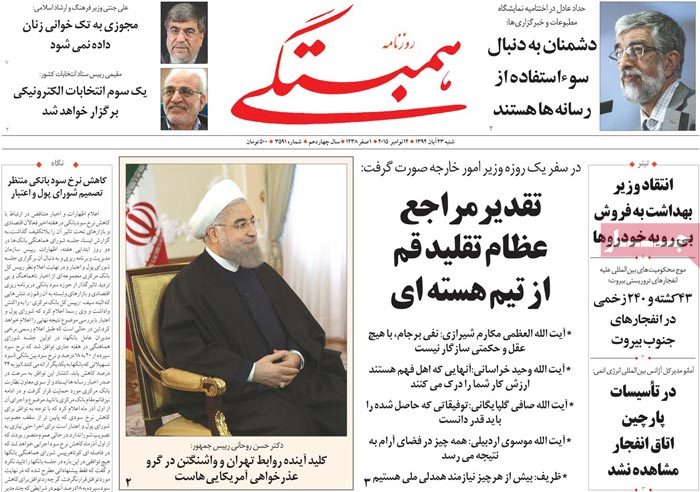
Hambastegi: The health minister has taken a swipe at the ever-growing sales of cars.
 

A look at Iranian newspaper front pages on Nov. 14


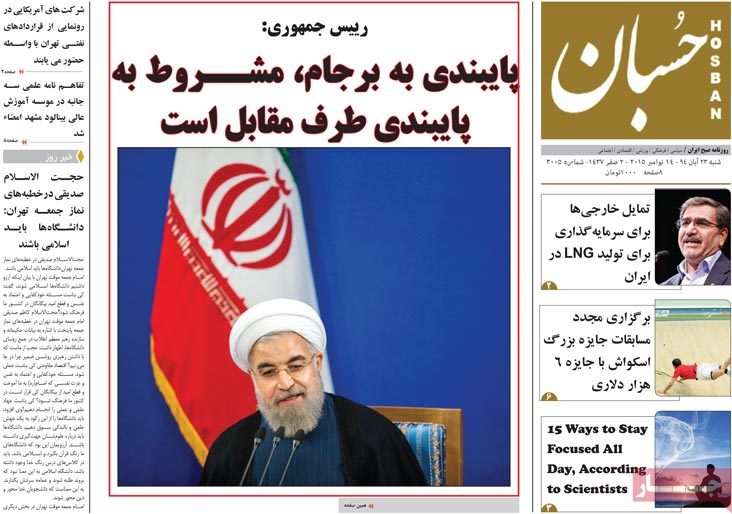
Hosban: [Iran’s] Compliance with the Joint Comprehensive Plan of Action is tied to the compliance of the other side, said President Rouhani.
 

A look at Iranian newspaper front pages on Nov. 14


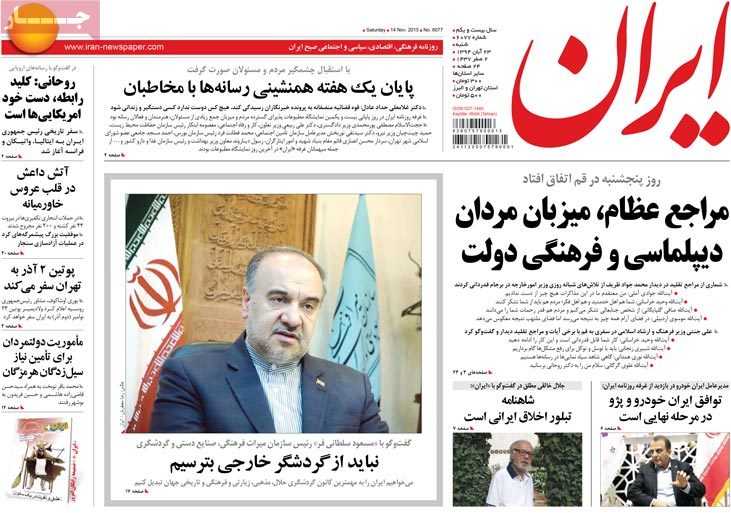
Iran: “We should not be afraid of foreign tourists,” said the director of the Cultural Heritage, Handicrafts and Tourism Organization.

Masoud Soltanifar further said that we want to turn Iran into the hub of halal, religious, cultural and historical tourism in the world.
 

A look at Iranian newspaper front pages on Nov. 14


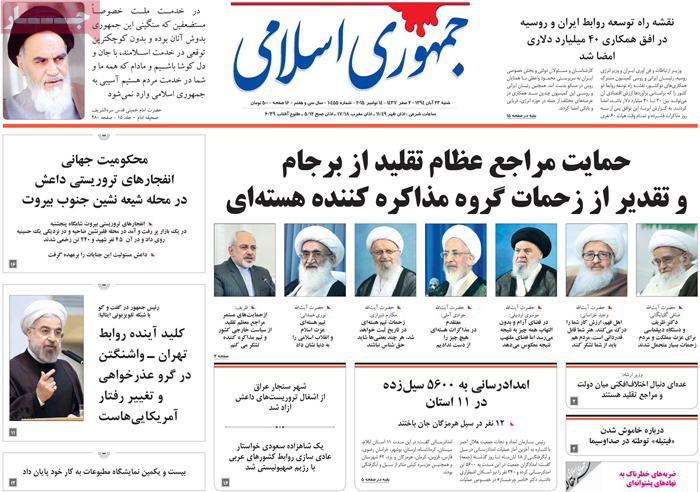
Jomhouri Islami: Sinjarin northwestern Iraq has been taken back from ISIS terrorists.

Jomhouri Islami: A Saudi prince has asked for the normalization of ties between Arab nations and the Zionist regime.

Jomhouri Islami: Some are seeking to create division between the government and sources of emulation, said the minister of culture and Islamic guidance.
 

A look at Iranian newspaper front pages on Nov. 14


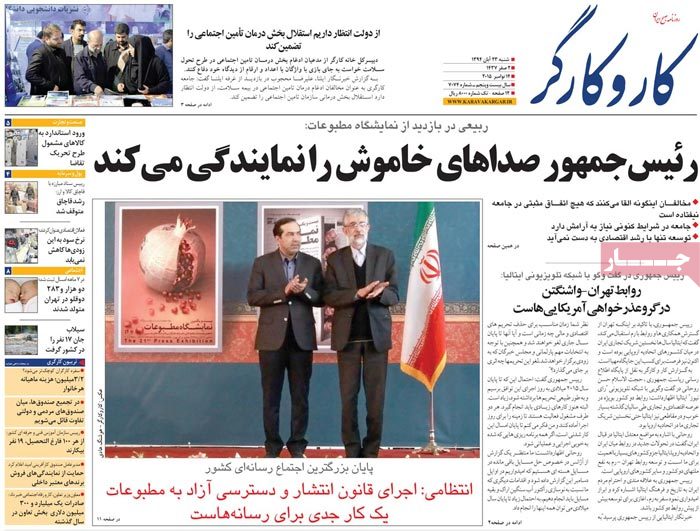
Kar va Kargar: Implementation of the Free Access to Information Act is a serious task the press should focus on, said Deputy Culture Minister Hossein Entezami in the closing of the press exhibition in Tehran.
 

A look at Iranian newspaper front pages on Nov. 14


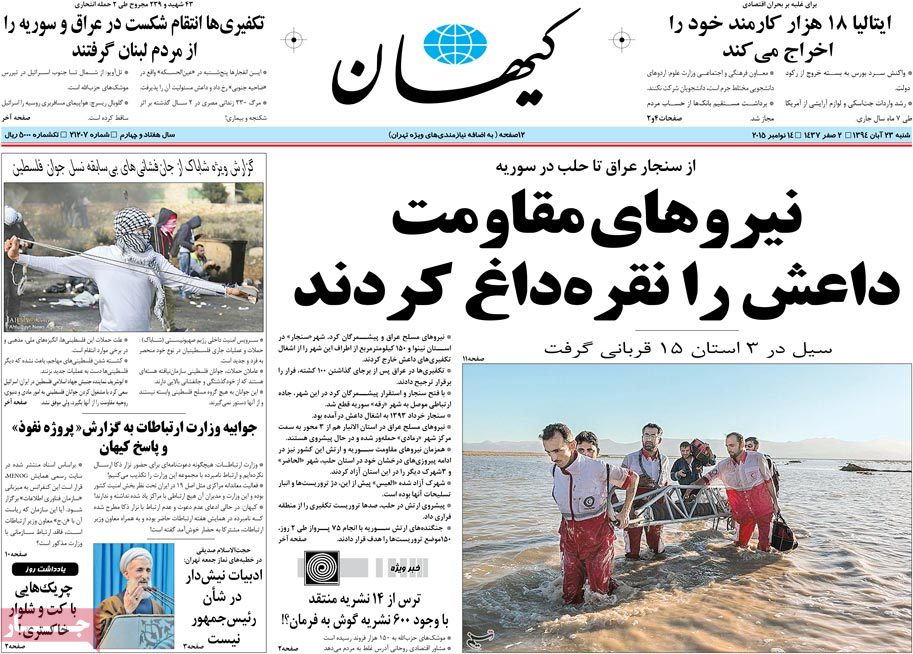
Kayhan: The Takfiris took their revenge for the setbacks they have suffered in Iraq and Syria on the Lebanese people.
 

A look at Iranian newspaper front pages on Nov. 14


Nasl-e Farda: “More than anything else, we need national solidarity,” said Foreign Minister Mohammad Javad Zarif in his meetings with sources of emulation in Qom.


A look at Iranian newspaper front pages on Nov. 14


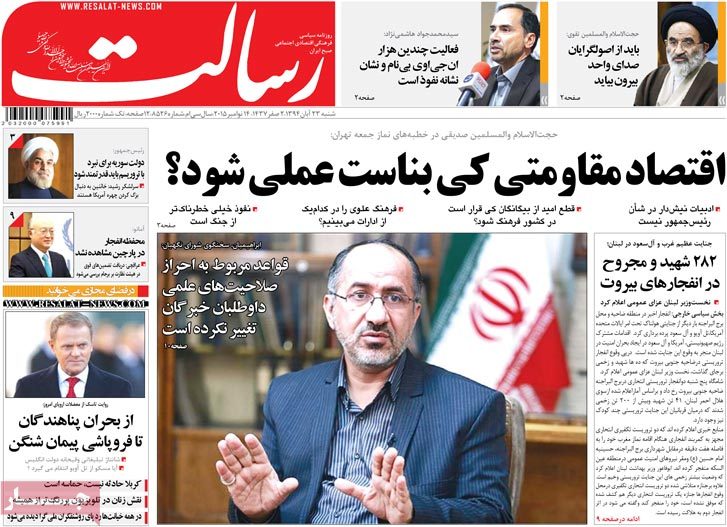
Resalat: The spokesman of the Guardian Council has said that laws governing the assessment of the scientific credentials of the Assembly of Experts candidates have not changed.

Resalat: Infiltration is more dangerous than war, said Tehran’s Friday prayer leader.
 

A look at Iranian newspaper front pages on Nov. 14


Rooyesh Mellat: All economic sanctions [against Iran] will be lifted by the end of 2015, said President Rouhani.


A look at Iranian newspaper front pages on Nov. 14


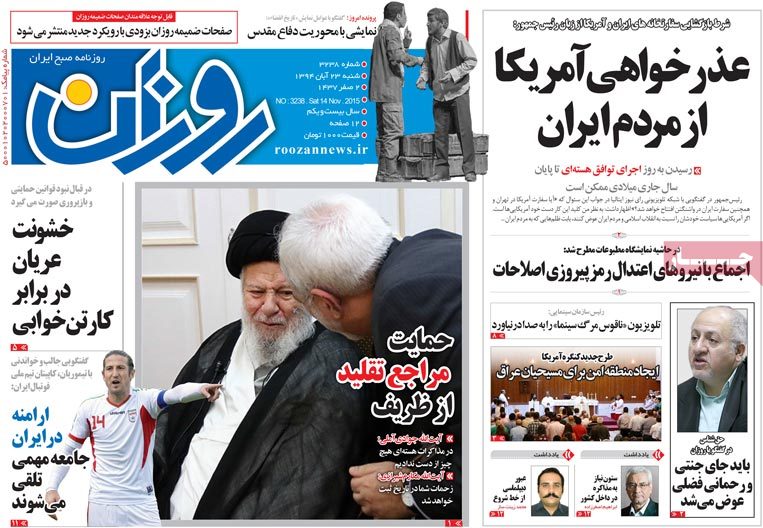
Roozan: A new plan by the US Congress: A Christian safe zone in Iraq
 

A look at Iranian newspaper front pages on Nov. 14


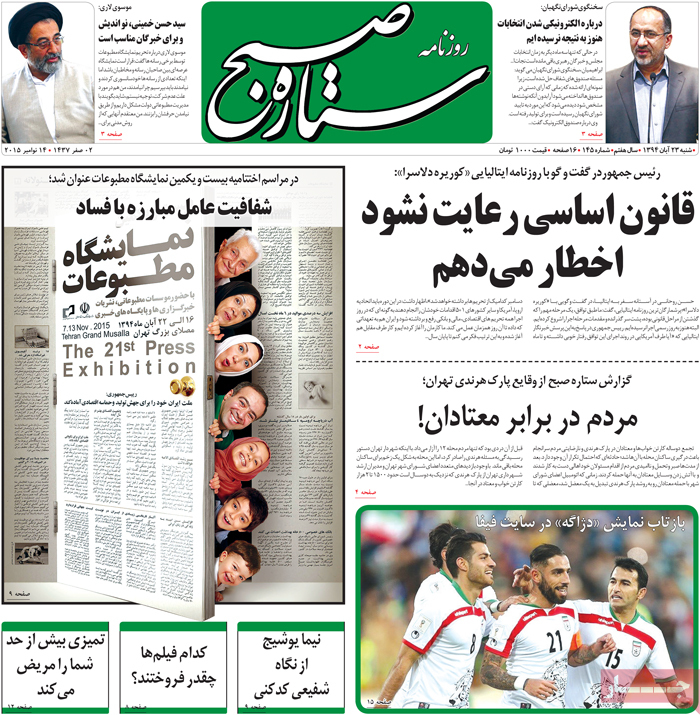
Setareh Sobh: Seyyed Hassan Khomeini [the grandson of the late Imam] is an innovative thinker who is suitable for the [Assembly of] Experts, said Abdolvahed Mousavi Lari, [a reformist cleric].
 

A look at Iranian newspaper front pages on Nov. 14


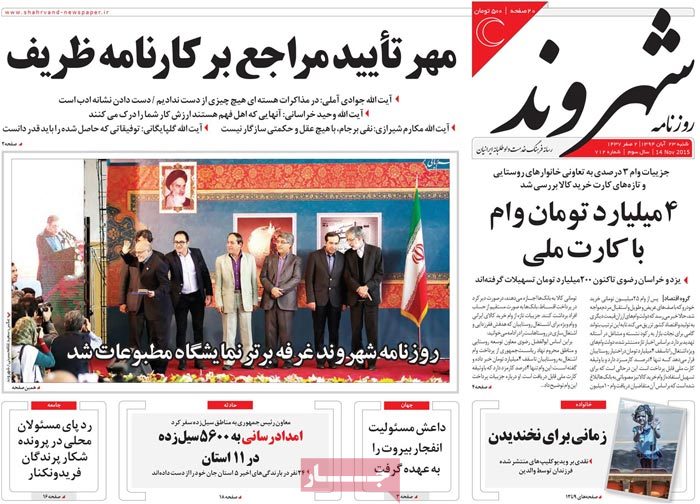
Shahrvand: Shahrvand’s has been named the top stall at the 21st Press and News Agencies Exhibition.

Shahrvand: Traces of local officials in the case of bird hunting in Fereydoonkenar, a resort town on the Caspian Sea
 

A look at Iranian newspaper front pages on Nov. 14


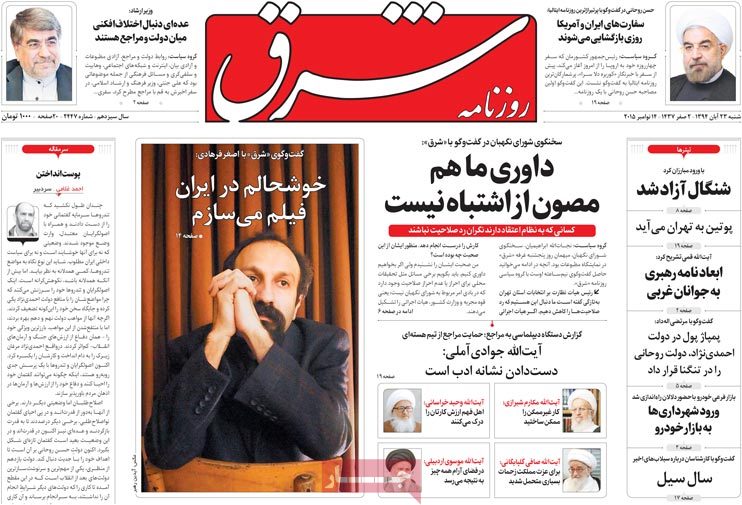
Sharq: “Our judgment is not immune to mistakes,” said the spokesman of the Guardian Council in an interview with the daily.

Sharq: “I am happy to make a film in Iran,” said Asghar Farhadi, the Oscar-winning Iranian filmmaker, in an interview.
 

A look at Iranian newspaper front pages on Nov. 14


Shorou: Good things are likely to happen if the US apologizes to Iran, said President Rouhani in an interview with an Italian daily.


 

A look at Iranian newspaper front pages on Nov. 14


Highlights of Ettela’at newspaper on Nov. 14

82aa4b0a (2)

 “I will enforce the Civil Rights Charter,” said President Rouhani in interviews with France 2 TV channel and Europe 1 radio network, adding that all citizens should enjoy equal rights.

The president also called on investors all over the world to get more active [in Iran] following “the good conditions” that have been created in the country.

 A $ 40b agreement between Iran and Russia on nuclear energy and plane purchase

The Russian energy minister has said that his country has many plans for Iran including: selling aircraft and helicopters to Iran, partnership with Iran in making passenger and rail cars, renovation of Iran’s railroads, and construction of units in the Bushehr Nuclear Power Plant.

 TheIraqi city of Sinjar was retaken in a big operation by Peshmerga forces.

Fighter jets of the [US-led] coalition bombarded a big convoy of ISIS terrorists fleeing Sinjar.

 A terrorist attack by ISIS in Dahiyeh, Beirut has martyred 43 people and injured another 239.

ISIS has assumed responsibility for the attack, releasing the names of its three suicide bombers.

 Sources of emulation praise Dr. Zarif’s diplomatic efforts

Ayatollah Abdul-Karim Mousavi Ardebili: Everything bears fruit in a calm and tension-free atmosphere.

Ayatollah Nasser Makarem Shirazi: The foreign minister’s efforts will go down in history.

In another development, Minister of Culture and Islamic Guidance met with the sources of emulation in Qom.

 Media are a freedom indicator in society, said Dr. Haddad Adel in the closing of the press exhibition.

 Director General of the International Atomic Energy Agency Yukiya Amano has said that Tehran has honored all its commitments under the roadmap [of cooperation Iran and the IAEA signed in July].


What are the reasons behind Saudi Arabia’s hostility to Iran? (PART TWO)

770285-900x580 (1)

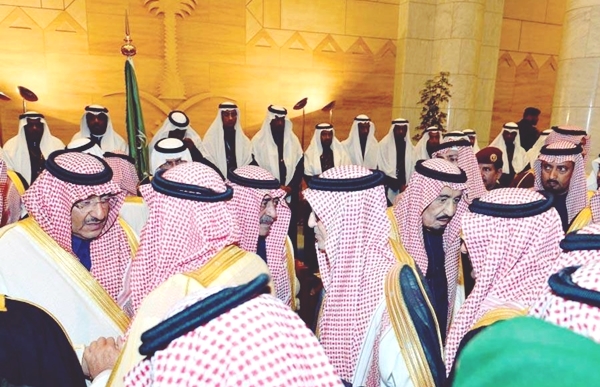
The hostility of Saudi Arabia toward the Islamic Republic of Iran came to a head with the Mina tragedy. Officials in the kingdom insist on maintaining their hostile attitude instead of walking down the path of realism and being accountable for their mismanagement of the deadly stampede.

Hostile ties between Iran and Saudi Arabia have a long history dating back to when the kingdom was formed. Saudi Arabia’s hostile approaches to Iranian pilgrims and dispute over three Iranian islands [in the Persian Gulf] are classic examples of such historical hostility. This hostile attitude, which has been escalated following the victory of the Islamic Revolution, has shown itself in different forms, from a proxy war to threats to wage war.

Fararu.com on November 10 released a report on the reasons behind the hostility Saudi Arabia nurses against Iran. The following is PART TWO of the partial translation of the report which references an article by the Islamic Revolution Document Center:

Support for Saddam Hossein during the imposed war and attempts to undermine Iran’s interests in Iraq, Syria, Lebanon, etc. are among the measures Saudi Arabia takes to counter Iran. Nonetheless, what Saudi Arabia has done to consolidate its foothold in the region – to bring to power a government in Iraq with close ties with Al Saud family; to separate Syria from Iran; to stop Hezbollah in Lebanon from gaining power, to name only a few – has done little to help it achieve its stated objectives, even through open support for ISIS.

8- Financial and intelligence support for Saddam Hussein

Prior to the victory of the Islamic Revolution, Saudi Arabia had not accumulated enormous wealth and used to treat Iran cautiously. Saddam’s invasion of Iran provided Riyadh with the opportunity to flex its muscle. It was all clear that Saddam could not handle his invasion of Iran – which ended in failure – without support from Saudi Arabia and fellow Arab nations.

In reaction, Iran was aware of and enraged by Saudi Arabia’s financial and arms support for Iraq during the imposed war in the 1980s. Iran’s advances in the war made Saudi Arabia and other sheikhdoms concerned about Iran’s growing power. As a result, Riyadh increased its substantial arms assistance to Iraq during its war against Iran. A case in point was an agreement between Kuwait and Saudi Arabia to deposit – as of 1982 – their oil revenues from joint fields (300,000-350,000 barrels per day) to Iraq’s account.

On Saudi Arabia’s intelligence assistance to Saddam Hussein, Jeune Afrique [a French language weekly news magazine published in Paris] wrote on June 9, 1982 that one month before the outbreak of the [Iran-Iraq] war, Saudi rulers presented a kingly gift to Saddam: a report from US secret agencies on Iran’s economic, social and military conditions as well as intelligence on Iran’s army, its forces, […] and other confidential information.

9. Saudi Arabia’s anti-Iran policies in oil market

Saudi Arabia, which produces 10 million barrels per day, is the world’s largest oil exporter. It is the only country which can prevent oil prices from drastically increasing by raising its output. Saudi Arabia has time and again used its capability [to manipulate prices] as a weapon against the Islamic Republic of Iran.

Developments unfolding after the so-called Arab Spring, especially what is happening in the countries surrounding the kingdom, confirm Saudi Arabia’s recent [oil] stances [against Iran] and its willingness to join the West to pile pressure on Iran more than ever.

Saudi Arabia has continued to use oil as a weapon against Iran […] to date. Such a stance has played a key role in the current low oil prices which have taken a heavy toll on the economies of regional countries, including Iran.

Following the drastic drops in oil prices in late 2014 and early 2015, Iran and fellow OPEC members – which experienced declining oil revenues due to plummeting prices – accused Saudi Arabia of seeking to drop oil prices and deal a blow to crude producers by its record outputs.

10. Saudi cooperation with US sanctions against Iran

After the victory of the Islamic Revolution, Saudi Arabia has shown open hostility toward Iran on different occasions. Riyadh has been one of the supporters of anti-Iran sanctions and has implemented US policies in the region. In parallel with unjust sanctions against the Islamic Republic of Iran, Saudi Arabia has seized the existing opportunity – due to its internal shortcomings – to insist on the misappropriate US stance and beat the drum of hostility to Iran more than before.

11. The Shiite Crescent and fight against pro-Iran governments and groups

Iran’s influence in regional countries has been cause for concern in Saudi Arabia. Such an influence is given more prominence as far as Iraq, Syria and Lebanon go. The formation of a government in Iraq is a vital process for its powerful neighbors, including Iran and Saudi Arabia. A united, integrated and predominantly-Shiite Iraq poses a threat to radical Sunni governments in the region, among them Saudi Arabia and Jordan.

Following the 2003 US invasion of Iraq and the overthrow of former Iraqi dictator Saddam Hussein, the Shiites took over the government in Iraq and showed willingness to have more ties with Iran. Formation of a Shiite-majority government in Iraq is believed to threaten the interests of radical Sunni governments in the region and those of the US. It is in such a context that introduction of the Shiite Crescent issue becomes meaningful.

Saudi interferences in Lebanon are meant to undermine the influence of Hezbollah and shore up its rivals. In the 2006 Hezbollah-Israel war, Saudi Arabia sided with the Zionists, but Hezbollah emerged victorious in that war. A new regional coalition led by Iran against the Riyadh government turned into the main concern of Saudi Arabia.

According to a Saudi Foreign Ministry’s confidential document, Samir Geagea [a Lebanese politician] asked the Saudi ambassador to pay money for implementing a Saudi plan in Lebanon. Under the same document, the Saudi ambassador stressed the need for supplying Geagea with finances, citing his role as a deterrent against Hezbollah. […]

12. Saudi Arabia’s push to prod US to attack Iran (concurrent with nuclear crisis)

The fact that Saudi Arabia has asked the United States to attack Iran is yet another clear sign of the kingdom’s hostility toward Iran. According to documents leaked by WikiLeaks, in 2008 King Abdullah urged the US to attack Iran. According to the document obtained from one of US embassies, the Saudi king has told the US, “Cut off the head of the snake”[King Abdullah of Saudi Arabia repeatedly exhorted the United States to “cut off the head of the snake” by launching military strikes to destroy Iran’s nuclear program, according to leaked US diplomatic cables (Reuters – November 29, 2010)].

13. Intelligence Cooperation with Israel to attack Iran’s nuclear sites

Since the start, Saudi Arabia has been among bitter opponents of the settlement of Iran’s nuclear case [through talks] with P5+1. It is also concerned about measures which tip the regional balance in favor of Iran. Saudi opposition to the settlement of the nuclear case has been evident in its approaches and approval of the West’s political stance.

In addition to their political stances, the Saudis – according to the intelligence leaked by confidential documents – have been studying a joint plan with the Zionist regime to launch attacks on Iran’s nuclear sites. Above all, there is evidence that Mossad and the Saudi intelligence agencies have established extensive contacts on Iran’s nuclear program.

14. Mina tragedy and the Saudi unaccountability 

On Thursday (September 24, 2015) a stampede broke out in [tent city of] Mina during the Hajj rituals which killed thousands of pilgrims, with a large number of people missing. Hundreds of Iranians were martyred in the deadly stampede with many still unaccounted for.

In reaction, the Saudi government has not accepted responsibility for the incident, and at some stages has even displayed clear signs of hostility and intentionality. Riyadh’s refusal to issue visas for an Iranian delegation which was to go to Saudi Arabia to follow up the case of the victims, lack of cooperation with Iran’s Hajj Office in the kingdom to identify the missing pilgrims and the bodies of the dead, and unaccountability in connection with [the fate of] the missing Iranian diplomat in the Mina tragedy are just a few examples of the historic hostility of the Saudi Arabia toward Iran.

It comes as the Saudi rulers have in recent days placed on their agenda military threats [against Iran] in reaction to Iran’s pressures (due to unaccountability of Saudi officials).

Iran attaches great importance to security in Muslim world: Zarif

139407141106542246246124

Foreign Minister Mohammad Javad Zarif on Thursday reaffirmed Tehran’s resolve to have close relations with all its neighbors and Muslim world countries.

Iran’s neighbors are top on the country’s foreign policy agenda, Zarif told reporters in the holy city of Qom.

“Apart from the trips I made for the nuclear negotiations, most of my trips have been to Islamic countries and regional states,” the minister noted.

“This is because the security of the Muslim world is of particular significance to our country,” Zarif explained.

He further said that Iran has mutual interests with Islamic countries, and that is why Tehran’s priority in its foreign policy is forging close ties with Muslim nations.

Zarif also referred to the meeting of Iranian ambassadors and envoys with the Supreme Leader of the Islamic Revolution Ayatollah Seyyed Ali Khamenei earlier this month, during which the Leader elaborated on the continuous development of relations with neighbors as well as Muslim and African countries as requirements of the country’s foreign policy.

President Rouhani has on many occasions stressed that the first priority for Iran following the recent nuclear deal between Tehran and world powers is strengthening ties with the neighboring and Muslim countries.

Iran roundly condemns Beirut terrorist bombings

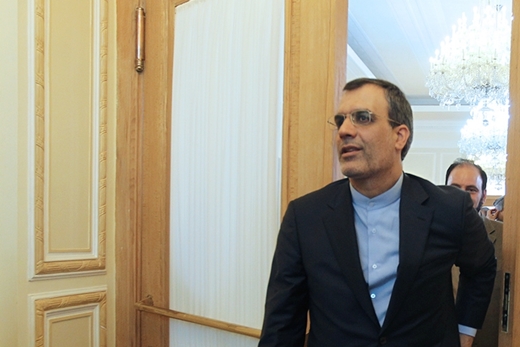
Jaberi ansari

The Iranian Foreign Ministry has strongly condemned two terrorist attacks that killed scores of people in Lebanon’s capital on Thursday.

Foreign Ministry Spokesman Hossein Jaberi Ansari offered condolences to the Lebanese government, nation and the bereaved families of the victims over the tragic incident.

He further expressed hope that unity among the Lebanese nation, resistance movement and army, as well as the international community’s determination in the fight against terrorism will pave the way for an effective battle against extremist and terrorist groups.

Jaberi Ansari also hoped that the solidarity of Lebanese society, which symbolizes unity and resistance, will be preserved.

At least 43 people were killed and more than 200 others injured after two explosions struck the General Security Post in Hussaineya Street in Borj al-Barajneh neighborhood in southern Beirut on Thursday.

The death toll is expected to rise as many of the wounded are in critical condition.

The IS terrorist group released a statement, claiming responsibility for the bombings.

Lebanese Prime Minister Tammam Salam declared Friday as a day of national mourning and condemned the attacks as “unjustifiable.” He further called for unity against “plans to create strife” in the country.

Russia’s Putin to visit Iran in late November

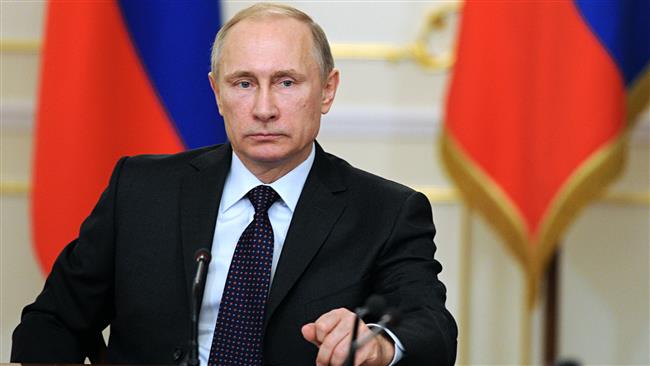
putin

Russian President Vladimir Putin plans to pay an official one-day visit to Iran later this month, the Kremlin says.

President Putin will set off for Tehran on November 23 to attend a meeting of the Gas Exporting Countries Forum (GECF), the Kremlin’s top foreign policy aide Yury Ushakov told journalists on Friday.

He added that the Russian president – who last visited Iran in 2007 – will likely hold talks with senior Iranian officials.

“It is entirely logical that some bilateral contacts are envisioned, including with the hosts,” Ushakov said.

He, however, added that the schedule of President Putin’s meetings has not been finalized yet.

Also on Friday President Putin held a telephone conversation with President Rouhani and discussed Tehran-Moscow relations. The two presidents agreed to continue dialogue during Putin’s visit to Tehran for the GECF meeting.

Iran and Russia seek to step up economic cooperation after Tehran and P5+1 reached a nuclear agreement in Vienna on July 14.

Moscow is also keen to use its long-standing relations with Tehran to win lucrative contracts in the energy sector.

The GECF has 18 main and observer members and its permanent secretariat is located in Doha.

Iran, Russia, Qatar, Algeria, Bolivia, Egypt, Equatorial Guinea, Libya, Nigeria, Trinidad and Tobago, Venezuela, Peru, the United Arab Emirates, and Oman are the main members of GECF.

GECF members account for 42 percent of global gas output, 70 percent of global gas reserves, 40 percent of pipe gas transmission, and 65 percent of global trade of Liquefied Natural Gas (LNG).

President Rouhani condemns multiple terror attacks in Paris

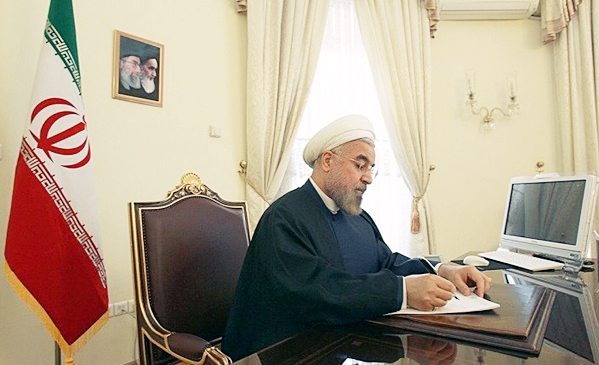
Rouhani

President Hassan Rouhani has denounced multiple terror attacks in Paris which killed more than 150 people and injured 200 others late Friday.

Entekhab.ir on Saturday released a report on the reaction of the Iranian president and Foreign Ministry to Friday’s terror attacks in Paris. The following is the translation of the report:

The Iranian president released a message of condolence to his French counterpart Francois Hollande, saying that the terror attacks which killed and wounded a large number of people in Paris filled our hearts with agony and grief.

“On behalf of the Iranian nation, which has fallen victim to the ominous phenomenon of terrorism, I condemn in the strongest possible terms these inhumane crimes and express [heartfelt] condolences to the French nation and government,” the president further said.

President Rouhani went on to say that the world will definitely signal a unified message in such incidents: Stronger determination to launch an all-out fight against terror groups.

In another development, the Foreign Ministry spokesman on Saturday denounced the bloody attacks in Paris, saying that Iran stands by the families of the victims in these trying times.

Hossein Jaberi Ansari further said that the perpetrators of these crimes have nothing to do with Islam and other divine faiths, stressing the need for integrated international determination to address the root causes of terrorism.

He also said that Iran will carry on with its efforts to fight terrorism and extremism and is ready to cooperate with world nations in this regard.

No link between JCPOA, Iran-US ties: Rouhani

afb76a38-9c3e-430e-88bb-a13ac2cdb28c

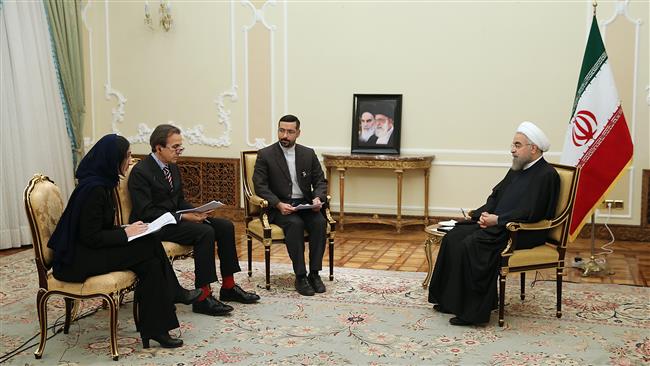
President Rouhani has dismissed claims that the nuclear agreement reached between Iran and P5+1in July has had an impact on Iran’s ties with the US.

“The nuclear deal is one thing, and relations with the US another,” President Rouhani said in an interview with Italian newspaper Corriere della Sera, released on Thursday.

[…]

President Rouhani described the problems in Iran-US relations as “long-standing,” saying they started following the victory of the Islamic Revolution in 1979 and “have persisted” to date.

The president said that even following the signing of JCPOA, the US will not lift all sanctions against Tehran but only those related to the nuclear program.

“Therefore, the relation between Iran and the US is a different issue. But the way we’ll implement the agreement can have an impact in the future,” he pointed out.

He emphasized that if JCPOA is implemented well, it will lay the foundation for “fewer tensions” with the US and create “the conditions for a new era.”

“But if the Americans don’t meet their nuclear deal commitments, then our relations will certainly be the same as in the past,” the president said.

Leader of the Islamic Revolution Ayatollah Seyyed Ali Khamenei has ruled out any negotiations between Tehran and Washington on matters other than the nuclear issue.

Iran “did not and will not hold talks with the US on issues other than nuclear negotiations,” the Leader said on September 9, adding that the US animosity toward Iran cannot be concealed.

“One [US official] smiles, while another draws up a bill against Iran.”

New phase in Iran-Italy ties

The president also said Tehran and Rome have had “long good relations economically, culturally and politically” and expressed hope that his trip will start a new phase in ties.

“As to international and political issues, the Italian leaders have always taken a moderate stance on us,” President Rouhani said.

He added that Iran regards Italy as a partner and a friend in Europe.

The president’s remarks came ahead of his [now postponed] scheduled visit to Italy and France, which would mark the first visit of an Iranian president to Europe in a decade.

[…]