Thursday, January 1, 2026
Home Blog Page 4694

Situation in Syria affects Iran: IRGC chief

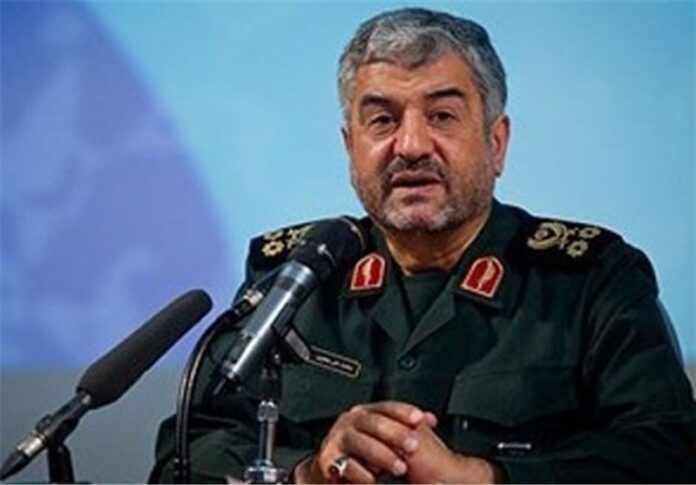
General Jafari

Commander of the Islamic Revolution Guard Corps (IRGC) Major General Mohammad Ali Jafari stressed Iran’s unwavering support for Syria and said the situation in the Arab country has a direct effect on the Islamic Republic.

Speaking to reporters Tuesday on the sidelines of a ceremony in commemoration of Major General Hossein Hamedani, an IRGC commander who was martyred on October 8 on an advisory mission in Syria, Major General Jafari said the security situation in Syria affects that of Iran.

“Undoubtedly, in a country like Syria with its population, religious and ethnic composition, when their [terrorists’] objectives are not realized, it will have a direct effect on our security,” the commander said.

He further praised the braveries of Major General Hamedani, saying that he played an outstanding role in the resistance of Syria against foreign-backed militancy.

[…]

IS pursuing Islamophobia scenario: President Rouhani

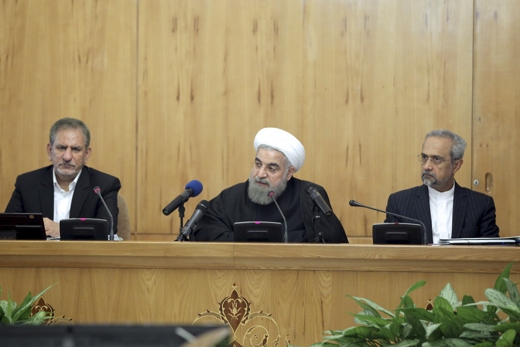
Rouhani-Government

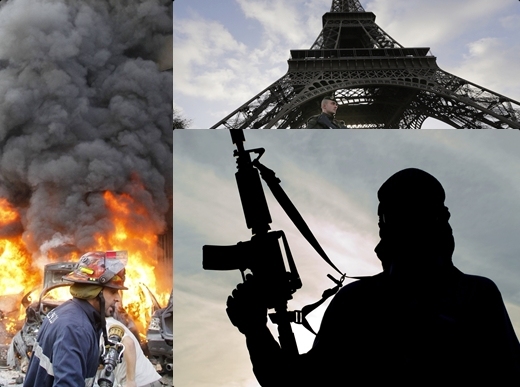
President Rouhani has condemned the recent terrorist attacks in Lebanon and France along with the downing of the Russian passenger plane by the IS terrorists, and said their main goal is to create a wave of Islamophobia.

“The IS terrorists with the aim of creating a wave of Islamophobia in the world are trying to claim that they represent Islam while the noble religion of Islam is against acts of terror,” President Rouhani said Tuesday at a meeting of the Supreme Cultural Revolution Council.

“Islam is the religion of peace and mercy and these attempts, especially in Europe and the US where many Muslims live, should not be allowed to result in increasing Islamophobia,” the president said.

President Rouhani expressed regret that innocent children, women and civilians have been the main victims of these terrorist acts and said global will and unity is needed to confront the crimes.

“Iran, as a country that is a victim of terrorism itself, condemns terrorist acts and massacre of innocent people and it will seriously confront these terrorist acts,” he added.

Amir Abdollahian, UN envoy discuss Yemen crisis

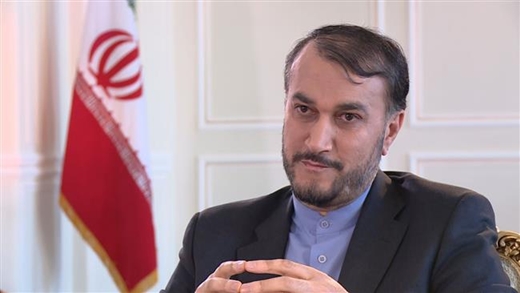
amir-abdolahian1

Deputy Foreign Minister Hossein Amir Abdollahian and UN special envoy to Yemen Ismail Ould Cheikh Ahmed in a telephone conversation on Tuesday discussed the latest developments and international efforts to halt the Saudi aggression against Yemen.

The deputy foreign minister pointed to the continued Saudi airstrikes on the Yemeni nation, and said Iran is ready to help with the resumption of national dialogue in Yemen.

Amir Abdollahian reiterated Iran’s logical stance on a political solution to the crisis in Yemen, and called for an end to Saudi-led airstrikes on Yemen.

The UN envoy, for his part, praised Iran for its efforts to help find a political solution to the crisis in Yemen, and said, “A lot of efforts have been made so far to stop the war in Yemen and send humanitarian aid to the Muslim country.”

Cheikh Ahmed said that the Yemeni crisis has a political solution, and added, “The early signs of the attainment of an agreement can be seen, but it needs cooperation of all Yemeni sides and all countries’ support for the Yemeni-Yemeni talks.”

Nine heads of state to attend Tehran gas summit: Oil minister

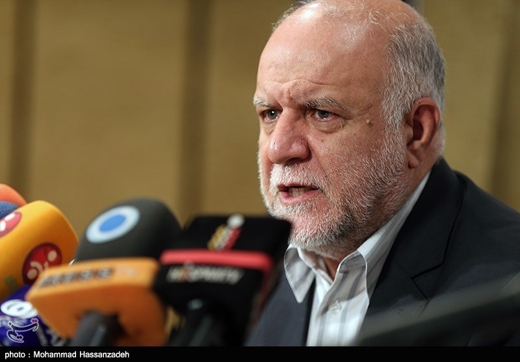
Ministers Weigh Plans for Iran-Iraq Oil Cooperation

Presidents of Bolivia, Russia, Equatorial Guinea, Nigeria, Venezuela, Iraq, Turkmenistan [as a guest], Iran and the Algerian prime minister are to attend a Tehran Summit of the Gas Exporting Countries Forum (GECF) next week, the oil minister said.

Bijan Namdar Zanganeh described as unprecedented the number of heads of state who will converge on Tehran for the GECF gathering. “The Qatar summit hosted four presidents, while the forum in Russia was attended by three.”

He said that the event is aimed at promoting cooperation between rivals and added, “Member states are mature enough to have cooperation in tandem with competition.”

Zanganeh said natural gas exports through pipeline to faraway destinations like Europe are difficult and need the approval of a lot of countries along the route, and added that’s why Iran prefers exports of liquefied natural gas (LNG) to Europe.

Three terror attacks, media frenzy and different reactions

Terrorism-Beirut-Paris

In less than a week, ISIS targeted different places in the world, leaving a path of death and destruction in its wake. The way media around the world covered the terror attacks in Baghdad, Beirut and Paris raises a couple of questions: Why the global media ignored the Beirut bombings? Are media to blame for the disproportionate focus on the Paris attacks over Beirut’s?

Alef.ir on November 16 published a piece by Amir-Mohammad Fatemi on the extensive media coverage of Paris attacks and why nobody paused to listen to the voice of the victims of terror attacks in Beirut and Baghdad. The following is the translation of part of that piece:

1. Thursday November 12: A predominantly Shiite suburb of Beirut was rocked by twin bombings which left up to 300 people killed or injured.

Friday November 13: A bomb went off in a funeral procession for a Shiite fighter who was killed in the fight against ISIS, killing and injuring more than 95 people.

The world media largely ignored these two terror attacks.

Late Friday November 13: Paris was hit by multiple attacks [claimed] by ISIS following the Beirut and Baghdad bombings. Up to 360 people were killed or injured in the terror attacks.

Western, Arab, world and even Iranian media reacted differently this time around and – unlike what they did in reaction to the twin bombings which were carried out hours apart in two different places by the same terror group – gave extensive coverage to the Paris attacks describing them as being similar to 9/11 attacks on the US in 2001.

2. On any grounds, Iranian media have – perhaps unwittingly or just because they were seeking to follow the news and analyses produced by the Western and non-Western media outlets – covered the Paris attacks and their aftermath over the past few days, ignoring the Beirut and Baghdad bombings. […] On Sunday the world media did not run one news analysis or even one single headline on the terror attacks in Beirut and Baghdad. […]

3. A study of more than 2,000 front pages of newspapers and websites which covered the 33-day war [the 2006 Israel-Hezbollah War] between Hezbollah and the invading, armed-to-the-teeth army of the Zionist regime suggests that less than five percent of these media outlets dealt with the 33-day war.

It also reveals that three percent – out of the overall five percent – of the news items was aimed at defending the innocence of the Zionist regime’s military, and the remaining two percent covered the battle itself. In other words, no media organization released news materials to defend the rightfulness, legitimacy and innocence of the country which came under attack. […]

4.  Officials of the United Nations, all Western states, and other countries – including Iran – have expressed regret over the Paris attacks and sympathized with the French government and people over the past few days, like what was done when 9/11 attacks were mounted.

It is interesting that no government – but Iran’s – expressed sorrow or cabled a message [of condolence] over bomb attacks in Beirut and Baghdad against the innocent Shiite people. It seems as if those who were killed in Beirut and Baghdad were different from the dead in the Paris attacks!

Perhaps people in Iraq and Lebanon, Shiites included, are believed to deserve to suffer through bomb attacks, killings and pillage at the hands of ISIS terrorists! Perhaps we have to admit that we are treated as second class in the world classifications when it comes to being killed or injured!

Maybe it is for the same reason that US Secretary of State John Kerry openly blamed – in a press conference on Saturday – Bashar Assad’s policies for ISIS terrorist activities in Syria. In response to remarks by his Russian counterpart Sergei Lavrov that France’s behavior may have probably triggered terrorist attacks in Paris, Kerry remained silent.

When Lavrov said with subtlety that all [people and nations], either for or against Bashar Assad, are targeted by ISIS terrorist attacks, Kerry remained silent again. [Kerry suggested radicals were drawn to the country in their fight against Assad, a view Lavrov disputed. … Kerry said the war “can’t end as long as Bashar Assad is there. That’s the perception of the people waging the war.” But Lavrov said the conflict — or its solution — is “not about Assad.” “It doesn’t matter if you are for Assad or against him,” he said. “ISIS is your enemy.” (AP- November 14)].

Without any partisan or factional bias, the following question – which is one of the main national and religious concerns – needs to be thought over: why was it that terrorist attacks against the Shiites in Beirut and Baghdad were overshadowed by the Paris attacks in Iran’s media, both privately-run websites and the national broadcaster, IRIB?

5. The Mina tragedy in which a number of Iranians went missing is still an open case, at least for Iran. What unfolded in Saudi Arabia [during the Hajj rituals] did not land in the spotlight thanks to a [virtually] blanket media blackout imposed by the Western and Arab countries […].

[…]

6. Why they [the Western and Arab countries] treat us [Iranians] and anything which has something to do with us in this manner [ignoring what happens] is not the focus here in this article. But it is of great significance to ponder on one point: why do we treat our own issues in such a manner, both from social and media angles?

Following the 9/11 attacks, I said – in a letter in response to remarks by a certain country’s officials who blamed Iran for not expressing sympathy with the American people [for the terrorist attacks] – that we shed tears for the dead people in a country that has cried for our dead in Iran, and that we voice regret for the losses of those who have expressed regret over the sufferings we have endured.

That’s why the Iranian media should think thoroughly about the reason why they brought into focus the Paris attacks and expressed regret [over the attacks] and sympathy [with France], but they looked the other way or did not give full coverage to the bomb attacks and pains in Beirut and Baghdad? […]

Iranian, French presidents discuss terrorism over phone

Rouhani-Hollande

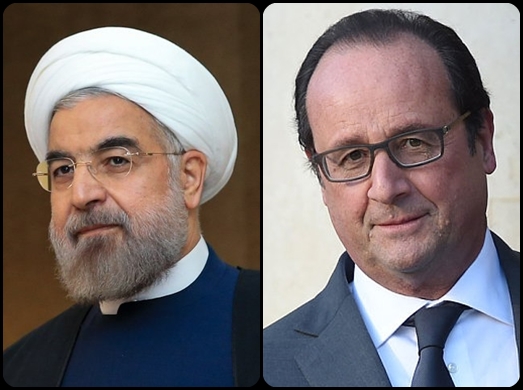
In a phone conversation Tuesday, President Rouhani and his French counterpart Francois Hollande called for counter-terrorism efforts and the fight against terrorism.

According to President Rouhani’s Twitter account, the two sides called for creation of a world against violence and extremism.

In a message to Hollande, President Rouhani condemned the Paris terrorist attacks which claimed the lives of almost 130 civilians and added that the deaths of many civilians in the terrorist attacks caused deep grief for the Iranian people.

He said he strongly condemned the incident on behalf of the Iranian nation who itself is the victim of the evil phenomenon of terrorism.

The president stressed the need for global efforts to fight all terrorist groups.

A string of coordinated attacks in and around Paris left at least 129 people dead and some 200 others injured; a state of emergency has been declared in the European country shaken by the horrific attacks.

Supreme Leader outlines environmental policy

Leader

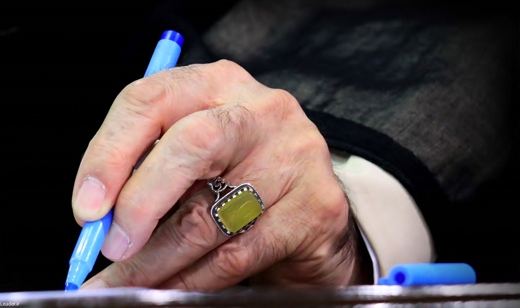
Supreme Leader of the Islamic Revolution Ayatollah Seyyed Ali Khamenei on Tuesday outlined a 15-point general environmental policy for the country.

Under Article 110 of Iran’s constitution, creating an integrated national environment system, managing vital resources in a coordinated and systematic fashion, criminalizing  environmental degradation, compiling an environmental atlas, strengthening the environmental diplomacy, developing green economy, institutionalizing the environmental culture and ethics are the main topics of Supreme Leader’s general environmental policy.

Several months ago, Ayatollah Khamenei urged Iranian authorities to try to tackle the country’s environmental problems through detailed, accurate planning.

The Supreme Leader described land grab and acquisition of mountainous land as deplorable, adding land and mountain reclamation is a crime and those committing such crimes should be prosecuted.

Water and land degradation are the biggest environmental threats in Iran to overcome. This requires stricter policies and laws to protect land.

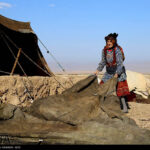
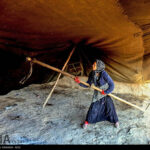
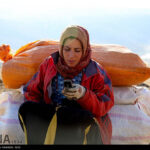
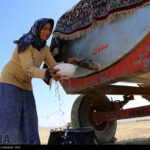
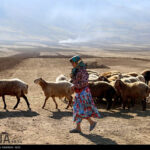
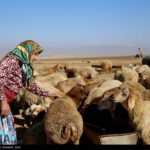
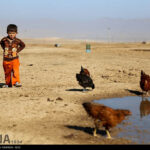
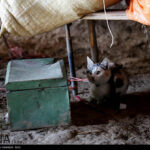
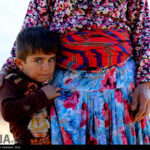
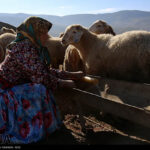
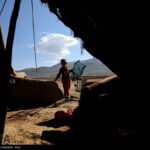
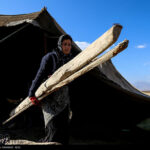
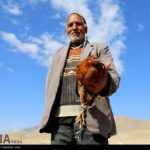
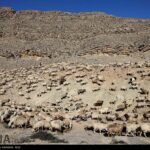
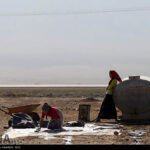
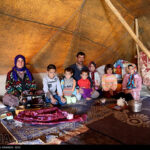
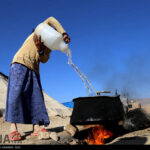
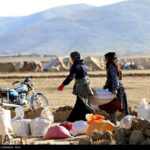
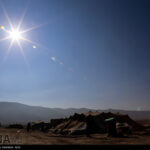
Trips across deserts by nomads in northeastern Iran (PHOTOS)

Nomads0

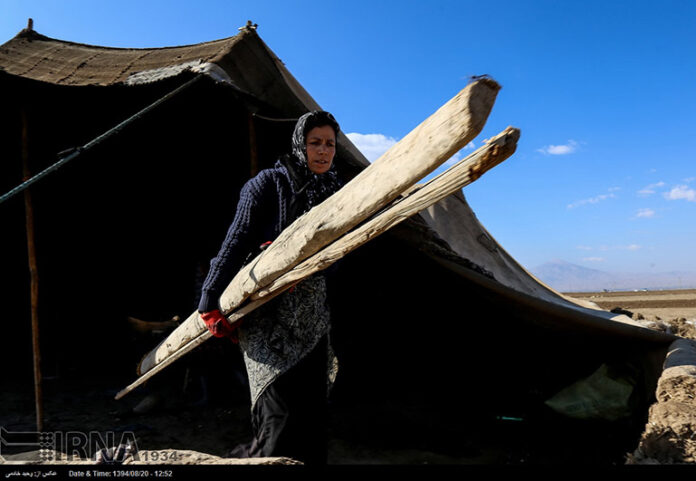
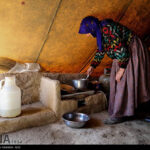
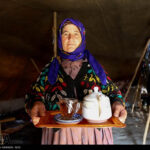
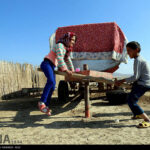
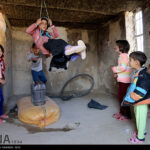
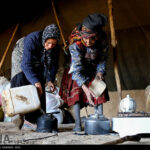
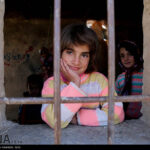
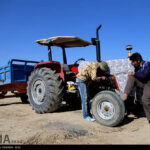
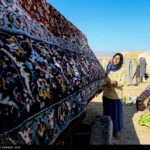
Nomads based in deserts in the northeastern Iranian province of North Khorasan live in tents all year through. In winter, 120 Kurdish-speaking nomadic families in the towns of Maneh and Samalqan travel 100 km west to get to a region called Maraveh Tappeh in Semnan Province.

The following are snapshots of their trips published by the Islamic Republic News Agency:

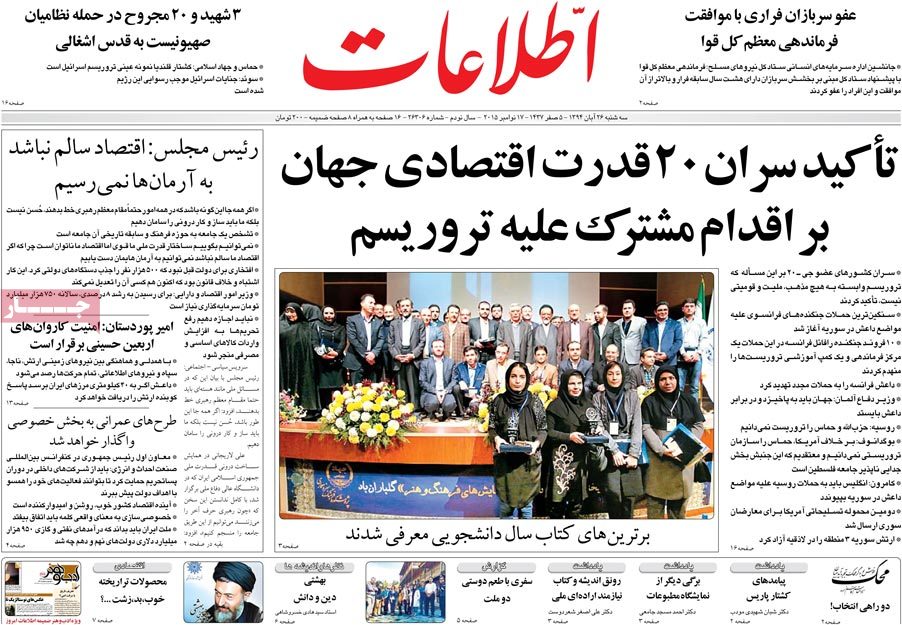
A look at Iranian newspaper front pages on Nov. 17

Iranian Newspapers Headlines

What the court heard in a ninth hearing in the corruption trial of Babak Zanjani along with the comments of the parliament speaker about the illegal measures the Ahmadinejad administration took, and those of the interior minister about Iran’s red lines in dealing with IS terrorists dominated the front pages of Iranian newspapers on Tuesday. Also on the cover of reformist-leaning dailies were the comments of the Expediency Council chief on the upcoming elections.


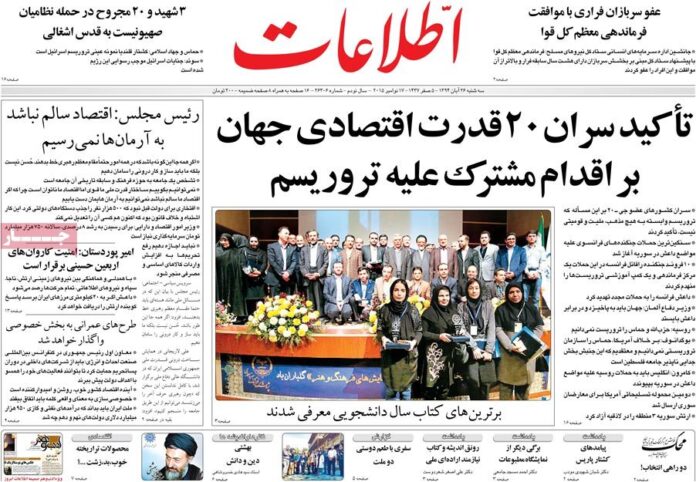
Ettela’at: G20 leaders have underlined joint action against terrorism.

It came as French fighter jets launched Paris’ heaviest attacks against IS positions in Syria.

And the terrorist grouping threatened to attack France again.


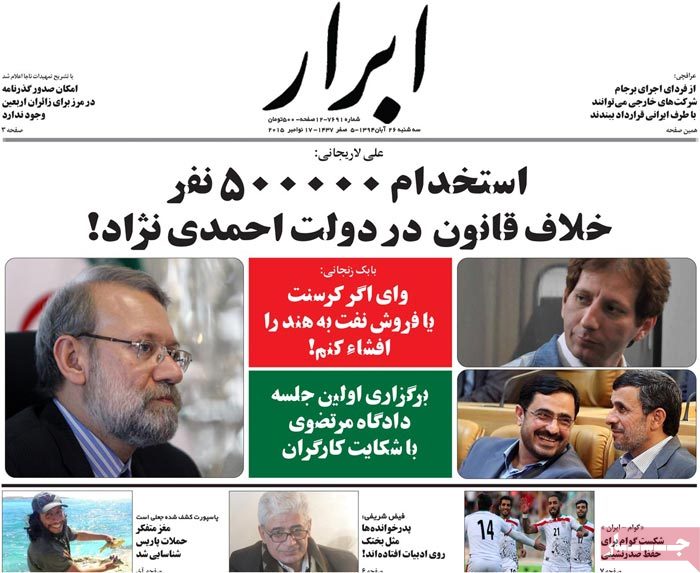
Abrar: Abbas Araghchi, a deputy foreign minister, has said foreign firms will be able to sign deals with Iran a day after implementation of the Joint Comprehensive Plan of Action has begun.

Abrar: The Ahmadinejad government acted against the law by hiring 500,000 new civil servants, said Parliament Speaker Ali Larijani.
 

A look at Iranian newspaper front pages on Nov. 17


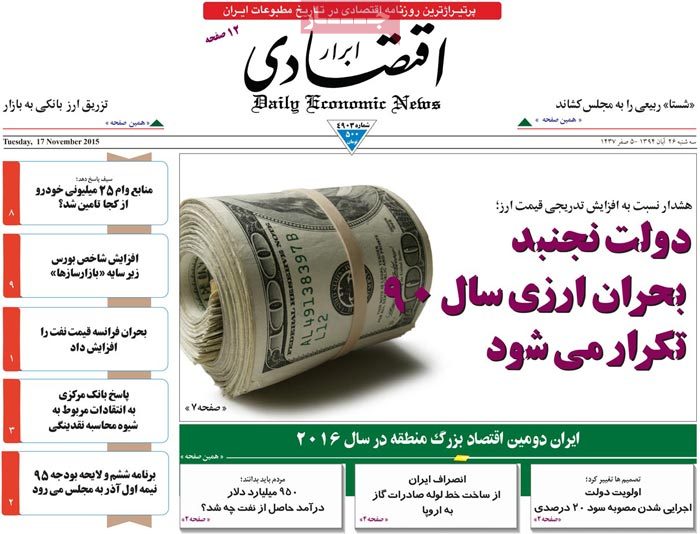
Abrar-e Eghtesadi: Iran will be the region’s second largest economy in 2016.

Abrar-e Eghtesadi: In the absence of government action, the foreign currency crisis of 2011 may repeat itself.
 

A look at Iranian newspaper front pages on Nov. 17


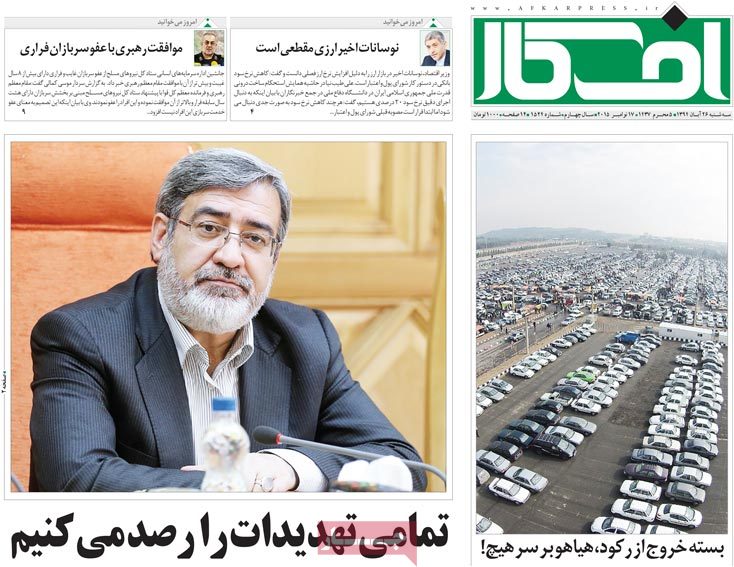
Afkar: The economy minister has said fluctuations in foreign currency rates are temporary.

Afkar: The interior minister has said that his ministry monitors all threats.
 

A look at Iranian newspaper front pages on Nov. 17


Aftab-e Yazd: Apples and Oranges!

In a bid to secure enough signatures to question Foreign Minister Zarif, a minority of MPs are drawing a comparison between the Algiers Agreement and the Joint Comprehensive Plan of Action.


A look at Iranian newspaper front pages on Nov. 17


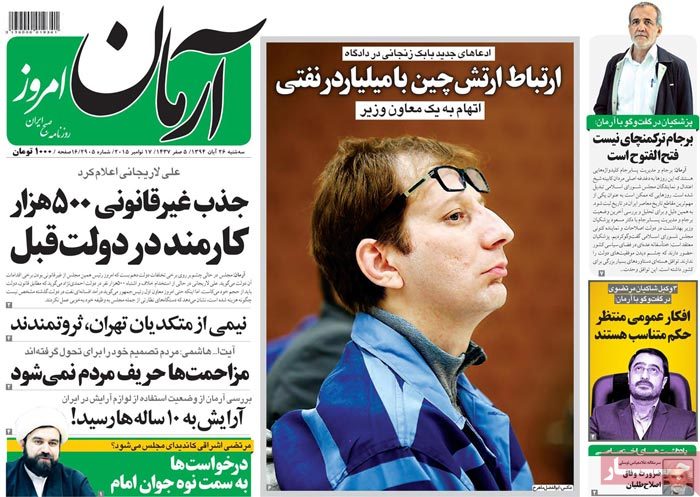
Arman-e Emrooz: Babak Zanjani [a young billionaire who is on trial for corruption] has claimed he has been in contact with the Chinese Army.

He has also implicated a deputy minister in the corruption case.

Arman-e Emrooz: More than half of street beggars in Tehran are rich.
 

A look at Iranian newspaper front pages on Nov. 17


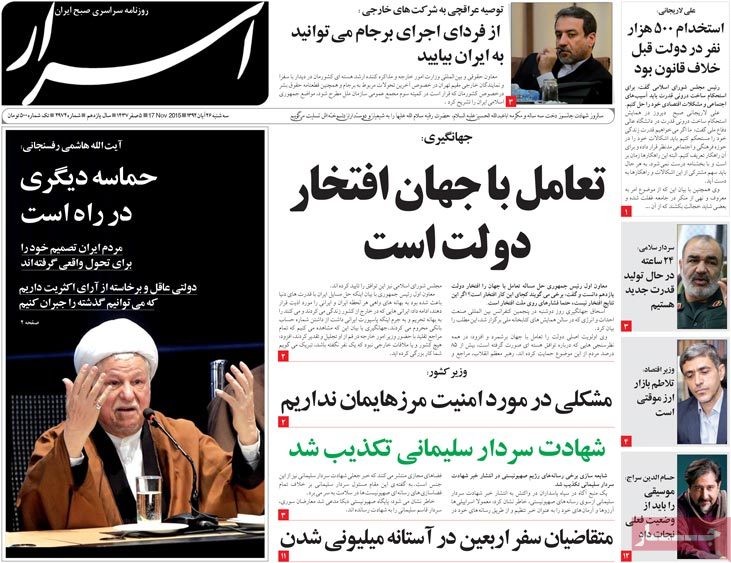
Asrar: “Another epic is around the corner; the Iranian people have made up their mind to bring in genuine change,” said the chairman of the Expediency Council.
 

A look at Iranian newspaper front pages on Nov. 17


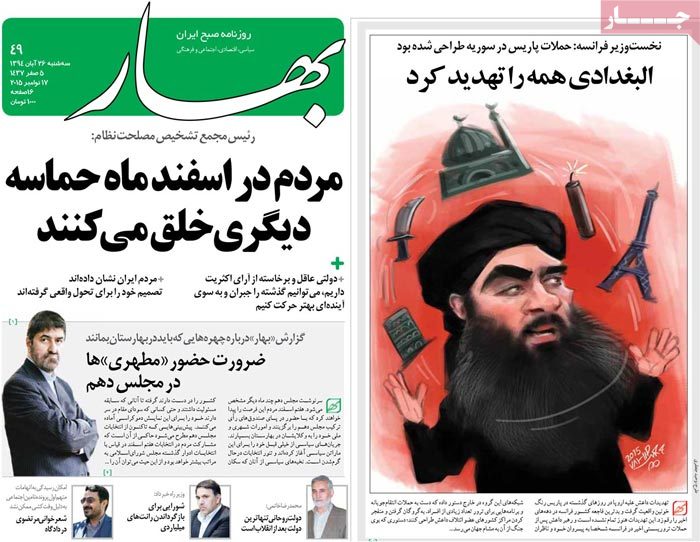
Bahar: The Iranian people will make another epic in the upcoming elections in 2016, said the chairman of the Expediency Council.

Ayatollah Akbar Hashemi Rafsanjani said, “We have a prudent representative government in office; we can make up for the past and head for a better future.”
 

A look at Iranian newspaper front pages on Nov. 17


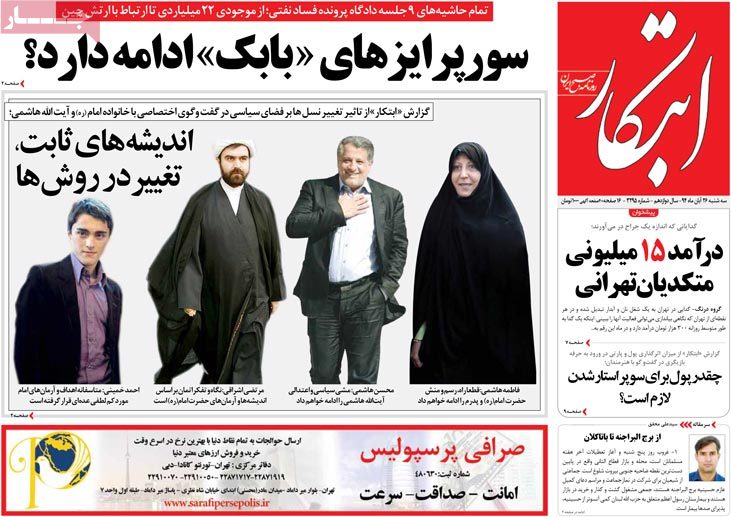
Ebtekar: Will Babak Zanjani continue to spring surprises on us?

A look at all the claims made in the last nine hearings of the young billionaire from statements that he has $22 billion in cash to his ties with the Chinese Army.
 

A look at Iranian newspaper front pages on Nov. 17


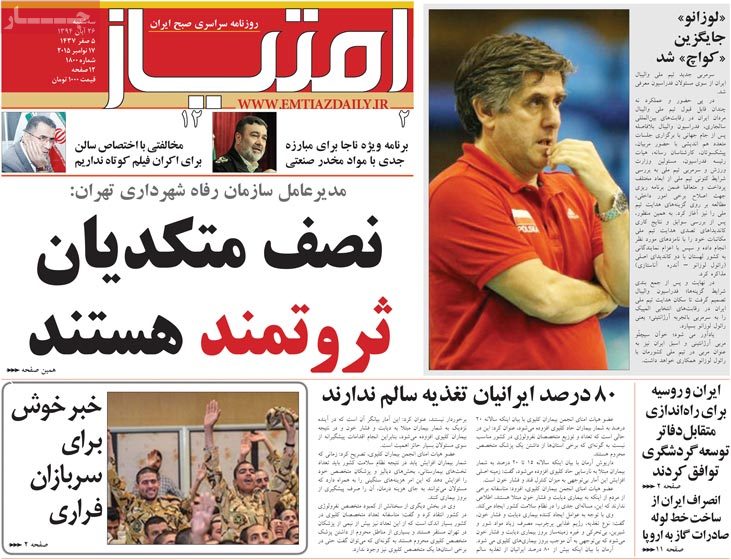
Emtiaz: Raul Lozano has replaced Slobodan Kovac as the head coach of the Iranian national volleyball team.

Emtiaz: Up to 80 percent of Iranians have unhealthy diets.
 

A look at Iranian newspaper front pages on Nov. 17


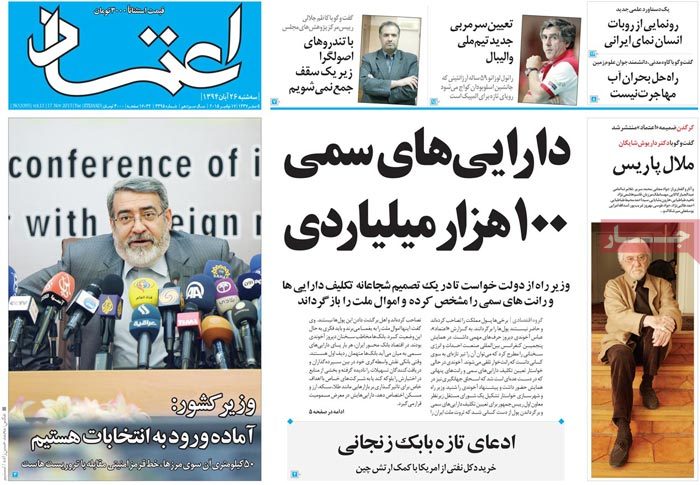
Etemad: The interior minister has said that his ministry is ready to organize the upcoming elections.

Abdolreza Rahmani Fazli further said terrorists would cross our security red lines if they came any closer than 50 km to the Iranian border.
 

A look at Iranian newspaper front pages on Nov. 17


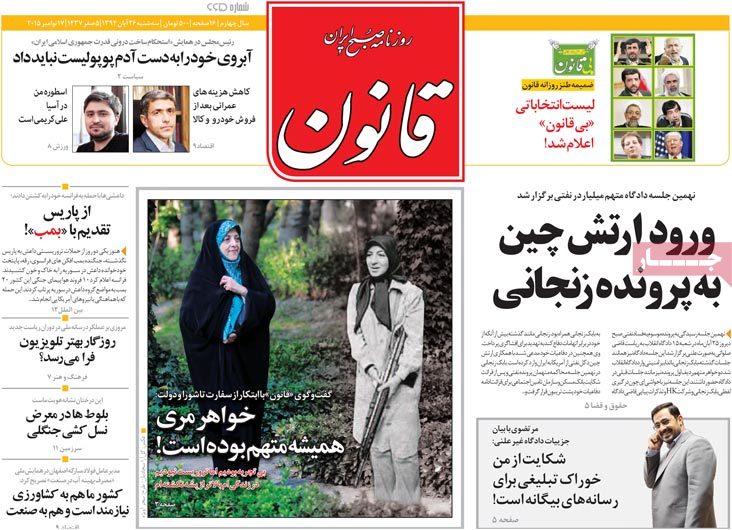
Ghanoon: One should not trust a populist with their reputation, said Parliament Speaker Ali Larijani.
 

A look at Iranian newspaper front pages on Nov. 17


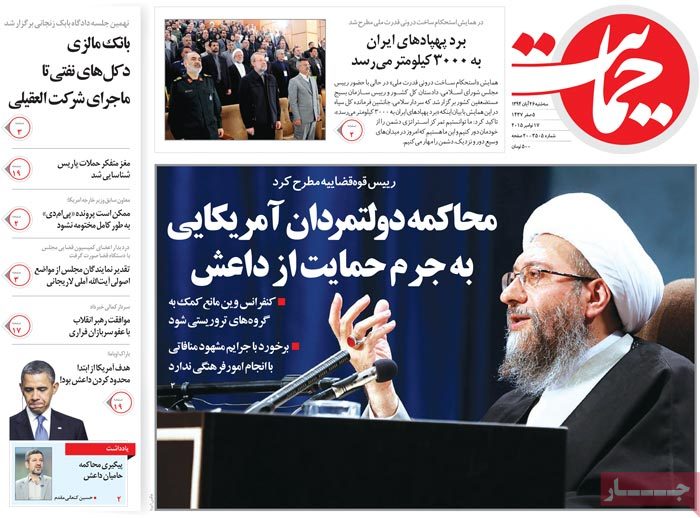
Hemayat: US statesmen should be put on trial for supporting IS, said the Iranian judiciary chief.

Ayatollah Sadegh Amoli Larijani also called on participants in Vienna talks on Syria to prevent the flow of aid to terrorists.

Hemayat: Iranian drones have a range of 3,000 km.
 

A look at Iranian newspaper front pages on Nov. 17


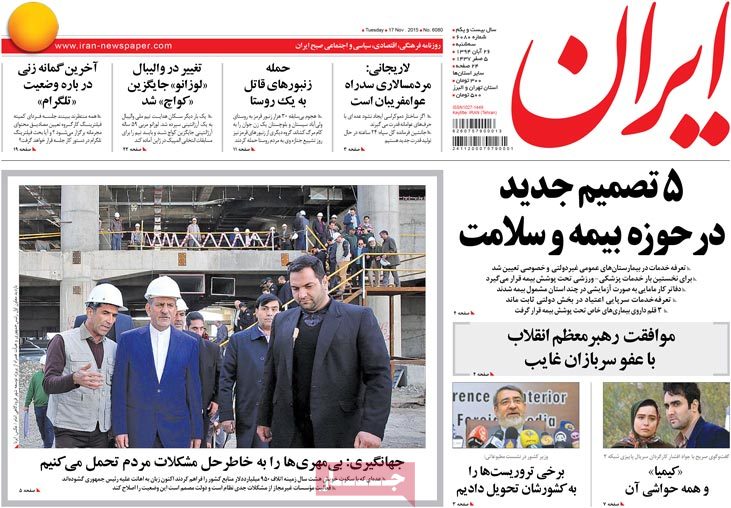
Iran: The interior minister has said that Iran has repatriated a number of terrorists to their country of origin.
 

A look at Iranian newspaper front pages on Nov. 17


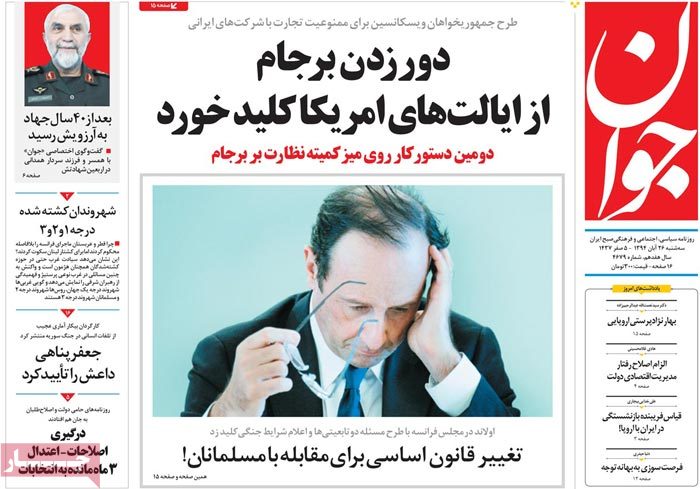
Javan: The move to skirt the Joint Comprehensive Plan of Action started in American states.

Wisconsin Republicans have introduced a bill to ban trade with Iran.
 

A look at Iranian newspaper front pages on Nov. 17


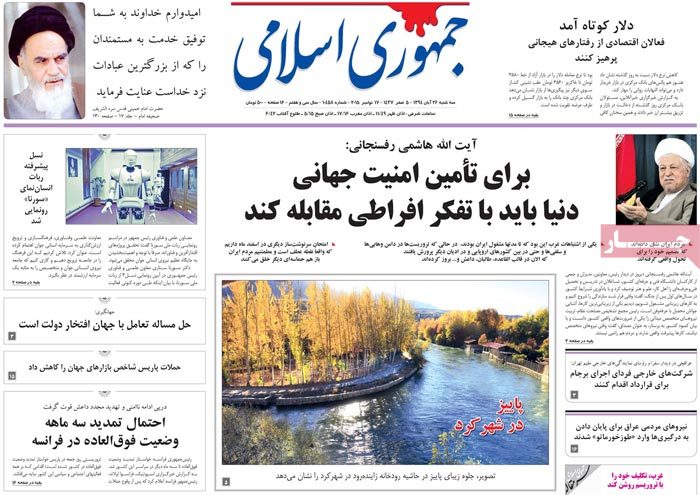
Jomhouri Islami: To ensure global security, the world needs to take on the extremist ideology, said the chairman of the Expediency Council.

Jomhouri Islami: The administration takes pride in settling the problems standing in the way of interaction with the rest of the world, said the first vice-president.
 

A look at Iranian newspaper front pages on Nov. 17


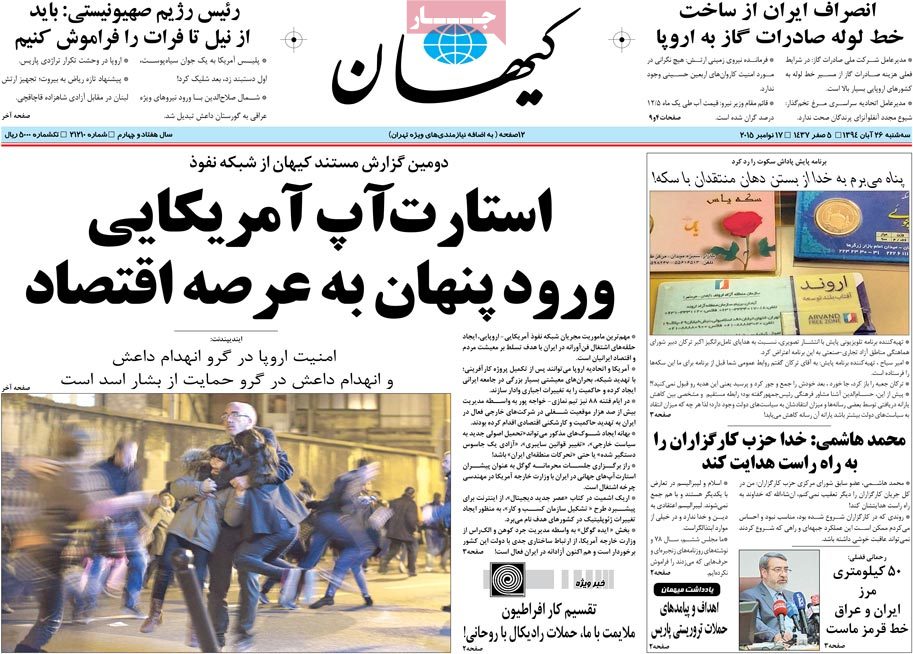
Kayhan: Iran has decided to back away from a pipeline project to export natural gas to Europe.
 

A look at Iranian newspaper front pages on Nov. 17


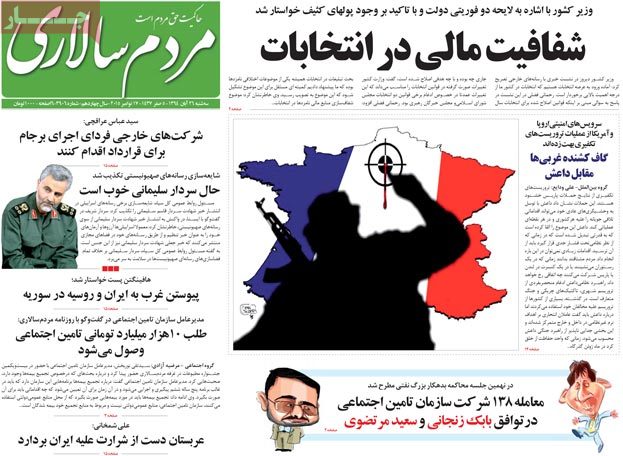
Mardomsalari: The secretary of the Supreme National Security Council has urged Saudi Arabia to ditch its evil attitude toward Iran.
 

A look at Iranian newspaper front pages on Nov. 17


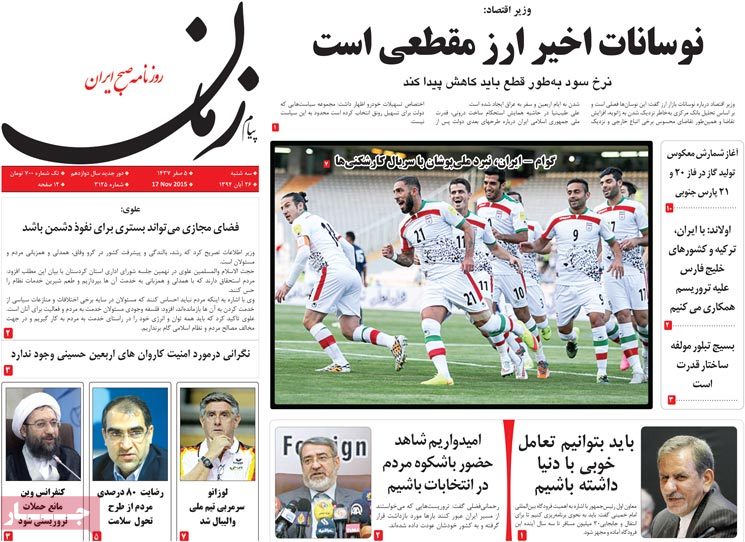
Payam-e Zaman: Up to 80 percent of Iranians are satisfied with the Healthcare Transformation Plan, said the health minister.
 

A look at Iranian newspaper front pages on Nov. 17


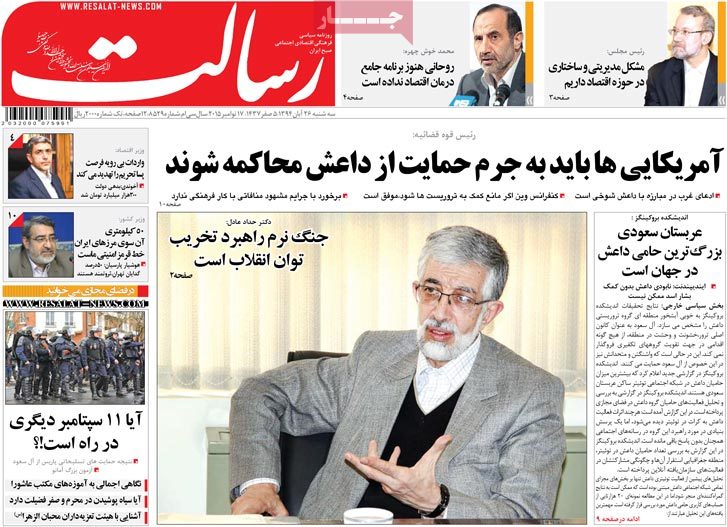
Resalat: President Rouhani has yet to present a comprehensive plan to resuscitate the national economy, said Mohammad Khoshchehreh, an economist.

Resalat: Unchecked imports will pose a threat to opportunities that are bound to arise in the post-sanctions era, said the economy minister.
 

A look at Iranian newspaper front pages on Nov. 17


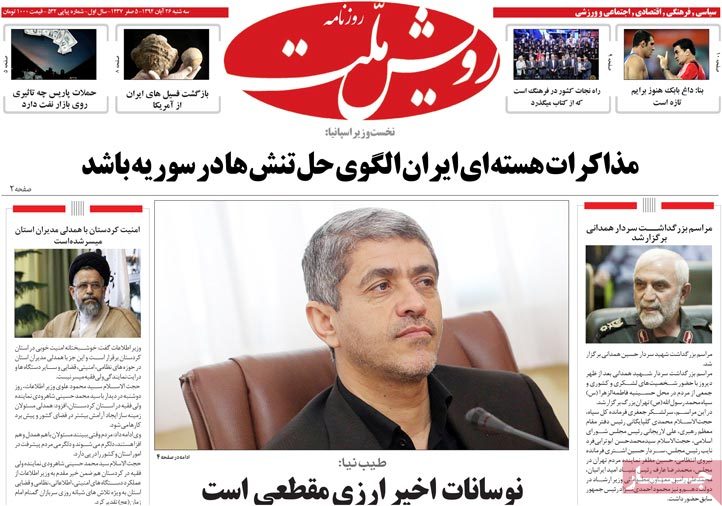
Rooyesh Mellat: Iran’s nuclear talks could serve as a model for efforts to ease tensions in Syria, said the Spanish prime minister.
 

A look at Iranian newspaper front pages on Nov. 17


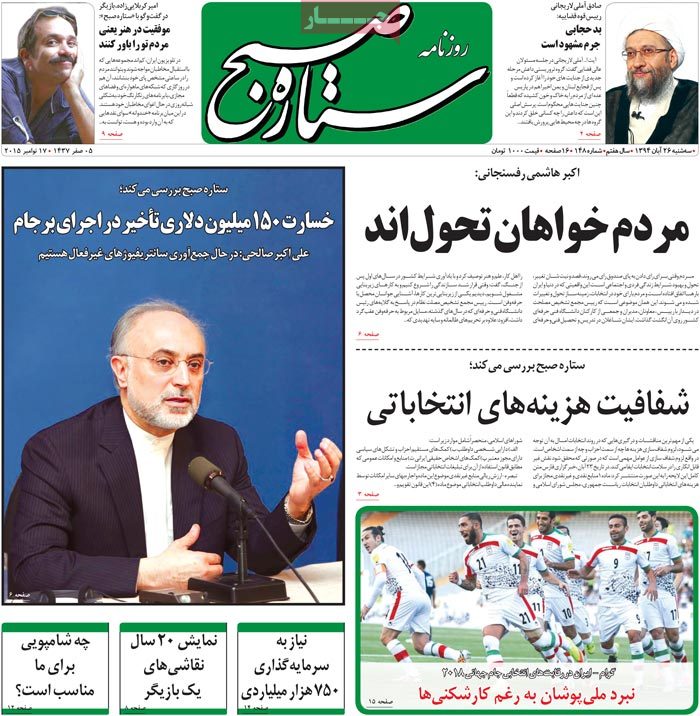
Setareh Sobh: Despite obstructions, Iran will take on Guam in the 2018 World Cup qualifiers on Tuesday.
 

A look at Iranian newspaper front pages on Nov. 17


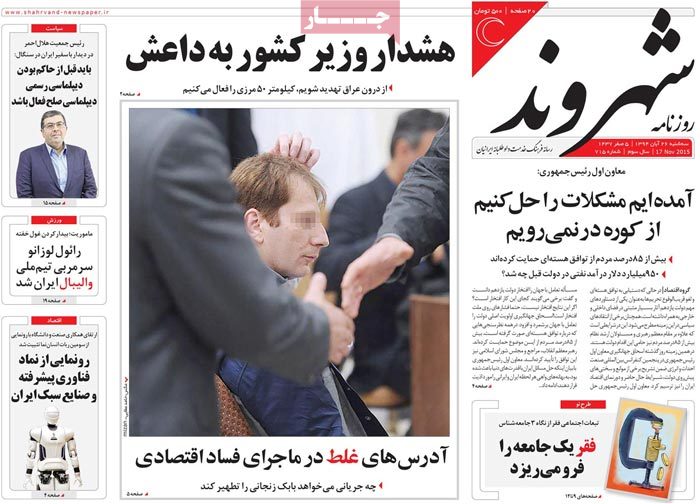
Shahrvand: “We are here to solve the problems; we won’t lose our temper,” said the first vice-president.

Eshagh Jahangiri further said that 85 percent of the public support the nuclear deal.

“What happened to the $950 billion in oil revenues the previous government earned?” the vice-president asked.
 

A look at Iranian newspaper front pages on Nov. 17


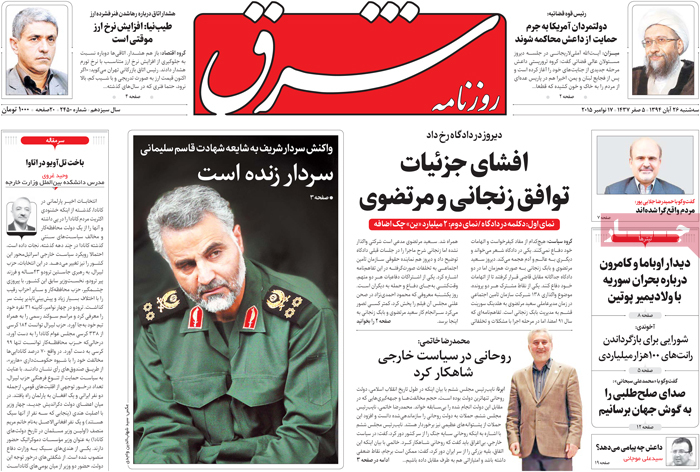
Sharq: The general is alive, said Brigadier General Sharif in reaction to rumors that Major General Ghasem Soleimani [the commander of IRGC’s Quds Force] has been martyred.

Sharq: Details of a deal between Zanjani and [Saeed] Mortazavi [both on trial for corruption] were revealed in a court hearing yesterday.
 

A look at Iranian newspaper front pages on Nov. 17


Taadol: To secure eight percent growth, the country needs $ 250b in investment, said the minister of finance and economic affairs.


 

A look at Iranian newspaper front pages on Nov. 17


Highlights of Ettela’at newspaper on Nov. 17

ettelaat17

 G20 leaders have underlined joint action against terrorism.

It came as French fighter jets launched Paris’ heaviest attacks against IS positions in Syria.

And the terrorist grouping threatened to attack France again.

 Draft dodgers have been forgiven following the Supreme Leader’s go-ahead.

The commander in chief of the armed forces has pardoned those who have dodged conscription for eight years or more.

 An attack by the Israeli military against Beit ul-Muqaddas has left three Palestinians martyred and 20 others wounded.

Hamas and Islamic Jihad have denounced the killings as jarring examples of Israeli terrorism.

 “In the absence of a healthy economy, we won’t be able to secure our goals,” said the parliament speaker.

Ali Larijani further said under the previous government as many as 500,000 people were hired by state institutions and that practice was wrong and against the law.

 The commander of the Iranian Army’s ground forces has said that convoys of mourners [who travel to Iraq to take part in Arba’een mourning ceremony] will be secure.

If IS moves to within 40 km from the Iranian border, it will draw a crushing response from the Iranian Army, Brigadier General Pourdastan said.

 The private sector is to be entrusted with development projects.
The first vice president has hailed the prospects of the country’s economy as bright and promising.

 Top student authors of the year have been named.