Saturday, January 3, 2026
Home Blog Page 4681

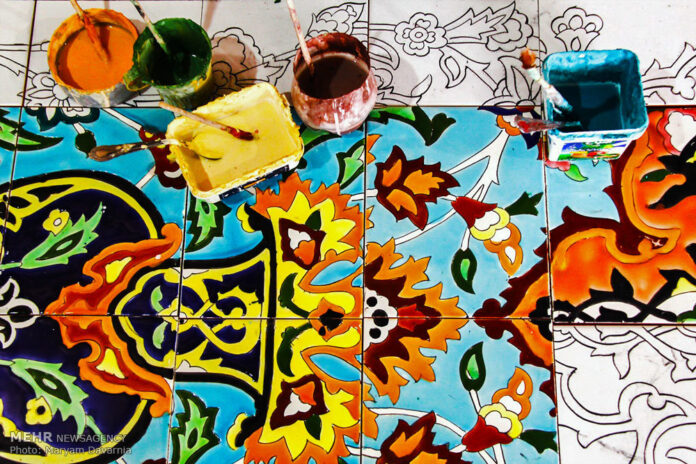
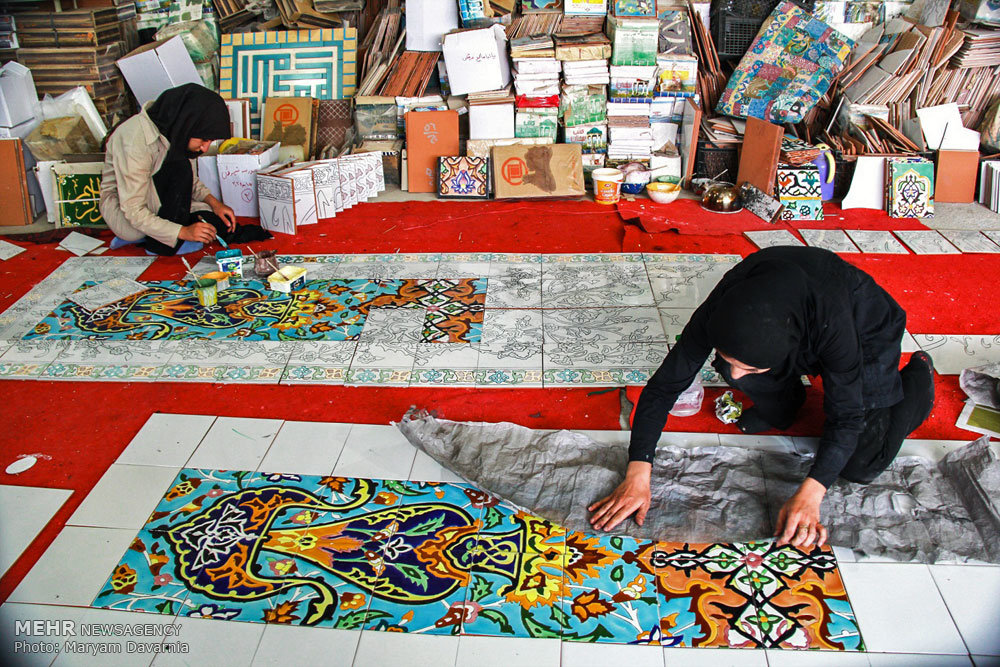
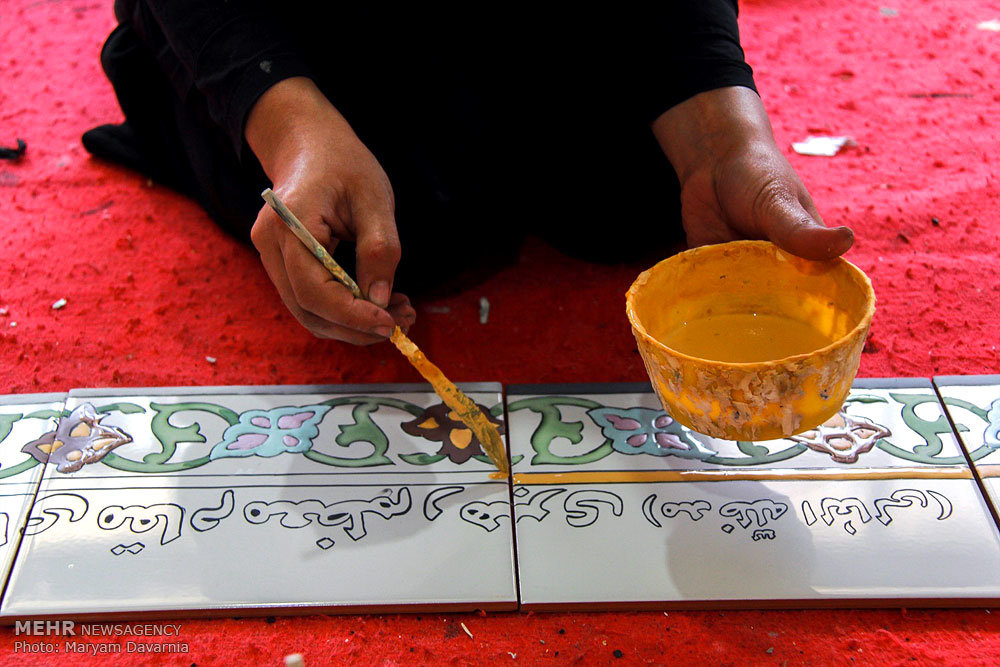
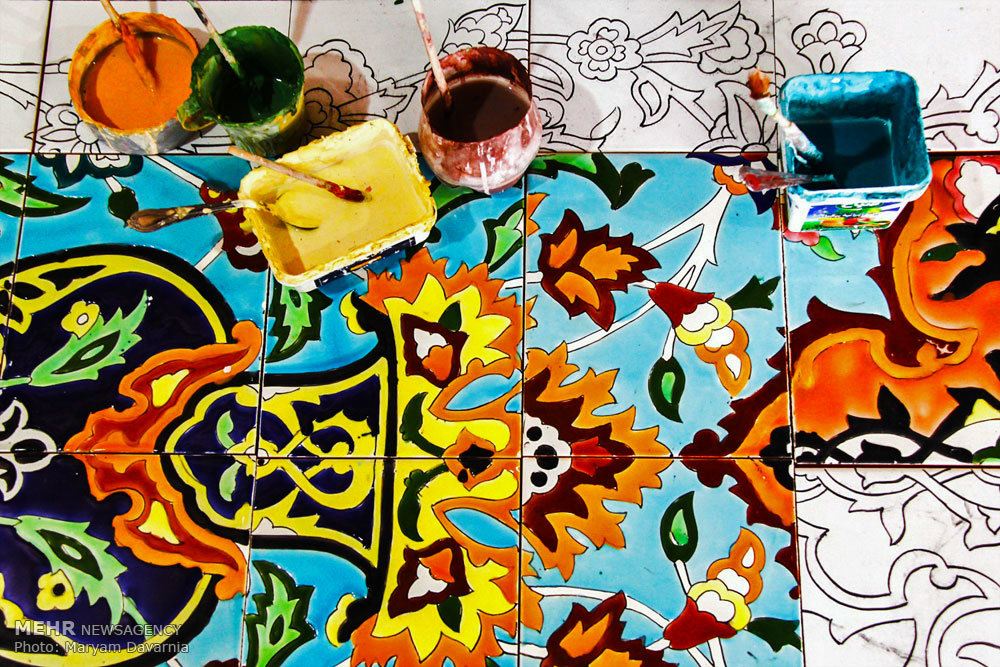
Traditional Tiling Workshop (PHOTOS)

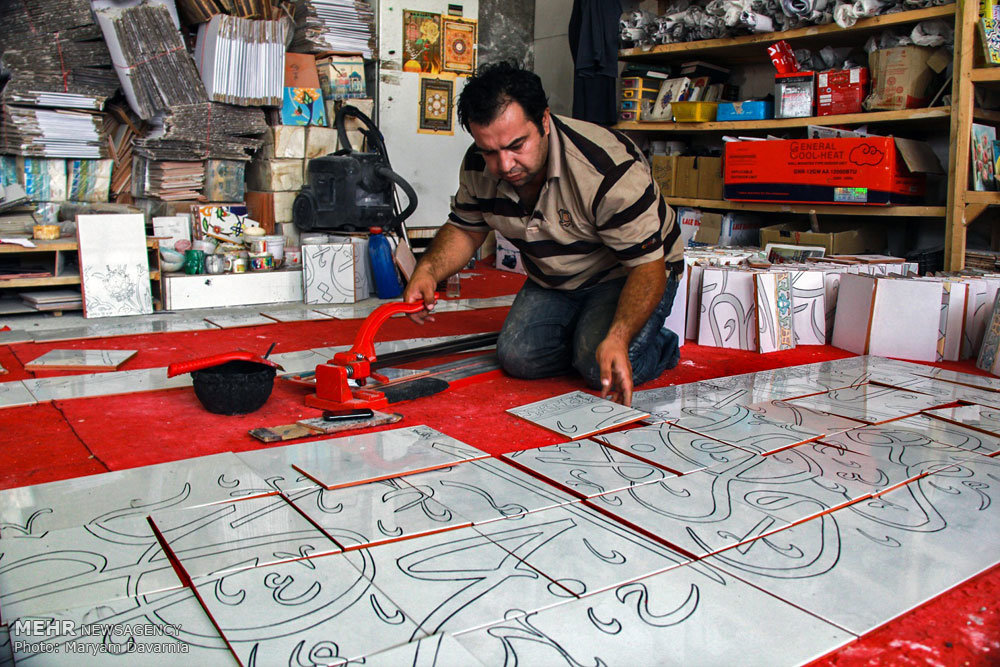
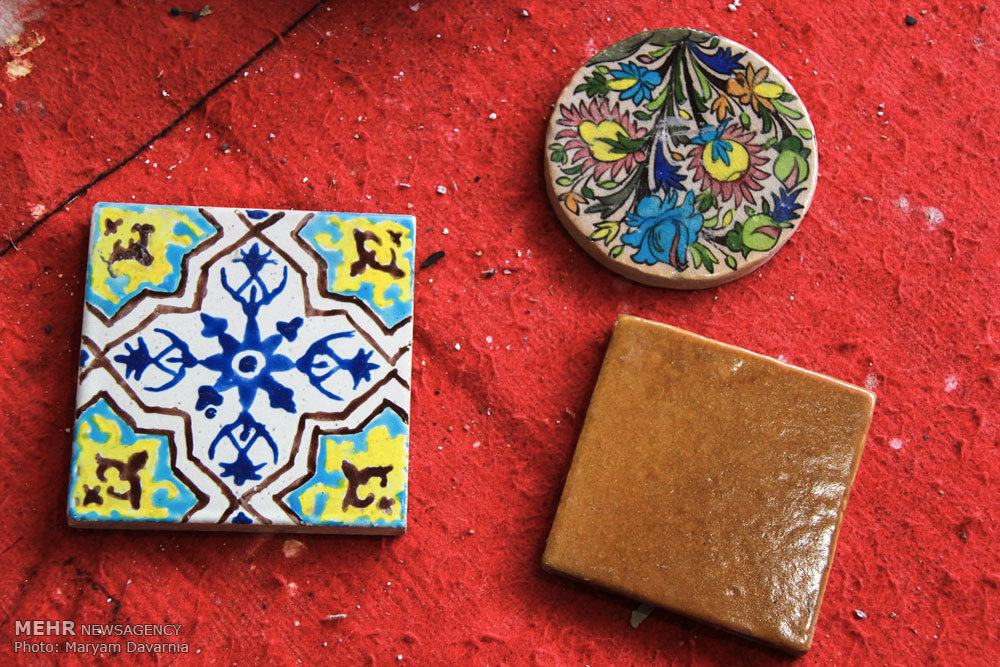
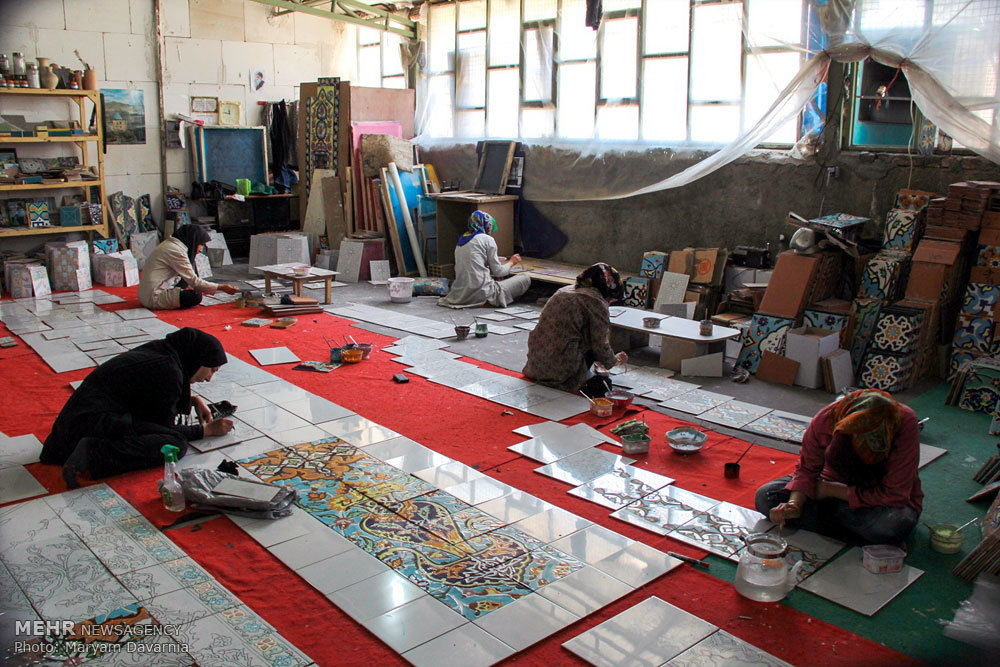
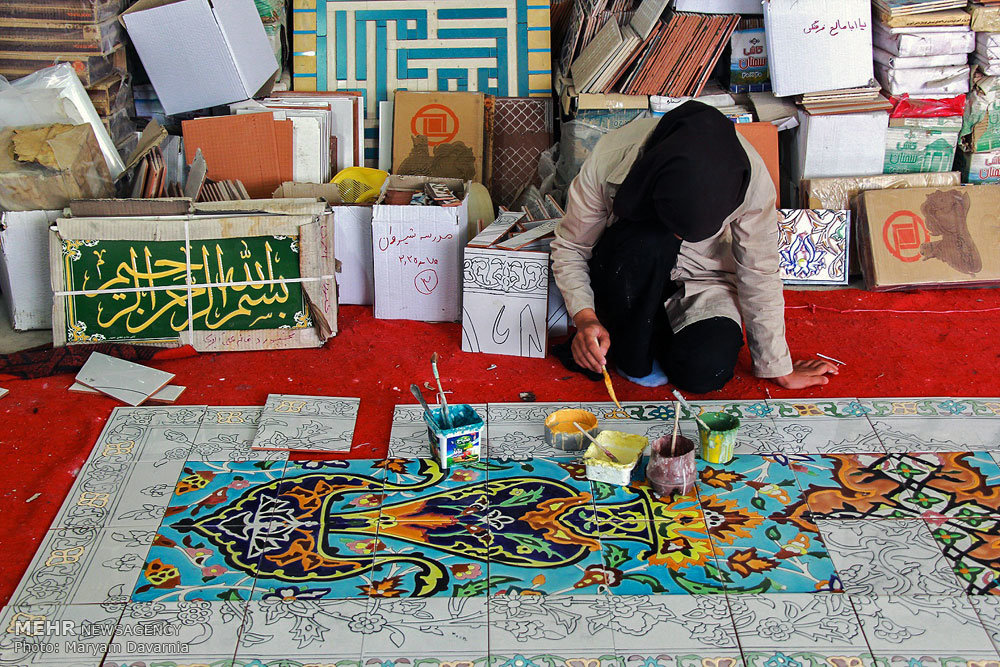
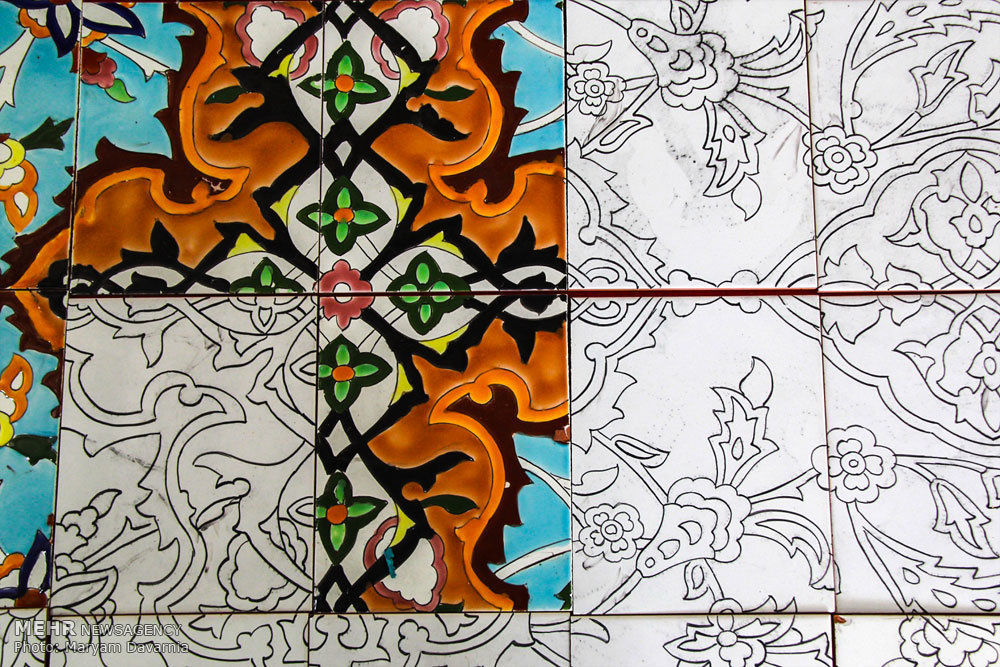
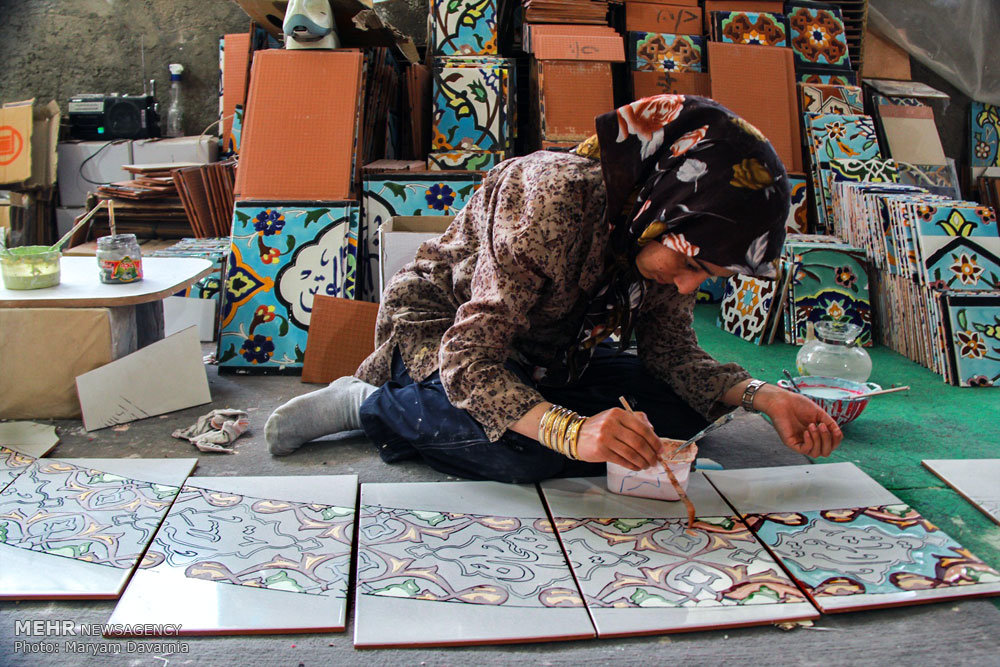
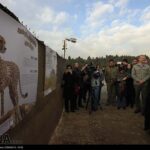
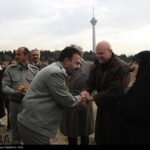
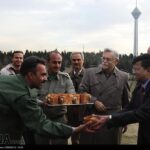
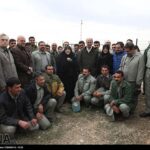
The Traditional Tiling Workshop in North Khorasan is the only such workshop which has its own kiln.

The workshop provides all the tiles used in mosques and holy places as well as other areas in the northeastern province.

The following pictures have been released by Mehr News Agency: 

Presidential elections in the US and future of Iran-West ties

usa

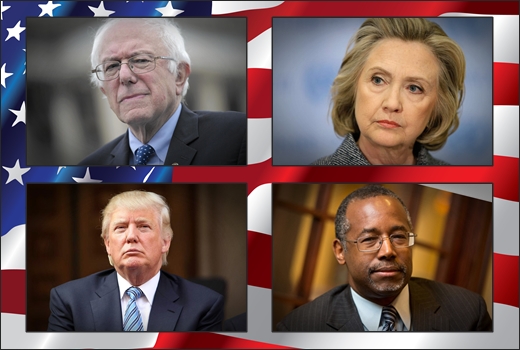
With the US presidential elections heating up, Alef.ir’s Barzin Jafar-Tash has taken a look at the future of Iran’s ties with the West.

The following is the translation of the piece that was released by the news website on December 5:

The victory of Justin Trudeau in Canada was good news for Iran. The news was so good that some analysts described it as the collapse of the last anti-Iran stronghold in the West. On his first working days, Trudeau pulled out of the US-led anti-Daesh coalition and called for the resumption of ties with Iran. His foreign minister has also officially announced that the days of having special relationship with Israel are numbered.

In Britain too, the Labour Party by electing Jeremy Corbyn as party chairman, to a large extent, led the political atmosphere of the country toward wisdom. Jeremy Corbyn is critical of the intervention policies of the US and the West in the Middle East and is one of the veteran activists of the Labour movement.

As for Palestine, Jeremy Corbyn believes in a two-state solution and his meetings with members of the Lebanese Hezbollah Movement have proved problematic for him.

Given the problems France is grappling with and the threat of Daesh, French President Francois Hollande, too, can no longer emerge as a staunch supporter of Israel against Iran.

In such circumstances when blind, loud advocates of Israel are nowhere to be seen in the West, an atmosphere has been prepared for Iran’s political and economic maneuvering. Iran can capitalize on this atmosphere to boost its political ties with the world, the West in particular.

However, this proper international atmosphere will probably undergo change with the 2016 US presidential elections. In the Democratic camp, opinion polls put veteran US Senator Hillary Clinton in the lead with a vast margin.

Given Hillary Clinton’s record of currying favor with Israel and having animosity toward Iran, things will become hard for Iran in case she wins the 2016 elections.

In the Democrats’ last party debate, when she was asked which enemy she made during her political career she was most proud of, she said without hesitation and in a loud voice: “Well, in addition to the NRA, the health insurance companies, the drug companies…the Iranians…. probably the Republicans.”

According to opinion polls, in the other camp (the Republicans), there is a neck and neck competition. Jeb Bush and Senator Ted Cruz who are among the Republicans mainstream – and almost logical – hopefuls are lagging behind Ben Carson and with a wider margin behind Donald Trump.

Trump, the billionaire businessman, with his controversial and dramatic campaign is in the lead with a comfortable margin.

Trump who is known for his racist stances has problem with all US minorities from blacks, to Hispanics, to women and Muslims. He is also one of the staunch opponents of the Iran nuclear agreement. Trump believes that with this agreement, Iran has fooled the US.

In general, none of the Republican candidates have much of a chance versus Hillary Clinton.

Senator Bernie Sanders is the only hopeful for the US presidential elections whose opinions with regard to Iran and Israel differ from other candidates and his triumph can herald a new era both for Iran and the world.

The 74-year-old Sanders is from Vermont. He has been a Black Civil Rights Movement activist and as he says he is the only Socialist at the US Congress. He has turned down big financial aid from corporations and political lobbies, and identifies himself as the representative and supporter of the low- and middle-income families of society. Sanders was among the first Senators who boycotted Netanyahu’s speech at the US Congress, he has rallied behind nuclear agreement with Iran and has publically announced he does not support Benjamin Netanyahu.

However, in primaries and caucuses Senator Bernie Sanders has his work cut out for him taking on a powerful and well-known Clinton.

In such circumstances, the victory of any of the US candidates, except for Senator Bernie Sanders, will create a hard international atmosphere for Iran in 2016.

All these candidates are unconditional supporters of Israel and share a harsh and sometimes irrational enmity toward Iran.

In a condition like this, the wisest approach Iran can adopt during the remaining one year till the US presidential elections is to take advantage of the current logical and proper situation in the West to advance its interests and stabilize its rational image in the court of public opinion in the West.

If Iran takes that step, even the election of an anti-Iran and pro-Israel president will not tilt the balance, and the project that identifies Iran as a security threat and isolates Iran will not be placed back on the agenda.

With the nuclear agreement nearing implementation, the threat Daesh poses to the West and the existence of moderate and logical governments in the West, now it remains to be seen what will happen to Iran-West ties.

UN lauds Iran’s AIDS program as a flawless model in the region

GaryLewis

UNDP Resident Representative and United Nations Resident Coordinator in Iran Gary Lewis has described as praiseworthy Iran’s efforts to control AIDS, saying that Iran’s performance in fighting AIDS is exemplary in the Middle East and the entire world.

Tuesday December 1 marked World AIDS Day. To celebrate the occasion, UN Secretary General Ban Ki-moon said, “World leaders have unanimously committed to ending the AIDS epidemic by 2030 as part of the Sustainable Development Goals adopted in September. This commitment reflects the power of solidarity to forge, from a destructive disease, one of the most inclusive movements in modern history.”

The theme of World AIDS Day through 2015 is “Getting to Zero.” Zero new HIV Infections. Zero Discrimination. Zero AIDS Related Deaths”. Vaghaye-e Etefaghiyeh, an Iranian newspaper, on December 6 published an interview it conducted with Mr. Lewis five days earlier on World AIDS Day 2015 – On the Fast Track to End AIDS. The following is the translation of the interview in its entirety:

Q: Where do you think Iran stands now as far as AIDS prevention and treatment is concerned?

A: The number of Iranians living with HIV/AIDS is estimated to be around 80,000. Of that figure only 23,000 have been diagnosed. Of the latter figure, only 6,000 are under treatment. Under new goals, the UN seeks to raise to 90 percent the number of patients who are aware of their HIV status. It also seeks to see 90 percent of people with diagnosed HIV infection receive treatment. The UN also wants 90 percent of all people receiving therapy to have viral suppression.

With the help of science and technology the world has managed to reverse the AIDS epidemic and slow it down. Thanks to the global fight against the epidemic, the number of new HIV infections and AIDS-related deaths has declined sharply. The figures are on a downward trend since an all-time high of 2004. So we can take the fight against HIV/AIDS one step further and bring the curtain down on it by 2030.

Q: How can you end the AIDS epidemic?

A: We can secure our goals when we follow a strategic approach. In fact, we want to devise on three fronts the strategies Iran wants to adopt in taking on AIDS. As I said by 2020, 90% of all people living with HIV will know their HIV status. By 2020, 90% of all people with diagnosed HIV infection will receive sustained antiretroviral therapy. And by 2020, 90% of all people receiving antiretroviral therapy will have viral suppression. It is known as 90-90-90 [An ambitious treatment target to help end the AIDS epidemic]. A large number of countries have promised to implement plans to achieve these goals.

Q: What are your plans for stemming the spread of AIDS in children?

A: All UN activities on HIV come in line with its country programs for fighting AIDS. One such plan is about vulnerable children. We are conducting research to find answers to the existing questions. We have screening plans to measure the AIDS epidemic and other indicators such as nutrition and anemia [or blood deficiency]. One target of AIDS programs is to prevent Children of Labor from catching the viral disease. These children are most likely susceptible to AIDS due to young age and their vulnerability to social harms. They are among those groups which are the target of AIDS prevention programs. I have no statistics available about these children.

Q: How do you evaluate the performance of the Iranian government as far as the AIDS [risk] reduction program goes?

A: The [UNODC] Country Program for HIV in Iran is proverbial in the Middle East and the world; it is pragmatic since it has been pieced together based on knowledge and science, and it has the backing of the United Nations. That’s why I can say that Iran has set an example in the world.

Ten years ago when I was on a mission in South Asia, I told Maldivian officials to travel to Iran and learn about its program [about HIV prevention and treatment]. The focus the Iranian government has put on HIV programs is remarkable. The role the Iranian media outlets play in this regard is perfect too. That you [in the media] convey our message to the Iranians shows that dissemination of information plays a key role in Iran.


Gary Lewis has served with the UN offices in Asia, Africa, Europe, the Americas and the Middle East for more than 25 years. From 2008 to 2013, he was in Bangkok as the regional representative of the United Nations Office on Drugs and Crime (UNODC) Regional Representative Regional Centre for East Asia and the Pacific, covering 34 countries and territories. From 2004 to 2008, he served as Regional Representative of the UNODC Regional Office for South Asia in New Delhi, covering 6 countries.

In search of spirituality on the path of death and destruction

isis2

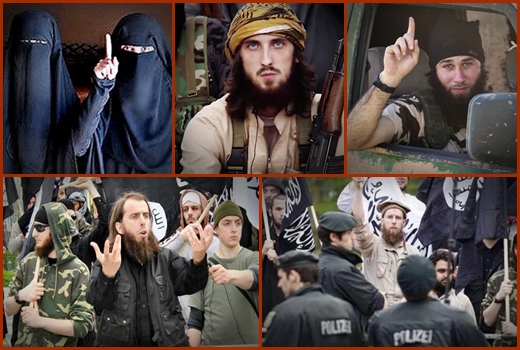
An Iranian university professor has said that Western youth join ISIS in pursuit of serenity and a respite from senselessness and monotonous life which prevails in Europe.

Ebrahim Fayyaz, a professor of social sciences at the University of Tehran, made the comment in an interview with Mosalas, a weekly news magazine (the 289th issue) and added that the Western civilization has got closer to the verge of collapse for which monotonousness is to blame. During the extensive interview, Dr. Fayyaz took a sociological look at the reasons why European youth are lured to join ISIS, the terror group’s notorious ideology, as well as the Arba’een March and its goals and message, violence in the name of Islam, and the exit strategies.

The following is PART TWO of the translation of the professor’s remarks on the presence of Western youth in the ranks of ISIS terrorists:

The Western world and ISIS appeal to the youth

The first reason behind ISIS recruitment of young people is capitalism in Europe which has been prevailing there for years and has rendered everything monotonous and senseless. The new generations of Europeans show reactions to such monotonous rhythm of life and senselessness and complain about their uncertain future.

In the 1960s, the youth in France had complaints about the dominant senselessness, monotonousness and rationality in Europe. As a result the student movement was established in 1968. The structures that emerged in the 1970s and 1990s gave rise to postmodernism and thus such senselessness came to the surface more than before. Economic factors too came into play and it became clear that the stage was set for the growth of the movement in suburban Paris.

Members of this movement – even if they were highly educated – were treated as second- and third-class citizens in France. If they were Arabs of Moroccan or Algerian origin, they were viewed as Arab servants. I’ve heard it from Iranian expatriates in France that even those members of this movement who have found their way into top partisan tiers, are still known as Arab servants. It means that a sort of modern slavery is in place in France by which some ostensibly free people are treated as slaves.

In other words, suburban Paris has been enslaved by urban Paris. That night an attack was launched by suburban Paris against urban Paris where plays and music were performed, and the rich bought tickets to watch a football match. Urban Paris is home to the old aristocracy in France which has taken on a new form.

Suburban Paris, by contrast, is the place where the second and third class citizens live and are bitterly opposed to and disapprove of urban Paris. Protests are ongoing in a violent fashion and it is just the beginning. Perhaps the French government and state institutions can clamp down on this movement militarily, but they cannot deliver a cultural blow to it and the movement will reproduce its own culture.

A case in point is the cultural reproduction of the black community in the US in defiance of slavery, although there is no end in sight to the violent treatment and willing killing of the blacks in the US. Although dominated by capitalism, the West is extremely racist. They claim that they are against racism, but the reverse holds true. They have strong belief in racism. The blacks are given a racial treatment in the United States, and in France migrants, Arabs, residents of suburban Paris and non-Parisians suffer from racial discrimination.

These people are extremely humiliated in France and their French accent is demeaned. Aristocracy is ruling there through capitalism. Rightist parties led by Ms. Marine Le Pen represent the aristocracy, with socialists being in charge of executive leadership. The socialists who lead the highest social class in France have disguised themselves in socialism clothing to pursue their capitalist agenda.

Institutionalization of ISIS ideology among European youth

Two points should be discussed here: How are the youth lured to join ISIS? Will these young people carry out ISIS-style measures when they return to countries such as Germany? I should clearly say that such measures will never be carried out in Germany and Britain, and if they do happen, it would be on a limited scale, thanks to a special structure in these countries which does not allow it. But such measures are doable in France due to its culture.

The reason why the ISIS discourse is appealing in Europe and can lure the youth should be traced to the viewpoints of Ibn Khaldun [a Muslim historiographer and historian, regarded to be among the founding fathers of modern sociology, historiography, demography, and economics].

The civilized areas with sedentary culture [In cultural anthropology, sedentism (sometimes called sedentariness) simply refers to the practice of living in one place for a long time] are strongly corrupt. Repetition and senselessness are the order of the day in such areas, aristocracy has been institutionalized and life – in different periods of time – is monotonous and unchanged.

At this point, people who make up the population of society feel a spiritual void and look for a way to reclaim spirituality. Since ISIS is apparently an Islamic group, Muslims in Europe who have been extremely humiliated join the [terror] group in pursuit of serenity and a respite from senselessness and monotonous life.

For instance, a Japanese man who used to live in Tokyo had joined ISIS although he was not a Muslim. Asked about the reason why he had joined the group, he said that he was sick and tired of living a senseless life in Tokyo, adding that he had joined ISIS to overcome this crisis [of lack of spirituality]!

ISIS is seeking to destroy all signs of civilization and make its presence felt militarily. ISIS is an anti-hygiene group. Those who have had contacts with members of the group say that up close the body odor of ISIS fighters is disgusting. They do not take a shower, because they have a tendency to live a barbaric life in the wild.

ISIS members wear very long beards which are similar to a broom; they dislike shaving, because they want their faces to look like creatures who lived in the pre-human era. They bring to mind the nostalgic situation of the early years after the advent of Islam; they live in deserts, have anti-urban mood and are interested in destruction; that’s why they take a hammer to civilizational and historic works.

On the surface, they want to say that they are fighting against polytheism and atheism, but below the surface they are exactly what Ibn Khaldun has described; ISIS members are nomads who oppose sedentism. [Al-Qaeda leader Osama] Bin Laden and the Taliban too had similar tendencies. Bin Laden took pride in living under the trees in villages getting kicks from giving up on civilization [and living in the wild]. He was the son of a multibillionaire family with a stake in giants such as Football Club Barcelona and Chelsea FC, but he personally found calm in living in Afghanistan’s deserts.

Therefore, the main indicator is an escape from civilization toward an uncivilized society. These individuals seek to leave the harsh, rational, monotonous and closed atmosphere of Europe. They have always lived in cities and have seen no village or desert. A life alive with [action] and excitement is appealing to young people.

This mainly holds true about European Muslims, and non-Muslims in Europe leave for countries such as India to embrace Buddhism. I have encountered such people in the deserts of India and Thailand who have shown tendency toward mysticism.

The Western civilization has hit the peak of civilizational rationality and offers no option for the future. It has reached its end .The Western civilization is going around in circles; no thinker in the West can say that they are elite. They all say that they have become Easternized. The West, which is creating knowledge-based structures such as postmodernism, is returning to the East. […]

Today nobody enjoys calm and tranquility in the West; they have no hope in the future; they are in present time moving around in circles, and this has rendered them [mentally or psychologically] exhausted.

Political leaders in Europe are suffering from a kind of stupidity and mental backwardness, something which can be referred to as civilizational stupidity; when civilization makes everything rational, monotonous and circular, nothing will be left for the future. That’s why young Muslims in Europe join the ranks of ISIS and non-Muslims are blended into the nihilistic movements of Buddhism in India, China, Thailand, and so on. This reveals that the Western civilization is on the verge of collapse and monotonousness is to blame for it.

What comes next is military action which takes a toll [on nations]. ISIS carries out military operations and deals a blow to France. The United States is losing its clout in the Middle East and cannot serve its own interests in this region. The US has a two-pronged approach to dealing with the Middle East: on the one hand, it is leading the fight against ISIS, and lends logistical and military support to the [terror] group on the other hand.

This brings us to the conclusion that the Western civilization has hit a cul-de-sac, mentally and structurally. The paradigm the West has introduced has failed. The Western paradigm – referred to as a knowledge-based structure which is expected to respond to the questions raised by the young people and the generations to come – is no longer existent, neither for the West, nor for other countries.

We can say with certainty that formation of groups such as ISIS has been the [direct] result of the West’s failed paradigm. In other words, the Western civilization has suffered a paradigmatic failure and is undergoing a paradigmatic revolution.

Rational discourses such as Shiism – building on the wisdom of Imam Ali and under the umbrella of Imam Hussein – can get a big job done by charting the Revolution’s course. Today people can properly take care of this objective.

[…]

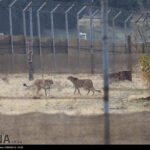
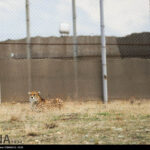
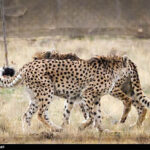
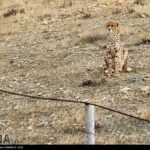
International Cheetah Day (PHOTOS)

Cheetah Day0

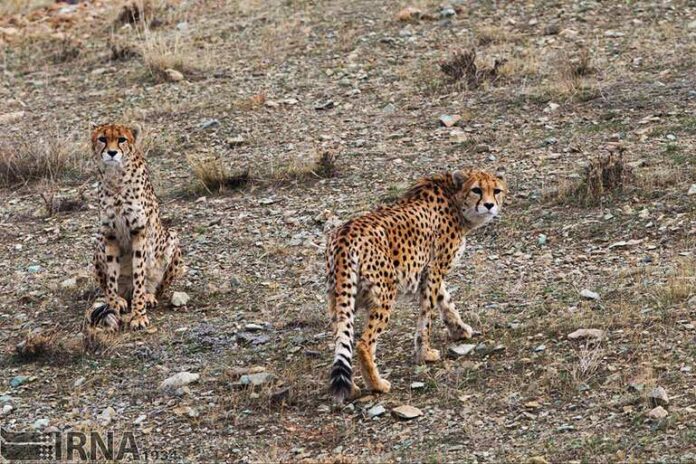
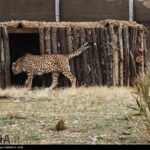
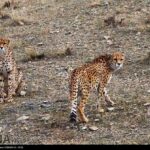
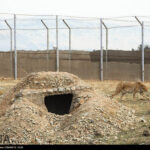
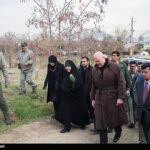
International Cheetah Day was commemorated in a ceremony at Pardisan Park on Sunday with director of the Environment Protection Organization Masoumeh Ebtekar and United Nations Resident Coordinator in Iran Gary Lewis in attendance.

Pardisan Park, a research site in Tehran, is home to two Asiatic Cheetahs, namely Delbar (female) and Kooshki (male).

The following images of the ceremony have been released by IRNA News Agency:

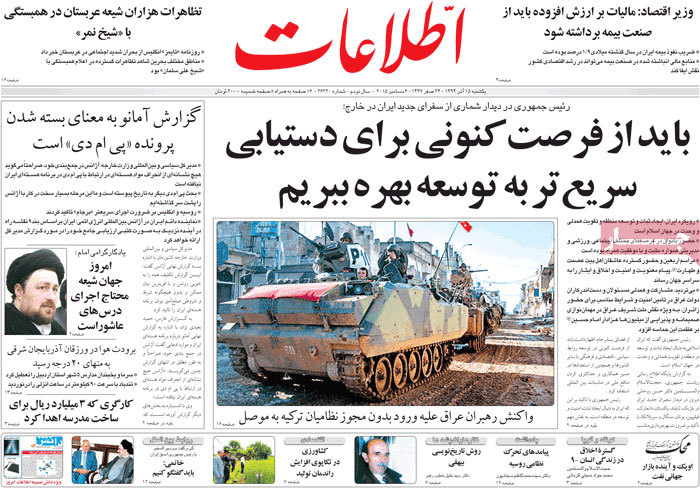
A look at Iranian newspaper front pages on Dec. 6

Iranian Newspapers Headlines

The comments of President Rouhani at a meeting with nine Iranian new ambassadors to other countries dominated the front pages of Iranian newspapers on Sunday.


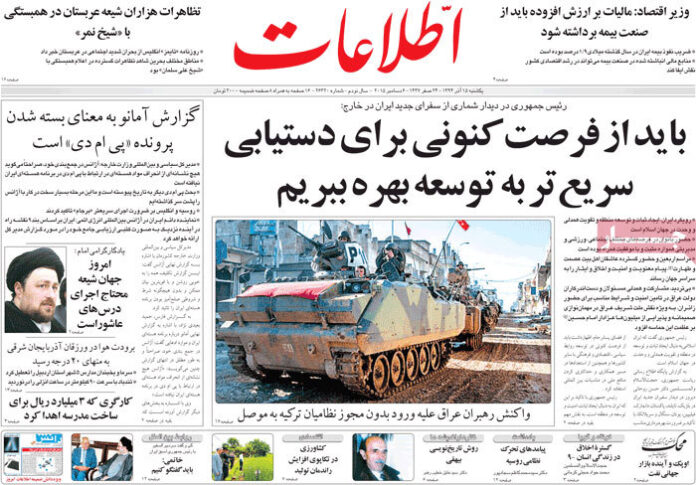
Ettela’at: The existing opportunity should be seized to secure faster growth, President Rouhani said at a meeting with a number of new Iranian ambassadors before their departure on their missions.

He further said that Iran’s policy is based on regional development and stability and promotion of unity across the world of Islam.


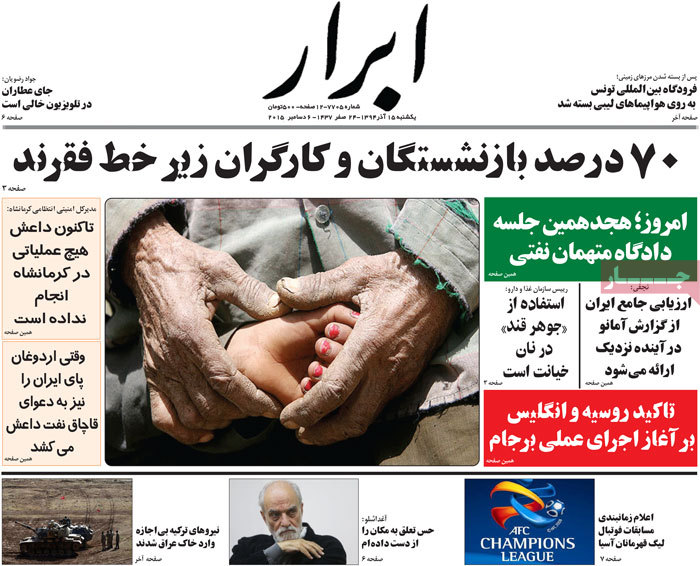
Abrar: Russia and Britain have underlined practical measures to implement the Joint Comprehensive Plan of Action.

Abrar: Daesh operatives have carried out no terrorist attacks in Kermanshah, said the director general of the security office of Kermanshah Police Department.


A look at Iranian newspaper front pages on Dec. 6


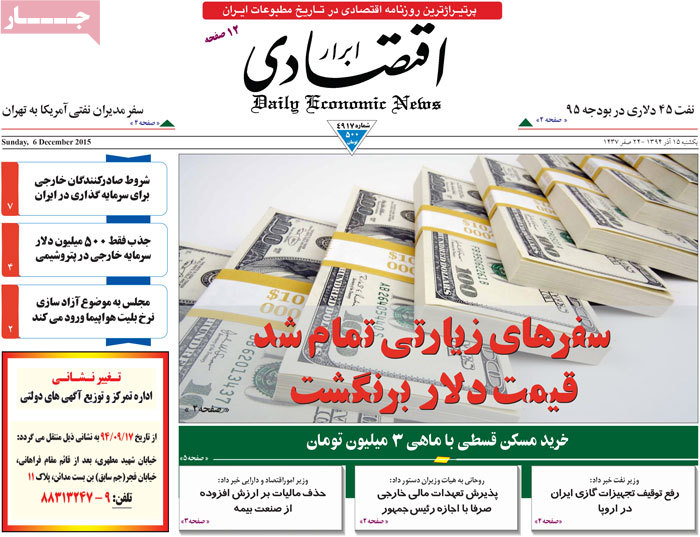
Abrar-e Eghtesadi: American oil executives to visit Iran

Abrar-e Eghtesadi: The petrochemical sector has only drawn $500 million in foreign investment.


A look at Iranian newspaper front pages on Dec. 6


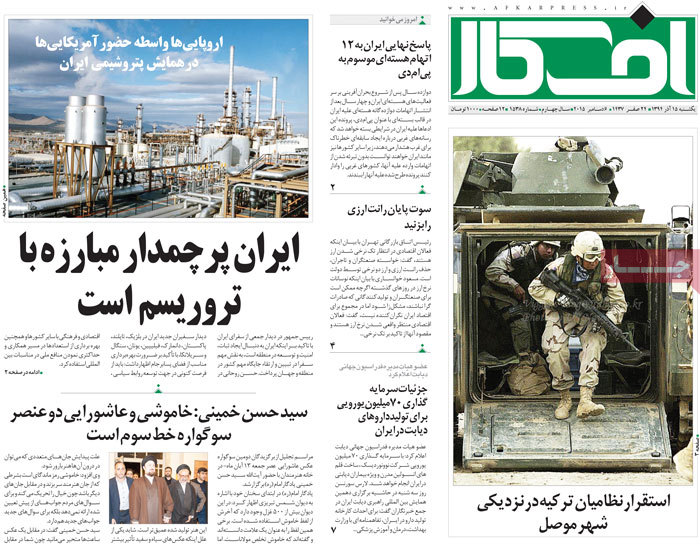
Afkar: The Europeans acting as a mediator for American presence in Tehran petrochemical conference


A look at Iranian newspaper front pages on Dec. 6


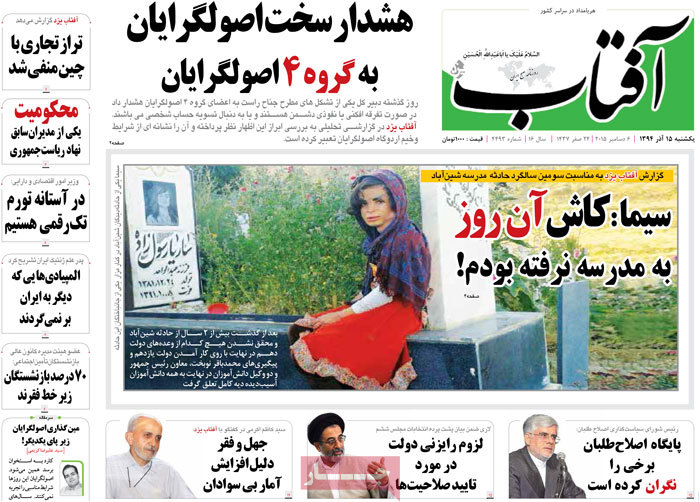
Aftab-e Yazd: Abdolvahed Mousavi Lari, a reformist leader, has called on government to engage in lobbying [with the Guardian Council] over the screening of candidates for upcoming elections.
 

A look at Iranian newspaper front pages on Dec. 6


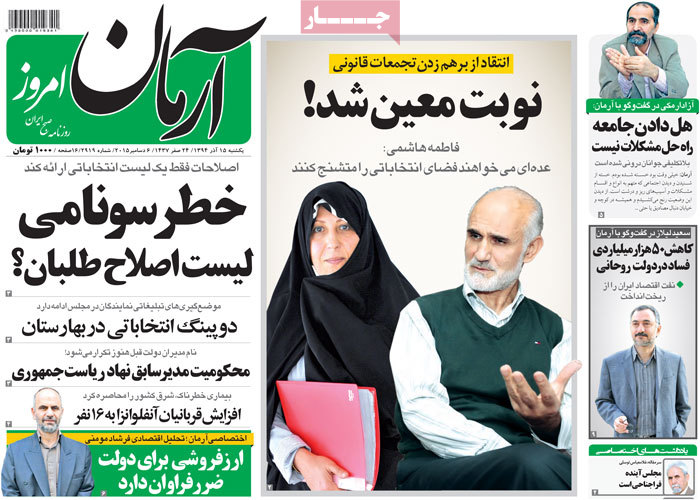
Arman-e Emrooz: The number of flu victims in the country has risen to 16.

Arman-e Emrooz: Corruption is down by almost $17 billion in the Rouhani administration, said Saeed Laylaz, a top economist, in an interview with the daily.


A look at Iranian newspaper front pages on Dec. 6


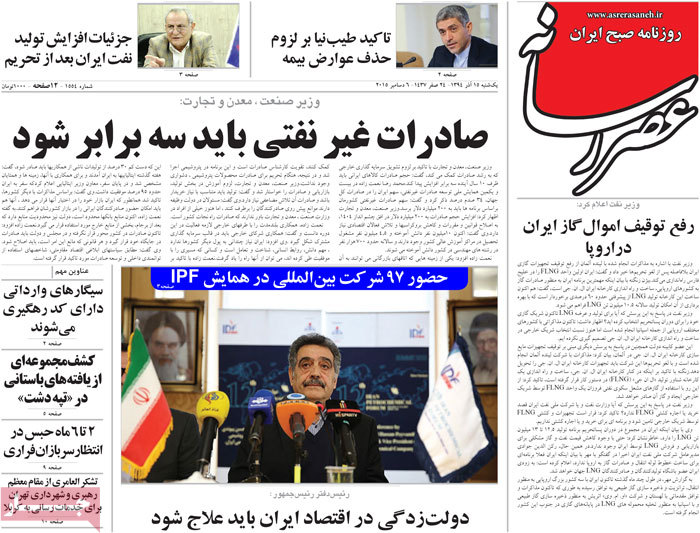
Asr-e Rasaneh: The oil minister has said that Iran’s gas assets in Europe have been unfrozen.


A look at Iranian newspaper front pages on Dec. 6


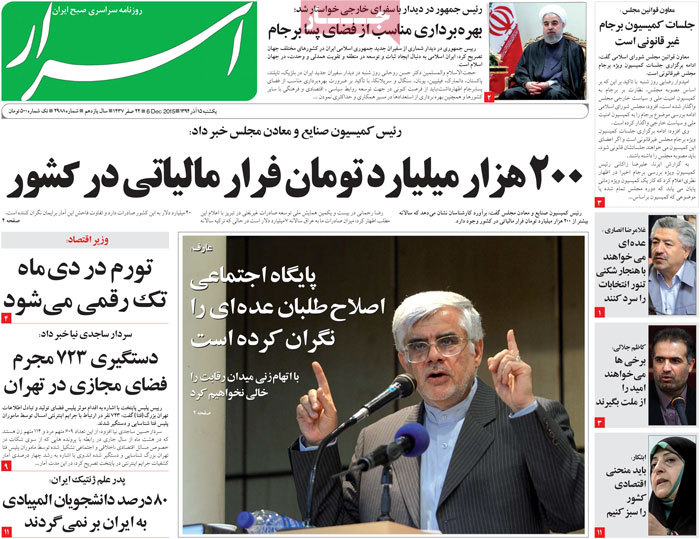
Asrar: A senior parliamentary official has said that continued meetings of the chamber’s JCPOA Review Committee are illegal.

Asrar: The chairman of parliament’s Industries and Mines Committee has said that tax evasion exceeds $65 billion a year.

Asrar: The economy minister has said that inflation will slip into single digits next month.

Asrar: Police have arrested 723 individuals for cybercrimes.


A look at Iranian newspaper front pages on Dec. 6


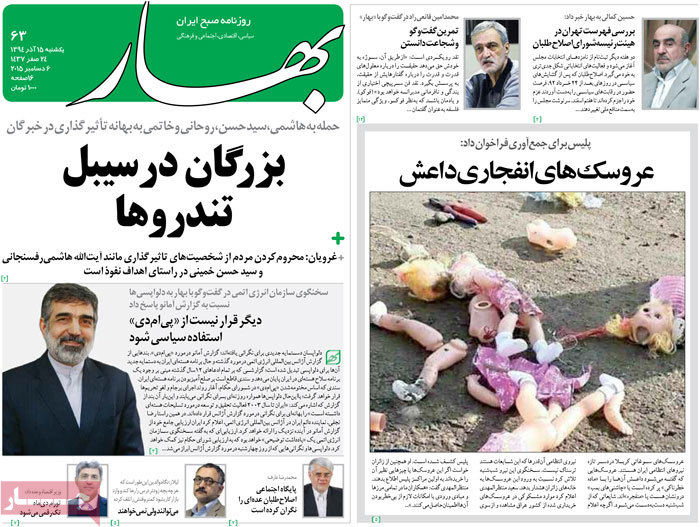
Bahar: The PMD will no longer be used as a political tool, said the spokesman of the Atomic Energy Organization of Iran in an interview with the daily.


A look at Iranian newspaper front pages on Dec. 6


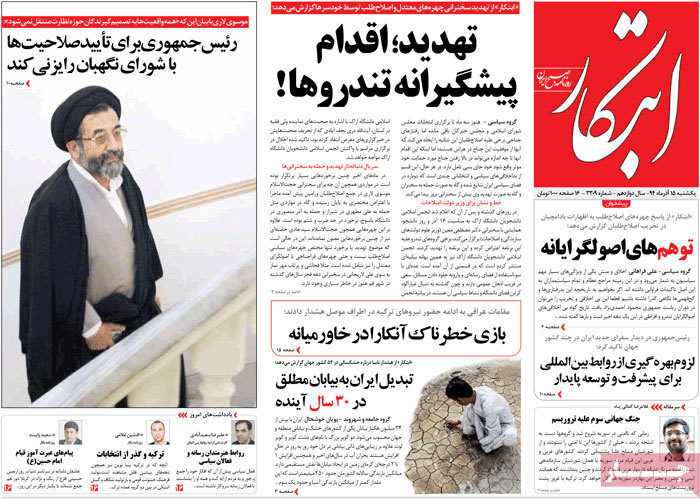
Ebtekar: Threats, a hardliner preventive measure of choice!

The daily takes a closer look at threats issued by rogue elements against gatherings in which moderate and reformist figures deliver a speech.


A look at Iranian newspaper front pages on Dec. 6


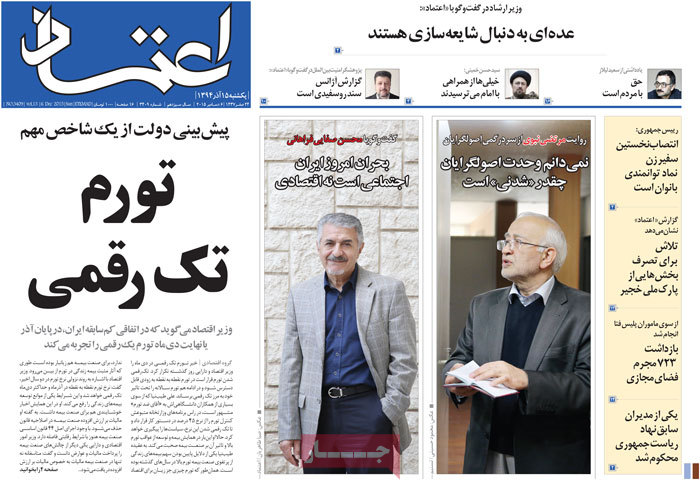
Etemad: A former manager at the Presidential Office has been found guilty [for obstruction of justice by failing to provide the document he was asked to hand in to the Inspection Committee of the Presidential Office].


A look at Iranian newspaper front pages on Dec. 6


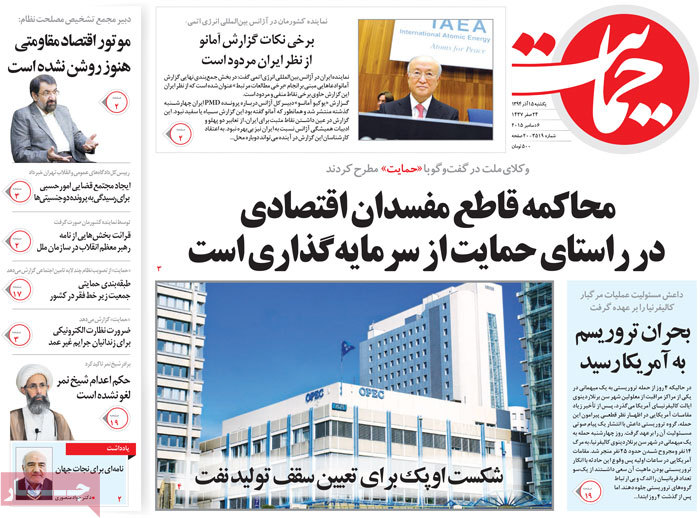
Hemayat: MPs have called for corrupt individuals to be seriously dealt with in a bid to support investment.


A look at Iranian newspaper front pages on Dec. 6


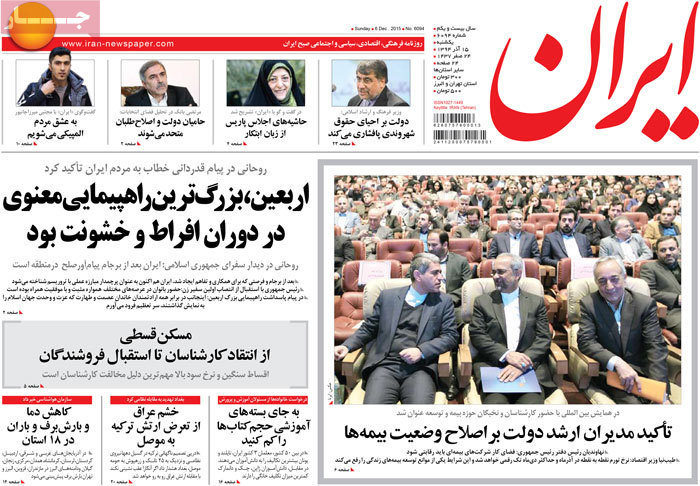
Iran: The minister of culture and Islamic guidance has said that the administration insists on the revival of civil rights.


A look at Iranian newspaper front pages on Dec. 6


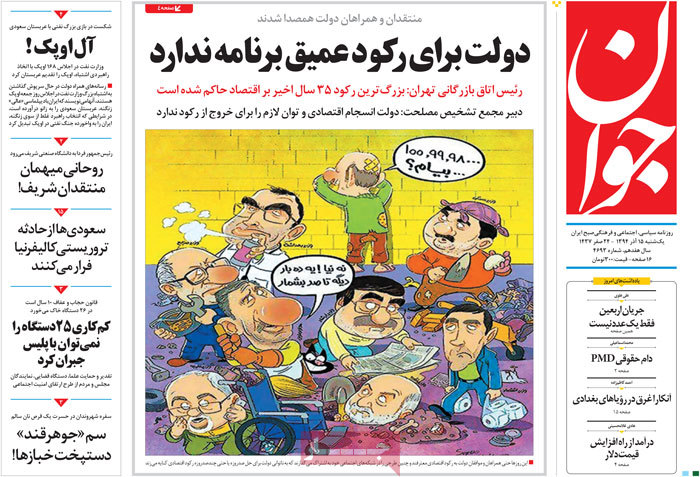
Javan: The Rouhani government has no plans to lift the country out of deep recession.


A look at Iranian newspaper front pages on Dec. 6


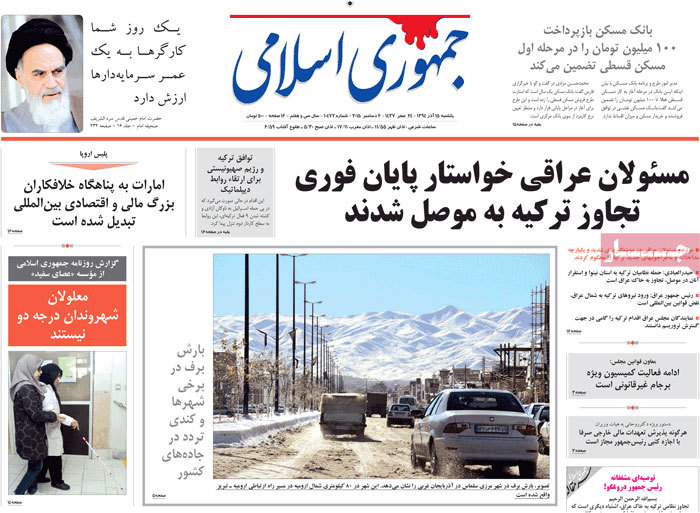
Jomhouri Islami: Autumnal snowfall in some areas has slowed down traffic on roads.


A look at Iranian newspaper front pages on Dec. 6


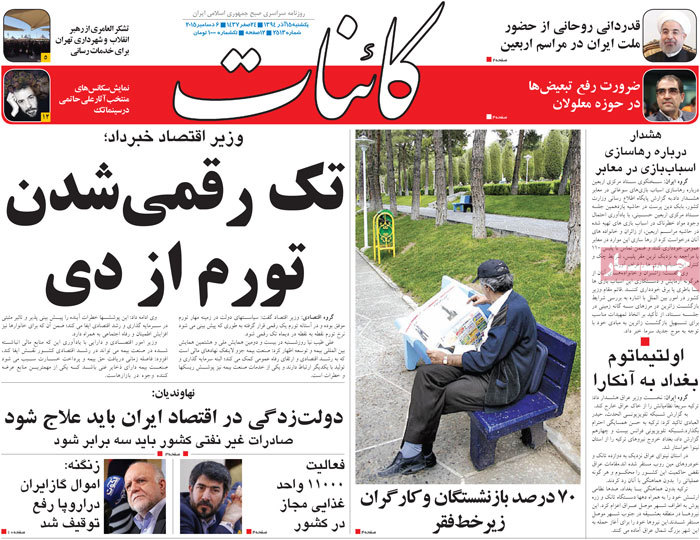
Kaenat: The head of Iraq’s Badr Organization has thanked the Leader and Tehran Municipality for rendering assistance to his country to organize the Arba’een ceremony.


A look at Iranian newspaper front pages on Dec. 6


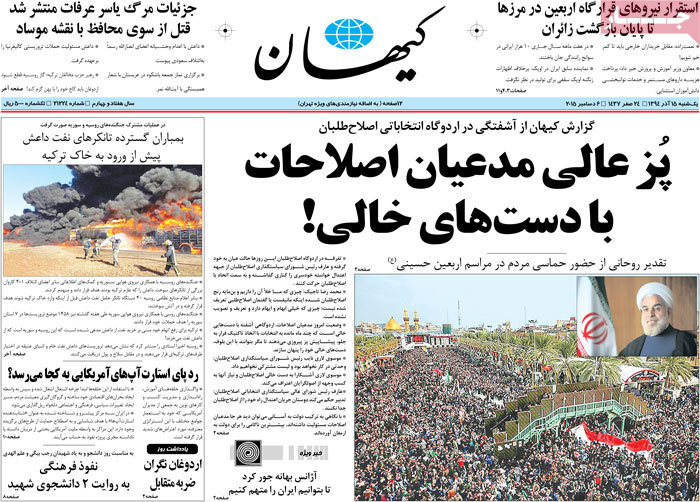
Kayhan: Russian and Syrian fighter jets pounded IS oil tankers before they crossed the border into Turkey.

Kayhan: New details about the death of Yasser Arafat are out; a bodyguard acted on a Mossad plot and killed the former Palestinian leader.


A look at Iranian newspaper front pages on Dec. 6


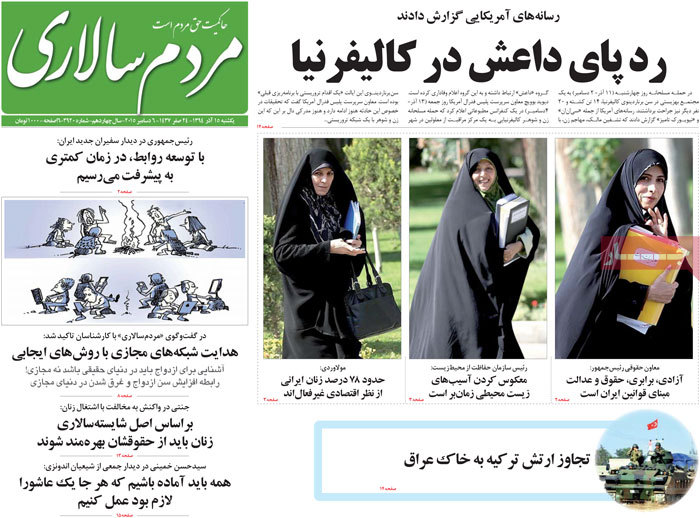
Mardomsalari: The director of the Environment Protection Organization has said that reversing the harms the environment has suffered is time-consuming.

Mardomsalari: The vice-president for women and family affairs has said that 78 percent of Iranian women are economically inactive.


A look at Iranian newspaper front pages on Dec. 6


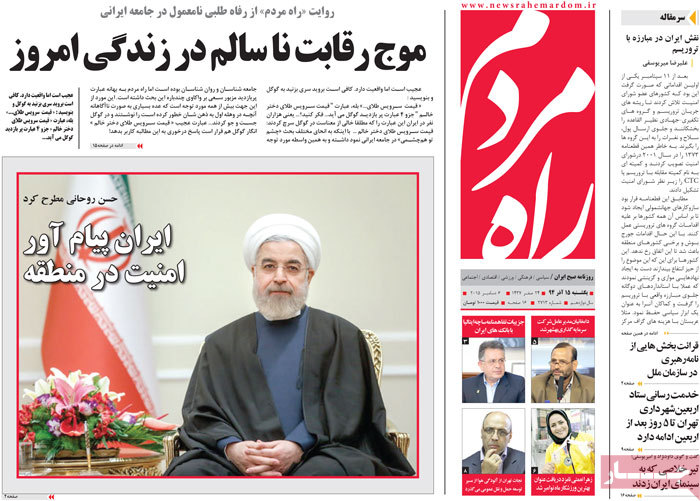
Rah-e Mardom: Part of the Leader’s letter [to Western youth] has been read out at the United Nations.


A look at Iranian newspaper front pages on Dec. 6


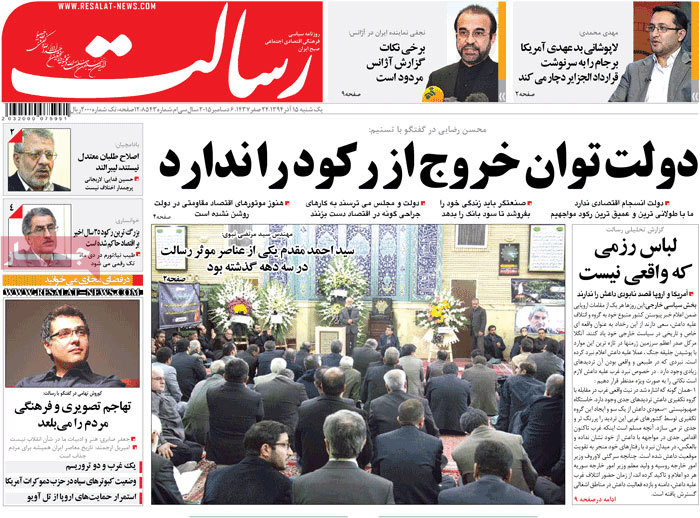
Resalat: The secretary of the Expediency Council has said that the government is unable to lift the country out of recession.


A look at Iranian newspaper front pages on Dec. 6


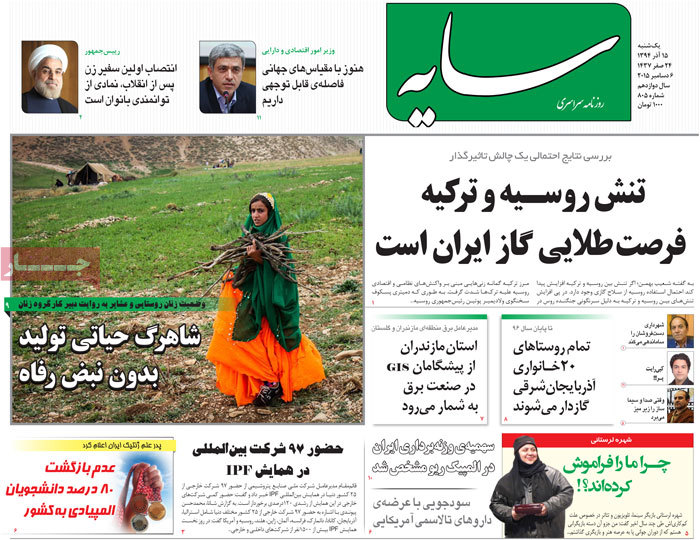
Sayeh: Appointment of the first female ambassador after the Islamic Revolution is a manifestation of the capabilities of Iranian women.


A look at Iranian newspaper front pages on Dec. 6


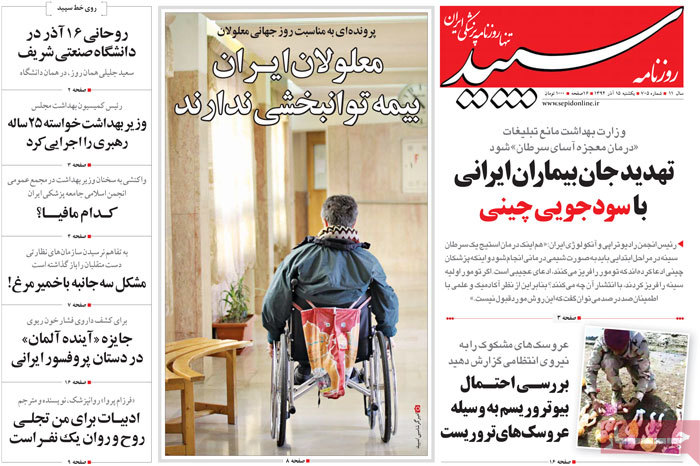
Sepid: To mark University Student Day, President Rouhani will go to Sharif University of Technology.


A look at Iranian newspaper front pages on Dec. 6


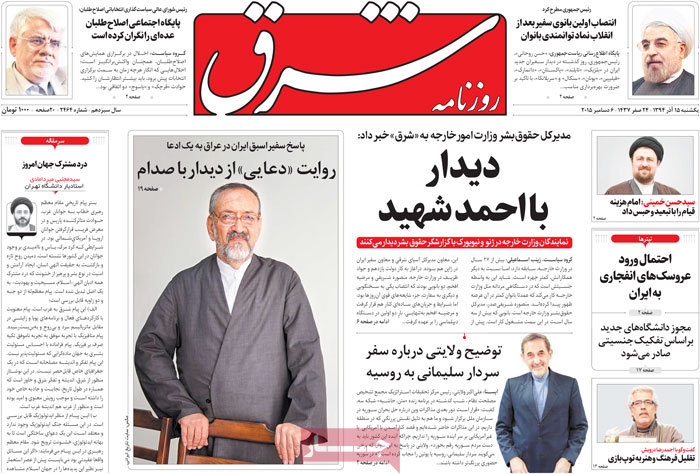
Sharq: A meeting with Ahmed Shaheed

Representatives of the Iranian Foreign Ministry will hold talks with the UN Human Rights Rapporteur in Geneva and New York.


A look at Iranian newspaper front pages on Dec. 6


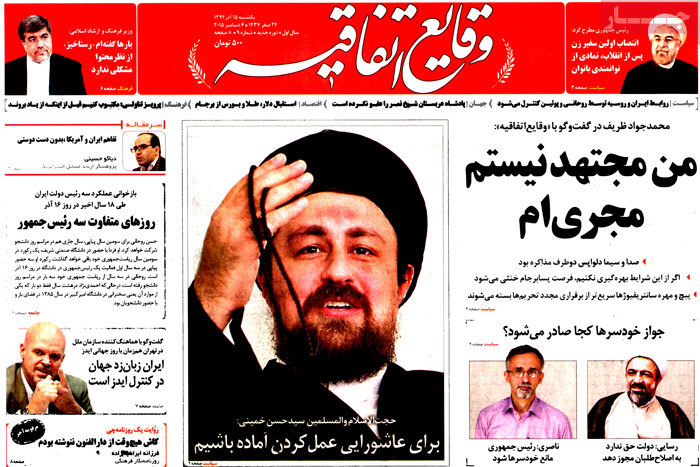
Vaghaye-e Etefaghiyeh: Foreign Minister Mohammad Javad Zarif said that he is not an analyst, rather he is an executive.

In an exclusive interview with the daily, the top diplomat said that failure to act on the conditions that have emerged in the wake of the nuclear deal will see the opportunity slip away.

He further said the nuts and bolts of centrifuges will be back in place even faster than the re-imposition of sanctions.

Vaghaye-e Etefaghiyeh: Hamid Rasaei, [a hardline principlist MP] has said that the government has no right to authorize reformist gatherings.


A look at Iranian newspaper front pages on Dec. 6


Highlights of Ettela’at newspaper on Dec. 6

Ettelaat

 The existing opportunity should be seized to secure faster growth, President Rouhani said at a meeting with a number of new Iranian ambassadors before their departure on their missions.

He further said that Iran’s policy is based on regional development and stability and promotion of unity across the world of Islam.

 Iraqi leaders have reacted to Turkey’s unauthorized military deployments in northern Iraq.

Prime Minister Haider al-Abadi has called for the immediate pullout of Turkish forces from Iraqi soil.

President Fuad Masum has slammed the incursion as flagrant violation of international law.

 The economy minister has called for the insurance industry to be exempted from VAT.

He further said that the finances accumulated in the insurance industry can instead play a role in the country’s economic growth.

 Thousands of Saudi Shiites have staged a rally in solidarity with Ayatollah Nimr al-Nimr.

And the Times reported that Saudi Arabia is grappling with a simmering social crisis.

 The report the IAEA director general has issued on Iran’s nuclear case will translate into the closing of the possible military dimension (PMD) case.

 The grandson of the late Imam Khomeini has said that the modern-day Shiism needs to implement the lessons taken away from the uprising of Imam Hussein.

 Temperatures have plunged to -20º C in Varzaghan, East Azerbaijan Province.

 A worker gave away all the $100,000 he received in inheritance for completion of a school project.


Iran to present assessment of Amano’s report soon: Envoy

139406201648251326065474 (1)

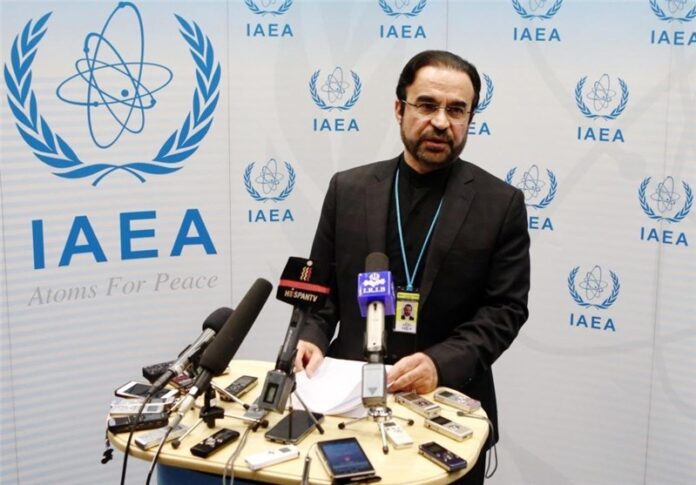
Iran’s Ambassador to the International Atomic Energy Agency (IAEA) Reza Najafi said the country will soon present its assessment of a recent report by the UN’s nuclear watchdog about Tehran’s nuclear program.

“Based on Article 9 of the Road-map, the Islamic Republic of Iran will submit its comprehensive assessment of the report by IAEA Director General (Yukiya Amano),” Najafi said in reference to the report titled “final assessment on past and present outstanding issues regarding Iran’s nuclear program.”

The report on the so-called PMD (possible military dimensions) in Iran’s nuclear program, which was released on Wednesday by the IAEA, confirmed that the agency has no credible indications of suspicious work in Tehran’s nuclear activities.

The document will be the basis of one final report by the IAEA Board of Governors that is expected to close the case on the alleged PMD in Iran’s nuclear program once and for all.

Najafi further said although the report is indicative of non-diversion of Iran’s nuclear program and proves that all allegations against Tehran over the past 12 years have been false, it does contain “some negative points” which are rejected by Iran.

As part of a Road-map signed between Iran and the IAEA in July, the agency is required to finish its investigations about Iran’s nuclear activities and submit a report to the Board of Governors by December 15.

The Road-map was signed on the same day that Tehran and P5+1 reached a conclusion on a lasting nuclear agreement, known as the JCPOA.

The IAEA has been given the role of verifying Iran’s commitments under the Joint Comprehensive Plan of Action (JCPOA).

The agreement was officially adopted on October 18, and is going to take effect within weeks.

Rouhani: Iran heralds international campaign against terrorism

Rouhani

President Hassan Rouhani said on Saturday that the Islamic Republic of Iran heralds the international campaign against terrorism and will spare no efforts to bring stability and security to the countries in the region.

President Rouhani made the remark in a meeting with Iran’s new ambassadors to Senegal, Thailand, the Philippines, Belgium, Pakistan, Denmark, Greece, Sri Lanka and Malaysia.

President Hassan Rouhani said that implementation of the Joint Comprehensive Plan of Action has created suitable opportunity for expansion of cooperation with the world countries.

Arba’een was a good opportunity for demonstrating the power of Islam in the world, President Rouhani said.

The Islamic Republic of Iran is willing to develop solidarity and unity among Islamic Ummah, he said, adding that the country will broaden ties and relations with other countries as well as brotherhood and affinity among world Muslims.

President Rouhani prayed for success of the Iranian ambassadors on their mission. The new ambassadors vowed to do their best to upgrade relations and cooperation with other countries.

Iran, South Korea to launch shipbuilding JV

5e5ba0f0-3b6e-470b-80ef-12719768f4da

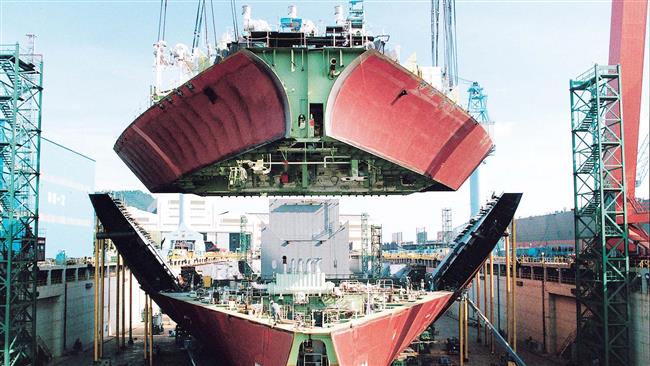
Iran said on Saturday that a deal has been reached with South Korea to launch a joint shipbuilding venture.

The venture will be established between Iran Shipbuilding and Offshore Industries Complex Company (ISOICO) and Hyundai, IRNA reported.

ISOICO Managing Director Hamid Rezaian said that the related consultations as well as key agreements for the move have already been taken care of.

Rezaian said that his company will work over the development of a seventh generation of ships with Hyundai.

He added that marketing and taking advantage of joint markets would be on the agenda of the two companies.

ISOICO, as the Middle East’s largest shipbuilding company, would be a suitable partner for Hyundai, the official said adding that the lifting of sanctions would serve to create attractive investment opportunities for both companies.

Rezaian had announced in late November that ISOICO is looking into partnerships with major international shipbuilders including Hyundai and Germany’s Nordic Yards Wismar.

He added that similar talks have been held with other companies from Italy, China and Turkmenistan.

Iran has a sprawling shipbuilding industry, chiefly devoted to constructing oil tankers and container ships as well as offshore structures.

The country owns the world’s largest fleet of oil supertankers consisting of 42 VLCCs, each able to carry 2 million barrels of oil.

With the removal of the sanctions, the Islamic Republic plans to expand its container fleet in order to extend its forward coverage beyond all frontiers.

Iran’s biggest operator, the Islamic Republic of Iran Shipping Lines (IRISL), wants to place orders for Triple E vessels which can carry more than 18,000 containers, its chairman Mohammad Saeedi said recently.