Sunday, December 21, 2025
Home Blog Page 4675

A look at Iranian newspaper front pages on August 13

Iranian Newspapers Headlines

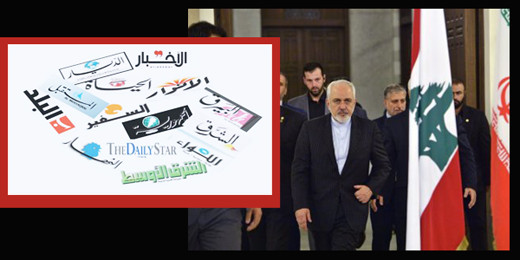
The Lebanon and Syria visits of Foreign Minister Mohammad Javad Zarif where he held talks with his hosts over bilateral ties, regional developments and the nuclear deal Iran and P5+1 cut in Vienna in July dominated the front pages of Iranian newspapers on Thursday. The comments of Secretary Kerry on the negative impact of a likely rejection by Congress of the Vienna accord on the US dollar also appeared on the covers of Iranian dailies.


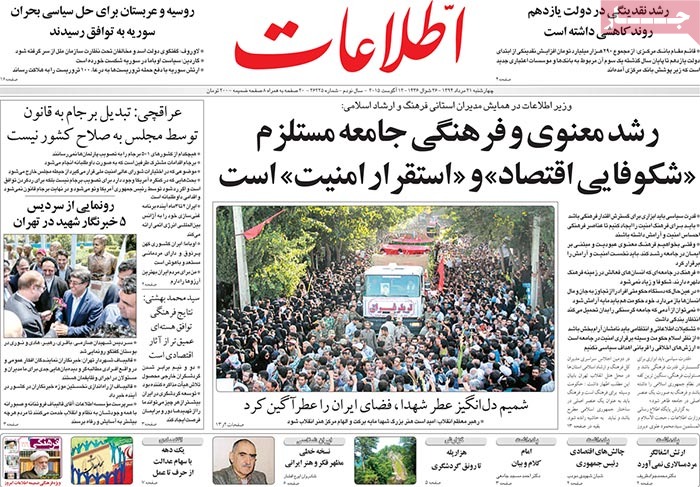
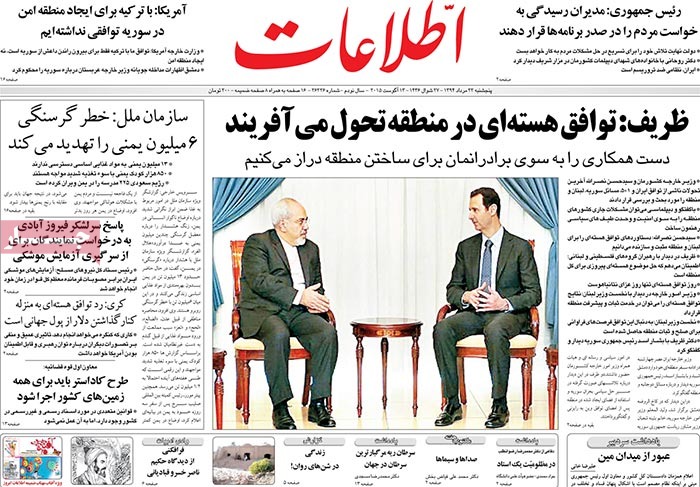
Ettela’at: “The nuclear deal will transform the region,” Foreign Minister Mohammad Javad Zarif said in his meetings with officials in Lebanon and Syria.

“We extend a hand of friendship to our brothers to cooperate in building the region,” the Iranian top diplomat said.


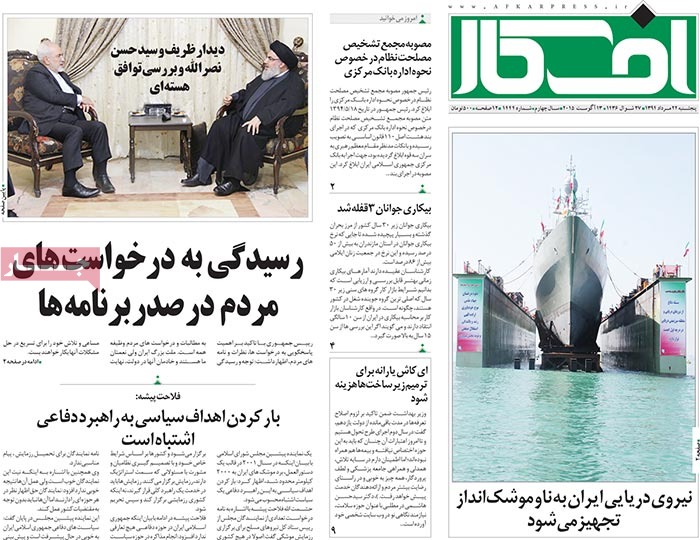
Afkar: The Iranian navy will be equipped with guided missile cruisers.

Afkar: “Inclusion of political goals in the country’s defense strategy is a mistake,” said Heshmatollah Falahatpisheh, a former MP.
 

A look at Iranian newspaper front pages on August 13


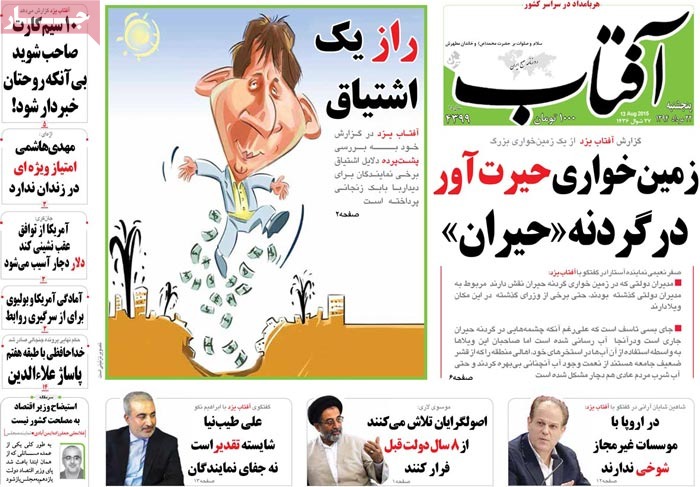
Aftab-e Yazd: “Mahdi Hashemi [a son of the chairman of the Expediency Council] receives no special treatment in prison,” said the judiciary spokesman.

Aftab-e Yazd: Huge land grab along Heyran Road [in the northwest]

An MP has said that individuals with managerial positions in the previous administration have played a role in the land grab and that even some of the previous Cabinet ministers own villas in this area.
 

A look at Iranian newspaper front pages on August 13


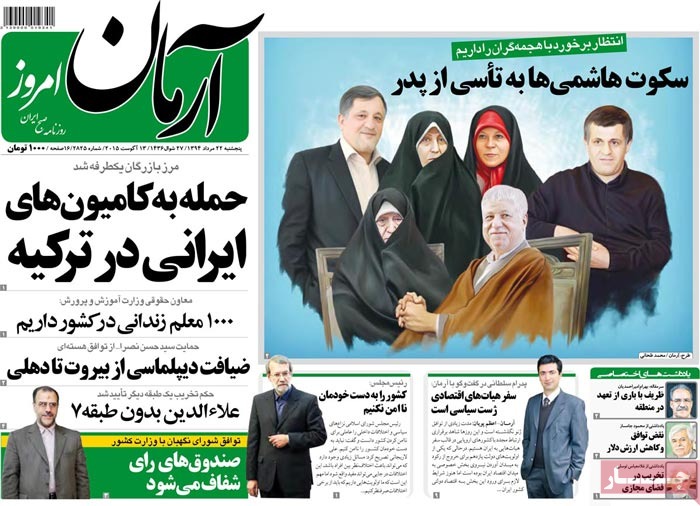
Arman-e Emrooz: Iranian trucks have been attacked on Turkish soil.

Arman-e Emrooz: “We should not make the country insecure through political bickering,” said Parliament Speaker Ali Larijani.
 

A look at Iranian newspaper front pages on August 13


Asr-e Rasaneh: The tomb of Cyrus the Great in Pasargadae has been laser-scanned after the launch of a laboratory to restore stone structures.


A look at Iranian newspaper front pages on August 13


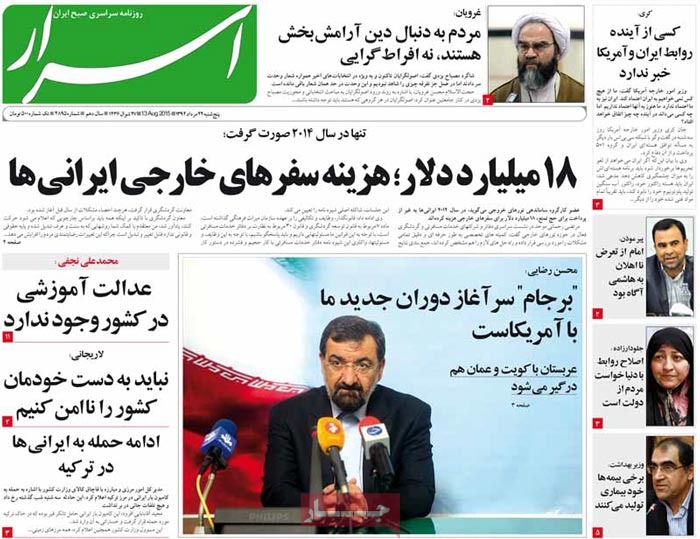
Asrar: Iranians spent some $18 billion on their overseas trips in 2014 alone.

Asrar: “The Joint Comprehensive Plan of Action marks a new beginning between Iran and the United States,” said the secretary of the Expediency Council.
 

A look at Iranian newspaper front pages on August 13


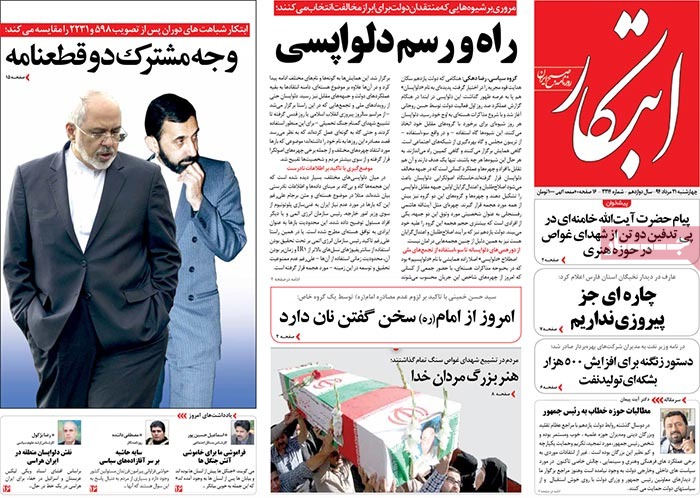
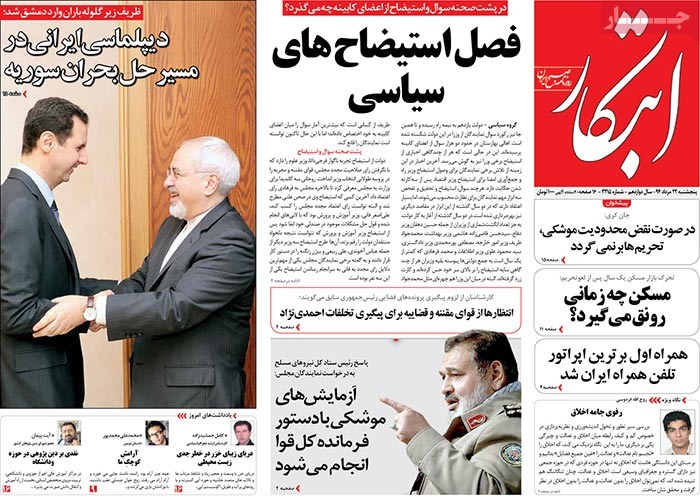
Ebtekar: Iranian diplomacy to settle the Syrian crisis

Foreign Minister Zarif arrived in Damascus as shelling in the Syrian capital was ongoing.
 

A look at Iranian newspaper front pages on August 13


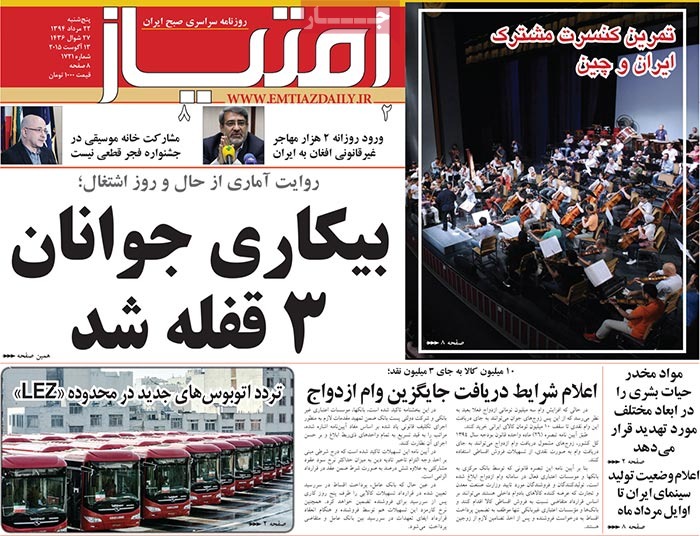
Emtiaz: “An estimated 2,000 Afghan nationals enter Iran illegally on a daily basis,” said the interior minister.
 

A look at Iranian newspaper front pages on August 13


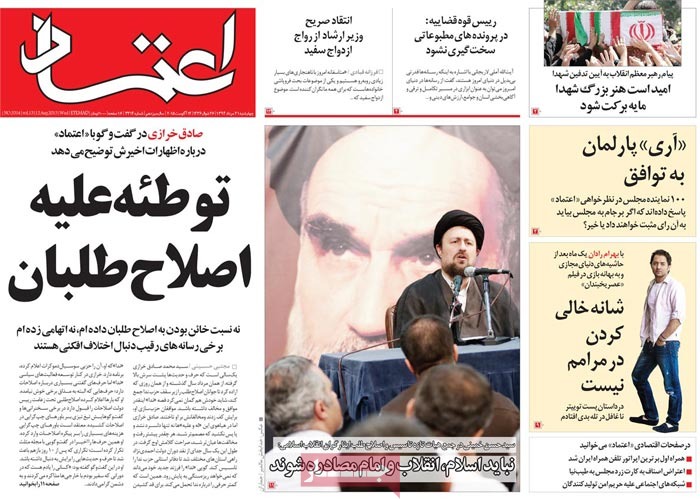
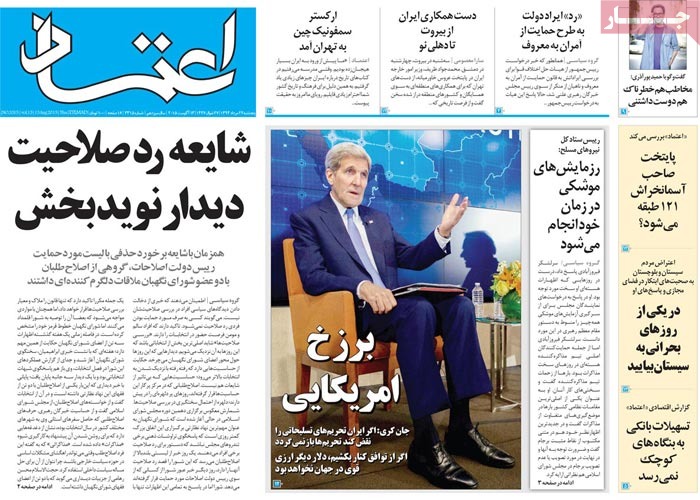
Etemad: The Chinese symphony orchestra has arrived in Tehran.

Etemad: Rumors of disqualification; a promising meeting

A number of reformists have held a promising meeting with two members of the Guardian Council as rumors swirl that the ticket supported by the head of the reformist government [a reference to Mohammad Khatami] will be disqualified.
 

A look at Iranian newspaper front pages on August 13


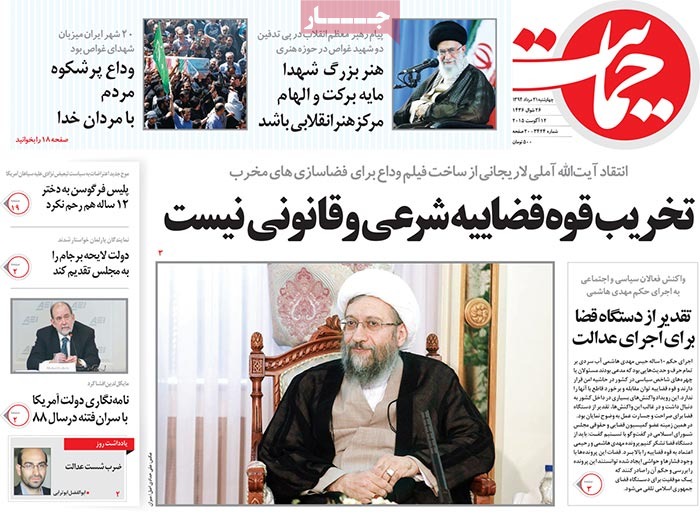
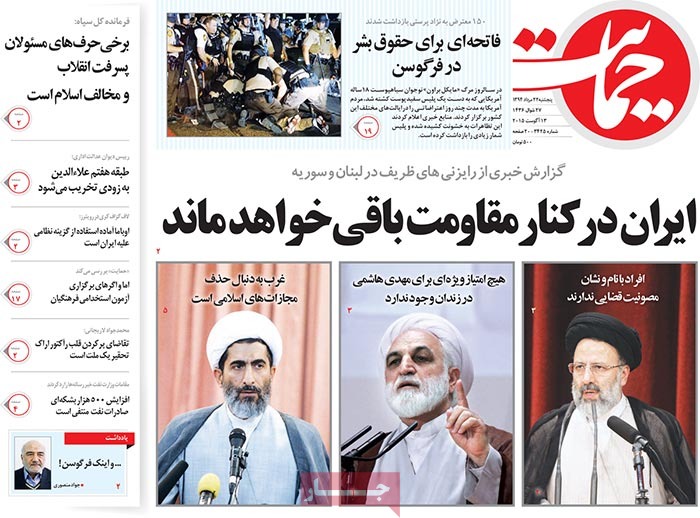
Hemayat: The attorney general has said that fame does not bring immunity from prosecution.

Hemayat: Following a new ruling by the Supreme Administrative Justice Court, a seventh floor of Alaeddin Building in Tehran will be demolished.
 

A look at Iranian newspaper front pages on August 13


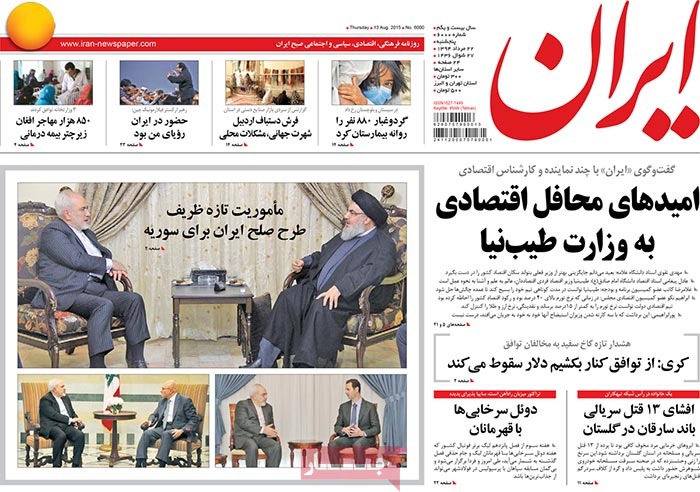
Iran: A dust storm has sent 880 people to hospital emergency rooms in Sistan and Baluchestan.

Iran: A new mission for Foreign Minister Zarif: presenting Iran’s peace plan for Syria
 

A look at Iranian newspaper front pages on August 13


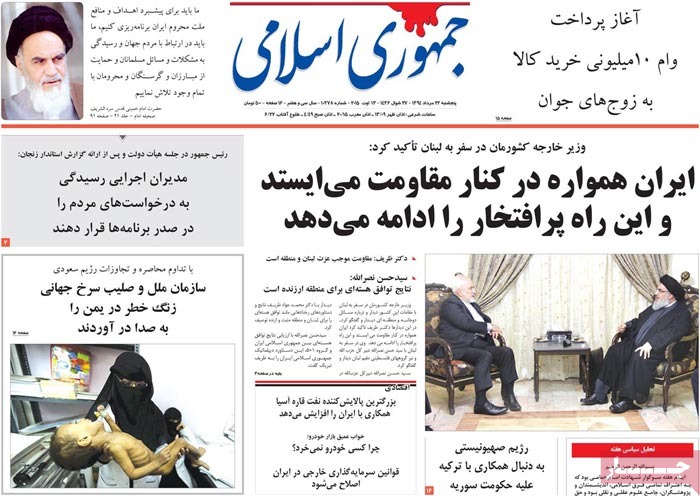
Jomhouri Islami: Laws regulating foreign investment in Iran will be reformed.

Jomhouri Islami: Asia’s largest refinery expands it cooperation with Iran.
 

A look at Iranian newspaper front pages on August 13


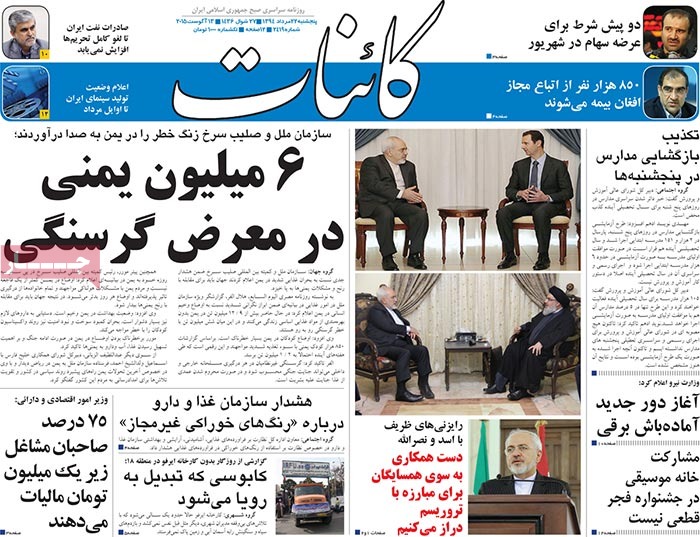
Kaenat: “Some 850,000 Afghan nationals who are in Iran legally will receive health insurance,” said the Iranian health minister.
 

A look at Iranian newspaper front pages on August 13


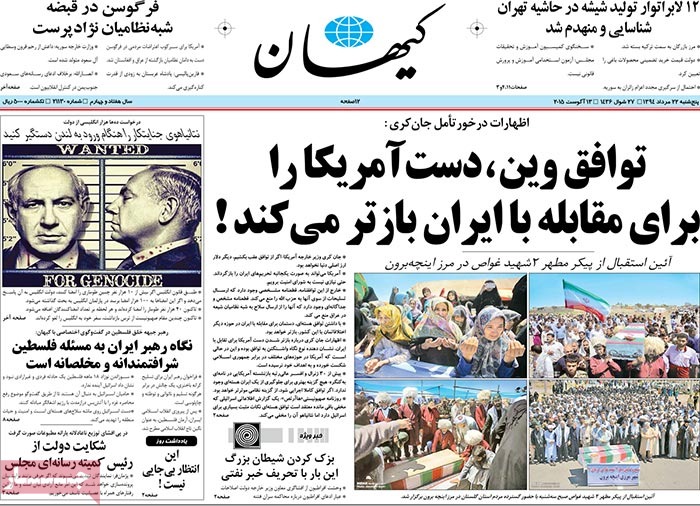
Kayhan: Twelve labs producing meth near Tehran have been shuttered.
 

A look at Iranian newspaper front pages on August 13


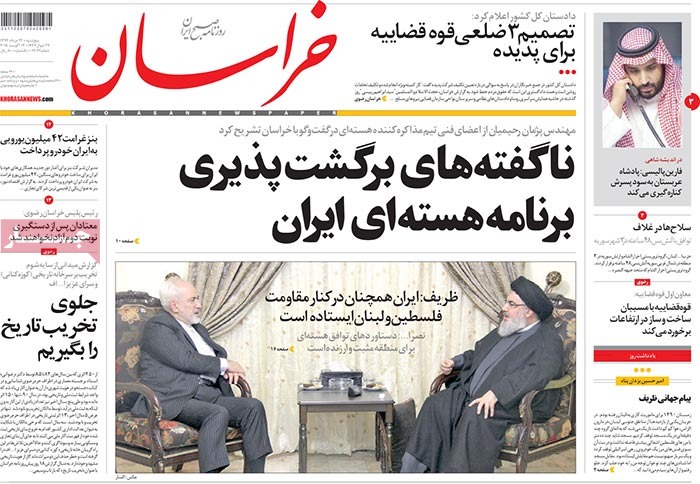
Khorasan: “Iran continues to stand by the Lebanese and Palestinian resistance groups,” said Foreign Minister Zarif.

The leader of the Lebanese Hezbollah told the visiting Iranian FM that the nuclear deal between Iran and P5+1 will have a positive impact on the region.
 

A look at Iranian newspaper front pages on August 13


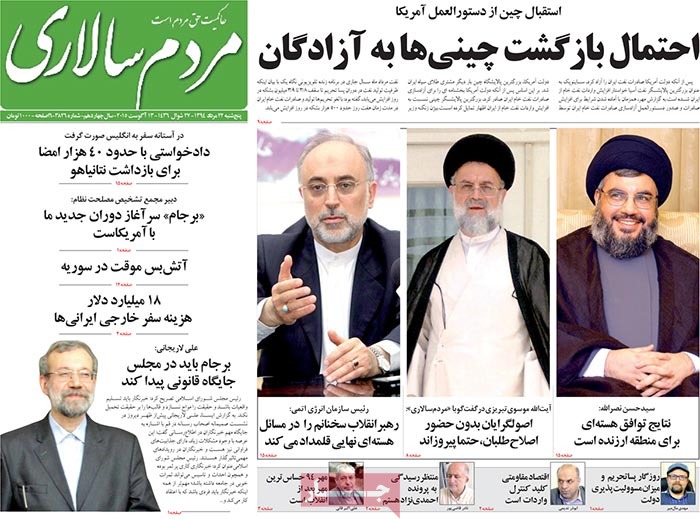
Mardomsalari:”The Supreme Leader views my comments on [technical] nuclear issues as final,” said Ali Akbar Salehi, the director of the Atomic Energy Organization of Iran.

Mardomsalari: Some 40,000 people have signed a petition for Netanyahu to be arrested.

It came ahead of a planned visit to Britain by the Israeli PM.
 

A look at Iranian newspaper front pages on August 13


Rooyesh Mellat: “The Joint Comprehensive Plan of Action should become legally binding in the Islamic Consultative Assembly,” said Parliament Speaker Ali Larijani.
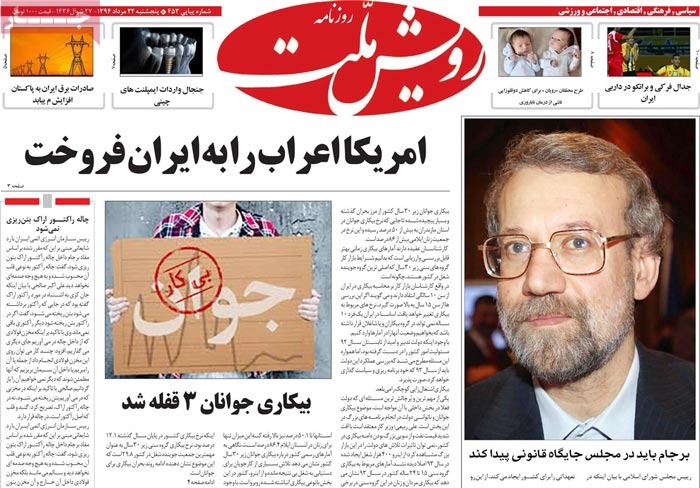
 

A look at Iranian newspaper front pages on August 13


Sayeh: Ministers of the 11th government operating under the shadow of impeachment.
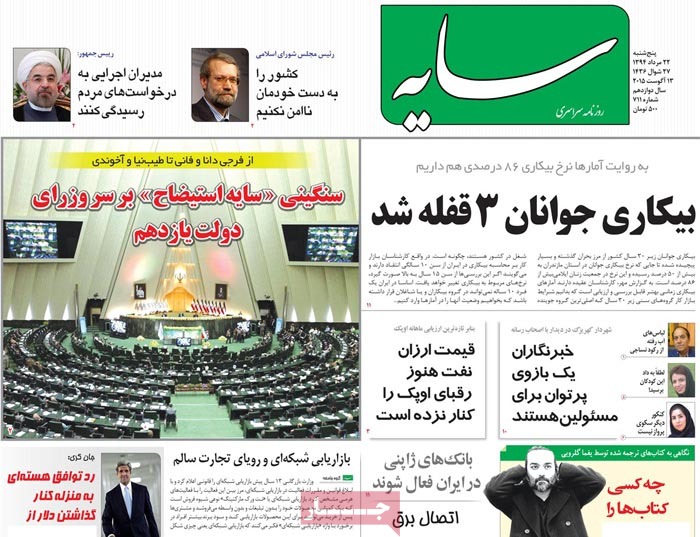
 

A look at Iranian newspaper front pages on August 13


Shahrvand: Turkey is no longer safe, a warning to tourists and businessmen.

Bazargan Border Crossing has been shut down.
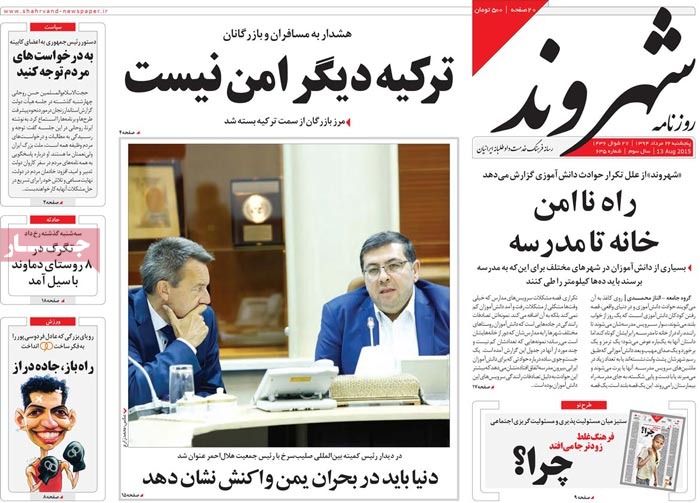
 

A look at Iranian newspaper front pages on August 13


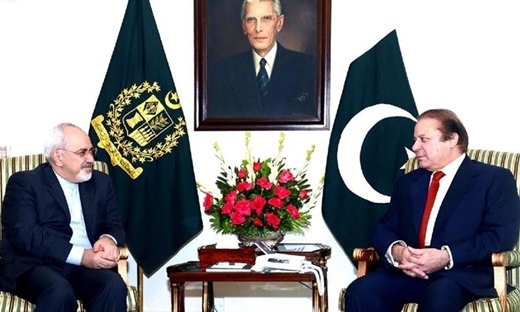
Zarif, Pakistani PM discuss bilateral ties, regional developments

Zarif-Pakistan

Iranian Foreign Minister Mohammad Javad Zarif, who is on a one-day visit to Pakistan, met Pakistani Prime Minister Mohammad Nawaz Sharif in Islamabad and discussed mutual cooperation and regional developments.

The Iranian foreign minister and Pakistani prime minister underlined the need for consolidation of all-out ties between Tehran and Islamabad to further broaden mutual cooperation, especially in the post-nuclear deal era between Iran and six world powers.

Speaking to reporters upon his arrival at Benazir Bhutto International Airport on Thursday morning, Zarif described Iran’s ties with Pakistan – a friendly and neighboring country – as very important, and said that during his visit to Islamabad he will discuss problems and issues that the region is having with Pakistani friends.

He said that one of the most important objectives of his visit to Pakistan is to exchange views on different subjects, especially economic cooperation.

“We are trying to remove the problems that have been created for both countries due to the Western-imposed sanctions,” Zarif said.

“The Islamic Republic of Iran deems as highly important its relations with the neighboring countries and Pakistan is a friend, neighbor and very close to Iran; we have very solid relations with that country in different fields, especially in the cultural area,” Zarif added.

The Iranian foreign minister, meantime, pointed to regional problems, and said, “In view of the fact that some regional countries, including Yemen, Afghanistan and some other regional states are facing different problems, I will consult with the Pakistani allies in this regard as we hope that these consultations will be in the interest of both countries, regional peace and security”.

Zarif will meet his Pakistani counterpart Sartaj Aziz, Pakistani Parliament Speaker Sardar Ayaz Sadeq and Pakistani Senate Speaker Raza Rabbani during his one-day visit to Islamabad.

Zarif and Sartaj Aziz will also attend a joint press conference in Islamabad.

The Iranian foreign minister will meet senior Pakistani officials during his one-day visit to Pakistan.

ICRC lauds Iran over humanitarian aid for Yemen

ICRC-Peter Maurer

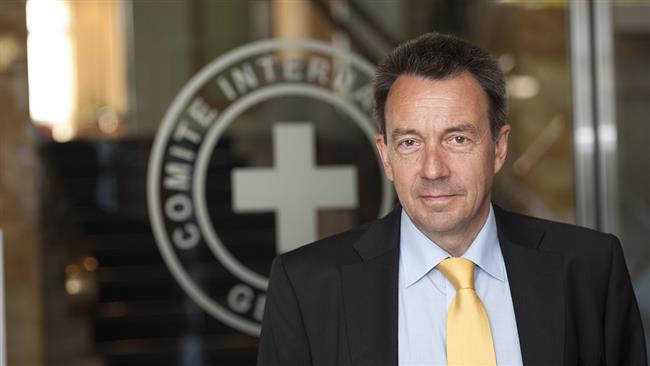
The president of the International Committee of the Red Cross (ICRC) has praised the Islamic Republic of Iran for its dispatch of humanitarian aid consignments to Yemen, where people are being targeted in a Saudi military campaign.

“We are grateful for the expression of support coming from the Iranian Red Crescent Society (IRCS) and the government of Iran for our operations in Yemen,” Peter Maurer said in a meeting with IRCS Secretary General Ali Asghar Ahmadi in Tehran on Wednesday.

Maurer added that humanitarian support for the people of Yemen is a major priority of his Geneva-based humanitarian institution, stating that the ICRC has increased its aid efforts for Yemen twofold in recent days, but a lot more needs to be done to meet the demands in the country.

He also deplored the persistent instability in Yemen, stressing the need for a political solution to the Yemeni conflict. He also pointed to the constant violation of human rights in Yemen, noting that the IRCS is in talks with the sides to the conflict in the Arab country to halt the fighting.

Maurer added that the conflict-stricken people of Yemen are in dire need of even very basic commodities.

Ahmadi, for his part, touched on the hurdles that the IRCS has faced while trying to dispatch aid cargoes to Yemen, saying the organization under his watch has already sent 5,000 tons of relief aid to Yemen.

He also expressed hope that condition will soon become conducive to the dispatch of a consignment of medical supplies to the Arab country.

On April 22, Saudi fighter jets intercepted an Iranian airplane carrying humanitarian aid to Yemen, and prevented it from entering Yemeni airspace.

Following Riyadh’s interception of the Iranian aid flight, Iran’s Foreign Ministry summoned Saudi Arabia’s chargé d’affaires in Tehran to express objection to the move.

On May 22, an Iranian cargo vessel carrying tons of medical aid and foodstuff for Yemen arrived in Djibouti, where international aid efforts for the Arab country are concentrated.

The Iranian ship, dubbed Nejat (Rescue), left the Iranian port city of Bandar Abbas on May 11, and carried 2,500 tons of basic supplies, including flour, rice, medicine, and water. Several international journalists, doctors, and anti-war activists were also aboard the ship.

On March 26, Saudi Arabia began its military aggression against Yemen – without a UN mandate – in a bid to undermine the Houthi Ansarullah movement and restore power to fugitive former Yemeni president Abd Rabbuh Mansour Hadi, an ally of Riyadh.

Tarik Jasarevic, a spokesman for the World Health Organization, said on July 28 that 1,859 civilians were among the total of 3,984 people killed in Yemen until July 19. Local Yemeni sources, however, put the fatality figure at much higher.

Zarif, Assad warn terrorism threatens all countries

Zarif-Asad

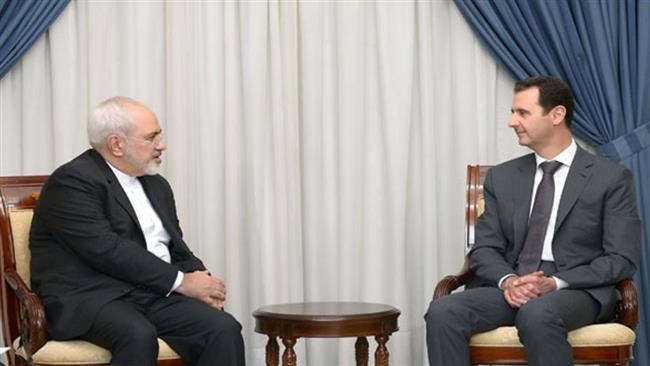
Iranian Foreign Minister Mohammad Javad Zarif and Syrian President Bashar al-Assad have warned against rising terror threats in the Middle East, urging all countries to make sincere efforts to uproot terrorism.

During a Wednesday meeting in Damascus, Zarif and Assad emphasized that the growing wave of terrorism poses a threat to both regional states and other world countries, saying it is necessary for all sides to adopt realistic policies and help cut the support for terror groups.

The two senior officials also discussed ways to settle the deadly crisis, which has claimed over 240,000 lives in Syria since early 2011.

During the talks, Zarif reaffirmed Iran’s firm support for the Syrian nation, saying the Arab country’s fate should be decided by its own people without any foreign meddling.

Assad, in turn, thanked the Islamic Republic’s firm stance on the peaceful settlement of the conflict in Syria.

The Syrian leader also congratulated Iran on the recent breakthrough in its nuclear talks with P5+1, saying the Iranian nation achieved the diplomatic victory through resistance and following the guidelines set by Supreme Leader of the Islamic Revolution Ayatollah Seyyed Ali Khamenei.

Following the meeting, Zarif hailed his talks with the Syrian leader as “positive,” saying the meeting was focused on ways to find a political solution to the crisis plaguing Syria.

The Iranian minister further said it is time for regional countries to respect the Syrian nation’s rights and make efforts to fight terrorism and sectarianism.

Iran’s proposed peace plan on Syria was on the agenda of talks between Zarif and the Arab country’s officials.

Last year, Iran put forward a peace initiative which is aimed at facilitating the political resolution of the crisis in Syria, while protecting the country’s territorial integrity and independence. The proposal also highlights the Syrian nation’s right to self-determination.

Earlier this month, Iranian Deputy Foreign Minister for Arab and African Affairs Hossein Amir-Abdollahian said the Islamic Republic would submit a revised peace plan to the UN after “close consultations” with Syrian officials.

Zarif meets with leaders of Palestinian and Lebanese groups

2903990-4453186

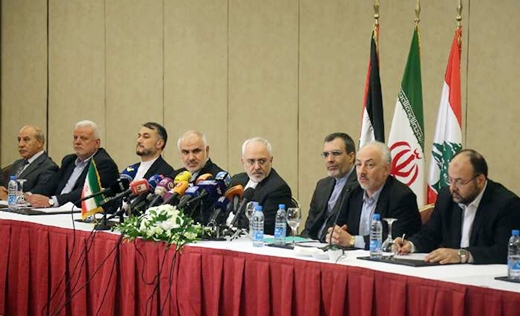
Iran holds out a hand of cooperation to all regional countries, its neighbors and resistance movements to establish coherent, brotherly relations in the region, Foreign Minister Zarif, who is in Lebanon on the first leg of a regional tour, said in a meeting Wednesday with the representatives of Palestinian and Lebanese groups.

Zarif added that only the Zionist regime and the Zionists are benefiting from rifts and wars among regional nations.

He called on Muslim nations to build on their common ground to end their differences.

He said, “As a country which believes in cooperation and constructive interaction between regional countries, Iran holds out a hand of cooperation to you all,” adding, “Today, we face a domestic threat of extremism, terrorism and sectarianism. We need to tap into the Islamic message of unity to tackle these threats. To that end, we need to be farsighted and take into account the interests of all countries and the Islamic community rather than being narrow-minded or focusing on personal concerns.”

At the beginning of the meeting, the representatives of the Palestinian and Lebanese groups congratulated the Islamic Republic of Iran for clinging to its rights through steadfast, logical diplomacy in talks with world powers.

They also called on Iran to tap its diplomatic potential to end sectarian strife in Syria, Lebanon, Palestine and Yemen.

Lebanese media give extensive coverage to FM Zarif’s trip

zarif01

A trip by Foreign Minister Mohammad Javad Zarif to Lebanon – the first leg of his regional tour – in which he has called for regional cooperation and dialogue to solve the problems and defuse the crises have dominated the headlines in the Arab country with different Lebanese groups on the political landscape welcoming Zarif’s stances.

The Islamic Republic News Agency (IRNA) on August 12 published a report on the coverage in Lebanon of the Iranian top diplomat’s visit to the country and the messages he carried for regional countries. The following is the translation of the report:

As-Safir Newspaper wrote on Wednesday [August 12] that Zarif picked Lebanon to convey a message to Islamic nations in the Middle East and called, upon arrival, on these countries to answer Iran’s call for more cooperation and dialogue.

The daily further said that Zarif’s visit carried two other messages: rivalry for cooperation and construction, and Iran’s support for the Lebanese, adding that political sources at [opposing] March 8 and March 14 alliances described Zarif’s remarks in Beirut as serious, calm, respectful and responsible. They also likened Zarif’s message of stability in Lebanon to the case the Iranian FM made in an article As-Safir published ten days ago: First the neighbor, then the home.

The US delegation trip delayed

While in the presidential palace, Zarif said he was impressed by the stable security situation in Lebanon as compared with his previous trip (January 2014) and supported intra-Lebanese dialogue for an agreement to elect a president, An-Nahar, another Lebanese daily, wrote.

The daily further said that a Lebanon visit by a US delegation which has been under review for ten days has been put off after the Beirut visit of Iran’s top diplomat.

Al Liwaa wrote that the message Zarif’s remarks got across – especially the part in which he said time has come for rivalry for reconstruction in Lebanon – translates into support for all Lebanese sides and the need for restoration of calm in the country.

The daily then quoted sources in the Lebanese government as saying that part of positive talks between Zarif and Prime Minister Tammam Salam focused on the Iran nuclear deal and the need for tapping into the deal’s potential to support regional stability and solve Lebanon’s problems.

Al Binaa newspaper wrote that despite a busy schedule and a full itinerary, Zarif insisted on the inclusion of Lebanon in his regional tour, adding that his trip signaled the following message: despite regional and global developments, Iran’s presence in Lebanon would be overwhelming.

The daily went on to write that Zarif has underlined his country’s support for the Lebanese resistance and the need for maintaining the country’s stability and for a diplomatic solution to the Syrian crisis.

Following Dr. Zarif’s trip, informed sources do not expect a change of course in Lebanon as far as the election of a president is concerned, especially because the Iranian foreign minister said that the election of a president is an internal issue of Lebanon, the daily added.

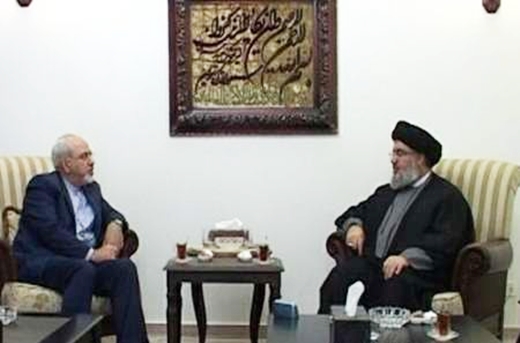
Zarif, Nasrallah meet in Lebanon

IMG10023647

Iranian Foreign Minister Mohammad Javad Zarif conferred with Secretary General of the Lebanese Hezbollah Resistance Movement Seyyed Hassan Nasrallah on Tuesday evening.

According to the Lebanese media, Zarif and Nasrallah discussed latest regional and international developments and Iran-Lebanon bilateral relations.

Deputy Foreign Minister Hossein Amir Abdollahian and Iranian Ambassador to Beirut Mohammad Fathali were also present in the meeting.

[…]

Zarif arrived in Beirut, at the head of a high-ranking delegation, on Tuesday evening on the first leg of his second regional tour after conclusion of nuclear talks between Iran and P5+1 (the US, China, Russia, France and Britain plus Germany) in Vienna on July 14.

Zarif is expected to pay visits to Syria, Pakistan, India and Russia after his trip to Lebanon.

Official invites Japanese banks to launch branches in Iran

139404141347259255628514

Head of the Trade Promotion Organization of Iran Valiollah Afkhamirad invited Japanese banks, insurance companies and other businesses to actively work in the Islamic Republic.

“(Iran’s) free trade zones are appropriate for the establishment of (branches of) Japanese banks and insurance companies,” Afkhamirad said in a meeting with a high-ranking Japanese economic delegation in Tehran.

“During the sanctions period, Japanese banks were cautious about (working in) Iran,” he said, adding that the time has now come for them to boost cooperation with Iran.

The remarks come against the backdrop of a wave of renewed interest in ties with Iran after Tehran and P5+1 (Russia, China, the US, Britain, France and Germany) on July 14 reached a conclusion over the text of a comprehensive 159-page deal on Tehran’s nuclear program.

The comprehensive nuclear deal between Iran and six world powers will terminate all nuclear-related sanctions imposed on Iran after coming into force.

Experts believe that Iran’s economic growth will rise remarkably after the final nuclear deal takes effect.

Iranian FM’s regional tour aimed at boosting ties: Official

139402011533236415144754

Iranian Foreign Minister Mohammad Javad Zarif’s second tour of regional countries aims to reaffirm Tehran’s resolve to reinforce its ties with neighbors, Deputy Foreign Minister for Arab and African Affairs Hossein Amir Abdollahian said on Tuesday.

Explaining Iran’s priority in strengthening ties with neighbors and the wider region is one of the purposes behind Zarif’s tour, he noted.

Amir Abdollahian added that the Iranian foreign minister will also confer with the officials of the countries he is to visit on the latest regional and international developments and will hold consultations with them on the necessity of focusing on political solutions to ongoing regional crises.

Zarif who is now in Lebanon is scheduled to visit Syria, Pakistan, India, and Russia in his tour of regional countries.

In his first regional tour in July, he visited Kuwait, Qatar, and Iraq, where he held talks with their highest-ranking officials.

Zarif’s tours come in the wake of the conclusion of nuclear talks between Tehran and P5+1 (Russia, China, the US, Britain, France and Germany).

Iran and the six powers on July 14 finalized the text of a nuclear deal that will terminate all anti-Iran sanctions after it takes effect. The United Nations Security Council also unanimously passed a resolution afterward, endorsing the comprehensive accord.

A look at Iranian newspaper front pages on August 12

Iranian Newspapers Headlines

Funeral processions held in several cities for the martyrs of the Iran-Iraq war dominated the front pages of Iranian newspapers on Wednesday. The comments of the grandson of the late Imam Khomeini on the Islamic Revolution and those of the deputy foreign minister on the Vienna accord also made front-page headlines.


Ettela’at: “The cultural and spiritual growth of society requires economic boom and security,” the intelligence minister told a gathering of provincial culture official.

He further said that political might should be used as a means to promote cultural authority.

Highlights of Ettela’at newspaper on August 12

A look at Iranian newspaper front pages on August 12


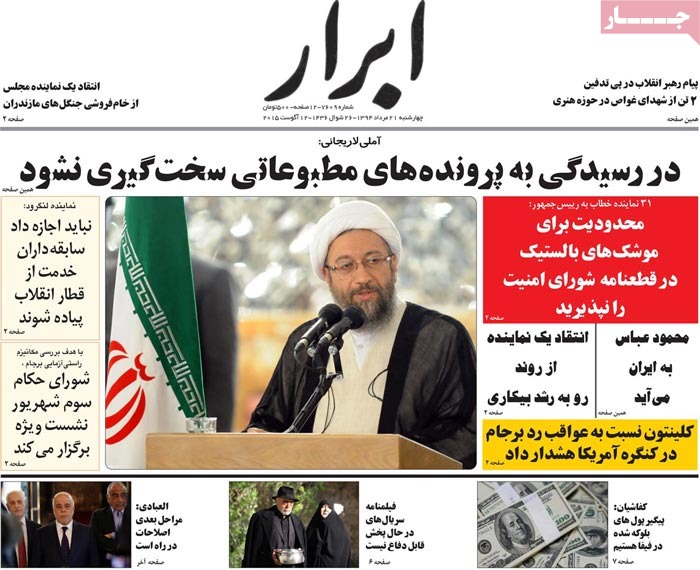
Abrar: Thirty-one MPs have called on President Rouhani not to accept the restrictions related to ballistic missiles stipulated in the UN Security Council resolution.

Abrar: Palestinian Authority President Mahmoud Abbas is to visit Iran shortly.


A look at Iranian newspaper front pages on August 12


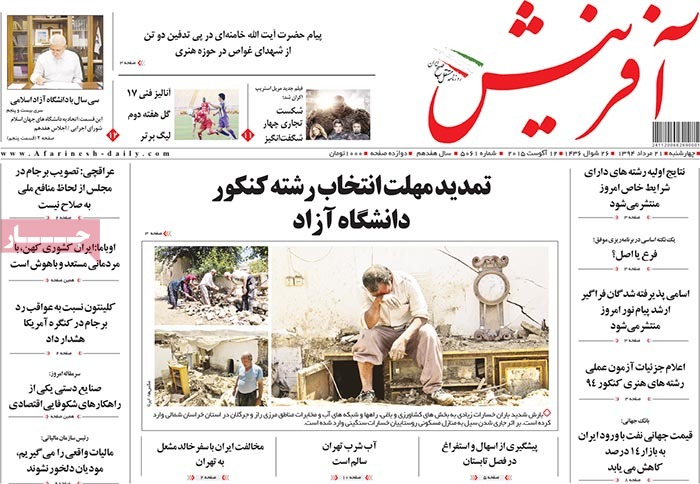
Afarinesh: Hillary Clinton has warned of the consequences of a possible congressional rejection of the Vienna accord.


A look at Iranian newspaper front pages on August 12


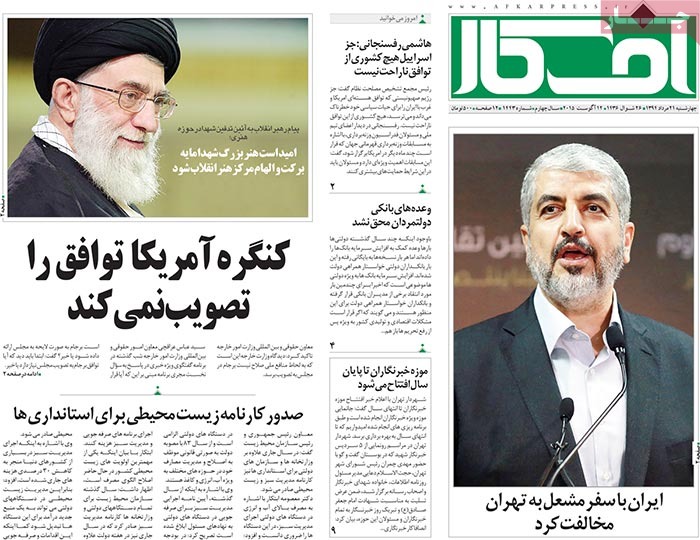
Afkar: Iran has opposed a Tehran visit by Hamas Leader Khaled Mashal.


A look at Iranian newspaper front pages on August 12


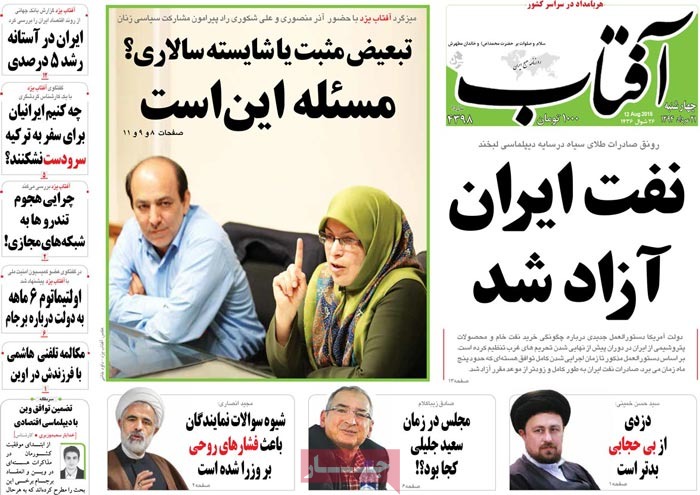
Aftab-e Yazd: The ban on Iranian oil has been lifted.

In a new directive on crude oil and petrochemical purchases from Iran, the US government has lifted the ban on imports of Iranian oil.


A look at Iranian newspaper front pages on August 12


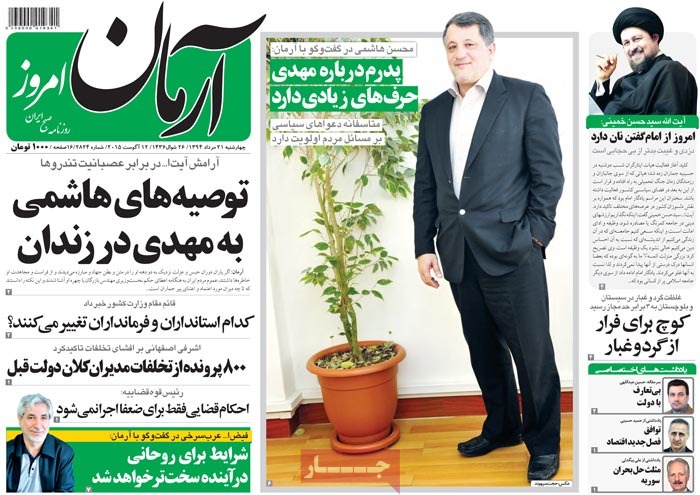
Arman-e Emrooz: “There are 800 cases involving offenses committed by senior officials of the previous administration,” said Mohammad Ashrafi Esfahani, who oversees a government office that looks into administrative offenses.


A look at Iranian newspaper front pages on August 12


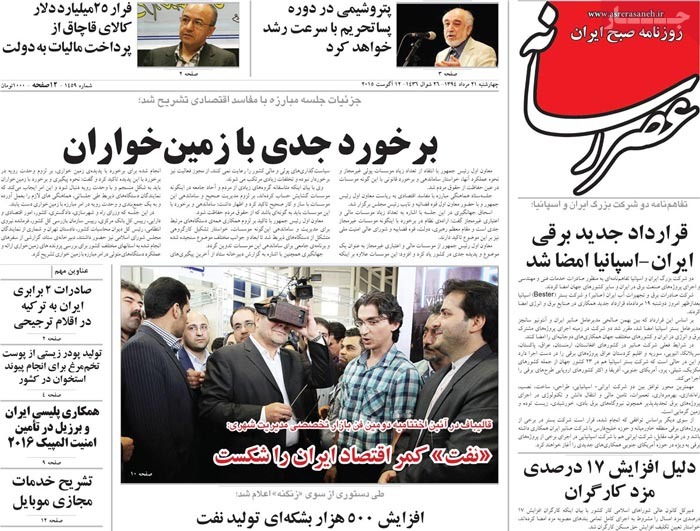
Asr-e Rasaneh: Tax evasion by those who slipped $25 billion worth of smuggled goods into the country

Asr-e Rasaneh: Iran and Spain have signed an electricity contract.


A look at Iranian newspaper front pages on August 12


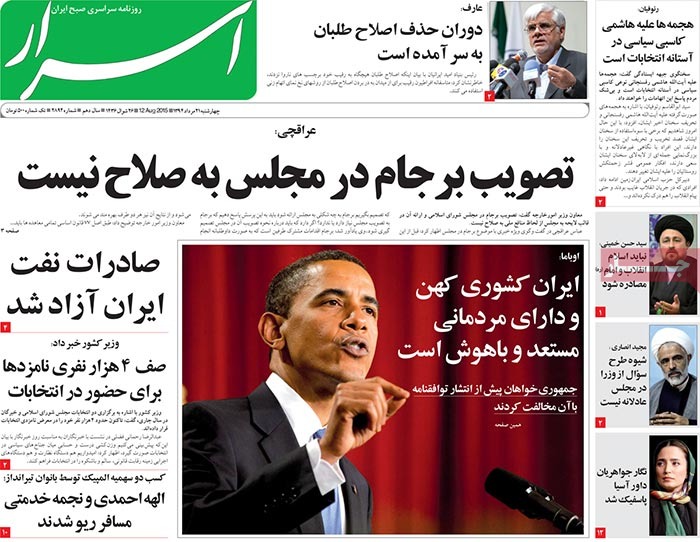
Asrar: Iranian actress Negar Javaherian has been given a seat on the jury of the Asia Pacific Film Festival.

Asrar: “Islam, [our] revolution and [the late] Imam [Khomeini] should not be hijacked,” said Seyyed Hassan Khomeini, the grandson of the founder of the Islamic Republic.

Asrar: The interior minister has said that some 4,000 individuals have expressed willingness to run for parliament in elections slated for early 2016.


A look at Iranian newspaper front pages on August 12


Ebtekar: Oil Minister Bijan Namdar Zanganeh has ordered oil production increased by 500,000 barrels a day.


A look at Iranian newspaper front pages on August 12


Etemad: The judiciary chief has called on officials to act leniently in cases involving the press.


A look at Iranian newspaper front pages on August 12


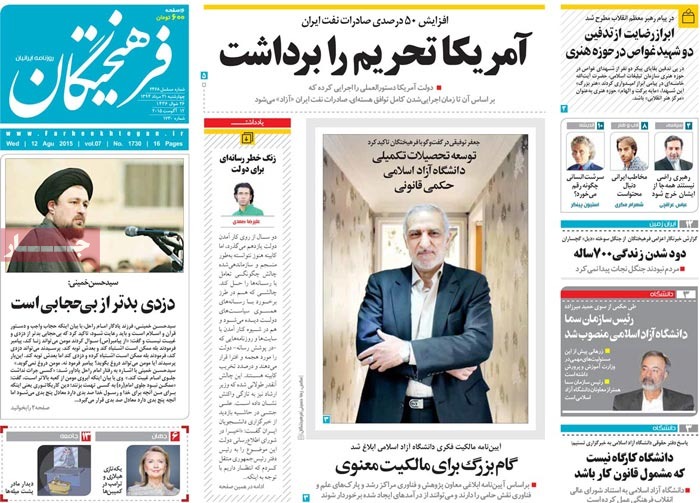
Farhikhtegan: “Theft is worse than failure to comply with the Islamic dress code,” said the grandson of the founding father of the Islamic Republic.


A look at Iranian newspaper front pages on August 12


Hemayat: “Measures to discredit the Judiciary are neither legitimate nor legal,” said the Judiciary chief as he lashed out at those who have released images of Ayatollah Rafsanjani bidding farewell to his son before the latter reported to prison to serve a 10-year jail term.


A look at Iranian newspaper front pages on August 12


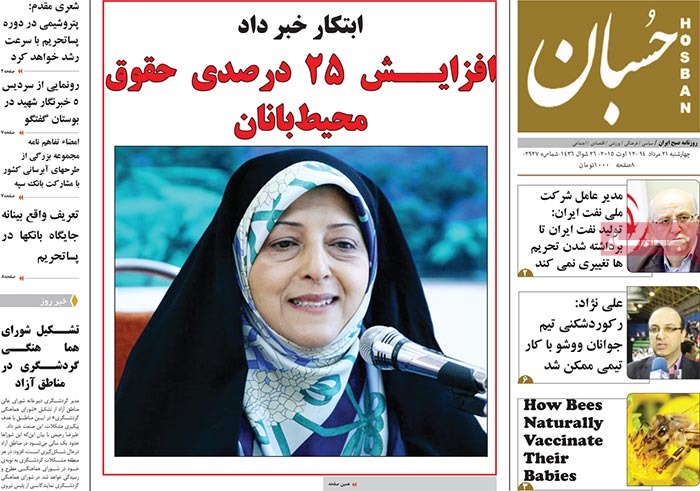
Hosban; The director of the Environment Protection Organization has said that park rangers will receive a 25 percent pay raise.


A look at Iranian newspaper front pages on August 12


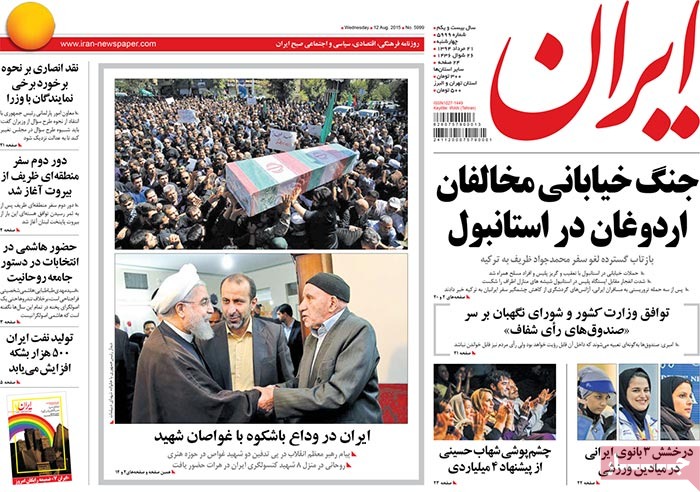
Iran: The Interior Ministry and the Guardian Council have agreed on introduction of transparent ballot boxes.

Iran: A second round of regional visits has taken Foreign Minister Zarif to Beirut, Lebanon.


A look at Iranian newspaper front pages on August 12


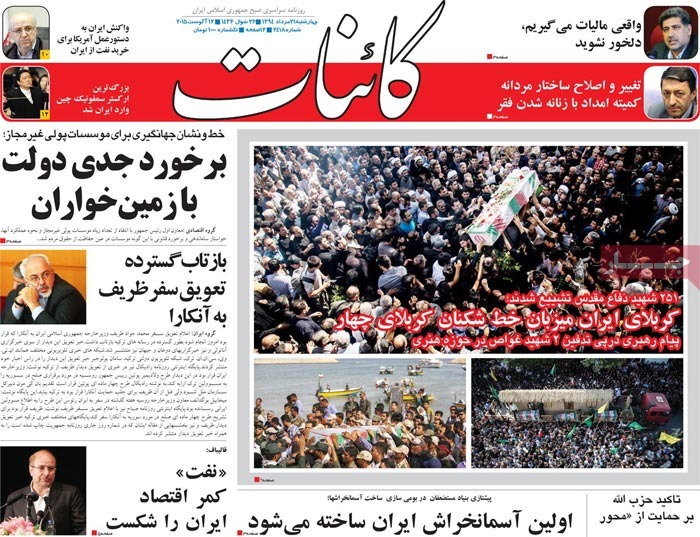
Kaenat: Zarif’s decision to put his Ankara visit on hold has drawn widespread reactions.


A look at Iranian newspaper front pages on August 12


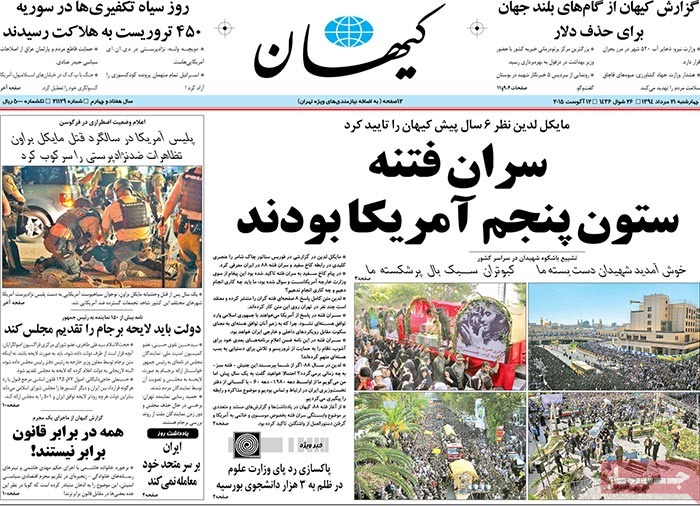
Kayhan: Some 150 MPs have sent a letter to the president calling on him to present the Joint Comprehensive Plan of Action to parliament in the form of a bill.


A look at Iranian newspaper front pages on August 12


Roozan: Minister of Economy and Financial Affairs has fallen victim to populist posturing.

The daily says the economy chief is likely to be impeached by parliament.


A look at Iranian newspaper front pages on August 12