Saturday, December 27, 2025
Home Blog Page 4659

France’s Larcher urges cooperation among regional powers against terrorism

Gerard Larcher

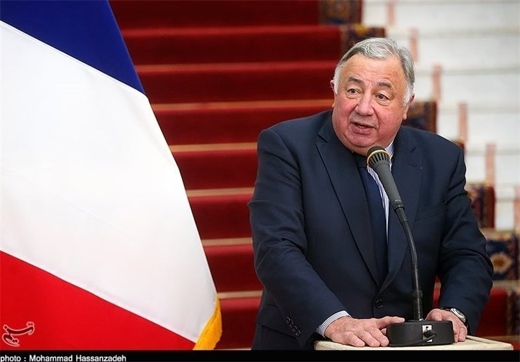
President of the French Senate Gerard Larcher reiterated the necessity for close cooperation among key regional players to end the threat posed by terrorism.

Speaking after a meeting with Ali Akbar Velayati, an advisor to the Supreme Leader of the Islamic Revolution Ayatollah Seyyed Ali Khamenei in Tehran on Sunday, Larcher said he and Velayati exchanged views on developments in Iraq, Syria and the entire region.

He also said that the recent resolution by the UN Security Council on Syria was another major issue discussed at the meeting.

Larcher noted that they also understand the two countries’ views on planning counterterrorism measures, and added, “There are many dangers in the West Asia region, and cooperation among regional and global powers can be a solution to the issue (terrorism).”

He further noted that the upcoming visit to France by President Hassan Rouhani can be an opportunity for conferring on bilateral ties.

Addressing a joint press conference with his Iranian counterpart Ali Larijani here in Tehran, Larcher noted that Rouhani will pay an official visit to Paris on January 27 and 28.

Rouhani was due to travel to France in late November but put off the trip following the November 13 attacks in Paris that left 130 people dead.

Rouhani: IAEA resolution proves Iran commitment to obligations

Rouhani-Bulgarian

President Hassan Rouhani says a recent resolution of the Board of Governors of IAEA shows that Iran’s nuclear program has always been peaceful and that Tehran is committed to its international obligations.

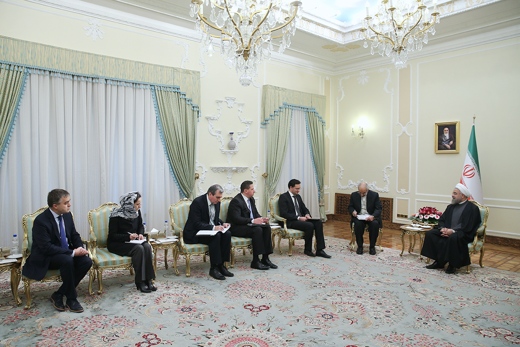
President Rouhani made the remarks in a meeting with visiting Bulgarian Foreign Minister Daniel Mitov and added that conditions for development of ties between Iran and the European Union, especially Bulgaria, are ready.

Iran’s rich energy resources, its population of 80 million, its important position in the region and appropriate economic conditions after the removal of sanctions would set the stage for development of relations with Sofia, the president said.

Rouhani said Bulgaria as a friendly country and as a gateway to EU could be an important connection route for Iran and countries of the region for European Union.

“Moreover, Bulgaria and EU can be connected to Oman Sea and Indian Ocean through Iran,” he added.

Referring to the sensitivity of regional developments, especially Syria, President Rouhani said that current situation in the region is worrisome and that all countries should try, as their duty, to fight terrorism and restore peace and stability in the region.

Rouhani underlined that protection of territorial integrity and respect for geographical borders of countries has a great deal of importance for Iran, because tension along the borders of the countries may create instability in the region.

For his part, Mitov conveyed the greetings of Bulgarian president and prime minister to President Rouhani and said that Iran has an important role, not only in the region, but also in the world and that Sofia intends to develop its relations with Tehran in all areas.

He stressed the need for the two countries to tap into their capacities to develop bilateral relations, Mitov underlined cooperation in the field of energy.

The Bulgarian foreign minister also referred to Iran’s constructive role in regional developments and the necessity of the fight against terrorism, and said that Bulgaria supported Iran’s presence in Vienna talks and hailed it as positive and very constructive because Bulgaria believes everybody should help eliminate the problem in Syria.

He said that the fight against terrorism, maintaining territorial integrity of Syria and holding national election are among the priorities of Bulgaria when it comes to Syria.

Concerning religious followers and different ethnicities in Iran and their peaceful life together, Mitov said that Iran could be a suitable example for other countries in the field of co-existence of religions and ethnicities.

Mitov arrived in Tehran on Sunday and delivered a speech for students and professors of International Relations School of Foreign Ministry and said that taking on ISIS is a priority for Bulgaria.

Spokesman: Assassination of Samir Qantar newest form of state terrorism

Jaber Ansari

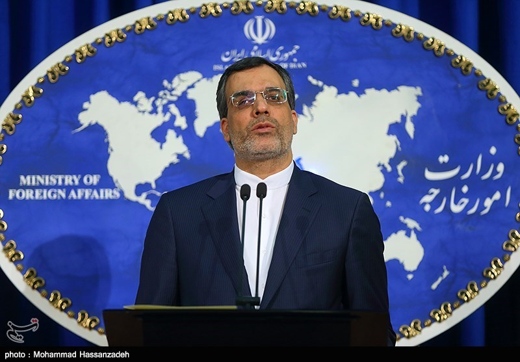
Foreign Ministry Spokesman Hossein Jaber Ansari on Sunday denounced the assassination of Samir Qantar in an airstrike by the Zionist regime’s warplanes.

Ansari denounced the move as clear evidence of the violation of the national sovereignty and territorial integrity of an independent state and a member of the United Nations and as the newest pattern of the state terrorism of the Zionist regime.

He described Samir Qantar as a symbol of resistance against occupation and invasion of the Zionist regime, who after close to three decades of captivity was released a few years ago in a prisoner swap with the Lebanese Hezbollah.

Jaber Ansari extended condolences to Qantar’s family, his fellow fighters, Lebanese and Palestine resistance as well as the Lebanese government and nation.

He added such acts of the Zionist regime have turned to a permanent and constant conduct and are the most dangerous form of state terrorism.

He called on international organizations and world governments to condemn such terrorist acts and not allow the global community’s campaign against terrorism get weakened under the influence of terrorist measures of the Zionist regime.

The Zionist fighter planes bombarded a residential area in Jaramana District of Damascus Rif on Saturday evening, which left a number of Syrian citizens, including Samir Qantar, killed.

Iran MP reacts to US travel restriction

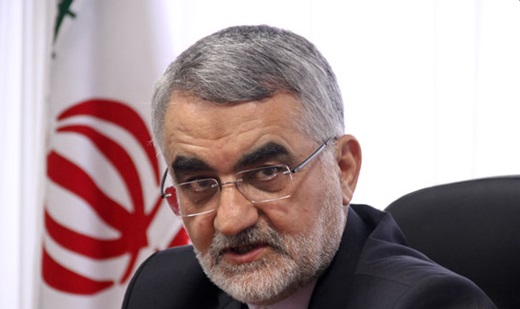
The US decision to bar people who are citizens of the 38 countries that participate in the Visa Waiver Program (VWP) and who are also dual nationals from Iran, Iraq, Syria and Sudan from using the visa-free system is in contradiction with the Joint Comprehensive Plan of Action (JCPOA) Iran has signed with P5+1, Iranian MP Alaeddin Boroujerdi said Sunday.

The following is the translation of part of the comments the deputy made as reported by Khabaronline.ir on December 20:

Boroujerdi, a member of the chamber’s National Security and Foreign Policy Committee, said the Americans have committed themselves to not imposing additional restrictions on Iran. The move may not amount to a direct restriction for our country, but the problem it causes for citizens of other countries in visiting Iran add up to restriction for Iran.

He further said that the US thought after conclusion of a deal with Iran, the stage would be set for its return to the country, but the comments of the Supreme Leader against their political and economic return to the country put the Americans in a passive mode, so they decided to play the visa and travel card.

He said despite such measures the nuclear deal Iran has struck with P5+1 would proceed according to plan. “American obstructionism won’t impact JCPOA. Our red lines remain the same ones the Leader set: closure of the PMD case and shipment of uranium which was properly taken care of by the Russians.”

The MP also said that in the meeting he had with French senators, they signaled Paris’ willingness to expand its economic and commercial ties with Iran and this latest US measure is in conflict with the policies of the Europeans.

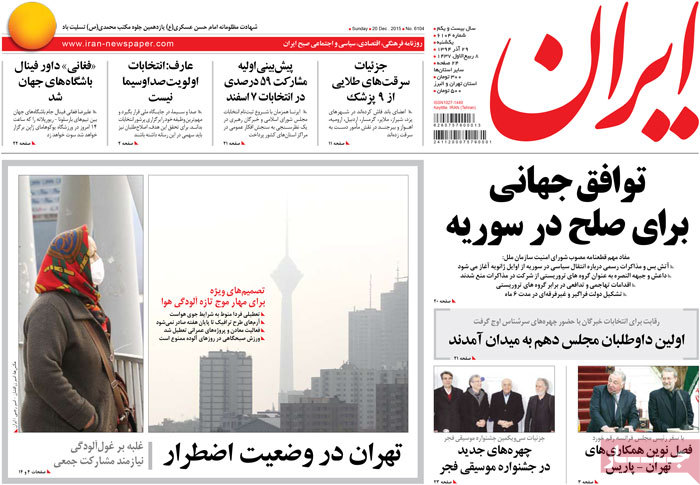
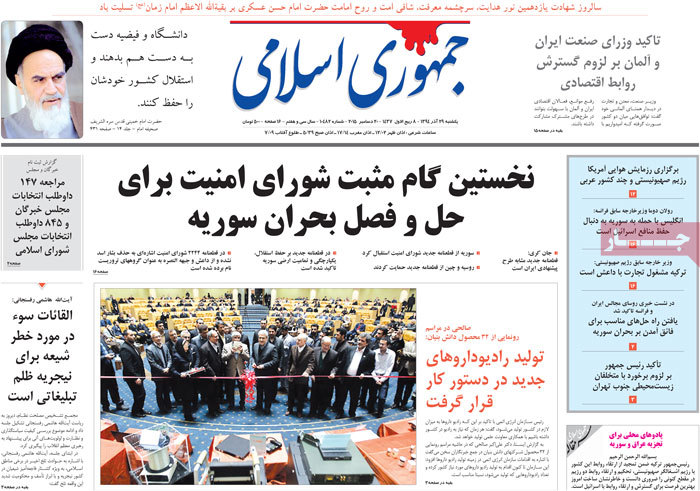
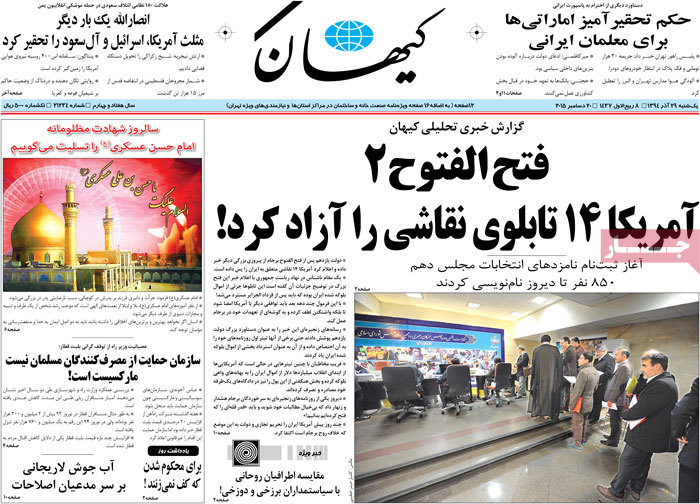
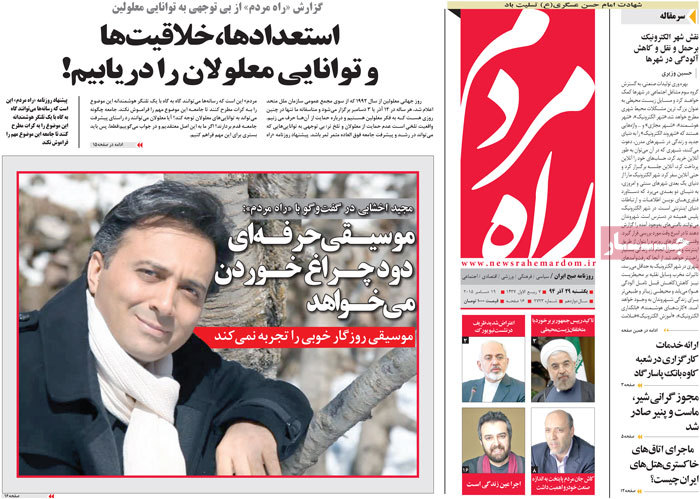
A look at Iranian newspaper front pages on Dec. 20

Iranian Newspapers Headlines

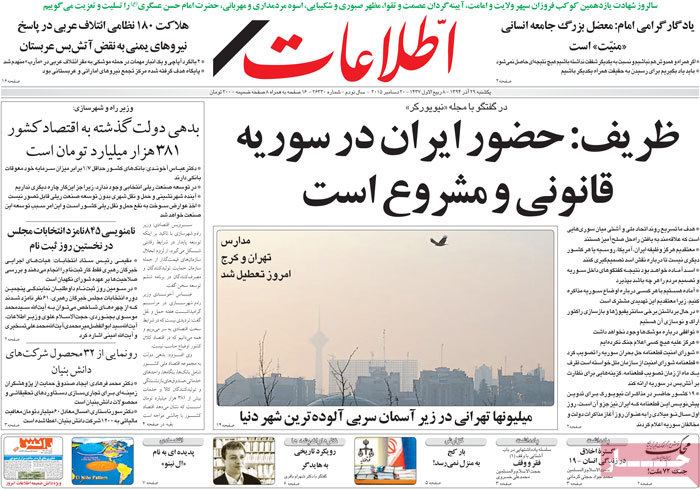
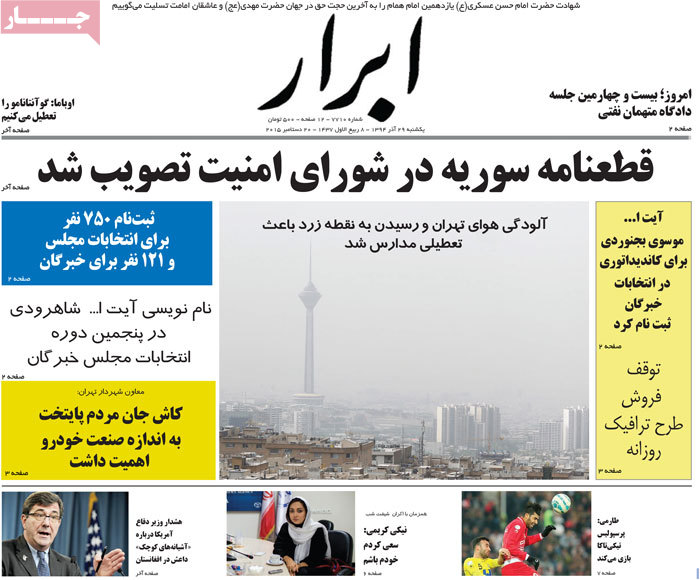
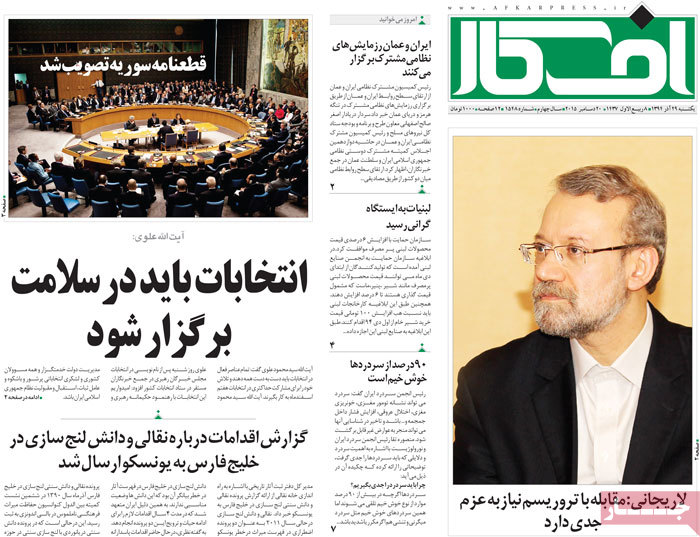
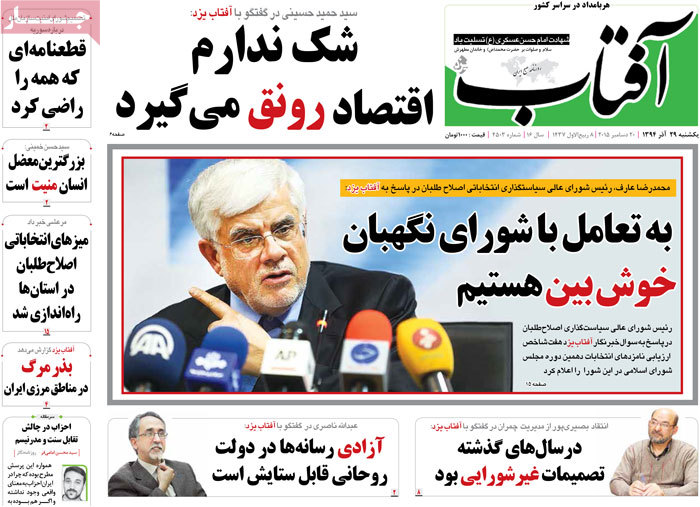
High levels of air pollution in the capital leading to the closure of schools dominated the front pages of Iranian newspapers on Sunday.


Ettela’at: Iran’s presence in Syria is legal and legitimate, said Foreign Minister Mohammad Javad Zarif in an interview with The New Yorker.

He further said, “Our purpose here is to facilitate a process of national unity and reconciliation between those Syrians who are interested in finding a peaceful resolution.”

Ettela’at: Millions of Tehran residents under the lead-tinged sky of the most polluted city in the world.

High levels of pollution prompted officials in Tehran and Karaj to order schools closed.

Ettela’at: The grandson of the late Imam Khomeini has said that egotism is the biggest problem humanity is faced with.

In the absence of sympathy and compassion, results will elude us, Seyyed Hassan Khomeini said.

Ettela’at: One-hundred-eighty members of the Saudi-led coalition were killed in a Yemeni response to violation of ceasefire by the Saudis.

Ettela’at: The minister of roads and urban development has said that the previous government owes some $127 billion to the national economy.

Abbas Akhoundi further said without development of the railroads, urbanization and urban transport would have a bleak future.

Ettela’at: Some 845 individuals fielded their candidacy on the first day of registration for parliamentary elections.

The head of the Electoral Commission has said that the executive panels simply sign up the potential candidates; the responsibility to vet them rests with the Guardian Council.

Ettela’at: Thirty-two products of knowledge-based companies have been unveiled.

The minister of science has said that formation of a fund to support researchers paves the way for the commercialization of research at knowledge-based firms.


A look at Iranian newspaper front pages on Dec. 20


Abrar: A 24th hearing in the trial of the so-called oil defendants [a reference to Babak Zanjani and his co-defendants] will be held on Sunday.


A look at Iranian newspaper front pages on Dec. 20


Afkar: Iran and Oman will soon hold joint naval exercises.

Afkar: The fight against terrorism requires steely determination, said Parliament Speaker Ali Larijani.


A look at Iranian newspaper front pages on Dec. 20


Aftab-e Yazd: Mohammad Reza Aref [a reformist leader] has said that he is optimistic about interaction with the Guardian Council [over the vetting of reformist candidates].

Aftab-e Yazd: A resolution that satisfied everyone [a reference to the UN resolution on Syria].


A look at Iranian newspaper front pages on Dec. 20


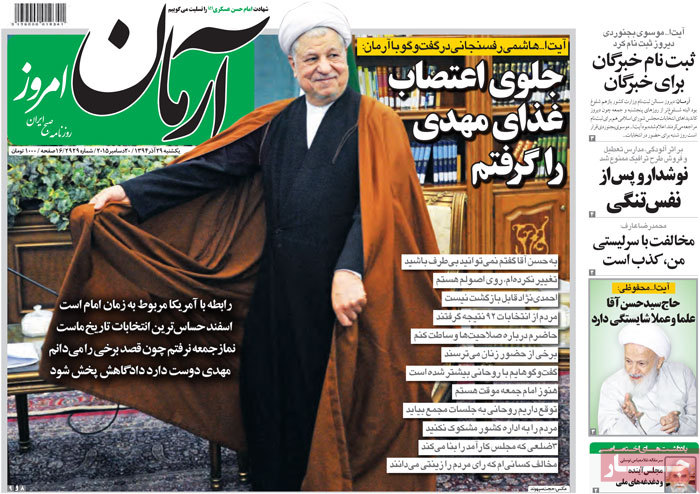
Arman-e Emrooz: In an interview with the daily, Chairman of the Expediency Council Ayatollah Akbar Hashemi Rafsanjani has said that he has talked his son Mehdi [who is in prison] out of going on hunger strike.

“I told [Seyyed] Hassan [Khomeini] that he cannot be indifferent…. I have not changed, I still insist on my principles…. I stand ready to act as a mediator in the vetting process…. My contacts with [President] Rouhani have increased…. I am still the interim Friday prayer leader of the capital… I am opposed to those who view the votes of the public as decorative,” the top councilor said.


A look at Iranian newspaper front pages on Dec. 20


Asrar: The president of the French Senate has said that President Rouhani’s France visit will usher in an era of new cooperation between Tehran and Paris.

Asrar: The chairman of the Expediency Council has rejected allegations that Iran is meddling in Nigeria’s [internal] affairs.


A look at Iranian newspaper front pages on Dec. 20


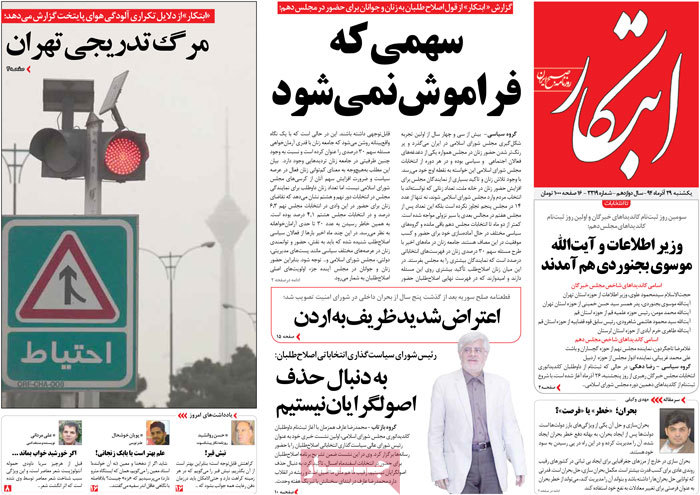
Ebtekar: A share that should not be forgotten!

The daily has a report on the pledge reformists have made to women and youth about their share of legislative seats in the 10th parliament.


A look at Iranian newspaper front pages on Dec. 20


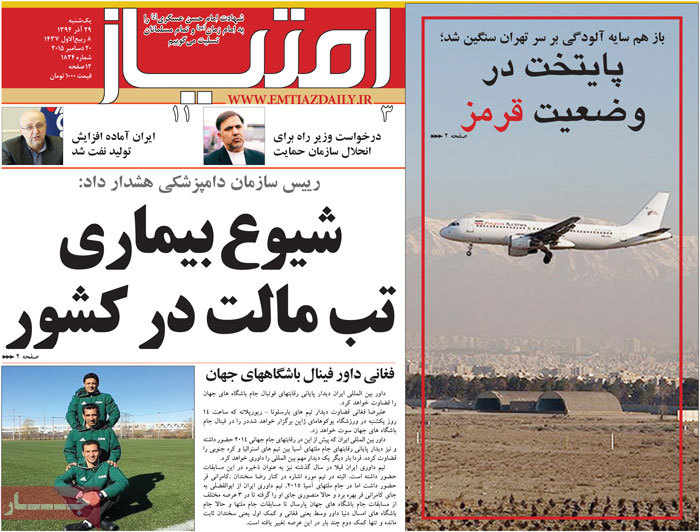
Emtiaz: Alireza Faghani, an Iranian referee, will officiate the final of the FIFA Club World Cup.


A look at Iranian newspaper front pages on Dec. 20


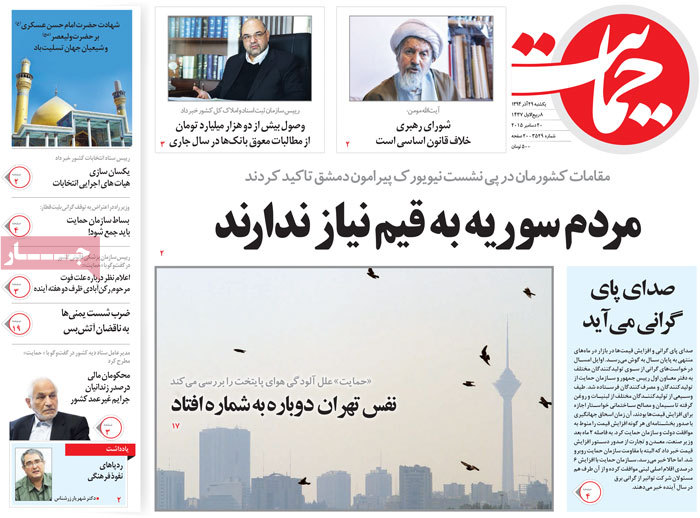
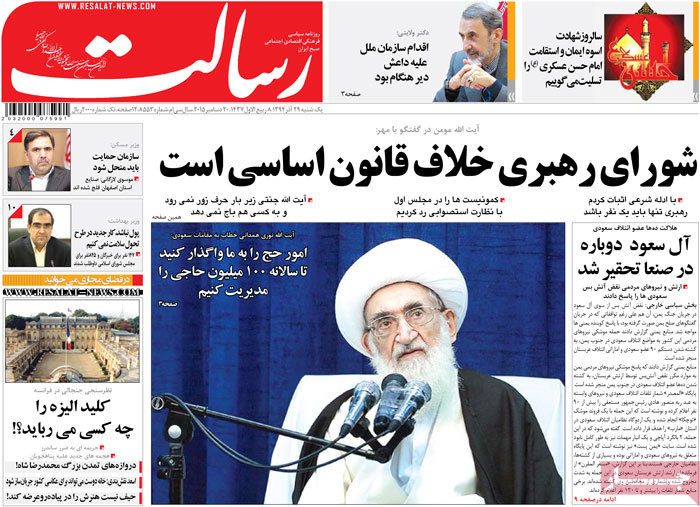
Hemayat: Formation of a leadership council goes against the Constitution, said Ayatollah Momen, a member of the Guardian Council.


A look at Iranian newspaper front pages on Dec. 20


Iran: [Result of] An opinion poll shows that turnout for upcoming [parliamentary and Assembly of Experts] elections is projected to stand at 59 percent.


A look at Iranian newspaper front pages on Dec. 20


Jomhouri Islami: The industry ministers of Iran and Germany have underlined the need for expansion of economic ties between the two countries.

Jomhouri Islami: President Rouhani has called for those who commit environment offenses to the south of the capital to be seriously dealt with.


A look at Iranian newspaper front pages on Dec. 20


Kayhan: An Emirati court has issued “humiliating” verdicts for Iranian teachers.


A look at Iranian newspaper front pages on Dec. 20


Rah-e Mardom: Authorities have given the go-ahead to a hike in milk, yogurt and cheese prices.


A look at Iranian newspaper front pages on Dec. 20


Resalat: The measure the UN took against Daesh came too late, said Ali Akbar Velayati, an aide to the Supreme Leader.


A look at Iranian newspaper front pages on Dec. 20


Saheb Ghalam: Ali Akbar Velayati has said if we fail to take on our enemies in Syria, we’ll have to lock horns with them on our borders.


A look at Iranian newspaper front pages on Dec. 20


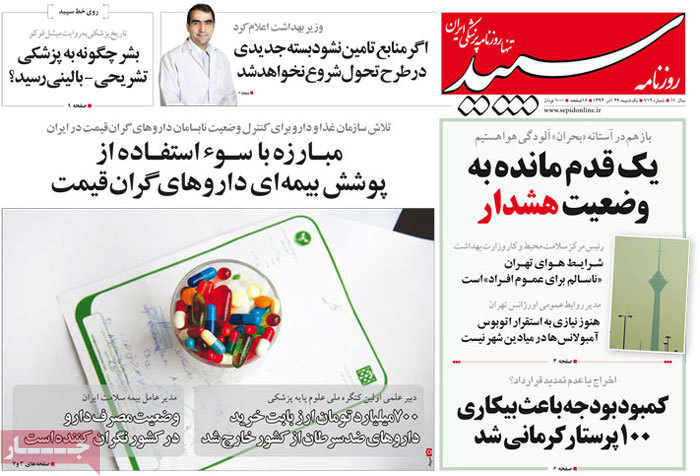
Sepid: The health minister has said that in the absence of finances, the Healthcare Transformation Plan will feature no new packages.


A look at Iranian newspaper front pages on Dec. 20


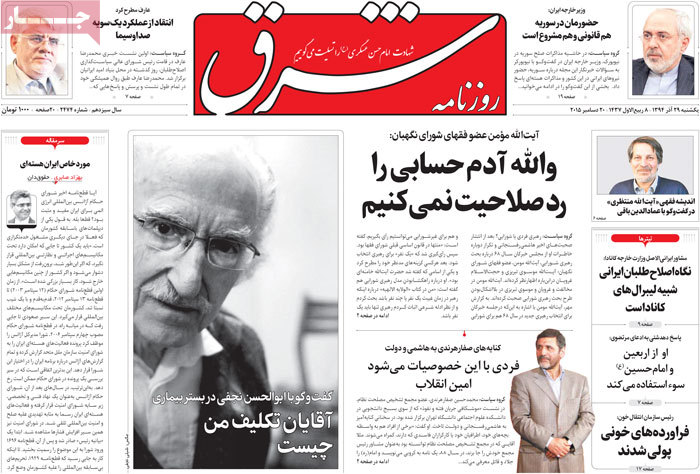
Sharq: Mohammad Reza Aref, a reformist leader, has criticized the one-sided approach of Islamic Republic of Iran Broadcasting.


A look at Iranian newspaper front pages on Dec. 20


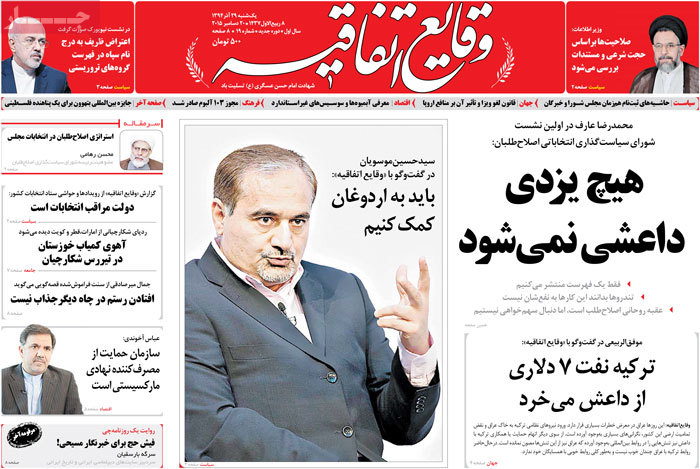
Vaghaye-e Etefaghiyeh: Mowaffak al-Rubaie, a distinguished Iraqi statesman, has said in an interview with the daily that Turkey buys oil from Daesh $7 a barrel.

Vaghaye-e Etefaghiyeh: Hossein Mousavian, a former Iranian nuclear negotiator, has told the daily in an interview, “We need to help [Turkish President] Erdogan.”


A look at Iranian newspaper front pages on Dec. 20


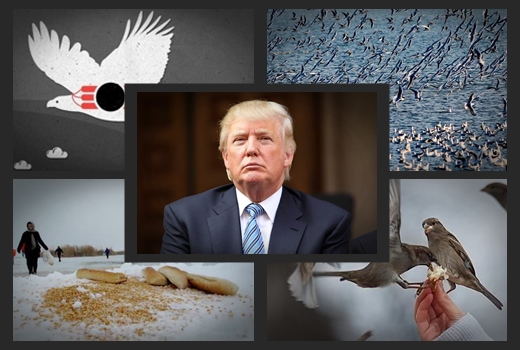
Middle Eastern birds and a lesson for Mr. Trump

Birds-trump

You are about to read two short and apparently unimportant reports. The selection and release of two independent reports in one single package is not merely intended to give you mixed feelings of happiness or sadness by learning about the sweet and bitter destinies of two types of birds in a region.

The main goal here is to offer two pictures in one frame to help readers easily understand the clash of two world views and two cultures which are reflected in the behavior of two people with different characteristic traits (society and culture).

There are two types of people who are – unfortunately in individual and collective manners, from afar and from a superficial and vulgar perspective – described as Muslims and members of the world of Islam!

IFP recommends reading and more importantly contemplating the origin of this news package to all those who are out of touch with ground realities in the Middle East but take the liberty of passing judgment on the unknown sects, creeds and territories.

Among the target audience of this news package, US presidential candidate Mr. Donald Trump has a special status, a man who sounds as if he were sympathizing with [the cause of] Takfiri Wahhabis like Al-Qaeda, ISIS, etc. in quest of yet another Crusade.

One day the GOP presidential frontrunner promises to ban all Muslims from entering the United States [until authorities “can figure out” Muslim attitudes towards America in the wake of the San Bernardino shooting], and another day he characterizes the Iranian nation as terrorists [On Tuesday, Donald Trump said the nuclear deal was a “horrible, disgusting, absolutely horrible deal” with a “terrorist nation.” (The New Yorker, December 18)].

Despite his great yearning – in past and present – for getting his hands on oil in faraway places, this GOP showman seems not to have any interest in studying the history of human civilization and the contribution of different tribes, nations and religions in this part of the world [the Middle East] to the evolution of the culture of the international community.

That’s why we had better talk with such individuals in plain language and explain the naked truth for them by bringing palpable examples which can spare them [the trouble associated with] thinking. And the truth here is: in the absence of knowledge and documentary proof, judging even one single individual clearly amounts to human rights violation, let alone passing judgment on an entire religion or a school of thought with hundreds of millions of followers, or even an entire nation!

First report

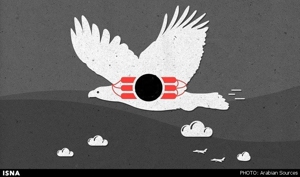
The terrorist ISIS grouping is seeking to use birds as suicide bombers to blow up jets which target its positions in Syria and Iraq.

The terror group has posted a document on social networking sites detailing a new method it is to use – birds as suicide bombers – to attack fighter jets, Rusiya Al-Yaum reported.

ISIS-BirdsAccording to Vocativ, a media and technology company in the US, ISIS has decided to use the birds to bring down the fighter jets of the US-led coalition in the first place.

The new tactic [“A New Way to Down Warplanes”] is to strap a “lightweight” bomb to a bird and train the bird in six steps to fly into a jet and detonate an explosive — effectively making the bird a suicide bomber.

The mastermind of the plot suggests using a Urea bomb, which he theorizes was the explosive used by ISIS to down the Russian Metrojet plane that crashed in the Sinai Peninsula, [killing all 224 on board in late October].

After conducting extensive research, the ISIS sympathizer said, he found two birds which properly fit this type of operation: falcons and vultures.

Birds-turned-into-suicide bombers seem highly unlikely to greatly contribute to hunting the jets, because the height, speed, and the noise of these jets are so high that prevents the birds from approaching the planes.

Second report

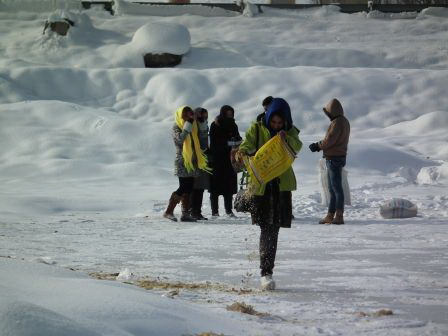
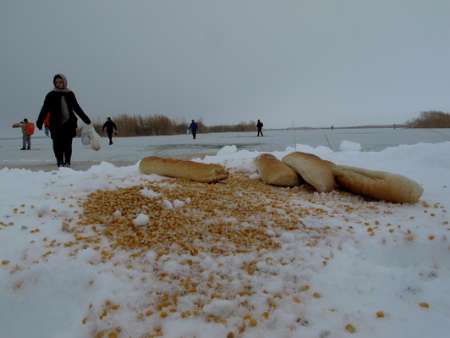
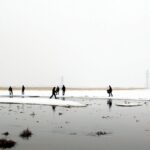
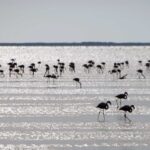
The head of the Environment Protection Organization in Naghadeh, West Azerbaijani Province, said that a group of environmentalists have rushed to the help of migrant birds in the town in the cold, snowy days by spreading seeds along the Sulduz Lagoon to feed them.

birdsFaramarz Safari further said that heavy snowfall has caused the marine habitats and lagoons in the town to freeze over and this may cause the migrant and indigenous birds in the lagoons to die of hunger. That’s why, he added, the Environment Protection Department in Naghadeh has taken measures – in cooperation with environmental groups – to spread seeds to feed the birds and the wildlife during the cold winter.

Much of Sulduz Lagoon has frozen, he said, adding that the first phase of bird feeding saw more than 300 kilograms of wheat and beans spread in different places along the lagoon for the birds to feed on.

birdsThe environment chief in Naghadeh went on to say that leaving feed for birds and the wildlife on cold winter days can generously contribute to efforts to maintain and protect the animals in the wild and to prevent the indigenous birds from migrating to other regions.

Sulduz Lagoon, which is located 25km to Naghadeh, was revived in 2001. The lagoon is now in good conditions and this has caused seabirds and other animals to migrate to the watery habitat in northwestern Iran.

Naghadeh is home to seven seasonal and permanent lagoons in which more than 10,000 migrant and indigenous birds live. Hasanloo, Darge Sangi, Yadegarloo lagoons in Naghadeh have been recognized as international water habitats.


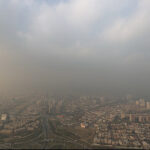
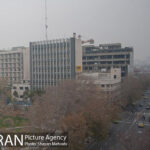
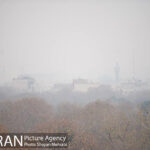
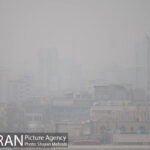
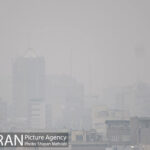
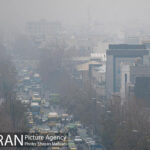
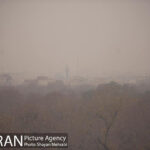
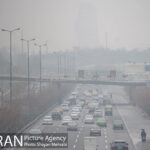
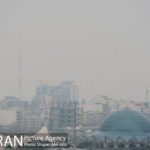
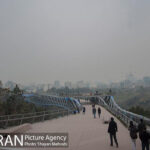
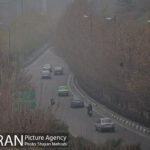
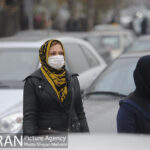
Air pollution in Tehran (PHOTOS)

Air pollution400_B

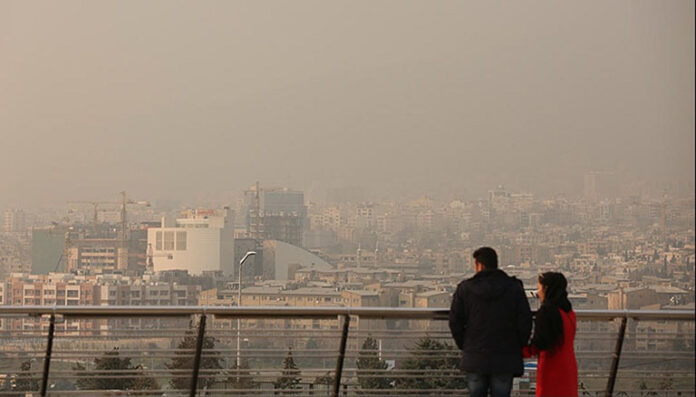
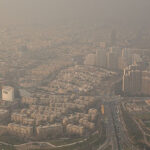
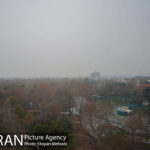
A spike in the level of pollutants in Tehran’s air has prompted officials to declare a red alert, and order schools closed.

On Sunday the level of particles 2.5 micrometers or less in size was seven times the level deemed acceptable by the World Health Organization.

The following images of air pollution in Tehran have been released by Tehran Picture Agency:


What does the Constitution stipulate?

ali-motahari

With less than three months to go before elections for the Assembly of Experts and parliament are held (February 26, 2016), electoral fever in the country has risen to a high pitch.

Recent remarks by the chairman of the Expediency Council on the formation of a “leadership council” and the responsibility of the Assembly of Experts to oversee the workings of the leader have stirred a controversy. Opponents of Ayatollah Akbar Hashemi’s comments were quick to condemn his words as unconstitutional and illegal.

One such condemnation came from the Judiciary chief who said assertions that the assembly is tasked with overseeing the leader’s performance have no constitutional foundation.

In reaction, Tehran MP challenged the top judge’s interpretation of the Constitution, seeking to explain the basic laws for the public.

In a letter to the Judiciary chief, Tehran MP Ali Motahari said that everyone is accountable in the Islamic Republic of Iran and that the glory of the Islamic Republic lies in the fact that it is a religious establishment which has not fostered despotism.

The following is the translation of part of Motahari’s letter as reported by Fararu.com on December 18:

To Esteemed Judiciary Chief Ayatollah Sadegh Amoli Larijani,

Recently you made a [public] comment which raised eyebrows among a large number of politicians, lawyers and Islamists. You said that “oversight of the leader” [supervision of the performance of the leader] has not been envisioned in the Constitution.

It is clear that the phrase “oversight of the leader” is nowhere to be found in the Constitution, but the question that arises here is: Hasn’t this phrase’s implied meaning been included in the Constitution? Shall we simply stick to [the face value of] words?

Your comment runs counter to the ideology of Imam Khomeini and the Supreme Leader, defies wisdom and politics, contradicts the tradition of the Muslim Prophet and Imam Ali, and is against the Constitution and what was debated in the Constituent Assembly. What you said also plays into the hands of those who always accuse the Islamic Republic of being a religious dictatorship.

Your remark is a reminder of claims by the Catholic Church in the Middle Ages that the ruler shoulders no responsibility vis-à-vis people and he is only responsible to God, but that people have responsibility vis-à-vis the ruler. Islam disapproves of this. As Imam Ali has put it, a ruler owes people some rights and people too owe the ruler some rights; basically this is a two-way street, and the only one who owes people no right and only people owe Him some right is God.

You seem to have hurried – out of feverish excitement – to respond to the comments of Ayatollah Hashemi Rafsanjani on the need for supervising the affiliates of the Supreme Leader’s Office, and made a statement you yourself may not have much belief in.

You have said that under the Constitution, the Assembly of Experts is tasked with determining whether an individual meets the necessary requirements to become leader, [it does not supervise the workings of the leader] and that it is quite natural that such determination differs from oversight and these two are not interdependent.

Firstly, the Assembly of Experts is not simply tasked with determining who meets or lacks the necessary requirements to become leader on the day the leader is appointed; rather, according to the Constitution’s Article 111, it is charged with measures to see if the leader continues to meet those requirements during his leadership.

[Whenever  the  Leader  becomes  incapable  of  fulfilling  his  constitutional  duties,  or  lobs one  of  the  qualifications  mentioned  in  Articles  5  and  109,  or  it  becomes  known  that  he did not possess some of the qualifications initially, he will be dismissed. The authority of determination  in  this  matter  is  vested  with  the  experts  specified  in  Article  108. …]

Secondly, to determine whether the leader continues to meet those requirements is all but impossible without supervising the workings of the leader, and despite your interpretation, these two are interdependent.

You have made an analogy which is unfortunately inaccurate and irrelevant. You have said that oversight by the Assembly of Experts of the leader resembles a situation in which people who seek to follow the sources of emulation supervise these sources because the followers should make sure that their sources of emulation meet the requirements of being the most learned individual, enjoy Ijtihad and are just, [and have gone on to say] that the falsehood of such a comment is clearly evident.

Firstly, the falsehood of this comment is not evident, because even in this case [that you mentioned] the follower of a source of emulation has the responsibility to supervise the source to see if he continues to be just, and this does not happen unless the follower keeps an eye on the performance of the source of emulation. If that source of emulation fails to be just, the follower should turn to another source.

Secondly, let’s assume that supervision does not apply to this case (sources of emulation and their followers), but it provides us with no good reason to claim that it does not apply to the responsibilities of the Assembly of Experts either, because these two subjects are totally different.

Followers are not allowed to dismiss a source of emulation, but the Assembly of Experts has the authority and responsibility to dismiss the leader in case he fails to meet the requirements of the leadership, and such authority is not exercised and such responsibility is not undertaken unless the assembly supervises the workings and behavior of the leader.

In other words, the question of sources of emulation and their followers is a personal issue, and the question of the Assembly of Experts and the leader is a social one, thus comparing these two questions is a mistake.

In a Q-and-A session with students of Amir Kabir University of Technology on February 27, 2001, the Supreme Leader said, “Nobody is above supervision. The leader himself is not exempt from supervision, let alone the bodies linked to the leadership.

“Therefore all [officials] should be supervised. Those who rule [the country] should be subject to supervision. Governance naturally leads to the accumulation of wealth and power. In other words, public funds and properties as well as social and political authority lie in the hands of the rulers. It [supervision] is necessary and imperative so that those in government do not betray [people’s] trust, do not misuse [their position] and do not get consumed with their passions.”

The Supreme Leader also touched upon the selection of leader in the sermons of Eid-ul-Fitr prayers in 2006, and said, “The main responsibility of the [Assembly of] Experts is first to choose the leader and second to supervise the sitting leader”.

[…]

In short, nobody in the Islamic Republic can be unanswerable [to the public]. The glory of the Islamic Republic lies in the fact that although it is a religious government, it has not been afflicted by the deviations religious governments went through in Europe in the past and has not walked down a path that leads to religious despotism, because the Constitution of this establishment, and above all Islam, has prevented such a thing from happening.

Ayatollah Shahroudi raps Riyadh for irrational stance on Nigeria

saudi-king-salman

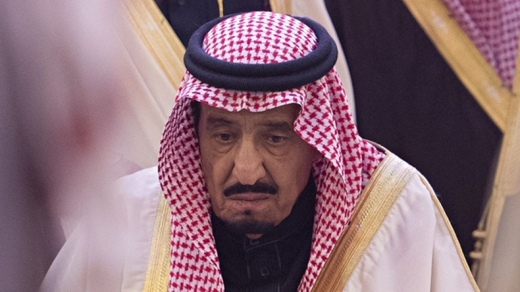
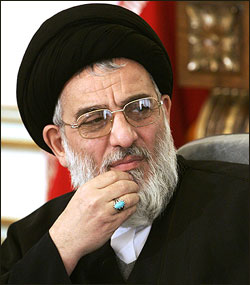
The vice-chairman of the Assembly of Experts has strongly criticized Saudi Arabia for taking side with the Nigerian army in the massacre of Shiite Muslims of the African country.

Shahroudi
Ayatollah Mahmoud Hashemi Shahroudi

“Saudi Arabia’s coalition with the US and arrogant powers is a blatant example of friendship with blasphemers; the Saudi king’s congratulations to the perpetrators of crimes in Nigeria is shameful and disgraceful,” Ayatollah Mahmoud Hashemi Shahroudi said on Saturday.

He reiterated that attacking and killing innocent Shiites in a country that has about 15 million Shiites and an apparent Muslim government is a painful crime against Islam.

“In a country where Boko Haram kills innocent people and enslaves children and women, and no effective measures are taken against it, authorities treat 15 million Muslims in a violent manner only for fulfilling their religious duties and staging protests against Israel,” Ayatollah Hashemi Shahroudi said.

The Nigerian army attacked two religious centers of the country’s Shiite community last week, killing hundreds of defenseless civilians there. The military also arrested Leader of the Islamic Movement of Nigeria Sheikh Ibraheem Zakzaky after raiding his house and killing his son, assistants and followers.

On Monday, Iran’s Foreign Ministry summoned Nigeria’s charge d’affaires in Tehran over the massacre of the Shiite Muslims in Zaria in Kaduna State and voiced Tehran’s serious concern over the incident.

At the meeting, the head of the Foreign Ministry’s office for African affairs condemned the Nigerian army attack on the Shiite community as unacceptable, and reiterated the Nigerian government’s responsibility for protecting the lives of the Shiites and religious centers, especially the Islamic Movement of Nigeria.

“The Islamic Republic of Iran seriously demands clarification of the dimensions of the incident, treatment of the wounded people and compensation for the damage incurred at the earliest,” the Iranian diplomat said.

The Nigerian charge d’affaires, for his part, said that he would inform his government of Iran’s concern and provide Tehran with a response.

Iran awards IKIA deal to Dutch firm NACO

Iran IKIA airport

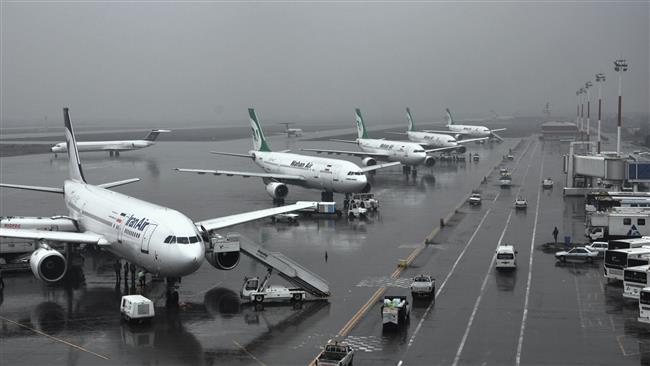
Iran on Saturday awarded a deal to a Dutch company over the development of a town in the vicinity of the country’s biggest airport – Imam Khomeini International Airport (IKIA) – in southern Tehran.

The contract was signed between the Managing Director of IKIA Airport Town Company Mahmoud Navidi and Kiel Cloisterville, the vice president of the Netherlands Airport Consultant Company (NACO).

NACO will be in charge of providing consulting services for the development of Phase 1 of IKIA Airport Town for a period of five years, IRNA reported.

Phase 1 of the project includes a passenger terminal named “Salam” with capacity of around five million passengers a year, a passenger terminal named “Iranshahr” with a capacity of 20 to 22 million passengers a year as well as a section of free trade zone.

Upon the completion of the first phase of the IKIA Airport Town, the passenger capacity of the airport will reach 30 million passengers from the current 8 million in the next five years.

NACO identifies itself as a global provider of airport planning, airport design, and airport engineering services. It also says it has carried out projects in 550 airports worldwide.

Officials had previously said the country is in talks with the French industrial group Bouygues and Aéroports de Paris to expand the airport at a total cost of $2.8 billion.

Earlier this month, France’s AccorHotels signed an agreement in Tehran to run two hotels near IKIA, marking the first foray by a major foreign entity into the country’s hospitality market since 1979.

Under the deal, the group will manage four-star Ibis IKIA with 196 rooms and five-star Novotel IKIA with 296 rooms.