
Harvest time has arrived in Khorasan Razavi Province where saffron farmers are hard at work to collect their products.
The following are the images the Young Journalist Club has placed on its website of the harvest season:
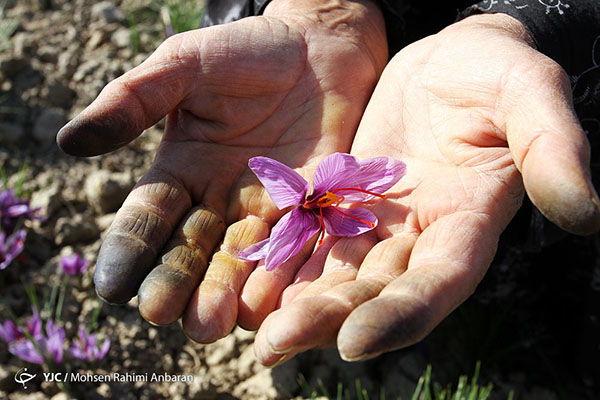
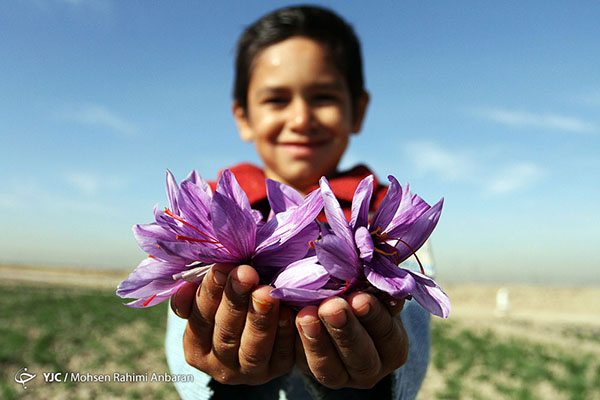
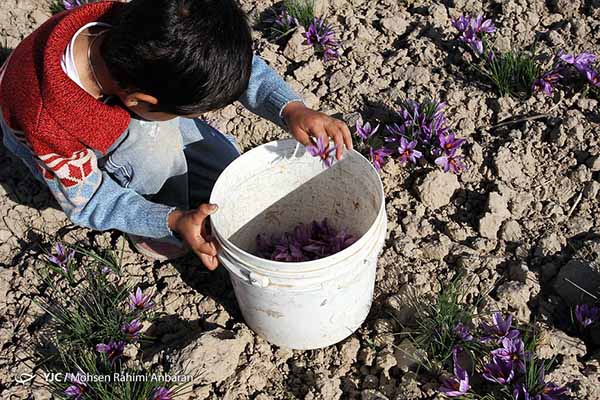
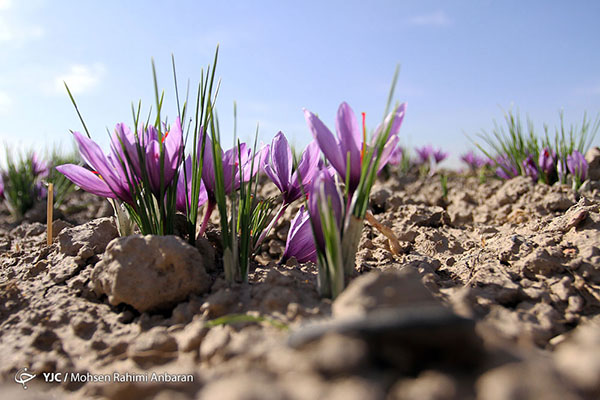
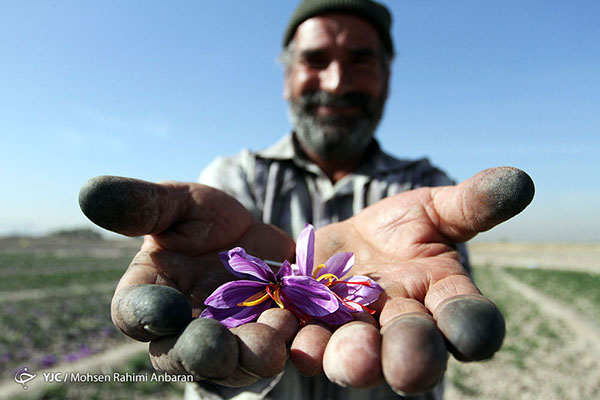
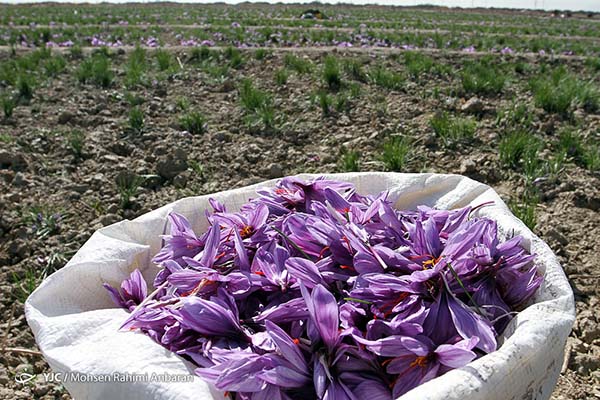
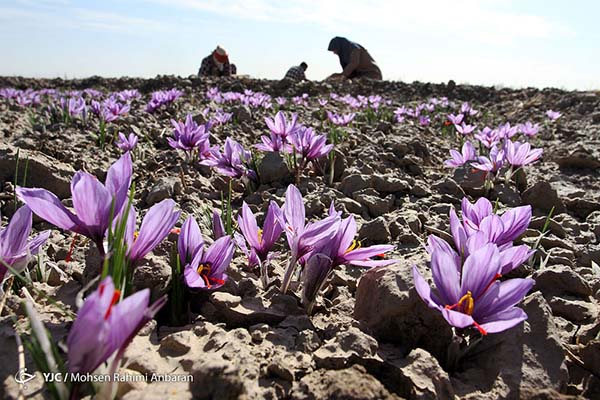
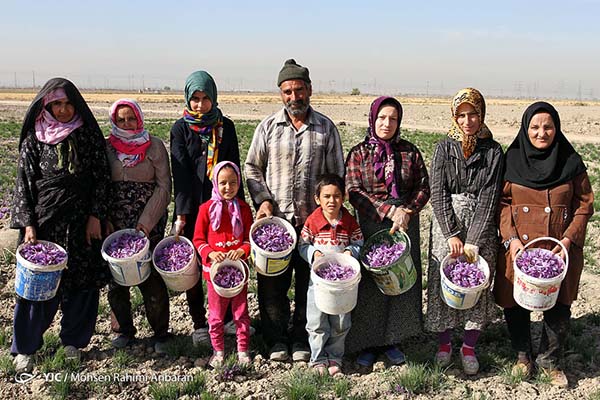
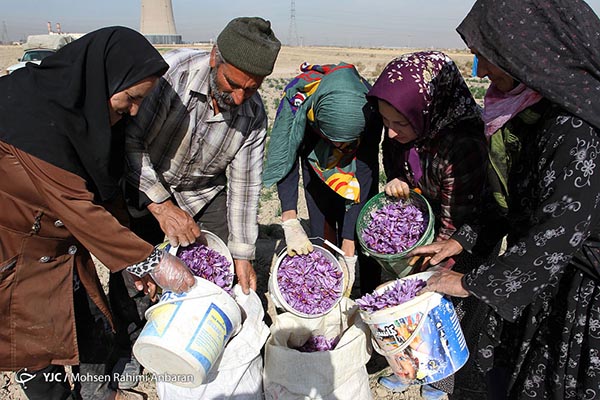
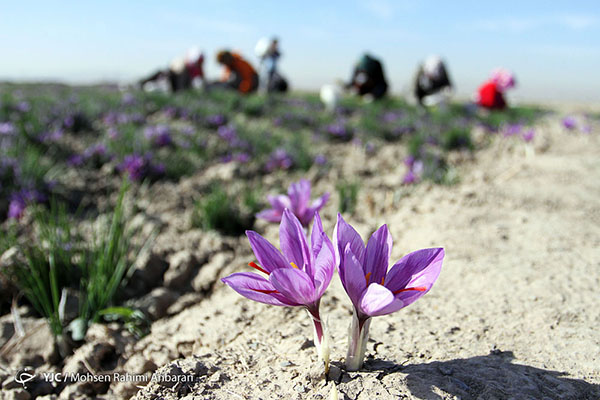
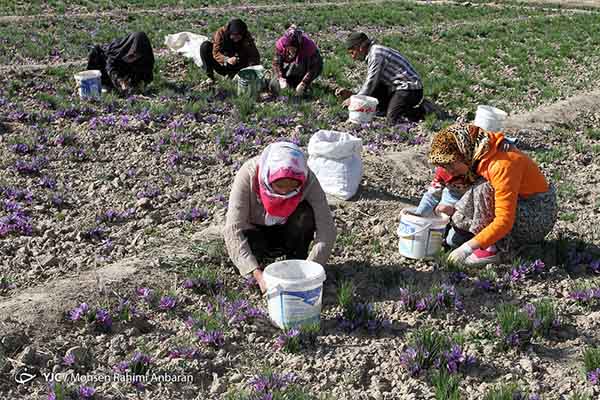
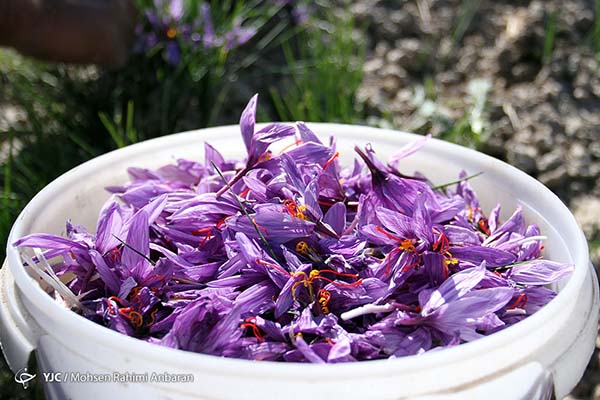
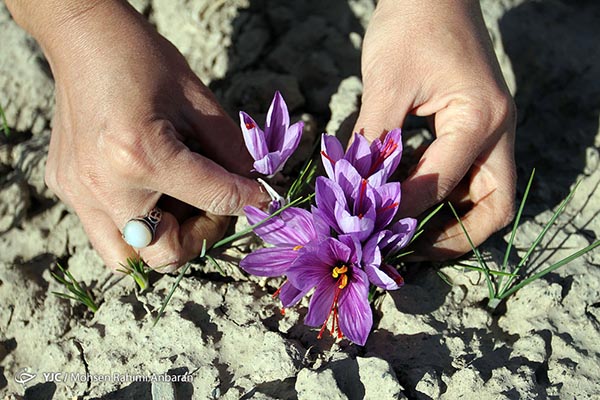
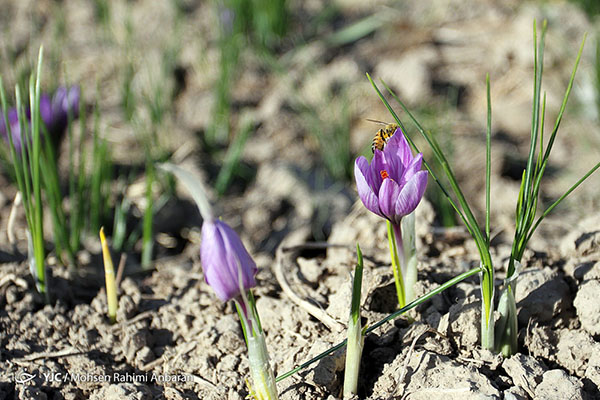
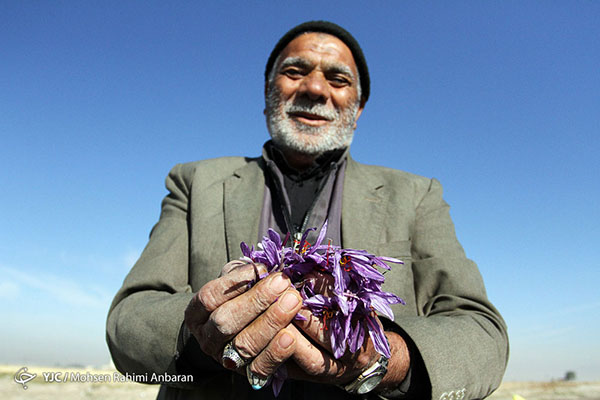
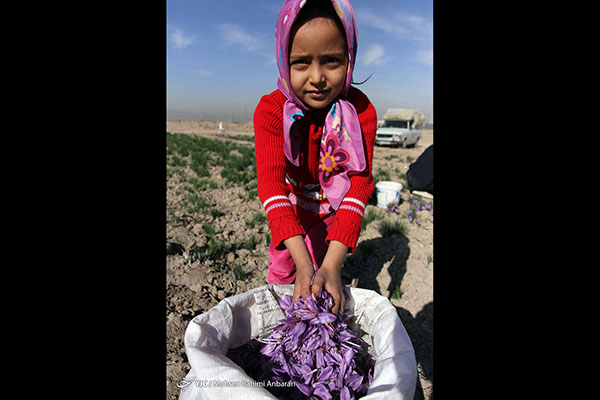
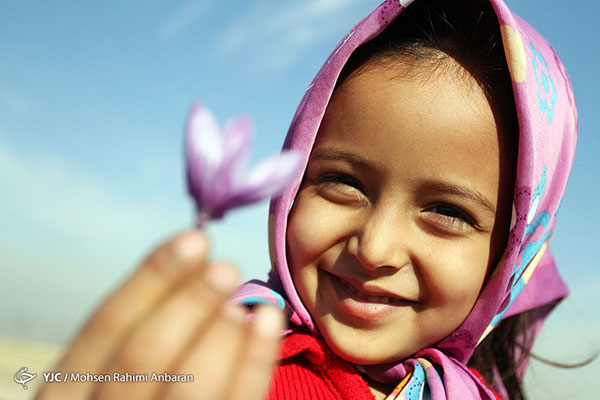
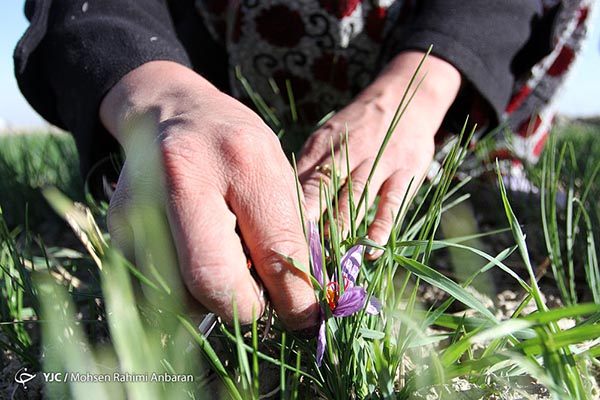
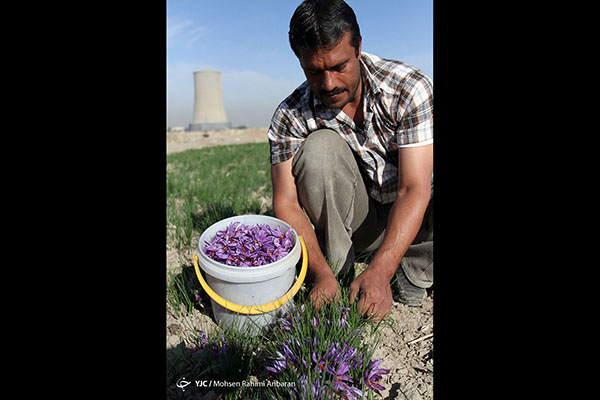
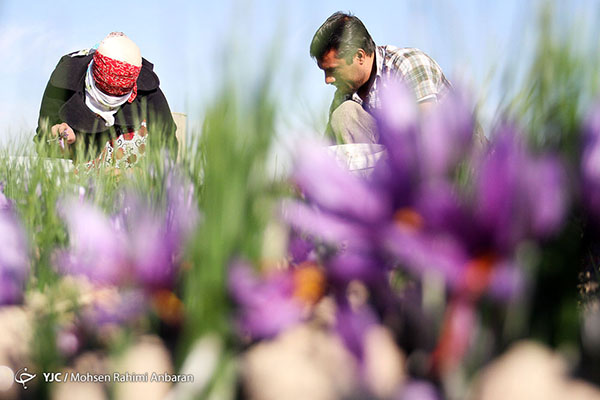

Harvest time has arrived in Khorasan Razavi Province where saffron farmers are hard at work to collect their products.
The following are the images the Young Journalist Club has placed on its website of the harvest season:
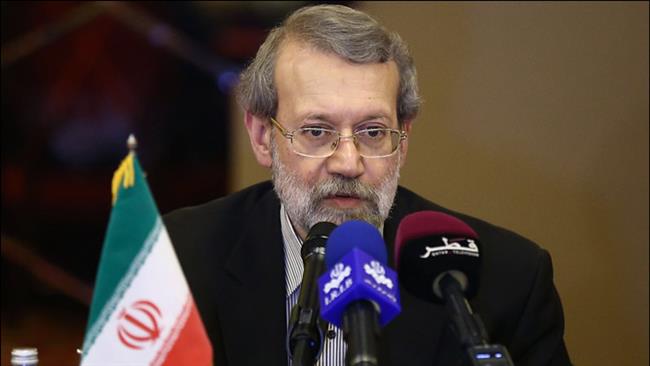
Parliament Speaker Ali Larijani said on Friday that Iran is seeking to unveil the aspects of the human tragedy in the Mina stampede through the fact-finding committee, the United Nations and the Organization of Islamic Cooperation (OIC).
Larijani said that Iran is making efforts to pursue the case of Iranian pilgrims who went missing during the deadly incident.
The top MP went on to say that the Saudi government has buried some of the victims, adding that in order to identify the Iranian pilgrims, Iran is fingerprinting the victims.
Larijani blamed the Saudi officials for the incident, saying that they even didn’t act properly after the disaster.
About the former Iranian ambassador to Beirut Ghazanfar Roknabadi, who went missing in the incident, Larijani said that Roknabadi had been transferred to hospital, but Saudi officials deny that.
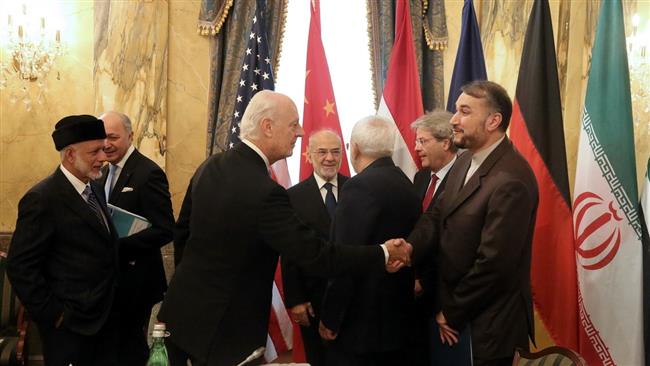
According to Iranian media outlets, Hossein Amir-Abdollahian, Iran’s deputy foreign minister for Arab and African affairs, on Friday dismissed as false the reports on Assad’s fate.
Western media had earlier in the day reported that Iran has signaled that it favored a six-month “transition” period in Syria followed by elections to decide the fate of the Syrian president.
“Iran does not insist on keeping Assad in power forever,” Reuters quoted Amir Abdollahian as telling Iranian media.
The developments come as international talks on the crisis in Syria are underway in the Austrian city of Vienna. The negotiations have brought together some 16 countries including Iran.
This is the first time the Islamic Republic has attended the talks after it was denied participation in the previous two rounds – both of which ended inconclusively – under pressure from the US and its allies.
Iranian Foreign Minister Mohammad Javad Zarif heads Iran’s delegation during the Vienna talks.
“Non-interference in the internal affairs of Syria [and] combating terrorism and extremism” must also be among common objectives of all participants in the negotiations if they really want to address the crisis in Syria, Zarif said upon arrival in the Austrian capital on Thursday.
The parties involved in efforts to end the violence in Syria have apparently come to the conclusion that “no reasonable and logical” solution could be found to the crisis without the Islamic Republic, added Iran’s foreign minister.
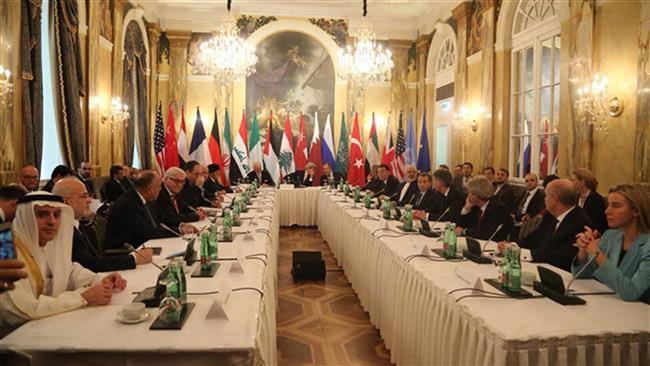
Apart from the Islamic Republic, the United States, Turkey and Saudi Arabia, and representatives from at least 12 other countries are also attending the talks. Those states are France, Germany, Egypt, Russia, Jordan, the UK, Qatar, the United Arab Emirates (UAE), Iraq, Lebanon, China and Oman.
Envoys from the United Nations and the European Union are also present at the talks.
‘Common ground’ sought
“I believe it is very important that … we will have all the relevant actors, regionally and internationally, relevant actors playing around the same table trying to define a common space for the beginning of the political process to find a solution to the crisis in Syria,” EU foreign policy chief Federica Mogherini said.
Dmitry Peskov, spokesman for Russian President Vladimir Putin, said Friday that the Vienna talks will focus not “on [President Bashar] al-Assad’s fate but on the Syrian settlement,” adding that “only the Syrians can determine the political future of Bashar al-Assad.”
He said the “search for a political solution of the Syrian conflict has no alternative,” adding that “all the interested sides were taking part in the Vienna talks, mainly states, which can make a contribution into the settlement.”
Meanwhile, Iraq’s foreign minister also said on Friday that the next multilateral meeting on the Syria crisis should be in Vienna next week.
Ibrahim al-Ja’afari added that the Friday talks on resolving the Syria crisis had failed to bring an agreement on Assad’s role in the political process.
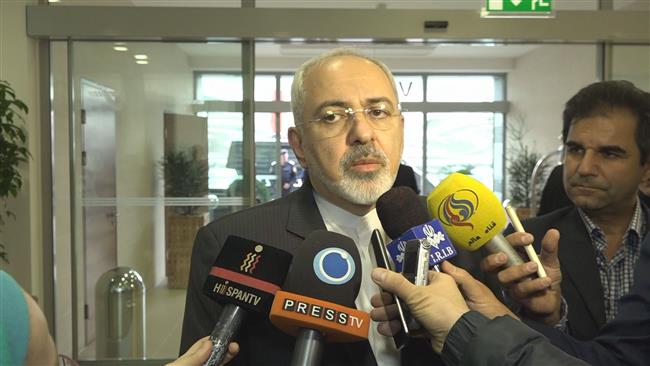
Iranian Foreign Minister Mohammad Javad Zarif made the remarks upon his arrival in the Austrian capital city of Vienna on Thursday.
Respecting the territorial integrity and national unity of Syria should be top on the agenda of the Syria talks, said Zarif, adding, “Non-interference in the internal affairs of Syria [and] combating terrorism and extremism,” must also be among common objectives of all participants in the negotiations if they really want to address the crisis in the Middle Eastern state.
The top Iranian diplomat further emphasized that the Islamic Republic has attended the negotiations to work for a solution to the conflict in Syria and hopes all others participants “are here for the same reason.”
The international talks on the Syrian turmoil are expected to take place in Vienna on October 30. The negotiations will bring together about a dozen countries including Iran, the first time such appearance by the Islamic Republic in a meeting on Syria.
Two conferences were previously held in an attempt to resolve the Syrian crisis in the Swiss city of Geneva, one in 2012 and the other in 2014. However, both events ended in failure amid the absence of Iran, an important regional player.
Elsewhere in his remarks, the Iranian foreign minister said no preconditions had been set for Iran’s attendance in the Vienna talks, adding that Tehran would never partake in the conference if there were such requirements.
The parties involved in efforts to end the violence in Syria have apparently come to the conclusion that “no reasonable and logical” solution could be found to the crisis without the Islamic Republic, added Iran’s top diplomat.
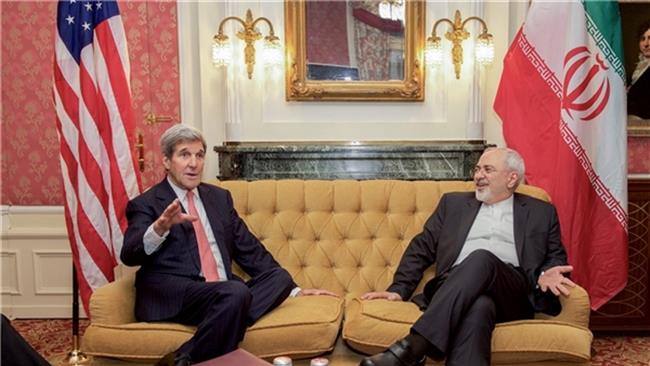
Zarif and US Secretary of State John Kerry met in Vienna on Thursday evening ahead of the Syria negotiations and discussed the implementation of the Joint Comprehensive Plan of Action (JCPOA) reached between Iran and the P5+1 group of countries over the Islamic Republic’s nuclear program.
The Iranian foreign minister also met his Russian counterpart, Sergei Lavrov, where the two sides stressed the need to combat terrorism and extremism as well as political process, national dialogue and foreign non-interference in Syria.
Zarif and EU foreign policy chief Federica Mogherini will also meet later on Thursday. Their talks will focus both on the JCPOA as well as regional issues.
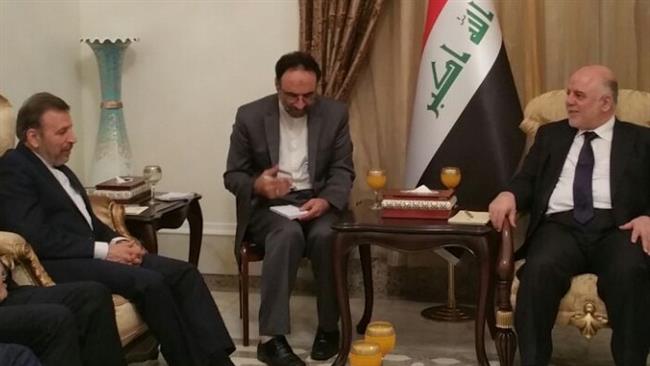
An Iranian minister has expressed Tehran’s readiness to help Iraq in the fight against terrorist groups.
“Iran is fully ready to support Iraq in [its] war against terrorism, and we can carry out necessary measures in this regard through expansion of bilateral cooperation with the friend and neighboring country of Iraq in all areas such as communications and information technology,” Minister of Communications and Information Technology Mahmoud Vaezi said in a meeting with Iraqi Prime Minister Haider al-Abadi in Baghdad on Friday.
Vaezi stressed the importance of improving Tehran-Baghdad cooperation, and said Iran is making efforts to fulfill its obligations vis-à-vis Iraq in all arenas.
He further said that the presence of “criminal” Takfiri, terrorist and extremist groups in any country is “dangerous and will lead to regional instability.”
The Iraqi premier, for his part, said the Middle East is facing many challenges, including the danger of the IS terrorists.
Abadi also expressed his country’s willingness to strengthen relations with Iran, which he said would serve the two states’ interests.
Gruesome violence has plagued the northern and western parts of Iraq ever since IS terrorists launched their offensive in Iraq and took control of portions of the country. The militants have been committing heinous crimes against all ethnic and religious communities in Iraq, including Shias, Sunnis, Kurds, and Christians.
Iran’s support for regional, global peace
In a meeting with Iraqi Foreign Minister Ibrahim al-Jaafari, the Iranian minister said the Islamic Republic supports any plans aimed at promoting regional and international stability and security.
Jaafari, for his part, commended Iran’s support for Iraq in the fight against terrorism.
Iraq is ready to adopt the necessary measures to bolster relations with all countries based on common interests, the Iraqi foreign minister said.
Vaezi also held talks with his Iraqi counterpart Hassan Kazim al-Rashid about the expansion of cooperation, particularly in the communications sector.

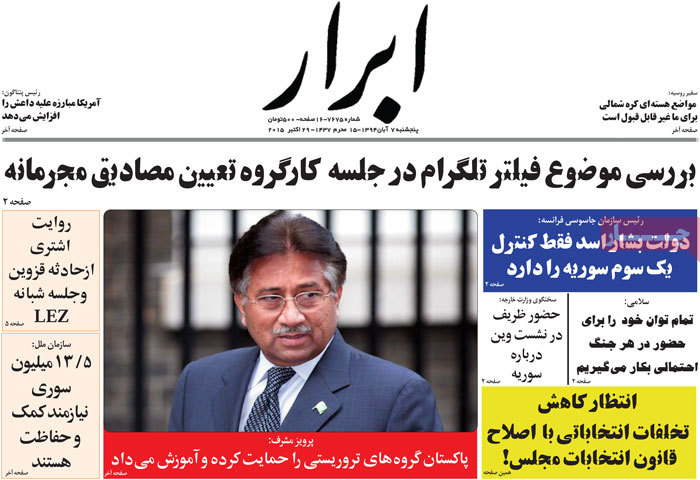
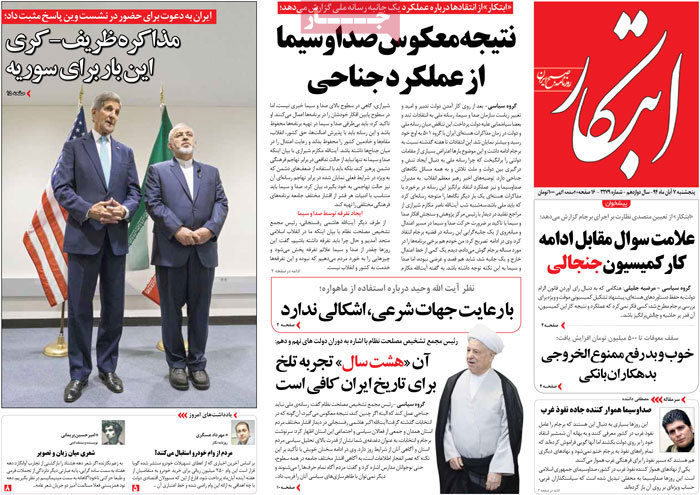
Acceptance by Iran of an invitation to attend a Vienna conference on the Syrian crisis dominated the front pages of Iranian newspapers on Thursday. Reformist-leaning newspapers also gave front-page coverage to the critical comments of Ayatollah Nasser Makarem Shirazi aimed at IRIB.
Ettela’at: Iran is to attend international talks in Vienna over the Syrian crisis.
The announcement came after the UN, the US, Russia and France invited Iran to help work out a solution to the crisis.
Ettela’at: [Secretary of the Supreme National Security Council Ali] Shamkhani has held talks with Pakistani officials on efforts to fight terrorism and ensure border security.
Ettela’at: Turkey, Qatar and the United Arab Emirates have reportedly flown 500 IS militants to Aden, Yemen.
In another development, the UN secretary general condemned a Saudi-led coalition’s attack on a medical facility run by Doctors without Borders.
Ettela’at: Verdicts to pull down illegally-constructed buildings are issued but are not implemented, complained the top judge at the Court of Administrative Justice.
Mohammad Jafar Montazeri further said that the number of complaints people lodge against the government has decreased.
Ettela’at: Grand Ayatollah Nasser Makarem Shirazi has criticized the national broadcaster for its one-sided treatment of the nuclear issue.
The source of emulation urged IRIB to walk down the path of moderation.
Ettela’at: A funeral service has been held for two Iranians martyred while defending the holy shrine of Zeynab in Syria.
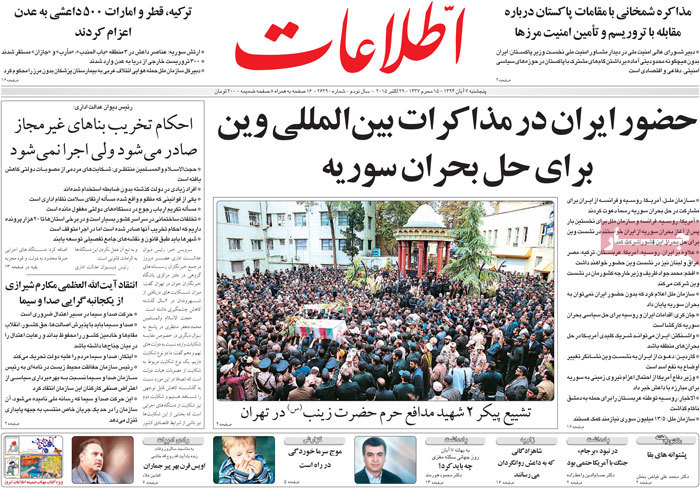
Abrar: Former Pakistani President Pervez Musharraf has said that Pakistan trains and supports terrorist groups.
Afarinesh: Imports of gasoline from countries to the north of Iran have been banned.
Afarinesh: On the sidelines of the Vienna meeting on Syria, Iran and the US will get together to coordinate the implementation of the Joint Comprehensive Plan of Action.
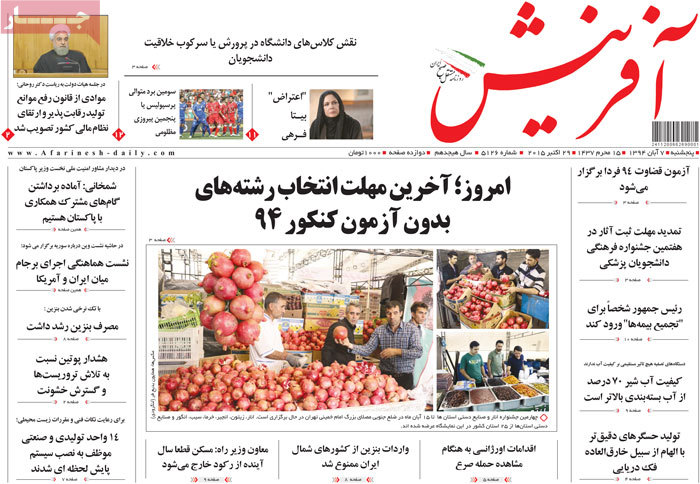
Afkar: Zarif and Mogherini have held talks on the phone over Syria.
Afkar: Former UN chief Kofi Annan has underlined Iran’s involvement in efforts to settle the Syrian crisis.
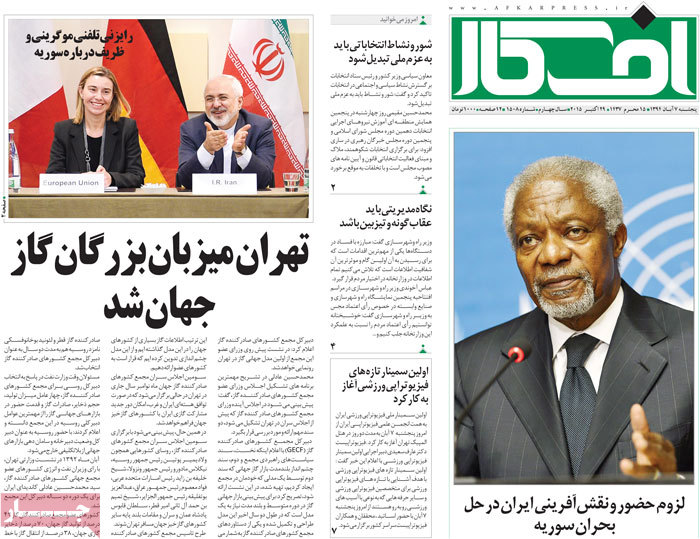
Aftab-e Yazd: Attorneys for the Oil Ministry have said that the preliminary debts of Babak Zanjani [a young billionaire on trial for corruption and embezzlement] stand at €2.066 billion.
Aftab-e Yazd: American lawyers will visit Iran on tourist visas; it is not a business trip, the head of the Bar Association of Iran has said in an interview with the daily.
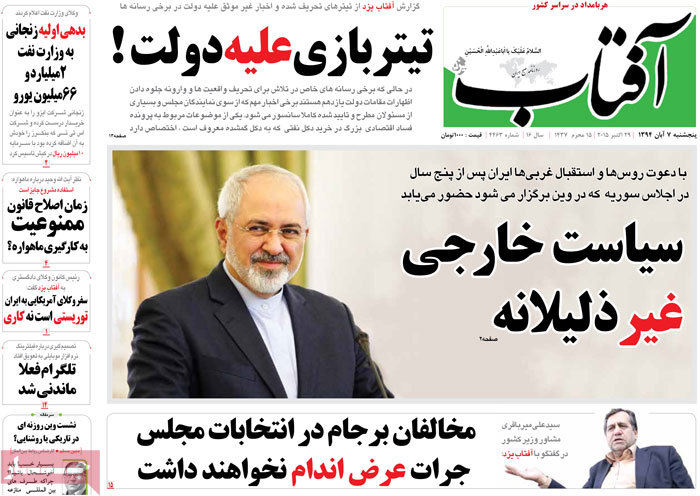
Akhbar Sanat: Iran has been chosen as host of natural gas heavyweights in the world, said the secretary general of the Gas-Exporting Countries Forum.
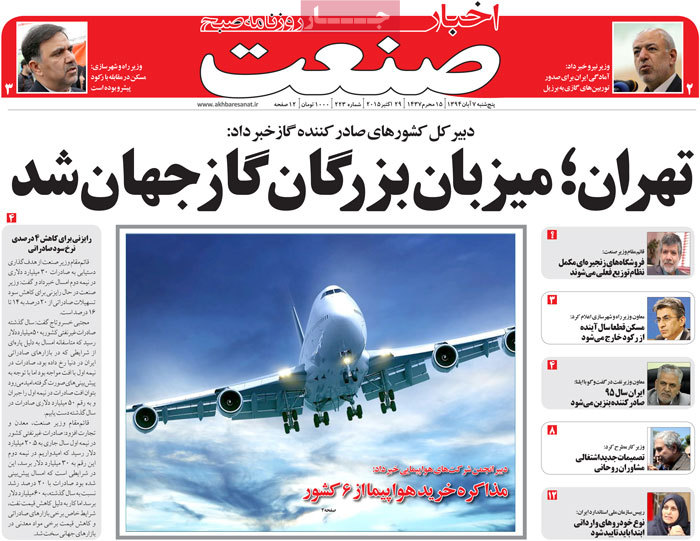
Amin: “You cannot resort to political charades to fool the public,” said Chairman of the Expediency Council Ayatollah Akbar Hashemi Rafsanjani.
He further said that execution of Ayatollah Nimr al-Nimr will have grave consequences for the Saudis.
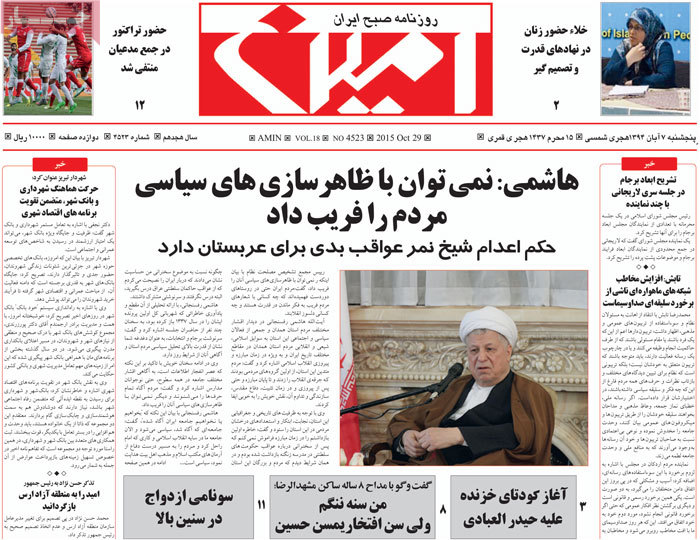
Arman-e Emrooz: Zarif and members of his nuclear negotiating team travel to Vienna for a different purpose: To attend a meeting on developments in Syria.
The Iranian and American top diplomats are to get together in Vienna for a non-nuclear meeting.
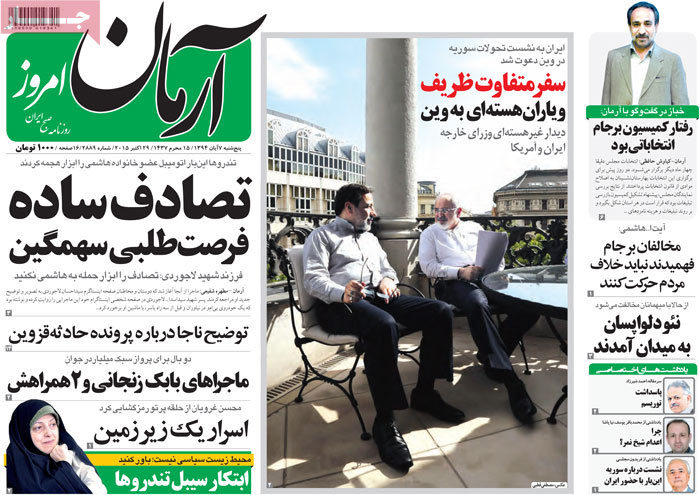
Asr-e Eghtesad: Iran’s business environment has improved by 12 notches, according to a World Bank report.
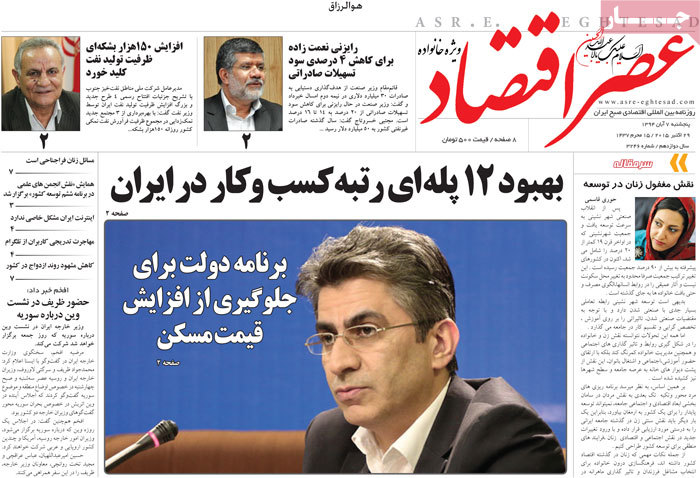
Asrar: Ayatollah Hashemi Rafsanjani has issued a warning to the Wahhabi rulers of Saudi Arabia.
Asrar: “We have been found guilty without ever being tried,” said a number of pop singers in a letter to President Rouhani.
In the letter the singers have complained about bias against pop music in the country.
Asrar: The director of the Environment Protection Organization has said that IRIB is trying to create a media crisis for the administration.
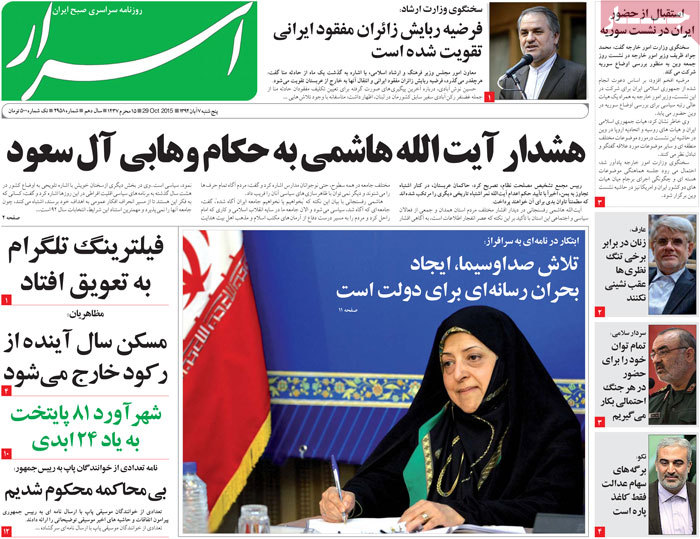
Ebtekar: “The bitter experience of those eight years is enough for Iranian history,” said the chairman of the Expediency Council in reference to the two-term presidency of Ahmadinejad.
Ebtekar: Ayatollah Hossein Vahid Khorasani has said that if religious issues are taken into consideration watching satellite TV would be acceptable.
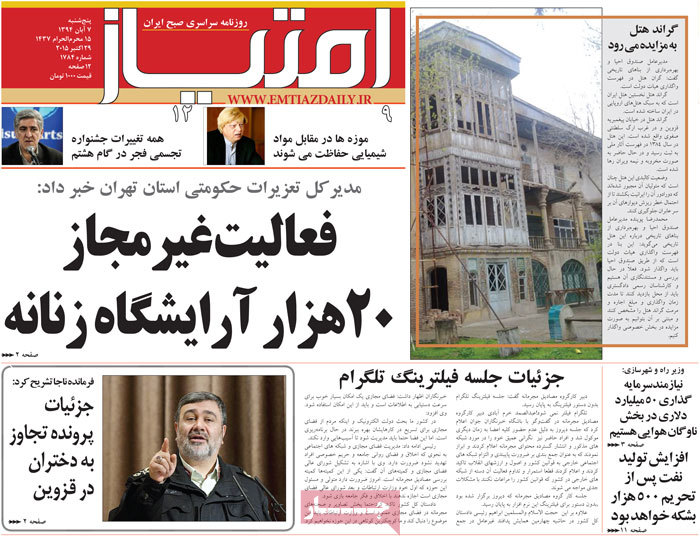
Emtiaz: The air fleet needs $50 billion in investment, said the minister of roads and urban development.
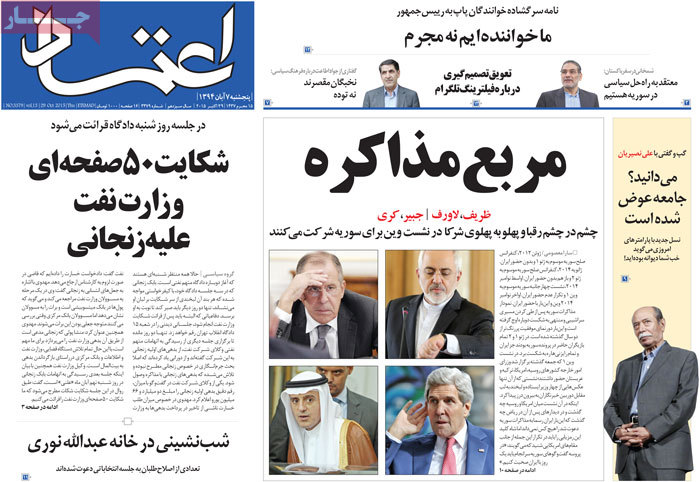
Etemad: A decision on whether to block Telegram [a messaging app very popular in Iran] has been put off.
Etemad: The secretary of the Supreme National Security Council has said that Iran believes in a political solution to the Syrian crisis.
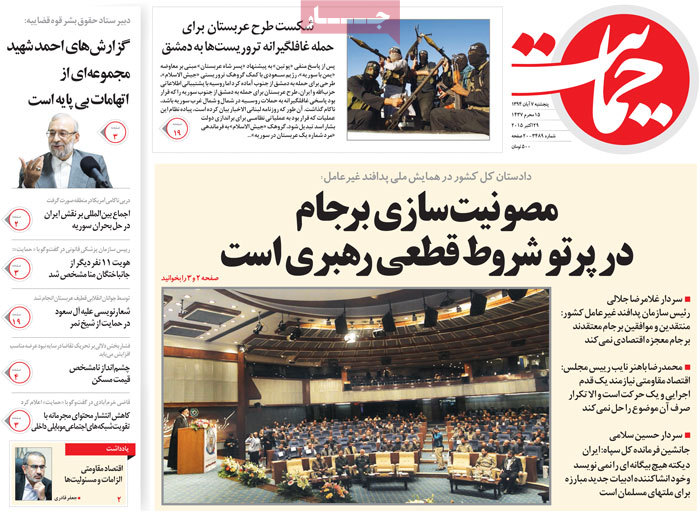
Hemayat: “The reports Ahmed Shaheed issues on Iran are a set of baseless allegations,” said the secretary of the Iranian judiciary’s Human Rights Council.
Iran: Iran’s daily crude production has increased by 150,000 barrels.
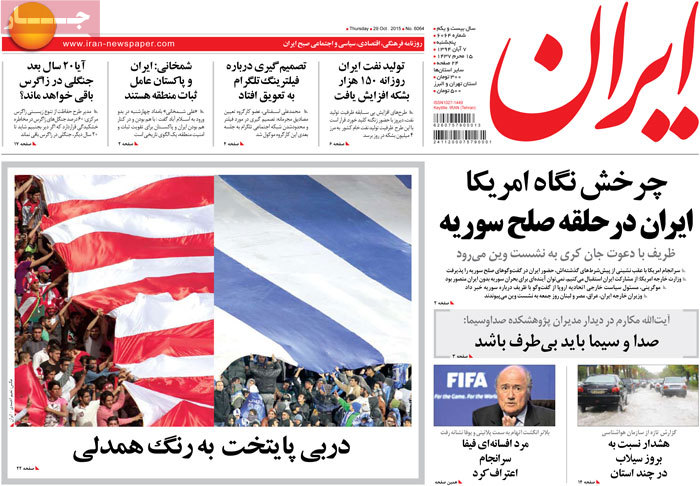
Iran: A change in American attitude; Iran has become a link in the Syrian peace chain.
Foreign Minister Zarif attends the Vienna meeting at the invitation of Secretary Kerry.
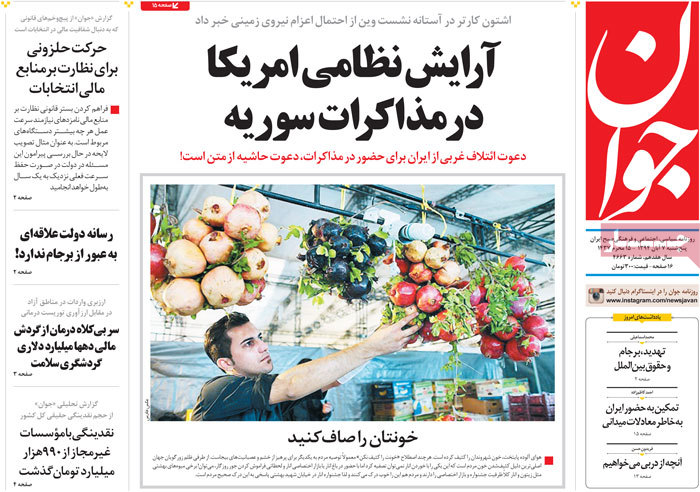
Javan: The military posture of the US in Syria talks
Ahead of the Vienna meeting, US Defense Secretary Ashton Carter has said that ground troops are likely to be sent to Syria.
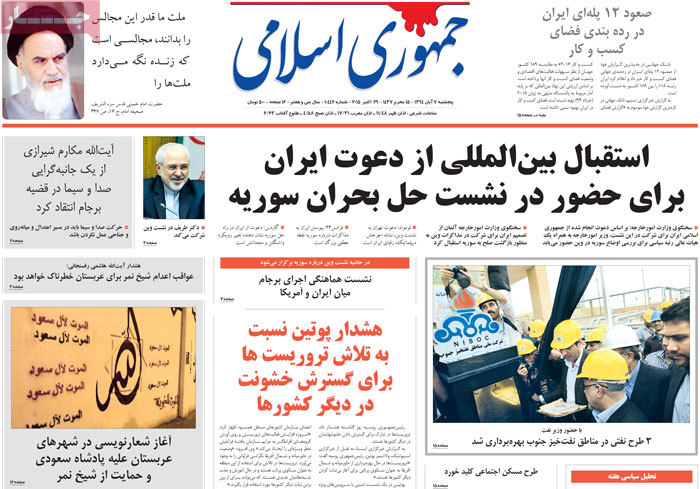
Jomhouri Islami: With the oil minister on hand, three oil projects have been inaugurated in the south.
Jomhouri Islami: Iran’s upcoming presence at the Vienna meeting on Syria has drawn an international welcome.
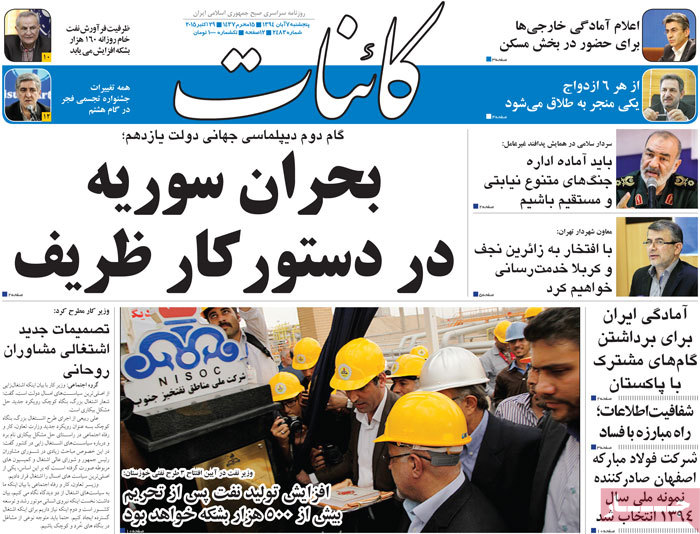
Kaenat: One in every six marriages ends in divorce.
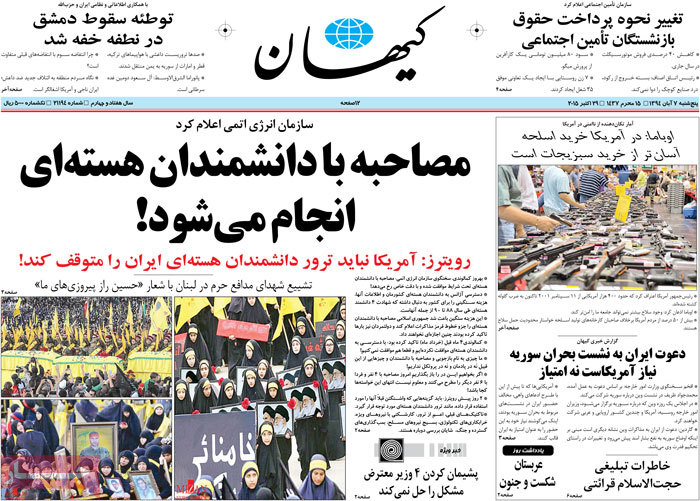
Kayhan: The Atomic Energy Organization has said that nuclear scientists can be interviewed!
Kayhan: The presence of Iran in the Vienna meeting on Syria is what the US needs; it is not a concession.
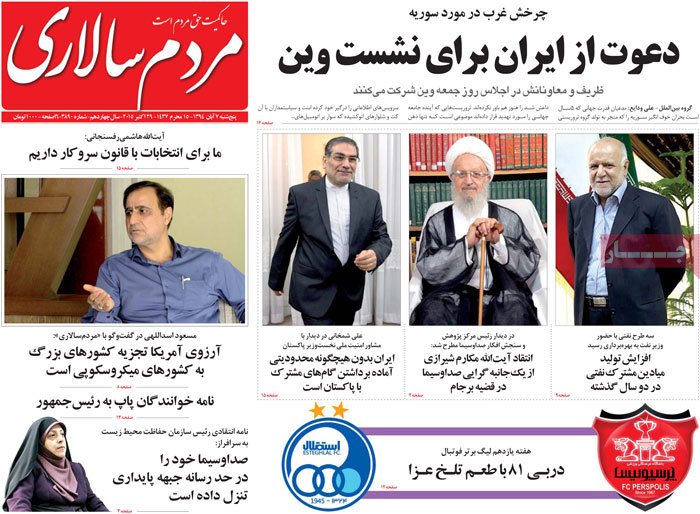
Mardomsalari: IRIB has lowered its position to being the mouthpiece of the Stability Front, said the director of the Environment Protection Organization in a letter to the chairman of the national broadcaster.
Mardomsalari: An 81st encounter between the capital’s soccer heavyweights [Persepolis and Esteghlal] will take place on Friday as the sports community is still mourning the loss of the captain of the red-clads.
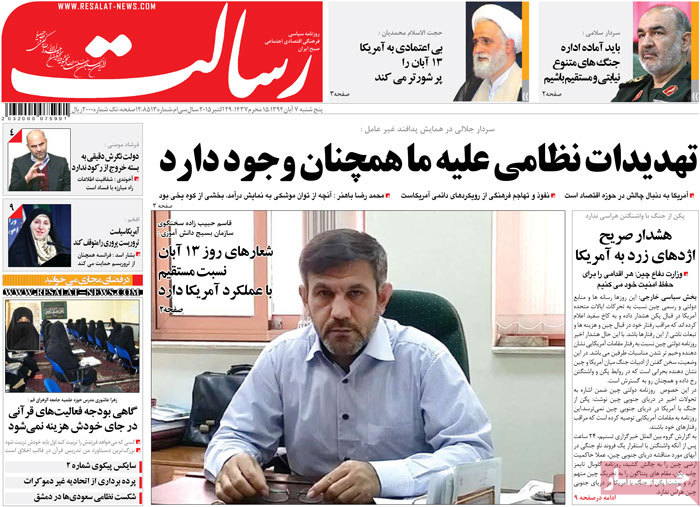
Resalat: The head of the Passive Defense Organization has said that military threats continue to be issued against Iran.
He further said that infiltration and cultural encroachment are among unchanging approaches of the US.
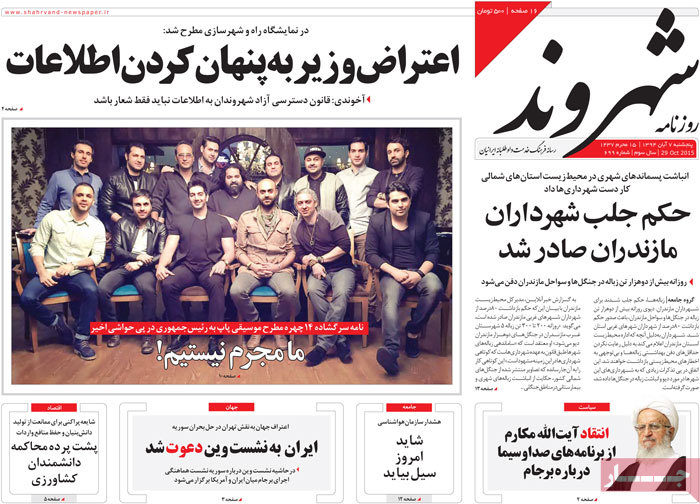
Shahrvand: Arrest warrants have been issued for a number of mayors in the northern province of Mazandaran for dumping the urban waste in areas other than landfills.
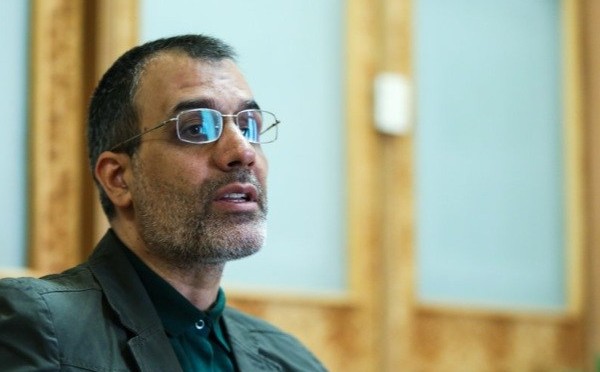
The Iranian Foreign Ministry has appointed a new figure as its spokesman.
Sadegh Hossein Jaberi Ansari, the foreign ministry’s director general for Middle-Eastern affairs, will replace Marzieh Afkham in coming weeks.
He will reportedly start his new post in coming two weeks.
Afkham will be appointed as Iran’s new ambassador to Kuala Lumpur.
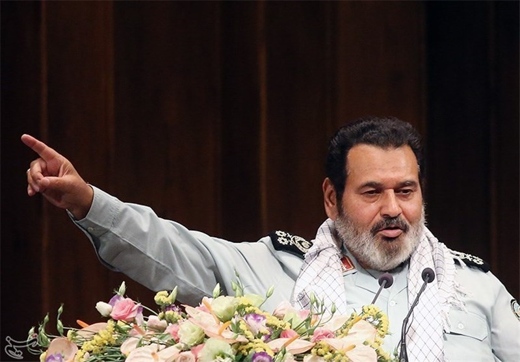
Chief of Staff of the Iranian Armed Forces Major General Hassan Firouzabadi described the Saudi regime as a “war criminal”, saying the Arab country’s presence in Friday talks in Austrian capital of Vienna on the Syrian crisis would not be legitimate.
The Saudi regime is a war criminal because of its all-out support for Daesh (ISIL) and terrorist acts in Iraq, Syria, and Lebanon as well as the state-sponsored terrorism in Bahrain and numerous crimes it committed by attacking Yemen’s hospitals, schools, and houses, and for the destruction of Yemen’s infrastructures, Firouzabadi said Thursday.
With such a conduct, the Saudi regime’s participation in the multilateral Syria talks in Vienna is suspicious and illegitimate, he stated.
A number of world powers and regional countries, including Russia, the United States, Britain, France, Germany, Iran, Egypt, Jordan, Qatar, Saudi Arabia, Turkey and the United Arab Emirates on Friday will hold talks in the Austrian capital on ways to find a solution to the Syrian crisis.
The Iranian top commander also said that the “arrogant” rulers of Saudi Arabia should be accountable to their own nation and regional countries for their “crazy” moves.
“Dire consequences await the Al Saud rulers (for their actions),” he added.
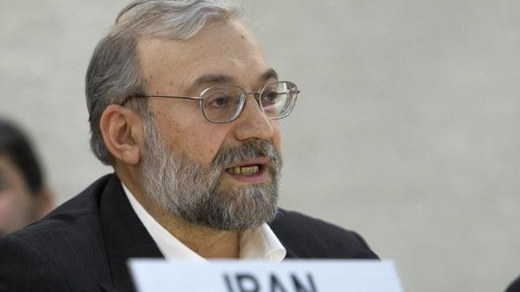
“Ahmed Shaheed’s reports are collection of baseless accusations, which have been gathered from a group of terrorism-related references,” IRIB quoted Larijani as saying on Wednesday.
He added that Shaheed is a media puppet and his cohorts are terrorists who pose as human rights activists, hence Iran does not accept his appointment and pays no attention to his reports.
He also noted that Iran is the most democratic nation in West Asia and only pays heed to the UN Universal Periodic Reviews.
In his recent report, Shaheed accused Iran of human rights violations and censured the execution of drug traffickers.
Under pressure from the US and its allies, the UN Human Rights Council named the former Maldivian foreign minister as its human rights investigator for Iran in June 2011.
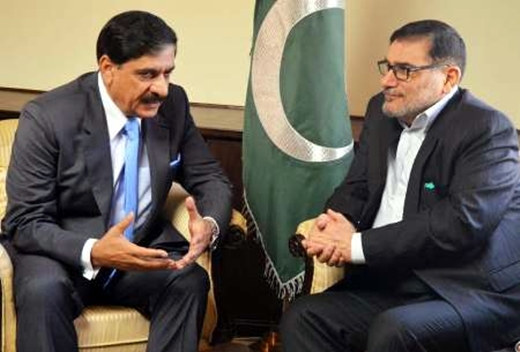
Iran is ready to take steps toward cooperation with Pakistan on the political, security, defense and economic fronts, Secretary of the Supreme National Security Council Ali Shamkhani said Wednesday at a meeting with Lieutenant General Nasir Janjua, the National Security Advisor to Prime Minister Nawaz Sharif.
What comes next is the translation of a report by the Islamic Republic News Agency about what else Shamkhani said at the meeting:
Ali Shamkhani, who is in Pakistan for a two-day state visit, further said, “Iran and Pakistan’s shared security and defense concerns over key questions, including the fight against terrorism, border security, extremism and violence and regional security cooperation provide perfect ground for closer bilateral cooperation.”
He hailed the wise move of the Pakistani government not to get involved militarily in the Yemeni crisis and said, “Through dialogue, understanding and rejection of non-peaceful solutions, Muslim countries should not allow their differences to pave the way for the interference of countries which do not have the best interests of Muslims at heart.”
The Iranian official added, “The change of governments in Pakistan won’t interfere with the strategy of the Islamic Republic to expand all-out ties with Pakistan.”
He underlined the need for adoption of joint solutions to counter foreign-backed terrorist groups along the Iran-Pakistan border and said, “Some trans-regional countries along with their regional allies seek to cause divisions between Tehran and Islamabad through stirring up border insecurity at the hands of terrorists.”
Shamkhani, who arrived in Islamabad early Wednesday, is also scheduled to meet with Prime Minister Nawaz Sharif and his advisor for foreign affairs Sartaj Aziz.
© All Content by IFP News ( Iran Front Page ) is licensed under a Creative Commons Attribution 4.0 International License.
