Thursday, January 1, 2026
Home Blog Page 4572

Shazdeh Garden in Iranian desert (PHOTOS)

Shazdeh Garden11

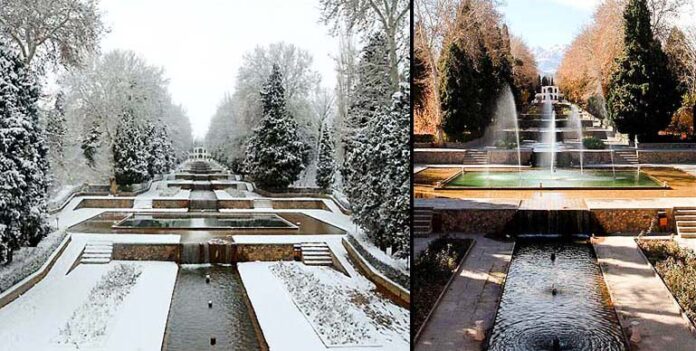
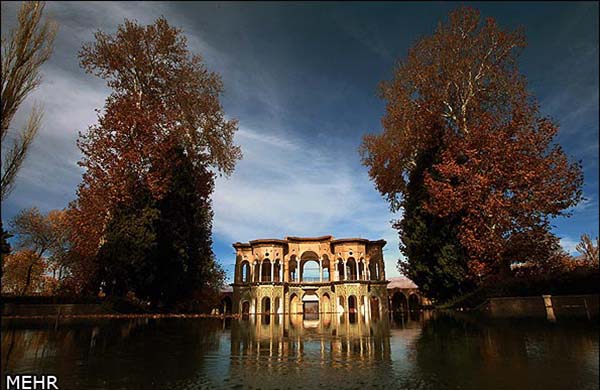
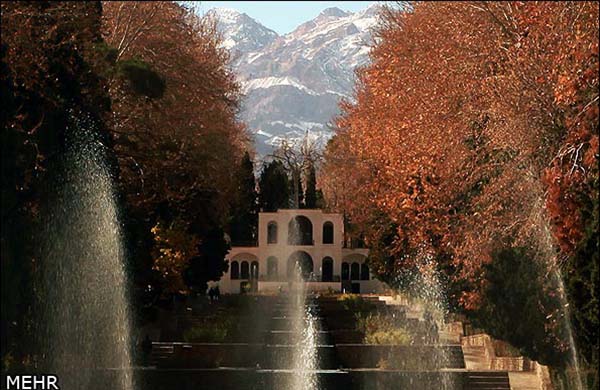
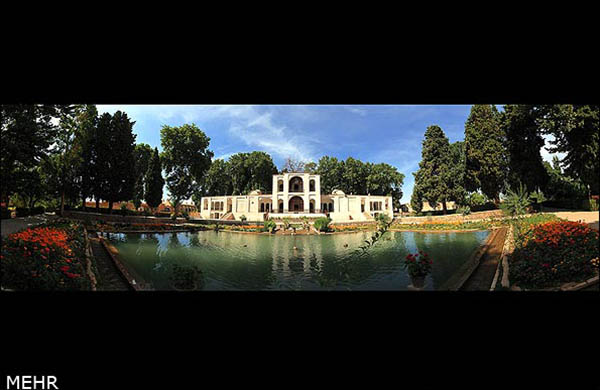
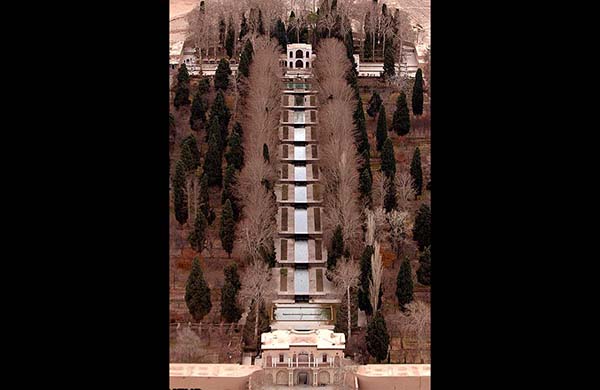
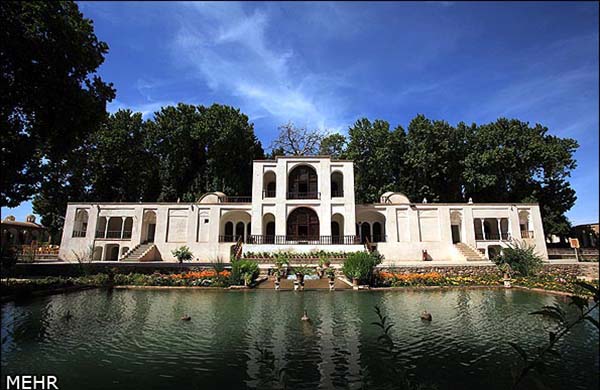
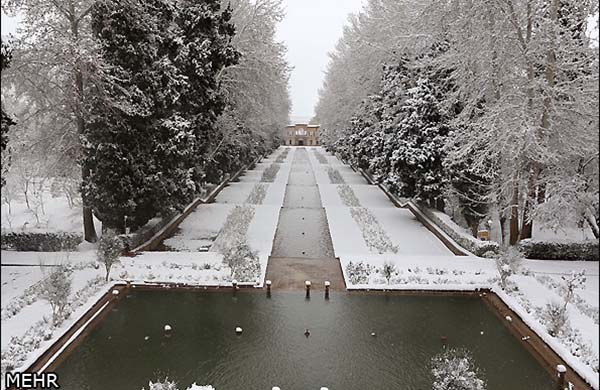
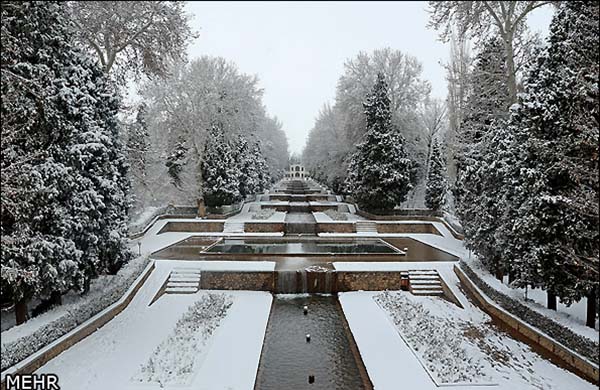
In visiting the southern Iranian province of Kerman, one needs to make sure they take in Mahan: home to the biggest and most beautiful Iranian garden.

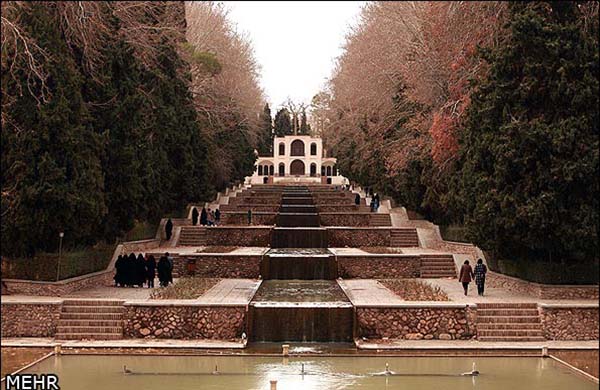
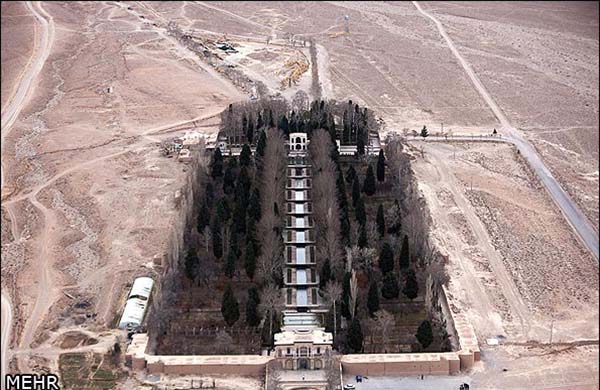
Shazdeh Garden was built on orders of a Qajar prince in the mid-1850s. In light of the fact that the garden was located in all but featureless desert, beasts of burden were used to bring in plants and saplings to the construction site.

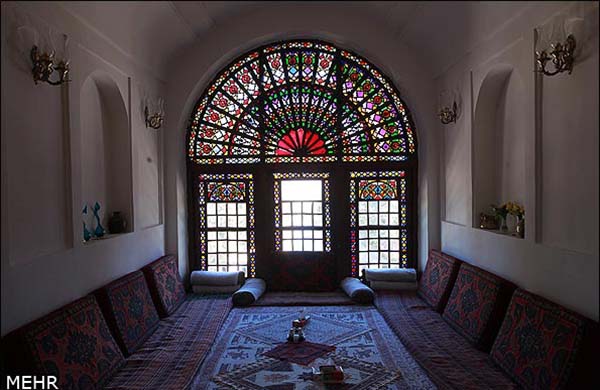
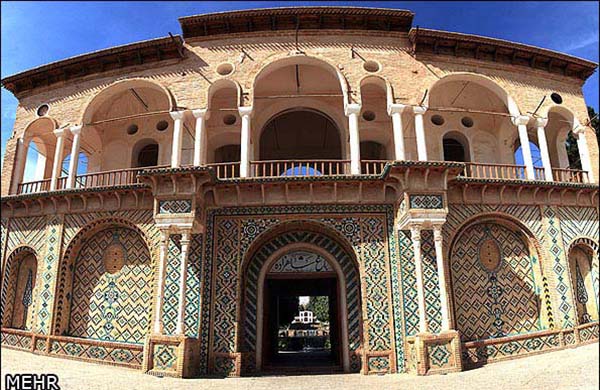
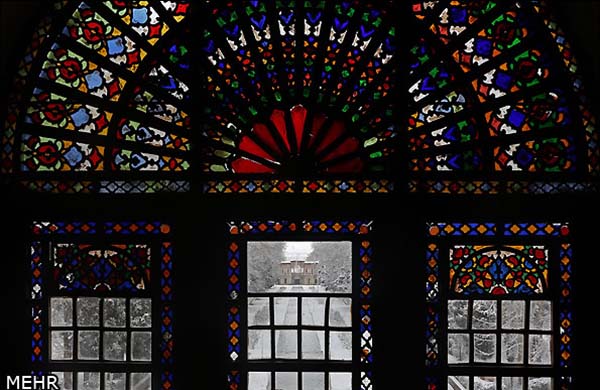
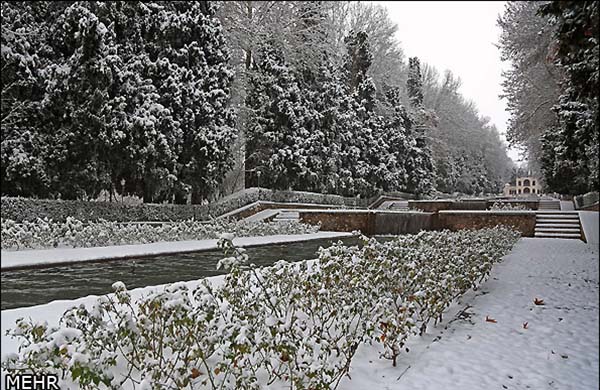
The rectangular 5.5 hectare walled garden which features two beautiful mansions has been designated as a UNESCO World Heritage Site. The cobblestoned garden has several fountains.

GRI’s 2015 Person of the Year in Political Risk

Mohammad-Javad-Zarif

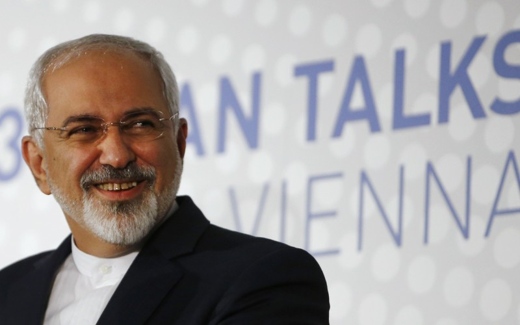
Global Risk Insights, which provides insights for leading media outlets around the world on political risk, international economics, and geopolitics, has named the Iranian foreign minister as its Person of the Year in 2015 in the area of political risk.

The following is the reason globalriskinsights.com has provided for naming Mohammad Javad Zarif as its 2015 Person of the Year in Political Risk:

Iranian Foreign Minister Mohammad Javad Zarif is Global Risk Insights Person of the Year in Political Risk 2015. Like our 2014 GRI Person of the year Indian Prime Minister Narendra Modi, Zarif has given Iran the opportunity to engage in active dialogue with the international community and the global economy after many years of isolation.

2015 has been an exciting year regarding political risk. There have been political upheavals throughout the globe and many a region marred by violence. However, looking positively on the international scene the Iranian nuclear deal on the 14th of July between Iran and the P5+1 stands out as the most important and influential event that has occurred this year.

Through skilled diplomacy and tough negotiation, Iranian Foreign Minister Mohammad Javad Zarif has brought Iran out of the cold and back into the international community.

Although it is significantly early to say whether the deal will be a complete success, Zarif’s skilled diplomacy and rhetoric has allowed Iran and the United States to come to the table and negotiate a deal and remove sanctions from the Iranian economy.

This is a significant feat, worthy of this year’s award. Zarif has demonstrated that he is a formidable political operator and skilled negotiator whose continued role at the helm of Iranian foreign policy will spell new exciting possibilities for post-sanction Iran. Here are three reasons why Zarif is the winner of this year’s award:

Iran is no longer an isolated actor

Zarif’s somewhat apt and memorable role in spearheading the Iranian nuclear negotiations has produced two positive developments. Firstly, the ability for Iran to come to a compromise with the P5+1 about its nuclear capabilities means that it is no longer isolated from the international community.

Iran has now cooperated with the IAEA and other international agencies in securing the terms of the deal, but it demonstrates a willingness to remove its previous pariah status within the international community.

Secondly, the conclusion of the deal has secured Iran’s role as a regional power. It now has the ability and potential to use its expanding influence on other regional issues and crises. Zarif’s prominent role in the recent talks in Vienna on the future of a political solution to the Syrian Crisis demonstrates this.

An invitation by the US to this event signifies Iran’s role in the Syrian conflict and its growing ability to influence Middle Eastern Politics. With Zarif continuing in his capacity as the Foreign Minister, there is potential for constructive cooperation with Europe and the US in fighting the rise of Daesh in Syria and Iraq.

Economic Potential

Iran’s isolation from the international economy has caused inflation to reach 40% and GDP to drop by 20% since sanctions were tightened in 2011. The negotiating capability and skill of the Iran delegation led by Zarif gave Iran many potential avenues of increasing economic development in the Joint Comprehensive Plan of Action (J.C.P.O.A).

Due to sanctions relief and an unfreezing of assets, Iran will now become the largest country to rejoin the global economy. Iran’s outdated energy industry requires at least USD$200 billion in upgrades, which presents big news for international oil companies. Other sectors in the economy will develop as well as Iran seeks to update its health, banking and commercial aircraft industries after many years of economic neglect.

In terms of trade and commerce, China, Russia and France will recommence business dealings that were cancelled previously. On top of this, trade and economic ties between Iran’s neighbors such as Turkey, Oman, and the UAE will develop and promote more regional economic cooperation.

However, the big winner in all this is the Iranian population. Sanctions have crippled the Iranian economy and unemployment is at 10 %. As more money is injected into the economy through oil revenues and investment, there is the potential for increased economic development in necessary infrastructure and a higher standard of living for the rapidly expanding Iranian middle class.

A possible normalization of US-Iranian relations

For the first time in 36 years, there are signs of a possible political rapprochement between Iran and the United States. While normalizing relations between Iran and the United States face incredible domestic pressure and there are considerable hurdles to overcome, the dialogue between Iran and the US has been positive.

Zarif and US Secretary of State John Kerry have developed a healthy dialogue over the last two years that has seen the Iranian Nuclear deal come to fruition despite calls from both conservative elements in the Majlis and Congress looking to shut down the deal at any opportunity.

Compromise and rationality were prominent and slowly and steadily Zarif’s active dialogue and skill as a foreign minister have alleviated some of the distrust that both nations feel for each other.

It may take some time for developments to transpire and progress, but the cool-headed way that Zarif has dealt with the nuclear issue and maintained a strong Iranian position shows a positive development in the possible normalization of US-Iranian relations.

A look at Iranian newspaper front pages on Dec. 26

Iranian Newspapers Headlines

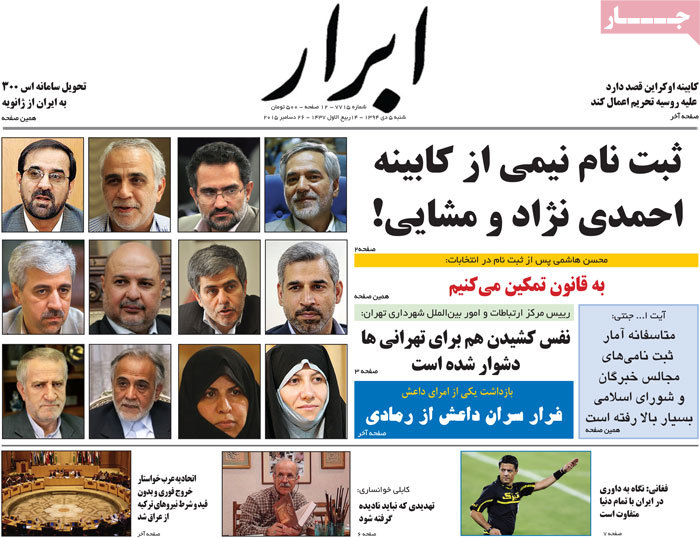
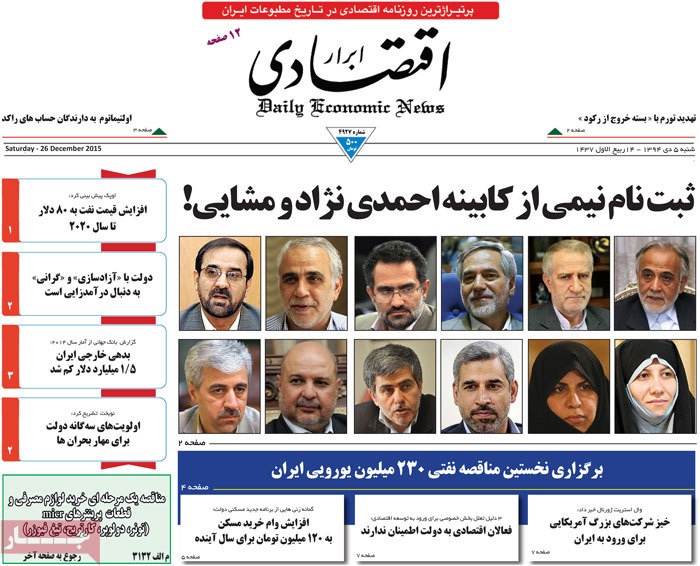
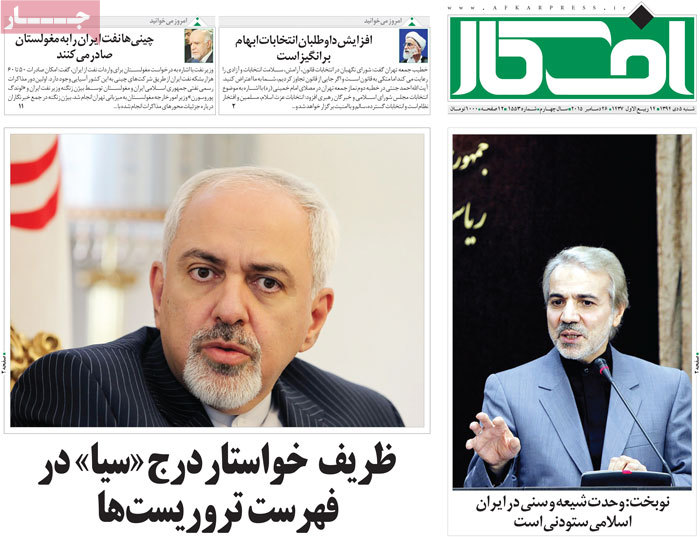
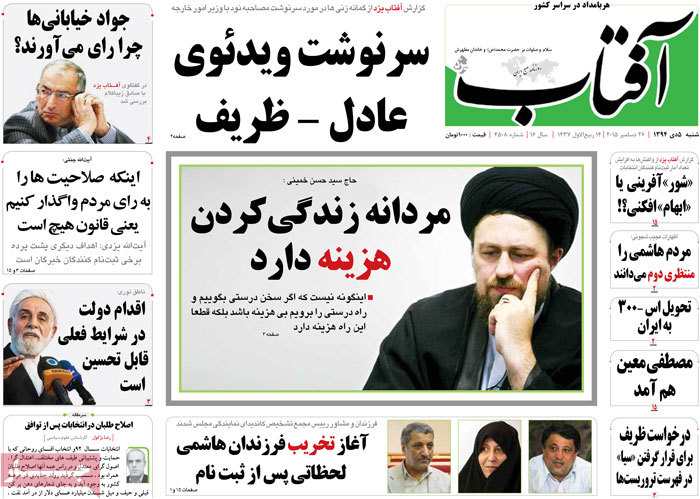
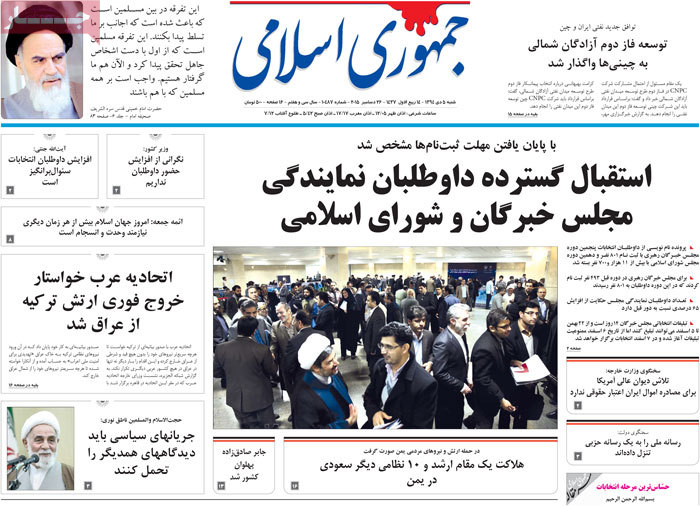
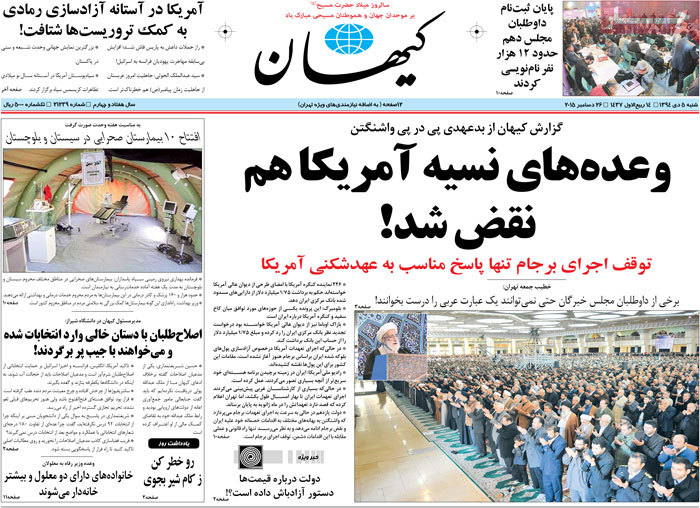
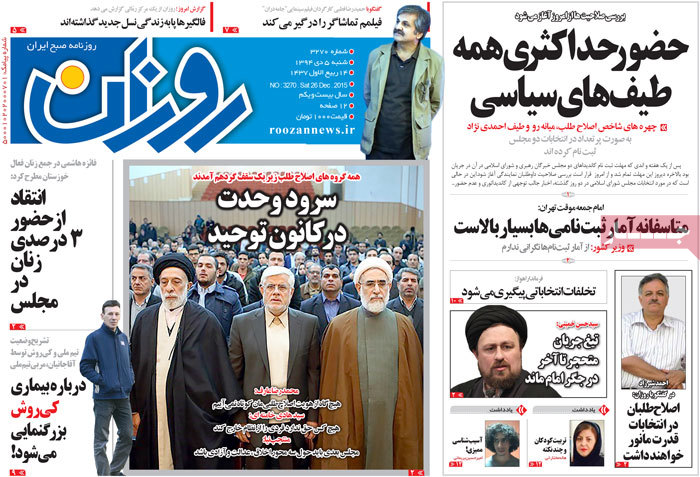
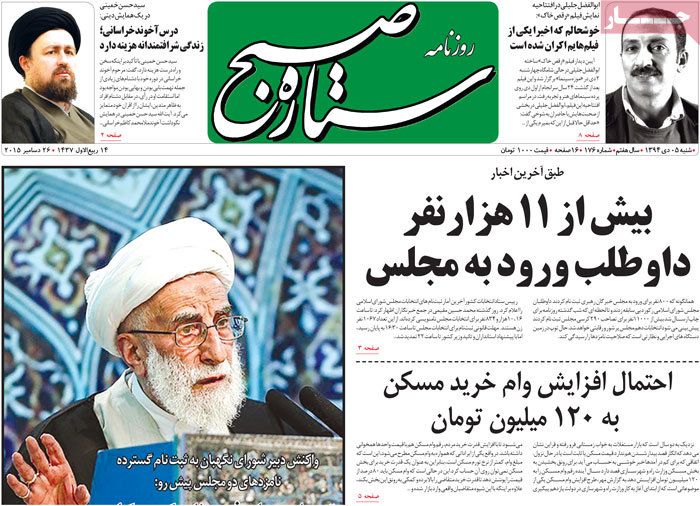
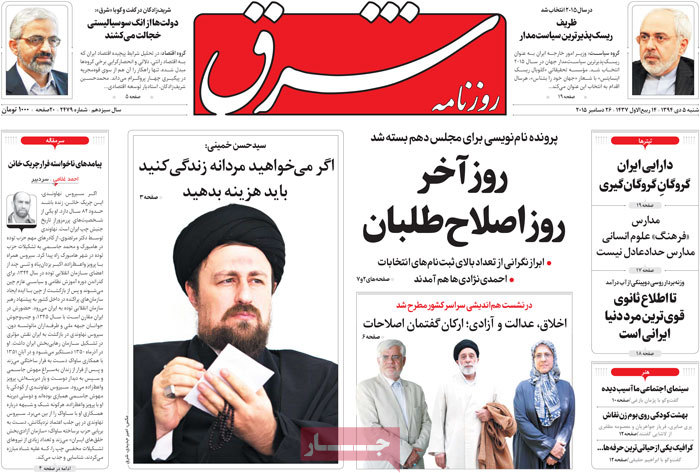
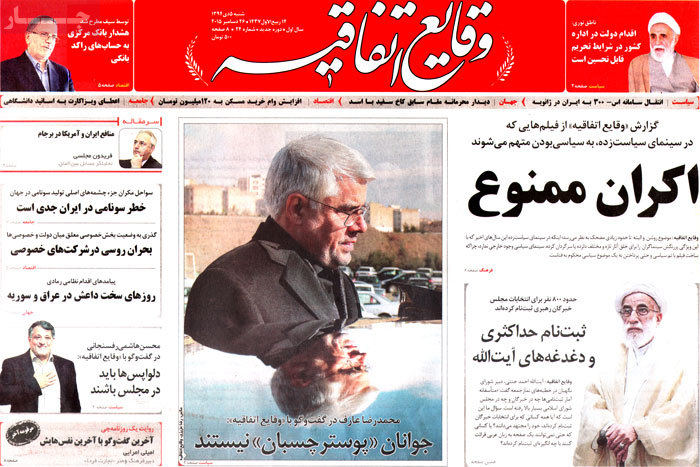
Registration of around 12,000 people for the late February elections dominated the front pages of Iranian newspapers on Saturday. Also in the news were comments by the interior minister that he is not worried about the growing number of registered candidates and those of the secretary of the Guardian Council who said the number is dubious.


A look at Iranian newspaper front pages on Dec. 26


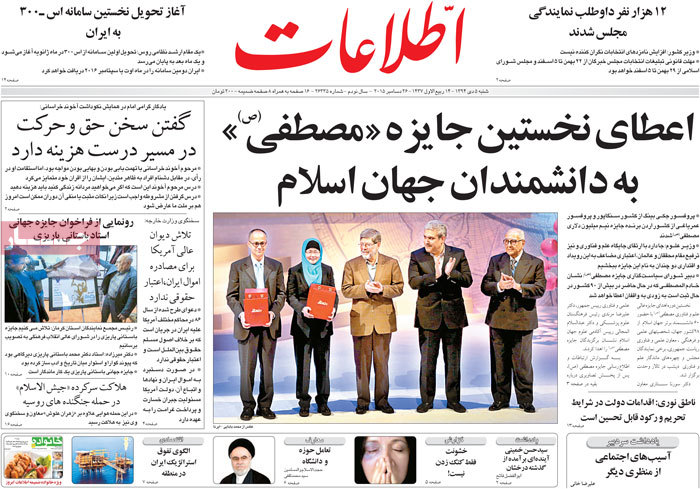
Ettela’at: Afirst Mustafa Prize has been granted to the scientists of the world of Islam.

[The $500,000 Mustafa Prize is a top science and technology award granted to the top researchers and scientists of the Organization of Islamic Cooperation (OIC) member states biennially.]

Jackie Y. Ying from Singapore and Professor Omar Yaghi from Jordan are the recipients of the prize in the “Life Sciences and Medicine” and “Nano-science and Nanotechnology” categories.

Ettela’at: As many as 12,000 people have fielded their candidacy for the Islamic Consultative Assembly. The interior minister has said that the growing number of candidates is not alarming.

Those running for the Assembly of Experts can run their electoral campaign between February 11 and 24, and those running for parliament between February 18 and 24.

Ettela’at: The first S300 missile defense system is to be delivered to Iran soon.

A top Russian military official has said that his country starts to deliver the first S300 system to Iran in January.

Ettela’at: To utter the truth and walk down the path of rightfulness involves a price to pay, said the grandson of the late Imam Khomeini in a congress to commemorate Akhund Khorasani.

Seyyed Hassan Khomeini further said that the lesson we can learn from the late Grand Ayatollah Mullah Mohammad Kazim Khorasani is that you need to pay the price if you want to lead an honorable life.

Ettela’at: The Foreign Ministry spokesman has said that attempts by the US Supreme Court to seize Iran’s assets lack legal substance.

Ettela’at: The race for Professor Bastani Parizi Prize has officially started.

“We are trying to make the Bastani Parizi Prize approved in the Supreme Cultural Revolution Council, said the head of the assembly of MPs representing Kerman Province.

Ettela’at: Zahran Alloush, the head of the Jaysh al-Islam [the Army of Islam], has been killed in a Russian airstrike.

Alloush’s deputy and the spokesman of the terrorist group in Syria were also killed in the air attack.


Abrar: “We will abide by the law,” said Mohsen Hashemi after registering for parliamentary elections.


A look at Iranian newspaper front pages on Dec. 26


Abrar-e Eghtesadi: Registration of half of Ahmadinejad’s Cabinet and Rahim Mashaee, the former president’s chief of staff [for the upcoming elections]!


A look at Iranian newspaper front pages on Dec. 26


Afkar: The government spokesman has said that unity between the Shiites and Sunnis is praiseworthy in Iran.


A look at Iranian newspaper front pages on Dec. 26


Aftab-e Yazd: To leave it to people’s opinion to decide on the qualifications [of candidates] means that laws make no sense, said Ayatollah Jannati, the secretary of the Guardian Council.


A look at Iranian newspaper front pages on Dec. 26


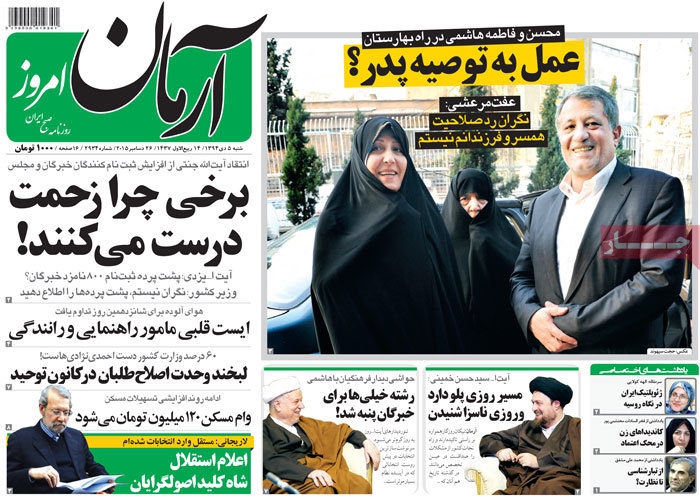
Arman-e Emrooz: Mohsen and Fatemeh Hashemi on their way to Baharestan [the Tehran street along which the Islamic Consultative Assembly is located]

The daily has a report on the children of Ayatollah Akbar Hashemi Rafsanjani who are running for parliament.

“I am not worried about the disqualification of my husband and children,” said Effat Hashemi, the wife of the chairman of the Expediency Council.


A look at Iranian newspaper front pages on Dec. 26


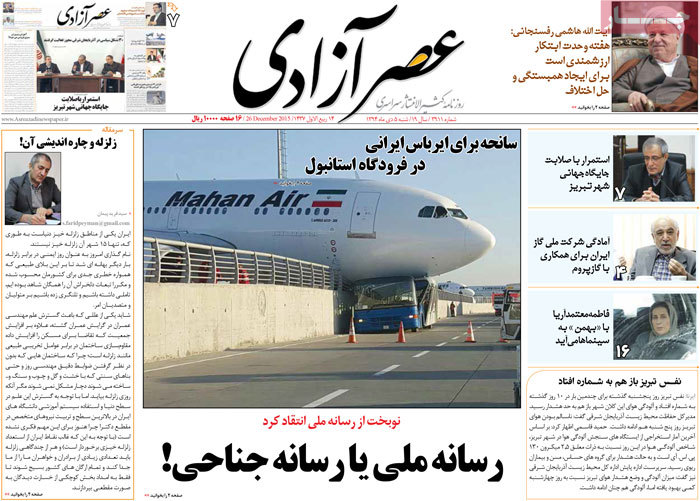
Asr-e Azadi: A national broadcaster or a factional one?

Mohammad Bagher Nobakht has criticized Iran’s national broadcaster, IRIB.


A look at Iranian newspaper front pages on Dec. 26


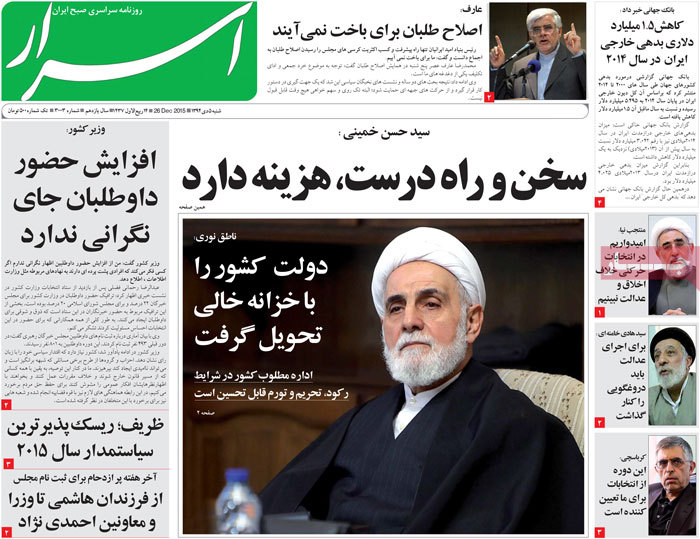
Asrar: Reformists will not come [forward to contest and] lose the elections, said Mohammad Reza Aref, a reformist leader.


A look at Iranian newspaper front pages on Dec. 26


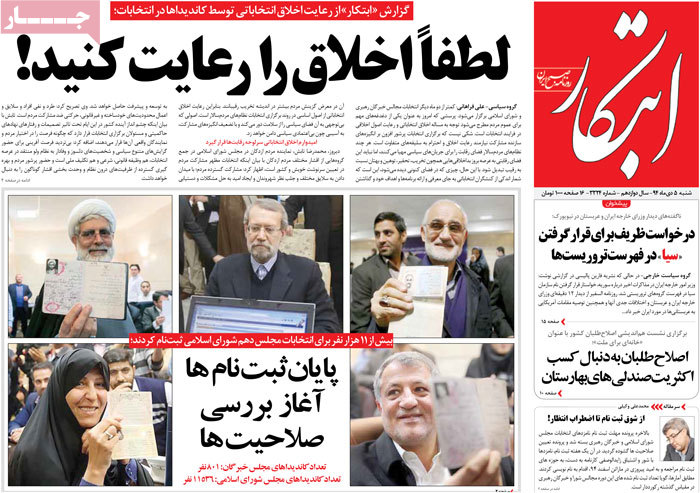
Ebtekar: Untold stories about a meeting between Iranian and Saudi foreign ministers in New York

Foreign Minister Zarif has asked for the CIA to be enlisted as a terror group.


A look at Iranian newspaper front pages on Dec. 26


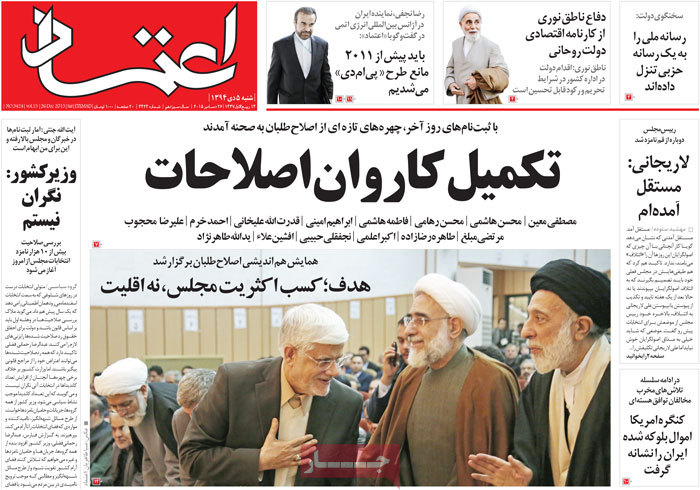
Etemad: “I run in parliamentary elections on an independent ticket,” said Parliament Speaker Ali Larijani who has fielded his candidacy from Qom Constituency.


A look at Iranian newspaper front pages on Dec. 26


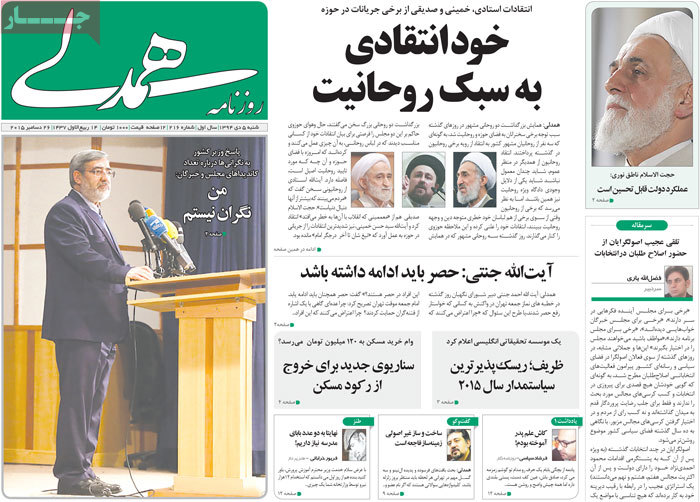
Hamdeli: The house arrest [of Mir-Hossein Mousavi and Mehdi Karroubi, the two 2009 presidential candidates who disputed the election results] should continue, said Ayatollah Ahmad Jannati.


A look at Iranian newspaper front pages on Dec. 26


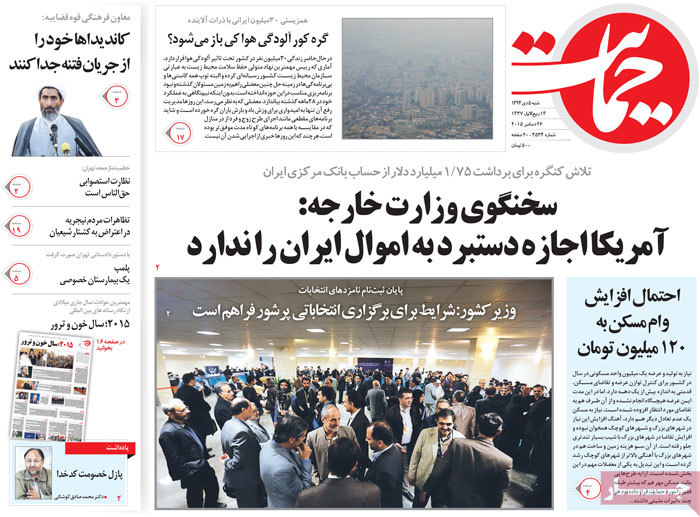
Hemayat: The Foreign Ministry spokesman has slammed efforts by the US Congress to withdraw some $1.75 billion from the account of the Central Bank of Iran, saying that the US has no right to steal Iran’s assets.


A look at Iranian newspaper front pages on Dec. 26


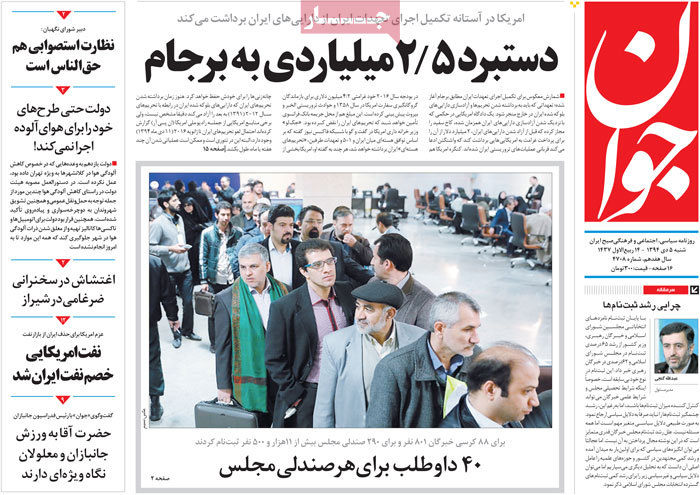
Javan: The secretary of the Guardian Council has said that active oversight is a right people are entitled to.


A look at Iranian newspaper front pages on Dec. 26


Jomhouri Islami: Political groups should accommodate each other’s viewpoints, said Akbar Nategh Nouri.


A look at Iranian newspaper front pages on Dec. 26


Kayhan: Ten field hospitals have been launched in Sistan and Baluchestan Province to mark Unity Week.  


A look at Iranian newspaper front pages on Dec. 26


Roozan: “Unfortunately the number of those registering [for elections] is very high,” said Tehran’s Friday prayer leader.


A look at Iranian newspaper front pages on Dec. 26


Setareh Sobh: The latest reports indicate that more than 11,000 people are seeking to enter parliament.


A look at Iranian newspaper front pages on Dec. 26


Sharq: Zarif has been recognized [by the Global Risk Insights] as the 2015 Person of the Year in Political Risk.

MORE


A look at Iranian newspaper front pages on Dec. 26


Vaghaye-e Etefaghiyeh: The [so-called] Worriers should be in parliament, said Mohsen Hashemi in an interview with the daily.


A look at Iranian newspaper front pages on Dec. 26


2016 New Year Shopping in Tehran (PHOTOS)

2016 New Year-8

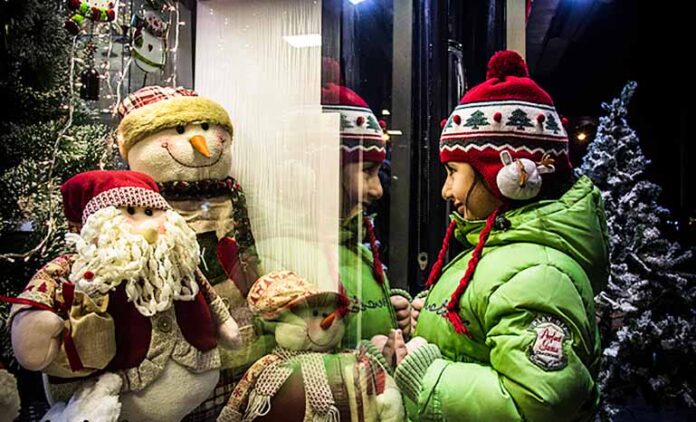
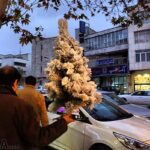
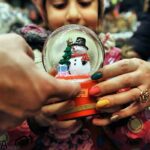
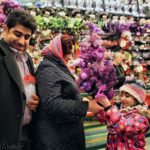
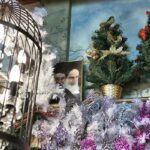
With 2016 only a few days away, members of the Christian community are involved in a frenzy of shopping in Tehran and elsewhere in the country.

The following images of the buying frenzy in the capital have been issued by the Islamic Republic News Agency (IRNA):

Supplies of S-300 Air Defense Systems to Iran to Begin in January 2016: Source

s-300

The deliveries of Russian S-300PMU-2 air defense systems to Iran will begin in January, a source in the Russian military and technical cooperation system said on Friday.

“It is planned to begin the process of delivery of the first regiment of the S-300PMU-2 air defense systems in January and to complete it in February. Iran is due to receive the second regiment of these systems in August or September 2016,” the source was quoted by Russia-based TASS news agency as saying.

“Russia will thus fulfill its obligations to supply the S-300PMU-2 air defense systems to Iran,” he added.

According to the source, about 80 Iranian specialists will be trained to use the S-300 missile systems (NATO reporting name SA-10 Grumble) at the Mozhaisky Military Space Academy.

“About 80 military specialists from Iran in January, 2016 will begin a training to use S-300 at the training centers of the Mozhaisky Academy,” the source said.

“The training program will be four months long. Its cost is a part of the contract. After the course, supposedly in May, the Iranians will return home.”

In September the parties signed an additional agreement to the contract on the S-300 air defense systems, the source recalled.

“The first batch of the S-300PMU-2 systems under the contract — one regimental set — was immediately sent to the Kapustin Yar range. Currently these systems are completing tests there to confirm their stated specifications. Then they will arrive at the port of shipment in the Russian part of the Caspian Sea from where they will be delivered to Iran by maritime transport,” the source said.

Earlier, Iran ordered from Russia five S-300 divisions worth over $800 million. However, in autumn of 2010, the then President Dmitry Medvedev banned transfer of the equipment to Tehran. The contract was terminated, the prepayment was returned to Iran, but as the contract was not observed Iran filed a suit to the Geneva arbitration court claiming almost $4 billion.

In spring 2015, Russia’s President Vladimir Putin lifted the ban on supplies of the S-300 systems to Iran. Sergei Chemezov, of the defense export authority Rosoboronexport’s Rostech Company, said in early November the contract on the systems came into force.

In early December, presidential aide on military-technical cooperation Vladimir Kozhin confirmed the information. Later on, Deputy Prime Minister Dmitry Rogozin told reporters as the first S-300 division is supplied, Iran will revoke its lawsuit.


Number of Applicants for Iran Parliament Seats Surpasses 10,000

Election

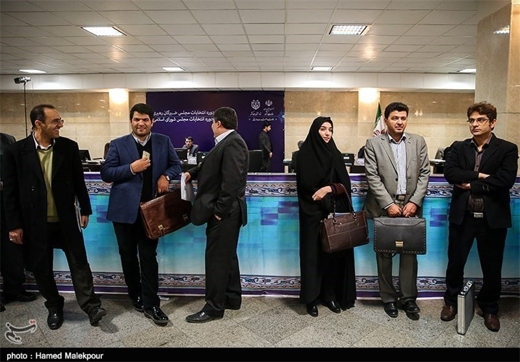
More than ten thousand Iranians have registered as of Friday noon to run for a seat in the parliament in elections slated for late February, an official announced.

Interior Ministry Spokesperson Hossein Ali Amiri said on Friday that 10,004 persons have registered to run in the parliamentary elections, 960 of whom are women.

Earlier in the day, Interior Minister Abdolreza Rahmani Fazli had announced that the number of female applicants have risen by 3 percent compared to the previous term.

According to the minister, 20 Iranians from the religious minorities have signed up for candidacy. 73 percent of the applicants are under the age of 50, he added.

Rahmani Fazli noted that the final list of the qualified candidates will be released on February 17.

There will be 290 seats in the Iranian parliament up for grabs.

As regards the Assembly of Experts elections, due to be held simultaneously with the parliamentary elections on February 26, the minister explained that 801 people have registered so far, showing a 62 percent rise in comparison with the previous term.

The 88-member Assembly of Experts is a high-ranking body that elects leader of the Islamic Revolution.

Members of the assembly are directly elected to office by people for an eight-year term. It holds biannual meetings to appoint a new chairman.


UN must be cornerstone in Syria national talks: Iran

Amir Abdollahian-UN

A senior Iranian official says the United Nations must play a pivotal role in the Syrian national dialog aimed at finding a settlement to nearly five-year-long crisis in the Arab country.

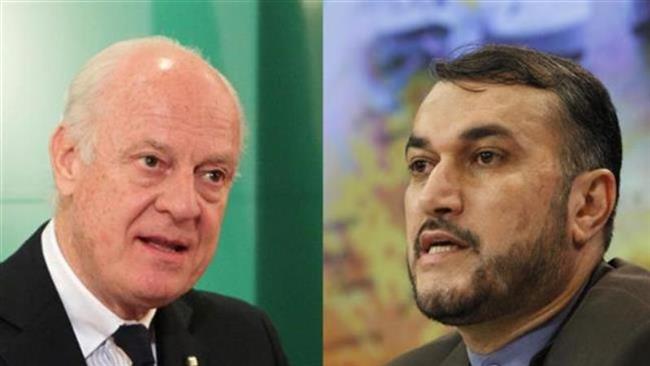
Iran’s Deputy Foreign Minister for Arab and African Affairs Hossein Amir-Abdollahian held a telephone conversation with UN Special Envoy for Syria, Staffan de Mistura, on Friday to discuss the latest developments pertaining to international talks on the Syrian conflict.

Amir-Abdollahian underlined that the list of terrorist groups in Syria should not divide terrorism into good and bad and should be based on the recent talks in New York on the Syrian crisis. He also urged the international community to adopt a realistic approach toward fighting terrorism and promoting a political process in the Arab country at the same time.

He said the crisis in Syria will only be resolved through respecting the country’s sovereignty, independence, national unity and territorial integrity as well as the Syrian people’s will.

The Iranian diplomat emphasized that all Syrian parties, including the opposition groups that are committed to a political approach, should engage in the talks about the Syrian conflict.

“Therefore, the Islamic Republic of Iran believes that [Syrian] national dialog should be [held] with the United Nations as its cornerstone,” Amir-Abdollahian added.

The UN envoy, for his part, praised Iran’s constructive and positive role in previous international talks on the Syrian crisis in Vienna and New York.

He added that respect for the Syrians’ viewpoints as well as the maintenance of the country’s integrity are among the UN’s principles.

De Mistura expressed hope that intra-Syrian talks will be held by the end of December.

The UN envoy is reportedly scheduled to pay a visit to some regional countries, including Iran, ahead of a new round of talks on Syria.

The foreign-sponsored conflict in Syria, which started in March 2011, has claimed the lives of more than 250,000 people and left over one million injured, according to the United Nations. The foreign-sponsored militancy has also displaced nearly half of the country’s population.

The UN says 12.2 million people, including more than 5.6 million children, remain in need of humanitarian assistance.

Syria blames the crisis on some countries, including Turkey and Saudi Arabia, saying that if it had not been for their support, the terror groups, particularly the Daesh Takfiri terrorist group, could have never taken control of the territories across the country.

The Austrian capital of Vienna hosted the first two rounds of talks on Syria on October 30 and November 14. The third round of Syria talks was held in New York on December 18.

The UN Security Council on December 18 adopted a resolution supporting an international roadmap for a peace process in Syria. The UN seeks to convene peace negotiations in Geneva some time in January 2016.

The participants in the talks are trying to work out a list of legitimate opposition groups, as opposed to terrorists, in Syria to engage in talks with the government in Damascus.


Iran slams ‘unlawful’ US bid to seize assets

Jaber Ansari

A senior Iranian official has censured US efforts to have Tehran’s assets frozen in the country turned over as compensation to American victims of bombings in Lebanon and Saudi Arabia.

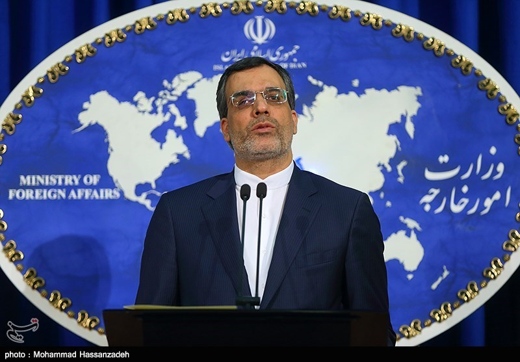
“The US judicial apparatus, with the support of the country’s administration and Congress, has been issuing and enacting rulings against the Islamic Republic of Iran for years, violating basic principles of international law with recourse to unsubstantiated and baseless allegations,” Foreign Ministry Spokesman Hossein Jaberi Ansari said on Friday.

“Some US courts are making a travesty of justice and law, having sentenced the Islamic Republic of Iran over the past few years to paying restitution to victims of terror acts carried out by known citizens of US allies.”

The case in the US involves over 1,300 plaintiffs, who have demanded compensation over two bombings, namely the 1983 Marine barracks bombing in Beirut, Lebanon, and the 1996 Khobar Towers bombing in Saudi Arabia.

The US Supreme Court is mulling a case on appropriating $2 billion of Iranian assets.

Iran has dismissed any role in the attacks and rejected rulings by US circuit and appeals courts to hand over $2 billion in frozen Iranian assets in Citibank accounts in New York to the plaintiffs.

The money belongs to Bank Markazi, the Central Bank of Iran (CBI), and has been blocked under US sanctions.

The CBI has appealed against such rulings, and the case has reportedly moved to the Supreme Court, with the administration of US President Barack Obama urging it not to overturn previous verdicts in favor of the plaintiffs.

In his Friday comments, Jaberi Ansari said, “The US government has demonstrated that its hostile measures against Iran persist regardless of realities and under the influence of Zionist circles, and that there are no signs of efforts toward understanding and utilizing the situation and reducing the Iranian government’s and nation’s deep mistrust of US policies.”

Jaberi Ansari’s reference to US failure to “utilize” the situation apparently relates to the new opening after the conclusion of a deal between Iran and P5+1 in July.

A look at Iranian newspaper front pages on Dec. 24

Iranian Newspapers Headlines

The comments of President Rouhani about a wide range of issues, including the nuclear deal, economic growth and elections, dominated the front pages of Iranian newspapers on Thursday. Also on the cover of dailies was the latest from registration for the upcoming elections.
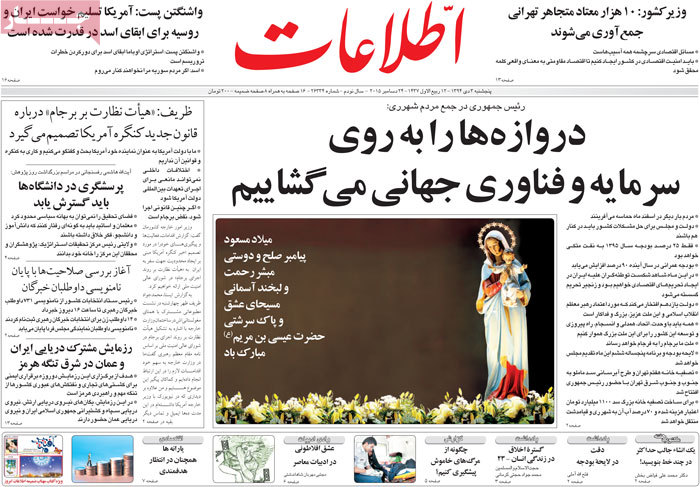
 

A look at Iranian newspaper front pages on Dec. 24


Ettela’at: We will open the gates to investment and global technology, President Rouhani told locals in Shahr-e Rey.

He further said that next year’s budget will rely on oil revenues by as little as 25 percent.

Ettela’at: Congratulations on the birth anniversary of the prophet of peace and friendship, harbinger of heavenly compassion and laughter, the Messiah of love and good-naturedness. Merry Christmas

Ettela’at: The interior minister has said that 10,000 addicts who openly use drugs on the streets will be rounded up.

Abdolreza Rahmani Fazli further blamed pocketbook issues as the root cause of all social harms.

Ettela’at: The Washington Post has said that the US has bowed to the demand of Iran and Russia to keep Assad in power.

In another development, President Assad said that he would step down if the Syrians want him to.

Ettela’at: Foreign Minister Mohammad Javad Zarif has said that the JCPOA Supervision Panel will make a decision about the new law passed by the US Congress.

The Iranian top diplomat further said that internal disagreements should not stop the US administration from complying with its international commitments.

Ettela’at: The idea of asking [political] questions in universities should be promoted, said Ayatollah Akbar Hashemi Rafsanjani in a ceremony to mark Research Day.

Political issues should not be used as an excuse to restrict analyses and research, the chairman of the Expediency Council said.

Ettela’at: With the registration of candidates for Assembly of Experts elections coming to an end, the screening process has started.

The head of the Electoral Headquarters said that by 4:00 p.m. Wednesday, 731 individuals had fielded their candidacy for the Assembly of Experts.

Ettela’at: Iran and Oman hold joint naval maneuvers in the eastern part of the Hormuz Strait.

The drill is meant to ensure the security of commercial vessels and tankers crossing the strategic strait.


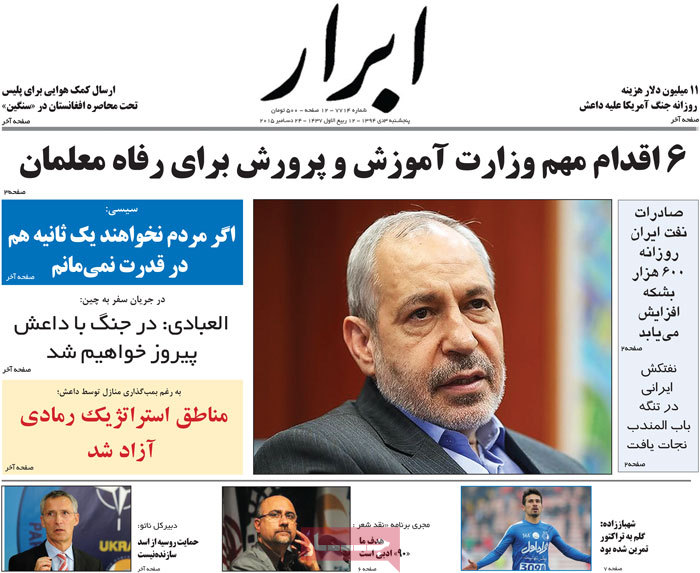
Abrar: The Egyptian president has said that he won’t remain in office even for a second if the Egyptians don’t want him to.

Abrar: Despite booby-traps, strategic parts of the Iraqi city of Ramadi have been taken back from Daesh terrorists.
 

A look at Iranian newspaper front pages on Dec. 24


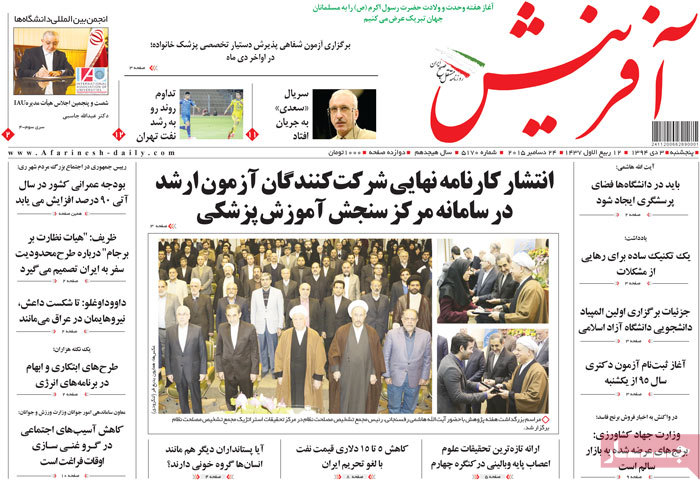
Afarinesh: President Rouhani has said that the country’s development budget will increase by as much as 90 percent next year.
 

A look at Iranian newspaper front pages on Dec. 24


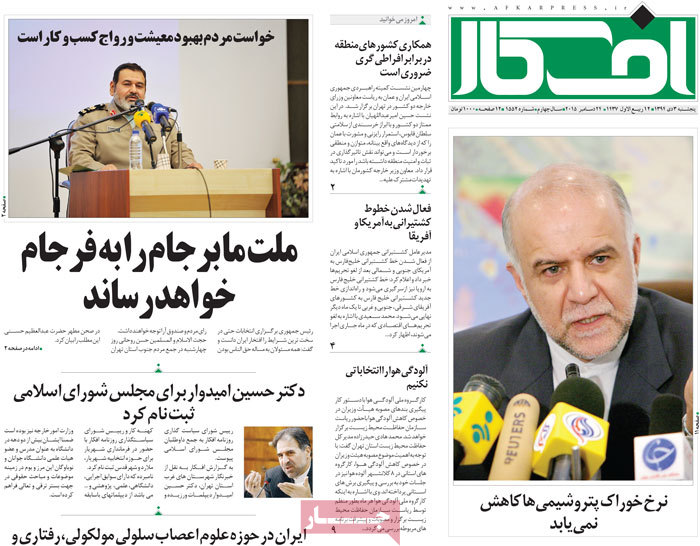
Afkar: Shipping lanes between Iran, the US and Africa have been activated.
 

A look at Iranian newspaper front pages on Dec. 24


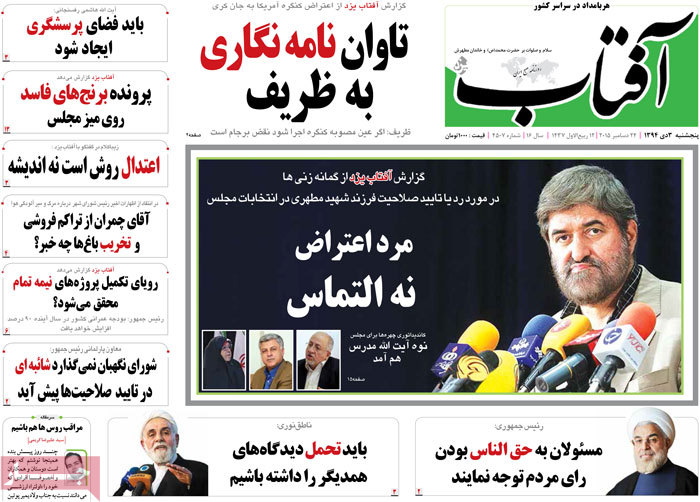
Aftab-e Yazd: We need to accommodate each other’s opposing views, said former parliament speaker Akbar Nategh Nouri.

Aftab-e Yazd: President Rouhani has urged fellow officials not to forget the fact that [free and fair] elections are a right members of the public are entitled to.
 

A look at Iranian newspaper front pages on Dec. 24


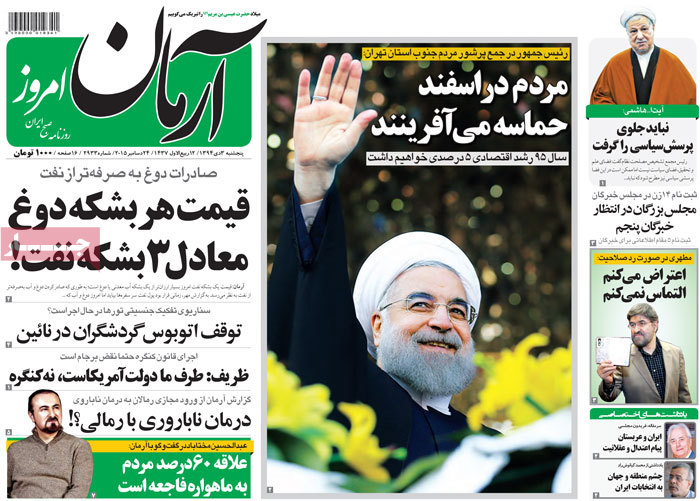
Arman-e Emrooz: In case I am disqualified [from running for parliament] I will appeal, but I won’t beg, said outspoken principlist MP Ali Motahari.

Arman-e Emrooz: President Rouhani has said that Iranians will make an epic in the late February elections.

He further said the country’s economic growth is projected to stand at 5 percent next year.
 

A look at Iranian newspaper front pages on Dec. 24


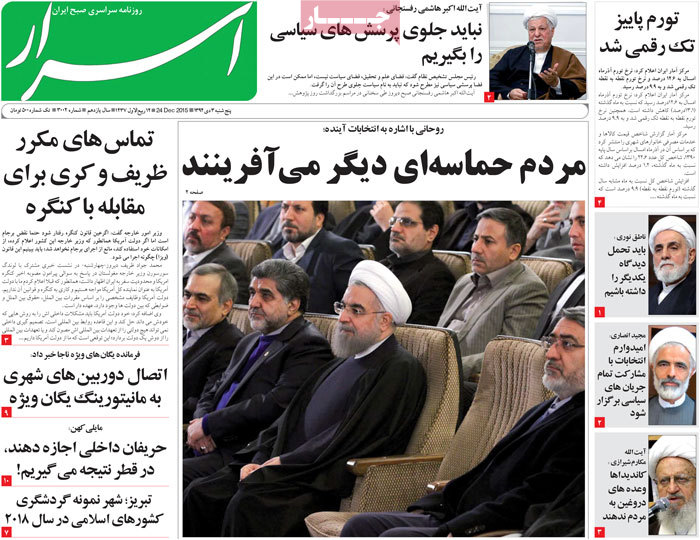
Asrar: Inflation slipped into single digits in the fall.

Asrar: Tabriz, an exemplary Islamic tourist destination in 2018.
 

A look at Iranian newspaper front pages on Dec. 24


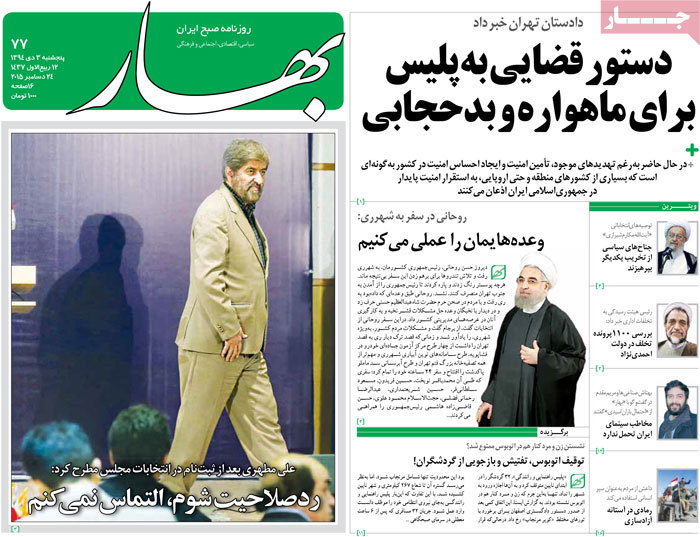
Bahar: The Tehran prosecutor has said that judicial orders have been issued for the police to deal with those who have satellite dishes and women who fail to observe the Islamic dress code.
 

A look at Iranian newspaper front pages on Dec. 24


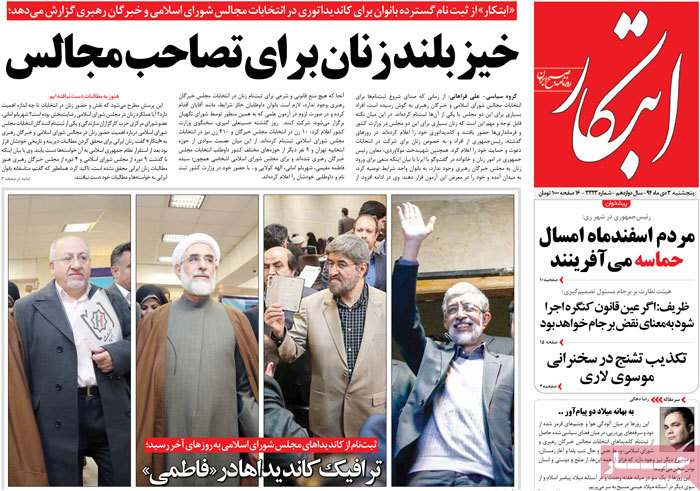
Ebtekar: Women extensively seek to win seats in both assemblies.

A large number of women have fielded their candidacy for the upcoming elections for the Assembly of Experts and the Islamic Consultative Assembly.
 

A look at Iranian newspaper front pages on Dec. 24


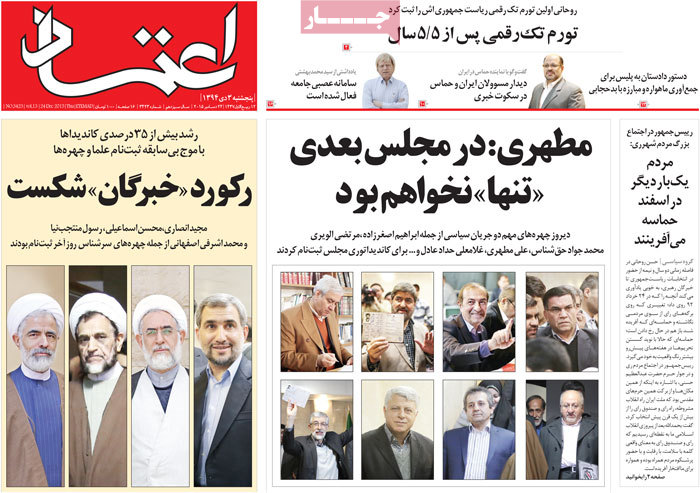
Etemad: Inflation has plunged into single digits for the first time in five and a half years.

Etemad: Tehran MP Ali Motahari has said that he won’t be alone [in speaking out] in the next parliament.

Etemad: With an unprecedented wave of scholars and figures signing up, the number of potential candidates for the Assembly of Experts is 35 percent up, setting a new record.
 

A look at Iranian newspaper front pages on Dec. 24


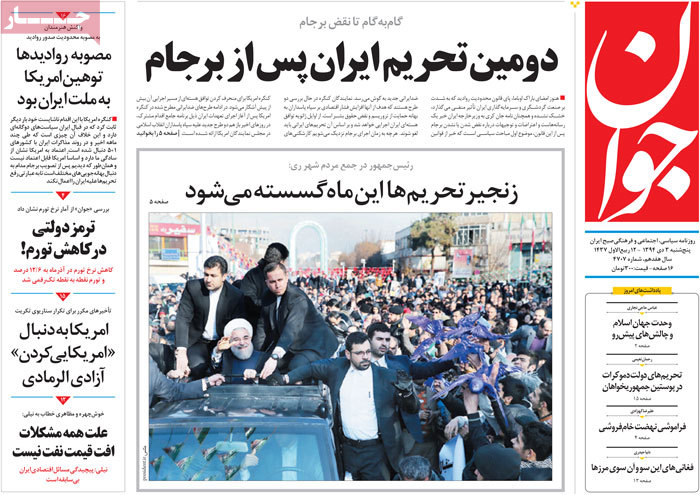
Javan: The chain of sanctions will break up this year, said President Rouhani.
 

A look at Iranian newspaper front pages on Dec. 24


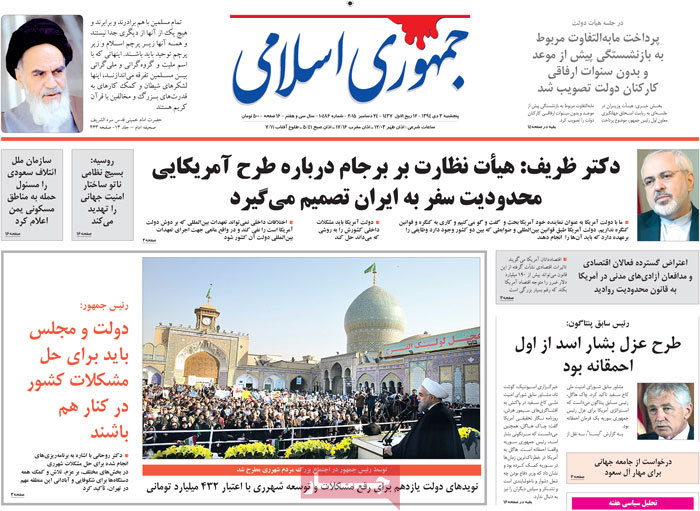
Jomhouri Islami: President Rouhani has said that the Executive and Legislative branches should work together to settle the problems of the public.
 

A look at Iranian newspaper front pages on Dec. 24


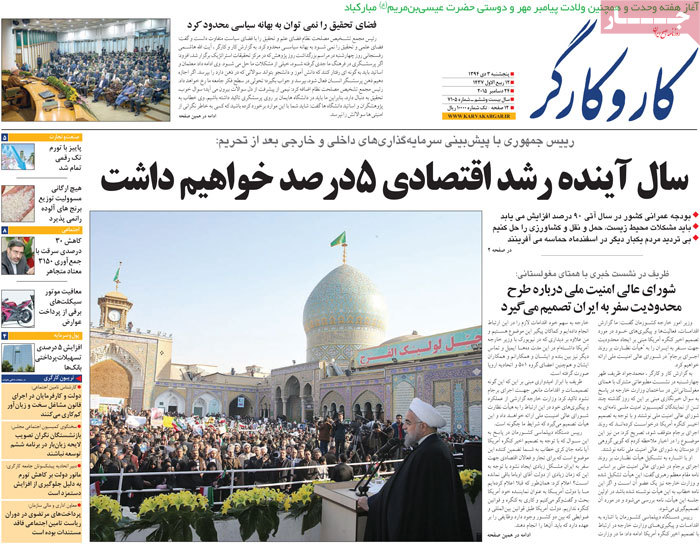
Kar va Kargar: The Supreme National Security Council will decide on the US measure to limit visits to Iran by foreign nationals, said Foreign Minister Zarif.
 

A look at Iranian newspaper front pages on Dec. 24


Kayhan: The countdown is on for the liberation of Ramadi in Iraq.

Daesh terrorists have fled to nearby deserts.

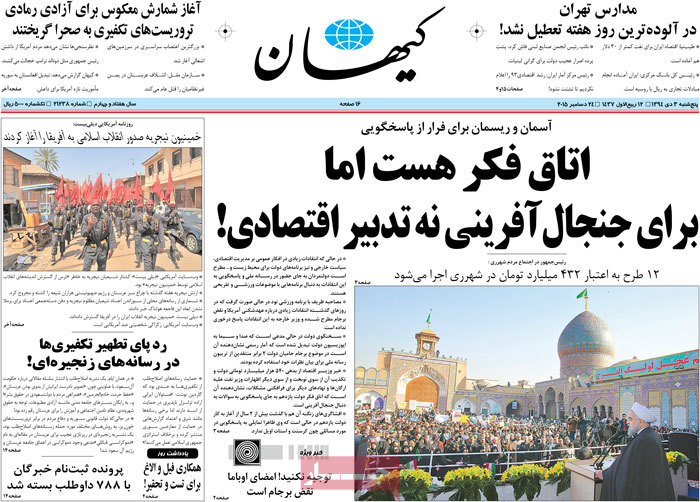
Kayhan: The schools of the capital were not closed on the most polluted day of the week!
 

A look at Iranian newspaper front pages on Dec. 24


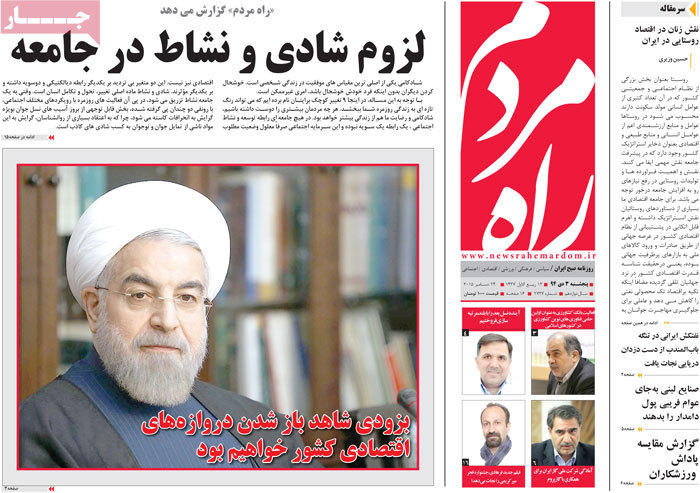
Rah-e Mardom: An Iranian tanker has been saved from the pirates in the Bab-el-Mandeb Strait.
 

A look at Iranian newspaper front pages on Dec. 24


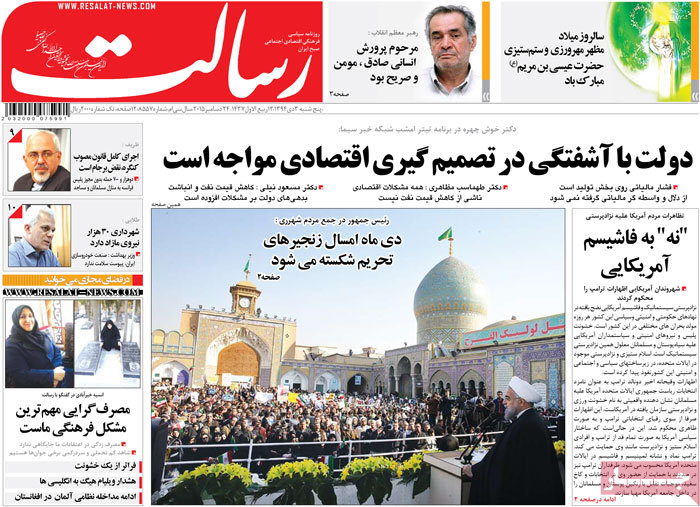
Resalat: Full implementation of the changes to the Visa Waiver Program adopted by the US Congress will amount to breach of the nuclear deal, said Foreign Minister Zarif.
 

A look at Iranian newspaper front pages on Dec. 24


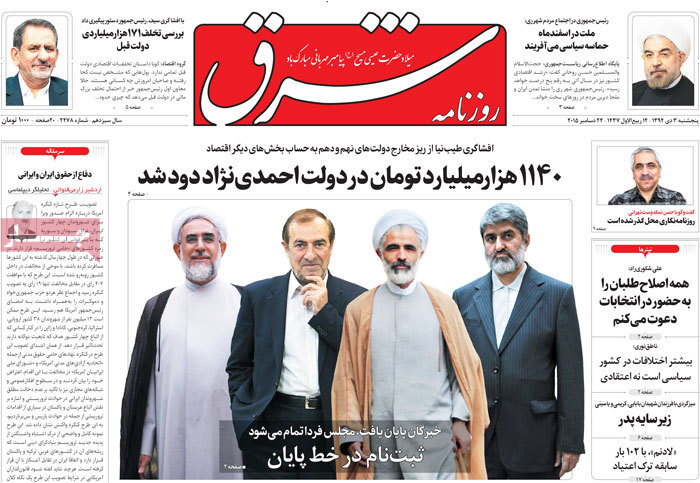
Sharq: Some $380 billion went up in smoke during the presidency of Ahmadinejad, said the economy minister.
 

A look at Iranian newspaper front pages on Dec. 24


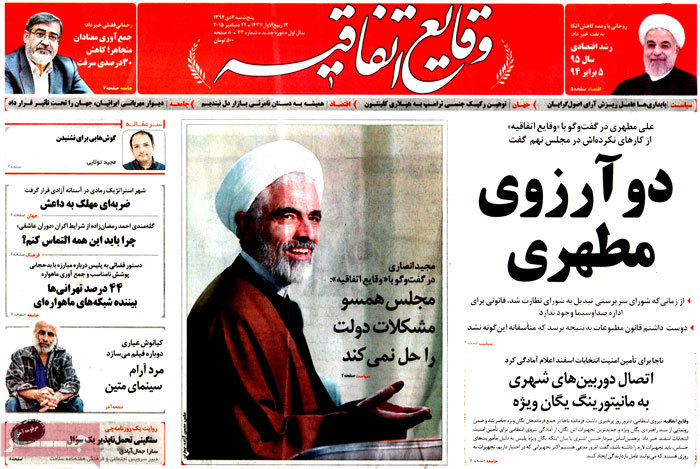
Vaghaye-e Etefaghiyeh: The Law Enforcement Force has signaled readiness to ensure the security of upcoming elections.

Special police will have access to urban traffic cameras.
 

A look at Iranian newspaper front pages on Dec. 24


Nondescript choppers drop off Daesh fighters in Afghan province

ISIS-Afghanistan

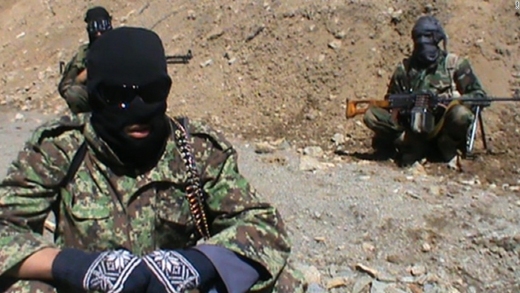
Two helicopters have dropped off a number of militants wearing Daesh uniforms in the Afghan province of Nangarhar, a member of the Afghan Senate has told the Islamic Republic News Agency in an interview conducted over the phone.

The following is the translation of a report the Iranian official news agency ran on its website on December 23:

A number of people in Tor Ghar, Nangarhar Province have contacted me to say that nondescript helicopters have airlifted Daesh militants there, Afghan SenatorHaji Lutfullah Baba said on Wednesday.

They asked me to follow up the issue and urge security and military officials to look into the militant movements which pose a threat to the security of the province and the entire nation, he said.

He went on to say that the people of Nangarhar are worried about security in the province. Deterioration of the security situation in Nangarhar, a major economic hub, will deal a body blow to the Afghan economy, he said.

He added that an investigation has been launched to determine to which country the helicopters belong.

A spokesman for the province of Nangarhar has confirmed reports that the choppers have dropped off men in black uniforms.
It is not the first time choppers are sighted dropping off militants in areas controlled by the opposition. Similar sightings have been made in Kunduz, Baghlan and Badakhshan.
Daesh has picked Nangarhar as the hub of its Afghan operations. The Afghan national security advisor has said that Daesh in Afghanistan has established structural links with their leaders in Iraq and Syria.

Some Afghan officials, though, accuse the National Directorate of Security (NDS) of failing to crack down on the terrorist grouping.

A few weeks ago, a vice-speaker of the Afghan House of Representatives alleged that government officials and the NDS support the Daesh terrorists.

A day after those allegations were made public, the interior minister, chief of staff and head of the national security agency held a news conference to refute those allegations. The deputy should produce evidence to shore up those allegations, they demanded.

A few days later, the vice-speaker responded to that call by saying that provision of evidence will result in the collapse of the national unity government.