Wednesday, December 31, 2025
Home Blog Page 4564

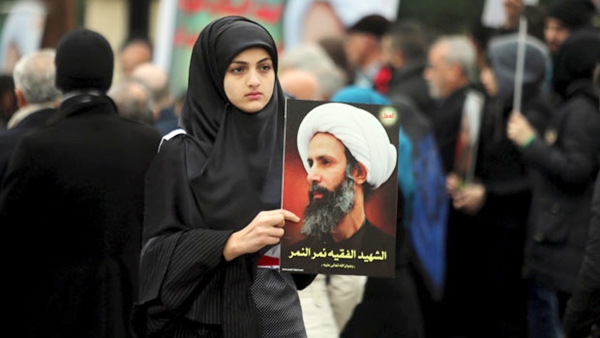
Execution of Nimr, a message by Riyadh to Tehran

By executing prominent Shiite cleric Nimr al-Nimr, Saudi authorities seek to illustrate their determination to take on Iran, an Iranian history researcher and political science professor has said.

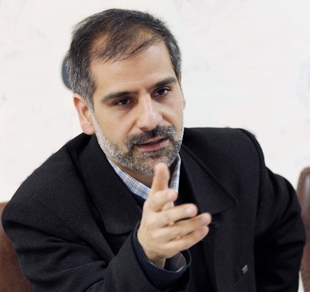
Nabavi
Dr. Abdolamir Nabavi

The following is the translation of part of a wide-ranging interview Dr. Abdolamir Nabavi, a Karaj University professor, gave to Khabaronline.ir’s Saeed Jafari:

Q. In the wake of the execution by Saudi authorities of Sheikh Nimr, how do you see the future of equations in the Middle East and the prospects of ties between Iran and Saudi Arabia?

A. It seems the Saudi measure is a continuation of the iron-fist policy launched toward the end of King Abdullah’s rule. Saudi authorities decided to introduce change to their foreign policy and walk down a more confrontational path with Iran.

The announcement of the execution which came on the same day the ceasefire with the Houthis in Yemen was declared over can signal different messages.

One should not forget the fact that ties between Turkey and Saudi Arabia are on the mend. And the Egyptian foreign minister paid a surprise visit to Saudi Arabia. Normalization of ties between Turkey and Egypt is said to have been on the agenda of the visit. That means Riyadh seeks to buttress the axis to confront Iran and bring Turkey and Egypt on board.

I believe the execution of Nimr was part of a ploy by hardliners both inside the kingdom and outside to muddy the waters and render relations with Iran tense. You should keep in mind that there are many who benefit from high levels of tensions between the two countries and seek to make relations tenser. This latest measure by the Saudi government should be analyzed through that lens.

Official: Saudi Arabia can’t cover up mistake by cutting ties with Iran

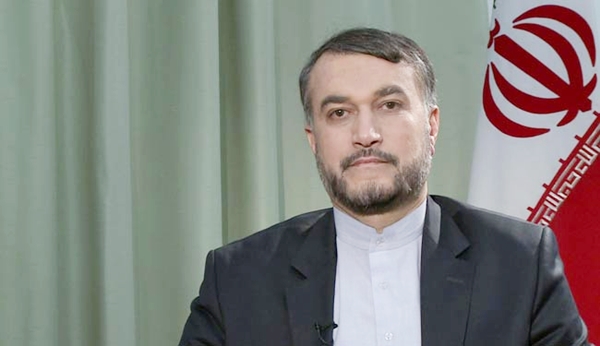
Deputy Foreign Minister for Arab and African Affairs Hossein Amir Abdollahian said Saudi Arabia should not try to cover up its big misdeed by cutting ties with Tehran.

He said the decision by Saudi officials to cut relations with Iran will not cover up the grave mistake they did in executing the outstanding religious scholar.

The Foreign Ministry official made the remarks following an announcement by the Saudi Foreign Ministry that Riyadh has cut off its diplomatic relations with Iran.

He said that Saudi Arabia has records of creating insecurity in the region by making strategic mistakes and adopting hasty and unwise policies which have led to the spread of terrorism and extremism.

It also inflicted economic damage on Muslim nations of the region by hatching a plot aimed at reducing oil prices.

He further noted that Saudi Arabia also played a non-constructive and disparaging role during Iran’s nuclear talks with P5+1.

He said the latest mistake of the Saudi government was the execution of Sheikh Nimr al-Nimr, who was a prestigious religious scholar esteemed by the whole Islamic world.

Stressing that none of Saudi diplomats in Iran suffered any injury or damage, Abdollahian noted that Iran enjoys one of the world’s highest security status.

He said [foreign] diplomats in Iran are carrying out their duties in absolute safety.

Saudi Foreign Minister Adel al-Jubeir announced on Sunday that Riyadh severed its diplomatic relations with Tehran one day after the government and people of Iran protested the execution of the prominent cleric Sheikh Nimr al-Nimr.

He told reporters in Saudi capital that Iranian diplomats were asked to leave the country within 48 hours.

Iran, ideal destination for renewable energies investment: VP

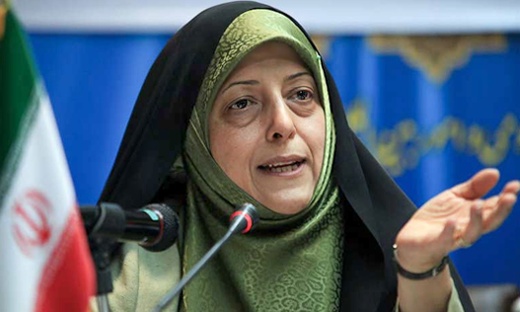
Masoomeh Ebtekar

Studies show that Iran is among the world’s most suitable destinations for investment in the field of generating renewable energies, particularly solar energy, said the head of Iran’s Environment Protection Organization.  

Addressing professors and faculty members of Tarbiat Modares University on Sunday, Masoumeh Ebtekar stressed that her organization and universities can enhance cooperation in conducting applied studies in the field of the environment.

“We do not have much time to waste. Currently, the country is faced with serious environmental challenges and crises. We are required to work out scientific strategies and make effective decisions, based on applied studies, to overcome the problems,” she added.

The government is required to adopt a more practical approach to addressing the country’s environmental challenges in the Sixth Five-Year Economic Development Plan (2016-21).

“We should further promote using green and environment-friendly technologies in domestic industries. In the post-sanctions era, we will have a great deal of favorable opportunities to expand foreign cooperation in this regard and increase investment in the field of environment,” Ebtekar said.


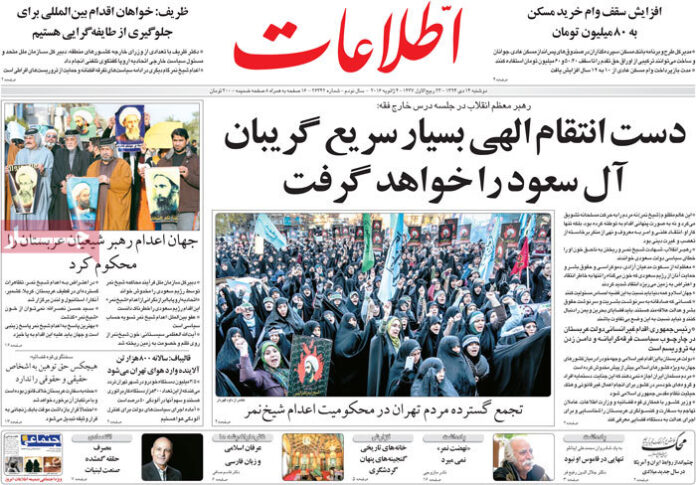
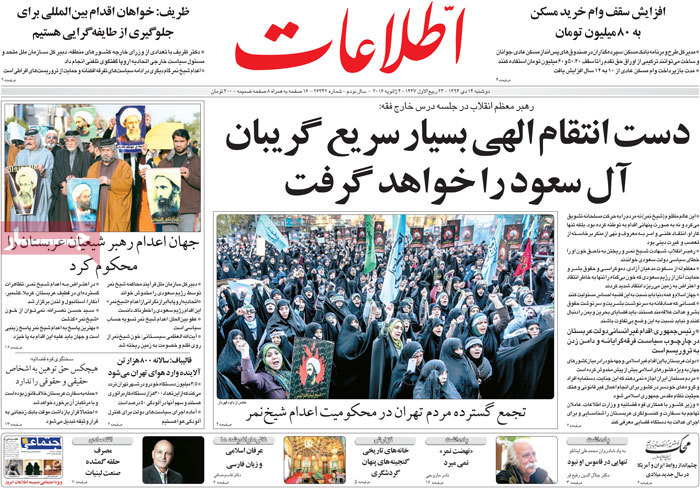
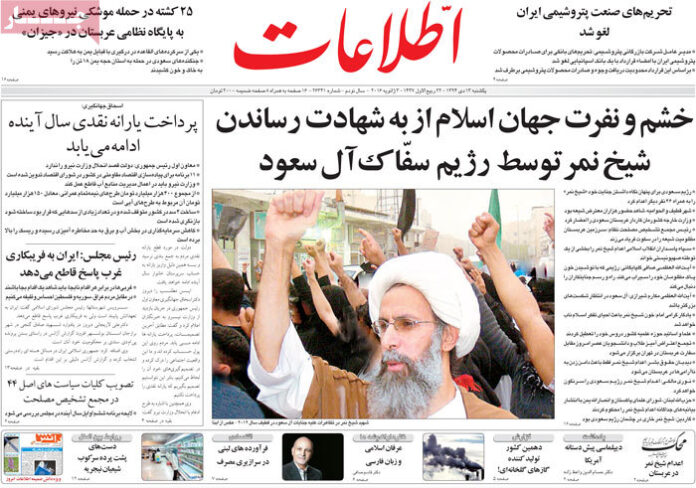
Highlights of Ettela’at newspaper on Jan. 4

Ettela’at: Divine revenge will soon catch up with the Al Saud family, said the Supreme Leader.

Sheikh Nimr al-Nimr neither incited the public to take up arms; nor did he plot covertly; all he did was to build on his religious zeal to insist on promotion of virtue and prevention of vice, Ayatollah Khamenei said in condemning the execution by the Saudi authorities of the prominent Shiite cleric.

Ettela’at:People in Tehran have staged a massive rally in condemnation of the execution of Sheikh Nimr in Saudi Arabia.

Ettela’at:The international community has condemned the execution of the Saudi Shiite leader.

The UN chief described the trial of Sheikh Nimr as flawed.

Ettela’at: The ceiling of the home loans banks will offer has risen to almost $27,000.

Ettela’at: Foreign Minister Zarif has called for international efforts to prevent sectarianism.

The Iranian top diplomat talked over the phone with a number of his regional counterparts, the UN secretary-general and the EU foreign policy chief.

Ettela’at: The mayor of Tehran has said that each year some 800,000 tons of pollutants find their way into the air of the capital.

Ettela’at: The Judiciary spokesman has said that no one is entitled to insult real and legal parties.

He further said attacking the Saudi Embassy was against the law and those who played a role in it will be seriously dealt with.

Iran warns of extremism fallout in Mideast

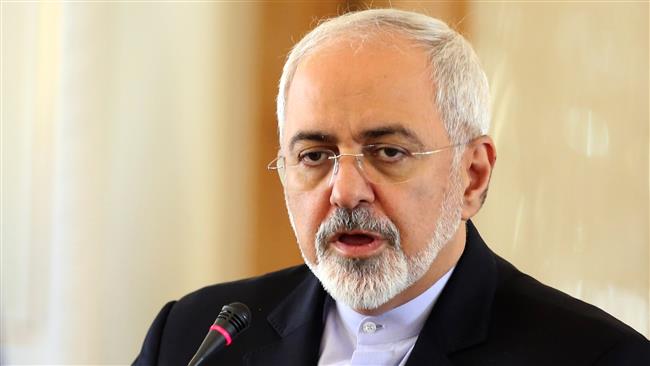
Foreign Minister Mohammad Javad Zarif has warned about the repercussions of extremism in the Middle East following Saudi Arabia’s execution of a top Shia cleric.

Zarif held separate phone conversations on Sunday with UN Secretary General Ban Ki-moon, European Union foreign policy chief Federica Mogherini as well as with a number of foreign ministers from regional states.

Zarif reiterated Iran’s condemnation of the execution of Sheikh Nimr Baqir al-Nimr, noting that the Shiite cleric’s execution was in line with divisive and pro-terrorism policies which have been ravaging the region and the world.

The Iranian foreign minister also underscored the need for coordinated regional and international efforts to halt measures against religious groups and tribalism-based policies.

Zarif also said that the Islamic Republic remains fully committed to safeguarding diplomatic missions it hosts.

[…]

Sheikh Nimr had been arrested in 2012 in the Qatif region of Saudi Arabia’s Shiite-majority Eastern Province, which was the scene of peaceful anti-regime demonstrations at the time. He had been charged with instigating unrest and undermining the kingdom’s security. Nimr had rejected the charges as baseless.

In 2014, a Saudi court sentenced the clergyman to death, provoking widespread global condemnations. Back then, the UK-based rights body Amnesty International called the sentence “appalling,” saying the verdict should be quashed since it was politically motivated.


A look at Iranian newspaper front pages on Jan. 4

Iranian Newspapers Headlines

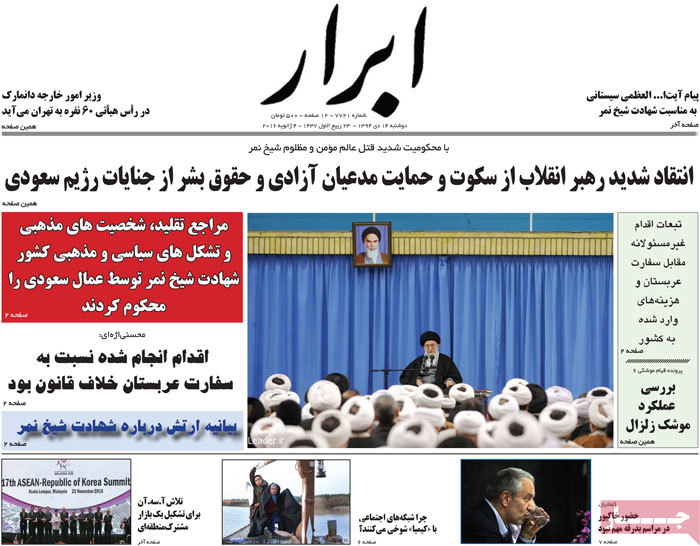
The widespread condemnation of the execution of Sheikh Nimr al-Nimr, including the warning of the Supreme Leader about “divine revenge” dominated the front pages of Iranian newspapers on Monday.


Ettela’at: Divine revenge will soon catch up with the Al Saud family, said the Supreme Leader.

Sheikh Nimr al-Nimr neither incited the public to take up arms; nor did he plot covertly; all he did was to build on his religious zeal to insist on promotion of virtue and prevention of vice, Ayatollah Khamenei said in condemning the execution by the Saudi authorities of the prominent Shiite cleric.


Abrar: The Danish foreign minister is to arrive in Tehran at the head of a 60-member delegation.

Abrar: The Iranian Army has released a statement on the execution of Sheikh Nimr al-Nimr.
 

A look at Iranian newspaper front pages on Jan. 4


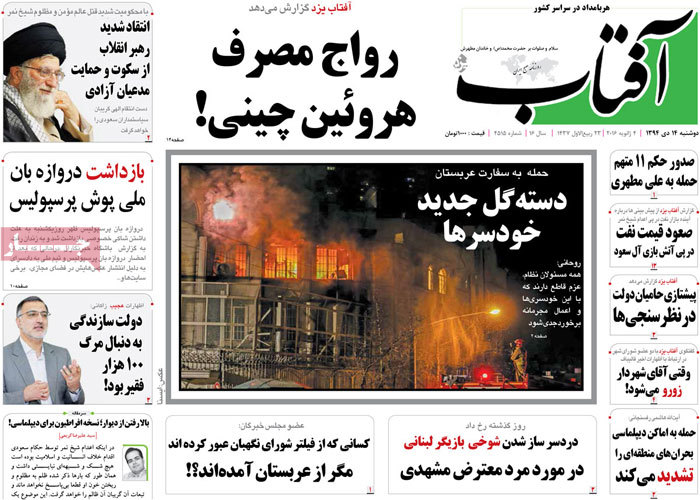
Aftab-e Yazd: The new problem rogue elements have created: an attack on the Saudi Embassy in Tehran

Storming diplomatic missions will intensify regional crises, said Ayatollah Akbar Hashemi Rafsanjani, the chairman of the Expediency Council.

Aftab-e Yazd: The daily has a report about the growing popularity of “Chinese heroin” among drug users in Iran!
 

A look at Iranian newspaper front pages on Jan. 4


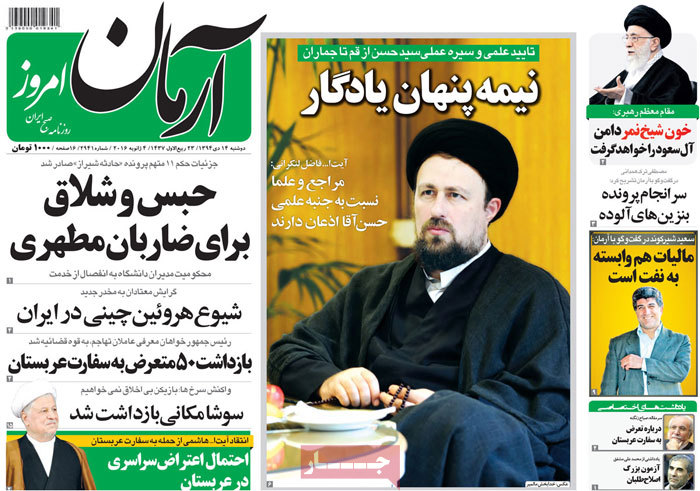
Arman-e Emrooz: A court in Shiraz has handed down sentences ranging from lashes to imprisonment for those involved in an attack on Tehran MP Ali Motahari when he was in the southern city to deliver a speech last year.

Arman-e Emrooz: Sosha Makani, the goal-keeper of the capital’s soccer heavyweight, has been arrested.

In reaction, Persepolis Football Club has said that it is not interested in players involved in immoral issues.

[The arrest came after a number of images featuring the Persepolis goalie changed hands on social networking sites.]
 

A look at Iranian newspaper front pages on Jan. 4


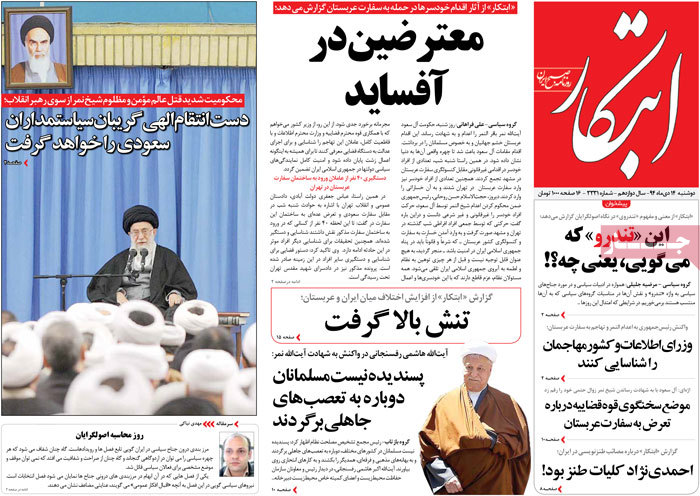
Ebtekar: President Rouhani ordered the Intelligence and Interior Ministries to identify those who attacked the Saudi Embassy as he reacted to [read condemned] the execution of Sheikh Nimr al-Nimr in Saudi Arabia.

Ebtekar: Ayatollah Akbar Hashemi Rafsanjani has said that a return to bigotry of the Ignorance Era is anything but advisable.
 

A look at Iranian newspaper front pages on Jan. 4


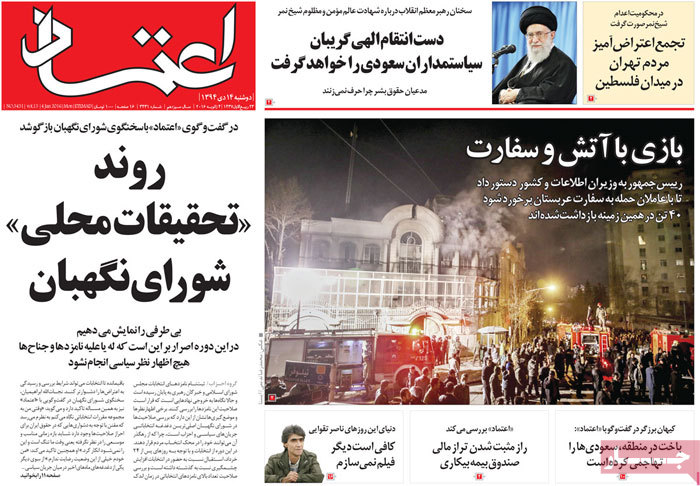
Etemad: In an exclusive interview with the daily, the spokesman of the Guardian Council has talked about how the council goes about screening the candidates of the upcoming elections.

We will show our impartiality in the vetting process; this time around the insistence is on not making any political comment for or against any candidates or parties.
 

A look at Iranian newspaper front pages on Jan. 4


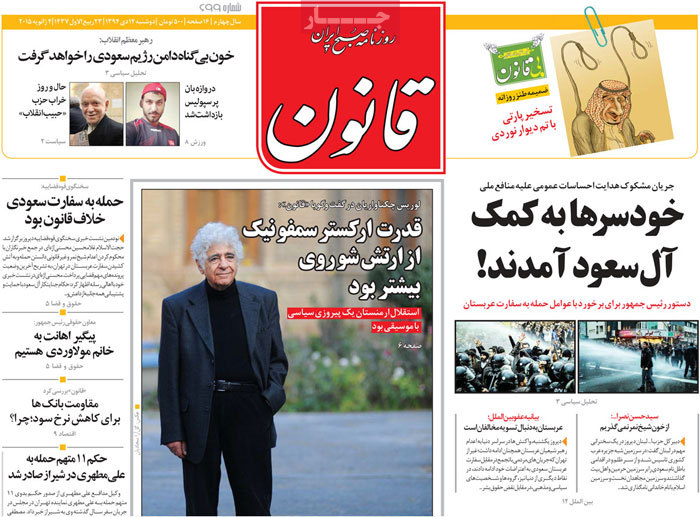
Ghanoon: Rouge elements rushed to the aid of the House of Saud.

A suspicious group is inciting public sentiments against national interests.
 

A look at Iranian newspaper front pages on Jan. 4


Hemayat: The blood of Sheikh al-Nimr will pave the way for the downfall of the brutal Saudi government, said the Judiciary chief.

Hemayat: The Judiciary spokesman has said that elimination of the death penalty from the list of punishments handed down to drug traffickers won’t bolster the fight against drugs.
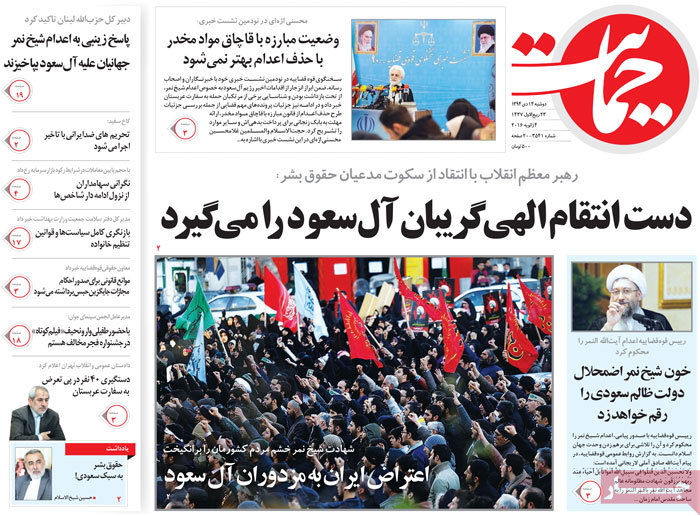
 

A look at Iranian newspaper front pages on Jan. 4


Iran: Spilling the blood of Sheikh Nimr was a political blunder the Saudis committed, said the Supreme Leader.
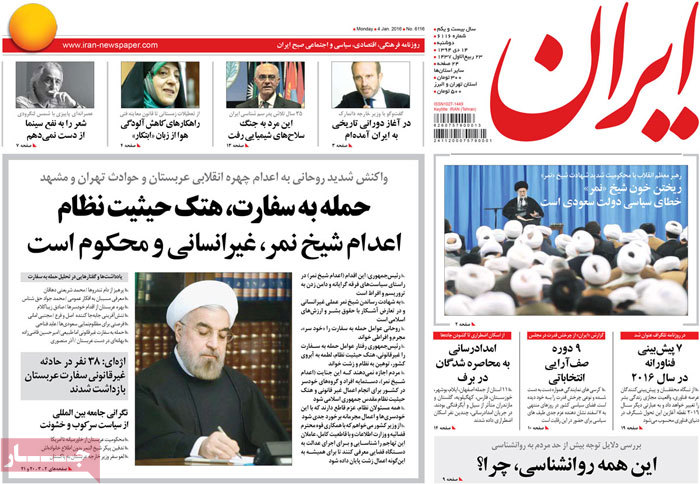
 

A look at Iranian newspaper front pages on Jan. 4


Javan: The West is worried the Saudis might drown in the blood of Nimr.

The Supreme Leader has said that divine vengeance will catch up with the House of Saud.
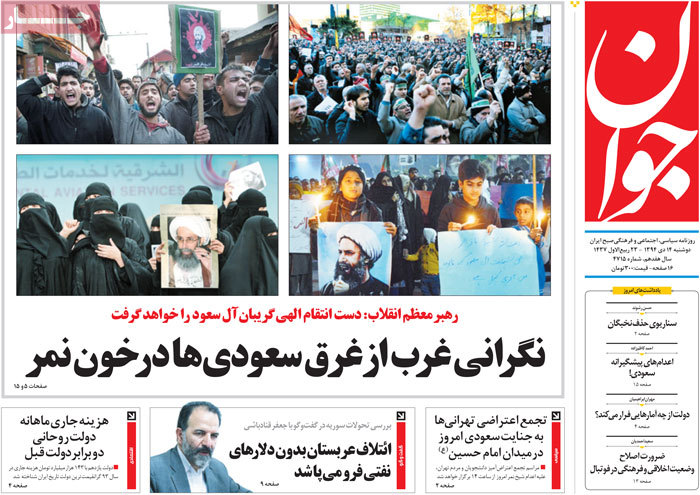
 

A look at Iranian newspaper front pages on Jan. 4


Jomhouri Islami: The Oil Ministry has signed 12 cooperation deals with top universities of the country.
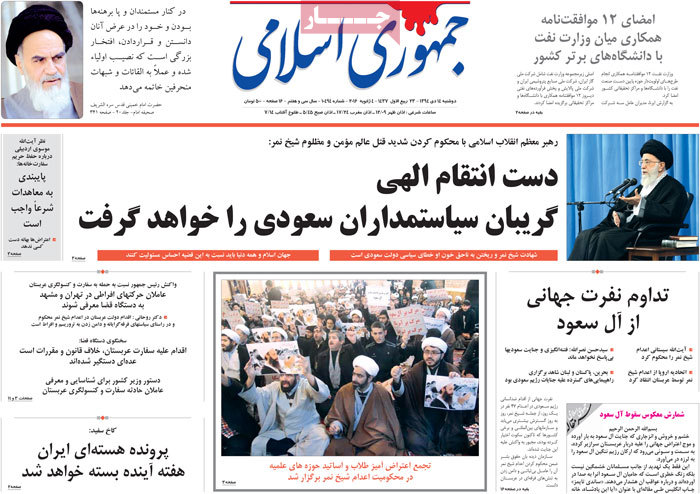
 

A look at Iranian newspaper front pages on Jan. 4


Kayhan: The Judiciary spokesman has said that attacking the Guardian Council and questioning its responsibilities is actionable.
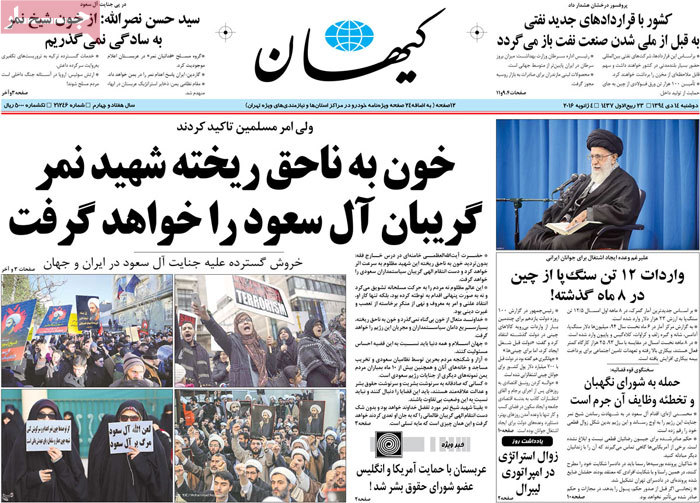
 

A look at Iranian newspaper front pages on Jan. 4


Khorasan: Around 50 individuals have been arrested in Tehran and 27 more in Mashhad for storming the Saudi Embassy and Consulate.
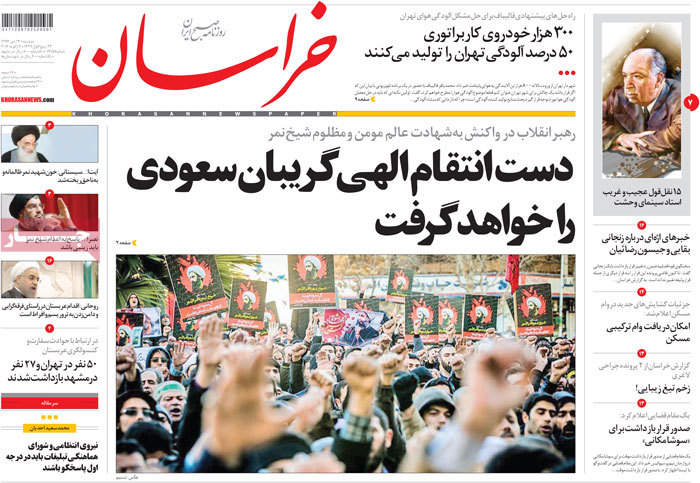
 

A look at Iranian newspaper front pages on Jan. 4


Mardomsalari: Tehran City Council has decided to change the name of Boustan Street [the same street in northern Tehran on which the Saudi Embassy is located] to Martyr Nimr.

Mardomsalari: The Judiciary spokesman has said that investigation into the conduct of Hamid Baghaei [a top lieutenant of Ahmadinejad] is close to completion.
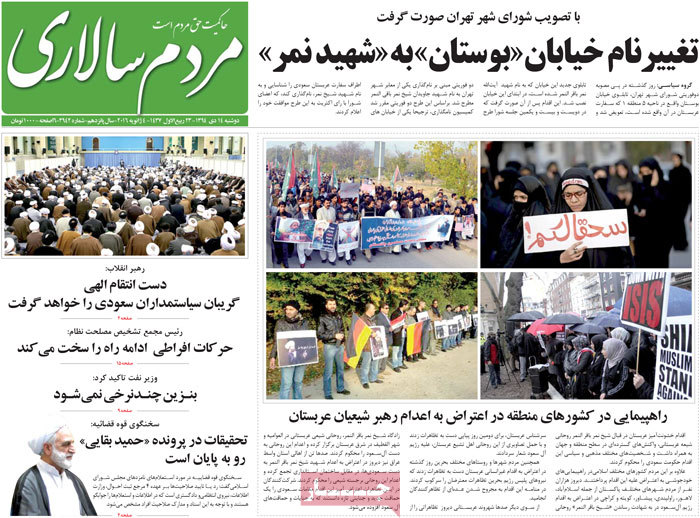
 

A look at Iranian newspaper front pages on Jan. 4


Resalat: We are not expecting justice to be administered in Saudi Arabia anymore, said Tehran Friday Prayer Leader Ayatollah Ahmad Khatami.
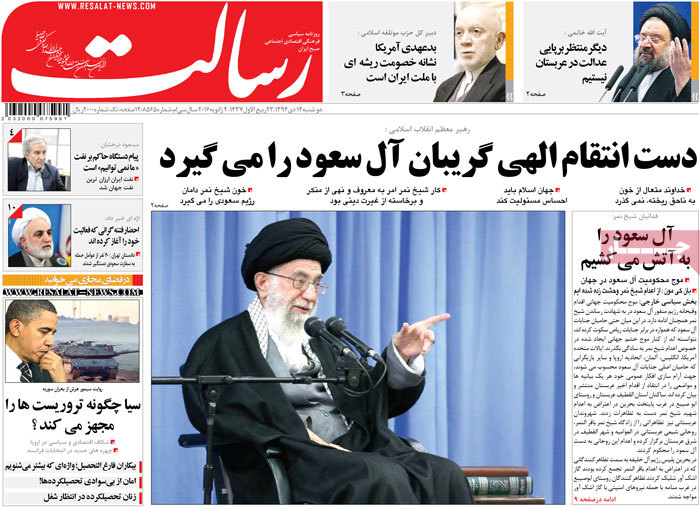
 

A look at Iranian newspaper front pages on Jan. 4


Shahrvand: The number of Iranians killed in road accidents in the first nine months of the year [started March 21, 2015] stood at 11,867, said the commander of the Traffic Police.

The figure is down by 2.7 percent over similar period last year.
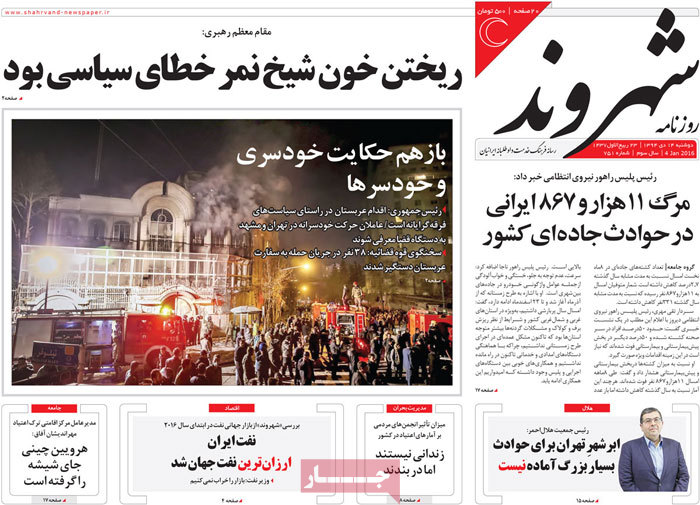
 

A look at Iranian newspaper front pages on Jan. 4


Sharq: Those who stormed the Saudi Embassy will be dealt with, said Judiciary Spokesman Gholamhossein Mohseni Ejei.
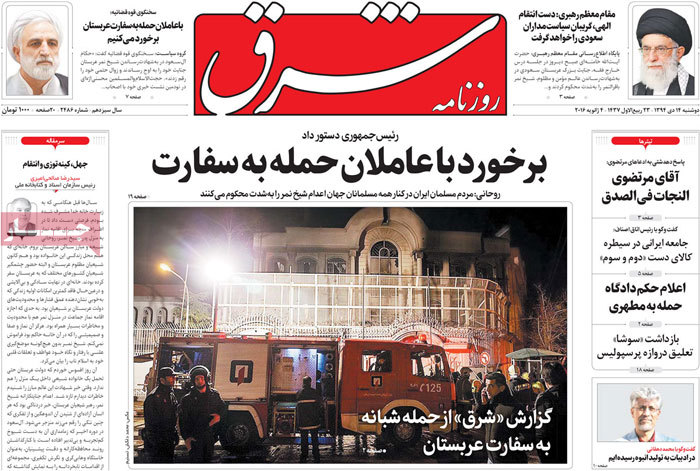
 

A look at Iranian newspaper front pages on Jan. 4


Taadol: The governor of the Central Bank has warned that Iran’s banking system is not ready to get back into the international fold.
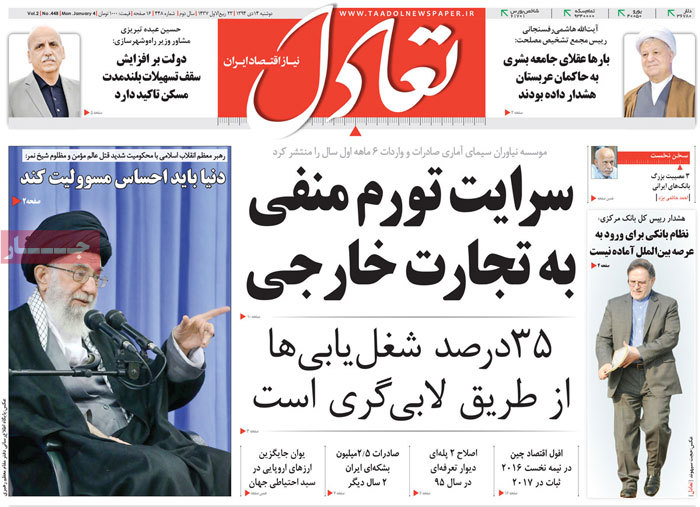
 

A look at Iranian newspaper front pages on Jan. 4


Vaghaye-e Etefaghiyeh: The petrochemical industry gets off to a running start in the post-sanctions era.

The oil minister has said that 70 petrochemical projects will be implemented.
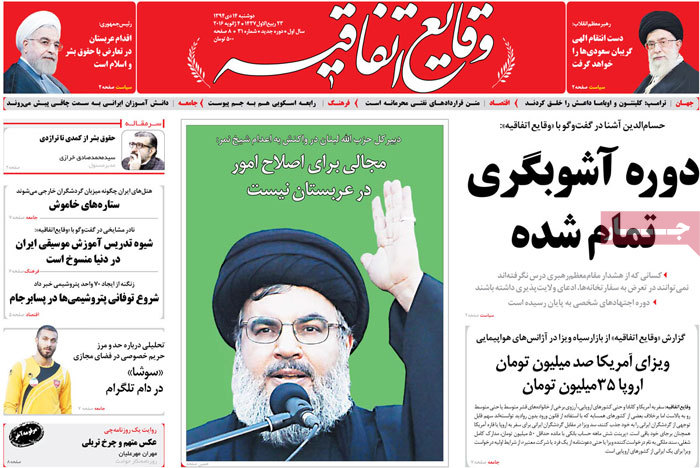
 

A look at Iranian newspaper front pages on Jan. 4


Saudis made a mistake; tough days lie ahead

If the executions by the Saudis of 47 people on terrorism charges were meant to intimidate others and prevent any protest or acts of violence against the Saudi establishment and institutions, the raw nerve these executions have touched will produce a reverse effect, said    Abdel Bari Atwan, the editor-in-chief of Rai al-Youm in an editorial posted on the website of the online newspaper.

The following is the translation of the editorial by the world-known journalist from its Farsi version as published by Tasnim News Agency on January 3:

What is certain is that a new Saudi Arabia which emerged almost a year ago with the ascension to power of King Salman is trying to reinforce speculations that time has come for resoluteness and adoption of an iron-fist policy to spell an end to a policy of compromise which was followed by previous monarchs.

Declaration of war on Yemen to counter Ansarullah Houthis and their allies under the pretext of containing the spread of Iran’s influence was the first measure in line with the transformation in question. They have started the New Year with mass executions unprecedented since 1980 when 63 hardliners led by Juhayman al-Otaybi were put to death for staging an attack on the Grand Mosque in Mecca.

Resoluteness is necessary and to a large extent important, but it should be timely. Those who are resolute should be in possession of the elements of power and its components; besides steadfastness should be exercised within a firm strategic framework and in ideal regional and international conditions. Those conditions do not seem to be met by present-day Saudi Arabia.

It is not wise to launch two simultaneous wars in Syria and Yemen simply to counter the influence of Iran which would be given a leg-up by the [nuclear] deal with P5+1 which ends nearly three decades of isolation. It [the first war] comes at a time when a superpower like Russia is using all its political and military muscle to support the Syrian regime and has openly declared war on armed groups there. On the other hand, Saudi Arabia’s oil revenues are shrinking and the policies of its traditional ally, that is to say the US, are dotted with uncertainty and confusion.

The execution of 42 Sunni extremists convicted of supporting Alqaeda and direct and indirect involvements in protests and bombings between 2003 and 2006 was designed to hide the execution of prominent cleric Sheikh Nimr al-Nimr.

They [the Saudi authorities] cannot conceal the truth and soothe Shiite anger. For the first time such a move will unify Shiites and Sunnis in their rage and result in reprisal attacks by extremists. Sheikh Nimr was accused of inciting rallies similar to those inspired by the Arab Spring which had and still have the support of the Saudis.

We at Rai al-Youm condemn terrorism which claims innocent lives and targets security and stability; but we draw a line between terrorism and the legitimate demand of people for freedom and reforms and for the right to protest at injustice, suppression, and crackdown. Accordingly, we oppose the death penalties handed down by a corrupt judicial system which does not appreciate the minimum values of justice and its tools. So we condemn the execution of 47 individuals in Saudi jails in 12 cities on Saturday, because those who were killed were denied a fair trial and were unable to properly defend themselves.

These executions were carried out by a system that sentences a Twitter user to lashes and 10 years in prison and bans a female poet from penning articles and deprives them of the freedom of speech. These rulings against a poet or an intellectual for writing a sonnet come on orders of a local ruler, and not official courts.

Injustice, marginalization and clampdown are the only measures which are not taken in Saudi Arabia on religious or tribal grounds. As far as the question of freedom, reforms and justice is concerned, Saudi Arabia does not treat the Shiites and Sunnis differently, but we should admit that the Shiite minority has been subjected to persecution in Saudi Arabia more than others.

The Shiites have suffered racial discrimination and marginalization over the past decades. They have been also treated as second-class citizens, something which casts a doubt on their citizenship. Anyone who claims otherwise is an arrogant person who closes their eyes to the realities.

We do not predict things before they happen, but we are all-but certain that such executions will trigger retaliatory measures and dangerous reactions which can negatively impact the kingdom’s security and stability, fan the flames of Saudi Arabia’s growing security problems, and thicken the kingdom’s file on the lack of freedoms and a fair judicial system.

Saudi Arabia’s biggest enemies come from within, those who adopt similar policies and stances which fuel crises and wage civil strife along with wars fought overseas. The wars Saudi Arabia fights overseas are still at early stages. It is very hard to predict the result of those wars which are likely to drag on for several decades.

Foreign wars come at a human, financial, political and military cost. By contrast, civil wars – if they ever break out – will inflict staggering costs in all areas, especially when they erupt at the wrong time, against the backdrop of wide public rage and amid tough economic conditions and high unemployment.

Those executed [by Saudi Arabia] have a popular, tribal and sectarian favorability with supporters at home and abroad. We do not believe that the one who made such a decision [carrying out the execution of Sheikh Nimr and 46 others] has properly taken everything into account, exactly like what happened when Saudi Arabia was mired in foreign battles among them the war in Yemen.

Tough days, or toughest days I should say, lie ahead for Saudi Arabia. Enough said, I should say.

President Rouhani: Saudi sectarianism behind execution of Sheikh Nimr

President Hassan Rouhani says Saudi Arabia’s execution of prominent Shiite cleric Sheikh Nimr al-Nimr was in line with Riyadh’s sectarian policies which aim to spread terrorism and extremism.

In a message on Sunday, the Iranian president condemned Saudi Arabia’s “un-Islamic and inhuman” act of executing Sheikh Nimr, which was in “blatant violation of human rights and Islamic values.”

“Such a measure is in line with sectarian policies and aims to spread terrorism and extremism in the region and across the world, which have destabilized the region and waged war and conflicts in recent years,” Rouhani said.

The Iranian president emphasized that by executing Sheikh Nimr, the Saudi government has further tarnished its image among world countries, particularly Muslim states.

[…]

Rouhani said the Muslim Iranian nation, along with all Muslims across the world, slam Saudi Arabia’s execution of Sheikh Nimr but will not allow disobedient groups and individuals inside the country to use this crime as a pretext to conduct illegal acts and cause disgrace for the Islamic establishment.

The Iranian president added that all Iranian authorities are determined to take a firm action in dealing with any unlawful measure.

On Saturday evening, Iranian police prevented angry protesters from storming the Saudi embassy in Tehran.

According to reports, a number of protesters threw incendiary devices at the building causing minor damage. Police forces, deployed to keep order, dispersed the angry crowd.

Tehran Prosecutor General Abbas Jafari Dowlatabadi said on Sunday that 40 people have been identified and arrested for entering the premises of the Saudi embassy in Tehran.

Iran, Saudi Arabia seem to avoid hasty decisions

Iran Issues Statement on US Bid to Reinstate UN Sanctions

An informed source at the Foreign Ministry has rejected as “false” reports that Iran and Saudi Arabia are to downgrade their diplomatic ties following the execution on Saturday of prominent Saudi Shiite cleric Sheikh Nimr al-Nimr.

The source told IFP that no measure has been taken by Tehran or Riyadh to that end.

It came after certain Iranian media quoted some sources in the region as reporting that Saudi Arabia has expelled the Iranian ambassador to Riyadh and that Tehran has acted in kind.

With tensions between the two key regional heavyweights running high, certain media experts and politicians speculate about the future of ties between Iran and Saudi Arabia in the form of reports.

Iran’s foreign policy seems to have been formulated based on the principle of tolerance with a focus on serving regional interests. The timely reaction of Iran’s Foreign Ministry to the incident in Tehran on Saturday night – in which a number of enraged young people stormed the Saudi embassy – is in line with Iran’s strategy of pursuing convergence with neighboring countries, especially Muslim nations.

Although the guarded words and deeds of Iranian politicians and officials met with the protest of part of Iranian society, they signify the seriousness of what Tehran favors: prevention of creating new tensions in a region which is already beset by growing crises.

Highlights of Ettela’at newspaper on Jan. 3

Ettela’at: Rage and indignation across the Muslim world over the execution of Sheikh Nimr al-Nimr by the brutal Saudi regime

The Iranian Foreign Ministry has summoned the Saudi charges d’affaires over the execution of the prominent Shiite cleric.

Ettela’at: The petrochemical sanctions against Iran have been lifted.

According to the managing director of Iran Petrochemical Commercial Company, conclusion of a deal with a Spanish bank marked the official termination of sanctions.

Ettela’at: A missile attack by Yemeni forces against a Saudi military base in Jizan left 25 dead.

And in another development, a senior Alqaeda official was killed in clashes with Yemeni tribal fighters.

Ettela’at: The first vice-president has said that payment of cash subsidies will continue into next year.

Eshagh Jahangiri further said that the administration has no plans to dissolve the Energy Ministry.

Ettela’at: The parliament speaker has said that Iran will offer a firm response to the West’s deceptiveness.

Ali Larijani said any uncalled-for measure by the West should be met with a fitting response.

Ettela’at: The Expediency Council has approved the general outlines of the policies governing Article 44 of the Constitution [which deals with privatization of state companies].

The council is expected to take up the Sixth Development Plan early next year [starts March 21, 2016].