Thursday, December 25, 2025
Home Blog Page 4553

Official: US hindering Iran’s recovery

Some Iranians are frustrated that economic recovery from years of sanctions is slow as banking transactions are still stricken with problems and the return of Iran’s capital from abroad is facing hurdles.

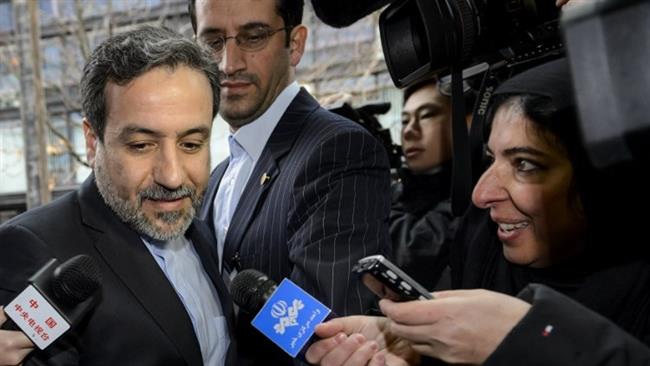
“Here, we are faced with two types of a new problem: one is returning to former conditions which will automatically take time; the other is that American obstructions have made it difficult,” Abbas Araqchi said Saturday night.

US and European businesses are reluctant to do business with Iran for fear of getting tangled in a thicket of US regulations months after sanctions were lifted on the Islamic Republic under a nuclear agreement.

Araqchi dismissed contentions that sanctions on Iran had been lifted “only on paper.”

“All the sanctions which were to be annulled have been canceled and those parts which had to stop have been halted. We are now facing a new situation,” Araqchi said.

“Sanctions were getting their legitimacy from Security Council resolutions which have been totally cancelled,” he added.

However, certain restrictions not related to Iran’s nuclear issue remain in place, Araqchi said, citing “primary sanctions” which the US has imposed on Iran over terrorism and human rights accusations.

“The overlapping of ‘primary’ and ‘secondary’ sanctions has created some problems and the Americans have not had the necessary cooperation in this regard yet,” he said.

Iran, however, has managed to remove some of the problems through pressuring the US, including those related to insurance for oil tankers, Araqchi said.

“Iran’s capabilities brought the Americans to the negotiating table and their obstructions are now normal,” he added.

The US has fined some of the largest international banks for trading for Iran. Araqchi said some of those banks had pledged not to deal with Iran, but Tehran was pressuring Washington to remove the restrictions.

“We knew that we would be facing breach of contract and malfeasance by the Americans when it came to the implementation (of the agreement),” he said.

US President Barack Obama has appeared to take further steps toward easing restrictions on Iran and allowing the country to begin trading in dollars.

Araqchi said Iran had raised its crude oil exports to 1.7 million barrels per day (bpd), but it faced challenges for returning to pre-sanctions levels when the country sold 2.5 million barrels.

“Our customers have gone and concluded deals with other countries. We have to find new clients and nobody can expect us to return to former export rates overnight,” he said.

Araqchi predicted Iran’s oil exports to hit 2.5 million bpd within a year.

As for the repatriation of Iranian assets abroad, the official put the sum above $100 billion, some of which belonged to the government while others were owned by the Central Bank and the Ministry of Petroleum or held in the form of deposits with Chinese banks.
Iran missiles not open to talks, compromise: Araqchi

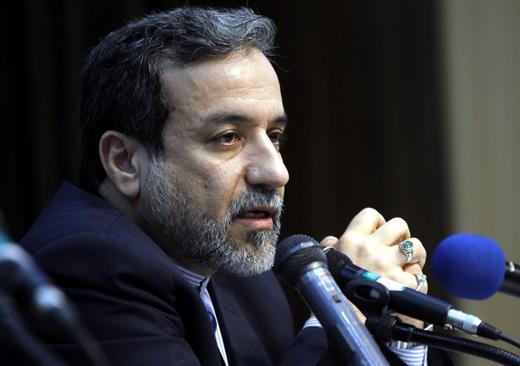
“During the [nuclear] negotiations [with the P5+1 group of countries], we never allowed them to raise the issue of our country’s missile [program], because no wise individual will negotiate over his country’s security,” Iranian Deputy Foreign Minister for Legal and International Affairs Abbas Araqchi said in a televised interview Saturday night.

Referring to recent claims by the US and some European countries about Iran’s latest ballistic missile tests, the official said those countries have already brought up this issue at the UN Security Council twice, but have failed to make the body issue even a statement against Iran.

Araqchi stated that the US and the West frequently resort to the Security Council Resolution 2231 to call for a stop on Iran’s ballistic missile tests, adding, “The resolution calls upon Iran not to test or produce missiles which are capable of carrying nuclear warheads, but Iran has never developed missiles for this purpose.”

The Iranian deputy foreign minister reiterated that there is no evidence to show that Iran’s missiles are meant to carry nuclear warheads and therefore do not violate the Security Council Resolution 2231.

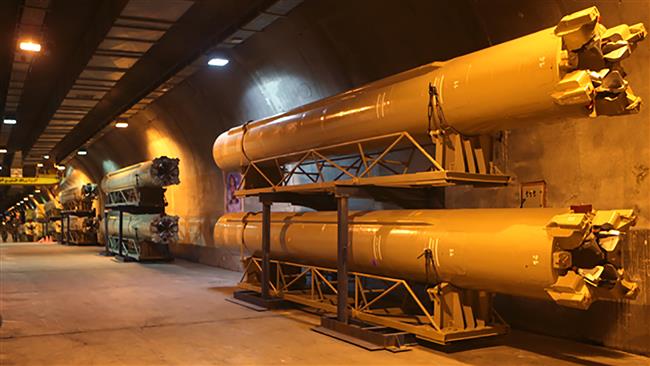
The Islamic Revolution Guards Corps (IRGC) successfully test-fired two ballistic missiles on March 9 as part of military drills to assess the IRGC’s capabilities. The missiles dubbed Qadr-H and Qadr-F were fired during large-scale drills, code-named Eqtedar-e-Velayat.

On March 8, Iran fired another ballistic missile called Qiam from silo-based launchers in different locations across the country.

On March 24, the US Treasury Department blacklisted two Iranian companies claiming that the firms backed Iran’s ballistic missile program. Washington also claimed that the companies are working for an industrial group, which the US alleges is in charge of Iran’s ballistic missile program.


underground IRGC missile facility


Washington claims that Iran’s missile tests violate the UN Security Council Resolution 2231 that endorsed a nuclear agreement, known as the Joint Comprehensive Plan of Action (JCPOA), reached between Iran and the P5+1 group of countries – the five permanent members of the UN Security Council plus Germany – on July 14, 2015.

Iran, however, has repeatedly announced that the missile launches were not against the Security Council resolution.

Resolution 2231 (2015) provides for the termination of the provisions of previous Security Council resolutions on the Iranian nuclear program, and calls on Iran not to undertake any activity related to ballistic missiles designed to be capable of delivering nuclear weapons, including launches using such ballistic missile technology.

IRGC busts terrorist group in southeast Iran

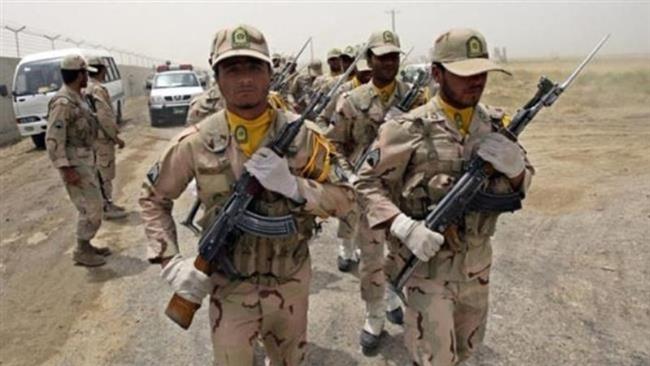
“In a coordinated operation conducted by the IRGC forces and the Shia and Sunni people of Sistan and Baluchestan, a terrorist group affiliated with Mojahedeen-e Khalq Organization (MKO) has been demolished south of Sistan and Baluchestan,” Tasnim news agency quoted Commander of the IRGC Ground Forces’ Quds Base Brigadier General Mohammad Marani as saying on Sunday.

He added that the terrorist group’s leader, Ahmad Sahouei, along with four other members of the cell, were killed during an operation by the IRGC forces.

The commander noted that provincial security forces were monitoring the criminal group, which has been conducting acts of murder and armed robbery, saying that weapons and ammunition were seized from the armed group.

The MKO has carried out numerous terrorist attacks against Iranian civilians and government officials over the past three decades. Out of the nearly 17,000 Iranians killed in terrorist attacks since the victory of Iran’s 1979 Islamic Revolution, about 12,000 have fallen victim to the acts of terror carried out by the MKO.

The group was viewed by the EU as terrorist until January 2009, when the EU Council lifted the designation under immense pressure from political lobbies. The decision was followed by the United States in September 2012.

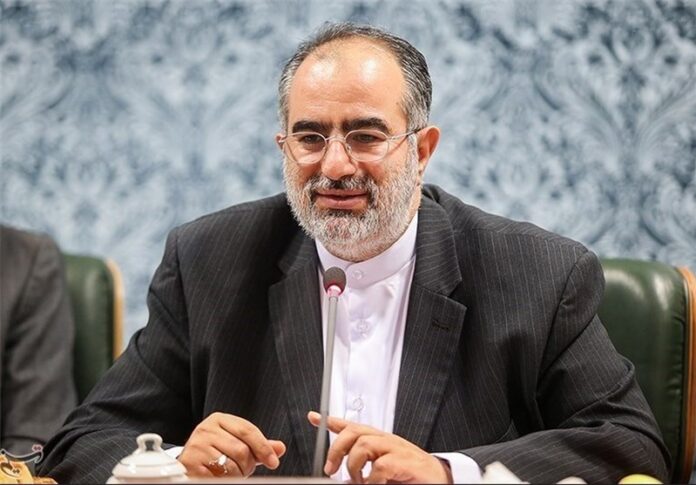
Iran Not Comparable to Soviet Union, Cuba: Presidential Adviser

In a post on his account in a social network, Hesamoddin Ashna, the cultural adviser to President Hassan Rouhani, said the enemies can never influence the calculations of Iranian official, who benefit from the wise leadership of Leader of the Islamic Revolution Ayatollah Seyed Ali Khamenei.

He added that US President Barack Obama had better be mindful of the fact that Iran is not similar to Cuba or the former Soviet Union, which broke up under the Cold War strategies.

His comments came after Obama travelled to Havana in March in a first visit by a US president to Cuba in 88 years. Washington and Havana had agreed in December 2014 to restore diplomatic ties that the US had severed more than 50 years ago.

Iranian officials, however, have noted times and again that the Islamic Republic will not allow any US inroads into the country.

Ayatollah Khamenei has on many occasions urged vigilance in the face of enemy ploys to gain a political and cultural foothold in Iran, warning that the consequences of such infiltration would be much worse than that of enemy’s economic influence.

As part of plans for cultural infiltration, the enemy has made heavy investment to gradually change the Iranian people’s beliefs, the Leader has warned.


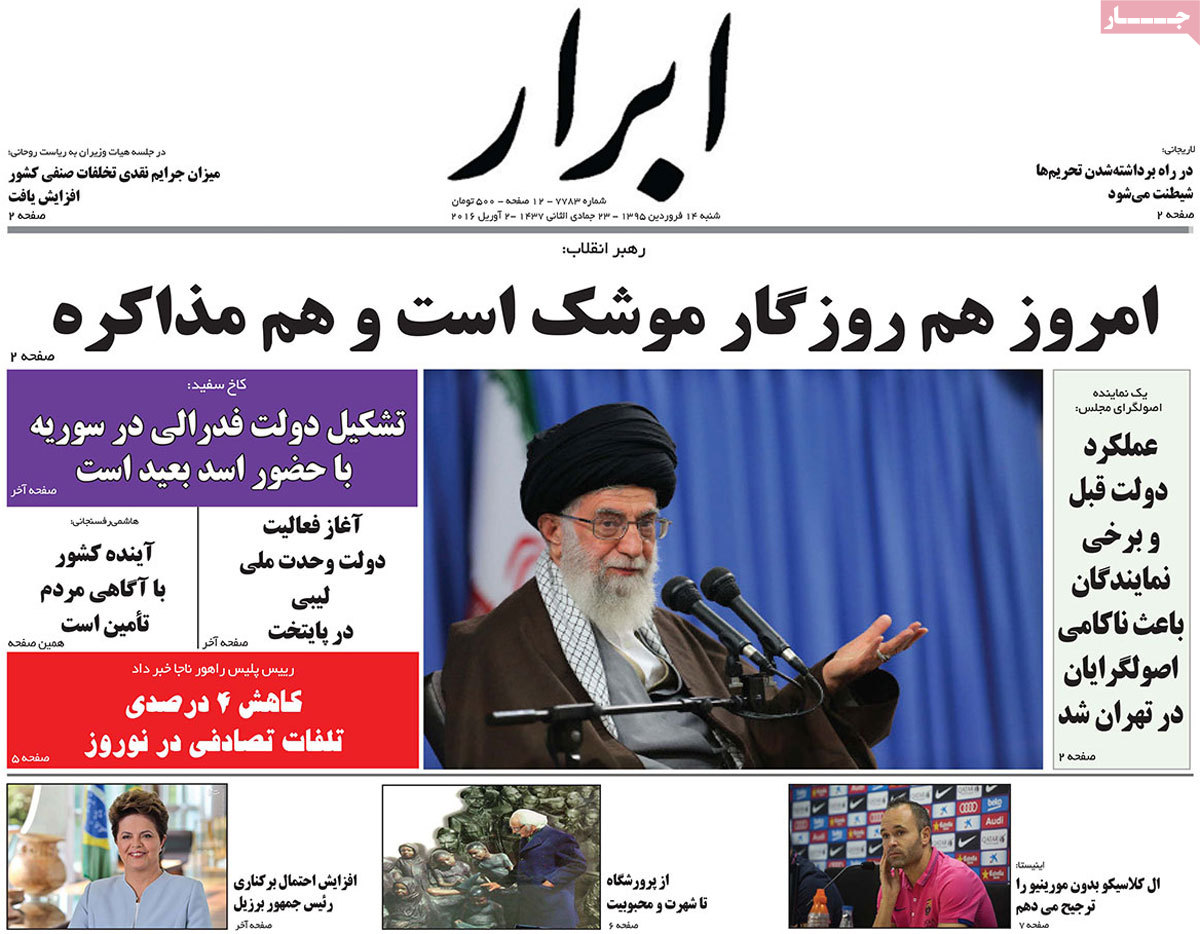
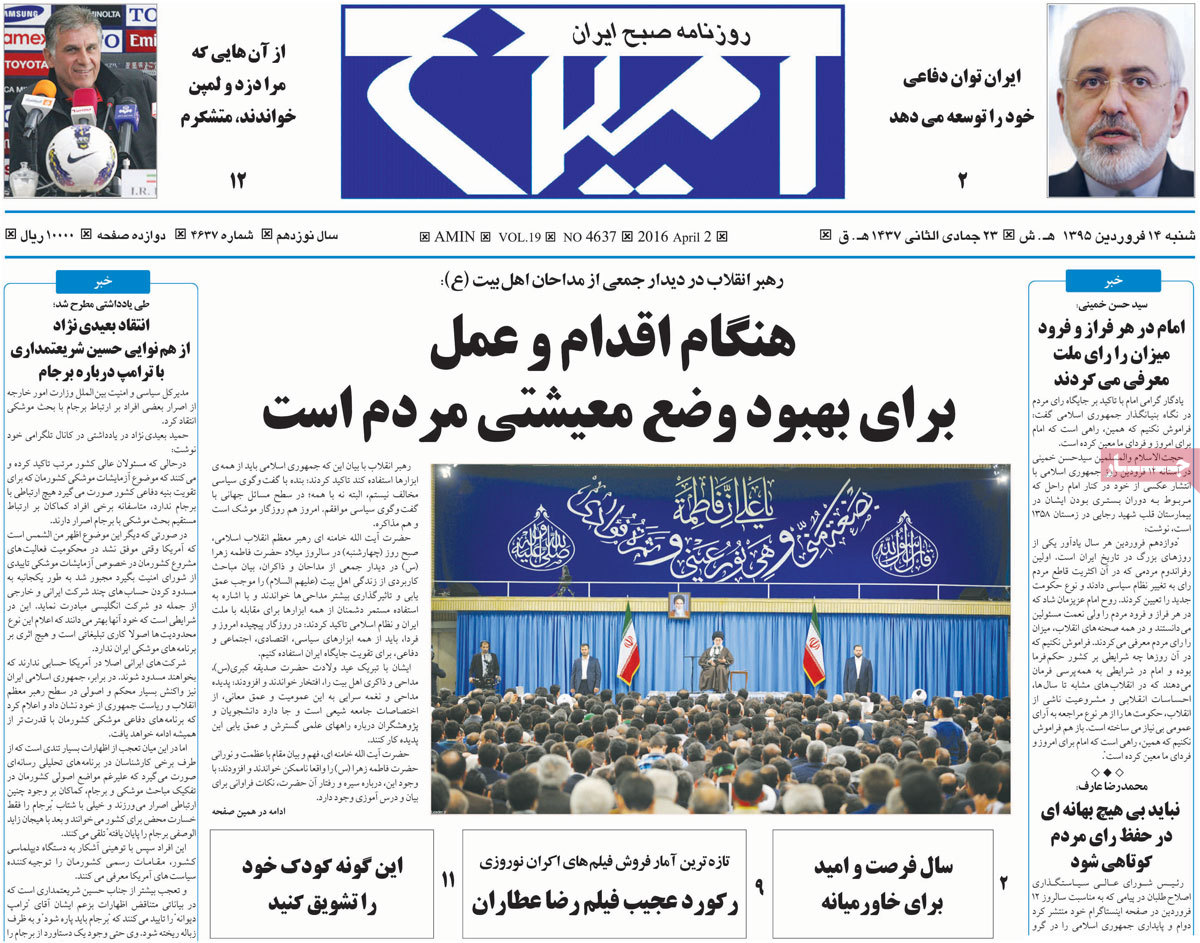
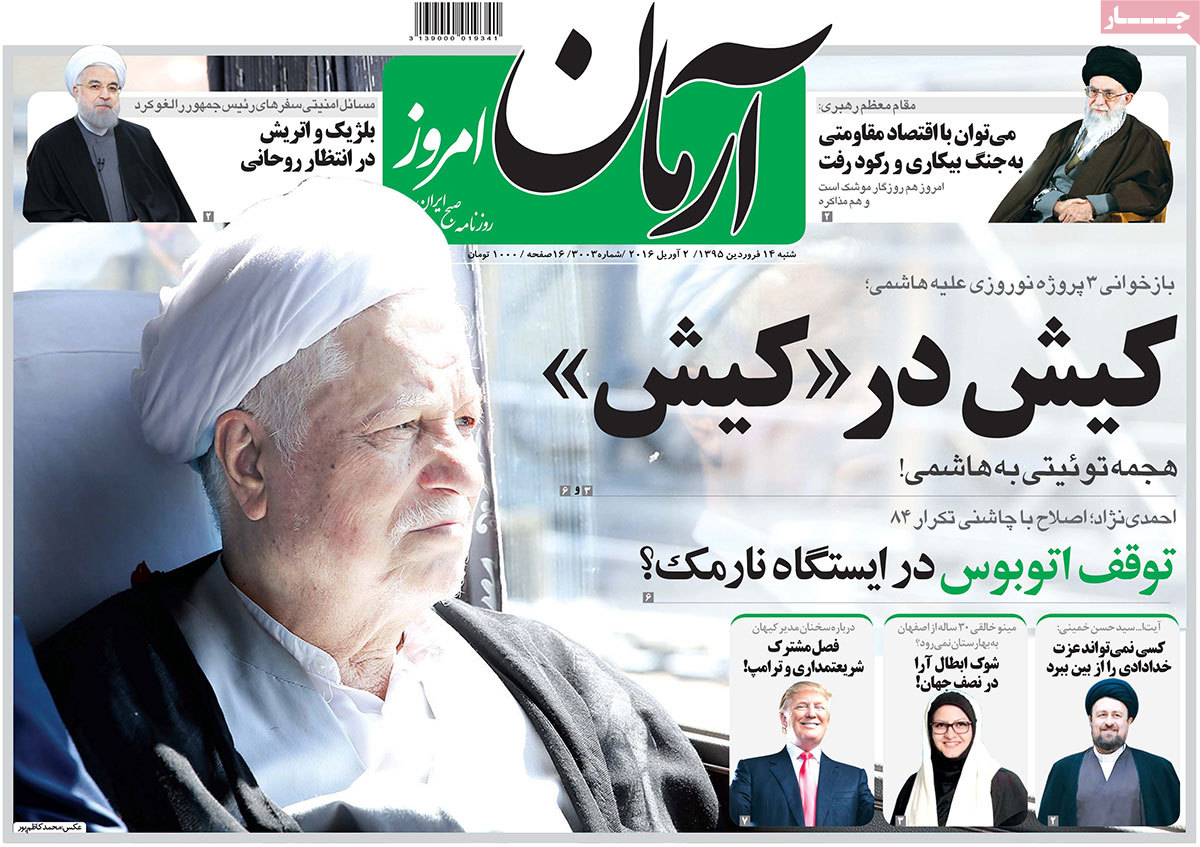
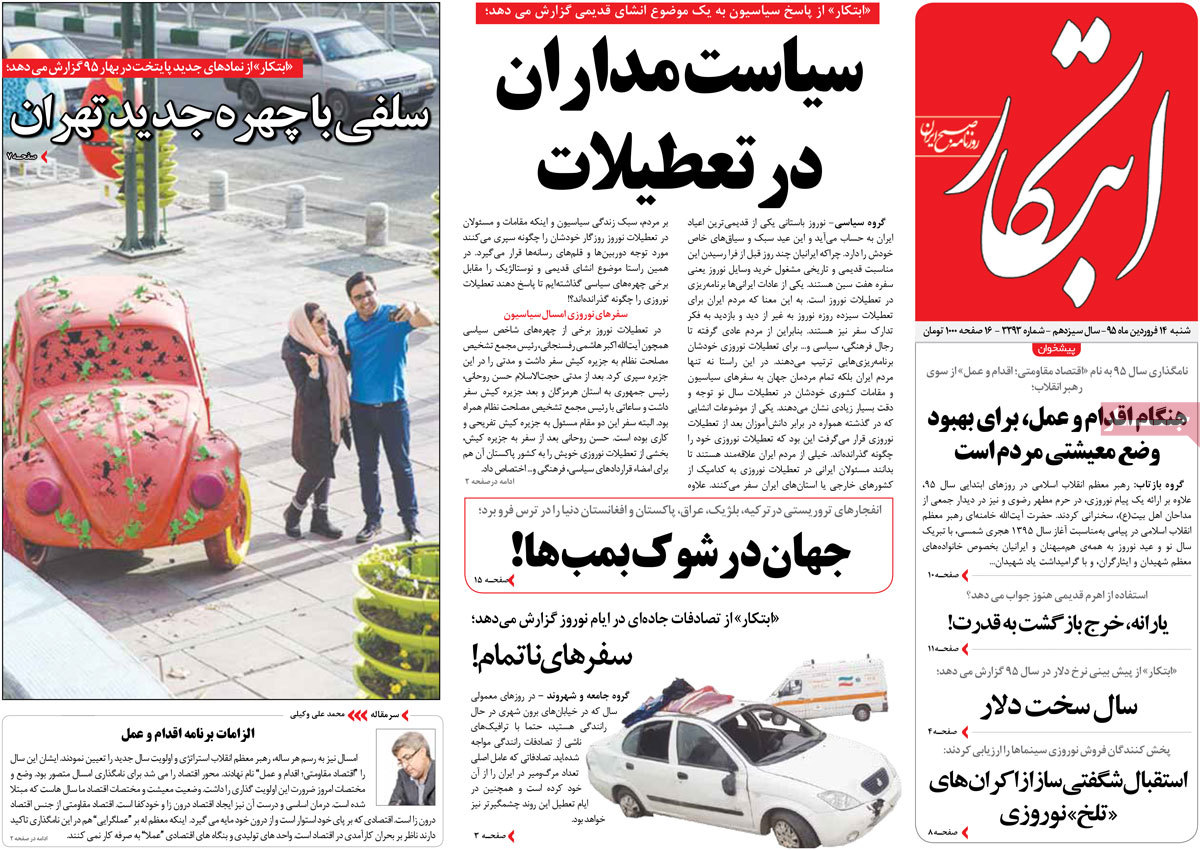
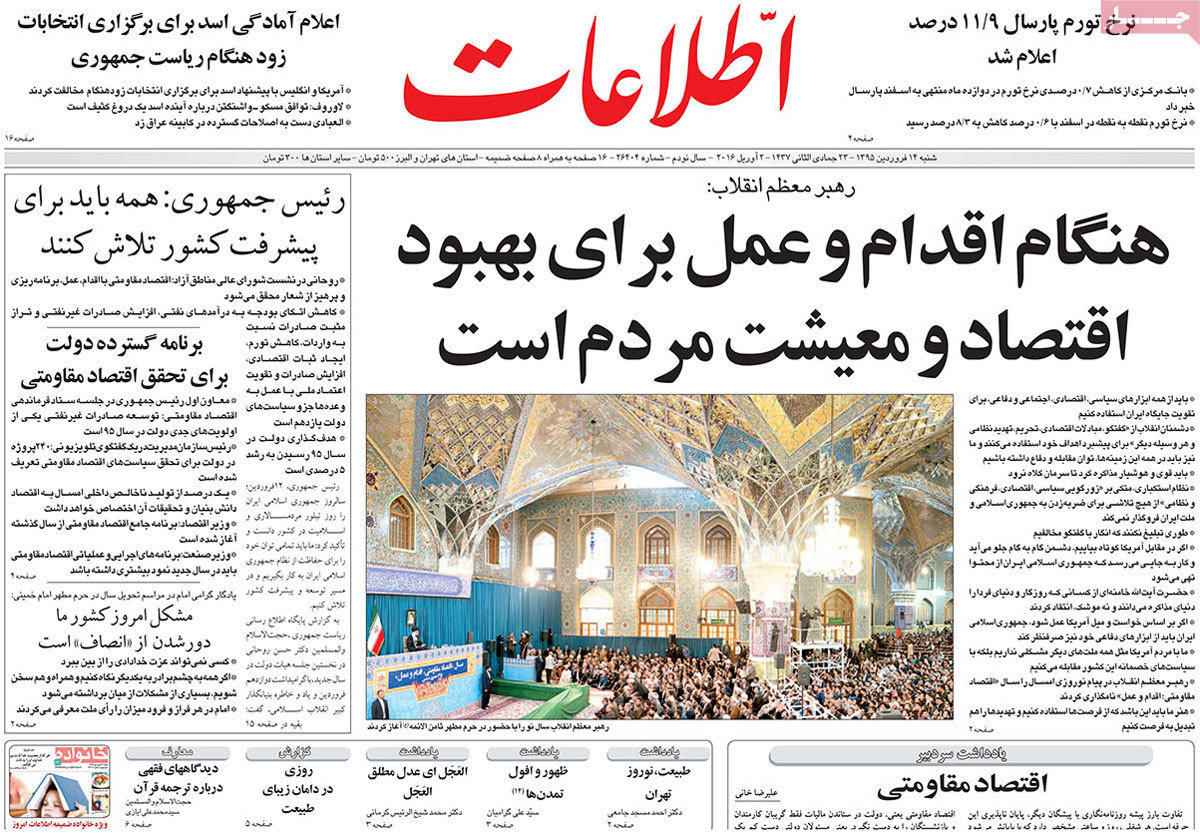
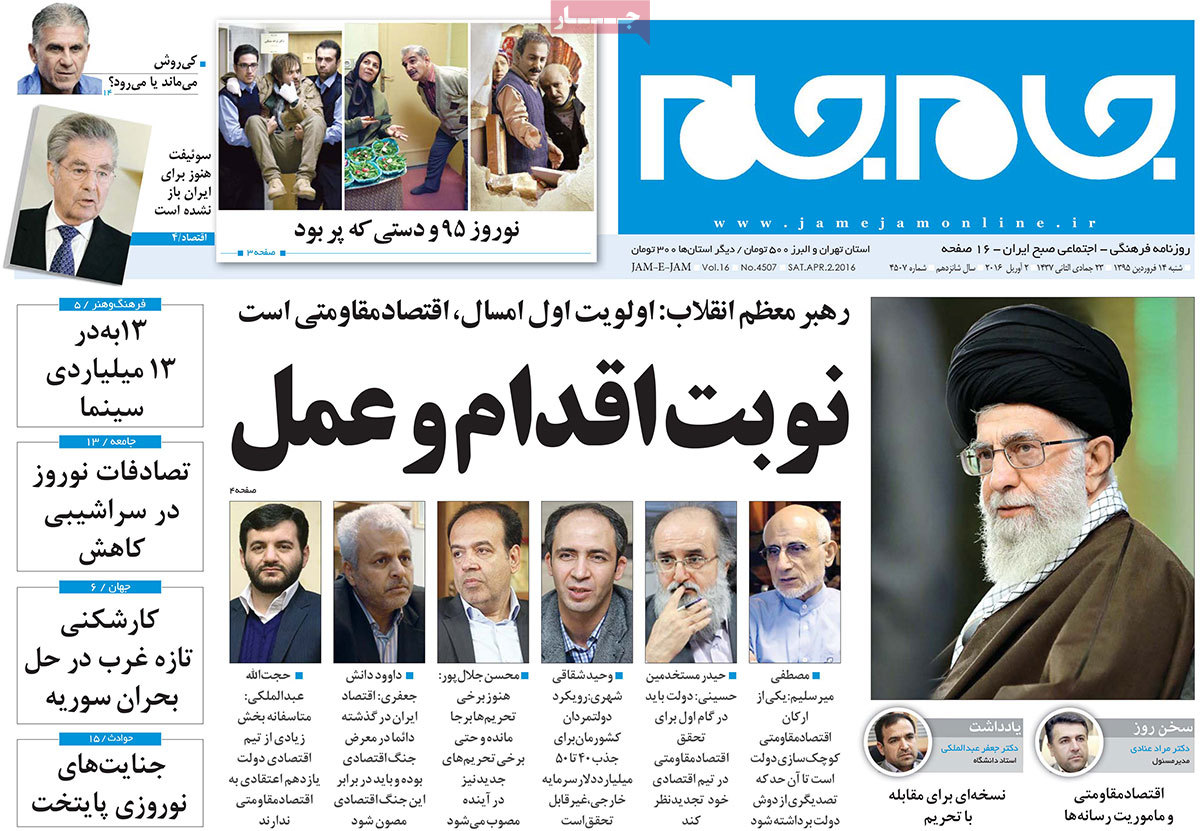
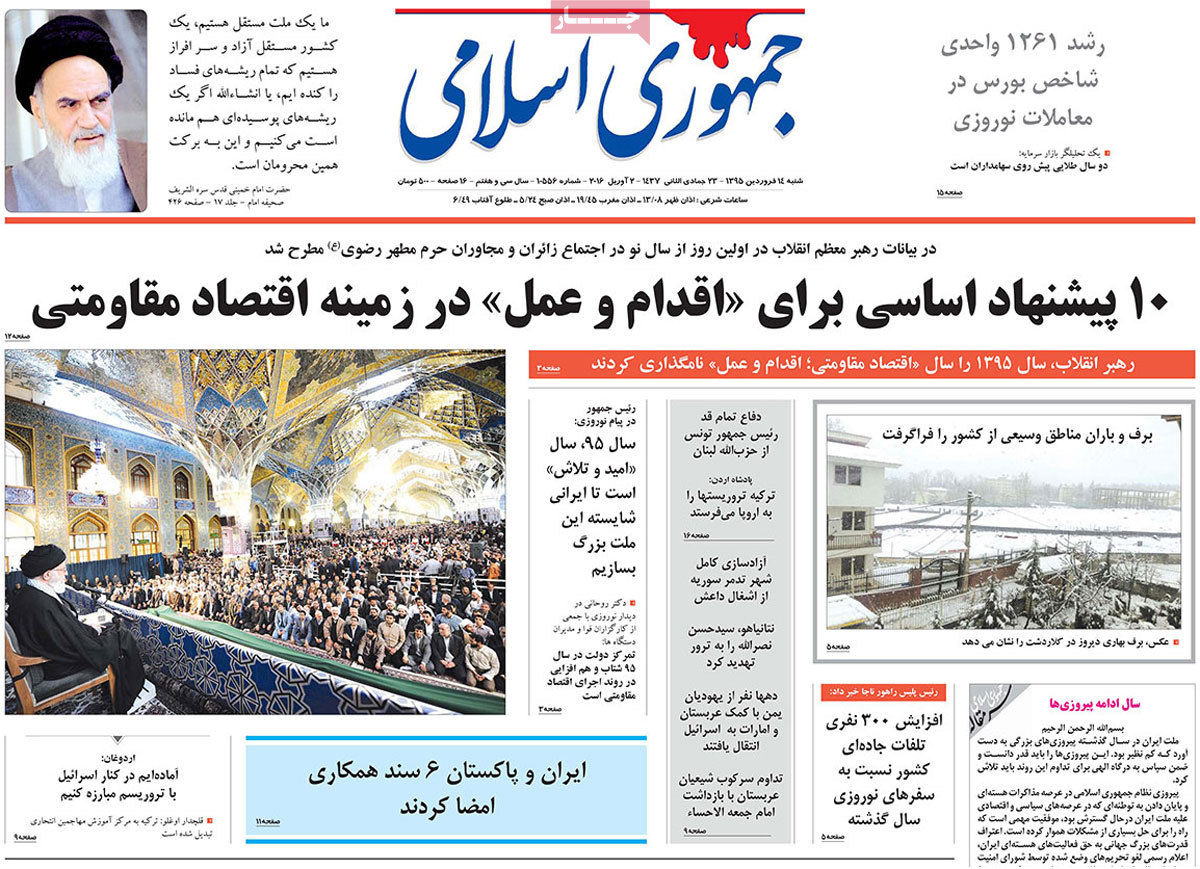
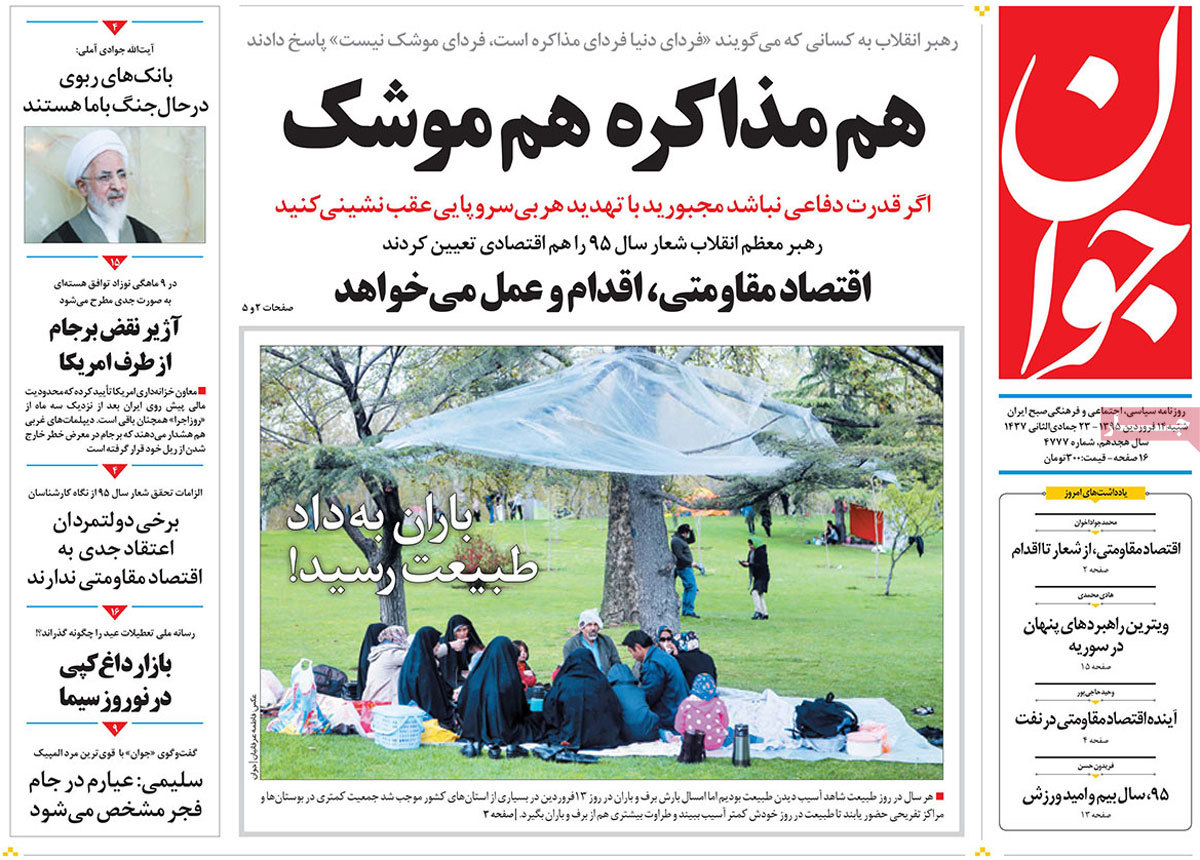
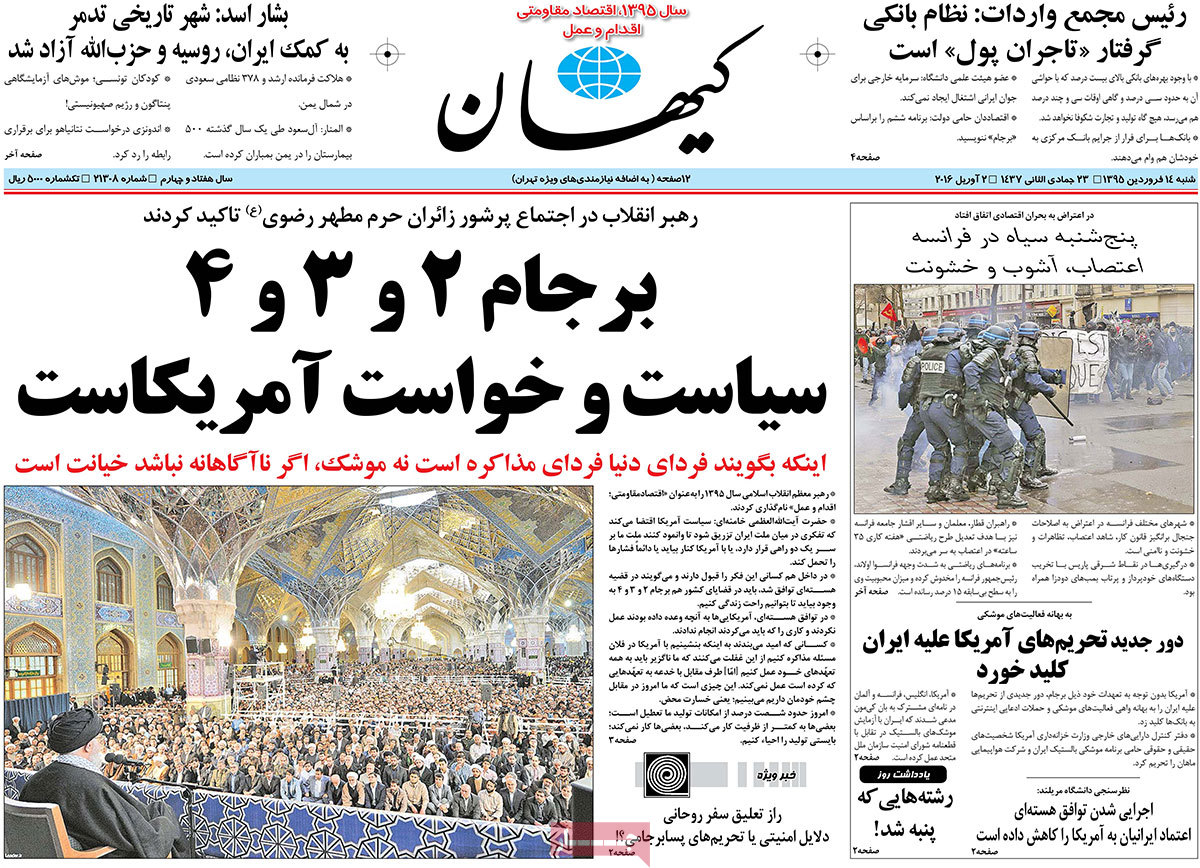
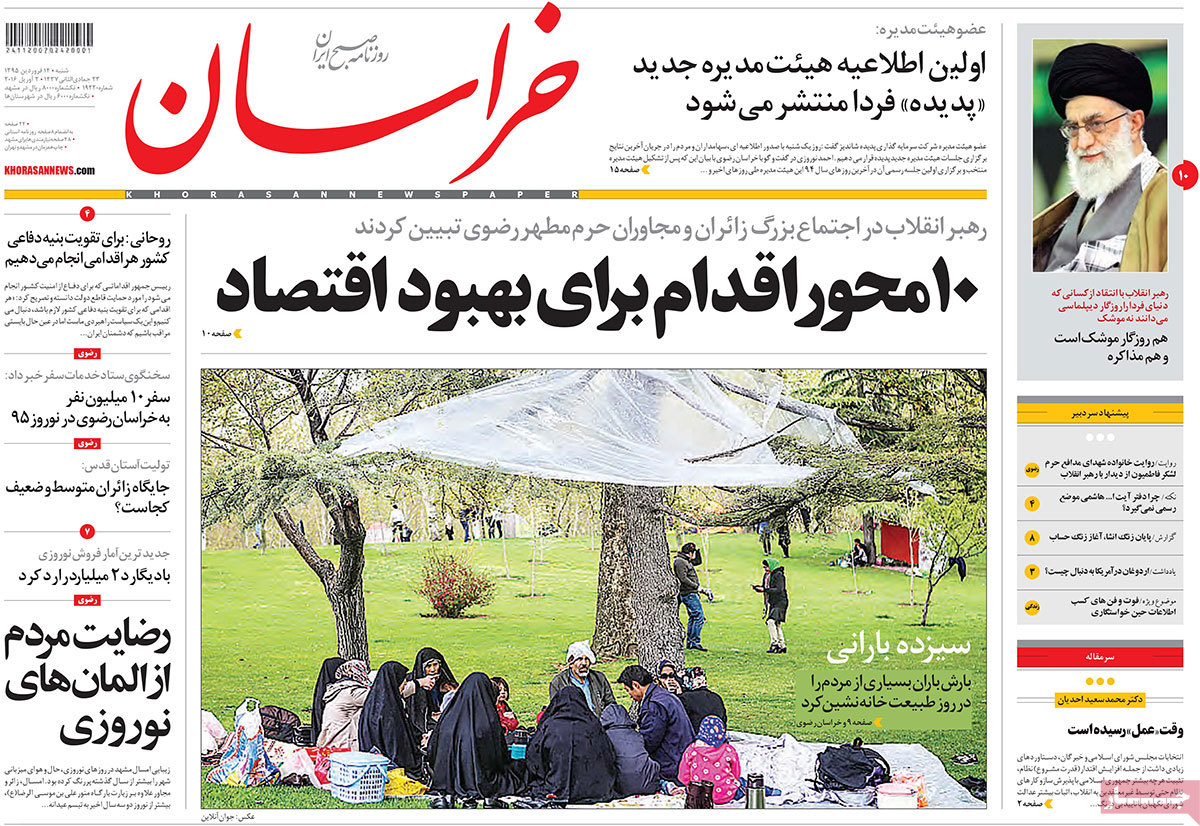
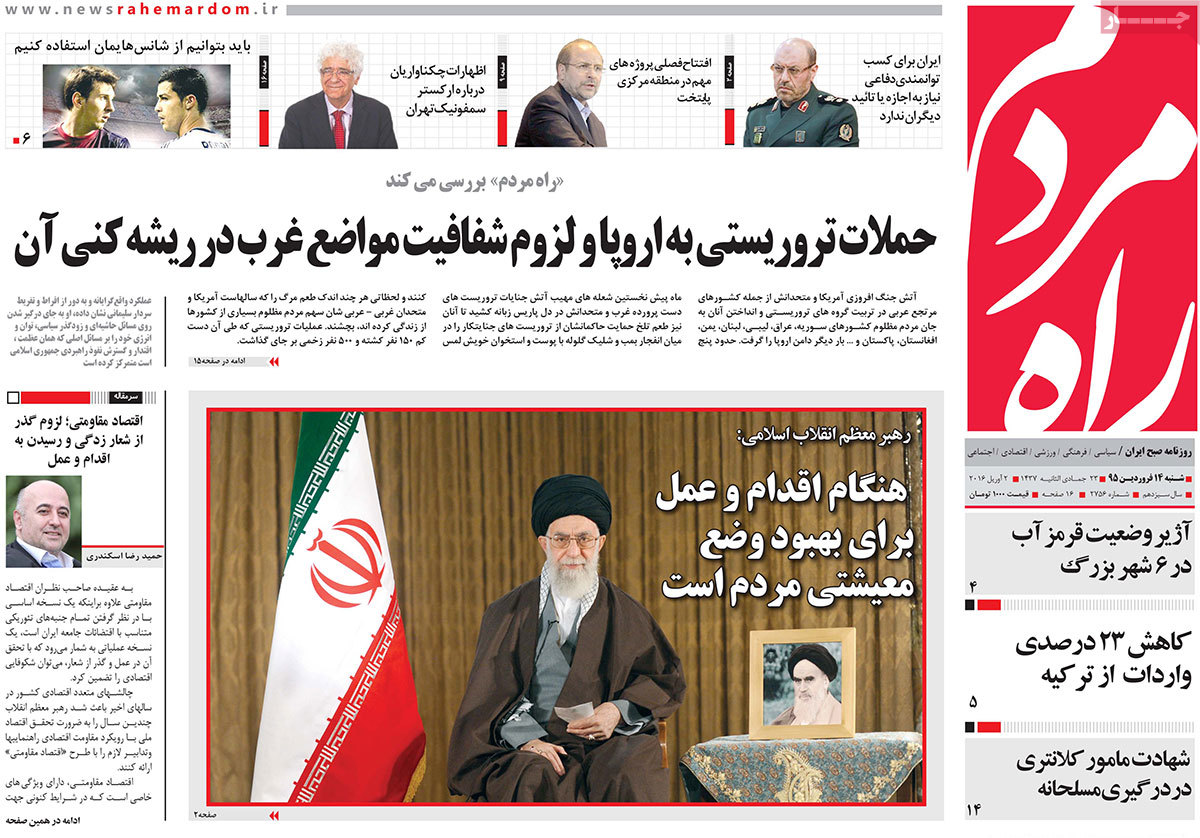
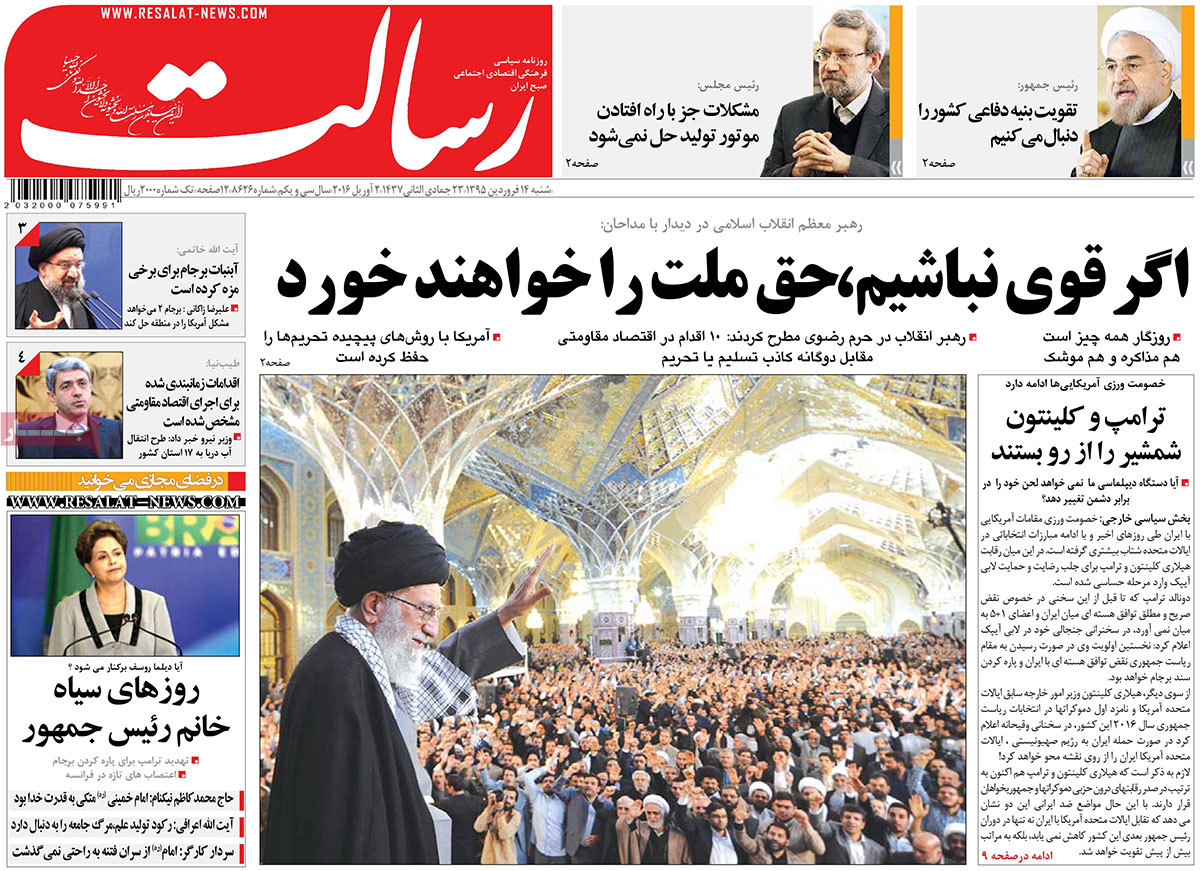
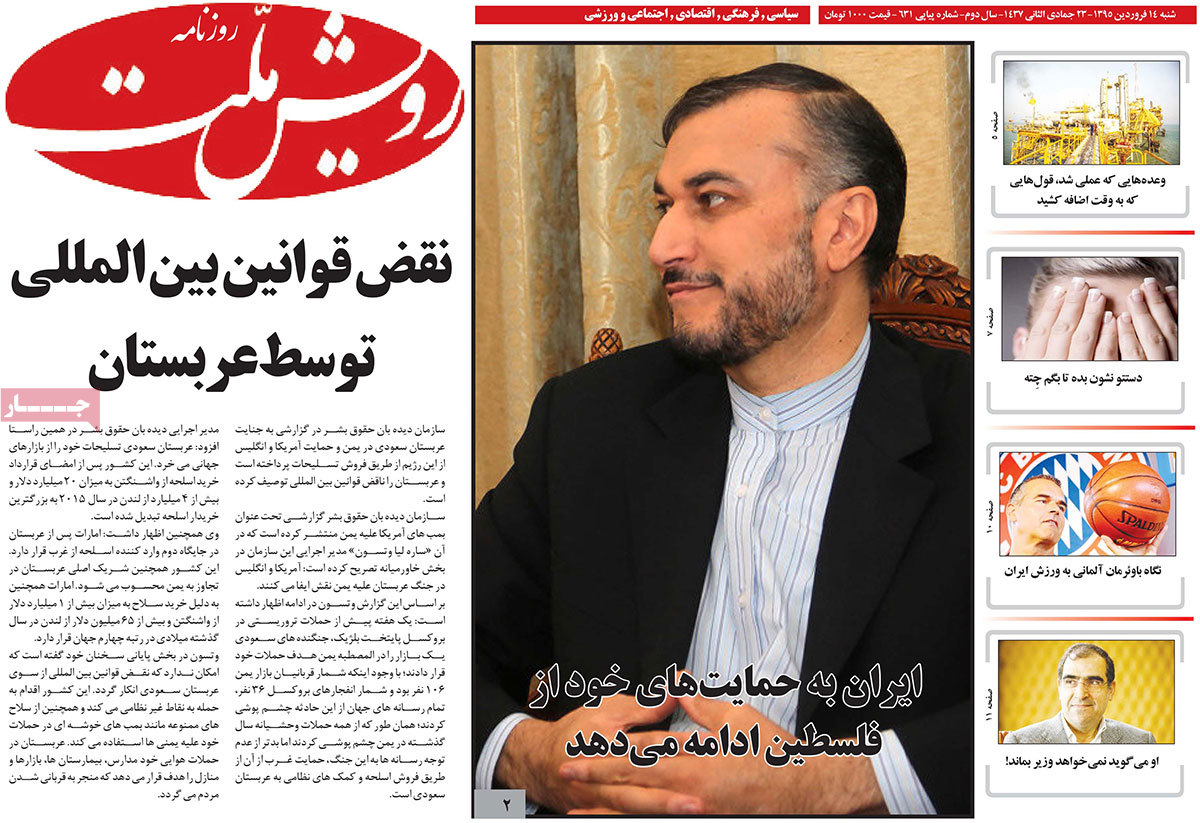
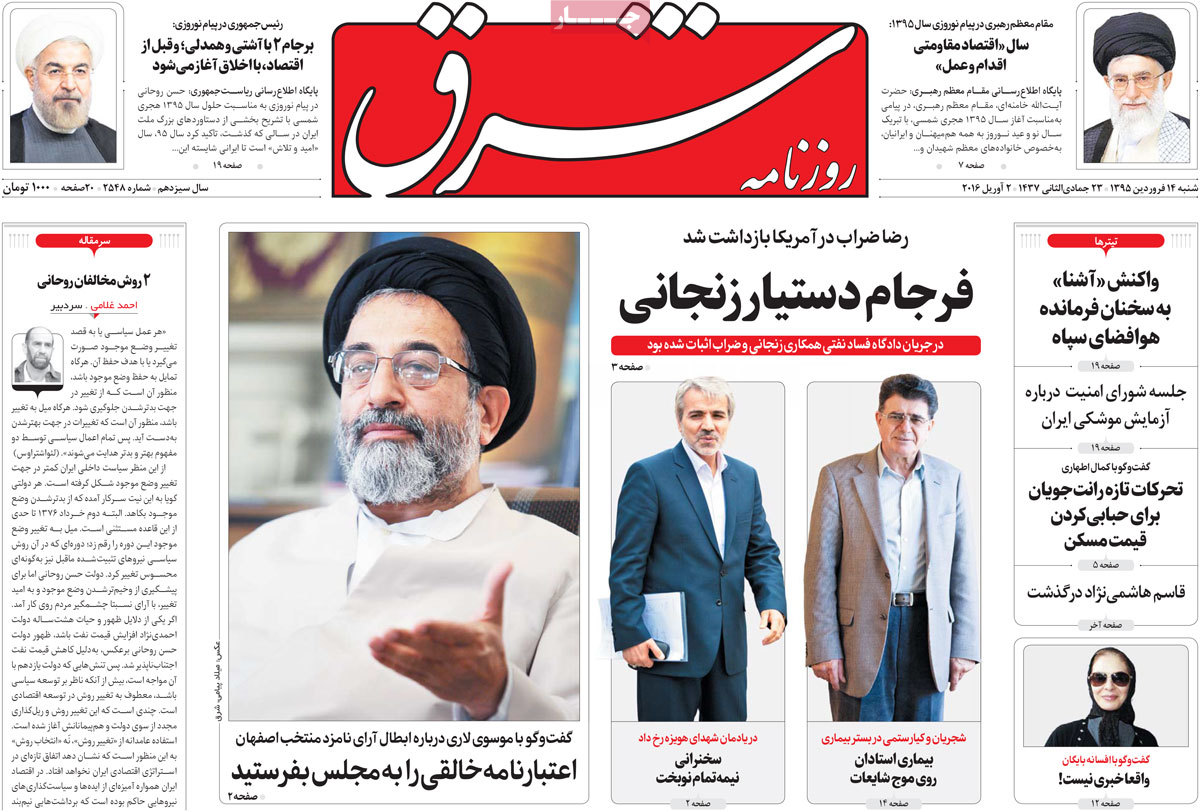
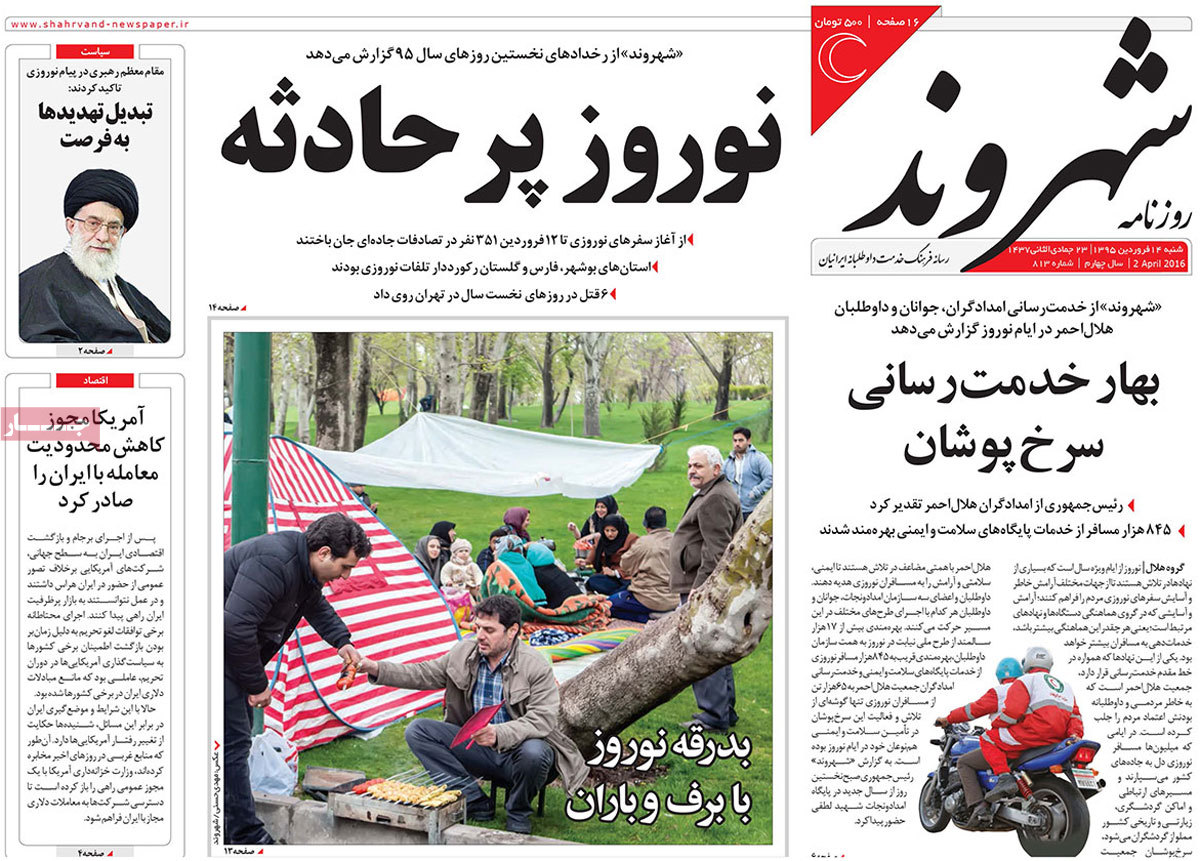
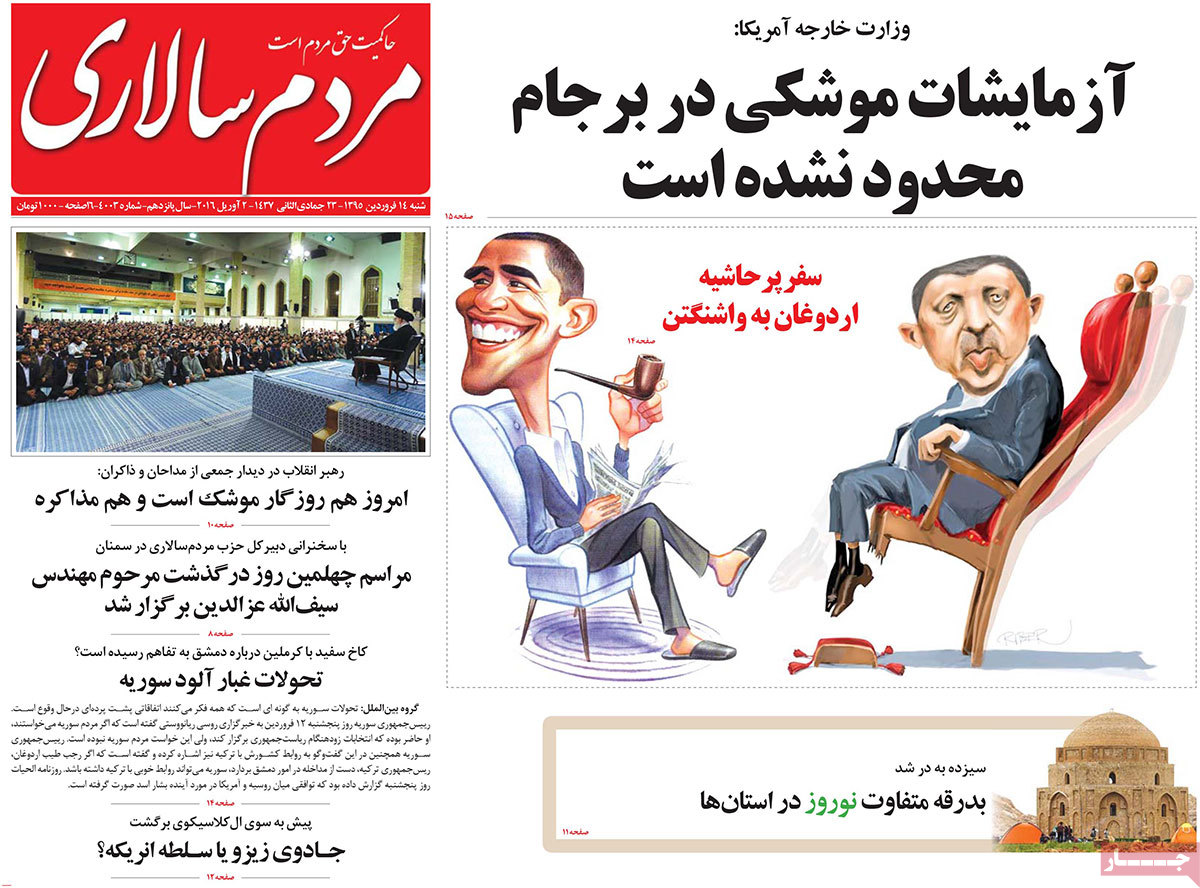
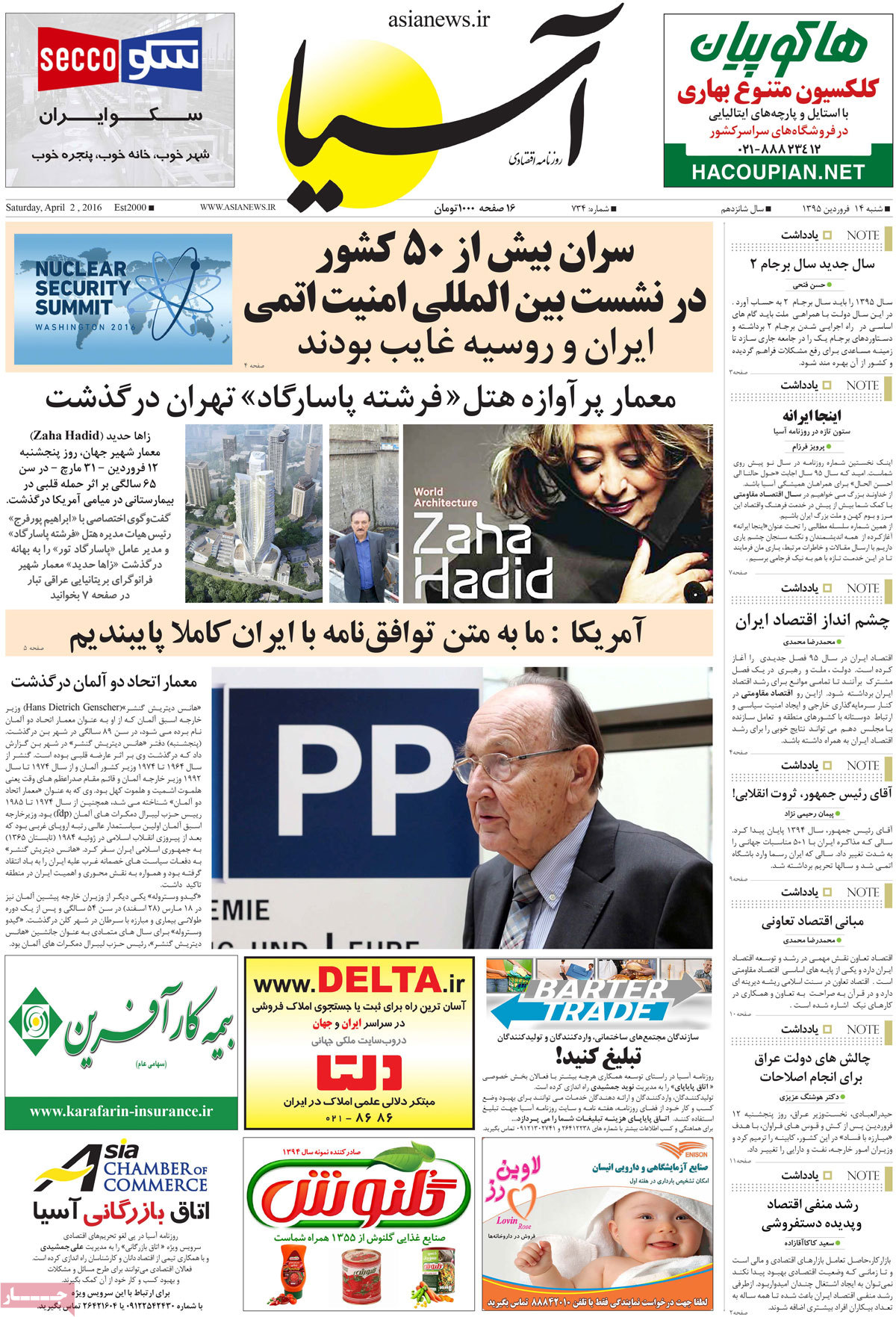
A look at Iranian newspaper front pages on April 2

Iran Newspaper front pages

Saturday, April 02, 2016 is the first working day in the new Iranian calendar year 1395 which began on March 20. No paper was published in Iran in the past fortnight as Iranians celebrate the first 13 days of the year as Nowruz and enjoy New Year holidays.

Most of the headlines focused on the leader’s speech on the first day of the year in which he underscored the need for materializing policies of the economy of resistance. The Supreme Leader of the Islamic Revolution, Ayatollah Seyyed Ali Khamenei, also slammed the US for not honoring the nuclear deal by which Iran agreed to curb its nuclear program in exchange for removal of US-engineered draconian sanctions.

The administration’s firm resolution to revamp the economy and expectations about the economic climate in Iran in the New Year were also considered by most papers on the day.

Here are the top headlines.


Abrar:

  1. Mischiefs being made in sanctions’ removal: Parliament Speaker
  2. Today, time for missiles, talks: Leader
  3. Gov’t cabinet approves raising penalties for corporate offenses
  4. Former admin’s performance cause of principalists’ election loss in Tehran: MP
  5. White House says formation of federal gov’t run by Assad unlikely in Syria
  6. Libya’s national unity government sails into Tripoli
  7. Nation’s awareness secures country’s future: Rafsanjani
  8. 4% drop in Nowruz road accident death toll


A look at Iranian newspaper front pages on April 2


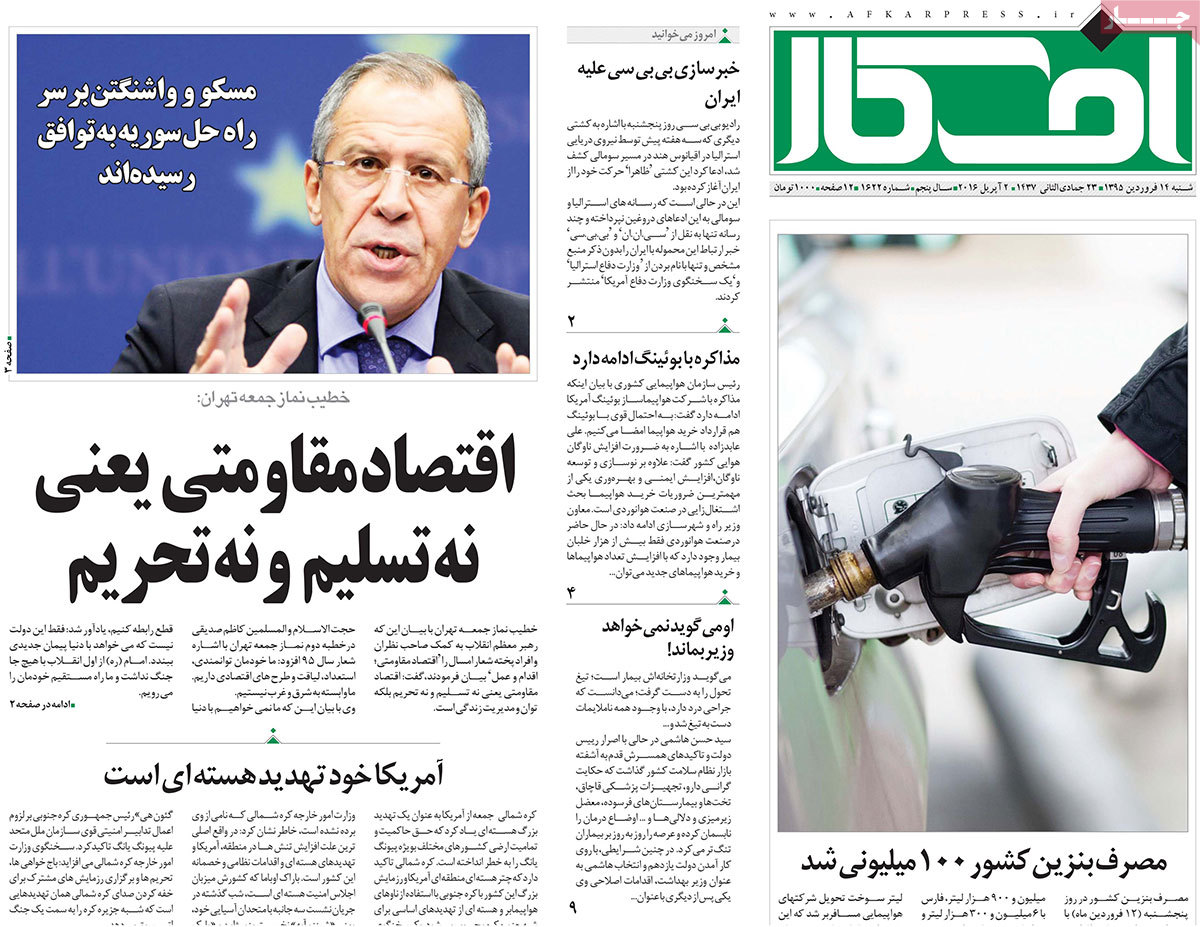
Afkar:

  1. BBC’s anti-Iran news hype
  2. Moscow, Washington agree on Syrian solution
  3. Tehran Friday Prayer Imam: Resistive economy means no to surrender, sanctions
  4. N. Korea: US is a nuclear threat
  5. Talks under way with Boeing


A look at Iranian newspaper front pages on April 2


Amin:

  1. FM: Iran to enhance defense might


A look at Iranian newspaper front pages on April 2


Arman-e Emrouz:

  1. Fighting unemployment, recession possible thru Resistance Economy: Leader
  2. Belgium, Austria awaiting Rouhani visit

Iranian President Hassan Rouhani’s visit to the two countries was canceled due to security considerations.


A look at Iranian newspaper front pages on April 2


Ebtekar:

  1. Selfies with new face in Tehran

People take pictures with a pink Volkswagen car in the city of Tehran.

  1. About time for practice, action to better nation’s livelihood

A viewpoint about the Supreme Leader’s naming of the new Iranian calendar year as the year of “Resistive Economy; Practice and Action”.

  1. Explosions shake the world

Dozens of terrorist blasts in Turkey, Belgium, Pakistan, Iraq and Afghanistan gripped the world by fear in the past fortnight.

  1. Report studies road accidents during Nowruz: “Unfinished trips”
  2. Hard year for dollar; Report estimates that the New Year will be a difficult year for forex market in Iran.
  3. Sad films get surprising reception in Nowruz


A look at Iranian newspaper front pages on April 2


Ettela’at:

  1. Iran inflation rate at 11.6% for last calendar year
  2. Leader calls for practice, action for promoting nation’s livelihood, economy
  3. Assad says ready for early presidential election
  4. Rouhani urges nation to close ranks to develop country
  5. Admin plans for realizing economy of resistance


A look at Iranian newspaper front pages on April 2


Etemad:

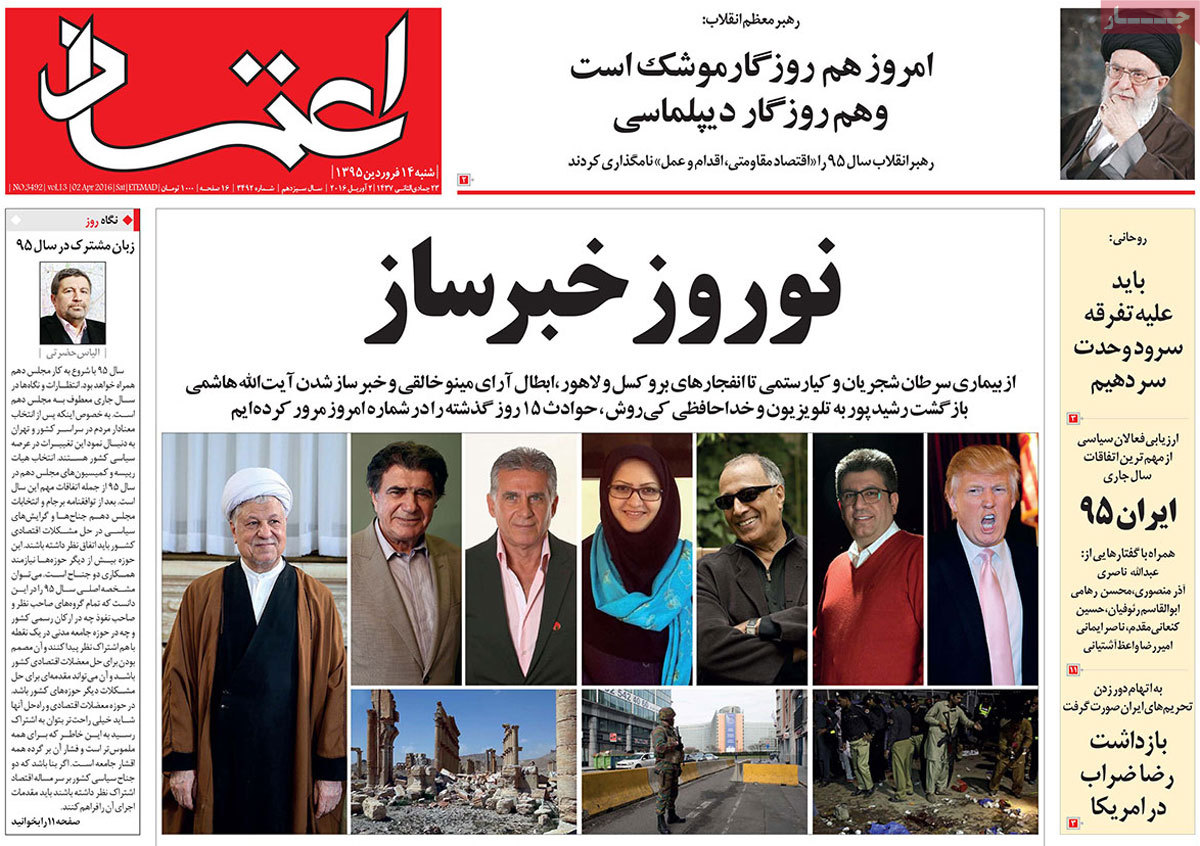
  1. Nowruz news-makers

The paper has highlighted the top news stories of Nowruz which include disqualification of Minu Khaleghi in parliament election after she won majority votes to make way to the parliament, cancer diagnosis of epic traditional singer Mohammad Reza Shajarian, return of top TV personality Reza Rashidpour to TV screens and national football coach Carol Quiroz’s farewell to Iran.

  1. Reza Zarrab captured in US for bypassing sanctions


A look at Iranian newspaper front pages on April 2


Hemayat:

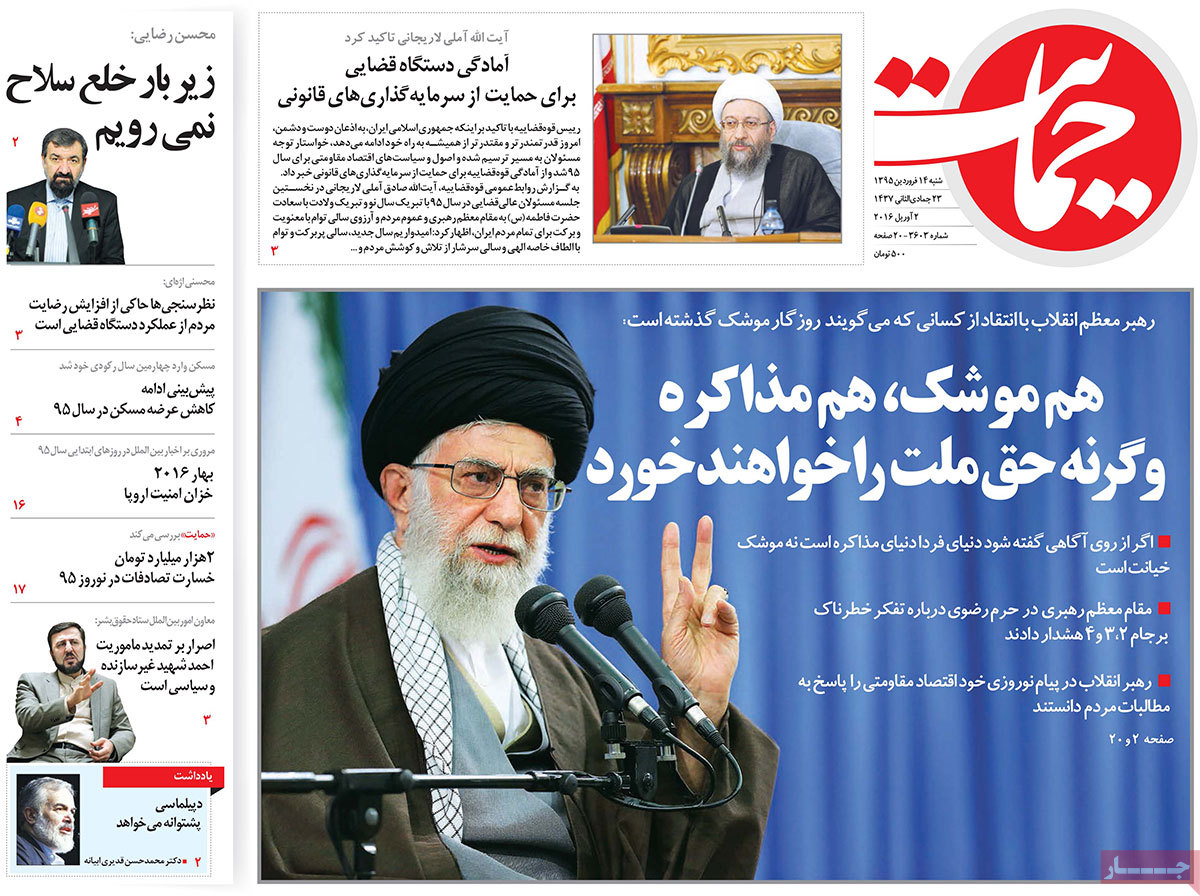
  1. Judiciary ready to support legal investors: Chief
  2. Iran never succumbs to disarmament: Official
  3. Polls confirm nation’s satisfaction with judiciary’s performance
  4. IRR20,000b losses in Nowruz accidents


A look at Iranian newspaper front pages on April 2


Iran:

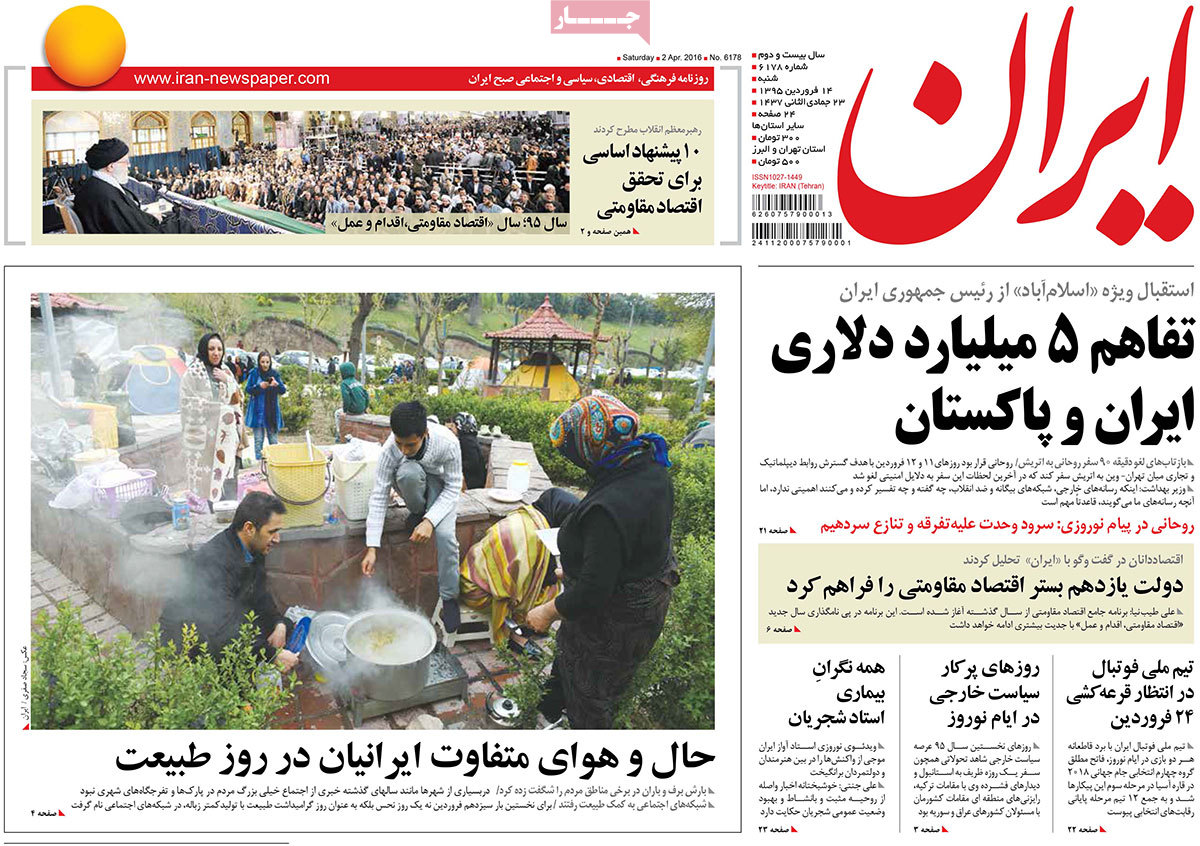
  1. Iran, Pakistan ink $5b MoU
  2. Leader offers 10 crucial suggestions for resistive economy
  3. Economists: Admin prepares for resistive economy
  4. Iran’s foreign policy busy in Nowruz days


A look at Iranian newspaper front pages on April 2


Payam Zaman:

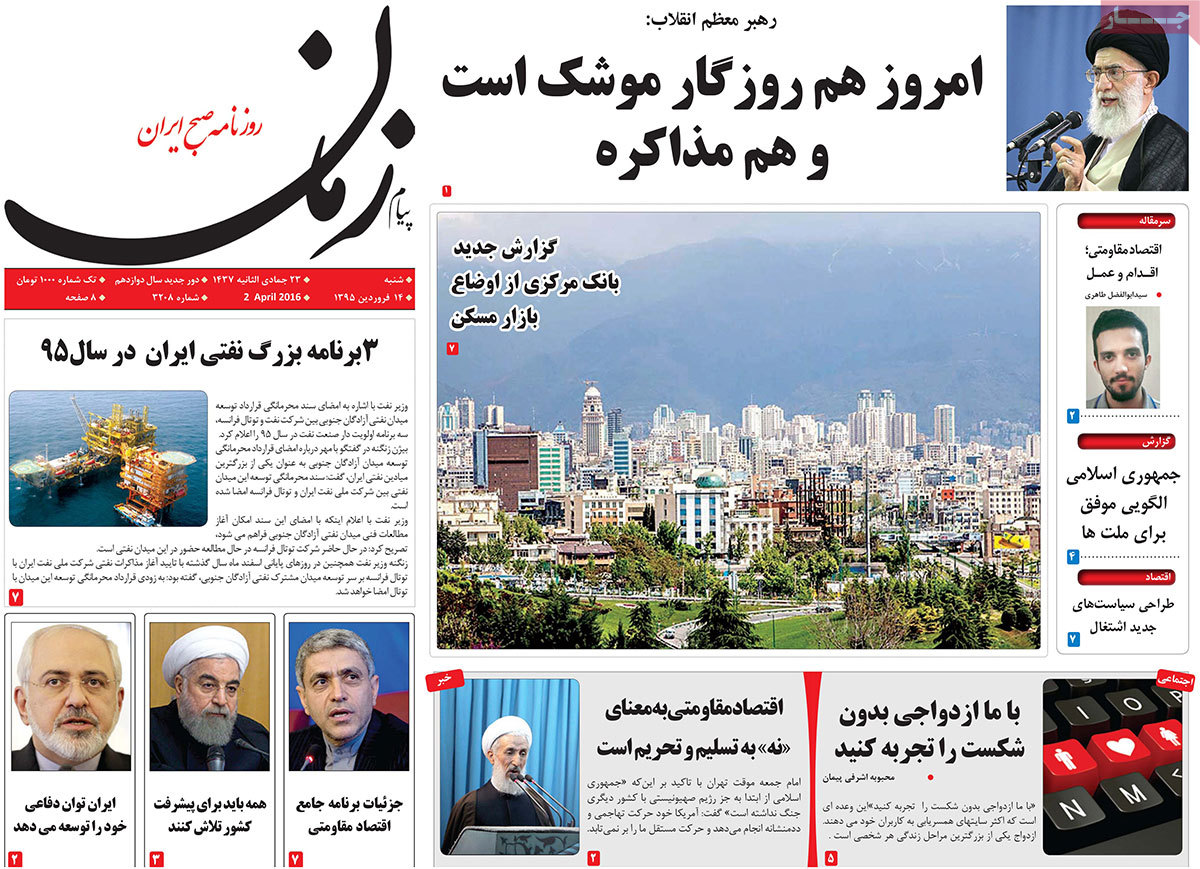
  1. Iran mulls 3 major oil plans in new [calendar] year
  2. Resistive economy means no to surrender, sanctions
  3. Islamic Republic successful sample for nations
  4. Economy minister unfolds details of resistive economy agenda
  5. New CBI report about housing market in Iran


A look at Iranian newspaper front pages on April 2


Jamejam:

  1. Time for practice, action: Leader
  2. Reduction in Nowruz accidents, death toll
  3. West’s new act of obstruction in Syrian crisis


A look at Iranian newspaper front pages on April 2


Jomhouri Islami:

  1. Leader offers 10 fundamental proposals for practice and action for resistive economy
  2. Rain, snow grip most Iranian territories
  3. Tunisian president offers full support to Hezbollah
  4. Jordan’s King: Turkey transferring terrorists to Europe
  5. Iran, Pakistan sign cooperation docs
  6. Erdogan: Turkey will cooperate with Israel in fight against terrorism


A look at Iranian newspaper front pages on April 2


Javan:

  1. Both needed: missiles, talks

“Without defense power, we would have to retreat by every threat,” said the leader during his opening speech at the first day of the new Iranian calendar year.

  1. Rain saves nature [on Nature Day]
  2. Alarm goes off for JCPOA violation by US
  3. Cleric: Mortgage banks in fight with us


A look at Iranian newspaper front pages on April 2


Kayhan:

  1. Leader: JCPOA II, III, IV, US will
  2. Banking system busy with “money vendors”
  3. Assad hails help of Iran, Russia, Hezbollah in freeing historical city of Tadmur
  4. US unleashes new sanctions on Iran
  5. Maryland University poll: JCPOA implementation reduced Iranians’ trust in US


A look at Iranian newspaper front pages on April 2


Khorasan:

  1. Ten million visit Khorasan Razavi during Nowruz
  2. Film, Bodyguard, sells IRR20b


A look at Iranian newspaper front pages on April 2


Rah-e Mardom:

  1. Report: Terrorist attacks in Europe and need for transparency of western stance to uproot such assaults
  2. Red alert for water in 6 major cities
  3. Iran needs no permission, confirmation for enhancing defense might: Commander
  4. Iran’s imports from Turkey down 23%


A look at Iranian newspaper front pages on April 2


Resalat:

  1. If we are not strong, nation’s rights will be trampled upon: Leader
  2. Trump, Clinton start open fights
  3. JCPOA candy seems tasty for some: Cleric
  4. Boosting domestic production only solution to solving problems: Parliament speaker
  5. Rouhani says admin will pursue bolstering Iran’s defense might


A look at Iranian newspaper front pages on April 2


Rooyesh Mellat:

  1. Violation of int’l rights by Saudi Arabia
  2. Fulfilled promises; vows left for injury time
  3. Iran firm in supporting Palestine


A look at Iranian newspaper front pages on April 2


Shargh:

  1. Reza Zarrab [Zanjani’s assistant] captured in US
  2. UNSC convenes on Iran’s missile tests


A look at Iranian newspaper front pages on April 2


Shahrvand:

  1. US issues permit to ease restrictions on trade with Iran
  2. Nowruz fraught with accidents


A look at Iranian newspaper front pages on April 2


Mardom Salari:

  1. US: No curbs on missile tests in nuclear deal


A look at Iranian newspaper front pages on April 2


Asia:

  1. Heads of over 50 states miss Tehran, Moscow Nuclear Security Summit
  2. Zaha Hadid, architecture of Tehran’s Fereshteh Pasargad, dies
  3. US says fully honors JCPOA context


A look at Iranian newspaper front pages on April 2


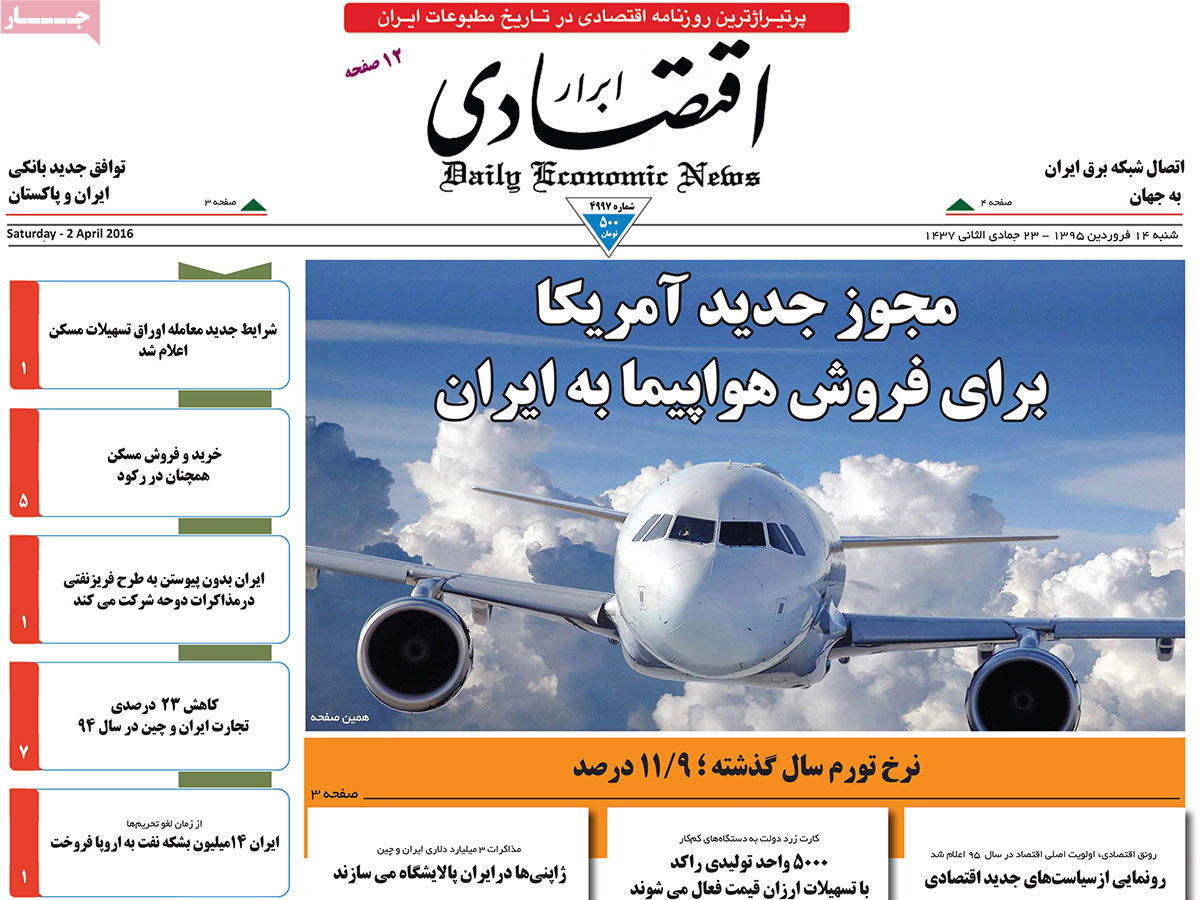
Abrar Eqtesadi:

  1. New US permit to sell planes to Iran
  2. Iran to attend Doha meeting without acceding oil freeze plan
  3. Iran sells 14mb of oil to Europe since JCPOA implementation
  4. Japan to build refinery in Iran


A look at Iranian newspaper front pages on April 2


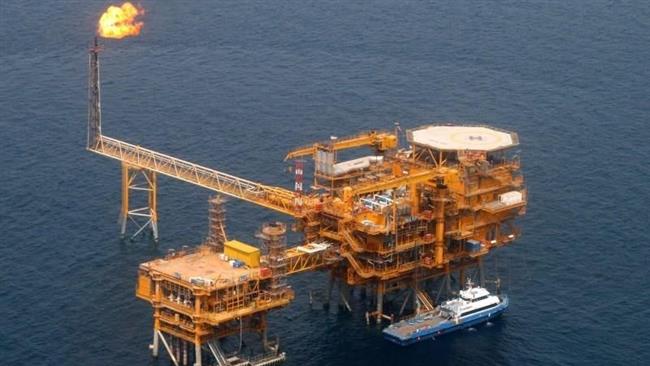
Iran’s oil production up 100k bpd

Figures released by Bloomberg show that Iran’s overall crude output now stands at 3.2 million bpd which is the highest level since May 2012.

In mid-January, a series of economic sanctions that had been imposed on Iran for multiple years were removed after a deal between the country and the P5+1 – the five permanent members of the Security Council plus Germany – was implemented.

The sanctions barred foreign investments in the Iranian oil industry and also limited a low ceiling of 1 million bpd on the country’s oil exports.

Immediately after the removal of the sanctions, Iran both increased its oil output and subsequently its exports.

The country’s oil output rose by several hundred thousand barrels per day to reach around 1.4 million bpd.

Iran’s First Vice President Es’haq Jahangiri said in late March that the country’s oil exports had reached around 2.2 million bpd within two months after the removal of the sanctions on Iran.

Jahangiri said the figure marked a rise of 900,000 bpd in Iran’s oil production capacity.

Iran has already rejected calls by other fellow producers to freeze its post-sanctions oil output increase plans to help stabilize the prices.

The country’s Oil Minister Bijan Zangeneh has repeatedly emphasized that the Islamic Republic will press on with its plans to increase oil production – that had been restricted for several years as a result of the sanctions – to regain its lost market share.

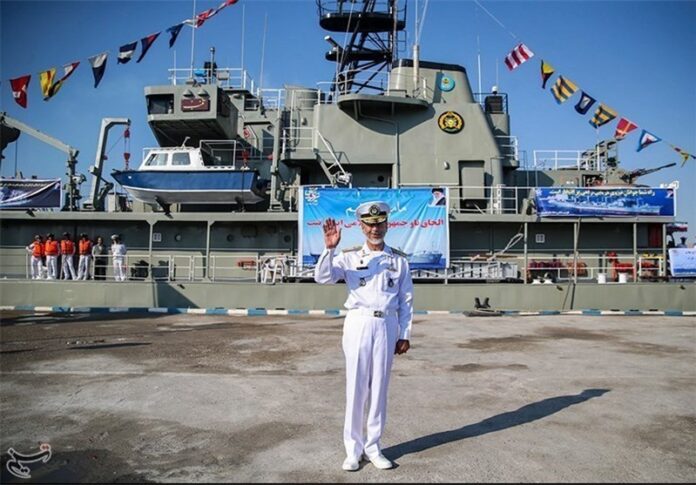
Iran’s New Naval Flotilla Dispatched to Gulf of Aden: Commander

The Navy seeks to secure its mighty presence in the northern parts of the Indian Ocean, Gulf of Aden, Bab el-Mandeb Strait, and Red Sea as part of the grand plans set by Leader of the Islamic Revolution Ayatollah Seyed Ali Khamenei, Admiral Sayyari told reporters in the southern port city of Bandar Abbas.

He made the comments in a ceremony held to welcome the 38th flotilla, which returned home after a 73-day mission in international waters.

According to the commander, the 40th fleet consists of Alborz destroyer and Tonb warship.

Since November 2008, the Iranian navy has conducted anti-piracy missions in the Gulf of Aden and Bab el-Mandeb Strait to protect the country’s vessels against pirate attacks.

Under the terms of several UN Security Council resolutions, nations can deploy warships to the Gulf of Aden and coastal waters of Somalia to protect their vessels against pirates and, after giving notice to Somali government, enter Somali territorial waters in pursuit of the pirates.


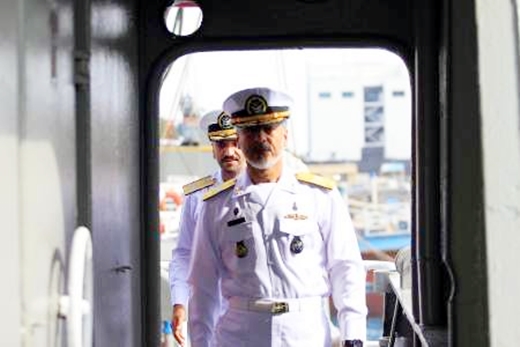
Sanctions have no impact on Iran’s naval capabilities: Sayyari

Speaking to reporters, he noted that the navy needs for defending Iran’s sea borders will be addresssed according to programs regardless of US and its allies opposition.

Despite sanctions, Iran’s navy reached big progress in all fields including manufacturing of ‘Jamaran’, ‘Damavand’, and ‘Sahand’ destroyers, the commander added.

He praised the navy presence in the international waters aimed at protecting naval routes and providing security for trade vessels and oil tankers.

The Iranian Navy’s 38th flotilla of warships returned home on Saturday, 75 days after it started its foreign mission in international waters.

The flotilla docked at the southern port city of Bandar Abbas on Saturday.

The flotilla comprising Martyr Naqdi destroyer, Lavan logistic warship and Bushehr vessel had been deployed to international waters on January 20 after a week-long naval war game code-named “Velayat 94” in the country’s southeastern waters.

The flotilla comprising Martyr Naqdi destroyer, Lavan logistic warship and Bushehr vessel had been deployed to international waters on January 20 after a week-long naval war game code-named “Velayat 94” in the country’s southeastern waters.

Iran’s trade surplus positive for 1st time in 37 years

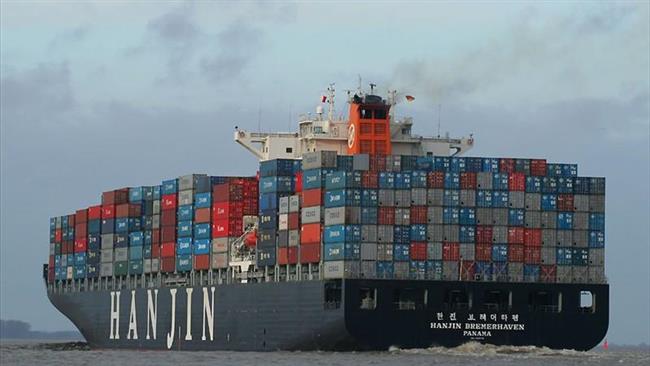
Ship trade

Iran’s Customs Administration said in an announcement on Saturday that the country had a trade surplus of $916 million over the aforementioned period.

It said the total value of exports stood at $42.4 billion against $41.4 billion in imports. Both figures indicated a decrease of respectively 16 percent and 23 percent compared to the same period the previous year.

The volume of exports stood at 93.5 million tons while the volume of imports stood at 35.7 million tons indicating a decrease of 7 percent and 18 percent, respectively.

The main import items have been livestock corn, wheat, soybean, rice and soybean meal.  The main export items have been gas oil, liquefied petroleum gas (LPG), liquid propane and tar.

The Customs Administration figures further show that there has been a drastic drop of 52 percent in exports of condensate.

The leading importers of Iranian products over the period under study were China, Iraq, the UAE, Afghanistan and India.  China’s imports of Iranian products saw a drop of above 23 percent while the UAE and Afghanistan increased imports from the Islamic Republic.

The leading exporters of products to Iran were China, the UAE, South Korea, Turkey and Switzerland. Imports from China were lower by 18 percent compared to March 2014-2015.

Iran’s imports of automobiles plunged by a whopping 50 percent in quantity and 42 percent in value.

Figures show the country had spent $1.2 billion on imports of cars over the period under study. This is while it had spent $2.1 billion on imports of cars the year before.

Iran Fully Complying with JCPOA: IAEA Chief

“It (Iran) is implementing not just its safeguards agreement with the Agency, but also its Additional Protocol. Transparency measures which go beyond Iran’s obligations under its formal agreements with the IAEA have also been agreed,” Amano told reporters after a two-day summit on nuclear security in Washington.

The Nuclear Security Summit 2016 came to an end on Friday.

The first Nuclear Security Summit was held in Washington, DC in 2010, and was followed by additional Summits in Seoul in 2012 and The Hague in 2014.  These Summits have achieved tangible improvements in the security of nuclear materials and stronger international institutions that support nuclear security.

“The JCPOA (Joint Comprehensive Plan of Action) is a clear gain for nuclear verification in Iran,” he added.

Tehran and the Group 5+1 (Russia, China, the US, Britain, France and Germany) reached a nuclear deal on July 14, 2015 and started implementing it on January 16.

The comprehensive nuclear deal, known as JCPOA, terminated all nuclear-related sanctions imposed on Iran.

Following is the full text of Amano’s speech on Friday: 

On April 1 in Washington, I met with the E3/EU+3 group of countries at the invitation of President Barack Obama of the United States of America.

I informed President Obama, as well as President Xi Jinping of China, President Francois Hollande of France, Prime Minister David Cameron of the United Kingdom, President Donald Tusk of the European Council, Secretary of State John Kerry of the United States,  Federal Minister of Defence Ursula von der Leyen of Germany, the High Representative of the European Union for  Foreign Affairs and Security Policy Federica Mogherini, and Ambassador Sergey Kislyak of Russia about the IAEA’s verification and monitoring of Iran’s nuclear-related commitments under the Joint Comprehensive Plan of Action.

I noted that Iran is now subject to the strongest nuclear verification regime in the world. It is implementing not just its safeguards agreement with the Agency, but also its Additional Protocol. Transparency measures which go beyond Iran’s obligations under its formal agreements with the IAEA have also been agreed.

The IAEA has considerable experience and expertise in nuclear verification. We can effectively fulfil our responsibilities as the eyes and ears of the world in Iran and give the international community the assurances it seeks.

I stressed that this is only the beginning of a process that will take many years. I asked the E3/EU+3 for their continued support in ensuring that the necessary funding is made available for the IAEA’s JCPOA-related activities.

The JCPOA is a clear gain for nuclear verification in Iran. Considerable effort was required in order to reach this agreement. A similar and sustained effort will be required to implement it. The IAEA will continue to do its part in a factual and impartial manner.