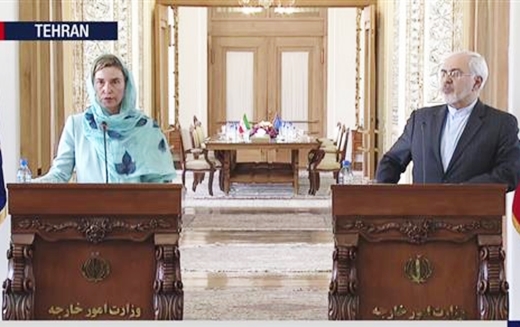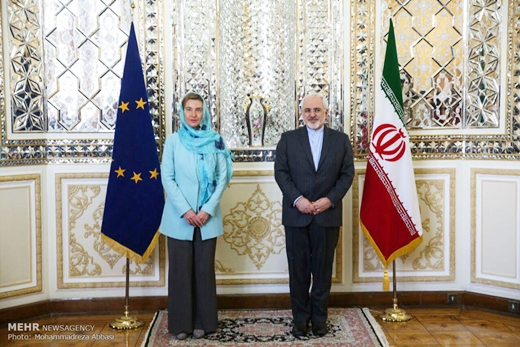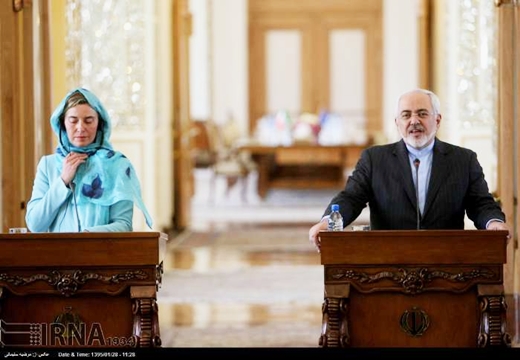
The EU High Representative and Vice-President of the European Commission (HRVP) Federica Mogherini, EU Commissioners Elżbieta Bieńkowska (Internal Market, Industry, Entrepreneurship and SMEs), Arias Cañete (Climate Action and Energy), Christos Stylianides (Humanitarian Aid and Crisis Management), Violeta Bulc (Transport), Carlos Moedas (Research, Science and Innovation), Karmenu Vella (Environment, Maritime Affairs and Fisheries) and Tibor Navracsics (Education, Culture, Youth and Sport) met with their Iranian counterparts here on Saturday.
The two sides taking stock of their long standing relations, based upon mutual respect and interests, reiterated their intention to develop a broad and comprehensive agenda for bilateral cooperation.
They welcomed the implementation day of the Joint Comprehensive Plan of Action (JCPOA) on 16 January 2016 that contributed toopening a new chapter in EU-Iran relations. The EU and Iran are fully committed to the JCPOA and its implementation in all its aspects. It was reconfirmed that the continued and full implementation of the JCPOA remains of utmost importance.
It was stated that the following shared and overarching objectives are vital for the promotion of EU-Iran relations:
Ensuring and supporting the full implementation of the JCPOA in order to further improve and deepen bilateral cooperation;
Developing cooperativerelations in areas of mutual interest to benefit the economic development, human rights, prosperity and well-being of the people of Iran and the EU;
Promoting regional peace, security and stability as well as peaceful settlement of regional conflicts through dialogue and engagement.
To facilitate the programme of cooperation as set out below and with a view to preparing the future opening of an EU Delegation in Tehran, in accordance with rules and regulations ofthe Islamic Republic of Iran, an EU liaison team will be sent to Tehran. This will contribute to strengthening the relations and implement future cooperation initiatives.
The EU and Iran intend to cooperate in the following areas:
Political Consultations
The two sides intend to enhance their political dialogue through consultations at the level of the HRVP and the Iranian Foreign Minister,annually. This advances the existing agreement to meet regularly for a High Level Dialogue at Deputy Minister/ Political Director level. Senior officials and experts will meet as required to explore other fields of mutual interest in which bilateral, regional andinternational cooperation projects could be developed.
Human Rights
The two sides expressed their determination to enhance and promote human rights. In this context, they intend to engage in a human rights dialogue. To this end, they would welcome the exchange of visits of delegations.
Economic Cooperation
The two sides encourage the expansion of economic relations between EU and Iran, recognizing the importance of macro-economic issues, trade, finance and investment in achieving sustainable growth and development. They intend to engage in a macro-economic and finance dialogue including on the following initiatives:
· Improve and enable financial as well as encouraging banking cooperation between the EU and Iran. The EU can assist if required in addressing Anti Money Laundering and Countering Financing of Terrorism (AML/CFT) issues;
· Explore the prospect of extendingthe third country lending mandate of the European Investment Bank (EIB) to Iran, to enhance the availability of finance for investment in Iran and possible blending (of loans with grants);
· Cooperation in a variety of sectors with a focus in particular on encouraging regulatory and industrial policy dialogues and creating mutual opportunities, including textiles, tourism, raw materials, construction and any other areas to be mutually determined;
· Building on EU expertise in the field of SMEs support to foster Business and in particular SMEs favourable environment in Iran and share information on the “Enterprise Europe Network”;
· Exchange of Iran and EU business missions in the second half of the year;
· Consider development cooperation on strengthening the private sector and SMEs in Iran;
· Facilitate and encourage EU-Iran business sector presence in each others’ markets through a variety of measures .
Trade and investment Cooperation
The two sides strive to strengthen their bilateral cooperation on trade and investment matters. With a view torenewing a dialogue to strengthen trade and investment relations between Iran and EU, they agreed to exchange visits of expert delegations at an appropriate level in the coming months. EU will support and assist Iran to become a member of the World Trade Organization (WTO).
Agriculture
The two sides intend to promote cooperation on agriculture and the agri-food industry with a view to exploring production and technological methods and to assisting Iranian products to meet regulatory and phytosanitary standards of the European markets.
Transport
The two sides express their commitment to a safe and sustainable development of all modes of transportation in order to support the resumption of trade, investment and citizens´ links. Specifically with respect to the safety of transport, in line with consultations already held, they intend to:
· Perform technical assessments to remove and review restrictions on the aircraft fleet of Iran Air with regard to the EU Air Safety List, and to issue “Third Country Operator Authorization” to the Iranian air carriers that applied, provided the necessary safety requirements have been met;
· Embark on technical cooperation in support of aviation safety in Iran;
· Exchange views on the possibility of a horizontal agreement;
· Exchange views and experience on rail safety and interoperability, as well as facilitation of international rail transport, including rail corridors;
· Explore cooperation in other sectors, such as maritime, rail, road and urban transport.
Energy and climate change
Recognizing the significant potential in establishing a comprehensive cooperation in the field of energy, the two sides intend to:
· Foster improved conditions for investments and technology exchange in the production and generation of energy, and energy efficiency; and exchange information, where needed, on legal and regulatory frameworks ;
· Engage in initiatives which aim at strengthening the security of energy supply and demand in the region and beyond ;
· Cooperate in multilateral fora with a view to enhancing the transparency and the functioning of the global energy market ;
· Promote investments and encourage technological and technical exchanges to mitigate GHGs emission as well as adaptation measures through promoting energy efficiency in different sectors of the Iranian economy as well as enhancing use of renewable energies;
· Facilitate investments in upstream and downstream projects in the energy sector of Iran.
For this purpose it is intended to launch a dedicated EU-Iran Dialogue on Energy. The objectives and modalities of such cooperation are further detailed in the Joint Statement on Energy.
Civil nuclear cooperation
With a view to contributing to the implementation of measures listed in Annex III of the JCPOA, the two sides are launching a first cooperation project in the field of nuclear safety aimed at assisting the Atomic Energy Organisation of the Islamic Republic of Iran and the Iranian Nuclear Regulatory Authority through EU development assistance. In addition, the EU will share with Iran its experience acquired from stress tests carried out within the EU and in third countries. Additional options for co-operation in the civil nuclear field include joint fission and fusion research activities, as well as a possible regional nuclear safety conference and a nuclear business forum.
Environment
In recognition of the importance of protecting and conserving the environment and the role of resource efficiency in achieving green growth, and in acknowledgment of Iran’s pressing environmental challenges, the two sides intend to:
· Establish bilateral co-operation to address air, soil and water pollution, water resources management, conservation and sustainable use of nature, biodiversity, desertification, and waste disposal management issues;
· Exchange experiences with a view to identifying appropriate policy responses, including projects to tackle cross-border pollution;
· Strengthen co-operation in international environmental fora including in the framework of multilateral environmental agreements.
Civil protection
· In support of better prevention, detection and response to disasters, including at the regional level, the two sides intend to share experiences and best practices.
Science, Research and Innovation
The two sides will foster further the science, research and innovation cooperation between the EU and Iran, including through stepping up Iran´s participation in the EU Research and Innovation Programme Horizon 2020 and its complementary EuratomProgramme. They will encourage setting up partnerships with EU counterparts, knowledge-sharing, mobility of researchers, participation in collaborative research activities in various areas. They will share experience in the areas of technology and innovation. For this a separate joint statement on science, technology, research and innovation was agreed between Commissioner Carlos Moedas and his counterpart, Dr. Mohammad Farhadi the Iranian Minister for Science, Research and Technology and Dr. SorenaSattari the Vice-President of the Islamic Republic of Iran for Science and Technology.
Education
Acknowledging the importance of developing the human dimension of EU-Iran relations, the two sides intend to further deepen their cooperation in the field of higher education. To this effect, it is recalled that the EU has earmarked an additional budget of EUR 3 million for Erasmus+ actions, to be used for cooperation with Iran in 2016 and 2017. The two sides will expand the possibilities for Iranian higher education institutions to participate in the Jean Monnet action for European integration studies. They also intend to organize relevant academic events and fairs, in Tehran towards the end of 2016 to foster cooperation between our universities and promote the participation of Iranian students and researchers and academic staff in EU programmes, particularly Erasmus+ and the Marie Sklodowska Curie action. The EU will also explore ways to allow for Iranian students to participate in Erasmus+ “credit mobility” action, which consists of short-term mobility to European and Iranian universities.
Culture
Both Iran and the EU have remarkably rich cultures and cultural heritage which makes them significant for global tourism industry. Both sides therefore will promote tourism and ecotourism plans and programs. Moreover, the two sides would share expertise in the area of conservation and restoration of archaeological and historical works of art and monuments in order to contribute to the preservation of cultural heritage and the promotion of cultural tourism. To this effect, the EU can share its expertise in the field, including through developing specific training modules. The two sides also intend to further develop cultural cooperation between EU, its Member States and Iran, including through exchanges of professionals andorganisation of events aimed at making their respective cultures better known to the people in the EU and Iran. To this effect the two sides will consider ways to improve Iran-EU cultural and art exchanges in Tehran and the European capitals. In addition, Iran and the EU consider that developing their cooperation in the field of sport constitutes a component of their engagement.
Drugs
Both sides recognized and agreed to meet the challenges for Iran resulting from opium production in the region, as well as its multiple negative side effects in the areas of drug trafficking, human trafficking, border management, law enforcement and health related aspects. Drug abuse inflicts huge damage on the societies and individuals in Europe and Iran, thus both sides have a common interest in addressing the drugs problem, both on the supply and demand side, as well as transit issues. The two sides intend to engage in consultations, exchange of experience,and expertise, including on effective and proportional criminal justice,as well as explore measures to address root causes of the problem, including poverty alleviation and reconstruction in Afghanistan, support for political stability to foster required environment for sustainable development in that country, both at multilateral and bilateral levels. Both sides share the view on the need for evidence-based, integrated, comprehensive and balanced approach in the fight against drugs.
Migration
The two sides agreed to launch a comprehensive migration dialogue and acknowledged the need to exchange information on migration management and flows as well as on policy and legislative approaches and priorities in relation to regular and irregular migration, asylum seekers and refugees, both at national and regional levels.
Regional issues
The two sides acknowledged the seriousness and urgency of addressing the volatile situation in the region. Terrorism, extremism and violence have endangered regional stability and inflicted loss of human life and resources on an unprecedented scale and have become global issues. In this context, both sides will look at ways to implement the UNGA Resolution on World Against Violence and Extremism (A/RES/128/67). They therefore consider that it is crucial to translate the positive benefits of the JCPOA into improved prospects for regional peace and stability. To this end, the two sides will engage, in a constructive and equitable manner, on regional issues with a view to building channels of dialogue, mutual trust and understanding, and in particular to fostering approaches aimed at resolving regional crises.
The two sides consider that solutions to such crises must be inclusive, peaceful and comprehensive, and above all sustainable. They stress the need for all actors to adopt constructive approaches that reinforce the principles of non-interference and the territorial integrity of states, as well as respecting the primacy of international law, including human rights.
Humanitarian Cooperation
The two sides share deep concerns on the dire humanitarian situation in the region due to the multiple conflicts. Violence and insecurity have led to the displacement of millions of people and the EU and Iran advocate all parties to the conflict to ensure the protection of vulnerable population as well as humanitarian access to the people in need. The two sides intend to enhance humanitarian coordination and humanitarian assistance delivery in respect of International Humanitarian Law in the crises affecting Syria, Iraq, Yemen and Afghanistan. The EU expresses its appreciation to Iran’s decision to include all registered Afghan refugees in the national health insurance scheme on the same basis as its own citizens and to allow all foreign children irrespective of their legal status to be enrolled in the national education system. The EU will continue to provide humanitarian and development assistance in support of health care, shelter, food security and protection for the most vulnerable. In order to meet the needs of a growing number of Afghans in Iran, the EU will make immediately available EUR 6.5 million for additional humanitarian support. Within this amount EUR 1.5 million is allocated to assist with the integration of 10,000 out of school Afghan children into the Iranian education system. Both the EU and Iran recognize the importance of working closely with the Government of Afghanistan on a common and mutually reinforcing strategy towards durable solutions. Cooperation on civil society building and strengthening of the local authorities is continuing and the two sides intend to increase this cooperation in the future.