Wednesday, December 24, 2025
Home Blog Page 4317

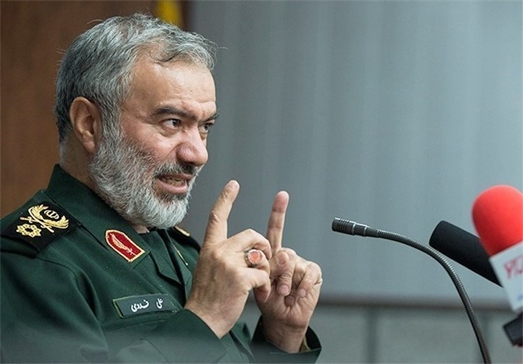
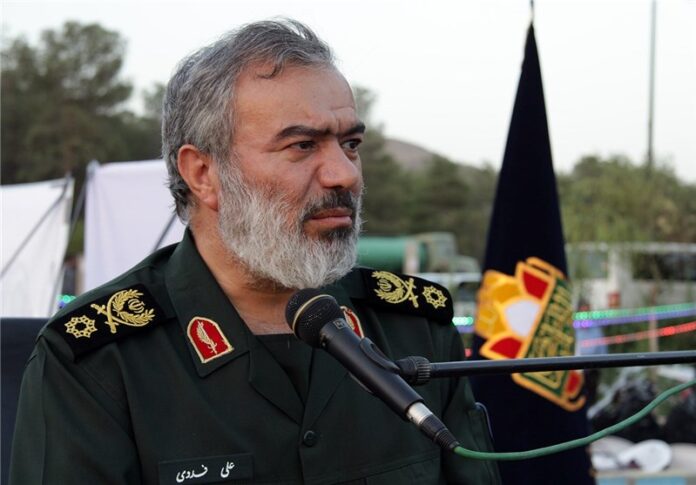
IRGC Navy Commander Warns US to Leave Persian Gulf

Commander Rear Admiral Ali Fadavi

“What has been in place in the Persian Gulf for years and has not changed is the powerful presence and intelligence supremacy (of the IRGC) in the Persian Gulf and the Strait of Hormuz,” Rear Admiral Ali Fadavi said in a ceremony held in the southern port city of Bushehr on Tuesday.

He further denounced the US naval presence in the region, saying that over the past 28 years, the US has been the cause of insecurity in the regional waters.

The Iranian commander emphasized that in order to prevent any problems in the “important Persian Gulf region”, the Americans had better leave the waters in a dignified way.

The Islamic Republic of Iran has always been against the presence of foreign powers in the Persian Gulf.

Back in December 2015, Leader of the Islamic Revolution Ayatollah Seyed Ali Khamenei underlined that security of the Persian Gulf region comes within the purview of the regional countries alone, and dismissed the US claim of seeking security in the region.

“The Persian Gulf’s security relates to the countries of the region which have common interests, and not to the US. So, the security of the Persian Gulf region should be provided by the countries of this region itself,” the Leader said at the time.

Iran, G5+1 FMs May Hold Talks in New York: Russian Diplomat

iran-nuclear

There is a strong possibility that the foreign ministers of Iran and the Group 5+1 (Russia, China, the US, Britain, France and Germany) will meet on the sidelines of the 71st Session of the United Nations General Assembly in New York, Kabulov said on Wednesday.

He said arrangements for the meeting will be discussed in talks in New York between Iranian Foreign Minister Mohammad Javad Zarif and his Russian counterpart, Sergey Lavrov.

The likely ministerial meeting of Iran and the Group 5+1 would focus on the implementation process of the nuclear agreement reached between the two sides back in July 2015, known as the Joint Comprehensive Plan of Action (JCPOA), according to Russian media reports.

The 71st Regular Session of the UN General Assembly began at the UN headquarters on Tuesday, September 13.

While the JCPOA came into force in January, some Iranian officials complain about the US failure to fully implement the accord.

Back in March, Leader of the Islamic Revolution Ayatollah Seyed Ali Khamenei said Americans have yet to fulfill what they were supposed to do as per the nuclear deal.

Iran still has problems in its banking transactions or in restoring its frozen assets, because Western countries and those involved in such processes are afraid of Americans, the Leader said at the time, criticizing the US for its moves to prevent Iran from taking advantage of the sanctions removal.

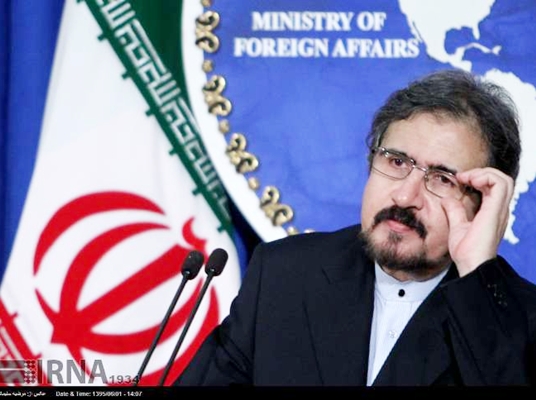
Iran Denies Report of US Contact on Syria

bahram-qassemi-2

The denial came after media stories about coordination between Iranian Foreign Minister Mohammad Javad Zarif and US Secretary of State John Kerry on a ceasefire in Syria that took effect on Monday.

“The Islamic Republic of Iran and the United States of America have not basically had any contact, consultation or talks regarding the regional issues,” the spokesman said on Tuesday.

On Monday evening, a nationwide ceasefire brokered by the US and Russia came into effect in Syria.

The agreement’s initial aims include allowing humanitarian access and joint US-Russian targeting of extremist groups, which are not covered by the agreement.

Syria has been gripped by foreign-backed militancy since March 2011. UN officials estimates that over 400,000 people have been killed in the conflict, which has furthermore displaced over half of Syria’s pre-war population of about 23 million.

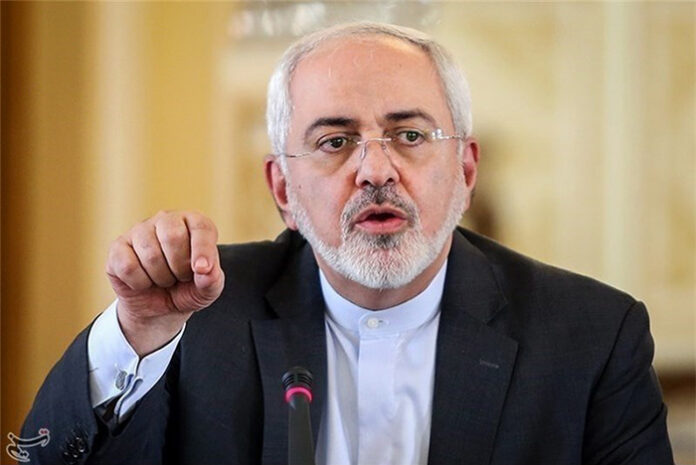
Iran’s FM Zarif: Let Us Rid the World of Wahhabism

Mohammad Javad Zarif

IRNA covered the op-ed by changing its original title into “Majority of Atrocities Committed in Islam’s Name Have Their Roots in Wahhabism”.

Here’s the full text of the original article:


Public relations firms with no qualms about taking tainted petrodollars are experiencing a bonanza. Their latest project has been to persuade us that the Nusra Front, Al Qaeda’s affiliate in Syria, is no more. As a Nusra spokesman told CNN, the rebranded rebel group, supposedly separated from its parent terrorist organization, has become “moderate.”

Thus is fanaticism from the Dark Ages sold as a bright vision for the 21st century. The problem for the P.R. firms’ wealthy, often Saudi, clients, who have lavishly funded Nusra, is that the evidence of their ruinous policies can’t be photoshopped out of existence. If anyone had any doubt, the recent video images of other “moderates” beheading a 12-year-old boy were a horrifying reality check.

Since the terrorist attacks of Sept. 11, 2001, militant Wahhabism has undergone a series of face-lifts, but underneath, the ideology remains the same — whether it’s the Taliban, the various incarnations of Al Qaeda or the so-called Islamic State, which is neither Islamic nor a state. But the millions of people faced with the Nusra Front’s tyranny are not buying the fiction of this disaffiliation. Past experience of such attempts at whitewashing points to the real aim: to enable the covert flow of petrodollars to extremist groups in Syria to become overt, and even to lure Western governments into supporting these “moderates.” The fact that Nusra still dominates the rebel alliance in Aleppo flouts the public relations message.

Saudi Arabia’s effort to persuade its Western patrons to back its short-sighted tactics is based on the false premise that plunging the Arab world into further chaos will somehow damage Iran. The fanciful notions that regional instability will help to “contain” Iran, and that supposed rivalries between Sunni and Shiite Muslims are fuelling conflicts, are contradicted by the reality that the worst bloodshed in the region is caused by Wahhabists fighting fellow Arabs and murdering fellow Sunnis.

While these extremists, with the backing of their wealthy sponsors, have targeted Christians, Jews, Yazidis, Shiites and other “heretics,” it is their fellow Sunni Arabs who have been most beleaguered by this exported doctrine of hate. Indeed, it is not the supposed ancient sectarian conflict between Sunnis and Shiites but the contest between Wahhabism and mainstream Islam that will have the most profound consequences for the region and beyond.

While the 2003 American-led invasion of Iraq set in motion the fighting we see today, the key driver of violence has been this extremist ideology promoted by Saudi Arabia — even if it was invisible to Western eyes until the tragedy of 9/11.

The princes in Riyadh, the Saudi capital, have been desperate to revive the regional status quo of the days of Saddam Hussein’s rule in Iraq, when a surrogate repressive despot, eliciting wealth and material support from fellow Arabs and a gullible West, countered the so-called Iranian threat. There is only one problem: Mr. Hussein is long dead, and the clock cannot be turned back.

The sooner Saudi Arabia’s rulers come to terms with this, the better for all. The new realities in our region can accommodate even Riyadh, should the Saudis choose to change their ways.

What would change mean? Over the past three decades, Riyadh has spent tens of billions of dollars exporting Wahhabism through thousands of mosques and madrasas across the world. From Asia to Africa, from Europe to the Americas, this theological perversion has wrought havoc. As one former extremist in Kosovo told The Times, “The Saudis completely changed Islam here with their money.”

Though it has attracted only a minute proportion of Muslims, Wahhabism has been devastating in its impact. Virtually every terrorist group abusing the name of Islam — from Al Qaeda and its offshoots in Syria to Boko Haram in Nigeria — has been inspired by this death cult.

So far, the Saudis have succeeded in inducing their allies to go along with their folly, whether in Syria or Yemen, by playing the “Iran card.” That will surely change, as the realization grows that Riyadh’s persistent sponsorship of extremism repudiates its claim to be a force for stability.

The world cannot afford to sit by and witness Wahhabists targeting not only Christians, Jews and Shiites but also Sunnis. With a large section of the Middle East in turmoil, there is a grave danger that the few remaining pockets of stability will be undermined by this clash of Wahhabism and mainstream Sunni Islam.

There needs to be coordinated action at the United Nations to cut off the funding for ideologies of hate and extremism, and a willingness from the international community to investigate the channels that supply the cash and the arms. In 2013, Iran’s president, Hassan Rouhani, proposed an initiative called World Against Violent Extremism, or WAVE. The United Nations should build on that framework to foster greater dialogue between religions and sects to counter this dangerous medieval fanaticism.

The attacks in Nice, Paris and Brussels should convince the West that the toxic threat of Wahhabism cannot be ignored. After a year of almost weekly tragic news, the international community needs to do more than express outrage, sorrow and condolences; concrete action against extremism is needed.

Though much of the violence committed in the name of Islam can be traced to Wahhabism, I by no means suggest that Saudi Arabia cannot be part of the solution. Quite the reverse: We invite Saudi rulers to put aside the rhetoric of blame and fear, and join hands with the rest of the community of nations to eliminate the scourge of terrorism and violence that threatens us all.

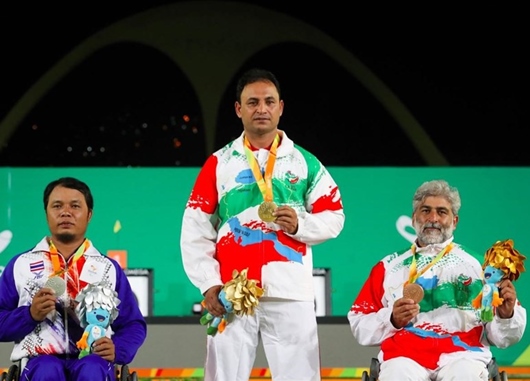
Iran’s Rahimi, Ranjbar Win Gold, Bronze at Individual Recurve

gholamreza-rahimi

Rahimi beat top-seeded teammate Ebrahim Ranjbar in a five-set semifinal then shot two perfect 30-point sets to claim recurve men’s open Paralympic gold ahead of Netsiri.

“The match was good, we’re going to do our best and be stronger. We are all good, powerful men and I like it,” said Rahimi.

“The first thing that was important for me is that my flag went up in the Paralympic arena. That was my goal.”

Rahimi, ranked fifth after the ranking round, was the only athlete to shoot more than one perfect set during the eliminations – and both came in the final against Netsiri.

Ranjbar defeated Luciano Rezende of Brazil 7-1 and won the bronze medal.

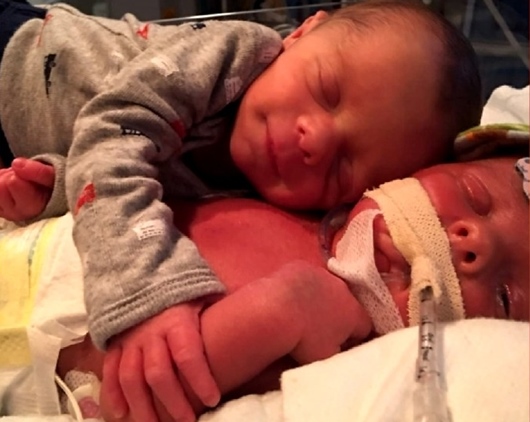
Photo of Hugging Twins Brings Tears to Millions of Eyes

twins

The two boys were born August 18 in Gainesville, Fla.

But while Mason was born healthy, his brother Hawk was diagnosed with a rare congenital condition called CDH.

The boys’ parents chronicled Hawk’s journey on Facebook — and posted the sweet picture of both brothers meeting again outside of the womb with the caption.

Mason Buchmeyer hugs his brother, and smiles, capturing millions of hearts and “likes.”

His mother, a nurse from Fort Pierce, says it was actually Mason who needed calming down that night.

“He was actually getting really fussy,” Brandy Guettler said, “And the nurse said why don’t you try laying him down next to Hawk. I said ‘Can you do that?’ So we laid him there and all of the sudden as soon as he felt Hawk, he reached his arm out and grabbed him and just started to smile. The two of them knew they were there for each other.”

She took a picture and Mason and his brother Hawk, on a ventilator, went viral.

“We posted the picture for people to see how they were doing since we were so far away at Shands in Gainesville,” Tommy Buchmeyer, Hawk and Mason’s Father said, “Every day the numbers grow. 5.6 million people have seen it. 24,000 shares. 105,000 likes.”

“We didn’t expect it to take off the way it has. We have been contacted from Ireland, Scotland, Ukraine, United Kingdom, people from all over,” Guettler said.

And except for the first few shares, most were just in love with the image, and had no idea the story behind the picture. Well, now you will.

According to a report by CBS, as covered by Al Alam, that tiny twin, Hawk, who gave his brother comfort, he himself was fighting for his life. But a few weeks later Hawk succumbed to the condition.

His parents announced his passing on Facebook saying they will always treasure the photo and the short time they had with their little boy.

IRGC Navy Equipped with New High-Speed Craft

ali-fadavi

The new vessel joined the IRGC Navy’s fleet during a ceremony in Iran’s southern port city of Bushehr.

Named after Mohammad Nazeri –commander of the elite commando units of the IRGC Navy who was martyred in May- the new vessel is the biggest Iranian aluminum-hulled ship, IRGC Navy Commander Rear Admiral Ali Fadavi said.

With a length of 55 meters, the high-speed vessel has an operational range of 10,000 kilometers, the commander noted.

The Iranian watercraft can accommodate 100 passengers and carry a helicopter on board, Fadavi added, saying it can also sail into rough seas.

Nazeri vessel, designed and manufactured by local experts, will allow for the IRGC Navy’s stronger presence in high seas and oceans, he went on to say.

The IRGC has in recent years acquired technical expertise in the production of speed boats.

Back in May 2015, Rear Admiral Fadavi said his forces were testing military speed boats with the breakneck velocity of 110 knots (203 km/h).

The speed boats are seen by many military experts as the IRGC’s trump card in case of any direct confrontation with US warships.

The IRGC Navy says the security of the Persian Gulf will be ensured without the presence of foreign forces, particularly the Americans.

A Look at Iranian Newspaper Front Pages on September 13

Iran Newspaper front pages

Newspapers on Tuesday covered the upcoming visits of President Hassan Rouhani to Caracas and New York City.

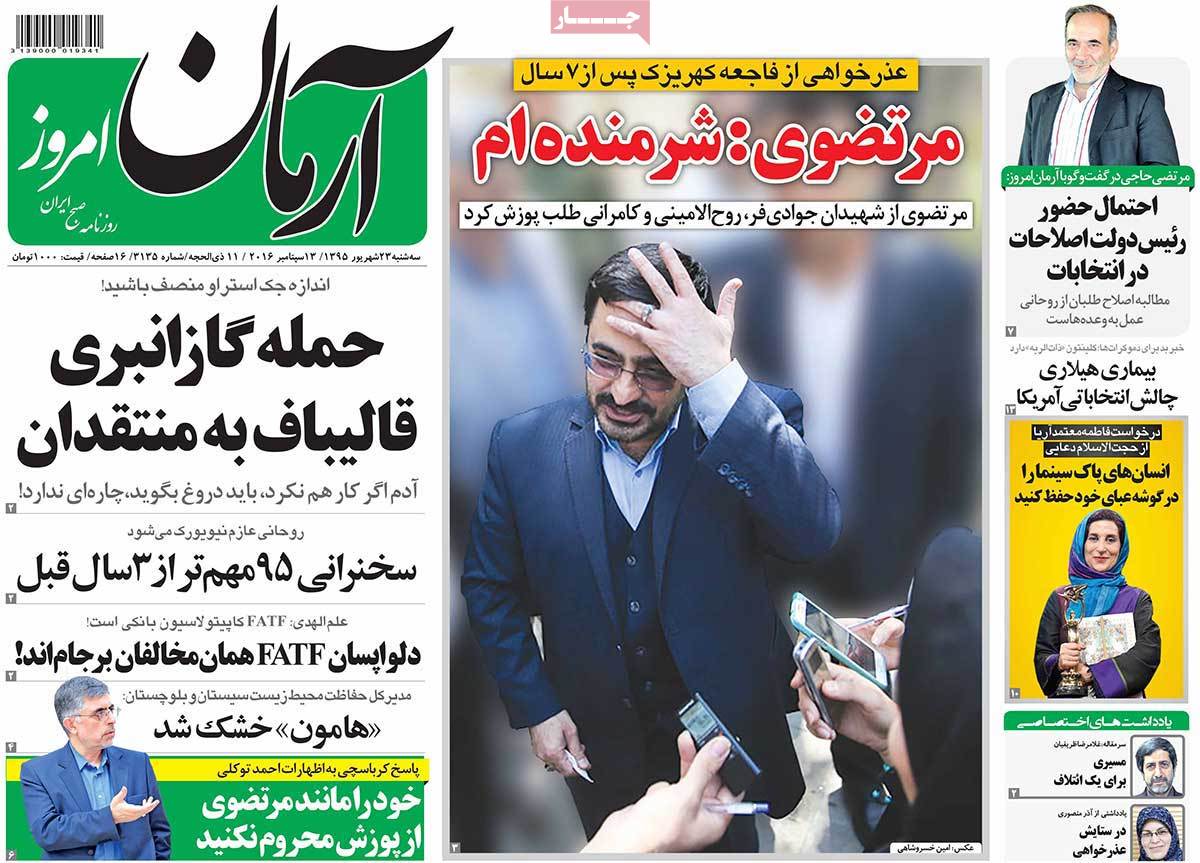
They also covered the letter of apology by Saeid Mortazavi, the former prosecutor-general of Tehran who allegedly had a role in the deaths of three Iranian protesters during the 2009 Iranian election protests. Mortazavi is now being tried for what he did at that time.

The health conditions of US Presidential Candidate Hillary Clinton also received great coverage in Iranian newspapers today.

The above issues, as well as many more, are highlighted in the following headlines:


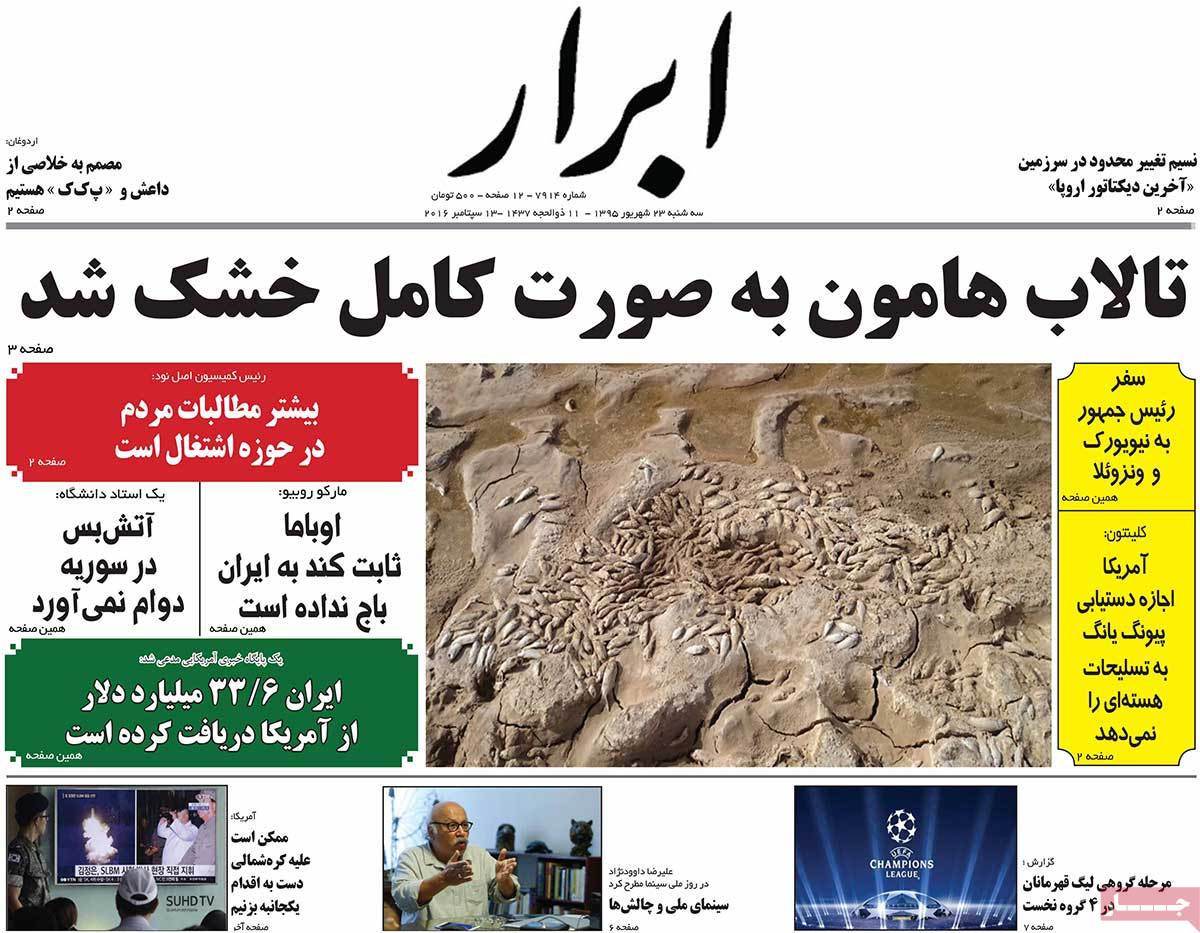
Abrar:

1- Hamoun Wetland Completely Dries Up

2- President’s Visit to New York and Venezuela
A Look at Iranian Newspaper Front Pages on September 13


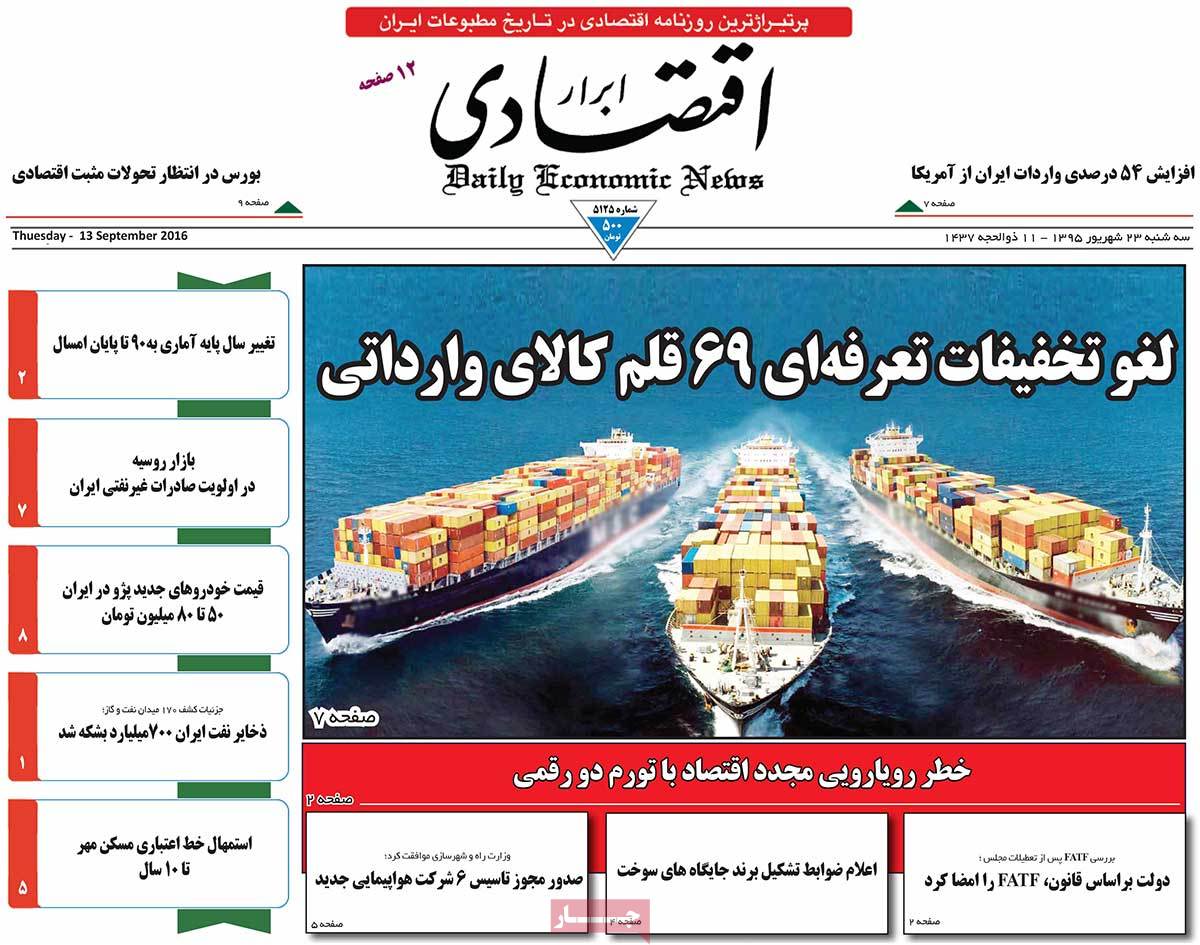
Abrar-e Eqtesadi:

1- Russian Market, a Priority for Iran’s Non-Oil Exports

2- 54% Increase in Iran’s Imports from US
A Look at Iranian Newspaper Front Pages on September 13


Afkar:

1- Nuclear Chief: US Political Credit Hinges on Its Commitment to JCPOA

2- Amir Abdollahian: Saudi Arabia Should Accept the Responsibility of Mina Tragedy and Pay Blood Money of Its Victims

A Look at Iranian Newspaper Front Pages on September 13


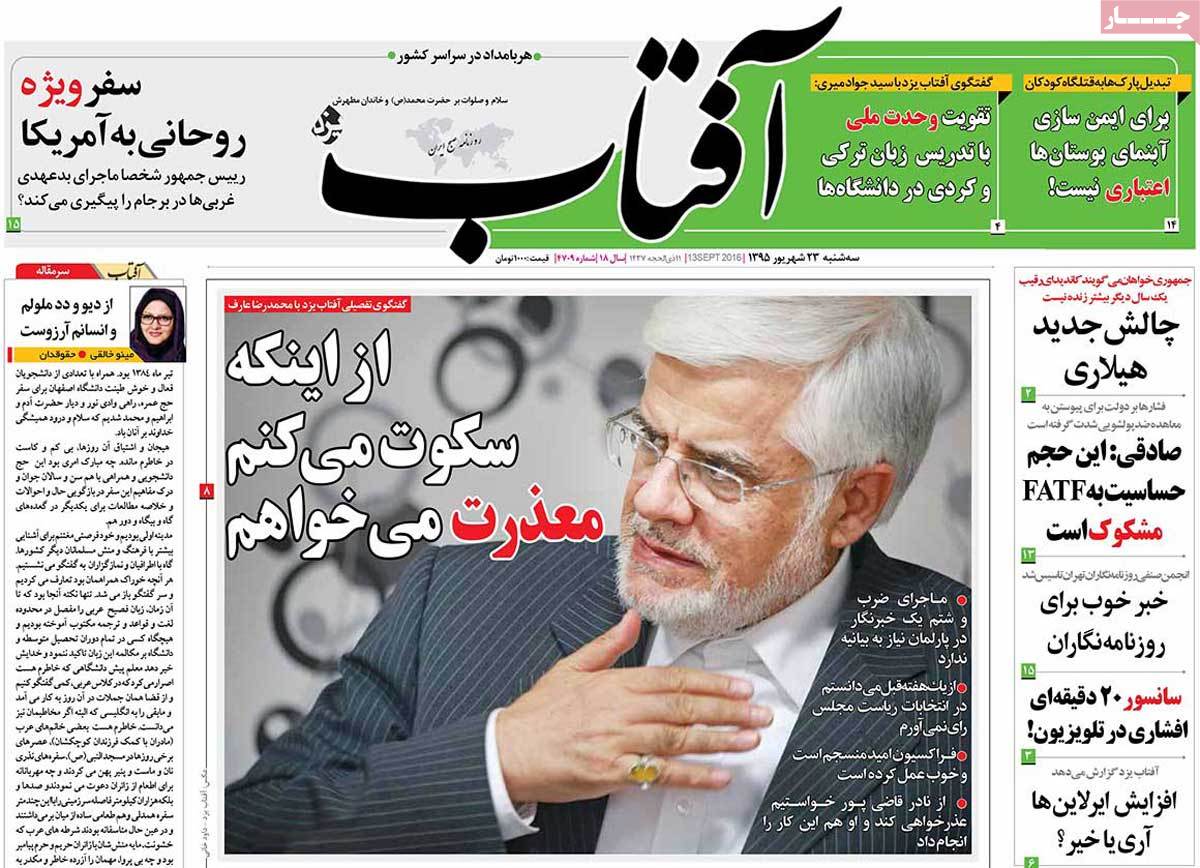
Aftab-e Yazd:

1- Rouhani’s Special Visit to the US: Will President Personally Pursue West’s Violation of Its JCPOA Commitments?
A Look at Iranian Newspaper Front Pages on September 13


Arman-e Emrooz:

1- Saeid Mortazavi: I’m Embarrassed; Apology for Kahrizak Tragedy after 7 Years
A Look at Iranian Newspaper Front Pages on September 13


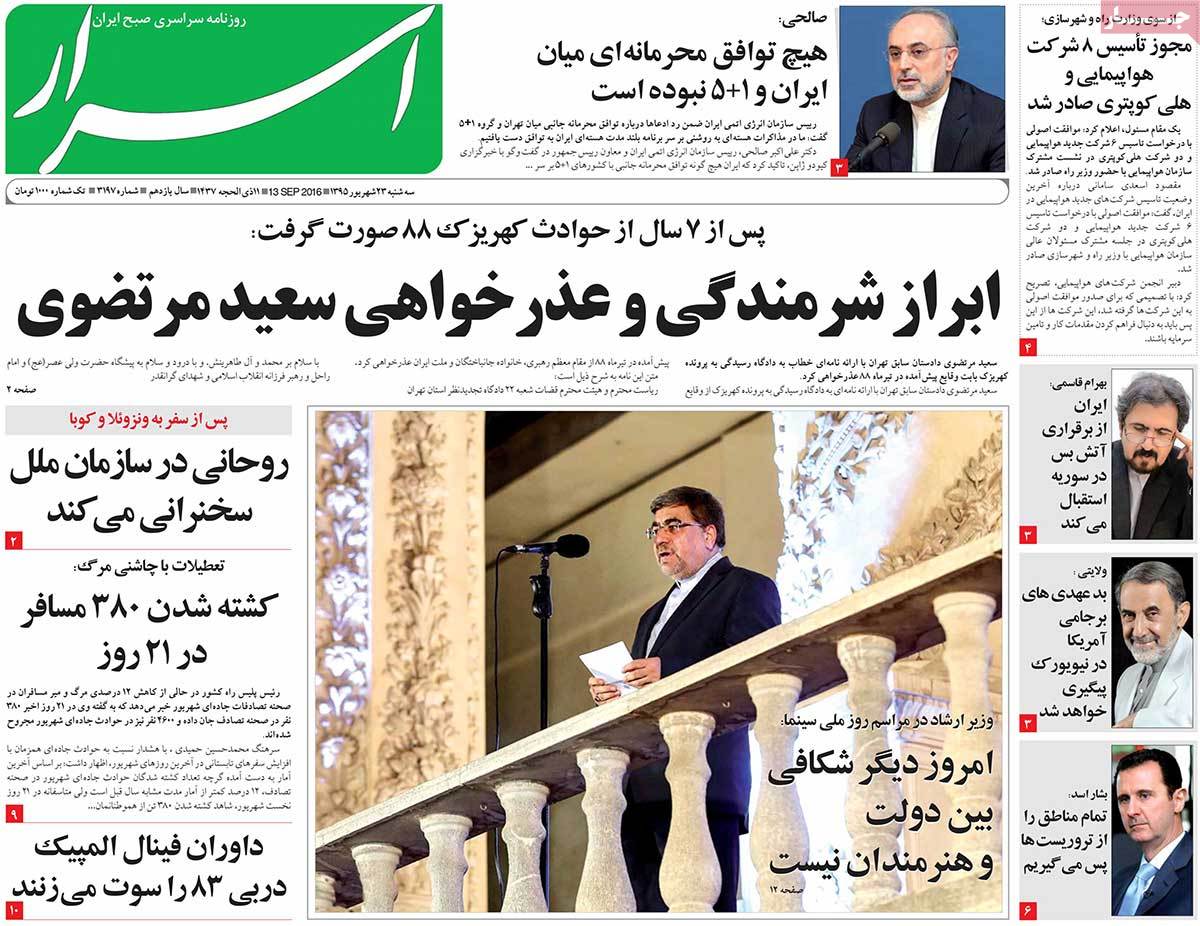
Asrar:

1- Nuclear Chief Salehi: No Secret Deal between Iran and Group 5+1

2- Culture Minister in National Day of Cinema: Today, There’s No Gap between Government and Artists Anymore

3- Foreign Ministry Spokesman: Iran Welcomes Establishment of Ceasefire in Syria

4- Assad: We’ll Reclaim All Lost Territories from Terrorists
A Look at Iranian Newspaper Front Pages on September 13


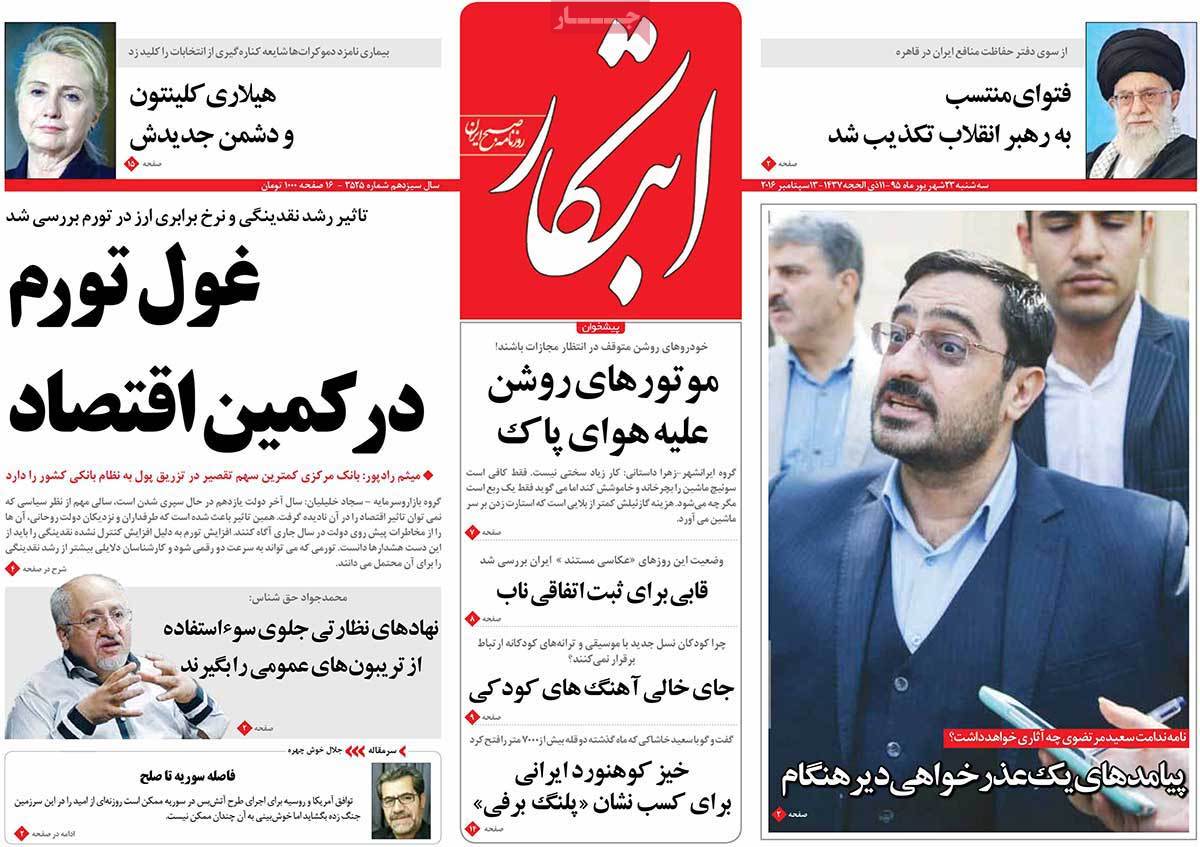
Ebtekar:

1- Reformist Figure: Inspection Bodies Should Prevent Abusing Public Tribunes

2- Iranian Mountaineer Trying to Win “Snow Leopard” Award: Saeid Khashaki Climbed 2 Peaks of over 7,000m
A Look at Iranian Newspaper Front Pages on September 13


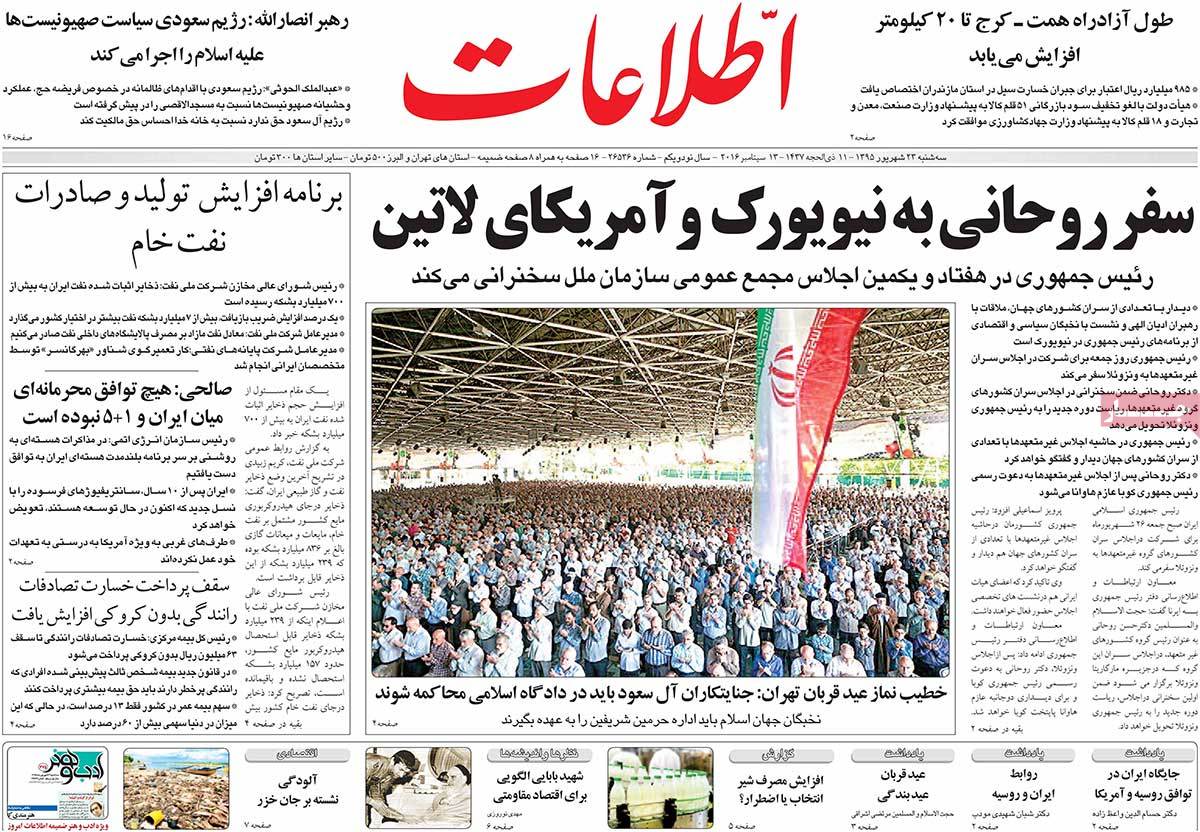
Ettela’at:

1- Tehran Friday Prayers Leader: Al Saud Criminals Should Be Tried in Islamic Court

2- Plan for Increase in Production and Export of Crude Oil

3- Ansarullah Leader: Saudi Regime Implementing Zionists’ Policies against Islam
A Look at Iranian Newspaper Front Pages on September 13


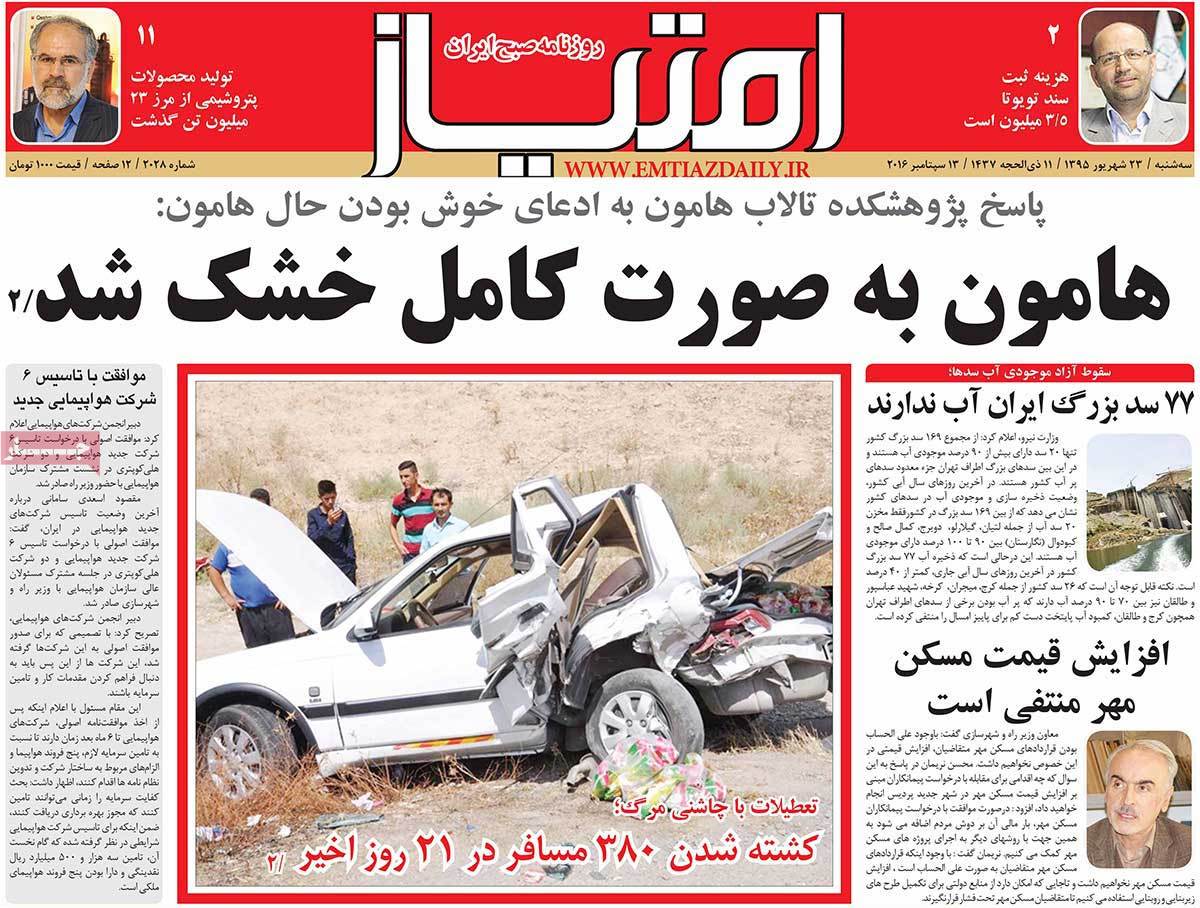
Emtiaz:

1- Amount of Iran’s Petchem Products Exceeds 23 Million Tons

2- 77 Major Dams in Iran Don’t Have Water

3- Vacation Flavoured with Death: 380 Passengers Dead in Car Accidents in Past 21 Days
A Look at Iranian Newspaper Front Pages on September 13


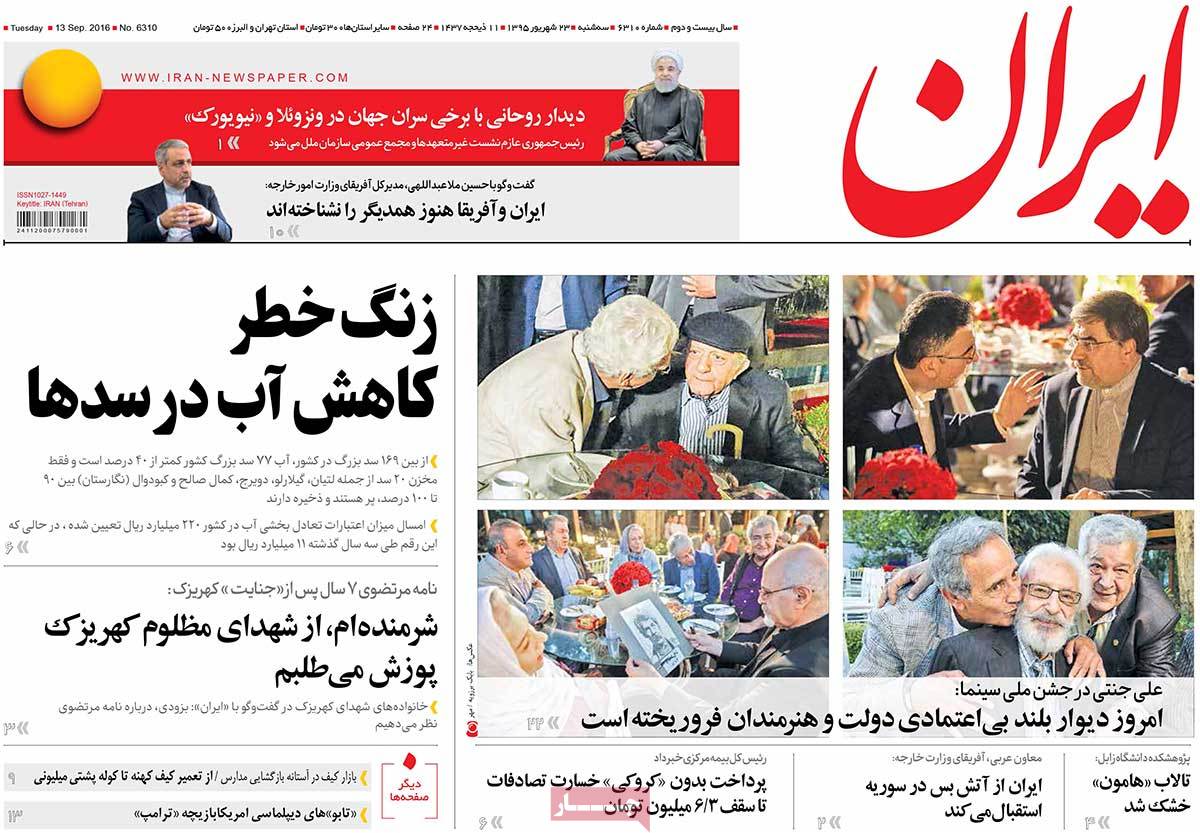
Iran:

1- Iran and Africa Have Yet to Know Each Other: Foreign Ministry Official
A Look at Iranian Newspaper Front Pages on September 13


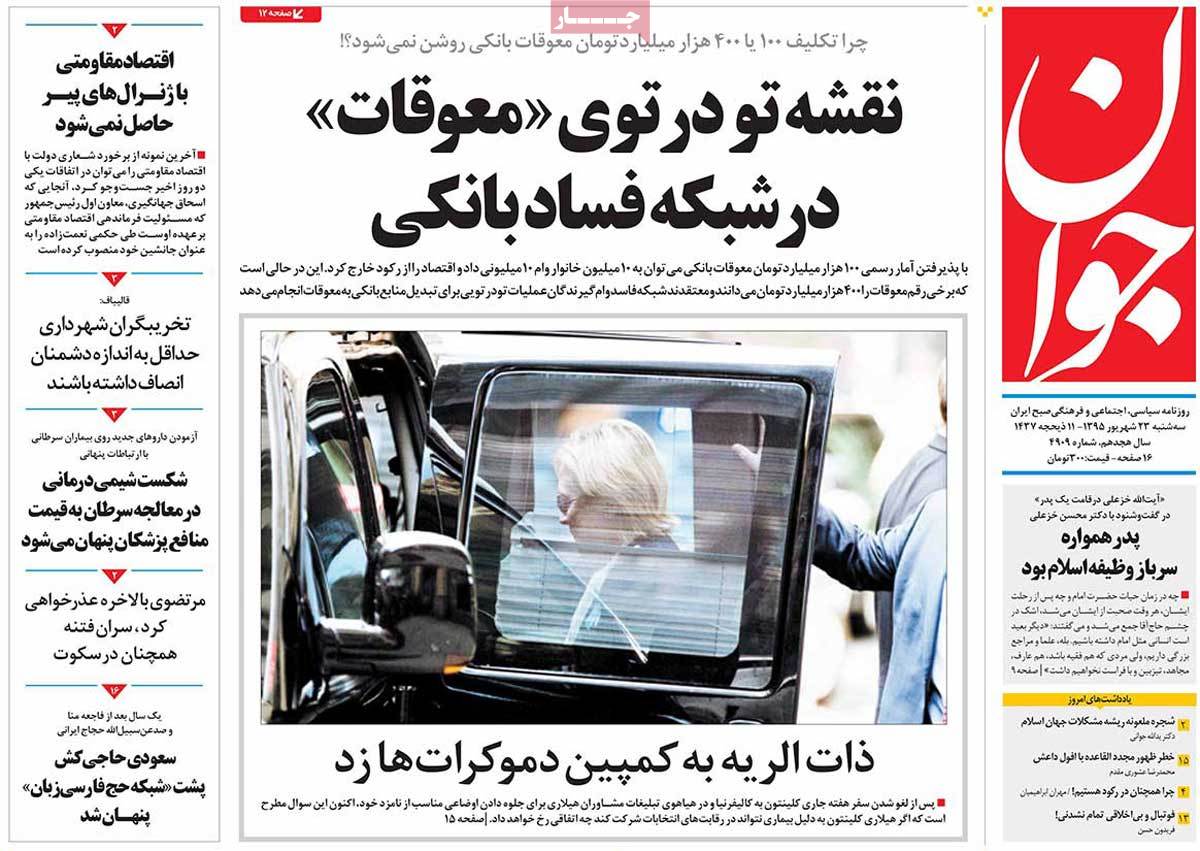
Javan:

1- Pneumonia Attacks Democrats’ Campaign
A Look at Iranian Newspaper Front Pages on September 13


Jomhouri Eslami:

1- Nuclear Chief Salehi: Continued Implementation of JCPOA Is to the Benefit of World and Region; Iran to Build Small and Large Nuclear Power Plants

2- JCPOA Revived Copper Industry: Official

3- New Anti-Syria Front Opened for Terrorists and Israel in Golan Heights as Ceasefire Takes Effect

A Look at Iranian Newspaper Front Pages on September 13


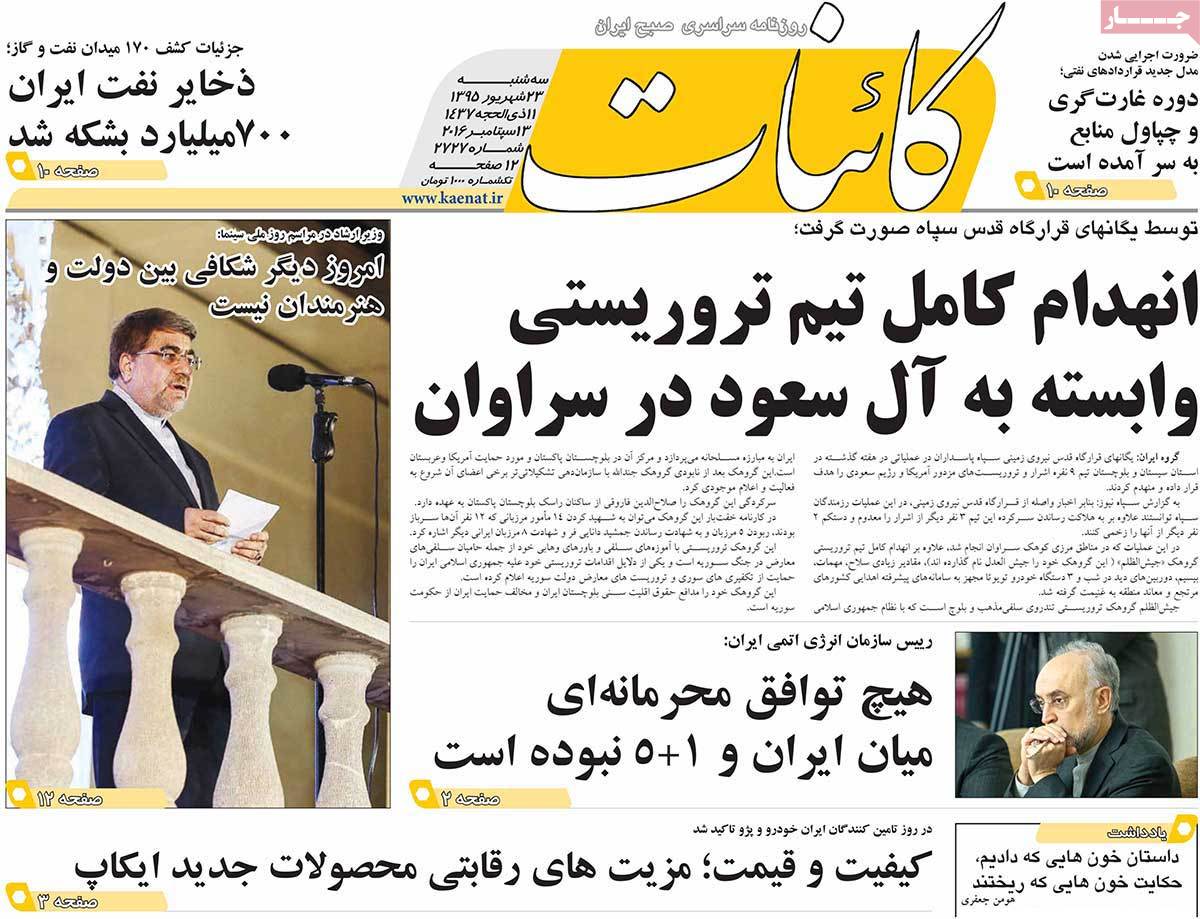
Ka’enat:

1- IRGC Quds Force Units Smash Terrorist Outfit Linked with Al Saud in Saravan [southeastern Iran]

2- 170 Oil and Gas Fields Explored in Iran: Iran’s Oil Reserves Increased to 700 Billion Barrels
A Look at Iranian Newspaper Front Pages on September 13


Kayhan:

1- ‘Mother of ISIS’ Likely to Be Removed from US Elections after Clinton’s Pneumonia Is Confirmed

2- Eight Wrong Marriage Traditions from Ayatollah Khamenei’s Point of View

3- Ayatollah Khatami: Al Saud Is Not Just Accused, It Is Criminal and Should Be Tried
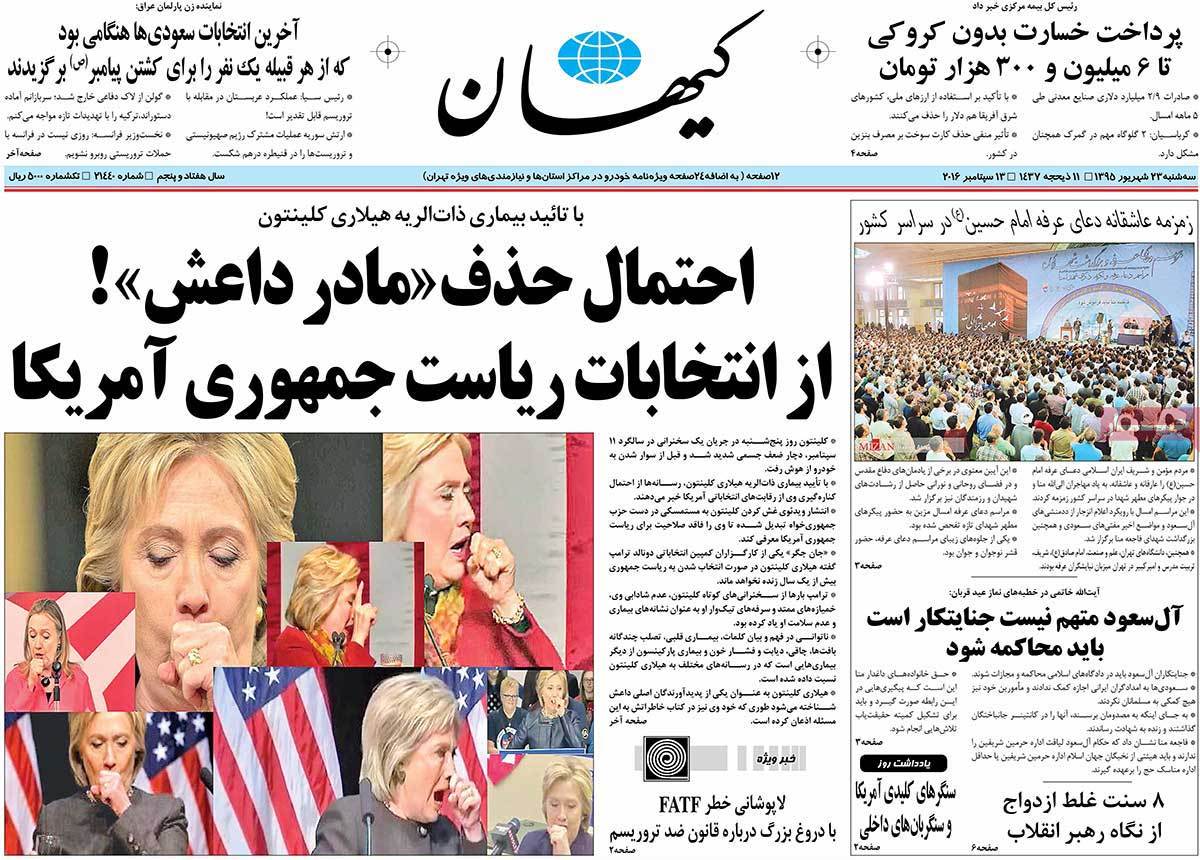
A Look at Iranian Newspaper Front Pages on September 13


Payam-e Zaman:

1- Education Minister: Number of Students in Iranian Schools Up by 200,000 in New Year

2- Nuclear Chief Salehi: Iran’s Nuclear Industry Not Stopped at All

3- Alarming Threat of Land Subsidence in Tehran
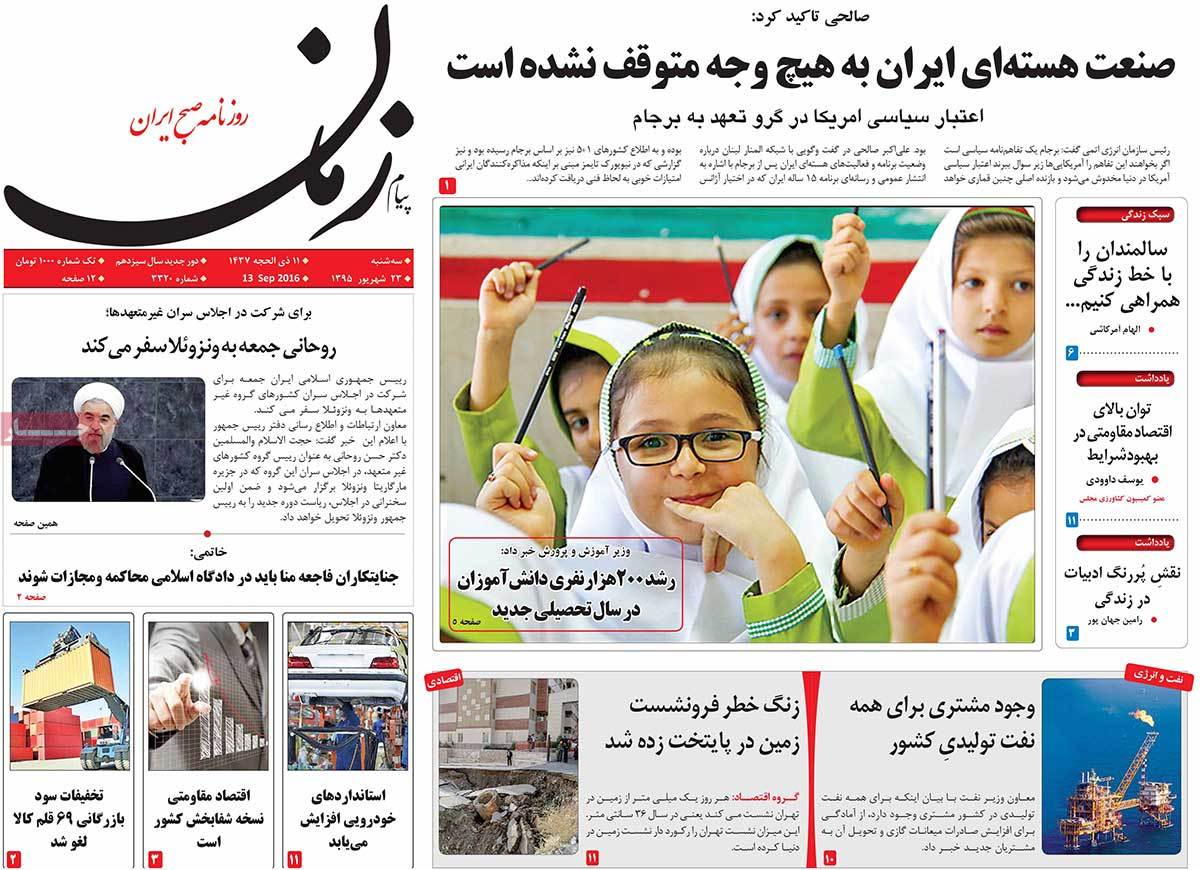
A Look at Iranian Newspaper Front Pages on September 13


Resalat:

1- Ayatollah Alamolhoda: FATF Is US Hegemony over Iran’s Banking System

2- Zarif: Stubbornness and Ignorance of Al Saud Has Made It an Illogical Regime

3- Muslim World Waiting for Al Saud’s Collapse: Saudi Arabia’s Role Is Felt in All Regional Crises

4- Leader’s Advisor Urges President Rouhani to Pursue US Violation of Its Commitments in New York Visit
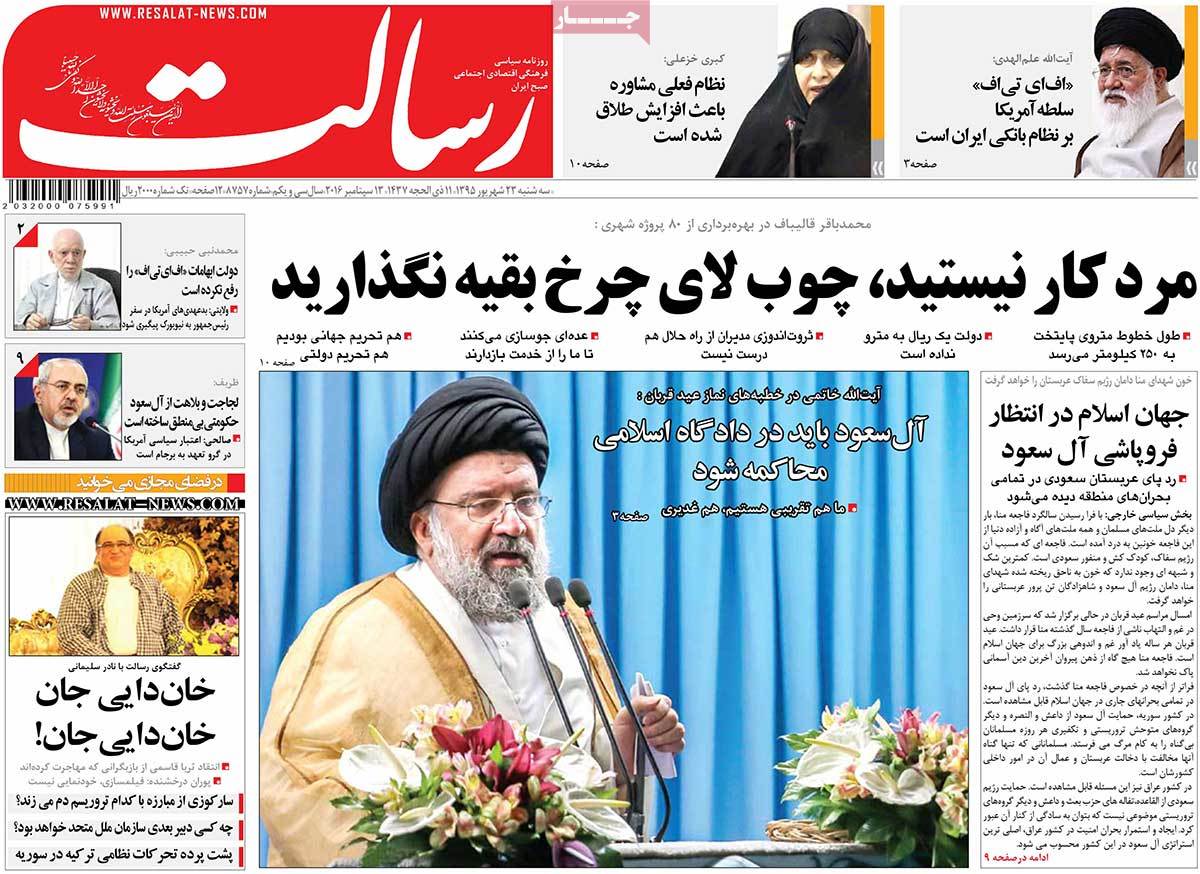
A Look at Iranian Newspaper Front Pages on September 13


Roozan:

1- Cinema Official: Good Days to Come for Iran’s Cinema

2- Hillary Falls Down in September 11 Commemoration Ceremony: Clinton’s Physical Weakness Discussed in Media

3- Rouhani’s Emphasis on Dialogue and Constructive Interaction with the World, Most Important Feature that Distinguishes Him from Ahmadinejad

4- Women Are Going to Take Lots of City Council Seats
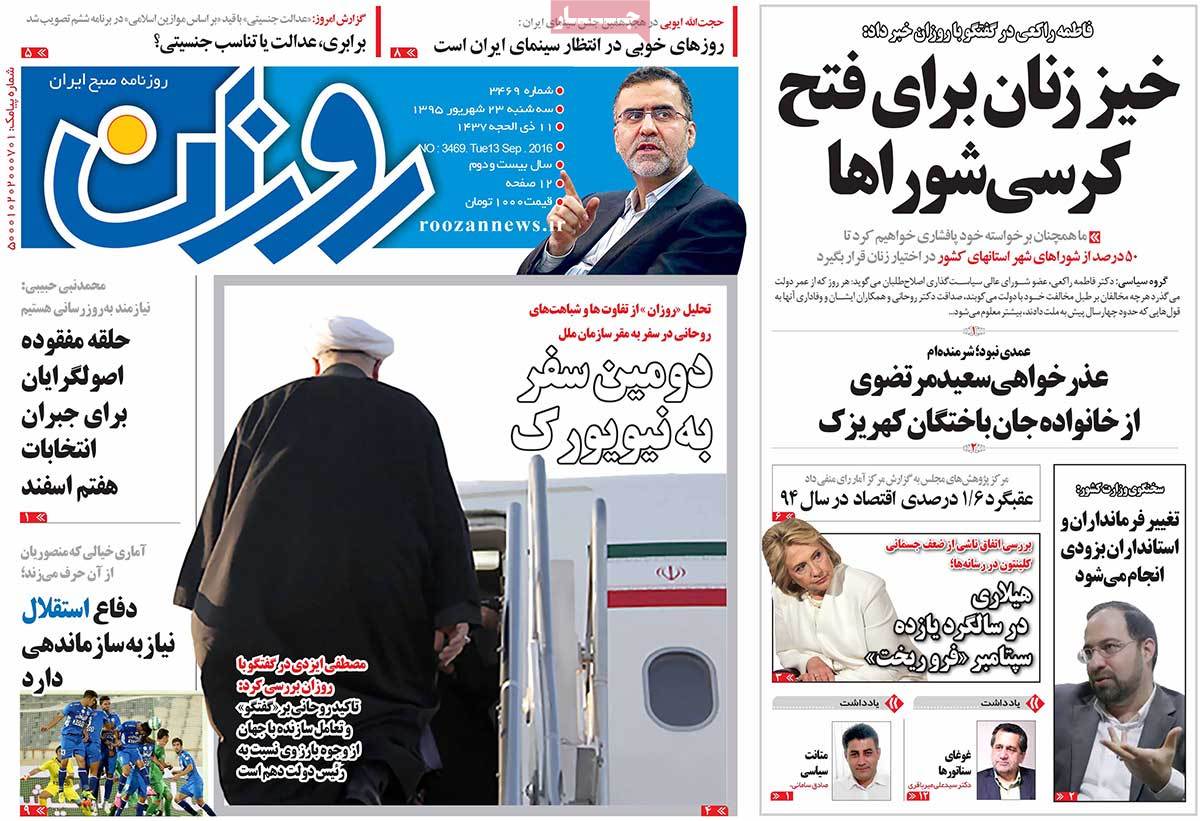
A Look at Iranian Newspaper Front Pages on September 13


Sayeh:

1- Iran’s Nuclear Organization Chief: US and China Are Re-Designing Arak Heavywater Reactor

2- Iran’s Mixed Archery Team Wins Gold in Paralympics

3- The Period of Time between One’s Graduation and Beginning of First Job Has Increased: Costs of Excessive Focus on University Degrees for Iran’s Economy
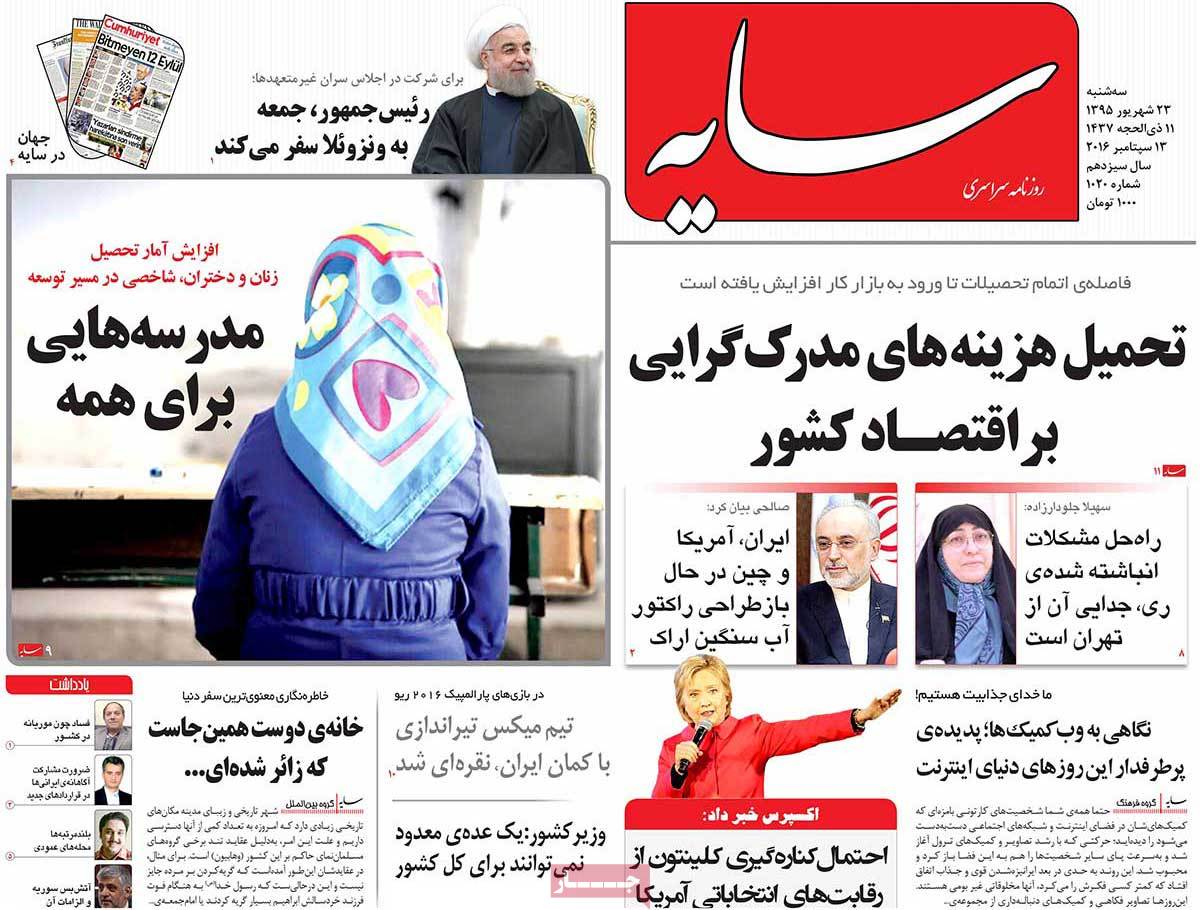
A Look at Iranian Newspaper Front Pages on September 13


Setareh Sobh:

1- Alamolhoda: FATF Is Capitulation of Banking

2- If We Don’t Cooperate with FATF, We Should Stay in Isolation: Former CBI Official
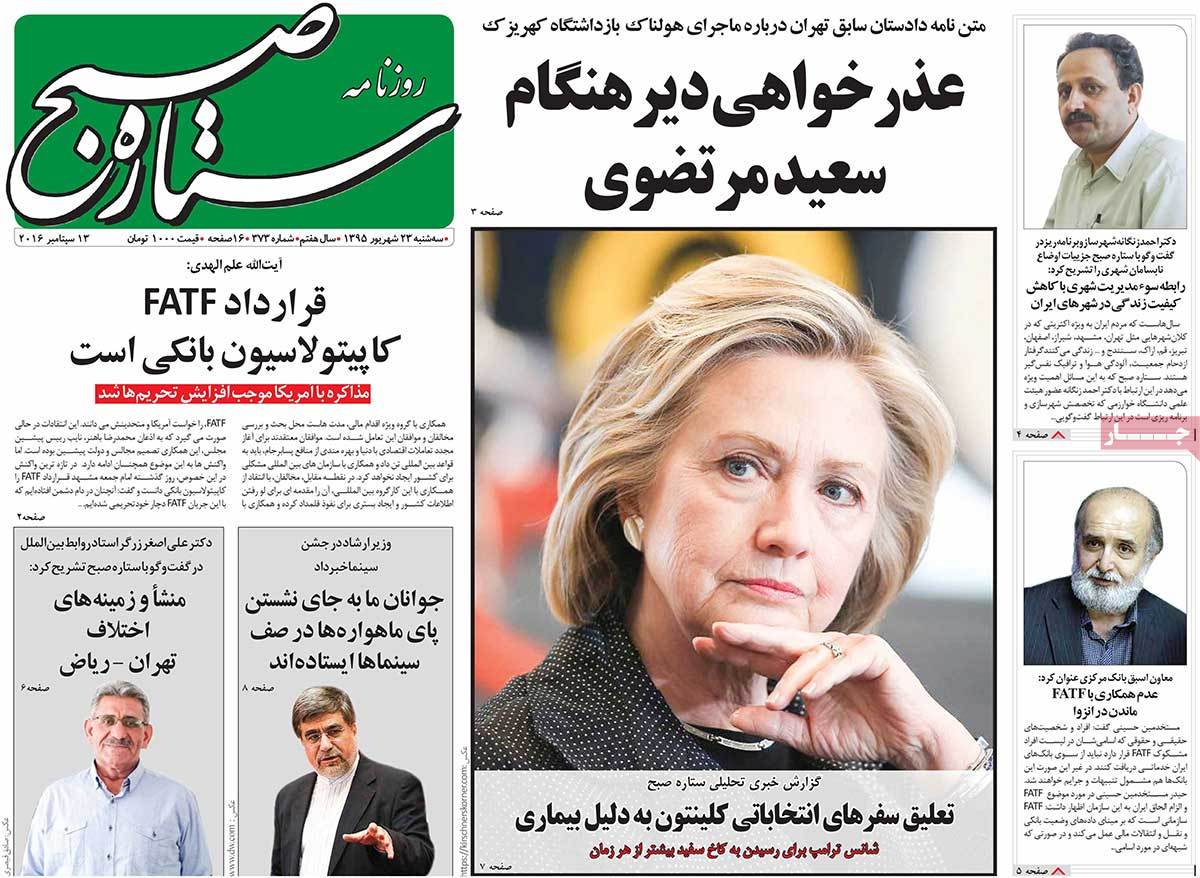
A Look at Iranian Newspaper Front Pages on September 13


Ta’adol:

1- Iranian Tourists Victims of Explosion in Turkey’s Van

2- Iran’s Auto Manufacturer SAIPA Receives $1bn Finance Offer

3- Deputy FM: Saudis Trying to Reverse Everything
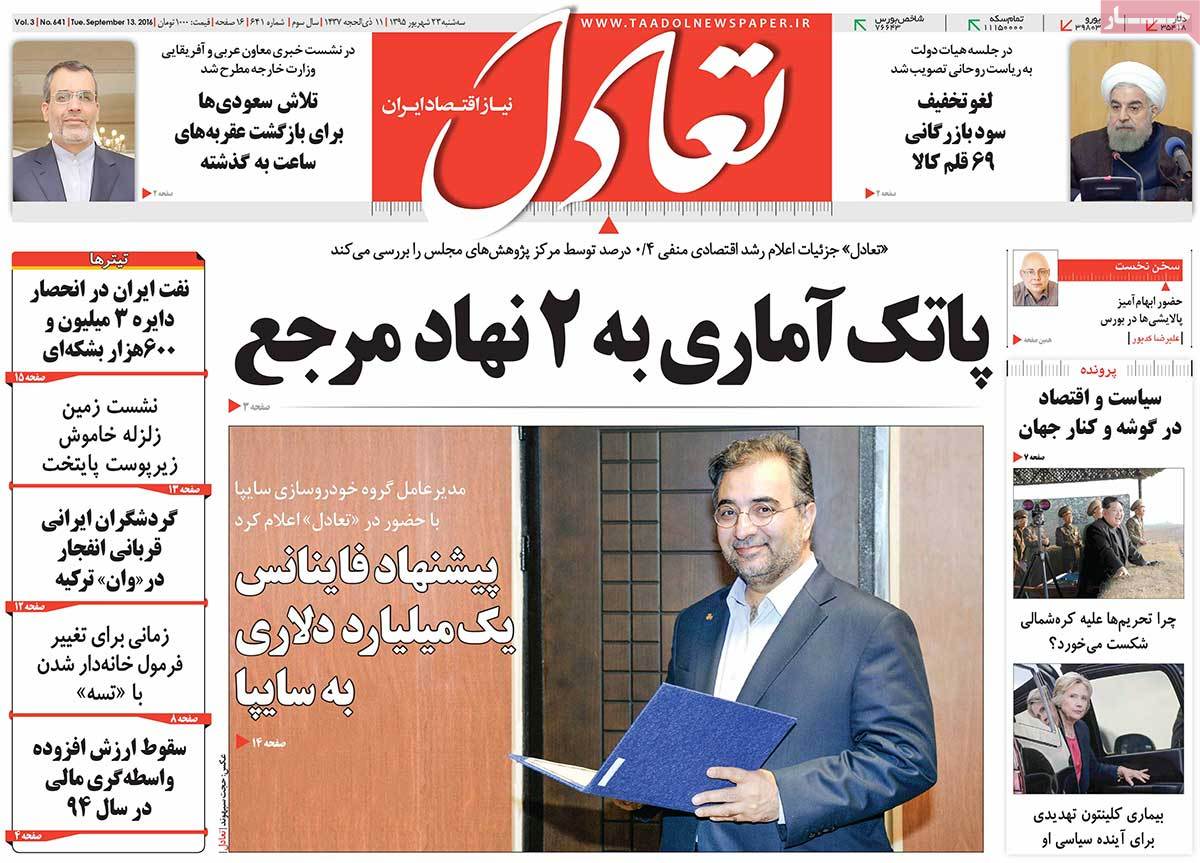
A Look at Iranian Newspaper Front Pages on September 13

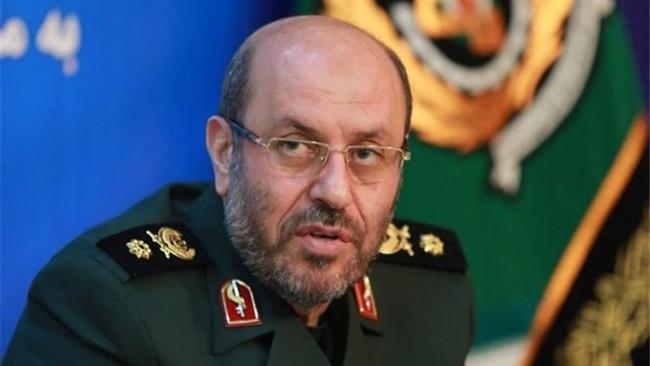
Syria Truce Mustn’t allow Terrorists to Rearm: Iran

Speaking to reporters in Tehran on Tuesday, Dehqan added that the ceasefire in Syria, which was brokered by Russia and the United States and took effect late Monday, is a favorable development sought by everybody.

He added that global efforts are required to maintain the ceasefire in order to dispatch humanitarian aid to civilians in besieged areas and pave the grounds for Syrians to find a political solution to the crisis in the country.

Dehqan further stated all countries must respect the legal and legitimate Syrian government because the crisis in the war-stricken country cannot be settled through military approaches.

The truce deal was announced on Friday following intensive talks between Russian Foreign Minister Sergei Lavrov and US Secretary of State John Kerry. The seven-day-long ceasefire took effect at sundown on Monday.

Hours after it took effect, a group of militant outfits, including the so-called Free Syrian Army and its affiliated groups, including Ahrar al-Sham and Jaish al-Islam, released a joint statement bashing the accord and calling it “unjust.”

The government in Syria announced on Tuesday that militants hostile to Damascus have violated the ceasefire in the city of Aleppo.

Russia has been conducting an aerial campaign against militant positions in Syria since September 2015. The operations were launched on a request by Damascus, which has long had military accords with Moscow.

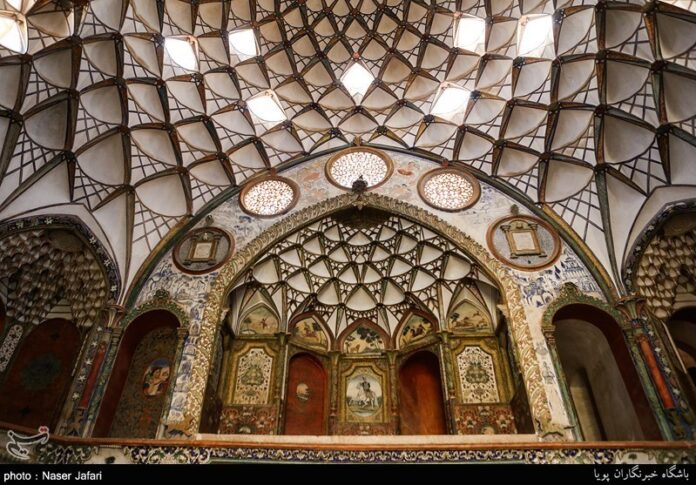
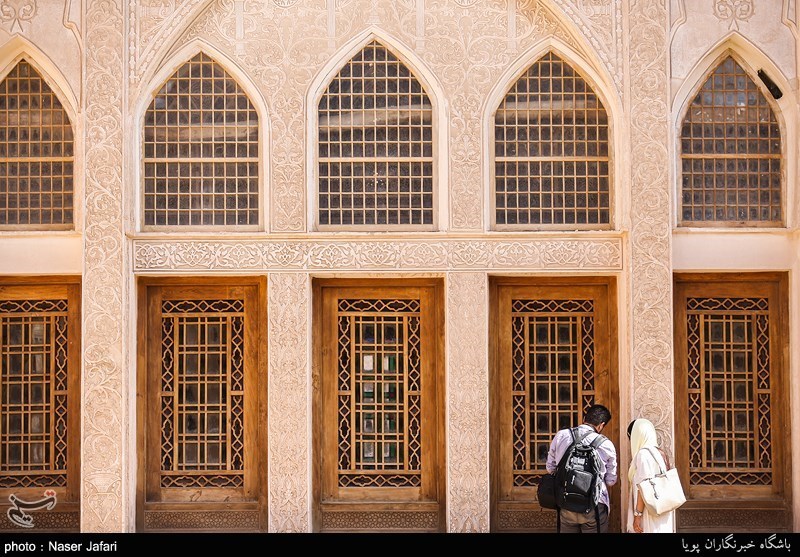
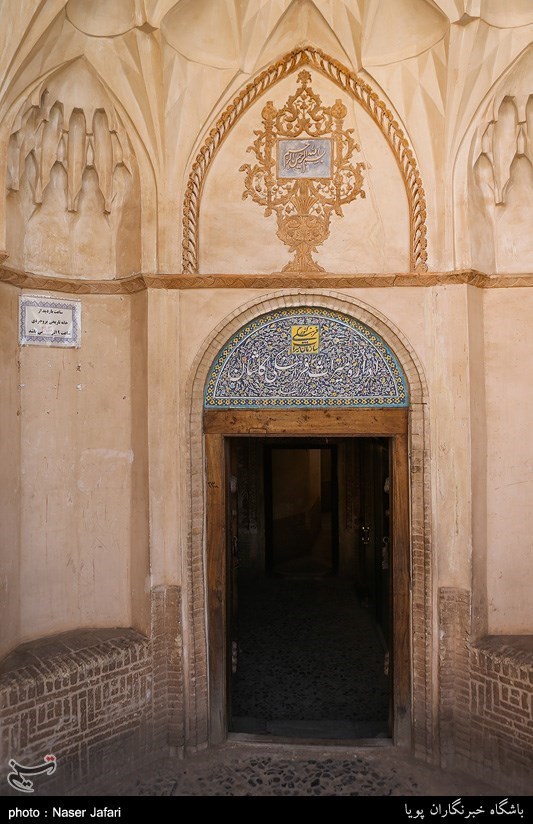
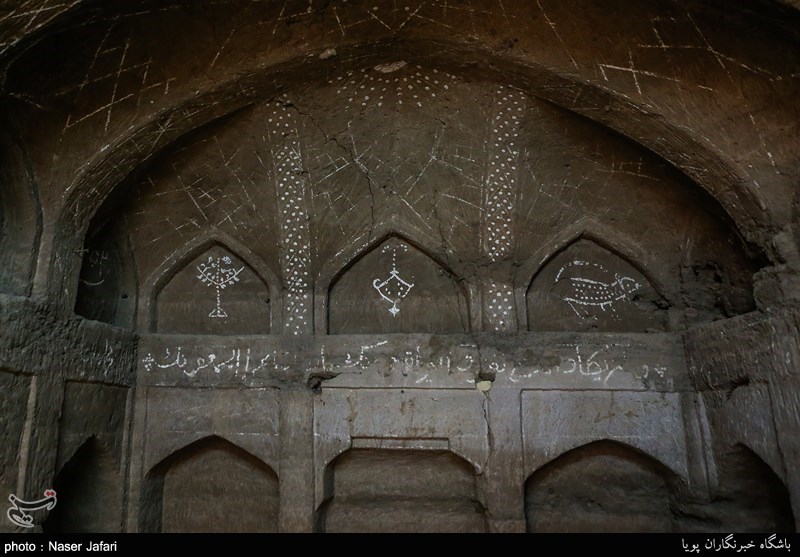
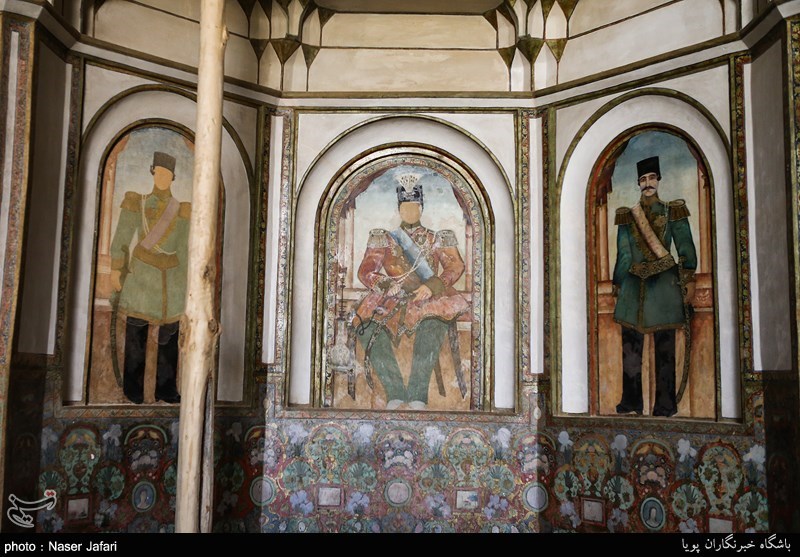
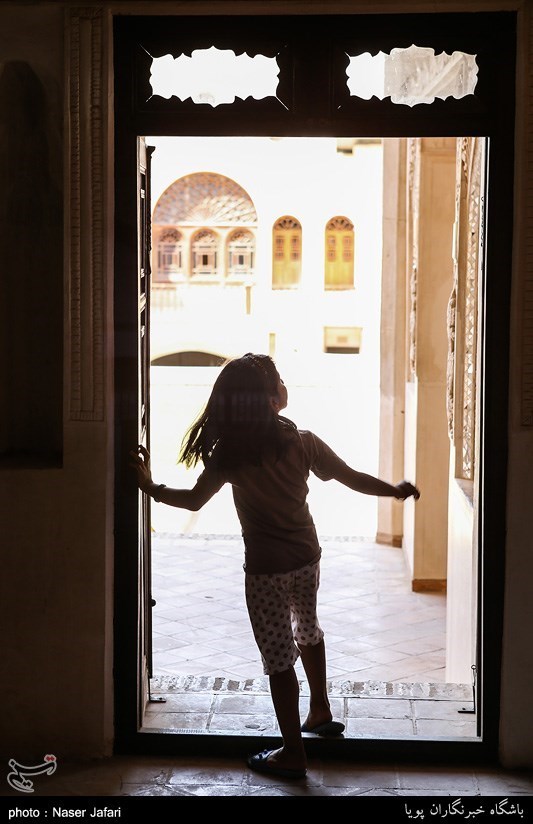
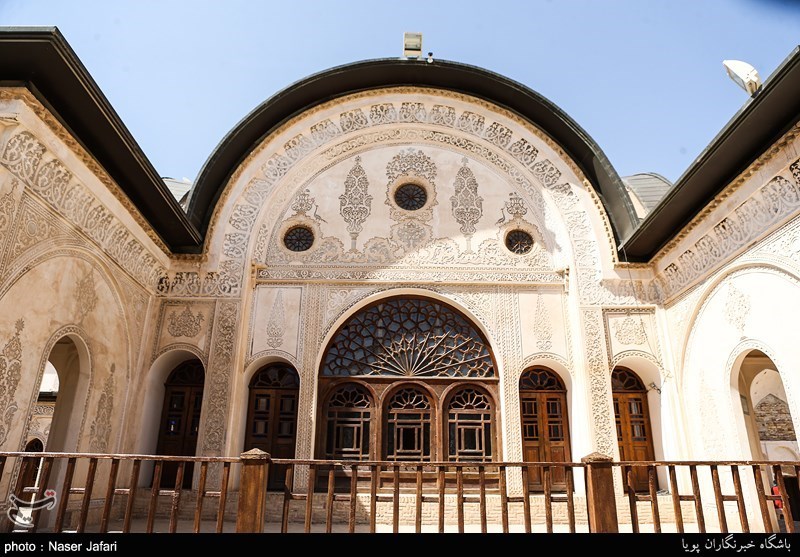
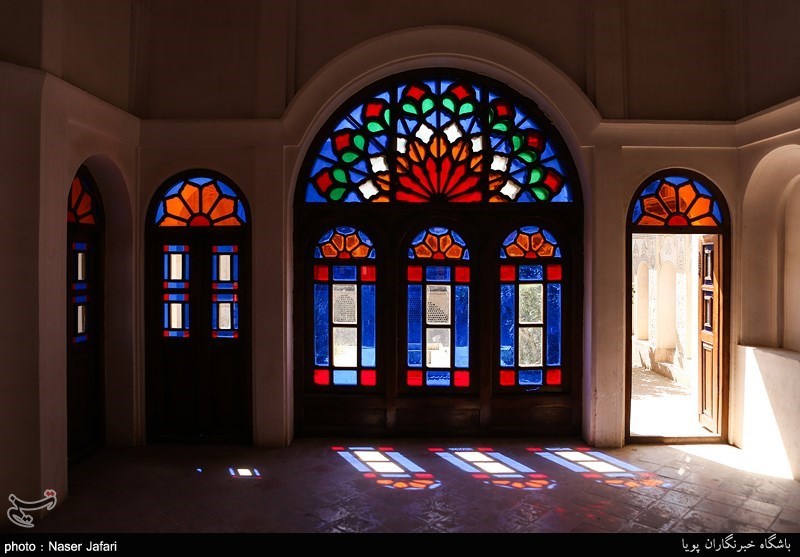
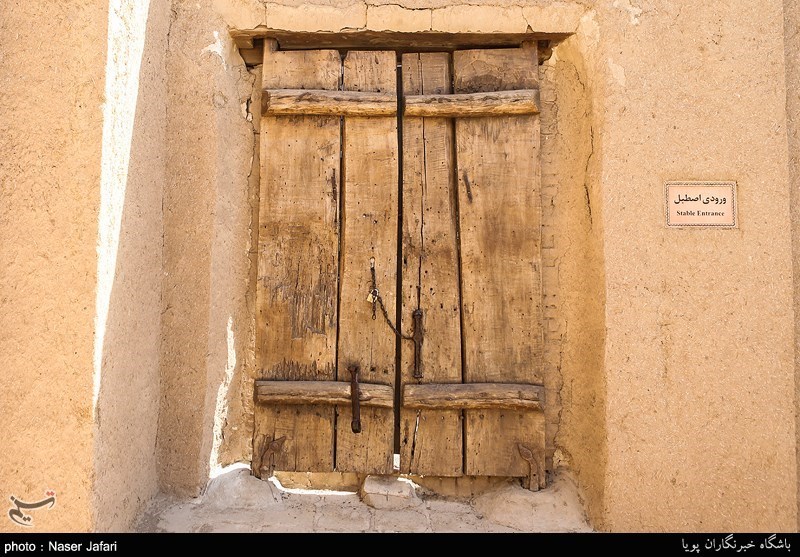
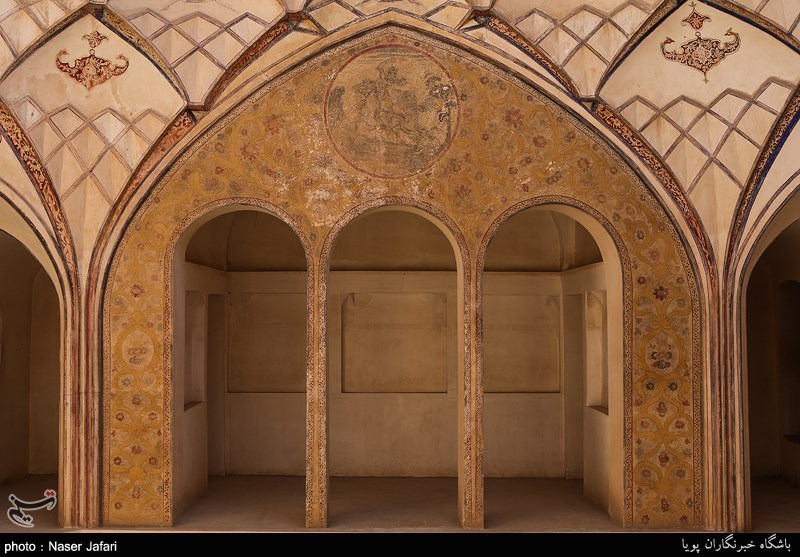
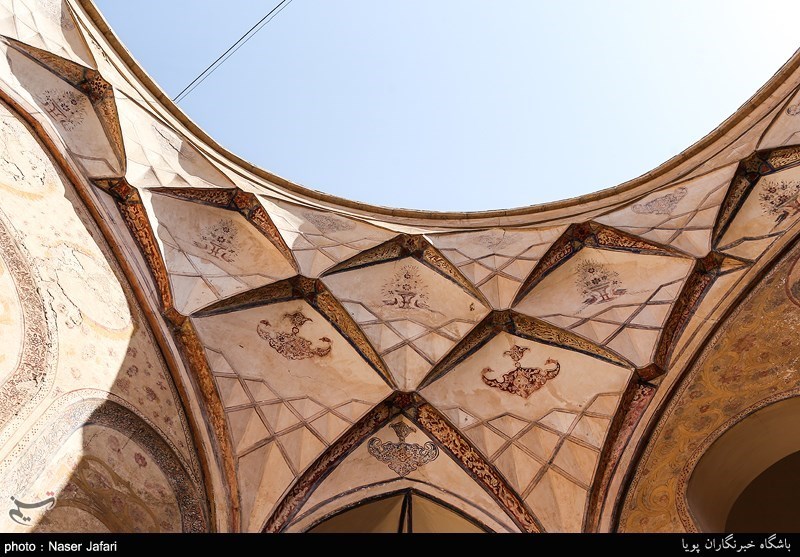
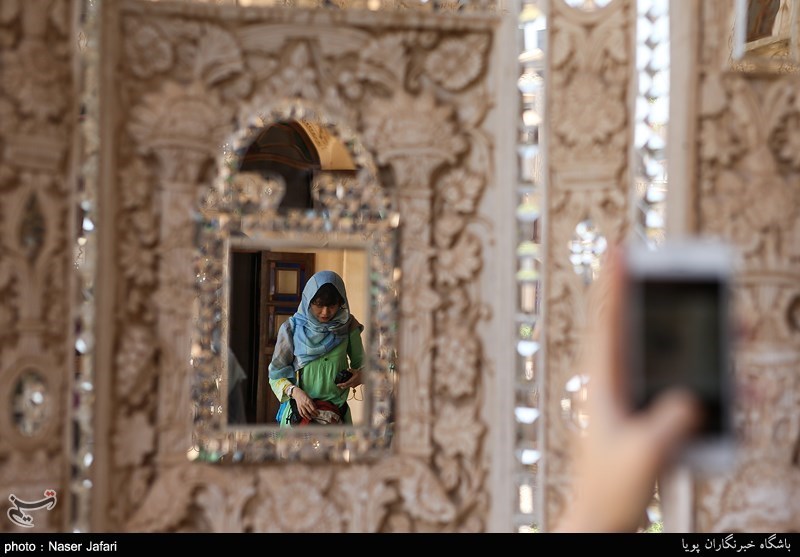
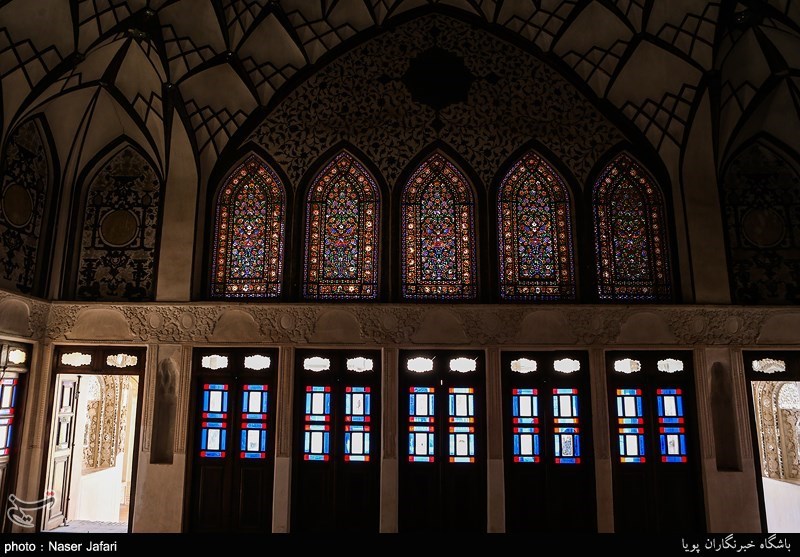
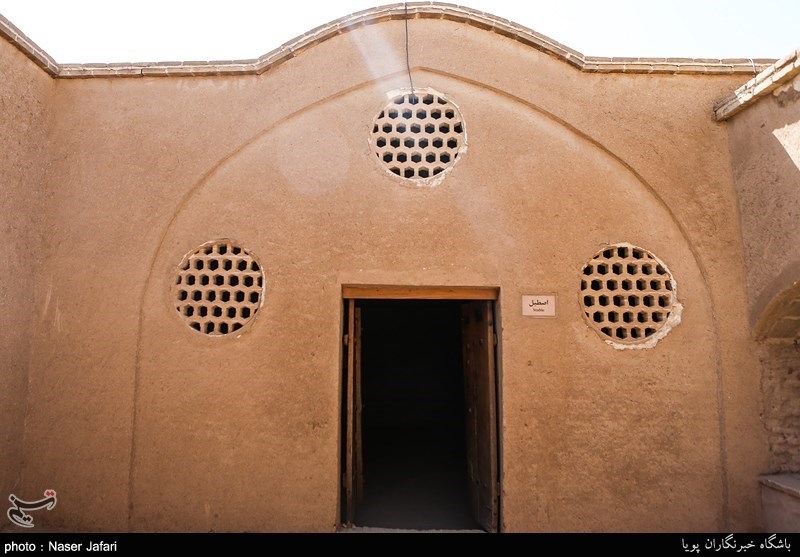
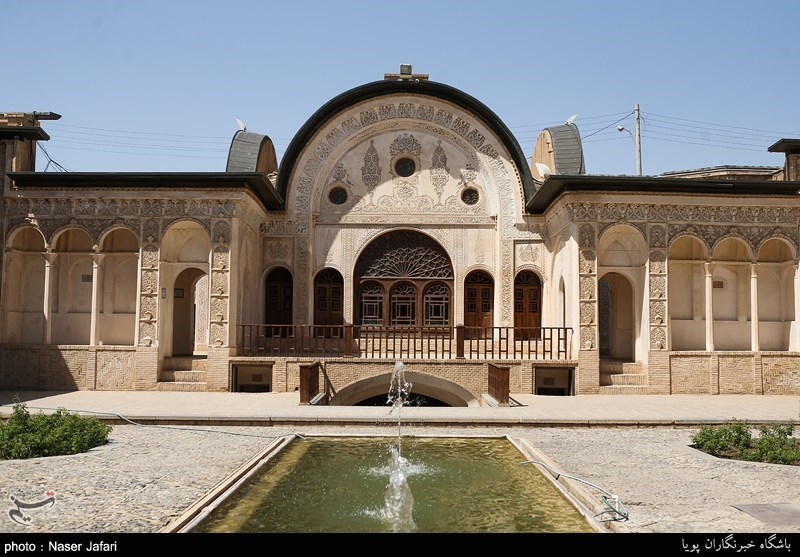
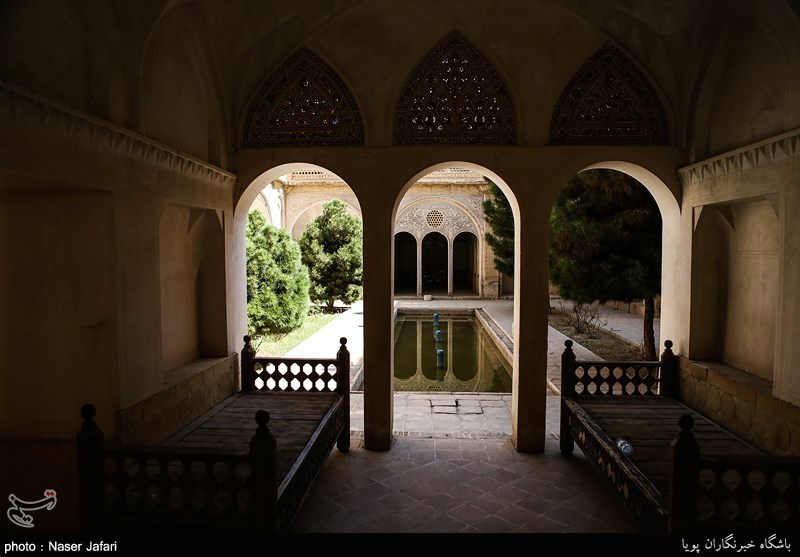
Historical Houses of Iran’s Kashan

historical-houses-kashan
Kashan

Here are Tasnim’s photos of some of these houses: