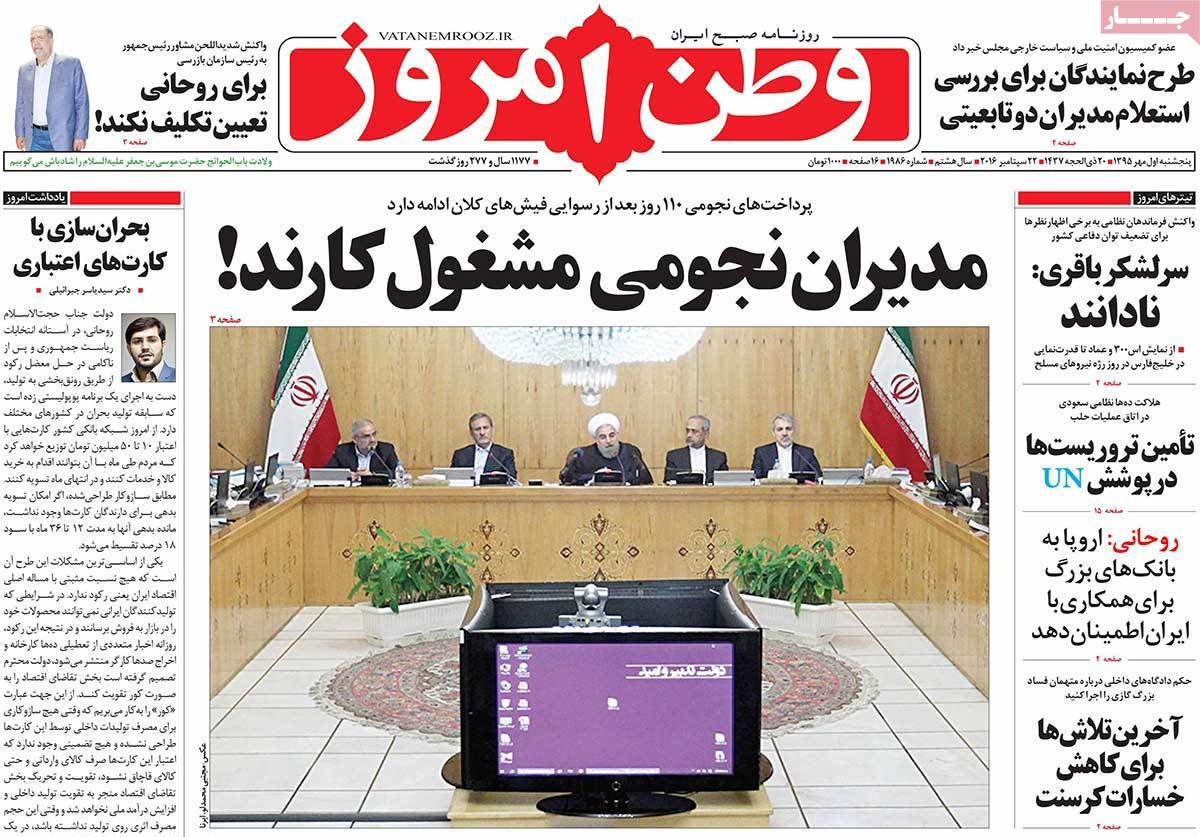
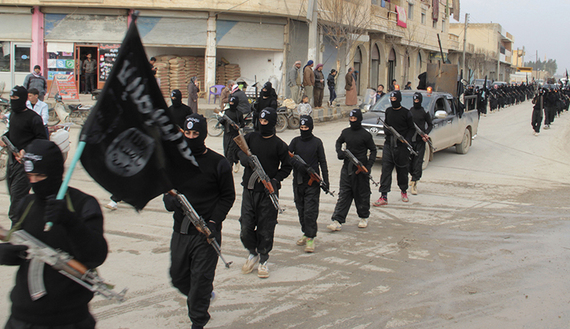
Local witnesses said that ISIS elements have dug a long fiery moat around Mosul in an attempt to impede the progress of Iraqi forces.
There is only one path left open to Iraq’s western desert and to the borders of Syria from there; therefore, if worse comes to worst for the terrorists, they will have a chance to flee into Syrian cities of Raqqah and Deir ez-Zor.
Militants from the terrorist group have started digging the moat in preparation for a long battle with Iraqi forces.
Reports suggest that fighters have sealed off entire districts and began building a network of tunnels to obstruct government troops.
Reuters reported that senior Iraqi military officers, Mosul residents, and local officials say a trench along the city’s perimeter is being built.
Mosul is the largest city under Isis control and a battle to liberate the city is set to be the biggest, and possibly longest, the terrorists have ever fought with an operation to retake the city possibly launched in the next month.
According to a report by Al Alam, as translated by IFP, Khalil Harb in an article in the Lebanese newspaper As-Safir said Iraqi Prime Minister Haider al-Abadi has announced military operations to liberate the town of Al-Shirqat, which is located 120km from Mosul.
However, General Joseph Francis Dunford, chairman of US Joint Chiefs of Staff, announced that Mosul will be liberated in October, namely on the verge of the US presidential election, in the hope that a possible victory in the operation would benefit the US democrat presidential candidate Hillary Clinton.
Meanwhile, the ceasefire in Syria is still hanging in the balance and efforts by the US, Russia and other countries have all turned out fruitless. Even the meeting of International Syria Support Group (ISSG) was of no avail to revive the collapsed ceasefire in Syria.
While every eye is on the tensions between Washington and Moscow to be relieved, Iraq’s future as a country whose destiny is geographically intertwined with Syria is of utmost importance.
On the other hand, as the war drums are getting louder in Mosul, there is a chance that Americans seize this opportunity to exert pressure on Syria.
In fact, since the summer of 2014 when Abu Bakr al-Baghdadi declared himself as the caliph of Iraq and Syria, the Americans never bothered to hide that they are cooking the idea of defeating ISIS in Iraq and pushing the terrorists into Syrian territory.
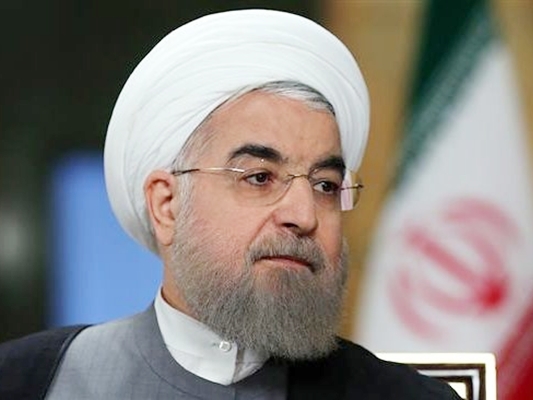
Speaking to reporters in Tehran upon his arrival from New York on Friday, President Rouhani said Iran and the Group 5+1 (also known as E3+3) held meetings at the level of directors and foreign ministers on the sidelines of the 71st annual session of the UN General Assembly.
The meetings were part of periodic sessions of a joint commission on implementation of the Joint Comprehensive Plan of Action (JCPOA), a July 2015 nuclear deal between Iran and the six countries.
According to President Rouhani, all participants in the meeting have decisively told the US that it is not closely conforming to the JCPOA terms, saying Washington has also promised to correct its conduct.
“The fact that six countries adopted a united stance by warning the US to modify its behavior was a major achievement for the Islamic Republic of Iran,” he added.
The joint commission was formed in October 2015 to oversee the process of implementation of the JCPOA. While the 159-page deal came into force in January 2016, the US has come under fire for its failure to fully implement the accord.
Elsewhere in his comments, President Rouhani said he held 14 meetings with heads of states on the sidelines of the UNGA session in New York, saying many leaders have asked Iran to “propose solutions to conflicts in Iraq, Yemen and Libya.”
The interlocutors admitted that Iran plays a “very influential and unmatched role in the settlement of regional problems,” he added.
President Rouhani returned home on Friday after visiting Venezuela, Cuba and the US.
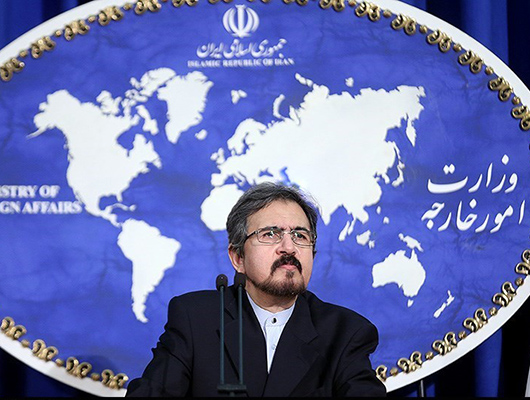
Iranian Foreign Ministry Spokesman Bahram Qassemi on Thursday expressed condolences to the families of victims of the deadly attack on Souq al-Hanoud area in the al-Hawak district of Yemen’s Hudaydah province. The strike, which occurred late on Wednesday, killed some 50 civilians and injured scores of others.
The spokesman noted that the international community’s indifference to the Saudi conduct and the continued arms sale to the Riyadh regime have encouraged the kingdom to intensify attacks on Yemen’s defenseless people and keep its acts of aggression.
Qassemi further underlined that the muted response to the killing of Yemeni civilians and sale of destructive weapons to Saudis would make certain Western countries more disgusting in the eyes of the public and represent them as accomplice to the crimes committed by the Saudi “child-murderer” regime.
Since March 2015, Saudi Arabia and some of its Arab allies have been launching airstrikes against the Houthi Ansarullah movement in an attempt to restore power to the fugitive former President Abd Rabbuh Mansour Hadi, a close ally of Riyadh.
More than 10,000 Yemenis, including many women and children, have died in the Saudi-led aggression so far.
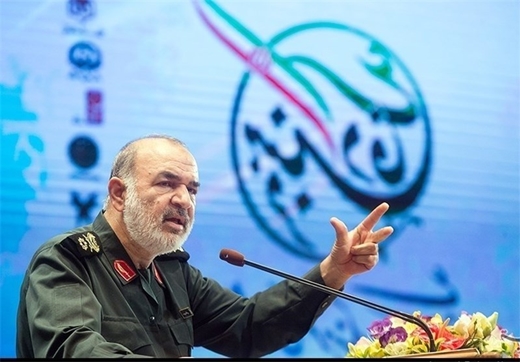
“We would pursue any enemy seeking to cause the slightest damage to Iran’s self-esteem and independence no matter where in the world they be,” Brigadier General Hossein Salami, the Islamic Revolution Guards Corps (IRGC)’s second-in-command, said in a televise interview on Thursday.
He added that the Islamic Republic has been building and modernizing its military equipment on its own without relying on any country despite the arms and economic embargoes it is facing.
In the area of producing unmanned aerial vehicles (UAVs), Iran now stands on an equal footing with the United States, Russia and China, he said. “Our UAVs can fire rockets at and capture footage from [targets] within a range of 3,000 kilometers,” Salami said.
“Some big powers have even made demands for our products,” the senior military official said.
A long-range Qadr ballistic missile is launched in the Alborz mountain range in northern Iran on March 9, 2016. (Photo by AFP)
Touching on Moscow’s sale of the S-300 missile system to Tehran, Salami said the purchase was driven by contractual obligations not domestic needs for such apparatus.
Amid the diplomatic efforts to resolve the Iranian nuclear issue, the Americans were always broaching the military option, Salami said. “They, however, never dared to take any action as they did not feel empowered versus us…They know the consequences of attacking Iran will be dire.”
Americans are bereft of political logic, he said, adding that all they understand is the logic of power.
Addressing Iran’s support for Lebanese and Palestinian resistance groups, the commander asserted that the Lebanese resistance movement of Hezbollah and fellow Palestinian groups are “completely popular and defend their rights.”
“It is not acceptable under any circumstances for them (the West) to ask us to consider them to be terrorists,” the commander said.
Brigadier General Farzad Esmaili, the commander of the Khatam al-Anbiya Air Defense Base, said on Thursday the forces warned off the intruding American aircraft in recent days and made them fly away.
The commander did not give further details elaborating on where the planes attempted to enter Iranian airspace.
The Lockheed U2, nicknamed “Dragon Lady”, is an American single-jet engine, ultra-high altitude reconnaissance aircraft operated by the United States Air Force. The spy plane can fly at an altitude of 21,000 meters and provide day and night and all-weather intelligence gathering as it carries high-resolution cameras and sensors.
The Iranian Army’s Air Defense Base reportedly warned off a US radar-evading unmanned aerial vehicle (UAV) in late August which had sought to intrude on Iranian airspace.
The US spy drone had sought to cross into Iran through the eastern border from neighboring Afghanistan. However, it was immediately detected and forced to leave the area after a “timely and stern” warning by the Air Defense Base.
In December 2012, Iran’s Islamic Revolution Guards Corps (IRGC) captured a US ScanEagle drone over the Persian Gulf waters upon its intrusion into the Iranian airspace.
In December 2011, Iran downed a US RQ-170 Sentinel stealth aircraft (shown) with minimal damage.
In the same month the previous year, Iran downed a US RQ-170 Sentinel stealth aircraft with minimal damage. The drone was flying over the Iranian city of Kashmar, near the Afghan border, when it was brought down
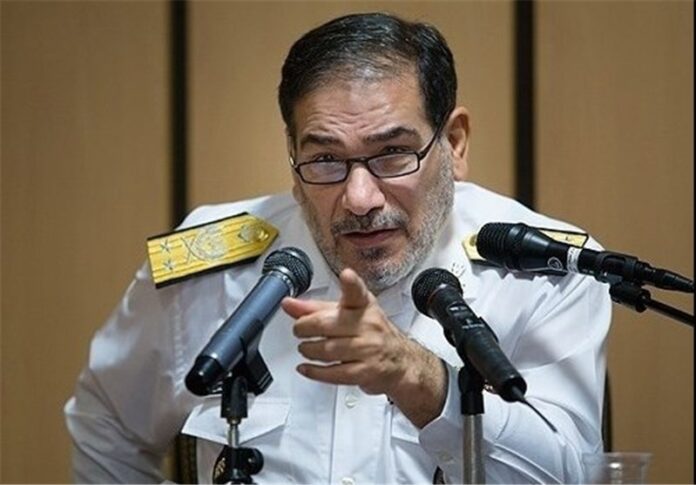
“The Saudi government’s conduct, its refusal to apologize to the bereaved families (of Mina victims) and its ignorance about identifying and introducing those at fault in the catastrophe raise doubts about the involvement of elements from the Saudi government in the incident,” Shamkhani told reporters in Tehran on Friday.
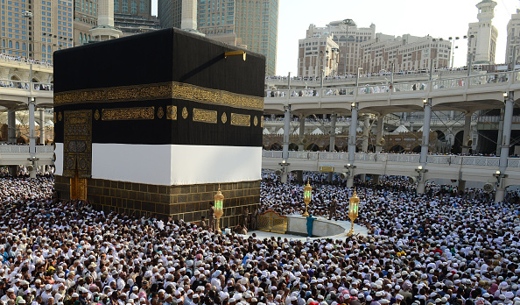
His comments came a year after the deadly crush of people during the last year’s Hajj rituals in Mina, near the Saudi Arabia’s holy city of Mecca, which claimed the lives of over 4,700 pilgrims, including 465 Iranians.
Shamkhani further took a swipe at the West for unwavering supports for the Al Saud’s crimes and adopting double-standards in dealing with the humanitarian catastrophes, saying such Western approach has encouraged the “reactionary Saudi regime” to keep committing atrocities.
Earlier this month, Leader of the Islamic Revolution Ayatollah Seyyed Ali Khamenei blamed the Saudi-affiliated propaganda organizations for their attempts to spread the notion that the Mina tragedy signifies friction between Shiite and Sunni Muslims or between Arabs and non-Arabs.
Supporters of the Saudi rulers are trying to spread such an “outright lie” in a propaganda campaign, while “most of the 7,000 Mina martyrs, including a large number of Iranian martyrs, are Sunnis,” the Leader revealed.
The Azeri newspaper Serq, published in Baku, has reported that some Islamic countries are voicing their criticism against the way the Saudi kingdom is running hajj rituals.
Here’s IFP’s translation of the report, which was covered by IRNA.
Nigerians and Yemenis have barred their citizens from going on the annual pilgrimage to Mecca.
In an address to the Nigerian nation, their government has announced, “Instead of traveling to Saudi Arabia for the pilgrimage to the house of God and pouring millions of dollars into the pockets of Arab Sheikhs, you’d better visit the symbolic house of God in your own country.”
It further pointed to Iranians who were barred from this year’s Hajj due to Saudis’ stonewalling.
Serq quoted a political analyst named Arif Ismayilov as saying, “Saudi Arabia’s failure to learn a lesson from the Hajj disaster last year caused some countries to change their minds on sending pilgrims to Mecca.”
Ismayilov added that although the Nigerian government’s action is not religious in nature, it is a form of protest against Saudi Arabia.
He pointed to the colossal number of deaths in last year’s Hajj in Mina, which exposed ineptitude of Saudi rulers, and said, “Most pilgrims crushed in the disaster were from Iran and Nigeria.”
He added that a while ago more than one million Yemenis voiced their protest at the policies of Saudi rulers and held the symbolic stoning of Satan (which is part of Hajj rituals) in their own country.
Although the number of pilgrims was less than previous years, reports have been released of problems hampering the performance of Hajj rituals, Ismayilov regretted.
He said the recent protests of Islamic states against Saudi Arabia are due to the Al Saud’s unfriendly stance towards Muslims.
Referring to the fatwa issued by a Saudi mufti in an Islamic country and in the heart of Mecca for killing Shiites, Ismayilov voiced his disappointment of Saudi rulers and concluded, “It is a must for Saudi Arabia to reform its policies, otherwise conflicts are bound to increase in the Muslim world.”
“The Saudi government must stop continuing with its divisive policies, disseminating the ideology of hatred and encroaching on the rights of its neighbors and it must shoulder its responsibility with regards to the life and dignity of [Hajj] pilgrims and found its relations on the basis of mutual respect and accepting responsibility towards regional nations” if it seeks a new prospect for its development and the security of the region, Rouhani said.
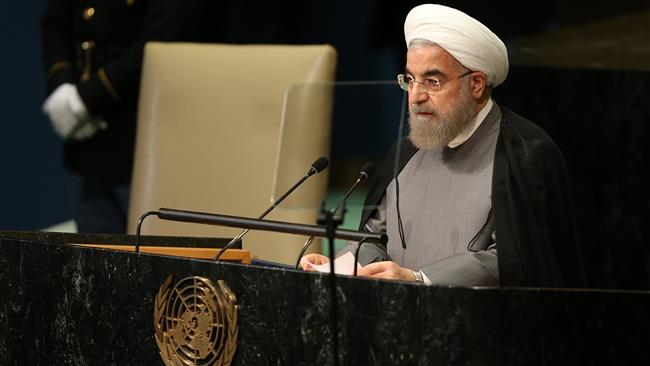
The Iranian president made the remarks during his speech at the 71st UN General Assembly session in New York on Thursday.
For the region to enjoy security and peace, “certain countries in the region must stop bombarding their neighbors and put an end to their support for Takfiri terrorist groups, accept their responsibility and take measures to compensate [for their acts],” the Iranian president added.
Rouhani said countries of the region are well capable of building their future and countering terrorism if they rely on their common grounds, including history and culture.
Pointing to the conflicts gripping regional nations, including the people of Syria, Iraq, Yemen, and the Palestinians, Rouhani warned against the unprecedented rise of violence in the Middle East and North Africa.
He described security as a global issue and said over the past years world powers have been advancing different methods of “repression and military intervention” under the pretext of removing security concerns for their people.
The issue of borderless terrorism and extremism could be blamed on the security strategies adopted by global powers over the past 15 years, Rouhani said, stressing that security in one part of the world could not be provided and guaranteed at the cost of destabilizing other parts of the globe.
Rouhani said Iran pursues the policy of “constructive cooperation” with its neighbors to contribute to regional security, adding that Tehran backs the development of the countries of the region.
Iran is opposed to sectarianism and any attempt aimed at fomenting sectarian rifts, Rouhani said, warning that certain countries seek to turn religious differences into tense confrontations for their own political gains.
Elsewhere in his speech, the Iranian president pointed to the landmark nuclear agreement reached between Iran and the six world powers in July 2015, and described the nuclear negotiations which resulted in the conclusion of the Joint Comprehensive Plan of Action (JCPOA) as an exemplary model of diplomacy.
He said the conclusion of the JCPOA put an end to a “fabricated crisis” about Tehran’s nuclear program and recognized the peaceful nature of the Iranian nuclear program.
“We should never forget that pressures, sanctions and illegal threats which aimed to dismantle all [Iranian] enrichment facilities failed, and today the [UN] Security Council and the International Atomic Energy Agency (IAEA) have officially recognized Iran’s peaceful nuclear program,” Rouhani said.
Iranian Foreign Minister Mohammad Javad Zarif (1st R) and other members of the Iranian delegation listen to the speech by Iran’s President Hassan Rouhani at the UN General Assembly on September 22, 2016. (Photo by president.ir)
He warned the United States against reneging on its commitments stipulated in the JCPOA and said any Washington’s delay in implementing the nuclear agreement would further discredit the US in the global arena.
“The US procrastination in fulfilling its commitments over the past months is a strategic mistake which needs to be compensated for immediately,” Rouhani added.
Following is the full text of the Iranian president’s address to the UN General Assembly:
In the name of God, the most Compassionate, the most Merciful
Praise be to Allah, Lord of the two Worlds, and peace be upon our Prophet Mohammad (PBUH) and his family and companions.
Mr. President,
I congratulate you on your election as the president of the 71st Session of the United Nations General Assembly and I hope that the decisions and initiatives taken by this Assembly play an effective role in resolving the problems that our world is currently facing.
Mr. President,
Mr. Secretary-General,
Excellencies,
Ladies and Gentlemen,
15 years have passed since the painful terrorist attack in this city; a disaster whose human dimensions moved the entire world. On that day, no one imagined that this occurrence would lead to larger disasters, resulting in a devastating war in the Middle East and the spread of insecurity across the globe. This war has sown the seeds of borderless terrorism everywhere on earth. Today, the most pressing question as to why we are facing such a situation should be on the agenda of international forums. We need to find out which approaches, policies and erroneous actions paved the way for the spread of insecurity throughout the world. And what would be the picture the world 15 years from now.
Security has become a global problem at a time when major powers are mainly focusing on advancing different methods of repression and military intervention under the pretext of creating a secure environment for their citizens. The genesis of borderless violent extremism and terrorism could be attributed to the security strategies developed by major powers in the past 15 years. The main lesson to learn from the analysis of this trend is that security in one region at the cost of insecurity in others would not only be impossible but it could also lead to more insecurity everywhere.
The terrorists even went as far as claiming to have established States in the Levant, Iraq and Libya. More unfortunately, they hide their nefarious intents behind religious literature, thus turning a compassionate religion into an instrument of violence and terror by spreading extremist and Takfiri propaganda. Regrettably, some powers have provided covert and overt support for these Takfiri groups or condoned their formation. The same powers are now committing atrocities against innocent people and their defenders under the guise of fighting terrorism.
Ladies and Gentlemen,
The century that began with terror and violence in New York should not continue with hostile competitions and expanding conflicts in the Middle East.
Today in fact, the discourse of hatred and violence in the Middle East and North Africa is spreading with an astonishing speed, and this region is stuck in a web of the most savage and destructive policies. Millions of Syrians are stranded in deserts and high seas, and hundreds of thousands of them are subjected to violent deaths. Iraqis of every ethnic group are concerned about their territorial integrity and the future of their homeland. The defenseless people of Yemen are subjected to daily aerial bombardment, and Afghanistan, following decades of occupation and atrocity, is yet to find comfort from suffering, violence and terror. The oppressed Palestinians are still afflicted by a web of apartheid policies and atrocities set by the usurping Zionist regime.
Undoubtedly, if the region is to reverse the current dangerous trend into one towards development and stability, certain countries must stop bombing their neighbors, and abandon supporting Takfiri terrorist groups; and, while accepting responsibility, try to compensate for past mistakes. If the Saudi government is serious about its vision for development and regional security, it must cease and desist from divisive policies, spread of hate ideology and trampling upon the rights of neighbors, accept its responsibility for the protection of the lives and dignity of pilgrims and construct its relations with the nations in the region on the basis of mutual respect and accountability.
The future of our region rests on dealing with fundamental challenges such as security crises, due to the inefficiency and the lack of legitimacy of governments. We won’t be able to combat criminal and terrorist networks without genuine democracy and without a real participatory approach at the national and transnational levels.
We believe that countries in our region can create their shared future through relying on their common history and culture and isolating terrorist groups. We should never allow our region to run once again the risk of a new dismemberment following the one that took place close to a century ago.
Mr. President,
Iran’s principled approach calls for constructive partnership with our neighbors with a view to establishing an enduring order based on shared security and efforts aimed at enhancing the development of the countries in the region and mutually beneficial economic cooperation. To uproot violence in the region, there is no choice but to focus on promoting democracy, citizenship rights and economic development.
Iran opposes any kind of sectarianism and any attempt to promote religious gaps. The Muslim people, be they Shi’as or Sunnis, have and continue to live together for centuries in harmony and mutual respect. Attempts to turn religious dissimilarities into tense confrontations is rooted in vested interests of certain countries, which try to hide their quest for power covered in religious slogans.
Iran considers it imperative to preserve territorial integrity of States, keep national borders intact, enhance peoples’ right to self-determination and uphold the principle of refraining from the threat or use of force. We also reiterate the need to use diplomacy for conflict resolution.
Mr. President,
Excellencies,
Despite today’s difficulties, I have hope in tomorrow. I have no doubt that we can prevail through prudence and wisdom. The experience acquired through dialogue between Iran and the group of 5+1 and the fruition of the Joint Comprehensive Plan of Action (JCPOA) are indicative of the success that we could achieve through moderation, constructive interaction and the promotion of dialogue; a policy that brought a long, complicated and unnecessary crisis to an end by adopting a win-win approach. This deal confirmed the peaceful nature of Iran’s nuclear program through devising confidence-building mechanisms, closing the so-called “possible military dimension” file and reinstating Iran’s right to develop a peaceful nuclear program. This deal also put an end to unfounded concerns and led to the removal of the brutal sanctions against Iran.
Beyond the nuclear file, however, the JCPOA contains important lessons for resolving complicated international problems. This deal is not only a political agreement, it also represents a creative approach and method for constructive interaction with a view to peacefully resolving crises and challenges. To learn lessons from the JCPOA and put them towards improving international relations, we should never forget that pressures, sanctions and illegal threats against the Iranian people, which sought to fully dismantle Iran’s enrichment program, were all defeated. And today, the Security Council and the IAEA have formally accepted Iran’s peaceful nuclear program.
The US is fully aware that JCPOA constitutes a recognized multilateral agreement, and any failure on the part of the United States in implementing it would constitute an international wrongful act and would be objected to by the international community. Any failure in implementing the JCPOA will further erode the credibility of the United States in the world. The lack of compliance with the JCPOA on the part of the United States in the past several months represents a flawed approach that should be rectified forthwith. Unfortunately, such illegal actions are not unprecedented: the latest case in point is the
US Supreme Court ruling to seize billions of dollars of the Iranian people’s assets. This experience demonstrated that the Zionist pressure groups could go as far as having US Congress pass indefensible legislations forcing the highest American judicial institution to violate preemptory norms of international law.
Ladies and Gentlemen,
With God’s help, the Iranian people’s endurance and the increasing participation of Iran ‘s international partners from different regions, only 8 months after the removal of the cruel nuclear-related sanctions, the economy of Iran , as the most secure and most profitable investment destination in the region, is showing clear improvement. Iran ‘s economic growth rate surpassed 4 percent in Spring 2016, the inflation rate dropped to single digits, and Iran has come close to pre-sanction level of oil production and export. All in all, we are witnessing more development in the economic, scientific and technological fields in Iran .
Iran is one of the rare oil-producing countries that could offset the shocking impact of the sharp slide in oil price in 2014. We are intent on strengthening economic stability and consistency, thus encouraging more investment, through economic reforms and fiscal and financial discipline, while preserving our low-inflation achievement. The economic growth is to increase to around 5% by the end of 2016. Currently, based on all domestic and international prediction, Iran is enjoying one the highest growth rates among the oil-producing countries.
Excellencies,
To conclude, let me emphasize that, despite all hardships, I deeply believe that moderation will prevail over extremism, peace will triumph over violence, enlightenment will overcome ignorance, and finally justice will rise above injustice. What is important is that belief, hope and efforts are towards realizing peace and justice and there is no doubt that the Almighty will assist all those who endeavor towards peace, justice and moderation.
Thank You Mr. President
Shiraz and its legendary Persepolis, a must-see destination for tourists visiting Iran. The picture shows a tourist watching a famous statue.
Although the exact date of the construction of the garden is not clear, historical evidence suggests it was constructed during the Seljuk Dynasty on the orders of the celebrated Seljuk monarch Sanjar as many other gardens were planted during his reign.
Like many other historic monuments in the southern city of Shiraz, it was restored and repaired by the Zand kings (1750-1794).
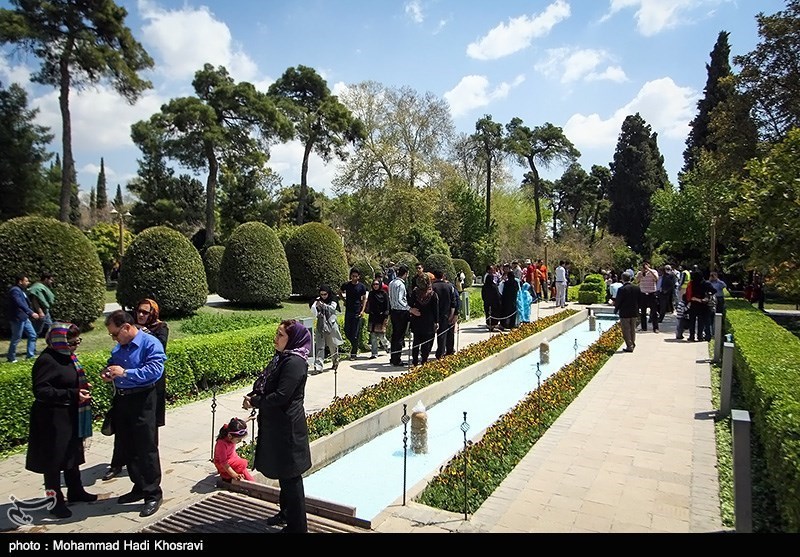
During the late Zand Dynasty, the garden was owned by Qashqai tribal chiefs. A Qashqai tribal chief, Mohammad Qoli Khan, ordered the construction of the original mansion in the early eighteenth century, planting the garden with different trees including cypress, pine, orange and persimmon trees.
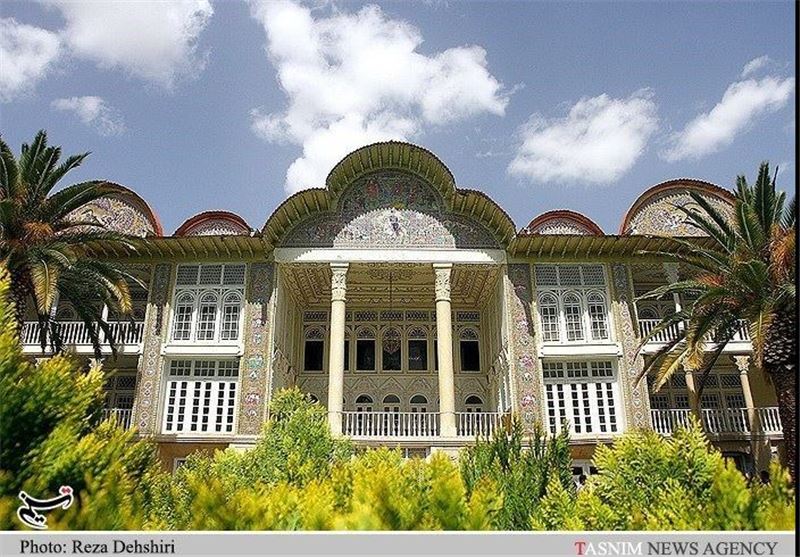
During the reign of King Nasser ed-din of the Qajar Dynasty, Mirza Hassan Ali Khan Nasir-al Mulk bought the gardens from the Qashqai tribes and constructed the present pavilion which was designed by a famous Shirazi architect, Mohammad Hassan.
The decoration of the pavilion was completed by Hassan Ali Khan’s son Abol Qassem Khan who inherited the garden after his father.
The garden finally went to Abol Qassem Khan’s son Abdullah Qavami who sold it to Qashqai tribes once again.
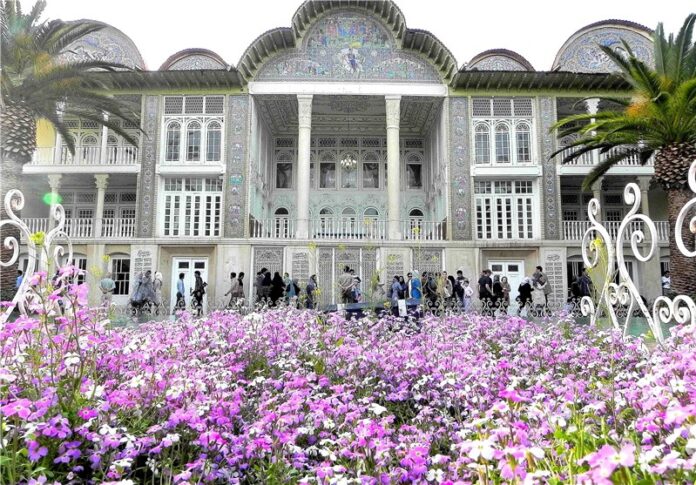
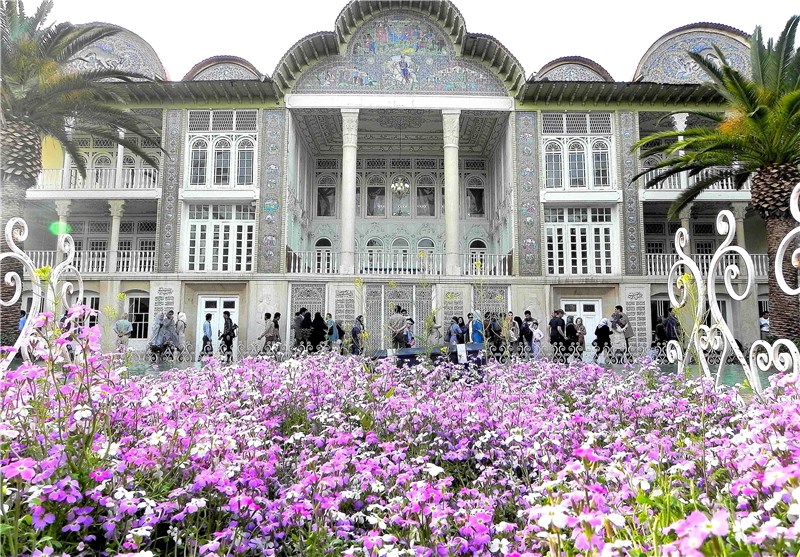
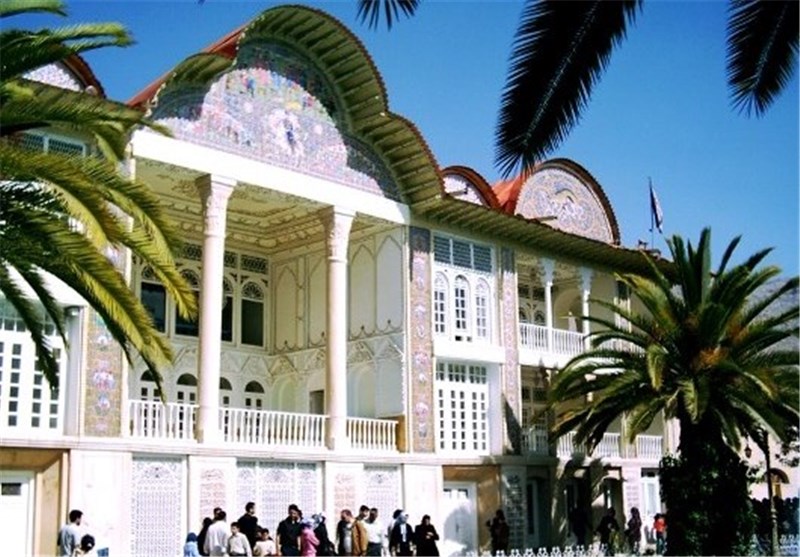
The beautiful three-story pavilion of the garden was constructed based on Safavid and Qajar style of architecture.
The lower story of the mansion has an impluvium especially designed for relaxation during the hot days of summer. The ceiling of this structure is beautifully adorned with colorful tiles. A small stream also passes through it, connecting to a large pool in front of the building.
The middle storey has a large veranda erected on two pillars behind which stands a magnificent hall. On the two sides of the hall there are two corridors each having 4 rooms and two small terraces. The front sides of the pillars are decorated with tiles showing the images of horsemen and flowers.
The upper story consists of a large hall whose windows open to the main veranda. It is also surrounded by two corridors leading to two terraces.
On the entablature of the building there are three arched (semi-circular, crescentic) pediments ornamented with tile work.
The middle pediment, being larger than the other two, shows Nasser ed-din Shah on the back of a white horse.
Around this picture, some scenes based on storied from the works of Ferdowsi and Nezami (two famous poets) can be seen.
One of the small pediments represents an image of Darius the Great (the founder of the Achaemenid Dynasty) as represented in Persepolis monuments.
And finally the third pediment illustrates a deer being hunted by a panther.
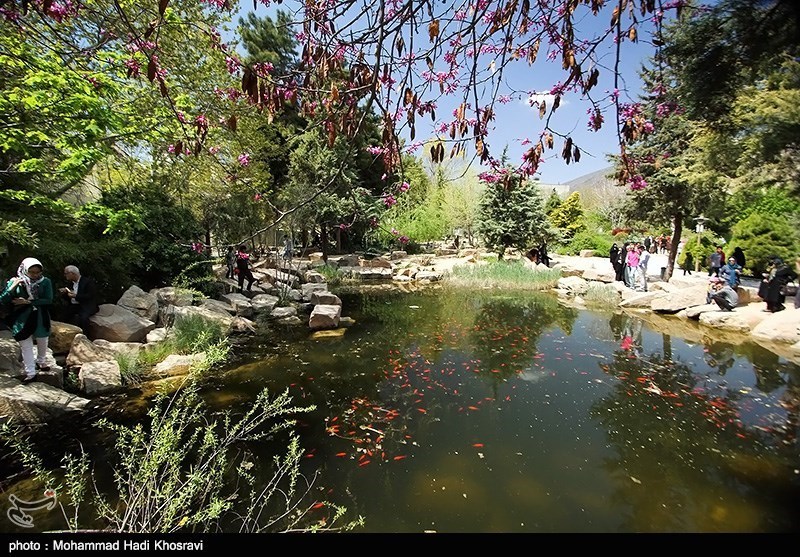
The garden with its beautiful flowers, refreshing air, tall cypresses (a stately, beautiful cypress tree there known as sarv-e naz which is said to go back to 3000 years ago) and fragrant myrtles is a major tourist destination especially in the spring.
Now a property of Shiraz University, it has been turned into a botanical garden and is open to the public as a museum. The mansion has also been assigned to the Faculty of Law of the university.
It has been named after a legendary garden called Eram in southern Arabia, built by order of Shaddad, an Arab king, to compete with Paradise.
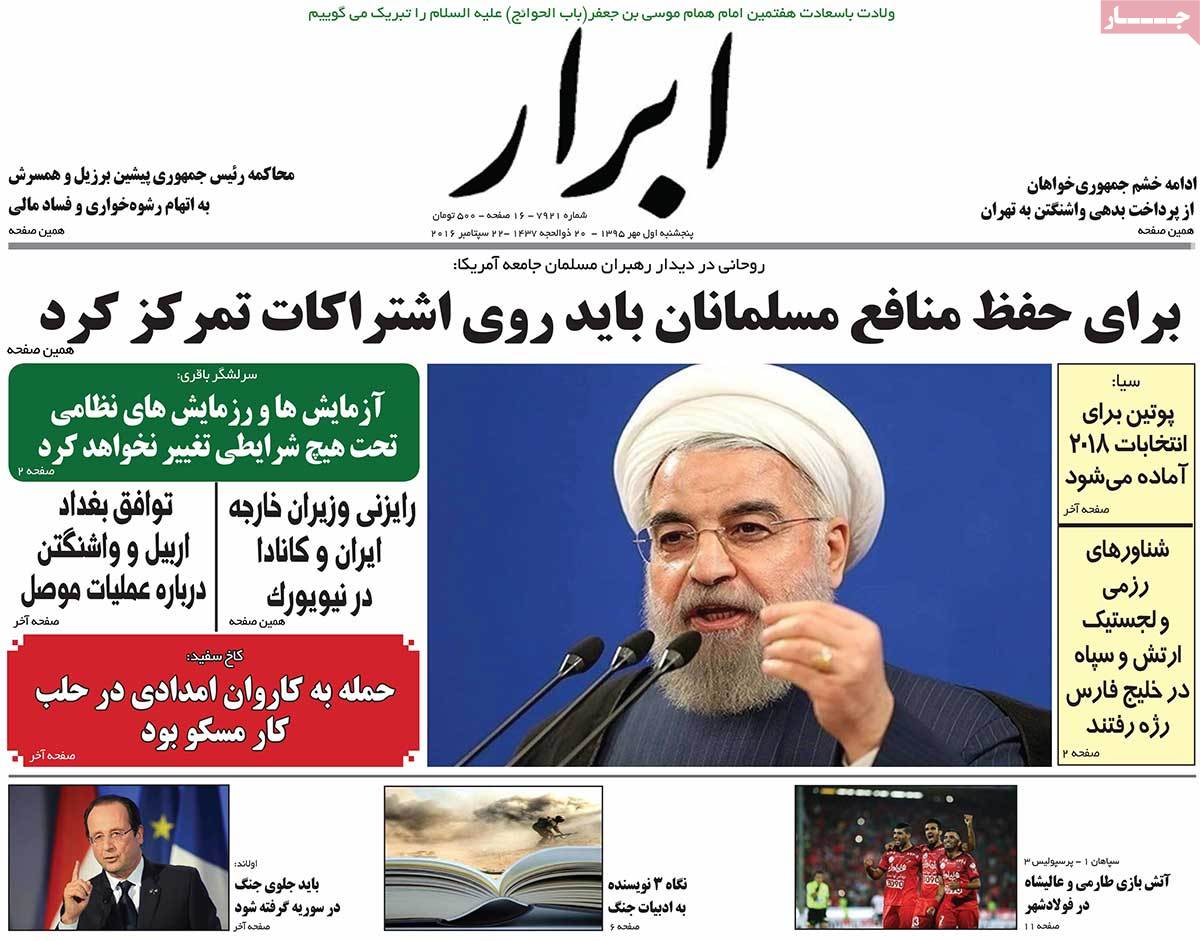
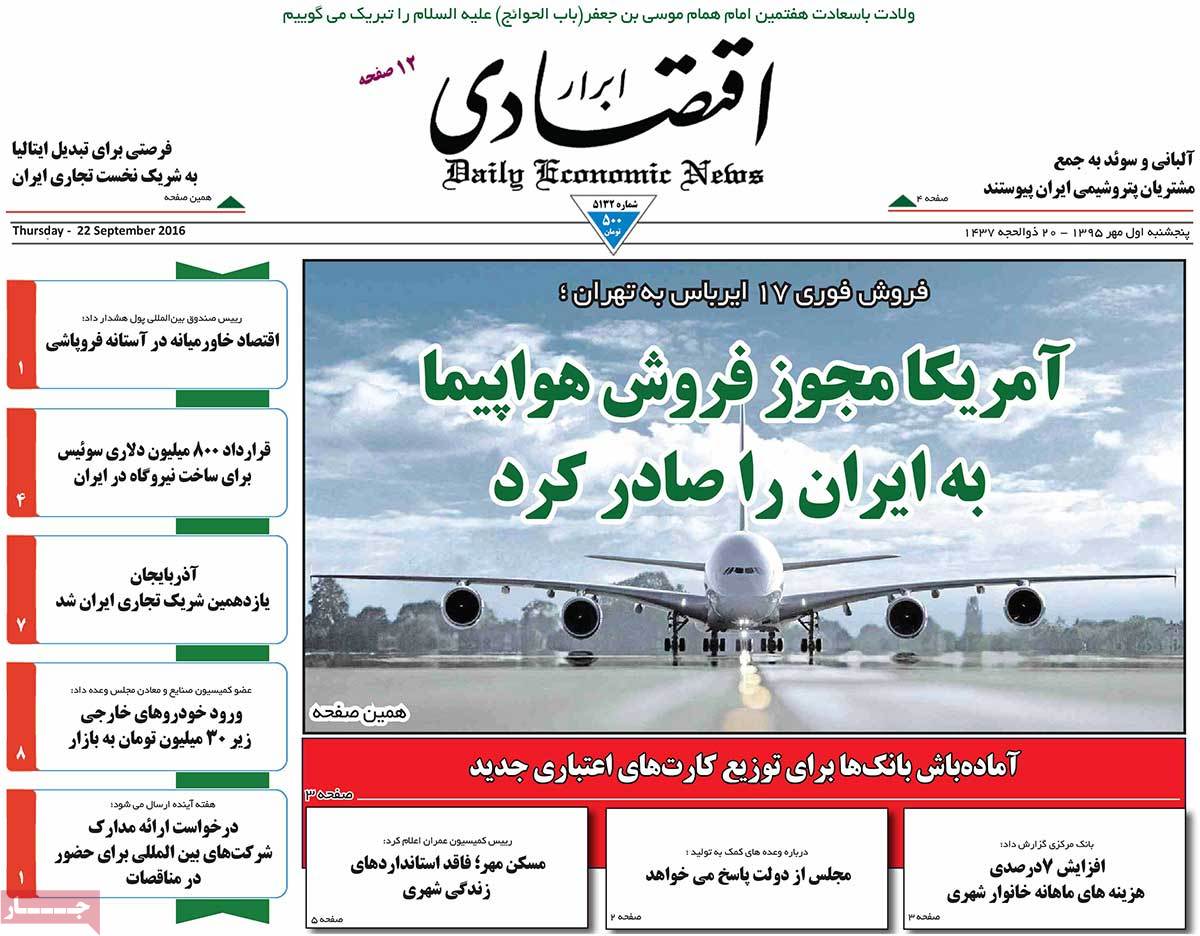
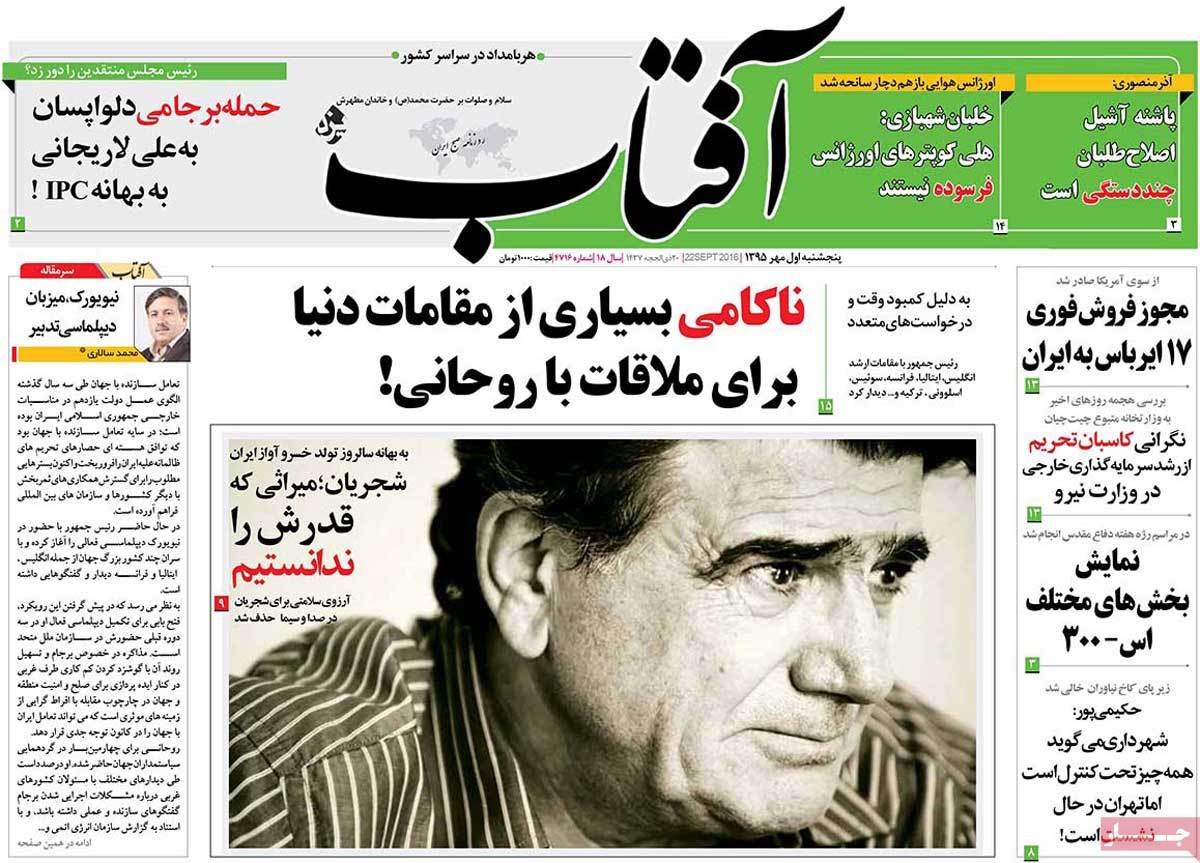
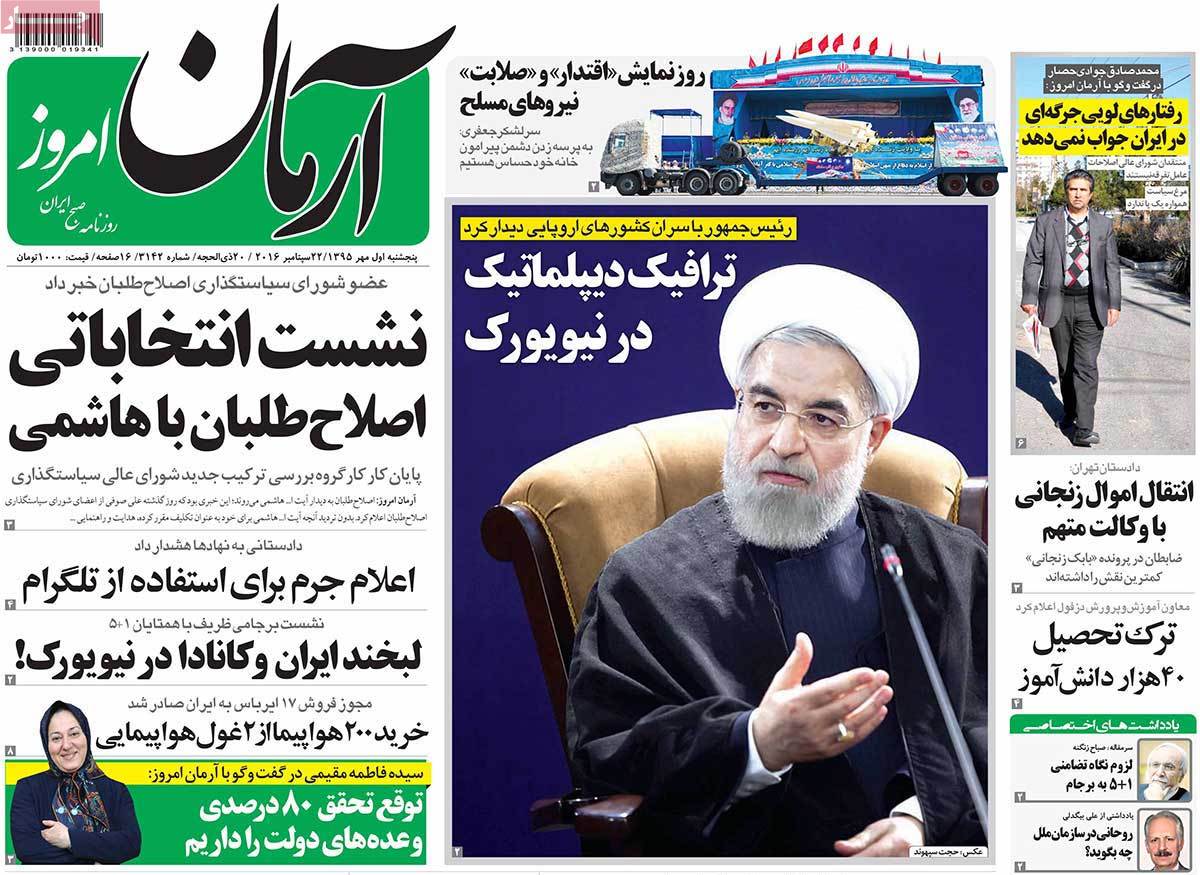
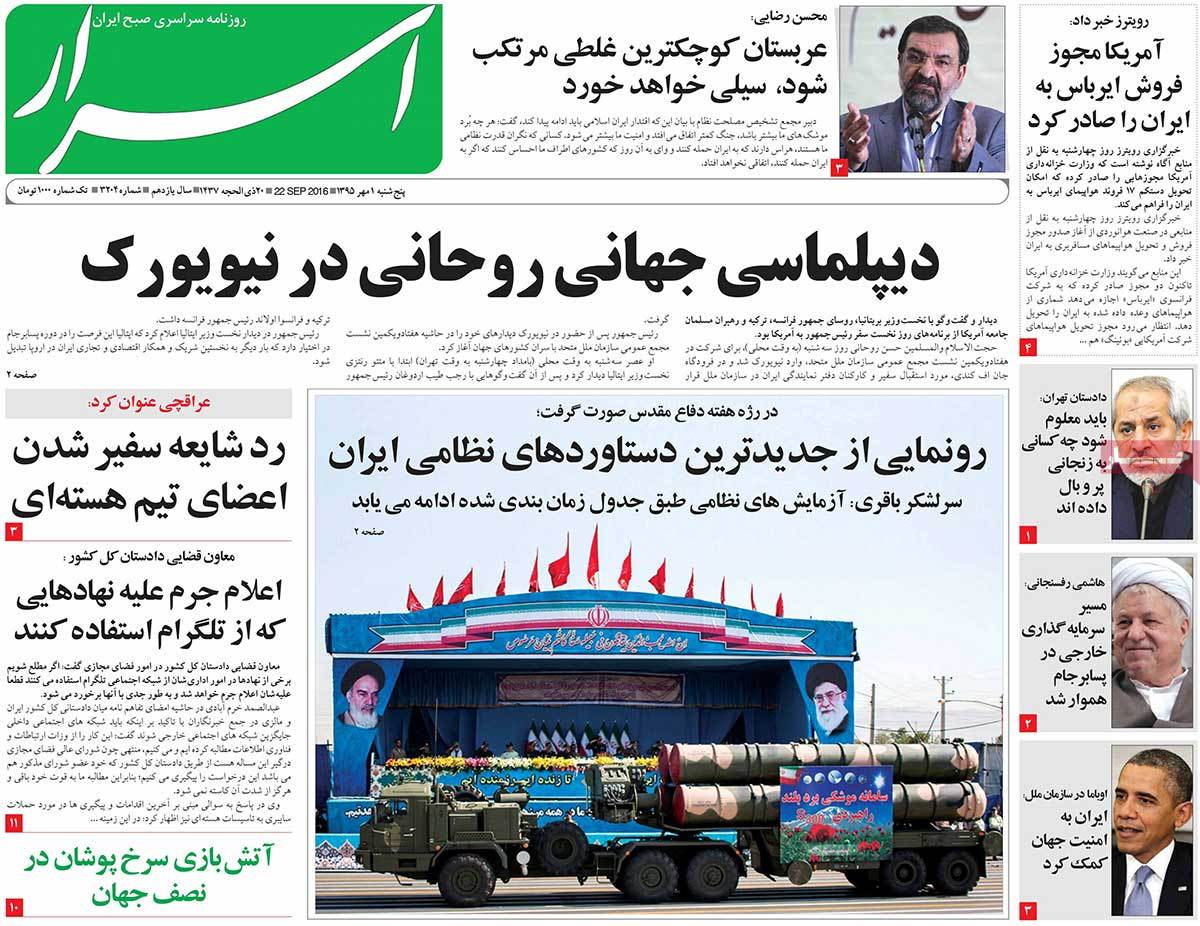
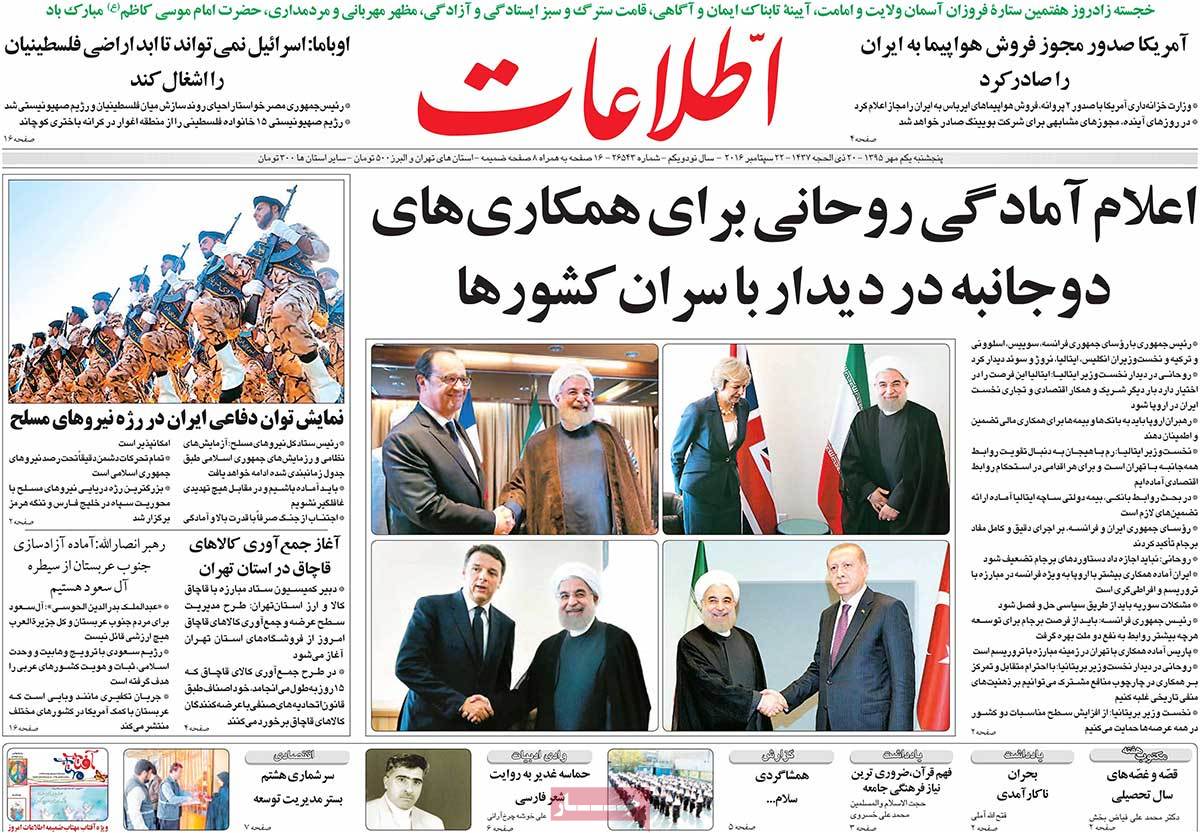
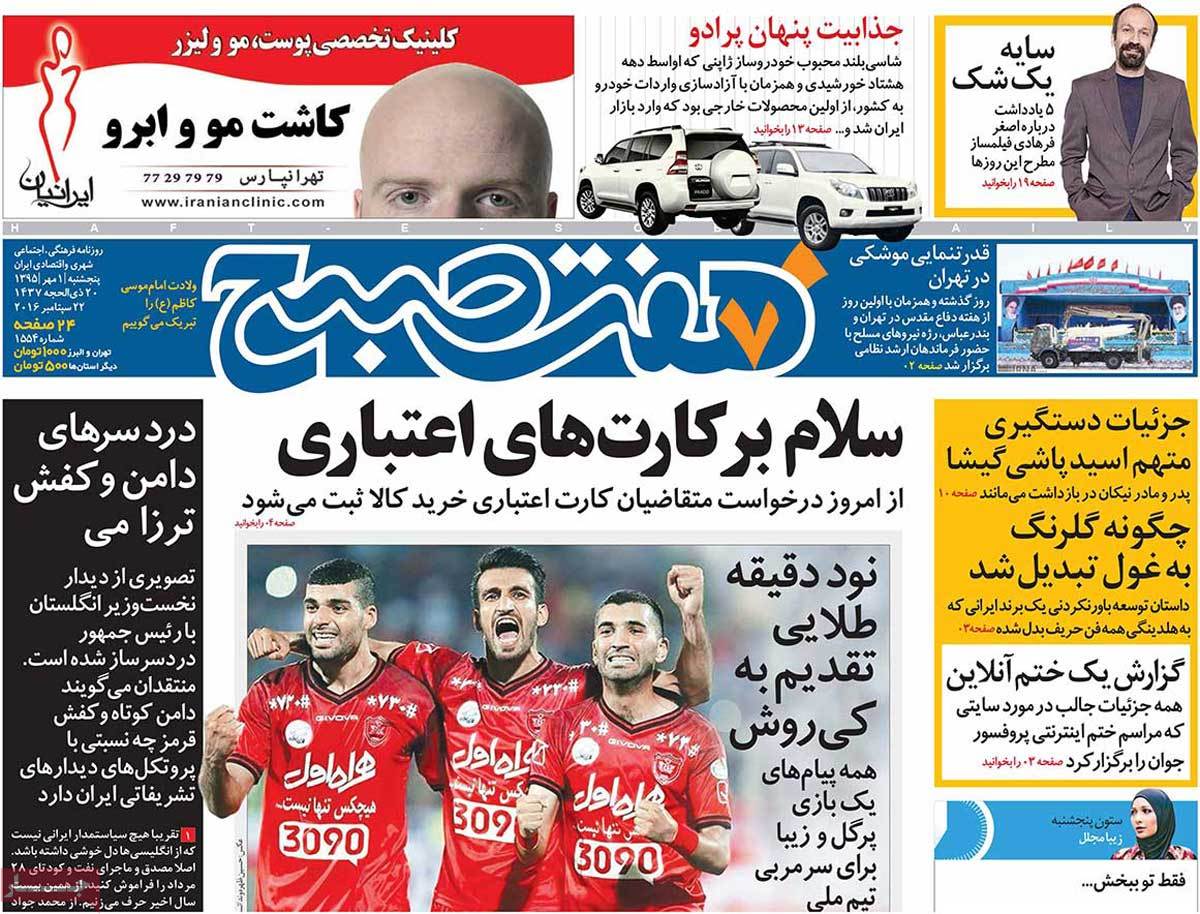
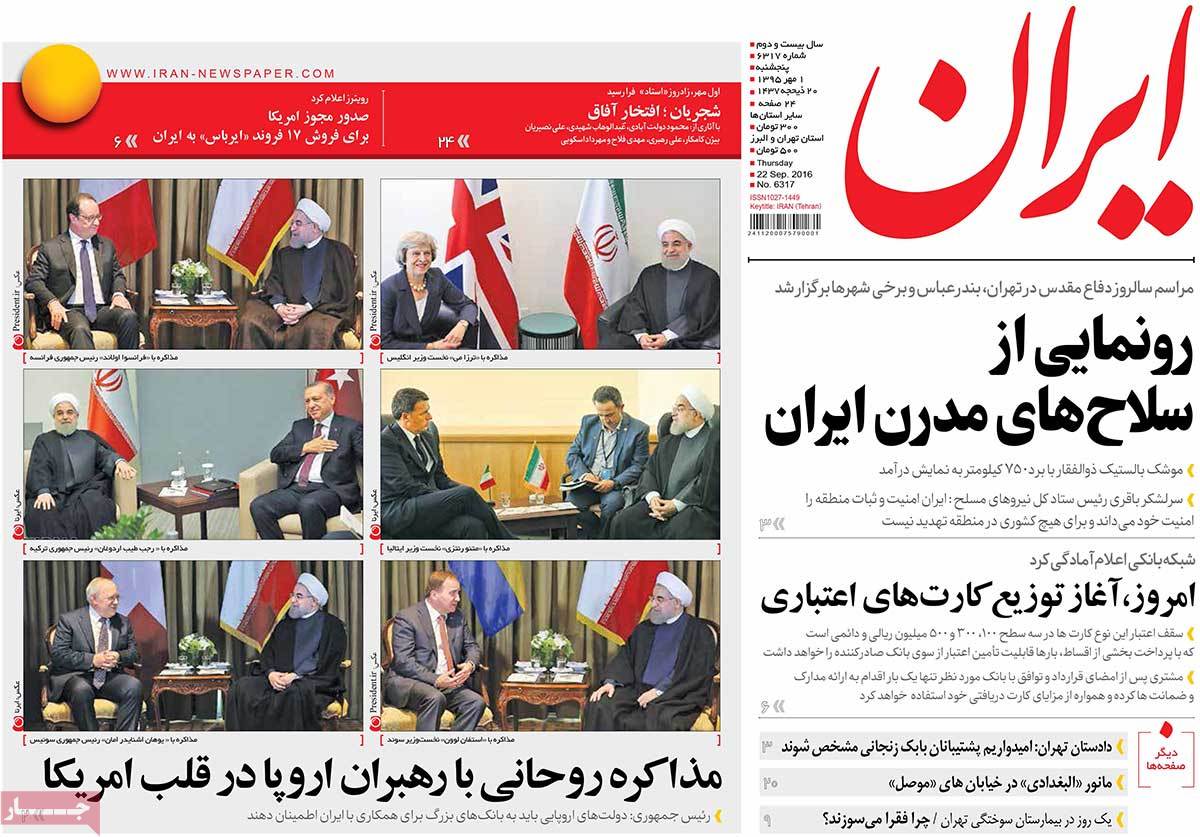
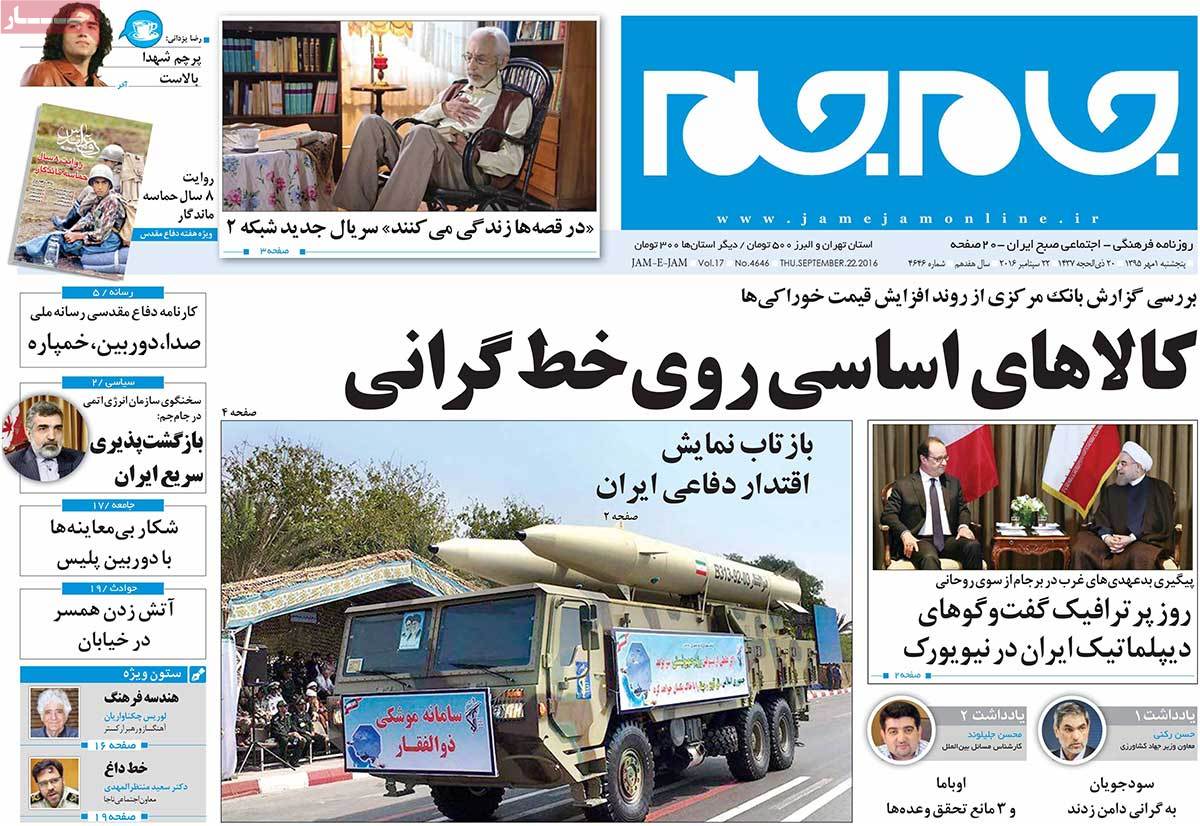
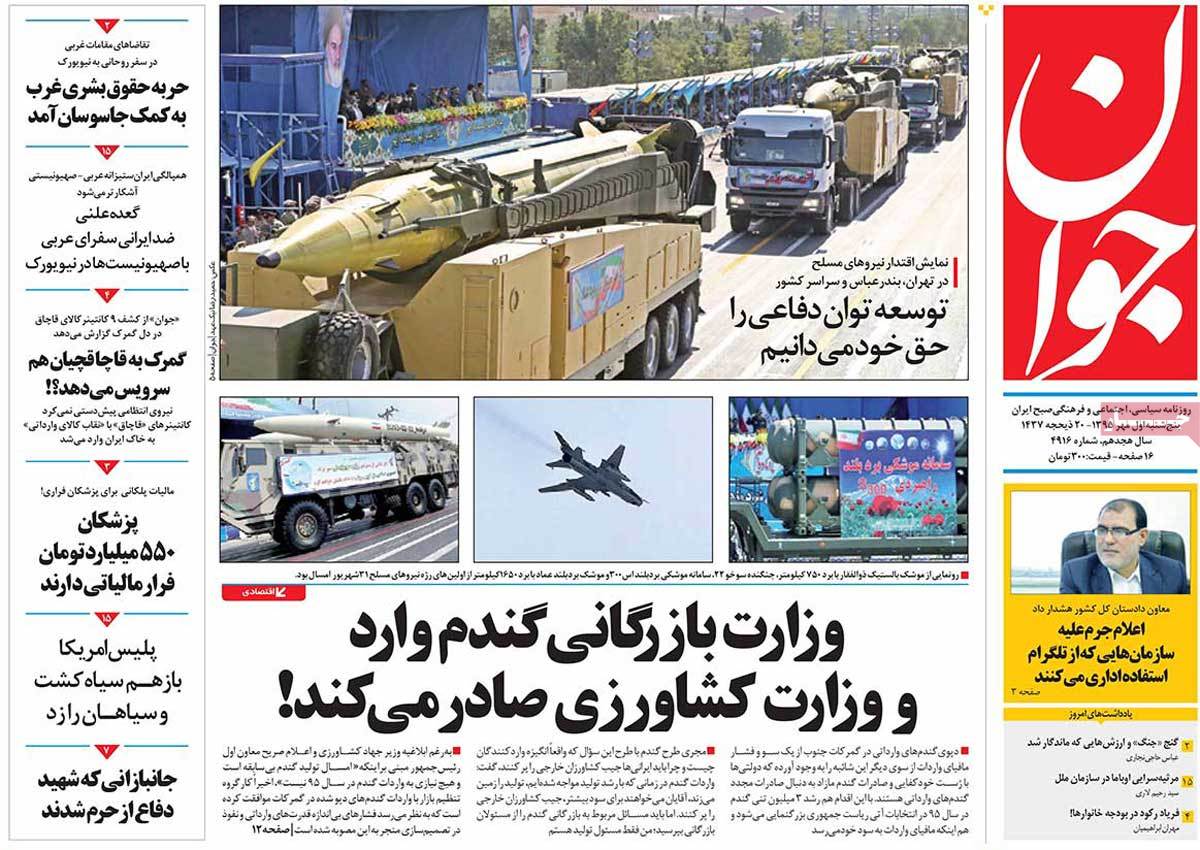
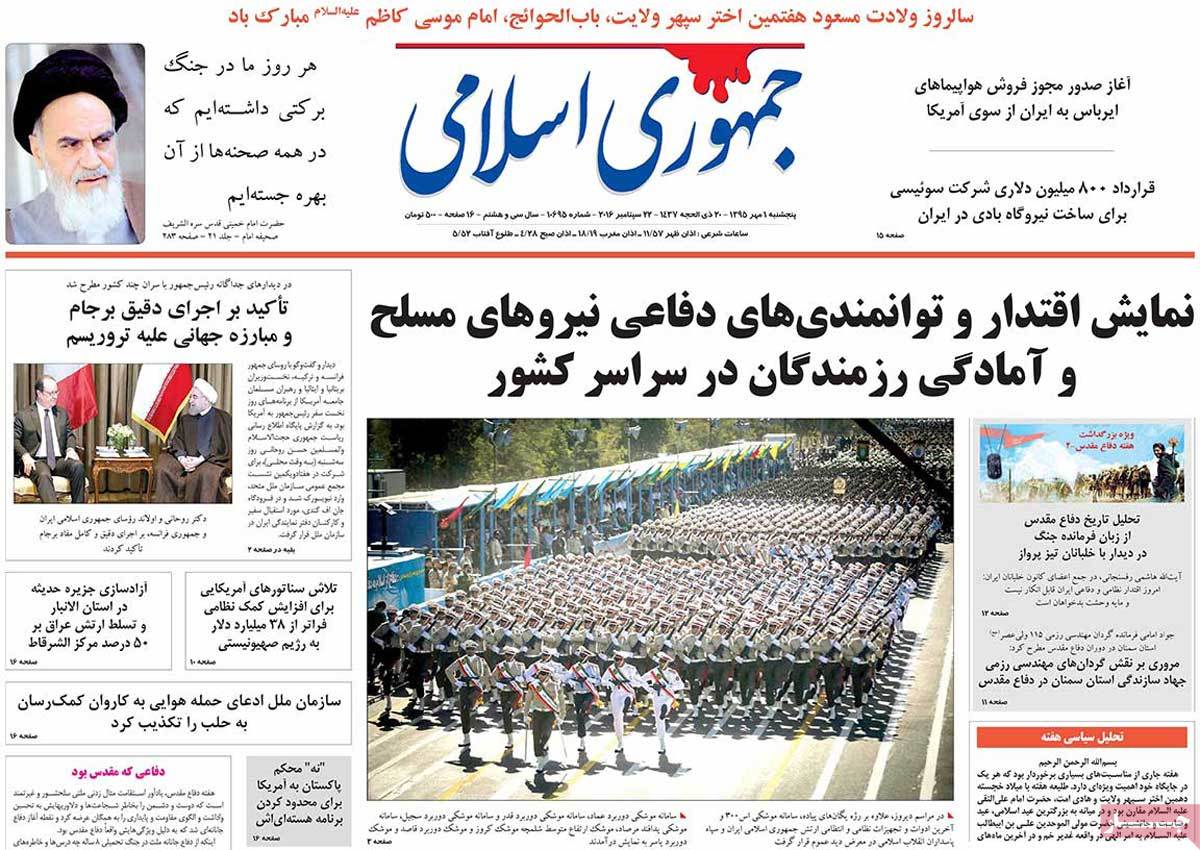
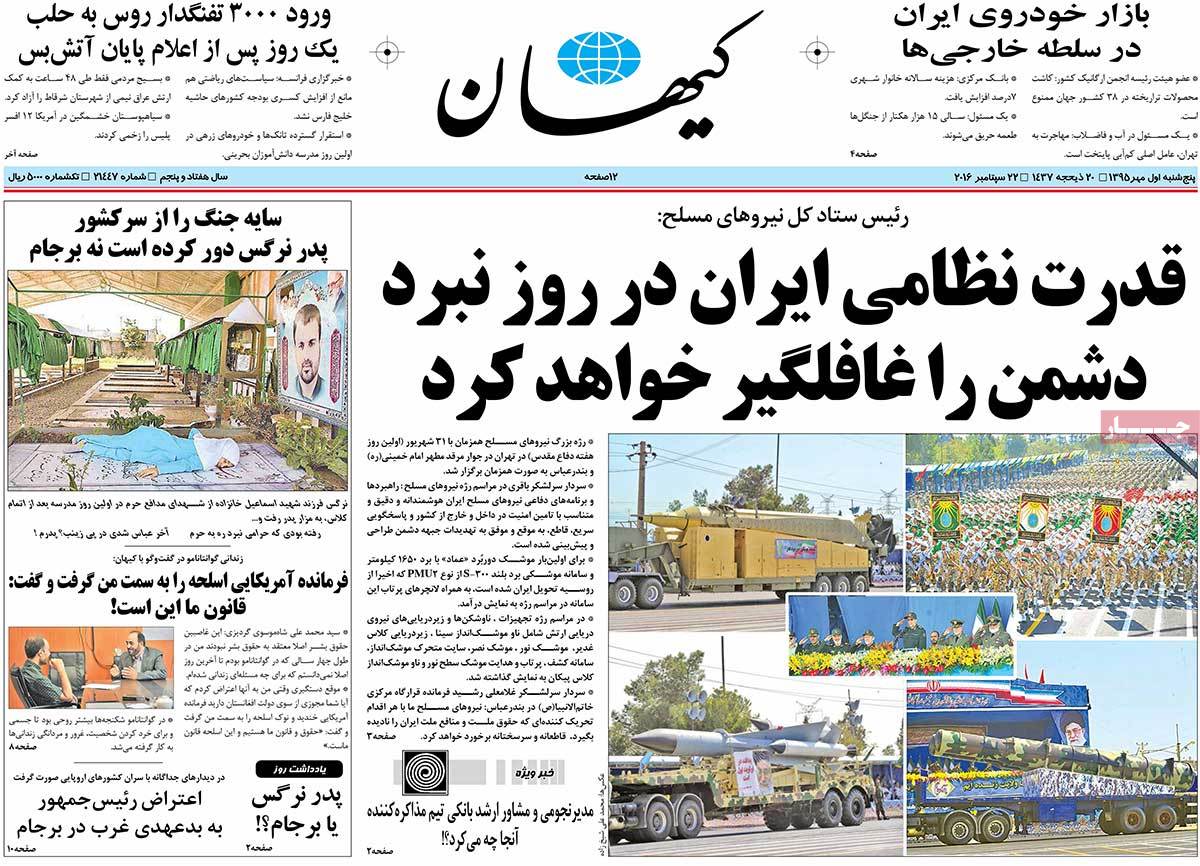
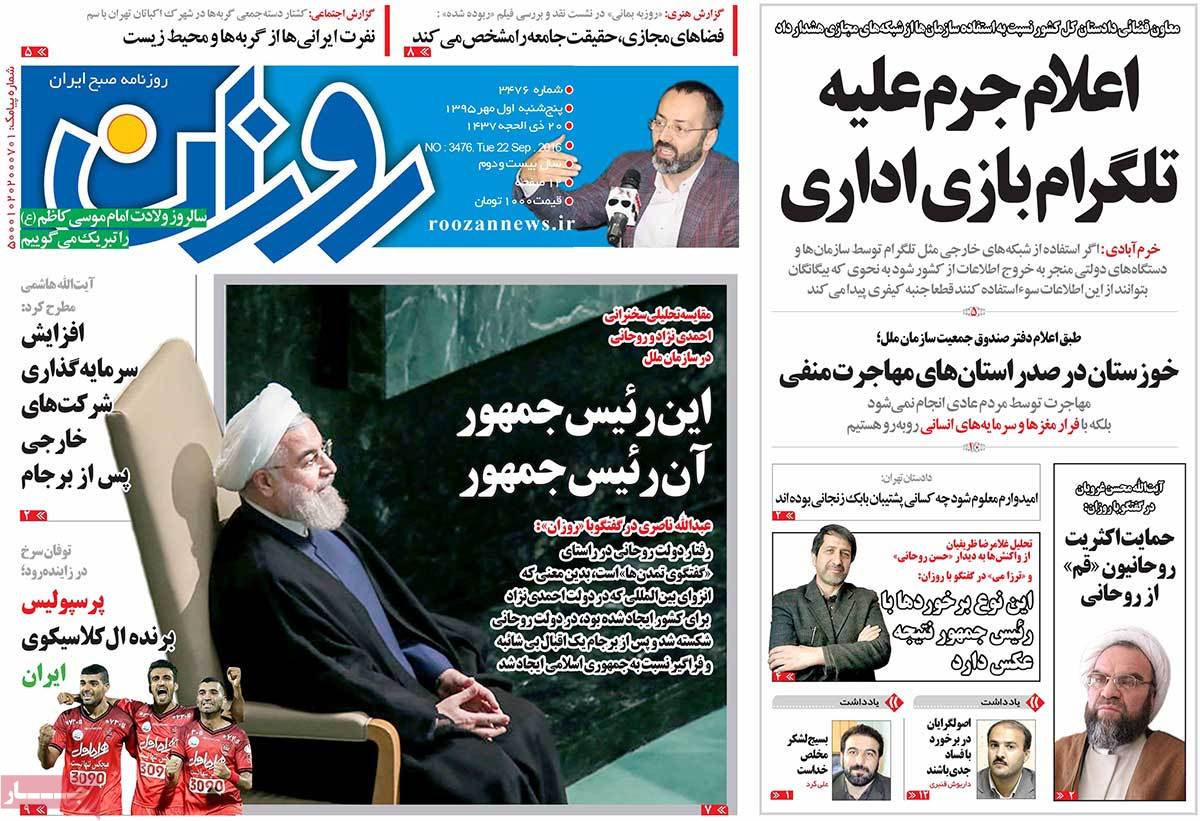
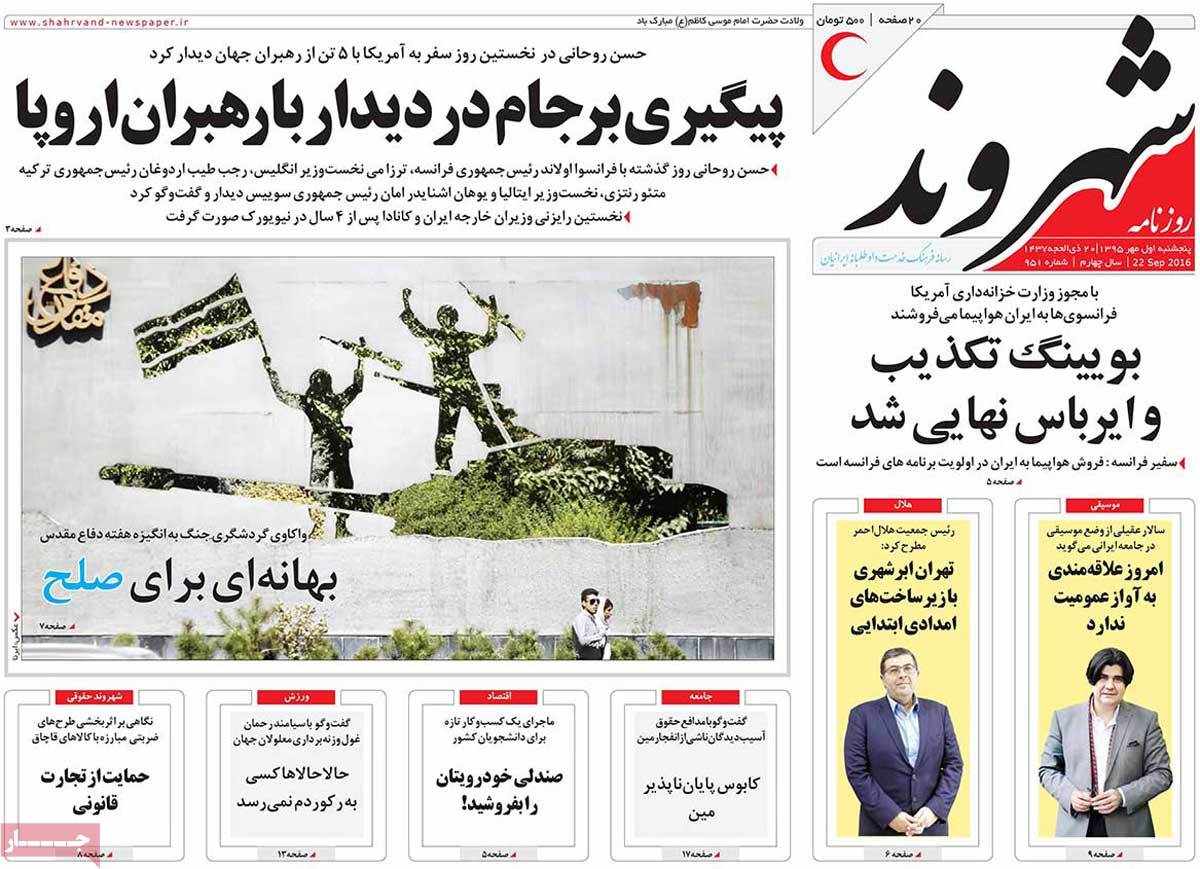
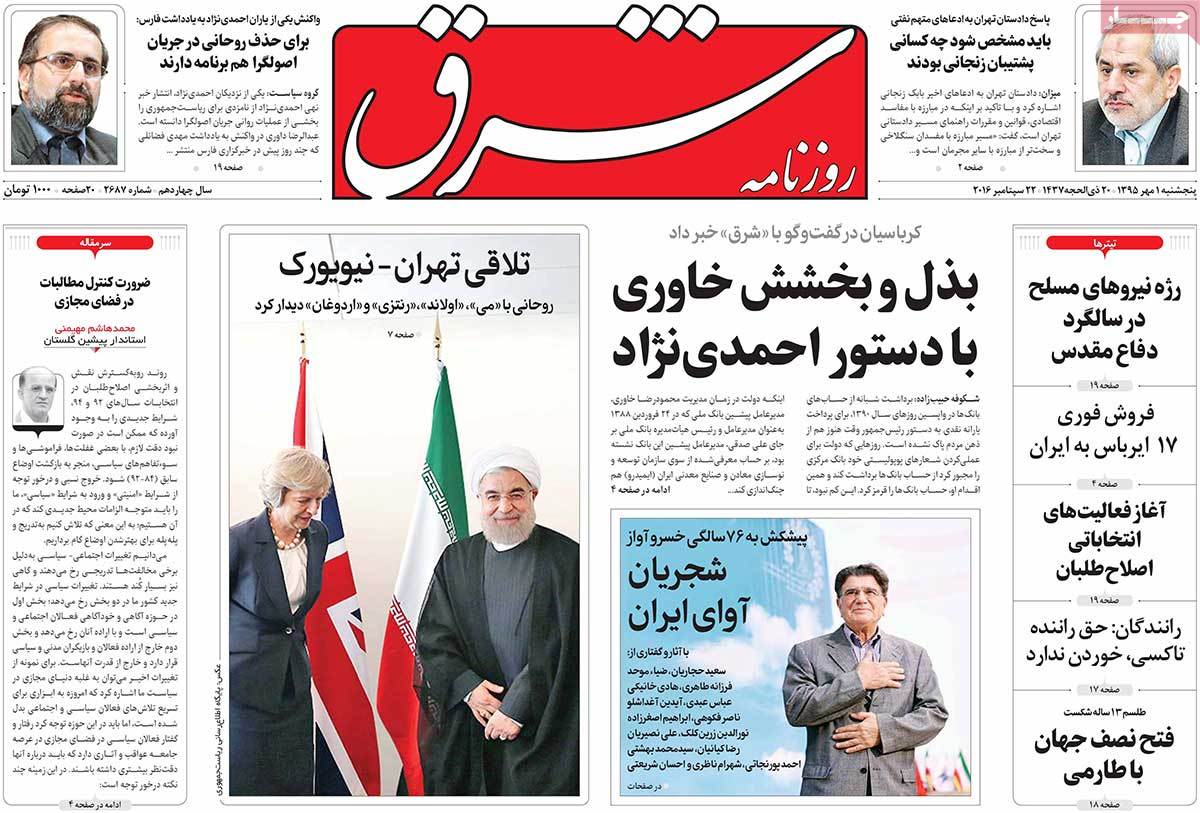
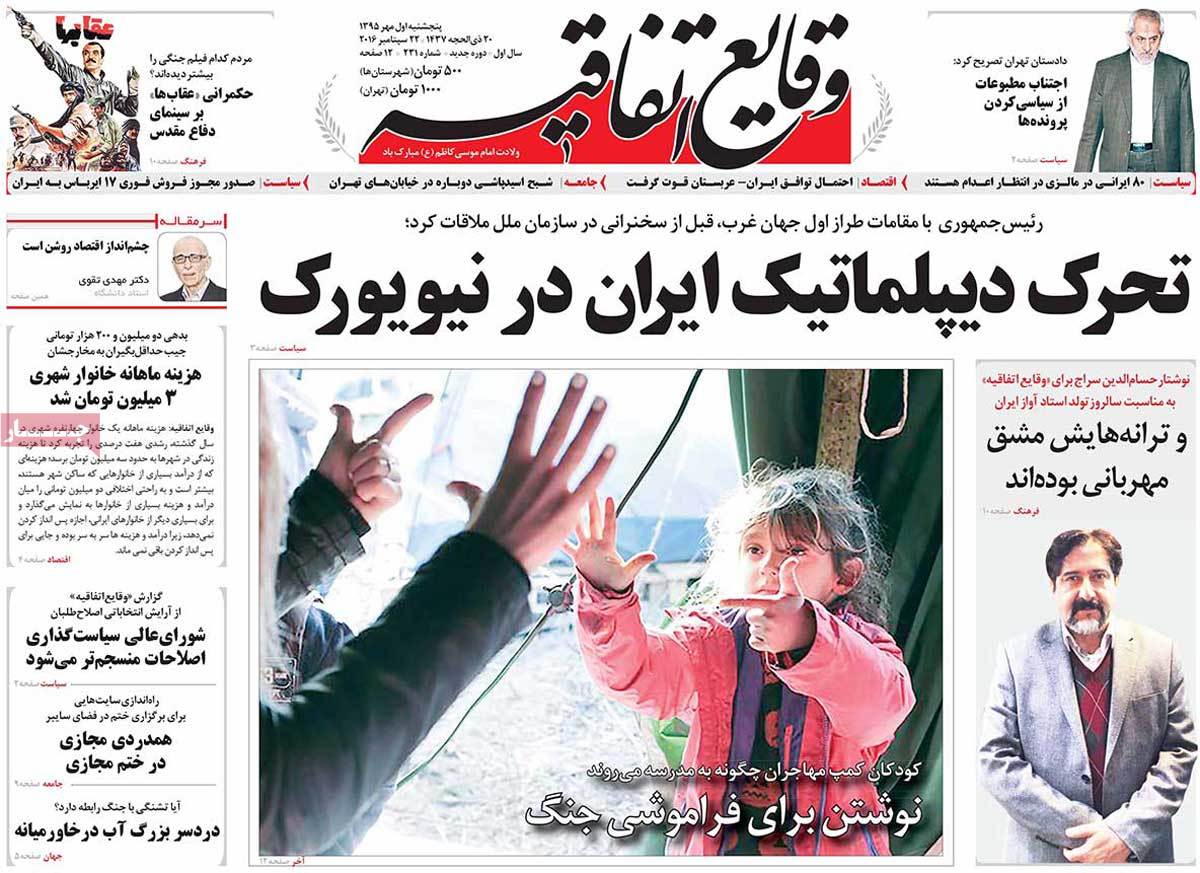
The majority of newspapers on Thursday covered the meetings between President Hassan Rouhani and world leaders on the sidelines of the ongoing United Nations General Assembly in New York City.
They also covered the nationwide parades and the display of Iran’s military capabilities on the anniversary of the onset of Iraqi imposed war.
Many newspapers, particularly the reformist ones, published special reports and articles about Mohammad Reza Shajarian, the well-known Iranian singer, on his 76th birthday anniversary, who is suffering from cancer these days. He has been censored by the Islamic Republic of Iran Broadcasting (IRIB) and barred from holding concerts in Iran since 2009.
The above issues, as well as many more, are highlighted in the following headlines:
Abrar:
1- We Should Focus on Commonalities to Protect Muslims’ Interests: Rouhani
2- Iranian and Canadian FMs Hold Talks in New York
3- GOP’s Continued Anger at White House’s Payment of Its Debts to Iran
4- Putin Getting Prepared for 2018 Elections: CIA
Abrar-e Eqtesadi:
1- Albania and Sweden Join Customers of Iran’s Petchem Products
2- An Opportunity for Italy to Become Iran’s First Trade Partner
3- Middle East’s Economy on Verge of Collapse: IMF Chief Warns






 Photos by Tasnim, Text by Press TV