Sunday, December 28, 2025
Home Blog Page 4226

US Claims of Chopper Harassment in Hormuz Strait ‘Propaganda Campaign’: IRGC

IRGC

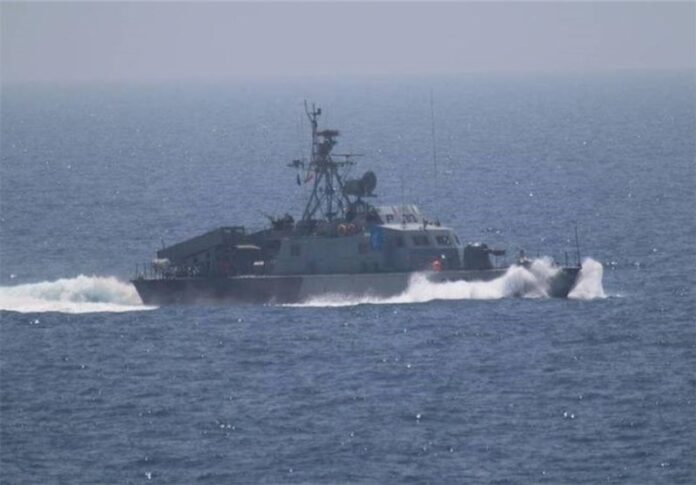
Reports by US officials that a patrol vessel of the IRGC naval forces recently pointed its weapon at a US Navy helicopter in the Strait of Hormuz is part of the US “propaganda” campaign against the Islamic Republic, an informed source at the IRGC Navy said in a statement on Tuesday.

“Some US officials occasionally repeat such allegations. It shows that they are seeking certain goals beyond their propaganda campaign (against Iran). Therefore, we tell them with emphasis: Stop the propaganda; you are the problem,” the source said.

On Monday, two US defense officials, speaking on condition of anonymity, claimed an IRGC patrol vessel on Saturday pointed its weapon at its helicopter in the Strait of Hormuz in an “unsafe and unprofessional” encounter.

They claimed the incident took place when a US Navy MH-60 helicopter flew within half a mile (0.8 km) of two Iranian vessels in international waters.

One of the vessels pointed a weapon at the helicopter, they added.

It is no secret to anyone that the main problem is the presence of American military forces in the Persian Gulf, the source said, noting that via “inappropriate” and “unprofessional” behavior, Americans are attempting to show that the security situation is the region is not normal.

The source added that Iranian military forces, regardless of enemies’ propaganda, will continue monitoring all movements in the Persian Gulf and the Strait of Hormuz to secure maritime routes and establish security in the region.

In a similar development on August 25, Pentagon officials said Iranian speedboats had “harassed” US warships in the Strait of Hormuz.

They said Iranian boats sped close to two US Navy destroyers with their weapons uncovered in the Strait of Hormuz in an “unsafe and unprofessional” encounter.

A day later, Iran’s Defense Minister Brigadier General Hossein Dehqan vowed that the Islamic Republic would confront any vessel intruding into its territorial waters.

Iran has invariably stressed that it only uses its naval might for defensive purposes and to send across the Islamic Republic’s message of peace and security to other nations.
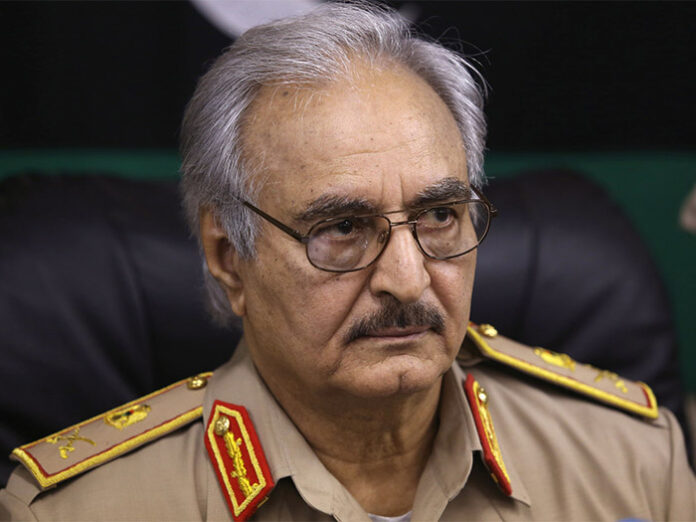
Libya’s Army Chief Meets Russian Defence Minister in Moscow

General Haftar

According to a report covered by Kayhan newspaper, General Haftar also met on Monday with Russian Foreign Minister, Sergei Lavrov, and the Russian National Security Council chief, Nikolai Patrushev.

General Haftar arrived in Moscow on Sunday following an official invitation from Russia in order to strengthen relations between the two countries and discuss the current situation in Libya and common issues.

Haftar visited Moscow earlier in June and met with the Russian defence minister and the Russian National Security Council chief, Middle East Monitor reported.

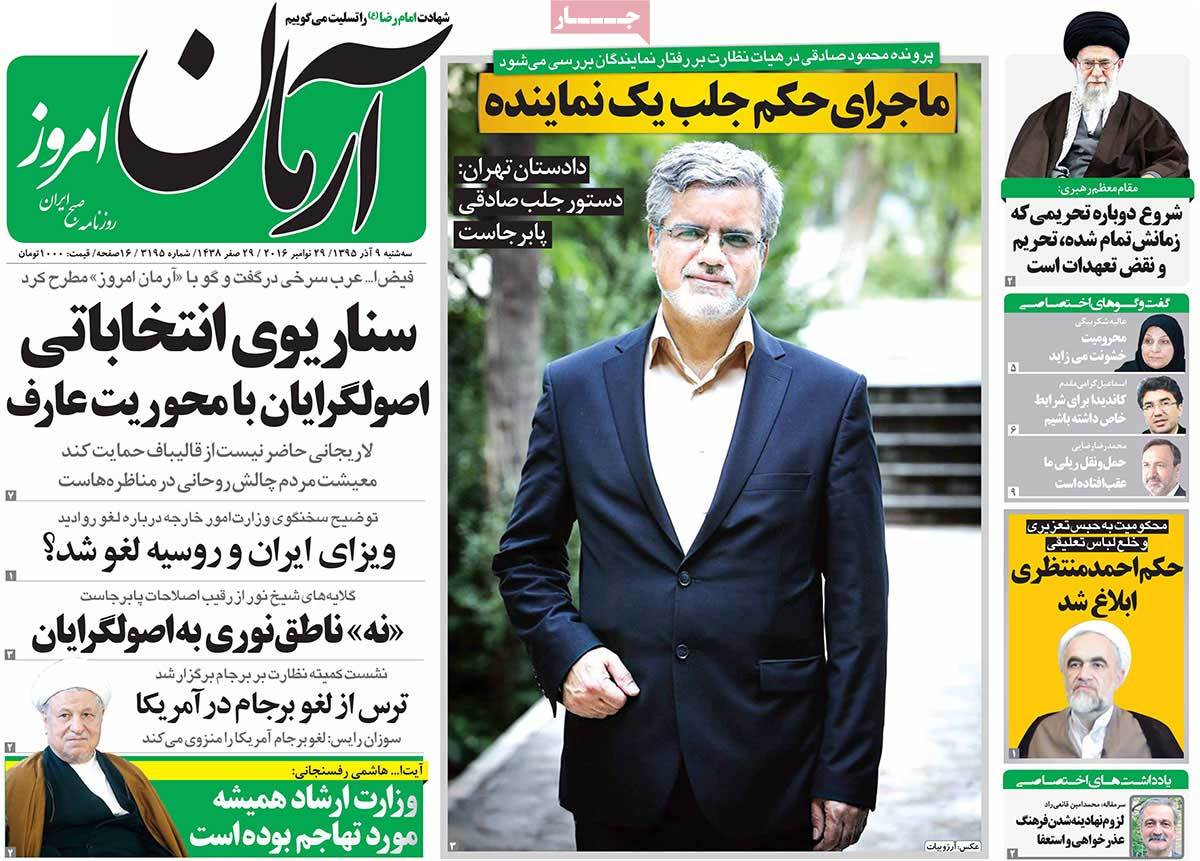
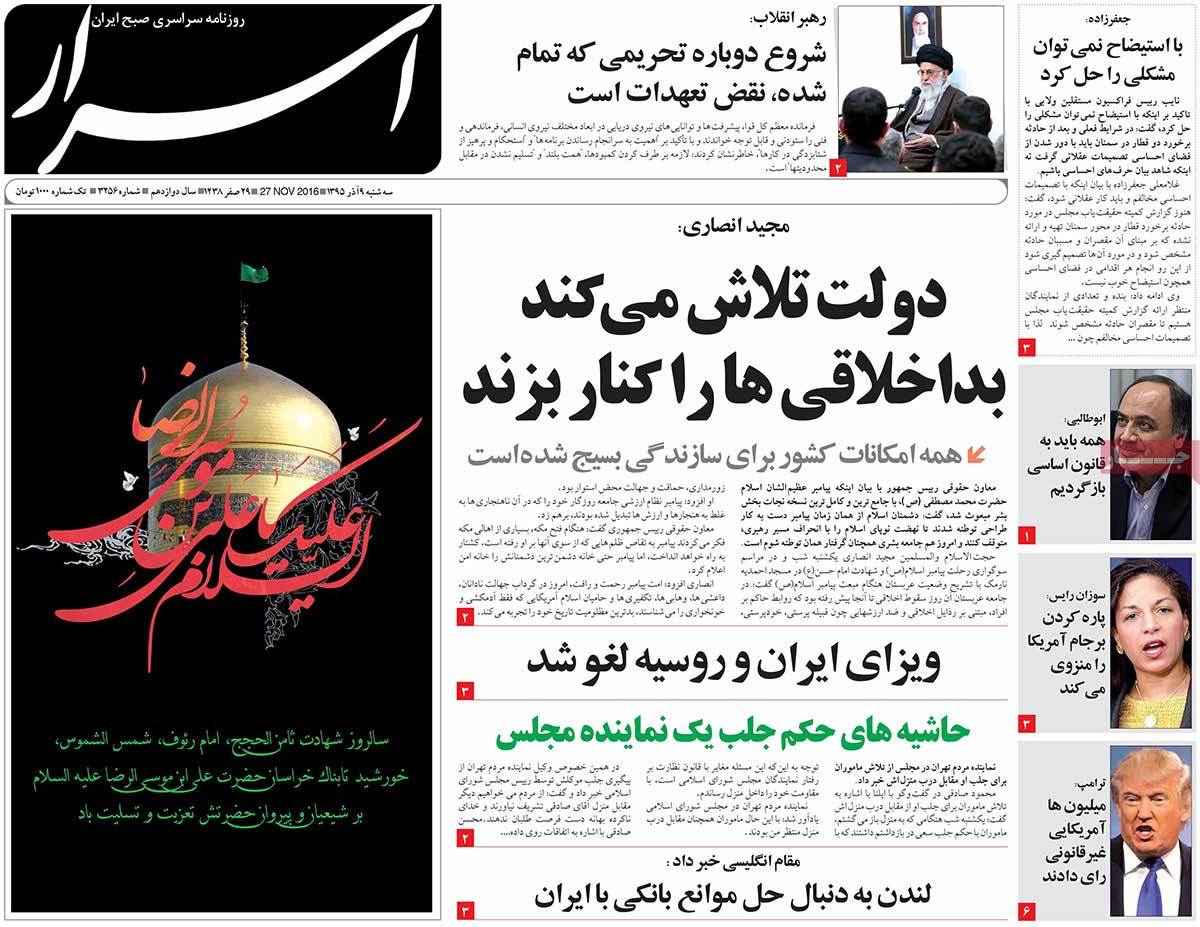
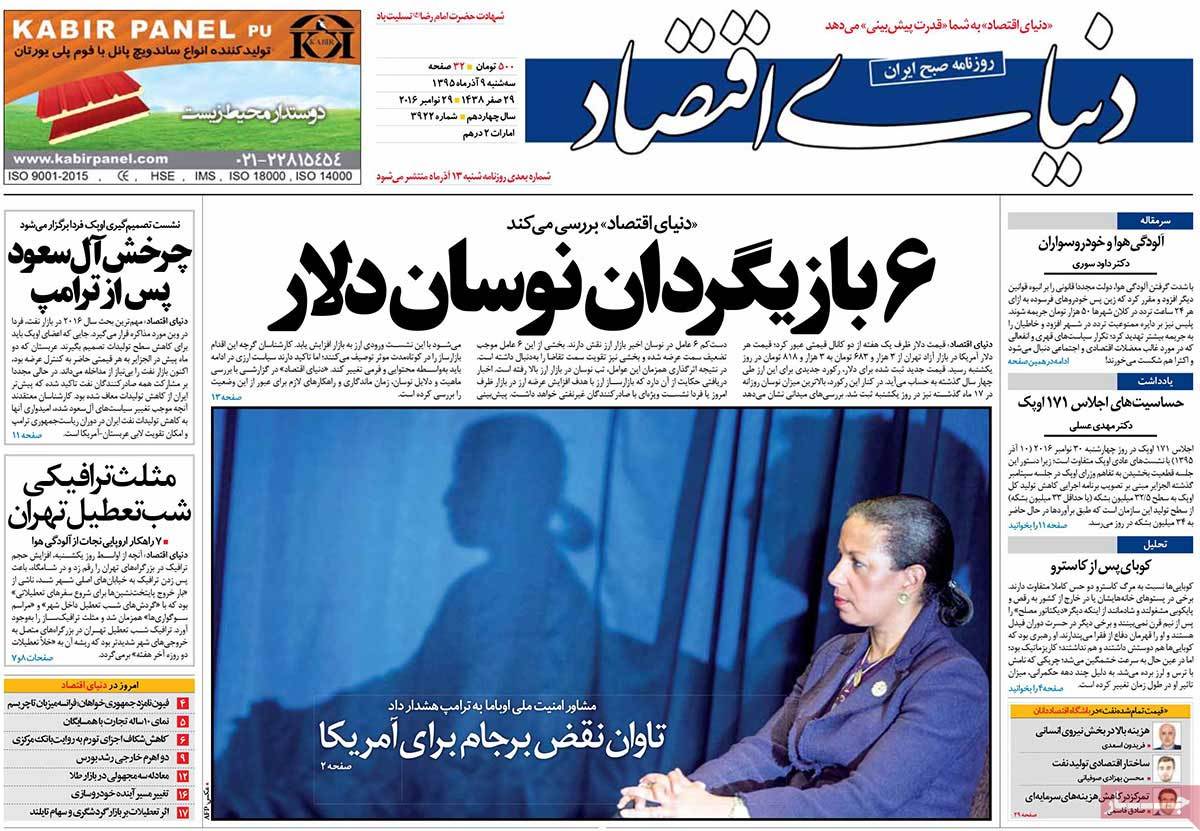
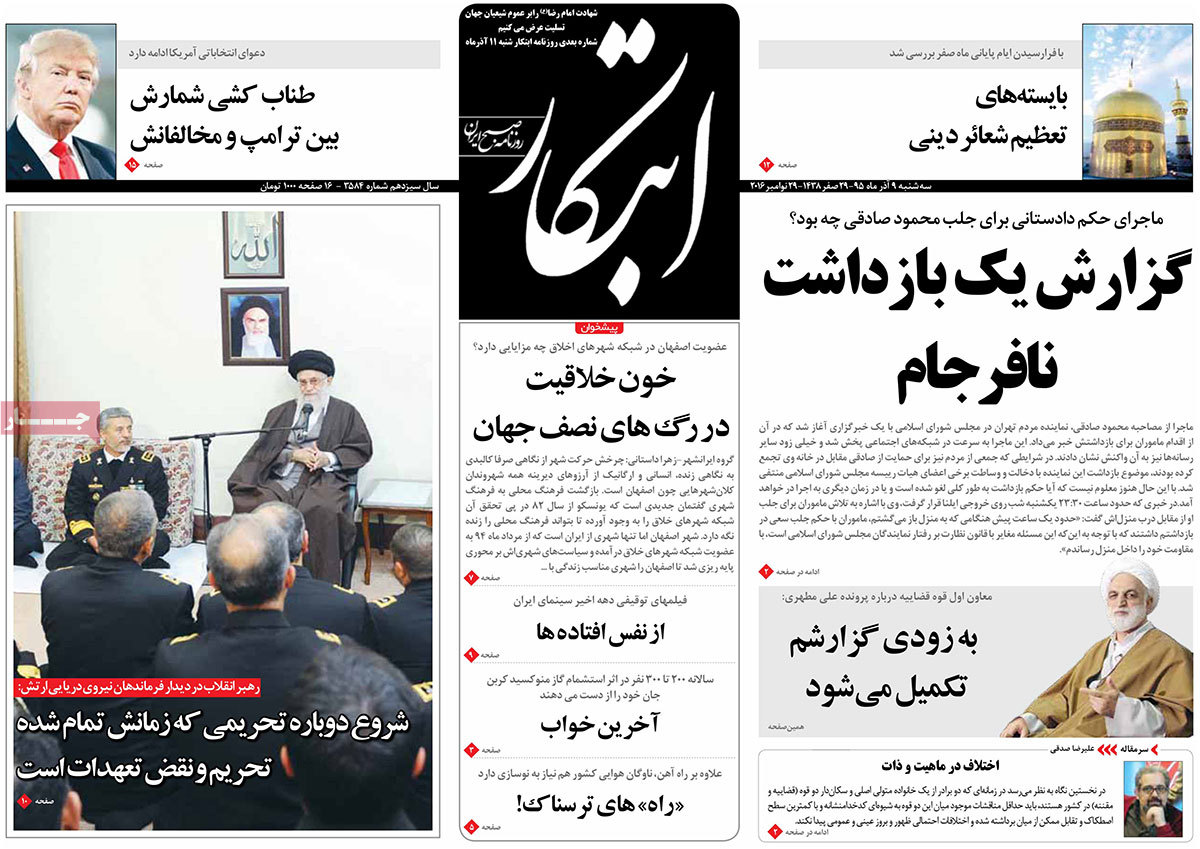
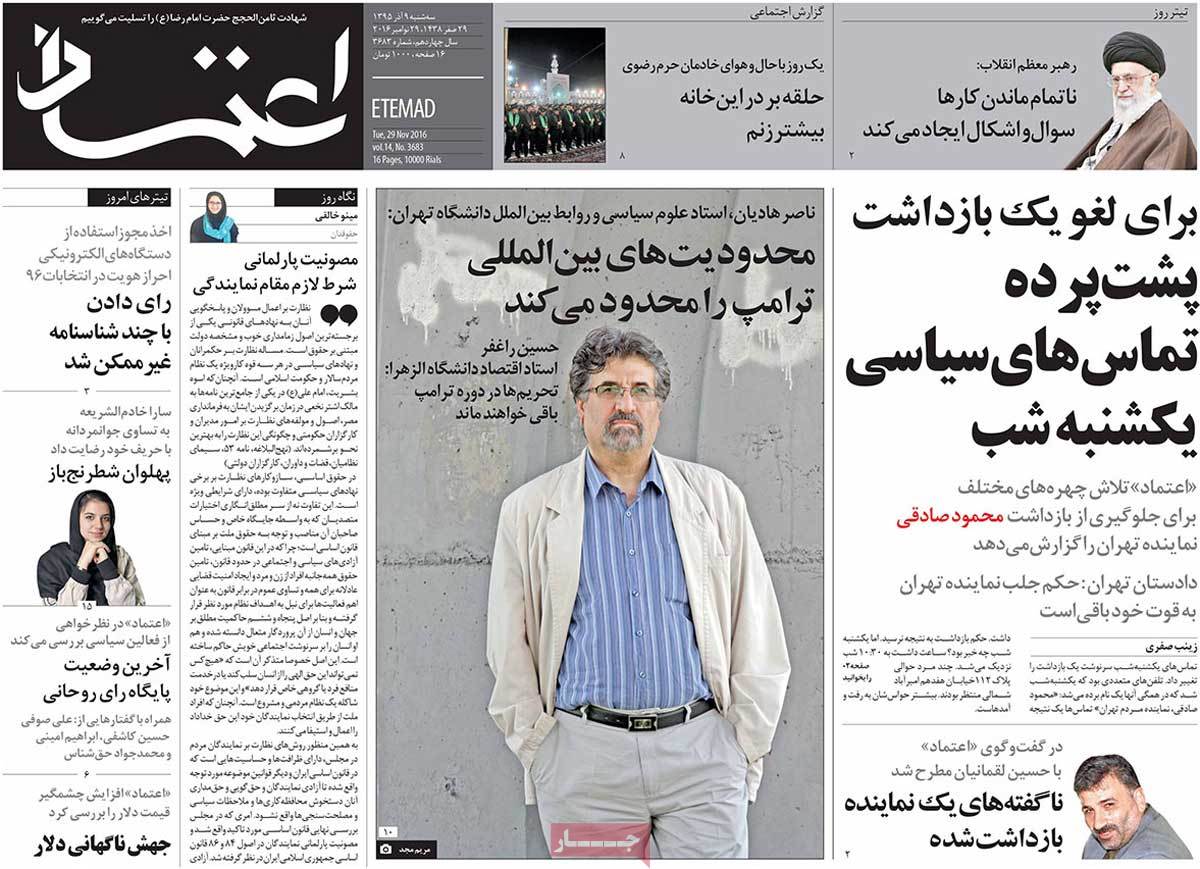
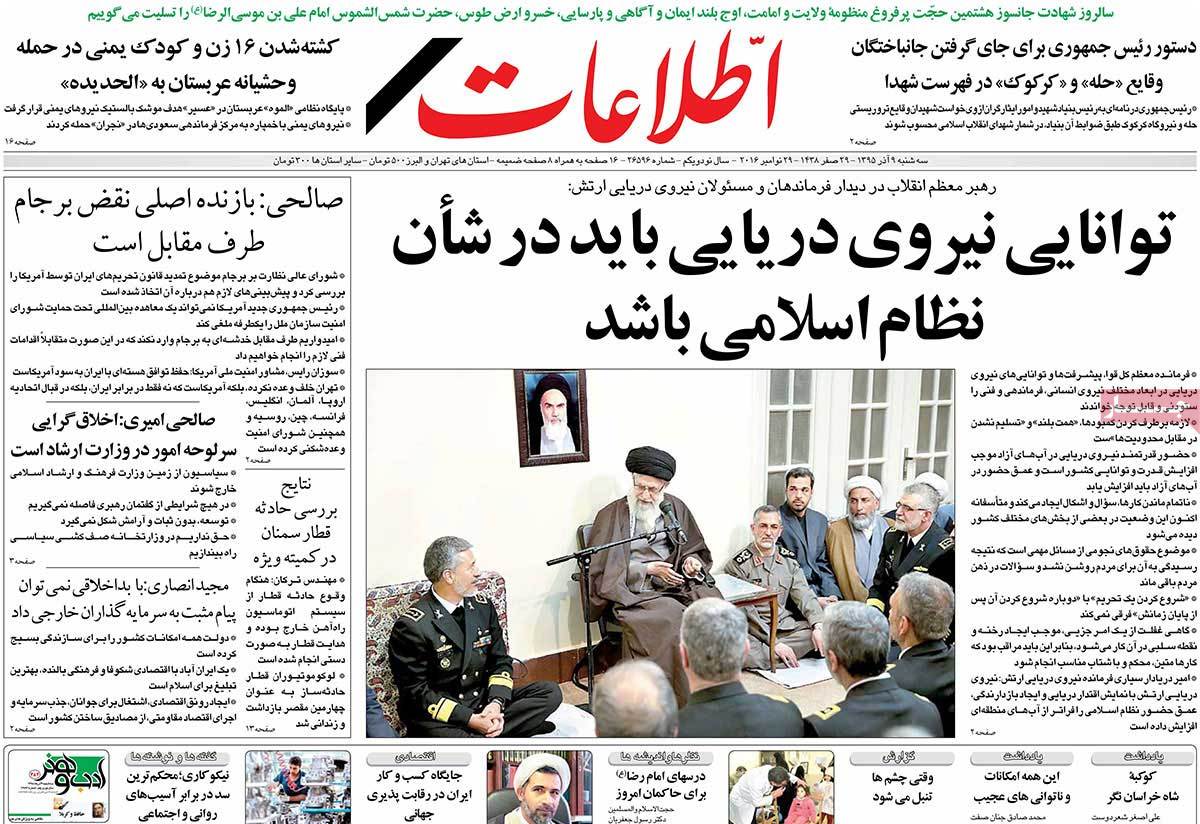
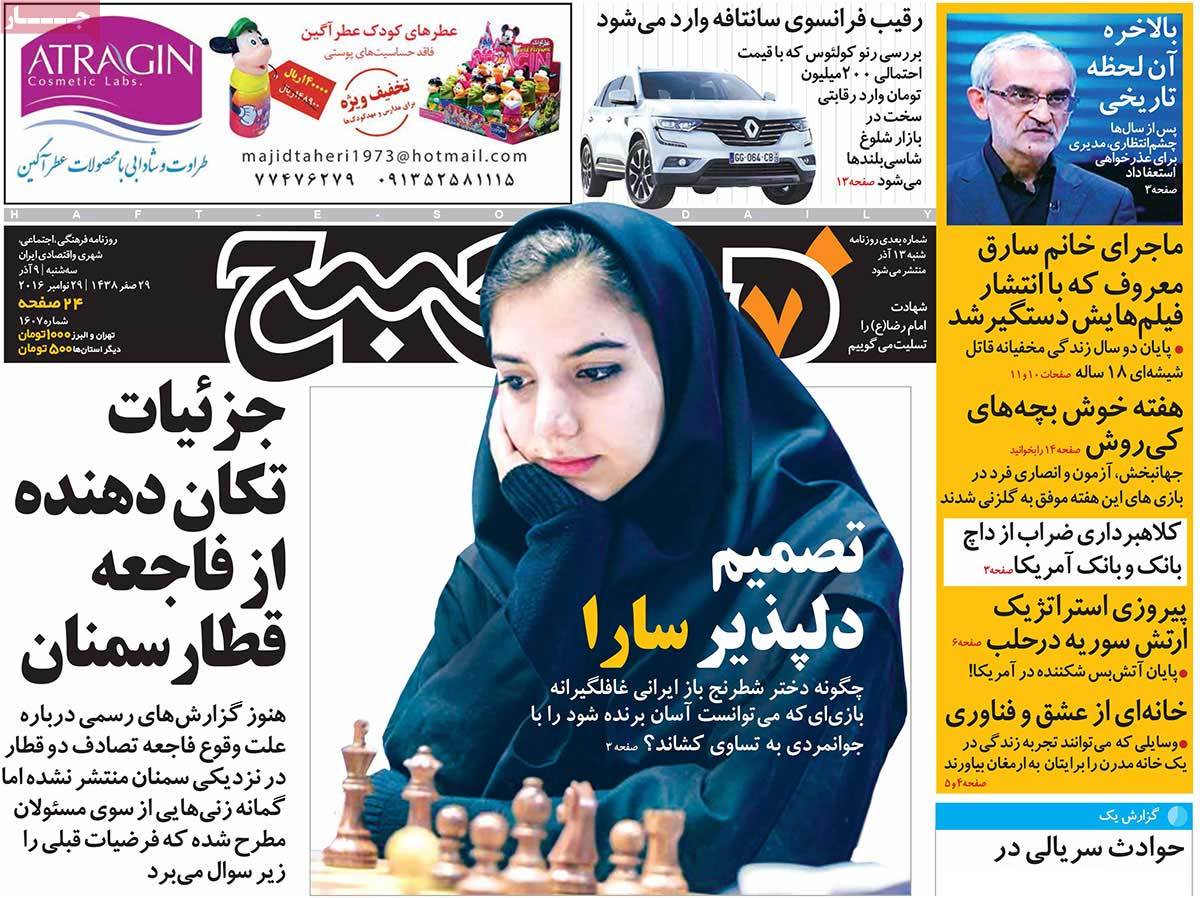
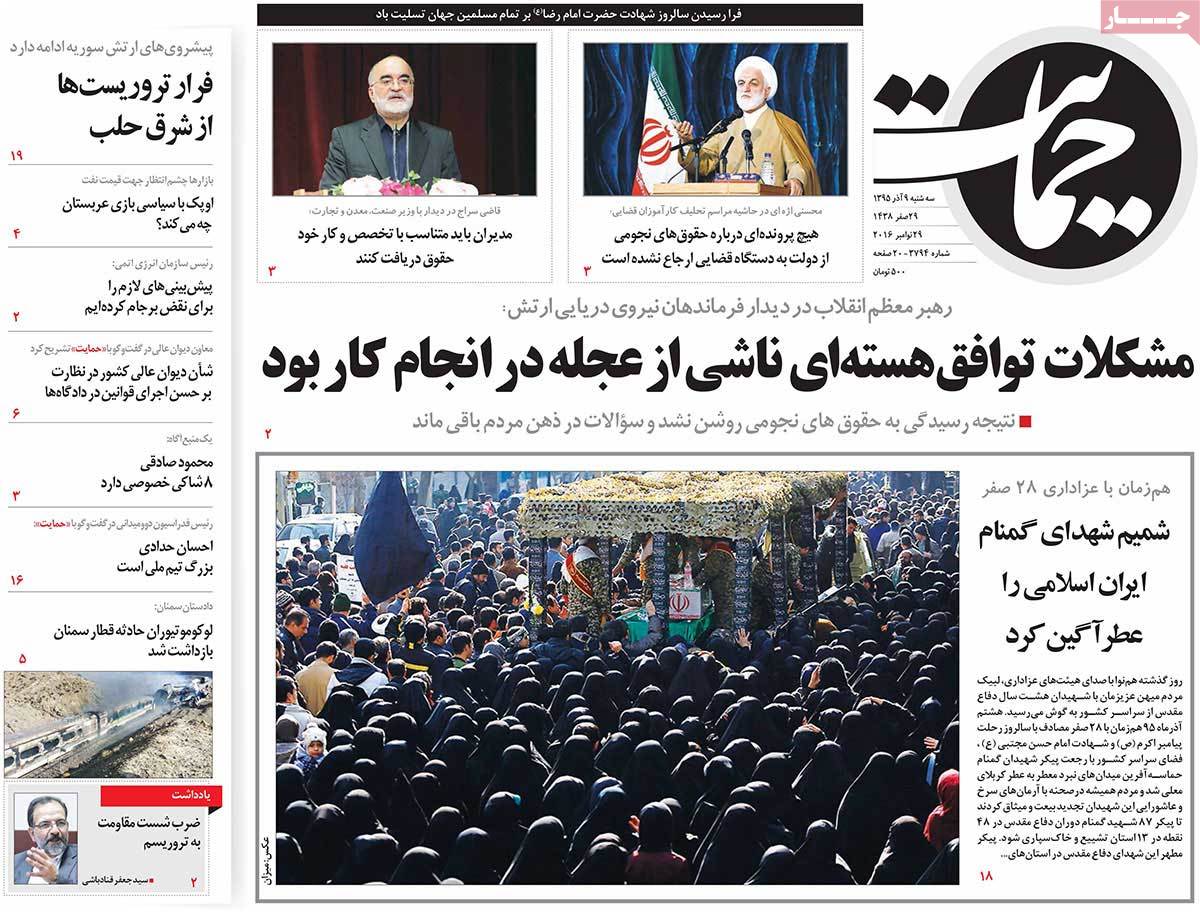
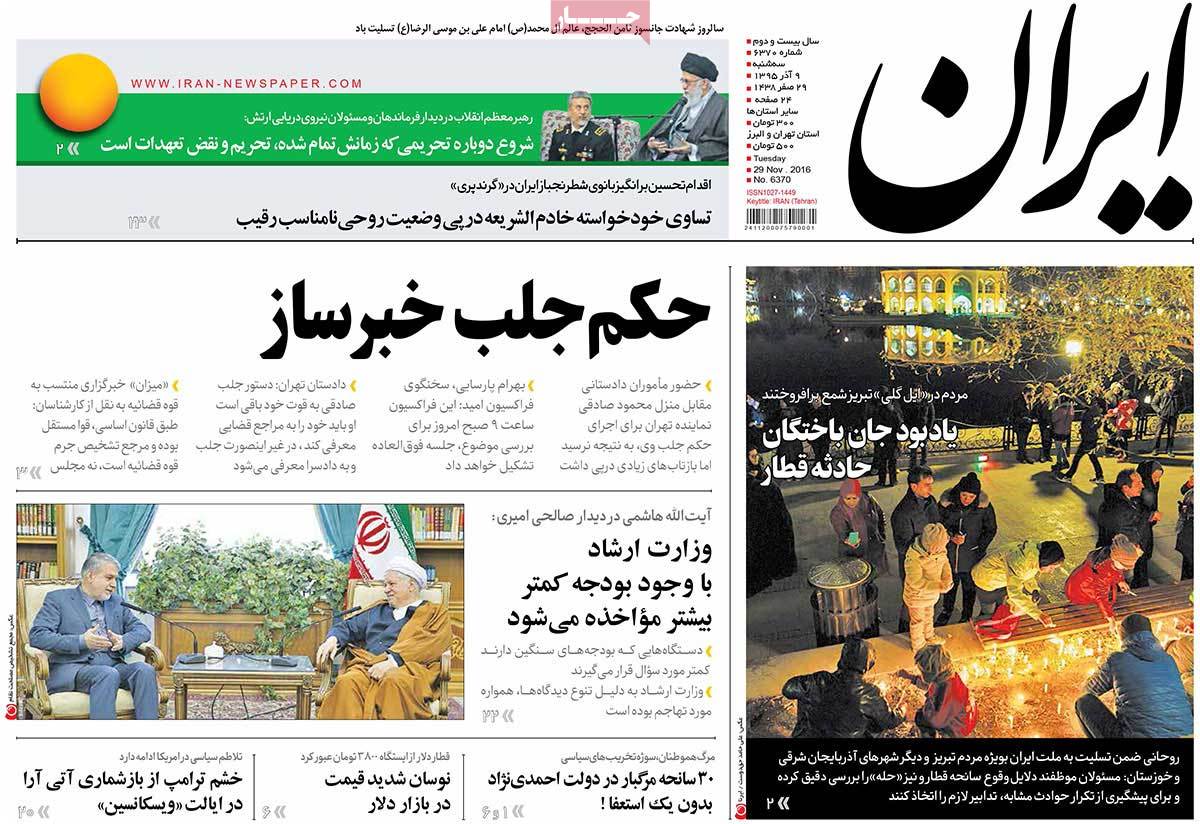
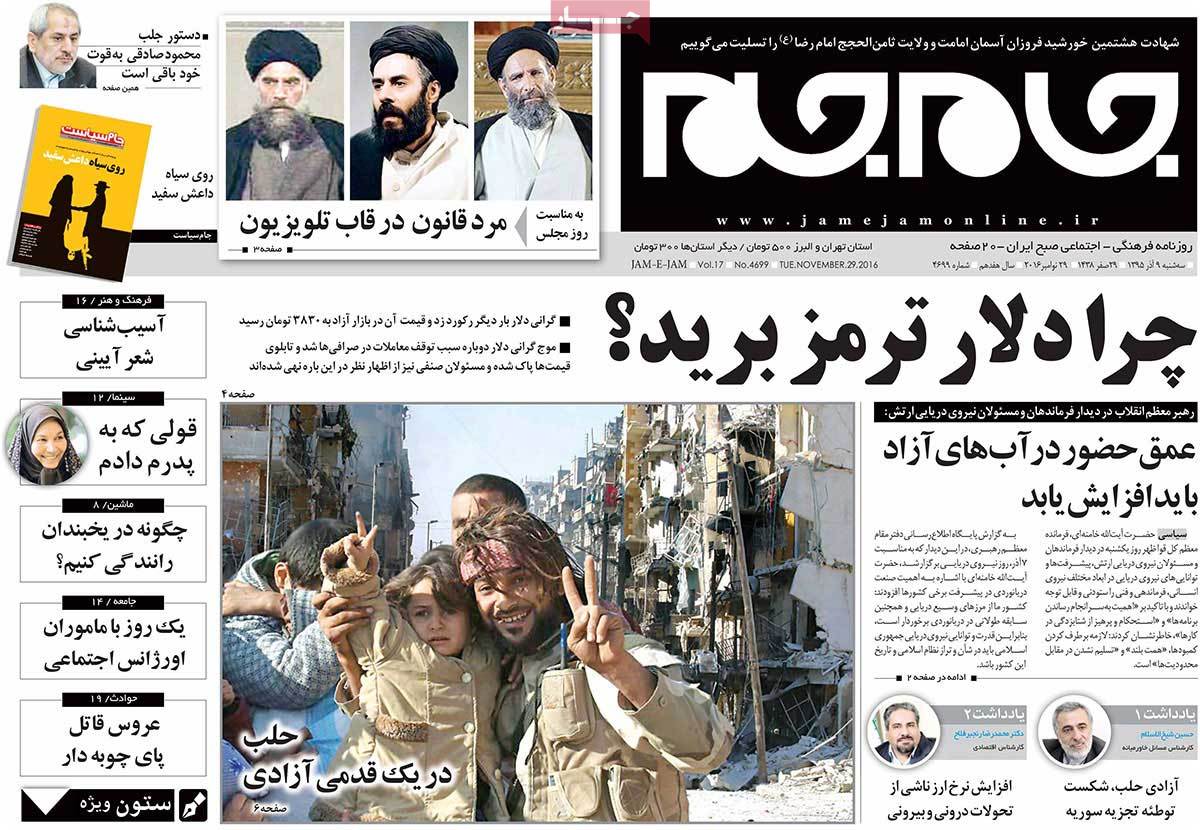
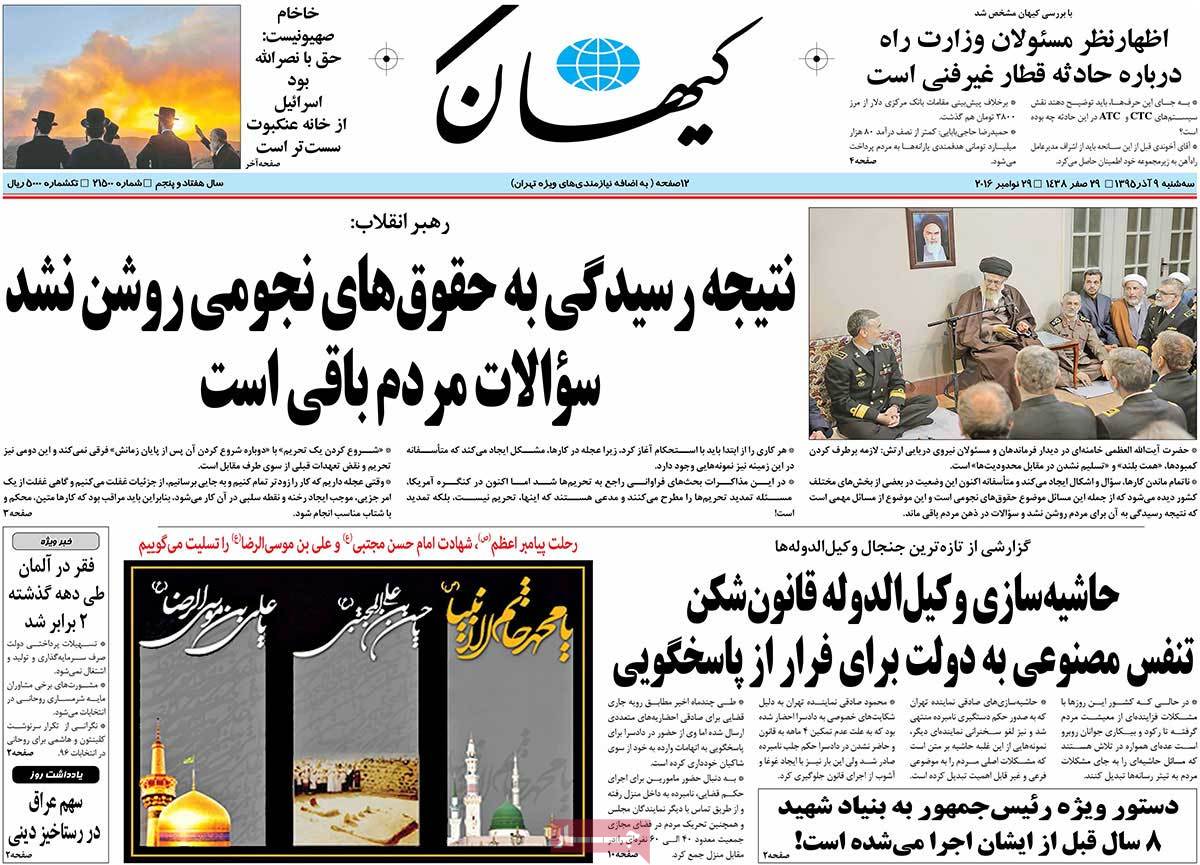
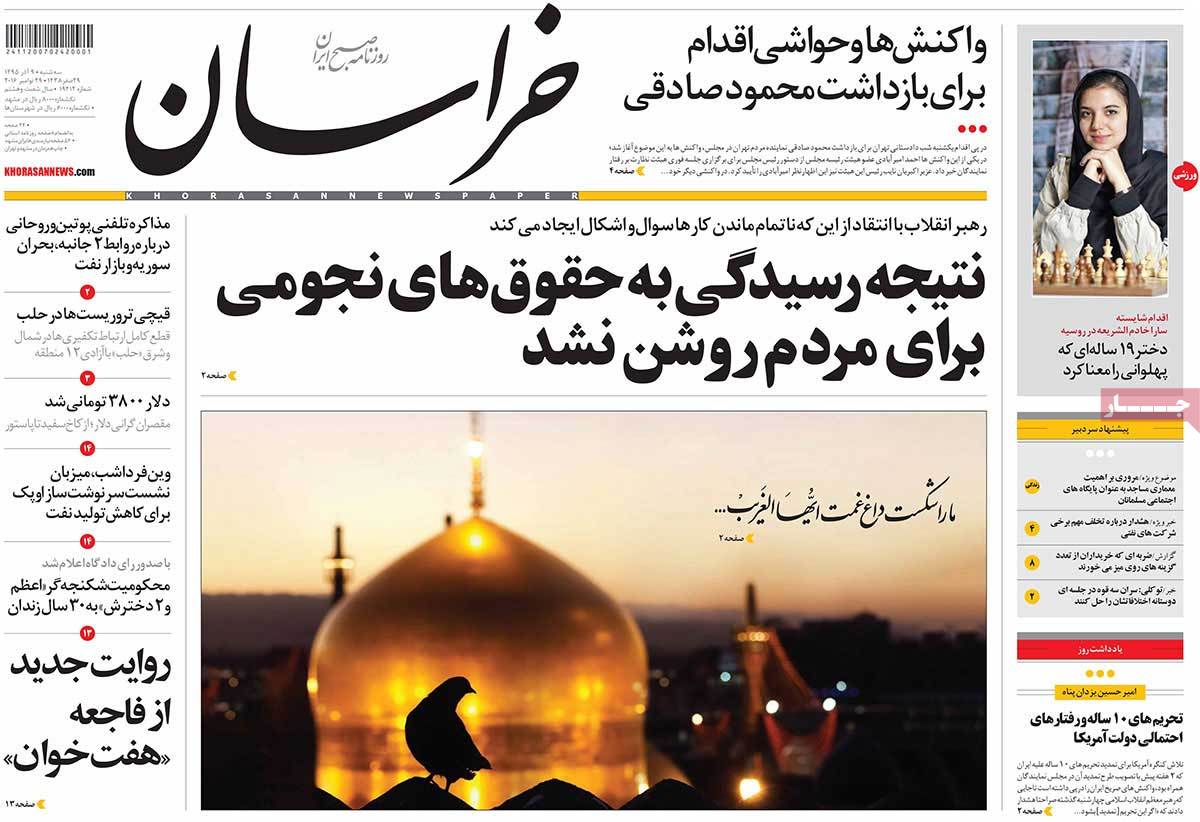
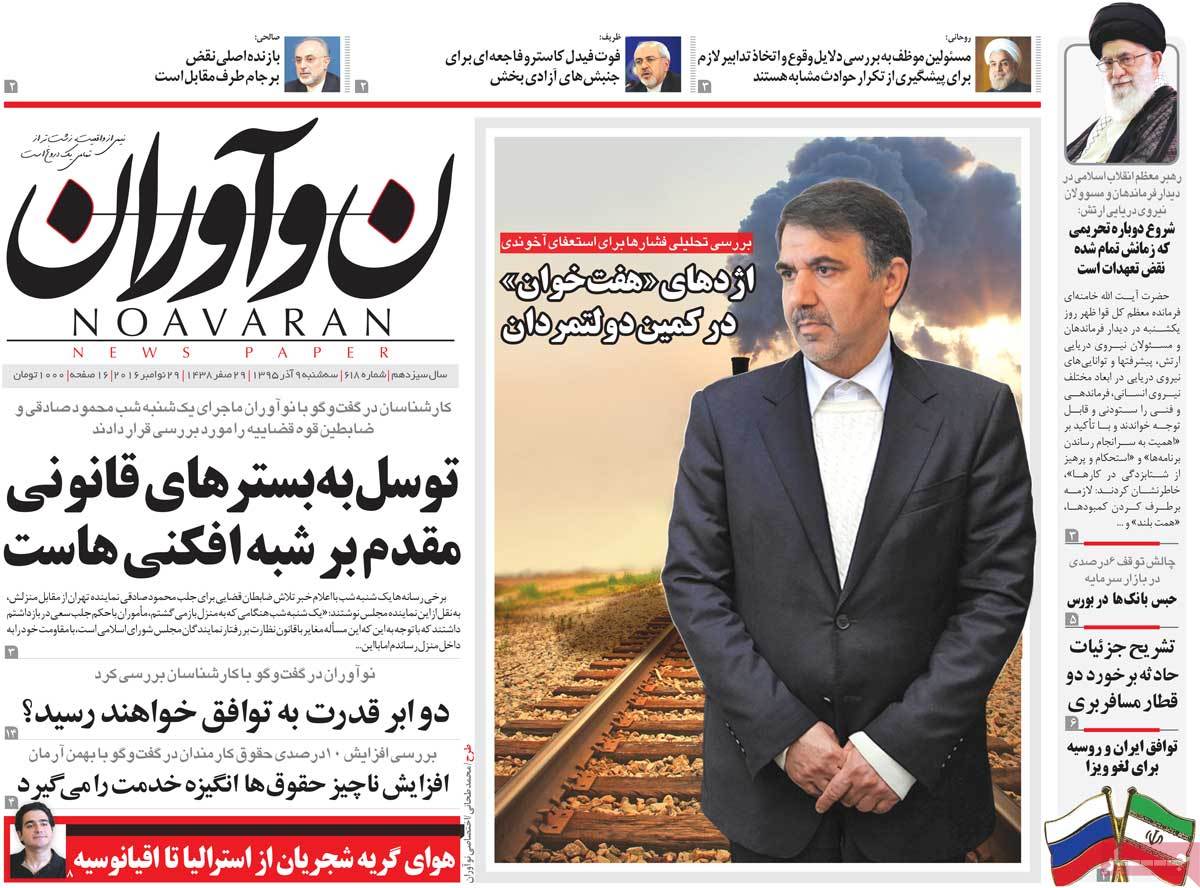
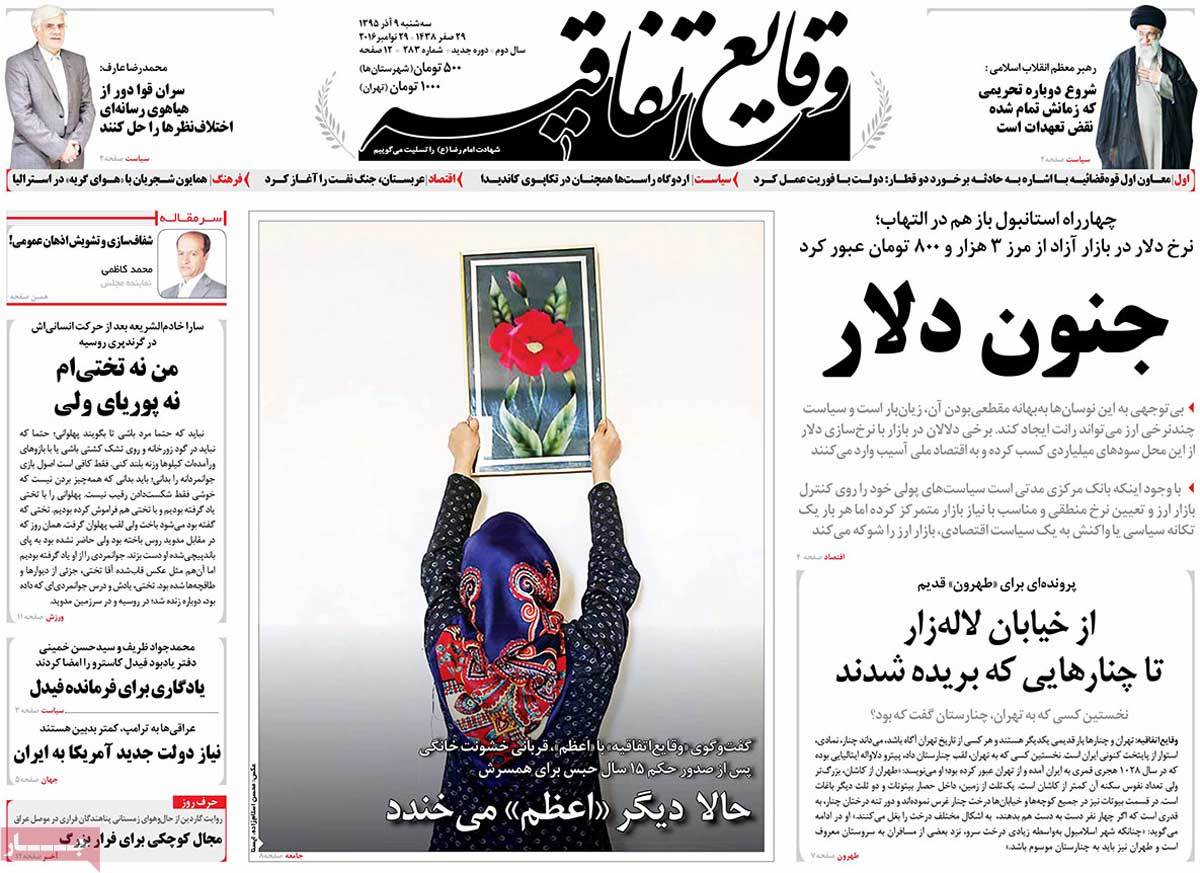
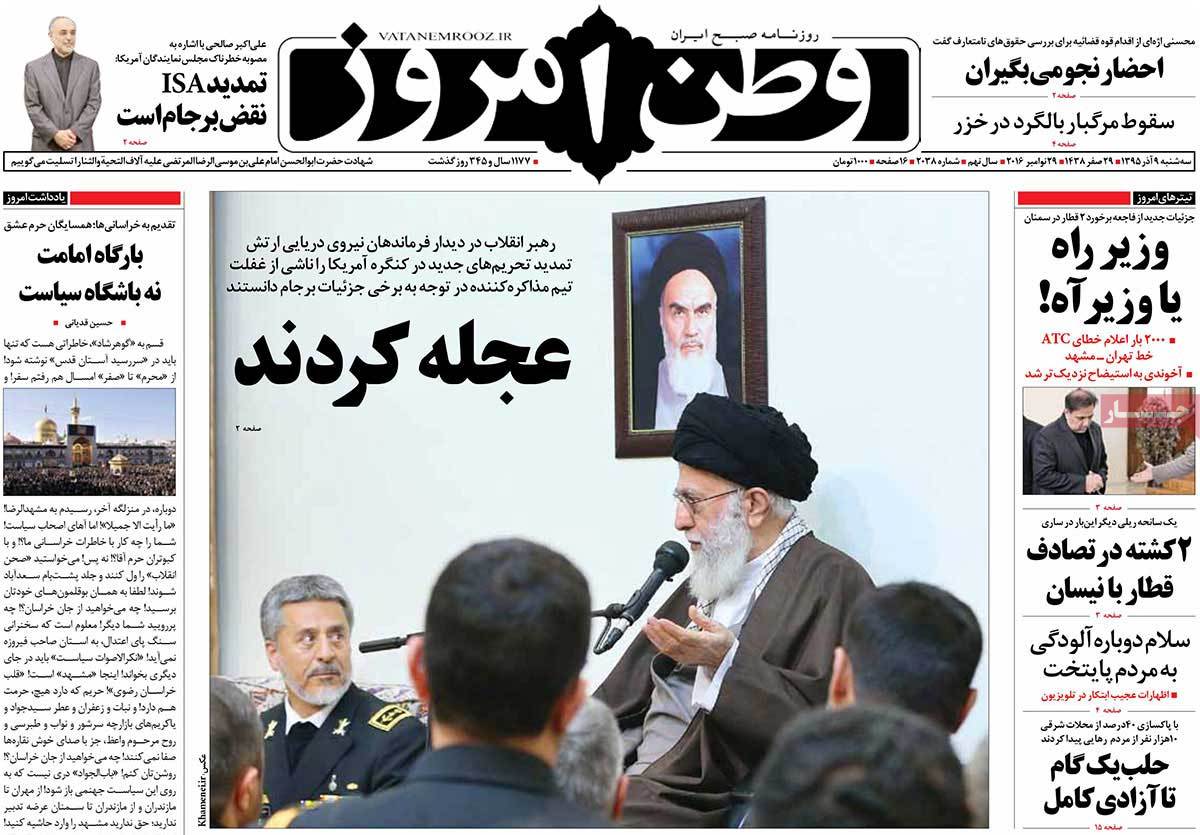
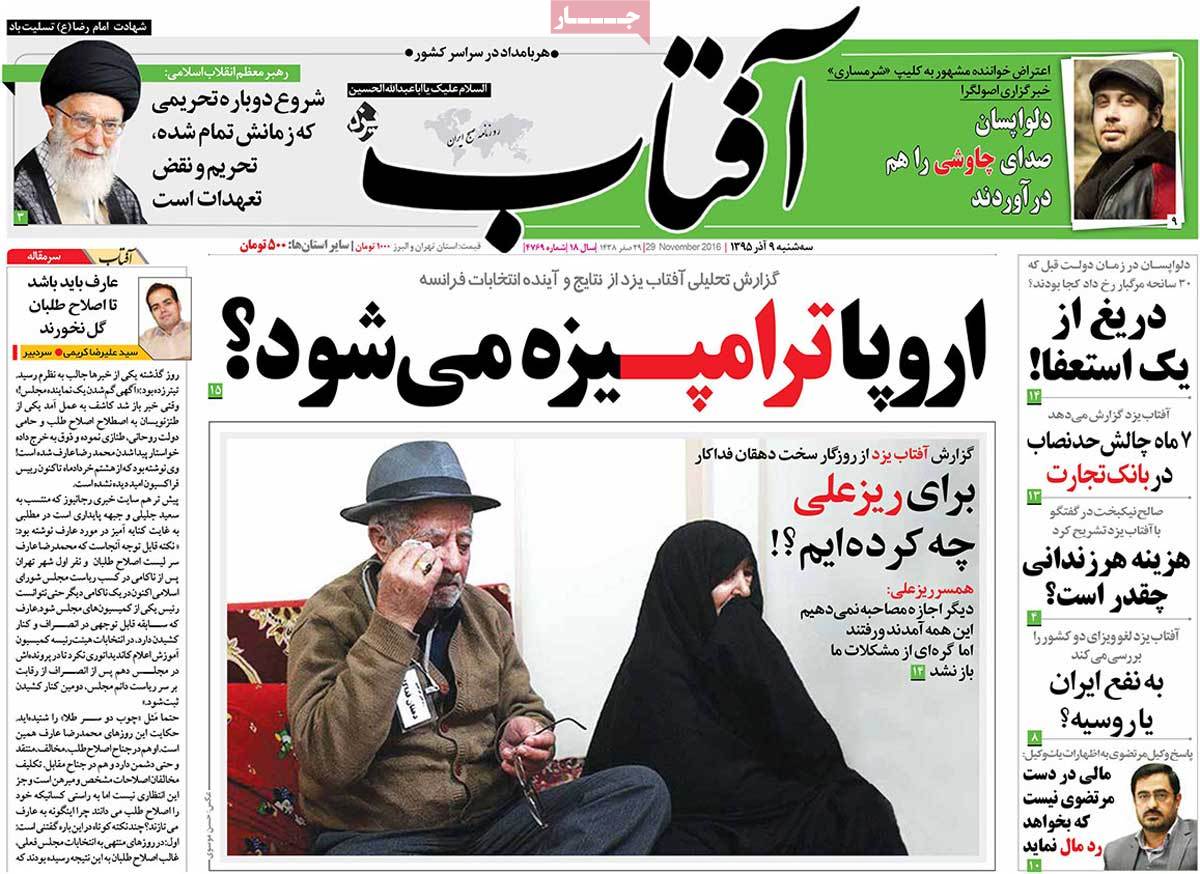
A Look at Iranian Newspaper Front Pages on November 29

Most newspapers on Tuesday covered the remarks made by the Leader of the Islamic Revolution in a meeting with Navy commanders. Ayatollah Seyyed Ali Khamenei talked about the US extension of anti-Iran sanctions and described it as a violation of the nuclear deal with Tehran.

The lifting of visa requirements between Iran and Russia was also a top story. Aftab-e Yazd in an article discussed whether the move will be to the benefit of Iran or Russia.

The recounting of votes in some US states also received great coverage.

The above issues, as well as many more, are highlighted in the following headlines:


Aftab-e Yazd:

1- Leader: Extension of Expired Sanctions Is Violation of Commitments

2- Lifting of Visa Requirement between Iran and Russia: Favourable to Which Side?

A Look at Iranian Newspaper Front Pages on November 29


Arman-e Emrooz:

1- Fear of JCPOA Abolition in JCPOA: US National Security Advisor Says Scrapping Nuclear Deal Will Isolate US

A Look at Iranian Newspaper Front Pages on November 29


Asrar:

1- Government Tries to End Unethical Behaviours: VP for Legal Affairs

2- Controversies Surrounding Arrest Warrant of an MP

3- British Official: London Seeks to Remove Barriers to Banking Ties with Iran

4- Trump: Millions of Americans Voted Illegally

A Look at Iranian Newspaper Front Pages on November 29


Donya-ye Eqtesad:

1- Obama’s National Security Advisor Warns Trump: US Should Pay a Price for Violating JCPOA

A Look at Iranian Newspaper Front Pages on November 29


Ebtekar:

1- Trump and Opponents Continue Conflicts over US Elections

A Look at Iranian Newspaper Front Pages on November 29


Etemad:

1- Int’l Restrictions Will Limit Trump: Academic

2- Iranian Chess Player’s Fair Play in Match against Ukrainian Opponent


A Look at Iranian Newspaper Front Pages on November 29


Ettela’at:

1- Leader: Capabilities of Iran’s Navy Should Be as Much as Islamic Establishment Deserves

2- 16 Yemeni Children and Women Killed in Saudi Arabia’s Brutal Attack on Hodeida

3- Iran’s Nuclear Chief: Other Side Will Be the Loser of JCPOA Violation

A Look at Iranian Newspaper Front Pages on November 29


Haft-e Sobh:

1- Iranian-Turkish Businessman Zarrab Has Blackmailed Dutch Bank and US Bank

A Look at Iranian Newspaper Front Pages on November 29


Hemayat:

1- Leader: Problems of Nuclear Deal Were Caused by the Rush in Finalizing the Deal

2- Terrorists Escape Eastern Aleppo

3- Nuclear Chief: We’ve Made Required Arrangements for Responding to JCPOA Violation

A Look at Iranian Newspaper Front Pages on November 29


Iran:

1- People in Tabriz Light Candles to Commemorate Victims of Train Crash

2- Trump’s Anger over Upcoming Recount of Votes in Wisconsin

A Look at Iranian Newspaper Front Pages on November 29


Jame Jam:

1- Leader: We Should Increase Depth of Our Presence in High Seas

2- Aleppo on Verge of Liberation


A Look at Iranian Newspaper Front Pages on November 29


Jomhouri Eslami:

1- 1,200 Sunni Pilgrims Walk towards Shrine of Imam Reza, Eighth Shiite Imam

2- Parliament Speaker’s Mediation Leads to Cancellation of Reformist MP’s Arrest

3- Iraqi FM: Law of Recognition of Iraqi Popular Forces Was a Great Victory for Iraqi Nation


A Look at Iranian Newspaper Front Pages on November 29


Kayhan:

1- Zionist Rabbi: Nasrallah Was Right, Israel Is Weaker than Spider’s Nest

2- Poverty in Germany Has Doubled in Past Decade

A Look at Iranian Newspaper Front Pages on November 29


Khorasan:

1- Vienna Waiting for OPEC’s Decisive Summit for Oil Output Cut

2- Terrorists’ Escape Routes Cut Off in Aleppo: 12 Regions Liberated

A Look at Iranian Newspaper Front Pages on November 29


Noavaran:

1- Zarif: Castro’s Death Was a Disaster for Freedom-Seeking Movements

2- Iran-Russia Deal for Lifting Visa Requirements

A Look at Iranian Newspaper Front Pages on November 29


Shargh:

1- Shamkhani: Trump’s Oil Policy Will Disrupt Market

2- Foreign Policy Expert Mousavian:: Saudi Arabia’s Billion-Dollar Package to Trump for Action against Iran

3- Berlinale Representative’s Visit to Iran Sparks Controversy

4- We Wish US Would Take Logical Stances: Iran’s Nuclear Chief


A Look at Iranian Newspaper Front Pages on November 29


Ta’adol:

1- War of Bank Notes in New Delhi: Indian PM Gambling with the Country’s Monetary System

2- Saudi Arabia’s Oil Bluff: Latest Stances by Saudi Officials on Verge of Vienna Summit

A Look at Iranian Newspaper Front Pages on November 29


Vaghaye Ettefaghieh:

1- Iraqis Are Less Pessimistic about Trump: New US Administration’s Need for Iran


A Look at Iranian Newspaper Front Pages on November 29


Vatan-e Emrooz:

1- Iran’s Nuclear Chief: Extension of Anti-Iran Sanctions Is Violation of JCPOA

2- Air Pollution Once Again Says Hello to People of Tehran

A Look at Iranian Newspaper Front Pages on November 29

A Look at Iranian Newspaper Front Pages on November 29

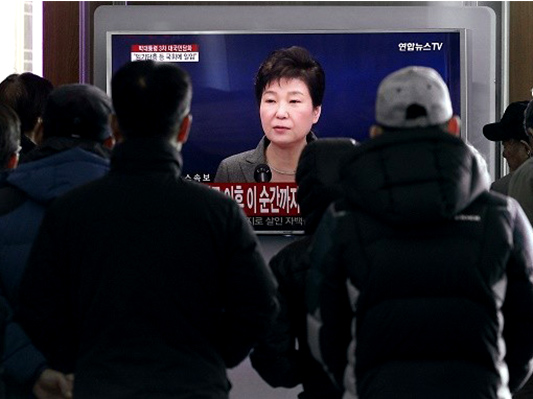
South Korean President Offers to Resign after Corruption Scandal

South Korean President

Speaking in a nationally televised address on Tuesday, Park – whose single five-year term will not be officially over until early 2018 – asked the national assembly to set a new deadline for the end of her turbulent presidency.

The South Korean leader has faced massive street protests in recent weeks amid prosecution claims that a corrupt confidante wielded government power from the shadows.

“I will leave to parliament everything about my future including shortening of my term,” Park said in her third public address since the scandal broke.

“Once lawmakers come up with measures to transfer power in a way that minimises any power vacuum and chaos in governance, I will step down,” she said, as reported by The Guardian.

The offer by Park, South Korea’s first female president, came after another weekend of huge protests in Seoul and other cities calling for her immediate resignation over her role in an influence-peddling scandal centred on her long-time friend Choi Soon-sil.

Opposition lawmakers immediately rejected the offer, describing it as a last-ditch attempt to avoid the humiliation of impeachment.

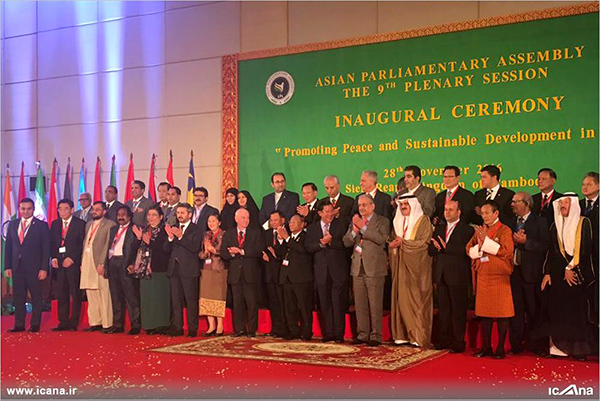
Iran Takes Part in Asian Parliamentary Assembly in Cambodia

APA

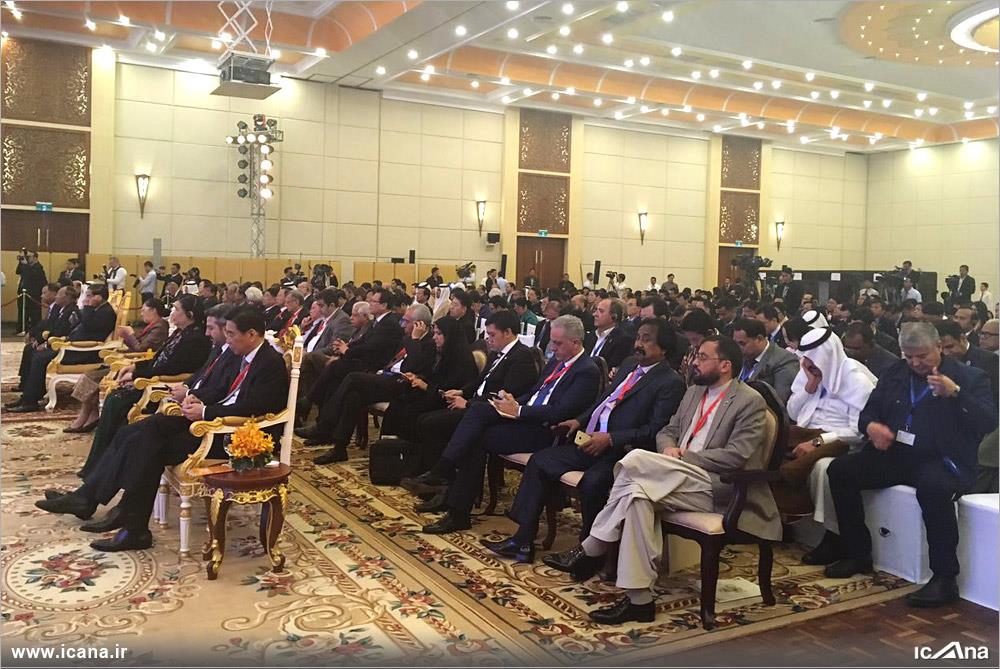
The APA Plenary Session was inaugurated on November 27 and will go on until December 2 in Sokha Siem Reap Resort & Convention Centre in Siem Reap, Kingdom of Cambodia.

Thxe Iranian delegation participating in the 9th Plenary session is comprised of MPs Ali Kazemi, Jalil Rahimi Jahan Abadi, Fatemeh Zolqadr, and Hajar Chenarani.

Zolqadr told ICANA that she read aloud the message of Iran’s Parliament Speaker Ali Larijani to the APA summit in English, and told the audiences that Larijani failed to attend the summit because of recent tragic incidents in Iran.

At the end of her speech, Zolqadr added, the audiences observed a one-minute silence to commemorate the victims of an ISIS terrorist attack on pilgrims in the Iraqi city of Hilla and the Iranian passengers killed in a train crash in Iran’s Semnan Province.

AAPP was established in 1999, and transformed into the APA, which currently consists of 42 Member Parliaments, 16 observers and 10 partner organizations.
apa


Iran Convinces OPEC States to Return to Negotiating Table: MP

opec

Speaking to Shana, Vice-Chairman of Iranian Parliament’s Energy Commission Hossein Amiri Khamkani said Iranian Minister of Petroleum Bijan Zangeneh managed to convince OPEC members to return to the negotiations so that the organization will fulfil its mission once again.

The MP said the country should raise its exports to have a say in the world energy market and preserve its standing.

He said immediately after and during the Joint Comprehensive Plan of Action (JCPOA), Iran’s Parliament, especially its Energy Commission, supported Ministry of Petroleum, so that the country succeeded to regain its former OPEC quota.

He added that the Majlis will continue support for such gestures.

Khamkami said fortunately, a good diplomacy was followed in the oil domain and the country managed in the Algeria session to regain its last solid bases.

171st OPEC Meeting Will Be Fruitful If Not Politically Conditioned: Minister

Iranian Minister of Petroleum Zangeneh said the 171st meeting of members of the Organization of the Petroleum Exporting Countries (OPEC) could end with an agreement if political intentions do not prevail in the session.

Speaking in a televised interview Monday night, the official said the upcoming ordinary meeting of OPEC members in Vienna on November 30 will bear the desired fruits if discussions will be held based on economic and business views and all the members remain committed to what was agreed upon in Algiers in September.

OPEC members in Algiers agreed that the organization’s total output would remain at the 32.5mbd level with the maximum output not crossing 33 mbd in case of emergency.

Zangeneh warned, however, that decision making will become difficult if political motivations prevail in the meeting, Shana reported.

He expressed the hope that the economic spirit will lead the meeting and oil will not be used as a means for political intentions so that a favourable result will be reached.

“As a founding member, Iran has always cooperated with the organization strongly and has always struggled to play an influential role in the body,” he further said.

Bijan Zangeneh, 63, further said Iran has always tried to ensure security of crude oil supply and is currently exhibiting the maximum level of collaboration and flexibility with the OPEC while being the least dependent on oil revenues among other OPEC members.

Iran relies for less than 7% of its GDP on oil revenue and depends only for 30% of its national budget on oil and gas condensate sales, however, it has always cooperated with the OPEC and has tried to play a constructive role in the body, he said.

Under the US-led sanctions, Iran was not able to raise its production while certain other members did in fact raise their output considerably in order to fill the gap created by Iran’s absence in the market, the top Iranian energy official argued.

 Libya and Nigeria have also been struggling with domestic troubles in recent years and must be considered as exceptions in OPEC’s production cuts, Zangeneh said.

“Naturally, in order to manage the market, those countries [that has raised their output the most in recent years] are required to shoulder more burden than others in the production cuts and be more receptive of their responsibilities in this regard,” he added.

Minister of Petroleum Bijan Zanganeh is to leave Tehran for Vienna on Tuesday to take part in the 171st OPEC session.

The price for OPEC basket of crude fell by 34 cents to 44.88 dollars a barrel on the eve of the OPEC session.

Saudi Energy Minister Khaled al-Faleh had on Sunday announced Riyadh adheres to its stance in connection with the Algiers accord. He said consensus on oil output freeze will help market balance.

Talking to reporters, he said that he believed oil market will be balanced in 2017 even if the producers do not interfere in the issue.

Many experts believe the 171st OPEC meeting will be tough in its kind and the members will be able to bring the oil price to the range of 50 to 55 dollars a barrel through adhering to the Algiers accord and its enforcement.

The 14 OPEC members are now producing 33.6 million barrels per day oil and they should decrease the output by 1.1 million barrels per day should they reach the Algiers accord.

Iran Ready to Respond to US if Sanctions Renewed: Salehi

salehi

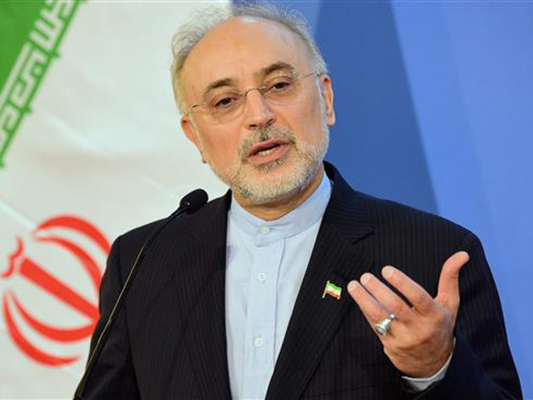
“Iran has made necessary preparations for potential US decisions about the extension of sanctions,” Ali Akbar Salehi, the head of the Atomic Energy Organization of Iran (AEOI), told reporters on Monday.

In case of the final approval of the Iran Sanctions Act (ISA), it will “certainly be a violation of the JCPOA (the nuclear agreement, known as the Joint Comprehensive Plan of Action),” he added.

Salehi noted that Iran is ready to respond to any US breach of the JCPOA, saying Tehran, however, will make necessary decisions at the appropriate time and after the assessment and analysis of Washington’s moves.

He said Leader of the Islamic Revolution Ayatollah Seyyed Ali Khamenei has already provided guidelines to Iranian officials about standing ready to considerably increase the country’s nuclear enrichment capacity.

“The JCPOA has brought about an evolution or new paradigm in international diplomatic interactions and all, including Iran, regional and world states, have benefited from it,” Salehi said.

He emphasized that Washington will be the “main loser” if it fails to remain committed to its obligations under the nuclear agreement.

The AEOI head expressed hope that the next US administration would act wisely and on the basis of realities “because it cannot unilaterally undo an international agreement which has been endorsed by the United Nations Security Council.”

Salehi’s remarks came a day after Ayatollah Khamenei said the renewal of sanctions against Iran by the US is tantamount to the violation of commitments under the JCPOA.

“During the [nuclear] negotiations there was a lot of debate about the sanctions, but now they raise the issue of extending the sanctions in the US Congress and claim that these are not [new] sanctions but renewal [of old ones],” the Leader said in a meeting with a group of Iranian Navy commanders and officials in Tehran on Sunday.

“‘Initiating sanctions’ is no different from ‘renewing them after their expiration,’ and the latter is also [an instance of imposing] sanctions and violation of the previous commitments by the opposite side,” Ayatollah Khamenei said.

The GOP-controlled US House of Representatives on November 15 passed a bill for a 10-year extension of the Iran Sanctions Act (ISA). The ISA will expire at the end of 2016 if it is not renewed. The bill must be approved by the Senate before being signed by the US president into law.

Iran’s Ancient Water System, Masterpiece of Creative Genius: UNESCO

Shushtar13

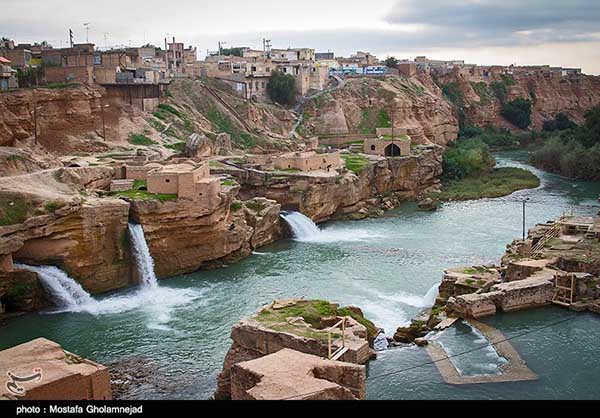
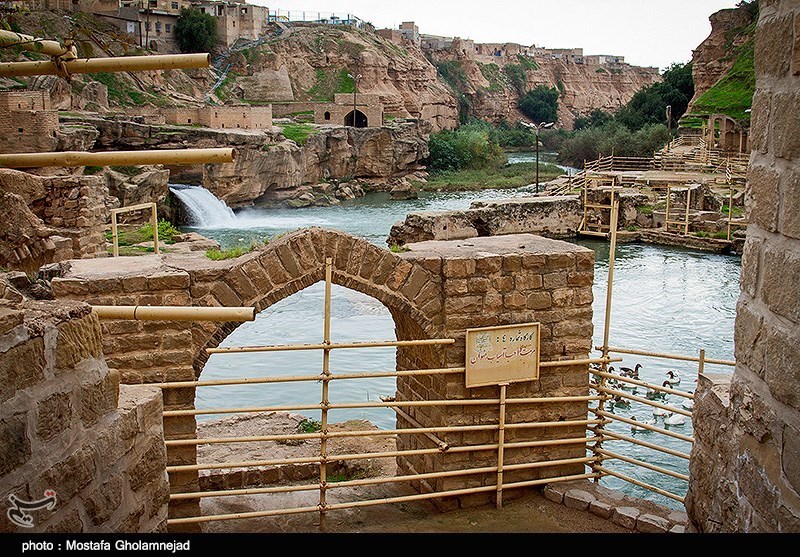
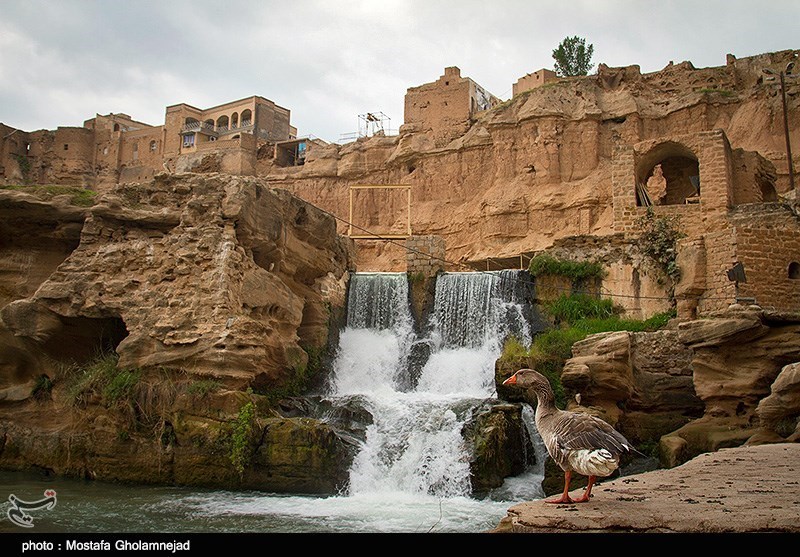
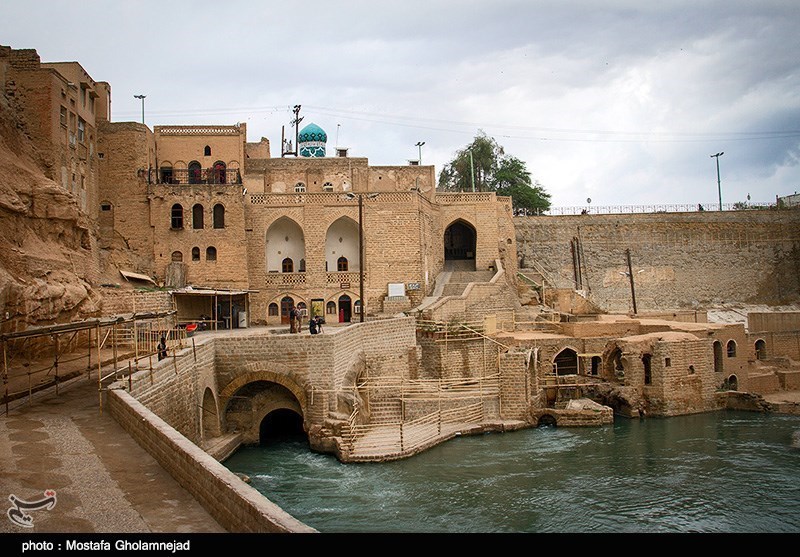
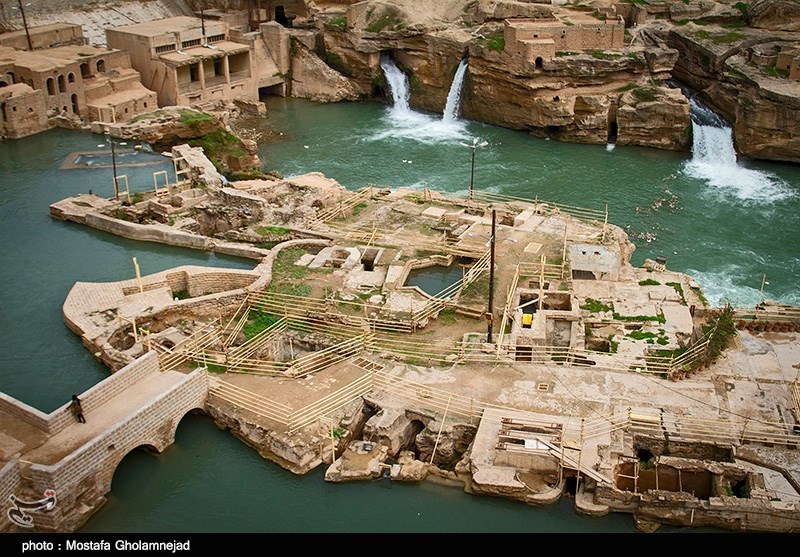
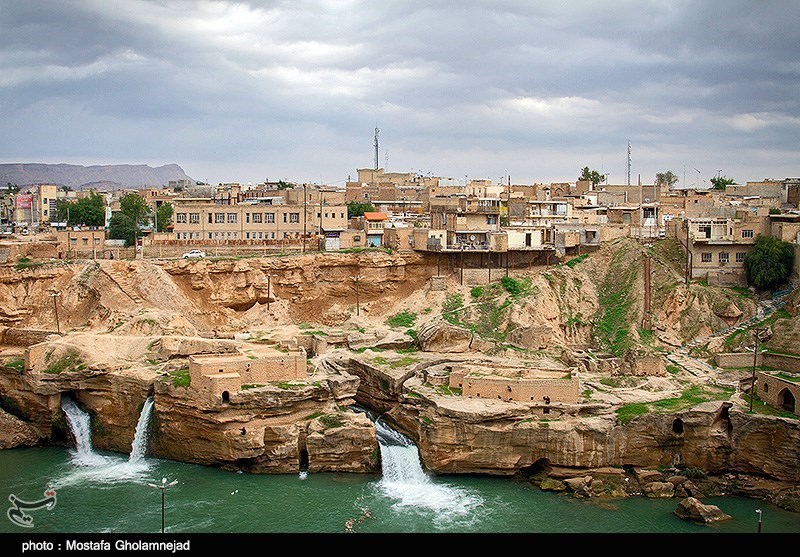
Shushtar, Historical Hydraulic System, inscribed as a masterpiece of creative genius, can be traced back to Darius the Great in the 5th century B.C.

Brief Synthesis

The Shushtar Historical Hydraulic System demonstrates outstanding universal value as in its present form, it dates from the 3rd century CE, probably on older bases from the 5th century BCE. It is complete, with numerous functions, and large-scale, making it exceptional. The Shushtar system is a homogeneous hydraulic system, designed globally and completed in the 3rd century CE. It is as rich in its diversity of civil engineering structures and its constructions as in the diversity of its uses (urban water supply, mills, irrigation, river transport, and defensive system). The Shushtar Historical Hydraulic System testifies to the heritage and the synthesis of earlier Elamite and Mesopotamian knowhow; it was probably influenced by the Petra dam and tunnel and by Roman civil engineering. The Shushtar hydraulic system, in its ensemble and most particularly the Shâdorvân Grand Weir (bridge-dam), has been considered a Wonder of the World not only by the Persians but also by the Arab-Muslims at the peak of their civilization. The Gargar canal is a veritable artificial watercourse which made possible the construction of a new town and the irrigation of a vast plain, at the time semi-desert. The Shushtar Historical Hydraulic System sits in an urban and rural landscape specific to the expression of its value.

Iran’s Ancient Water System, Masterpiece of Creative Genius: UNESCOIran’s Ancient Water System, Masterpiece of Creative Genius: UNESCO

The Shushtar Hydraulic System is testimony to a remarkably accomplished and early overall vision of the possibilities afforded by diversion canals and large weir-dams for land development. It was designed and completed in the 3rd century CE for sustainable operation and is still in use today. It is a unique and exceptional ensemble in terms of its technical diversity and its completeness that testifies to human creative genius.

Iran’s Ancient Water System, Masterpiece of Creative Genius: UNESCO

The Shushtar Historical Hydraulic System is a synthesis of diverse techniques brought together to form a remarkably complete and large-scale ensemble. It has benefited from the ancient expertise of the Elamites and Mesopotamians in canal irrigation, and then that of the Nabateans; Roman technicians also influenced its construction. Its many visitors marveled at it and were in turn inspired. It testifies to the exchange of considerable influences in hydraulic engineering and its application throughout antiquity and the Islamic period under the various Iranian dynasties.

Iran’s Ancient Water System, Masterpiece of Creative Genius: UNESCO

Shushtar is a unique and exceptionally complete example of hydraulic techniques developed during ancient times to aid the occupation of semi-desert lands. By diverting a river flowing down the mountains, using large-scale civil engineering structures and the creation of canals, it made possible multiple uses for the water across a vast territory: urban water supply, agricultural irrigation, fish farming, mills, transport, defense system, etc. It testifies to a technical culture dating back eighteen centuries serving the sustainable development of a human society, in harmony with its natural and urban environment.

Iran’s Ancient Water System, Masterpiece of Creative Genius: UNESCO

Integrity and Authenticity

The integrity of the hydraulic footprint is good, but its functional integrity compared with the original model is only partial and reduced, notably for the dams; it remains good for irrigation and water supply. The authenticity of elements reduced to archaeological remains is certain, but has been affected by 20th century works and materials so far as the civil structures and sites still in use are concerned. Efforts directed to the restoration of attributes that demonstrate authenticity must be pursued.

Management and protection requirements

The components of the management plan are satisfactory, but they need to be improved in terms of the interpretation of the sites and the involvement of the local population.

Iranian, Russian Presidents Discuss Regional Issues, Bilateral Ties

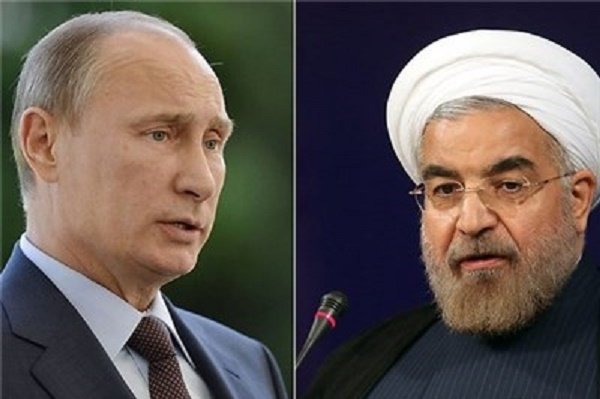
In the conversation on Monday night, President Rouhani expressed the hope that an upcoming session of Iran-Russia joint economic commission would remove obstacles, if any, to closer mutual cooperation.

He further hailed the “historical impacts” of Tehran-Moscow cooperation in the fight against terrorist groups in Syria on regional stability, reiterating that only the people of Syria can decide the fate of their country.

For his part, the Russian president expressed satisfaction with a rise in the volume of bilateral trade in comparison to the previous year, saying the two countries can cooperate in major projects in the nuclear, oil, gas and transportation industries.

As regards Syria, Putin underlined that Iran and Russia are and will remain partners in settling regional crises, noting that such collaboration will continue until the Syrian people are saved from terrorist groups.

The two presidents further discussed the latest developments in the international oil market, and agreed to work together as part of the necessary coordination among oil producing countries.

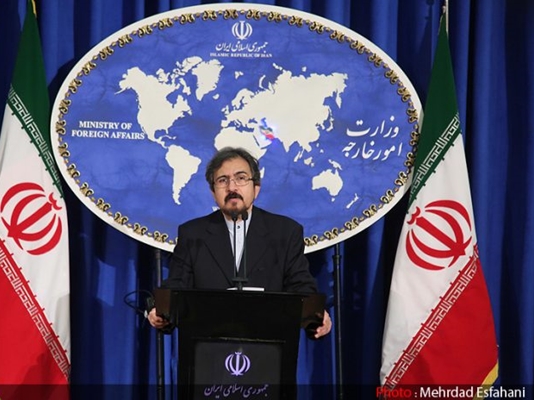
Iran-Russia Visa-Free Deal Not Signed Yet: Spokesman

bahram-ghasmei

Visa requirements for package tours between the two countries are going to be removed under certain conditions but the agreement on the issue has not been signed yet, he said on Monday.

The two countries are going to sign the deal in the near future, Qassemi added.

There were reports earlier on Monday that Iran and Russia have already removed visa requirements for travelers from the two countries.

Russian Foreign Ministry Spokeswoman Maria Zakharova, too, said on Monday that the deal has not been signed yet.

Tehran and Moscow hope to sign an inter-governmental agreement on cancelling visas for tourists who book package tours through travel agencies, she said.

According to her, visa liberalization for Russian and Iranian tourists was one of the topics which dominated Russian-Iranian consultations on consular matters held by the heads of appropriate foreign ministry departments on November 21-22.

“Their outcome raises hopes that a Russian-Iranian inter-governmental agreement on cancelling visas for travelers who purchase packaged tours may be signed soon,” Zakharova said.

“During the consultations, the parties reviewed the draft’s text clause-by-clause. We are planning to work over the document jointly with Russian agencies in the next two or three months before the government issues a directive on this matter,” the Russian diplomat explained.

The sides agreed to examine the possibility of using a mechanism of direct invitations for arranging package tours for Russian and Iranian businessmen. It gives legal entities, companies and the heads of enterprises the right to invite foreign business partners independently.

“We are planning to make the said agreement a supplement to the existing Russian-Iranian inter-governmental agreement on simplifying reciprocal travel for certain categories of Russian and Iranian citizens,” Zakharova said, according to Tass.

“We believe that these steps will add momentum to Russian-Iranian relations and will, first and foremost, create favorable conditions for enhancing business cooperation and tourism, and expanding reciprocal understanding of the centuries-old cultural traditions of Russia and Iran.”