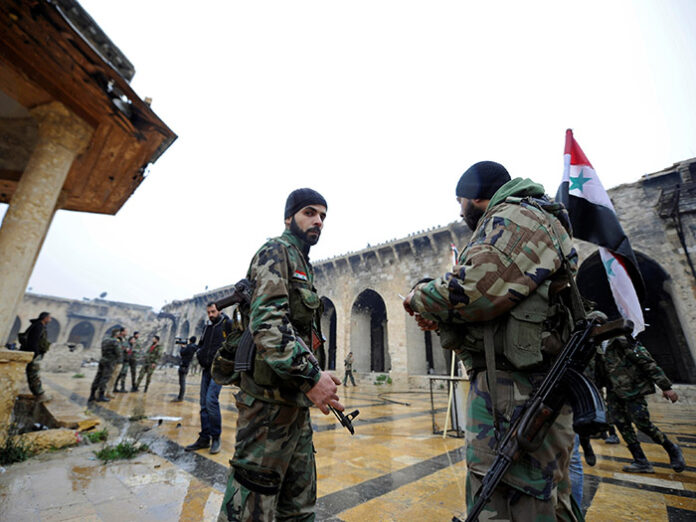
 According to a Farsi report by Mashregh News, following the liberation of Aleppo, the Western-Arab-Jewish coalition started moaning and groaning. Israelis are clad in black as a sign of mourning for “civilians” in Aleppo, and the US envoy to the UN started reciting fully emotional sermons.
Syrian Army’s victory has baffled the pro-militant officials and media in a way that even the analysts of their own TV channels are showing contradictory reactions.
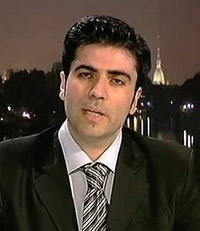
Farahmand Alipour, a BBC and VOA analyst, says the US envoy was acting as if she was the Swiss envoy to the UN and her country had committed no crime against humanity!
Alipour wrote in his personal Telegram channel:
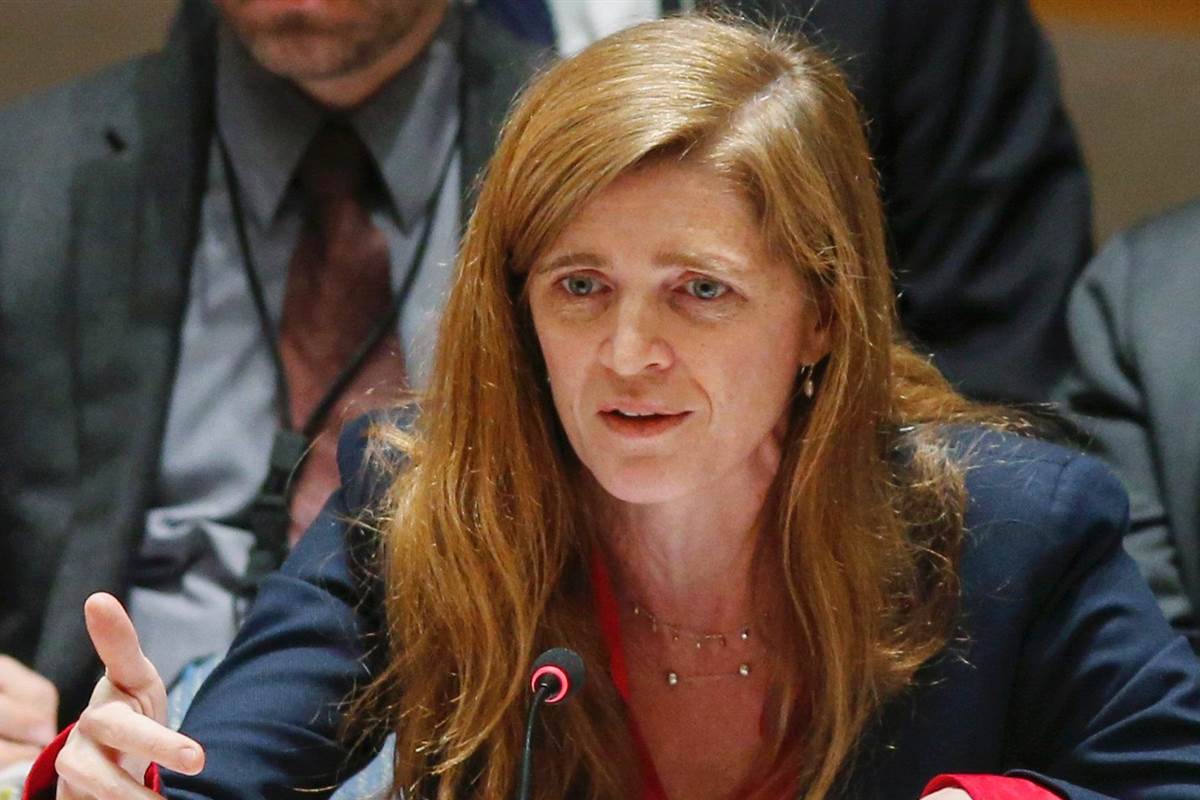
Since the liberation of eastern side of Aleppo, the pro-US media started to launch large hues and cries in support for “civilians” residing in the regions. Of course, they are shameful of openly defending their militants east of Aleppo. Samantha Power, who had possibly forgotten she is the US envoy to the UN Security Council, delivered an emotional and humanitarian speech and in an address to Russia, Syria and Iran, said they had lost even the ability to be shameful.
The second TV channel of Israel has called what is going on in eastern Aleppo since the Syrian government forces dominated the city as a holocaust against which world leaders cannot do anything.
No statistic has been released by independent sources on fatality rate over recent days. Western media have at times put number of the dead at 82 and referred to it as the human casualty. It is not clear how many of those announced dead were civilians or were killed by which of the clashing sides.
But what would have happened if the US army, rather than the Syrian army, tried to regain Aleppo from extremist Islamist groups? Let’s suppose the figure 82 is right as regards the Aleppo fatalities. Could the US liberate the city with 82 victims?
The US decided in 2004 to confront Falluja insurgents. They were brothers of those who are today in Raqqa and Idlib and were yesterday in Aleppo. The US forces initially surrounded the city and then raided it both from the air and the ground. Based on official statistics, 620 civilians and 250 armed rebels were killed. However, the figures on table in Iraq put number of the civilian fatality as high as more than 2,000. In Fallujah war, the US army used white phosphor chemicals. It is a substance exploding in the air and causing severe burns. International treaties have since 1982 banned the use of fire arms against civilians and even the military positions that are located inside regions with civilian population concentrating in it. Falluja was an instance. The protocol has not been endorsed by the Senate, however. Hence, use of such arms cannot stand as an instance of crime!
 The US army published an article on Falluja battle in its journal in April 2005. It assessed the use of white phosphor as a psychological weapon used to expel rebels from their hideouts. It was a tactic known as ‘shake and bake’. Italian RAI network has broadcast a documentary, entitled hidden massacre in Fallujah, on the anniversary of the military operations. It shows burnt body of women and children. The US ambassador to Rome brushed off authenticity of such a report and documentary. However, several months later in 2006, the government of George W. Bush officially confirmed the use of black phosphor in Fallujah. Since 2004, hundreds of children suffering defects, sometimes beheaded children, are born in Fallujah and pregnancy of women in Fallujah is still a nightmare.
Speaking of Iraq and the US and the way the US confronts its enemies – and of Samantha Power, who thinks she is not the US envoy but the Swiss envoy to the UN – it is good to have a look at a report by French magazine Le Monde on genocide and massacre of half a million Iraqi children:
The UN Security Council should be held accountable in the most lethal case of massacres in Iraq: It means the punishments imposed on Iraq after aggression on Kuwait. Based on the UN statistics, the UN Security Council banned any trade with the country, thus causing deaths of 500,000 to one million children.
The UN Human Rights Coordinator in Iraq, Irish Denis Halliday, resigned from his mission in Iraq in 1998 so as not to be forced to implement the sanctions program. He calls the programs as a genocide.
In 1995, an American female journalist asked the then US Ambassador to the UN, Madeleine Albright, whether continued sanctions were worth of lives of 500,000 Iraqi children. Her answer was alarming: That’s a very difficult choice. However, we think that’s the price which should be paid. Yes, it is worth.
 With lapse of years, it is now clear that the genuine goal of the sanctions was not Iraqi weapons but the dictator himself. As Denis Halliday explains, the justification was if you hurt Iraqi people and kill their children, they will rise up out of anger and topple the despot. The US tried to follow up the hypothesis for 12 years. In 1991, the US air force regularly bombarded water, sewage, purification and even power plant stations. In the coming decade, Iraqis lived without any drinking water. Halliday says typhoid and all the diseases caused by contaminated waters and spread like a flashlight were devastating. Americans did know such an approach could kill thousands of people. A classified Pentagon file in 1991 well confirms the issue. The confidential investigation, which was cold-bloodedly entitled ‘vulnerability of water refining in Iraq’, makes it clear that ruining water networks will cause collective deaths and spread of contagious diseases.
During all these years, the diseases were spread; Britain and the US dominated the committee of punishment in New York. In 12 years, the two allies prevented sanctions for import of necessary parts for repair of the water network. Halliday concludes: “And instead of holding Saddam Hussein accountable, Iraqi people eventually lay the blame on the US and the UN for all the pain and sufferings they were enduring as a result of the impact of the decisions on their lives.”
Years have passed and American leaders have come to understand that their hypotheses, including the punishments, have been ineffective, but have destroyed thousands of Iraqis. However, they continue imposing sanctions; why? One of the members of the American delegation to the UN, who defended sanctions, was Thomas Pickering who simply admits: “There is no best solution.”
Is there any need to recall the US-backed regimes in Tel Aviv, in Riyadh, in South America and so on and know what they do? Is there any need to recall that after decades, the US is still officially refraining from expressing verbal apology for genocide in Hiroshima and Nagasaki? Which war do you know in the universe on one side of which the US does not lie? Our world is so disgraceful. The most indebted to the world poses to be the most creditor. The most disgraceful elements worldwide like Israelis have been more sensational vis-à-vis Aleppo. This is while, nine years have passed and they have put their foot on the neck of Gaza prison and every two years, they review the episode.

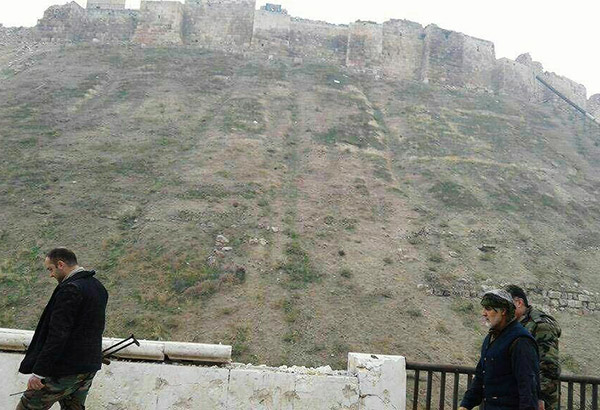
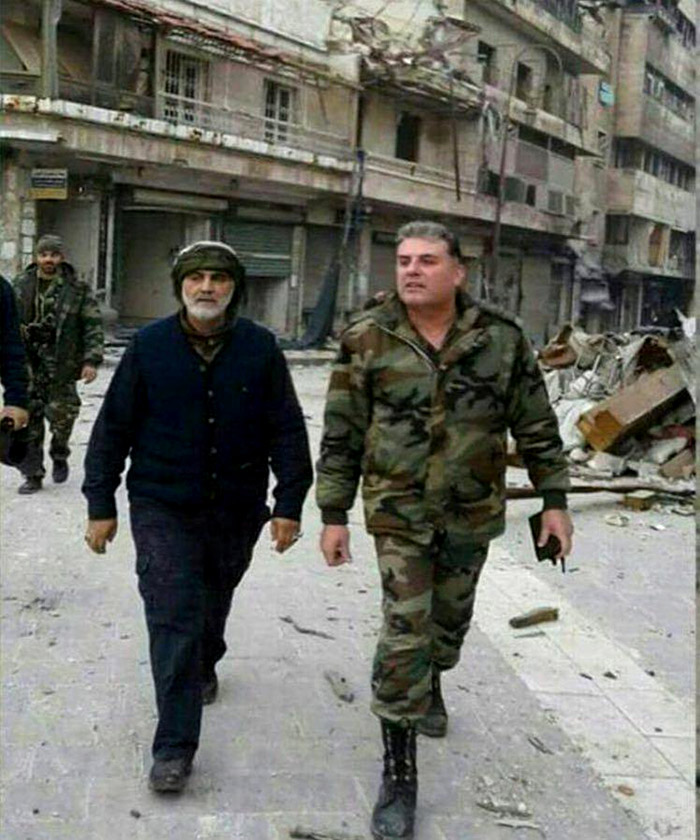 General Soleimani and the IRGC Quds Force have offered extensive advisory help to the armies of Iraq and Syria in their ongoing fight against terrorists, particularly the ISIS militants.