Sunday, December 21, 2025
Home Blog Page 4080

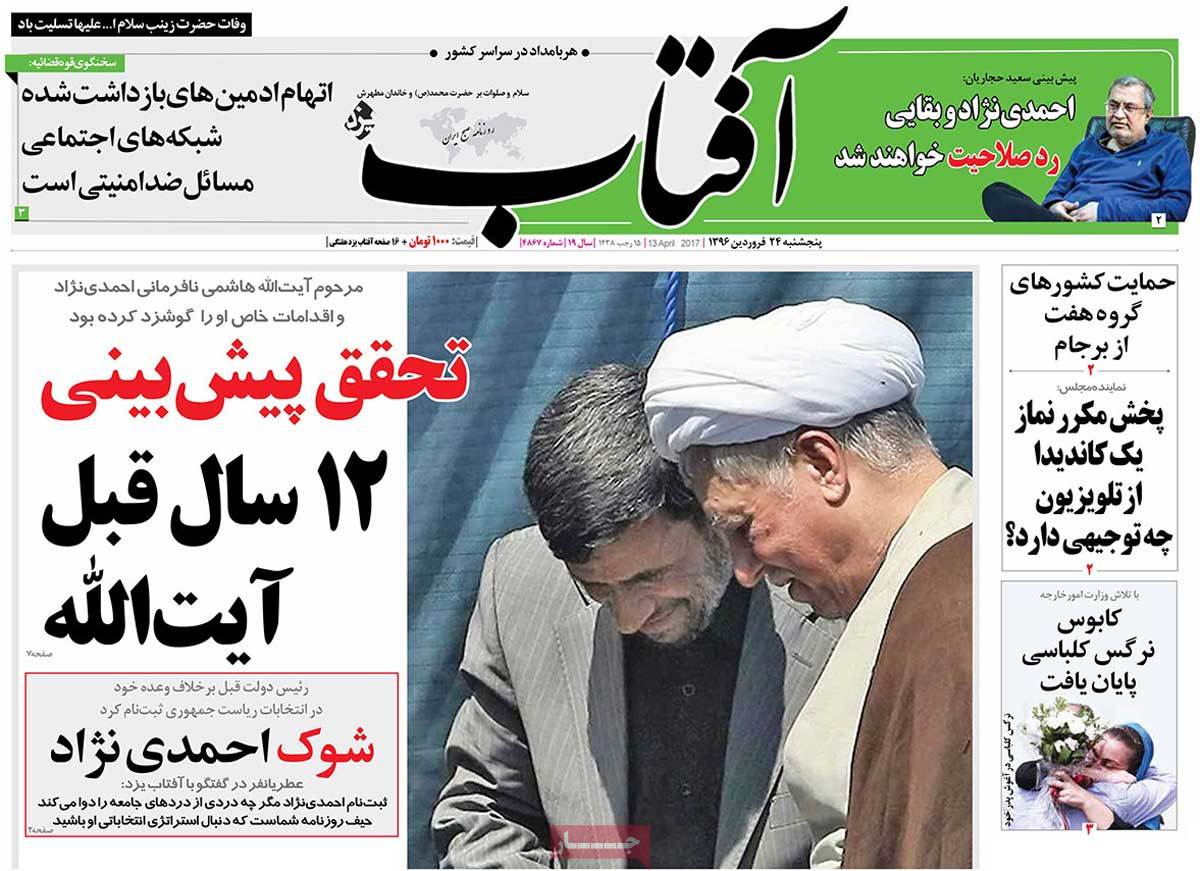
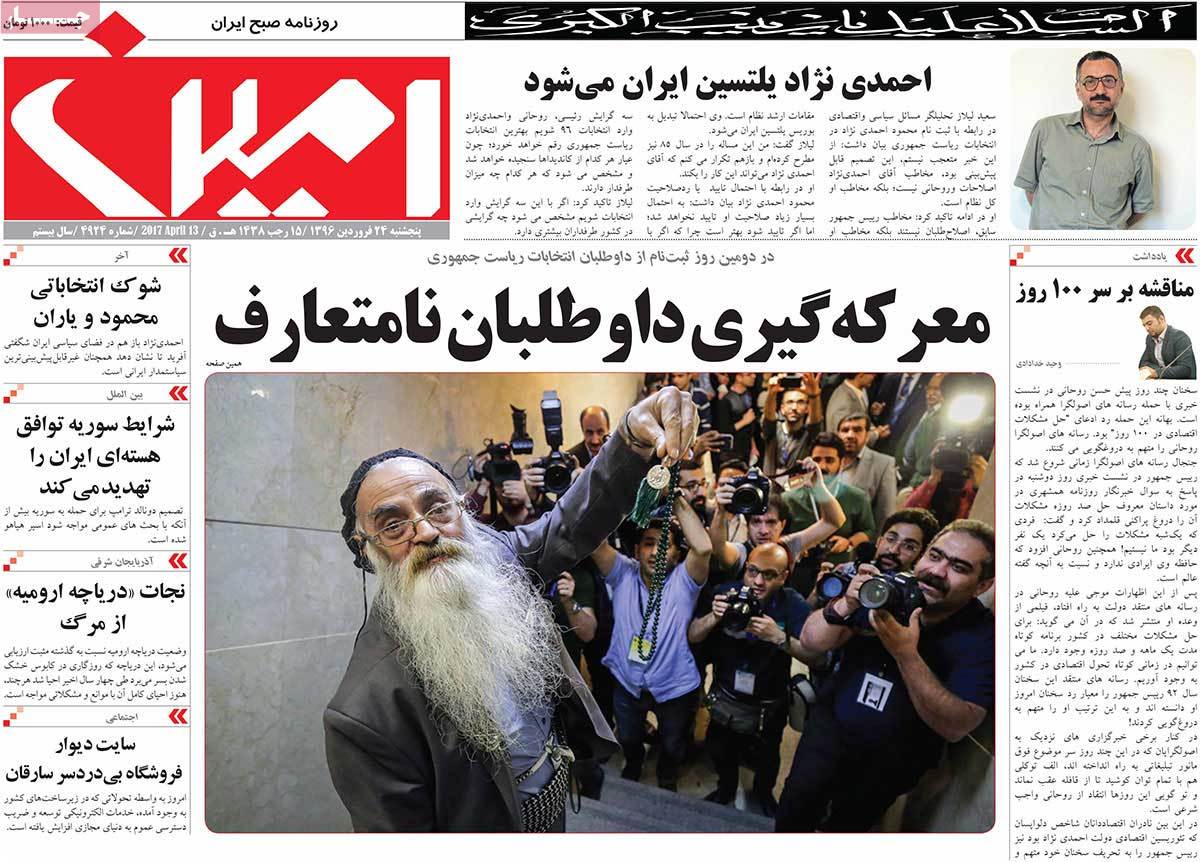
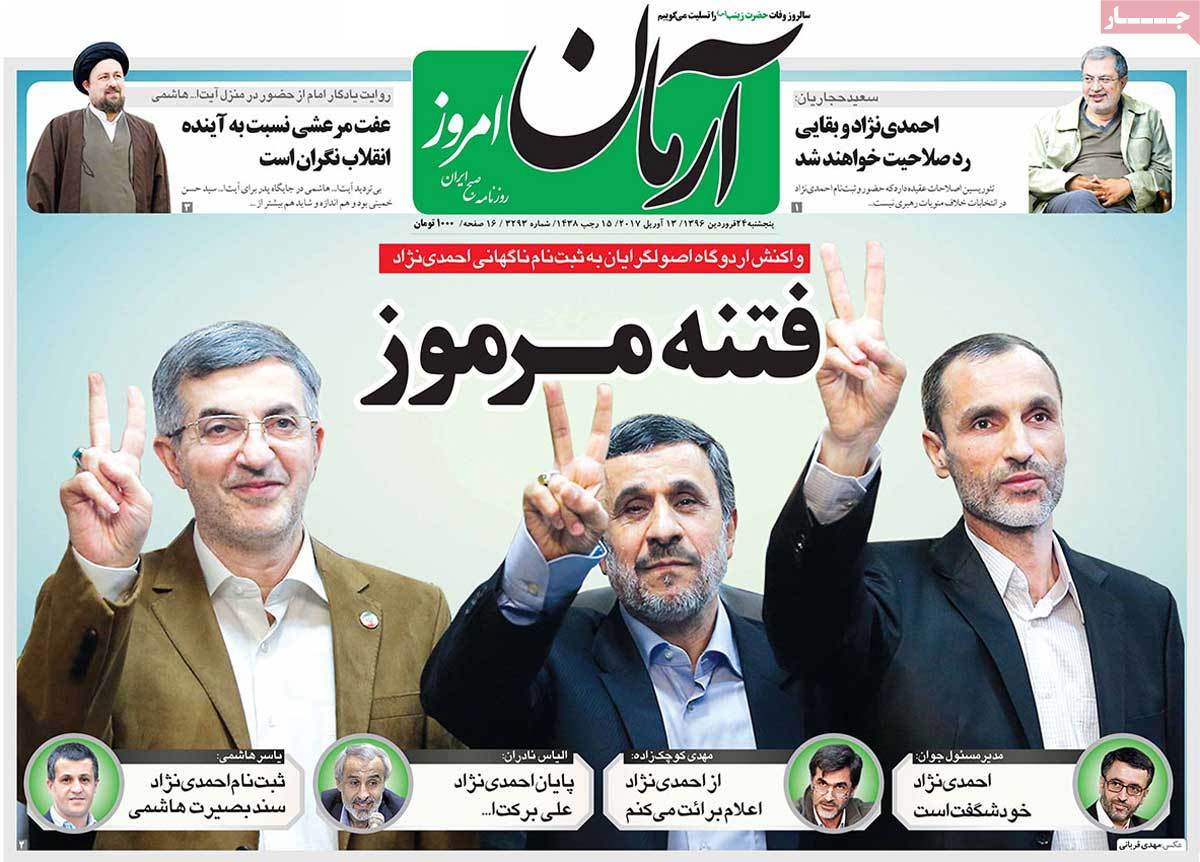
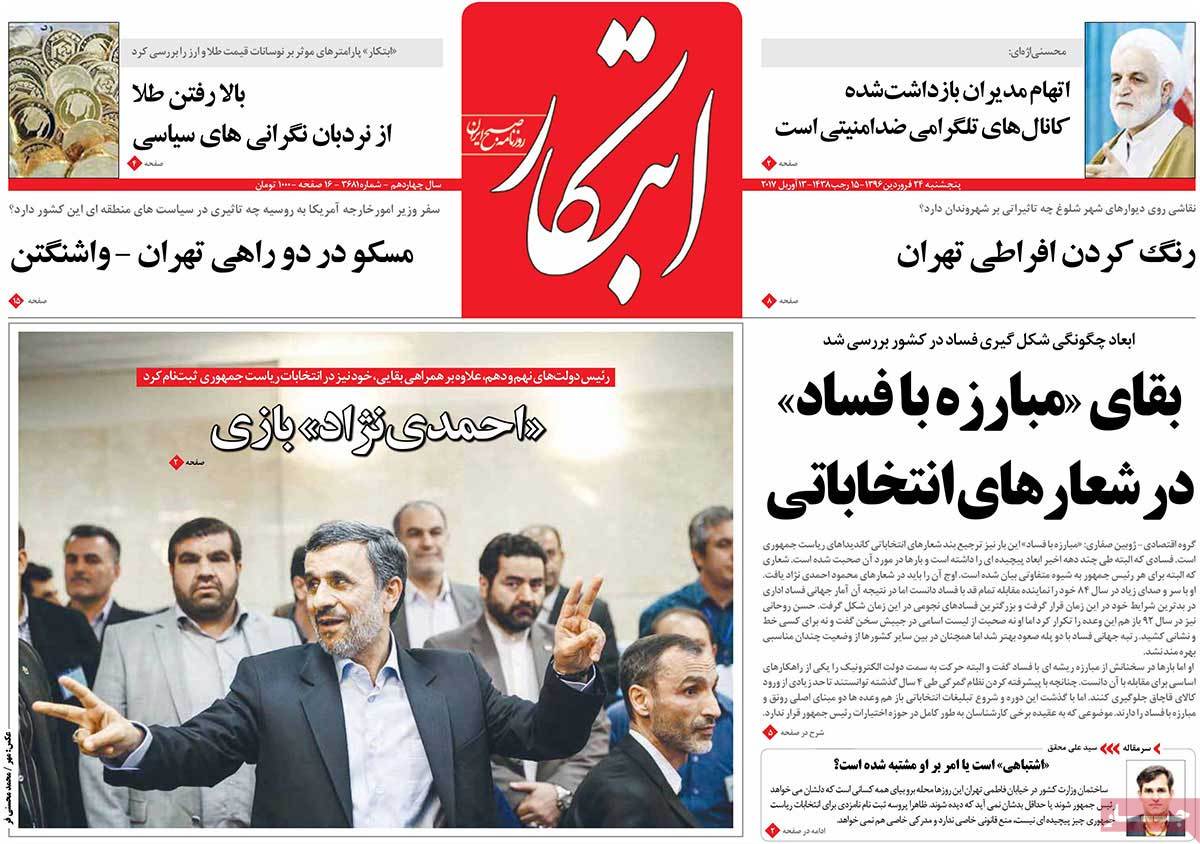
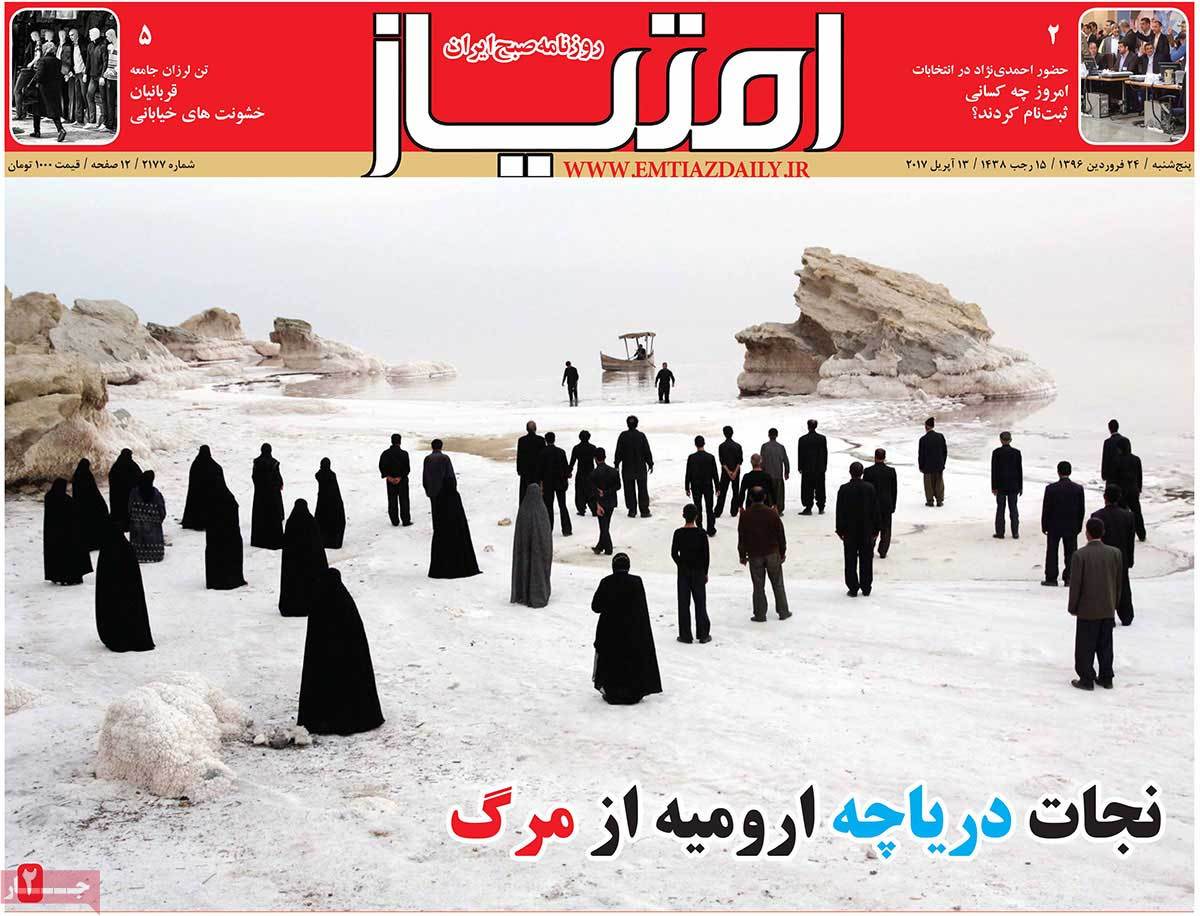
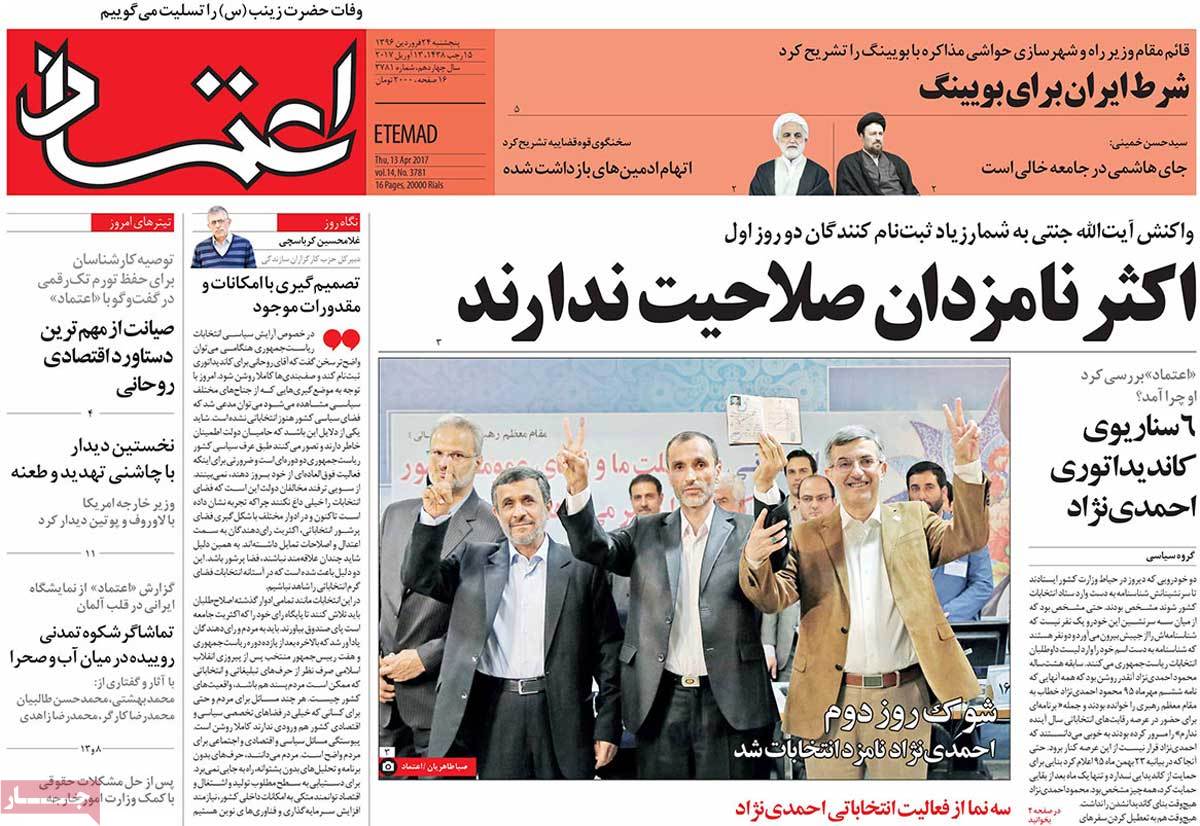
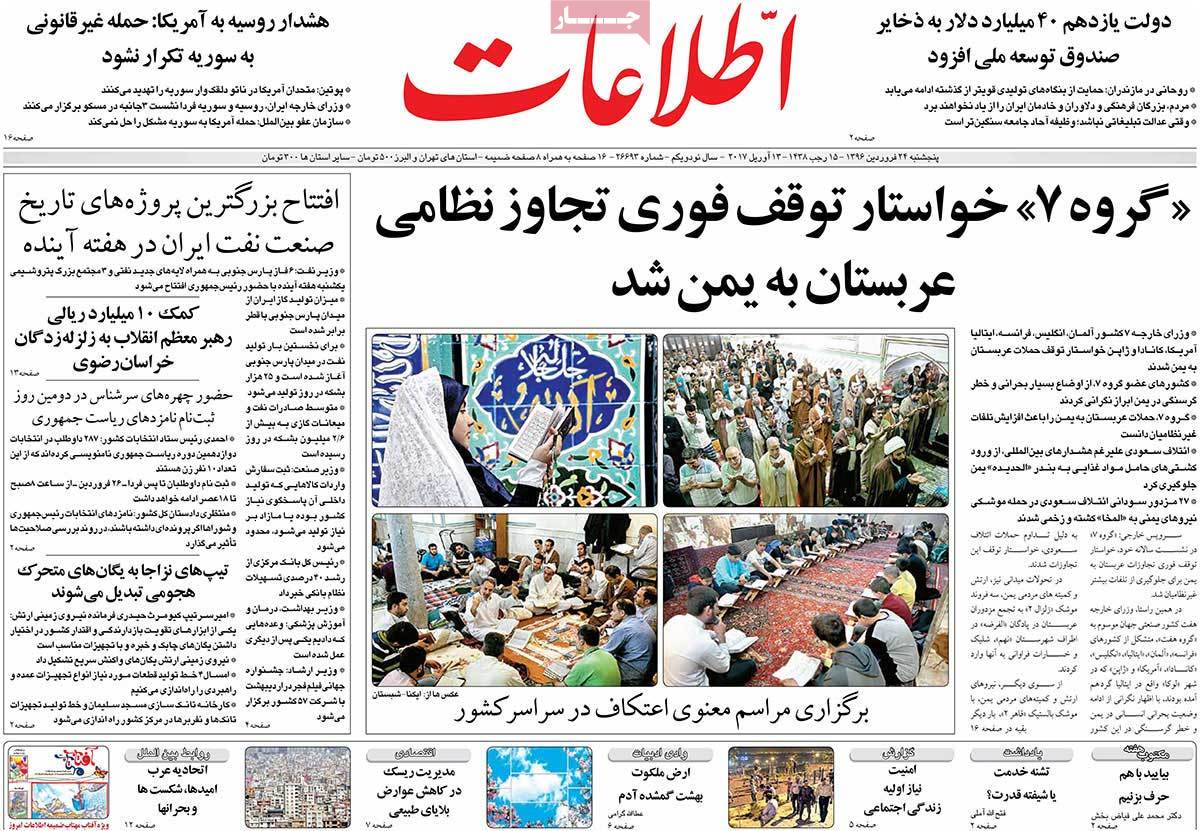
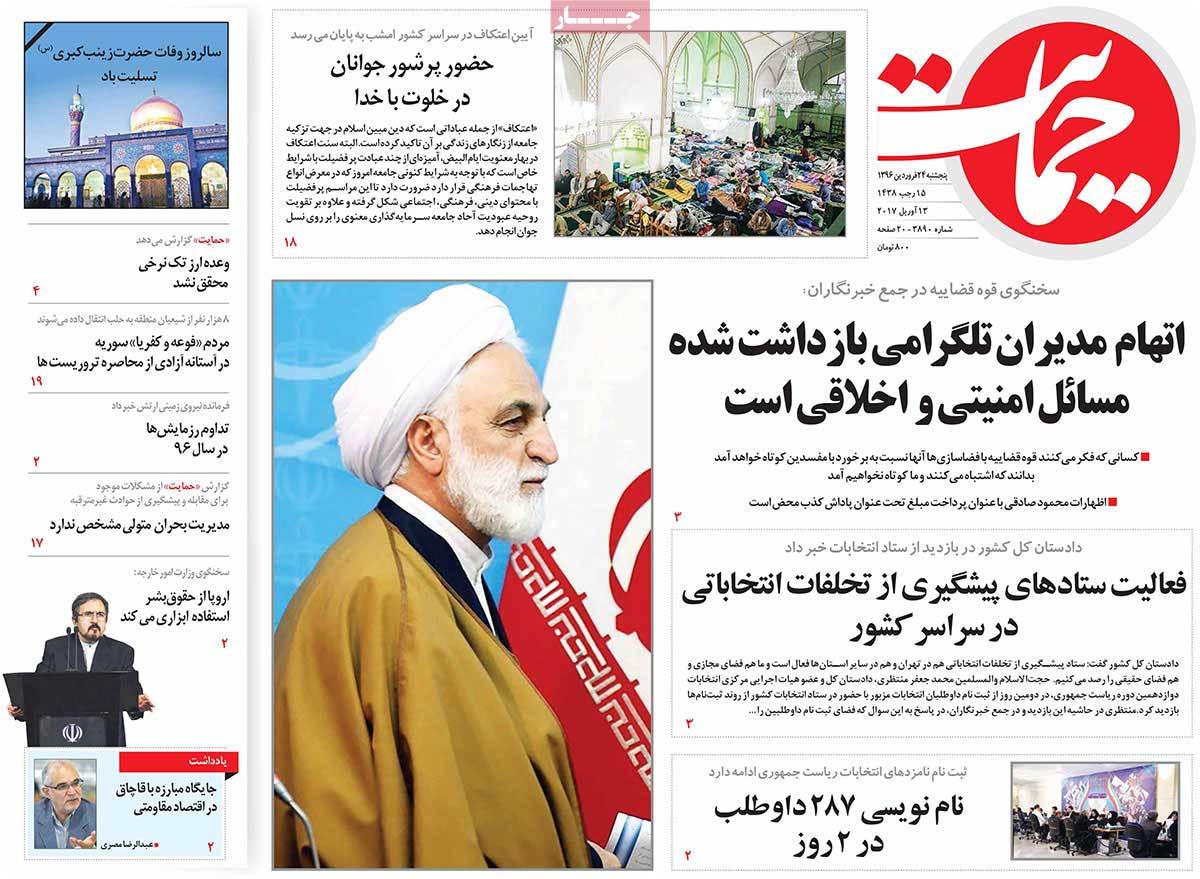
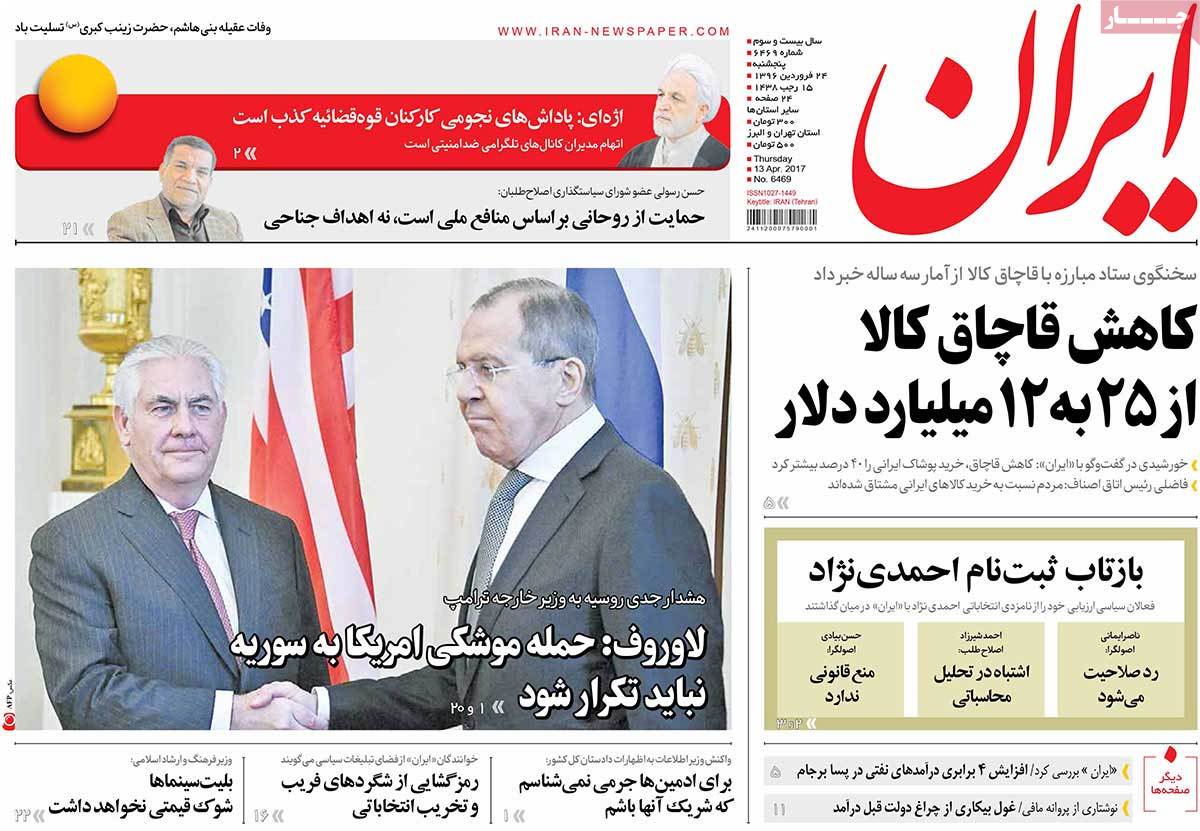
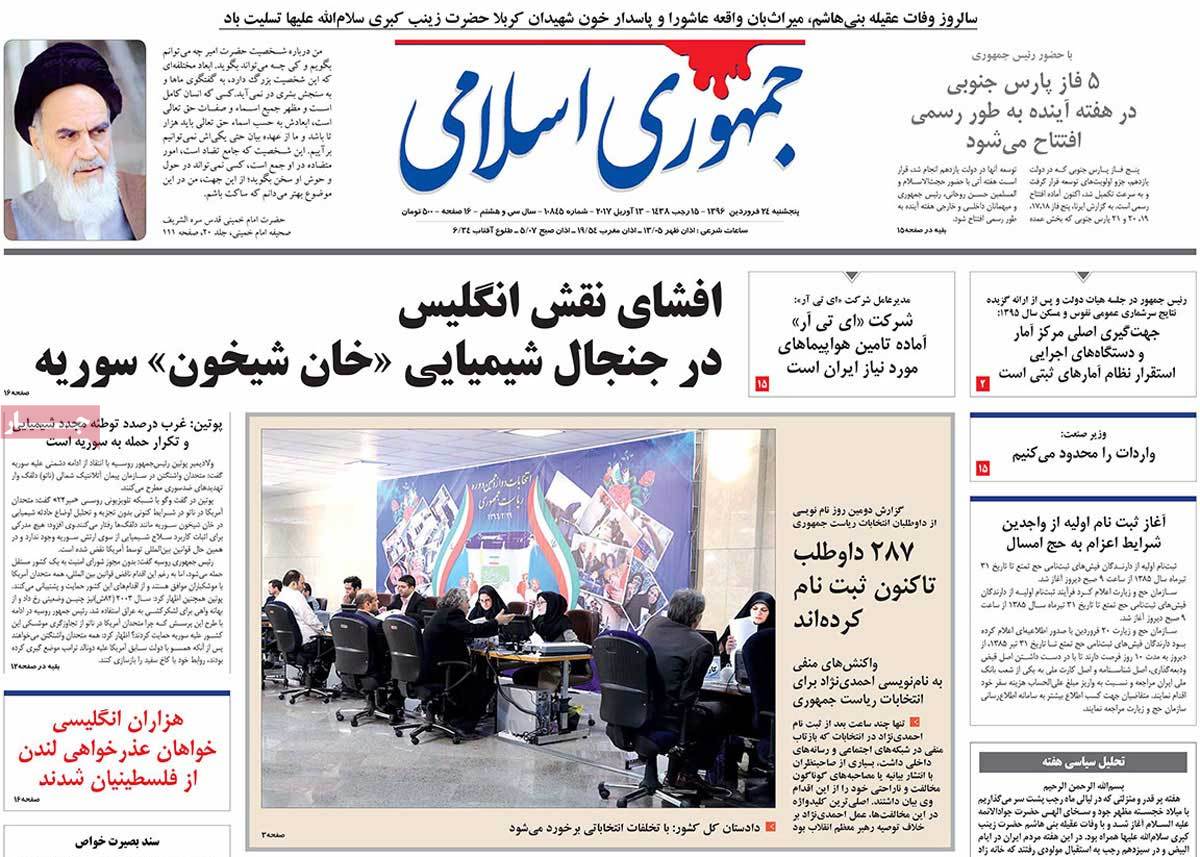
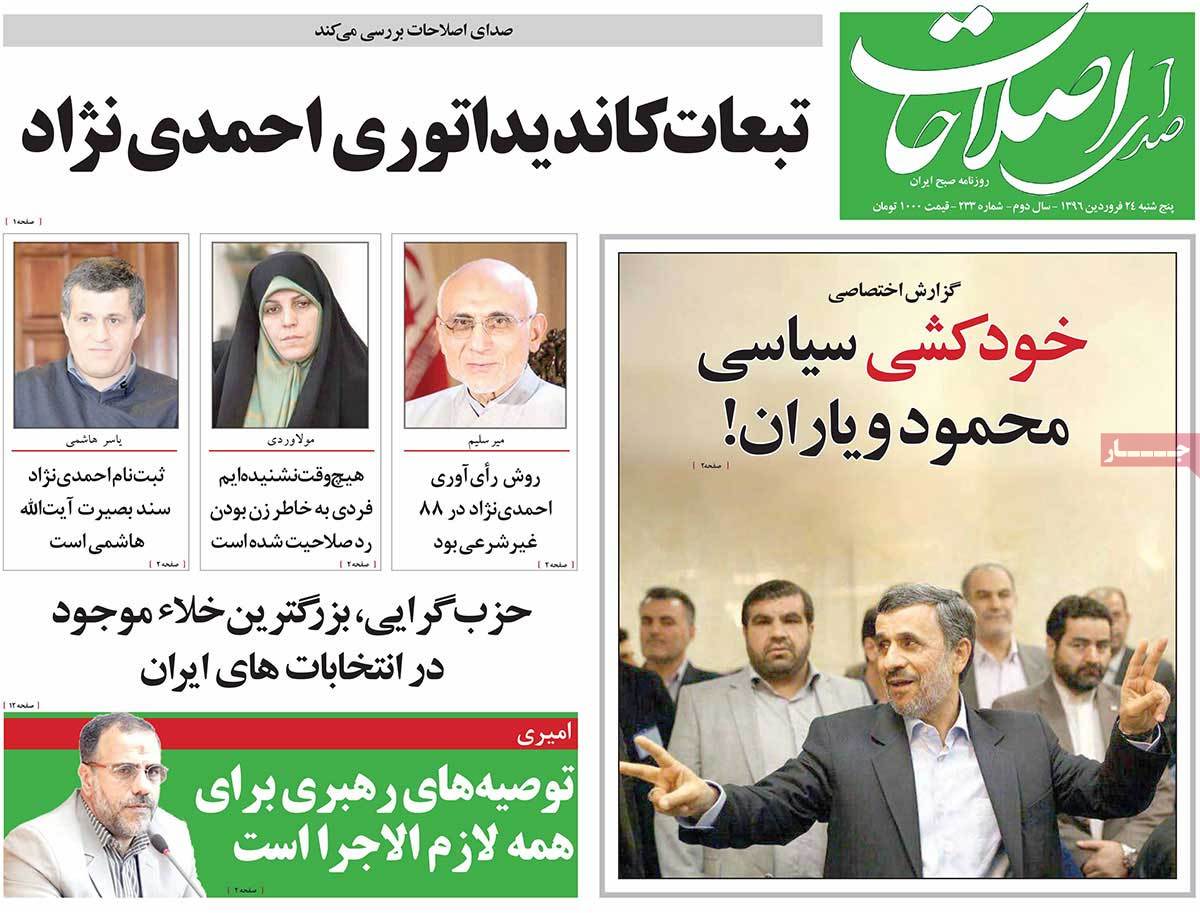
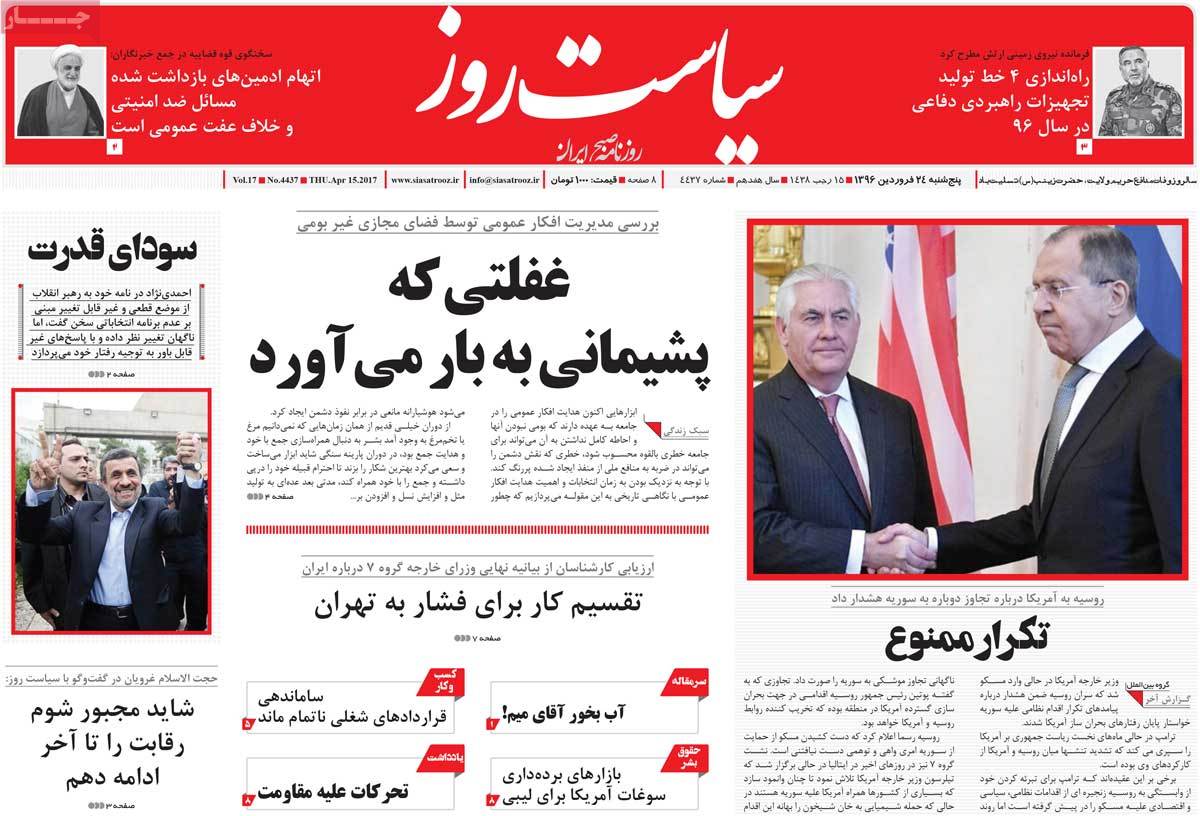
A Look at Iranian Newspaper Front Pages on March 4

Newspapers today widely covered the reactions to a bill approved by Iranian Parliament that legalizes salaries as high as nearly $6,300 for executives.

The disclosure of Trump cabinet’s ties with Russia and the possible resignations in his justice department also received great coverage.

Iranian President Hassan Rouhani’s meeting with his Turkish president and the remarks he made on the sidelines of the Economic Cooperation Organisation (ECO) Summit in Islamabad were among other top stories today.

Newspapers also covered the ongoing visits by Saudi Arabia’s King Salman to Southeast Asian countries.

The above issues, as well as many more, are highlighted in the following headlines and top stories:


19 Dey:

1- Iran President in ECO Summit: Asia to Be Pioneer in 21st Century

2- Rouhani: Enemies’ Dream about Leader-President Conflict Won’t Come True

A Look at Iranian Newspaper Front Pages on March 4


Abrar:

1- Deputy FM: It’s Not on Iran’s Agenda to Establish Ties with US

2- Foreign Affairs: Trump Should Keep Open Diplomacy Channel with Iran

3- Number of Displaced Mosul Residents at Highest Level

4- Erdogan: We Can Conduct Raqqa Operation in Cooperation with Russia, US

A Look at Iranian Newspaper Front Pages on March 4


Abrar-e Eqtesadi:

1- Iran’s Oil Output Close to 4m bpd

2- Iran’s €2-Billion Oil Talks with Japan

3- 101-Percent Expansion in Iran’s Oil and Gas Industry after JCPOA

4- Iran, Germany’s Siemens to Launch Joint Power Factory

A Look at Iranian Newspaper Front Pages on March 4


Afkar:

1- Putin Nominated for Nobel Peace Prize

A Look at Iranian Newspaper Front Pages on March 4


Aftab-e Yazd:

1- MPs’ Decision to Set $6,300 as Maximum Salary for Executives Sparks Controversy

2- Iran Parliament’s Bill to Allocate $52m to Return Iranian Elites Living in US Is a Show

A Look at Iranian Newspaper Front Pages on March 4


Arman-e Emrooz:

1- We Don’t Have 2 Guardian Councils: Vice-Speaker Writes to Ayatollah Jannati

2- State Dept. Official: Secrets behind Obama’s Last Negotiation with Iran

A Look at Iranian Newspaper Front Pages on March 4


Etemad:

1- Larijani: No Limit to Political Groups’ Contact with Iran’s Leader

2- Asghar Farhadi in Appreciation Ceremony in Tehran: I Hope I Won’t Become Stuck-Up

A Look at Iranian Newspaper Front Pages on March 4


Ettela’at:

1- US Council on Foreign Relations: Saudi Arabia Has Failed in All Fronts

2- UN Harshly Criticizes Saudi Arabia for Human Rights Violation

3- Nigerian Army Once Again Oppresses Shiites

A Look at Iranian Newspaper Front Pages on March 4


Haft-e Sobh:

1- Iranian Old Woman Dies of Cold, Hunger in Canada Where She Came to Visit Daughter

A Look at Iranian Newspaper Front Pages on March 4


Iran:

1- Iranian Cinema Holds Celebration in Honour of Farhadi

2- Rouhani and Erdogan Meet on Sidelines of ECO

3- Iranian President: We’ll Turn Differences to Strengths through Dialogue

A Look at Iranian Newspaper Front Pages on March 4


Jame Jam:

1- Nuclear Chief: Iran Continues Demanding Its Rights of Westerners

A Look at Iranian Newspaper Front Pages on March 4


Javan:

1- US Attorney General on Verge of Resignation over Ties with Russia

2- Difference between the Great Brando and Farhadi!

A Look at Iranian Newspaper Front Pages on March 4


Jomhouri Eslami:

1- Iran’s Successful Efforts in ECO Summit to Create Stability in Region

2- Syrian Army Liberates Palmyra

3- Yemenis Hold Anti-Saudi Rallies, Underline Use of Missile against Riyadh

A Look at Iranian Newspaper Front Pages on March 4


Kayhan:

1- Wave of Reactions to Parliament’s Strange Bill: Majlis legitimises astronomical salaries; Executives can receive 30 times more than workers

2- ISIS Leader Admits Defeat; Terrorists Escape to Mountainous Areas

3- Foreign Affairs: US Should Reinforce Moderates in Iran for May Election before It’s Too Late

A Look at Iranian Newspaper Front Pages on March 4


Mardom Salari:

1- Saudi Arabia Spends Billions to Counter Iran: A Report on King Salman’s Southeast Asia Tour

A Look at Iranian Newspaper Front Pages on March 4


Resalat:

1- Ayatollah Makarem Shirazi: Arab NATO Is US Plot to Destroy Muslim World

2- Ayatollah Khatami: Regional Countries Should Take Lesson from Saddam’s Fate

A Look at Iranian Newspaper Front Pages on March 4


Setareh Sobh:

1- French Ex-PM, Presidential Candidate Accused of Paying $700,000 to Wife, Children

2- US Economy to Become Fragile vis-à-vis China: Analyst

A Look at Iranian Newspaper Front Pages on March 4


Shahrvand:

1- Iranian Calligrapher Amirkhani Receives Chevalier Order in French Embassy

A Look at Iranian Newspaper Front Pages on March 4


Shargh:

1- Farhadi in Appreciation Ceremony: Cinema Knows No Border

A Look at Iranian Newspaper Front Pages on March 4


Vatan-e Emrooz:

1- Astronomical Salaries Repeated! Widespread protests against parliament’s bill that legalises astronomical salaries for executives

2- Culture Minister: 6 Ministers Pursuing Issue of ‘Clash of Clans’!

3- Trump’s State Dept. Shut Down: Atlantic’s Report about Chaotic Situation of US Diplomacy Apparatus

A Look at Iranian Newspaper Front Pages on March 4

Iran’s Abbasi Is Middle East’s Most Beautiful Hotel: CNN

Abassi hotel-Isfahan
The most beautiful hotel in Iran? Iran's oldest hotel might also be the country's, if not the region's, most beautiful. The Abbasi, which opened in the 1700s, represents authentic Persian design.

Here is CNN’s account of Abbasi Hotel and its ‘unique’ beauty:

Flick through almost any travel magazine these days and you’re bound to come across an article hailing Iran as the next big destination.

Prompting the spike in interest in the Islamic Republic is recent geopolitical wrangling in the shape of a nuclear deal with world powers that has ended some longstanding sanctions.

But while the country is trying to modernize its tourism industry in the face of increasing visitor numbers — 5.2 million came in 2016 and more are expected in 2017 — its more traditional offerings still have the potential to charm.

None more so than the Abbasi Hotel, an opulent if careworn establishment located in the ancient city of Isfahan.

It’s a place like no other.

Isfahan has its fair share of historical wonders (some which are UNESCO World Heritage sites), but in many ways the Abbasi has become a tourist attraction in its own right.

Built around 300 years ago, under the Safavid dynasty reign of Shah Sultan Hossein, it was originally used as a pit stop for merchants traveling the ancient Silk Road.

Abassi hotel-Isfahan
The Abbasi’s Qatar and Safarvid suites (pictured here) are its most atmospheric rooms.

Uniquely and Beautifully Persian

The complex provided shelter not only for traders but also for the camels and horses they used to help transport their goods.

The years, decades and centuries that followed took their toll on the old caravanserai (during the early 1900s it was used as a military complex) and it started to fall into disrepair.

In the 1950s French archaeologist André Godard, working in Iran at the time, took it upon himself to fight for its restoration.

Soon after that, the Abbasi became what it is today: a 4-star hotel drenched in an ancient past.

The Abbasi may not have an abundance of modern amenities. There are no state-of-the-art gym or in-room cappuccino machines (although it does have great Wi-Fi), but that adds to its charm.

In a globalised and franchise-dominated world, the Abbasi is unique.

This hotel is all about atmosphere. Moreover, it’s uniquely Persian.

Abassi hotel-Isfahan
Even the Abbasi’s ceilings are Instagram-worthy.

“I’d highly encourage anyone traveling to Iran to stay here as it’s an experience of a lifetime,” says general manager Jamal Zandi.

He’s not really exaggerating.

Hallways are lined with authentic miniature paintings, the ceiling of the lobby is finely detailed and the dining areas adorned with beautiful mirror work, glittering chandeliers, and exquisite colourful wall motifs often associated with romantic notions of “the orient.”

An array of emerald greens, jasmine blues and deep golds inevitably make visitors reach for their cameras as soon as they walk in.

Abassi hotel-Isfahan
The Abassi was once a stop for Silk Road traders.

The hotel has around 225 rooms, including 23 suites, and is divided between the hotel’s old wing and new wing.

Built in the 1970s, the rooms in the new wing are rather characterless — it seems that the re-creation of the hotel’s original look and feel was not a priority at the time of construction and the rooms are bland in colour and nondescript.

Guests who get to stay in the old wing, especially the Qajar and Safavid suites, are in for a treat. These rooms have been superbly restored and are decorated in an elegant traditional style without being overloaded.

At about $350 a night, they’re relatively pricey.

Abassi hotel-Isfahan
Abbasi Hotel has six restaurants — including a coffee shop, traditional teahouse and breakfast hall.


What really makes the Abbasi particularly special is its open-air courtyard.

It’s a large, beautiful, well-maintained Persian garden, complete with little fountains, brook-lined avenues, bright flower beds and quince-laden trees.

People spend their time drinking tea, reading a book or just hiding away from the hustle and bustle of the city in this oasis.

The courtyard restaurant is famous for an Iranian dish called Ash-e Reshteh, a thick type of noodle soup filled with all types of beans and herbs.

“Many Iranians think a visit to the Abbasi for its soup is an essential part of coming to Isfahan,” says Arian Aghamardi, a frequent guest at the hotel. “Nothing better to warm you up on a cold day.”

It was winter when CNN visited, yet the garden was still green and beautiful. It can only be more spectacular in the spring.

Times are clearly changing in Iran and new hotels are appearing on the scene.

Abassi hotel-Isfahan
Old wing: The hotel now houses more than 200 rooms including 23 suites. The newly designed rooms aren’t as characterful as the rooms in the old wing, especially the Qajar and Safavid suites.

While the US still has its sanctions in place, a situation unlikely to change under new President Donald Trump, hotel groups headquartered outside America have already started to move in.

The French Accor group became the first in 2016. Others are following, including the UAE’s Rotana and Spain’s Melia. It’s expected that by 2018 Iran will have six different international brands.

But anyone visiting Esfahan and staying elsewhere would be missing out if they didn’t at least stop by the Abbasi and take a look around.

It’s guaranteed to be one of the best memories of any stay in Iran.

Iran Tests S-300 Missile Defence System

S-300

According to a Farsi report by Fars News, the missile defence system was tested in a drill codenamed ‘Damavand’ attended by top officials and generals.

Russia concluded the supply of its S-300 surface-to-air missile defence systems to Iran back in October 2016 after years of dispute.

Moscow was committed to delivering the systems — which are used to target tactical and ballistic aircraft and projectiles — to Tehran under an $800-million deal in 2007.

However, Russia banned the delivery of the systems to Tehran back in 2010, citing the fourth round of the UN Security Council sanctions, which bars hi-tech weapons sales to the Islamic Republic.

Moscow’s refusal to deliver the systems prompted Iran to file a complaint against the relevant Russian arms manufacturer with the International Court of Arbitration in Geneva, Press TV reported.

In April 2015, Russian President Vladimir Putin lifted the ban on the delivery of the S-300 and Moscow subsequently signed a new contract to supply Iran with the systems by the end of that year.

Months later, Tehran dropped the lawsuit after Moscow agreed to fulfill its commitments under the 2007 accord.

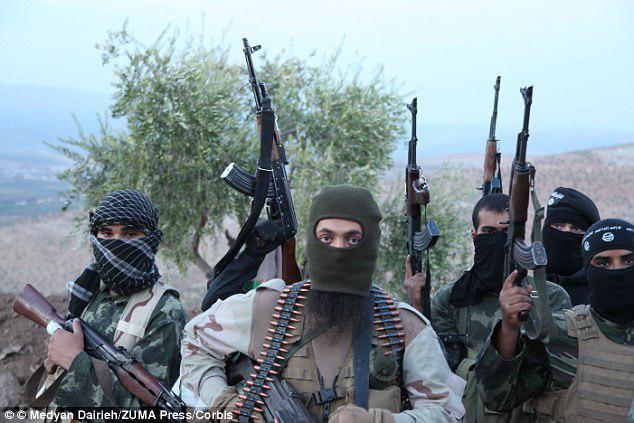
ISIS Uses Chemical Weapons in Iraq’s Mosul: Red Cross

ISIS

The patients, who are being treated at a hospital in nearby Irbil, are “showing clinical symptoms consistent with an exposure to a blistering chemical agent,” the organization’s regional director for the Middle East, Robert Mardini, said.

Several children, men, and women have symptoms that include blisters, coughing, redness in the eyes, irritation, and vomiting.

“The use of chemical weapons is absolutely prohibited under international humanitarian law. We are deeply alarmed by what our colleagues have seen, and we strongly condemn any use of chemical weapons, by any party, anywhere,” ICRC’s Mardini said.

The World Health Organization has responded to the reported use of chemical weapons agents in eastern Mosul, activating an emergency response plan to treat those who may be exposed to the highly toxic chemicals, the WHO said Friday.

ISIS has used chemical weapons on numerous occasions in Iraq and Syria, including in the battlefield in northern Iraq, according to Iraqi and US officials.

This is believed to be the first such attack in Mosul since the October start of the offensive to retake Iraq’s second most populous city from ISIS control.

Palestinian Woman Dies at 40 after Giving Birth to 69 Children

palestine

The Palestinian woman who had given birth to 69 children died last Sunday in the Gaza Strip at the age of 40, her husband reported to Gaza Al-An news agency.

The Palestinian woman, who was known as one of the most fertile women in the world, had given birth to twins 16 times, triplets seven times and quadruplets four times.

This is not the first time a woman gives birth to so many children. According to a Guinness World Record, a Russian woman named Vassilyeva had also given birth to 69 children.

Turkey Fires Officer Who Mistreated Iranian Nationals

Turkey Fires Officer

According to a report by ISNA, the Turkish officer was fired after Iran’s Foreign Ministry formally protested against what it called “disrespect” to Iranian tourists by some Turkish police forces.

Iranian Ambassador to Turkey Mohammad Ebrahim Taherianfard had also noted that Tehran will seriously pursue the case of Iranian nationals beaten by Turkish police.

The objection was motivated by a footage showing an Iranian being beaten by Turkish security guards in Gurbulak, a village in province Agri in eastern Turkey, which is a border checkpoint into Iran.

“Authenticity of the video has not been confirmed yet and the case is now under investigation,” the ambassador said, Fars reported.

He reiterated that the Iranian embassies all-over the world are responsible to protect the rights and dignity of the Iranian nationals, adding, “Those who are to lodge complaints in this connection can do it through Iranian embassy in Turkey or any other judiciary offices inside Iran.”

“Iran foreign ministry under no circumstances allows disrespect of Iranian nationals in neighbouring countries and will show proper reaction in dealing with any disrespect or beating up according to international rules and regulations,” the envoy added.

World Media Invite Tourists to Visit Iran in 2017

en-sky

Since late 2016, several articles have been published by international media outlets about the tourist attractions and monuments in Iran, to present them to the world or review the conditions of tourism industry in Iran.

According to a Farsi report by Mehr, many consider Iran as an attractive tourist destination. Some travel guides and reports point to the less-known aspects of Iran’s tourism which haven’t been noticed enough in media outlets: that women can safely travel throughout Iran; that Iranians are not terrorists; and that the majority of reports on Iran are false.

The majority of articles recently published about Iran’s tourism are positive. There is hope that the existing false image of Iran is modified by more reports of this type, particularly in the visual media, as well as the mainstream press in the countries that send lots of tourists abroad.


Guardian 

Excellent Natural Attractions

“Imagine a verdant landscape filled with rice paddies, tea plantations and olive groves. A land where you can hike up mountains in the thick mist of the morning and picnic by waterfalls on sun-weathered rocks in the afternoon. A land filled with golden apricots that taste like honey, peaches so succulent you barely notice the sweet juice that runs down your chin,” wrote Yasmin Khan in The Guardian about her food tourism in Iran.

In its special tourism issue, the Spanish newspaper El Mundo described Iran’s tourist attractions in an article by its Iran correspondent Zahida Membrado.

According to this report, Iran could not be found among the destinations of any tourist agency because of the unrealistic images published against it during the last decades; however, it is now turned to an attractive destination which leaves the visitors mouth agape. This could be true for any misjudged country; undoubtedly however, none of them is on a par with Iran in terms beauty, history, culture, magic, and natural attractions.

Membrado remarked that there is no risk for women who intend to travel across Iran by themselves.


Legendary History

In its first issue in 2017, the Austrian magazine Skylines has introduced a number of Iran’s tourist attractions in a report by its journalist who spent 6 days in the Islamic Republic.

“Land of Palaces: A journey along the legendary Silk Road, from Isfahan to Tehran” is the title of Skylines’ illustrated report on the tourist attractions of Isfahan, Kashan and Tehran.

During his journey to Iran, Massimo Rumi, the well-known Italian photographer, has also taken an unparalleled photo of Isfahan’s Sheikh Lotfollah Mosque architecture, which has been published in several websites.

figaro

The French newspaper Le Figaro also presented Iran as an interesting tourist destination in 2017 in its website. “The tour operators highlight the cultural richness of this country,” Le Figaro wrote, calling Iran “the country of contradictions”.

“After the removal of sanctions against Iran, this country is attracting more and more tourists,” the website added, announcing that based on the statistics of Seto, the French syndicate of tour operator companies, there has been a %144 increase in the number of French people who travelled to Iran in 2016.

“About 4,000 clients of French travel agencies chose this destination last year,” it added.

“Although the number is still low, Iran is becoming a trend. It is a unique destination for the fans of ski and sun tanning on Persian Gulf and Caspian Sea’s beaches; and also for the lovers of culture, art and history.”

“In April 2016, Air France launched its Paris-Tehran direct flight line. And more and more agencies are bringing the name of Iran in their catalogues,” it added.

Political Changes Bring More Tourists

In a report that cited Cox & Kings, one of the world’s oldest tour operators, the Russia-based Sputnik News predicted that a flood of tourists will pour into Iran, Russia and Jordan as some “on trend” destinations in 2017. Referring to the recent prominent political changes and events in Iran, the operator discussed that before the anti-Iran sanctions, the Islamic Republic was one of the most popular tourist destinations in the world.

Insider

The Insider website – affiliated with the well-known Business Insider – referred to Iran as one of the top 50 tourist destinations in 2017. Besides such websites as National Geographic Travel, Lonely Planet and Trip Advisor, Insider publishes lists to present top tourist destinations. This year, it started its list with Patagonia, Chile, St. Petersburg, Russia, Nepal, and mentioned Iran at the 11th place, hailing the country’s higher security in recent years.

“This trend is expected to continue well into 2017, thanks to new direct flights to Tehran from both London and Paris, and the construction of multiple new hotels,” Insider wrote.

While Iran’s name is cited before Portugal, Peru, France, Japan, Antarctica and Italy, Oman and India are the only other countries of the region to be cited in Insider’s list at places with reasonable levels of value and security to be tourist destinations.

Bloomberg

Iran’s visa is worth the trouble

In an article, Bloomberg counted Iran among the 20 countries to be visited in 2017. “For intrepid travelers, the question is not whether to visit Iran; it’s how to get there before an influx of tourists taints the experience.”

“The visa application process is lengthy and complex; citizens from the US, Canada, and the UK must be on escorted tours; and travelers have to abide by a government dress code,” Bloomberg added.

“Take our word for it, though. The hassle is worthwhile.”

Elsewhere in the report, the hospitality of Iranian people and the country’s foods are appreciated as “legendary” features. “There is a cultural norm in Iran that guests are from God,” cited the website from a tour leader.

“I frequently hear people say they’ve been all over the world and never received a welcome like they got there.”

Daily Mail

The UK-based Daily Mail has also prepared a list of top ten travel spots in 2017, pointing to Iran as one of them.

“Being one of the largest countries in the Middle East and one of the top 20 largest economies in the world, Iran is expected to see significant tourism growth following the lifting of sanctions that previously have restricted foreign investment since 2006,” wrote Azernews, Azerbaijan’s first English-language newspaper.

“Currently, the Islamic Republic’s share in the world tourism stands at 0.24 percent and such a result does not meet the country’s interest,” added Azernews.

It is pointed in this article that although there are 1,100 hotels in Iran, among them only 29 are five-star, and 75, four-star. “This will require the development of additional hotel capacity, estimated at 150 hotels, at least, to cater for the increased demand.”

Azer

No Country Dares Get into War with Iran: FM Zarif

zarif

Insecurity is no longer a problem limited to the region. Terrorists enjoying financial backing from their sponsors have expanded their terror activities to Paris and Berlin much in the same way that they have already done in Islamabad and Baghdad. With that in mind, Iran is now in a special position, given the domestic, regional and international circumstances.

In such conditions, Iran’s Foreign Minister Mohammad Javad Zarif says the Islamic Republic will continue to exercise self-restraint in the face of certain efforts to stoke tension in the region.

In a Farsi interview with Etemad newspaper published on Wednesday, Zarif weighed in on a whole range of issues. Here are excerpts from his remarks in the interview:

Iran Committed to Relations with Neighbours

At the beginning of President Rouhani’s term, we announced that our priority is to boost ties with neighbouring countries. We have always tried to ameliorate our relations with regional nations. Tehran believes the region needs cooperation and convergence as well as security. We attach great importance to the security of the whole region as well as that of every single country in the Middle East.

Iran Wants Stability in Saudi Arabia

We would like to see stability in Saudi Arabia and all Persian Gulf countries. We want to see war against Yemen stop. From day one, we made every effort to prevent an outbreak of war in the country. Even when the war erupted, we tried our utmost to help end it. We have followed the same policy all along, but unfortunately some countries, especially Saudi Arabia, favour tension as it serves their interests,

Some Cashed in on Ballyhoo over Tehran’s Nuclear Program

Years before Iran and the P5+1 countries reached a nuclear agreement, certain regional players sought to put Tehran’s nuclear case in a security context. The ballyhoo raised and crises created over Iran’s nuclear program had created the impression that Iran was a security threat. They used this perception as a cover for their destructive policies in support of extremism and certain measures to stoke insecurity in regional countries. After Iran’s nuclear issue was settled, they had no smokescreen any longer to hide their policies. That made them worried, and now they are pursuing other destructive policies.

en-zarif

Iran to Keep Exercising Restraint vis-à-vis Efforts to Create Tension

If Saudi Arabia is not interested in working toward detente, be it due to its domestic issues or regional and international matters, Iran will not succeed in easing tension no matter how hard it tries. Still, we will continue to exercise self-restraint vis-à-vis efforts made by the other side to fuel tension. Iran needn’t respond to just any attempt aimed at fuelling tension in the region. We are the most powerful country in the region, and we can increase our influence in the Middle East as a stabilising force. Iran has pursued this policy all along, and everybody admits that Iran’s regional clout is increasing.

Iran, Stabilising Force in Region

We have told our neighbours time and again that our influence and power will be to no one’s detriment; rather, Iran’s power is a source of stability in the Middle East. Our neighbours know well that whenever one of them has faced the threat of extremism and terrorism, Iran has rushed to the help of victims regardless of their ethnicity or religion.

Iran Opposed to Acts of Extremism, Even in Saudi Arabia, UAE

We were the first country to condemn the Iraqi invasion of Kuwait even before the [Persian] Gulf Cooperation Council did. We were the first country to help Iraqi people and to express solidarity with Turkey on the night of the failed coup against Ankara. We are basically against coups and extremism. We oppose acts of extremism against any country, even Saudi Arabia and the UAE.

Iran’s Security Is Endogenous

The cost of ensuring security in Iran will be higher if the region suffers from insecurity. The more insecurity, the more the cost of providing security. Thanks to God Almighty, the Armed Forces, the intelligence apparatus and security institutions, Iran enjoys the highest degree of security in the region.

Iran Relies on Deterrence Power Driven by Popular Support

Recently, Moscow has increased weapons sales to GCC member states, especially Saudi Arabia. Latest figures suggest Iran has the least amount of arms imports among regional states. We are not that much dependent on foreign countries in order to meet our defence needs. We mostly rely on domestically manufactured military hardware. We rely on deterrence driven by popular support.

No Country Dares Get into War with Iran

No country dares to get engaged in military confrontation with Iran. We are not worried because we are in possession of military equipment and hardware and rely on popular resistance. Of course, we have always reminded the international community, including those who have kicked up a fuss over Tehran’s defence program, that Iran will never launch aggression against any country.

Europeans Concerned over US Meddling in Internal Affairs

This year’s Munich security conference was held in an atmosphere different from that of previous years. The European Union is in its hardest political situation in recent decades. The convergence process in the continent has stopped and a wave of opposition to countries’ membership in the union has emerged. Britain decided to break away from the EU, and anti-EU movements have taken shape in other countries such as Greece, Spain, Italy, France and the Netherlands. In such circumstances, Trump believes the existence of a chaotic Europe will be to the benefit of America. Some analysts also believe Iran will benefit more from having bilateral relations with European countries than having relations with the EU as a whole. All in all, we have differences of opinion with the EU on some issues, but the Union has played a positive role in certain areas such as the negotiations over Iran’s nuclear program.

Farhadi’s Oscar Checkmates Trump! (Cartoon)

en-farhadi

Iranian cartoonist Bozorgmehr Hosseinpour has highlighted Farhadi’s firm response to Donald Trump’s travel ban by depicting the two behind a chessboard where the Iranian director checkmates the US President by his Oscar.

Russia Planning to Lay Naval Mines near US Coasts: Report

Russia is laying nuclear mine

According to a report by IFP, the Russia-based newspaper Komsomolskaya Pravda wrote in a report today that in reaction to the US efforts to extend its military presence near Russia’s borders, Russia is taking countermeasures by laying nuclear “mole” rockets that lay dormant until they receive a command.

Viktor Baranes, a military analyst, said that Russia is covertly laying nuclear rockets under the water and will activate them when necessary.

“The US spends so much money on military equipment near Russia; Moscow, however, has planned asymmetrical, rather cheap countermeasures,” he wrote.

In reaction to the report, however, the Kremlin urged not to take seriously reports of Russia allegedly “mining” the US coast.

“It sounds strange at the least, so I would offer not to take these newspaper reports seriously,” Kremlin spokesman Dmitry Peskov told reporters Wednesday.

Russia and the United States share interests particularly in the area of combating terrorism, Kremlin spokesman said.