Friday, April 10, 2026
Home Blog Page 4008

I am extremely proud to have my book published in Iran

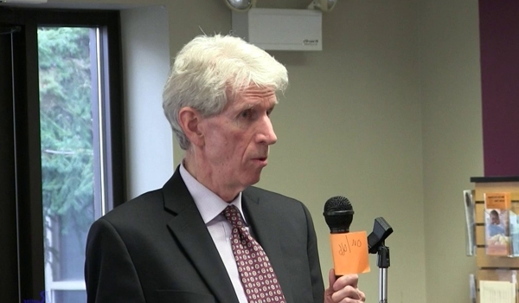
Gareth Porter
Gareth Porter

Gareth Porter, the award-winning American historian and investigative journalist, says he is proud and happy to have his book “Manufactured Crisis: The Untold Story of the Iran Nuclear Scare” rendered into Persian language and published in Iran as the first foreign language edition.

“I am extremely proud to have my book published in Iran as the first foreign language edition,”Dr. Porter said in an exclusive interview with Fars News Agency.

Gareth Porter is a leading American journalist, historian, anti-war activist and correspondent of the Vietnam War. Porter’s writings have appeared on such publications as The Nation, Inter Press Service, The Huffington Post, Truthout, Al-Jazeera, Press TV, Antiwar.com and Common Dreams. Porter is the 2012 winner of Martha Gellhorn Prize for Journalism, which is awarded annually to a journalist who exposes media propaganda.

Gareth Porter has recently published a book titled “Manufactured Crisis: The Untold Story of the Iran Nuclear Scare” which discloses the unseen and masked truths behind the decade-long standoff over Iran’s nuclear program.

In this book, Porter endeavors to reveal the destructive role Israel has played in the exacerbation of Iran’s relations with the West over the former’s nuclear activities. Porter maintains that Iran’s nuclear program is completely legal and regularly inspected, abused by the United States and Israel as a pretext for pressuring Iran.

Porter was due to arrive in Tehran on Saturday, September 27, to participate in the releasing ceremony of the Persian edition of his book which has been translated by Fars News Agency and will go on display during a launching and signing ceremony at the venue of FNA in Tehran later on Saturday.

Fars News Agency’s Javad Arab Shirazi has conducted an interview with Dr. Porter. What follows is the full text of the interview:

Q. Dr. Porter, what inspired you to author “Manufactured Crisis”?

A. What inspired me was the realization that there was a major story here going to the very core of US national security policy that involved a series of blatant falsehoods. It began with my realization that the “laptop documents” were certainly fraudulent, as indicated by multiple types of evidence. The more deeply I got into the story, the more I realized that it could be covered in a book, not in a series of articles.

Q. The title of your book is “Manufactured Crisis: The Untold Story of the Iran Nuclear Scare”. Would you be kind enough to let us know why you picked up this title for your book?

A. I thought it was important to find a phrase to describe the whole political process that has taken place over the years surrounding the Iranian nuclear case that would be dramatic enough to convey the deceptive nature of the charges of a covert nuclear program as well as the hyping of the “crisis” as involving the threat of war. In essence it conveys the idea that a completely false picture of issue has been foisted on the public.

The “untold” part of the title is also a reflection of the reality that no one else has come anywhere close to telling the real story of the politics surrounding the Iran nuclear issue, and that instead a false narrative has been created and constantly developed further over the years.

Q. The front cover of your book depicts Netanyahu’s cartoon bomb he showed during his UN speech last year. Would you please tell us whether you suggested the image or you were proposed choices?

A. The cartoon bomb picture was my idea, after exploring the possibility of a cover that would have both Netanyahu and Obama on it. No pictures that could be found seemed to convey the essence of the subject matter the way the Netanyahu picture does. It seemed the logical choice.

Q. Dr. Porter, in one of your latest interviews you mentioned, “If we go back in time until the 1990s, the first time the US talked about Iran as a threat for the development of Weapons of Mass Destruction (WMD) and nuclear power was at the end of the Cold War.” Would you please elaborate on this?

A. The end of the Cold War is a key turning point in US policy toward Iran, because the logic of the situation prior to that event was that there would be relaxation of tension between the US and Iran after the freeing of US hostages from Lebanon thanks to Iranian diplomatic intervention. That was indeed the intention of President George H. W. Bush. But instead the conflict was kicked into a higher gear by the bureaucratic interests in the Pentagon and the CIA, who saw the need for a new enemy to replace the Soviet Union and who now saw no need to come to terms with Iran in the regional context, because they perceived the United States as now the unipolar hegemon with unchallenged power. I view the origin of the charge of an Iranian desire for nuclear weapons as emerging out of those two closely linked consequences of the end of the Cold War.

First e-confab on environment, agroecosystem to be held in December

environment
environment

A first electronic conference on new findings on the environment and agricultural ecosystem will convene in December in Tehran, according to a research center at University of Tehran.

The Renewable Energies and Environment Research Center at the University of Tehran will hold an electronic conference in December focusing on new findings on the environment and agroecosystem (agricultural ecosystem).

Tabnak news website reported on September 27 that the e-conference intends to concentrate on the exchange, synergy and introduction of scientific and research-related findings in the areas of environment, agriculture and natural resources.

The conference will be held in cooperation with several state and non-state universities and institutions, and more than 250 faculty members from across the nation will sit on the conference’s jury.

According to an agreement inked between the University of Tehran and some international scientific institutions, the applicants can get related certificates after paying the required fees.

The certificates would bear specific identification codes, security holograms and embossed seals, and it could be accessible through a user identification authentication system at any time.

Top papers will be released in international journals. The admitted articles will be indexed free of charge in various websites and databases among them, www.civilica.com, www.callforpapers.ir and www.magrica.ir.

Those interested in participating in the conference can send their papers to www.agrocongress.ir.

Appointment of Iran’s new ambassador to Berlin signals a clear message to Washington

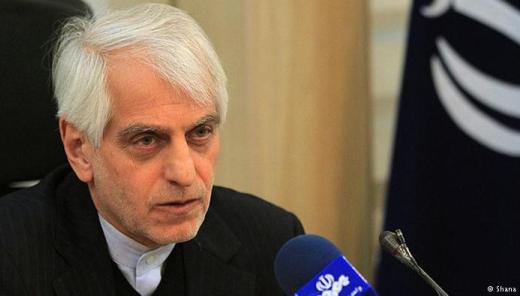
Ali Majedi-Iran's ambassador to Germany

Settlement of Iran’s nuclear case would be far from possible with no US approval, but all parties to the talks should play an active role in solving the dispute. […]

Recently, in a statement, the Europeans expressed dissatisfaction with the glacial pace of cooperation between Iran and the IAEA prior to the release of the official report of the International Atomic Energy Agency. In fact, that seemed to be a complaint [on their part] about what Washington has done to diminish Europe’s clout in P5+1.

Although Europe’s Big Three (namely Germany, France and Britain) are pursuing the nuclear talks through [EU’s] Catherine Ashton and have been kept posted on everything including trilateral negotiations between Iran, the US and Russia, Tehran needs to enter separate talks with all parties involved as it follows nuclear negotiations with P5+1.

What you just went through was part of Ali Majedi’s views in response to questions raised by Sharq Newspaper (2,120th issue). Majedi, who has majored in economics, served as a diplomat in the UAE, Brazil, Commonwealth States and Japan back in the 1980s.

Following the appointment of Bijan Namdar Zanganeh as oil minister in the reformist government of Mohammad Khatami, Majedi became deputy oil minister for international affairs and built on an “energy-diplomacy” mix to shine in talks with the Russians.

As a member of Iran’s nuclear negotiating team chaired by Hassan Rouhani [2003-5], Majedi was the head of the economic working group in nuclear talks with Germany, Britain and France which resulted in an agreement in Sa’adabad, Tehran.

He is expected to leave for Berlin shortly to serve as Iran’s ambassador to Germany. His appointment would get the following message across: Western countries are reclaiming their main place in diplomatic and economic relations with Iran.

The train of normalization of ties between Iran and the international community is on the move. Some have missed the global peace-destined train because of their failure to appreciate the concept of compromise and because of a Netanyahu-like mentality manifested in the childish graph he showed the world two years ago. The following is the translation of the interview:

Before a recent round of nuclear talks in New York, the European Union released a statement to signal dismay over the sluggish pace of cooperation between Tehran and the IAEA. What do you think the overall reaction of Iran’s foreign diplomacy should be?

The latest report by the IAEA suggests that Iran has fully implemented its voluntary measures. […] The EU is doing so to complain about their less active role in nuclear talks, for which they blame Washington. […] Europeans know what has happened in talks between Iran, the US and Russia. I believe that Iran should enter separate talks with Europe’s Big Three, although any solution would be a remote possibility without US approval. […]

I think we should give more weight to talks with each European country; this has been also echoed by the Europeans. The statement which is attributed to the UN nuclear watchdog seems like a diversion; perhaps the Europeans want to imply that they are seeking a bigger share and a more significant role in nuclear talks with Iran.

What do you plan to do in this regard as Iran’s new ambassador to Germany?

I had a meeting with Foreign Minister Zarif who asked me to be in touch with the Germans given their growing role in nuclear talks as soon as I get there. With the extensive international media coverage given to Iran-US talks and marginalization of Europe in such talks, the Americans seem to have been given a more active role. This comes as the Europeans have always been a weighty factor in the talks.

Given your previous post as deputy oil minister, do you think diplomacy can help solve economic problems?

The country’s diplomacy for which the Foreign Ministry is mainly responsible also covers economic issues. In today’s world where Iran is a key oil and gas producer, the Oil Ministry can be instrumental in economic diplomacy.

The ministry’s role can be activated through its Department of International Affairs and it can be a big help for the foreign policy machine. Cooperation between these two ministries could create valuable opportunities for Iran’s economy and in some cases it could reduce the threats. […] I hope my successors help the country in its march toward progress.

You mean reclaiming the oil markers Iran has already lost is a secondary goal of nuclear talks?

The onus is on the National Iranian Oil Company to sell Iran’s crude. But the oil ministry’s policies and the country’s diplomatic decisions could spark a rise in oil sales. […]

Iran’s gas is a major issue too. […] The gas and oil fields Iran shares with other countries have yet to get due attention so much so that one can say the previous government lacked a distinct plan for tapping into these fields’ potential.

Reports have disclosed multifold exploitation by certain Persian Gulf countries of these joint fields. Do you substantiate such reports?

Unfortunately they are true. Worse than that, in some cases no talks have been held with these countries. As for the use of the joint fields, a new attitude is needed and this question should be put forward: If a country uses a joint field double as much without the prior knowledge of the other country what can be done in terms of international law to challenge them in international circles?

This brings to the fore the role of economic diplomacy. I think we should enter serious talks with countries with which we share over 20 oil and gas fields. The oil ministry’s international department can play an earnest role in this.

How willing have foreign firms been to cooperate with Iran ever since the eleventh government has taken office? Is Iran ready to change the format of its oil contracts? How do you think this [possible] change of format can affect the lifting of sanctions and increasing oil sales?

International sanctions against Iran have nothing to do with the format of contracts. I think many Western countries and companies will return to Iran once the sanctions are lifted. They don’t think the previous contracts are satisfactory. For instance, they are not interested in buyback agreements and Iran has yet to put forward new contracts.

First of all, sanctions should be lifted, and then the contracts should be attractive enough. Foreign firms would choose from attractive options in Iran. […] For oil companies, the security of target countries comes first. Currently Iran is enjoying relative stability.

Recently I had a meeting with Russia’s Energy Minister Alexander Novak, who voiced his country’s willingness to invest in oil and gas projects in northern Iran. The question is: Why don’t other countries and multinationals follow suit?

Let’s go back to Germany and its role in nuclear talks. How much do you think Berlin can help the talks end conclusively?

Germany is an important European player, both politically and economically. I would do my best to contribute to the advancement of the talks. But we shouldn’t forget the fact that sanctions are not a proper tool for advancing international policies in today’s world. The continued use of economic sanctions could push the world back to the brink of bipolarization and the Cold War.

The economic sanctions against Iran are unjust. All in all, international sanctions are not in the interests of peace and stability as well as free trade in the world.

Some observers hold that nuclear talks are more of a one-on-one between Iran and the US than talks between Iran and P5+1 and that other countries have a ceremonial role. How far does a louder voice of Europe in the talks can help Iran serve its own national interests?

We need to work on this more. Back in 2003-05 as the US applied pressures, the European Three took on a moderating role. We also need to make the Americans play their own share in the talks and help Europe get rid of US pressures.

I would try to remind the Germans of Iran’s peaceful intentions and its role in stabilizing the world, and stress that Iran could be a safe trade partner for the Germans.

How much do you think the New York trip by the Iranian president for the UN General Assembly affected nuclear talks?

Such talks are time-consuming and we shouldn’t wait for immediate results. As a weighty figure, President Rouhani lent added weight to Iran’s team in the talks. […]

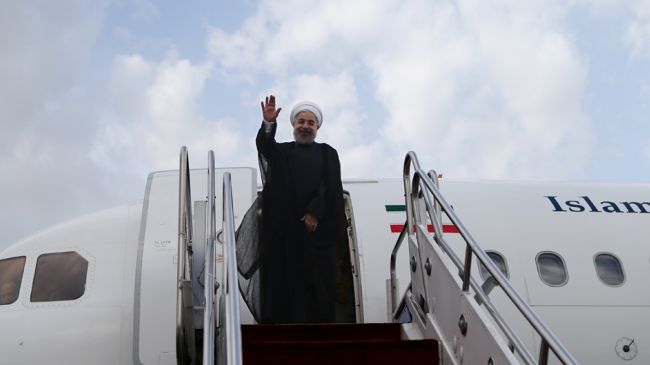
Rouhani heads to Russia for Caspian summit

Rouhani-Visit russia

Rouhani headed to the Russian city of Astrakhan on Sunday to participate in the summit set to be held on Monday after he wrapped up his visit to New York where he attended the 69th annual session of the United Nations General Assembly.

Iran, Russia, Kazakhstan, the Republic of Azerbaijan and Turkmenistan are the five littoral states of the Caspian Sea.

The last meeting of the Caspian Sea littoral states was held in the Azeri capital of Baku in November 2010.

The Caspian Sea is the largest enclosed body of water by area, and is variously classed as the world’s largest lake or a full-fledged sea.

The issue of the Caspian Sea’s legal regime gained importance following the breakup of the Union of Soviet Socialist Republics (USSR) and the emergence of independent states.

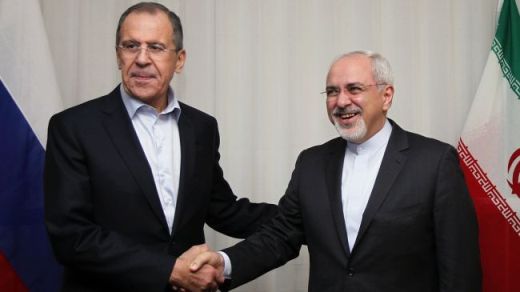
Iran, Russia FMs say nuclear talks must continue

Zarif-Lavrov
Zarif-Lavrov

During the Saturday meeting, which took place on the sidelines of the 69th UN General Assembly, the two top diplomats emphasized the need for the continuation of nuclear discussions between Iran and the six states – the US, Russia, China, France, Britain and Germany.

Zarif and Lavrov also held talks on the upcoming summit of the Caspian Sea littoral states, which is scheduled to be held in the southern Russian city of Astrakhan on Monday.

Zarif and Lavrov sat down for talks as Iran and the six powers wrapped their latest round of closed-door talks in New York on Saturday.

Following the meeting, the Iranian foreign minister said more talks would be held in future to reach a permanent deal on Iran’s nuclear energy program, adding that the next round of nuclear negotiations would be held in a European country.

On Friday, Iranian Deputy Foreign Minister for Arab and African Affairs Abbas Araghchi, a top nuclear negotiator, said Iran and P5+1 had not reached any agreement on major issues, adding, however, that there had been progress with regard to the details of technical issues.

Iran’s Shot-Putter Rajabi Wins Silver at Asiad

Rajabi, an Iranian female athlete

Iran’s Leila Rajabi claimed a silver medal in the women’s shot-put final in the 2014 Asian Games on Saturday.

The Iranian athlete won the silver medal with a throw of 17.80 meters at the Incheon Asiad Main Stadium.

“I am so happy because of winning the silver medal. My rival (Gong Lijiao) who won the gold medal is a world champion,” Rajabi said.

China’s Gong Lijiao snatched the gold medal with19.06 meters and her compatriot Tianqian Guo seized the bronze medal with 17.52 meters.

Some 9,500 athletes from 45 countries are competing at the Games, the world’s second-biggest multi-sport event after the Olympics, with 439 gold medals in 36 sports up for grabs.

Iran has participated in the games with 276 athletes in 22 sports.

A look at Iranian newspaper front pages on Sept. 27

Iranian Newspapers headlines
Iranian Newspapers Headlines

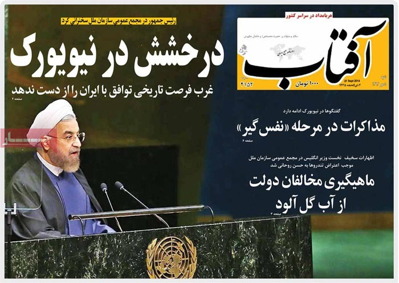
The speech of the Iranian president at the UN General Assembly and the gold medal Iranian heavyweight weightlifter grabbed in the Asian Games in South Korea dominated the front pages of a majority of Iranian newspapers on Saturday (September 27). Also remarks by Supreme Leader Ayatollah Seyyed Ali Khamenei on Sacred Defense and talks between Iran, the US and Europe were given front page coverage by several Iranian dailies.

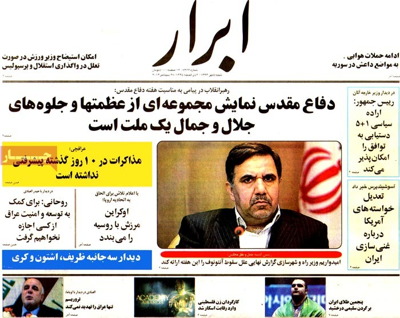
Abrar:“Iran does not need the permission of anybody to help Iraq boost its development and security,” said President Rouhani.

Abrar: “The sports minister is likely to be impeached in case of a delay in the privatization of Persepolis and Esteghlal, [the capital’s two main football clubs].”


Abrar newspaper sept. 27


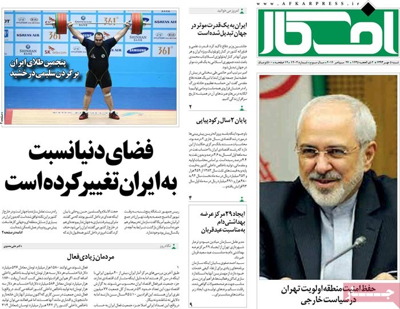
Afkar: “Behdad Salimi, Iran’s heavyweight weightlifter at the Asian Games in Incheon, secured the country’s fifth gold medal.”


Afkar newspaper sept. 27


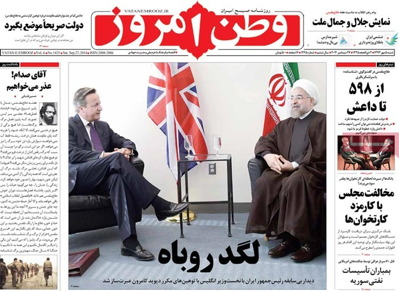
Aftab-e Yazd: “Moves by the government’s opponents to make the most out of murky waters” was highlighted by the daily to report on the harsh reactions by hardliners to unfounded remarks by the British premier at the UN General Assembly on Iran.


Aftabe yazd newspaper sept. 27


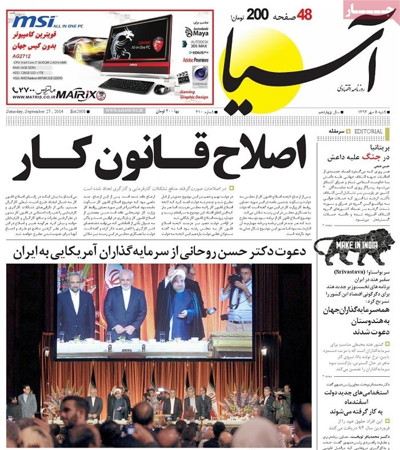
Asia: “Dr. Rouhani invites American businessmen to invest in Iran”, is the daily’s pick for its front page.


Asia newspaper sept. 27


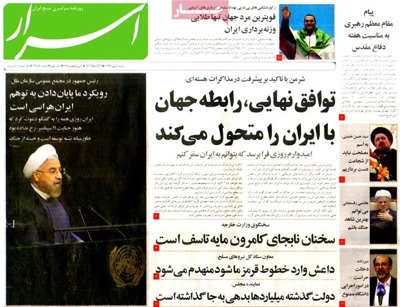
Asrar covers different stories on its front page, among them:

“ISIL will lie in ruins if it oversteps Iran’s red lines,” said Deputy Chief of Staff of Iran’s Armed Forces Major General Mohammad Bagheri.

“The previous government has left [its successor] with billions [of tomans] in red ink”, said an Iranian MP.

“The university security is not allowed to intervene in executive affairs,” said Hamid Mirzadeh, the president of the Islamic Azad University.

“US nuclear negotiator Wendy Sherman hopes she can one day make a trip to Iran.”


Asrar newspaper sept. 27


Ebtekar: “Nuclear talks have reached a breathtaking point,” said the daily, adding thatit seems more likely for the US to soften its demands as far as enrichment is concerned.

Ebtekar: Secretary of the Expediency Council Mohsen Rezaei has suggested that IRIB, Iran’s state broadcaster, interview former Prime Minister Mir-Hossein Mousavi and Ayatollah Akbar Hashemi Rafsanjani on how things unfolded during the Iran-Iraq war.


Ebtekar newspaper sept. 27


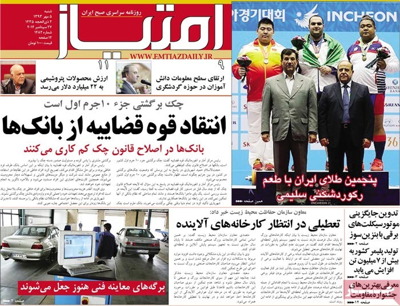
Emtiaz: “The factories which pollute the environment will be subject to shutdown,” said the deputy head of the Environment Protection Organization.


Emtiaz newspaper sept. 27


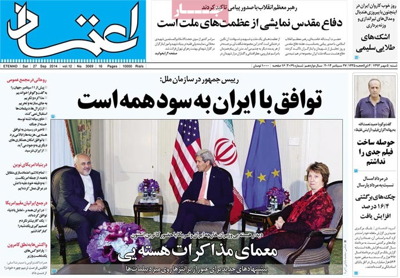
Etemad: “The Sacred Defense is a display of the Iranian nation’s glory and magnificence,” said the Supreme Leader in a message marking the Sacred Defense Week.


Etemad newspaper sept. 27


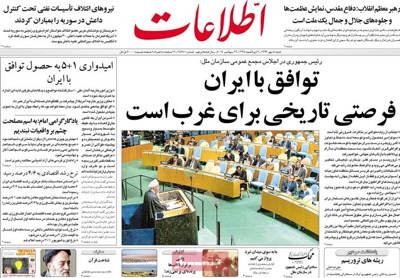
Ettela’at focused on remarks by President Hassan Rouhani at the UN General Assembly in New York quoting him as saying that arriving at a nuclear agreement with Iran would be a historic opportunity for the West.

Ettela’at dedicated part of its front page to Iran’s economic growth saying that it has risen to 4.6 percent.


Etellat newspaper sept. 27


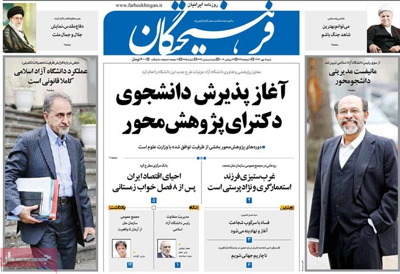
Farhikhtegan: “The decision by the Islamic Azad University to increase post-graduate admissions is totally legal,” said Mohammad Ali Najafi, the acting minister of science, research and technology.

Farhikhtegan: “Corruption bubbles up and is institutionalized when bravery is suppressed,” said Seyyed Hassan Khomeini, a member of the Board of Trustees at the Islamic Azad University.


Farhikhtegan newspaper sept. 27


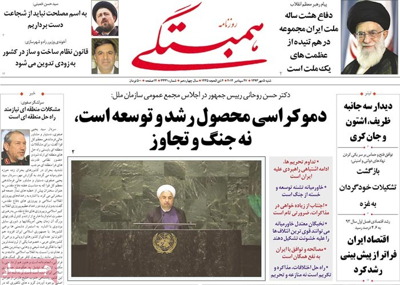
Hambastegi chooses President Rouhani’s words at the UN General Assembly for its front page, highlighting the following:

“Democracy is the product of growth and development, and not war and aggression.”

“The Middle East has a thirst for development and is weary of war.”

“It is a dire necessity to avoid acquisitiveness in [nuclear] talks.”

“The moderate-minded elite in the Middle East can build the strongest coalition against violence.”

“An agreement with Iran would serve the interests of all.”

“The solution to [Iran’s nuclear dispute] lies in holding talks and showing respect, and not in imposing sanctions and pursuing conflict.”


Hambastegi newspaper sept. 27


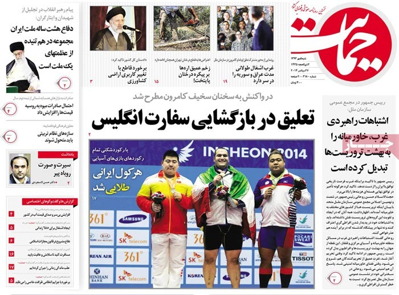
Hemayat took a look at reactions in Tehran to remarks by British Prime Minister David Camron on Iran at his UN General Assembly speech. It highlighted calls by some MPs for the reopening of the British embassy in Tehran to be put on hold.

Hemayat put a report on its front page on fruit prices in Iran, saying the fact that Iran may export fruits to Russia as part of the two countries’ efforts to have closer trade ties has sparked an almost 10% rise in prices.


Hemayat newspaper sept. 27


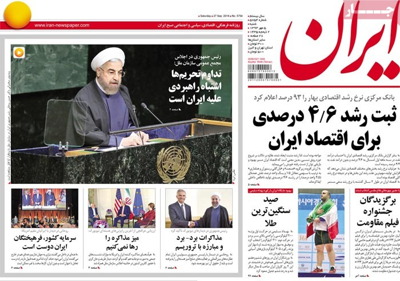
Iran: “To go ahead with sanctions against Iran is a strategic mistake”, President Rouhani said in his UN General Assembly speech.


Iran newspaper sept. 27


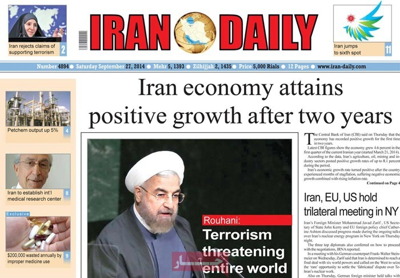
Iran Daily: “Iran to establish international medical research center,” Professor Majid Samii, the deputy chief of the Iranian Research Organization for Science and Technology (IROST) said.


Iran daily newspaper sept. 27


Javan: “Conflicting nuclear signals are sent from New York,” wrote the daily. It quoted Iran’s nuclear negotiator Seyyed Abbas Araghchi as saying that no progress was made in the nuclear talks in New York. Those comments were in contrast with remarks by US Under-Secretary of State Wendy Sherman who said progress is being made in nuclear talks.

Javan: “Ten-hour-long pleasure the Iranian reformist papers took from a historic meeting,” is the sarcastic title the daily has picked for its front page, examining the time span between a meeting between Iran’s president and the British prime minister and the latter’s speech at the UN General Assembly in which he made baseless accusations against Iran.


Javan newspaper sept. 27


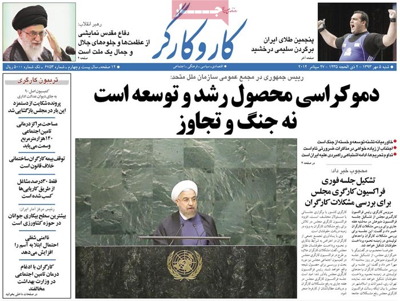
Kar va Kargar: “The Labor Caucus is to hold an ad hoc session to look into the problems the workers are currently facing,” said Alireza Mahjoob, the Secretary General of the Labor House.


Karo newspaper sept. 27


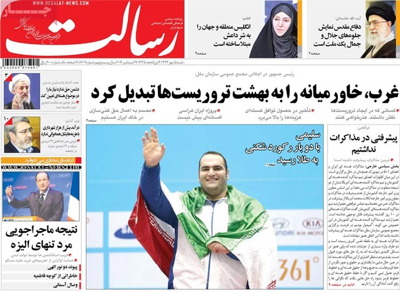
Resalat: “The enemy has no right to determine Iran’s nuclear needs”, interim Friday prayer leader Hojatoleslam Kazem Sedighi said.


Resalat newspaper sept. 27


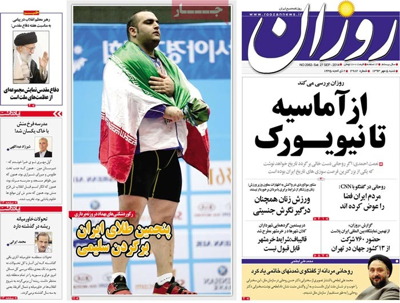
Roozan: “[President] Rouhani has bravely made mention of ‘Dialogue among Civilizations’ championed by [former President Mohammad] Khatami,” said former Vice-President Mohammad-Ali Abtahi.


Ruzan newspaper sept. 27


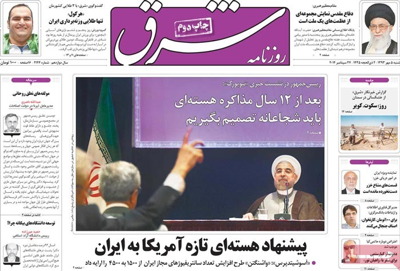
Sharq: “New nuclear offer by the US to Iran,” is the headline the daily has given to a front page report on the new US proposal.


Shargh newspaper sept. 27


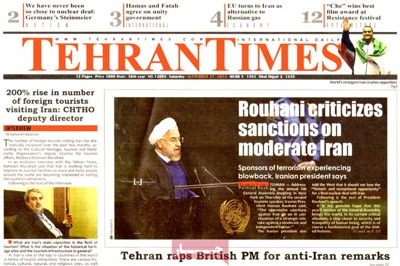
Tehran Times: “A 200% rise in number of foreign tourists visiting Iran,” said the deputy director of the Cultural Heritage, Tourism and Handicrafts Organization.


Tehran tims newspaper 27


Vatan-e Emrooz: “Parliament’s opposition to the fee the Central Bank of Iran has decided to charge for transactions involving debit card readers.”

Vatan-e Emrooz: “The US bombardment of Syria’s oil installations” is another front page story in which the daily reviews the expanded airstrikes against ISIL militants.


Vatane emruz newspaper sept. 27


From the fight against Ebola to the war on ISIL

Security council
Security council

Shahrvand newspaper belongs to the Red Crescent Society of the Islamic Republic of Iran. “The paper that promotes Iranian volunteerism,” reads a sign that rests permanently next to the logo of the paper which deals with questions like healthcare and the environment and highlights them more than other dailies.

What comes below is the translation of part of an opinion piece by Nader Sedighi – a researcher – which appeared in the paper on September 20:

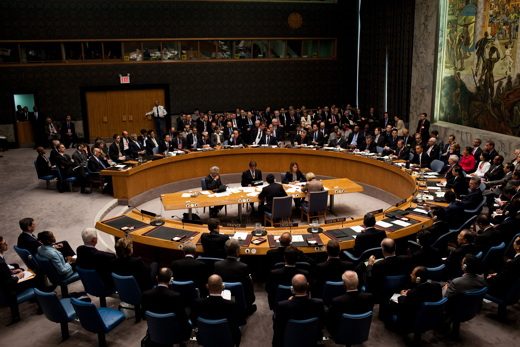
At a time when the United Nations Security Council calls an Ebola outbreak in West Africa a “threat to international peace and security” and health has become an all-important concept capable of raising global alarms, one should wonder why the world institutions still insist on imposing inhumane sanctions against the security, welfare, dignity and healthcare of Iranian citizens!

Never before have threats to the healthcare of a nation come in the same equation as threats to the security of citizens. Israeli Prime Minister Benjamin Netanyahu and Zionists at large are a tangible example in which threats to healthcare and security meet.

At wartime, Gaza in its entirety, including its people, trees, farms, mosques, schools, hospitals, children and women came under attack by one of the most powerful militaries in the world. During the ceasefire, like the residents of a refugee camp – or a big prison – Gazans were subject to blockade and gradual death, something that reminds one of Nazi concentration camps.

From the perspective of Italian philosopher Giorgio Agamben, when in a “state of exception” a nation suffers “collective punishment” ordinary life becomes similar to life in a refugee camp.

Under such circumstances, the government fails to remain responsible for the health of citizens. Instead, an outside force will dominate the everyday life of citizens and take over, through effective means of sanction, the right to spare or kill people who are suffering under sanctions.

If sanctions against Iran run their course as they have been initially designed by the Zionist lobby, they will simply turn our dear homeland – Iran – into a big refugee camp. As long as sanctions persist, and the so-called options remain on President Obama’s desk, we [the Iranian nation] experience more difficulties than those of Palestine.

[…] America’s simultaneous fight against Ebola and ISIL is an indication of its clear understanding of the security challenges associated with globalization.

The negative effects of sanctions and the inevitable impact of them on the healthcare of Iranian citizens reflect the dark side of America’s understanding of the world challenges when it comes to security.

How is it possible to make a transition from the dark understanding that America has in the field of security to a clear insight into present developments of globalization?

A self-giving boy secretly donates kidney to his mom

Kidney donation surgery

Earlier in September Jamejam newspaper ran a report on a young man who had saved his mom by giving her a kidney. The daily’s Masoumeh Maleki filed the report which featured a brief interview with both the donor and the recipient:

When the question of organ donation is raised, all eyes turn to brain-dead patients whose families donate the organs of their loved ones to needy patients, expecting nothing in return.

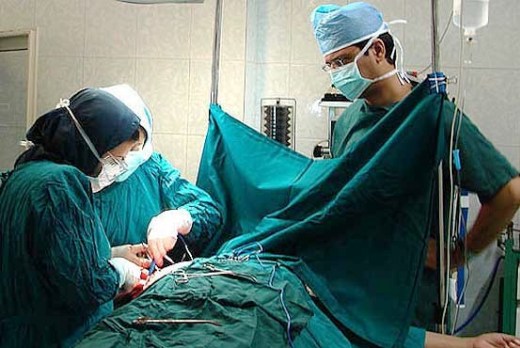
In the following story, however, the organ donor was not a clinically brain dead person. He was a 24-year-old young man who could not stand the sight of his mother, who had a kidney condition, on a hospital bed undergoing dialysis.

The woman, 51, who asked not to be named says, “I have been suffering from a kidney condition for ten years. I didn’t know about the condition until one day I fainted at home. When my family took me to the hospital, tests showed I had nephropathy. I was told to get serious treatment. I have since received dialysis three times a week.

“After a while I lost both of my kidneys. My husband who was earning a living by collecting [metal] scraps could hardly work and support the family due to his illness. We were given aid by Imam Khomeini Relief Committee. We were short on money and I couldn’t afford a kidney operation.

“My son came to visit me one day and said that one donor wanted to give me a kidney wanting nothing in return. Hearing this, I broke down in tears, thanking God and saying there were still people who do acts of charity for the sake of divine satisfaction.

“My son refused to let me know about the donor’s name despite my insistence. When I was taken to the hospital’s organ transplantation ward on a stretcher, I saw him getting prepared for the surgery. My son smiled when he saw me and urged me to stay calm. Right there I realized that he was the person who wanted to donate his kidney to me.”

No longer could I see my mom’s sufferings

The young donor, for his part, says, “Over the years I had bad feelings when I saw my mom suffer. When I saw all doors closed, the only thing that crossed my mind was that I had to do something myself. I thought I could give one of my kidneys to her. I was sure she would not agree if she knew I was the donor.

I was praying to be given a positive response by the doctors after undergoing tests. I wanted to save my mom. I felt extremely happy when I was told the donation is possible. This way I could return her kindness and make up for the hardships she had tolerated for raising me. I hope she is satisfied with me.”

Who feeds Putin with thoughts?

Russia-Putin
Russia-Putin

Fararu.com, a news website, on September 15 released a story on what partially lies at the center of a new Cold War-style showdown between Russia and the West: Novorossiya. The following is the translation of the report in its entirety:

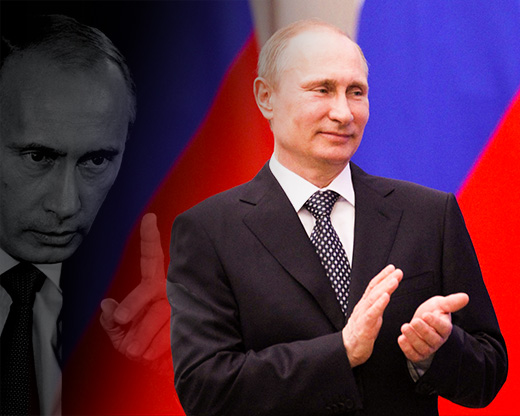
In the state-of-the-nation address on December 12, 2013 Russian President Vladimir Putin took a swipe at Western cultural policies. He lashed out at Western non-traditional values and said that the West treats good and evil equally.

Also, he cast Russia as a defender of traditional family values which from his perspective contribute to Russia’s greatness and act as a bulwark against the onslaught of “genderless and infertile so-called tolerance”.

He denounced what he called the “review of norms of morality” in so many countries and said the destruction of traditional values from above not only entails negative consequences for society, but is also inherently anti-democratic because it is based on an abstract notion and runs counter to the will of the majority of people.

In his speech, Putin openly targeted Western cultural policies. His annual address came at a time after his administration had launched a campaign against the spread of homosexuality which drew criticism from some Western governments and institutions and even prompted activists to demand a boycott of the Sochi 2014 Winter Olympics.

With his new approach, Putin has taken Russia to a new political era. During this period, the Russian president pursues a more confrontational policy toward the West in a more open and radical manner.

The Russian new policy came into sharper focus in the developments of the last year, including Moscow’s stance on the crises of Syria and Ukraine and even on Iran’s nuclear dossier. In the new era, President Putin and his government welcome any standoff with the West, an approach which has been unprecedented since the collapse of the Soviet Union.

Such an approach was perceived as extremist in Russia a few years ago. Now, however, it’s said to be greeted by a majority of the Russian people. In this new era, President Putin follows the doctrine of a famous Russian theorist and it seems he will forge ahead with it. Directly or indirectly, his policies have been influenced by the theories of Aleksandr Gelyevich Dugin, an ideologist and a political theorist.

Who is Dugin?

Aleksandr Gelyevich Dugin is a Russian philosopher and the father of neo-Eurasianism theory, aka the Eurasian Movement, which came into being after the collapse of the Soviet Union in Russia. He was born on January 7 in 1962 into a family of a colonel-general of the Soviet military intelligence and candidate of law Gelij Alexandrovich Dugin and his wife, a doctor and candidate of medicine.

In 1979, he entered the Moscow Aviation Institute, but couldn’t finish his course. Later, he got in through the backdoor and secured a job in the KGB [security police organization of Soviet Russia] archives. In fact, his father arranged the position for him. In his new job, he identified his main ambitions.

Reading documents that were inaccessible to many, he started doing research into fascism, Eurasianism and different religions. After the fall of the Soviet Union, he was amongst the earliest members of the National Bolshevik Party [NBP].

However, later a part of hard-line nationalist NBP members, supported by Dugin split off to form a right-wing, anti-liberal, anti-left nationalist organization: the National Bolshevik Front. Also, Dugin published his own journal entitled Elementary and collaborated with weekly journal Den [The Day].

In his journals, Dugin admired Nicolae Ceauṣescu, a communist politician and a hard-line Romanian nationalist who sympathized with Joseph Stalin [Russian leader who succeeded Lenin as head of the Communist Party] and was impressed by China’s ruling system – in fact, by the highly personal way that China’s Mao Zedong ruled his country.

The Eurasia Party was registered by the Ministry of Justice of Russia on June 21, 2002, before the Pan-Russian Eurasia Movement was founded by Aleksandr Dugin. The movement has the backing of some Russian military circles, and a number of Russian Muslim, Orthodox Christian, Buddhist leaders. It’s believed by some President Putin directly supports the movement with financial aid.

Dugin is of the opinion that in terms of culture, Russia belongs to the East and has to stand up to the West. Dugin also believes that a unipolar Western-American world should be confronted, views Russia as the torchbearer for the confrontation and accordingly defines allies for Russia. That’s why he floated the alternative of Eurasianism which defines Russia as Eurasia and its allies are Iran, Turkey, China, India, and some Eastern European countries like Bulgaria and Serbia.

Dugin’s Russia is Great Russia. Perhaps, he seeks to revive Tsarist Russia. His theories seemed to be far-fetched until a few years ago and described as so radical. Nonetheless, over the last year some developments have been in line with his line of thinking.

From Dugin’s perspective, Eurasianism is a political philosophy comprised of three levels: External, middle and internal. At the external level, it says the world is multipolar, meaning that there are some global decision-making centers one of which is Eurasia. Eurasia is not confined to Russia. In fact, it is made up of Russia along with the former Soviet Republics. At the middle level, there is convergence among former Soviet states to form a transnational model. At the internal level, it seeks to construct a political community which is studied in terms of its relation with civic rights as well as liberal and nationalist models.

These three levels define Eurasianism based on which only one foreign policy can exist. This foreign policy is different from globalization, the unipolar world, nationalism, imperialism, and liberalism. Therefore, Eurasianism offers an exclusive model of foreign policy.

Dugin is a professor of philosophy and political sciences at Moscow State University. On the fourth floor of the Sociology Department of the university, he has an office on whose door it’s written “The Center for Conservative Research”, a phrase which reflects his approach.

Vladimir Putin admired such an approach in his annual address in December 2013 and said, “The meaning of conservatism is not that it prevents moving forward and upward. It prevents moving back and down to the chaotic darkness, a return to the primitive state.”

Dugin, who used to be an obscure figure, is now known as an ideologist in the new framework of Russian leanings. His long grey beard reminds one of the characters of Russian classic story books. He loves Russia and favors the union of Slavic-speaking nations.

Dugin believed the “Russian spirit” has been re-awakened by Igor Strelkov, a Russian rebel military commander in Eastern Ukraine. Dugin is in pursuit of “New Russia”, an exact phrase that a while ago President Putin used to admire the separatists during the raging crisis of Ukraine.

When the question of annexing Crimea was raised, Putin adopted such a phrase. One more time, the president used it on Sunday August 31 when he talked about eastern Ukraine. By repeating the term “Novorossiya” [“New Russia”] he dropped hints about the annexation of Donetsk and Luhansk – two disputed cities in eastern Ukraine.

His comment might go even beyond that and refer to the annexation of Transnistria in Moldova for Russia. The use of the term “New Russia” – used at least twice by Putin – stems from the ideologies put forth by Dugin.

For a few years, Dugin held the idea that Crimea should be handed back to Russia, a development which took place in March, 2014 when President Putin’s resistance against the West paid off. Dugin does not stop at this point and wants eastern Ukraine to be annexed by Russia.

Some speculated that Dugin was the one who put the idea of splitting off from Ukraine in pro-Russian separatists’ heads. While others said that he provided President Putin with advice about the recent developments in Ukraine. When asked as to whether he is in touch with separatists, Dugin said they are his friends and in response to a question as to whether the Kremlin consulted with him and whether he had met with the president, he said that it was a personal matter and he would rather not answer it.

It’s said that on his desk along with books, half empty coffee cups, there is a spool of black and orange striped ribbon – a symbol of loyalty to Russia which is tied around rifles by pro-Russian separatists.

Dugin believes the “Russian spirit” has been re-awakened by the separatist struggle, which he calls the “Russian Spring”. From his perspective the symbol of that spirit is rebel commander Igor Strelkov.

In July 2014, Dugin called on President Putin to intervene militarily in eastern Ukraine “to save Russia’s moral authority”. His appeals for the annexation of Crimea went as far back as 2008, during Russia’s war with Georgia. Back then, he travelled to the disputed region of South Ossetia, where he was photographed with a rocket launcher.

Dugin’s Eurasianism lends a significant position to Iran. He views Iran as one of key Russian allies in the standoff with the unipolar Western-American world.

As for Iran’s role in his theory he said, “Iran plays a key role in Eurasianism theory which views the world as a multipolar system. Iran is not included in Eurasian convergence, because only former Soviet Republics fall into that category. Iran has the great civilization; it’s a powerful and independent country which should be respected. This alliance [Tehran-Moscow] should be maintained.

“We should not consider convergence with Iran. Iran is not part of the convergence model of Eurasianism. Rather, it is a partner of Russia in a multipolar world. Our strategic interests in Central Asia and in the region at large overlap. Thus, Iran serves a major role in the model of multipolar Eurasianism, and accordingly Tehran is the closest ally of Moscow. Of course, partnership with Turkey, China, and India has been considered as well.”

Dugin paid a visit to Iran in 2012 and held talks with some Iranian scholars, including Prof. Seyyed Mostafa Mohaghegh-Damad, Prof. Gholamreza Aavani, and Prof. Gholamhossein Ebrahimi Dinani. Also, he attended some meetings and lectures.

He is of the conviction that Russia will vehemently oppose any Western military action against Iran, and based on the very policy, Russia will lend support to Syria. Moscow will safeguard Iran’s strategic interests to the very end. This matter is of great importance because military action against Iran will pose a threat to security of Russian borders.