Friday, April 24, 2026
Home Blog Page 3990

Iran’s IRGC Chief Remains in Office for 3 More Years

Iran’s IRGC Chief Remains in Office for 3 More Years
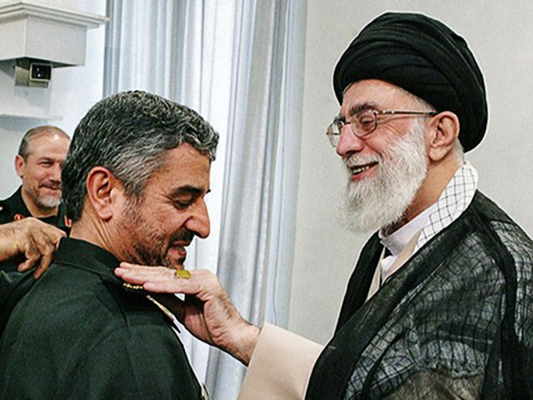
Leader of Iran's Islamic Revolution Ayatollah Seyyed Ali Khamenei and IRGC Commander Major General Mohammad Ali Jafari / Photo from ISNA

He declared the three-year extension of his term during a ceremony to introduce the new commander of Tehran’s Muhammad Rasoul Allah Corps on Tuesday, Mehr reported.

General Jafari was appointed to the post by the Leader of Islamic Revolution, Ayatollah Seyyed Ali Khamenei, on September 1, 2007, to succeed Major General Yahya Rahim Safavi.

General Rahim Safavi had served for 10 years from 1 September 1997 till 1 September 2007. Before him, Major General Mohsen Rezaei held the post since 1981, and remained in office until he announced his retirement from all his military posts in 1997.

Iran Lodges Protest with France over MKO Gathering

Iran’s Deputy Foreign Minister for European and American Affairs, Majid Takht-Ravanchi, lodged the Islamic Republic’s official protest against the recent MKO gathering in Paris in a meeting with the Secretary-General of the French Ministry of Foreign Affairs Christian Masset in Tehran.

The meeting was part of the third round of political talks between Iran and France at the level of Deputy Foreign Ministers.

The Iranian official also referred to the nuclear deal between Iran and the six powers and said Tehran cannot remain indifferent to the US non-compliance with the Joint Comprehensive Plan of Action (JCPOA).

He went on saying that Iran has fulfilled its commitments under JCPOA and thus cannot remain silent when it sees the US is not living up to its commitments as per the nuclear deal.

Takht-Ravanchi also emphasized that all sides are responsible to implement the JCPOA, adding Iran has fulfilled its commitments and consequently expects the other sides to do the same.

Masset, for his part, underlined the need for full implementation of the JCPOA, and recalled numerous opportunities for promoting bilateral relations.

Noting that his country is determined to bolster ties with Iran, French official hoped that cooperation will improve in the bilateral, regional and international levels.

A Look at Iranian Newspaper Front Pages on July 4

Newspapers today covered the remarks made by the Leader of Iran’s Islamic Revolution Ayatollah Seyyed Ali Khamenei in a meeting with top Judiciary officials in Tehran.

The top story, however, was the historic deal between Iran and a consortium led by the French oil giant Total for the development of Phase 11 of South Pars, the world’s largest gas field.

Iranian President Hassan Rouhani’s call for regional cooperation, particularly to fight against dust and sand storms gripping Iran and other countries, also received great coverage.

The above issues, as well as many more, are highlighted in the following headlines and top stories:


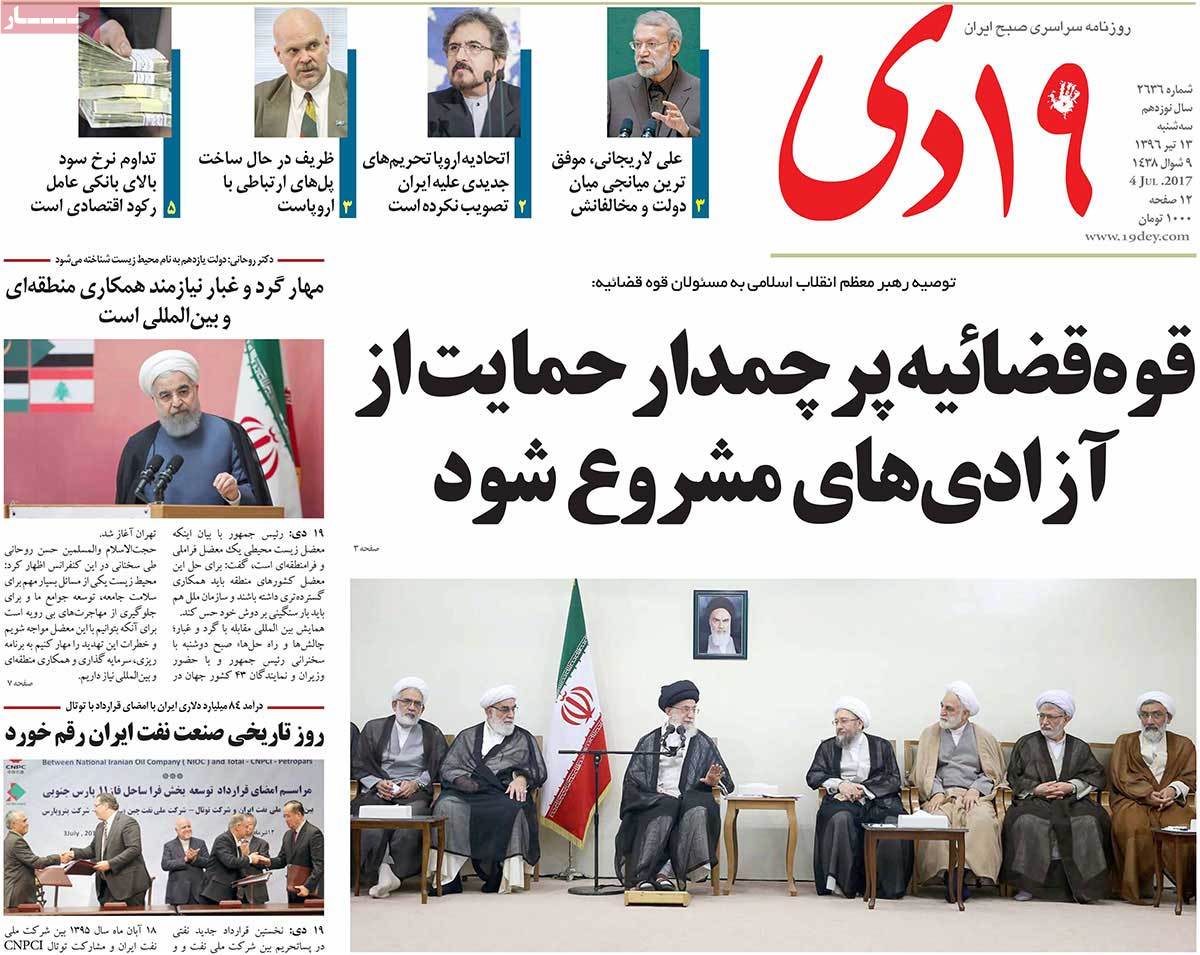
19 Dey:

1- Iran Leader: Judiciary Should Be Flag-Bearer of Supporting Legitimate Freedom

2- Rouhani: Fighting Dust Pollution Needs Regional, Int’l Cooperation

3- Historic Day for Iran’s Oil Industry
A Look at Iranian Newspaper Front Pages on July 4 - 19dey


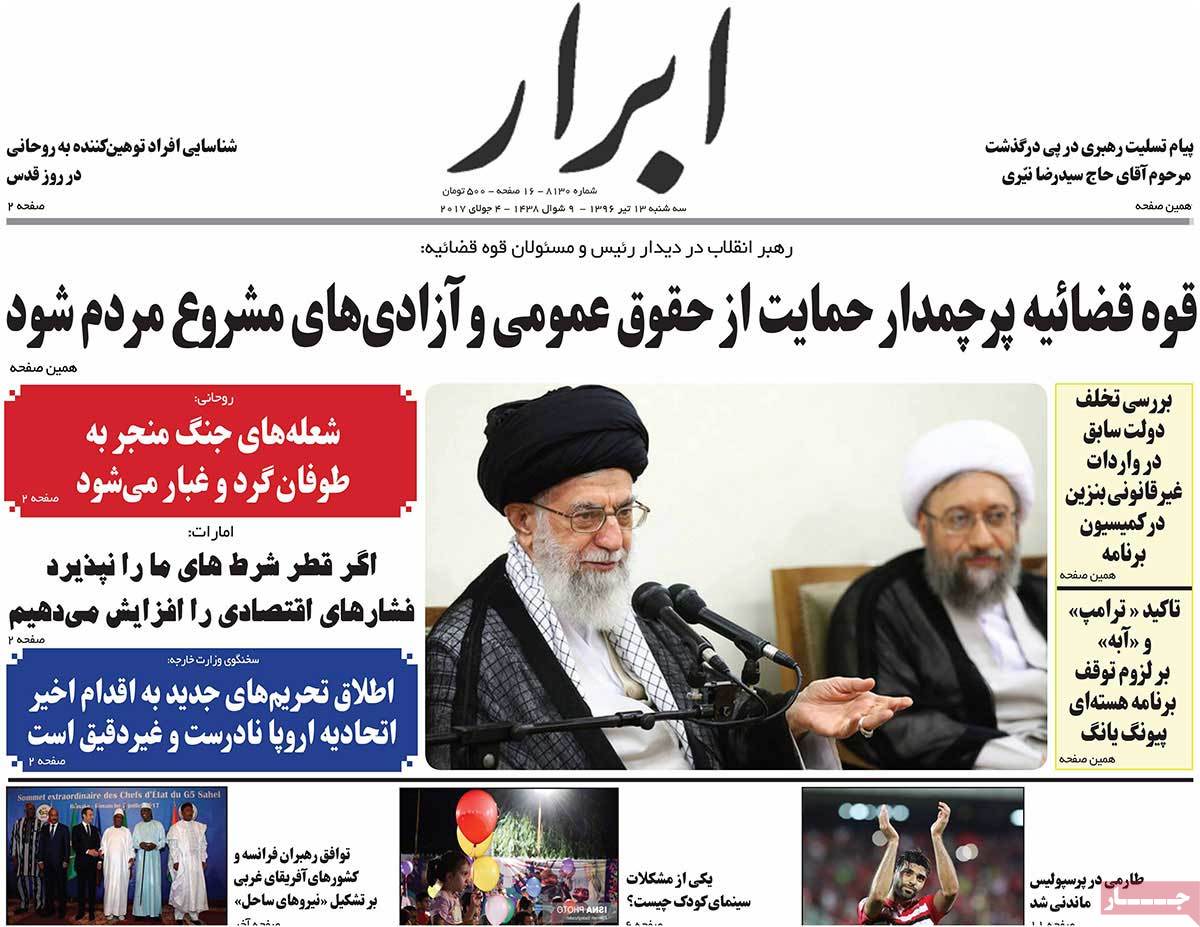
Abrar:

1- UAE: If Qatar Refuses Our Requests, We’ll Increase Economic Pressure

2- Trump, Abe Underline Need for Cessation of Pyongyang’s Nuclear Program
A Look at Iranian Newspaper Front Pages on July 4 - abrar


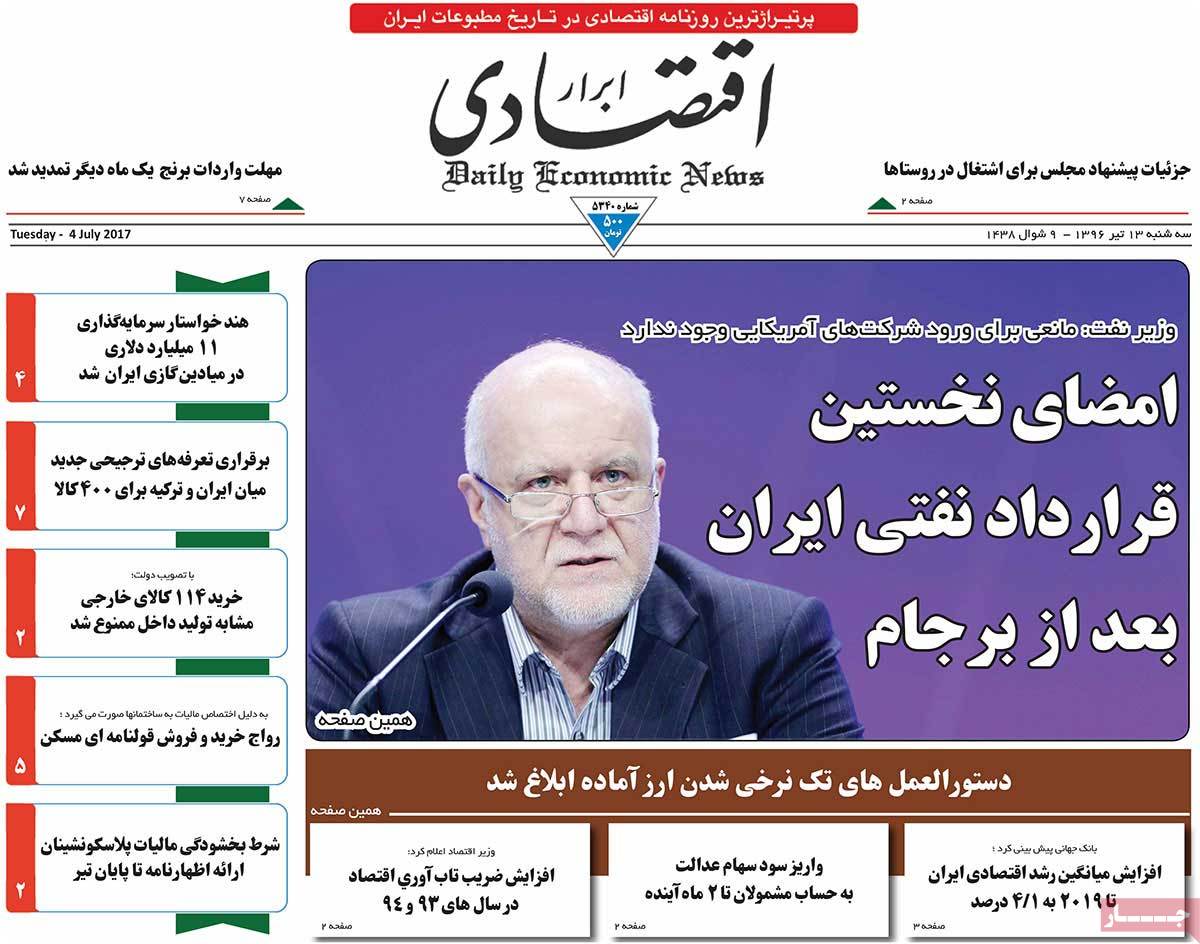
Abrar-e Eqtesadi:

1- Oil Minister: No Barrier to American Companies’ Investment in Iran

2- India Interested in Making $11bn Investment in Iranian Gas Fields
 

A Look at Iranian Newspaper Front Pages on July 4 - abraregtesadi


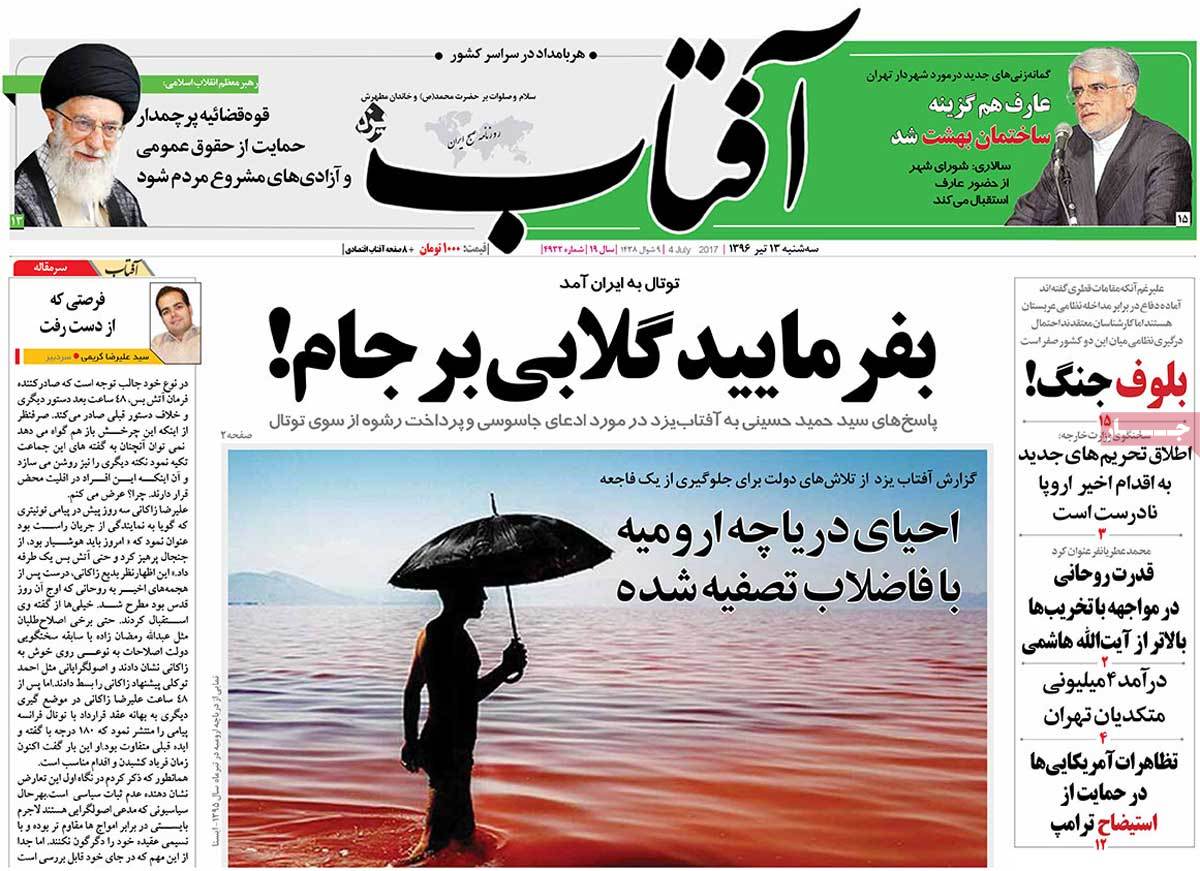
Aftab-e Yazd:

1- Here’s Fruits of Nuclear Deal! Total in Iran

2- Lake Urmia to Be Revived Using Treated Wastewater

3- Iran: It’s Inappropriate to Term EU’s Recent Move as ‘New Sanctions’

4- Beggars in Tehran Earn as Much as $1,000 per Day
 

A Look at Iranian Newspaper Front Pages on July 4 - aftabyazd


Arman-e Emrooz:

1- Environmental JCPOA: Over 30 States in Iran for Int’l Conference on Dust Pollution

2- Total to Pave Way for Foreign Investment [Editorial]
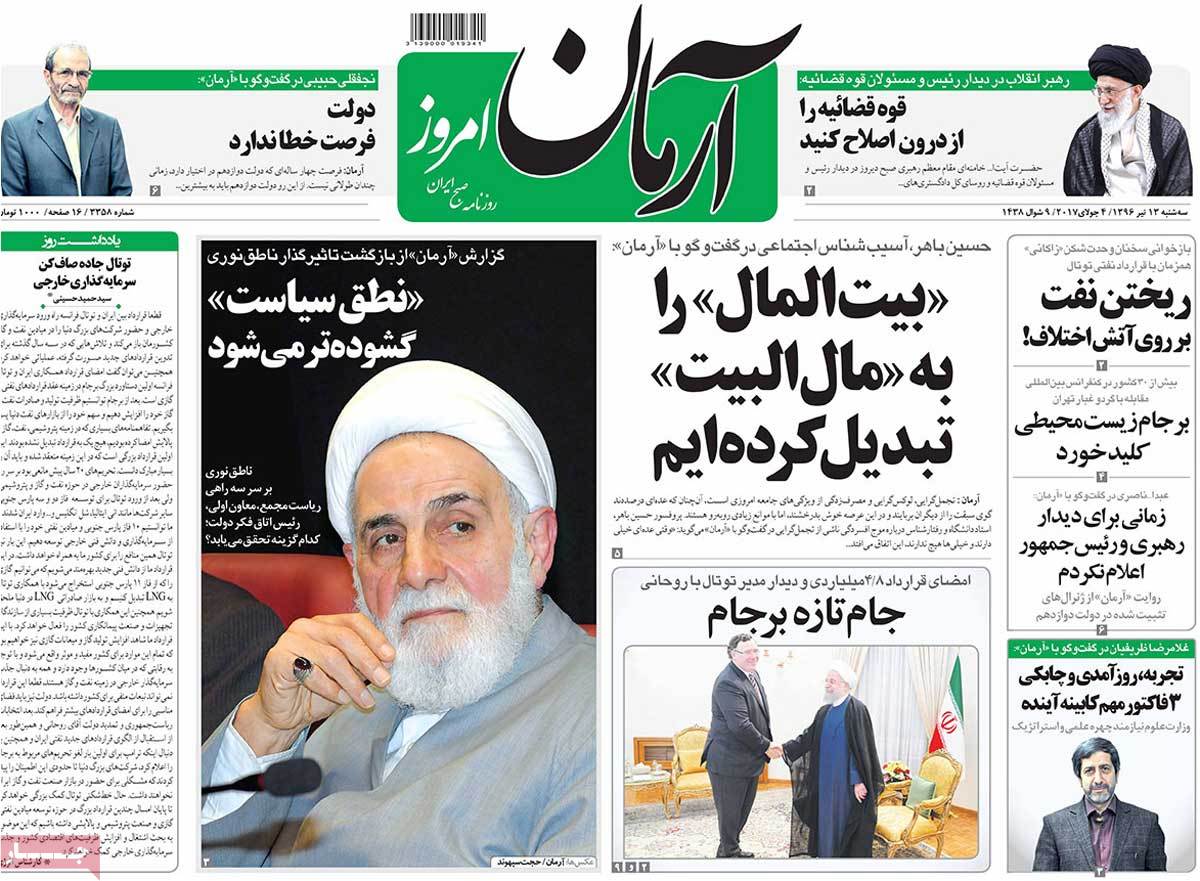
 

A Look at Iranian Newspaper Front Pages on July 4 - arman


Asrar:

1- No More Room for New Hajj Applicants: Official

2- JCPOA Shock and Iran’s Economy [Editorial]
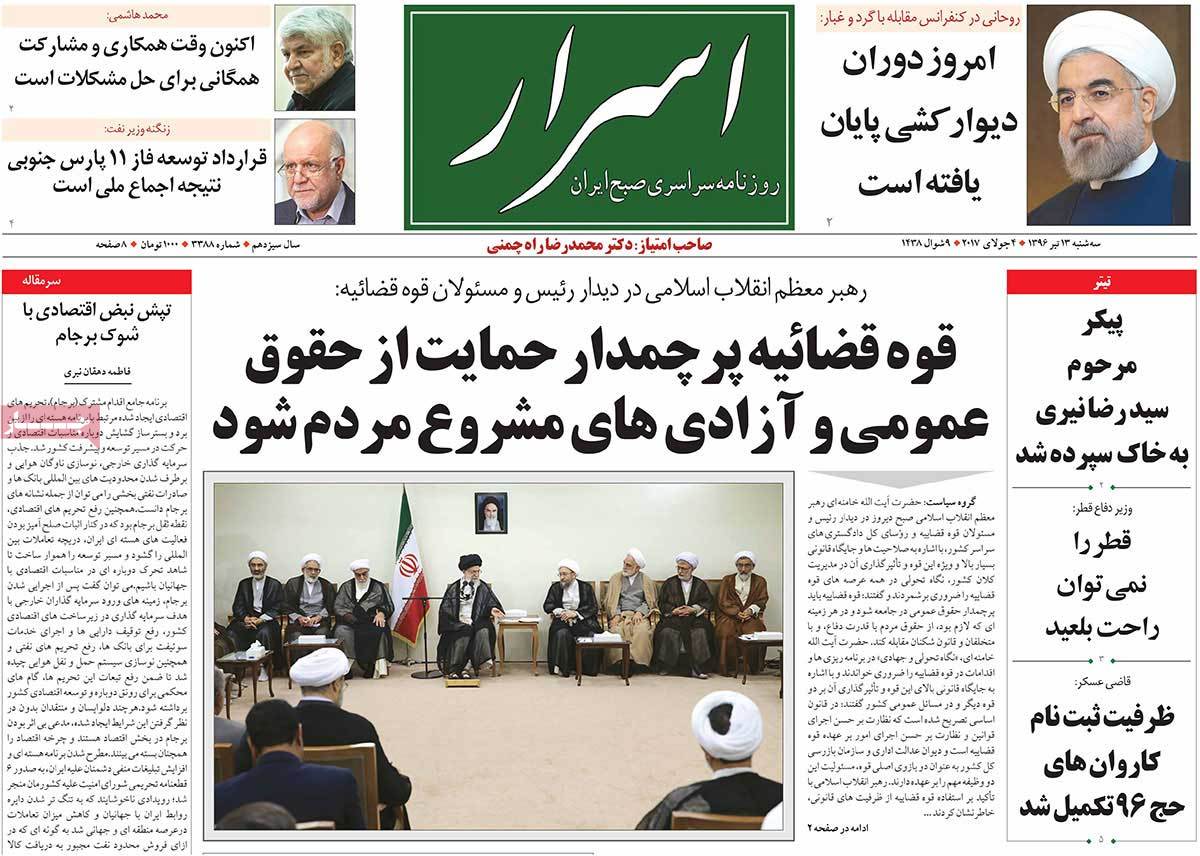
 

A Look at Iranian Newspaper Front Pages on July 4 - asrar


Ebtekar:

1- Rouhani: Flames of War Leads to Dust Storm
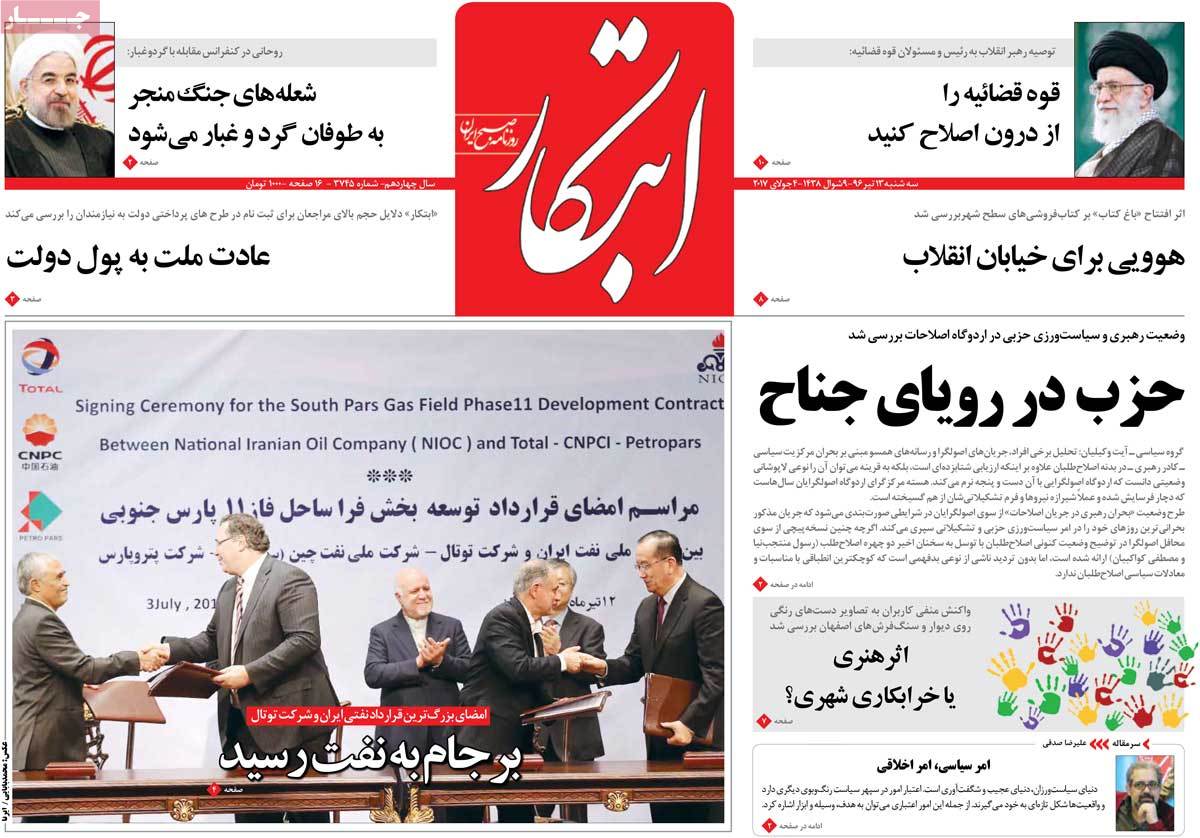
 

A Look at Iranian Newspaper Front Pages on July 4 - ebtekar


Etemad:

1- Reformist Figure: You’ll See Results of Rouhani’s Performance If You Wait

2- Rouhani’s Protest against Dam Construction in Neighbouring States

3- Investment Finally Made in Iran’s Oil Industry: Vote of Confidence for Iran
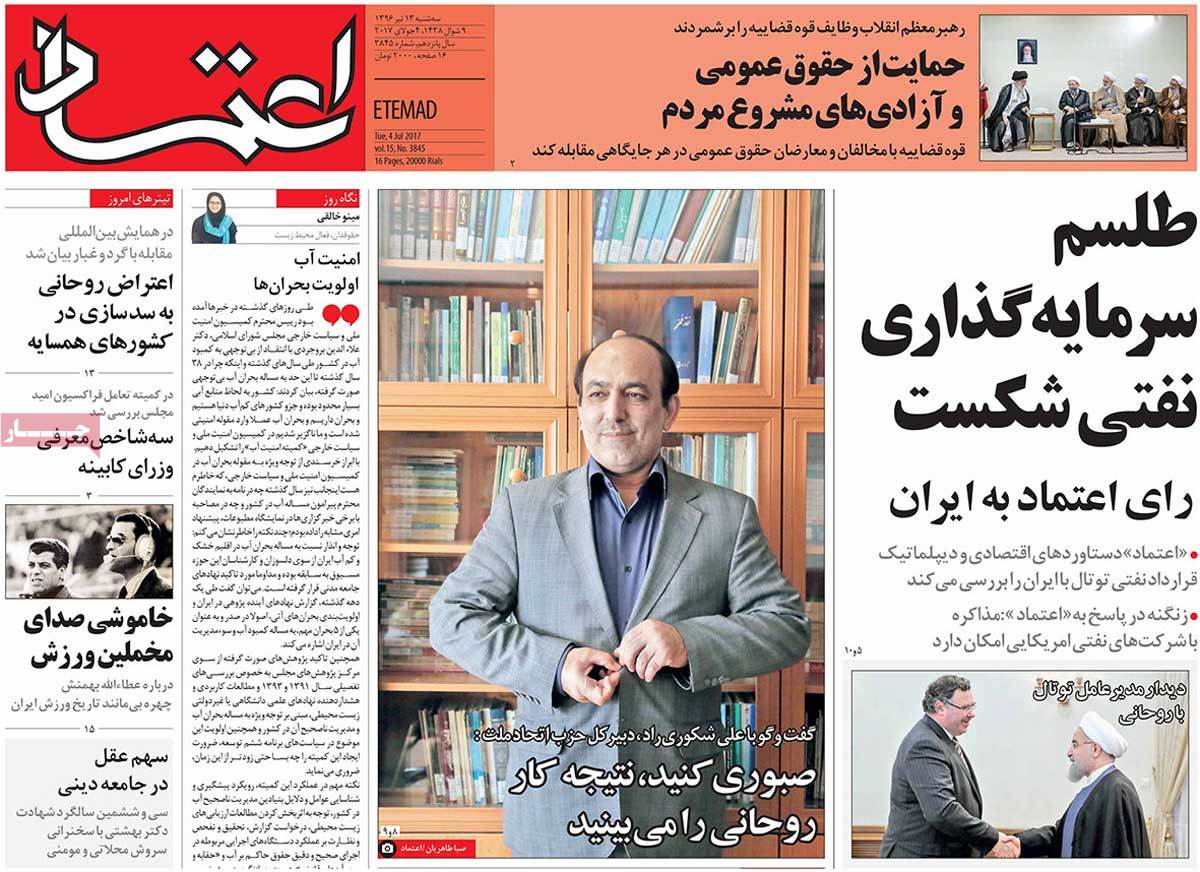
 

A Look at Iranian Newspaper Front Pages on July 4 - etemad


Ettela’at:

1- Iran Leader: Supporting People’s Legitimate Freedom Judiciary’s Duty

2- Iraq Would Have Collapse without Ayatollah Khamenei, Imam Sistani: Ammar Hakim

34- Doha: Saudi Arabia Cannot Swallow Qatar
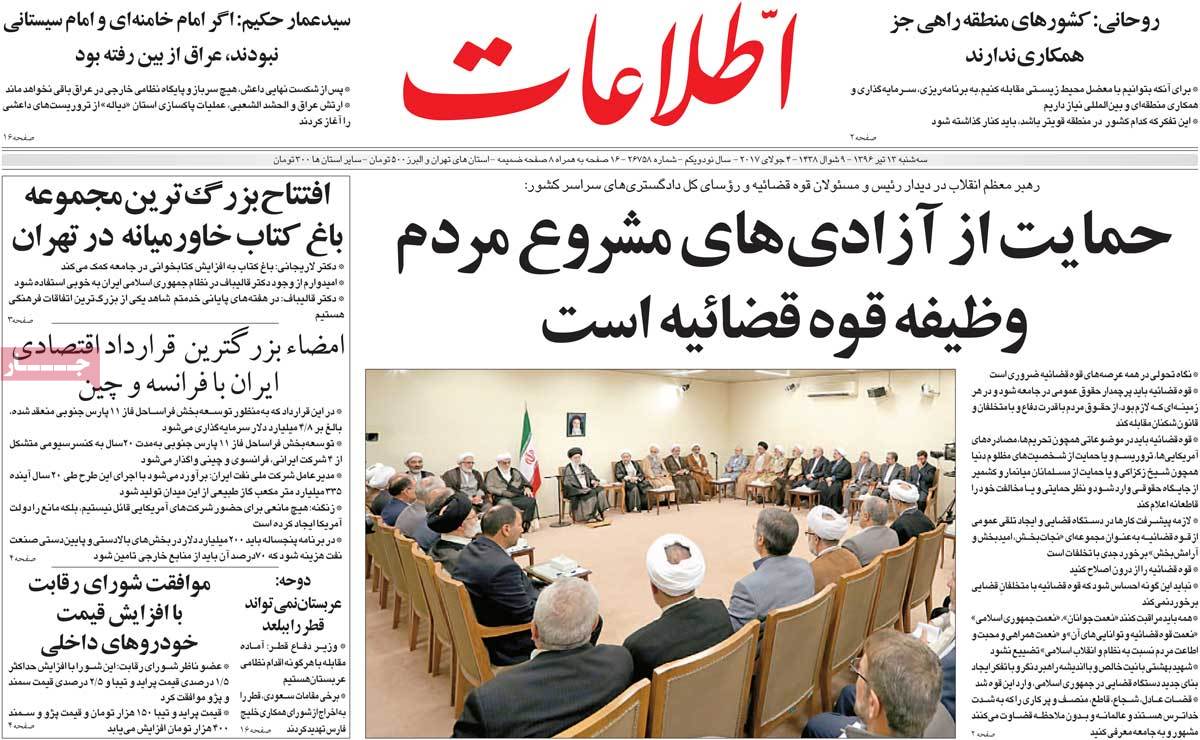
 A Look at Iranian Newspaper Front Pages on July 4 - etelaat


Haft-e Sobh:

1- The $5bn Giant: Iran, Total Sign Biggest Oil Deal
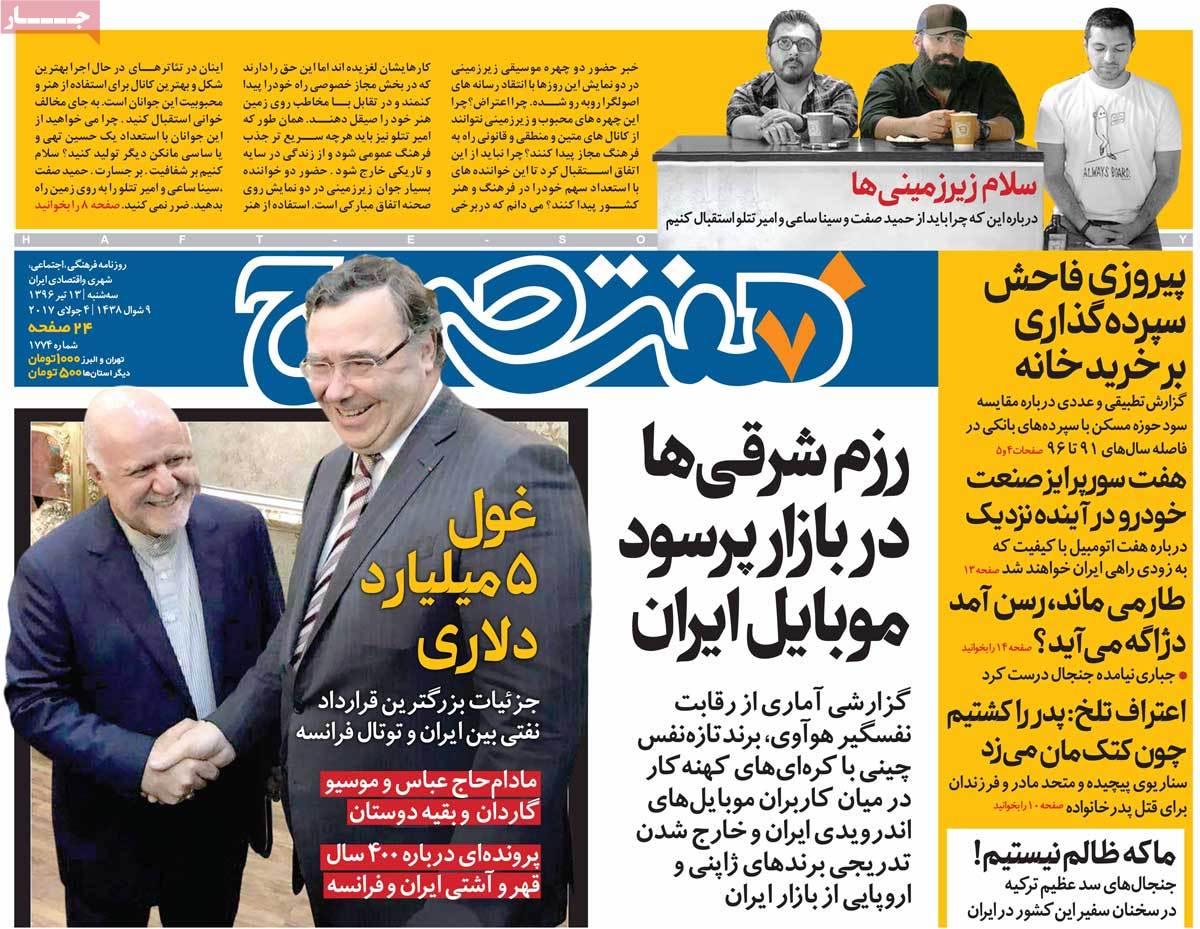
 A Look at Iranian Newspaper Front Pages on July 4 - haftesobh


Iran:

1- President: 80% of Iran’s Dust Pollution Comes from Abroad
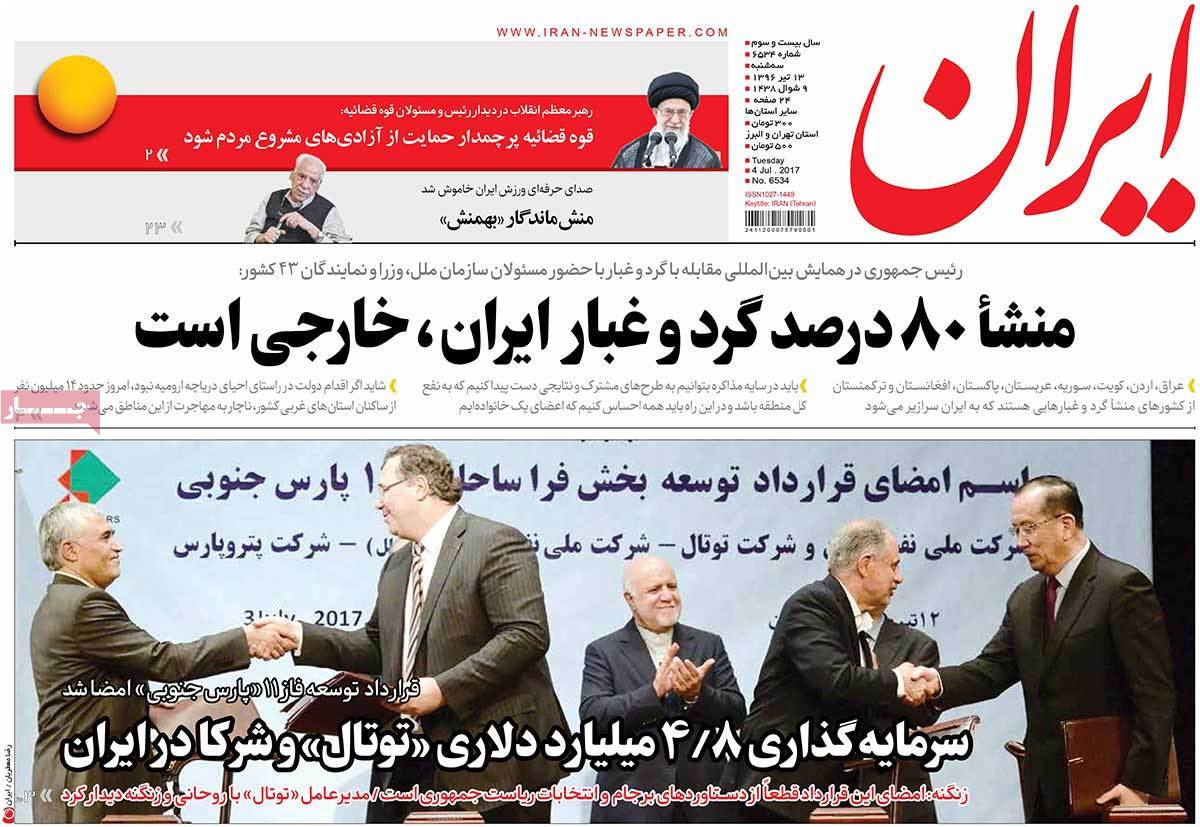
A Look at Iranian Newspaper Front Pages on July 4 - iran


Javan:

1- Leader: Judiciary Should Protect People’s Rights on Elections, Dust Pollution

2- ‘Qatar Partner’ Wins Deal on South Pars Phase Closest to Border

  • First Oil Deal Gifted to Total after 4 Years

3- Worldwide Protest Rallies Calling for Trump’s Impeachment
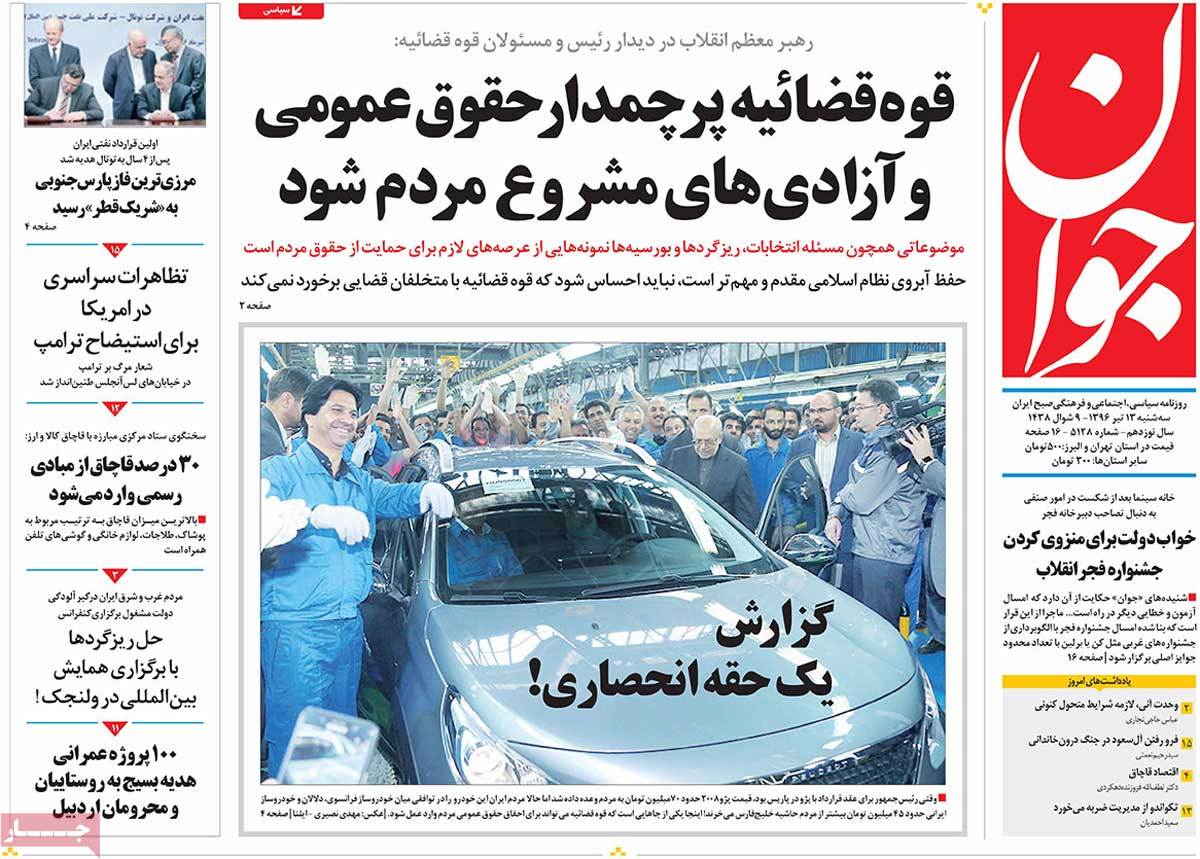
A Look at Iranian Newspaper Front Pages on July 4 - javan


Jomhouri Eslami:

1- Iran Leader: Judiciary Should Be Reformed from Inside

2- Hawking: Trump to Turn Earth Globe into Hell
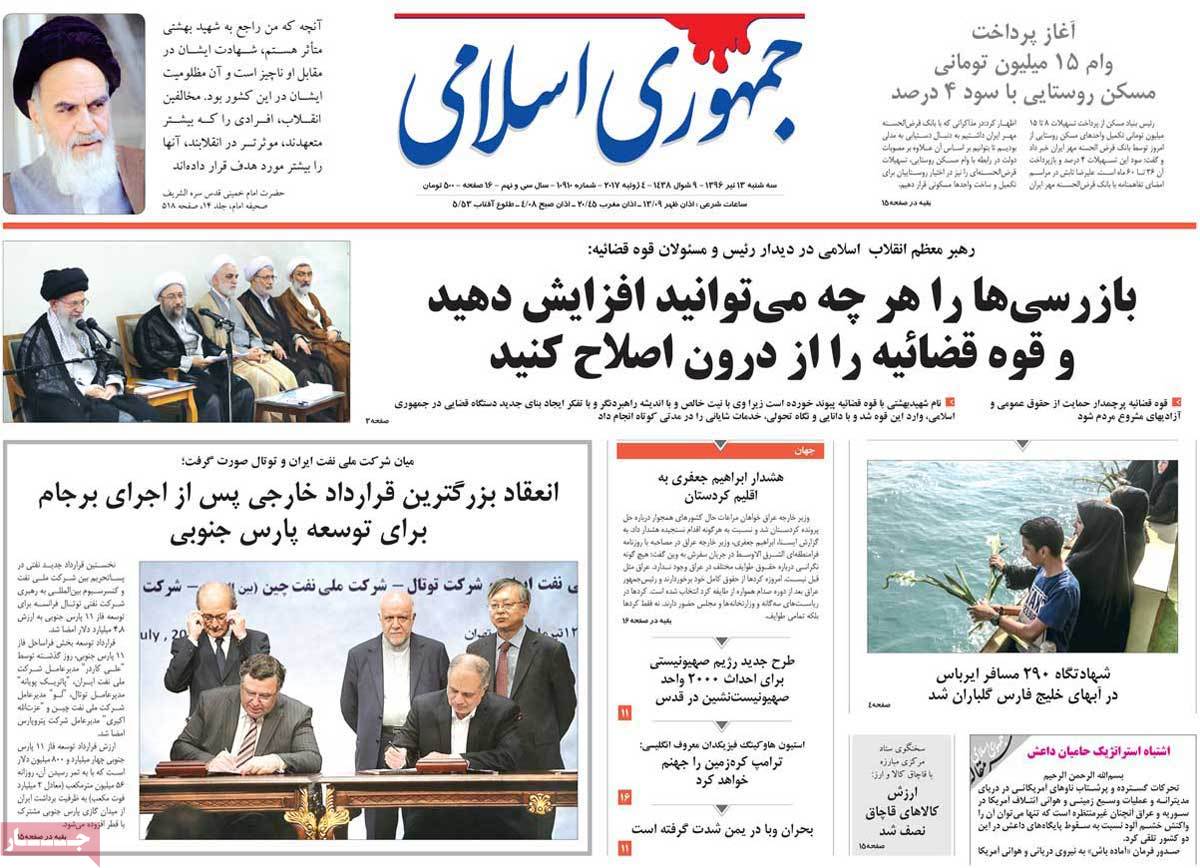
A Look at Iranian Newspaper Front Pages on July 4 - jomhori


Kayhan:

1- Iran Leader: Serious Punishment of Offenders Gives People Hope, Peace

2- Sunday Times: British Army’s Shocking Crime against Innocent Afghans

3- Deal with Total, Rouhani Government’s Reward for France’s Treasons
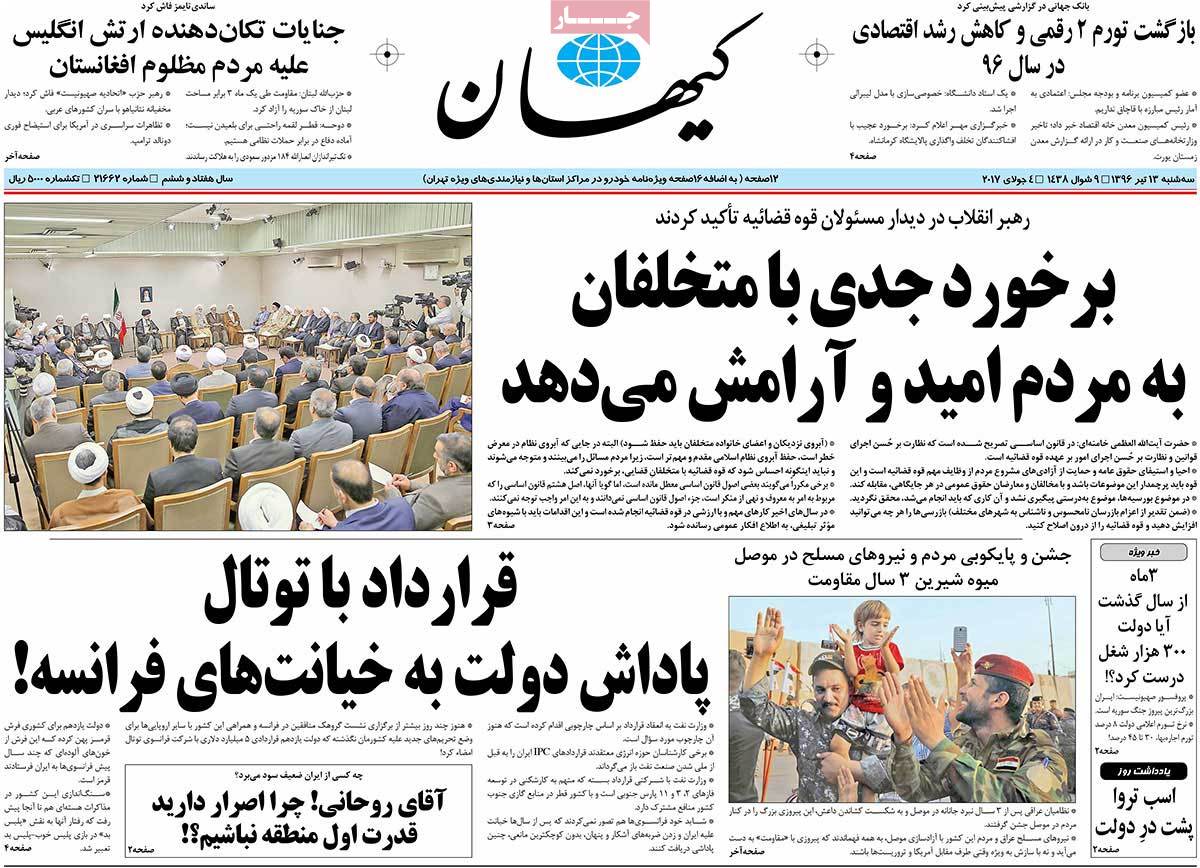
 

A Look at Iranian Newspaper Front Pages on July 4 - kayhan


Resalat:

1- Senior Lawmaker: Iran Worried about Hajj 2017
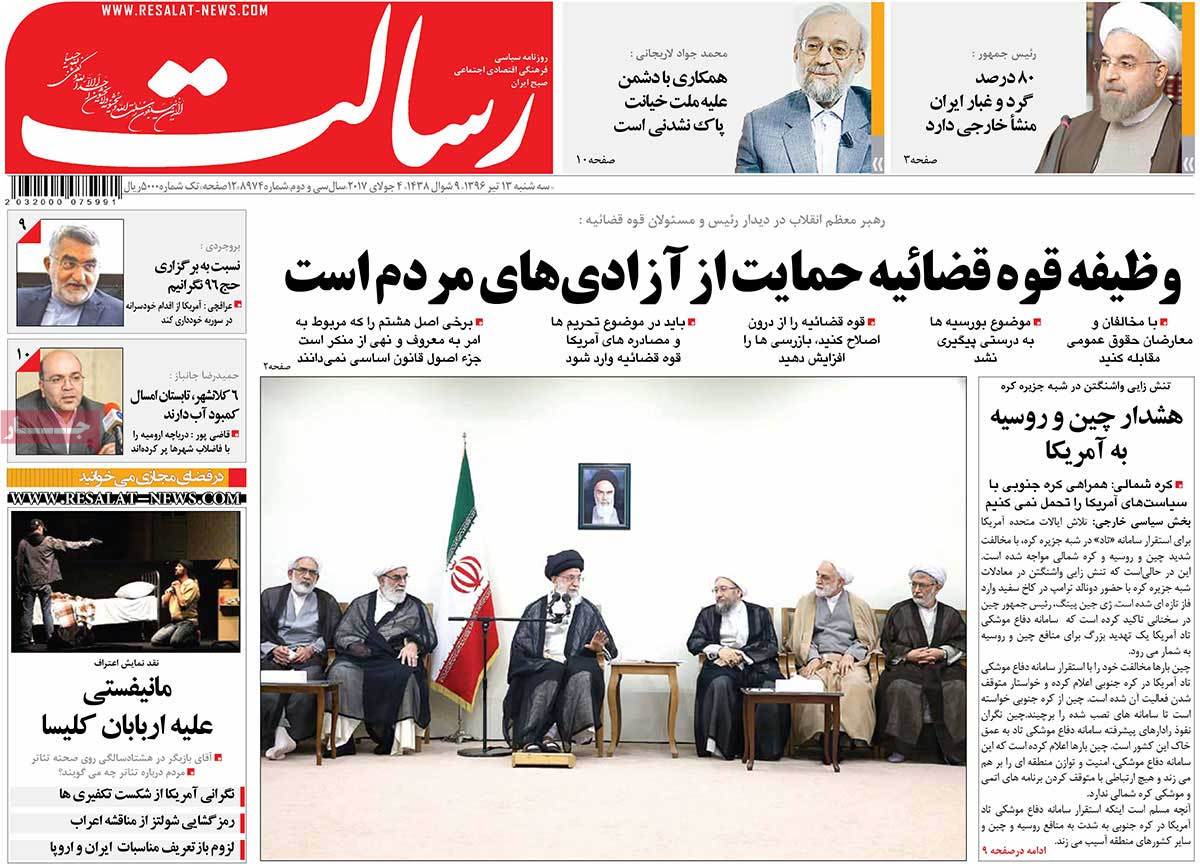
A Look at Iranian Newspaper Front Pages on July 4 - resalat


Setareh Sobh:

1- Iran’s Rouhani Calls for Win-Win Policy in World

2- 4 Arab States to Use Pressure and Diplomacy for Qatar after Deadline
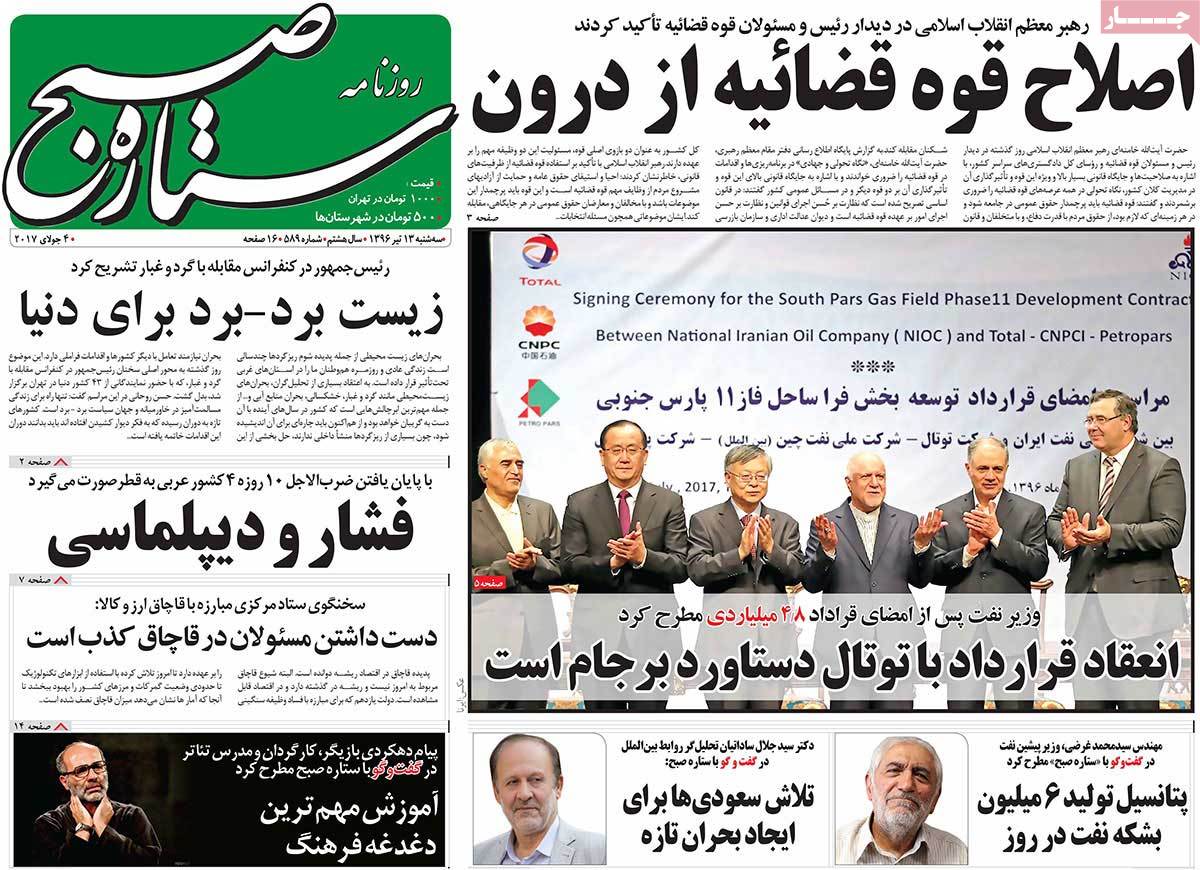
 

A Look at Iranian Newspaper Front Pages on July 4 - setaresobh


Shahrvand:

1- Water to Become Security Issue in Iran, Entire Region
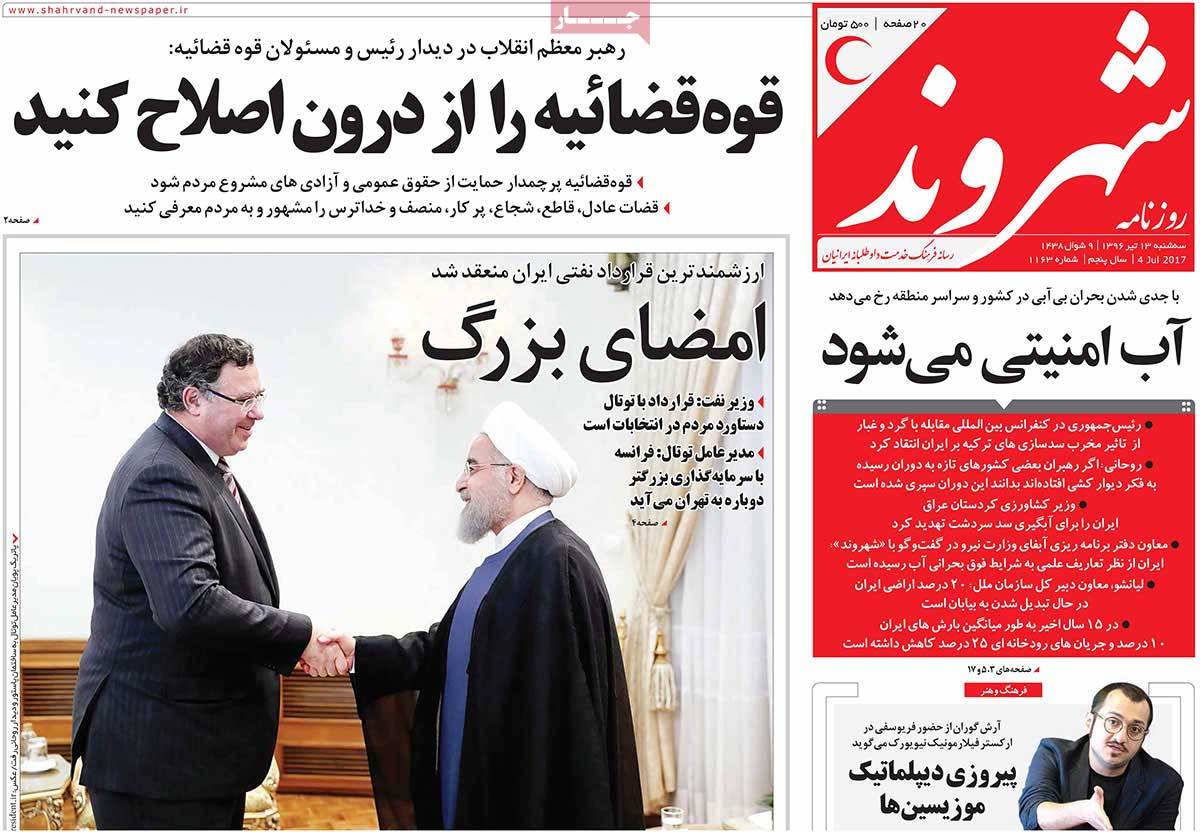
 

A Look at Iranian Newspaper Front Pages on July 4 - shahrvand


Shargh:

1- Total-Led Consortium Signs Historic Oil Deal with Iran

2- Rouhani May Appoint Army General as Defence Minister
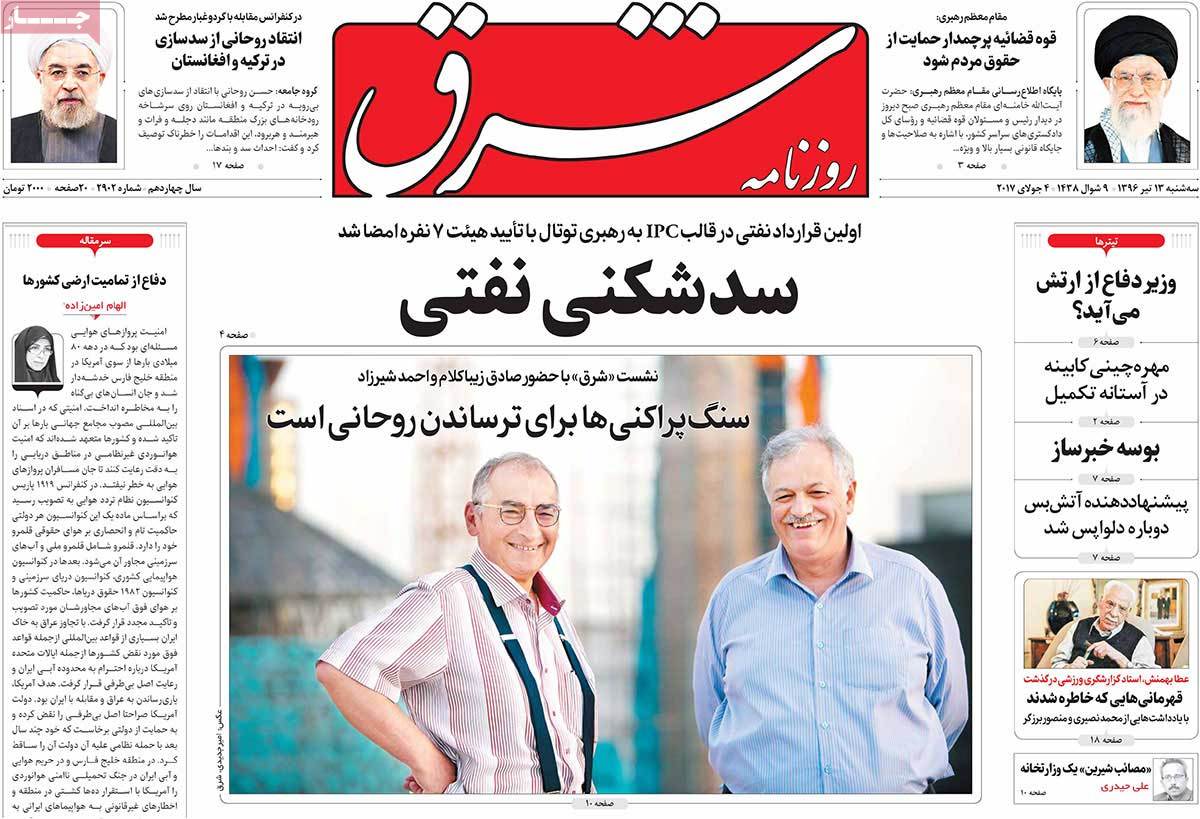
 

A Look at Iranian Newspaper Front Pages on July 4- shargh


Sobh-e Now:

1- Economic Concession to France: First Contract Signed Based on IPC
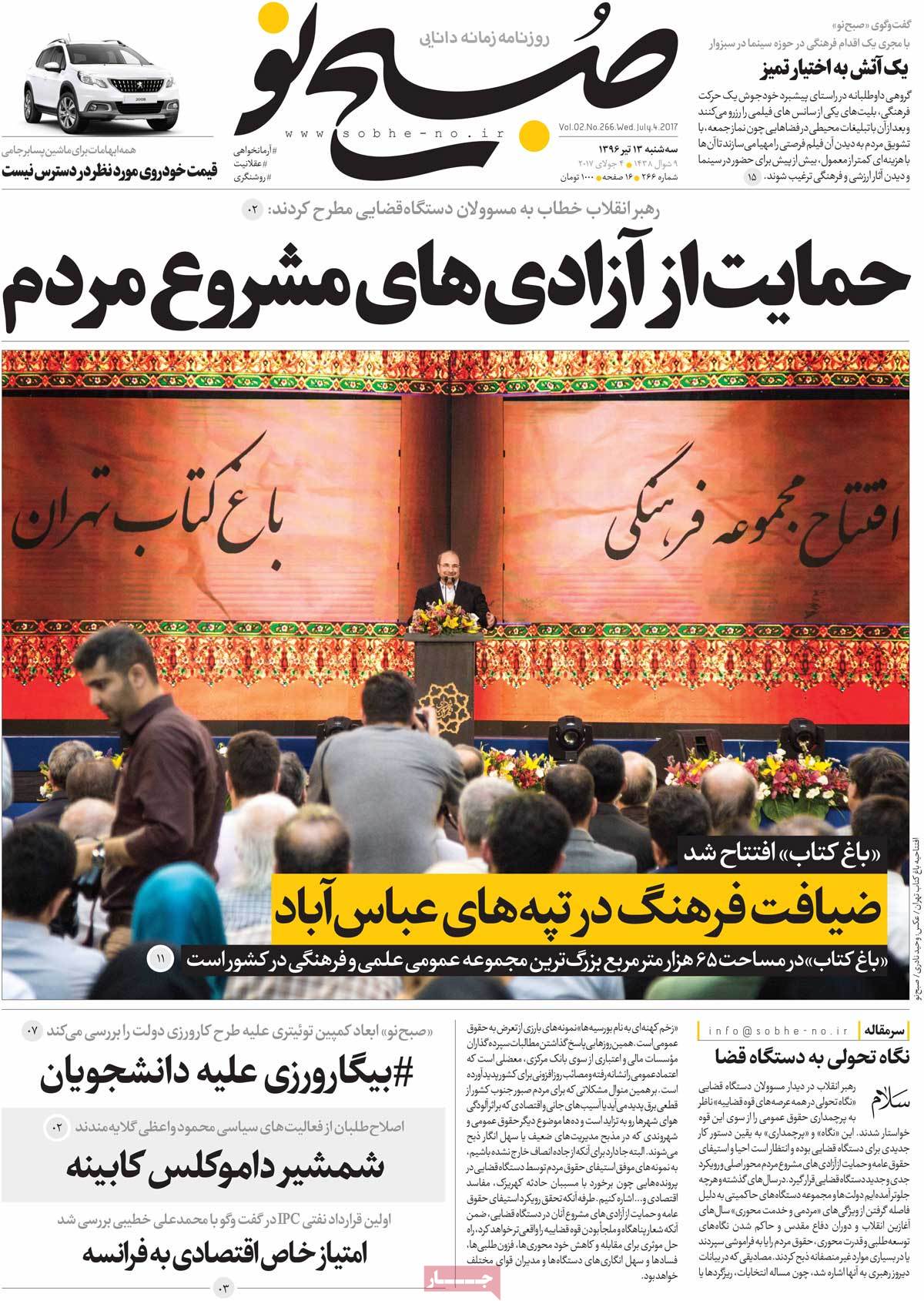
 

A Look at Iranian Newspaper Front Pages on July 4 - sobheno


Vaghaye Ettefaghieh:

1- Banned from Sleeping in Graves, Forced to Live in Deserts

  • A Report on Controversial Grave-Sleepers in Tehran
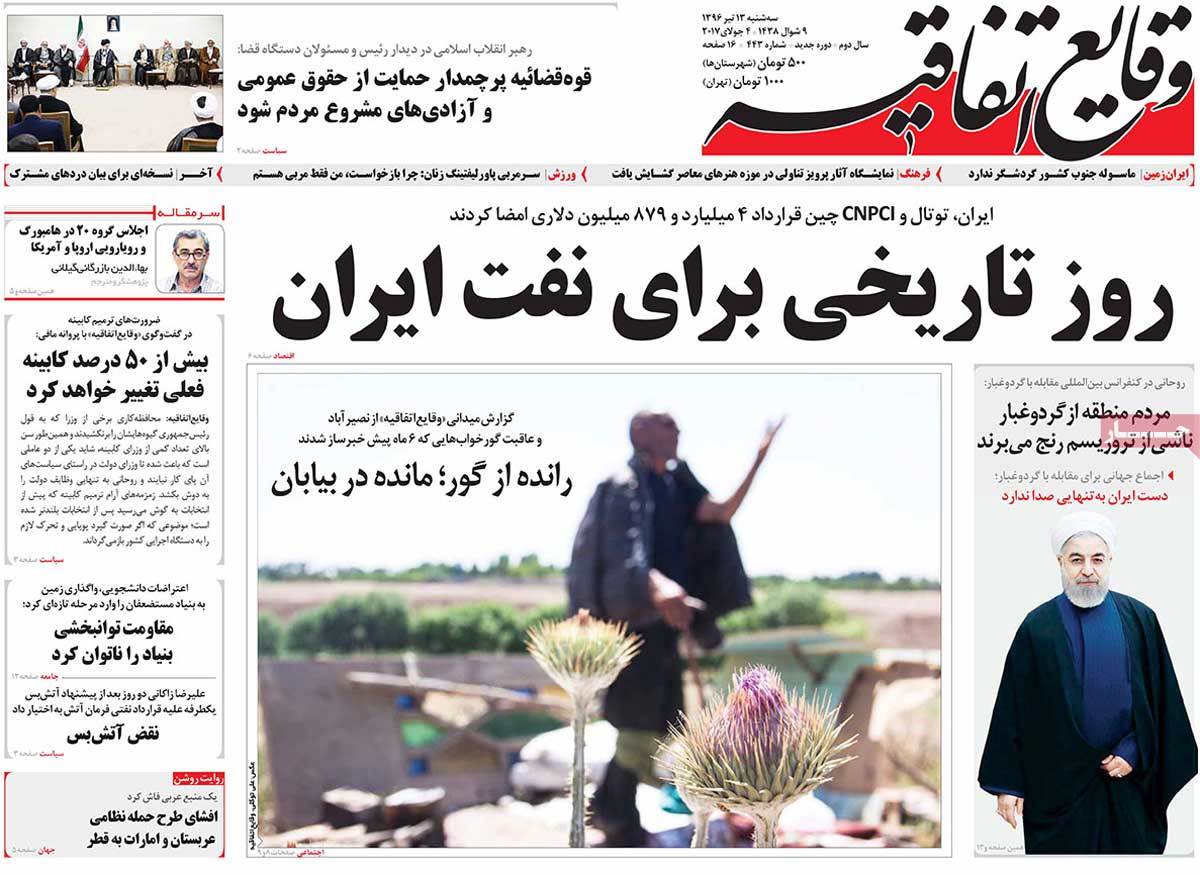
A Look at Iranian Newspaper Front Pages on July 4 - vaghaye

UN Calls for Iran’s Help in Resolving Syrian Crisis

jaberi ansari
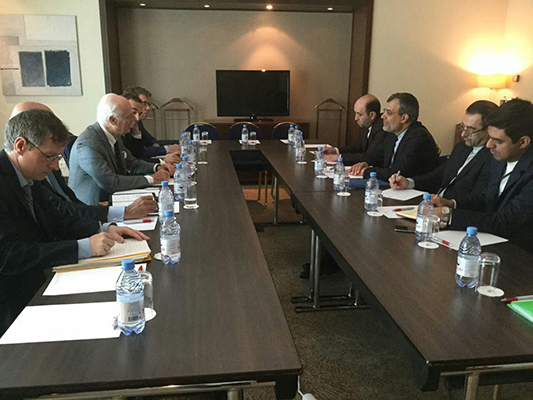
Iranian Deputy Foreign Minister Hossein Jaberi Ansari holds talks with the UN's Special Envoy on Syria Staffan de Mistura on the sidelines of Syria talks in the Kazakh capital of Astana on July 4 / Photo retrieved from Jaberi Ansari's Telegram channel

Staffan de Mistura on Tuesday called on Iran to play a more significant role and help the international body end the crisis in Syria within the framework of Geneva talks.

De Mistura also voiced the UN’s support for the efforts of three guarantors – Iran, Russia, and Turkey – in the framework of the Astana talks.

During the meeting held in the Kazakh capital of Astana as part of the fifth round of talks on Syria, the two sides discussed the latest developments in the Geneva and Astana processes including Syrian-Syrian talks, establishing the ceasefire, de-escalation, and taking practical measures to bring peace.

Iran’s Jaberi Ansari stressed that the two processes of Astana and Geneva are complementary. He also talked about the achievements of previous efforts and the requirements ahead.

Moreover, Iran’s top negotiator in the Astana talks touched on the UN’s role in providing technical assistance to reach a deal on creation of de-escalation zones as well as giving assistance to Syrian-Syrian talks to initiate a national reconciliation process.

The two sides also touched upon the significance and urgency to provide humanitarian aid for the Syrian people and looked into new executive proposals in this regard.

The two-day round of the Astana talks on Syrian reconciliation has kicked off on Tuesday. The parties are expected to work on approval of borders and maps of the de-escalation zones, as well as documents regulating the activities of de-escalation control forces.

How US Media Cover Same Tragedies in Opposite Ways

How US Media Cover Same Tragedies in Opposite Ways
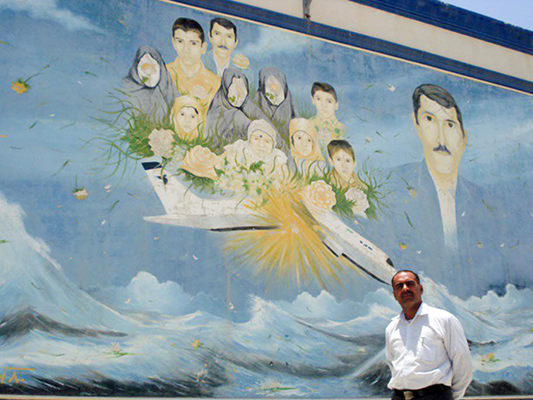
Ali Bandi, the only member of a 12-strong family, 10 of whom died after the US shot down Iran Air Flight 655 in 1988. Ali was doing his military service at the time. / Photo by Mojtaja Seraji, Gerishna

The downing of the Dubai-bound Iran Air flight 655 by the American warship USS Vincennes on 3 July 1988 over the Persian Gulf was not the only such incident in history.

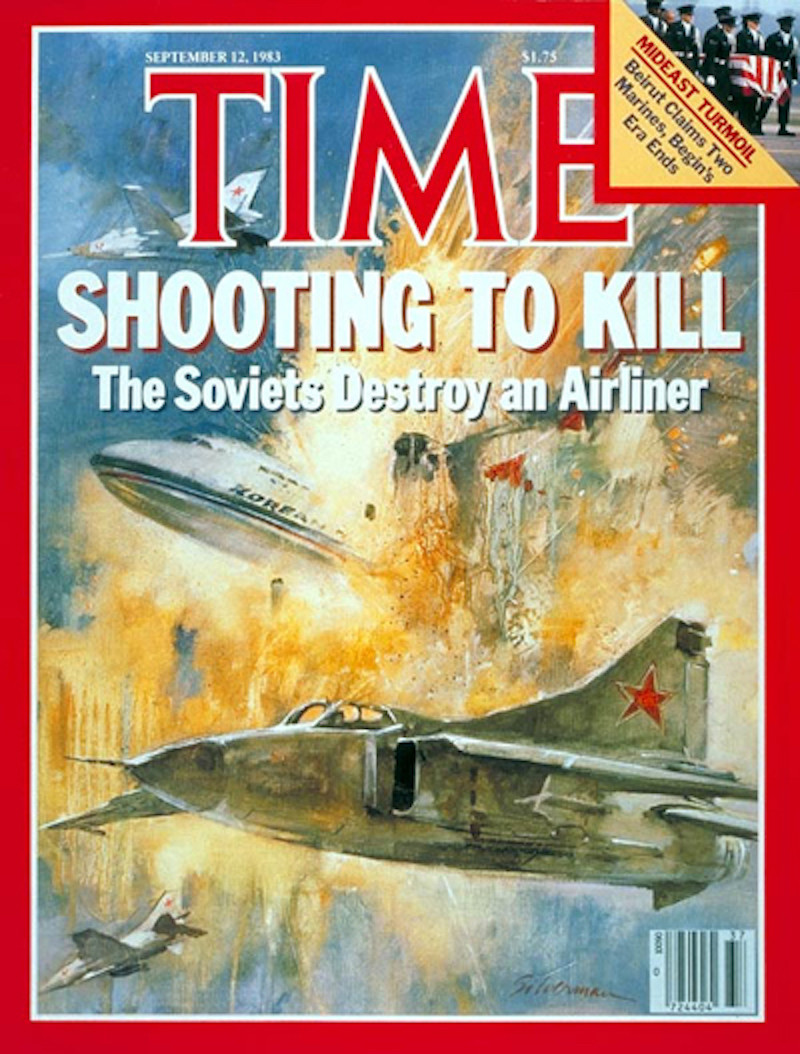
South Korea’s Boeing 747 airliner, flight 007, took off from the JFK airport on 1 September 1983 before being shot down by the former Soviet Union’s air force. All 269 crew members and passengers on board were killed.

TIME
The USSR’s downing of a Korean airliner covered on the Time magazine’s frontpage in 1983

Political commentator Sahand Iranmehr has drawn a comparison between the two incidents and found interesting points. First, the Americans’ justification for shooting down the Iranian airliner was that the Bandar Abbas airport in southern Iran from where the passenger plane had taken off was simultaneously used by F-14 jet fighters as well. The Americans claimed any aircraft that would take off from that airport was a fighter jet unless proven otherwise (according to information provided by Wikipedia). So, after giving 11 warnings (most of which could not be picked up by passenger planes due to their special frequency), the US warship shot down the Iranian airliner. After the tragedy, Washington justified the downing by saying that the Americans had failed to properly identify their target in a critical situation amid the Iran-Iraq war.

The contradiction associated with this justification comes to light when we refer to the case on the downing of the South Korean airplane. Soviet officials argued that the South Korean airliner could not be identified due to night-time darkness. They also said that the plane did not pay attention to the warning shots fired by the Russian air force, either. At that time, the US dismissed the Soviet authorities’ justification as farcical and unconvincing.

The more interesting point is that the South Korean aircraft had strayed into the Soviet airspace by mistake, and as a result, the aircraft increasing its altitude was regarded as a declaration of war while the Iranian Airbus plane had not crossed into the airspace of any country.

The second point in comparing the two tragedies is that American media claimed a technical error was to blame for the US downing of the Iranian airliner while the South Korean plane tragedy became front-page news in most US publications and even the photo of the aircraft was printed on the cover of Time magazine and the incident received blanket coverage as a war crime.

According to an article by Iranian researchers Alireza Dehqan and Ehsan Shah-Qassemi released in the Hamshahri Training website, Robert Matthew Entman, the head of the Institute for Public Diplomacy and Global Communication, for the first time introduced the concept “news framing” by directly comparing the two incidents.

News framing refers to double standards on news stories which are similar in terms of content, but political or economic considerations will result in them being aggrandized or downplayed.

Iran’s Customs Officers Seize Big Chunk of Opium

Iran’s Customs Officers Seize Big Chunk of Opium

Customs officers at Tehran’s Imam Khomeini International Airport in the Iranian capital have seized 2.406 kilograms of opium smartly concealed in a sugarloaf, according to a Farsi report by IRIB News Agency.

The chunk of opium was shaped into a conical sugarloaf, coated skilfully with sugar. Despite efforts to disguise the large piece of opium as a sugarloaf, the customs officer were vigilant enough to find and seize it.

According to the latest report by the Regional Intelligence Liaison Offices (RILO) – World Customs Organization, Iran’s Customs Administration (ICA) ranks first worldwide in terms of discovering and seizing narcotics smuggled to and from the country.

The report says the ICA has put in the best performance among the customs administrations of other countries in fighting and discovering drugs, including industrial, traditional and psychedelic drugs as well as opioid-based pills. Hong Kong, Japan and New Zealand stand second to fourth in this ranking.

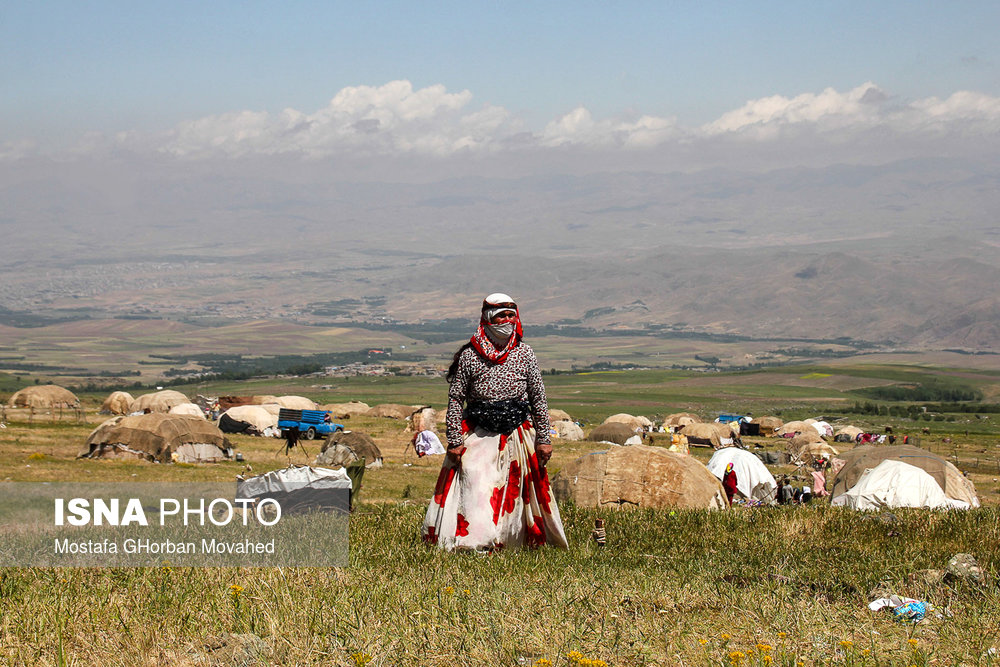
Nomadic Lifestyle in Northwestern Iran

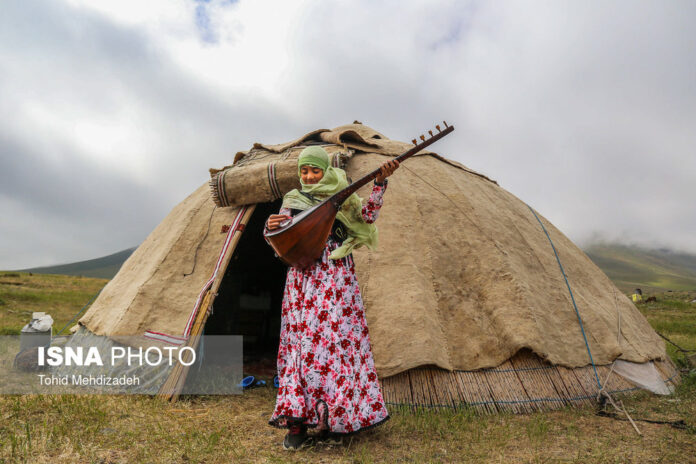
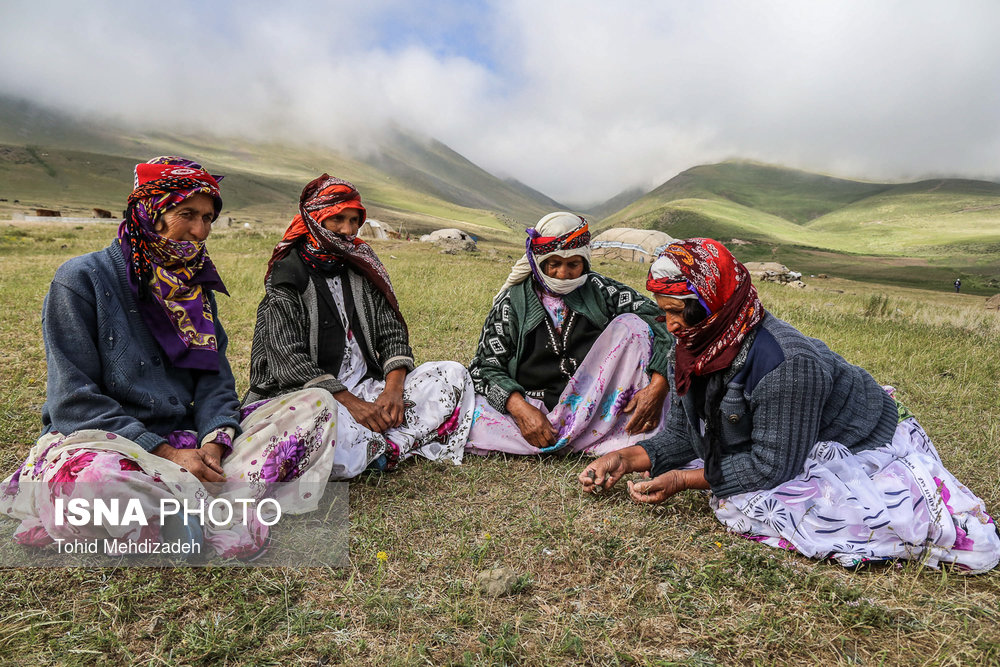
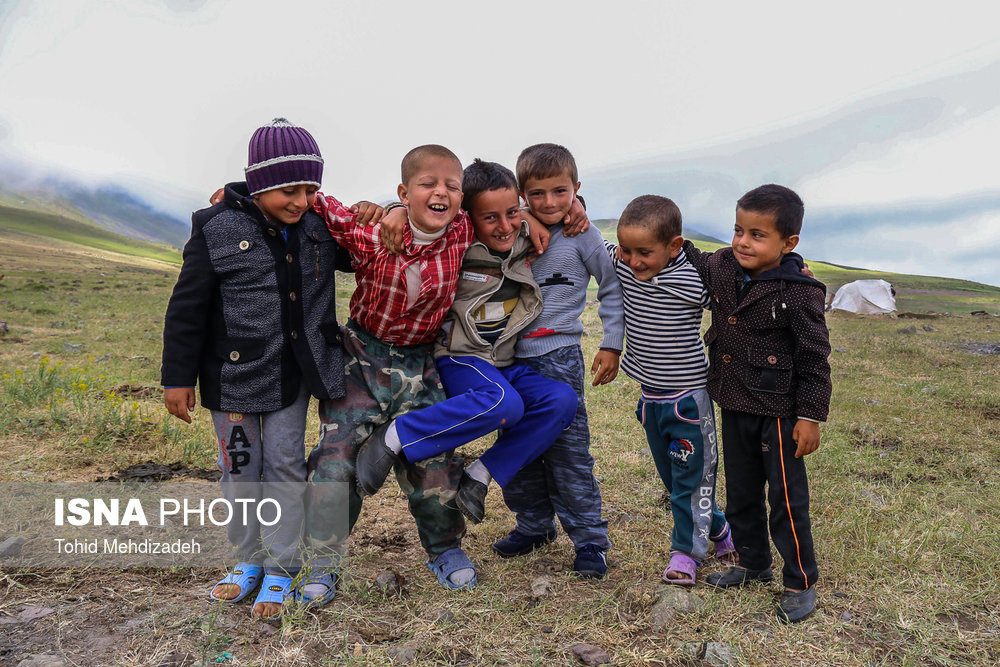
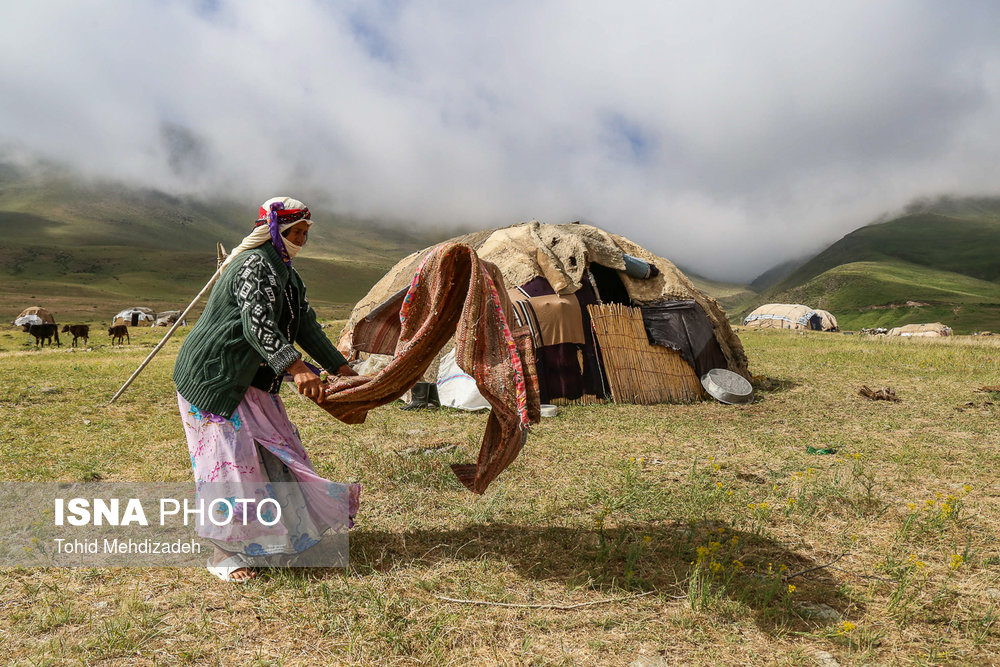
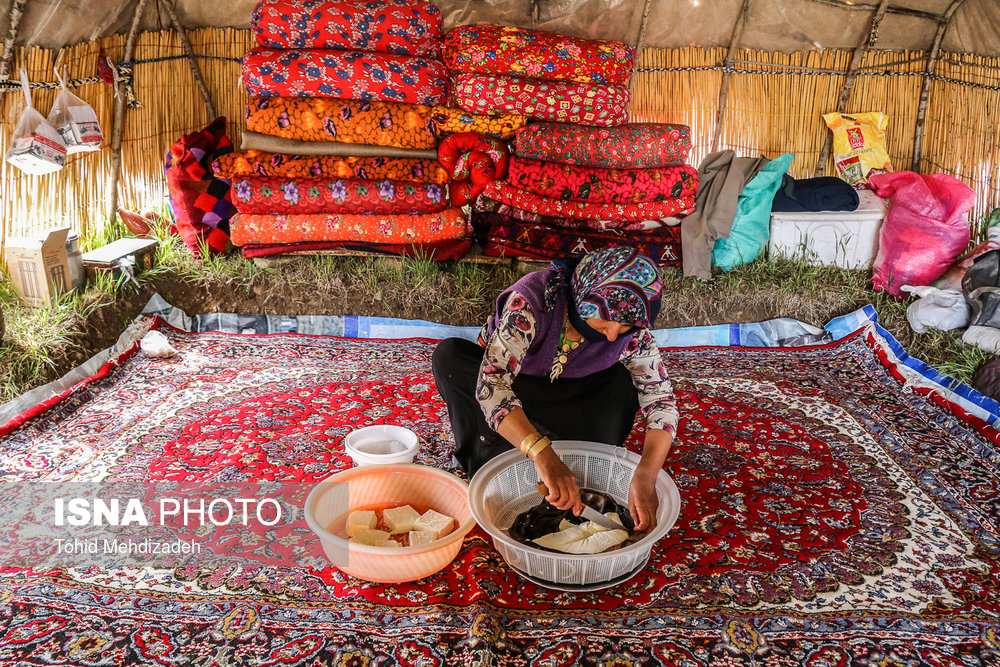
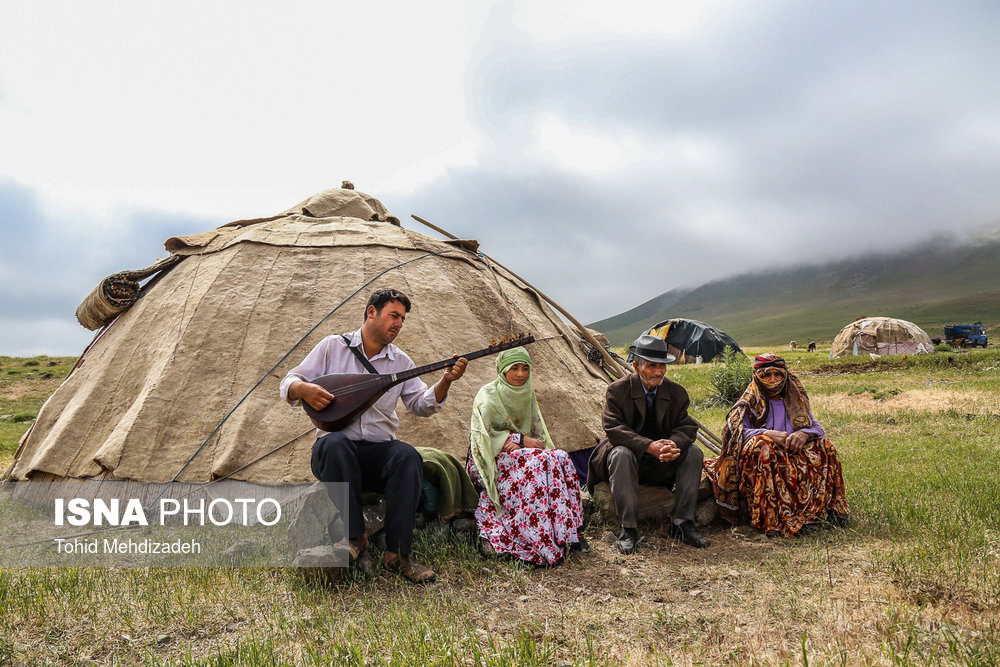
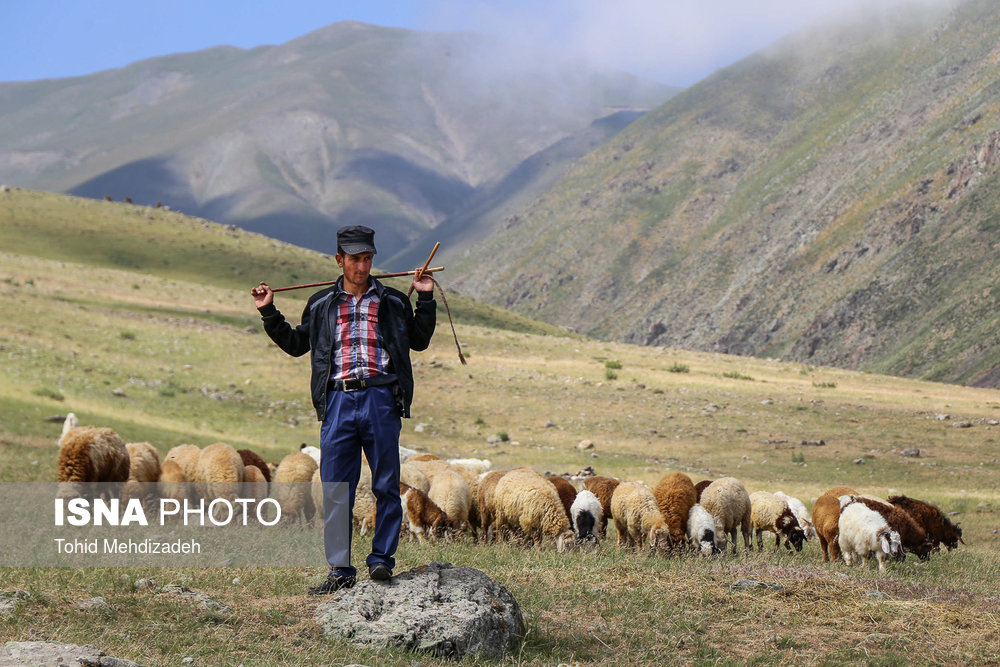
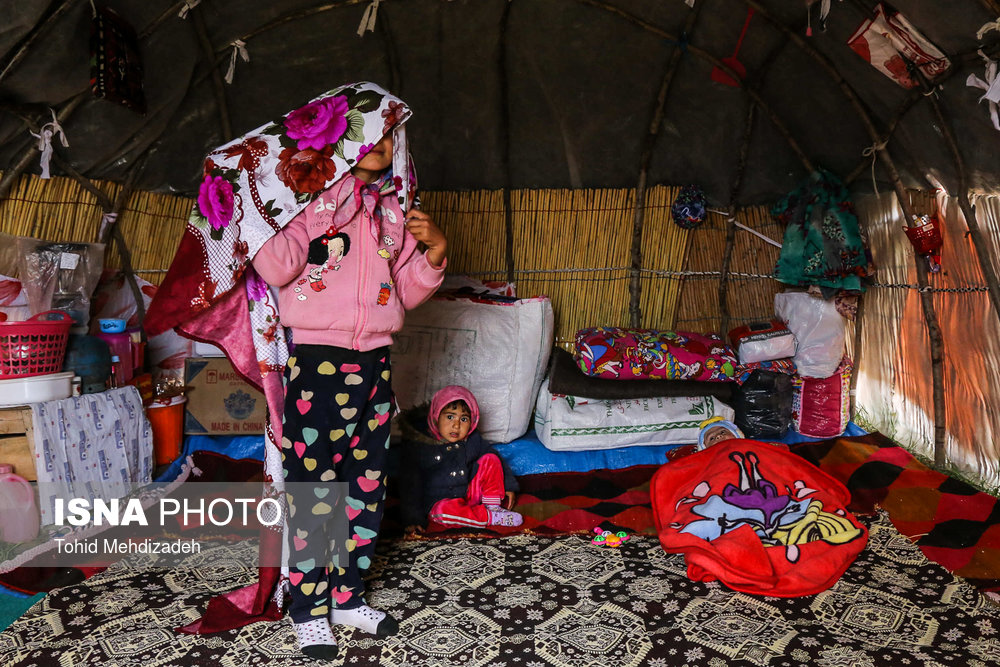
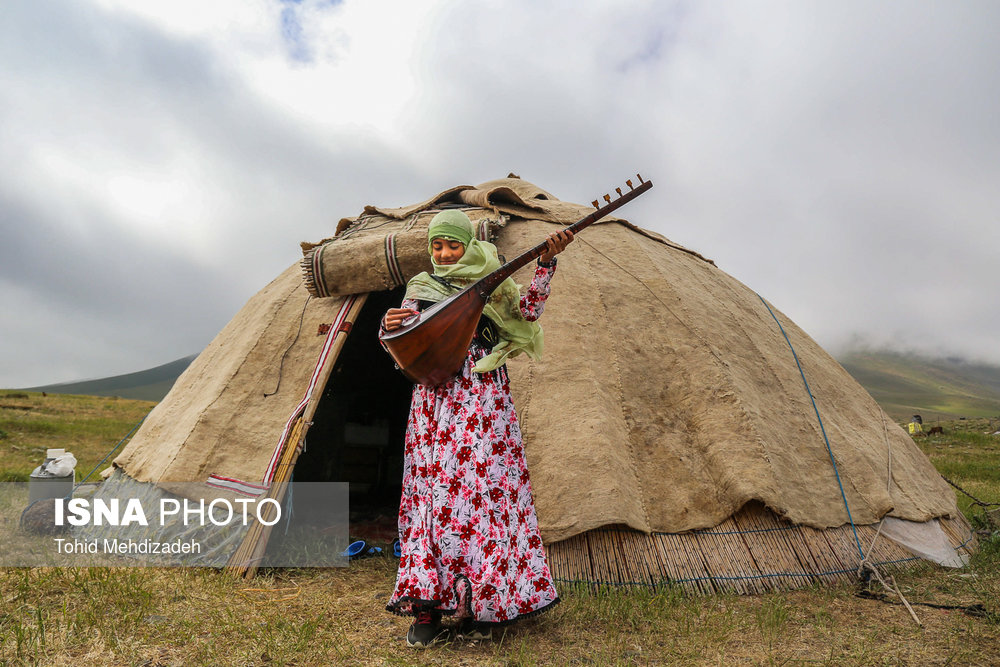
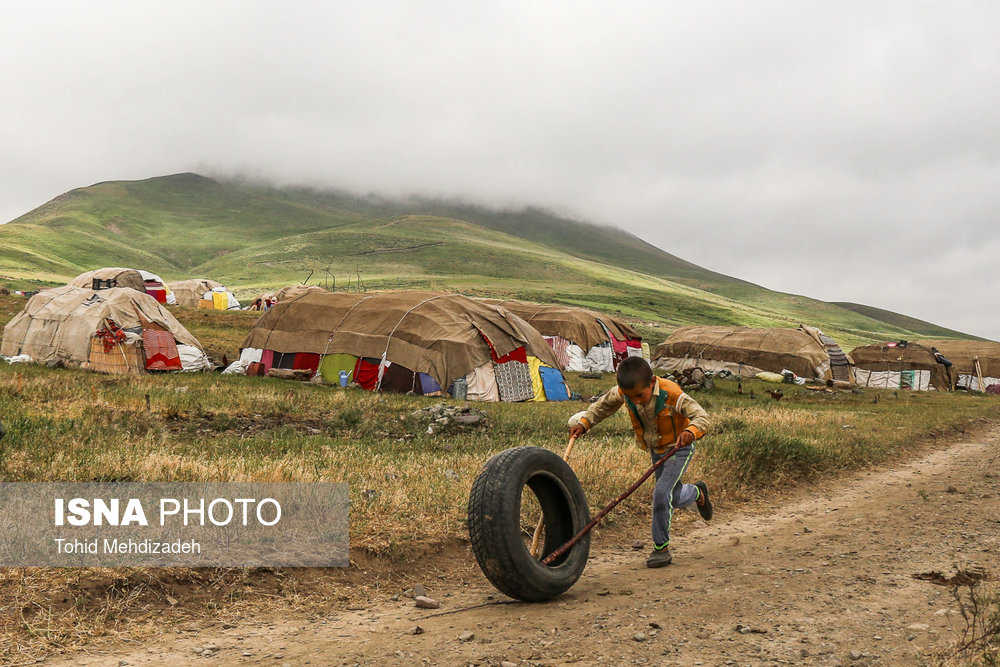
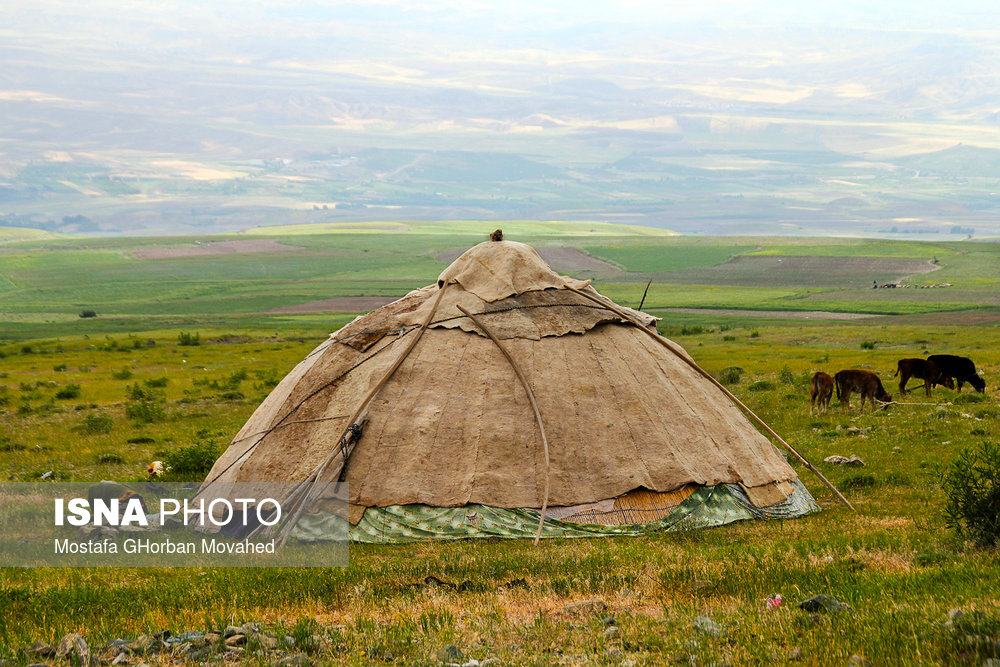
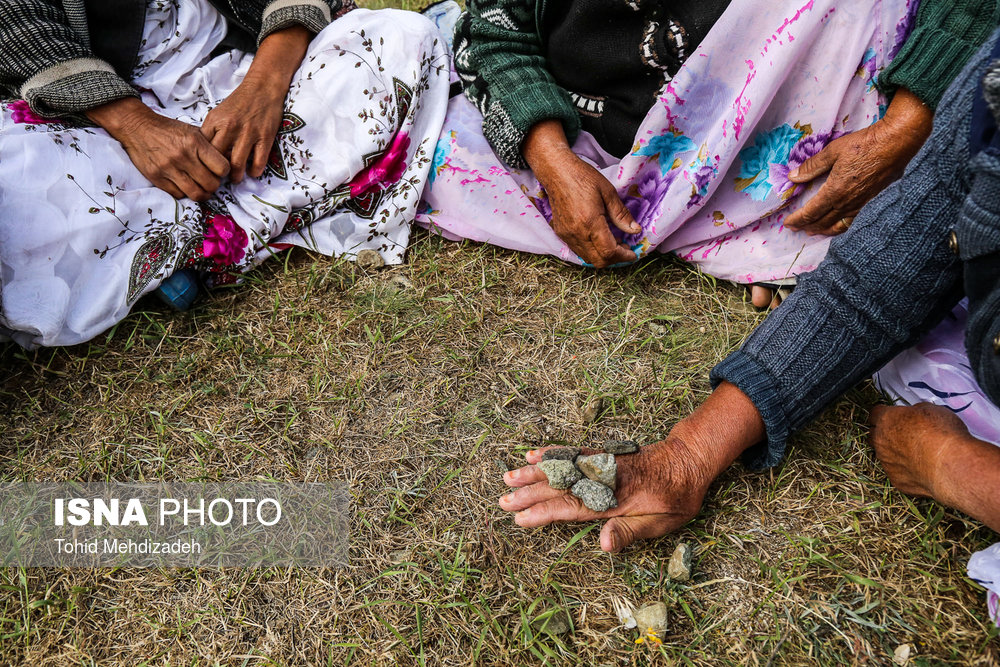
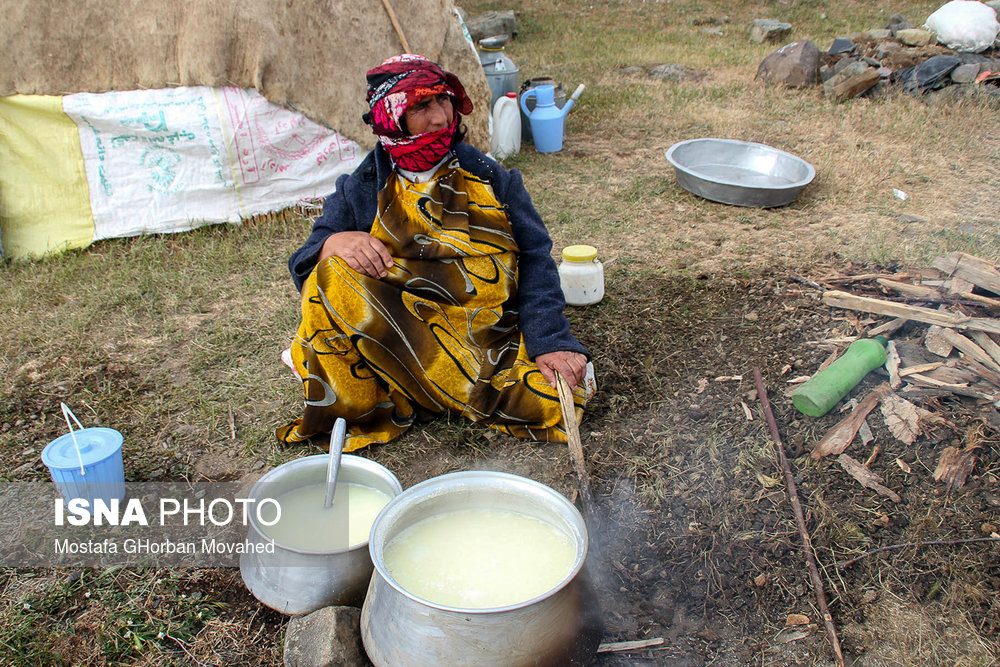
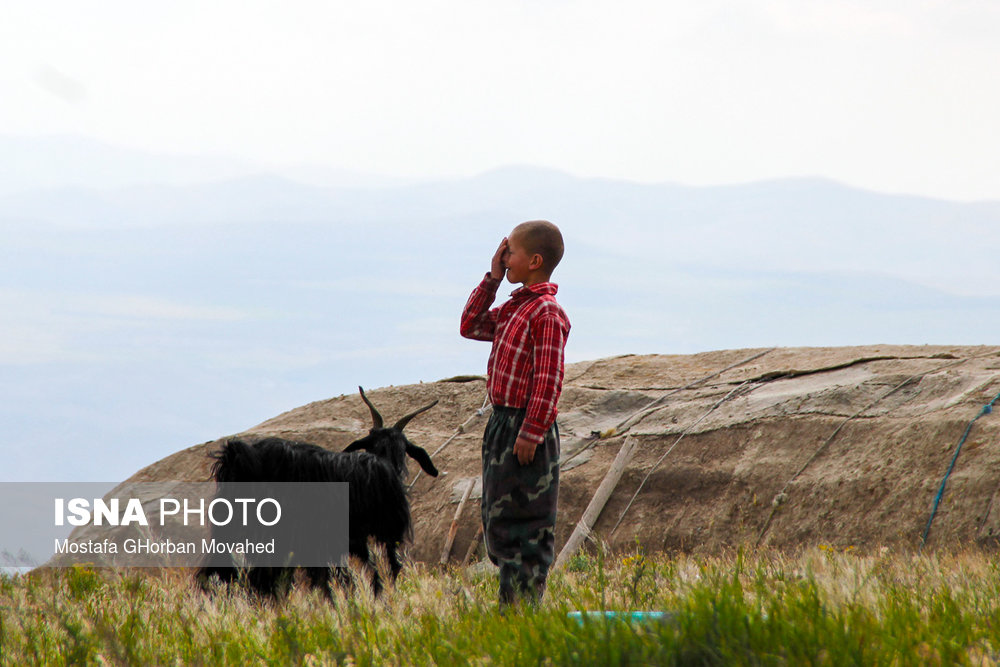
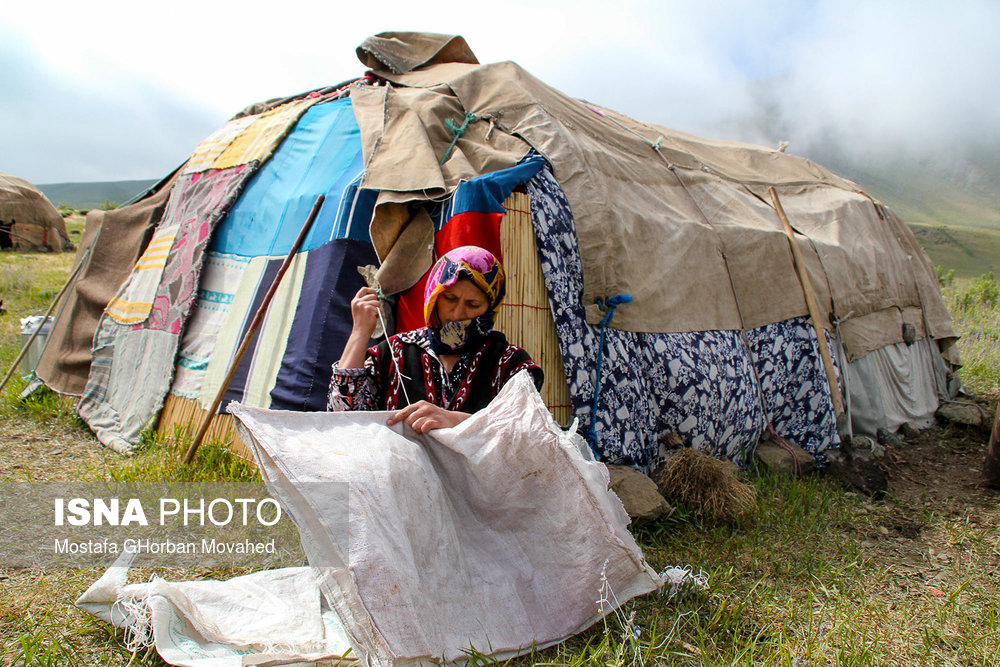
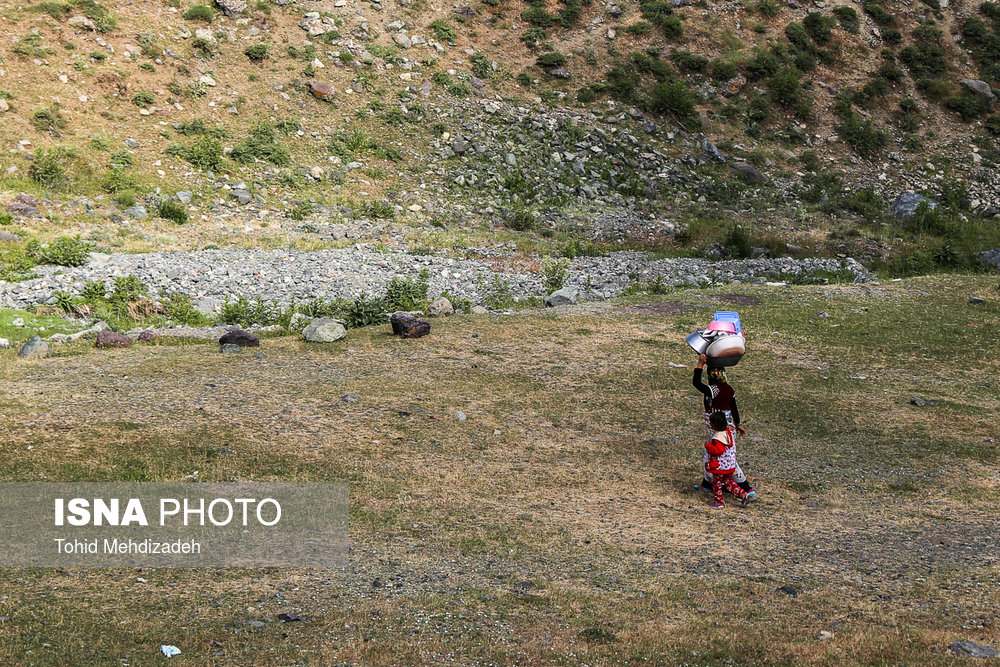
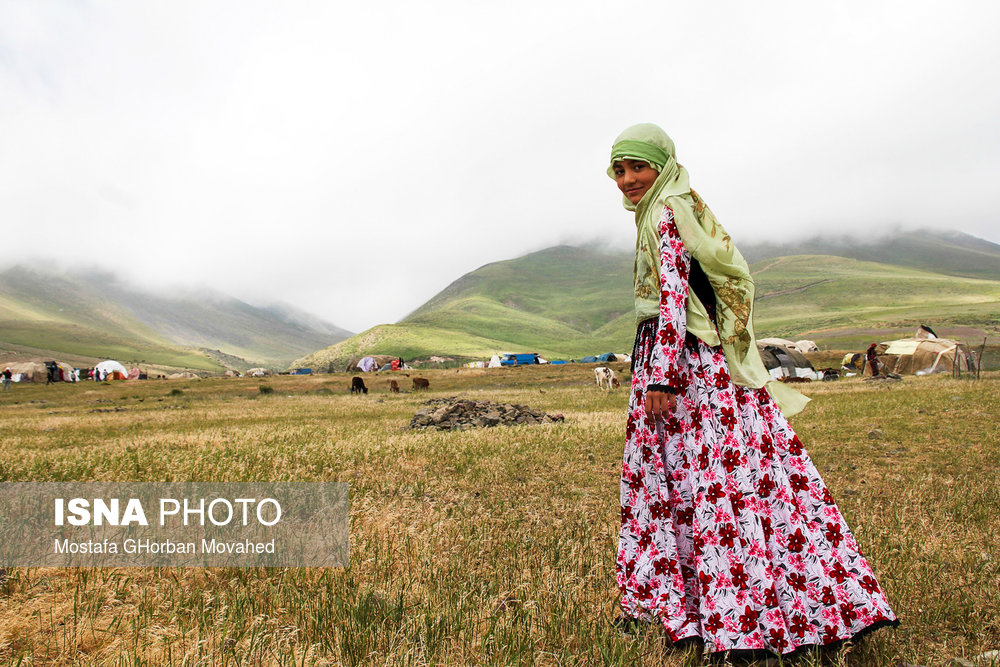
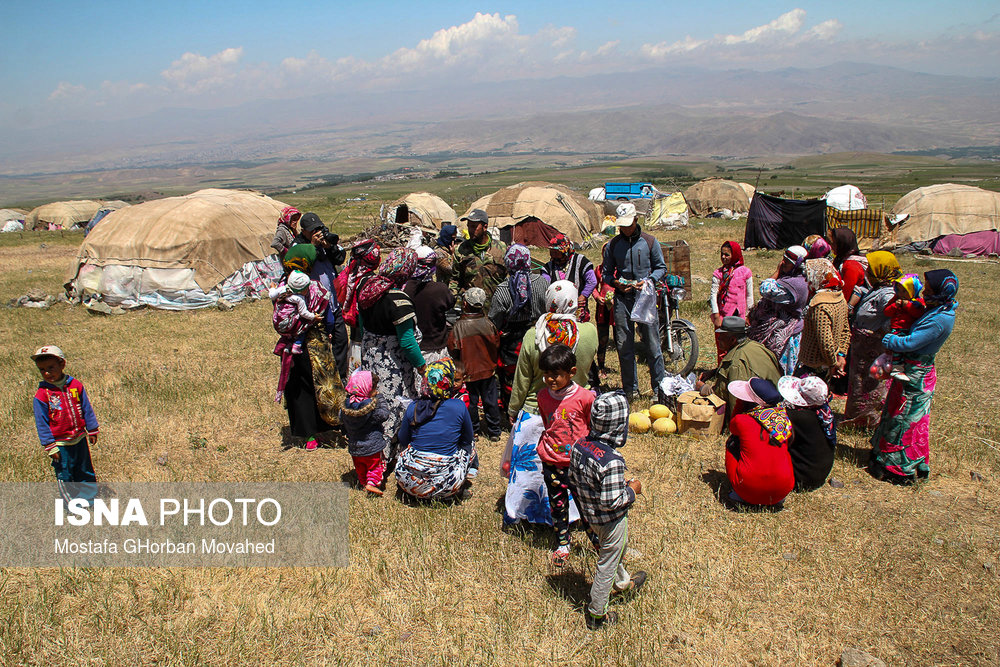
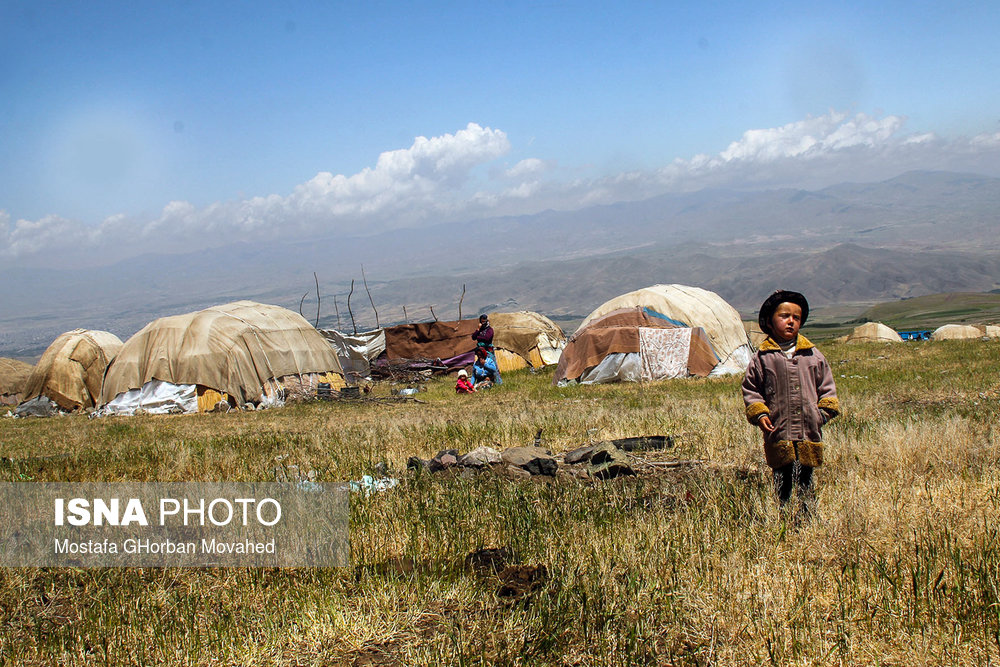
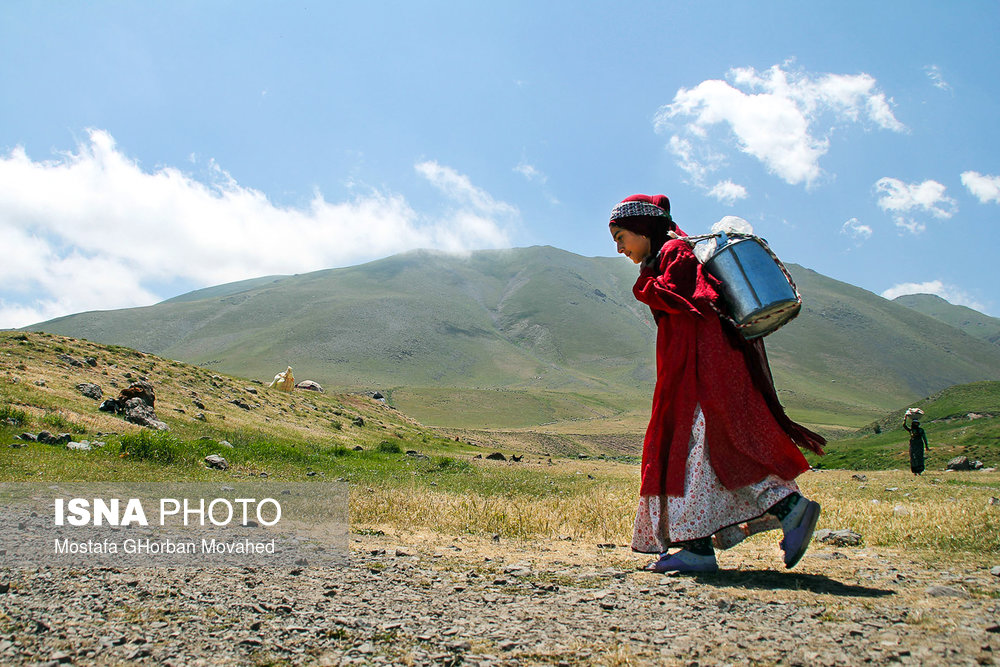
Atmianlu nomadic families annually gather in the beautiful Quch Gulu area, near the city of Ahar in Iran’s East Azarbaijan province, as of early June.

Here are ISNA’s photos of these nomads:

Story of Lonely Man Who Lives in Darkness

Story of Lonely Man Who Lives in Darkness (1)
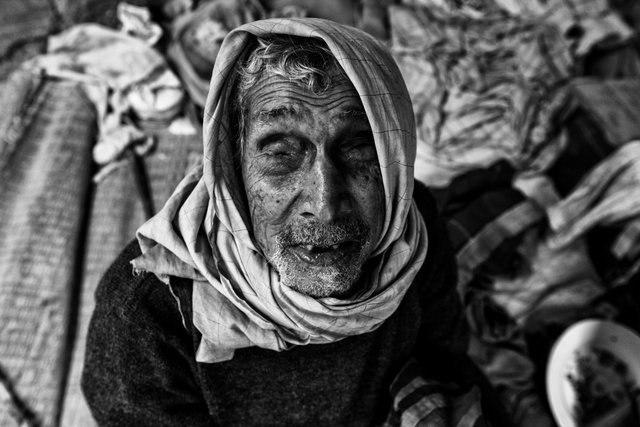
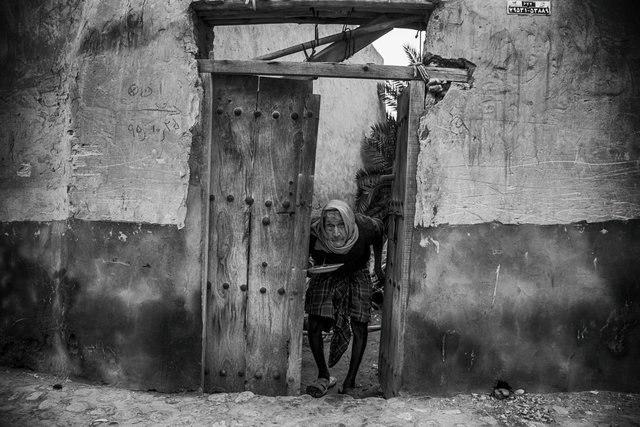
Issa, a nearly 100-year-old blind man, lives in Laft village Qeshm Island / Photo by Abdolreza Sheibani

The Laft village in southern Iran is known for its wind-catchers (wind-towers), narrow alleys and palm trees. Any visitor to Qeshm Island in Persian Gulf is mesmerized by the scenic beauty of Laft, its tropical trees, tall palm trees, beautiful sea and the floating Hara forest. But take this advice, do not forget Issa should you happen to visit Laft.

Years ago, residents of Laft came down with a strange disease. A deadly disease broke out among locals and blinded villagers. Issa, blinded by the same disease, is a survivor of the epidemic.

“Laft has been known as the town of the blind since then,” he says, according to a Farsi report by ISNA.

Story of Lonely Man Who Lives in DarknessIssa says he is 105 years old, but his neighbours say he is 90. He went blind at the age of seven due to the disease. This changed his life: dark and vague, so to speak. Still, he would go fishing at sea during his youth. Locals say he is very good at finding paths and addresses even though he cannot see, and that he knows the sea very well.

He got married twice. Both of his wives were visually challenged, too. They have both died. He has no children, either. So, he is alone, completely alone.

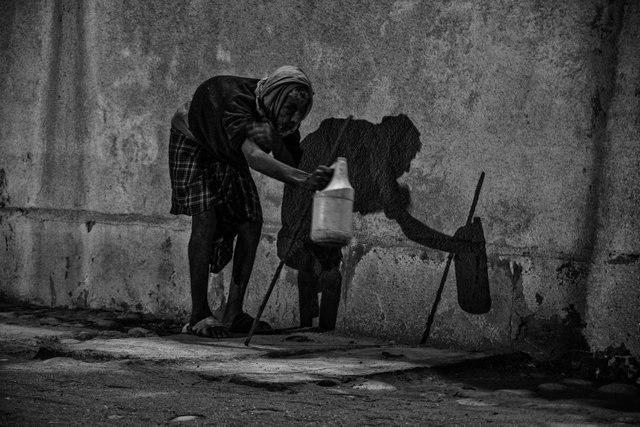
Issa’s heart is full of pain. Senility on the one hand, and loneliness on the other. Issa’s house – a tumbledown, to be exact – is surrounded by garbage. There is no piped water, either. One of Issa’s neighbours has agreed to provide his food and tea. To return his neighbour’s favour, Issa has signed over the dilapidated house to him. For Issa, his neighbour is a shoulder to cry on.

He attends mass prayers in the mosque five times a day. He also takes a 4-litre container of water with him to the mosque to perform ablutions and all. He does not have an identification card, nor does he receive cash subsidies or any other government services.

Story of Lonely Man Who Lives in DarknessHe has grievances because no one pays attention to him, and no one cares that the roof of his house is collapsing.

“You know, even the cats in the neighbourhood know that I cannot see. So, they take the chance, take my food and eat it,” Issa says.

Issa is an ordinary person like all of us. The only difference is that he cannot see the world as colourful as we do. He just sees darkness. Why don’t we care about him, so much so that he really thinks he lives in the town of the blind?

Two Iranian Organizations Shut Down in Tajikistan

Two Iranian Organizations Shut Down in Tajikistan
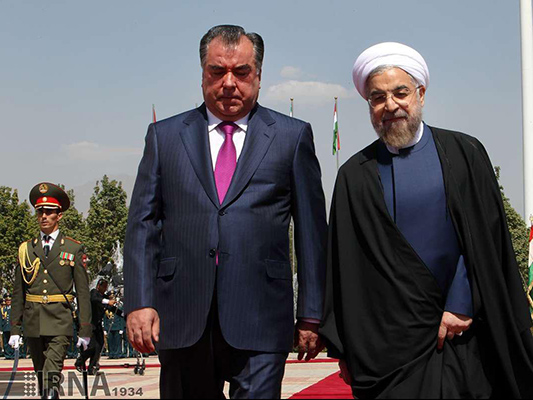
Iranian President Hassan Rouhani receiving his Tajik counterpart Emomali Rahmon in Tehran / Photo by IRNA

It is said that the Iranian embassy has closed its two offices in the historical city of Khujand at the request of Tajik government.

Local sources say about two weeks ago Tajik authorities have ordered the directors of the Iranian organizations in the second-largest city of Tajikistan to stop their activities because Tajikistan “does not need their services anymore.”

“After the Cultural and Trade offices of the Embassy of Iran received the official notification, Iran’s embassy in Dushanbe decided to shut them down,” local media quoted a source at the Iranian embassy as saying.

“The employees of the shut-down offices say the embassy has placed them on leave since mid-June,” the source added.

However, the local media say the embassy officials refused to comment on the issue.

Over the past two years, most of the organizations related to Iran have been forced to shut down in Tajikistan – including the Imam Khomeini Relief Foundation and its offices across the country, office of the Iranian embassy’s Cultural Attaché, and a hospital jointly run by the Tajik government and the Red Crescent Society of the Islamic Republic of Iran.

In the meantime, other media outlets say Tajiran joint tractor manufacturing company and Palood dairy factory are ending their activity in the central Asian country after 10 to 15 years of work experience in Tajikistan. The days are also numbered for the other Iranian organizations that are active in this country which shares the same language, culture, religion, and history with Iran.

Reports say the Tajik government has also restricted the activities of some Iranian companies and businesses in the country.

Witnesses say no Iranian-produced goods could be found in the Tajik markets and all the outlets selling Iranian products have been closed.

Observers believe the closure of these organizations is linked to the cold relations between Tehran and Dushanbe.
Moreover, according to Russian media, Tajikistan has blocked Iran from joining the Shanghai Cooperation Organization as a full member. Iran is now holding an observer status at the SCO.

This comes as in the past years the Islamic Republic of Iran has always been introduced as one of the key trade partners of Tajikistan next to Russia and China.

The strategic tunnel of “Istiqlol” [Independence] north of Dushanbe and “Sangtuda-2” power plant in the south are two major projects built by Iran.

The closure of the Iranian organizations is the latest indication of rising diplomatic tension between Dushanbe and Tehran. Relations between the two countries took a nosedive in late December 2015 on the issue of the Islamic Movement of Tajikistan. While the Islamic Renaissance Party of Tajikistan (IRPT) was considered by the Tajik government as a banned party, its leader Muhiddin Kabiri, who lives in exile, was invited to an international conference in Tehran, and this outraged the Central Asian state.

Tajik authorities said despite the fact that Mohiaddin Kabiri was accused of organizing riots in September 2015, Iran invited him to the International Conference of Islamic Unity while he was seated next to the head of Tajikistan’s state-backed Council of Islamic Ulema and other members of the official delegation from Tajikistan.

Meanwhile, informed sources say the tension between the two countries goes back to earlier times and is in connection with the assets of Babak Zanjani, the Iranian billionaire who is in jail and was earlier sentenced to death.

Experts believe that the ties between Iran and Tajikistan could be boosted again if a party takes a step to sit at the negotiating table to resolve differences, but within the past two years there has been no serious bilateral diplomatic engagements to yield result.


Follow Reza Khaasteh in Twitter via @Khaaasteh

Iran Welcomes Any Initiative for Ending Syria Crisis: FM

In a Monday meeting with Secretary General of France’s Foreign Ministry Christian Masset in Tehran, the Iranian foreign minister expressed the Islamic Republic’s readiness to send humanitarian aid to the Syrian people.

Zarif went on to say that as a country trying to find a political solution to the current crisis in Syria, the Islamic Republic of Iran welcomes any initiative put forth by France to achieve the goal.

He further expressed the hope that Iran-France cooperation would continue to expand and said repeated bilateral meetings can remove the obstacles to expansion of bilateral ties, particularly in the economic field.

He also called for continuation of political talks between the two sides.

For his part, Masset referred to the deep relations between Iran and France and said the trade volume between the two sides has been growing significantly after the nuclear deal between Iran and the world powers.

“France is seeking to remove the current barriers in the way of promoting bilateral relations. We are also trying to find an appropriate mechanism to continue our cooperation,” he said.

The French official also pointed to his country’s stance towards the nuclear deal and said Paris is interested in finding an immediate solution to the current crisis in the Persian Gulf.

“France is ready to mediate between the conflicting sides of the diplomatic crisis in the Persian Gulf,” he noted.

Iran Welcomes Any Initiative for Ending Syria Crisis: FM