Wednesday, April 22, 2026
Home Blog Page 3946

A Look at Iranian Newspaper Front Pages on August 12

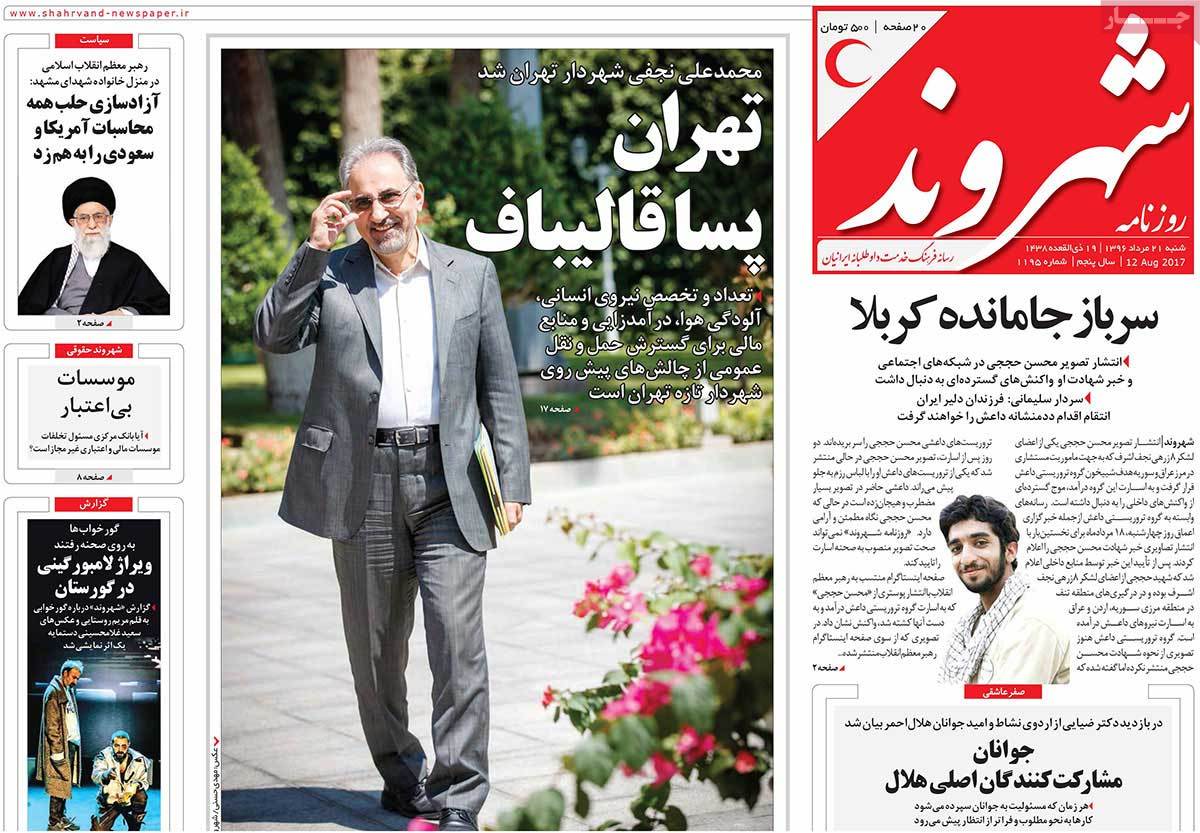
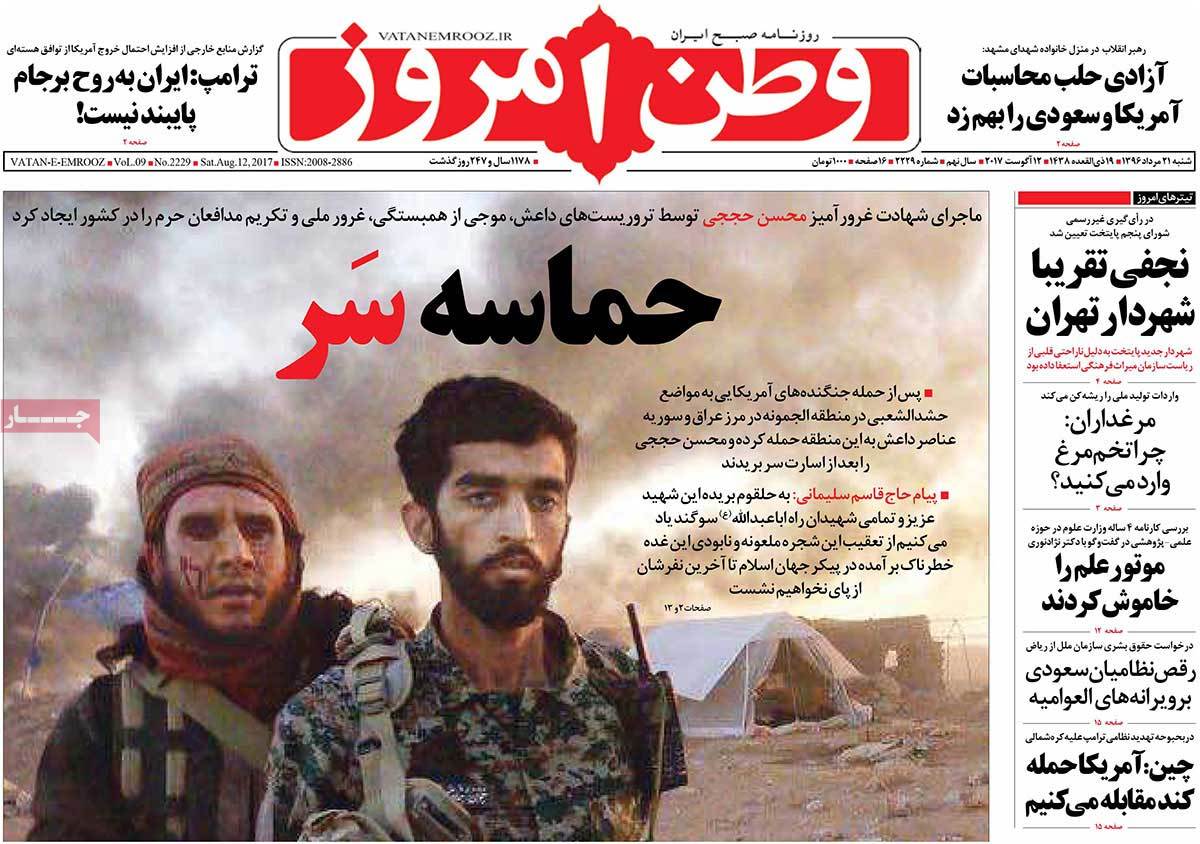
Almost all newspapers today covered the ISIS terrorists’ beheading of Iranian soldier Mohsen Hojaji, and the widespread reactions it sparked.

The Islamic Revolution Guards Corps (IRGC) Quds Force Commander Major General Qassemi Soleimani’s vow to cleanse the earth of ISIS militants was particularly covered in today’s newspapers.

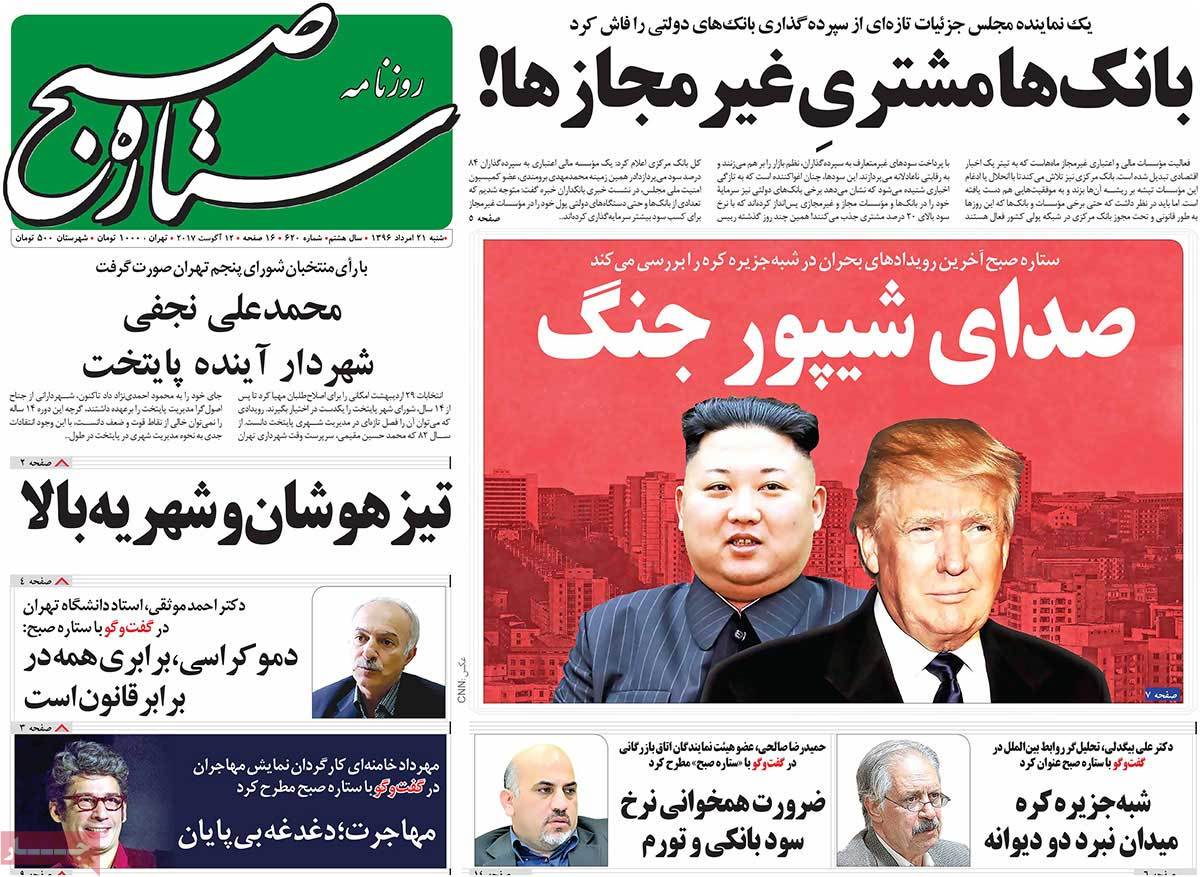
The imminent danger of a war in the Korean Peninsula was also a top story today. Many papers highlighted the exchange of threats between US President Donald Trump and North Korean Supreme Leader Kim Jong-un.

Iran President Hassan Rouhani’s ministerial nominees were also discussed in several newspapers on Saturday.

The above issues, as well as many more, are highlighted in the following headlines and top stories:


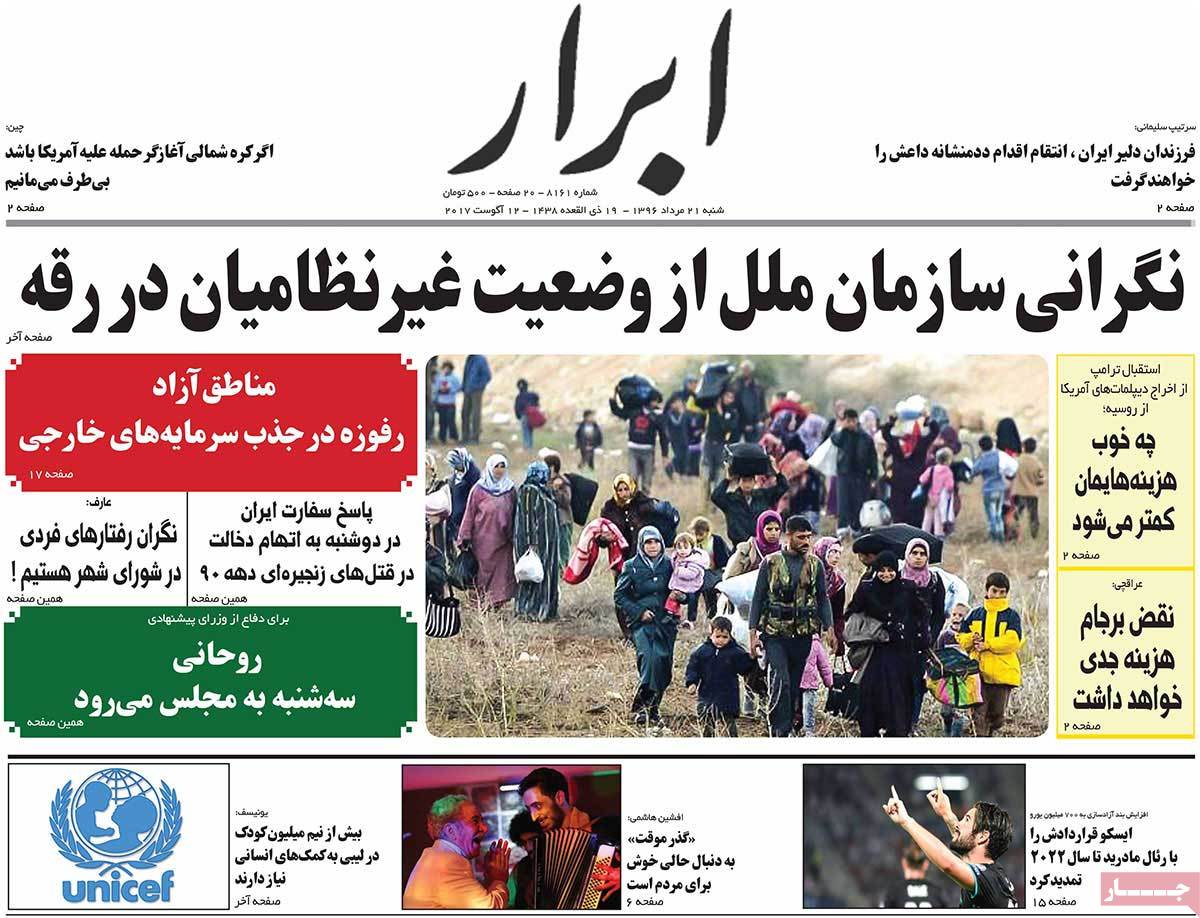
Abrar:

1- UN Concerned about Civilians in Raqqa

2- Rouhani to Appear in Parliament to Defend His Proposed Ministers

3- Trump Welcomes Deportation of US Diplomats from Russia

 A Look at Iranian Newspaper Front Pages on August 12 - abrar


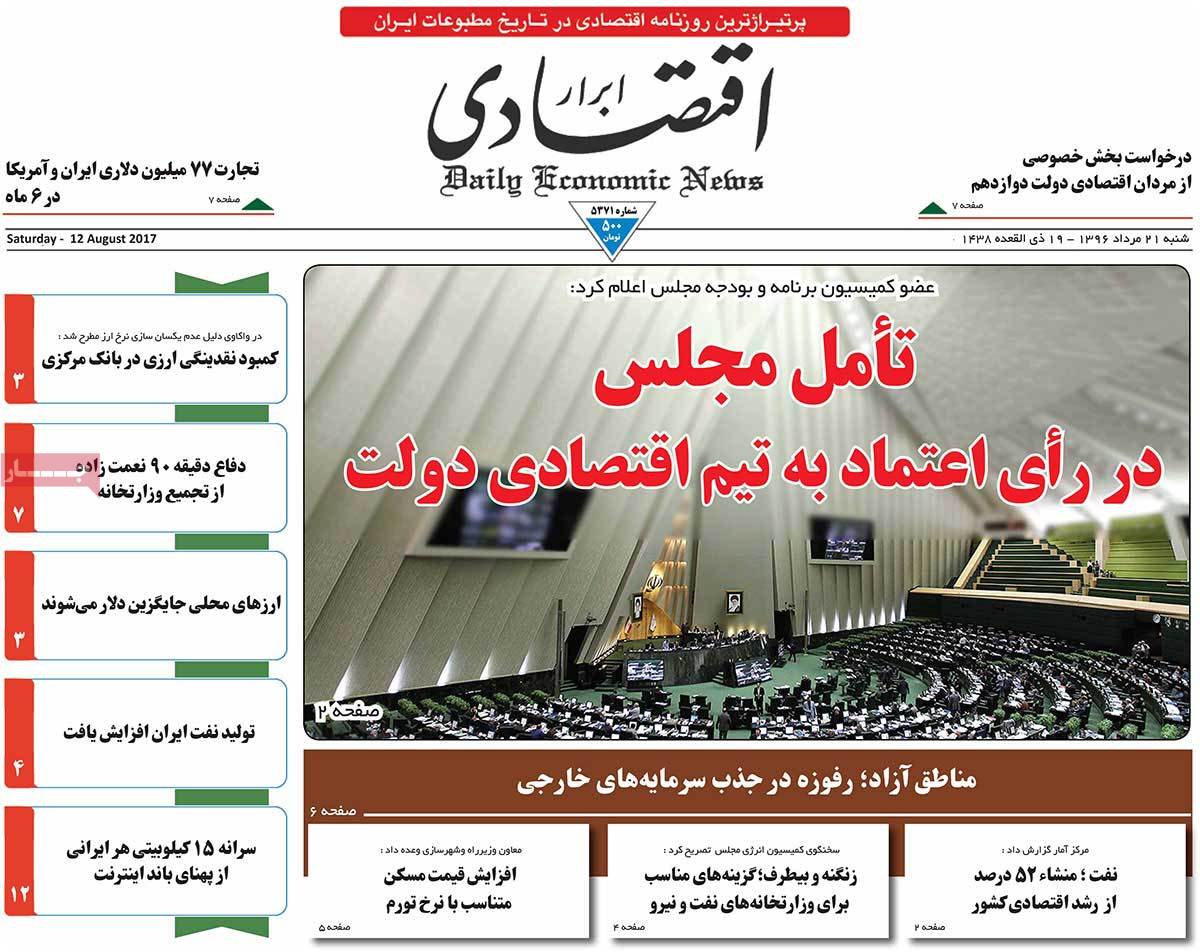
Abrar-e Eqtesadi:

1- MP: Parliament Doubtful about Giving Vote of Confidence to Rouhani’s Economic Team

 A Look at Iranian Newspaper Front Pages on August 12 - abrar egtesadi


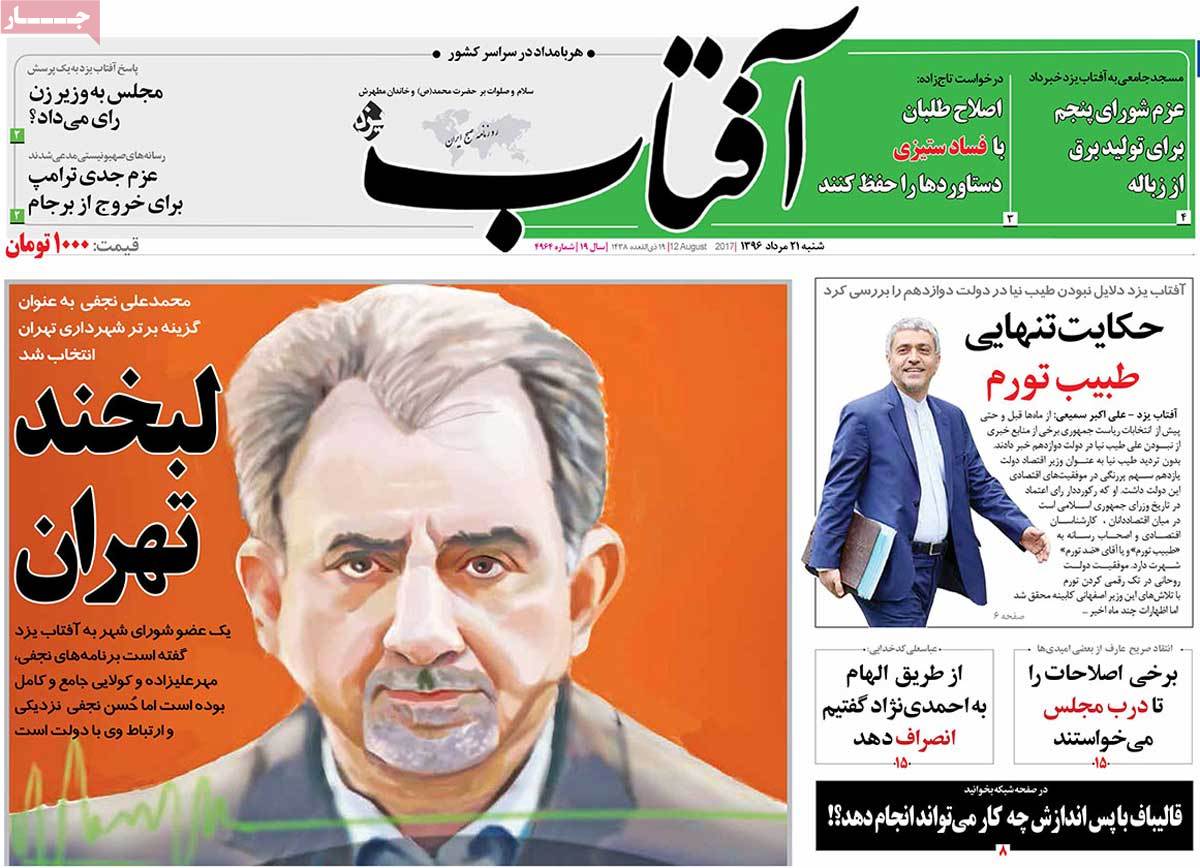
Aftab-e Yazd:

1- Tehran’s Smile: Najafi Elected as Top Candidate for Tehran Mayor

2- Trump Resolved to Withdraw from Nuclear Deal with Iran

3- Would Parliament Vote for Female Minister If Rouhani Nominate One?

A Look at Iranian Newspaper Front Pages on August 12 - aftab


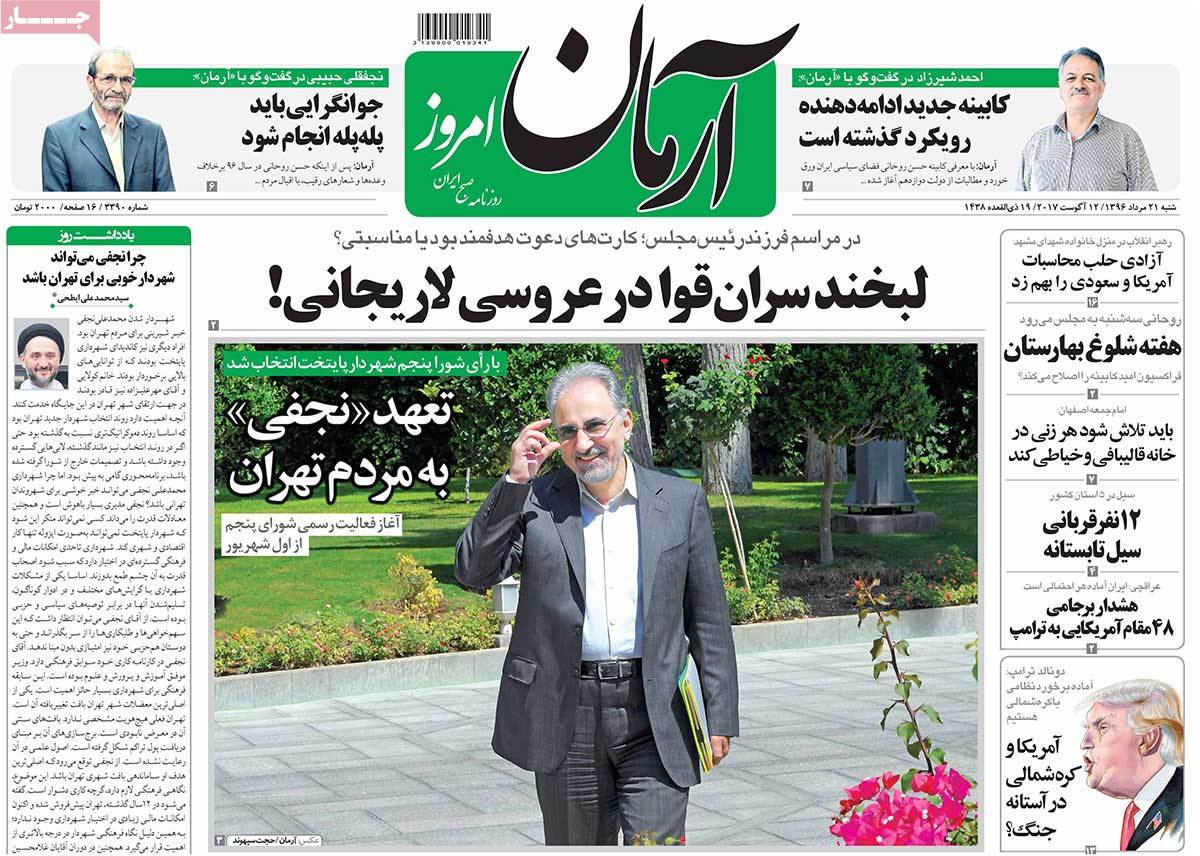
Arman-e Emrooz:

1- 12 Killed in Summer Flooding

2- 48 American Officials Warn Trump about Nuclear Deal

 A Look at Iranian Newspaper Front Pages on August 12 - arman


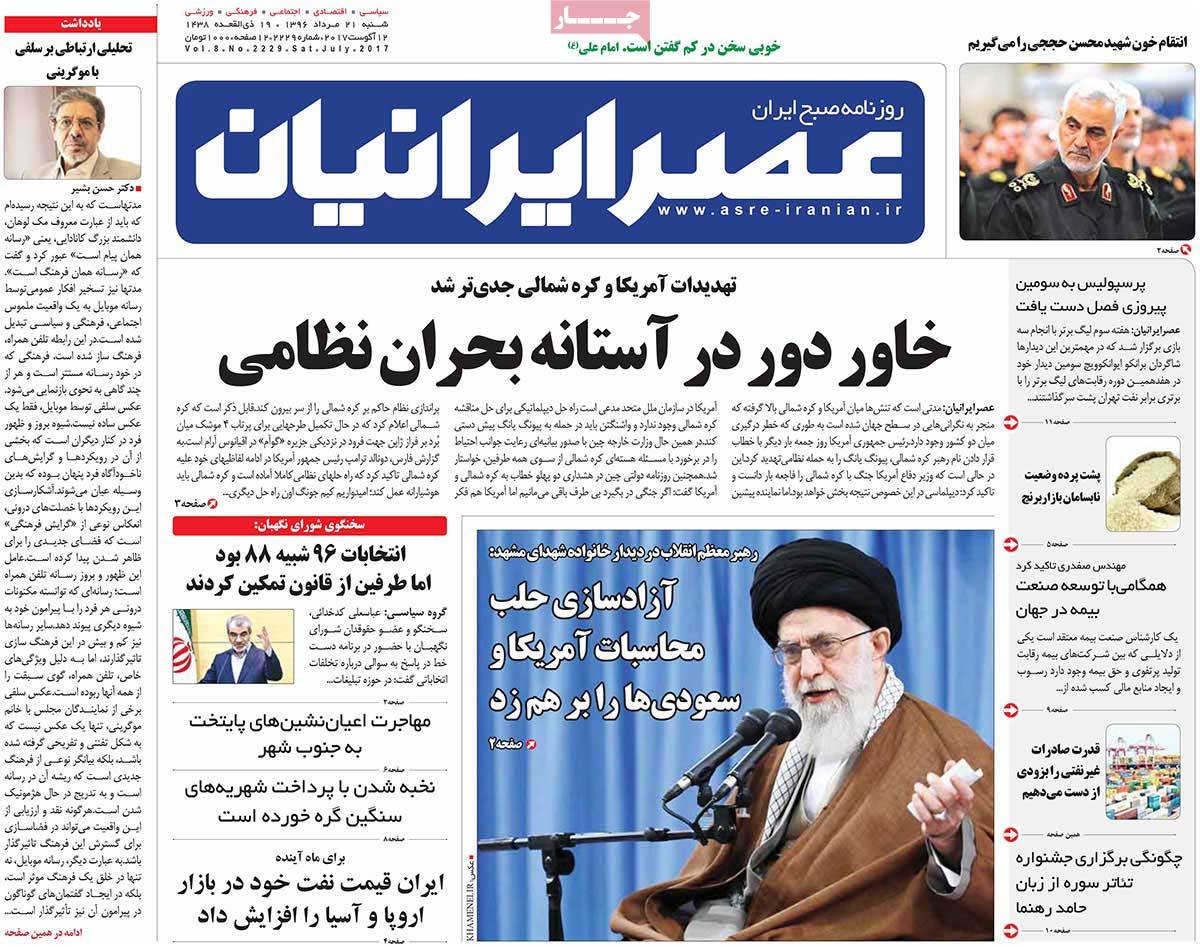
Asr-e Iranian:

1- Far East on Verge of Military Crisis

 A Look at Iranian Newspaper Front Pages on August 12 - asreiranian


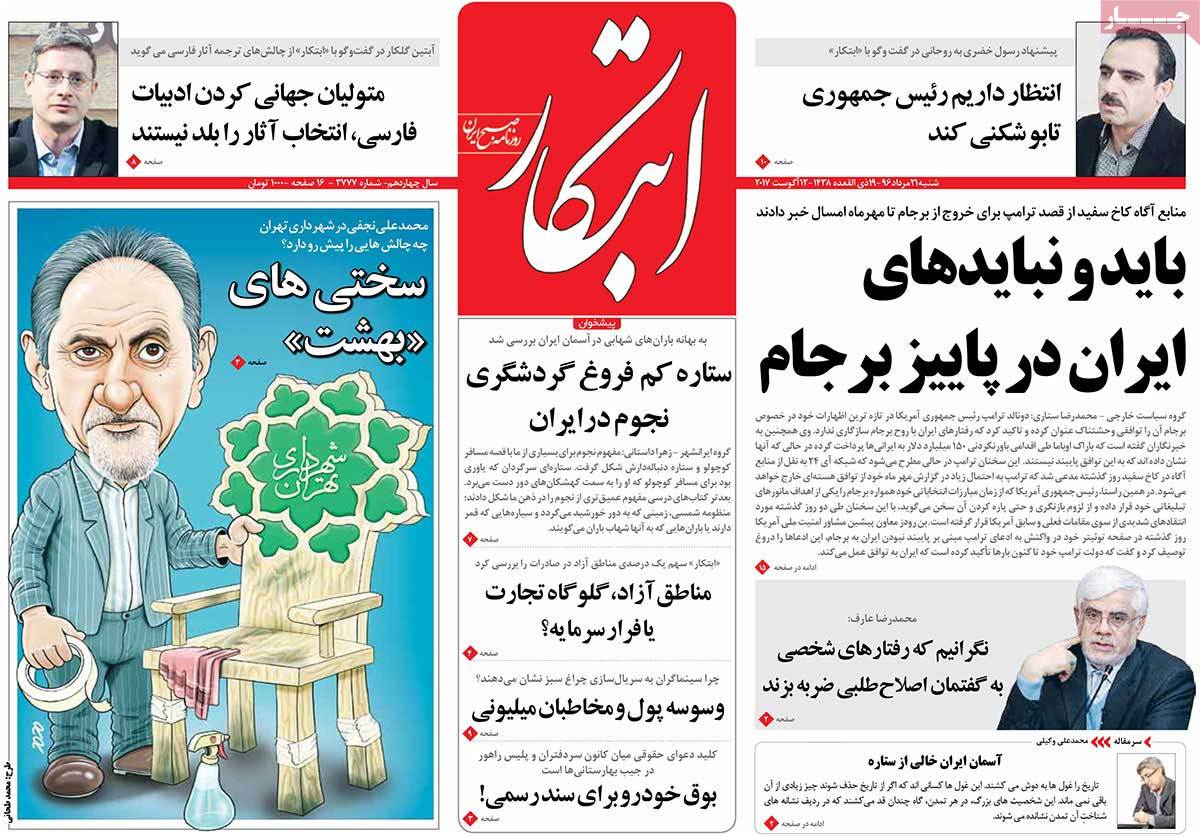
Ebtekar:

1- Dos and Don’ts of Iran in Fall of JCPOA

 A Look at Iranian Newspaper Front Pages on August 12 - ebtekar


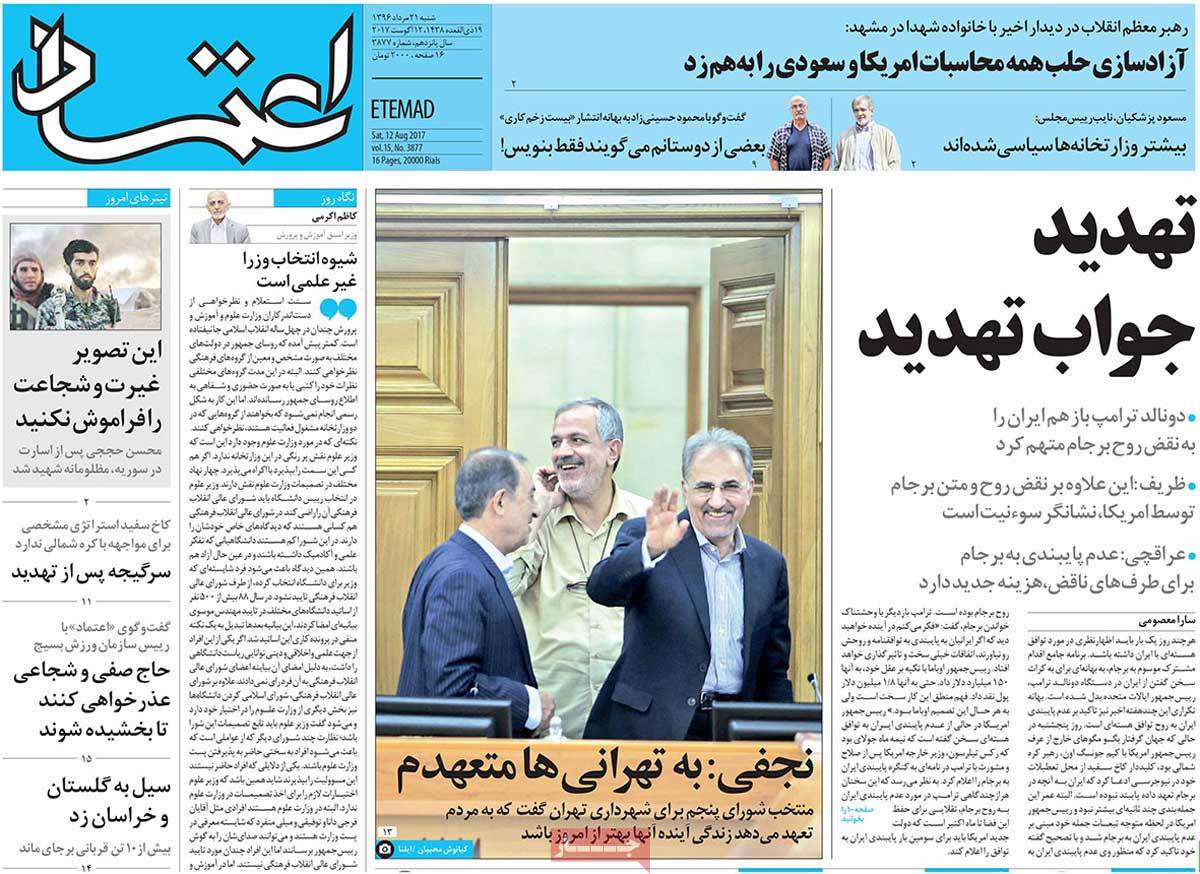
Etemad:

1- Threat in Response to Threat

  • Trump Once Again Accuses Iran of Violating Spirit of Nuclear Deal

2- Zarif: Bad Faith on Top of US Violating Letter, Spirit of JCPOA

 A Look at Iranian Newspaper Front Pages on August 12 - etemad


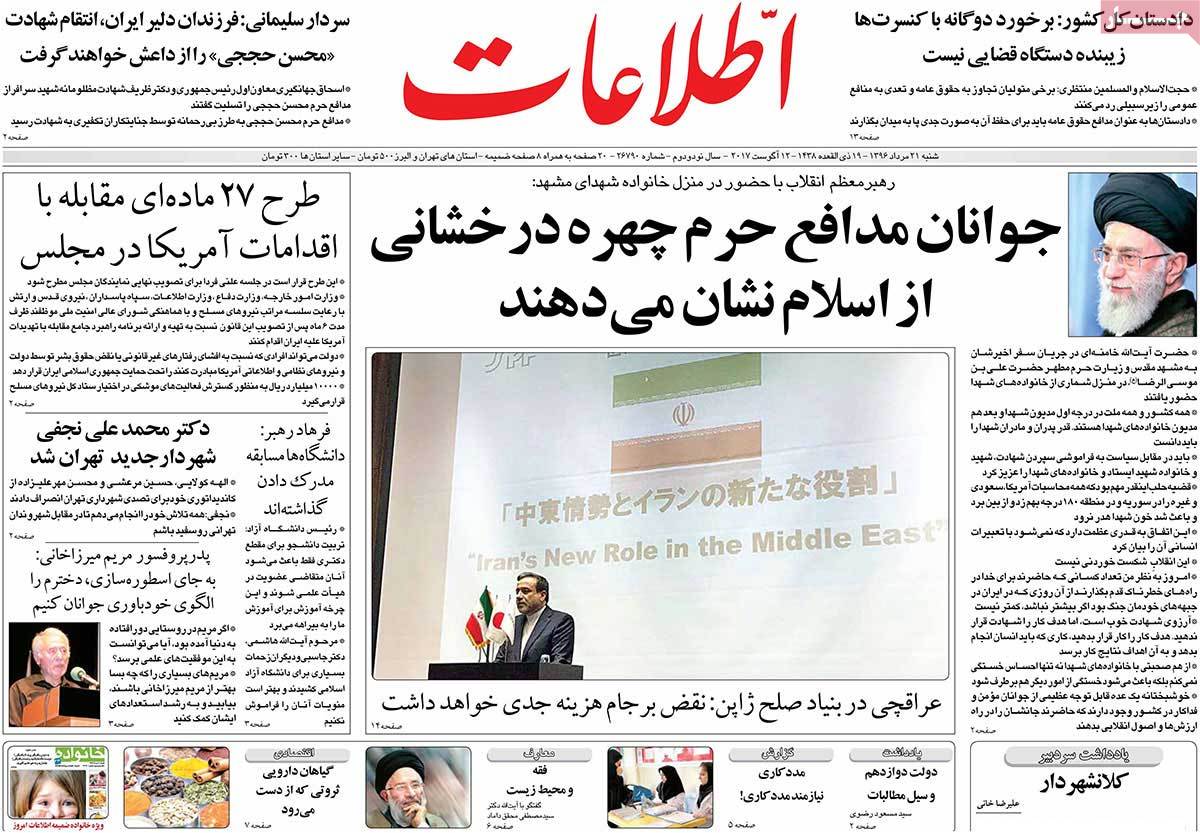
Ettela’at:

1- Iran Leader: Young People Defending Holy Shrines Depict Brilliant Image of Islam

2- General Soleimani: Iran’s Children to Take Revenge on ISIS for Beheading Iranian Soldier

3- Iran Parliament Working on 27-Article Plan to Counter US Measures

4- Mirzakhani’s Father: Let’s Take Maryam as Role Model Instead of Showing Her a Heroine

5- Iran Deputy FM: Violation of Nuclear Deal to Have Serious Consequences

 A Look at Iranian Newspaper Front Pages on August 12 - etelaat


Iran:

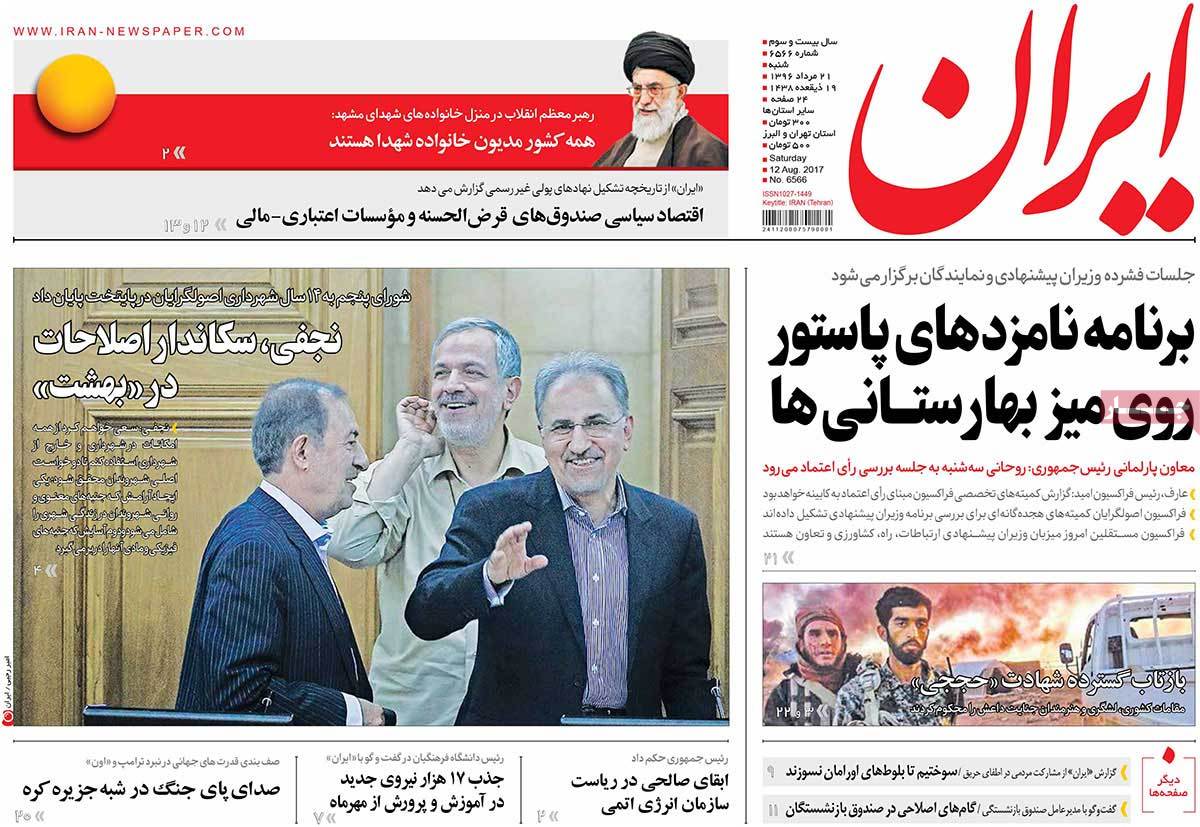
1- Plans of Rouhani’s Proposed Ministers to Be Discussed by MPs

  • Parliament to Hold Intensive Meetings with Ministers

2- President Re-Appoints Salehi as Iran Nuclear Chief

 A Look at Iranian Newspaper Front Pages on August 12 - iran


Javan:

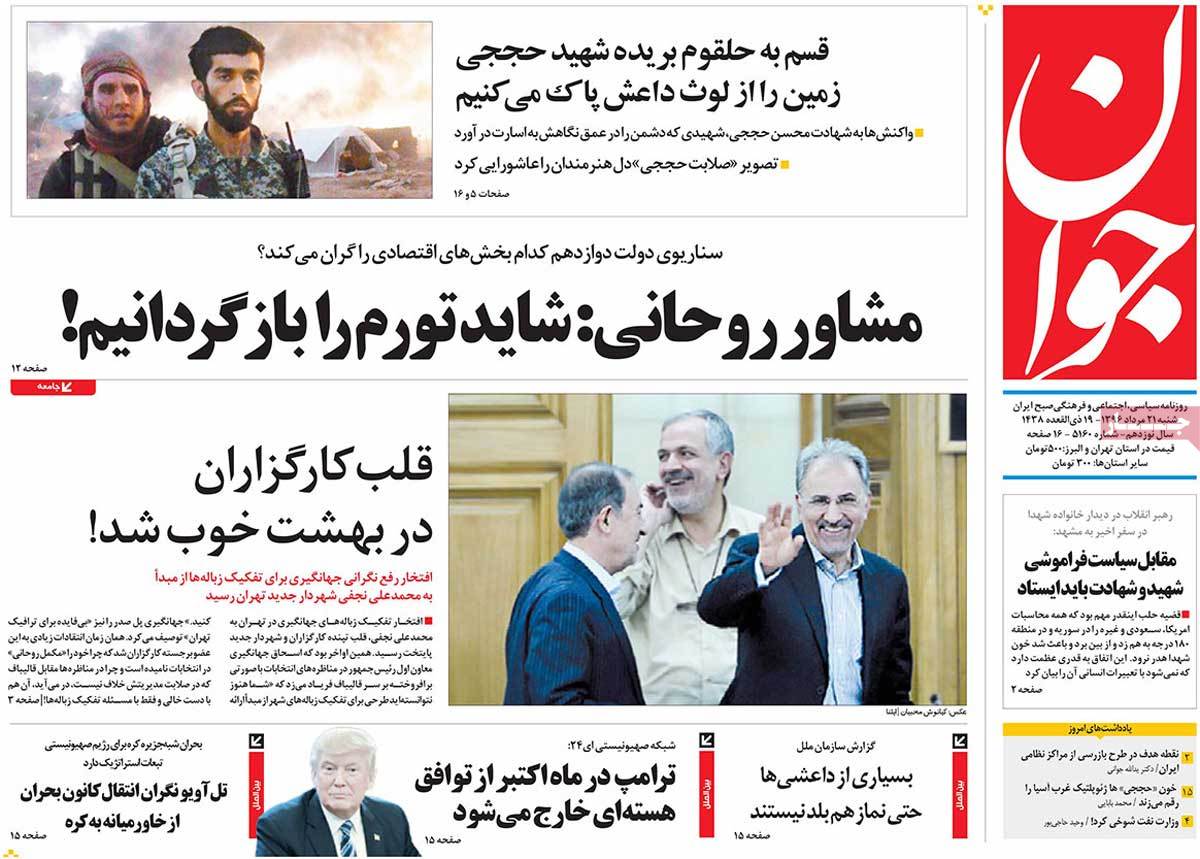
1- Rouhani’s Aide: We May Bring Back Inflation!

2- Earth to Be Cleansed of ISIS, Gen. Soleimani Swears to Beheaded Iranian Fighter’s Life

3- Israeli i24 News: Trump to Withdraw from Nuclear Deal in October

4- UN Report: Many of ISIS Elements Don’t Even Know How to Say Prayers

A Look at Iranian Newspaper Front Pages on August 12 - javan


Kayhan:

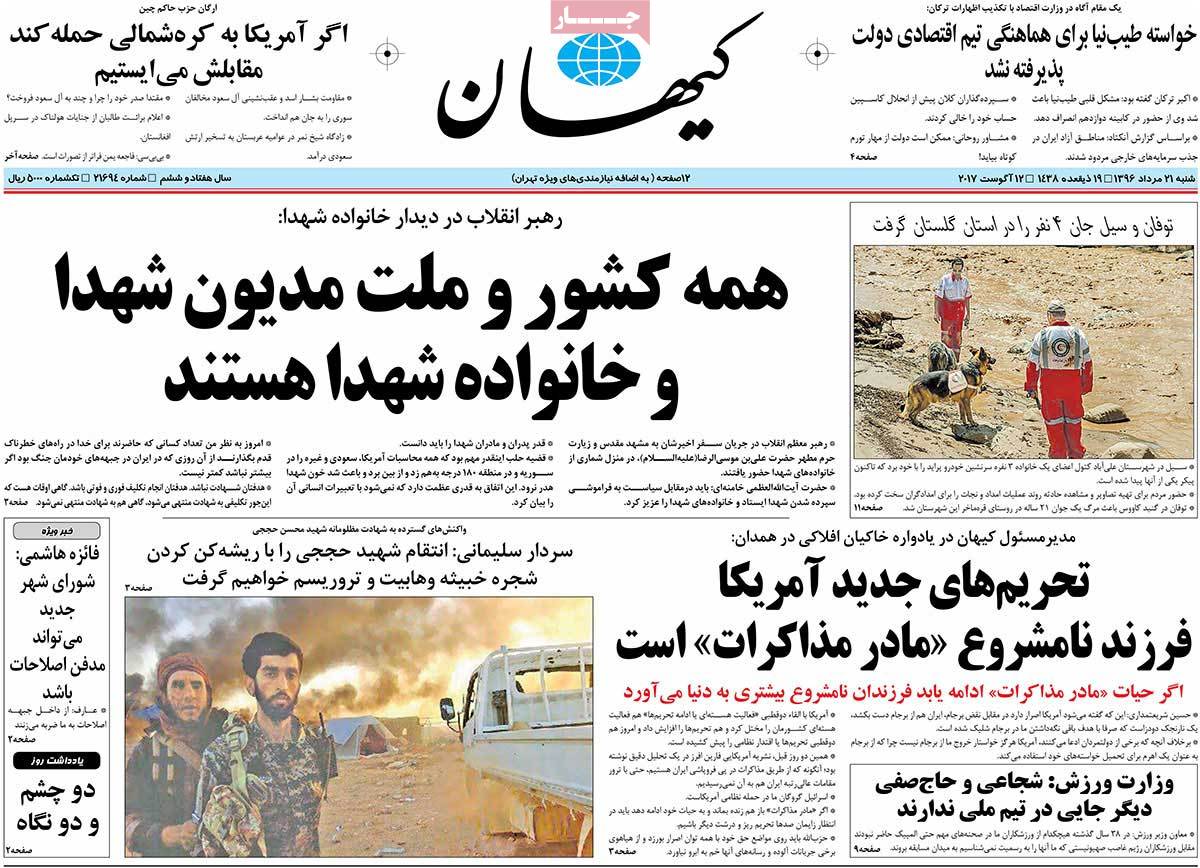
1- Iran Leader: Entire Iran, Nation Indebted to Martyrs, Their Families

2- Chinese Ruling Party: Beijing to Stand against US If They Attack N. Korea

3- Gen. Soleimani: We’ll Avenge Mohsen Hojaji’s Death by Eradicating Wahhabism, Terrorism

4- Kayhan Chief: New US Sanctions Illegitimate Child of ‘Mother of Negotiations’

 A Look at Iranian Newspaper Front Pages on August 12 - kayhan


Mardom Salari:

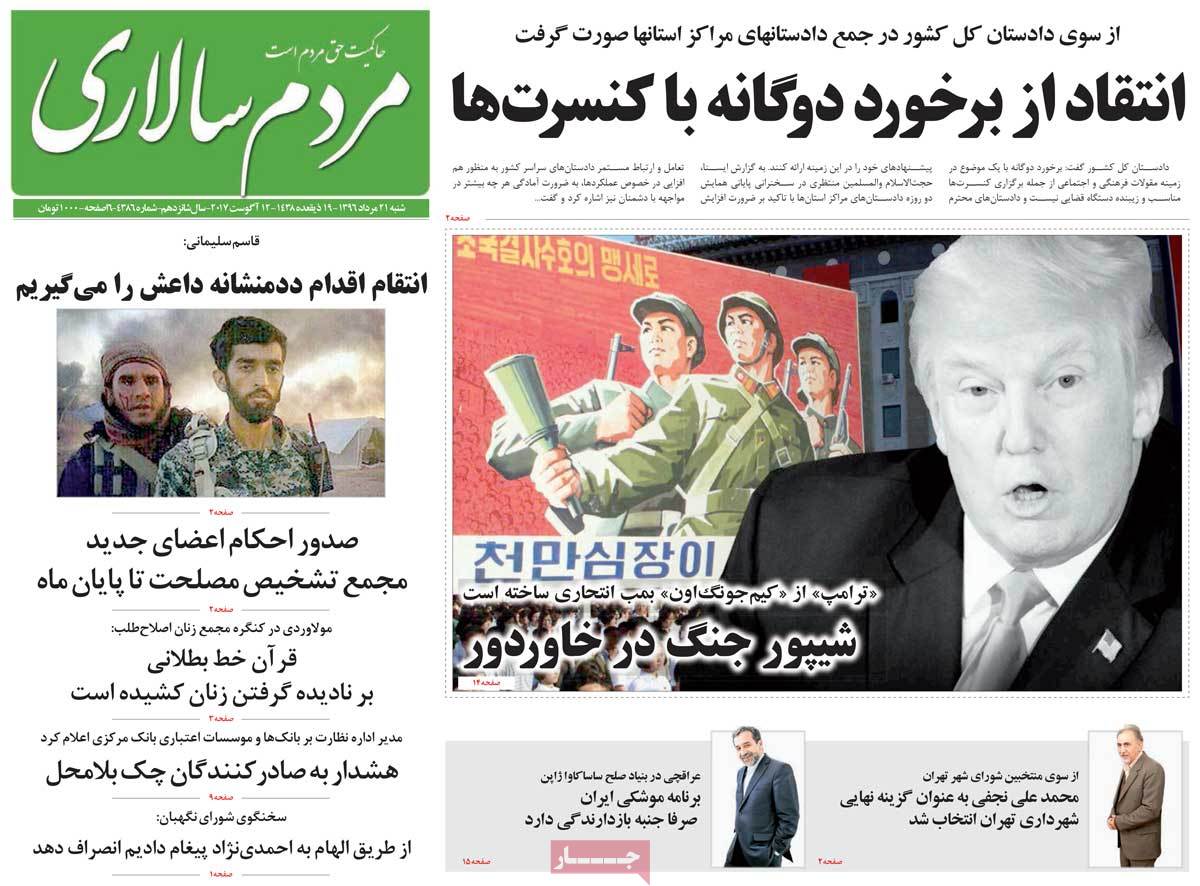
1- Horn of War in Far East: Trump Makes Suicide Bomb Out of Kim Jong-un

 A Look at Iranian Newspaper Front Pages on August 12 - mardomsalari


Setareh Sobh:

1- Analyst: Korean Peninsula Field of Battle between Two Crazy Men

 A Look at Iranian Newspaper Front Pages on August 12 - setaresobh


Shahrvand:

1- Aleppo Liberation Complicates Calculations of US, Saudis: Iran Leader

2- Post-Qalibaf Tehran: Najafi Becomes New Mayor

3- Soldier Left behind from Karbala

  • Widespread Reactions to Mohsen Hojaji’s Martyrdom

 A Look at Iranian Newspaper Front Pages on August 12 - shahrvand


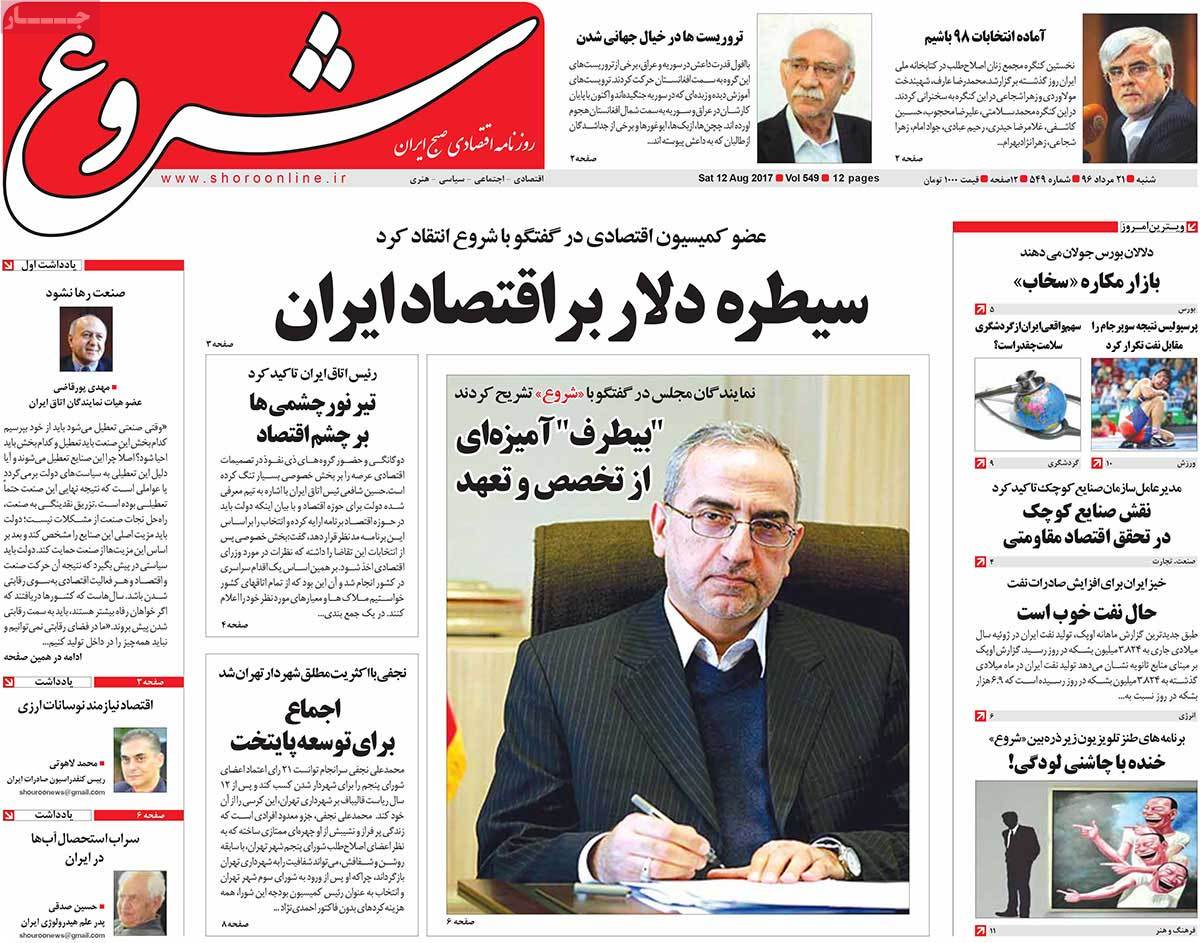
Shorou:

1- Dollar Dominating Iran’s Economy: MP

 A Look at Iranian Newspaper Front Pages on August 12 - shoro


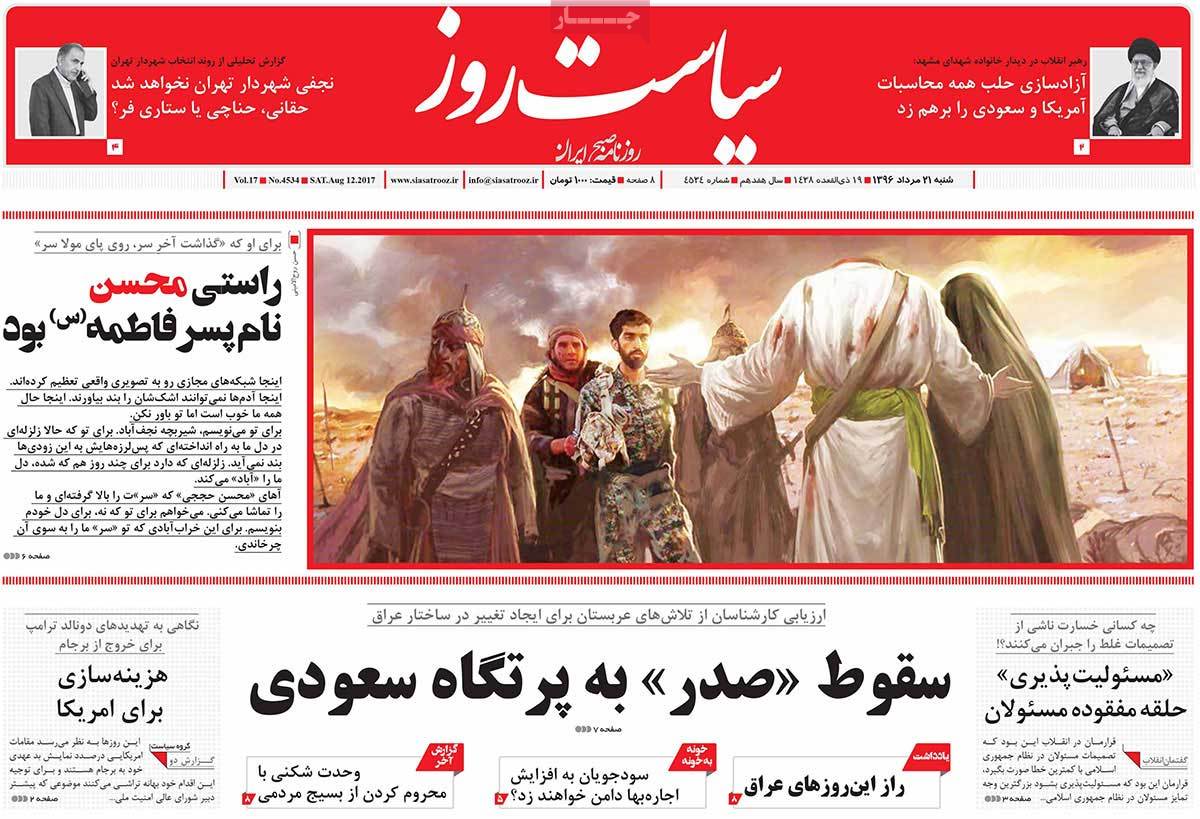
Siasat-e Rooz:

1- Sadr’s Fall into Saudi Abyss: Saudis Trying to Make Changes to Iraq Structure

A Look at Iranian Newspaper Front Pages on August 12 - siasatrooz


Vatan-e Emrooz:

1- Epic of Head: Honourable Martyrdom of Mohsen Hojaji Who Was Beheaded by ISIS

A Look at Iranian Newspaper Front Pages on August 12 - vatan emrooz

Iran Urges UN to Remain Neutral in Yemen Crisis

Iran Urges UN to Remain Neutral in Yemen Crisis

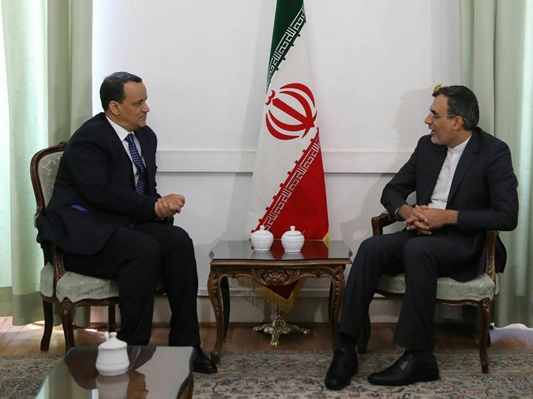
In a Saturday meeting in Tehran, Iran’s Deputy Foreign Minister for Arab and African Affairs Hossein Jaberi Ansari held talks with UN envoy on Yemen affairs Ismail Ould Cheikh Ahmed.

Following the meeting, the Iranian official described his negotiations with the UN representative as good and constructive.

He said the UN envoy seeks to actively pursue a political settlement in Yemen, according to a Farsi report by Fars News Agency.

He added Cheikh Ahmed’s visit to Iran is within the framework of his trips to countries in order to win support for the responsibility he is tasked with at the moment.

Jaberi Ansari reiterated that Tehran backs the UN’s efforts to resolve the Yemen crisis and get out of the current situation as soon as possible.

He said Iran believes efforts will bear fruit only if the UN remains fully neutral in line with its international mission and try to build confidence between the warring sides.

He expressed hope with the initiative and practical plans that the UN will pursue, efforts will be made to lift the blockade on Yemeni people as soon as possible and end the aggression against the Arab country.

He also hoped that attempts will lead to direct talks between the warring sides, the crisis will be settled politically and the Yemeni people’s votes will be used as a yardstick in a bid to get out of the current situation.

He added that the Yemeni envoy has asked Iran to contribute to the current efforts in Yemen.


General Soleimani Playing Key Role in Syria, Iraq: Politician

Hossein Amir-Abdollahian, a top Iranian politician has, in an interview with the Farsi-language Shargh newspaper, weighed in on regional developments, and the role of Major General Qassem Soleimani, the commander of the Quds Force of the Islamic Revolution Guards Corps (IRGC), in Syria and Iraq.

The following is the highlights of the interview with Amir-Abdollahian, a former Iranian deputy foreign minister who is currently the special aide to Iran’s parliament speaker and the director general for the Parliament’s international affairs:

Entering Foreign Ministry, Getting Familiar with FM Zarif

During the Holy Defence era (the eight-year Iraqi imposed war on Iran in the 1980s) I used to go to the frontline as a volunteer soldier and I was active at Basij (volunteer militia forces). So, when I entered the Foreign Ministry, personally I was interested to work in the field of Iraq affairs. When the war ended and as soon as I entered Iraq, I got to know Mr. Zarif, mostly because of the Iraq case. In those years, Mr. Zarif handled the international affairs of prisoners of war, and I took care of the affairs at the embassy, and later at home.

Impact of Regional Issues on Iran’s National Security

Regional topics are directly related to our national security. No one can say that the US occupied the whole Iraq 14 or 15 years ago, and this has no bearing on our national security. Let me give you an example. When the Americans occupied Iraq, just one of the incidents unfolding in the [ southwestern Iranian] province of Khuzestan and engineered by an American security agency was that a thousand handguns were being imported to create insecurity in the country. While Iraq was under the US occupation, Washington appointed its last consul general in Khorramshahr (before the ouster of the Shah) as the director of Iran-Iraq border affairs. He was privy to all details of the two countries’ border issues. At the same time, the US security apparatus began to plan importing weapons and explosives into Iran.

Could we sit idly by and do nothing? Yes. The Iranian establishment had decided that general Soleimani take over the important Iraq case. First, when I entered the Foreign Ministry, I thought those working at the ministry were the only ones involved in diplomacy work and that all tools were available to the Foreign Ministry only; however, this is not the case.

If the Foreign Ministry doesn’t have a backup, and if little attention is paid to the element of “being influential” in the foreign policy domain and many other factors associated with our national might, then the person who enters into talks will not have all he/she needs to get the job done. It wouldn’t be possible that I, as a diplomat, act against what general Soleimani does in Iraq within the framework of the establishment’s approved strategies to safeguard our national security.

Many of our generals and youth, who are the country’s assets, were martyred in the crisis pertaining to the ISIS terrorist group in Syria and Iraq in order to safeguard national and regional security, so that you and I will be safe. There is no way the discourse that I, as a diplomat, use be opposed to that of general Soleimani and the establishment’s strategies. We are facing a world which overtly says threatening words to ensure its objectives and national interests, and plunders nations’ wealth under the pretext of safeguarding its interests. I have never been an official IRGC member, but like other Iranians take pride in the fact that the IRGC as well as other security and military apparatus in the country safeguards our people’s security.

Consulting with General Soleimani

In sensitive security-political issues, whenever I, at the Foreign Ministry, wanted to take part in bilateral or multilateral talks on Syria, Iraq and key regional issues, I consulted general Soleimani in issues within his expertise after I took part in meetings with the ministry’s managers and experts. He would let me it on the latest developments.

For example, the swap of prisoners of war in Syria is not entirely in the hands of the Foreign Ministry and the embassy. On the ground, other sectors are responsible for the swap. Some issues related to national security are related to the Intelligence Ministry. When you act in coordination with them, consult them, and know that you can put what you say into action, then you will have what it takes to continue negotiations and the other side will realise that you know what’s going on.

Int’l Machine-Made Carpet Exhibition Held in Tehran

Some 110 domestic and foreign companies displayed their most recent products during the four-day event held in Shahr-e Aftab (City of Sun) Fairground, southern Tehran.

Iranian people have always showed great passion toward carpet industry and considered it as a work of art.

Iran exports carpets to at least 70 countries in the world. Experts attribute the increasingly lucrative market for Persian carpets worldwide to its quality, color and design.

Carpet-weaving is one of the most distinguished manifestations of Persian culture and art, which dates back to ancient Persia.

Persian carpets, in particular the hand-woven products, often feature geometric patterns which are a reflection of Islamic influences, although many Persian rugs depict natural scenes of animal and plant wildlife.

Here are IRNA’s photos of the exhibition, which was held from August 8 to 11:

US Seeks to Protect ISIS Terrorists in Iraq: Analyst

US Seeks to Protect ISIS Terrorists in Iraq

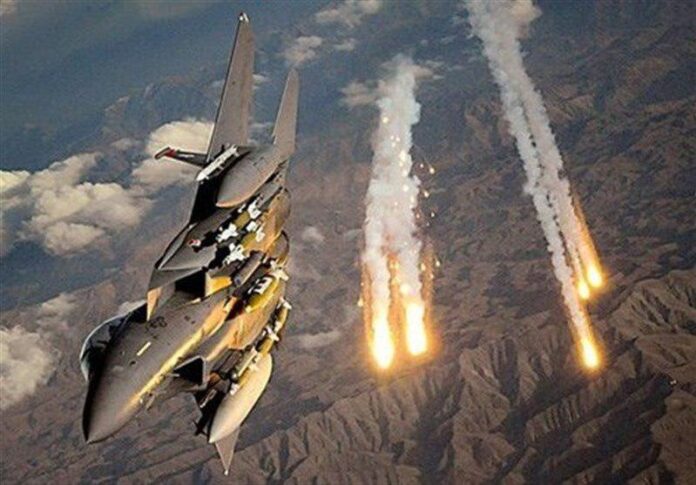
Political expert Hassan Hanizadeh has, in an interview with the Mizan News Agency, weighed in on the US air and ground attacks on the Sayyid al-Shuhada Brigades of the Popular Mobilization Units (PMU) in the town of Sinjar in Iraq’s Nineveh Province.

“The Americans had already announced that the PMU’s getting close to the Iraq-Syria border was their red line, and we saw that, under this very pretext, the US targeted PMU forces in Sinjar near the common border between Iraq and Syria,” he said.

Hanizadeh said attacks on civilian areas in Syria and the recent US attack on PMU troops in Sinjar are among the illegal activities by Washington in Syria and Iraq.

“The US insisted that the PMU must be dissolved after the liberation of Mosul. However, Iraqi Prime Minister Haider al-Abadi announced that the PMU will not be dissolved under any circumstances,” said the expert.

“In order to protect the ISIS in Tal Afar, the Americans did not allow PMU troops to reach the Syria-Iraq border and chase Takfiri terrorists,” he said.

He underlined that the US has, time and again, committed such crimes in Iraq and Afghanistan, but shirk responsibility for their crimes by simply saying “it was a mistake!”

Renowned Italian Musician to Hold Sax Masterclasses in Iran

Renowned Italian Musician to Hold Sax Masterclasses in Iran

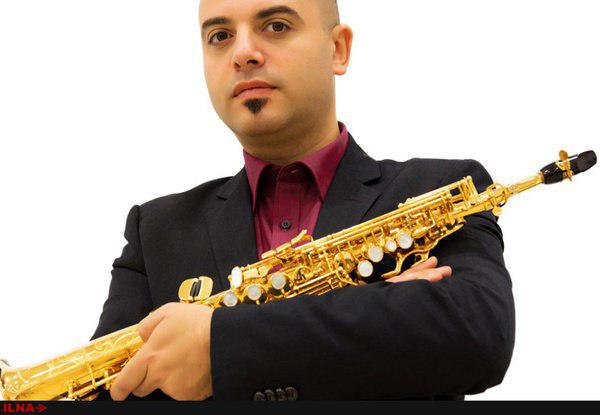
Prominent musician at the Italian National Police Wind Orchestra, Mario Ciaccio, is scheduled to travel to Iran in coming days to hold a number of masterclasses for Iranian musicians on how to play the saxophone in the Iranian capital, Tehran.

The classes will be held from August 21 to 28, according to a Farsi report by ILNA.

Ciaccio received his master’s degree in saxophone from F. Bonporti Conservatory, Palermo conservatory and L’Hay les Roses Consertavories all with magna cum laude.

Having won 12 Italian, European and international chamber music competitions, he performed with orchestras and musical institutions including Orchestra Haydn di Bolzano e Trento, Orchestra Sinfonica Siciliana, Palermo Orchestra di Musica Contemporanea, Filarmonica Franco Ferrara, Academie Neue Music Bolzano, Traiettorie Sonore Milan, Old time jazz Orchestra, Ars Musica, Teatro Massimo di Palermo, Teatro Comunale di Bolzano and Teatro Santa Chiara Trento, Novosibirsk Chamber Orchestra, Taichung Traditional Chinese Orchestra, Taoyan Wind Orchestra, Reno Galliera Wind Orchestra.

He has performed in more than 200 concerts. As Soloist, Ciaccio is currently performing in many concerts and tours in Russia, Spain, France, China, Taiwan, and the US.

Mr. Ciaccio is a conductor as well. He graduated from Conservatory “Briccialdi” of Terni in the classroom of M. Fabio Maestri. He was also director of Winds Instrumental Department at Eccher School of Music in Trento.

Currently he is saxophonist at the Police National Wind Orchestra of Italy. In February 2018 he will play at the world renowned Carnegie Hall.

Europe Satisfied with Iran Commitment to JCPOA: Ireland

During a recent visit to Tehran, Conor Ó Raghallaigh, the Deputy Secretary-General to the Irish President, highlighted the significance of compliance with the Iran nuclear deal known as the Joint Comprehensive Plan of Action (JCPOA).

He stressed that all signatories to the agreement must keep it on track.

“However, the US is using a different language,” said the Irish official in a Farsi interview with ICANA.

Ó Raghallaigh said Ireland believes Iran has remained committed to the JCPOA.

He described Iran’s performance regarding the JCPOA as good, saying, “This compliance with the deal is very important, and I don’t think the imposition of sanctions against Iran is a positive move.”

“Iran has observed the terms of the protocol and dealt with the agreement calmly, so unfair sanctions against Iran should be lifted,” he noted.

He then weighed in on Europe’s viewpoint on Iran’s abidance by the JCPOA.

“As we see, European countries are very content with the Islamic Republic of Iran’s dealing with the JCPOA. However, the US government is using a different language regarding the agreement. This comes as American people’s viewpoint is opposed to that of Washington,” said the Irish official.

He said the important point is that the nuclear deal should remain on track, which will see Iran’s doors opened to the world and vice versa.

Violation of Nuclear Deal to Cost US Dearly: Iran

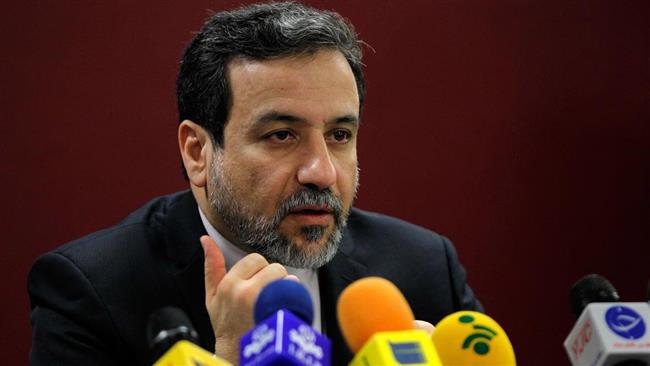
Abbas Araqchi

Addressing a Friday meeting of Japan’s Sasakawa Peace Foundation, Iranian Deputy Foreign Minister for Legal and International Affairs Abbas Araqchi said if any party to the deal, called the Joint Comprehensive Plan of Action (JCPOA), violates its terms, they will have to pay a “serious cost.”

Araqchi denounced the new US sanctions against Iran over its missile program as “unacceptable” and argued that Tehran’s missile program, which relies on Iranian people’s capabilities, is solely defensive and deterrent.

Iran and the five permanent members of the UN Security Council – the United States, Britain, France, Russia and China – plus Germany reached the JCPOA on July 14, 2015 and began implementing it in January 2016.

The UN Security Council later unanimously endorsed a resolution that effectively turned the JCPOA into international law.

Under the agreement, limits were put on Iran’s nuclear activities in exchange for, among other things, the removal of all nuclear-related bans against the Islamic Republic.

However, the US Senate and Treasury Department have imposed new sanctions against the Islamic Republic and several Iranian companies and individuals in recent months over its national missile program, which is not in breach of the JCPOA.

Araqchi’s comments come as the Iranian parliament (Majlis) is set to vote on a motion which incorporates a host of retaliatory measures in the face of US “acts of terror” and “adventurism” in the region.

Violation of Nuclear Deal to Cost US Dearly: Iran

The bill, which was passed by the Majlis’ Committee on National Security and Foreign Policy on Wednesday, will be put on the parliament’s agenda next Sunday, said Hossein Naqavi Hosseini, the committee’s spokesman, in a Thursday interview with the IRIB.

It “takes into consideration the aspects of US hostile measures in the region and their behavior in different areas, [including] acts of terrorism and human rights violations, will be put under close monitoring,” he added.

The bill allocates some $609 million to several state bodies, including the Foreign Ministry, Ministry of Finance and Economic Affairs, the Judiciary, the Islamic Revolution Guards Corps (IRGC) and its Quds Force, to monitor and probe US actions in the region, the lawmaker said.

Iranian lawmakers had passed the single-urgency motion with 93 percent of the votes, referring it to the National Security and Foreign Policy Committee for further consultation with different state organizations and legislative bodies, Naqavi Hosseini said.

The motion comes in response to the US violations of the Joint Comprehensive Plan of Action (JCPOA) on Iran’s nuclear energy program and Washington’s new sanctions against Tehran’s missile activities, the latest round of which was adopted last month.

‘Iran’s source of power is its people’

Elsewhere in his remarks in Japan, Araqchi elaborated on Iran’s role in the Middle East, describing the Islamic Republic as the most stable and secure country in the tense region.

Iran, contrary to many other countries, gains power from its people, Araqchi said.

He went on to enumerate the key challenges facing the Middle East, including poverty and economic disparity, undemocratic regimes, extremism and terrorism as well as the Israeli occupation of Palestinian territories.

Araqchi described Takfiri terrorism as the main challenge in the Middle East, which jeopardizes the entire global community and called for a collective campaign by all countries to eradicate the phenomenon.

Belarus to Promote Banking Relations with Iran

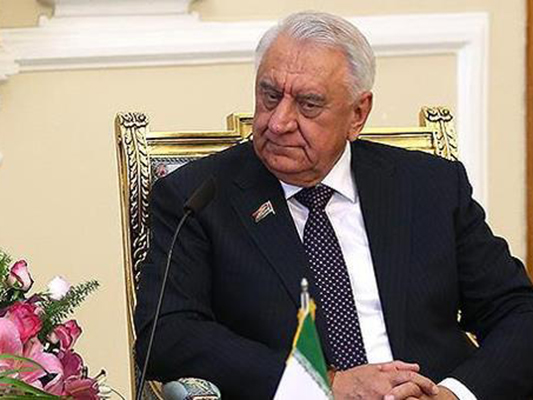
In a recent interview with ICANA, Myasnikovich referred to the re-election of Hassan Rouhani as Iran’s president and described it as another proof of democracy in Iran.

“Belarus and Iran have deep-rooted relations,” the speaker of the Council of the Republic of Belarus noted.

He then weighed in on the outcome of negotiations with the P5+1 group which led to the conclusion of the JCPOA.

“The agreement has had very positive results and serves the interests of countries in such a way that we can count on it,” he noted.

He then expressed regret that countries are facing a common threat due to sanctions.

“In order to boost relations, we should turn to dialogue and abide by its results,” he said.

The Belarusian speaker then touched upon Tehran-Minsk cooperation in the banking sector.

He said the two countries should upgrade the level of their banking cooperation through talks, and that obstacles to the enhancement of mutual banking cooperation should be removed.


World Deadly Silent on 21st Century’s Holocaust in Afghanistan

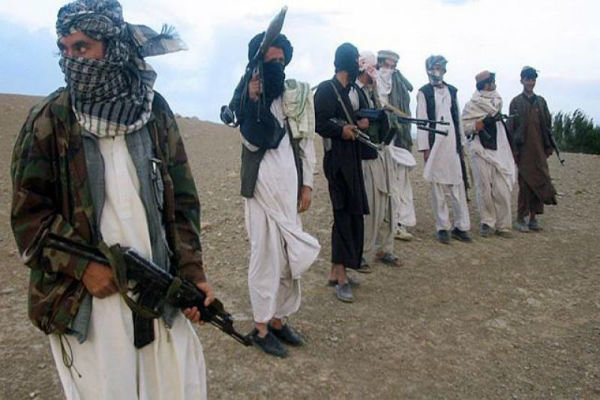
The ISIS and Taliban terrorists, in a joint operation, overran the strategic Mirza Olang region in Afghanistan’s Sar-e Pol province on August 5, 2017, triggering a massive human tragedy.

According to reports by Afghan local media, Taliban and ISIS terrorists, in a coordinated move on August 5, raided the Mirza Olang village, and savagely set fire to mosques and prayer sites, decapitated or shot dead some 50 villagers, including women and children, and took more than 150 families hostage.

“Over the past few years, terrorist elements launched numerous attacks to seize the strategic Mirza Olang area, but were defeated every time. Finally, ISIS and al-Qaeda mobilized their forces and military equipment, launching a joint operation from nearby areas to capture the village,” Afghanistan’s Khabarnama website quoted Sar-e Pol province authorities as saying.

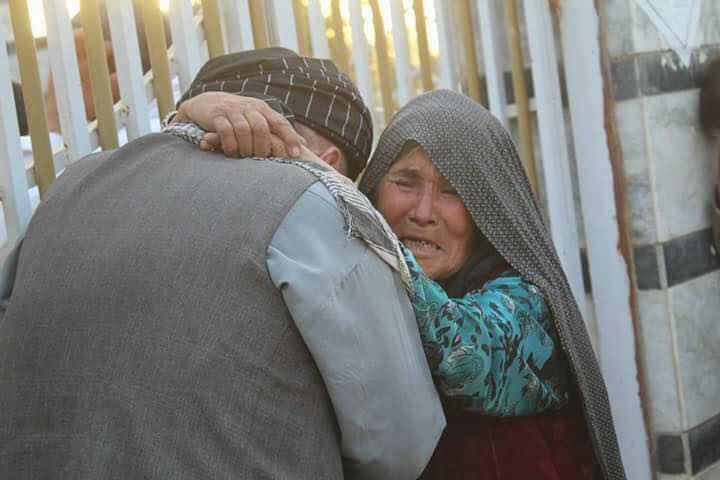
After 48 hours of resistance by Afghan government troops, terrorists managed to get into the village and began to kill villagers mercilessly. Hundreds of locals were made homeless and fled to nearby towns and cities, according to a Farsi report by Mizan.
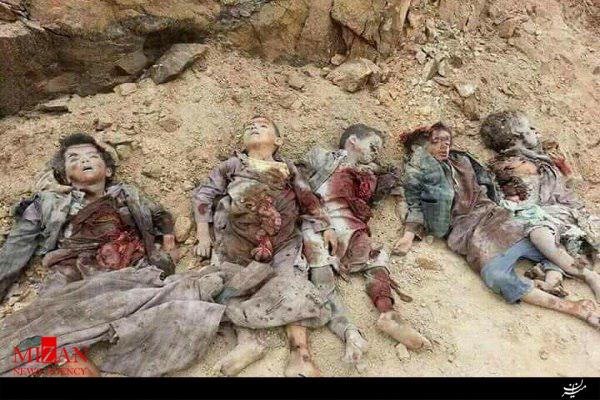
World Deadly Silent on 21st Century’s Holocaust in Afghanistan


Terrorists Enslaved Young Girls

“In addition to mercilessly killing and butchering children, women and the elderly in Mirza Olang village, Taliban and ISIS terrorists took around 80 villagers, including more than 30 young girls and women, to an unknown location in the very early hours of the raid,” says another Afghan news agency.

“Terrorists separated women and men, and transferred them to Pesta Mazar first before taking them to another area; however, no one knows their whereabouts,” according to the agency.
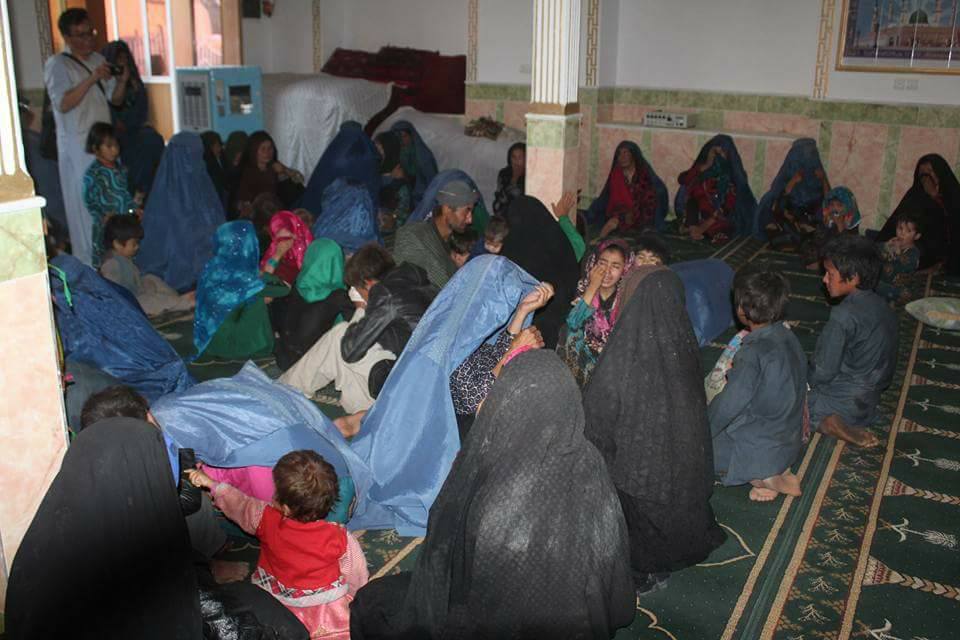
World Deadly Silent on 21st Century’s Holocaust in AfghanistanAfter the true extent and harrowing dimensions of the crimes were unmasked, mostly by the locals who had fled unscathed, local officials as well as users of social networks in Afghanistan blamed Ashraf Ghani for the human disaster. They accused him of remaining tight-lipped and dragging his feet on the gross genocide of Shiites in Mirza Olang.


Shiites: Victims of Ashraf Ghani & Peace Activists’ Project

The Afghan Voice website also reported on Afghan President Ashraf Ghani’s passive reaction to the catastrophe.
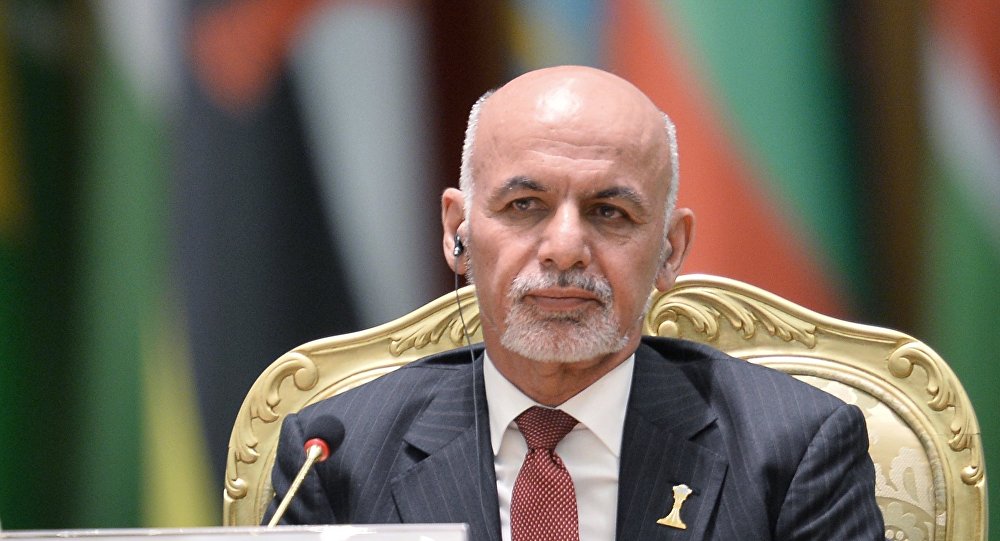
World Deadly Silent on 21st Century’s Holocaust in Afghanistan“Although Ashraf Ghani has highlighted the necessity of taking revenge for those killed in Mirza Olang, he did not introduce ISIS and Taliban terrorists as the key perpetrators of the crime, so that the Taliban’s track record would not be stained by this ignominious event, and the trend of Ashraf Ghani’s so-called ethnic peace with them wouldn’t be harmed. Killings and crimes by the Taliban, al-Qaeda and ISIS terrorists in different parts of Afghanistan are nothing new. It’s been decades that Afghan people have been victimized by terrorism on a daily basis. What makes the tragedy more painful and further reveals the innocence of the victims is that local officials had, time and again, warned about the possibility of such a human disaster, and called for the deployment of more troops to counter the attack by the Taliban and ISIS.
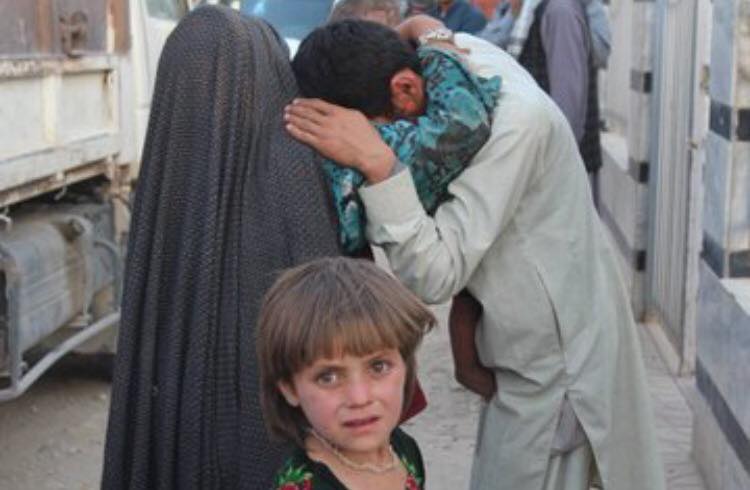
World Deadly Silent on 21st Century’s Holocaust in AfghanistanCentral Gov’t Refuses to Dispatch Troops to Mirza Olang

The fury and protest by Afghan people, including Shiites and Sunnis as well as local officials in Sar-e Pol province, at Afghanistan’s central government over the disaster intensified when the Afghan government did not send any ground or air forces to the area even three days after the tragedy happened. That allowed terrorists to commit whatever crime they wanted against the defenseless people of Mirza Olang, from slaughtering children and women to kidnapping young women and girls to taking hundreds of Shiites hostage.
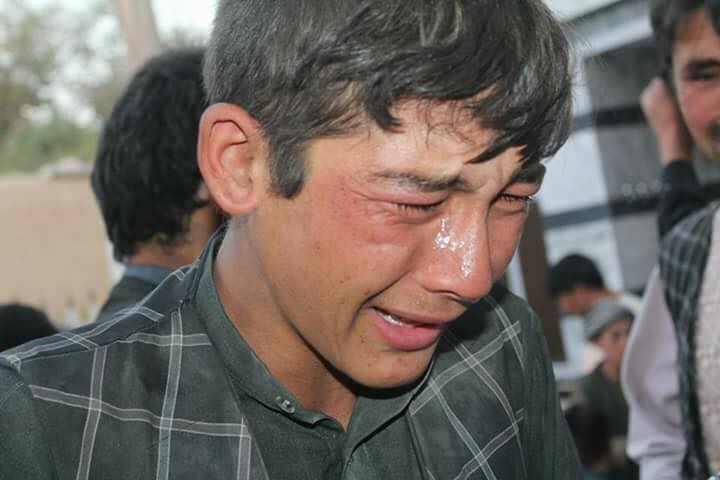
World Deadly Silent on 21st Century’s Holocaust in AfghanistanGovernor of Sar-e Pol province Mohammad Zaher Vahdat and Deputy Chief Executive Officer of Afghanistan Mohammad Mohaqiq are two government officials who, as they say, contacted Afghan security chiefs several times after terrorists began attacking Mirza Olang and called for action to save people.

“From the early hours of the terrorists’ attack, some of my colleagues working for media and I gave the necessary precautions regarding possible crimes in Mirza Olang, but unfortunately, security and military authorities didn’t take our warning seriously until ISIS and Taliban terrorists began killing and slaughtering people in Mirza Olang,” said Zaher Vahdat.


Zaher Vahdat’s Calls and Rights Advocates’ Silence

After two days and the central government’s foot-dragging regarding the deployment of jet fighters and ground forces to save hundreds of residents of Mirza Olang taken captive by terrorists, Zaher Vahdat addressing everybody shouted, “Hey, the international community! Hey, the people of the world! Hey, you so-called advocates of fighting terrorism who are in Afghanistan! Hey, you supporters of human rights and humanity! Notorious and merciless ISIS and Taliban terrorists have taken more than 150 defenseless families captive in Mirza Olang village. They are keeping on killing people without any mercy and fear. Don’t allow Mirza Olang to be registered in the history of the 21st century as a place where defenseless women and children were killed, and don’t allow your silence to make you accessories to this disaster.”
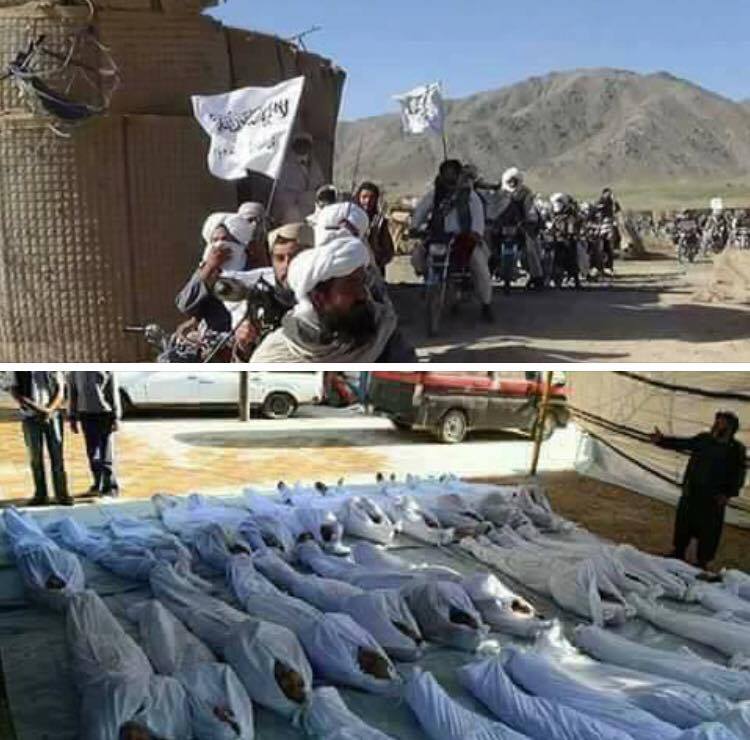
World Deadly Silent on 21st Century’s Holocaust in AfghanistanHowever, it seems those who Zaher Vahdat was addressing are not afraid of being put on the list of accomplices to crimes once again. The reason is that during the several days when Zaher Vahdat was repeatedly making calls for helping the residents of Mirza Olang, no troops were dispatched to the area. Moreover, no human rights institution and international organization mentioned the human disaster, especially at a time when we are surrounded by social media networks and information is disseminated in the twinkling of an eye. The killing of Shiites in Afghanistan unmasked another reality, too, the reality that all terrorist groups are the same because they all have a brutal nature, and all of them promote the policies of hostile governments in the region. Even if they ostensibly turn the gun at each other, they are united against the oppressed.

Many analysts believe the fresh wave of unrest in Afghanistan and the Taliban and ISIS throwing their weight around in the country justify foreign powers’ military buildup in Afghanistan and their ever-increasing influence in the country under the pretext that the government is unable to establish security and fight terrorism in the country.
World Deadly Silent on 21st Century’s Holocaust in Afghanistan


Captives Released Thanks to Efforts by Local Officials

Muhammad Hassan Sharifi Balkhabi, the representative of the Sar-e Pol province, has weighed in on the key reasons behind the tragedy.

“The disaster happened as a result of an insufficient number of military troops, the weakness of the local government and a lack of prompt support by the central government.”

Zabihollah Amani, a spokesperson for the governor of Sar-e Pol province, also told Afghan media that no troops were sent to the province despite repeated calls on military and security officials to do so.
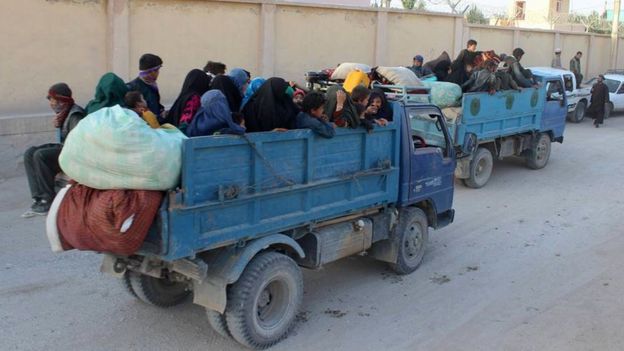
World Deadly Silent on 21st Century’s Holocaust in AfghanistanLocal authorities and elders, who had abandoned hope of receiving assistance from the central government, finally managed to secure the release of 250 of the hostages after holding talks with ISIS and Taliban elements. According to local media, the central government was supposed to dispatch troops to Mirza Olang and begin purging it from terrorists on Wednesday, exactly four days after the humanitarian disaster was committed.