Monday, April 20, 2026
Home Blog Page 3937

Iran Looking for Closer Ties with Neighbours in Rouhani’s New Term

Speaking at a weekly press conference on Monday, Foreign Ministry Spokesman Bahram Qassemi said the new administration has shaped its foreign policy on the basis of improvement of relations with neighbors, contribution to peace and stability in the region, and efforts to combat terrorism.

He referred to plans for establishment of a new economic bureau in the Foreign Ministry, saying it would help the ministry pursue economic diplomacy more actively to attract foreign investment, boost exports and send workforce abroad.

Highlighting Iran’s mutual cooperation with neighboring countries, Qassemi pointed to a recent visit to Turkey by Chief of Staff of the Iranian Armed Forces Major General Mohammad Hossein Baqeri, saying the high-profile trip marked a “progress and complementary step” in Tehran-Ankara ties and its positive impacts on regional developments will emerge in future.

As regards the tensions with Saudi Arabia, the spokesperson said Iran has taken the necessary measures with regard to the bilateral relations, expressing the hope that the kingdom would observe the regional situation with a better sense of realism.

He further described the political negotiations in the Kazakh city of Astana as an “effective approach” to settling the crisis in Syria, saying the initiative has no alternative.

Syria’s warring sides have so far attended five rounds of peace talks in Astana, brokered by Iran, Russia and Turkey, known as the guarantors of a ceasefire in the Arab country.

The fourth round of those talks in May produced a memorandum of understanding on de-escalation zones in Syria, sharply reducing fighting in the country.

A Look at Iranian Newspaper Front Pages on August 21

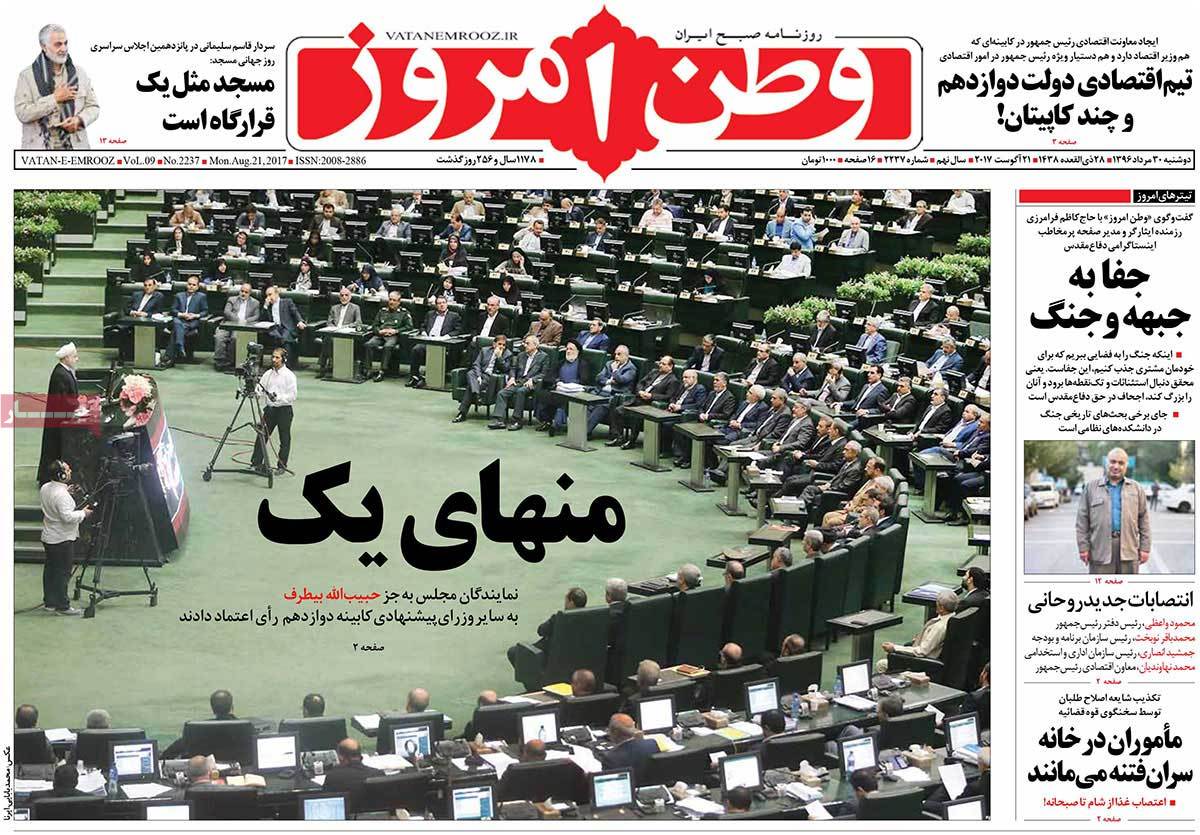
All newspapers today covered the almost unanimous vote of confidence Rouhani’s proposed ministers received from the Parliament in the Sunday session.

Some papers, both reformist and conservative, criticized the Parliament for approving so many of Rouhani’s ministerial nominees, but several others welcomed the support and highlighted the heavy burden on his administration’s shoulders.

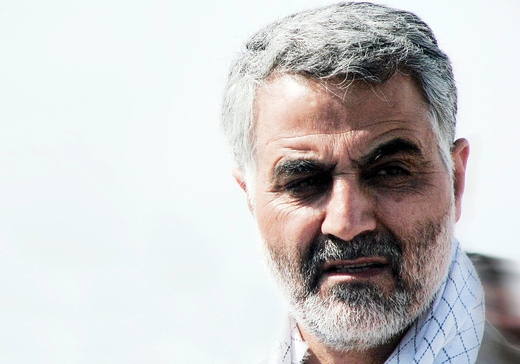
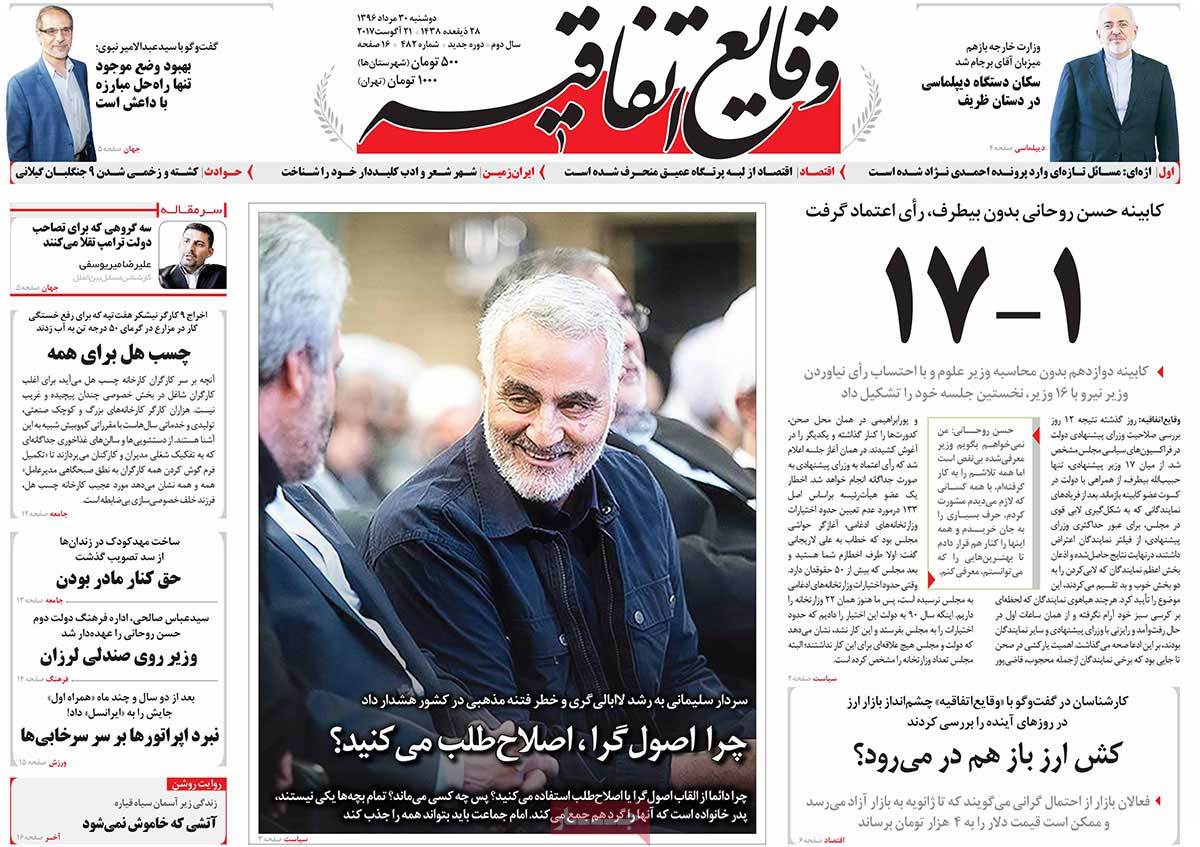
Another top story was the remarks made by IRGC Quds Force Commander Major General Qassem Soleimani about the dangers of dividing people into reformist/conservatives and those who observe or don’t observe the Islamic dress code.

The above issues, as well as many more, are highlighted in the following headlines and top stories:


19 Dey:

1- Parliament Did Its Best
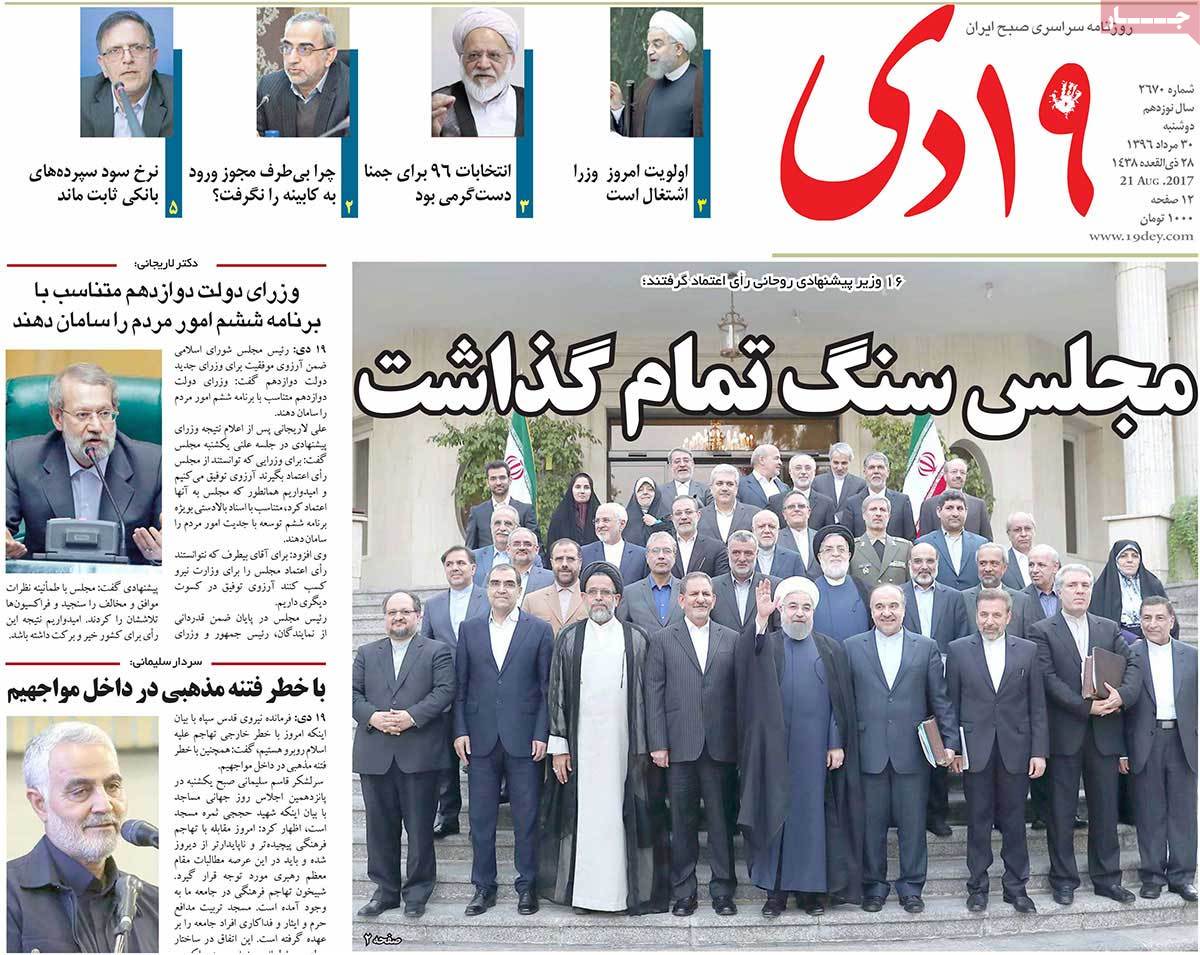
A Look at Iranian Newspaper Front Pages on August 21


Abrar:

1- Kissinger: Nuclear Deal Postpones Emergence of Iran’s Nuclear Capabilities

2- Barzani: Iran’s Influence in Iraq More than Any Other Country’s

3- ISIS Front Line Destroyed in Tal Afar

4- Iran Topic of Netanyahu’s Discussions with Putin
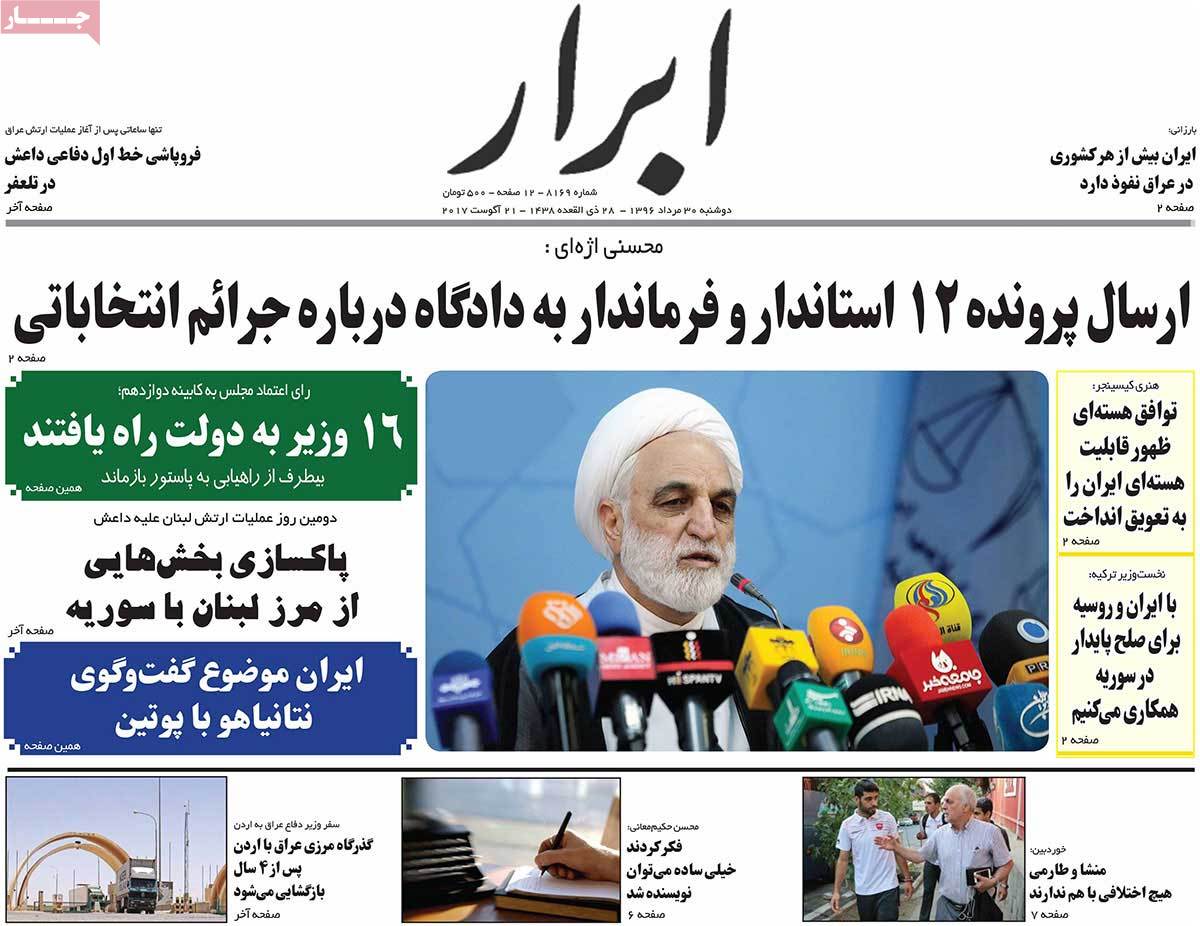
A Look at Iranian Newspaper Front Pages on August 21


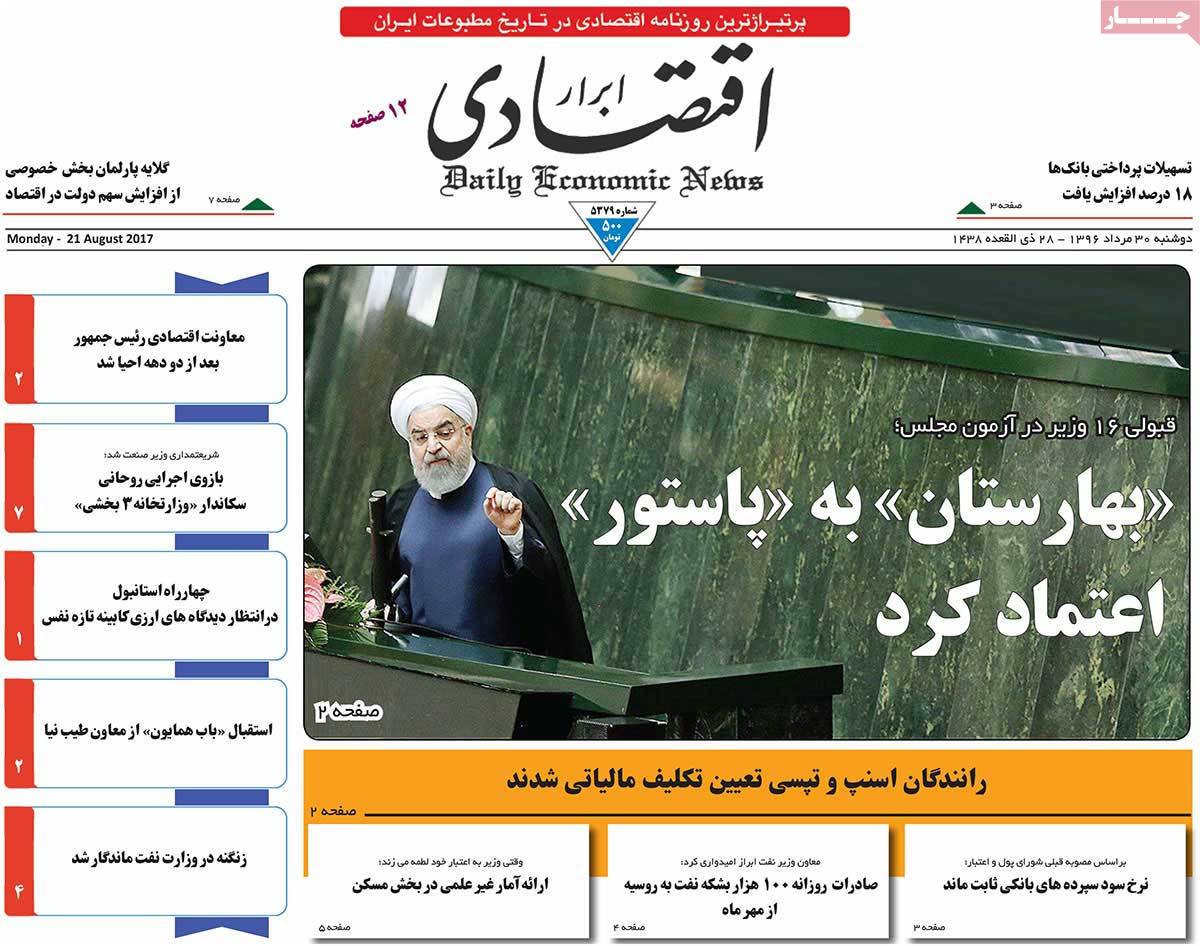
Abrar-e Eqtesadi:

1- Iran to Export 100,000 Barrels of Oil per Day to Russia as of Late September
A Look at Iranian Newspaper Front Pages on August 21


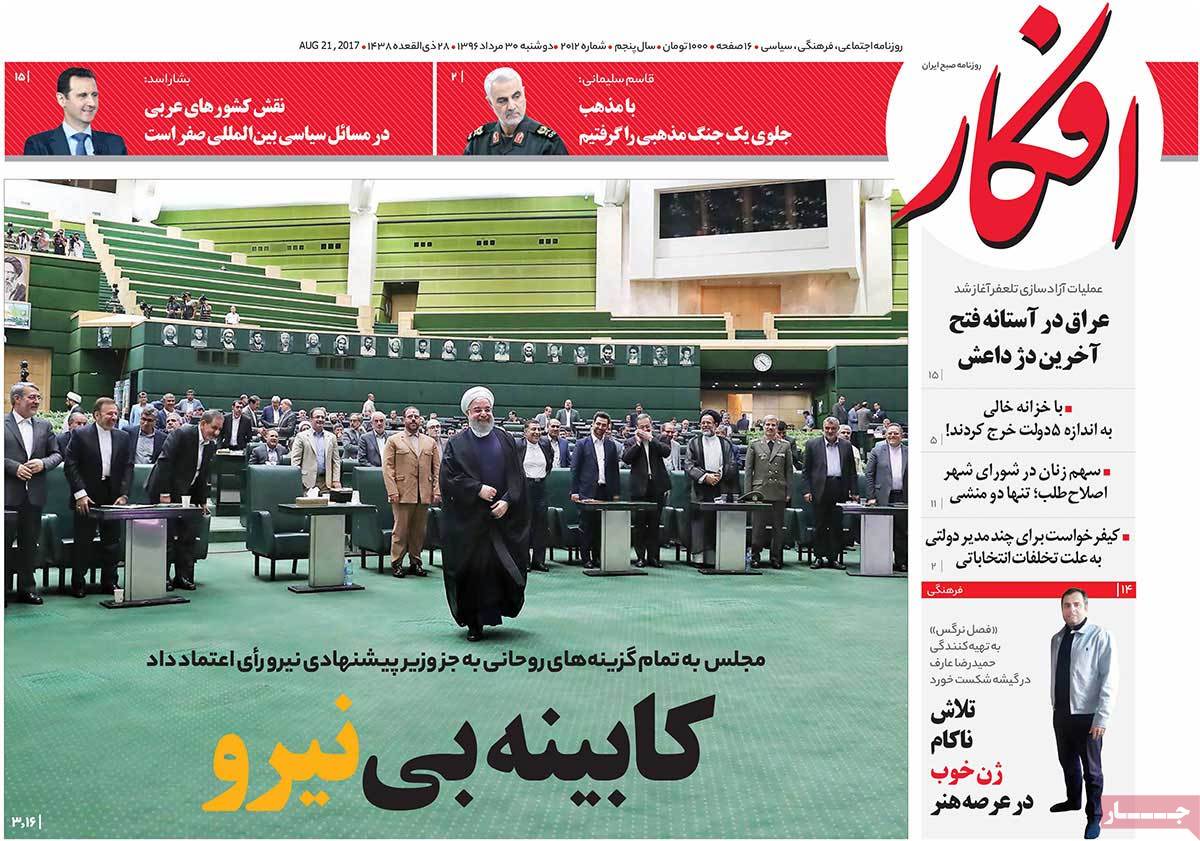
Afkar:

1- General Soleimani: We Prevented Sectarian War Using Religion

2- Iraq on Verge of Conquering Last ISIS Stronghold

3- Assad: Arab Countries Have No Role in Int’l Political Issues
A Look at Iranian Newspaper Front Pages on August 21


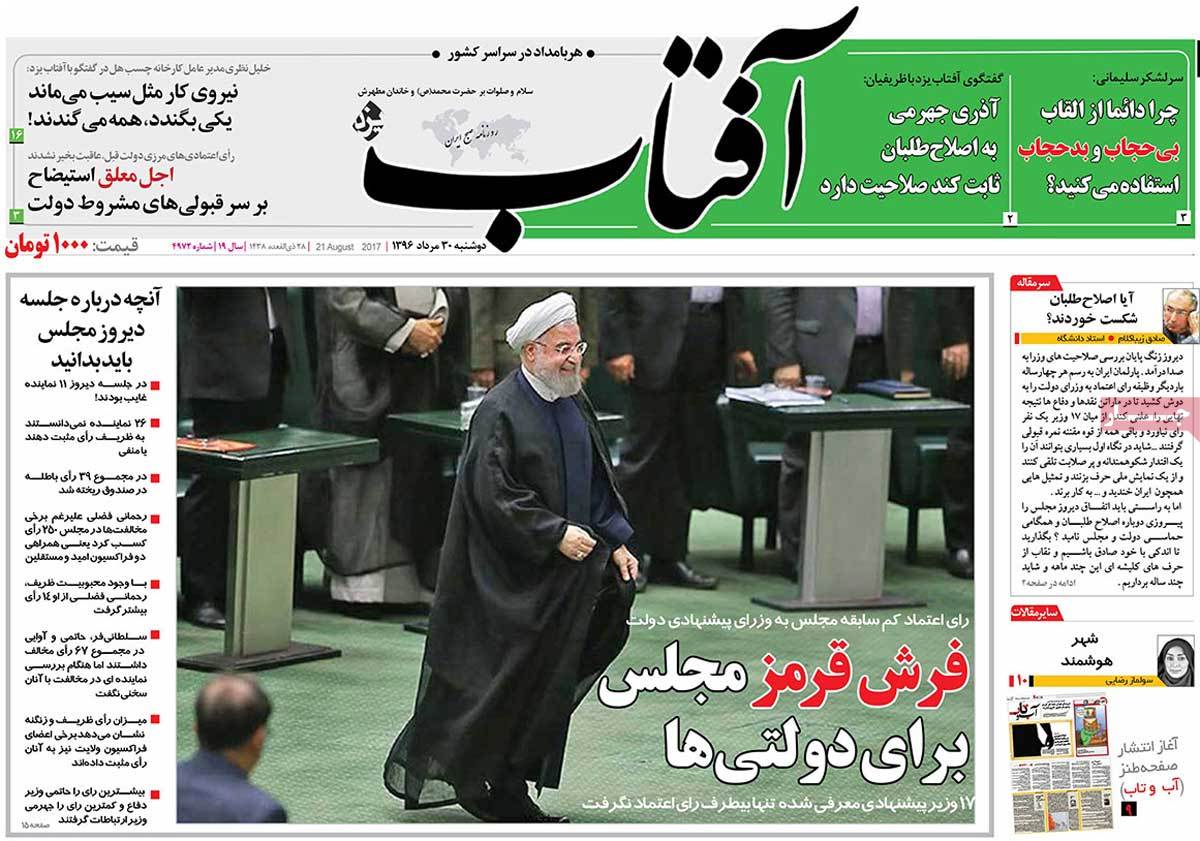
Aftab-e Yazd:

1- Parliament’s Red Carpet for Government

  • Unprecedented Vote of Confidence for Proposed Ministers
A Look at Iranian Newspaper Front Pages on August 21


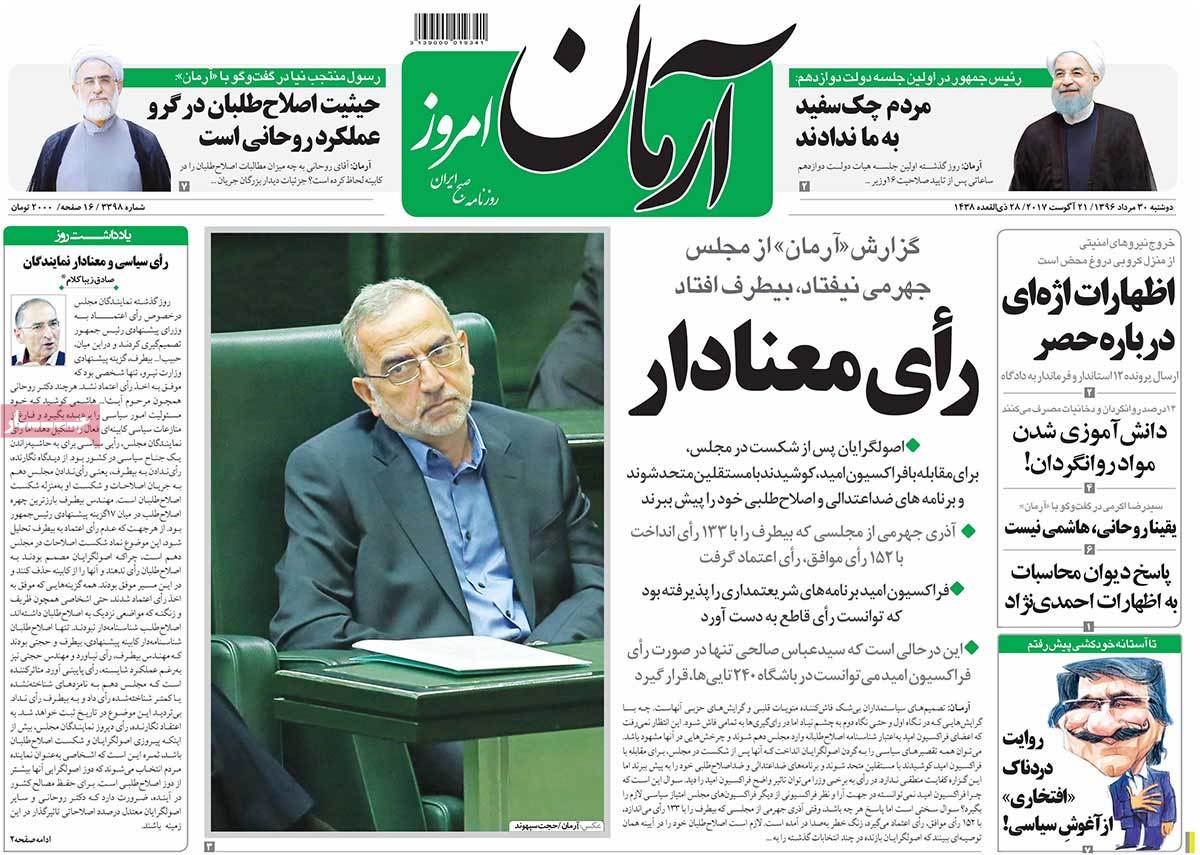
Arman-e Emrooz:

1- Rouhani: People Haven’t Given Us Blank Cheque

2- Politician: Reformists’ Reputation Hinges on Rouhani’s Performance

3- Political, Meaningful Vote of Lawmakers [Editorial]
A Look at Iranian Newspaper Front Pages on August 21


Ebtekar:

1- 17 Minus 1: Parliament’s Great Gift for Rouhani

2- Once Again Mr Diplomat: Challenges Faced by Zarif in Second Term
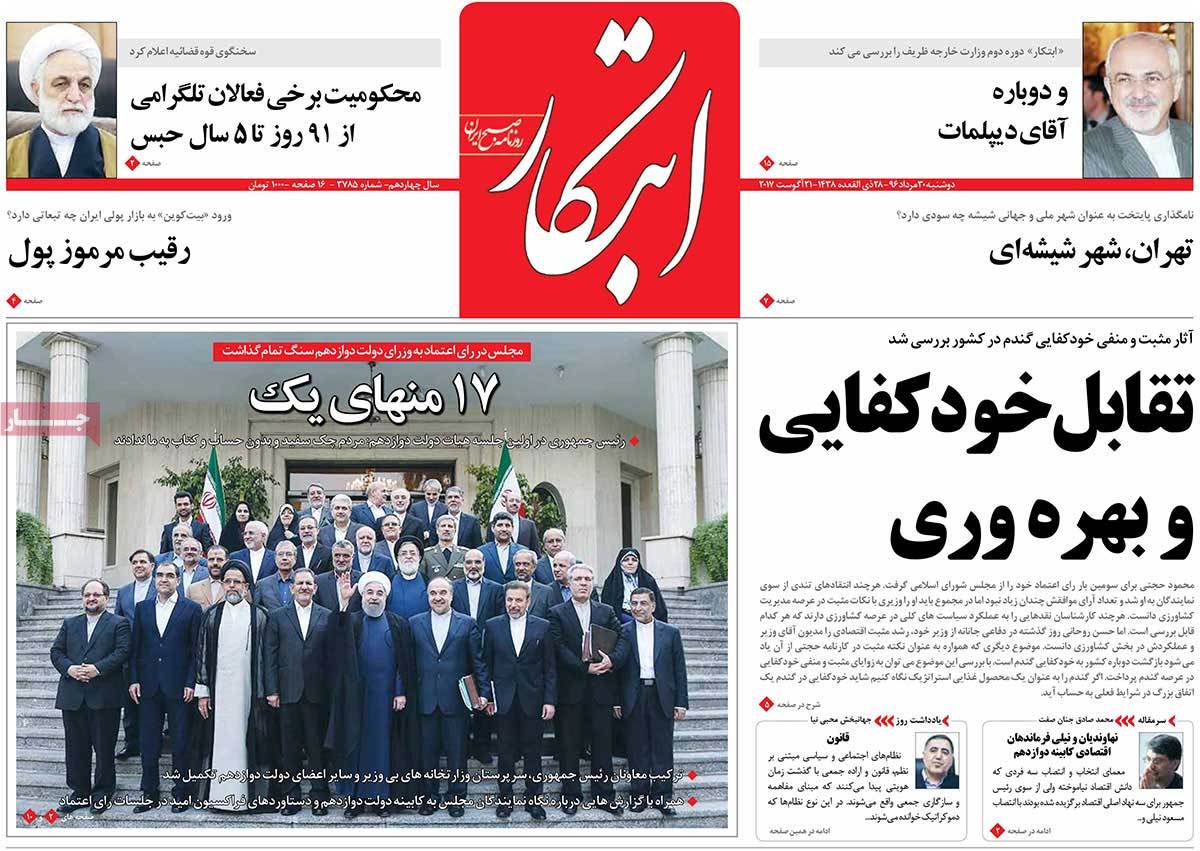
A Look at Iranian Newspaper Front Pages on August 21


Etemad:

1- Parliament’s Unexpected, Different Vote for Rouhani’s Second Cabinet

2- Reformist Analyst: No Serious Barrier for Rouhani in Second Term

3- General Soleimani: Why Do You Keep Dividing People into Reformist/Conservative?
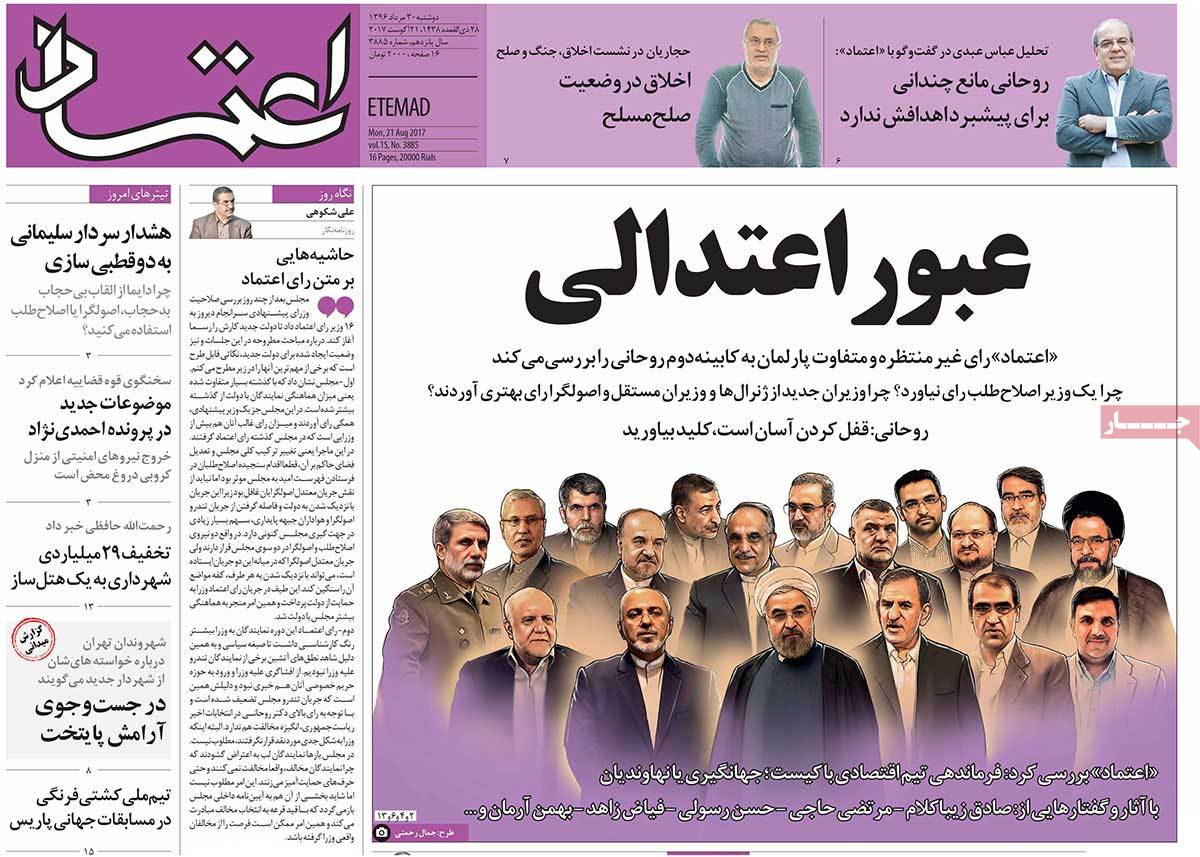
A Look at Iranian Newspaper Front Pages on August 21


Ettela’at:

1- Rouhani: Government’s New Plan Is to Establish Security, Freedom, Progress

2- Our Legitimacy Hinges on Giving Service to People: President

3- Al Jazeera Reveals Documents on Saudi Support for ISIS, Al-Qaeda

4- Judiciary: US Condemned to Pay Iran Compensation for Role in Chemical Attack
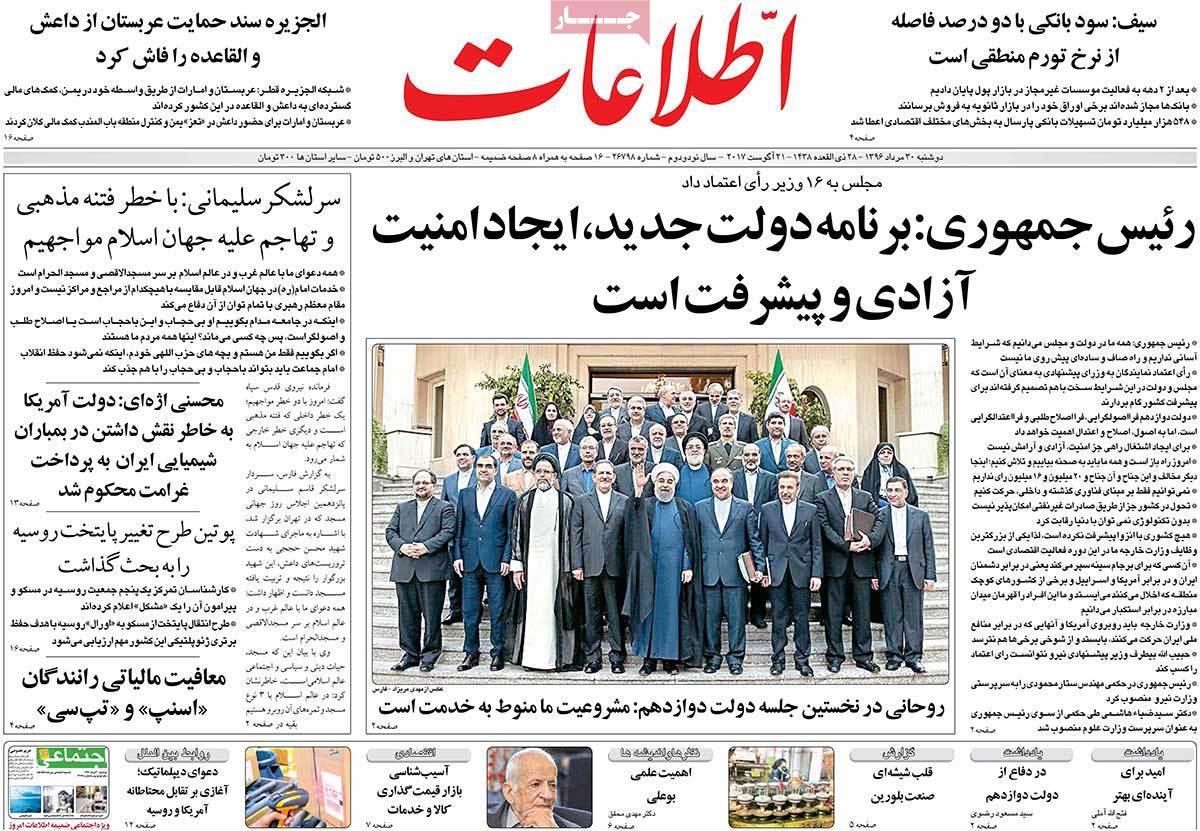
A Look at Iranian Newspaper Front Pages on August 21


Haft-e Sobh:

1- Shadow of Water on Cabinet: All Ministers, but Power Minister, Receive Vote of Confidence

2- Damn Crystal Vases: Interview with Famous Rapper Accused of Killing Step-Father
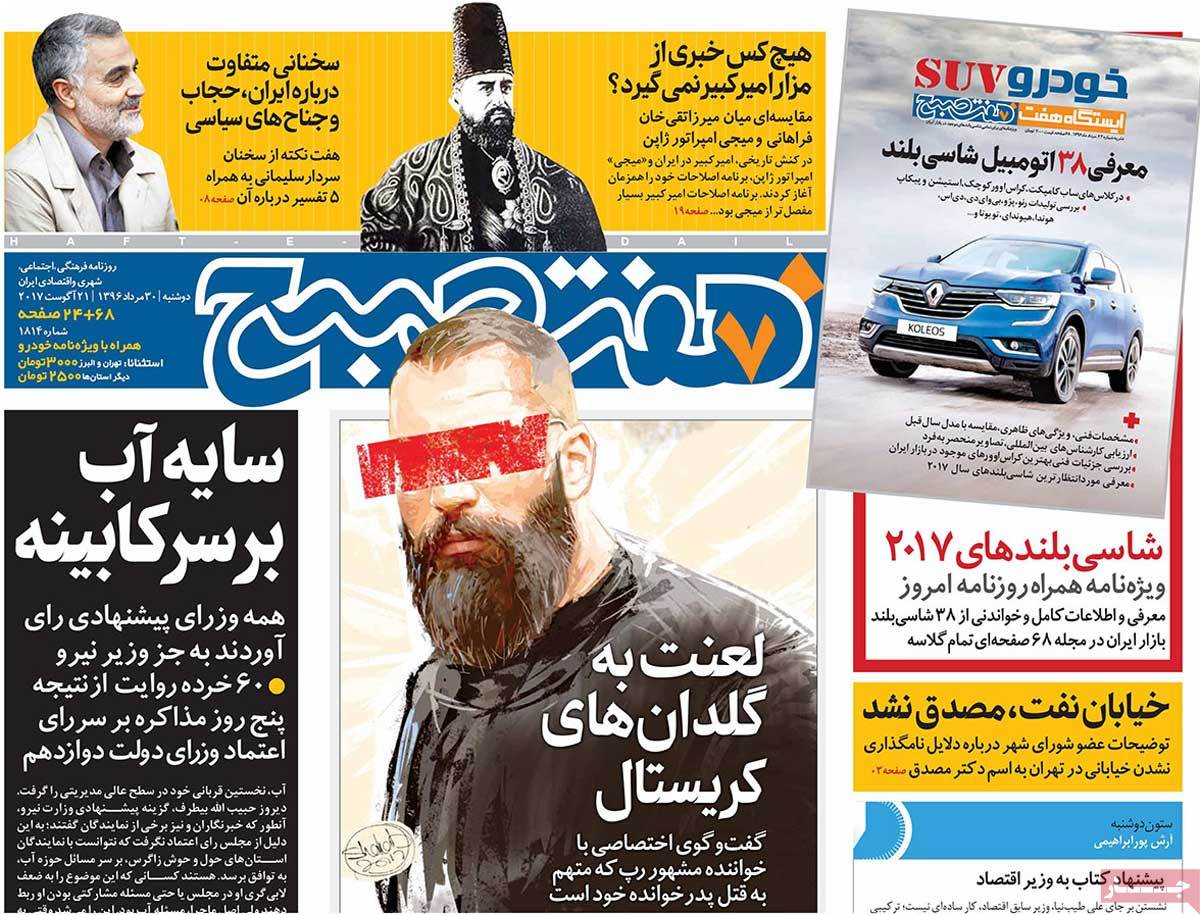
A Look at Iranian Newspaper Front Pages on August 21


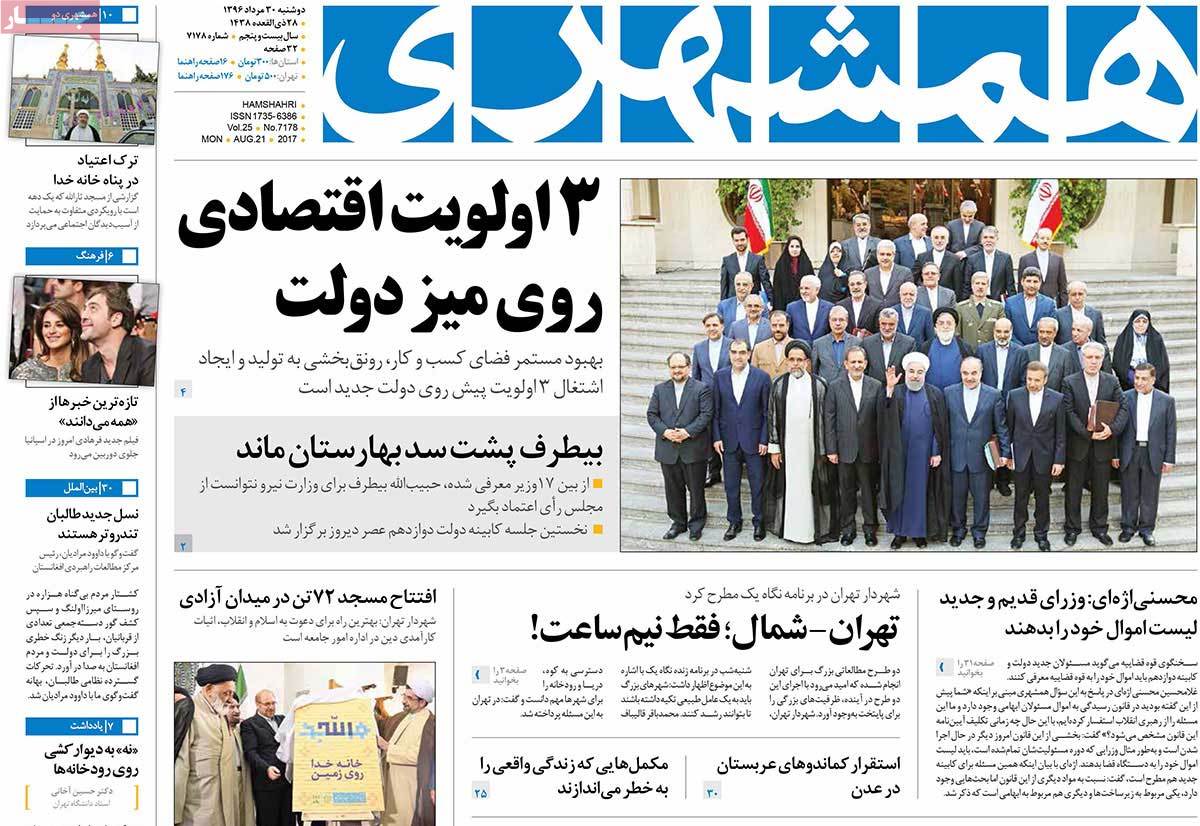
Hamshahri:

1- Mosque Helping People Quit Drug Addiction for Past 10 Years
A Look at Iranian Newspaper Front Pages on August 21


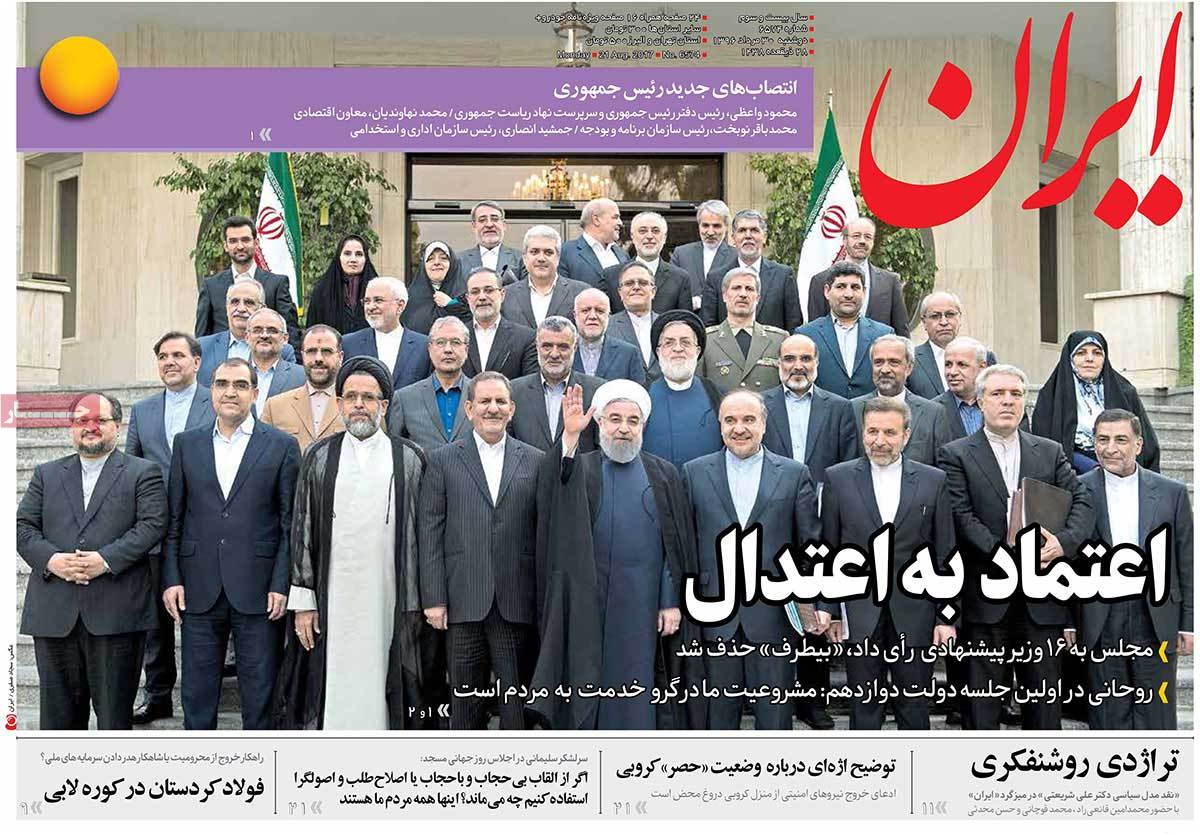
Iran:

1- Trust in Moderation: 16 Ministers Receive Vote of Confidence
 

A Look at Iranian Newspaper Front Pages on August 21


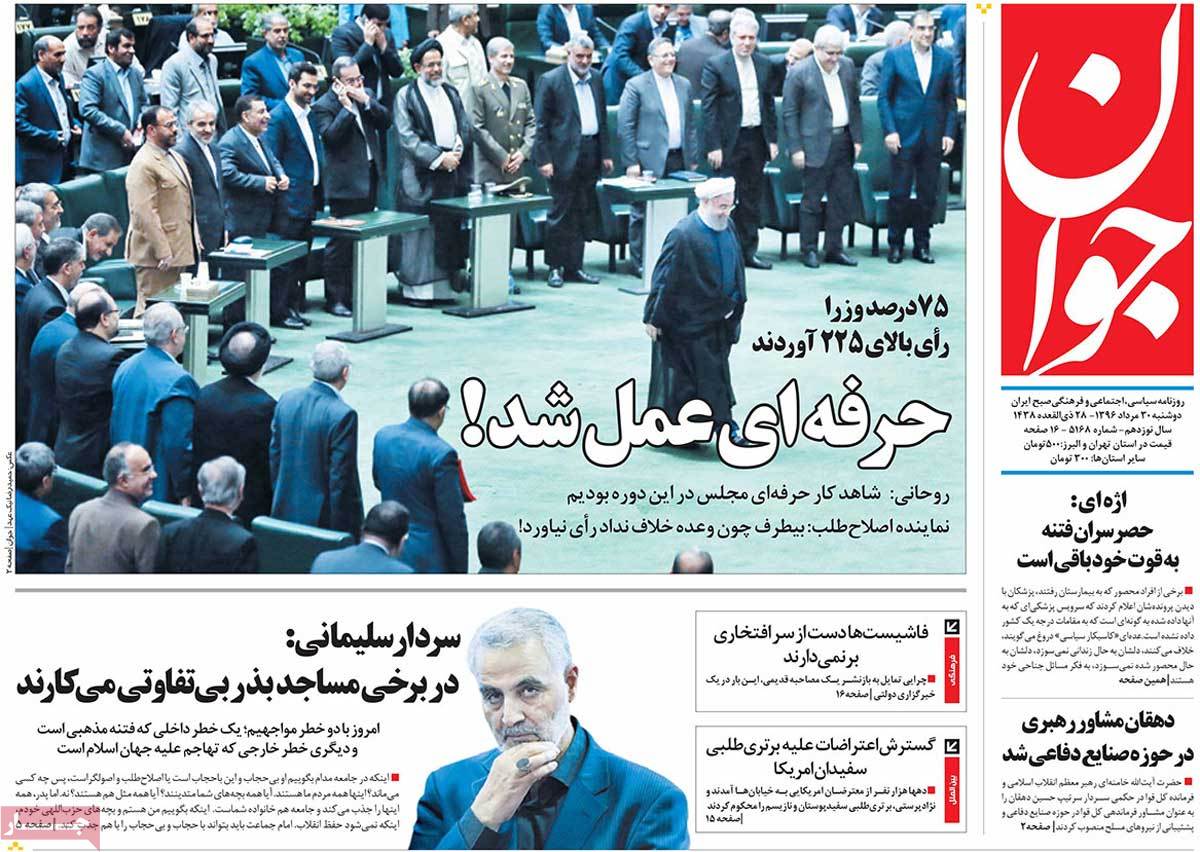
Javan:

1- Rouhani: Parliament Acted Professionally This Time!

2- 75% of Proposed Ministers Receive Over 225 Votes of Confidence

3- Judiciary Spokesman: Opposition Leaders to Remain under House Arrest
 

A Look at Iranian Newspaper Front Pages on August 21


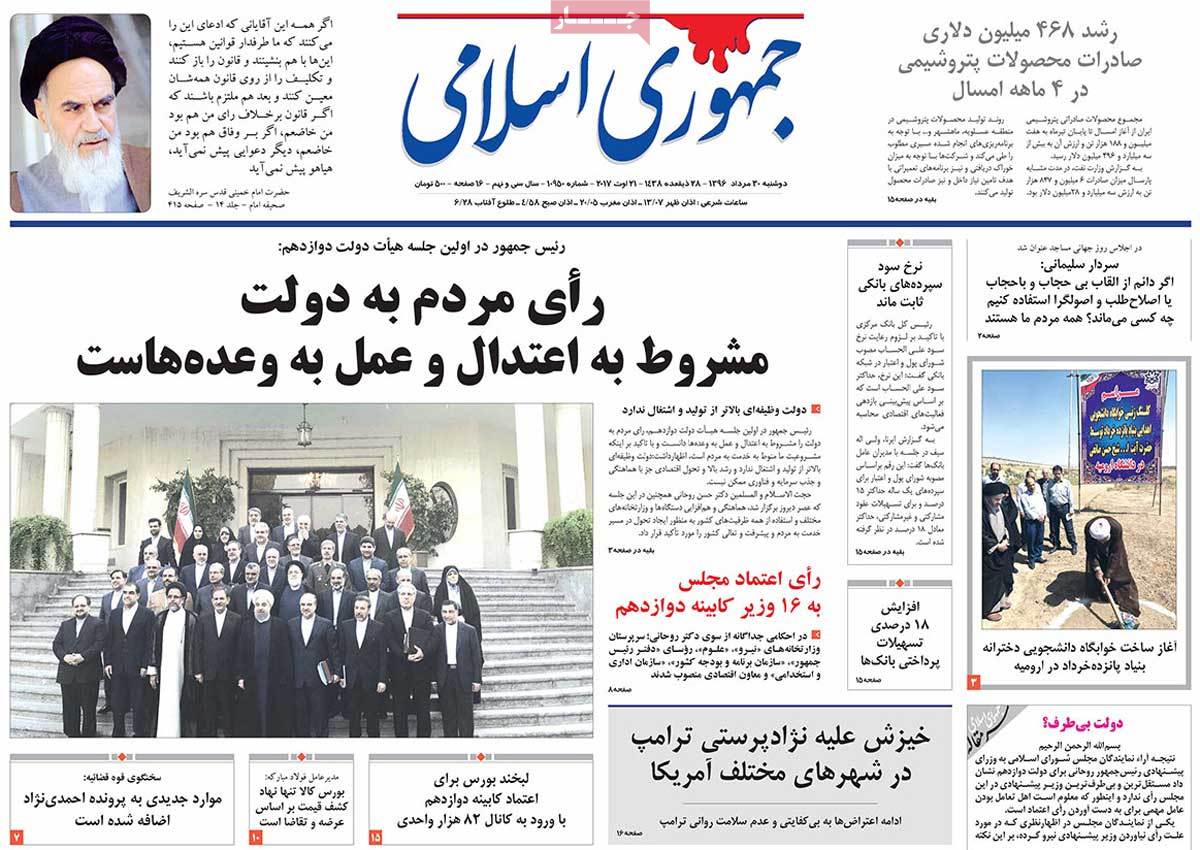
Jomhouri Eslami:

1- $468m Increase in Iran’s Petchem Exports in Past 4 Months

2- Various US Cities Rise against Trump’s Racism
A Look at Iranian Newspaper Front Pages on August 21


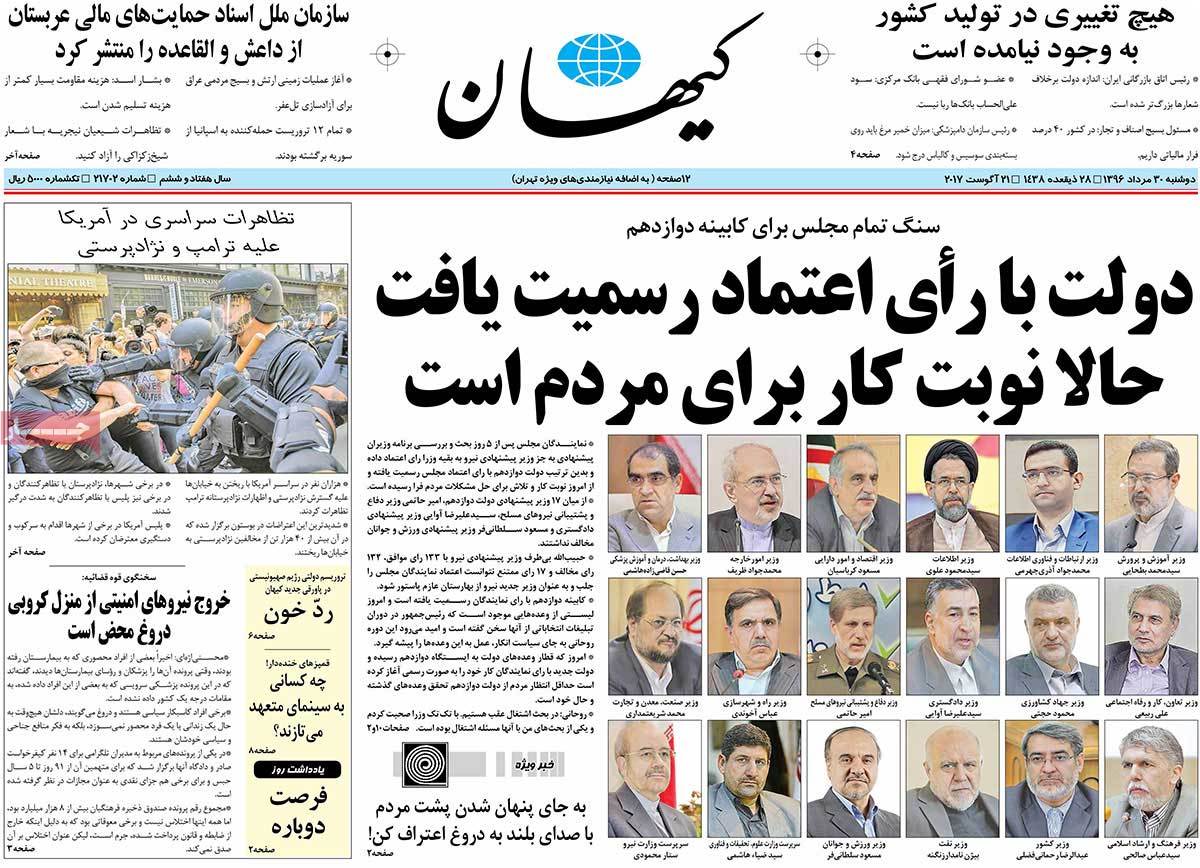
Kayhan:

1- Government Officially Starts Work: It’s Now Time to Work for People
A Look at Iranian Newspaper Front Pages on August 21


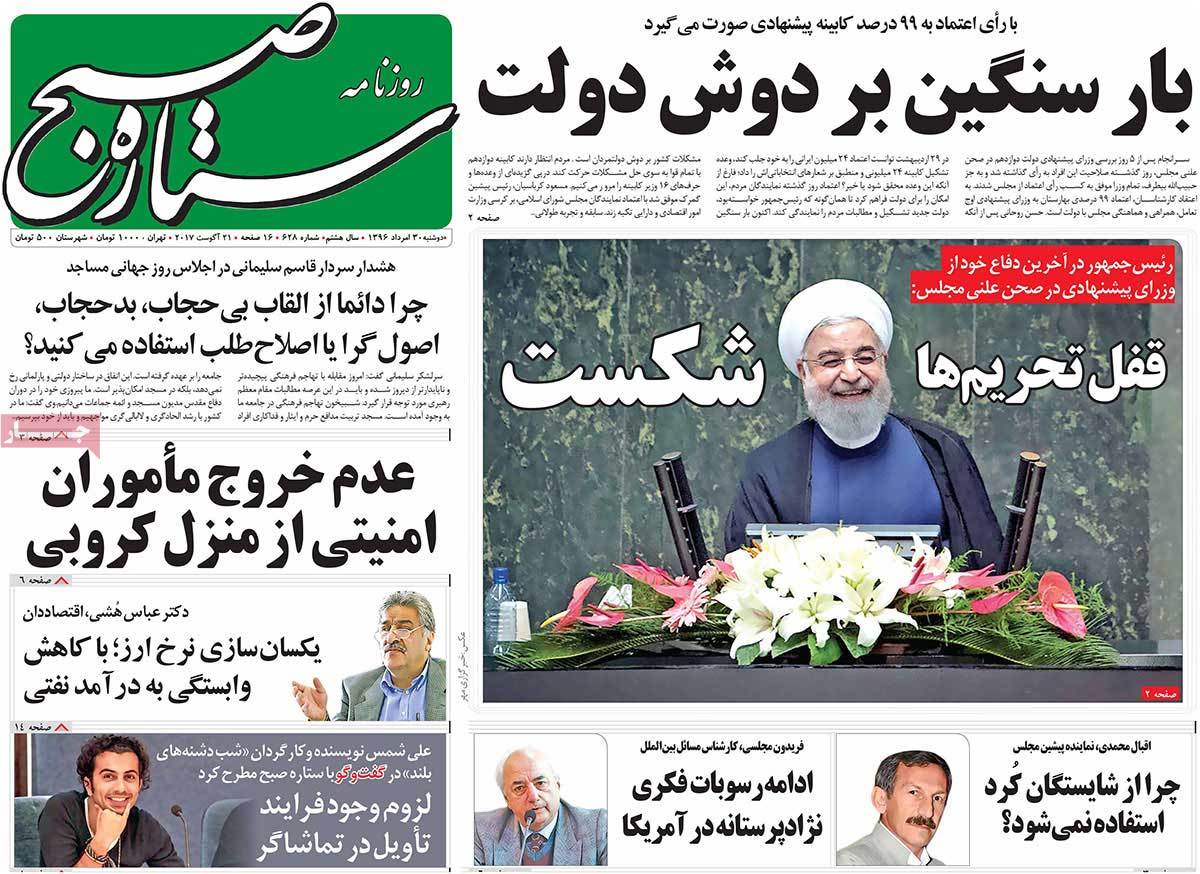
Setareh Sobh:

1- Analyst: Continued Racism in US

2- Heavy Burden on Gov’t Shoulders after Vote of Confidence for 99% of Cabinet
A Look at Iranian Newspaper Front Pages on August 21


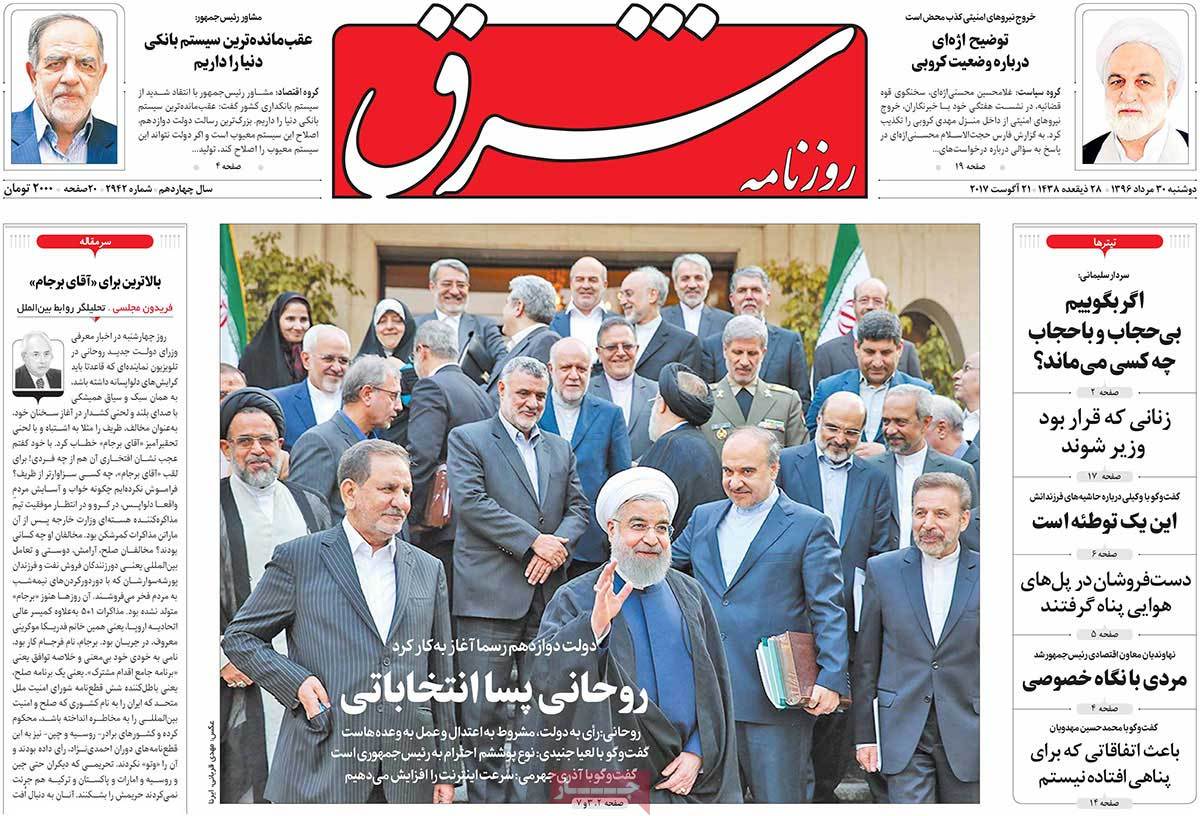
Shargh:

1- Post-Election Rouhani: New Gov’t Officially Starts Work
 

A Look at Iranian Newspaper Front Pages on August 21


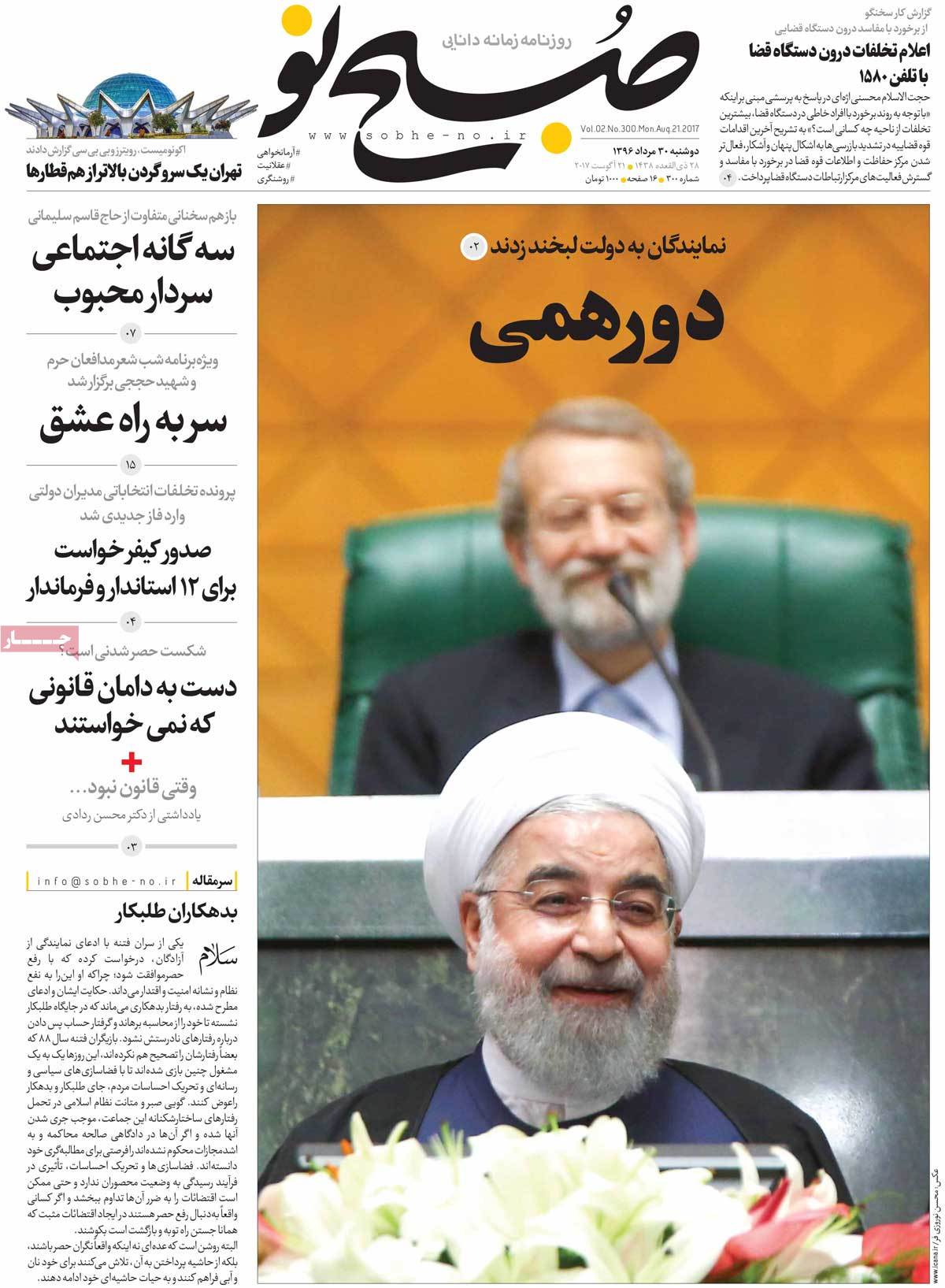
Sobh-e Now:

1- Friendly Gathering! Parliament Smiles at Government
 

A Look at Iranian Newspaper Front Pages on August 21


Vaghaye Ettefaghieh:

1- Zarif Once Again Takes Control of Iran’s Foreign Policy

2- Three Groups Trying to Take Over Trump’s Administration [Editorial]
 

A Look at Iranian Newspaper Front Pages on August 21


Vatan-e Emrooz:

1- Several Captains in Rouhani’s New Economic Team!
A Look at Iranian Newspaper Front Pages on August 21


Sustaining Nuclear Deal Iran’s Top Priority: FM Zarif

Speaking in a televised interview on Sunday night, Foreign Minister Zarif said the ministry under his watch would work first and foremost to keep the Joint Comprehensive Plan of Action (JCPOA) in place.

Priority number one of the diplomatic apparatus will be to sustain the JCPOA and to prevent America’s deal-breaching,” he said. “We must not allow America to execute or violate the deal at Iran’s cost.

He said the JCPOA had been built on distrust and envisaged the necessary rules to deal with non-performance by parties.

Earlier in the day, Zarif had received a favorable vote of confidence at the Iranian Parliament (Majlis) to work as foreign minister in President Hassan Rouhani’s second cabinet. During a final debate at the Parliament, President Rouhani, who was in attendance to defend his cabinet picks, stressed the preservation of the JCPOA.

Sustaining Nuclear Deal Iran's Top Priority: FM Zarif

The JCPOA, a major foreign policy achievement of President Rouhani’s first term, was finalized between the Islamic Republic on the one side and the United States, the UK, France, Russia, China, and Germany on the other in July 2015.

Zarif was Iran’s chief negotiator in the multilateral talks that culminated in the deal.

When it started being implemented some six months after conclusion, the deal terminated all nuclear-related sanctions against Iran in return for certain measures by the Islamic Republic to limit its nuclear program.

But the new US administration has been unhappy with the deal, which was negotiated under the administration of former president Barack Obama. The new White House occupant has attempted to undo every one of Obama’s major policy achievements.

And that includes the Iran deal.

Trump has adopted a hostile posture toward the JCPOA even as his administration has certified Iranian compliance twice so far, allowing for the continued waiving of certain sanctions against Iran. After the second certification, Trump assigned a team of his White House confidantes to search for and offer to him “options” to potentially decertify Iranian compliance. He had wanted the State Department to search for such options previously, but the department had come up empty-handed.

Also during a recent summit of the G20 in Germany, Trump attempted to urge European countries not to do business with Iran. That activity by the US president constituted a violation of the text of the JCPOA, according to Iran.

All of that Trump administration rhetoric and action has strengthened speculation and concern that the US may want to unilaterally pull out of the deal. Iran has been in contact with its European partners to urge against American non-performance but has said it is prepared for any scenario.

Relations with neighbors & economic diplomacy

Elsewhere in his Sunday interview, Zarif said the enhancement of relations with Iran’s neighbors and activating economic diplomacy were two other major priorities.

“We are in a region, where, unfortunately, there are upheavals and turbulence stemming from the wrong policies of [certain] regional countries, dangerous foreign interventions, and a surge in extremism,” he said. “Our region needs calm.”

He also said Iranian diplomacy had to facilitate the country’s development.

“In the past,” he said, “foreign policy was not only incapable of helping our development but also incurred costs, because of pressure by foreign powers.”

Things had changed under President Rouhani, he said.

The Iranian foreign minister suggested that the JPCOA had removed barriers in the way of trade with Iran by removing United Nations Security Council resolutions that had been imposed under Chapter VII of the UN Charter.

Zarif said that would also help a revitalized Iranian role in international organizations on the issue of human rights. He said Iran had to play that role more strongly now.

Qataris Holding Secret Meetings with Saudi King

Sheikh Abdullah bin Jassim Al-Thani, a member of Qatar’s ruling family, was the one who held the first secret meetings with Saudi King Salman in Morocco and also his crown prince, Mohammed bin Salman in Saudi Arabia.

In a post on his twitter account, Sheikh Abdullah publicly confirmed the reports and unveiled his reasons for holding talks with the Saudi royal family.

He said the meetings were mainly focused on facilitating the travel of Qatari pilgrims to Saudi Arabia to perform their annual Hajj rituals.

“During the meetings, I didn’t raise any personal issue with King Salman or his crown prince. Our main goal during the meetings was to explore ways to facilitate the travel of Qatari pilgrims to Saudi Arabia for annual Hajj. King Salman gave me a positive reply by issuing an immediate order to establish an emergency unit to offer special services to Qatari pilgrims,” he wrote.

Following the meetings, the Saudi King said he will mobilize all the kingdom’s potentials to enable Hajj pilgrims to perform their Hajj rituals with ease and peace of mind.

Meanwhile, he also allowed Qatari pilgrims to enter the Kingdom via Salwa border post so as to perform their Hajj ritual as well as allowed all Qatari citizens, who wish to enter the Kingdom to perform Hajj without e-permits.

In reaction to Sheikh Abdullah’s tweet, more than 240 thousand social media users turned to twitter and expressed thank for his efforts to mediate between Qatar and Saudi Arabia. But on the other side, some users created hashtags to express their opposition to Abdullah’s visit. They also threatened Abdullah that he should pay a price for his visit.

This comes as Qatar’s Foreign Minister, Mohammed bin Abdulrahman Al Thani, says Sheikh Abdullah’s visit was not official.

However, the scenario of secret talks between Qatari and Saudi officials continued with new reports saying King Salman has held secret talks with a top military commander in Morocco.

The talks between King Salman and General Tayeb Oral Oğlu, who is originally from Turkey, were held at the king’s residence in Morocco.

Oral Oğlu was appointed as the plenipotentiary head of Qatar’s armed forces on July 10 by Qatar’s Emir for six months, but the term can be renewed.

Morocco’s media wrote the general arrived in Morocco at the order of Qatari emir and held talks for 40 hours with King Salman on the latest diplomatic row between Qatar and some Arab states.

During the talks, the media reports said, the commander expressed thanks to Saudi officials for allowing Qatari pilgrims to enter the country to perform annual Hajj without e-permit.

Arriving on a Saudi plane in Morocco, he also held talks with Deputy Manager of Saudi Arabia’s Intelligence Organization.

Iran Deputy FM, Lebanese President Meet in Beirut

The meeting was held on August 21, 2017 at Lebanon’s Presidential Palace where the two sides discussed developments in the Arab country as well Tehran-Beirut relations.

The top Iranian diplomat conveyed Iranian President Hassan Rouhani’s greetings to his Lebanese counterpart, and praised the Lebanese people, government and army’s key role in fighting terror and countering the Israeli occupation.

Jaberi Ansari said the Iranian Foreign Ministry’s priorities during Rouhani’s second term as president are to boost regional cooperation and give fresh impetus to economic diplomacy, adding Iran pays due regard to Lebanon in that respect.

For his part, the Lebanese president said his country is largely affected by regional crises, especially the conflict in Syria.

He then highlighted the domestic achievements secured thanks to a national consensus in Lebanon on fighting terrorism as well as the approval of the new election law.

At this juncture, Aoun said, one of the Lebanese government’s priorities would be to address economic problems in the country.

He also asked Jaberi Ansari to convey his greetings to President Rouhani and congratulated him on the beginning of his second tenure as Iran’s president while emphasizing the need for closer cooperation between the two sides.

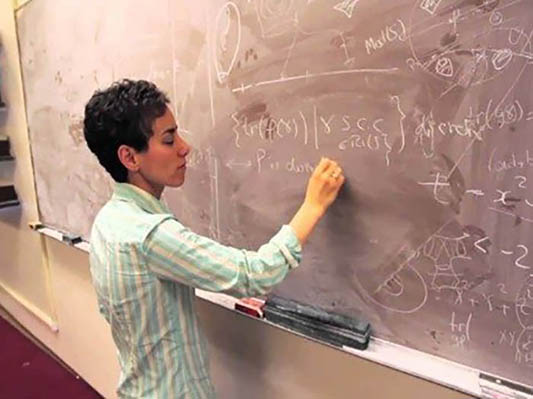
Iran to Present Science Award in Memory of Maryam Mirzakhani

Maryam Mirzakhani

Iranian Minister of Science, Research and Technology Mohammad Farhadi announced his ministry intends to give young women engaged in different fields of science an annual international award titled “Mirzakhani” as of the beginning of new school year (to start September 23).

The award is named after Maryam Mirzakhani, the late Iranian mathematician and university professor and the only female winner of the prestigious Fields Medal, who passed away on July 14, 2017, of breast cancer at the age of 40.

According to a Farsi report by the Ettelaat daily newspaper, Farhadi made the announcement on the sidelines of the first edition of “Women’s Award in Science”, which was held in the National Library of Iran in Tehran.

Addressing the ceremony, Farhadi stressed that “Women’s Award in Science” will be handed out every year.

“Today, there are a large number of female managers in many of the country’s research centres and knowledge-based companies.”

He said in the 1990s, female faculty members in Iran did not have the change to reach a level higher than an instructor.

However, he added, since 2011, they have achieved higher levels to become full professor in domestic and foreign universities.

The minister noted that currently, a number of Iranian female university professors are ranked among the world’s top scientists.

Addressing the same ceremony, new Vice-President for Women and Family Affairs Massoumeh Ebtekar said women have proven that gender fails to be an obstacle to gaining knowledge.

She added today, adopting knowledge-oriented approaches is the main basis for gaining power.

“The only countries that have managed to make advances in different fields are those that have developed science-oriented plans.”

She added during Iranian President Hassan Rouhani’s previous term in office, a plan was approved mandating that women must be appointed to 30 percent of the managerial posts of the country thanks to efforts by the former vice-president for women and family affairs, Shahindokht Molaverdi.

“Nevertheless, we, at present, unfortunately cannot witness a significant presence by women in the higher managerial echelons of the Ministry of Science, Research and Technology, Ministry of Health and Medical Education and domestic universities.”

Commemorating Mirzakhani, she said she was a prominent scientist in the field of fundamental sciences who had achieved an international level.

“I believe that today, serious plans are required to be drawn up concerning the issue of young women’s education. They are required to receive more applied education so that they can enter the job market at a more rapid pace.”

Elaheh Majazi, an advisor to the Iranian minister of science, research and technology, also told the audiences, “We believe that the Ministry of Science, Research and Technology is the main source of producing science and the country’s university professors and students as well researchers are the main producers of knowledge.”

Commenting on the ceremony where she was delivering her speech, she said the primary idea for handing out this award was produced last Iranian year (started mid-March 2016).

“At that time, we shared the idea with the minister of science. He welcomed it. The main purpose of this award is to express appreciation for women involved in different scientific fields.”

Women constitute close to 17 percent of the faculty members of Iranian universities, she added

Drug-Trafficking Band Smashed in Iran’s Capital

Brigadier General Hossein Rahimi, the provincial police chief, has said that Tehran police forces have annihilated a big international drug trafficking band which had smuggled 1.6 tons of narcotics to the Iranian capital.

According to a Farsi report by ISNA, five members of the group, who had imported the narcotics from the country’s southeastern borders in Sistan and Baluchestan province and had carried the cargo across Iran’s central deserts to the suburbs of Tehran, were identified and arrested by intelligent forces of the provincial anti-narcotics police.

“Only one member of the band has not yet been captured as he is not [currently] in the country. Moves are underway to seize him.”

Rahimi said in recent operations by the provincial police forces to fight drug-traffickers, 200 retailers of narcotics were arrested and 85 kilograms of different kinds of opioid-based drugs were seized.

Tehran police chief also noted that a marijuana distributing band has also been smashed recently.

The members of this band, who were both arrested, used the cyberspace and real space to sell their drugs.

In recent operations by the provincial police, more than 60 bottles of alcoholic beverages, scores of kilograms of opium and a number of melee weapons as well as guns belonging to drug traffickers were seized.

In addition to fighting large-scale dealers and drug-trafficking bands, he added, combatting retailers is also a priority for Tehran’s police.

“We will resolutely continue to tackle the drug trafficking problem.”

IRGC Congratulates Army General on Appointment as Iran DM

In its Monday statement, the IRGC expressed its pleasure with the huge number of votes of confidence General Hatami received from Iranian lawmakers on Sunday to become the new defence minister, and sincerely congratulated him on taking the office.

“There is no doubt that your presence […] promises the reinforcement of the Defence Ministry’s approaches and plans to further develop and upgrade the Islamic Republic’s defence industry,” the statement added.

It further hailed General Hatami’s appointment and said he will support the Islamic Republic’s Armed Forces in strengthening the country’s deterrence and defensive power with a focus on ‘missile capabilities’ and support for ‘the Islamic resistance front’ in countering ‘proxy wars’ and ‘Takfiri terrorism’ in the region.

“The Iranian nation will witness its manifestation in the Army and IRGC missions,” the statement added.

The IRGC also voiced its preparedness to provide the Defence Ministry with any kind of help, and wished success for Hatami and his hardworking colleagues in Iran’s defence industry.

General Hatami is the first Army general serving as Iran’s defence minister after the end of Iran-Iraq war in the 1980s. After receiving the greatest vote of confidence (over 260 votes) from the Parliament on Sunday, he went to his office at the Defence Ministry to replace Brigadier General Hossein Dehqan.

Later on Sunday, General Dehqan was appointed by Ayatollah Seyyed Ali Khamenei as a defence industries advisor to the Chief Commander of the Iranian Armed Forces.

‘Mosques Should Unite People from All Walks of Life’

General Soleimani-2

Speaking at a conference on mosques, General Soleimani said prayer leaders at mosques should be able to attract all people, regardless of their political tendencies.

Efforts should be made to make everybody interested in mosques, including those who observe the Islamic dress code and those who do not care much about the Islamic headscarf, he noted.

“Why do you keep dividing people into the ones who care about hijab and the ones who don’t? Why do you term people as conservative or reformist? Who else would be left for us?” he went on to say.

“All children are not the same; it is rather the head of the family who should gather them together. Prayer leaders should be able to attract all people, regardless of their hijab,” General Soleimani noted.

He went on to say that individuals such as martyr Mohsen Hojaji were brought up and nurtured at mosques, according to a Farsi report by ISNA.

General Soleimani said all the differences between the Muslim world and the West are over mosques, and added the Islamic community’s religious and political life hinges on mosques.

“Today, countering cultural inroads has become more complicated and more unstable than in the past, and we should pay attention to the Leader [of the Islamic Revolution Ayatollah Seyyed Ali Khamenei]’s demands in this regard,” said the top commander.

“Today, we are facing cultural encroachments upon our society. The mosque is a place where defenders of holy shrines and individuals making sacrifices for the society are trained. Such a thing does not happen within governmental and parliamentary structures, but at mosques. We owe our success during the Holy Defence era (the Iraqi imposed war on Iran in the 1980s) to mosques and imams,” General Soleimani stressed.

He underlined that due attention should be paid to mosques and the enemy should not be allowed to infiltrate into mosques.

“We are facing two dangers: one is ‘religious sedition’ which is a domestic threat, and the other is ‘encroachment upon the Muslim world’ which is a foreign threat,” he noted.

“There are many mosques in Jordan and Egypt, but they are indifferent toward the Israeli regime’s actions,” said the general.

He underlined the need to protect mosques, saying, “Mosques are bases, and have an impact on the whole society.”

“The number of mosques is not important, but we should know that our revolution depends on mosques.”

“We pay as much attention to our interests as those of Iraq. We have not been seeking to seize oil wells and capture Mosul and Kirkuk,” he said.

The top general then said Iran does not act based on whether or not a community is Shiite or Sunni.

“99% of Palestinians are Sunnis, but we are defending them.”

“Iran has never created crises and nurtured Takfirism,” he said.

General Soleimani said Saudi Arabia created terrorist groups, but Iran helped ensure stability in Syria.

“We averted a religious war with [the help of] religion, not with military power.”

He also underlined the Leader’s guidelines in safeguarding the Islamic Revolution and countering terrorists and Takfiris.

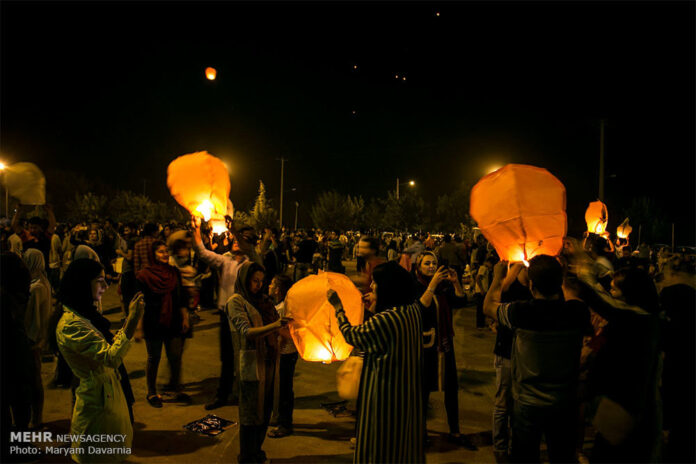
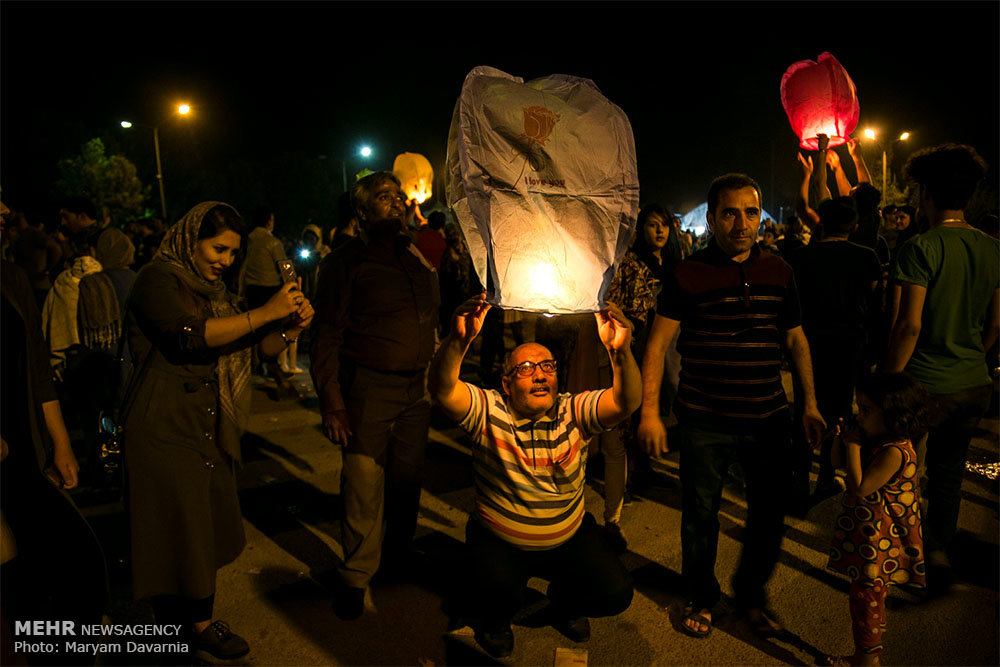
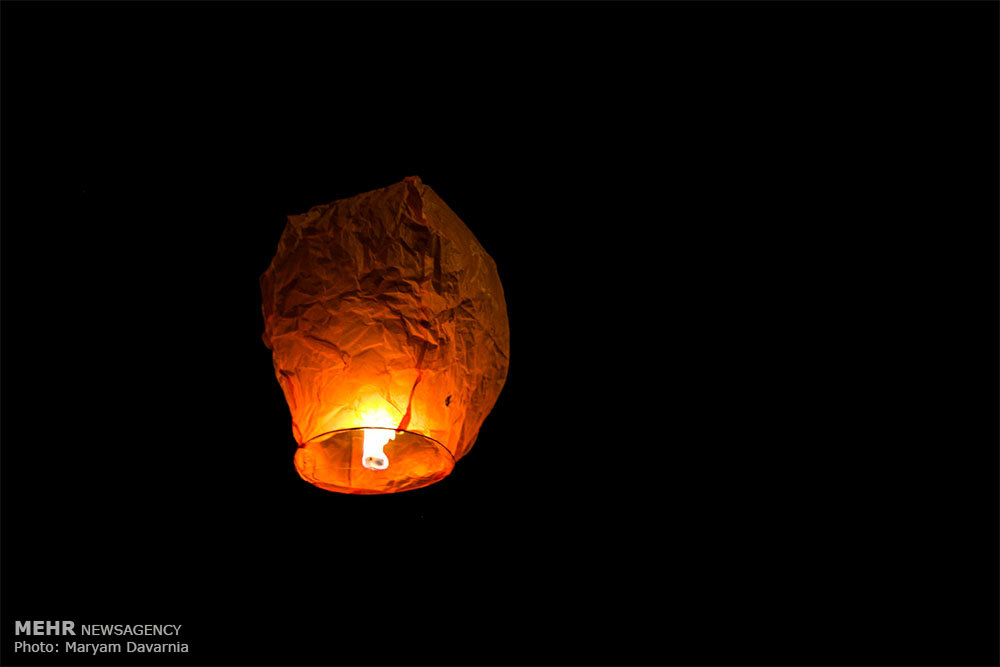
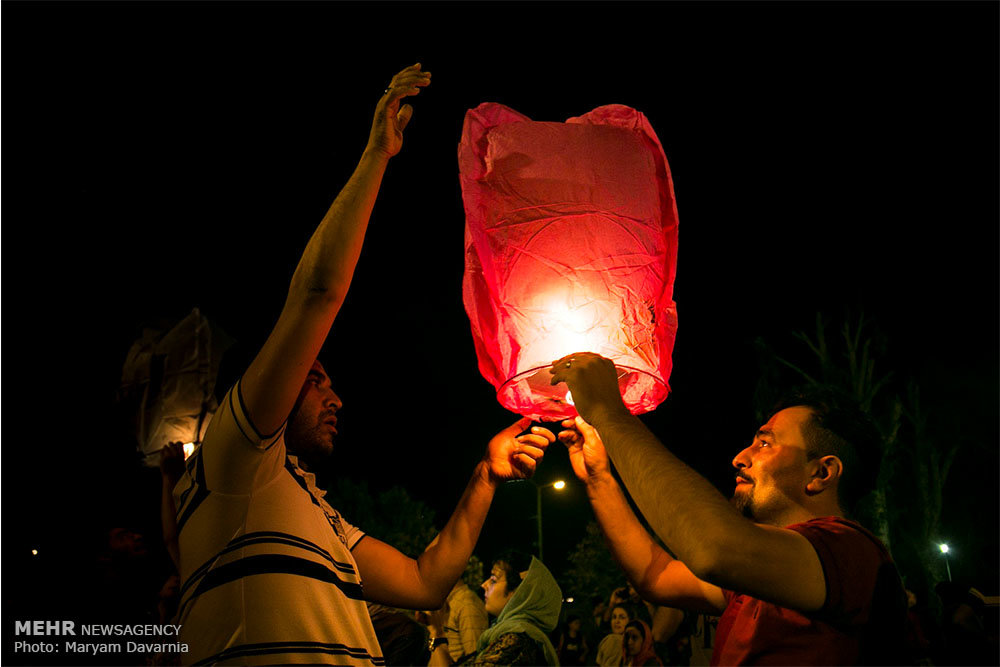
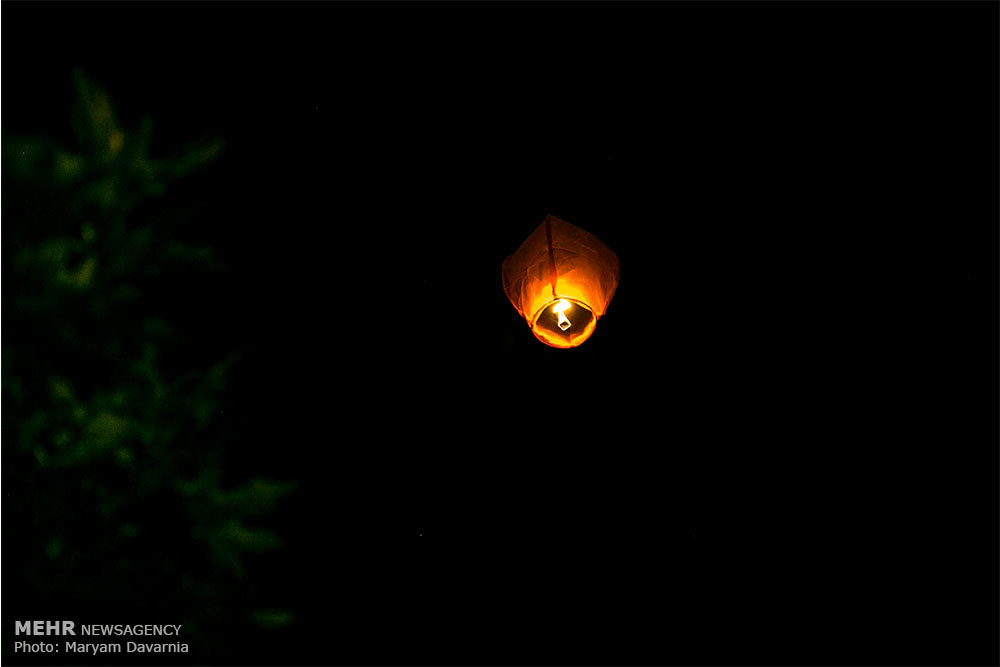
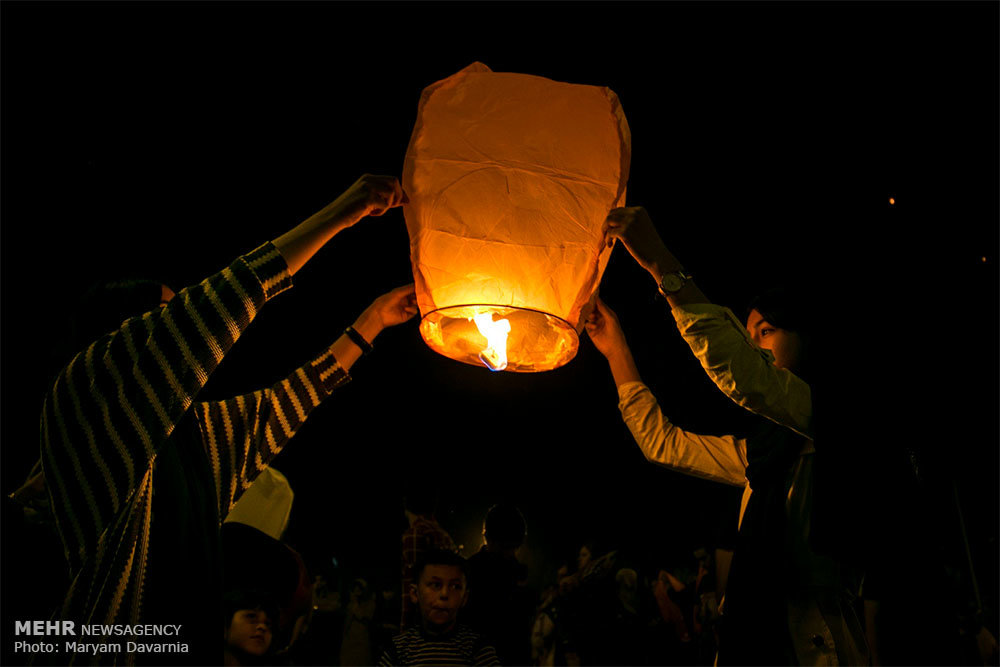
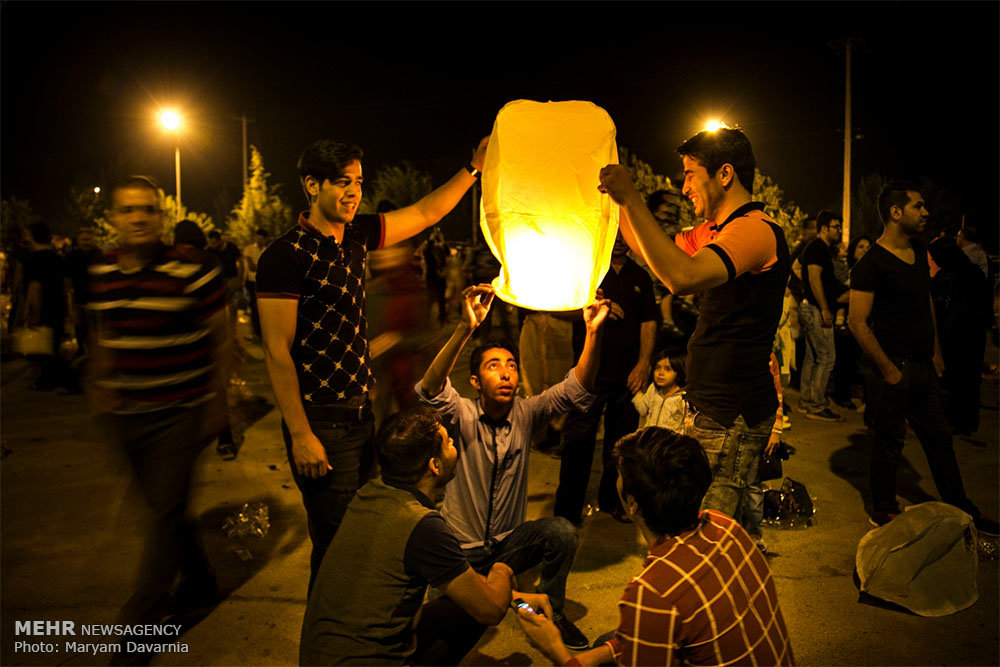
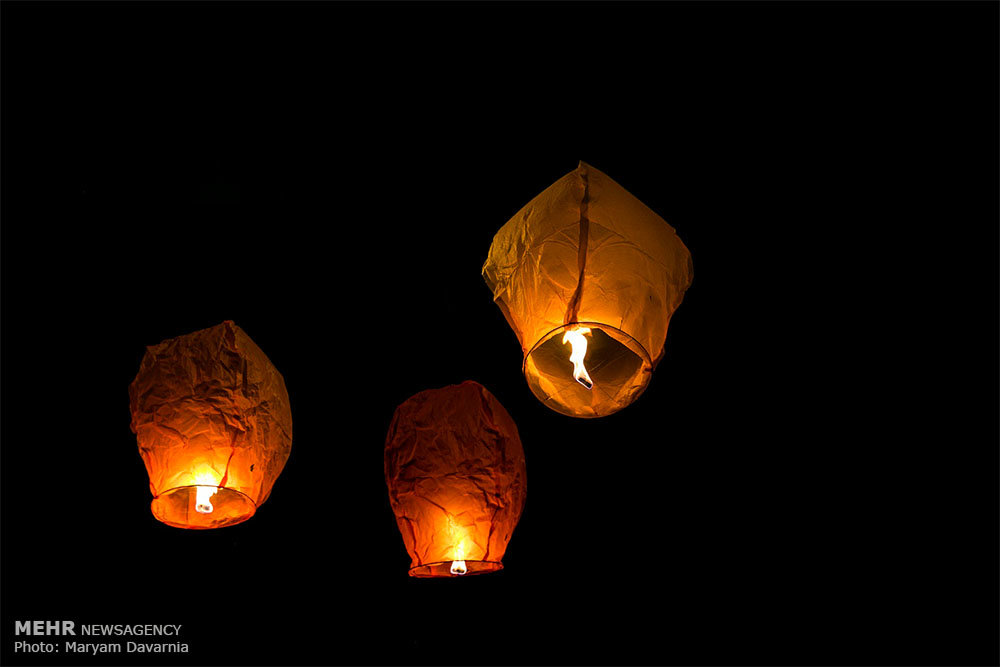
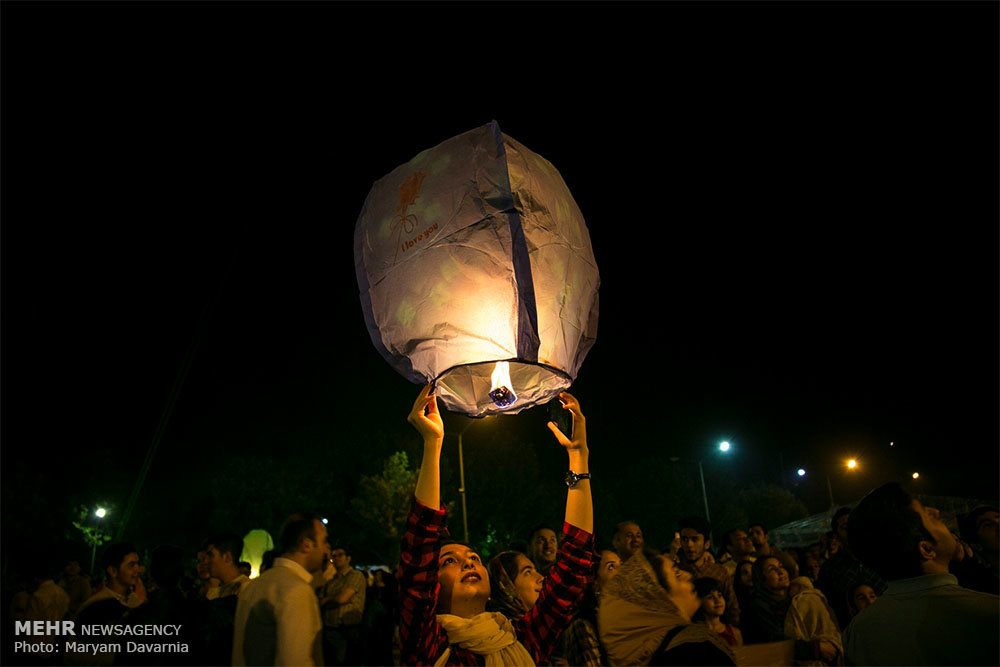
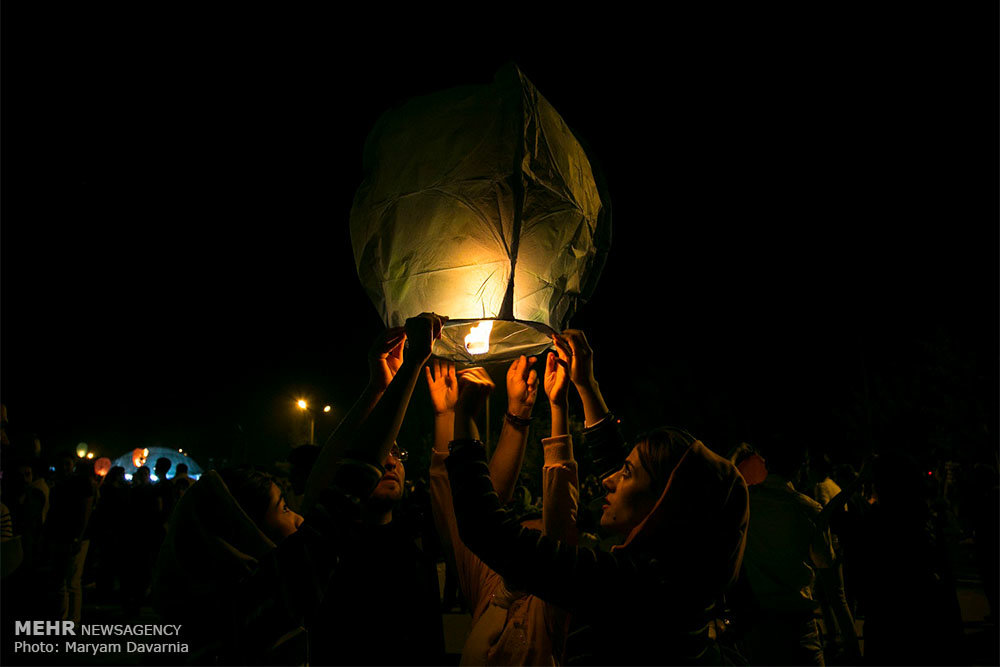
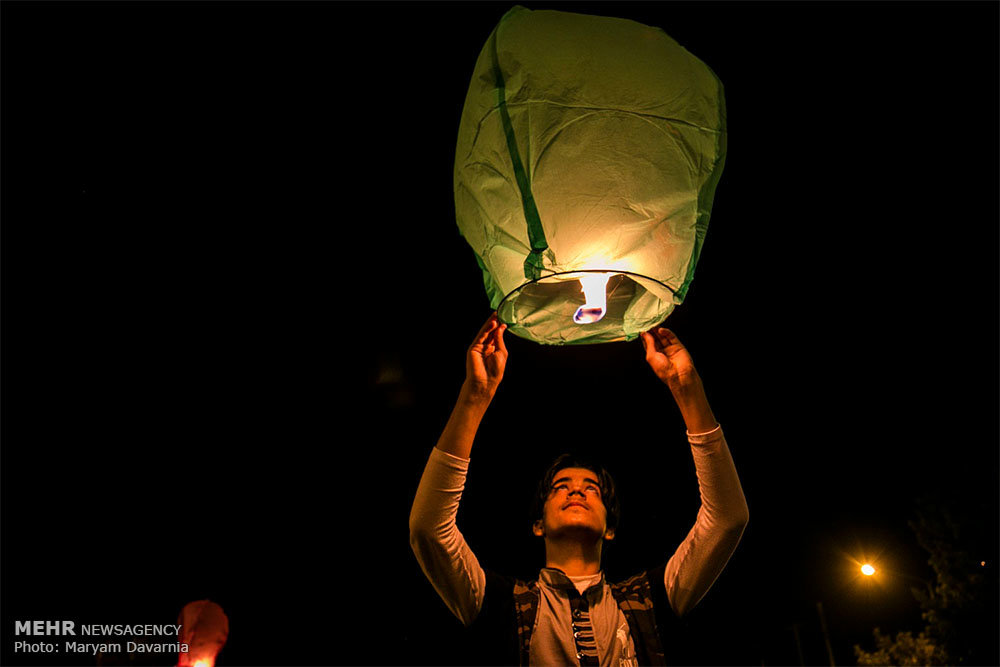
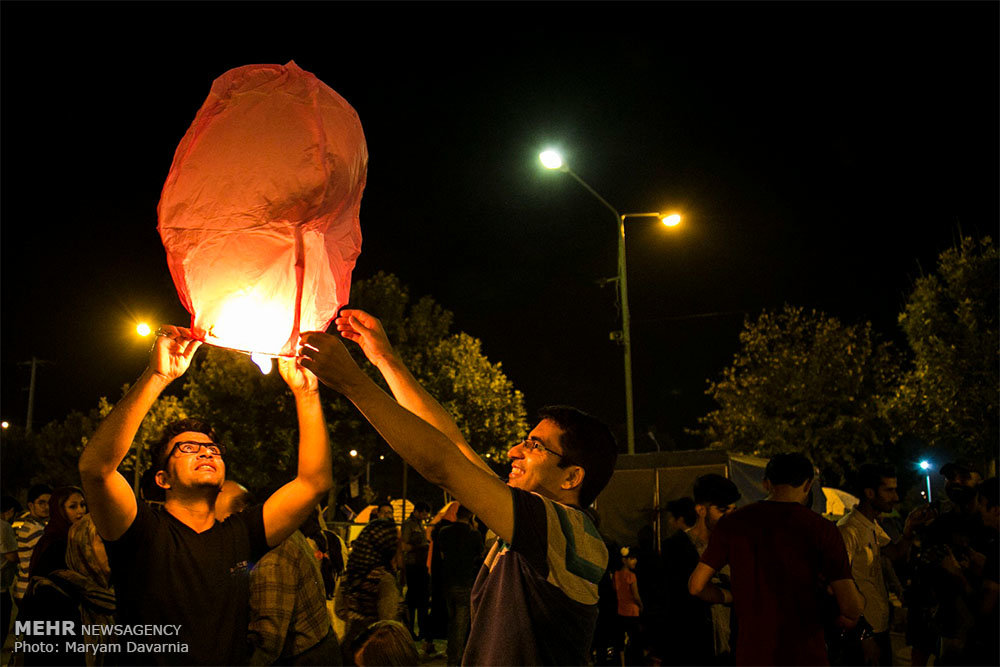
Iranians Hold Balloon Festival in Memory of Syrian Children

Citizens of Bojnourd gathered in the Besh Qardash Park on Friday to take part in the balloon festival held to commemorate the poor and innocent children of al-Foua and Kefraya besieged by the Takfiri terrorists.

Terrorists have for several years blocked humanitarian aid deliveries to the towns, where more than 7,000 Syrian civilians are trapped in an area of no more than 10 square kilometres.

The Syrian Ministry of Foreign Affairs says the civilians there, most of them women and children, lack the basic livelihood needs, including food and medicine and clean drinking water, and are in catastrophic situation.

Here are Mehr’s photos of the festival: