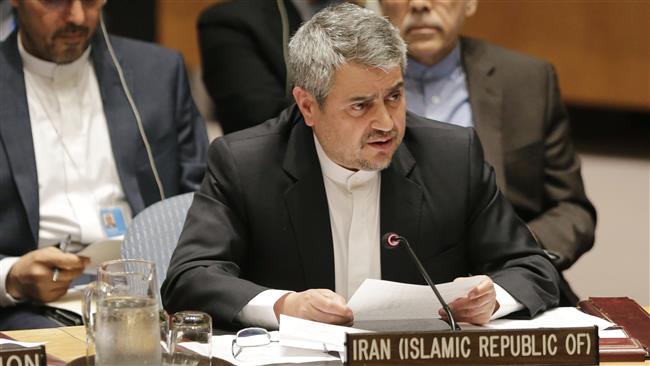
Iran’s Ambassador to the UN Gholam-Ali Khoshroo handed over to Guterres the country’s reaction to Trump’s anti-Iran allegations, and asked him to circulate it as a UNSC document.
Here is the full text of Iran’s reaction to Trump’s speech, retrieved from the Iranian Foreign Ministry’s official website:
In the name of God, the Compassionate, the Merciful
Statement of the Islamic Republic of Iran
13 October 2017
Since the victory of the Islamic Revolution in 1979, Iranian foreign policy has been developed and implemented based on principles of international law and international rules and conventions; respect for sovereign equality of all states and non-interference in internal affairs of others have formed the cornerstone of relations with other countries. After decades of dictatorship, dependence on foreign powers – especially the United States – and constant interference of those powers in Iran’s internal affairs, the Iranian people, with their newly-established democratic government, had hoped to be able to finally build ties with neighbours based on equality and fraternity, free from political, economic and military rivalries; to form a peace-seeking nation that sought to replace enmity and bloodshed with friendship and cooperation. By contrast, the United States and its allies in the Persian Gulf region have persistently refused to accept realities of Iran and the region, and have vainly attempted to thwart the Iranian peoples’ quest for democracy and self-determination.
From the very first days of the Islamic revolution, the United States adopted a hostile, interventionist and destabilizing approach towards Iran’s newly-established government — with the aim of overthrowing it. The United States’ bleak record — staging several coup attempts, harbouring terrorists, openly supporting Saddam Hussein during the imposed war against Iran — even his use of chemical weapons against Iranians, aiding secessionist plots, downing an Iranian civil airliner, and hundreds of other conspiracies against the Islamic Republic of Iran and its people — is undeniable. Even before the Islamic Revolution, the United States sponsored a coup against the democratically-elected government of Iran in 1953, thereby showing its constant historic enmity with democracy and its support for dictators.
Terrorist groups — that have found safe haven in and plotted against the Iranian people from the United States over the past 38 years– murdered 17000 Iranians in the first few years following the Islamic Revolution. The Islamic Republic of Iran, while successfully establishing the highest standards of stability and security at home, has provided its advisory services to the people and security forces of Iraq and Syria, playing an indispensable role in combating terrorism, thwarting the Takfiri campaign to take over Damascus, Baghdad and Erbil, and helping uproot these groups from Iraq and Syria. The constructive role of our armed forces in combating terrorist groups — which the current US president himself cited during his campaign as having been created by the US — has been instrumental in eradicating this scourge. It is unfortunate that, instead of discarding terrorism as a tool and joining Iran’s genuine counter-terrorism efforts, the United States continues to misportray these constructive efforts as destabilizing.
The role of the Islamic Revolution Guards Corps (IRGC) in the frontlines of combating terrorism in the region is irrefutable. The Corps, a branch of Iran’s armed forces, has an impeccable track record of containing Takfiri terrorism, restoring gradual tranquillity for the people of the region as well as safeguarding national sovereignty and territorial integrity of Iraq and Syria. The Revolution Guards are regarded as national heroes for their role in the defence of Iranian territory against Saddam Hussein’s army. Any action by the US administration or Congress against the IRGC will constitute a strategic mistake and will draw the indignation of the Iranian people and a strong and unified reciprocal reaction. The US President will have to bear full responsibility for all consequences of his rogue behaviour.
The United States has defined its interest in generating and aggravating regional disputes, and exacerbating conflict and insecurity to fuel an arms race and create bigger markets for its weapons. On the other hand, Iran has identified its regional interests with good-neighbourliness, and peace and stability in the highly sensitive Persian Gulf region. This is in clear contrast with the publicly stated position of the current president of the United States, who in his campaign, publicly considered the war between Iran and Iraq as serving US interests, and more recently openly made his visit to the region contingent upon the sale of hundreds of billions of “beautiful weapons” — tools of destruction that are currently being used against defenceless children and the elderly in Yemen.
The crises in our region, including in Afghanistan, Iraq, Syria, Yemen and Bahrain, are rooted in occupation, illegal military interventions, and hegemonic designs of the United States in the region. In contrast, the Islamic Republic of Iran firmly believes that its national security interests can only be secured through dialogue, confidence building and multilateral cooperation within the region, and we are determined to actively contribute to the promotion of effective regional cooperation for peace and security. Iranian proposals for political settlements to end the horrifying wars in Yemen and Syria have been welcomed by the international community, and Iran has played a constructive role in every international initiative aimed at ending regional conflicts. Iran has also cooperated with Russia and Turkey effectively to de-escalate the violence in Syria, and stands ready to contribute actively to joint efforts with the United Nations Secretary General and other responsible countries – including other permanent members of the Security Council – and the European Union, to put an end to conflicts and violence.
The hostile policies of the United States and its regional allies, especially the Zionist regime, as well as the transfer of hundreds of billions of dollars’ worth of arms into the region that have turned the region into a tinderbox require the Islamic Republic of Iran not to be complacent about the country’s defence needs. During the war imposed on us by Saddam Hussein’s regime, not only did the United States and its regional allies provide military, intelligence, logistical, economic and political assistance to Saddam, and offer their support and maintained their silence during his chemical weapons attacks campaign, they also did everything in their power to interdict the acquisition of even the most basic defensive capabilities by Iran. Through that experience we learned that in order to protect our people, safeguard our independence and security and defend our national honour, we must rely on indigenous capacities and not hesitate in developing the capability to meet the country’s legitimate defence needs. It is in this framework that Iran’s missile program has a purely defensive and deterrent character. Our missiles are strictly designed to carry conventional warheads and their range and precision are proportionate to our security environment and threat perception. It will continue with full force in accordance with our national defence program and is not, nor will it ever be, negotiable. When US allies in the region, whose combined population is far less than Iran, each spend exponentially higher sums on their military than Iran, why shouldn’t Iran — that has attacked no one in almost 300 years but has been the victim of aggression supported by the US and its regional partners — acquire necessary tools of deterrence in the face the constant threats by aggressors?
The antagonistic policies of the United States against Iran have also extended to the realm of advanced science and technology in past few decades. The United States has imposed restrictions that bar scientific and technological exchanges while also imposing sanctions in these fields. These actions serve no purpose but trying to hold back our technological development and prolong dependence on advanced powers. The efforts of our young scientists to acquire the knowledge for the development of a peaceful nuclear program has from its outset been met with propaganda, sanctions, cyber-attacks and even the assassination of our scientists. Iran has repeatedly stated that it wishes to utilize nuclear energy peacefully, and that we view weapons of mass destruction — including nuclear weapons — as disruptive to peace and security, and as such they will never have a place in our military doctrine. The International Atomic Energy Agency’s report and conclusion in 2015, rejecting accusations of Possible Military Dimensions (PMD), acknowledged the peaceful nature of Iran’s nuclear activities.
Iran has demonstrated its good will by entering into and its conclusion of nuclear negotiations with the P5+1 to resolve a fabricated crisis, and we have proven our fulfilment of our undertakings by the good-faith implementation of our commitments in accordance with the JCPOA. In contrast, the United States’ fulfilment of its commitments has been lacklustre and deficient from the very beginning, and in several cases — especially during the current administration — it has violated both the spirit and the letter of the JCPOA. The Islamic Republic of Iran has officially registered with the Joint Commission those violations, including failures in lifting of sanctions and policies preventing the establishment of an atmosphere necessary for normalization of trade and economic relations with Iran. The claim by the president of United States regarding Iran’s non-compliance has no international relevance or credibility, since the IAEA, as the sole authority to conduct such monitoring and verification, has repeatedly confirmed Iran’s full compliance with its commitments under the JCPOA. This proves once again that the United States is not a reliable negotiating partner.
The JCPOA is a valid international instrument and an outstanding achievement in contemporary diplomacy. It cannot be renegotiated or altered. The nuclear deal is not a bilateral agreement that can be annulled by unilateral action, but a deal endorsed by the international community and incorporated as a part of Security Council Resolution 2231. Other JCPOA participants, as well as the rest of the international community, should not allow the president of the United States to continue to mock and undermine the deal. The Islamic Republic of Iran will not be the first to withdraw from the deal, but if its rights and interests in the deal are not respected, it will stop implementing all its commitments and will resume its peaceful nuclear program without any restrictions.
Today, the United States is more isolated globally than ever before and the veracity of Iran’s policies and positions have become evident to the international community. The world has witnessed that over the past several weeks, most countries have been unified in supporting the JCPOA and the Islamic republic and rejecting US policies. The international community views Iran as a responsible actor endeavouring to promote peace and will not give any credence to rogue actors further isolating themselves every day by withdrawing from one or another international agreement and organization.
The difference between Iranian and US policies on many international and regional issues are clear and undeniable. Because of their miscalculations, various US administrations have aggravated these differences into open hostility against the people of Iran. In spite of all these animosities, embodied mostly in illegal threats and sanctions, the people of Iran have resiliently persisted in their quest for justice and independence. Iran has reached the pinnacles of influence and strength through relying on its own people and its indigenous capabilities, benefitting from the prudent and wise guidance of Ayatollah Khamenei, who has personified the dignity and integrity of the Iranian people, following the footsteps of the late Imam Khomeini. The new US rulers must not forget the hard lessons of the past four decades; they should not forget that previous administrations — who by uttering similar fallacies put themselves in open rivalry with the Iranian people – were forced to retreat from such imprudent utterances.