Saturday, December 27, 2025
Home Blog Page 3867

Trump Aware of Dangers of Violating Iran Nuclear Deal: Analyst

donald-trump

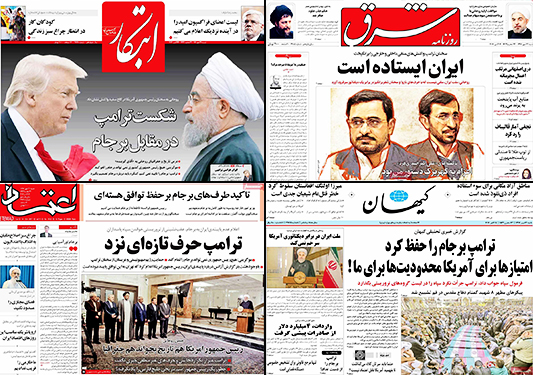
Shani Hormozi, an expert at the Expediency Council’s Centre for Strategic Studies, has, in an article published in the Persian-language Shargh daily, weighed in on the new US government’s policy on the Iran nuclear deal known as the Joint Comprehensive Plan of Action (JCPOA).

He underlined that the Trump administration is to, once again, report to Congress on Iran’s compliance with the JCPOA on October 15, 2017.

“The reality is that the Trump administration, despite being criticized for its inexperience in the foreign policy arena, is well aware of the dangers of the violation of the JCPOA. So, it seeks to set the stage for pointing the finger at Iran rather than openly withdrawing from the deal. One of the policies adopted [by Washington] in this regard is to lay the groundwork for presenting another definition of ‘compliance,’ whose general framework was delineated by [US Ambassador to the UN] Nikki Haley in a speech,” said the commentator.

Hormozi then referred to Haley’s speech at the American Enterprise Institute.

“Her use of false accusations to offer a new meaning of abidance by the JCPOA as well as using new untrue statements to accuse Iran of not remaining committed to the deal was planned within a meaningful structure,” said Hormozi.

Based on the new concept presented by the US, compliance with the JCPOA is not only a simple and basically technical concept; rather, it has three key components: The JCPOA, UN Security Council Resolution 2231and the law passed by the US Congress to monitor the implementation of the JCPOA.

Then the US says Iran’s compliance should not only be studied from the three above-mentioned perspectives, but, as a whole, it should be reviewed with regard to the nature and history of the Iranian government’s performance. This begs the question of why the Trump administration seeks to link the nature of the Iranian government and its performance since the 1979 Islamic Revolution to the JCPOA. The Trump administration is trying to mention respect for “international regulations” and abidance by “international agreements” together and come to the conclusion that respect for international regulations is a precursor to compliance with international agreements. Although the US has shrewdly crafted this policy to make international players pessimistic about Iran and the future of the country’s compliance with the JCPOA, it suffers from a major shortcoming, which is putting “intention” and “policy” in the wrong order. In fact, Trump first announced he intended not to confirm Iran’s compliance and then called on his Cabinet members and advisors to prepare the ground for announcing the non-compliance. This intention, and not policy, is not lost on media and Washington’s European allies.

Therefore, at least in the short run, arrangements and policies as such, will not be able to persuade key audiences. But what is important is that Trump’s personal traits and character are such that he is as likely to go back on his words as he is to keep them. This gives all players, namely Iran, the message that they should be prepared for all possible scenarios.

GAP Exhibition Presents Contemporary Iranian Architectural Works

The GAP was established based on an initiative by senior lecturer of the University of Melbourne, Blair Gardiner, and seeks to cultivate cross-cultural ties between Melbourne and cities around the world by organising exhibitions to show the architectural projects of various urban centres.

In the current academic year, Tehran has been selected as the eighth city to display its architectural works. Hence, the GAP has invited 7 prominent Iranian architects who have carried out prominent projects in Tehran to participate in the event.

From Iran, the Keivani Architects Studio, the Huba-Design Architectural Office, the Madjdabadi Architectural Office, the Cloot, the Shift Design Group, the Next office, and the Moj-e-No (New Wave) Architectural Office, have been invited to the exhibition.

Nima Keivani said in an interview with the Mehr News Agency that “the exhibition is a student collective activity that takes place at the Faculty of Architecture, Building and Planning of University of Melbourne, Australia. This is an excellent occasion for further introducing contemporary Iranian architecture and contemporary art to the international community. We see that the media and international organizations are paying great attention to architecture, and it proves that our country’s architectural position in the world is growing.”

At this event, seven well-known architectural offices of Tehran, who had previously carried out noticeable projects, present their works at the exhibition to the public as well as to the students of Designing and Architecture at the University of Melbourne.

On the sidelines of this exhibition, full interviews with Iranian architects will be published on the websites, publications and social pages of the university. They will also be published in the form of books and catalogues along with a full report of the exhibition.

Furthermore, a report and video footage in form of Q&A will be presented to the audience. At this session specialized questions in the field of architecture would be raised and the architects can express their concerns.

The exhibition was started at 6 pm on September 28 at Atrium of the University of Melbourne’s School of Design and will continue until October 12, 2017.

Östersund Player Chooses to Play for Iran despite Sweden Invitation

The 24-year-old midfielder, whose side Östersund FK tops the Group J of Europa League, was recently called on by Carlos Queiroz to play for Iran while he had played in two friendly matches for Sweden and scored a goal.

On 25 August 2017, Ghoddos revealed in an interview that he acquired his Iranian passport from the embassy. The following day, 26 August, he announced on his Instagram page that he would be joining Iran for their 2018 World Cup qualifiers against South Korea and Syria.

Östersund Player Chooses to Play for Iran despite Sweden InvitationGhoddos was called up for the first time for the Iran senior team training camps on 27 August 2017 by coach Queiroz for Iran’s 2018 FIFA World Cup qualifying matches against South Korea and Syria.

After Ghoddos couldn’t make his debut for Iran due to administrative issues with FIFA, he was called into Sweden’s World Cup qualification squad on 27 September for matches against Luxembourg and Netherlands.

He told the Swedish side that he will make his decision by Thursday, September 28. Now, Sweden’s Fotbollskanalen says Ghoddos has finally decided to play for Iran.

He later told a Swedish website about his decision that he is grateful to Andersson, the head coach of Sweden, for giving him the extraordinary option, but he has made his final decision and he will play for Iran.

He also wished success for Sweden in the road to FIFA World Cup 2018.

Andersson also noted that he is very upset about Ghoddos’ decision, but he respects that.

Ghoddos had earlier said in an interview with SportExpressen, “I will always love Sweden. I’ve grown up here. It is an honor to live here and to represent Sweden. At the same time, my parents are Iranian. I have Persian blood in my body. I love Iran too.”

1 Killed, 2 Wounded in Army Chopper Crash in Northwestern Iran

Speaking to the Tasnim News Agency, local military commander General Habib Shahsavari said the Army’s Bell-214 helicopter crashed on Thursday due to technical failure.

One person has been martyred in the incident and two others have been injured, who are expected to be discharged from the hospital within the next two days, he added.

In separate comments, Colonel Karim Hossein Nejad said the copter has crashed during a test flight.

Three servicemen were on board the doomed chopper, he explained, saying the flight technician has been martyred, while the pilot and co-pilot have suffered injuries.

Israel Main Winner of Iraqi Kurdistan’s Secession: Analysts

By triggering the idea of the Iraqi Kurds’ independence, Israel is seeking to disintegrate Iraq in order to undermine the strong Shiite forces fighting ISIS in the war-torn country, wrote in an op-ed the managing director of Persian-language Javan daily, Abdollah Ganji.

Ganji said Israel has raised and contributed to the idea of the Kurdish independence to roll back the latest victories of Iraqi forces backed by Popular Mobilization Units over ISIS.

He went on to say that Tel Aviv is deeply worried that during the upcoming post-ISIS era in Iraq, the united coalition of experienced forces from Pakistan, Afghanistan, Iraq, Syria, Lebanon and Iran will turn their eyes to Israeli forces in the Golan Heights.

“Therefore, to avoid any confrontation, Israel has hatched a plot to involve the forces in a new crisis.”

“As Hezbollah Chief Hassan Nasrallah said, the future war in the region would not be limited to Israel and Hezbollah but there will be many other sides including Iraq, Iran, and Afghanistan and so on,” Ganji noted.

“Creating a new civil war in Iraq will waste the available energies and capacities in a region far from the Golan Height. Fight against ISIS created a unity between experienced forces and paved the way for a massive campaign against the terrorists. Now the Zionists are deeply worried about the future of these forces in the post-ISIS era.”

“Kirkuk is a potential scene for another war which the Zionists are seeking to trigger. Substantiated reports say the US is seeking to destabilise the region by 2035 and the creation of ISIS and the disintegration of Iraq is part of the plan,” he added.

In another piece in the same newspaper, conservative analyst Abbas Salimi Namin said the latest developments in Iraqi Kurdistan region once again reveals the racial nature of Tel Aviv.

He went on saying the Zionists look at the Iraqi Kurds as an instrument to press ahead with their own interests in the region.

“Unfortunately, it is not clear yet why the head of Kurdistan region, Barzani, has forgotten his father’s recommendation who warned against putting trust in the Zionists. We also don’t know in return for which concessions he has decided to hold the referendum,” he wrote.

It goes without saying that if Iraq faces the tragic fate of Sudan, the least benefit that the Zionist will reap would be putting immense pressure on Baghdad to keep Tehran at bay. “The same story will go on for Iraq and Syria as well,” he added.

Salimi Namin accused the US of adopting double standard policies, saying the US claims it is in the camp of Iran, Turkey, Iraq and Syria when it comes to the independence of the Iraqi Kurds but “the independence vote was not possible without the US and the UK’s support for Iraq’s disintegration.”

“Meanwhile, the Zionists’ plot to fuel ethnic clashes in the region would end up in failure if the US and the UK hadn’t supported it,” he concluded.

‘Iran’s Rank Higher than Russia, Turkey in Tourism Security’

Isfahan -Foreign Tourists-2017

Iran’s ranking is higher than that of Russia and Turkey when it comes to tourism security, said Mohammad Moheb-Khodaei, the deputy head of the Iranian Cultural Heritage, Handicrafts and Tourism Organization for tourism affairs.

According to a Farsi report by Tasnim, he enumerated the features and standards of Iran’s tourism industry based on the figures presented by the World Tourism Organization.

“Iran currently ranks 94th in the world in the tourism industry. Iran has the 79th rank in terms of competitiveness and 86th place when it comes to tourism security, which is higher than that of Turkey and Russia.

He also said Iran’s airports have the 94th rank in the world in the airports sector, the 75th rank in the transportation and ports sector, and 38th in tourism culture.

“So, based on these statistics, we should be witnessing changes in standards of tourism in the country.”

He further noted that the tourism industry contributes to reducing unemployment, saying, “Of every 10 jobs in the world, one is related to tourism, and each job which is created in the tourism sector will create 7 jobs indirectly,”

Speaking in a ceremony marking World Tourism Day, he touched upon efforts made by those active in the field of tourism, tourism institutions, immigration police, university professors working in the field of tourism, journalists and reporters, the Foreign Ministry, the Ministry of the Interior, the Ministry of Health, Treatment and Medical Training, aid worker and ambassadors.

“World Tourism Day is very important for those active in the field of tourism,” he said, adding the tourism industry has been the focus of attention by people from all walks of life and authorities during President Hassan Rouhani’s administration.

“In the first year of the 6th National Development Plan, we have envisaged the creation of 70,000 jobs with the implementation of the ‘Resistance Economy’ strategy, which will serve as a model for us,” he said.

He then highlighted two key issues, namely supporting the private sector and paying attention to the tourism economy.

”Cultural and domestic elements as well as local values should be incorporated into the development of tourism, so that we will witness a drop in extravagance, maintenance of natural diversity, local contributions and promotion of marketing in the tourism sector,” he said.

‘West Plotting to Take Advantage of Kurds’ Secessionist Mentality’

The Persian-language daily Kayhan has, in an opinion piece, weighed in on the West’s new conspiracy for the Middle East region. The following is the full text of the article.

In West Asia, the end of the ISIS terrorist group’s activities is intertwined with a new plot. This time, the US and Israel want to take advantage of a handful of secessionists rather than ISIS to test their chances of implementing an evil plan known as “The Greater Middle East.”

Accordingly, there are secessionists such as Barzani, who have shown in word and in deed that they favour adventurism in dealing with the destiny of Kurdish people in northern Iraq. They have a mission to distort the realities of the past 100 years and disguise the wolf as the shepherd for Kurds and switch the places of benevolent and malevolent individuals.

This mission is quite obvious as it can be understood from the recent remarks made by Masoud Barzani and his aides in recent days. In order to create the impression that the referendum on the secession of Kurdistan was legal, Barzani has flashed back to the gas attack against Kurdish people in the city of Halabja in southern Kurdistan back in 1988 ordered by former Iraqi strongman Saddam Hussein, but has brazenly enough turned a blind to the fact that the US and Europe were the main accessories to Saddam Hussein’s crimes. The chemical attack against Halabja people by Saddam Hussein was supported by Washington, but Barzani and his aides did not mention this fact and remained silent. This way, instead of the US, Britain and France, the oppressed Arab people, Shiites and Sunnis alike, who had suffered as much as Kurdish people in Iraq had, would be accused, and the places of the wolf and sheep would be changed!

Whose handiwork was ISIS, which has created a reign of terror in recent years? Wasn’t it the ISIS terrorist group that committed heinous crimes against Izadi Kurds and people of other ethnicities? Wasn’t it ISIS that kidnapped Kurdish women? Aren’t thousands of Izadi Kurdish women being held captive by ISIS now?


Barzani: ISIS had arrived at the gates of Erbil, and I contacted the US, Turkey, Britain, France and even Saudi Arabia. In response, they said they could not help. Then I contacted General Qassem Soleimani. He answered, ‘Maintain control of the city just tonight. I’ll be in Erbil tomorrow after morning prayers.’ Then he along with 50 special forces went to the battlefield, organized Peshmarga forces, and the situation turned in our favour.


Didn’t ISIS terrorists threaten the borders of the Iraqi Kurdistan region in 2014? Didn’t Barzani and his wife pack up and get ready to flee? Barzani himself knows better than anyone else that if it weren’t for the prompt action of Iran’s General Qassem Soleimani, a doomed destiny would have loomed large for the residents of Erbil and other areas in Kurdistan.

In January, 2015, Barzani talked to the Turkish Zaman daily about how Erbil was saved.

“ISIS had arrived at the gates of Erbil, and I contacted the US, Turkey, Britain, France and even Saudi Arabia. In response, they said they could not help. Then I contacted Iran and asked for help. I said ‘We would evacuate the city if you won’t help.’ Then they gave me [general] Qassem Soleimani’s phone number. I called him immediately and told him the story. He then answered, ‘Maintain control of the city just tonight. I’ll be in Erbil tomorrow after morning prayers.’ Then he along with 50 special forces went to the battlefield, organized Peshmarga forces, and the situation turned in our favour,” said Barzani.

How can these organizers of the secession scenario in Iraq cover up the US, Israel, Britain and France’s backing for Takfiris and ISIS in Syria and Iraq?

At the moment, the greatest betrayal to Kurds would be to disguise their real slayers as friends, and friends as foes, and this is what some individuals poised as Kurds are commissioned to do.

It is noteworthy that the United States, Britain, France and the UN had not opposed the referendum in principle in recent days and even asked Erbil to delay the plebiscite for two years in return for their full support for the secessionists.

BBC, which has been enthusiastically covering stories pertaining to the developments in Iraq’s Kurdistan region, recently raised a question cunningly in order to sway certain currents.

“Will independence-seeking currents spread to Afghan borders?!”

This shows BBC favours the disintegration of the regional countries within the framework of the evil Greater Middle East scheme.

Iran Not to Recognize Any Group’s Sovereignty over Northern Iraq

“We do not regard any sovereignty for the parties and groups in North Iraq, and this is a common belief held by the Armed Forces of the both sides (Iran and Iraq),” Major General Mohammad Hossein Baqeri said in a joint press conference with his Iraqi counterpart Major General Othman al-Ghanmi, held in Tehran on Wednesday evening.

“The Islamic Republic of Iran recognizes integrated and unified Iraq, and as the Iraqi prime minister has said, Iran’s common frontier with Iraq are the existing legal borders,” the Iranian general noted.

Iran Not to Recognize Any Group's Sovereignty over Northern Iraq

Both Tehran and Baghdad disapprove of the Iraqi Kurdistan Region’s independence referendum, Major General Baqeri added, stressing that Iran does not agree with any change in Iraq’s geography or with the secession of any region from that country.

He also noted that he has reaffirmed Iran’s commitment to supporting the Iraqi government, Army, and the Popular Mobilization Units (PMU) -also known as Hashd al-Shaabi- in the meeting with the visiting Iraqi general.

Iran Not to Recognize Any Group's Sovereignty over Northern Iraq

For his part, Major General Ghanmi said their talks have revolved around military cooperation between Tehran and Baghdad, the necessary coordination amid the current critical situation, and the efforts to ensure security along the common borders.

Separately on Wednesday, Baqeri met with senior military and political officials from Turkey, during which the two sides discussed a variety of issues, including the Kurdish referendum in Iraq.

Baqeri told reporters after the meeting that both the Iranian and Turkish sides were concerned that the Kurdish vote in Iraq could lead to tensions in the Arab country, the repercussions of which could engulf the regional countries.

While Iraq’s Kurds rushed headlong into a vote for independence on Monday, all neighbors and countries in the Middle East, including Iran and Turkey, have voiced opposition to the vote and supported the Baghdad central government.

“Iran’s Name Should Bring Nice Concepts to Mind”

Iran

A 2015 Pew Research Center poll found that attitudes toward Iran are mostly negative worldwide. Majorities or pluralities in 31 of 40 countries surveyed hold an unfavorable opinion of the Islamic Republic. And in several Muslim-majority countries in the Middle East and Asia, ratings have declined considerably in recent years.

This has been mostly caused by the Iranophobia project pursued in Western countries, particularly the US and the UK, creating feelings and expression of hostility, hatred, discrimination, or prejudice towards Iran and its culture, and towards persons based on their association with Iran and Iranian culture.

The US has in recent years tried to link Iran’s name to terrorism and nuclear weapons, making the world afraid of the Islamic Republic.

The Asr-e Iran has, in a Farsi article, underlined the importance of promoting words and phrases that would bring the word “Iran” to mind in a positive sense.

“What should my country be known for in the world?”

In other words, “What word or words come to a foreigner’s mind when he/she hears the name of my country?”

This is the most important question that all managers in a country, especially top officials, should constantly think about and plan and act in that regard.

That is what North Korean officials have done. They have decided that the phrase “atomic bomb” come to mind when somebody hears the name of their country.

On the other hand, the name “South Korea” is associated with words such as “Samsung, LG and Hyundai” across the world.

Germany brings “Technology” and “Benz” to mind. Finland reminds one of a “superior educational system.” Brazil is associated with two words: coffee and football. The Netherlands is reminiscent of “gardens of flowers and good breeds of cattle.” France is associated with the words “culture, art, fashion and tourism.” Afghanistan brings “terrorism” and “narcotics” to mind. The United Arab Emirates reminds one of “Dubai, free trade and the Emirates airline.” Qatar brings “natural gas” to mind, and so on and so forth.

The association of these words with the names of countries is not a coincidence. Each one of these associations is the result of the performance of those countries’ officials and people.

Now the question is, “Do our country’s officials and people have any programs to promote key words which would bring the word ‘Iran’ to mind?”

Some time ago, I travelled to Bulgaria.

“Where are you from?” A middle-aged woman asked my daughter at the airport.

When she realized we were Iranians, she smiled and, with her special accent, said enthusiastically, “Oh! … Asghar Farhadi!”

I was glad to see the name of my country was associated with the name of a popular and great celebrity, and not “nuclear arms, human rights violations” and so on.

In the following days, I met a Polish man who was a mechanic. When he found out I was from Iran, he paused and asked, “I see! There is war in your country, isn’t there?!”

I explained to him that Iran was at war with Iraq three decades ago, and that the battlefield was on the border, not inside the country. I asked him to come and visit Iran.

“Maybe for the next vacations,” he answered.

Also several years ago, a Tajik driver in Dushanbe knew Iran with the word “Ahmadinejad” and praised him for standing up to the US.

In Turkey, I met an old man who, as soon as realized I was Iranian, began to criticize the situation of women in Iran.

The reason I am recounting the memories is to ask the question “What words Iran is going to be associated with, at last? Poetry and [renowned Iranian poet] Hafez? Ancient culture and civilization? Tourism? Terrorism? Arts and cinema? Violations of Human Rights? The Cylinder of Cyrus? Carpets, pistachios and rose water? War? The land of four seasons? Confrontation with the US? Wrestling? Kindness and hospitality? Missiles? Or …?”

The country’s planners as well as the people should consult one another and answer the following questions:

What words do we like our country to be associated with in the minds of people around the world?

What are the do’s and don’ts to achieve that strategic objective?

What words would annoy us if associated with the name “Iran?”

What programs should be put in place to dissociate negative concepts from the name of our country?

What responsibilities does each government body and the people have to achieve these goals?

How should this process be monitored?

Let’s not forget that today’s world is one of brands, and if the “Iran” brand is associated with nice concepts, it will protect our thousands-year-old credibility and reputation. Moreover, this targeted association of concepts can turn into power and wealth for the Iranian nation.

Riyadh Willing to Forge Ties with Tel Aviv on Countering Iran

The Basirat news website, in an analytical piece, has highlighted the Saudi Crown Prince Mohammed bin Salman’s overt and covert ties with the Tel Aviv regime, particularly with the aim of countering Iran.

Here is the full text of the piece:

Ever since Mohammed bin Salman climbed up the ladder of success and became Saudi Arabia’s crown prince, his name has been mentioned in many key Saudi cases. Bin Salman, who is said to be very close to being crowned as the Saudi king and assuming his father’s throne, has been a high-profile figure in the Saudi aggression against Yemen, and now he is on course to play a key role in the establishment of ties with Israel. Some time ago, Israeli media spoke of a secret trip to Israel by one of the members of the Al Saud dynasty. Afterwards, some Western media quoted an Emirati intelligence officer as saying that bin Salman was Riyadh’s secret emissary to Israel. Tel Aviv and Riyadh have not yet officially responded to the news; however, as the Emirati official says, the trip comes to resume the peace talks between Israel and the Palestinian Authority. The news was published days after Israeli Prime Minister Benjamin Netanyahu announced last week that Tel Aviv’s ties with the Arab world was at their highest level. Addressing the staff members of the Israel Foreign Ministry, he said the relations were at their highest level, ever, in Israel’s history.

Around three months ago, Israeli Transportation and Intelligence Minister Israel Katz asked Saudi King Salman to invite Netanyahu to visit Saudi Arabia, and send heir to the throne Mohammed bin Salman to Tel Aviv to advance common interests and counter Iran. The minister had also referred to bin Salman as an active and dynamic individual. Now with reports of bin Salman’s trip to Israel, it seems King Salman has met Israel’s demand.

Despite efforts by the Israeli regime as well as Saudi Arabia’s mediation and insistence, some Arab countries have not agreed to recognize Israel as a country so far. Nevertheless, Tel Aviv has covertly established diplomatic and economic relations with some Arab countries, including Saudi Arabia. Israeli Defense Minister Avigdor Lieberman had already called for the establishment of economic and diplomatic relations with Arab countries. As the minister says, these relations should take shape openly.

This comes as Israel signed peace agreements with Egypt and Jordan years ago. In the meantime, Israeli newspapers report of Tel Aviv forging closer security and military cooperation with Jordan on the country’s border with Syria. Israel has openly helped Egypt in fighting ISIS on the Sinai Peninsula. Maybe that is why many Israeli authorities have announced, time and again, over the past two years that Arab countries’ hostile look has been superseded by willingness to have cooperation with Israel.

The Israeli regime has got closer to Persian Gulf littoral states such as Saudi Arabia and the United Arab Emirates in recent years under the pretext of Iran’s growing influence in the region. Of course, Saudi Arabia’s alignment with Israel, especially in their campaign against Iran, is nothing new, and documents recently released by WikiLeaks show Israel and Saudi Arabia began establishing close relations in the mid-1990s. At that time, Saudi Arabia removed some companies linked to Israel from its list of banned entities. The close relationship between Tel Aviv and Riyadh grew stronger in 2002 when Saudi Arabia presented a peace plan. Saudi Arabia continued sending positive signals to Israel in 2005 when Riyadh removed level-two and level-three sanctions.

On the other hand, former Mossad Director Meir Dagan travelled to Saudi Arabia in 2010 for secret talks on Iran’s nuclear program. Also in recent months, the handing over of the ownership of Tiran and Sanafir islands to Saudi Arabia has enabled Riyadh and Cairo to jointly monitor Israeli vessels’ traversing the Tiran Strait.

The Israeli regime is banking on young and ambitious Saudi Crown Prince Mohammed bin Salman. Maybe that is why the former US ambassador to Tel Aviv said the designation of Mohammed bin Salman as the Saudi air to the throne amounted to an Israeli dream coming true. From the viewpoint of this American diplomat, bin Salman believes Riyadh and Tel Aviv have common interests and threats, which, at last, will be in the interest of Israel.

Bin Salman stands ready to return Israeli-Saudi relations back to normal within the framework of the implementation of an Arab peace plan. Meanwhile, one should not forget the role of transregional players, including the US. American President Donald Trump, during his first trip to the Middle East, spoke of the possibility of a new level of cooperation which would pave the way for more security and welfare in the region and across the world.

Bin Salman’s secret trip to Israel ushers in a new era of cordial relations that Trump had spoken of. Still, it remains to be seen whether Saudi-Israeli close relations will be conducive to a permanent and strategic agreement or will just be a transient alliance aimed at countering a common threat called Iran.

All in all, the Saudis, who have claimed to be advocates of the cause of Palestine and still do, have broken the taboo of having relations with the Israeli regime at this juncture and have no reservations about having ties with Tel Aviv, secretly or openly, within the framework of scenarios such as Iranophobia and countering the resistance front.