Monday, December 29, 2025
Home Blog Page 3814

Iran’s Gondishapur University Inscribed as World Heritage Site

Head of Gondishapur, Mohammad Reza Assari, said the university was registered on November 3 in the UNESCO’s list of world heritage.

In a Farsi interview with ISNA, Assari also said the idea to register Gondishapur University in the UNESCO’s world heritage list was raised first three years ago while the arrangements to hold Gondishapur Congress were being made.

Assari went on saying the registration was made with the aim of reintroducing the long history of the Academy of Gondishapur. “We shared our historical evidence with the UNESCO office in Iran.”

The head of the university said the office confirmed the authenticity of the evidence and the board of the directors is now waiting for the final registration of the university by the world body.

Elsewhere in his interview, Assari added the university was established in 271. “We are happy that the treasure which we had closed our eyes on is now recognized internationally as a historical and ancient site. Today, we can say that Iran is hosting the most ancient higher education centre in the world.”

Assari stressed the Gondishapur University in Dezful has been recognized as the first university in the world. “So far the UNESCO has confirmed our evidence on the history of the university.”

According to Assari, right now many foreign tourists travel to Dezful to visit the world’s oldest university. “In his book on the history of Gondishapur University, Mahmoud Mahfuz from Turkey quotes a line inscribed on the gate of the educational centre saying science and knowledge stand higher compared with sward and force.”

The world’s oldest university was built by Shapour I of Sassanid dynasty in a namesake city which stood near the existing city of Dezful. It included a medical school and was a centrefor training scientists for centuries to come. Iranian, Greek, Indian and Roman scientists conducted studies and scientific research there.

Iranian Writers Invited to Visit Italy

Simon de Conza, the head of the Italian Writers’ Association,has referred to the enthusiasms of Italian writers to establish close contacts with their Iranian counterparts and said ”since last year and particularly after Paris Book Fair, we began to make close contacts with Iranian writers but unfortunately the level of our contacts remains low.”

In an interview with the Mehr News Agency, he went on to say “during the past years, we found out that there are many things about Iran and its literature which we don’t know yet. So, we thought it is necessary to raise the level of our cultural relations because it is now too low.”

Conza also added that Italian writers are interested in the presence of more Iranian writers in Turin Book Fair. “So, we hope with better arrangements, we could witness their further presence in our cultural and literary events.”

During the interview, he added most Iranian and Italian writers and publishers don’t know yet that there are many commonalities between their works. “We are now trying to discover the commonalities. To this end, we need to hold more talks and establish closer relations with each other.”

He called for closer relations between writers from around the world and said “we are seeking a new way to provide the Iranian and Italian writers with appropriate mechanisms to translate and publish their works in other languages and countries.”

Conza stated the Italian association is planning to invite two foreign writers to Italy each month. “We will accommodate and provide them with good facilities so that they would write new pieces or complete their unfinished projects.”

“We will also link them with some Italian publishers to have their works published. We are very interested in having the Iranian writers in our country as well and strengthen the relations between Iranian and Italian publishers.”

Is Iran Capable of Sending Missiles to Yemen?

The Persian-language Mizan Online News Agency has, in an article, weighed in on a recent controversy regarding whether or not Iran is able to send missiles to Yemen. The full text of the opinion piece follows.

Given the incessant Saudi airstrikes on defenceless Yemeni people over the past three years, the Yemeni army, popular forces, and the Ansarullah Movement (Houthis) increased the range of their missiles by making certain changes to them. They lobbed one of these very missiles at the Saudi capital, Riyadh, a few days ago.

It was 9 pm last Saturday, November 4, 2017, when Yemeni military sources announced that a rocket had successfully struck an airport in Riyadh. It was a Burkan-2H missile fired by the missile units of the Yemeni army and popular committees at International Malik Khalid airport in the Saudi capital.

Denial and Revenge

After the news was announced, Saudi media claimed the country’s missile defence system had intercepted the Yemeni projectile before it could hit the airport. Nevertheless, hours after news spread that Yemen had fired a missile at Saudi soil, Saudi fighter jets attacked two military bases in the Yemeni capital, Sana’a, and one in the city of Sa’ada. The strikes indicated that Riyadh was to avenge Yemen’s November 4 missile assault.

Foolish Claim

In the early hours of Sunday (November 5), US President Donald Trump, in strange remarks, accused Iran of being involved in the missile attack.

“A shot was just taken by Iran, in my opinion, at Saudi Arabia. And our system knocked it down,” the US President said, referring to the Patriot missile batteries Saudi Arabia has purchased from the US.

Saudi Coalition Blames Iran

The faulty and aggressor Saudi-led coalition also announced in a statement that it had sealed all land, sea and air borders of Yemen. In a baseless claim, the coalition blamed Iran for Yemen’s missile attack on the Riyadh airport. The coalition said Iran’s role in commanding Ansarullah forces in the missile attack on Riyadh was a clear sign of an act of war. The coalition added it regards the attack as a military move and an act of war against Saudi Arabia.

IRGC’s Response

On the same day, commander of Iran’s Islamic Revolution Guards Corps (IRGC) Major General Mohammad-Ali Jafari responded to Trump’s claim that Tehran had provided Sana’a with missiles.

“Trump has made a lot of wrong and unfounded comments and told many lies. He has levelled a lot of accusations against Iran, including this very comment. We are not able to send missiles to Yemen, after all. The missiles belong to the Yemenis themselves. They have increased the missile’s ranges and use them to avenge the blood of their martyrs,” said the top general.

Russian Missiles

On February 7, Major General Mohsen Rezaei, the secretary of the Expediency Council and the former IRGC chief-commander, told Mizan Online News Agency that Yemeni’s attacks on Saudi positions was something natural.

“Nations that come under attack need some time to gain the necessary capabilities. Today, Yemeni people are slowly moving toward self-reliance, and their capabilities are growing day by day. Words that Iran has provided Yemen with weaponry and munitions are sheer lies. The Yemenis already possessed missiles before Saudi Arabia imposed a war on them. They had received a lot of missiles from Russia,” said Rezaei.

No Possibility of Sending Medicines to Yemen, Let Alone Shells and Missiles

Hassan Hanizadeh, an expert on West Asia issues, also told Mizan Online that that the Yemeni army has set up a specialized committee to produce long-range missiles. He said the committee makes changes to the missiles to increase their range and accuracy.

“The accuracy with witch the Yemeni missile hit the Malik Khalid airport in Riyadh has  surprised the military experts of the United States, Saudi Arabia and their allies,” said Hanizadeh.

“As the Americans and Saudis do not want to confess that the Yemeni army and Ansarullah have developed deterrence power and can land their missiles on Saudi soil, they level accusations against Iran and say the Islamic Republic provided Yemen with the missiles,” he said.

He said the accusations are mainly aimed at launching a propaganda campaign against Iran and, as a result, isolating the country.

Hanizadeh noted that Yemen is under a total blockade from the sea, land and air, adding US warship are also present in the Gulf of Aden and the Bab-el-Mandeb Strait.

Under such circumstances, he added, it is not even possible to send medicines to Yemen, let alone shells and missiles for Ansarullah and the Yemeni army.

It seems that the recent developments in Lebanon and Lebanese Prime Minister Saad Hariri’s resignation, levelling accusations against Iran over the Yemeni missile attack on Saudi Arabia, and the Israeli air raids on Hezbollah’s positions in Syria are all part of a new plot to create tension in the region, he noted.

It is noteworthy that Yemen’s missile strike on the Riyadh airport was part of Yemen’s retaliatory attacks against Saudi Arabia, which has been carrying out airstrikes against innocent Yemeni people.

Trump also claimed it was US-made missile defence systems that Saudi Arabia allegedly used to intercept the Yemeni missile, though reports suggest the projectile actually hit the airport. Trump also continued marketing US-made missile defence systems while aboard the plane en route to Japan, the first stop of his Asian tour. And Bin Salman in a phone conversation with British Foreign Secretary Boris Johnson claimed that Iran is to blame and has declared war.

Several American Figures Attending Arba’een Pilgrimage

Former congress woman Cynthia Ann McKinney was among the most notable figures whose participation in the religious trek grabbed the headlines in recent days.

Other American figures include political and social activist, Imam Mojahed Abdolkarim who is also the Imam of Rasoul Mosque in Los Angeles.

Two other social activists, the Italian author Fabrizia Baldissera and the American writer Edith McLeod Armstrong,are also among the figures in the religious event.

Interestingly enough,famous Russian political scientist Alexander Dugin, who is an advisor to Russian President Vladimir Putin, is also taking part in this year’s pilgrimage.

Saudi King Salman to Transfer Power to His Son within Two Nights: Report

Rai al-Youm, an Arab world digital news and opinion website, reported on Wednesday that the king will announce the decision within “the next two nights.”

Earlier on Wednesday, Saudi-owned television news channel Al-Arabiya had announced the news in a Twitter message, but it retracted the post hours later.

Political analysts say the regime in Riyadh is apparently seeking to test the waters and examine public reaction regarding a surprise shift in power.

Saudi King Salman to Transfer Power to His Son within Two Nights: Report

Since the establishment of Saudi Arabia as an absolute monarchy in 1932, the system has been effectively known as a hereditary dictatorship and monarchy.

The expected development marks a change in the order of succession in Saudi Arabia from lateral lines of elderly brothers to a vertical order under which the king hands power to his favorite son.

Saudi King Salman to Transfer Power to His Son within Two Nights: Report

Speculation of King Salman’s possible abdication surfaced in late June, when the monarch deposed his nephew, then deputy crown prince Mohammed bin Nayef as the heir to the throne and offered the position to his favorite son, in what analysts described as a “political earthquake” back then.

On the same day that King Salman replaced bin Nayef with his own son, a well-known Saudi online activist, known on Twitter as @mujtahidd, predicted that King Salman would renounce power in favor of his son.

The whistleblower has already leaked documents indicating high-level corruption inside the Saudi royal family.

In early September, the website of Lebanon’s al-Manar channel reported that the 32-year-old bin Salman had formed a team of aides to prepare the kingdom for celebrating his succession to power as the new king.

The paper quoted sources close to the royal family as saying that King Salman was due to step down over his health issues. The sources then noted that bin Salman had ordered the kingdom’s security officials to increase supervision of royal figures to prevent any coup.

Since replacing his cousin bin Nayef in June, bin Salman has embarked on a campaign to consolidate power, taking on rivals within the royal family.

Saudi King Salman to Transfer Power to His Son within Two Nights: Report

Late Saturday, bin Salman sent shockwaves through the kingdom when he fired senior ministers and had dozens of the country’s richest men detained, ostensibly on the grounds of fighting corruption. The arrests included his cousin and one of the world’s richest men, al-Waleed bin Talal.

Human Rights Watch on Wednesday voiced serious concern over the recent arrests in Saudi Arabia.

Analysts say the targeting of Saudi Arabia’s long-standing elite represents a shift from family rule to a more authoritarian style of governance based on a single man.

Riyadh has taken on more aggressive policies since bin Salman’s elevation to the position of defense minister and deputy crown prince in 2015, and later to the position of crown prince.

The kingdom is currently struggling with plummeting oil prices. The Al Saud regime also faces criticism over its deadly military campaign against neighboring Yemen, which it launched on March 26, 2015.

Many also see Riyadh’s policies as a major cause of the crises unfolding in the region, especially in Syria and Iraq.

Iran Opens New Embassy Building in Tajikistan

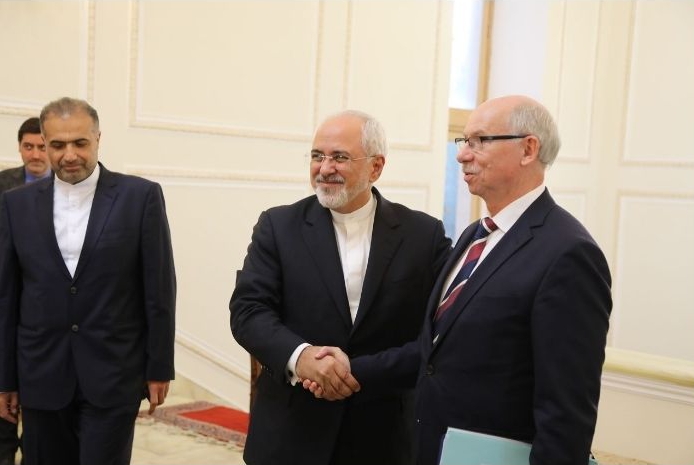
Iranian Foreign Minister Mohammad Javad Zarif opened the new embassy building during his short visit to the Central Asian state.

In an address to the opening ceremony, which was also attended by Tajik FM Sirodjidin Aslov, Zarif described Tajikistan as “the country of our kind friends” and stressed that “we find ourselves in our second homeland when we talk with our well-wishing friends who speak the same language as us.”

“The most beautiful explanation for this sense are the remarks made by the Leader of Iran’s Islamic Revolution who described the ties between Iran and Tajikistan as ‘relations between relatives’,” he added.

The Iranian top diplomat stressed that Tehran is determined to expand relations with Dushanbe in all fields and open up new horizons in cooperation with the Central Asian country.

Iran Opens New Embassy Building in TajikistanHe wished that the long-standing relations between the two Persian-speaking countries would further develop.

Zarif also declared that the joint commission of economic, technical, scientific and cultural cooperation between the two countries will hold a meeting in the near future.

He also pointed to the inauguration of the new embassy building and said, “This splendid building, in which the art of traditional Iranian architecture is used and is a modern one at the same time, is a symbol of common and ancient heritage of Iran and Tajikistan which share the same religion, culture, and language.”

Zarif arrived in Dushanbe on Wednesday in his first visit since two years ago. While in the Tajik capital, he held separate meetings with FM Aslov and President Emomali Rahmon.

Later on Thursday, he left Dushanbe for the Uzbek city of Samarkand, where he has arrived and is going to attend the International Conference on Security and Sustainable Development in Central Asia.

UNESCO to Register Iranian Polo, Kamancheh as Intangible Cultural Heritage

The United Nations Educational, Scientific and Cultural Organization (UNESCO) will officially register the Iranian polo and the Persian string instrument Kamancheh on its List of Intangible Cultural Heritage.

According to a Farsi report by ISNA, the decision was made by the Intergovernmental Committee for the Safeguarding of the Intangible Cultural Heritage, said Farhad Nazari, the head of the Iranian Office for Registration of Historical Monuments.

Two years ago, Iran had proposed its polo, which includes horseback riding coupled with narrating stories and music, be registered on the World’s List of Intangible Cultural Heritage, according to Nazari.

It was finally approved for registration, and will officially be registered at the 12th meeting of the committee to be held in South Korea next month, he added.

He further said the case titled “the art of making and playing the kamancheh” will also be reviewed and registered by UNESCO at next month’s meeting.

Millions of Arba’een Pilgrims in Iraq on World’s Biggest Pilgrimage

The ceremony is to highlight the hardships and sufferings of Imam Hussein (AS) and his followers after his martyrdom in 680 AD.

Imam Hussein’s uprising was in protest against Yazid, a caliph of the Umayyad, who tried to de-Islamize the Muslim community. Imam Hussein was martyred in an unequal battle and his family spread the message of his fight against oppression and corruption in the capital of the Umayyad caliphate during their captivity.

The pilgrimage on the 40th day after the martyrdom of Imam Hussein (AS) was banned during Saddam Hussein’s reign in Iraq; however, with the collapse of his regime, Arba’een once again flourished, and this time not only Iraqis, but also millions of Shiite, Sunni, and even Christian lovers of Imam headed to Iraq from all over the world to walk along the desert paths to the city of Karbala.

Iraqis are good hosts. The entire walkway to Karbala is full of stations where Iraqis including men, women, children, Shiites, Sunnis and non-Muslims spend everything they can afford to accommodate the pilgrims and relieve their fatigue.

Iranians are among the many participants in this massive gathering. Each year, the Iranians who return from the Arba’een pilgrimage share their memories with friends and family members, and the next year, they travel to Karbala along with them. This has increased the number of Iranians, who want to take part in the annual mass pilgrimage to Karbala, to over 2 million people in the past few years. It has also become a major social phenomenon, extending the path of pilgrimage from Iraq to Iran.

Religious analysts and sociologists have long been struggling to understand the cause of such a phenomenon. The Iranian media every year try to find a way to reflect the news of this gigantic and unique gathering and introduce it to the world, an effort that has never been able to reflect the magnificence of what is happening on the ground.

The audience must be there and walk in that direction to see and understand the whole reality.

Some say the size of the event and the volume of occasions are so large that the lens of the camera and the paper media cannot correctly reflect. Perhaps this is the reason we see non-Muslims from different countries taking part in the ceremonies of Arba’een in recent years. Even some Western universities like the Massachusetts Institute of Technology (MIT) carry out research into the phenomenon of Arba’een pilgrimage. Maybe the only way to understand the phenomenon that the media are unable to correctly reflect is to participate in it and become part of it.

The IFP has picked some of the best photos of Arba’een released by Iranian media in a bid to partly explain this unprecedented socio-religious phenomenon to the audience.

Egypt’s Sisi Turns Down Saudi Call to Boycott Hezbollah

“Egypt is not planning to adopt any measure to put pressure on Lebanon’s Hezbollah,” Sisi was quoted as saying on Wednesday by Sputnik.

He went on saying his country will not adopt any measure against the Lebanese movement and continues to support the stability of Lebanon.

Earlier, Saudi Arabia had called on Egypt to put Hezbollah movement under sanctions.

In response to a question on Egypt’s stance towards Hezbollah, Sisi stressed the region is suffering from instability due to the crises in Iraq, Syria, Libya, Yemen and Somalia.

He said Egypt supports any measure strengthening the regional stability and preventing from creation of a new crisis.

Egyptian president stressed that the region is too fragile in terms of security and cannot withstand new tensions and crises.

NATO May Withdraw Forces from Iraqi Kurdistan Region

Slovenian Defence Minister Andreja Katič said his country may withdraw its troops stationed in Erbil, Iraq.

“We also expect other NATO countries to do the same,” she was quoted as saying by Kurdpress.

NATO forces are stationed in Erbil as part of an anti-ISIS collation since the terrorist group’s attack on the region in 2014.

She went on saying the details of any decision on the pullout will be announced following upcoming NATO defence ministers meeting.

This comes as Germany has warned against the forces’ withdrawal from Erbil.

German Foreign Minister Sigmar Gabriel said any withdrawal of forces may pave the way for a civil war in Iraq.

He said if his country and other NATO members withdraw their forces from Erbil, Iraq may get involved in a civil war.

On Tuesday, NATO Secretary General said they support dialogue between the Kurdistan Regional Government and the Iraqi government to resolve disputes through peaceful means.

Jens Stoltenberg urged the two sides, Baghdad and Erbil, to refrain from resorting to violence.