Tuesday, April 28, 2026
Home Blog Page 3813

“Iran’s Market Should Not Be Possessed by France”

The Persian-language Alef website, an Iranian media outlet belonging to influential and conservative politician Ahmad Tavakkoli, has published an article on Iran-France trade relations. The highlights of the piece written by Ali-Asghar Khodarahmi follow.

France has, for long, been one of Iran’s trade partners and traditionally possessed part of Iran’s market, and unfortunately still does. However, France in line with sanctions policies, reduced or stopped its exports, even exports of auto parts, to Iran when the Islamic Republic was under sanctions.

During the nuclear talks between Iran and the P5+1 group over Tehran’s nuclear program, France played the role of the bad cop. Nevertheless, after the conclusion of the agreement, France, unfortunately, very easily once again secured the market in Iran and, to some extent, in the region through our country. And even worse, a large part of Iran’s consumer goods were made available to France in contravention of the policies stipulated in the Economy of Resistance initiative.

With the Macron administration coming to power, Paris has regarded Tehran’s policies as a destabilizing force in the region and is seeking a deal on Iran’s missile activities similar to the nuclear agreement. Unlike Britain, Germany, Italy, China and Russia, and without paying attention to the policies of these countries, France is pursuing its autocratic policies such as the time that Iran nuclear negotiations were underway.

If in our country, we regarded economy and foreign policy as interdependent, we would not allow France to control our 80-million-strong market as well as the region’s market which comprises 400 million people. At least, if Iran was to make its market available to France, it had better arranged for capital goods to enter the country, not consumer goods such as vinegar, chocolate, cosmetics, soap, food for pets, combs, bathtubs and showers, which are all produced inside Iran.

Now the question is whether or not the Iranian government wants to boost local industries with such policies! Can we accept that those who issue permits for importing such commodities have made the decision in line with national interests?

Finally, the government should allow manpower (that are NOT retired) to assume managerial posts, at least in medium-level positions, to destroy bases which are full of traditionalist idols and, instead, delineate a new path for the country’s commerce in keeping with the tangible realities associated with the society’s potential.

Iran, Turkey, Qatar Sign Trilateral Trade Deal in Tehran

Iran, Turkey and Qatar have signed a trilateral agreement aimed at boosting trade with Doha amid a Saudi-led blockade on the Persian Gulf sheikhdom.

Iranian Minister of Industry, Mines and Business Mohammad Shariatmadari, Turkish Economy Minister Nihat Zeybekci and Qatari Economy Minister Ahmed bin Jassim Al Thani signed the deal in Tehran on Sunday.

The measure would facilitate the process of the transiting goods among the three countries, by tackling obstacles created to economically isolate Doha.

Earlier, Shariatmadari announced Qatar was eager to expand ties with the Islamic Republic in all areas as a result of the current conditions that the Saudi-led blockade against it had created.

Iranian Minister of Industry, Mines and Business Mohammad Shariatmadari, Turkish Economy Minister Nihat Zeybekci and Qatari Economy Minister Ahmed bin Jassim Al Thani signed the deal in Tehran on Sunday.

The measure would facilitate the process of the transiting goods among the three countries, by tackling obstacles created to economically isolate Doha.

Earlier, Shariatmadari announced Qatar was eager to expand ties with the Islamic Republic in all areas as a result of the current conditions that the Saudi-led blockade against it had created.

Back in June, Saudi Arabia, Egypt, Bahrain, and the United Arab Emirates imposed a trade and diplomatic embargo on Qatar, accusing Doha of supporting terrorism, an allegation strongly denied by the emirate.

The Saudi-led bloc presented Qatar with a list of demands, among them downgrading ties with Iran, and gave it an ultimatum to comply with them or face consequences. Doha, however, refused to meet the demands and said that they were meant to force the country to surrender its sovereignty.

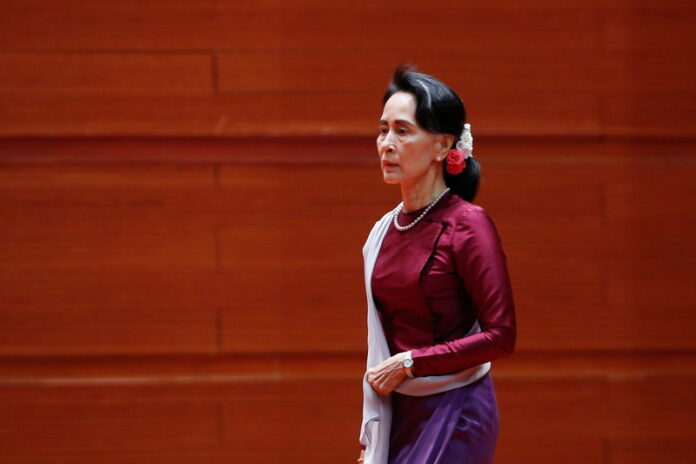
Myanmar Leader Defeats Trump to Win Islamophobia Award

Suu Kyi’s atrocities targeting Myanmar’s Muslim minority are so egregious that she shot past other nominated international Islamophobes US President Donald Trump, French far-right party National Front leader Marie Le Pen, and far-right Dutch party Freedoms Party leader Geert Wildres.

Between 2,000 and 3,000 Muslims were killed in Myanmar’s Rakhine state in the last three days, according to the European Rohingya Council and more than 617,000 Rohingya Muslims were forced to take shelter in neighbouring Bangladesh.

The annual Islamophobia Awards by the London-based Islamic Human Rights Commission hosted the representatives of many NGOs and Muslims. The program started with recitation from the Muslims’ holy book of Quran.

In the “United Kingdom” category, the Islamophobe of the year was announced as Tommy Robinson – the former leader of the fascist English Defense League (EDL) – who is infamously known by his anti-Islam views.

The other candidates in this category were TV presenter and columnist Katie Hopkins, former leader of the populist UK Independence Party (UKIP) Nigel Farage, far-right For Britain Party founder Anne Marie Waters and British Foreign Secretary Boris Johnson.

Fox News also received the ironic award in the “media” category.

The Islamic Human Rights Commission is an “independent, not-for-profit, campaign, research and advocacy organization”, established in 1997.

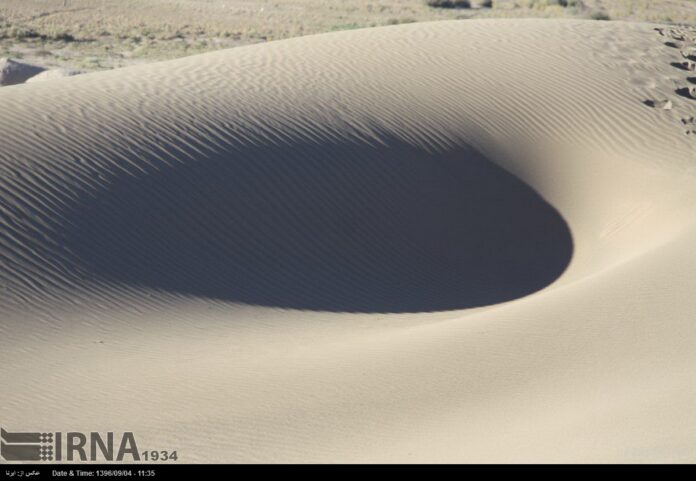
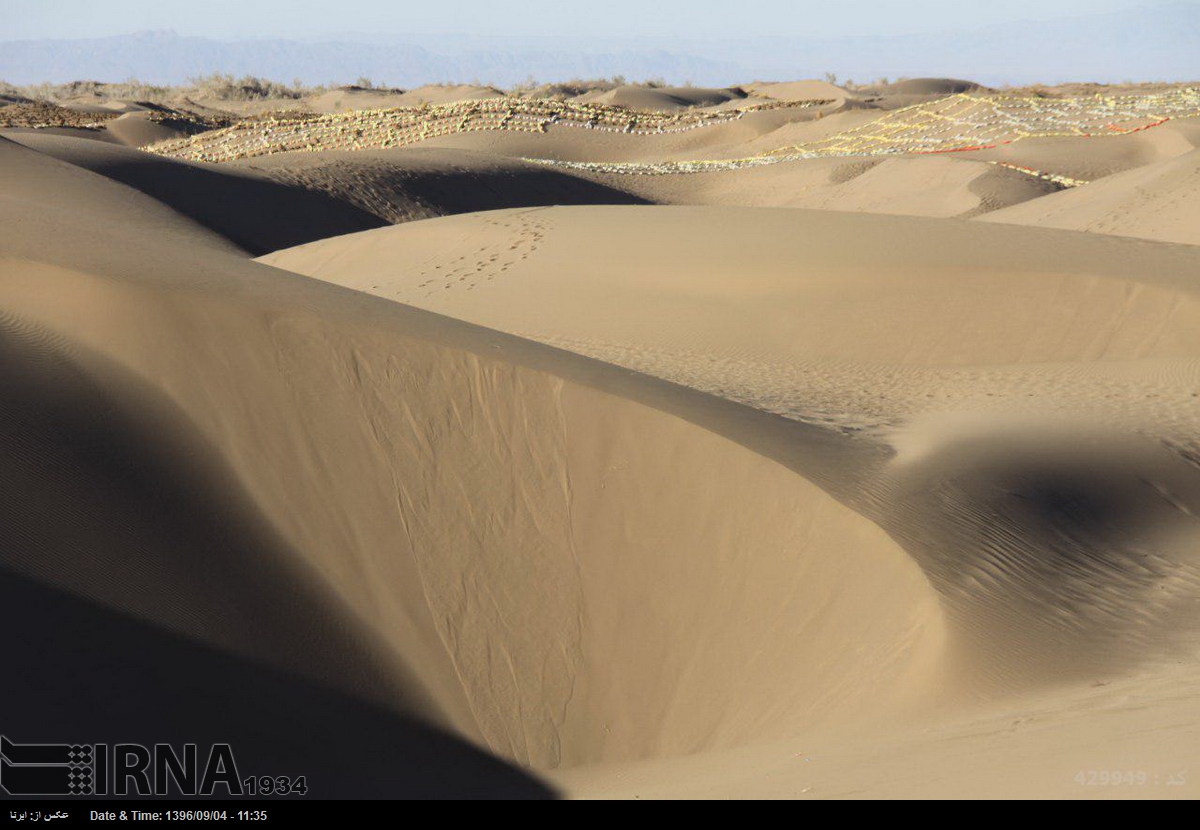
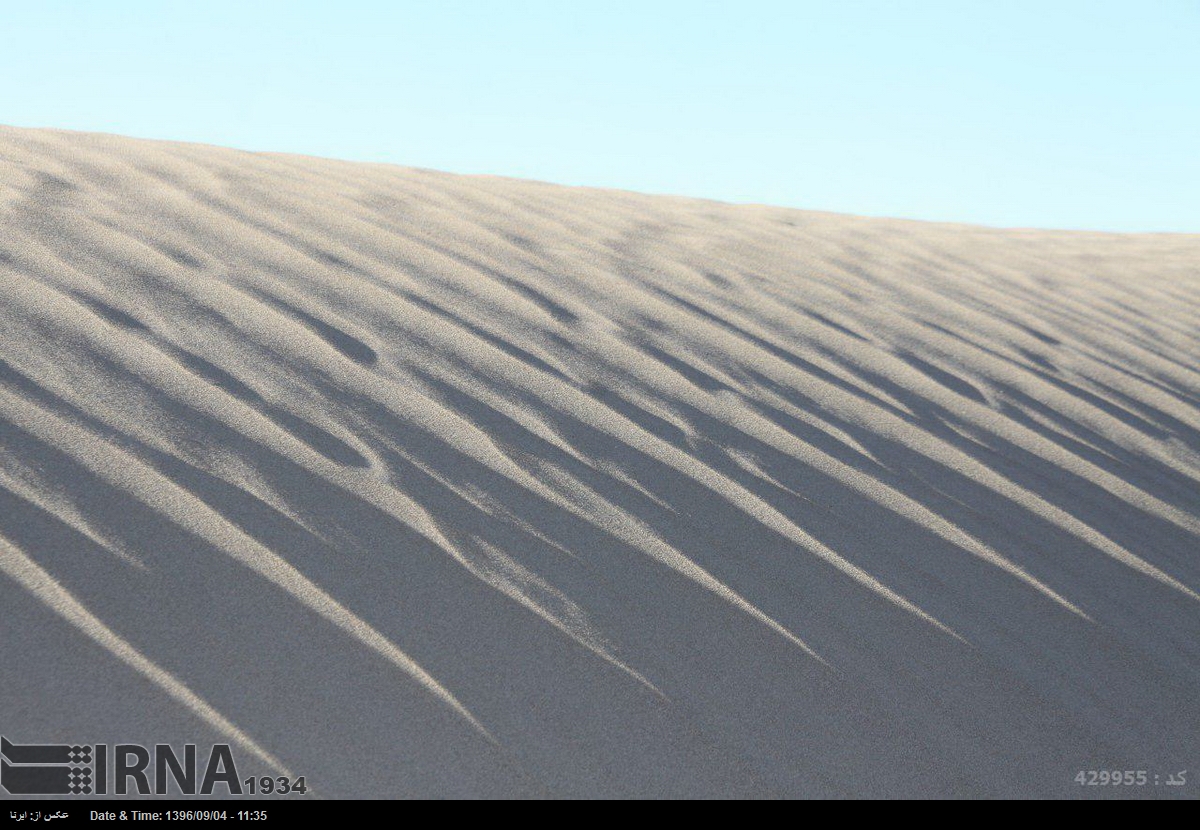
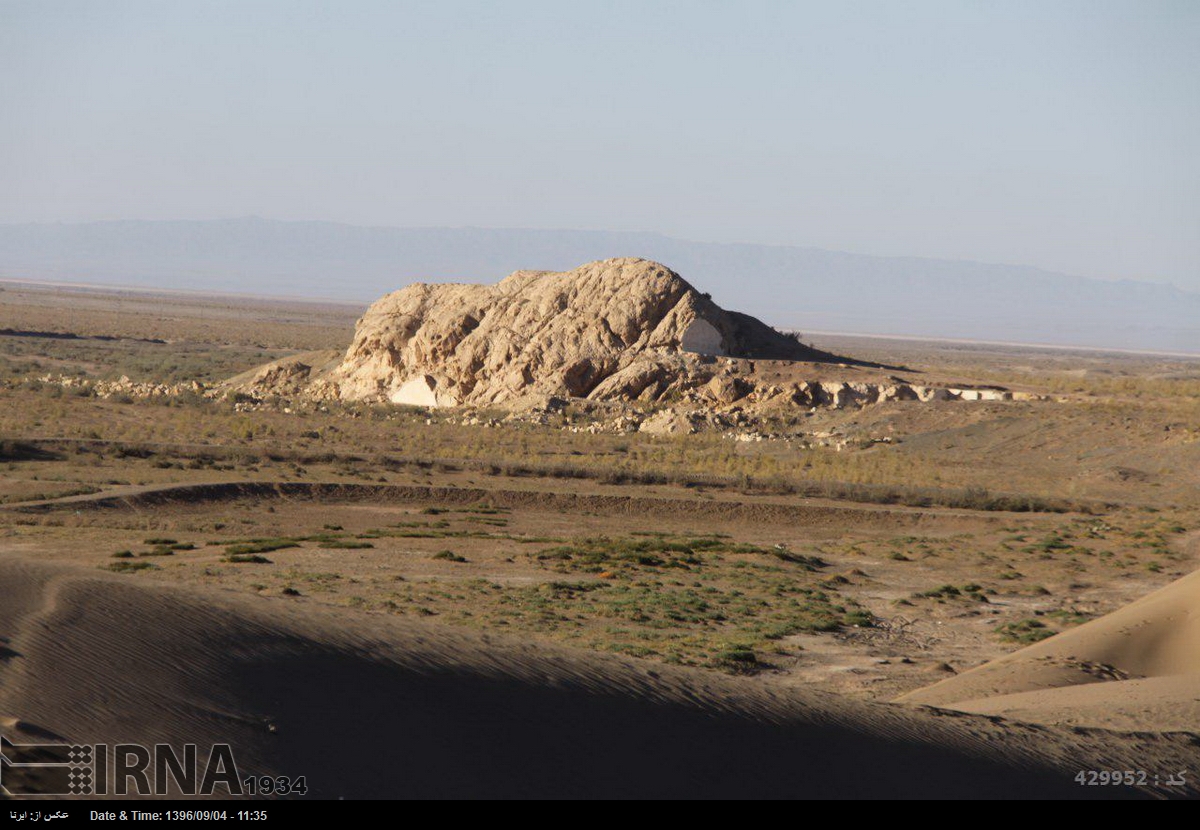
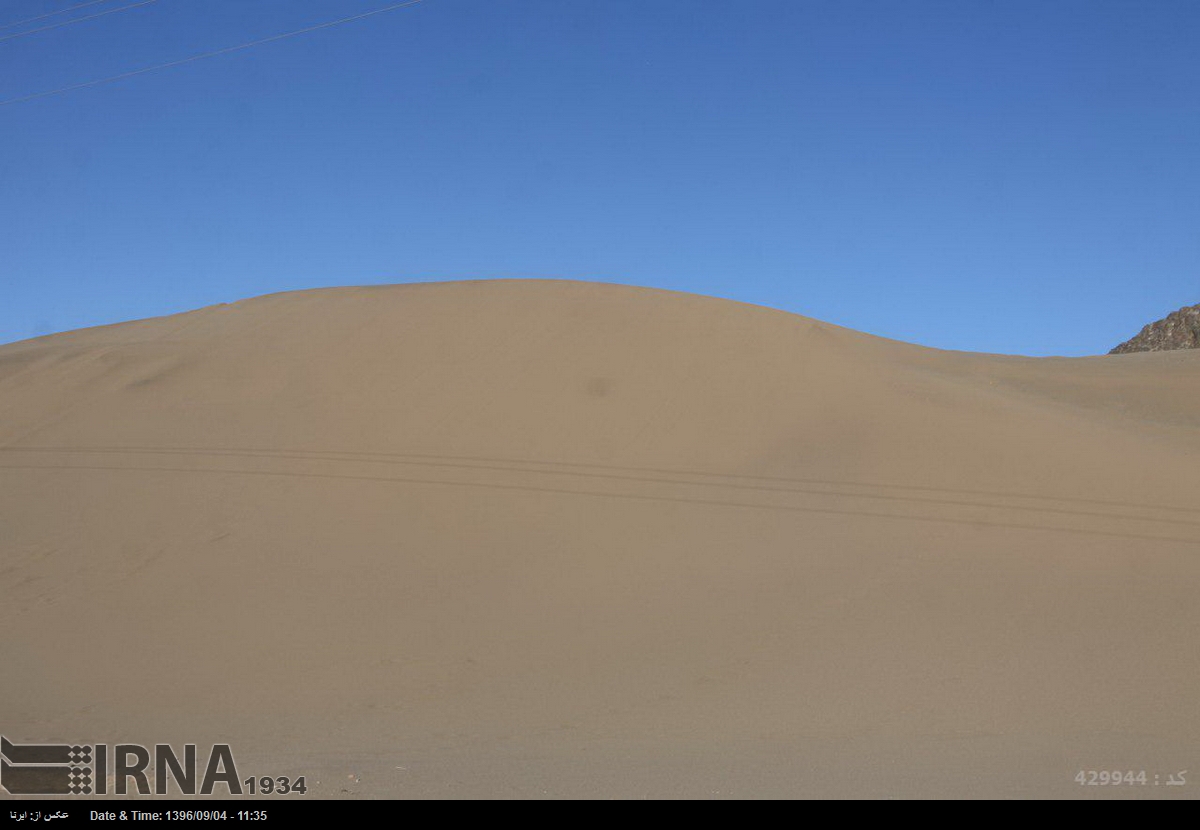
Iran’s Beauties in Photos: Reza-Abad Desert

Here are IRNA’s photos of the desert in autumn 2017:

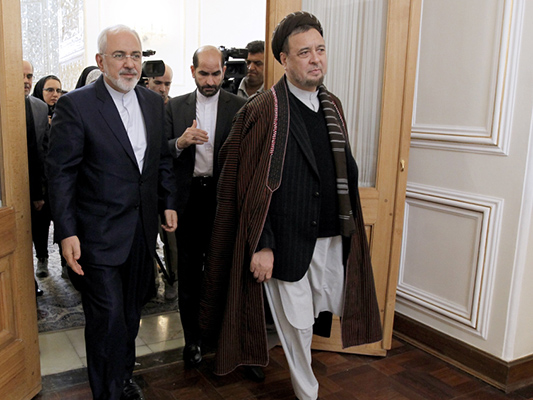
Iran, Afghanistan Discuss Joint Fight against Terror

Iran, Afghanistan Discuss Joint Fight against Terror

During the Sunday meeting, the two sides conferred on ways to expand Tehran-Kabul bilateral relations and mutual cooperation in different fields.

They also underlined the need for further collaboration in fight against terrorist groups and acceleration of effort to pursue the issues raised in Iran-Afghanistan five committees.

Back in June, a large delegation of Afghan officials visited Tehran and started an arranged series of talks with Iranian officials in five strategic fields.

The two countries had agreed each to assign committees in the areas of security, economy, culture, refugees, and water in order to discuss mutual cooperation in areas of concern.

The Afghan committees held a tightly packed series of meetings with their Iranian counterparts during their visit. The meetings were a long-delayed arrangement that was hoped to follow an unattained agreement during Hamid Karzai’s presidency.

Talks in areas of water and refugees turned out as the hottest. Water management plans in Afghanistan have led to the eastern Iranian Lake Hamoon drying out.

Also, estimates from the government of Iran indicate that 951,142 Afghan refugees reside in Iran, in addition to 620,000 Afghans who hold Afghan passports and Iranian visas. The government also estimates that there are approximately 1.5-2 million undocumented Afghans living in Iran.

Iran, Russia, Turkey Presidents to Meet Once in Every 15 Days

Syria Peace Talks

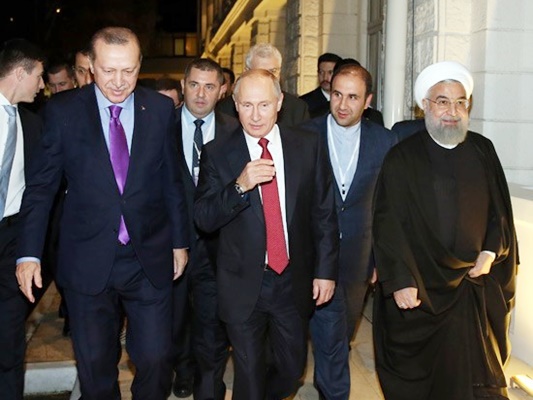
Erdoğan has declared that Turkey, Russia and Iran will meet regularly to discuss the Syrian crisis, as he commented on a recent trilateral meeting in the Black Sea resort of Sochi.

“As three leaders [Erdoğan, Iranian President Hassan Rouhani and Russian President Vladimir Putin], we have taken very critical decisions to end the humanitarian crisis in Syria,” the Turkish president said on Saturday.

“Hopefully, we’ll begin to see the positive effects of these decisions on the ground,” Erdoğan said in his address to the ruling Justice and Development Party (AKP) members in the northwestern province of Balıkesir on November 25.

He went on to say that the three leaders will meet once in every 15 days or a month.

“Our meetings will continue regularly,” he added, according to Hurriyet Daily.

Erdoğan, Rouhani and Putin convened on November 22 for a key summit to discuss the political future of Syria, amid hope that the civil war is coming to an end and victory against jihadist groups is imminent.

The leaders agreed on the necessity of a political solution to the Syrian crisis.

“EU Must Take Tougher Stances on MKO Terrorists”

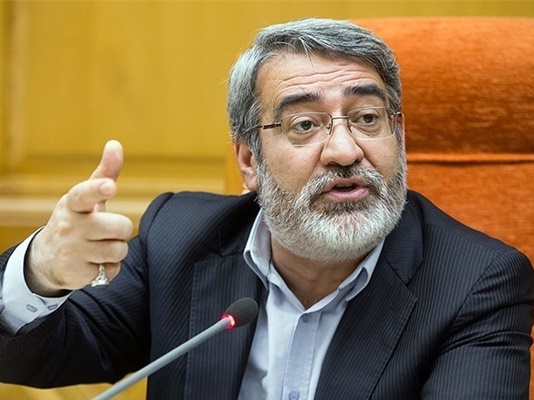
Abdolreza Rahmani Fazli

Iran is a major victim of terrorism and a number of Iranian officials have been assassinated by the MKO terrorists, Interior Minister Abdolreza Rahmani Fazli said in a meeting with Chairman of the European Parliament’s Group for Relations with Iran Janusz Lewandowski, held in Tehran on Saturday.

“Some of the (MKO members) who currently reside is certain European countries are among the highly dangerous terrorists,” Rahmani Fazli said, adding that Iran expects Europe to adopt a “tougher stance” on those criminals.

The MKO, the most hated terrorist group among the Iranians, has carried out numerous terrorist attacks against Iranian civilians and government officials over the past three decades. Out of the nearly 17,000 Iranians killed in terrorist assaults since the victory of Iran’s 1979 Islamic Revolution, about 12,000, including many top officials, have fallen victim to MKO’s acts of terror.

Elsewhere in his remarks, Rahmani Fazli highlighted Iran’s efforts in the fight against terrorism and drug trafficking and in bearing the burden of Afghan refugees, calling for international cooperation with Iran in those efforts.

The visiting European official, for his part, referred to the Joint Comprehensive Plan of Action (JCPOA), a nuclear agreement between Iran and the Group 5+1 (Russia, China, the US, Britain, France and Germany), and underscored that Europe stands with Iran regardless of the US administration’s policies on the deal.

A delegation from the European Parliament, led by Lewandowski, arrived in Tehran on Saturday for a series of meetings with the parliamentary and diplomatic officials.

It comes a week after teams from Iran and the European Union (EU) held the third round of political negotiations in Iran to boost cooperation in the field of peaceful nuclear technology.

Economic and political ties between Iran and Europeans have been growing since coming into forces of the JCPOA in January 2016.

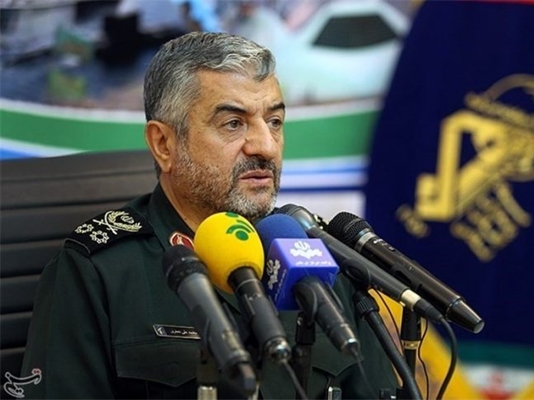
Popular Forces in Iraq, Lebanon Inspired by Iran’s Basij: IRGC Chief

In an address to a huge gathering of Tehran’s Basij (voluntary) forces on Sunday, Chief Commander of the Islamic Revolution Guards Corps Major General Mohammad-Ali Jafari outlined the major contribution of popular forces to the resistance front and said the IRGC is honoured to establish the first group of such forces in the region, known as Defenders of the Holy Shrine.

According to a Farsi report by Sepah News, he went on to say Lebanon’s Hezbollah and Popular Mobilization Units in Iraq are inspired by popular forces in Iran. “We see the same inspiration in Yemen and other regional states.”

The top commander pointed to the late founder of the Islamic Republic Imam Khomeini’s important advice on the necessity of creating resistance cells across the regional states and said today the cells have been established in the region and “we will see their regional affects in the near future.”

Elsewhere in his address, General Jafari said, “Our war knows no border and as you saw in Syria, Muslims from all countries rushed voluntarily to the battlefield against the enemy.”

He added whenever well-organized, people can step into the fray and overcome each crisis, even in the case of a world war.

“IRGC and the popular forces have expressed their readiness to take part in different scenes to resolve social problems.”

He then referred to the contribution of the IRGC and popular forces to the concerted efforts after the recent deadly earthquake in western Iran, and said if it was not for the popular forces’ help within a provincial unit of IRGC, the quake-hit Iranians would have a more disastrous condition now.

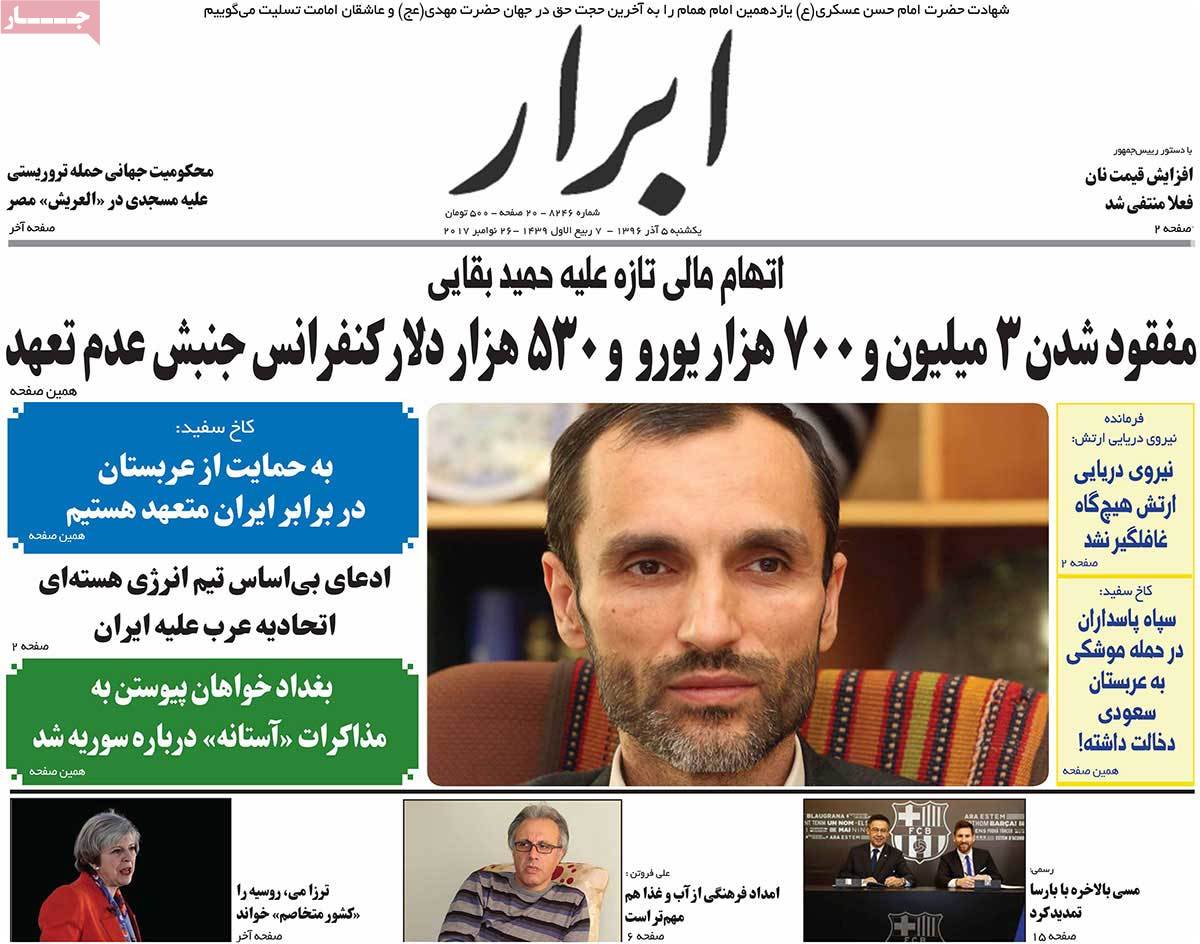
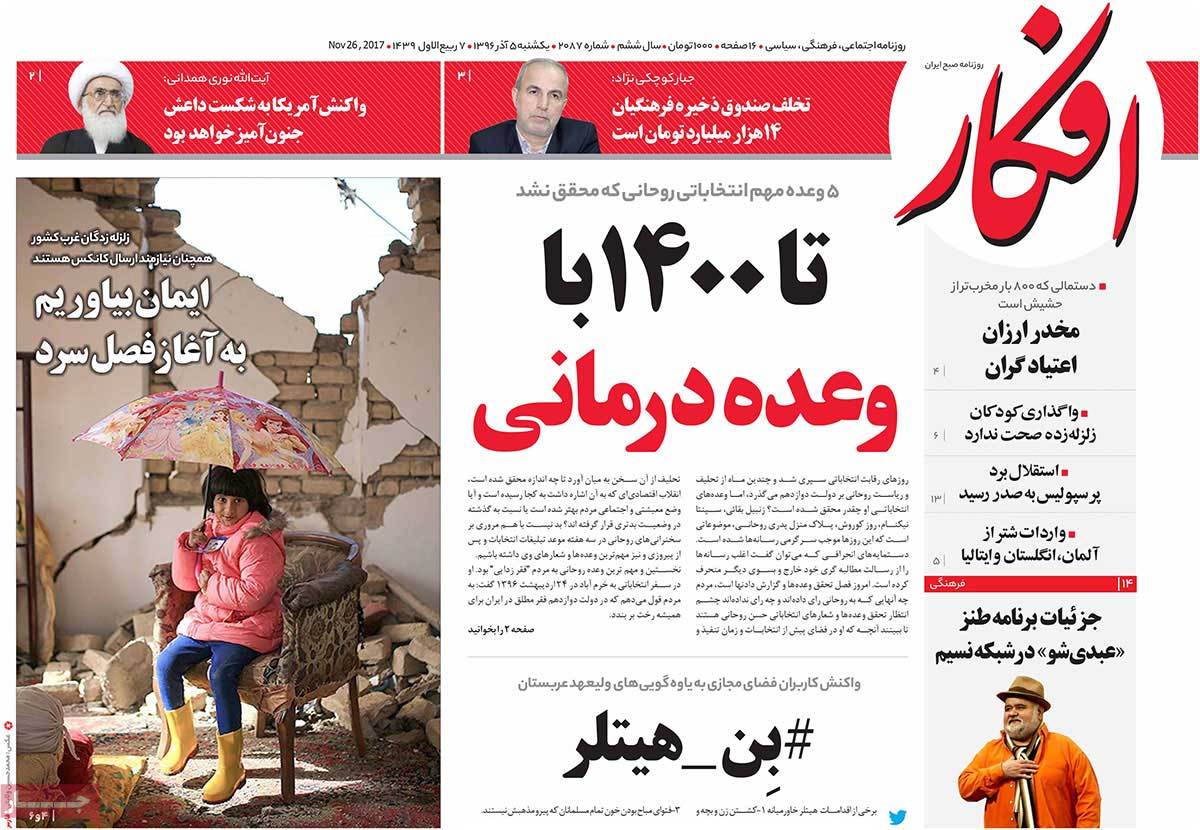
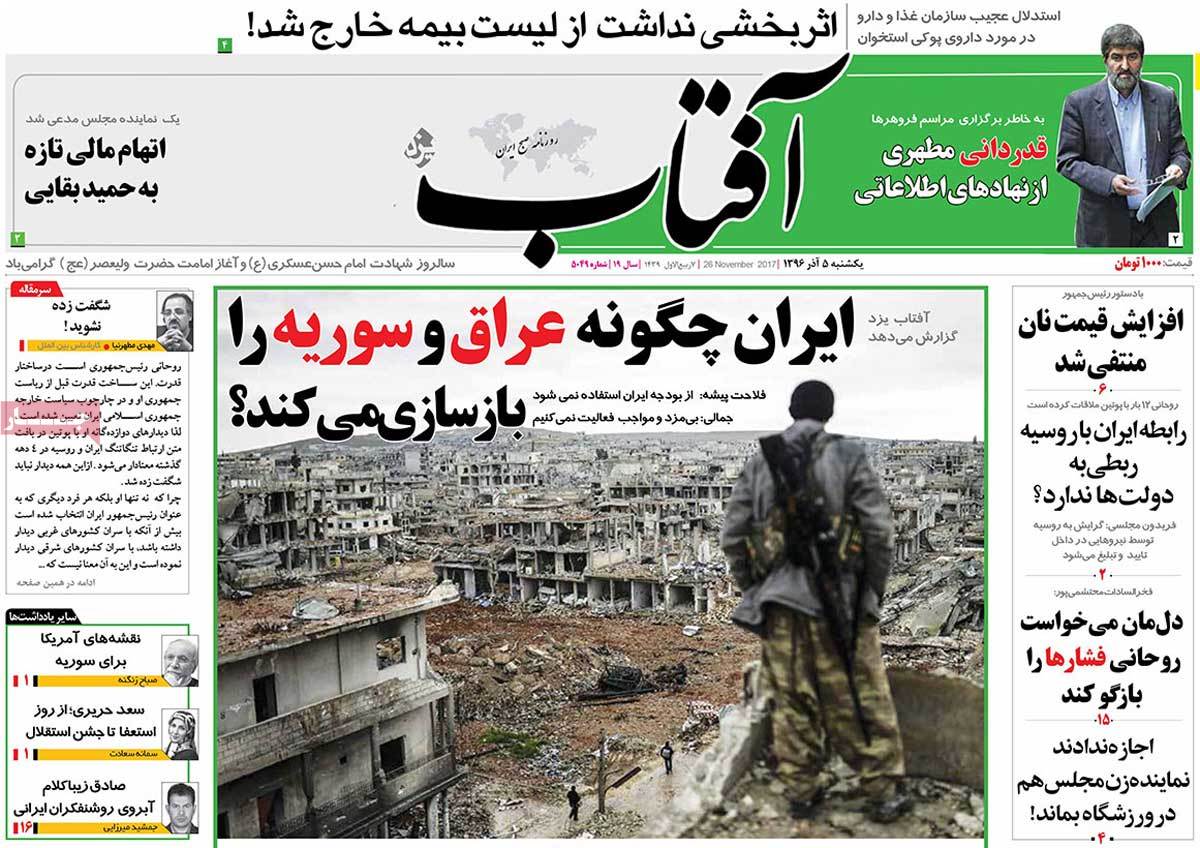
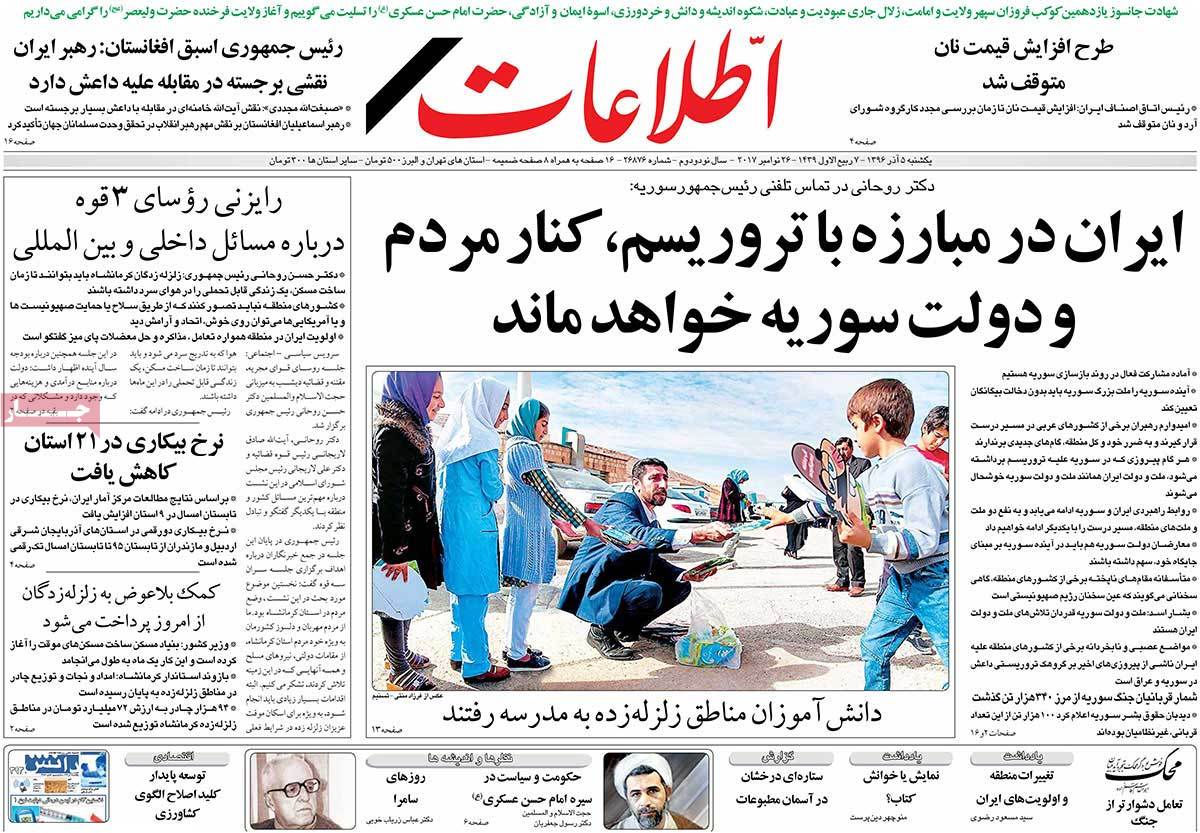
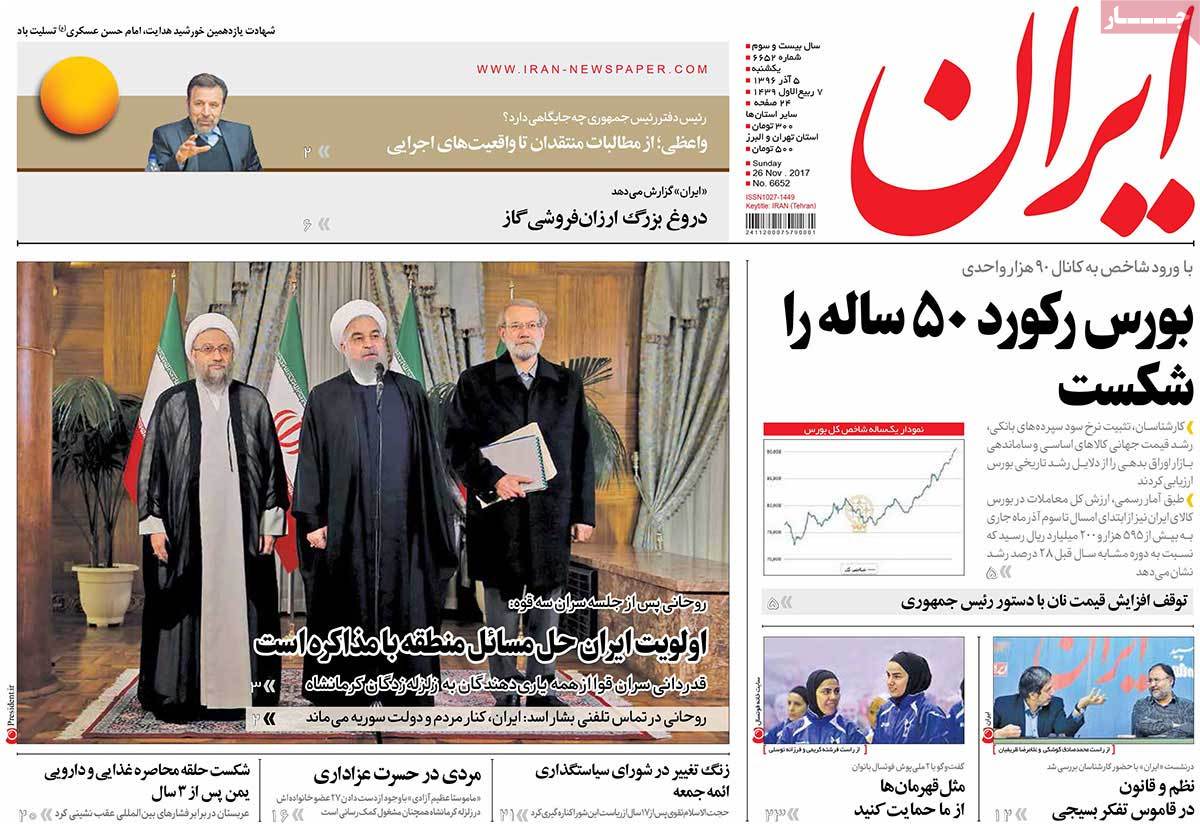
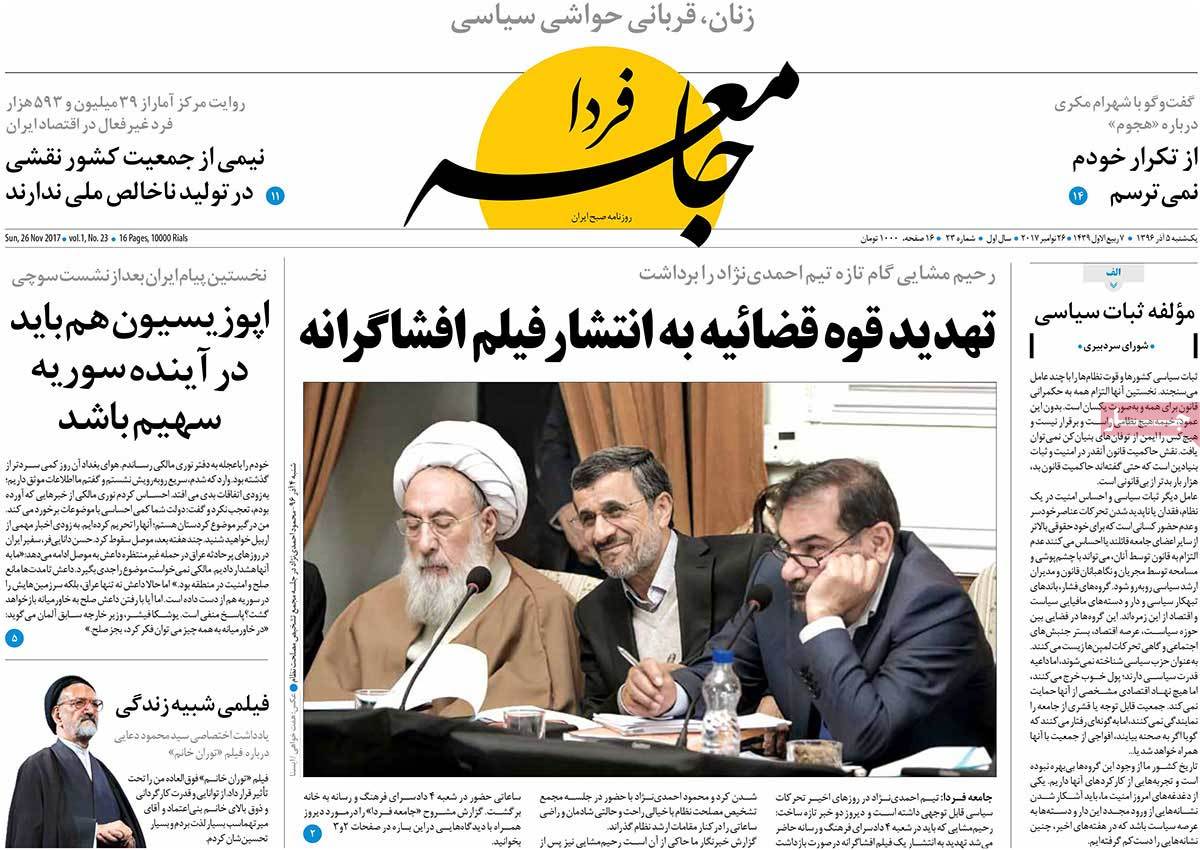
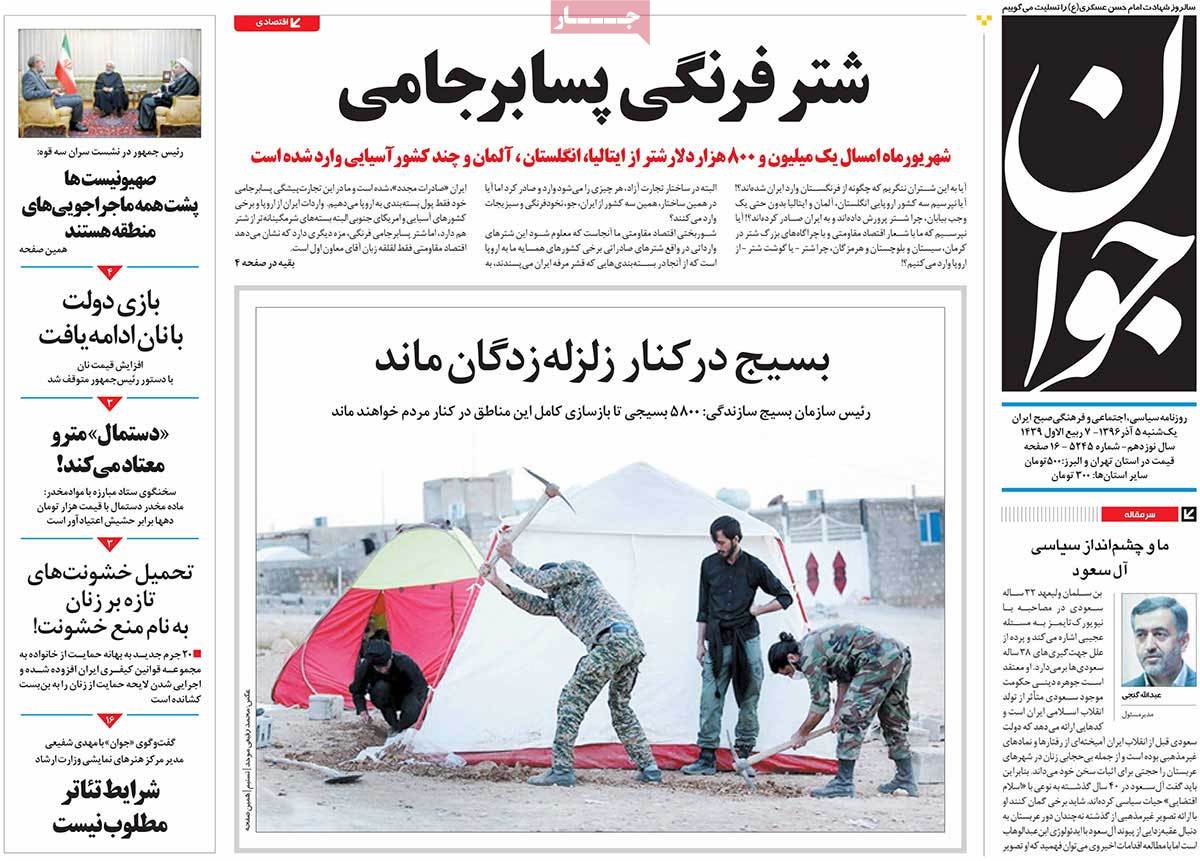
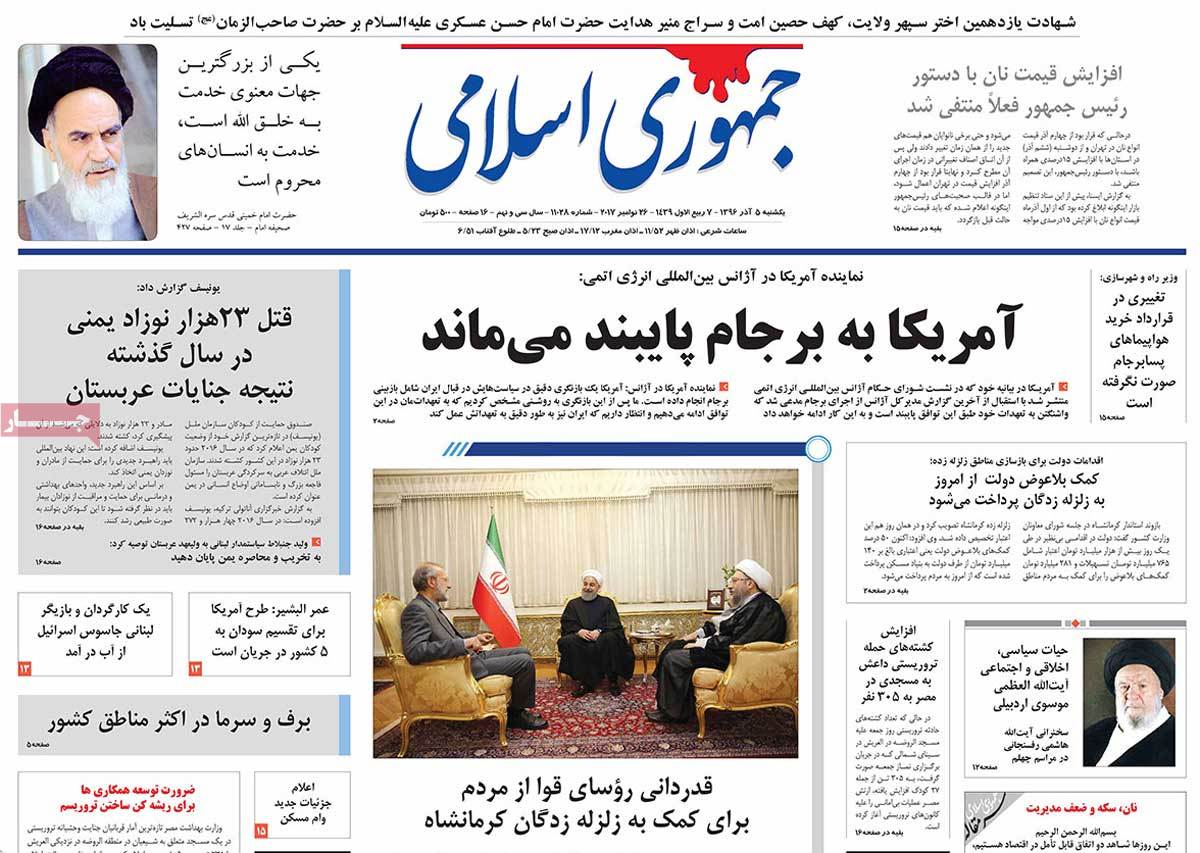
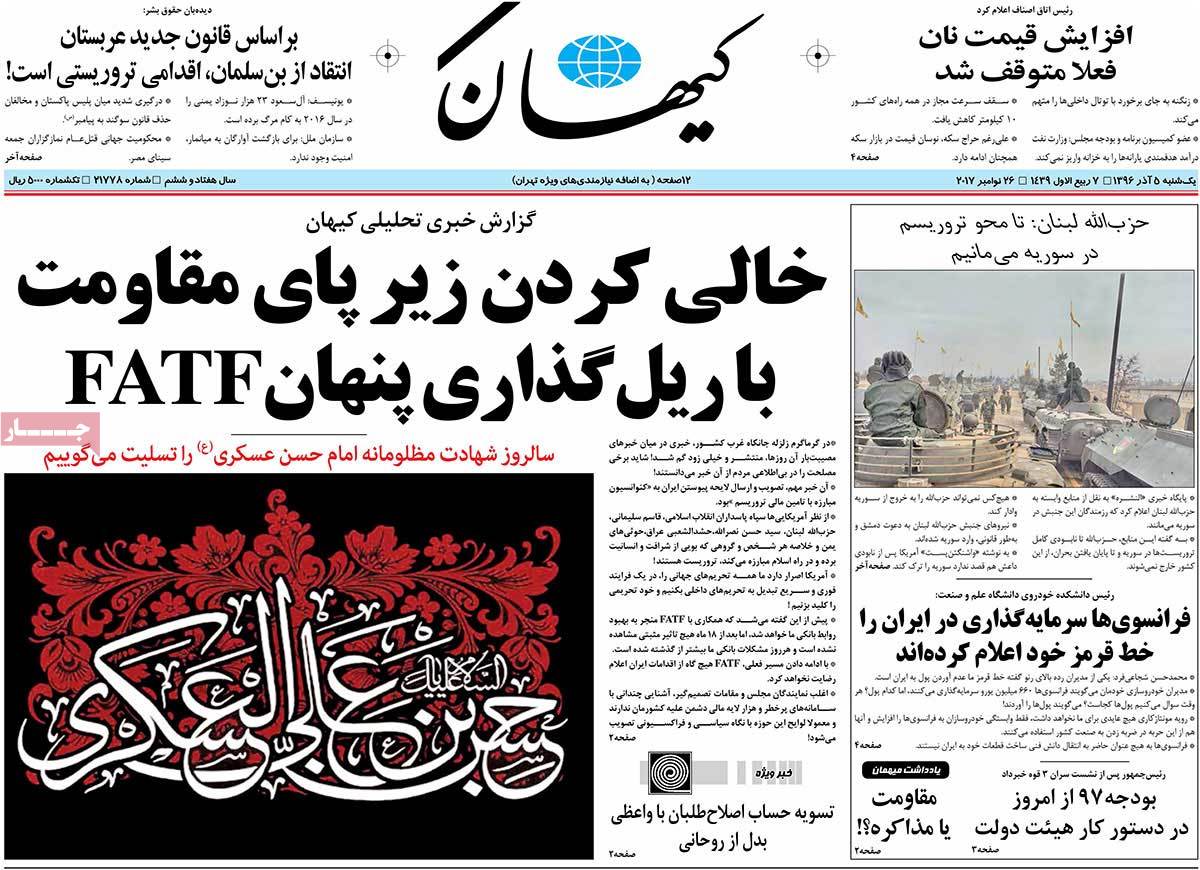
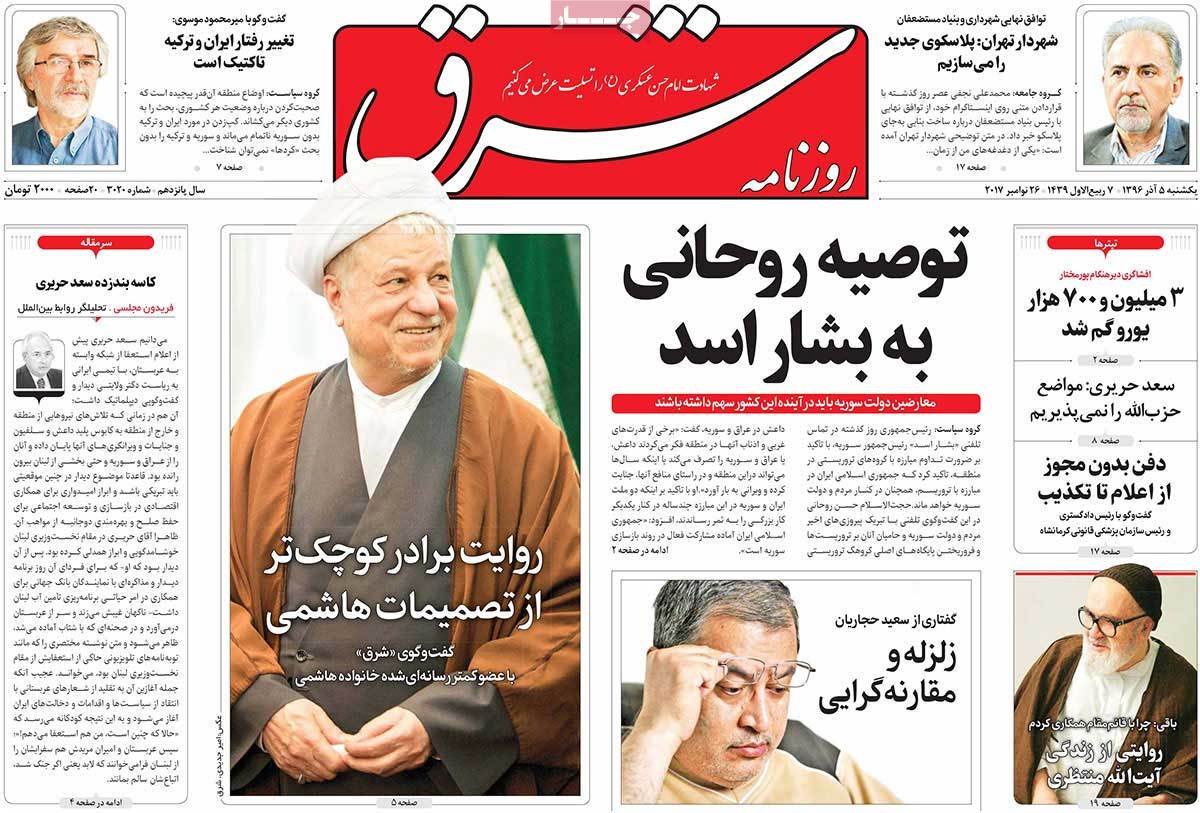
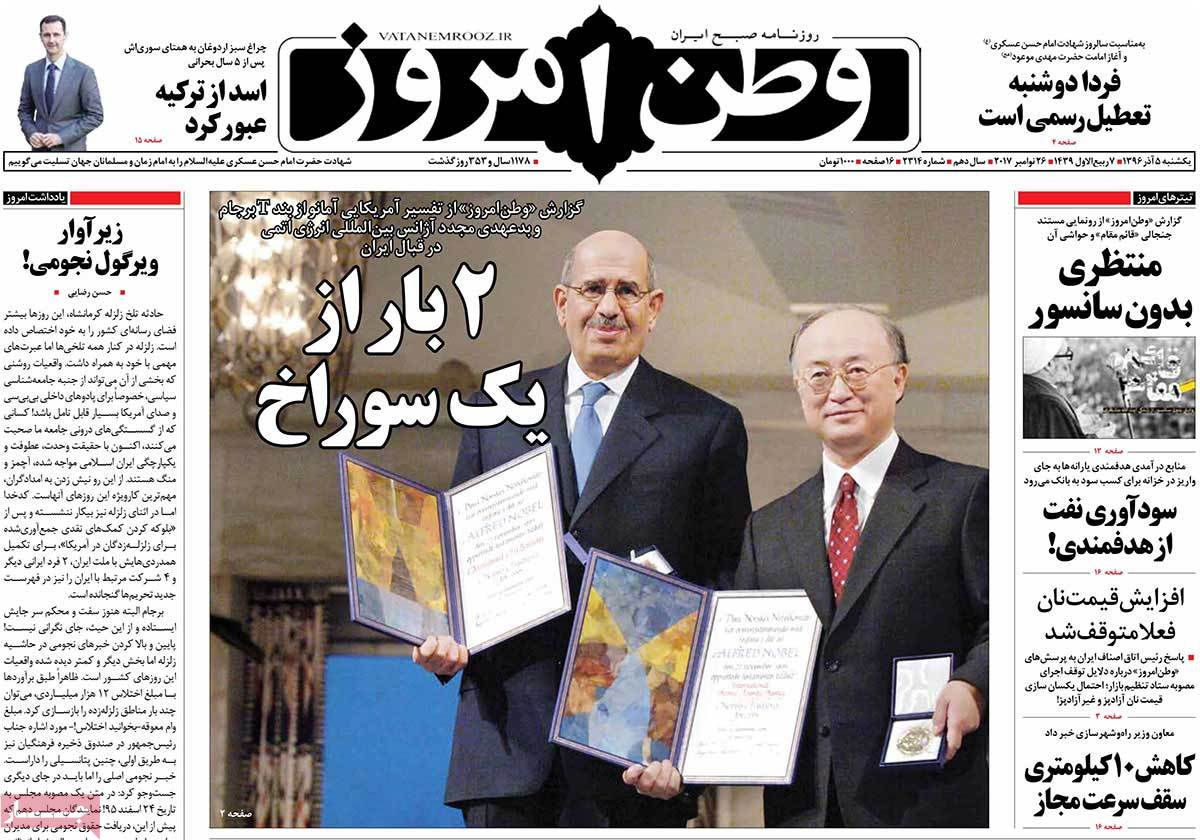
A Look at Iranian Newspaper Front Pages on November 26

Several papers today covered the reactions to Saudi Crown Prince Mohammed bin Salman’s anti-Iran remarks, particularly those by social media users, which were covered by Afkar newspaper.

A trilateral meeting between Iranian President Hassan Rouhani, Judiciary Chief Ayatollah Sadeq Amoli Larijani, and Parliament Speaker Ali Larijani on domestic and international issues also received great coverage.

Also a top story was the efforts underway in western Iran to help the quake-hit people recover.

The above issues, as well as many more, are highlighted in the following headlines and top stories:


Abrar:

1- Terrorist Attack on Egypt’s Arish Mosque Globally Condemned

2- White House: We’re Committed to Supporting Saudi Arabia against Iran

A Look at Iranian Newspaper Front Pages on November 26


Afkar:

1- #Bin_Hitler: Social Media Users Condemn Saudi Crown Prince’s Nonsense Remarks

A Look at Iranian Newspaper Front Pages on November 26


Aftab-e Yazd:

1- How Will Iran Reconstruct Iraq and Syria?

  • MP: Iran’s Budget Not to Be Used
  • Lawmaker: We Won’t Do Anything without Receiving Money

A Look at Iranian Newspaper Front Pages on November 26


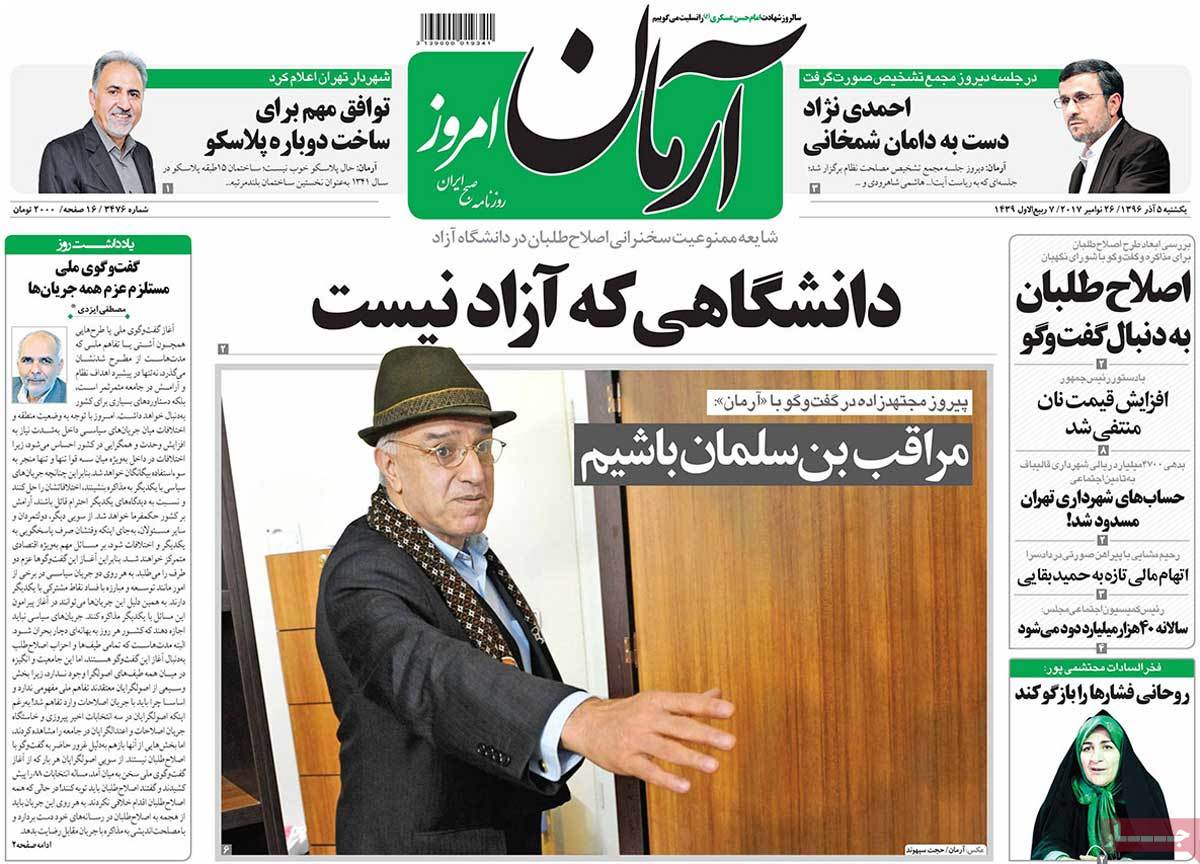
Arman-e Emrooz:

1- Analyst: We Should Beware of Bin Salman

2- Ahmadinejad Asks for Shamkhani’s Help

A Look at Iranian Newspaper Front Pages on November 26


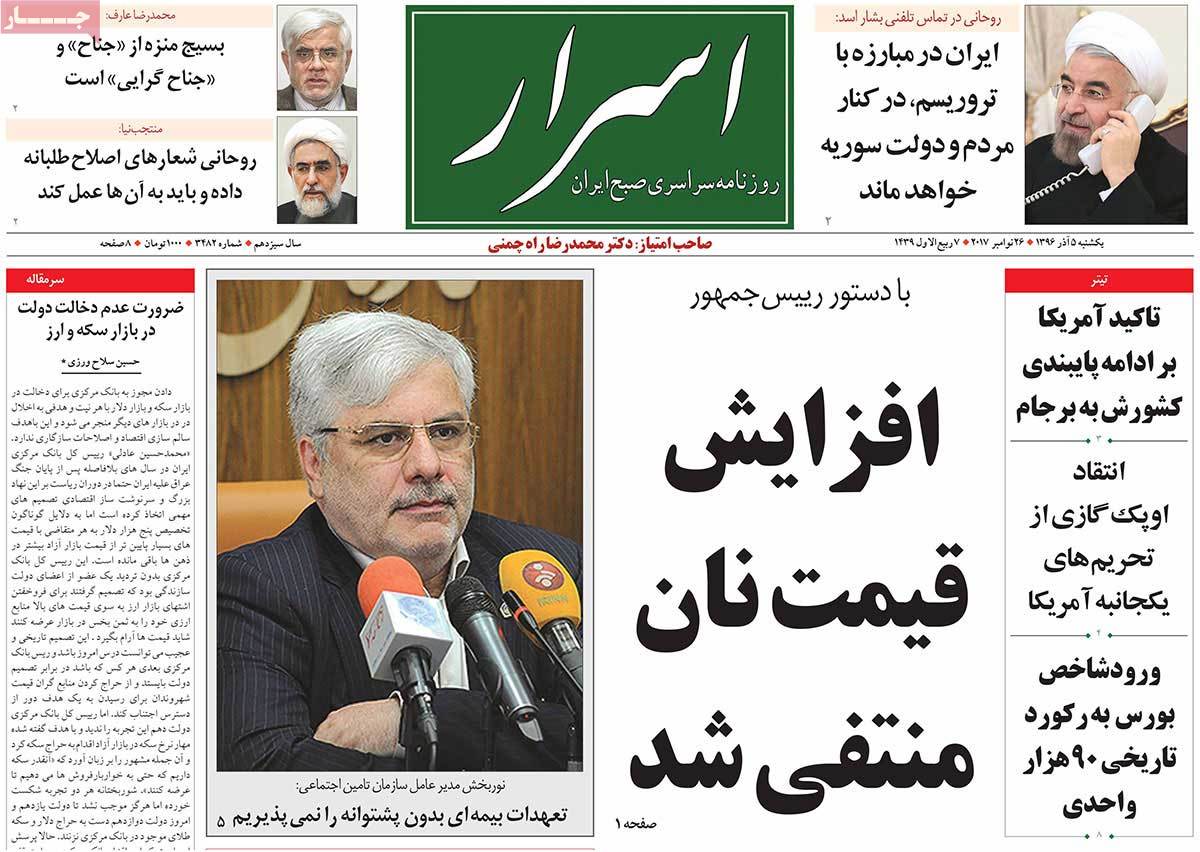
Asrar:

1- Rouhani to Assad: Iran to Stand by Syrian Nation in Fight against Terror

2- US Underlines Its Continued Commitment to Iran Nuclear Deal

A Look at Iranian Newspaper Front Pages on November 26


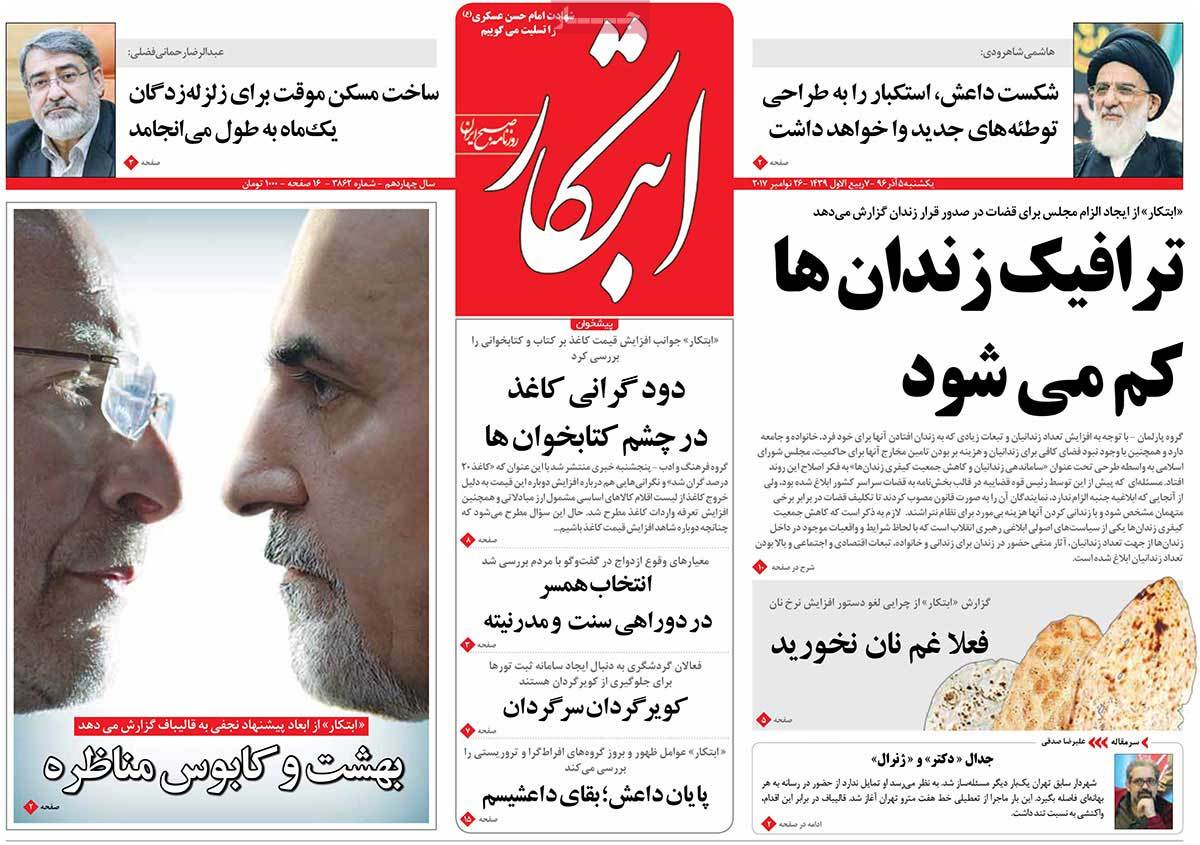
Ebtekar:

1- Interior Minister: Building Temporary Houses for Quake-Hit People to Take One Month

2- Hashemi Shahroudi: Defeat of ISIS to Make Arrogance Hatch New Plots

3- End of ISIS, Survival of Daeshism: A Review of Emergence of Extremist Groups

A Look at Iranian Newspaper Front Pages on November 26


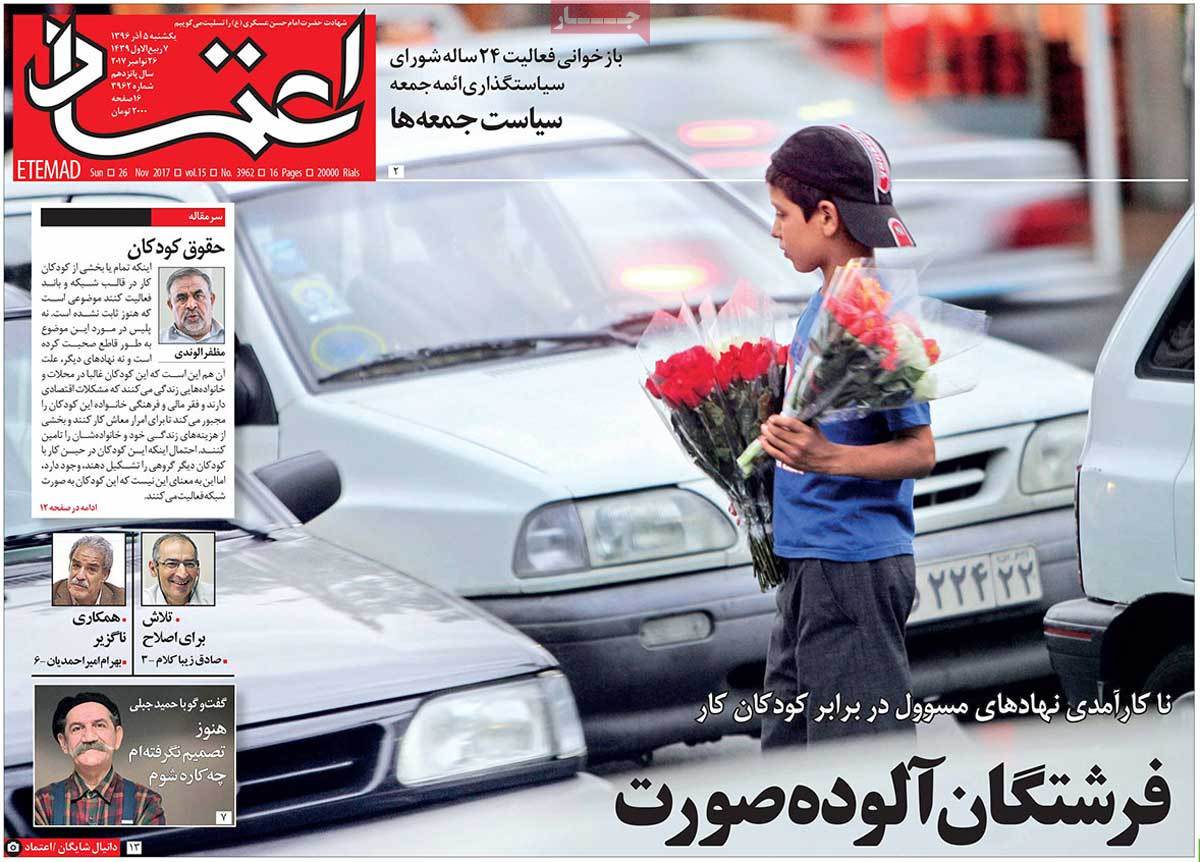
Etemad:

1- Angles with Dirty Faces: Iranian Authorities Inefficient on Child Labour

2- Children’s Rights [Editorial]

A Look at Iranian Newspaper Front Pages on November 26


Ettela’at:

1- Quake-Hit Students Go to School

2- Heads of Trio Branches of Power in Iran Discuss Domestic, Int’l Issues

3- Afghan Ex-President: Iran Leader Has Prominent Role in Fighting against ISIS

A Look at Iranian Newspaper Front Pages on November 26


Iran:

1- Rouhani: Iran’s Priority Is to Resolve Regional Issues through Negotiation

A Look at Iranian Newspaper Front Pages on November 26


Jame’eh Farda:

1- Ahmadinejad’s Aide Threatens Judiciary to Disclose Secrets in a Video

A Look at Iranian Newspaper Front Pages on November 26


Javan:

1- Foreign Camels, Fruit of Iran Nuclear Deal

  • Iran Imports $1.8m worth of Camels from Italy, UK, Germany, Asian States in One Month

2- Basij [Voluntary] Forces Stood by Quake-Hit People

3- Rouhani: Zionists behind All Regional Adventures

A Look at Iranian Newspaper Front Pages on November 26


Jomhouri Eslami:

1- US Envoy to IAEA: Washington to Remain Committed to Iran Nuclear Deal

2- UNICEF: 23,000 Yemeni Infants Killed in Past Year as Result of Saudi Atrocities

3- Top Iranian Officials Praise People for Helping Quake-Hit Areas

A Look at Iranian Newspaper Front Pages on November 26


Kayhan:

1- Efforts Underway to Undermine Resistance through FATF

2- Criticizing Bin Salman Deemed as Act of Terrorism Based on New Saudi Law!

A Look at Iranian Newspaper Front Pages on November 26


Shahrvand:

1- Robust Houses of Iraq Built with Iranian Materials

  • Only 7 Killed in Iraq Earthquake Thanks to Strict Construction Rules in Iraq

2- Interview with 3 Families Who Gifted Their Most Valuable Assets to Quake-Hit People

A Look at Iranian Newspaper Front Pages on November 26


Shargh:

1- Analyst: Change in Behaviours of Iran, Turkey Is a Tactic

2- Tehran Mayor: We’ll Construct New Plasco Building

3- Hariri: We Don’t Accept Hezbollah’s Stances

A Look at Iranian Newspaper Front Pages on November 26


Vatan-e Emrooz:

1- Burnt Twice by Same Flame

  • A Report on Amano’s American Interpretation of JCPOA’s Article T
  • IAEA Once Again Breaks Its Promises on Iran

2- Assad Bypasses Turkey

A Look at Iranian Newspaper Front Pages on November 26

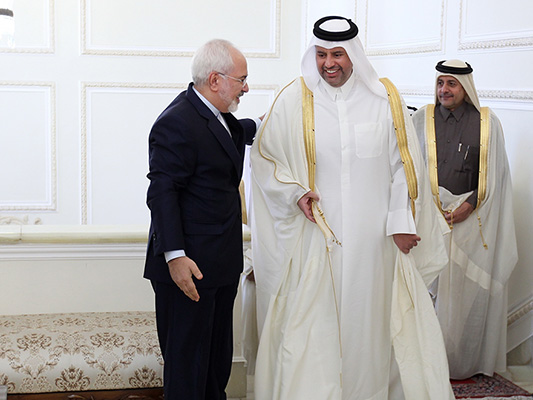
Iran FM, Qatari Minister Call for Promotion of Business Ties

zarif-qatar

During the Sunday talks, the two sides conferred on the latest situation of economic and trade ties between Iran and Qatar, and explored avenues for promoting them.

Zarif and the Qatari minister also underlined the need for removing barriers to expansion of business cooperation and facilitating the trade exchanges between the two countries.

Earlier in the day, Sheikh Ahmed also met Iranian Minister of Industry, Mine, and Trade Mohammad Shariatmadari.

Following the meeting, Shariatmadari said he has received a proposal from Qatar to increase the level of trade between the two countries by five folds.

Shariatmadari said the current level of annual trade between the two countries stood at below $1 billion, emphasizing that Doha had informed Tehran through Al-Thani about a proposal to increase this to as high as $5 billion per year.

The Iranian minister said Qatar was eager to expand ties with the Islamic Republic in all areas as a result of the current conditions that the Saudi-led blockade against it had created, according to a report by Iran’s IRNA news agency.