Friday, January 16, 2026
Home Blog Page 3790

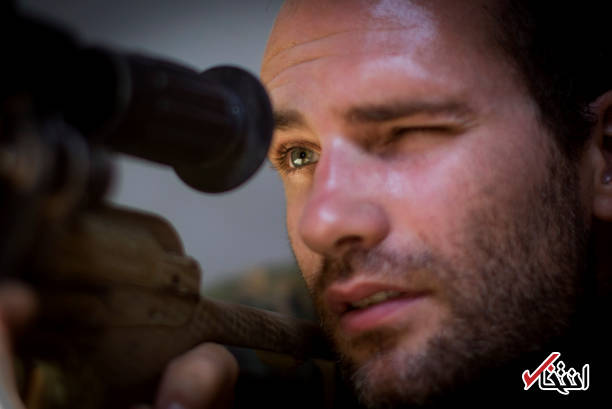
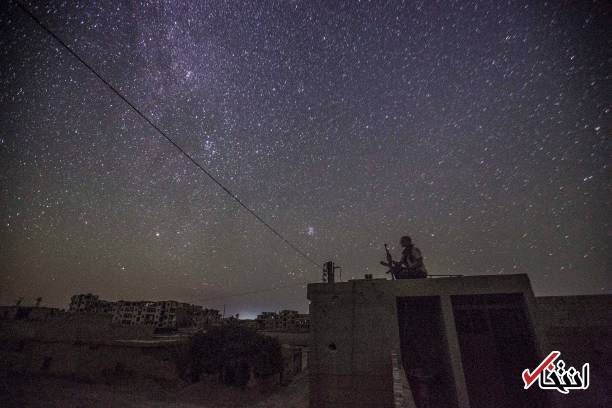
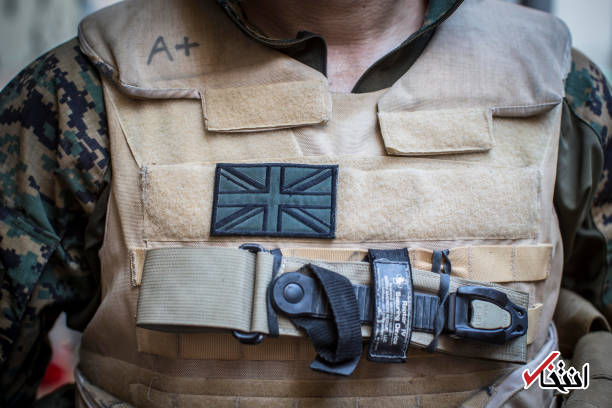
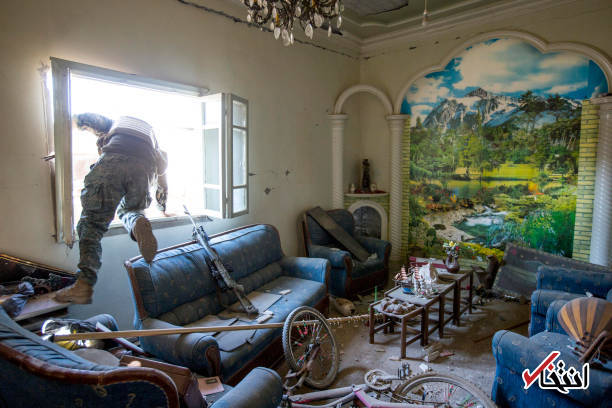
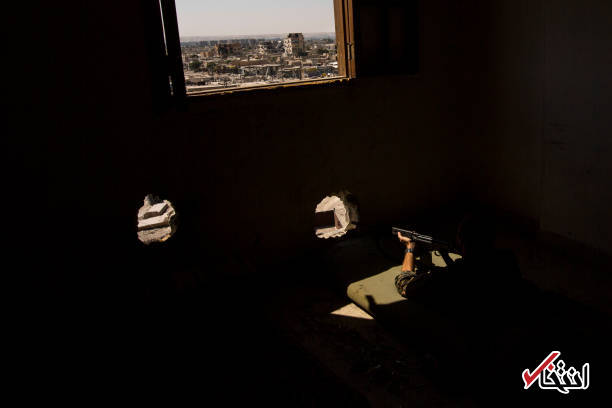
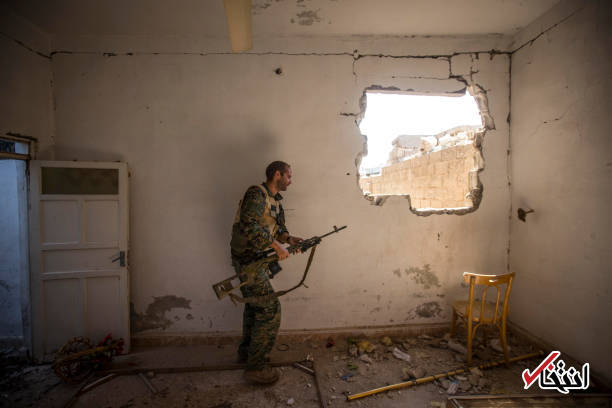
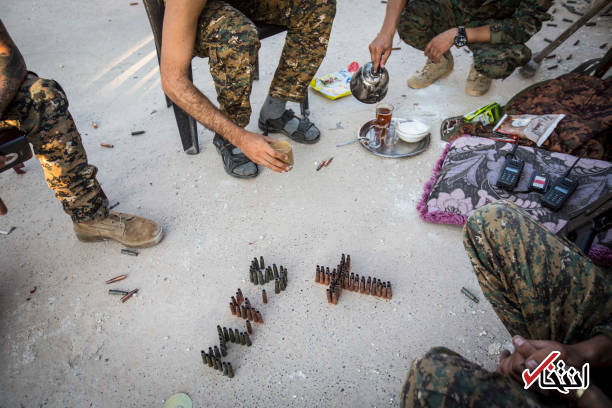
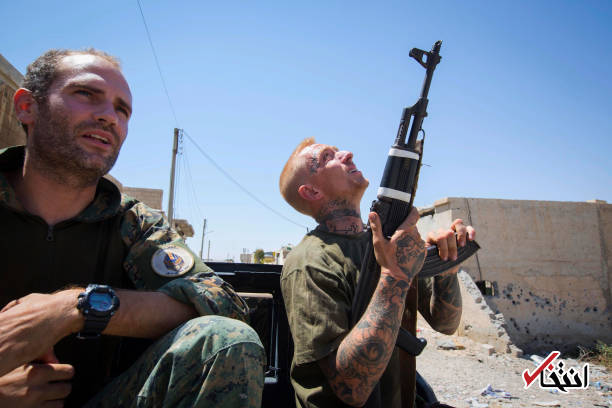
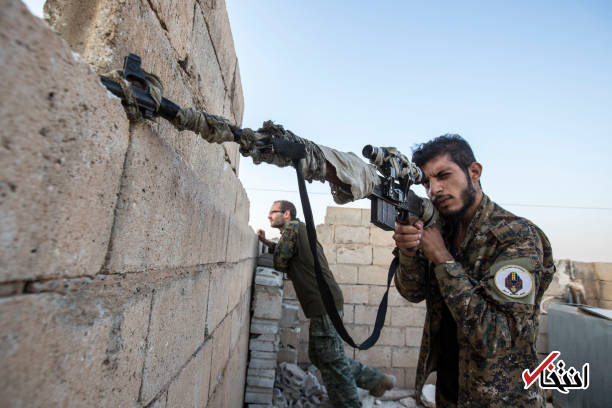
Christian Snipers in Syria, Pain in the Neck for ISIS

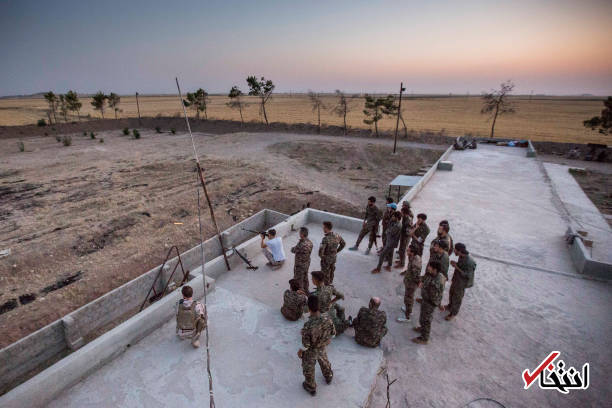
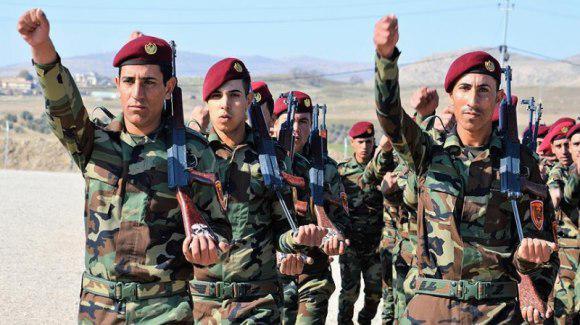
The Syriac Military Council is an Assyrian/Syriac military organisation in Syria which was established in 2013 with the aim of protecting the Syrian Christian population against the threats of ISIS. The organization is fighting now in the battlefront against ISIS terrorists.

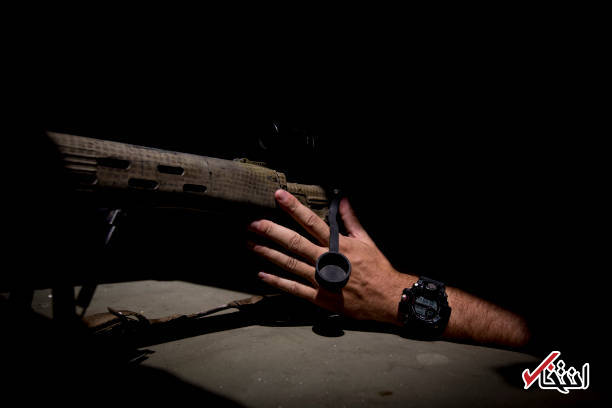
The organization has some skilled snipers who are fighting ISIS along with Syrian Kurdish fighters known as YPG to retake Raqqa from ISIS militants, according to a Farsi report by Entekhab news website.

ISIS militants massacred a large number of Syrian Christian civilians following the occupation of the Christian-populated areas of Syria in 2014. Churches and other sacred sites of the Christians in the areas were also razed to the ground by the terrorists.

YPG announced earlier that Raqqa will be completely liberated from ISIS within the next two days.

According to the Kurdish fighters, more than 100 ISIS members are besieged in the city.

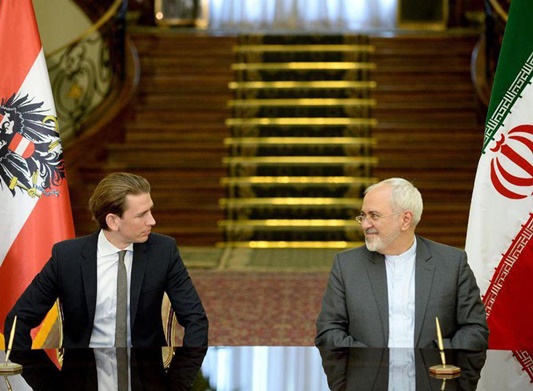
Iran Hopes for Enhanced Ties with Austria under Kurz’s Leadership

Iran Hopes for Enhanced Ties with Austria under Kurz’s Leadership

“Austria and Mr Kurz in particular, as the main host of Iran’s nuclear negotiations with the P5+1, played an important role in the finalization of the historic deal,” Foreign Ministry Spokesman Bahram Qassemi noted in a Monday statement.

Qassemi also expressed the hope that Tehran-Vienna ties would be promoted in all aspects in the new era and under his leadership.

Austria’s conservative People’s Party, led by 31-year-old Kurz, is set to win the country’s general election. Kurz is on course to become the world’s youngest national leader.

The People’s Party was set to win more than 31%. It is so far unclear whether the Social Democrats or the far-right Freedom Party will finish second.

Before the election, Kurz served as Europe’s youngest-ever foreign minister, after he was appointed in 2013 aged just 27.

Iranian, Canadian Diplomats Hold ‘Positive’ Talks in Tehran

In a statement on Monday, Foreign Ministry Spokesman Bahram Qassemi declared that a Canadian delegation, which had earlier visited Iran in May, recently travelled to Tehran and held talks with Iranian foreign ministry officials.

He said the recent visit was made as part of bilateral talks held between Iranian and Canadian foreign ministries within the past two years.

Qassemi noted that the negotiations were held with a positive approach and were aimed at exchanging views about technical and specialized issues.

He also noted that the two countries’ foreign ministers had earlier met each other on the sidelines of the UN General Assembly in New York.

Back in May, the Canadian delegation visited Tehran to hold talks with Iranian officials to facilitate the restoration of diplomatic ties, the first such visit since the previous Canadian government closed its embassy in Tehran nearly five years ago.

In September 2012, the administration of former Canadian Prime Minister, Stephen Harper, severed diplomatic contacts with the Islamic Republic, citing, among other pretexts, “continued threats from Iran to Israel”.

The Italian Embassy has been handling Canada’s interests in Iran since then.

Iran Welcomes Results of Kyrgyzstan’s Parliamentary Votes

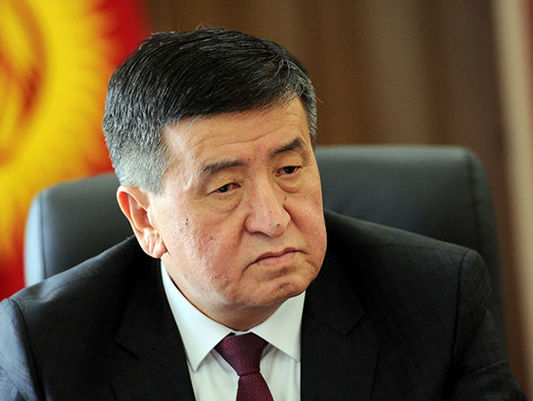
Sooronbay Jeenbekov

In a Monday statement, Foreign Ministry Spokesman Bahram Qassemi said Tehran welcomes the results of Kyrgyzstan’s presidential votes, and is prepared to further promote its ties with the country.

Former Prime Minister Sooronbay Jeenbekov won Kyrgyzstan’s presidential election, according to preliminary official data, as his defeated rival called for unity in the central Asian republic that’s been roiled by political violence in the past.

Jeenbekov, who’s backed by outgoing President Almazbek Atambayev’s Social Democratic party, received 54.3 percent of the about 1.7 million votes cast, making a run-off unnecessary, the central election commission reported Monday.

Businessman Omurbek Babanov, who heads the opposition Respublika party, was second with 33.4 percent.

Turnout was 56 percent of 3 million eligible voters.

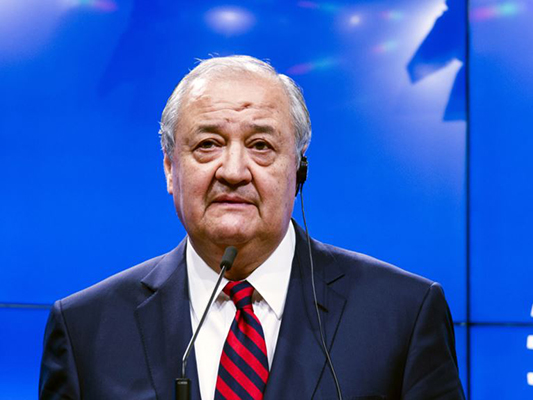
Uzbek FM to Arrive in Tehran on Three-Day Visit

In a statement on Monday, Qassemi declared that the Uzbek FM will be accompanied by a delegation during his three-day visit to the Iranian capital.

Kamilov will meet with his Iranian counterpart Mohammad Javad Zarif, President Hassan Rouhani, and Parliament Speaker Ali Larijani, Qassemi noted.

The Uzbek top diplomat will also hold talks with a number of Iranian ministers on economic affairs, he added.

Qassemi described the visit as a giant step towards all-out expansion of relations between Tehran and Tashkent.

Iraqi PM Appoints Arab Acting Governor for Kirkuk

Iraq’s Prime Minister Haider al-Abadi has assigned Deputy Governor of Kirkuk Rakan Saeed al-Jobouri to run the city until a new governor is chosen in accordance with the local municipals’ elections, parliamentarian Jasim Mohamed Jafaar told al-Sumaria TV on Monday.

Al-Jobouri is the first Arab governor in Kirkuk since 2003, according to Iraqi media reports.

“According to local elections’ law, the deputy governor of Kirkuk is acting as the city’s new governor succeeding Najmaldin Karim who was dismissed upon a decision taken by the Iraqi parliament late September,” Jafaar told Al-Sumaria.

He added that “Jobouri should remain in charge until a new governor is assigned by the prime minister or a new military ruler takes control of the city upon orders from the federal government in Baghdad.”

Iraqi PM Appoints Arab Acting Governor for KirkukThe appointment comes as Iraqi forces have gained control of Kirkuk’s airport and main military base as well as other strategic locations in the oil-rich province from Kurdish fighters.

Iraqi sources declared on Monday that the country’s security forces have gained full control of the airport and the K1 airbase, the largest one in Kirkuk.

The operation is carried out to take key areas in the disputed region following last month’s referendum held for possible secession of the Iraqi Kurdistan.

Meanwhile, some officials from the Patriotic Union of Kurdistan (PUK) have refrained from fighting with Kurdish forces against Iraqi central government. KRG President Masoud Barzani’s party has condemned the PUK officials’ move as a betrayal, saying Jalal Talabani’s party has committed a great and historic treason against Kurdistan.

In reaction to the developments, the US Department of Defence has urged Iraqi and Kurdistan Regional Government (KRG) forces Sunday to “avoid escalatory actions” and to turn to dialogue to defuse tensions and resolve their differences.

“We oppose violence from any party, and urge against destabilizing actions that distract from the fight against ISIS and further undermine Iraq’s stability,” Pentagon spokeswoman Laura Seal said when asked about an Iraqi state TV report that Iraqi forces had taken control of parts of the oil-rich Kirkuk region without opposition from Peshmerga fighters.

“We continue to support a unified Iraq,” she said. “Despite the Kurdistan Regional Government’s unfortunate decision to pursue a unilateral referendum, dialogue remains the best option to defuse ongoing tensions and longstanding issues, in accordance with the Iraqi constitution.”

She also called on “all actors” in the region to focus on the common threat of ISIS and avoid stoking tensions among the Iraqi people. Iraqi and Peshmerga forces have both been trained and armed by the United States.

A Look at Iranian Newspaper Front Pages on October 16

All newspapers today continued covering the reactions to US President Donald Trump’s speech against the Islamic Republic.

The Iraqi army and popular forces’ operation to retake Kirkuk from the Iraqi Kurds was also a top story today.

Several newspapers, particularly the conservative ones, also discussed the dangers of Iran’s trust in Europe amid the US withdrawal from the nuclear deal.

The above issues, as well as many more, are highlighted in the following headlines and top stories:


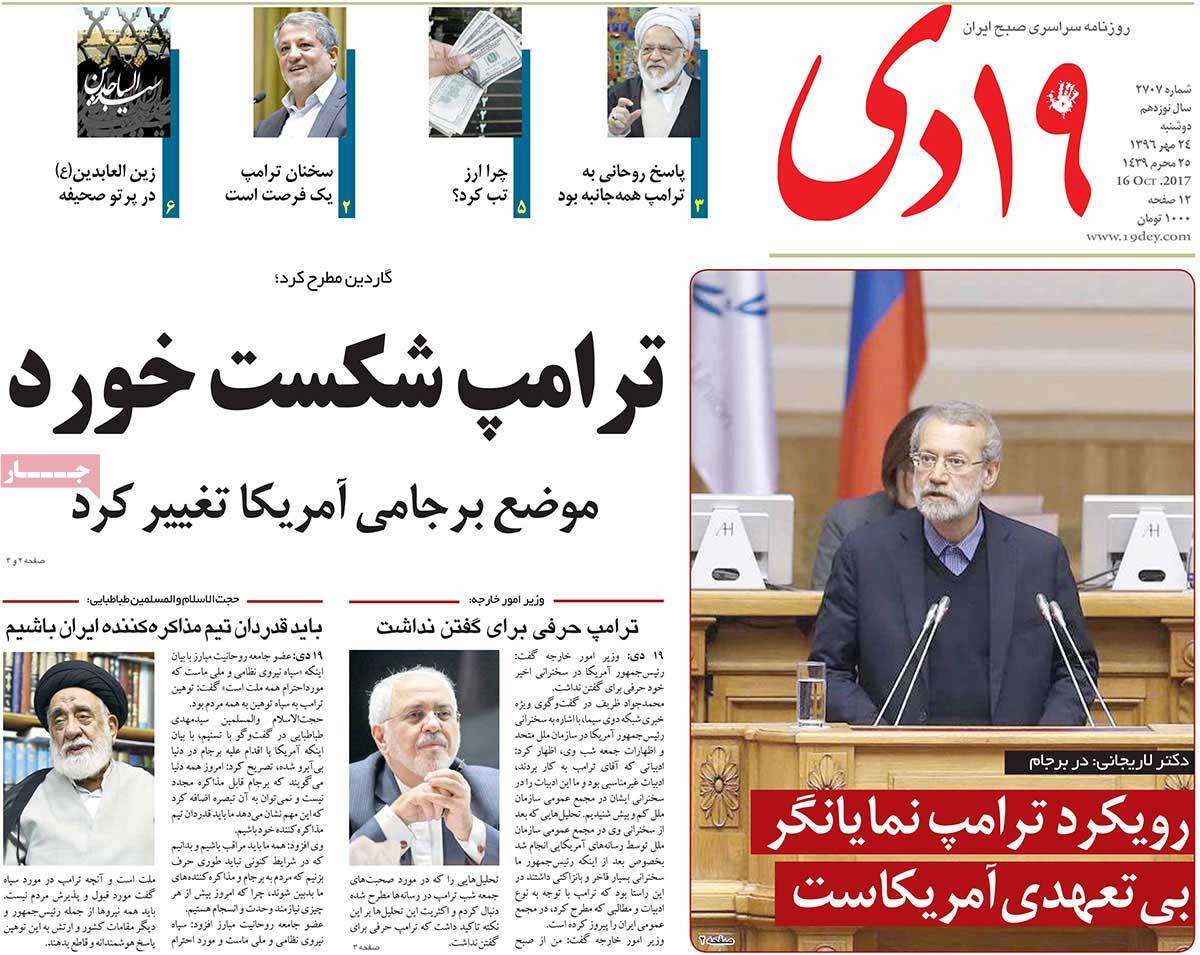
19 Dey:

1- Larijani: Trump’s Approach Shows US Not Responsible for Commitments
A Look at Iranian Newspaper Front Pages on October 16


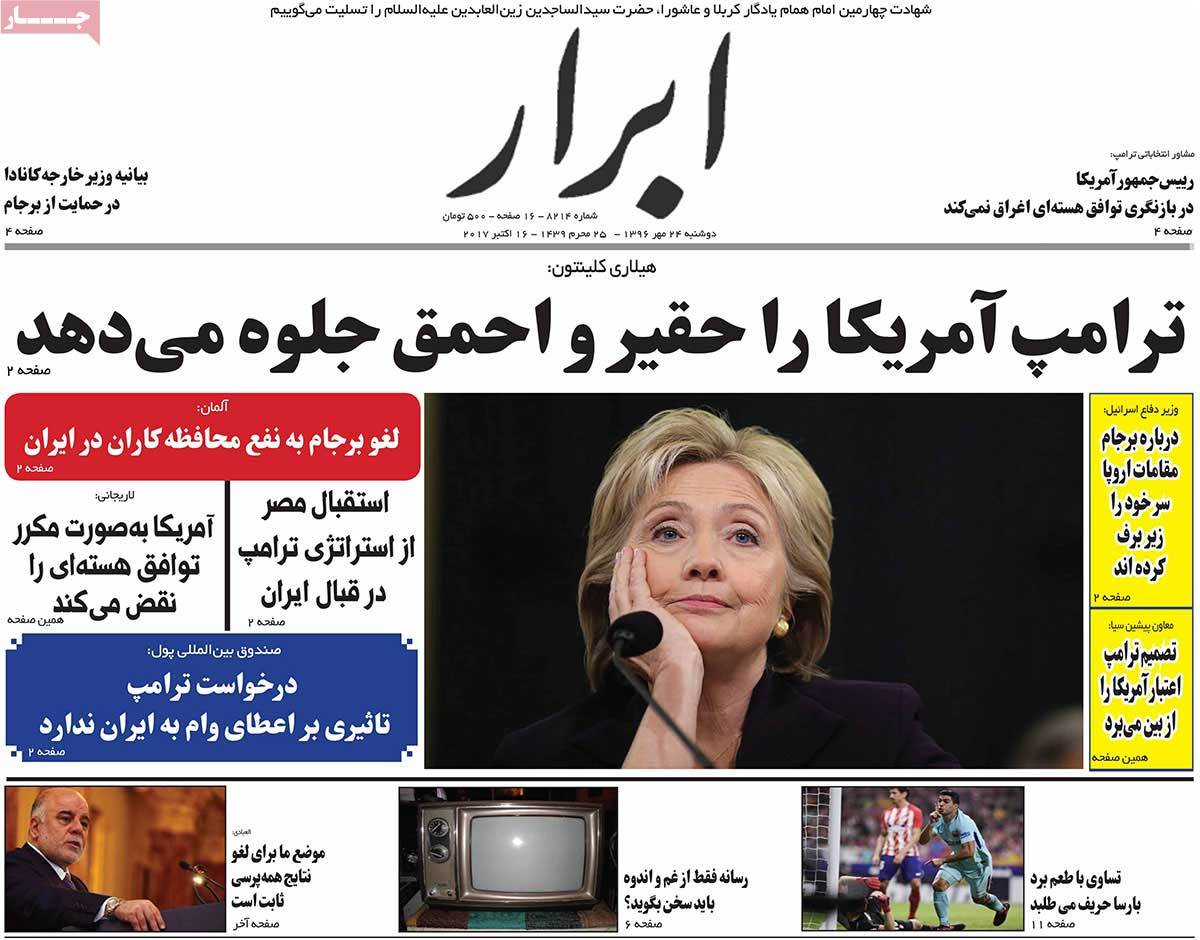
Abrar:

1- Former CIA Official: Trump’s Decision to Tarnish US Credibility
A Look at Iranian Newspaper Front Pages on October 16


Afkar:

1- Larijani: Trump Has Mistaken Politics for Real Estate

2- #Europe_Same_as_US: Iranians Protest Continued JCPOA Implementation with Europe
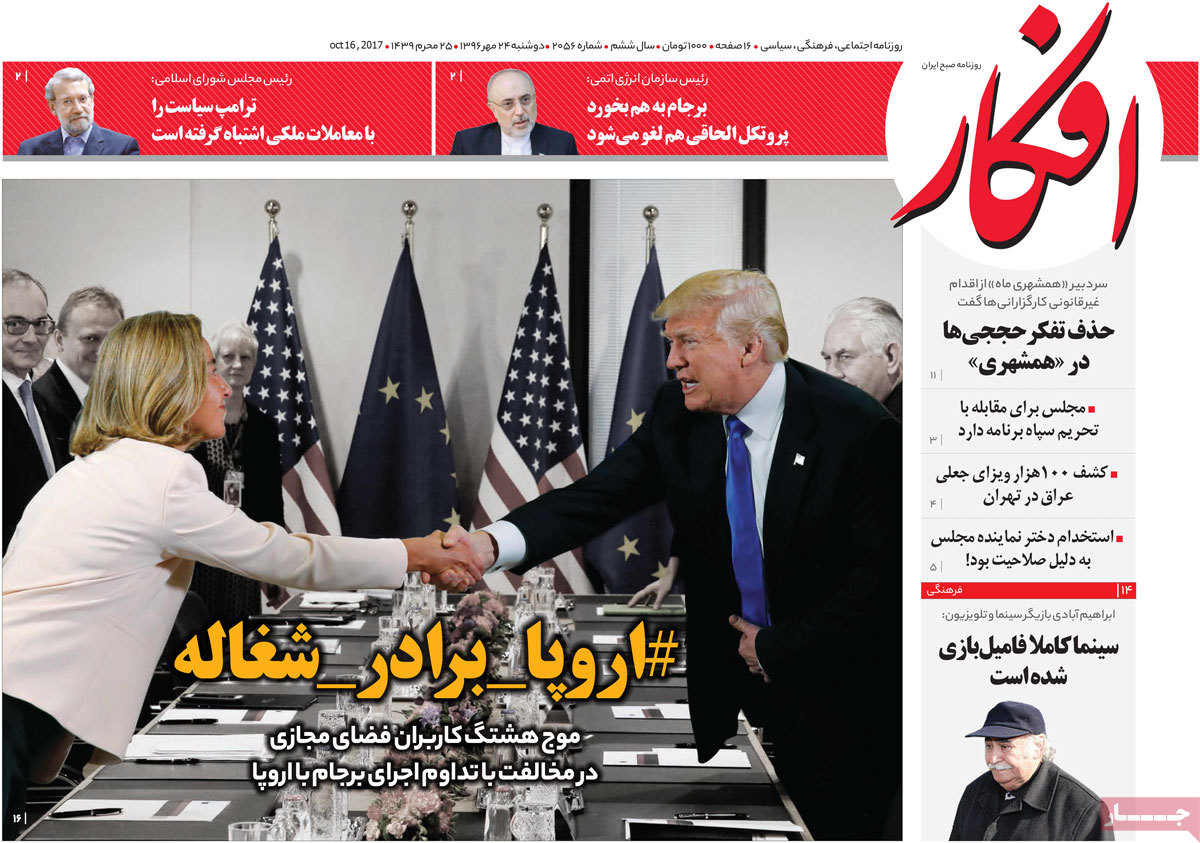
A Look at Iranian Newspaper Front Pages on October 16


Aftab-e Yazd:

1- Reformist Figure: Rouhani Keeping Reformists behind Doors of Gov’t

2- US Envoy to UN: We Seek to Remain in Nuclear Deal

3- IMF Rejects Trump’s Request on Iran

4- Why We Say Trump Is Crazy (Editorial)
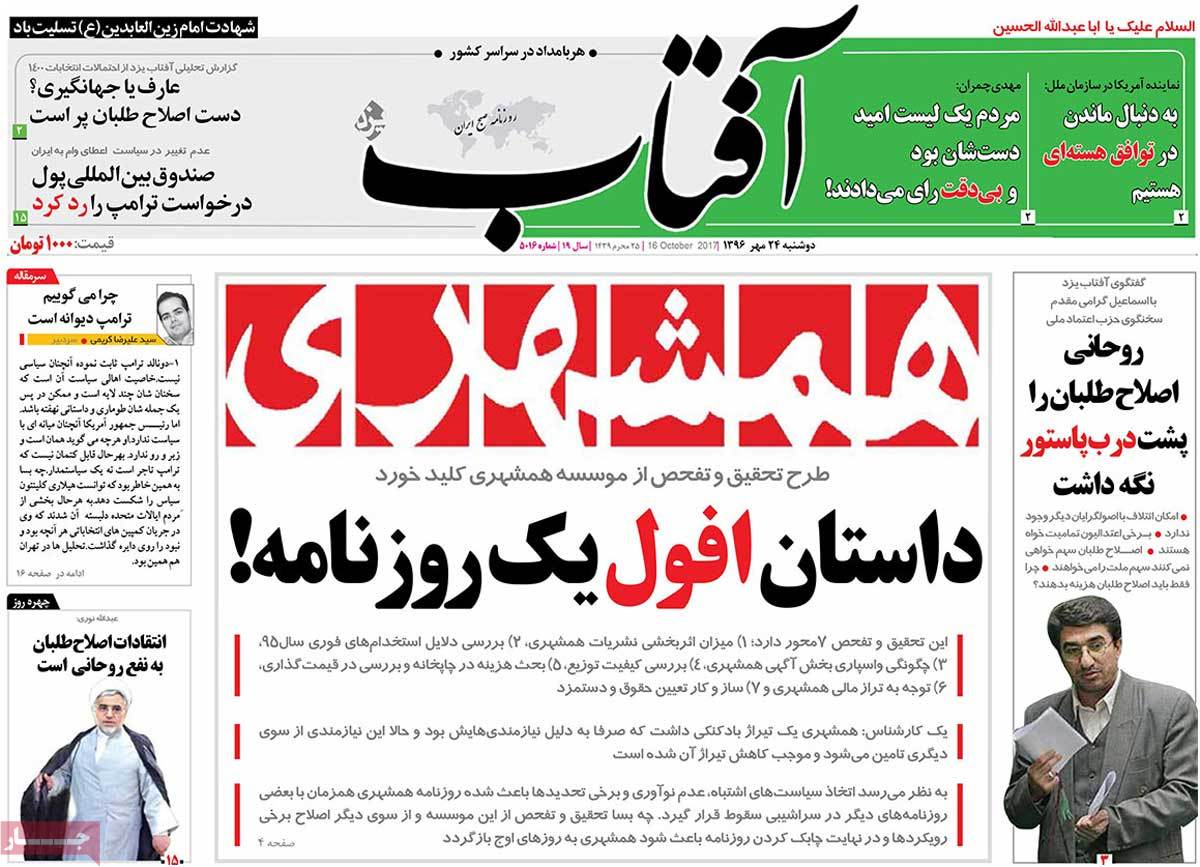
A Look at Iranian Newspaper Front Pages on October 16


Arman-e Emrooz:

1- Wise Americans Back Off: We’ll Remain in Nuclear Deal

  • A Report on US Officials’ Latest Stances on JCPOA

2- Letter for Trump: Zarif Says He’ll Write Letter on Trump’s Recent Remarks
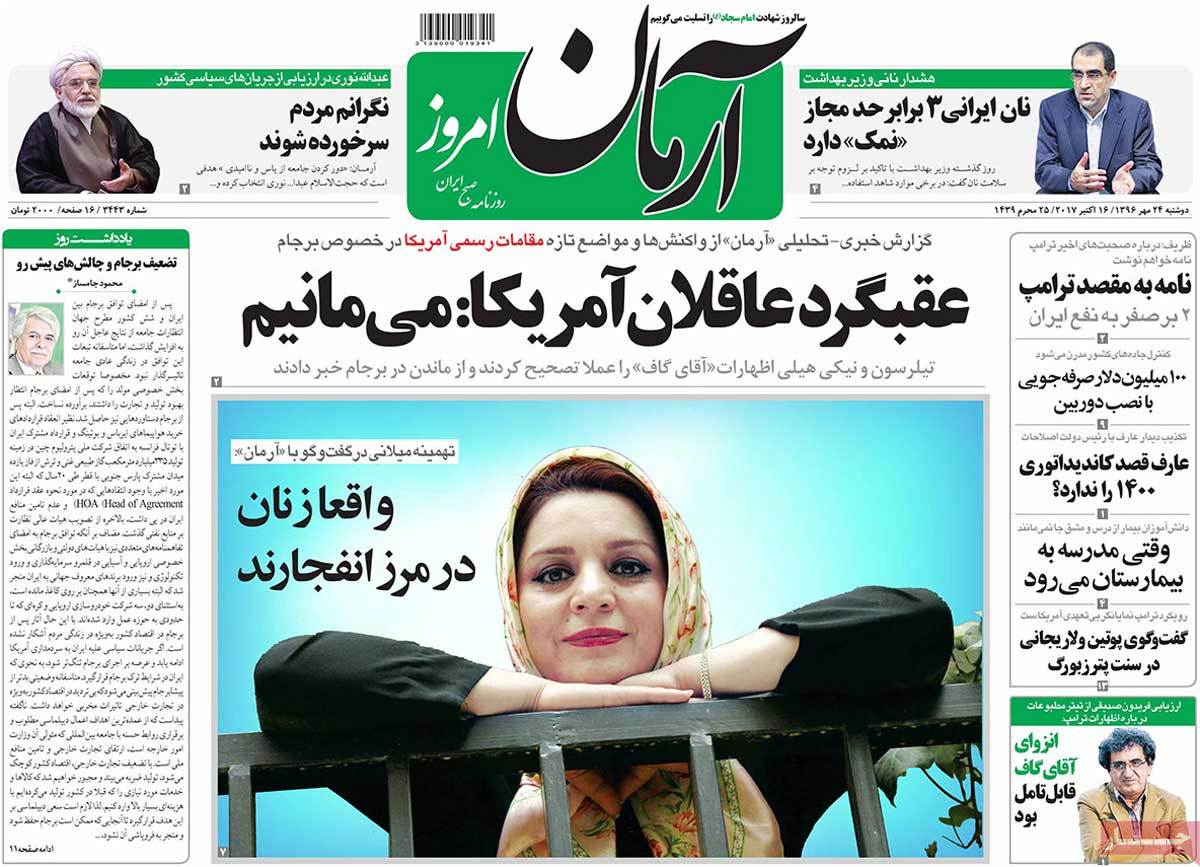
 

A Look at Iranian Newspaper Front Pages on October 16


Ebtekar:

1- Zarif: No One to Trust US in Long-Term Negotiations

2- Iran Nuclear Chief: We Should Be Grateful Our Enemies Are Ignorant

3- Tillerson: Remaining in JCPOA in Line with US National Interests
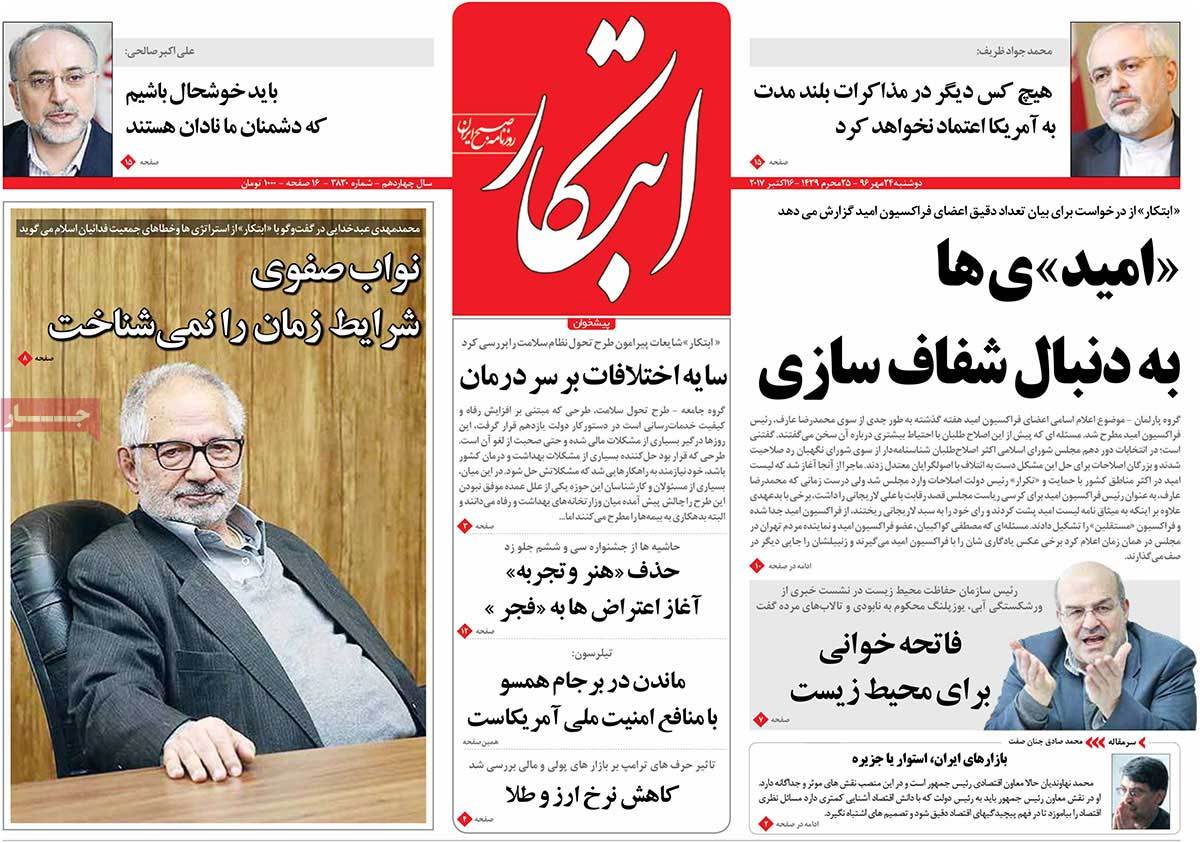
A Look at Iranian Newspaper Front Pages on October 16


Etemad:

1- Iranophobia, an Expensive Commodity from Middle East

  • Four Governments Support Trump’s Stances

2- Kurdish Leaders Hold Meeting, Say Ready for Talks without Precondition

3- Iran, Iraq Eye $20 Billion worth of Trade
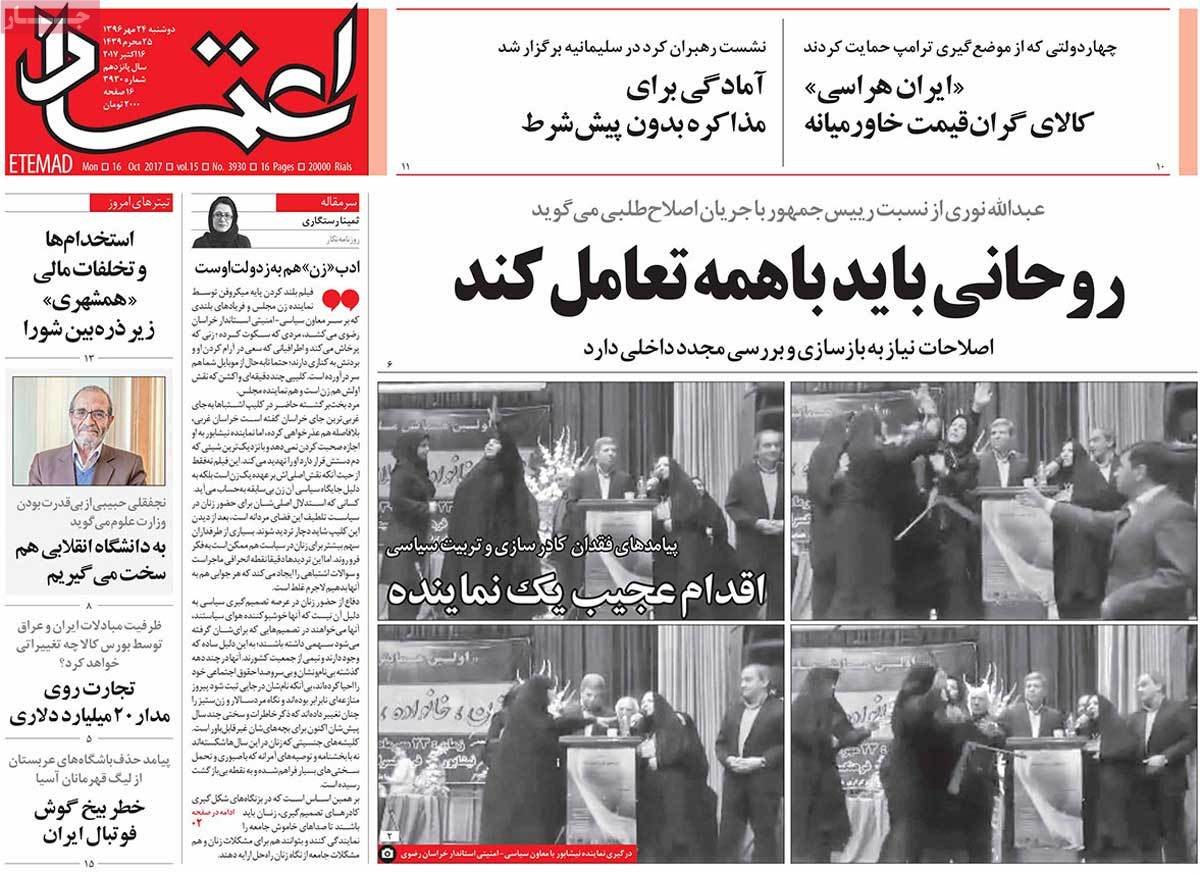
A Look at Iranian Newspaper Front Pages on October 16


Ettela’at:

1- Iran Nuclear Chief: If JCPOA Scrapped, Iran to Stop Implementing Additional Protocol

2- Larijani: Trump’s Allegations against IRGC in Line with Defending ISIS

3- Three Days of National Mourning in Somalia after 240 Killed in Mogadishu Blast

4- People in Isfahan Hold Gathering to Condemn Trump’s Remarks
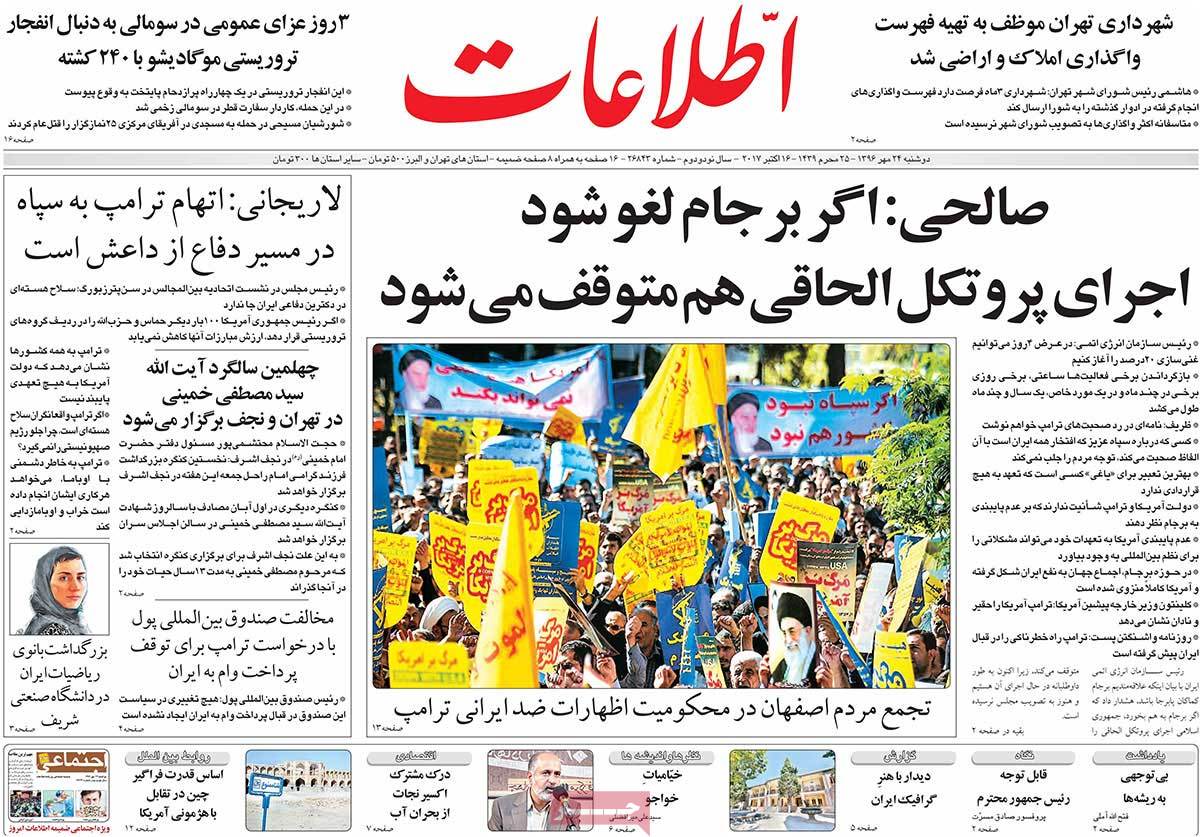
 

A Look at Iranian Newspaper Front Pages on October 16


Iran:

1- Details of $86 Billion worth of Deals Signed after Nuclear Deal

2- Iran Gone Bankrupt in Water Resources: Department of Environment Warns
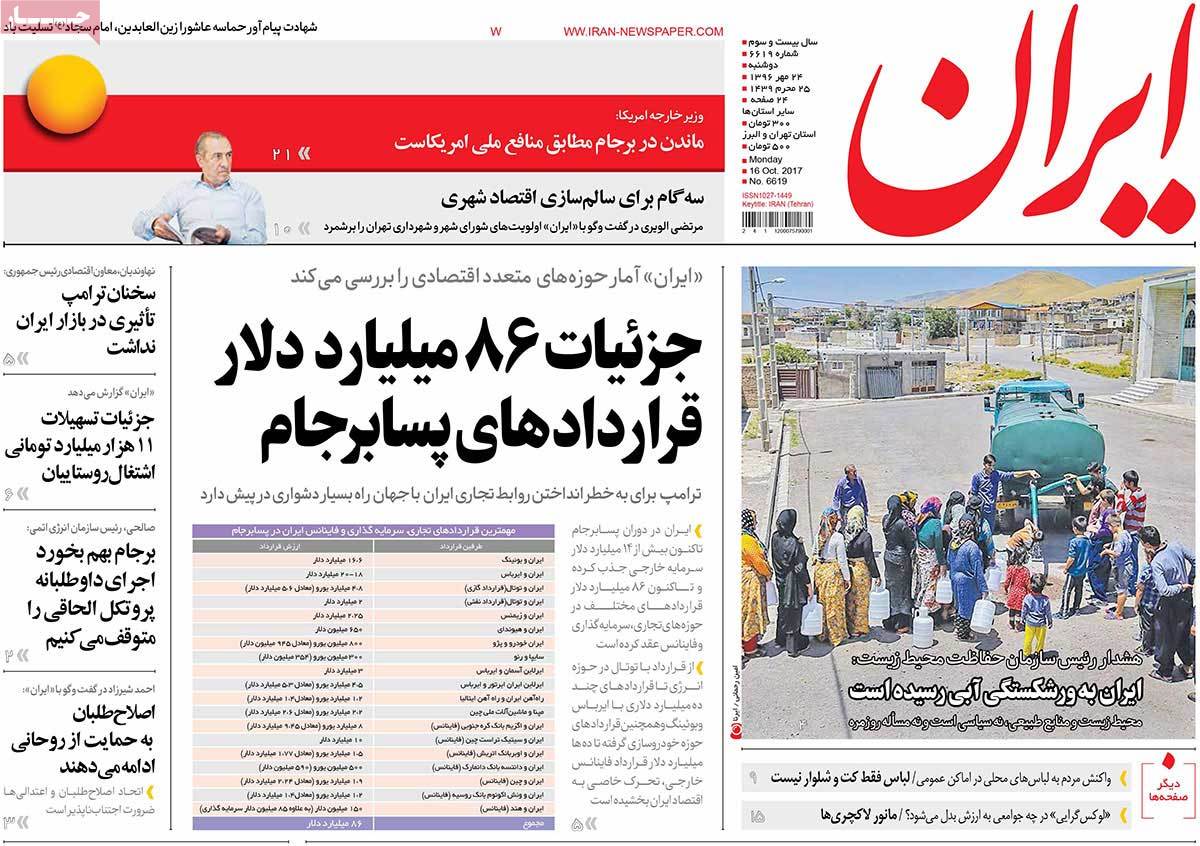
 

A Look at Iranian Newspaper Front Pages on October 16


Jame Jam:

1- Barbara Slavin: European Businessmen’s Deeds Important, Not Politicians’ Words
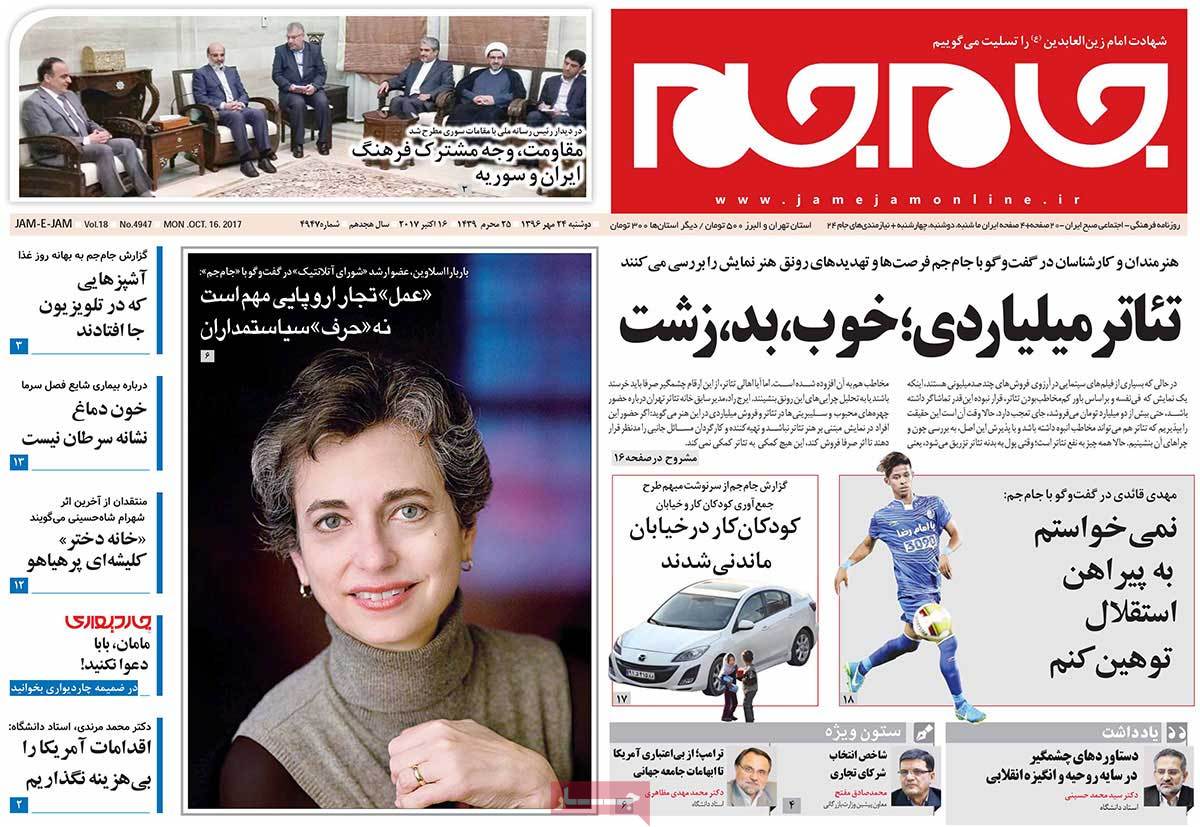
 

A Look at Iranian Newspaper Front Pages on October 16


Javan:

1- Call for Negotiation after Undermining Nuclear Deal

  • Tillerson: We Seek to Reinforce JCPOA through Secondary Agreement

2- Saudi Women from Driving to Singing! Analysis of Hasty Reforms Started from Women

3- UN to Train Iranian Ethics Teachers!

  • 30 Iranian Elites to Be Trained to Become Heads of Int’l Zionist Networks in Iran
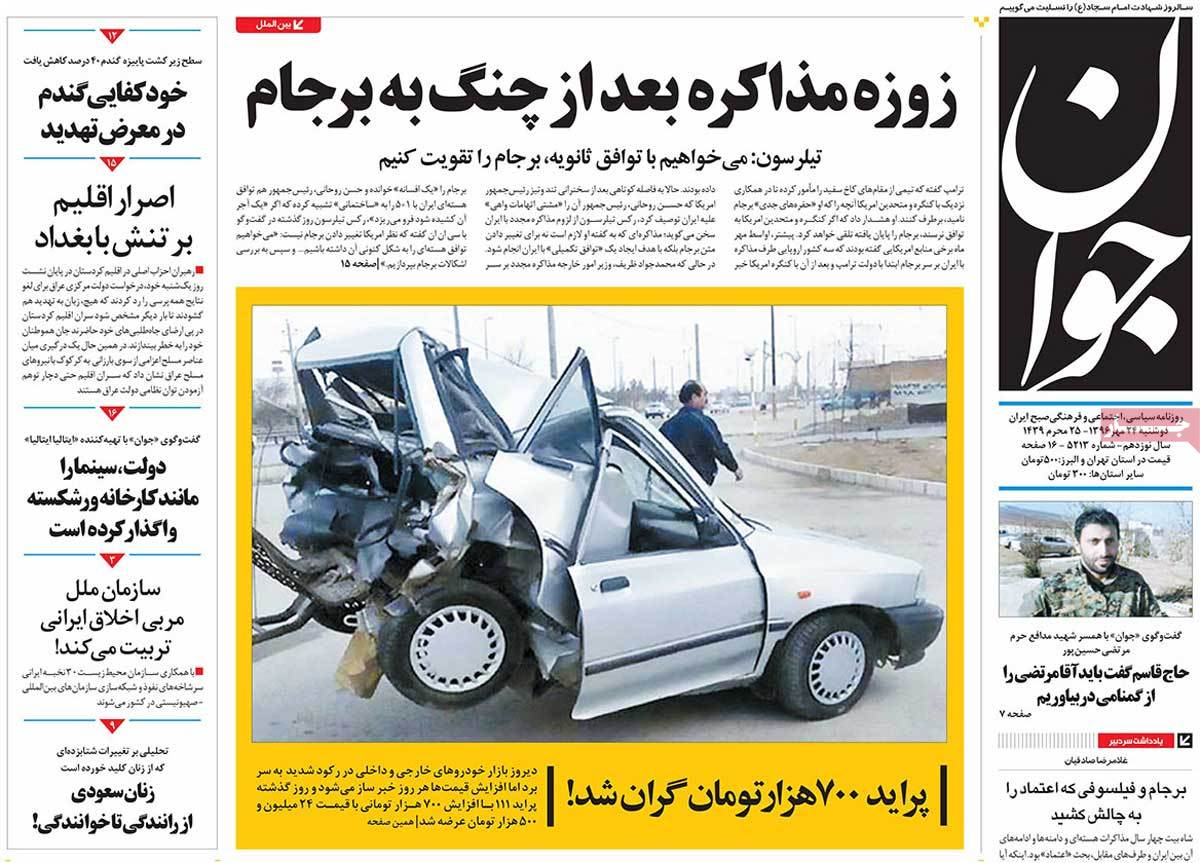
 

A Look at Iranian Newspaper Front Pages on October 16


Jomhouri Eslami:

1- Int’l Economic Bodies Underline Continuation of Post-JCPOA Cooperation with Iran

2- Barzani’s Adventure Leading to War in Kirkuk

3- Zarif: Trump’s Problem Is Lack of Strategy

4- Group of American Psychologists Call for Trump’s Removal
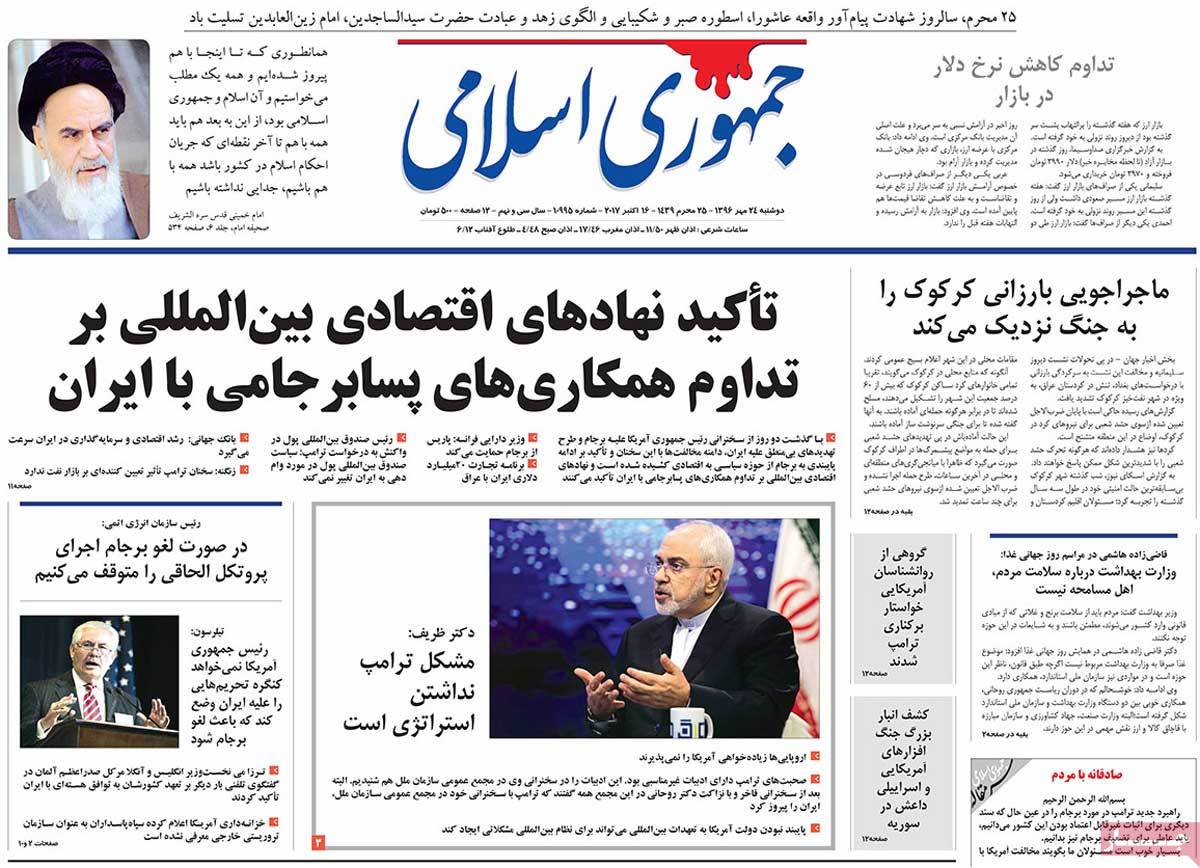
A Look at Iranian Newspaper Front Pages on October 16


Ka’enat:

1- American Withdrawal

  • Tillerson: Trump Not Asking Congress to Impose Sanctions Leading to JCPOA Annulment
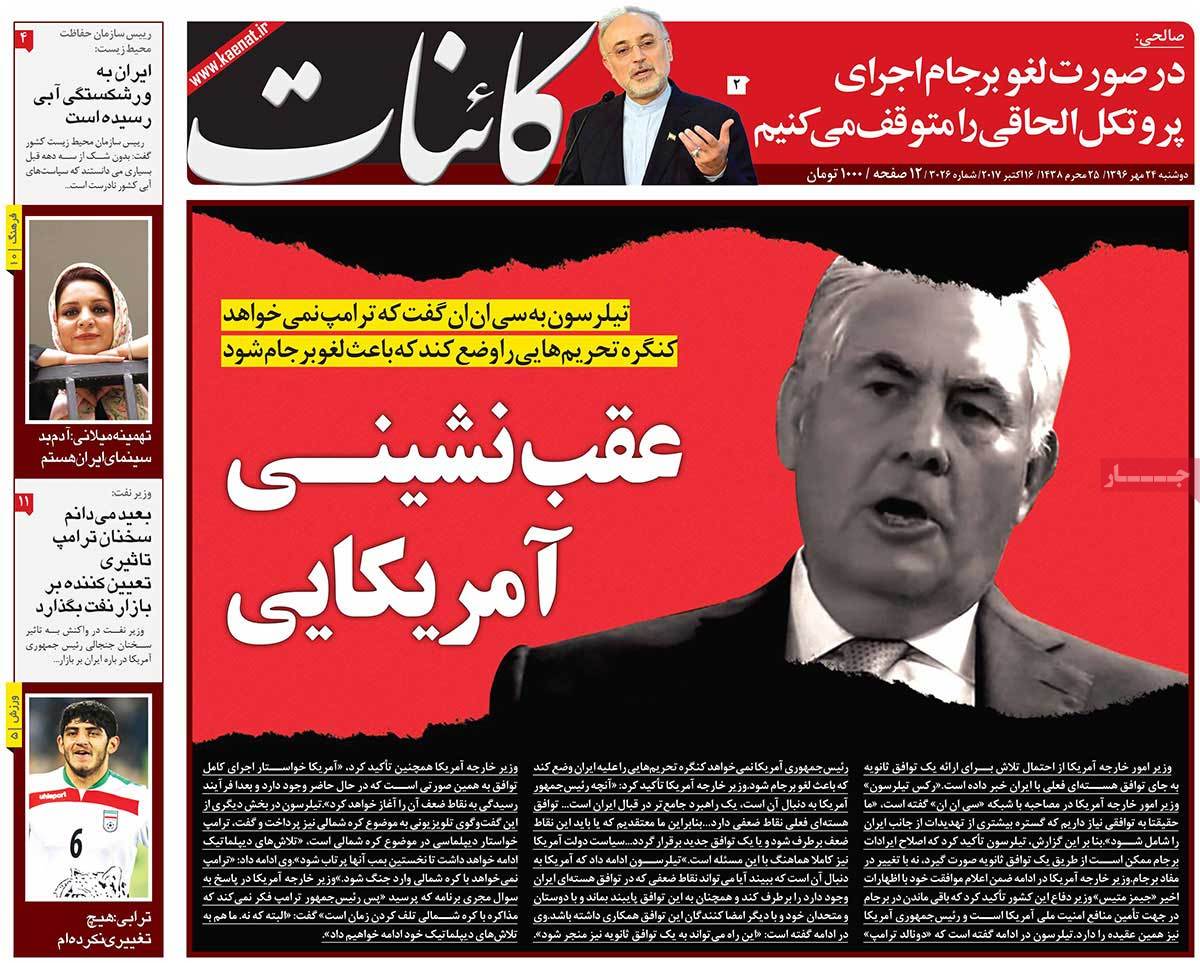
A Look at Iranian Newspaper Front Pages on October 16


Kayhan:

1- US, Europe Two Sides of Same Coin

2- US Secretary of State: Keeping Nuclear Deal Benefits US

3- European Leaders: We’ll Counter Iran’s Regional, Missile Program While Maintaining JCPOA
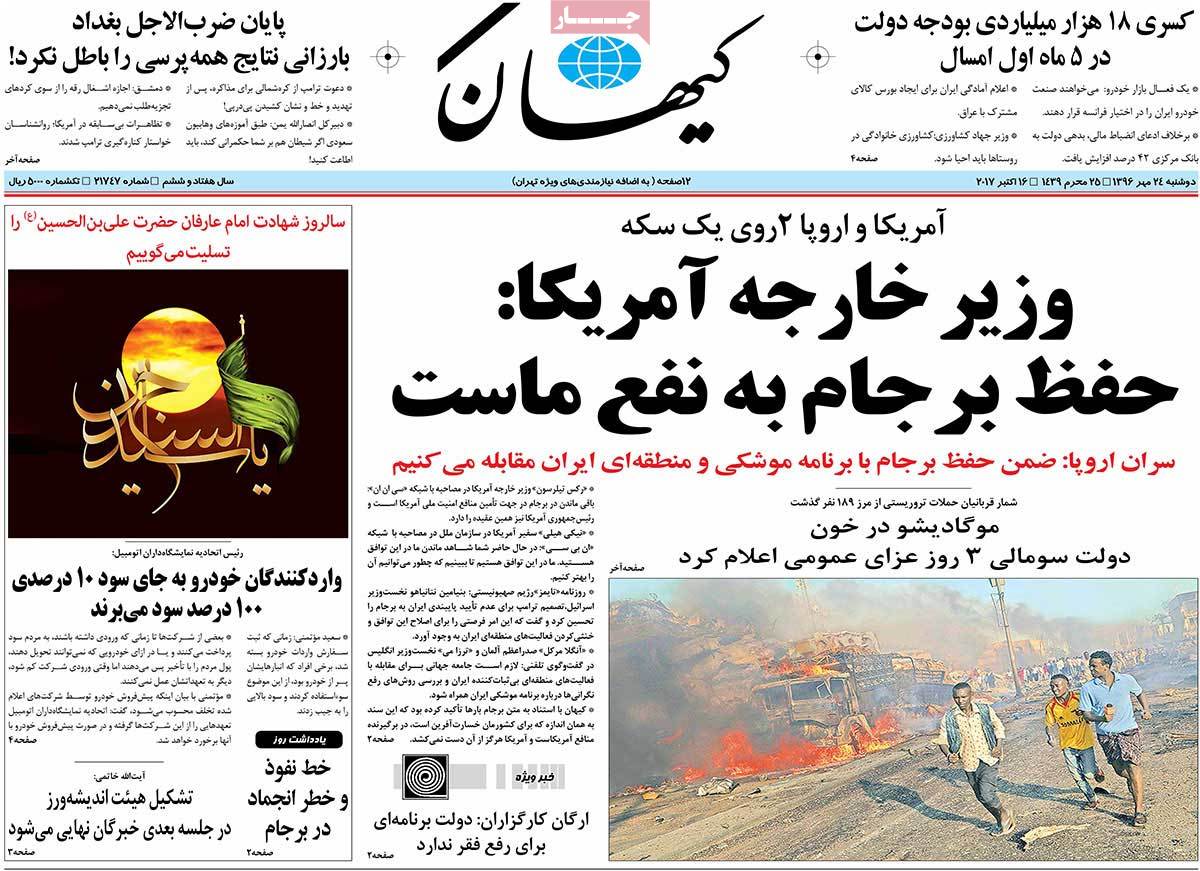
 

A Look at Iranian Newspaper Front Pages on October 16


Resalat:

1- IRGC General: History to Remember How We Defeat Trump

2- Sunni Cleric Urges Iran Foreign Ministry to Firmly Stand against US
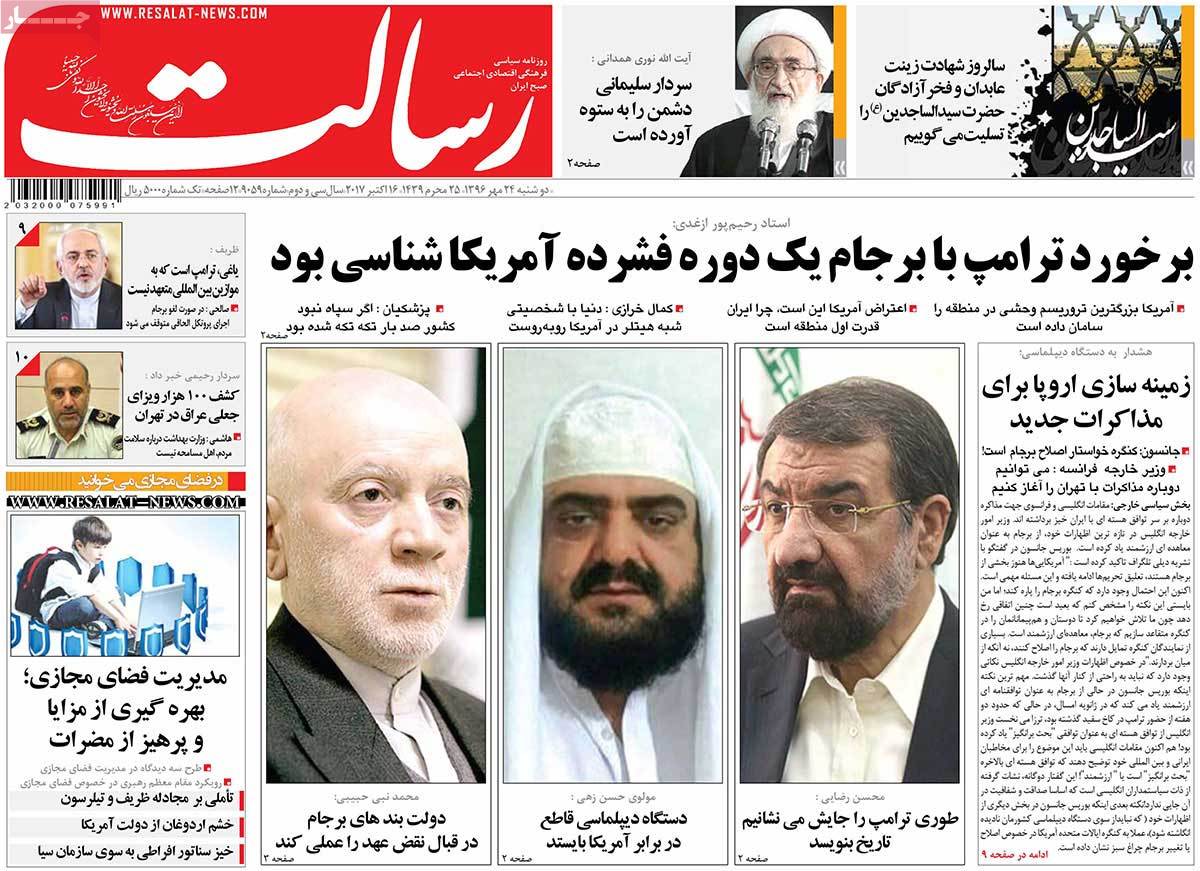
 

A Look at Iranian Newspaper Front Pages on October 16


Rooyesh-e Mellat:

1- Larijani: Trump Trouble-Making President for the World

2- Qassemi: No New Development in Iran-Kurdistan Borders

3- Iran’s Nuclear Chief Warns US against Forcing Tehran to Show Reaction
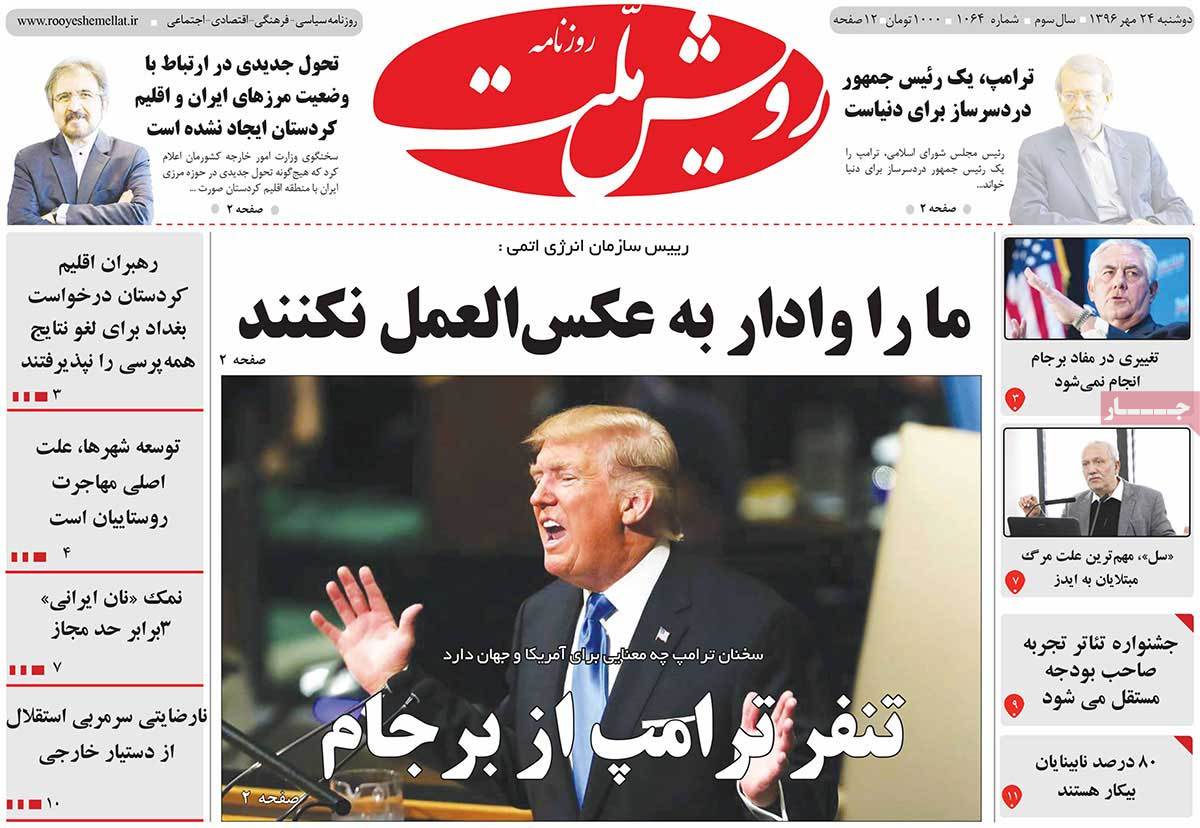
 

A Look at Iranian Newspaper Front Pages on October 16


Setareh Sobh:

1- Trump’s Role in US Decline: A Report on Reactions to Trump’s Remarks
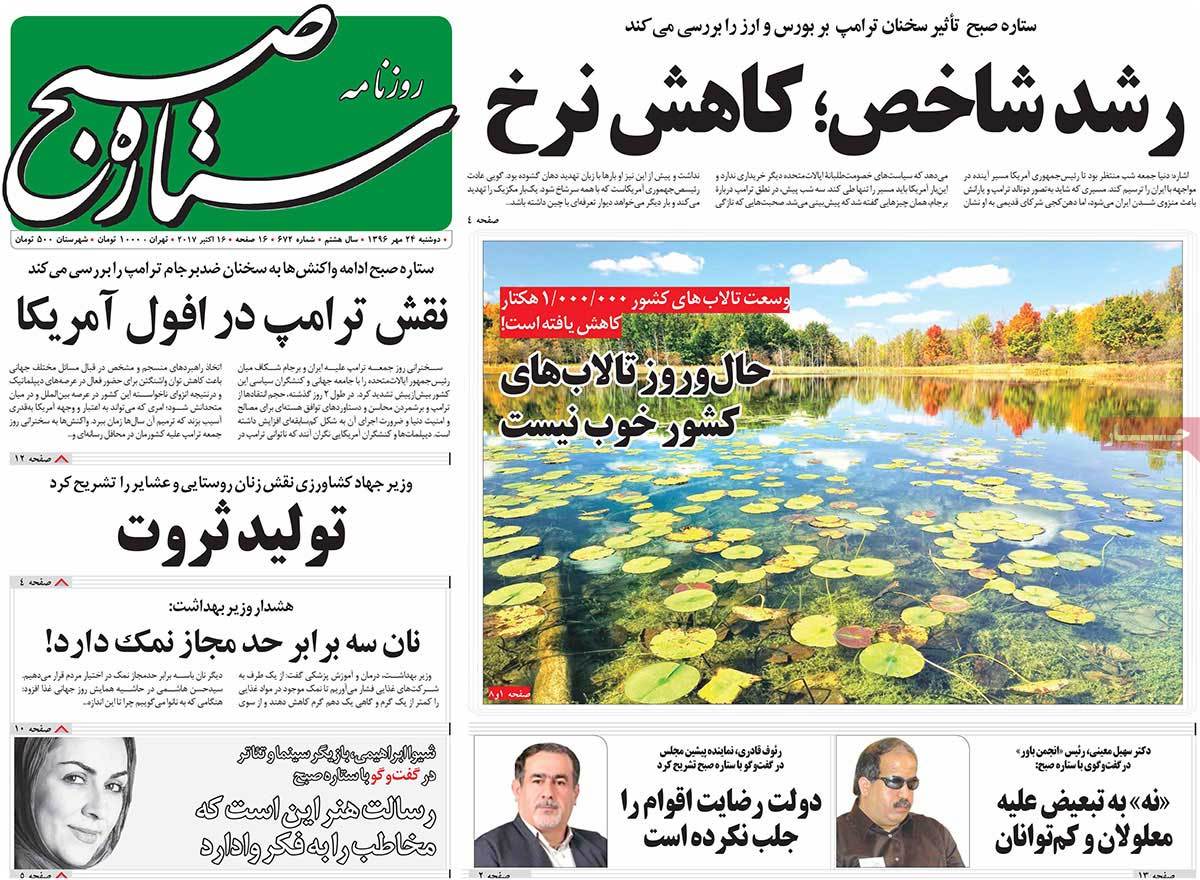
 

A Look at Iranian Newspaper Front Pages on October 16


Shargh:

1- General Soleimani’s Mediation

  • IRGC Quds Force Mediate between Iraqi Kurds, Central Gov’t

2- Tillerson: We Want Secondary Agreement

3- Trump’s Bomb Defused [Editorial]
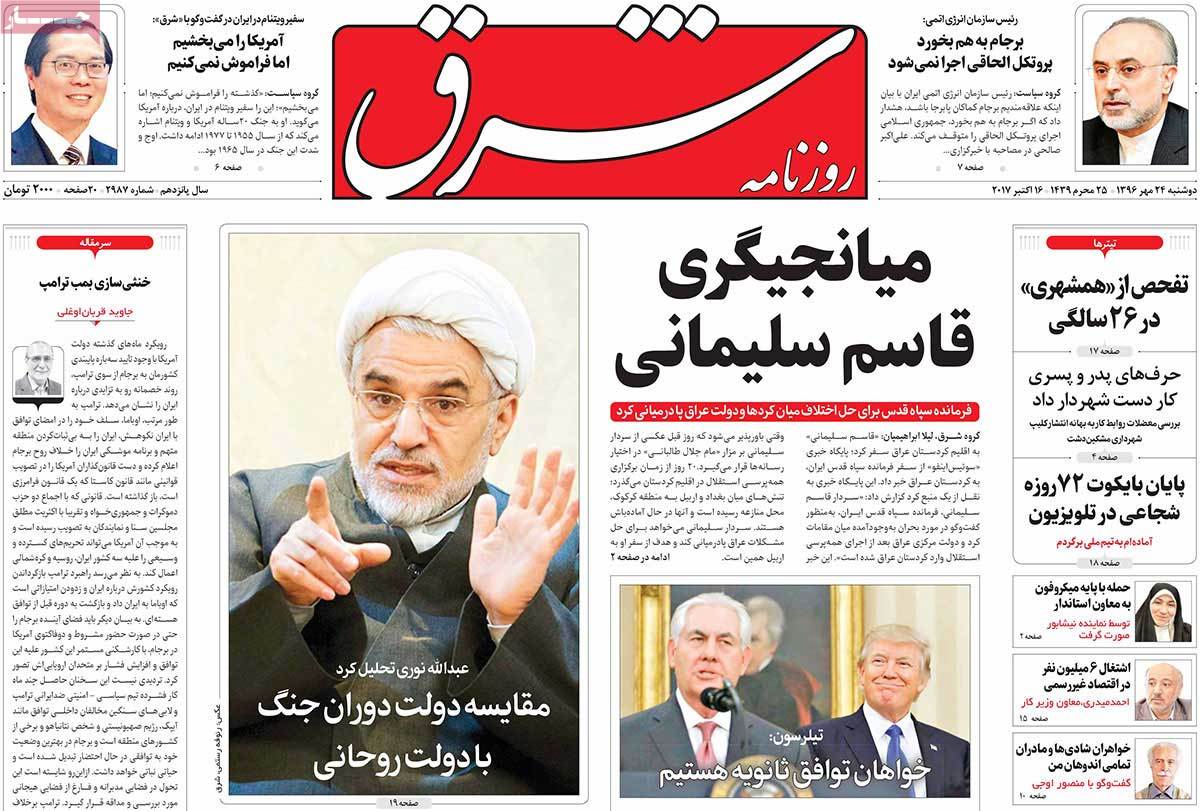
A Look at Iranian Newspaper Front Pages on October 16


‘Trump’s Remarks Only to Increase Popular Support for IRGC’

Iran to Reciprocate If US Designates IRGC as Terror Group

The Friday remarks by US President Donald Trump against Iran and the Iran nuclear deal have drawn mixed reactions. Hessamodin Ashna, a cultural advisor to Iranian President Hassan Rouhani, is among those who believe Trump’s speech would make the IRGC even more popular in Iran. The highlights of his Farsi interview with IRNA follow:

What is your analysis of Trump’s comments?

I had never seen a US president as desperate. I think Trump is in a predicament now as he feels under pressure to make good on the promises he made during his election campaign, not to mention the conflicts within the US government on the JCPOA. Of course, Trump showed how important the nuclear deal is and how prudently Iran has turned the JCPOA into an opportunity for itself. Before the JCPOA was concluded, it was Iran that was facing accusations and needed to prove something (the peaceful nature of its nuclear activities) to the world, and now it is the US that has to address global concerns.

Why do you think Trump is in such a situation now?

The Trump administration pays due regard to the interests of Israel and the Hebrew-Saudi lobby in Washington. Trump had chanted the slogan “America first,” and now the world is seeing that Washington is compromising its international credibility for Israel’s security. It looks like “Israel first” is the priority for Trump.

What do you think the US society’s reaction is to this approach of Trump?

The creation of tension in this region will benefit none of the regional countries. The Americans will secure no benefits, either, by spending so much energy and US taxpayers’ money in order to provoke tension, conflicts and war in the region. The elite of a country which claims to have the oldest democracy and civil society in the world cannot remain tight-lipped in the face of such irresponsible behaviour. American people and elite should know that Trump’s move constitutes the isolation of the US from the rest of the world.

The JCPOA is a multilateral agreement. How will the other signatories to the deal act?

The other countries attending the talks which led to the conclusion of the JCPOA are facing a tough test. These countries should get ready to defend the credibility of an agreement which took two and a half years to conclude. The credibility of these countries themselves is intertwined with their way of handling the JCPOA. The Europeans showed that they are dealing with the issue with interest. This position of the EU is praiseworthy, and Iran is waiting for the bloc to fulfil its commitments not only in word, but in deed as well.

How do you think Iran’s domestic economic and political atmosphere will react to Trump’s recent speech and future developments?

It is good to know that everything they do is aimed at influencing the country’s economic and political climate negatively. Firstly, people should rest assured that the government will not act hastily. Trump and the US government cannot bank on Iran’s hasty moves. Iran’s government will move forward in keeping with its national interests and alongside wise signatories to the JCPOA, at least as long as the nuclear deal does it more good than harm.

Investors from across the world, domestic economic activists and Iranian people can be confident that the government will move on the path to boost economic growth, solve problems and prioritize people’s livelihoods by introducing reforms to the country’s economy and extensive cooperation with the world. Today’s world considers us a reliable partner, and we are moving on a path that will be in the interest of the Iranian economy and people.

Trump tried to create divisions between the government, people and the IRGC. Can Trump achieve this objective?

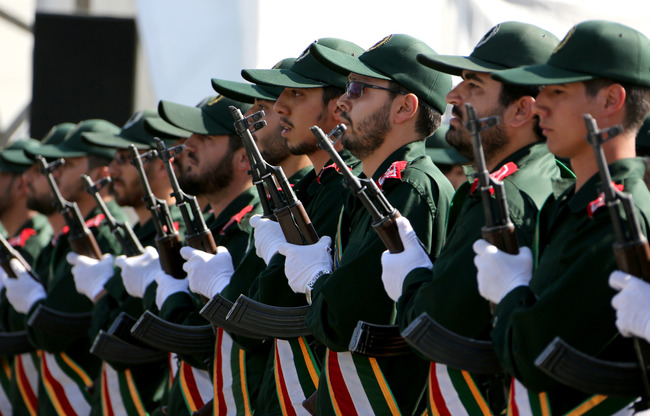
People in the region and in European countries know that if the IRGC had not stood up to terrorists in this region, Europe would be in a different situation now and terrorists would have made the world unsafe. The imposition of sanctions on the IRGC is nothing new. Trump should know as well that Iranian people do not want the IRGC for its economic activities; rather, people want the IRGC to safeguard Iran’s security and independence. The IRGC is not an economic enterprise, so its fate will not be affected with the imposition of sanctions. The IRGC is a military institution whose duty (ensuring security) is not negotiable, nor will it forgo its responsibilities. Trump’s remarks will only increase People’s support for the IRGC.

Now, after Trump’s speech, what is your idea of the JCPOA?

Today, the rightfulness of the JCPOA is more evident than ever. The US cannot pull out of the JCPOA without compromising its reputation and credibility. The world is standing by our side now, and Iran can pass through the current juncture alongside countries which respect peace, diplomacy, rationality and mutual interests.

Iraqi Forces Retake Kirkuk’s Biggest Military Base

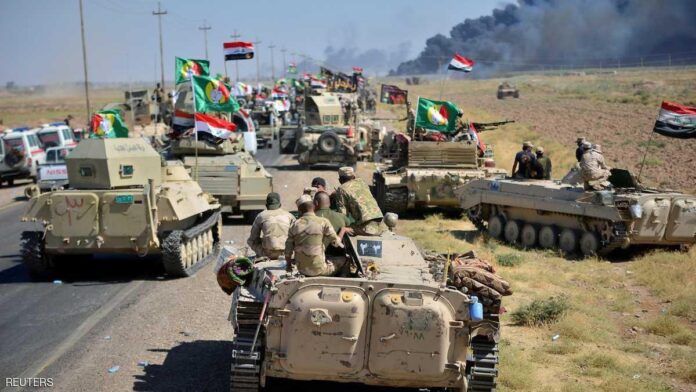
Iraqi officials have declared that the Iraqi Counter Terrorism Service has deployed its forces in K1 airbase, the major and biggest military base of the oil-rich city of Kirkuk.

The Iraqi state TV earlier reported that the central government forces have taken control of “vast areas” in the region of Kirkuk, including oilfields west of the city, in the early hours of Monday.

Iraqi Prime Minister Haider al-Abadi ordered security forces “to impose security in Kirkuk in cooperation with the population of the city and the Peshmerga”, the TV reports said.

“Iraq’s Counter Terrorism Service, the 9th armored division and Federal Police have taken control of vast areas of Kirkuk without confrontations,” it said, adding that oilfields and Kurdish military positions were captured.

However, a Kurdistan Regional Government security official denied that Iraqi forces were able to get closer to the city.

The most serious clash happened south of Kirkuk, an exchange of artillery fire between the Peshmerga and Iraq’s Popular Mobilization Forces, also known as Hashd al-Shaabi, the KRG official said.

There were clashes between Kurdish and Shiite Turkmen groups in another city, Tuz Khormatu, about 75 km (50 miles) south of Kirkuk, but no casualties were reported.

“Iraqi forces and Popular Mobilization Forces are now advancing from Taza, south of Kirkuk, in a major operation,” the KRG Security Council said in a statement around midnight.

Neither side provided a toll of casualties.

The Iraqi forces’ operation in the region of Kirkuk followed meetings held on Sunday by the Iraqi government in Baghdad and the Kurdish leadership in the town of Dokan.

Earlier reports said that KRG President Masoud Barzani and top Kurdish officials who met in Dokan rejected the Iraqi government’s demand that it cancel the outcome of the independence referendum as a precondition for talks to resolve the dispute.

Kirkuk, a city of more than a million people with a large Kurdish community, lies just outside KRG territory, but Peshmerga forces were stationed there in 2014 when Iraqi security forces collapsed in the face of ISIS onslaught.

Iraq’s semi-autonomous Kurdish region held a referendum for independence on September 25 amid regional and international opposition.

Iraq’s Internal Divisions Impacting Global Oil Market

While US President Donald Trump’s recent strategy on Iran’s nuclear program was expected to impact the global oil market, many experts say they are more concerned with Iraq’s internal division.

Experts believe that the conflict over Iraqi Kurdistan’s secession from Iraq has more concrete effects on oil prices across the globe, a Farsi report by Tasmin News Agency says.

While many observers expected that the fall of ISIS in Iraq will lead to the renewal of national unity in Iraq, Iraq seems to have entered a new phase of civil war which can cut the country’s exports of over half a million oil barrels per day.

About one third of Iraq’s oil is extracted by some foreign companies like DNO ASA, General Energy and Gulf Keystone Petroleum. Some other larger companies have also invested in Iraq’s oil fields enjoying political support within the government.

Reports say Gazprom Neft and Rosneft from Russia and Sharon from the US are interested in investing in oil fields of Kurdistan region.

Therefore, any ban on oil export from the region will not only hamper foreign investments but also will result in the shortage of oil for European refineries. This comes as the central government’s oil production in the northern areas of the country will run risks. The central government in Iraq is at the threshold of losing the pipeline used to export its oil to Turkey because the pipeline passes through the Kurdistan region.

If the tensions in the northern Iraq keep going on, the export of Iraqi Kurdistan’s oil will stop. This will have consequences affecting regional countries because refineries in the Mediterranean will have problem in making up for the Iraqi oil due to their long distances. This will in turn widen the gap between the demands for and supply of oil in the Mediterranean region and if prolonged, the problem can eat up the oil reserves of the region.

Iraqi Kurdistan Region exports about 565,000 barrels of oil per day which is equal to Qatar’s oil export.

So, as the politicians are involved in talks over the fate of Iran’s nuclear deal, it seems the main focus should be put on the oil markets in Iraq and the internal division in the country which is threatening the future of Iraq’s oil export.