Monday, December 22, 2025
Home Blog Page 3739

Dialogue Key to Attaining Optimal Security in Mideast: Iran

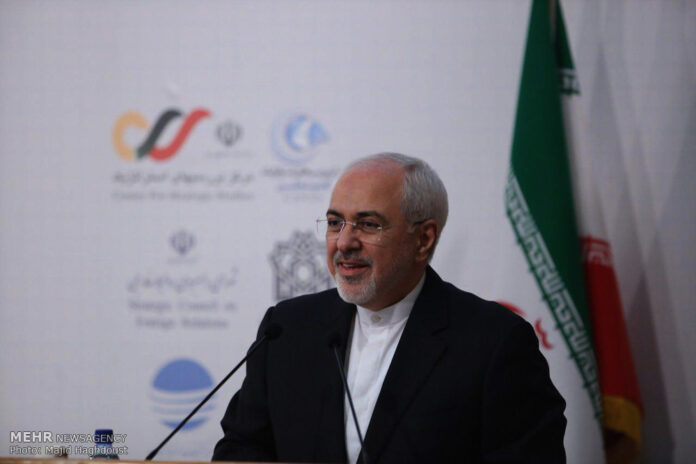
Addressing the Second Tehran Security Conference on Monday, Zarif said, “As to the ways and means to attain the optimal security situation, we should first and foremost rely on dialogue and confidence-building measures.”

“It is obvious that at all levels in our region we are facing a dialogue deficit. Aspects of this problem are visible at all levels in the region: between the ruling and the ruled at the national level, between governments at the official inter-regional level and between peoples at the unofficial inter-regional level,” he added.

He also noted that dialogues in the Middle East “should first and foremost seek to promote mutual understanding and knowing each other in general before seeking to address any particular issue or reaching any particular agreement.”

Here is the full text of his English speech:


In the Name of God, the Compassionate the Merciful

Distinguished Participants,

Ladies and Gentlemen,

I welcome you to the Islamic Republic of Iran to participate in the Second Tehran Security Conference. I hope that you will have a constructive and meaningful discussions and exchange of views in this Conference. I also hope that those who have arrived from outside Iran can have a pleasant stay in Tehran.

The Second Tehran Security Conference is held at a time when West Asia is going through one of its most difficult times. Violent extremism, which embroiled our region in one of its most tumultuous periods of its history, is on decline. Daesh, as the most petrifying representative of this scourge, is militarily suppressed, its self-proclaimed and false Caliphate destroyed and the territory under its control, occupied through boundless violence and terror, liberated. In the past six years, the peoples and governments of Iraq and Syria heroically resisted the violent extremist groups, especially Daesh, and achieved major victories. We are pleased that we could stand by these two friendly and brotherly nations in this historic fight.

In this period of time between the collapse of Daesh and the formation of an optimal security environment in the region, we and other regional actors are facing three major challenges, namely, first, ability to correctly grasp the current realities on the ground, second, arriving at a common understanding about the optimal condition for the region and third, ways and means to reach this optimal condition:

  • Current realities
  1. Despite crippling defeats inflicted upon Daesh and other terrorist groups in the past one to two years, and the collapse the false caliphate project and the destruction of the military – administrative apparatus of Daesh, their terror system is, however, still at work. Due to their extensive networks in different countries, including in West and Central Asia, especially in Afghanistan, and in North Africa, they have still a regional and global reach and, therefore, should still be considered a serious threat. Thus, the continued fight against the traces of this dangerous ideology in Syria and Iraq, precluding the spreading of extremism into new areas, eradicating its ideological roots and the cutting of its financial resources should still be a priority.
  2. Respect for national frontiers and the nation-state system, undermined by the terrorist groups and takfiri ideologies, should be restored as a matter of priority. Perpetuation of disregard for the nation-state system would certainly stoke the centrifugal tendencies in political units of several states and will result in nothing but more tension and instability.
  3. Preserving national coherence and territorial integrity of the countries in the region is imperative. Ethnic restiveness in Syria and Iraq, implicated with secessionist inclination, constitutes a threat for the region and the whole world. That should be prudently dealt with by national and local authorities through dialogue and on the basis of mutual respect, national sovereignty, territorial integrity and national constitutions, and turned into cooperation and convergence.
  4. The reconstruction of Iraq and Syria is one of the major issues that the international community should take up at this period. The speedy launching of this important process will have a major impact on the political stabilization of the whole region and the total defeat of extremism. It should be undertaken with a view to helping people and establishing peace and be devoid of any effort to advance political and factional agenda.
  5. The continuance of aggression against the oppressed people of Yemen, including indiscriminate aerial raids and extensive war crimes against civilians, is another major source of tension in the region. Following 33 months of senseless bombing campaign, aggressors should have realized by now that this crisis has no military solution and the parties to it have no way out other than engaging in dialogue to reach a national consensus to resolve the crisis.
  6. The US policies and its intervention in the region have been the major challenge that has fueled current crises and made them more complicated. The US continues to ignore the concrete realities in the region, and persists in its destabilizing and destructive policies such as maintaining its illegal military presence in Syria.
  7. The occupation of Palestine remains the most critical issue facing the region and the whole world. All regional issues are influenced directly or indirectly by this major threat to the entire region and the cruelty imposed on the Palestinian people for the past 70 years. Through the recognition of Al-Quds as the capital of the illegitimate Zionist regime, the US once more reasserted its open enmity against the Muslims and Islamic countries, and thereby provided another opportunity to extremism and terrorism to regrow.


  • Optimal Security Condition for the Region

Security issues and tensions should be dealt with and discussed while having a vision in mind and endeavoring towards creating an optimal security condition in the region. To this end, two ideas, namely “strong region” and “security networking” could be a basis for a new paradigm in West Asia.

  1. Strong Region

Efforts made towards creating “strong region” instead of seeking hegemony and trying to exclude other actors is rooted in the Islamic Republic of Iran’s strategic vision for our region. It emanates from the recognition of the imperative of respect for the interest of all stakeholders in the Persian Gulf region and the application of the win-win rule to our region. On this basis, ensuring the interest of each country depends on safeguarding the interests of all and every country in the region. Any domineering effort by any country in the region, aimed at excluding competitors and becoming the hegemon is not only inappropriate but it is essentially impossible too. Three decades of accumulated experience following the end of the Cold War and the strategic conditions in the transition to post-Western world have proven that aiming to achieve hegemonic status at the global or regional levels is not only fruitless but also dangerous. Although competitions among nations for socio-economic development and towards a higher level of welfare and peace of mind for their citizens is not inappropriate, efforts to attain ascendancy and hegemony are inherently destabilizing from a geopolitical and geostrategic perspective and create fundamental impediments for national development. Such rivalries create a vicious circle that will allow no country to win. Other regions have been able to reach peace and development only after they left behind destructive and domination-seeking rivalries and showed genuine tendency for cooperation. Countries in our region are destined to coexist by the rule of geography. While at the same time, shared history, culture and religion make such cooperation and coexistence not only imperative but also pleasant and rewarding. Our power and capability depend on our efforts to strengthen our regional community of nations. Any attempt by any of us to gain security and ascendance at the expense of others would enfeeble all of us.

Arms race is an example and outcome of such destructive rivalry. The military expenditure by our neighbors in the Persian Gulf region as a percentage of GDP is the highest in the world. Last year the military expenditures of GCC members amounted to a total of 116 billion dollars, which not only created more tension and fueled more distrust, but also wasted peoples’ vital resources, syphoning them into the coffers of lethal arms manufacturers. At the time when our region faces a full spectrum of such acute problems as terrorism, extremism, environmental crises like dust storms and drought, migration and the failure of governments to deliver, destructive arms race and tension among neighbors impose further cost on peoples in the region and exacerbate problems.

No country can secure itself at the cost of endangering its neighbors’ security. Such an idea is nothing other than a dangerous delusion in our current inter-connected world. Our experience in this region in the past four decades has proven that any such attempt first and foremost haunt those who seek to bring wars and bloodshed on their neighbors. The experience with Saddam, the Taliban and Daesh, among those still fresh in our minds, are undeniable facts.


  1. Security Networking

Given the current inter-connected world and the special condition of our Persian Gulf region, which has experienced the most bitter and destructive crises in the past four decades, engaging in bloc-formations and alliances have proven to be inefficient, as each power bloc forewarns a forthcoming crisis and aggression. On the other hand, differences in size, population and economic and military strength creates permanent concerns and reliance on foreign powers, resulting in the illusion of buying security that leads only to insecurity and the increase in distrust. At the same time, attempts aimed to create collective security regime is unrealistic and leads to failure.

It seems that security networking, based on synergy and inclusion, is the only way out of this dangerous vicious circle. In this security networking, all big and small regional States participate on the basis of the purposes and principles of the UN Charter, including sovereign equality of States, refrainment from the threat or use of force, peaceful resolution of conflicts, respect for territorial integrity of States, non-intervention in the domestic affairs of States and respect for self-determination of States by their own peoples.

Security networking doesn’t necessarily mean setting aside differences or overlooking historic problems. It is merely a means for managing them while precluding enmities as well as inefficient and destabilizing alliances. In this framework, the regional States, be they large or small, predicate themselves on security networking to cooperate with a view to creating a lasting arrangement for securing the region while rejecting any sort of hegemony by regional and supra–regional powers. Such an approach leads to the promotion of cooperation among the regional States and the creation of opportunities for all towards strengthening one’s security and stability as a supplement for the security and stability of its neighbors’. Based on this approach, in the current inter-connected world, the security of one country or a group of countries cannot be ensured without the security of others.

Within this conceptual and operational framework, hegemonic tendencies, unilateralism, confrontation and exclusion that lie in part at the root of the current difficulties in international relations, will lose any appeal. This framework also helps replace the inefficient and destabilizing doctrine of balance of power or reliance on military power blocs and dangerous and costly arms race with security networking, which is based on participation and the promotion of cooperation in the areas of common interests as well as dialogue on areas of difference of interest and opinion.


  • Ways and Means to attain optimal security situation
  1. Dialogue

As to the ways and means to attain the optimal security situation, we should first and foremost rely on dialogue and confidence-building measures. It is obvious that at all levels in our region we are facing a dialogue deficit. Aspects of this problem are visible at all levels in the region: between the ruling and the ruled at the national level, between governments at the official inter-regional level and between peoples at the unofficial inter-regional level.

Given the tremendous problems existing at the national and regional levels, our governments are in need of assuring dialogues now more than any time in the past. These dialogues should first and foremost seek to promote mutual understanding and knowing each other in general before seeking to address any particular issue or reaching any particular agreement. They should aim to make clear to the parties that we all have, more or less, similar concerns, fears, aspirations and hopes. We are not only destined to live together by the rule of geography but also based on common history, culture and religion on the one hand and common opportunities and challenges on the other, we could benefit from dialogue and positive interaction towards advancing the interests of our peoples. Such dialogues must replace rhetoric, slogans, rants and useless propaganda statements that we fire at each other through our media.


  1. Confidence Building Measures

In the past several years, tensions, aggressions and numerous wars in the region as well as destructive activities of terrorist groups have led to what I can describe as mutual-trust crisis among the regional States. Dialogue as I described earlier is one of the most important instruments for removing mistrust. Nonetheless, in addition to face-to-face dialogue, we need in some cases to adopt certain measures to decrease the level of concerns. Such measures are sometimes imperative for preventing tensions from rising, excluding or decreasing tension-creating factors and, more importantly, preventing clashes due to accidents or miscalculations. This way, we should be able to increase the predictability of regional actors’ behaviors and, accordingly, decrease the concern over any possible surprising actions by any regional actor.

Exchange of information in all areas tops all confidence-building measures. The main purpose of exchange of information is to inform counterparts about the objectives and aims and preclude misunderstandings and misconceptions. These measures may include, though not limited to, avoiding to make provocative statements or take provocative actions, exchange of officials, servicemen or civilians, for several weeks or months to confer with counterparts, undertaking confidence-building measure in border areas, where there is tension or concern over the movements of extremists, and finally, jot lines, making direct contact between high-ranking officials of States with tense relationship possible.

In the field of people-to-people contact, we may look into joint cooperation in a multitude of fields including promoting tourism and particularly Halal tourism, student exchanges, research trips, organizing sport competitions, encouraging businessmen to meet and engage with counterparts, encouraging artists to be in touch with one another and stage performances in different regional states, exchange of movies and TV series, thus enabling peoples to get acquainted with each other’s way of life, reviewing school textbooks aimed at excluding negativity and including positive contents about neighbors.

Cooperation in the areas of common interest and concern such as dealing with natural disasters, fighting sectarianism and extremism, empowering the youth and women to participate in different fields of social life are more confidence-building measures in which regional states could engage. All these measures could be followed up through the establishment of joint committees and task forces.

Ladies and Gentlemen,

The principle of “the constructive interaction with the world”, based on rationality and moderation, which involves constructive dialogue, participation and cooperation on the basis of common interests and mutual respect as well as win-win pattern in the interaction with others has formed the foundation of President Rouhani’s foreign policy. The nuclear deal is a product of this foreign policy. Its full implementation has so far played a major role in decreasing tension and promoting peace and stability in our region. The adherence by all to this important agreement would further help all of us move in the right direction.

As the first step towards the new paradigm of security networking in a strong and stable region, the Islamic Republic of Iran proposed to create a “Regional Dialogue Forum” in the Persian Gulf right after the conclusion of the JCPOA. This forum can be used as an instrument for helping organize and advance dialogue at all formal and informal levels in the Persian Gulf region, and while encouraging inter-governmental and formal dialogue, it could also promote dialogue between scholars and thinkers in the civil society. In the same framework, regional States can conduct preliminary consultations on how to implement confidence-building measures.

I hope that the discussions in the Second Tehran Security Conference can contribute to collective thinking and action for creating and advancing a new conceptual paradigm for security in this sensitive and volatile region. I wish you all success in the discussions that you will have throughout the day.
Iran Calls for Promotion of Banking Ties with Chile

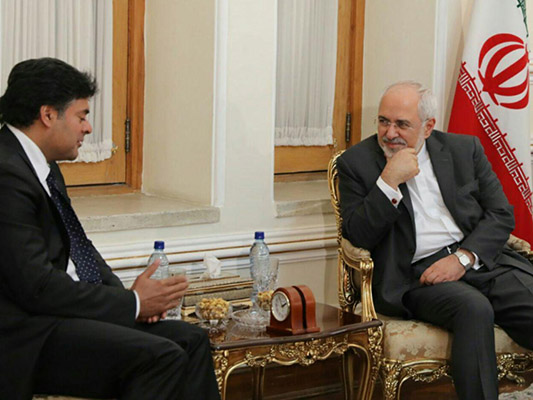
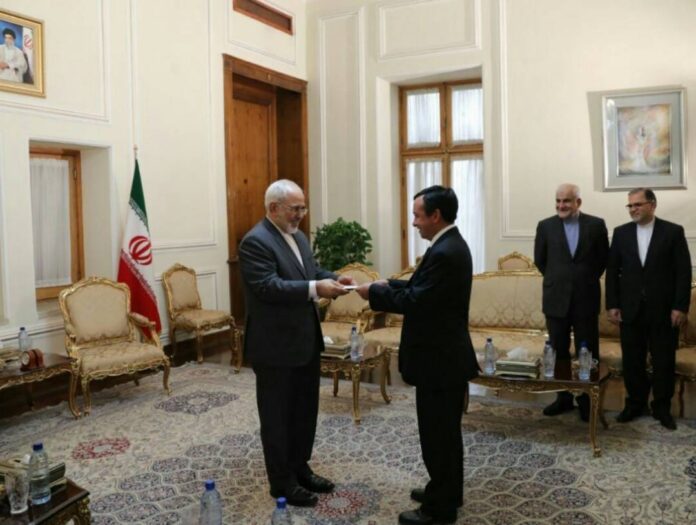
During the Sunday meeting in Tehran, Zarif hailed the reinforcement of political ties between Iran and Chile and the collaborations between the two countries’ private sectors, which are aimed at promotion of bilateral business relations.

He also underlined the necessity of enhancing parliamentary ties and popular relations among the two nations, urging that new ways should be found to develop mutual cooperation between Tehran and Santiago in various fields, particularly in the banking sector, during the new era of ties.

Chile’s Ignacio Llanos, in turn, handed over a copy of his credentials to Zarif as his country’s first-ever envoy to Iran since the 1979 Revolution.

Chilean President Michelle Bachelet appointed Llanos as the new ambassador to Tehran a couple of months ago.

Back in 2016, Chile reopened its embassy in Tehran after more than 35 years of problematized diplomatic ties and later dispatched a chargé d’affaires to Iran in complete silence.

Iran severed its diplomatic ties with Chile on August 18, 1980, protesting Chilean General Augusto Pinochet regime’s repressive internal policies and giving the Chilean chargé d’affaires in Tehran 15 days to close the embassy and leave the country.

Iran and Chile resumed relations on December 2, 1991 with Iran opening its embassy in Santiago, only to close it again in 1999 citing financial problems. The Iranian embassy in Santiago was finally reopened in 2007 at full ambassador level.

UNHCR Envoy Praises Iran’s Contributions to Refugees

Afghan refugees

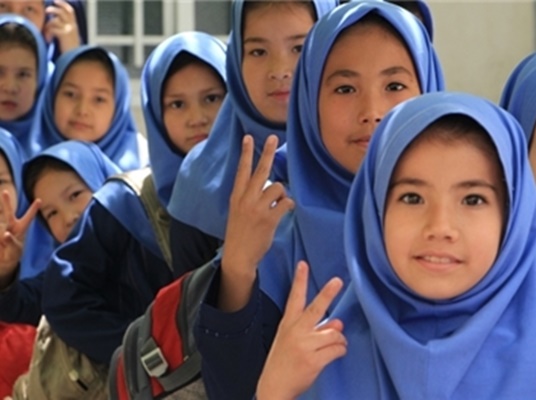
In a Sunday meeting with Iranian Foreign Minister Mohammad Javad Zarif in Tehran, Dhanapala hailed the Islamic Republic’s contributions towards the refugees and immigrants living in Iran, and said, “Iran has made a lot of efforts to help refugees within the framework of its international commitments.”

Zarif, for his part, pointed to the extensive and generous efforts made by Iran to help refugees, and underlined the need for continuation of talks and cooperation between Tehran and the UNHCR.

UNHCR Envoy Praises Iran’s Contributions to RefugeesThe United Nations High Commissioner for Refugees (UNHCR) has maintained an uninterrupted presence in the Islamic Republic of Iran since 1984, and has offices located in Tehran, Mashhad, Kerman, Shiraz, Isfahan, and at the Dogharoun border.
Back in 2016, Dhanapala told Tasnim that the Islamic Republic of Iran generously hosts one of the largest and most protracted refugee situations in the world.

“Government estimates indicate that 951,142 Afghan refugees and 28,268 Iraqi refugees reside in Iran, in addition to 620,000 Afghans who hold Afghan passports and Iranian visas,” he noted.

“Since the first influx of Afghan refugees almost forty years ago, the UNHCR has worked closely with its main government counterpart the Bureau for Aliens and Foreign Immigrants Affairs (BAFIA) of the Ministry of Interior, to assist and protect refugees in the country. In spite of the large voluntary repatriation to Afghanistan that took place between 2002 and 2005, Iran has witnessed an overall decline in the number of returnees to their country of origin, largely due to the continuing deterioration of the security and economic situation in Afghanistan,” Dhanapala added.

As a result, he said, the UNHCR has been working very closely with the government in the areas of health, education, and livelihoods in an effort to improve access to services for refugees during their stay in Iran, and works under the umbrella of a regional multi-year strategy known as the Solutions Strategy for Afghan refugees (SSAR) in an effort to find durable solutions for the very large population of refugees hosted in Iran.

Iran’s Shamkhani Calls on Muslim World to Unite against US

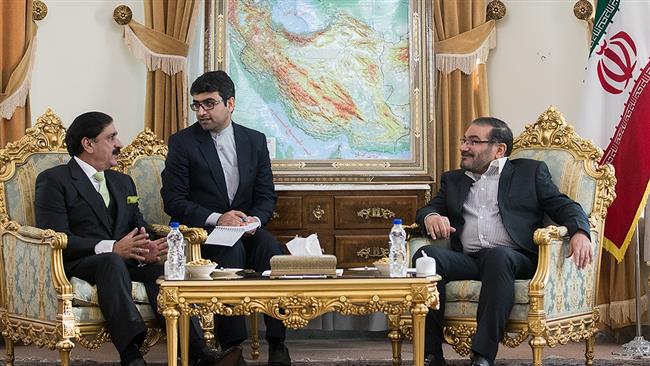
“The United States’ dishonest, duplicitous and divisive policy towards Muslim countries, including Iran and Pakistan, requires that they bolster cooperation against America in addition to maintaining vigilance and taking preventive measures,” Ali Shamkhani said Sunday.

The secretary of Iran’s Supreme National Security Council made the remarks during a meeting with Lieutenant General Nasser Khan Janjua whose country, like Iran, has recently come under unprecedented attacks by US President Donald Trump.

Shamkhani underlined the need to safeguard joint borders between Iran and Pakistan and make joint efforts to fight drugs as well as human and weapons trafficking.

“We will not allow some countries to affect relations between the two countries through sending weapons and hiring terrorists to create insecurity on their borders,” he added.

The Iranian official further touched on the necessity of lifting the Saudi blockade on Yemen, saying Muslim countries and the international community support political talks among Yemeni groups and seek an end to the bombardment and siege of the country.

Shamkhani also described the Palestinian issue as the top priority of the Muslim world.

The official highlighted cultural and religious commonalities between Iran and Pakistan and called for enhanced ties in all sectors, especially in countering their common threats.

The Pakistani official, for his part, highlighted the need for Muslim countries to exercise vigilance against foreign conspiracies hatched to increase rifts among them.

He further emphasized that Islamabad would develop its security and economic cooperation with Tehran.

Azmighan Village: A Picturesque Tourist Attraction in NE Iran

Villages are the best destinations where one can directly get a sense of culture and traditions. Each village in every corner of the world has special features which draw tourists and visitors.

Iran, too, is home to some of these settlements which bring together an amalgamation of scenic beauty, architectural marvels and rich history to display picturesque scenes.

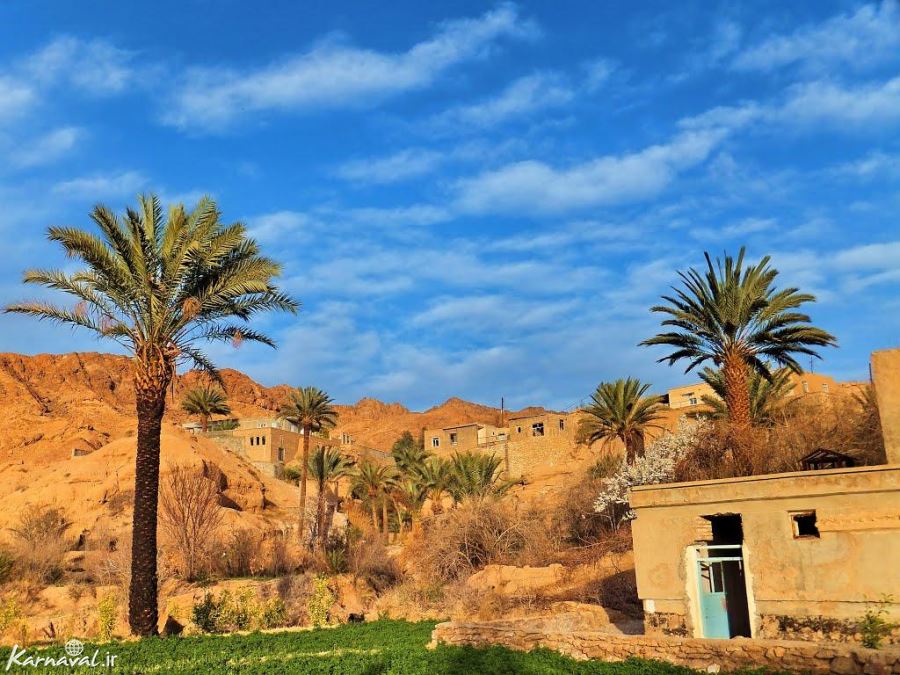
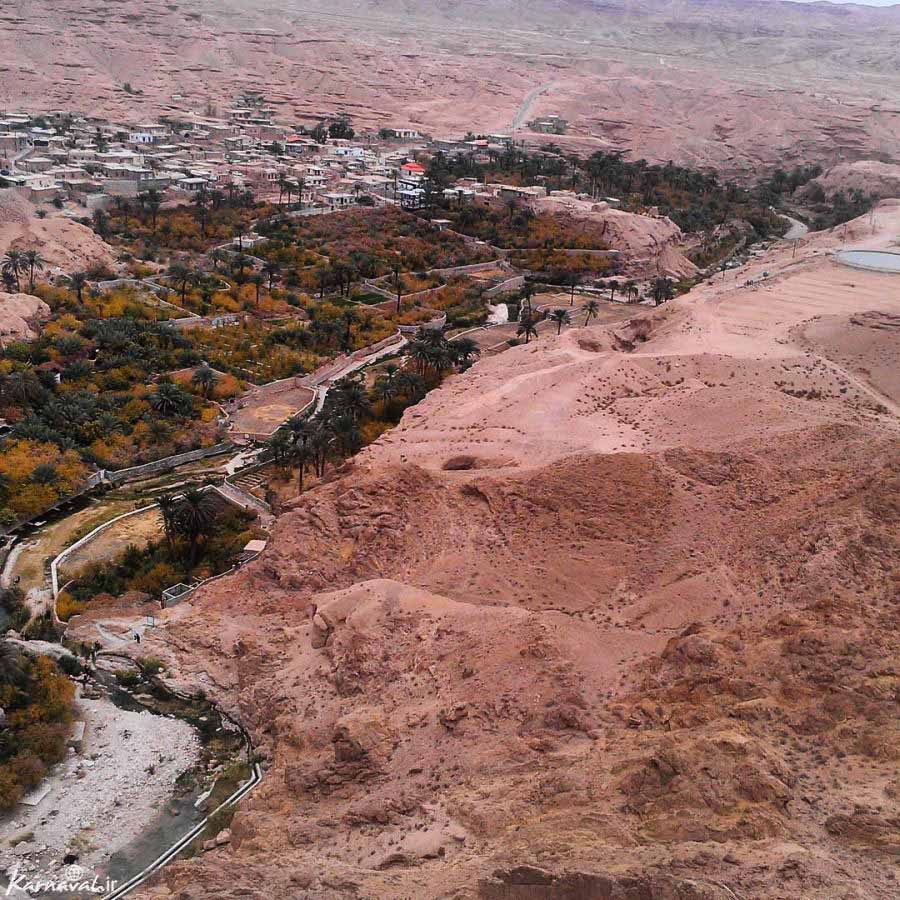
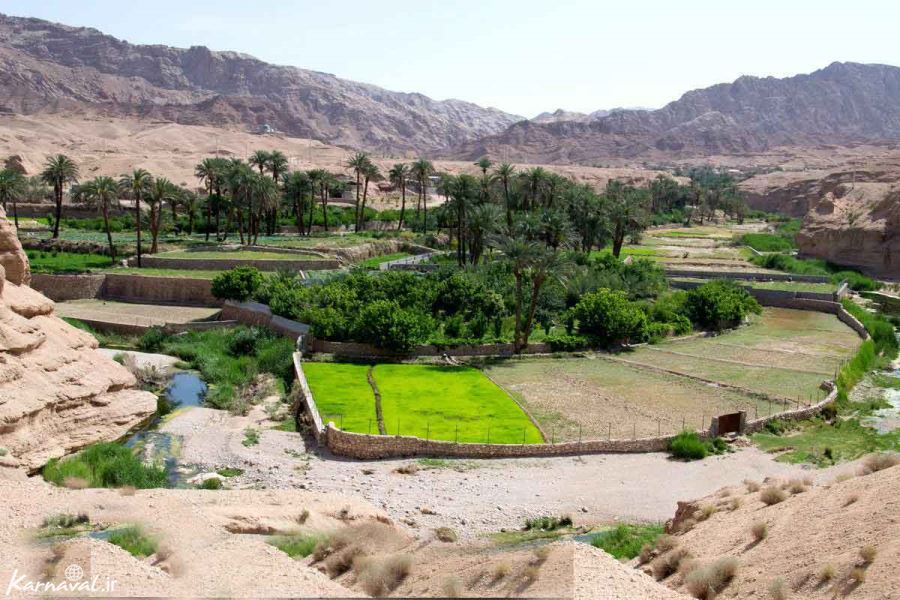
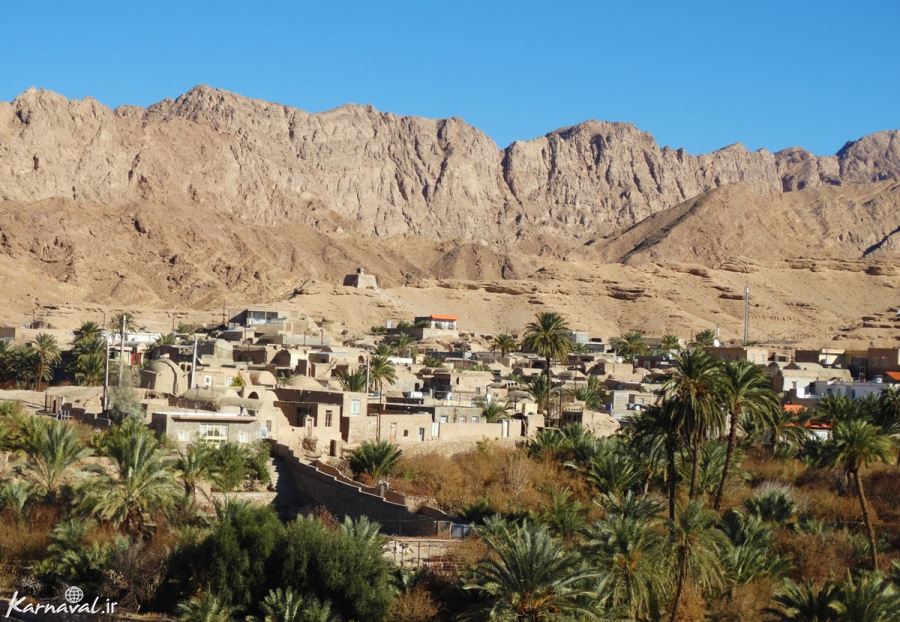
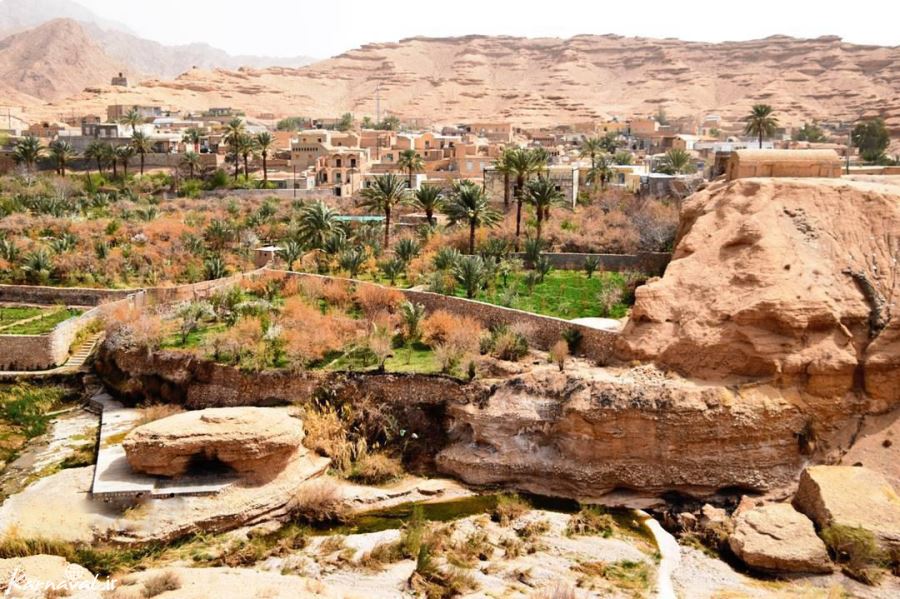
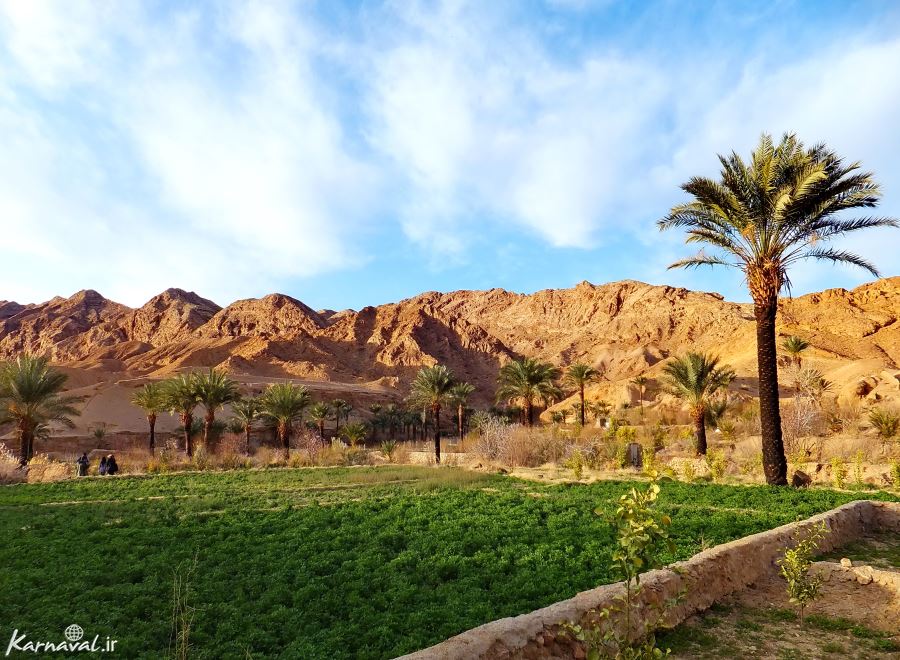
Now, we would like to take you to one of the most beautiful villages in northeastern Iran. The Azmighan village in South Khorasan province is nestled in the middle of a desert. Located some 1km above sea level, the village is one the most picturesque tourist attractions in the area.

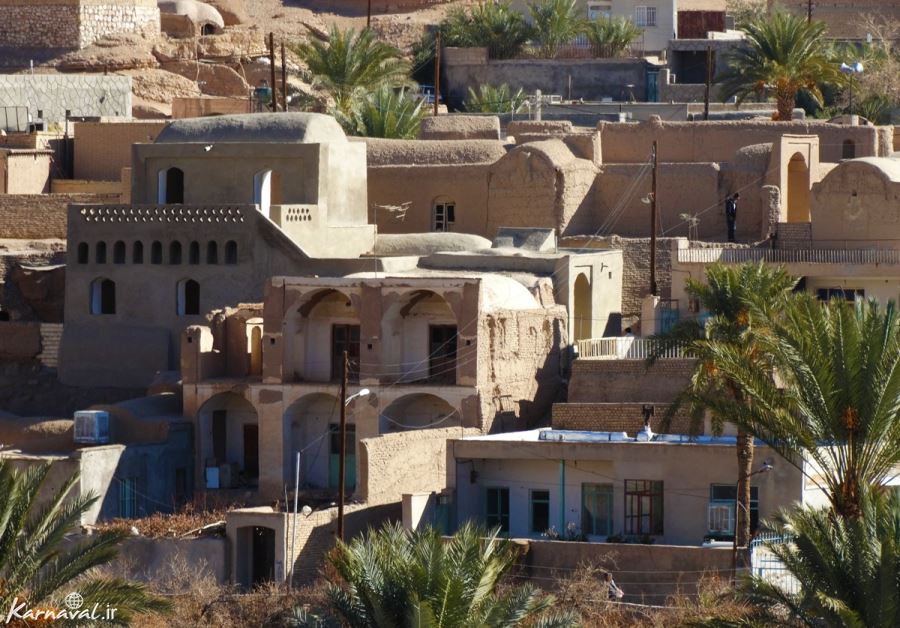
Sixty-eight families with a total of 223 members live in Azmighan. Like other desert homes, their houses are made with mud bricks, earth and wood. In local vernacular, Azmighan means a place to have fun and enjoy oneself.

Azmighan Village: A Picturesque Tourist Attraction in NE Iran


Scenic Beauty in Middle of Desert

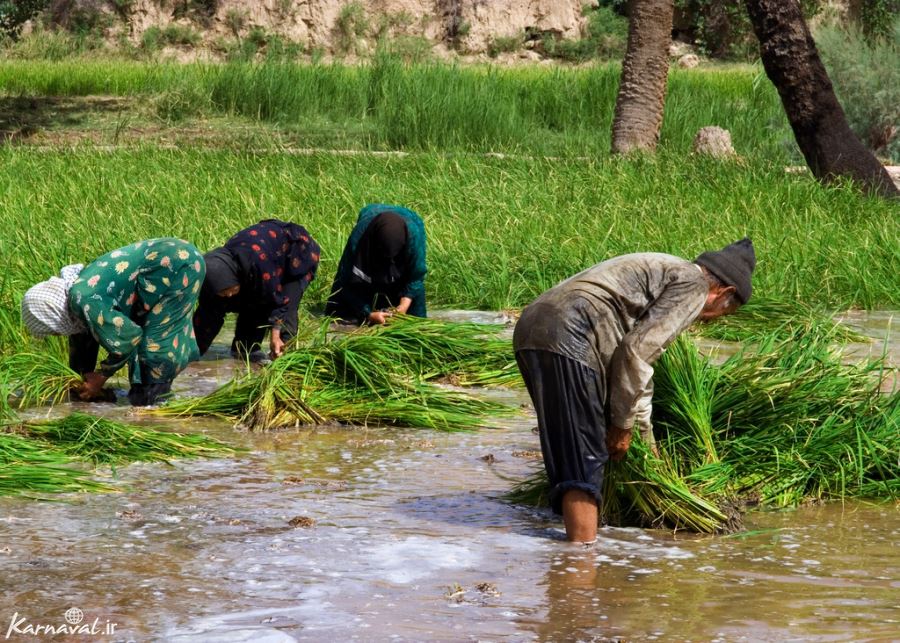
Azmighan is the only place where you can see both dates and rice grown together. The village has two regions: a hot and dry region where rice is grown, and a hot and humid region where they grow rice.
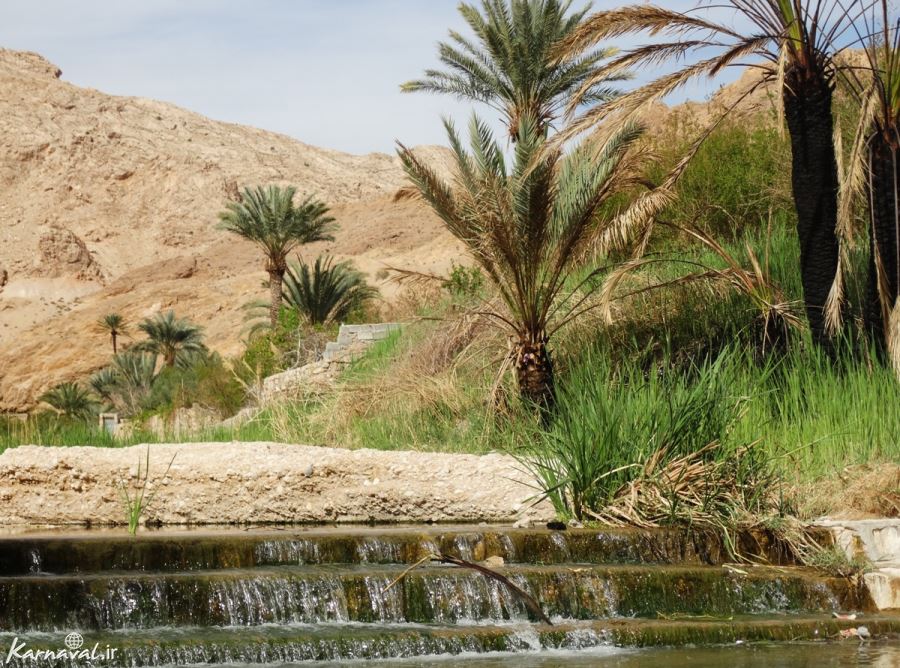
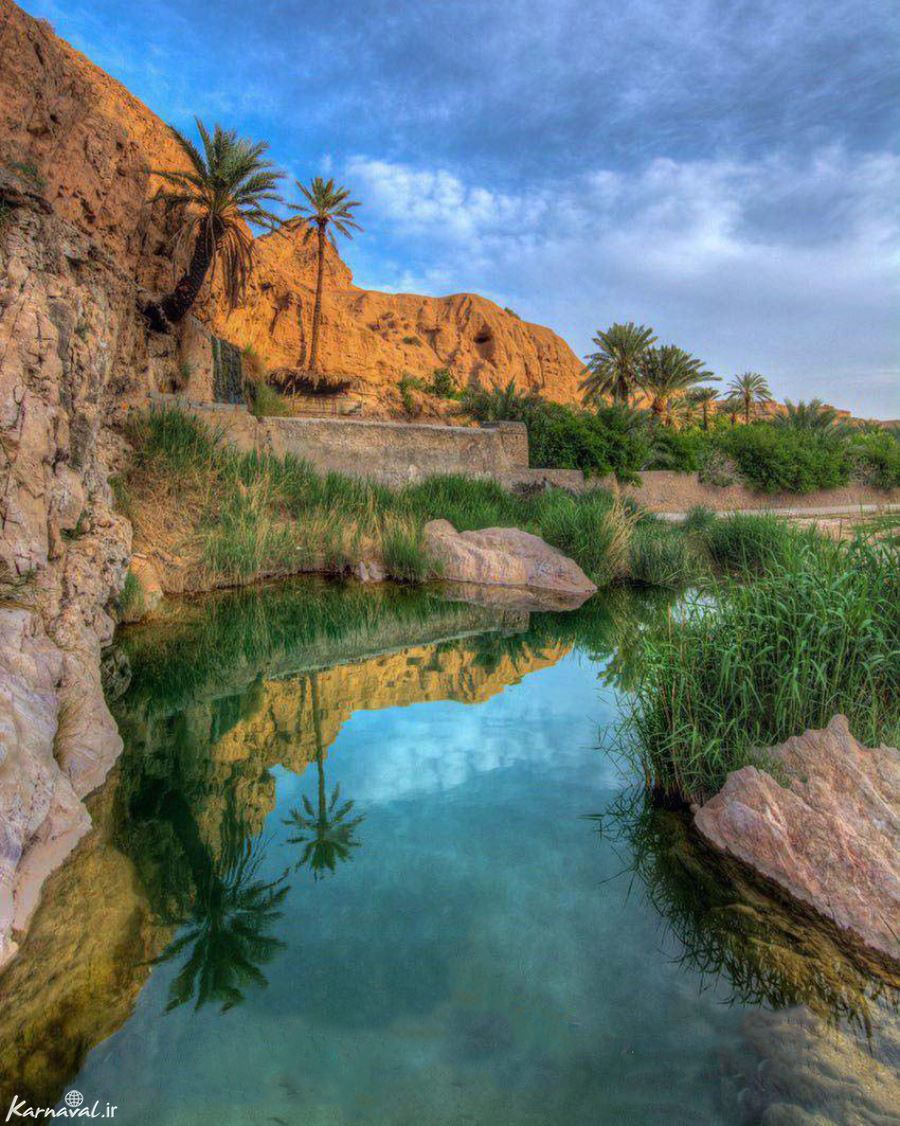
Azmighan is different from other desert villages as permanent rivers flow through it. Water, the key element of life, exists in Azmighan, giving the village a green and humid face.

Tourist Attractions

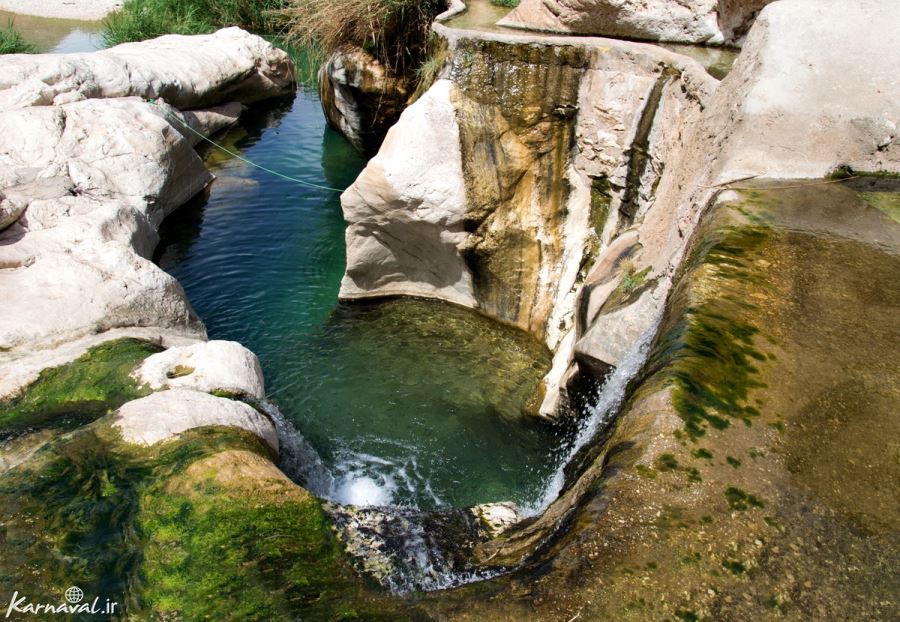
Among the most important tourist attractions in the village are a waterfall and diverse flora, including a 20-metre-tall fig tree which is 300 years old.

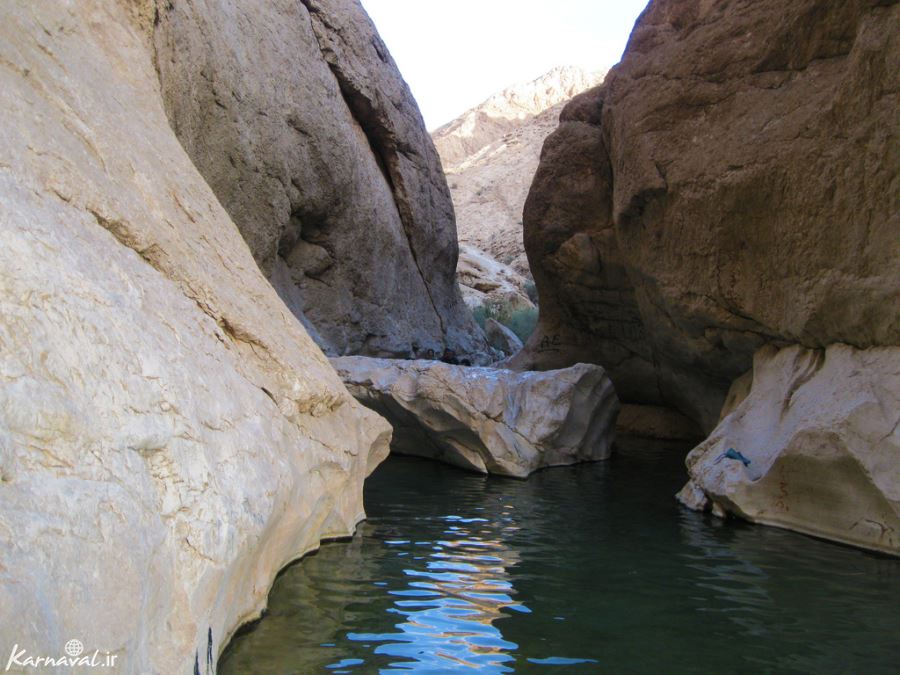
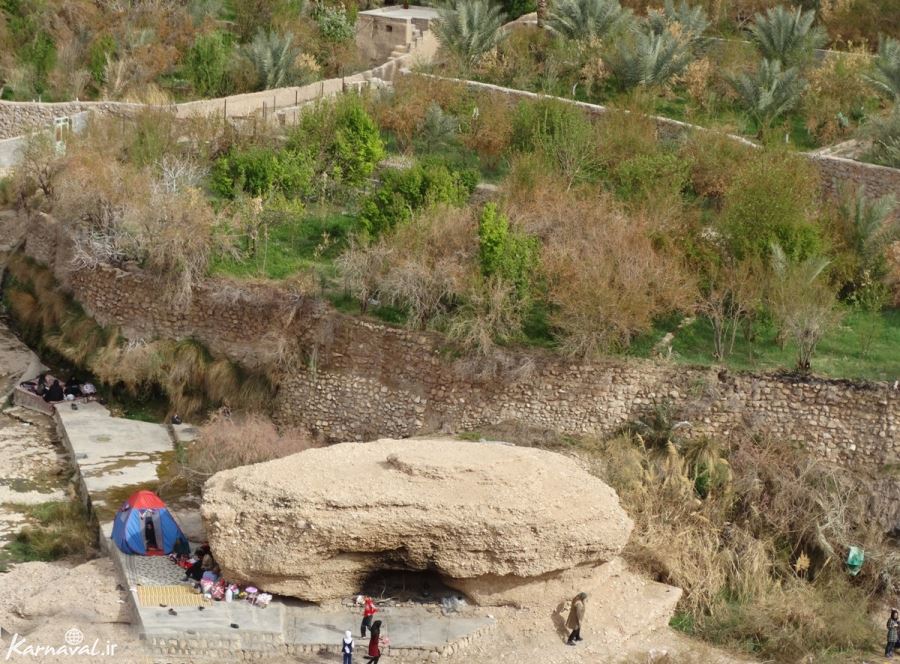
One of the tourist attractions of the village is Takht-e-Aroos, literally translated as “The Bride’s Bed.” It is a big white rock lying on a river bed at the bottom of a valley. The rock looks like a bed when seen from above as water keeps flowing on its both sides.

Azmighan Village: A Picturesque Tourist Attraction in NE Iran


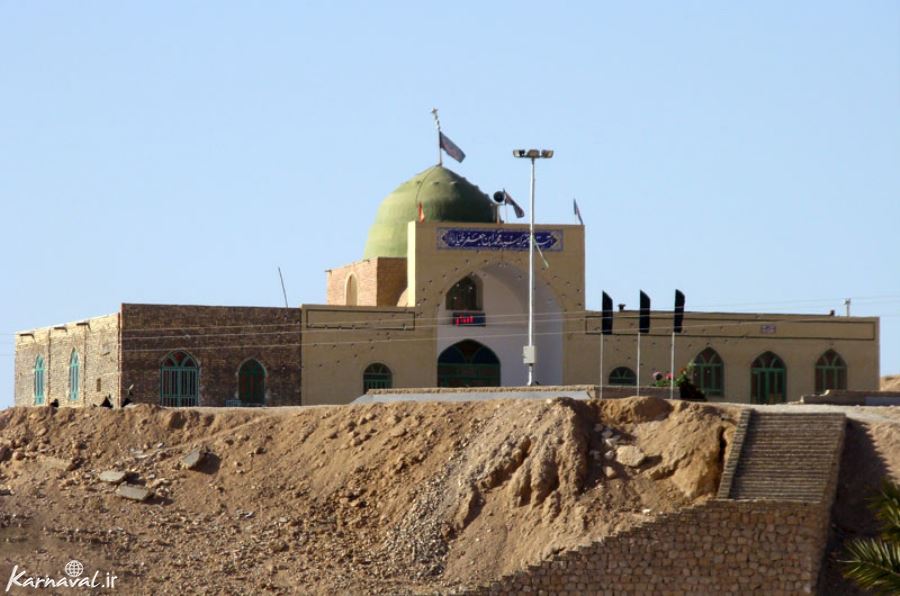
Another tourist attraction is a shrine which is said to be the final resting place of a nephew of Imam Ali, the first Shiite Imam. The mausoleum lies on high ground overlooking the village.

People are deeply attached to the holy shrine. Every year, up to 10,000 pilgrims reportedly visit the mausoleum.

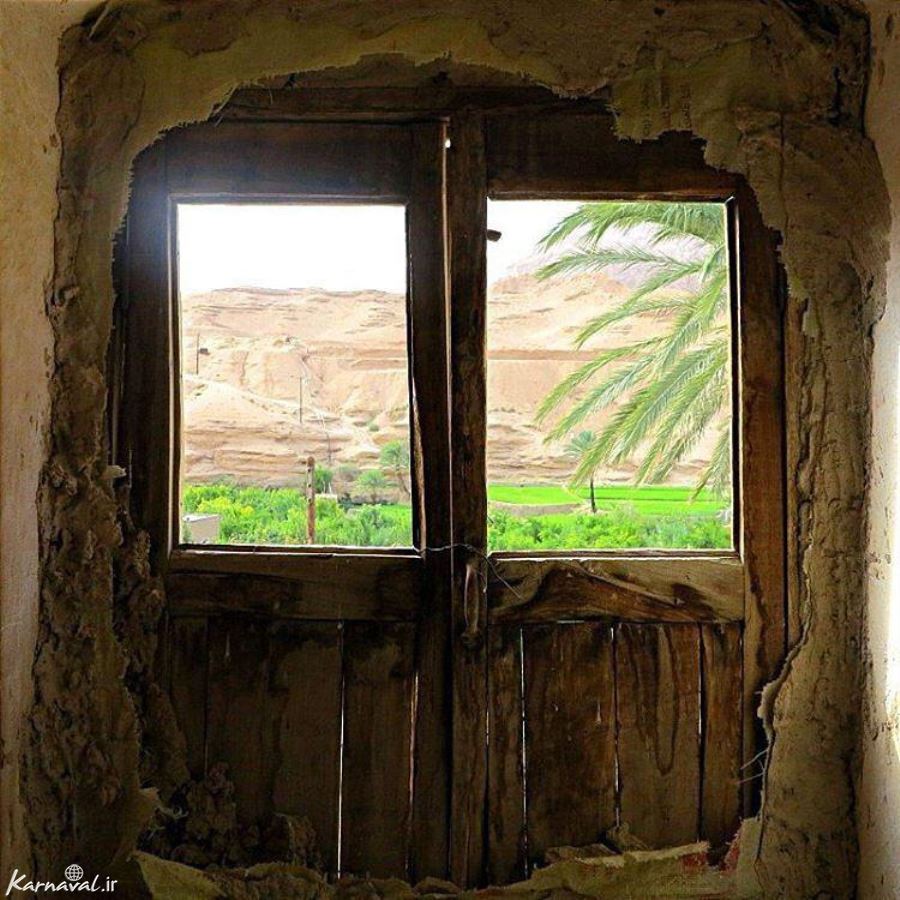
Among the historical attractions of Azmighan are old homes in the vicinity of the village. Some of them are used as warehouses or barns now.

Azmighan Village: A Picturesque Tourist Attraction in NE Iran


Leisure Activities in Azmighan

  1. Taking a walk through the alleys running through gardens
  2. Desert touring
  3. Taking photos
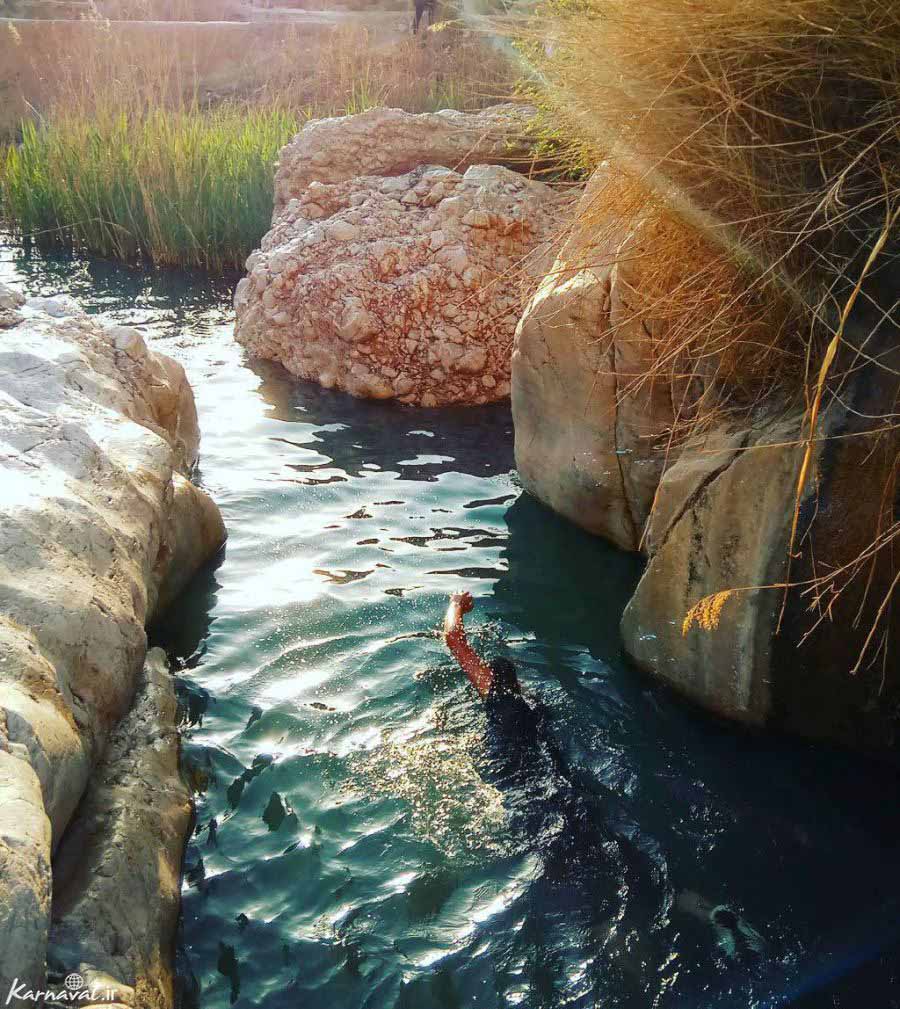
  4. Taking a dip and having a massage


Don’t be surprised! It is right that Azmighan is located in the heart of a desert, but it can be a suitable place for having a dip, swimming and diving. If your feet need some rest, you can put them in water for tiny fish to come and give you an enjoyable massage.

Iran Ready to Help Preserve Iranian Ancient Sites in Iraq

Abdolmalek Shanbehzadeh, the Director General of the Cultural Heritage, Handicrafts and Tourism Department of Ilam in western Iran, has underlined that the department is ready to offer technical services to Iraq for preserving and restoring some Iranian ancient sites like Solomon Hill, Baksayeh Hill and Chaharriz which used to located in Iran but became parts of the Iraqi territory following the 1975 Algiers Agreement.

He went on to say the three historic sites had been registered at the list of Iran’s national heritage sites more than eight decades ago.

The fate of the historic sites is now unclear, he noted, adding that the Cultural Heritage, Handicrafts and Tourism Department of Ilam has already started correspondence with the Iraqi side to establish cooperation to preserve the sites.

“During a technical meeting which is expected to be held between Iranian and Iraqi delegations in Iran, the two sides will discuss ways to start their cooperation in preserving the sites,” he noted.

Shanbehzadeh also added in addition to the mentioned sites, there are three other ancient sites in Iraq which have been registered as an Iranian national heritage.

“Shirvan Hill, Lalar Hill and the historic city of Simreh are the three Iranian national heritage which are located on the Iraqi side after the demarcation agreement between Iran and Iraq,” he said.

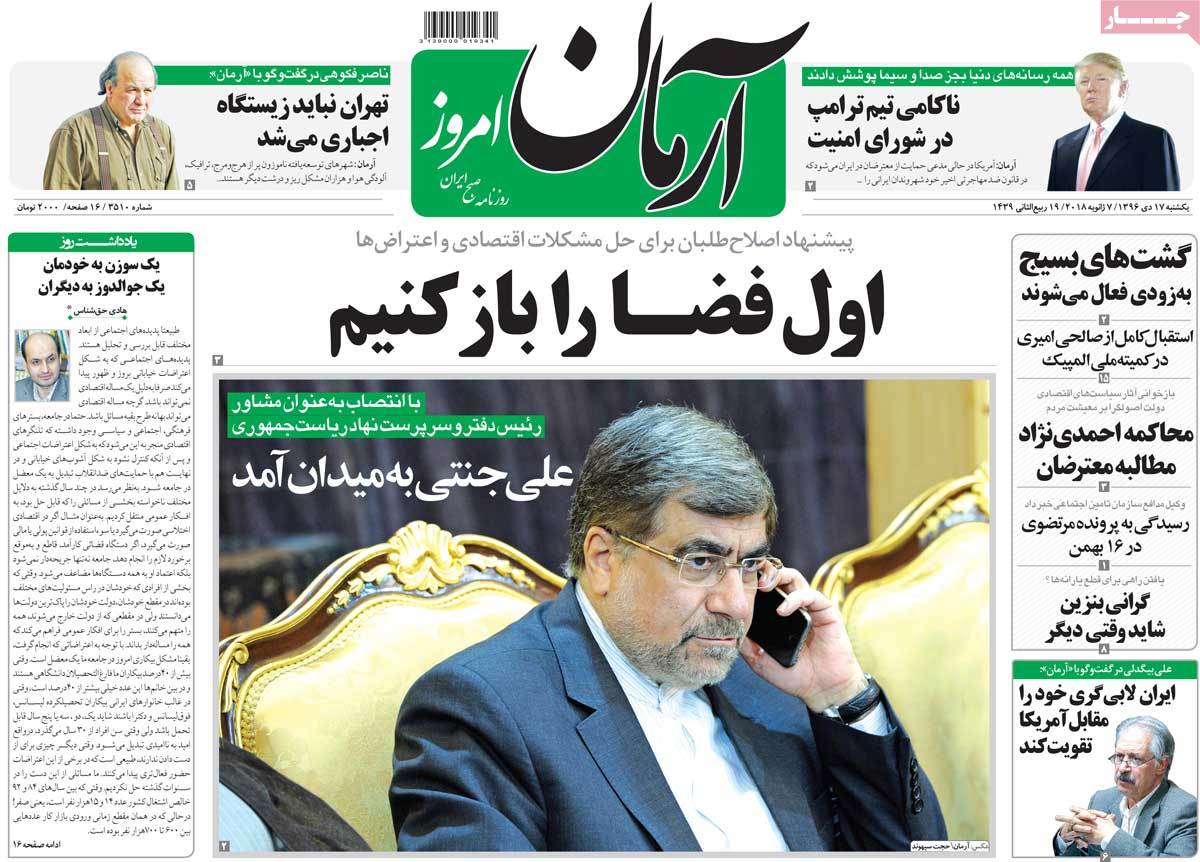
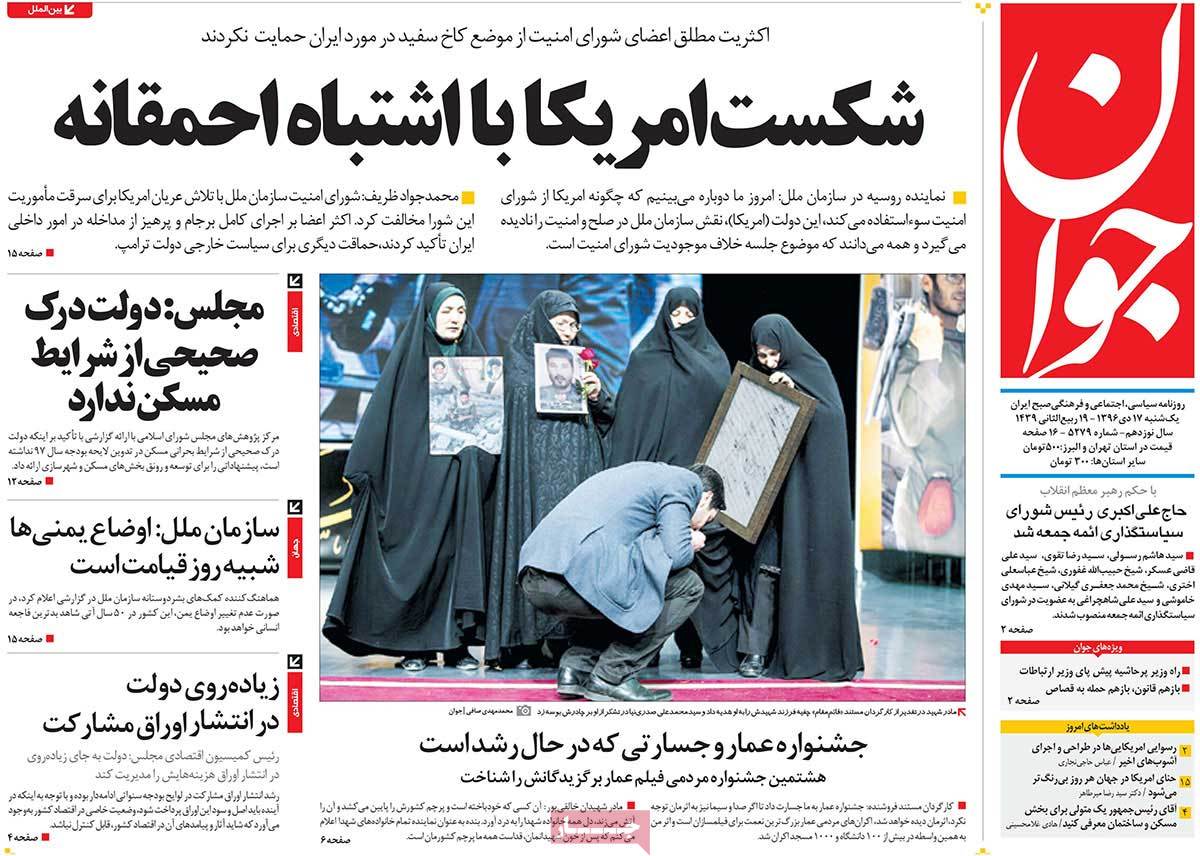
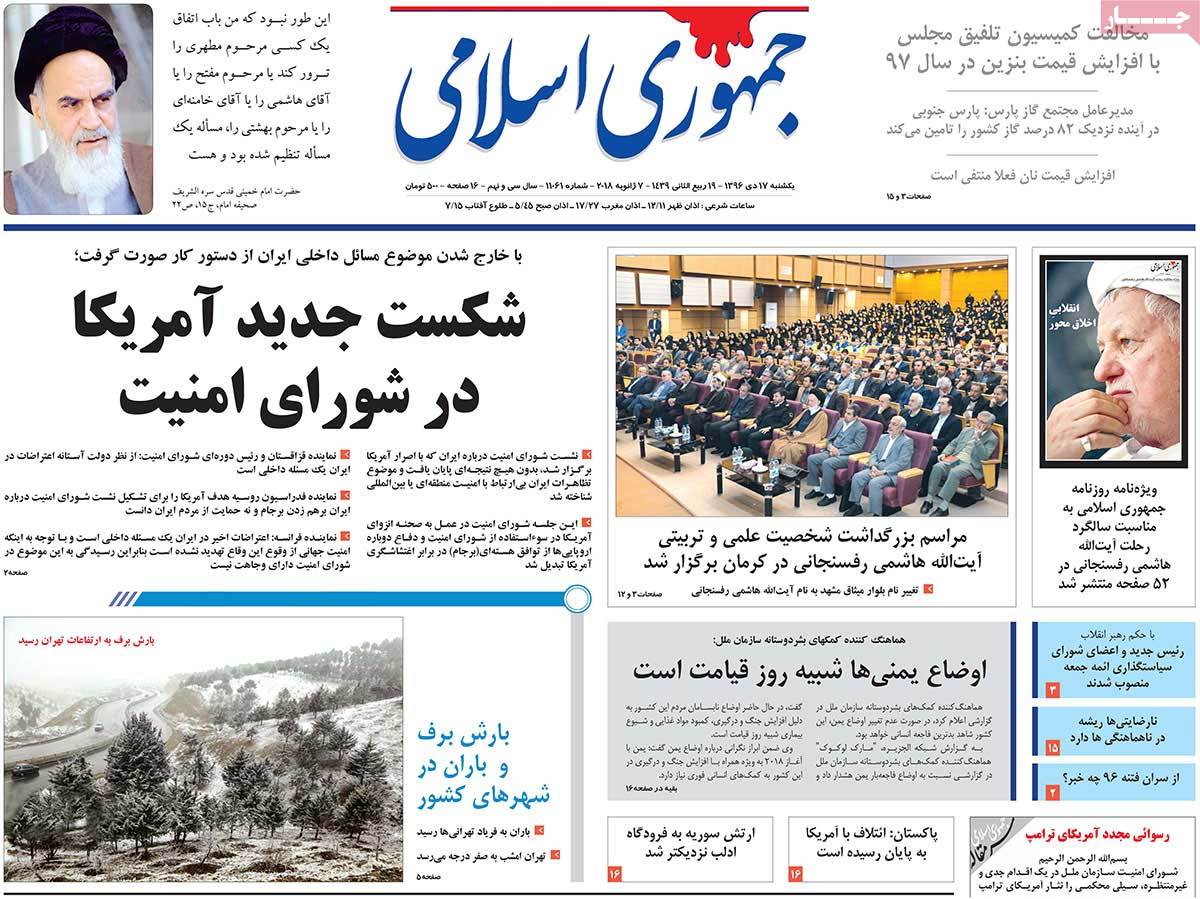
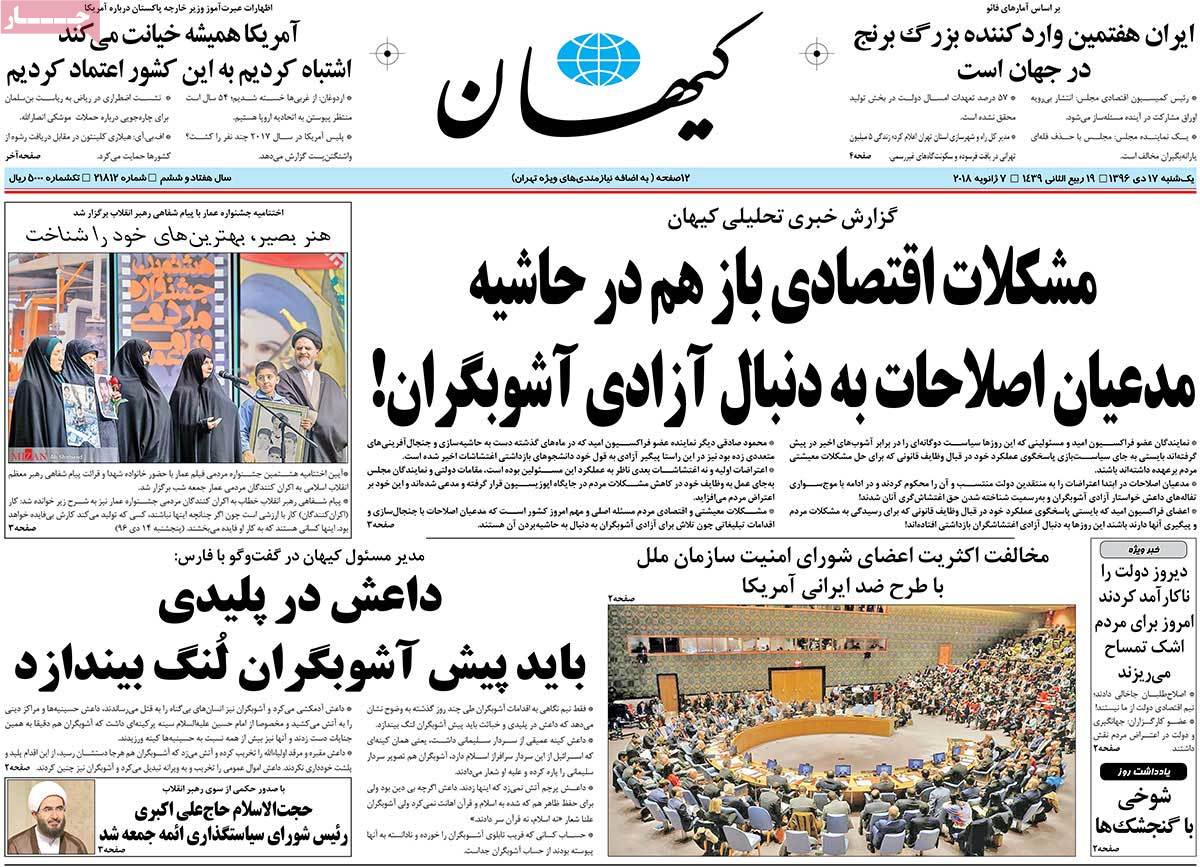
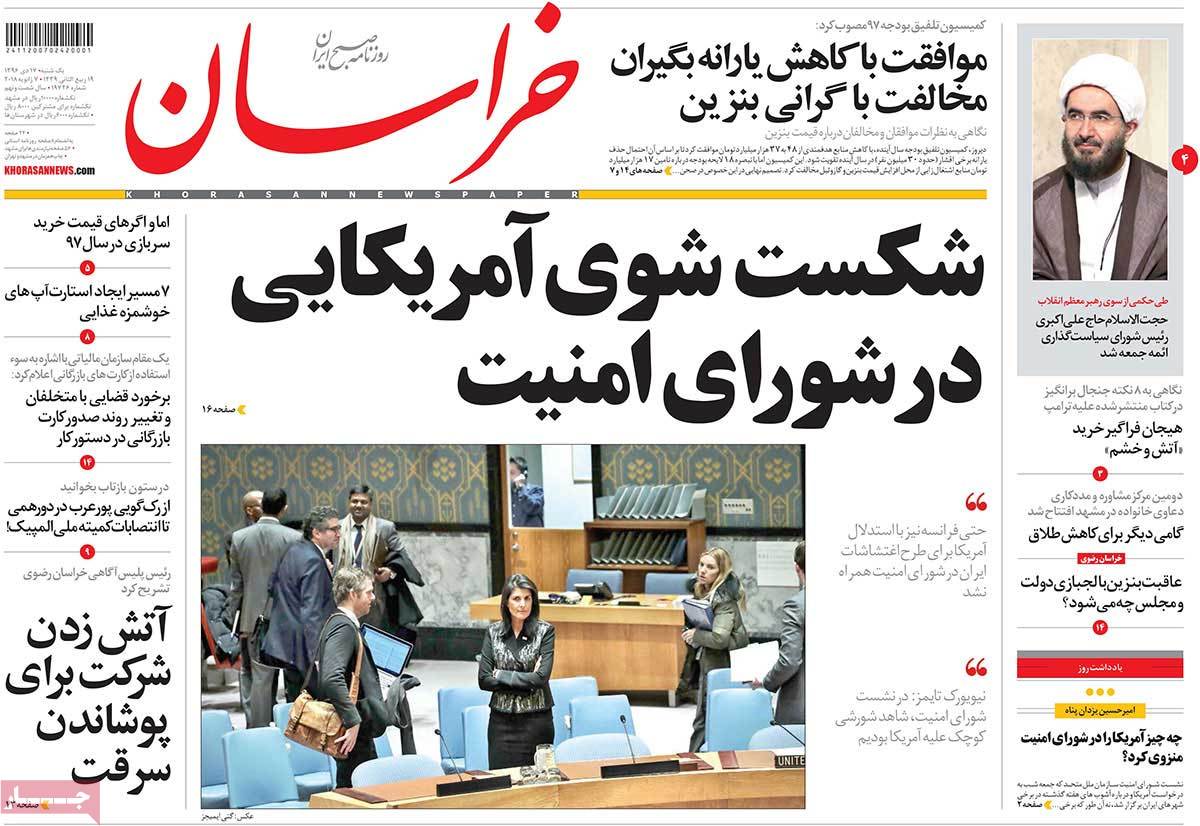
A Look at Iranian Newspaper Front Pages on January 7

A Look at Iranian Newspaper Front Pages on November 5

The top story in almost all papers today was the recent UN Security Council meeting on the Iran protests, which was held at the request of the US, but led to the isolation of Washington. The Friday meeting turned into a tribune for the member states to express their support for the Iran nuclear deal and to call for avoiding interference in Iran’s domestic affairs.

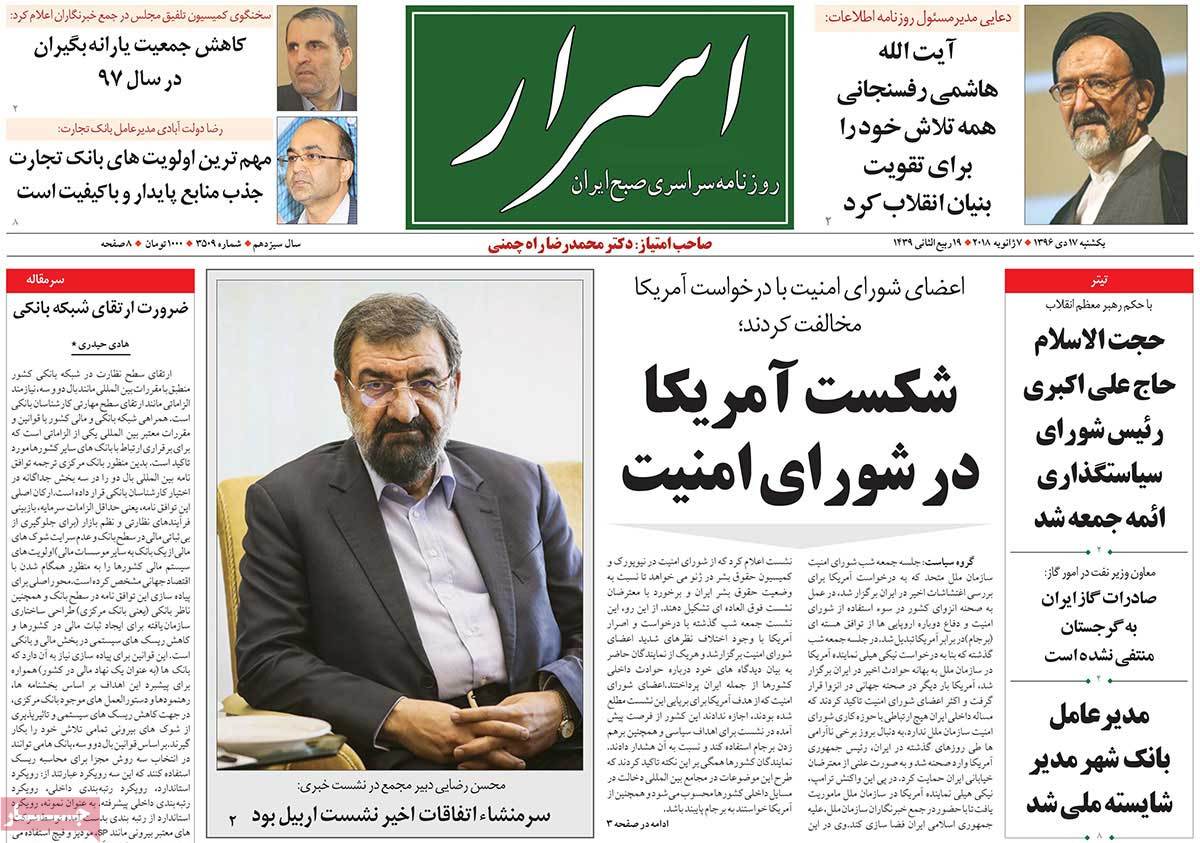
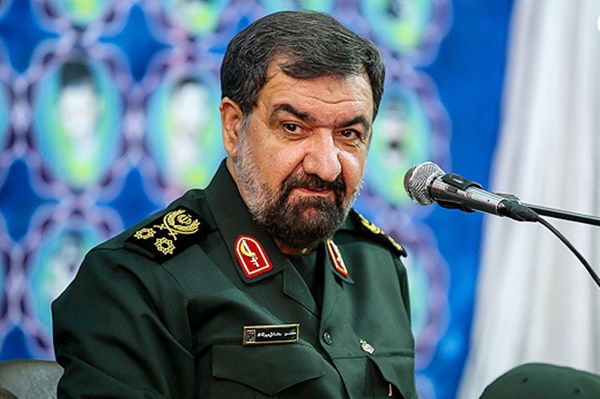
Several newspapers also covered the remarks by former IRGC chief-commander Mohsen Rezaei about the role of an Erbil-based “operation room” headed by a CIA agent in the recent unrest in Iran. Rezaei says Saddam Hussein’s brother-in-law and representatives of Saudi Arabia and the MKO terrorist group also attended the Erbil meetings where the unrest in Iran was orchestrated.

The above issues, as well as many more, are highlighted in the following headlines and top stories:


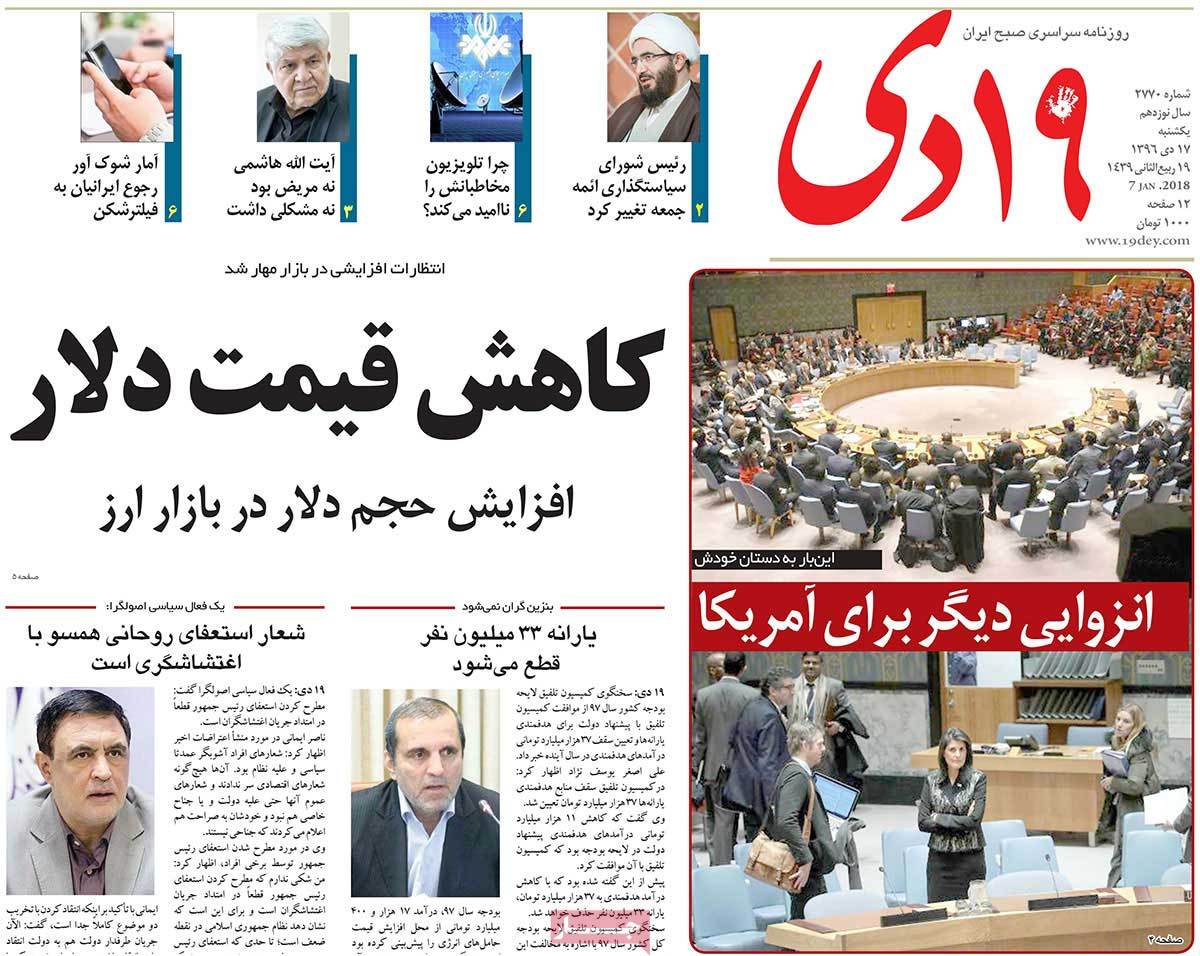
19 Dey:

  • Conservative Analyst: Those Who Call for Rouhani’s Resignation Serving Rioters’ Interests

A Look at Iranian Newspaper Front Pages on January 7


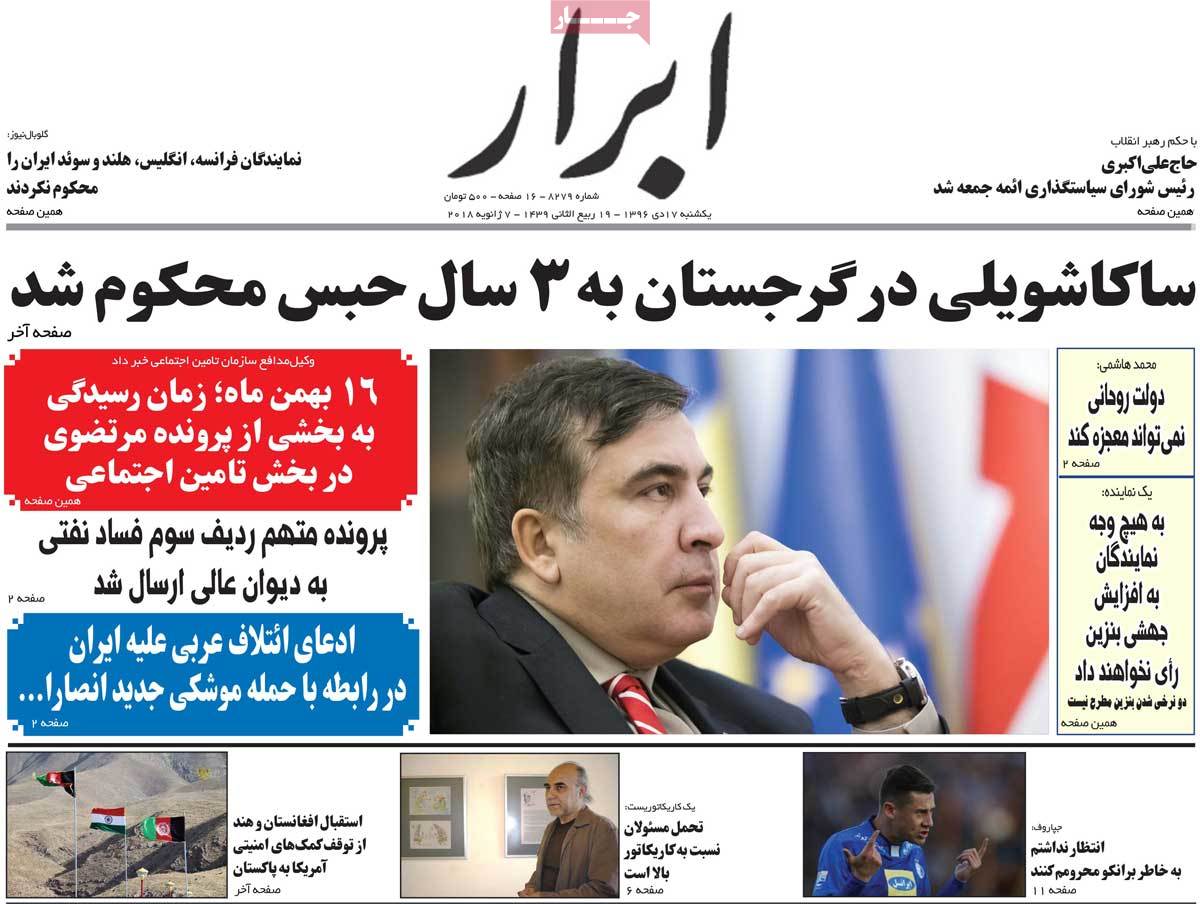
Abrar:

  • Georgia’s Saakashvili Sentenced to 3 Years in Prison
  • Global News: Representatives of France, UK, Netherland, Sweden Didn’t Condemn Iran

A Look at Iranian Newspaper Front Pages on January 7


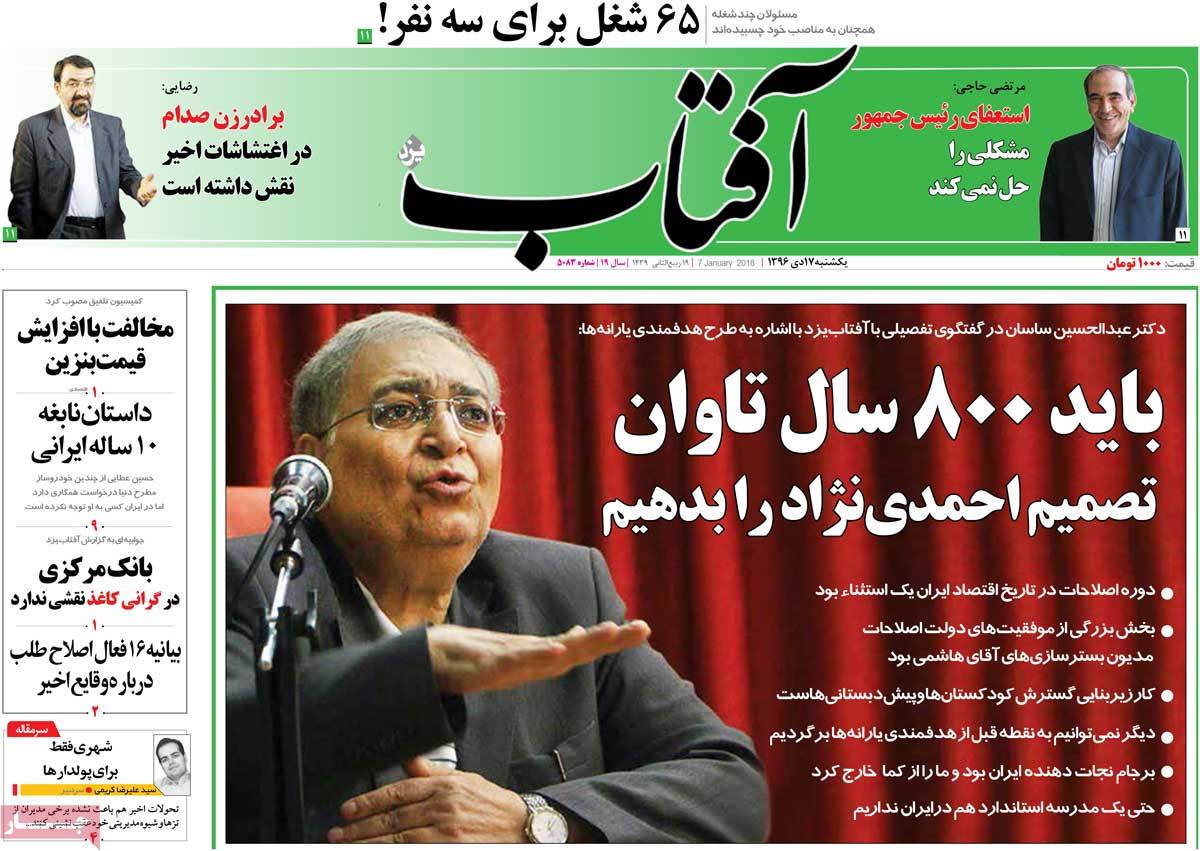
Aftab-e Yazd:

  • IRGC General Rezaei: Saddam’s Brother-in-Law behind Recent Riots in Iran
  • Story of 10-Year-Old Iranian Genius
  • Hossein Ataei Has Received Invitations from Tesla, Volvo

A Look at Iranian Newspaper Front Pages on January 7


Arman-e Emrooz:

  • Basij Forces to Start Regular Patrols

A Look at Iranian Newspaper Front Pages on January 7


Asrar:

  • IRGC General Rezaei: Erbil-Based Meeting behind Recent Unrest
  • Iran’s Gas Exports to Georgia Not Cancelled: Official

A Look at Iranian Newspaper Front Pages on January 7


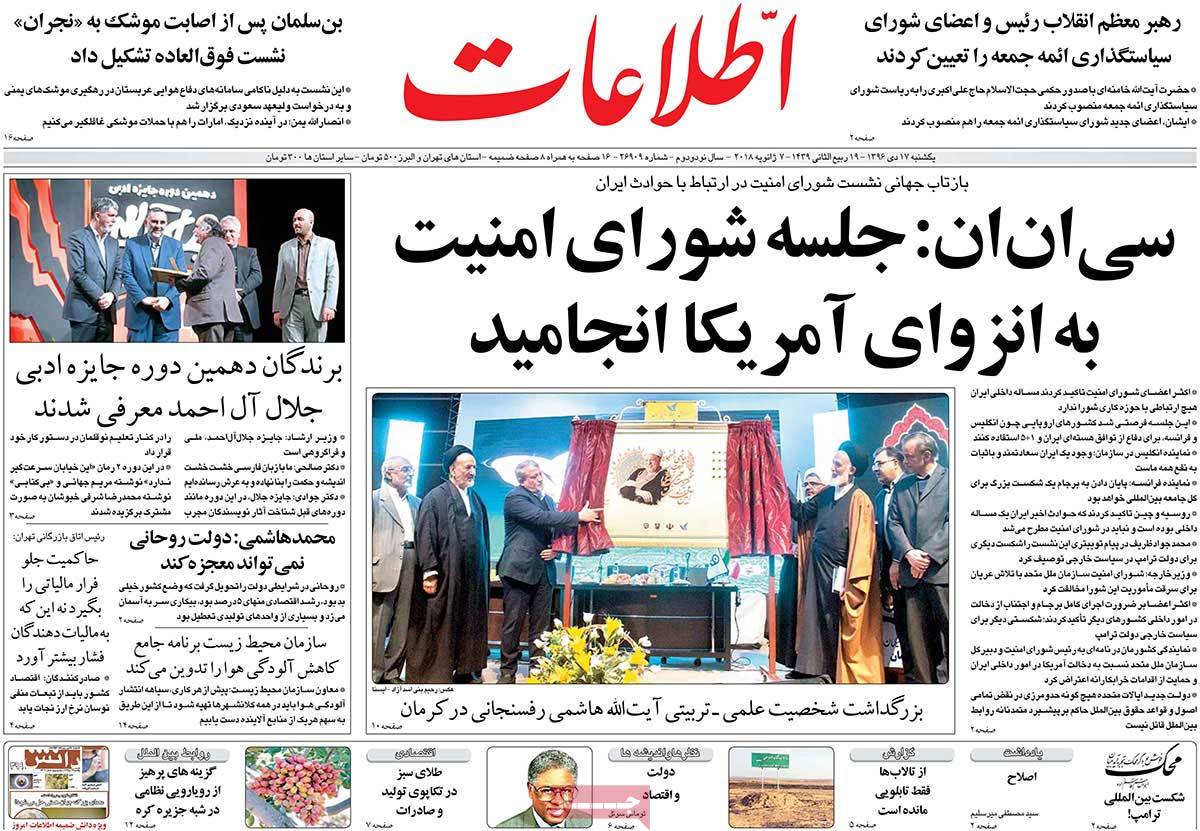
Ettela’at:

  • CNN: UNSC Meeting Led to US Isolation
  • Global Coverage of UNSC Meeting on Iran Protests
  • Bin Salman Holds Emergency Meeting after Yemeni Missile Hit Najran
  • Rouhani’s Gov’t Can’t Do Miracles: Mohammad Hashemi Rafsanjani

A Look at Iranian Newspaper Front Pages on January 7


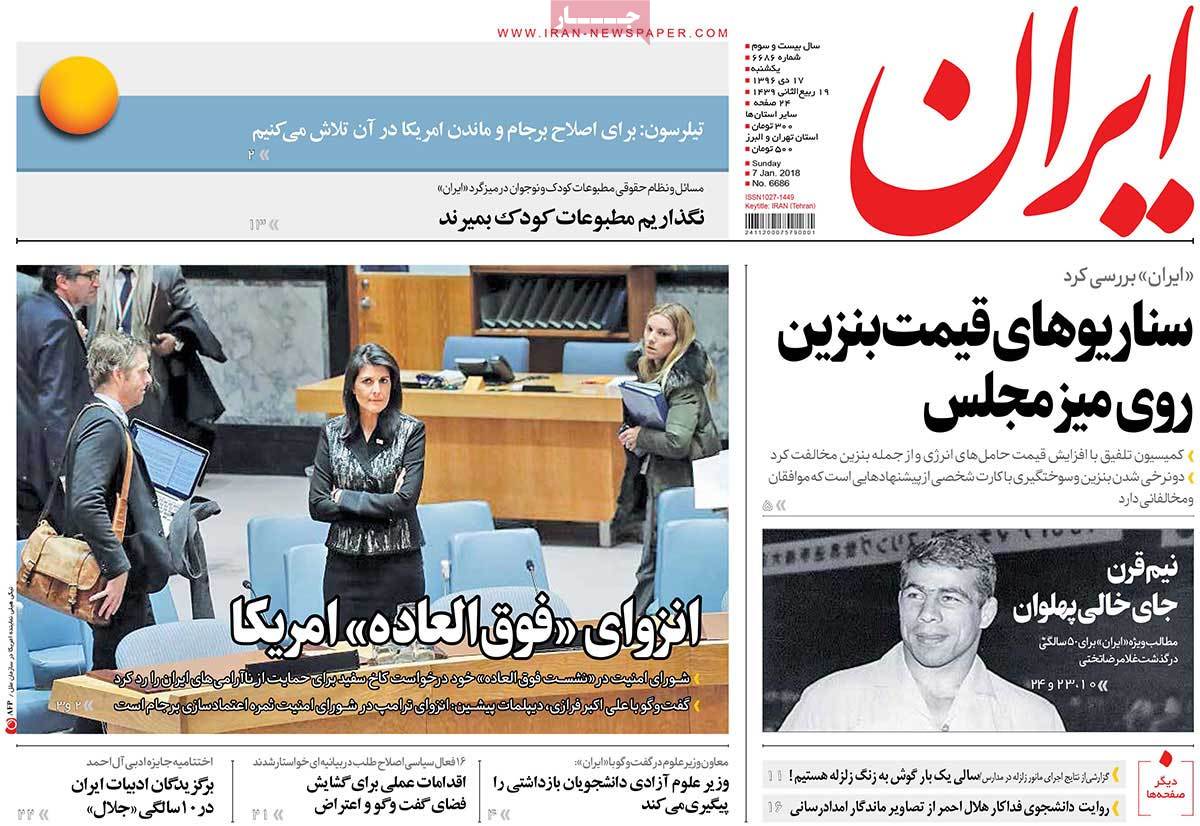
Iran:

  • “Extraordinary” Isolation of US
  • UNSC Rejects White House’s Request to Support Iran Unrest
  • Tillerson: We’ll Try to Revise JCPOA, Keep US on Board

A Look at Iranian Newspaper Front Pages on January 7


Javan:

  • US Suffers New Defeat with Its Stupid Mistake
  • Majority of UNSC Member States Refuse to Support US on Iran
  • Parliament: Gov’t Has No Correct Understanding of House Market

A Look at Iranian Newspaper Front Pages on January 7


Jomhouri Eslami:

  • US Suffers New Defeat in UN Security Council
  • South Pars Gas Field to Supply 85% of Iran’s Natural Gas: Official
  • UN Official: Situation of Yemenis Similar to Doom’s Day

A Look at Iranian Newspaper Front Pages on January 7


Kayhan:

  • Rioters Even More Wicked than ISIS: Kayhan Chief
  • Economic Woes Once Again Sidelined
  • Advocates of Reformism Looking for Freedom of Rioters!
  • Lessons to Be Learned from Pakistani FM
  • US Always Betrays; We Made a Mistake by Trusting US

A Look at Iranian Newspaper Front Pages on January 7


Khorasan:

  • Parliamentary Commission Rejects Increase in Fuel Prices in New Budget

A Look at Iranian Newspaper Front Pages on January 7


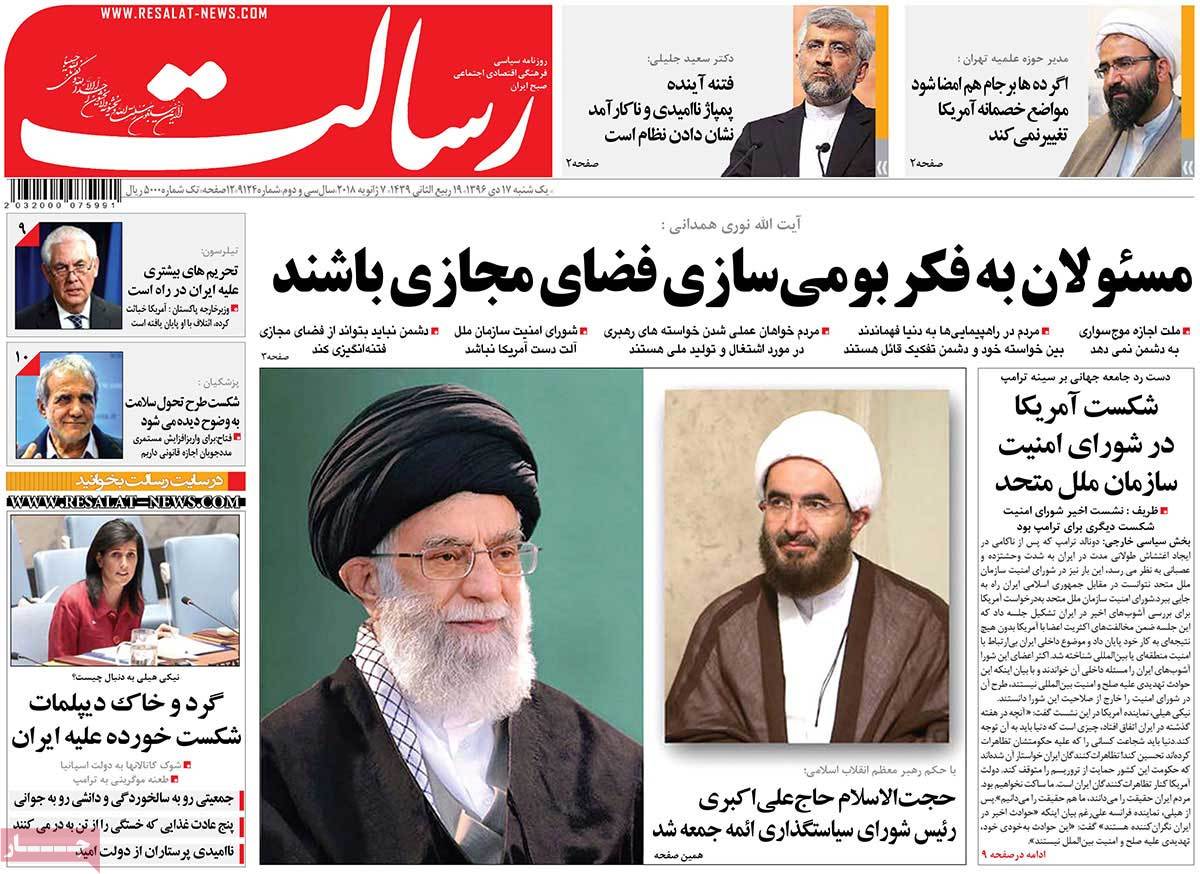
Resalat:

  • Ayatollah Nouri Hamadani: Officials Should Try to Localize Cyberspace
  • Academic: Next Sedition Based on Frustrating People, Introducing Gov’t as Incompetent
  • Tillerson: More Sanctions to Come against Iran
  • US Won’t Change Hostile Stances Even with Tens of Other JCPOAs: Cleric

A Look at Iranian Newspaper Front Pages on January 7


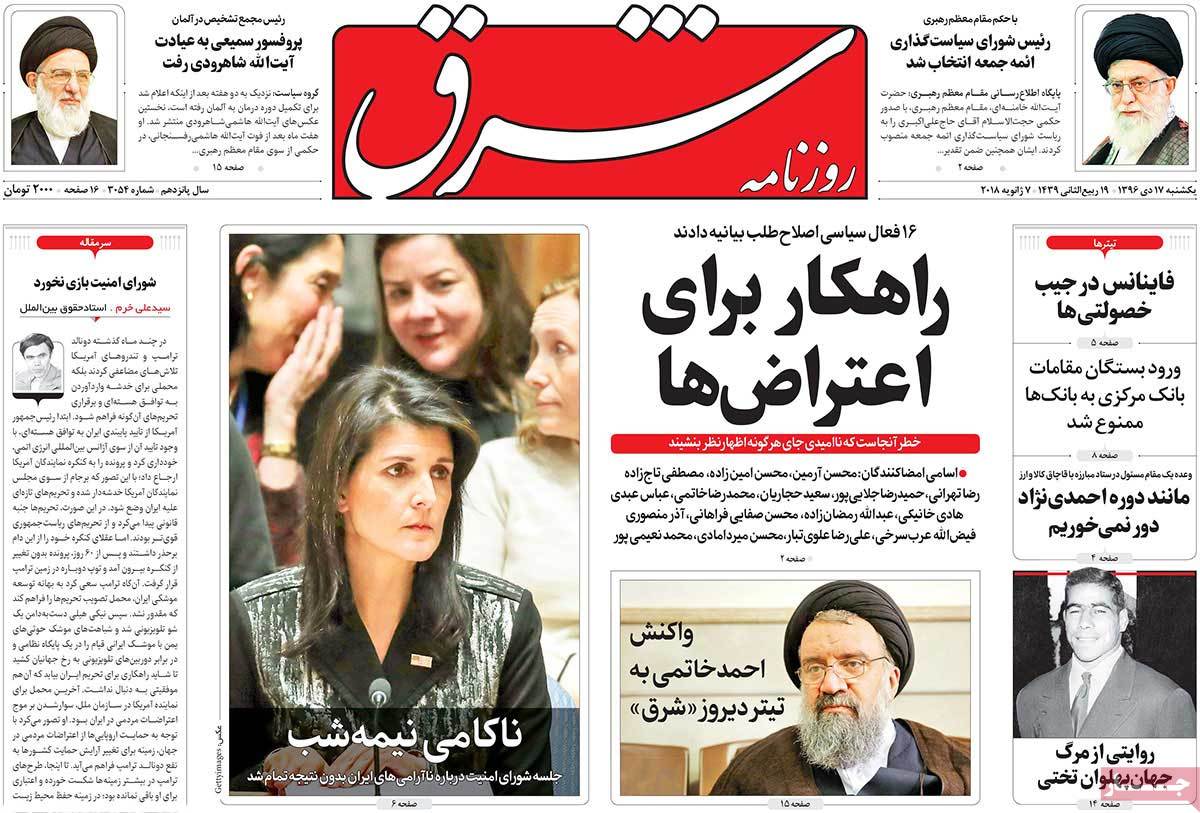
Shargh:

  • Ayatollah Hashemi Shahroudi Hospitalized in Germany, Visited by Professor Samii
  • Solution for Protests: 16 Reformist Political Figures Issue Statement

A Look at Iranian Newspaper Front Pages on January 7


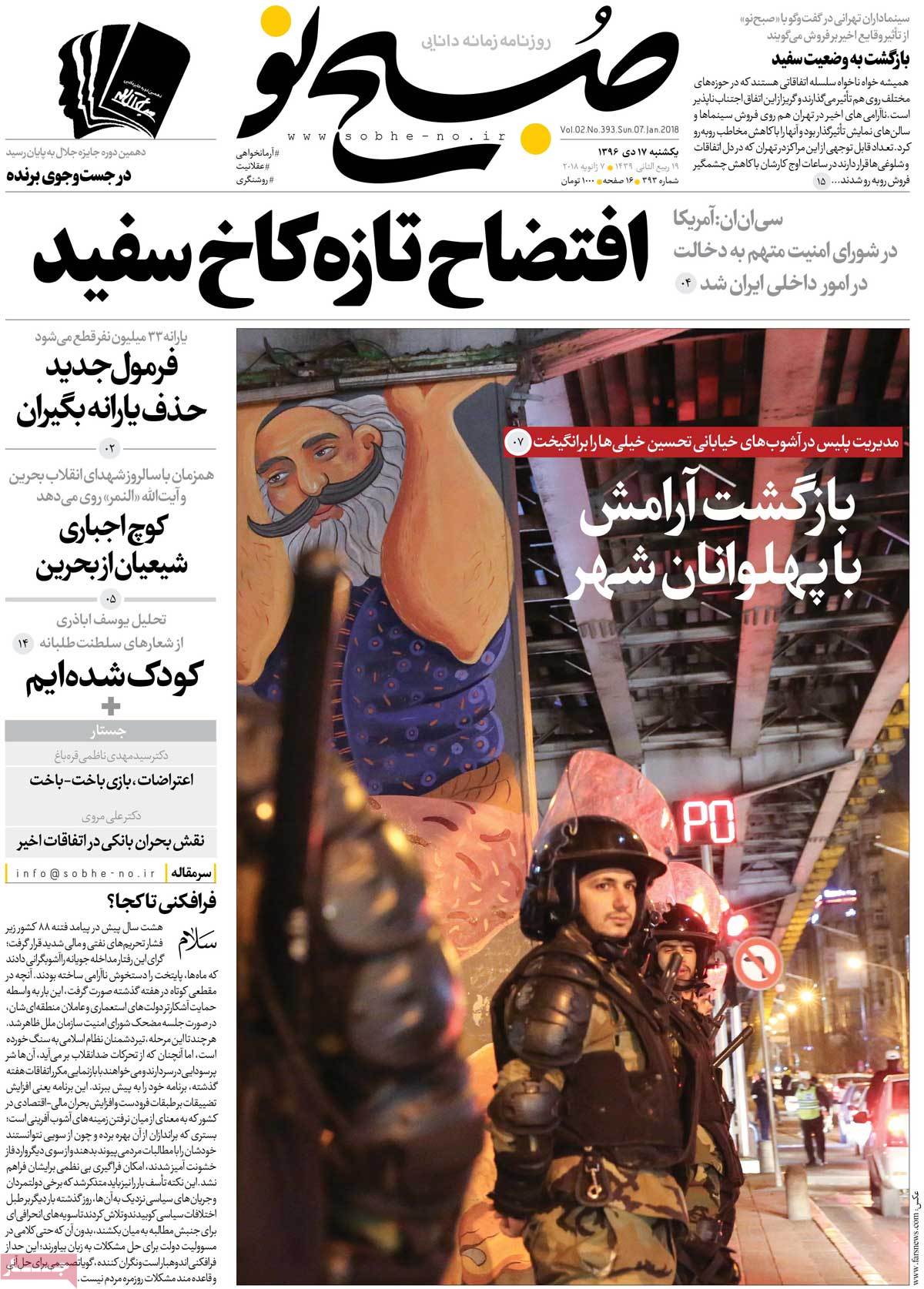
Sobh-e Now:

  • Return of Calm Thanks to Champions of City
  • Police Praised for Great Handling of Street Riots
  • White House’s New Scandal
  • CNN: US Accused in UNSC of Interfering in Iran’s Domestic Affairs
  • Shiites to Be Forced to Immigrate from Bahrain

A Look at Iranian Newspaper Front Pages on January 7


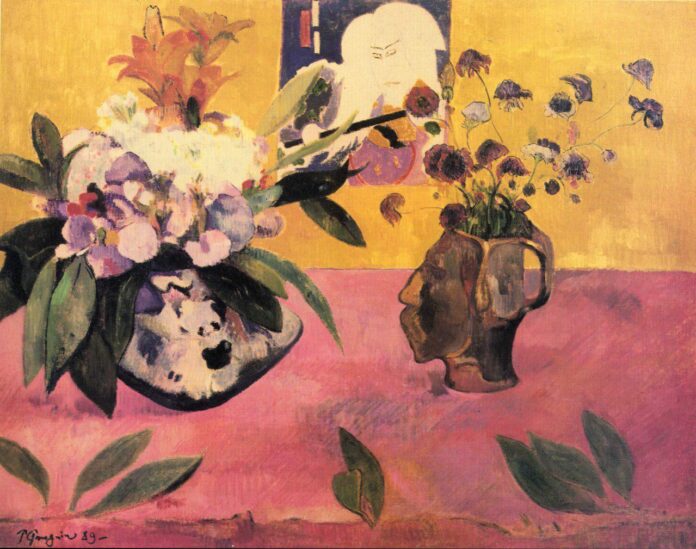
“Berlin, Rome to Display Items on Loan from Iranian Museum”

Photo of Paul Gauguin's Still Life with Head-Shaped Vase and Japanese Woodcut, which is kept in Tehran Museum of Contemporary Arts

Director of Iran’s Museum of Contemporary Art Ali Mohammad Zare says items on loan from the museum are to be displayed at exhibitions in Rome and Berlin.

He noted that the necessary arrangements are being made to lend the items to Germany and Italy as the two European countries have been willing to set up an exhibit to put on show items from the Tehran Museum of Contemporary Arts (TMoCA), reports the Persian-language Islamic Republic News Agency (IRNA).

“We want to show to all people of the world that the contemporary Iran is a treasure trove of artistic works,” he said.

“Many other nations know Iran by its past and are not that much familiar with our contemporary era, and we believe when artists and famous people visit our treasure trove and see what invaluable items are kept in our museum, they will be eager to learn more about our history,” he said.

“If it is finalized, we will, for the first time, be witnessing an exhibition of Iran’s modern and contemporary art being held in two European capitals,” said the official.

He predicted the exhibit will draw more than one million visitors, including authors, artists, film-makers and visual artists as well as European intellectuals.

“The visitors’ view of Iran will change as they see Iranian works of art and compare them with Western, European and American works,” said Zare.

Talks between the two European capitals and Tehran to open the exhibitions had initially broken down due to certain concerns in Iran over the transfer of the treasure to Europe.

Iran was worried that the pieces of art might be confiscated in Europe due to possible problems caused by the US sanctions.

Tehran Museum of Contemporary Arts was founded in in Tehran in 1977. Significant and precious items of modern art are on show at the museum.

New Quake in Iran’s Kermanshah Wounds 21 People

New Quake in Iran's Kermanshah Wounds 21 People

The quake occurred in Iran’s western town of Sarpol-e Zahab, around 320 miles west of Tehran, in Kermanshah Province at around 06:52 pm local time on Saturday.

According to the Seismological Center of the Institute of Geophysics of Tehran University, the epicenter of the quake was about eight km deep.

The quake left 21 people injured in rural and urban area.

Officials have dispatched search and rescue teams to the quake-hit areas.

Earlier in November, a magnitude 7.3 earthquake struck western Iran, killing more than 600 and injuring more than 9,000.

Sarpol-e Zahab suffered half of the temblor’s casualties.

Iran, which sits on several geological fault lines, is prone to earthquakes and suffers a quake per day on average.

A magnitude 6.6 earthquake flattened the historic city of Bam in south Iran and killed 26,000 people in 2003.

“Erbil-Based Operation Room behind Recent Unrest in Iran”

Speaking in a ceremony on Saturday, Rezaei said the recent unrest in Iran was masterminded by an operation room established a few months ago in the capital of the Iraqi Kurdistan Region, Erbil.

“The room worked under Michael D’Andrea, the head of the CIA’s Iran operations,” he added, according to a Farsi report by the Khabar Online news agency.

“The meetings of the operation room in Erbil were attended by Saddam Hussein’s brother-in-law, the chief of staff of Saddam’s son, and a number of representatives from Saudi Arabia and Mojahedin-e Khalq Organization (MKO) terrorist group,” he said.

Rezaei underlined that that the Expediency Council has also received and is investigating reports of the presence of a representative from the United Arab Emirates in the room.

Rezaei, who used to be the IRGC chief-commander in the 1980s, said the operation room drew on the social media to launch its project to create unrest in Iran in late December.
“Through the first phase of their project named Surefire Convergence Strategy, the operation room organizers thought they could take the control of Iranian cities. They planned to smuggle weapons into Iran in the next phase to prepare the grounds for further killings in Iran with the aim of convincing the international community to impose new sanctions on the country.”

“On the other side, the MKO terrorist group was expected to ask for the help of European countries to enter Iran to undermine the security of our country,” he noted.

Rezaei also said the political, defence and security commissions of the Expediency Council are expected to explore the recent unrest in Iran and the enemy plots to take advantage of it in separate reports to the council.

Last week, a number of peaceful protests over economic problems broke out in several Iranian cities, but the gatherings turned violent when groups of participants, some of them armed, vandalized public property and launched attacks on police stations and government buildings.