Saturday, April 11, 2026
Home Blog Page 3727

Tehran Blasts US for Discouraging Others from Investing in Iran

In a statement on Saturday, Qassemi censured McMaster’s “irrelevant” statements at the Munich Security Conference, in which he called on the countries of the world not to invest in Iran.

“Disruptions and barriers caused by the US administration in the past few years to deprive Iran of the benefits of the nuclear deal next to repeating such remarks show that they are still pursuing their useless Iranophobic policy, and at the same time prove their failure in achieving their illegitimate goals which are contrary to their international obligations.”

Qassemi also added that the successive defeats of the US administration in various global arenas, especially in recent months, have led them to explicitly proclaim their non-commitment, unreliability, and non-compliance with the international obligations and also their hostile intentions to the world.

The Iranian spokesman underlined that such remarks by the White House National Security Advisor leave no doubt that the United States, as one of the parties to the JCPOA that has pledged not to prevent “successful” implementation of the deal with the “goodwill”, still strives to hurdle the interaction and mutual enjoyment of the international community and Iran from the advantages, opportunities and economic, commercial and investment capacities of the countries of the world and the Islamic Republic.

“Of course, it seems that the willingness of many countries to cooperate with Iran besides the volume of foreign investment in Iran after the nuclear deal have become a source of concern for Washington.”

“We take these statements by this US official as threatening other countries. Such remarks are not only contrary to the US commitments within the framework of the JCPOA, but also are in violation of international laws and regulations by the US government,” he emphasized.

Qassemi’s comments came after McMaster brought a hardline message to global leaders on Saturday in Munich saying the international community must do more to isolate North Korea and Iran.

“The time is now, we think, to act against Iran,” McMaster said. “Let’s do everything we can to cut off funding.”

He made an appeal to NATO members and allies at the Munich Security Conference to look hard at who they are doing business with overseas and cut off funding that indirectly funds Hezbollah.

“When you invest in Iran, you’re investing in the IRGC. And when we look at the biggest trading partners with Iran, we of course see Russia, we see China. But we also see Japan, South Korea and Germany. It’s time to focus business intelligence efforts to figure out who we are really doing business with, and cut off funding.”

World Problems Not to Be Resolved Unless Commitments Met: Iran

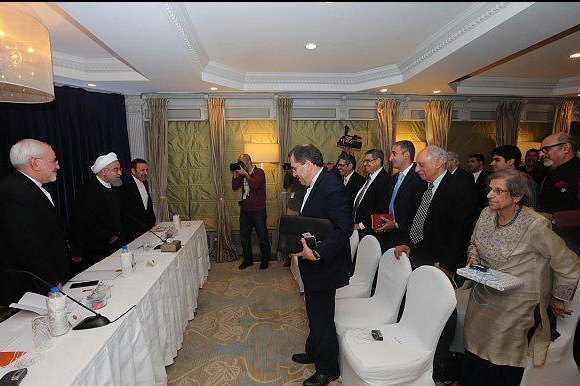
Iran's President Hassan Rouhani addressing a group of Indian elites in New Delhi / Photo retrieved from IRIB News Agency

Addressing a group of scholars and diplomats at the Observer Research Foundation (ORF) in New Delhi, Rouhani said human beings have faced problems like terrorism and violence for thousands of years.

He noted that humans are definitely not destined to abide by war and terror as they have gained many scientific achievements and virtues, a Farsi report by IRIB quoted him as saying.

Rouhani stated that despite all these achievements, there are problems that we have not yet been able to overcome. He also mentioned that many of the wars are waged due to computational errors.

“The US is a developed country with many scientists. It has trained and sent hundreds of thousands of spies to Iran, and decided for Iran in many different political and economic arenas for many years.”

Before the 1979 Revolution, Washington used to make decisions for Iran on military and cultural affairs and give orders to the Shah of Iran, he said, adding, however, the country has been making computational errors since the Islamic revolution.

Talking about the nuclear deal, the Iranian president said the agreement has been endorsed by seven states plus the UN Security Council. “Washington’s violation of the accord is in fact standing against the global public opinion.”

“As a country that has consistently met our commitments, we adhere to the JCPOA as long as all parties adhere to it. Trump is a businessman who thinks the world of politics is like the world of business.”

Noting that bargaining over a signed accord is something funny, he said the US will certainly regret it if it breaks the deal.

“As long as ethics is not observed, the world will not [become a safe place], and the problem of war and bloodshed will not be resolved,” added Rouhani.

Rouhani further underscored that today, ethics is not the basis of international politics, but it is rather dominated by power and as everyone knows the five countries that are in possession of nukes hold veto power.

Rouhani also lashed out at the United Nations saying the world body is not a place for the rule of justice these days.

“As long as justice does not dominate the world of politics, we will continue to see conflicts across the globe,” concluded the Iranian president.

 World Problems Not to Be Resolved Unless Commitments Met: Iran


Parsi Community Welcomed to Make Investment in Iran

During his visit to New Delhi, Rouhani also met with the community of Iranian-Indian Zoroastrians and called on them to invest in Iran.

He said India is the land of all religions that coexist together peacefully. He stressed that such coexistence exists in Iran as well, and the followers of other religious have a special role in the country.

“Iran’s progress has been achieved due to its ancient culture and civilization. We should not cut off our connection with our ancestors.”

“We are eager to see all Iranians have a closer relationship with their country. When Iran is attractive to all investors, you can come and invest as well,” said Rouhani.

He went on to say that Iran is rich in culture and civilization adding that the Islamic Republic is a great country that has successful scholars and economic activists across the world.

“We welcome all Iranian investors. In the past year, 400 successful Iranian entrepreneurs have returned to the country and have invested in Iran. God willing, we will build a more developed Iran with together,” he concluded.

“FATF Accession Impossible If Found to Be against Iran’s National Interests”

Mohammad-Reza Pourebrahimi, the Chairman of the Iranian Parliament’s Economic Commission, has touched upon the concerns of Leader of the Islamic Revolution Ayatollah Seyyed Ali Khamenei and the Supreme National Security Council about the FATF.

“The FATF will definitely lead to commitments for our country, and if those commitments run counter to our country’s national interests, we won’t accept them,” he noted, as quoted by the Persian-language Mashregh News website.

The legislator stressed that laws in Iran are based on transparency.

“Before the discussions on the FATF began, the Parliament had ratified laws, including one on fighting the financing of terrorism, which are in keeping with the FATF,” he said.

The lawmaker was asked about the original timeline, i.e. December 2017, when the FATF was supposed to go into effect in Iran. In response, he said, “Given that certain conditions need to be approved in order for our country to join the convention, the Islamic Republic will decide on that without setting any specific timeline and based on its national interests,” he underlined.

“As far as the FATF is concerned, the Economic Commission will certainly take the country’s national interests into account, and will present the prepared report to the Supreme National Security Council as well,” he said.

The parliamentarian said the FATF report has been drawn up and is awaiting final approval.

The report was prepared after the government presented to lawmakers several bills on fighting efforts to sponsor terrorism and tackling money-laundering, which were in line with the FATF, he added.

“After the bills were presented to Parliament, the legislature’s Presiding Board referred the bills to the Judicial and Legal Commission, and we are waiting for the commission to announce its final viewpoint about the bills, and if the commission’s report is deemed insufficient, the Economic Commission will present its report in an open session of Parliament,” said the MP.

Tehran, Berlin Sign Deal to Cooperate in Nuclear Safety

The cooperation deal was inked during a meeting between Head of the Iranian Nuclear Regulatory Authority Hojjatollah Salehi and Germany’s Ambassador to Tehran Michael Klor-Berchtold.

The meeting was also attended by the chairman of German company “Gesellschaft für Anlagen- und Reaktorsicherheit (GRS)”.

In October, a delegation from the European Union (EU) and a team from the Iranian Nuclear Regulatory Authority held meetings to discuss the second cooperation project in the field of nuclear safety.

The EU headquarters in Brussels, capital of Belgium, hosted the sessions.

The second project on mutual cooperation entails a boost to the technical capabilities of the Iranian Nuclear Regulatory Authority.

The two sides had launched their first cooperation project of 2.5 million euro in the field of nuclear safety in July 2017.

The interaction is part of a five-million-euro package approved in 2016 with regard to Iran-EU cooperation on nuclear safety, according to which the EU helps the implementation of Annex III of the 2015 nuclear deal, known as the Joint Comprehensive Plan of Action (JCPOA).

Turkey Rejects “Baseless” Accusation of Using Chemicals in Afrin

The source on Saturday rejected the “baseless accusations” raised by Kurdish forces, saying Turkey never used chemical weapons. “We take utmost care about civilians in Operation Olive Branch.”

Syrian Kurdish forces and a monitoring group said the Turkish military carried out a suspected gas attack that wounded six people in Syria’s Afrin region on Friday.

The source also described the accusations of wounding six civilians through a suspected gas attack as “black propaganda”, Reuters reported.

Turkey launched an air and ground offensive last month on the Afrin region, opening a new front in the multi-sided Syrian war, to target Kurdish fighters in northern Syria.

Birusk Hasaka, a spokesman for the Kurdish YPG militia in Afrin, told Reuters that Turkish bombardment hit a village in the northwest of the region, near the Turkish border. He said it caused six people to suffer breathing problems and other symptoms indicative of a gas attack.

The Syrian Observatory for Human Rights told Reuters that Turkish forces and their Syrian insurgent allies hit the village on Friday with shells. The Britain-based war monitoring group said medical sources in Afrin reported that six people in the attack suffered breathing difficulties and dilated pupils, indicating a suspected gas attack.

Syrian state news agency SANA, citing a doctor in an Afrin hospital, said Turkish shelling of the village caused choking in six people.

Downing of Israeli Jet Fighter Marks End of Tel Aviv’s “Invincibility”

The Persian-language Jomhouri Eslami newspaper has, in an editorial, weighed in on the ramifications of Syria’s recent downing of an Israeli jet fighter which had violated the Syrian airspace. The full text of the analytical piece follows:

Syria recently shot down an F-16 warplane of the Israeli regime in south Syria using its S-200 missile defence system, forcing other intruding jet fighters to flee the scene. Such a phenomenon has been unprecedented over the past 15 years. This comes as the Zionists have conducted numerous reconnaissance flights and airstrikes over Syria without any worries.

In order to justify the developments, the Tel Aviv regime claims that, first, it was busy shooting down an Iranian drone allegedly conducting reconnaissance flights over Israeli border areas, and second, Israeli fighter jets flew over Syria to bombard Iranian and Syrian bases on Syrian soil. The Islamic Republic of Iran has officially denied that any of its unmanned aerial vehicles (UAVs) had been flying over Israeli borders, saying Tel Aviv has made the baseless allegations simply to justify its act of aggression.

More importantly, the Zionists have alleged that Syria fired 27 S-200 missiles in order to intercept Israeli fighter jets. The claim, even if true, will be against Israeli occupiers. It clearly shows Syria’s determination to counter any military aggression by Zionists. It also indicates that the enemy, from now on, has to forget the idea of violating the Syrian airspace and throwing its weight around in the region because if the enemy does so, it will face a massive and debilitating volume of fire.

Following that incident, the Israeli regime made another mistake, which was to its own detriment. Immediately after its warplane was downed, the Israeli military tried to target several Syrian bases with missile attacks and air raids. Nevertheless, Tel Aviv rescinded its decision shortly after its “Security Cabinet” held a meeting, and announced that it had no intention of escalating military tension with Iran and Syria.

Hours later, Washington, too, decided to distance itself from the Zionists’ aggressive and tension-provoking behaviour. The US State Department officially announced that the US had not had any role in the Israeli airstrikes on Syria. The event (Israeli air raids and Syria’s downing of an Israeli warplane) with all its ramifications has turned into a yardstick against which to measure the Israeli regime’s vulnerability.

It shows that Israel and its regional supporters’ strategy of aggression has received a heavy blow. What happened was not just the downing of an Israeli warplane; rather, it triggered an end to the occupiers’ throwing their weight in the region. The event showed that gone are the days of hitting and running, and that the occupiers will have to pay the price for their evil deeds from now on. From this perspective, the day is drawing nigh when Israel will be taken to task for being an accessory to terrorists’ crimes as it has both overtly and covertly supported terrorists during their seven-year war on Syria.

Even if the recent Israeli operation against Syria was aimed at testing Damascus’ possible reaction, the downing of Israel’s US-made F-16 warplane is a great nightmare for the Tel Aviv regime and proves that the occupiers have tough days ahead. The Israeli regime believed the ISIS terror group and other terrorists had weakened the Syrian government and army and undermined their military power enough, but the Syrian army’s show of power made Israel understand that Damascus is even more determined than what it was before the acts of terror to counter the Zionist enemy.

Israel and its supporters had, for decades, been promoting the idea of “Israel’s invincibility” to create the impression that Israel’s fortifications in the heart of the Muslim world were impenetrable. But today, they have admitted that they were even flummoxed by a Syrian drone entering the occupied territories’ airspace. They have acted so passively in the measures they have adopted ever since that the consequences of their moves will be to their own detriment.

By taking a glance at the objectives and programs pursued by the Israeli regime and its allies against Syria and Iraq over the recent years, one can find out that those plotters have suffered costly failures in their schemes of aggression. Syria and Iraq were going to be monopolized and ruled by ISIS and other terrorist groups, so that Syria’s common borders with occupied Palestine would have become safer for the Zionists. However, with the complete failure of that plan, not only did terrorist fail to establish a secure circle and a buffer zone and increase their security coefficient, but, on the contrary, they have become so weak that they are seeing Syrian UAVs flying deep into the occupied Palestinian territories, and they are unable to tackle the drones.

Syria’s downing of the Israeli F-16 jet fighter was a unique incident in that its extensive and lasting consequences will definitely disrupt Tel Aviv’s calculations for a long period of time. Moreover, reactionary Arab states’ deadly silence over the incident is more humiliating than anything else for Arab rulers. In fact, reactionary Arab rulers, who are going lovey-dovey with the Tel Aviv regime, will be condemned and embarrassed in advance no matter what decision or position they adopt.

Digital Platform at Tehran Metro Promoting Ebook Reading

For using the services you need to install Fidibo’s app which is available for download on Apple’s App Store, Google’s Play Store and local app markets Café Bazaar and Sib App.

With assistance from Tehran and the Suburban Railway Operation Co, Fidibo has installed touch-screen panels dubbed Fidibox in 22 subway stations that with a few taps display a disposable QR code, the transportation company reported on its website.

After scanning the code via Fidibo, for an hour, commuters will have free access to a collection of 1,000 titles. People can choose from the number, download books for free and read them on their handset. After the one hour time, the book gets locked.

When using the tube the traveler can always get a new code and continue what he/she was reading during the earlier trip. People can also decide to continue reading the book without interruption. To do so they can purchase the books which they have started reading on the subway from Fidibo with a 20% discount.

Installation of Fidiboxes in subway stations is part of a plan known as ‘A library as Vast as a City’ introduced by the municipality that in addition to trying to increase book readership is aimed at helping people make better use of the time spent in public places.

Fidibo chief Majid Ghasemi explains, “Fidiboxes can be installed in other public locations, where people spend hours waiting, like bus stations, hospitals and clinics.”

Through the new service Fidibo is planning to offer themed reading material and introduce online book clubs.

Ghasemi says such services can be offered in subways in other cities. In addition to Tehran, four other cities have a subway system, namely Ahwaz, Tabriz, Shiraz and Mashhad.

Regarding the copyright of books, Fidibo has received the publishers’ assent to offer limited free access to their books through its app. Ghasemi says Fidibox has much potential and can be used as a perfect means by publishers to promote their books and attract a bigger and wider range of readership.

He said the Tehran Municipality and metro officials have assisted the startup in development of the scheme and promised to help the company promote it.

Fidibo was established by the cultural product chain store Book City Company in 2014. The startup works with over 400 publishers, including the well-known Niloofar, Amirkabir, Qoqnoos, Ney, Negah, Ghatreh, Mahi, Agah. Its app has been downloaded over 1.5 million times and some 16,000 books are available through its service.

In addition to Persian, Fidibo offers a limited number of books in English and Arabic and is trying to expand its reach to other countries. It has established offices in Murcia in Spain and Beirut.

In collaboration with its major investor Digikala (Iran’s largest online retailer), Fidibo is set to import ebook reader devices in the near future.

>Cultural Issue

The first Fidibox was unveiled on Feb. 7 at Meydan-e ValiAsr subway station during a ceremony attended by Tehran Mayor Mohammad Ali Najafi, deputy mayor for transport affairs Mohsen Pourseyed Aghaei and CEO of the subway company Farnosh Nobakht.

During the ceremony, Najafi said, “The municipality welcomes applications of modern technologies, especially when used for addressing cultural issues. Plans like these can help increase book readership mainly among the youth.”

Average book readership is pitifully poor in the country. Iran’s Public Libraries Institution says each Iranian hardly spends about 15 minutes reading books every day.

Echoing Najafi’s comments, Nobakht said, “The subway system boasts an average daily ridership of more than 2 million with each commuter spending up to 35 minutes on average on each trip. Imagine people spending part of this time reading books.”

Depending on the public response to the scheme the number of the Fidiboxes and the stations with the device can be increased, he said.

The subway company has said it will publish monthly reports on the public response and reception of the ebook service.

Fidiboxes have been installed at the following stations: Tajrish, Gholhak, Javanmard-e-Ghassab, Shahed, Daneshgah-e Sharif, Imam Khomeini International Airport, Sadeghiyeh, Theater-e Shahr, Mosalla, Meydan-e Enghelab, Meydan-e Vali Asr, Meydan-e Shohada, Shahrak-e Ekbatan, Bimeh, Baharestan, Azadegan, Imam Khomeini, Karaj, Golshahr, Shademan, Farhangsara, and Meydan-e Azadi.

Iran, India Sign 15 MoUs in Rouhani’s First-Ever Visit to New Delhi

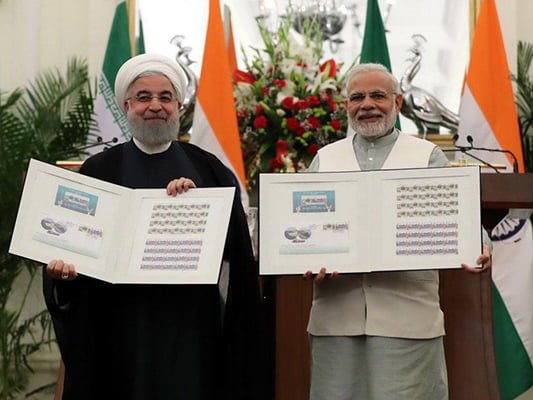
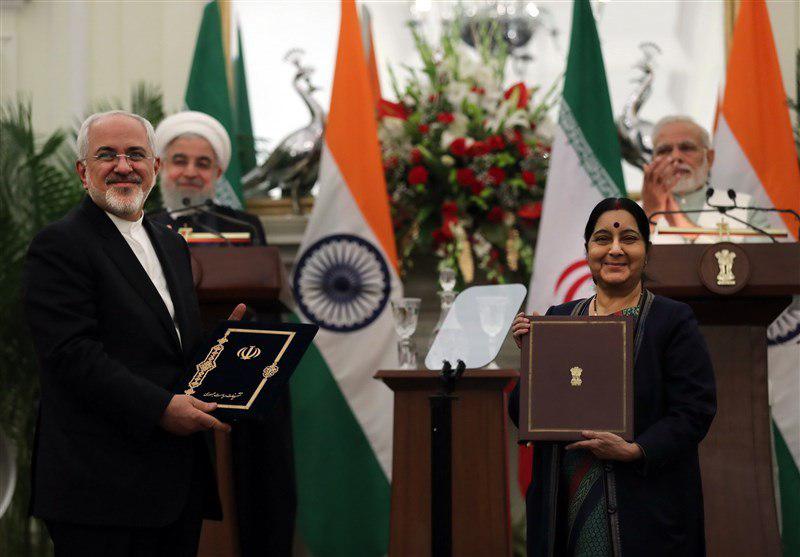
In a ceremony on Saturday attended by Iranian President Hassan Rouhani and India’s Prime Minister Narendra Modi, top officials from the two countries inked 15 agreements and memoranda of understanding.

The documents cover a varied range of issues, including the removal of political visa requirements, scrapping of double taxation, and cooperation on anti-dumping processes.

Other agreements included cooperation in agriculture, temporary administration of the first phase of Chabahar port, post affairs, and medical programs, Tasnim reported.

The two sides also signed a document on the extradition of criminals in the consular domain and another one on juridical cooperation in civil and trade affairs.

Iran, India Sign 15 MoUs in Rouhani’s First-Ever Visit to New DelhiIn a meeting in the same day, President Rouhani and Prime Minister Modi expressed readiness to expand relations between their countries in all areas.
Rouhani said it was incumbent on the countries’ politicians to deepen the historical amity between the nations in all cultural, economic, and commercial areas.

“Iran and India’s ties are not to any country’s detriment,” he said. “There are expansive capacities for the development and deepening of Iran and India’s relations, which should all be seized upon more than ever toward the interests of and creating a better future for the nations and the region,” he said.

The Iranian president also pointed to mutual investment in the southern Iranian port city of Chabahar by Iran and India as well as Afghanistan as a means of turning it into a trade hub, Press TV reported.

Rouhani said Chabahar could reinforce Iran and India’s historical ties by serving as a bridge connecting the subcontinent to Afghanistan, Central Asia, and Eastern Europe. “We are ready to sign bilateral and trilateral agreements to turn the transit route passing through Chabahar into a strategic pathway serving the reinforcement of regional ties,” he said.

Iran, he added, can provide the energy resources India is in need of by entering into long-term strategic agreements with New Delhi.

Modi, for his part, said many obstacles had been removed from the way of expanding bilateral economic relations, prompting many mutual investment projects to bear fruit and accelerating the trend of growth in mutual ties.

“Indian companies are ready to further their investment in the areas of mutual cooperation, including oil and gas,” he said.

Chabahar, he said, “can change the trade relations game across the region and the world,” noting that India had already begun exporting its goods, including wheat, to Afghanistan via the Iranian port city.

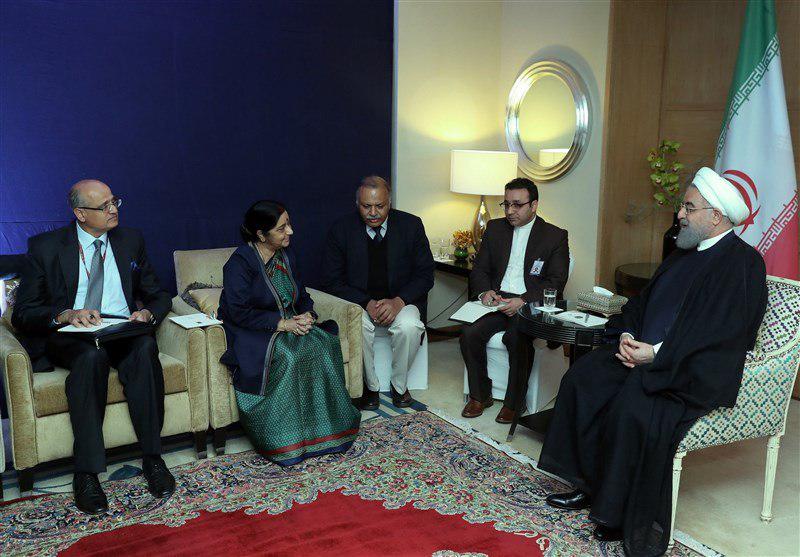
Iran, India Sign 15 MoUs in Rouhani’s First-Ever Visit to New DelhiRouhani also met India’s Minister of External Affairs Sushma Swaraj. During the talks, Rouhani said “promotion of cooperation between Iran and India on regional issues could strengthen the pillars of stability and security across the region.”

Enhancement of ties between the two great and influential Asian countries will serve the interests of their nations and the region, the president added, calling for closer cooperation with India in the energy industry, mining sector, transportation and the new technologies.

He also said Tehran would welcome a more active presence of Indian companies in Iran.

For her part, Swaraj said India is resolved to boost ties with Iran in all areas of mutual interest.

Calling for efforts to facilitate visa restrictions for Iranian and Indian travelers, she also emphasized that development of Iran’s southeastern port city of Chabahar would benefit the region, including the people of India and Afghanistan.

Before the meeting, the Iranian president had high-profile talks with his Indian counterpart Ram Nath Kovind.

During the visit, the two sides also issued a joint statement, the full text of which can be accessed via this link.

Heading a ranking diplomatic and economic delegation, Rouhani began his 3-day visit to India with a trip to Hyderabad, where he held meetings with Iranian people and students residing in India, and with Indian Muslim communities.

“France Giving Concessions to US over Iran Missile Program”

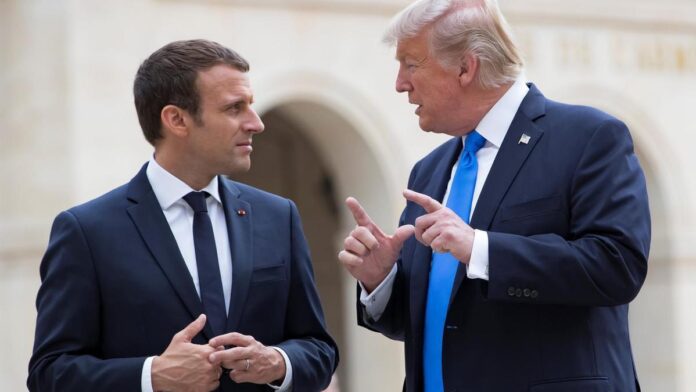
Referring to recent statements by French President Emmanuel Macron, who called for international monitoring of Iran’s missile program, Iranian MP Ezzatollah Yousefian Molla said, “In the same statements, Macron called for maintaining the nuclear accord and stated that it is a strong international treaty.”

“Macron knows the JCPOA is one of the most credible international treaties, and in addition to several European countries, important countries such as China and Russia are part of it, so the deal cannot be regarded as an ordinary one and cannot be easily challenged,” added the senior legislator, according to a Farsi report by ICANA.

The reason why Macron expressed support for the nuclear deal and at the same time talked about the necessity of holding talks on Iran’s missile program is to keep the US satisfied, he added.

“Recently, the French officials have had several meetings with the American side, and this shows that Paris and Washington are pursuing new policies, and proving that their relations have grown in comparison with other European countries.”

“Therefore, Macron has to always keep Trump satisfied and give Washington concessions. Talking about monitoring Iran’s ballistic missile is in line with this policy. Otherwise, the UK has never asked for permits to build its VTOL aircraft, or France has not asked for authorizations to build its Mirage squadrons,” noted Yousefian.

Regarding Macron’s statements on holding regional negotiations for security in the Middle East, he pointed out that “Certainly, these negotiations will take place with the participation of their allies and will not yield any results.”

“As we know, the NATO countries do not move in the same direction these days and there exists differences among them. Therefore, holding negotiations that can bring these countries at a table is almost impossible, and such attempts to hold talks is merely a political show,” concluded the Iranian lawmaker.

Macron said on Tuesday that Iran’s ballistic missile program must be placed under international surveillance. He also stressed preserving the nuclear deal that Donald Trump has threatened to scrap.

With the 2015 deal put in jeopardy by the US president, Britain, France and Germany are working on a plan to address Iran’s ballistic missile tests and its regional influence.

“And (we need) to put Iran under surveillance over its ballistic missiles. It’s indispensable for the security of the region and so we need a mechanism of sanctions and control adapted to that,” Macron told reporters.

While Iran signed the nuclear agreement – which it has repeatedly announced is for peaceful purposes only – it has repeatedly refused to discuss its missile program, something the United States and the Europeans have called for.

Iranian Deputy Foreign Minister Abbas Araqchi said on February 8 that the West must ensure the nuclear deal succeeds before trying to negotiate other issues.

Azeri Lady Finds Iranian Half-Sisters after 63 Years

Azeri Lady Finds Iranian Half-Sisters after 63 Years

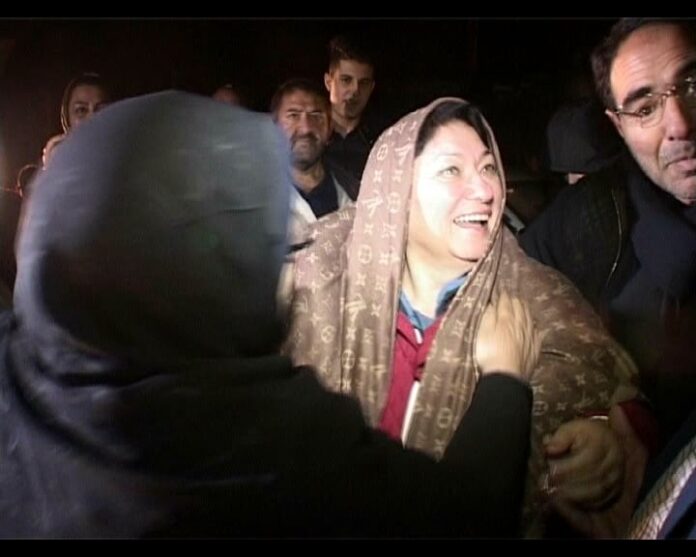
After decades apart, Lyudmila, a 63-year-old geography graduate from Moscow State University, had a face-to-face reunion with Zivar and Safiyeh, his elder half-sisters, in Meshginshahr in northwest Iran Thursday.

According to a Farsi report by IRNA, the story begins in 1940s, when their father, Nowruz Barpoosh, travels to Soviet Union on a business visit.

But the unfortunate businessman gets caught in the country, as his trip coincides with an order by former Soviet premier Joseph Stalin that Iranian nationals must be deported or exiled.

Nowruz gets arrested and sent into exile in Siberia, losing connection with his wife and three daughters in Iran.

After passing several years in exile, eventually Nowruz gets free, but he cannot return to Iran due to a travel ban imposed by the Soviet Union.

Nowruz moves to Azerbaijan’s Ganja, where he remarries an Azeri woman who gives birth to two boys and one daughter.

Nowruz, his Azeri wife, and their two sons died before the collapse of the Soviet Union, leaving Lyudmila alone.

After Azerbaijan declared independence in the wake of the breakup of the Soviet Union in 1991, Nowruz’s Iranian children started looking for their father in Azerbaijan.

Earlier this year, decades-long search finally led one of Nowruz’s grandchildren to find his grave in Ganja, which helped him track the way to Lyudmila and allow the family to get together after over 60 years.

Lyudmila said she was really glad they were together.

“It appears just like a dream to find my sisters and relatives at this age,” she said.

“Since early childhood, I used to see my father expressing how much he missed his children in Iran. I was quite eager to see my sisters,” she told IRNA, while shedding tears.

Zivar and Safiyeh said they did lots of searching through the years when they were younger, but they failed to find a trail of their father as they had not much information to go on.