Sunday, December 21, 2025
Home Blog Page 3715

“Women Removing Headscarves in Iran Encouraged from Abroad”

Speaking to reporters on Wednesday, Montazeri said this is a rare case, and in a country with 80 million population, women wear the accepted form of Islamic dress code which shows their chastity.

“If a person does not wear hijab, it is a crime and she must be prosecuted, but we believe that such people must be punished by receiving a notice,” underlined Montazeri.

“No one has the right to enter the private life of individuals, but we must pay attention to the laws in the society.”

Montazeri added that “hijab is a must in our country, and those who believe in Islam observe it and are committed to it, while the others must pay attention that observing hijab is obeying the country’s law.”

Meanwhile, Tehran’s prosecutor also said a person has been arrested in connection with what is called “Girls of Revolution Street” movement.

Tehran’s Prosecutor Abbas Jafari Dolatabadi announced that such a move is a crime and the Prosecutor’s Office would perform its duties in this regard.

According to a Farsi report by ILNA, Dolatabadi added that based on a police report, one person has been arrested and her case has been sent to the Prosecutor’s Office.

In response to a question about setting a $110 thousand bail for the person, he said, “I do not have any information about the bail, but the decisions on the bail amount will be reasonable.”

He further mentioned that the act is against the law and is considered a crime.

Dolatabadi noted that if such acts are continued, the Prosecutor’s Office will carry out its responsibilities.

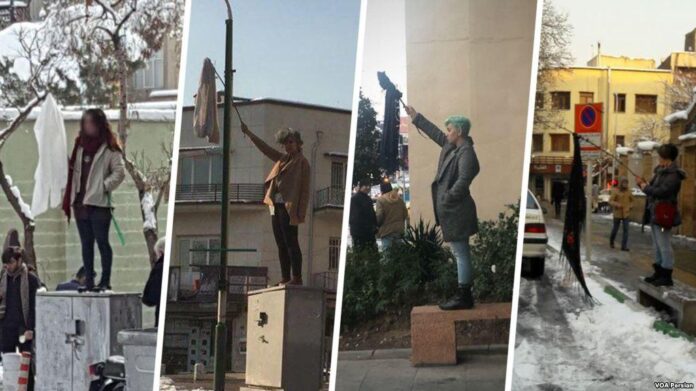
The reactions came after some girls removed their hijab in Tehran, particularly in Enqelab (which means Revolution) street, and other parts of Iran, holding their headscarves aloft on a stick in a so-called move namely “Girls of Revolution Street”.

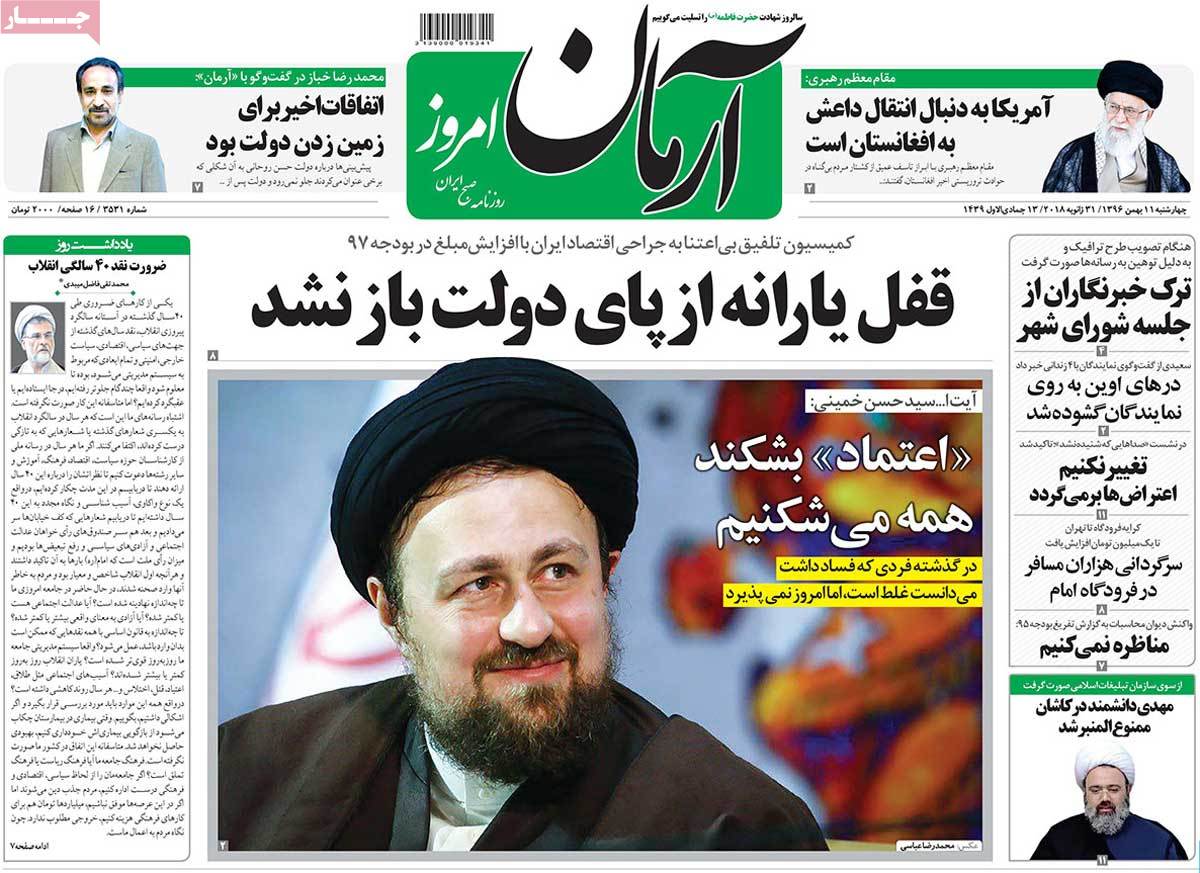
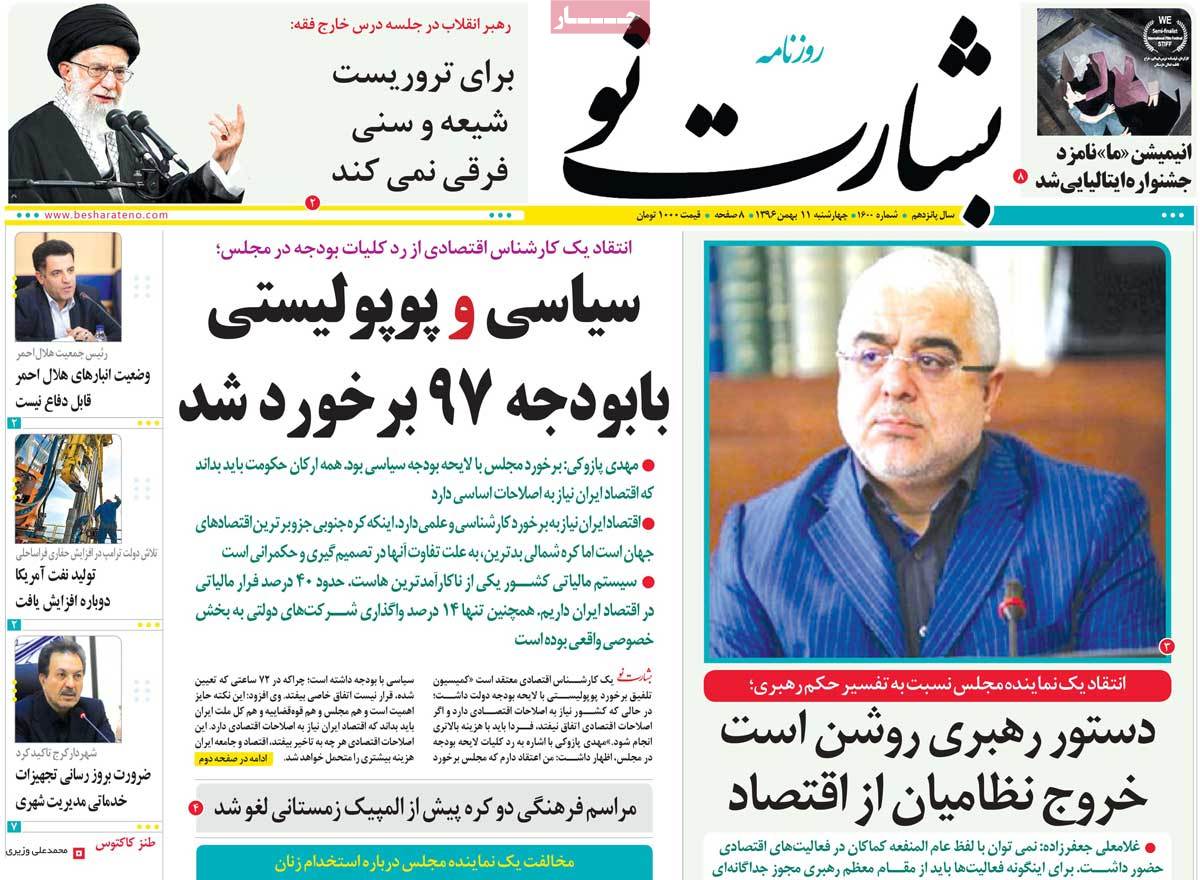
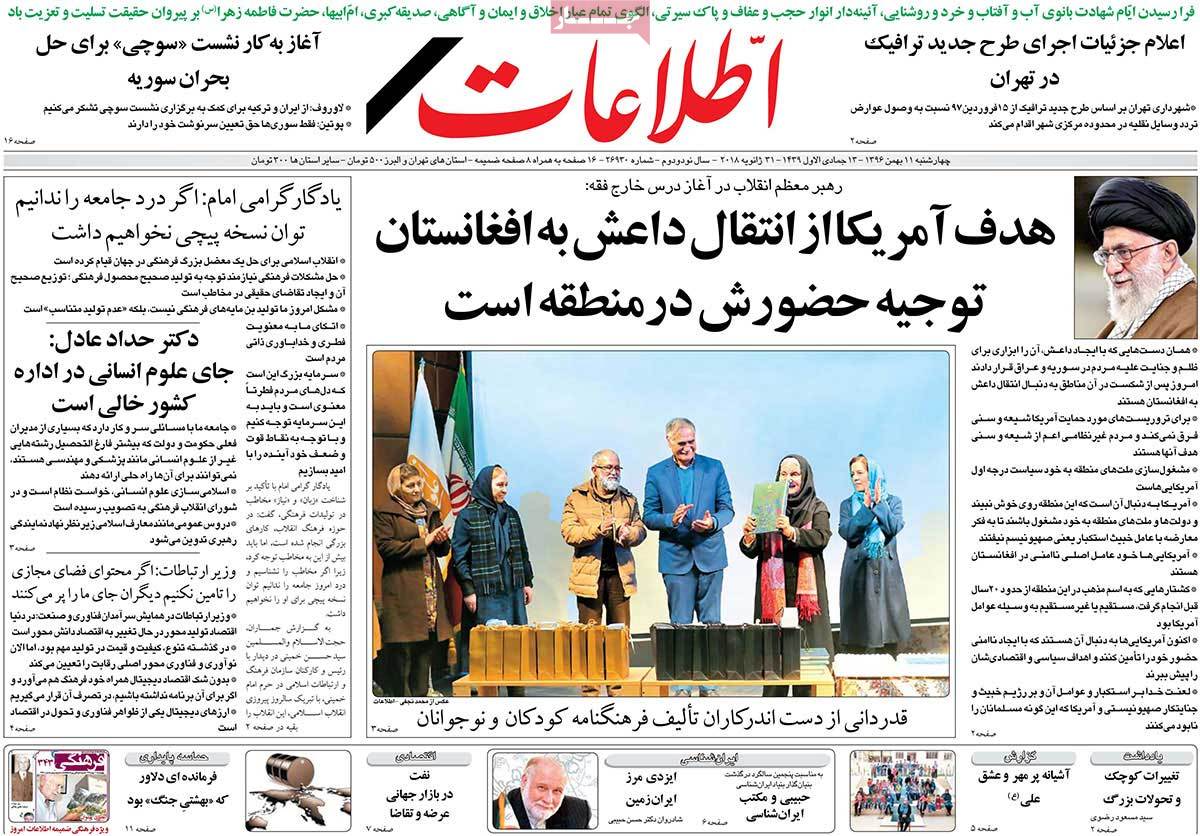
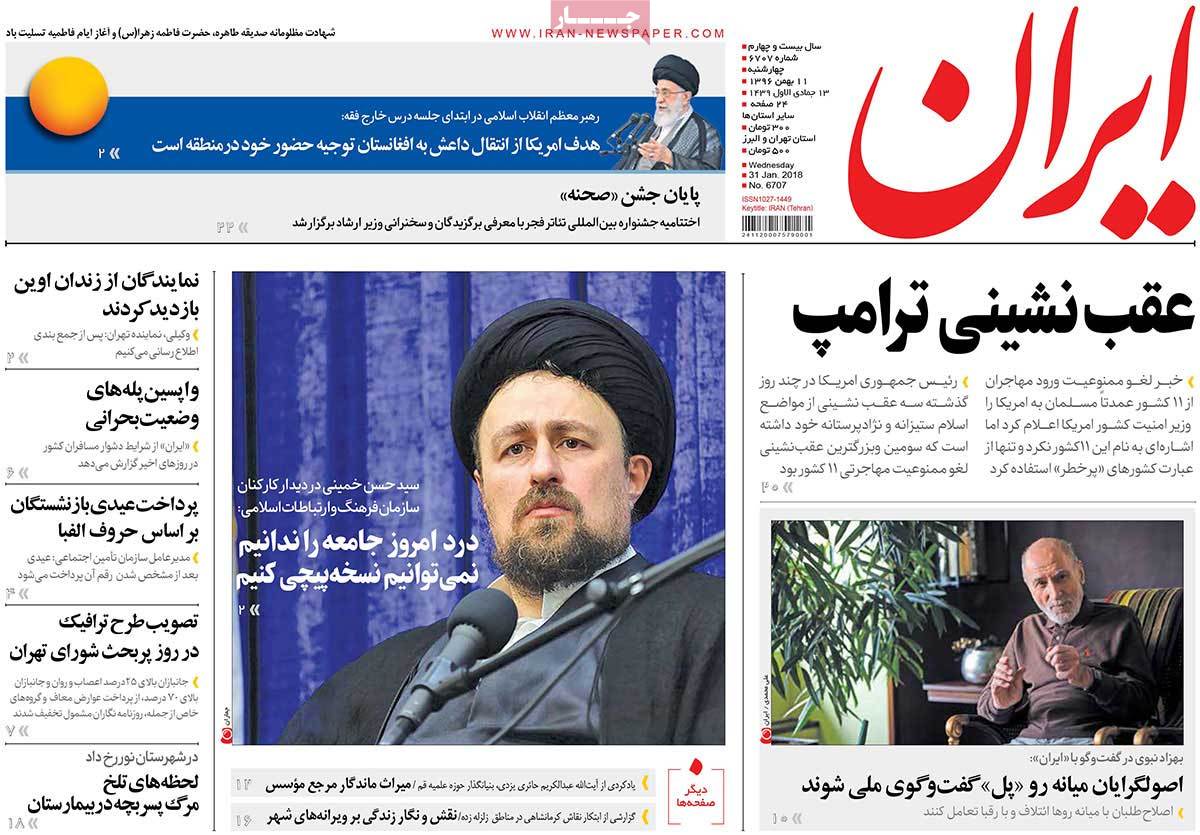
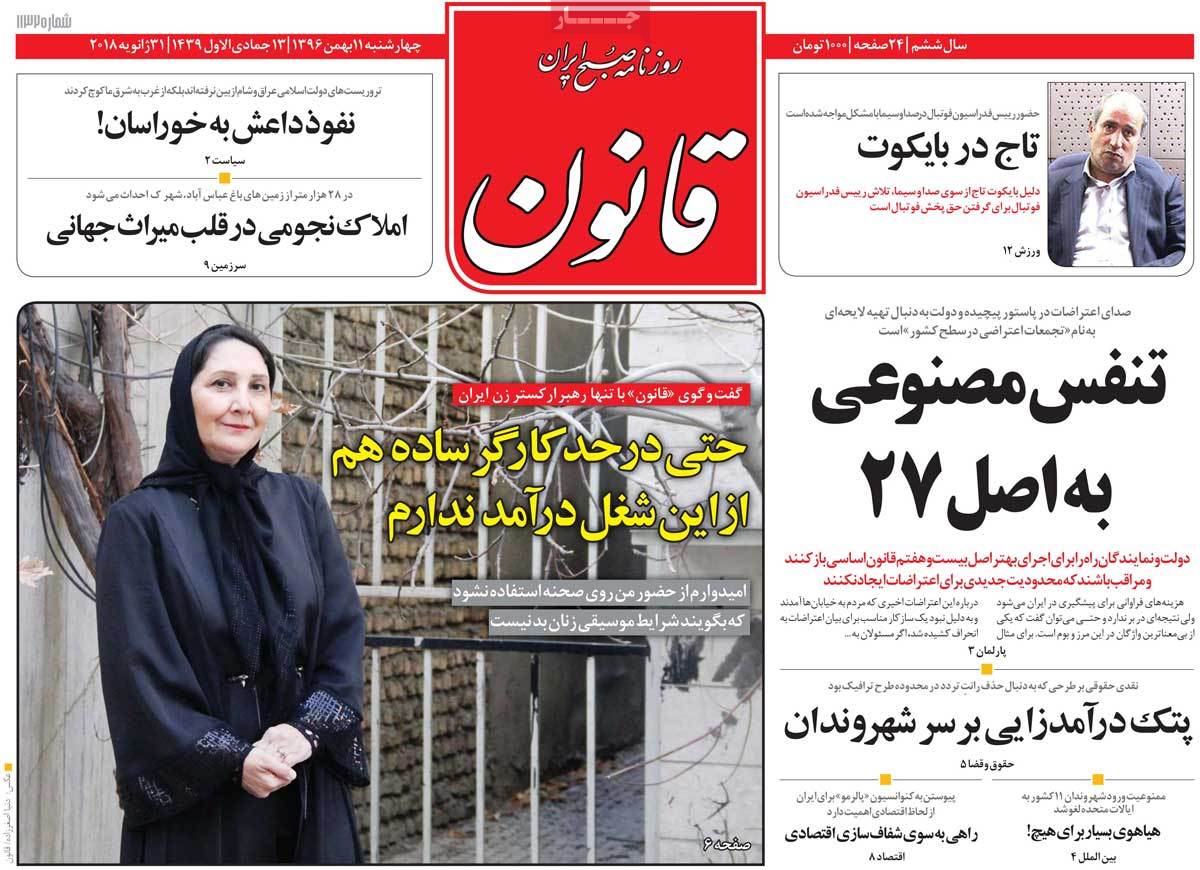
A Look at Iranian Newspaper Front Pages on January 31

A Look at Iranian Newspaper Front Pages on November 18

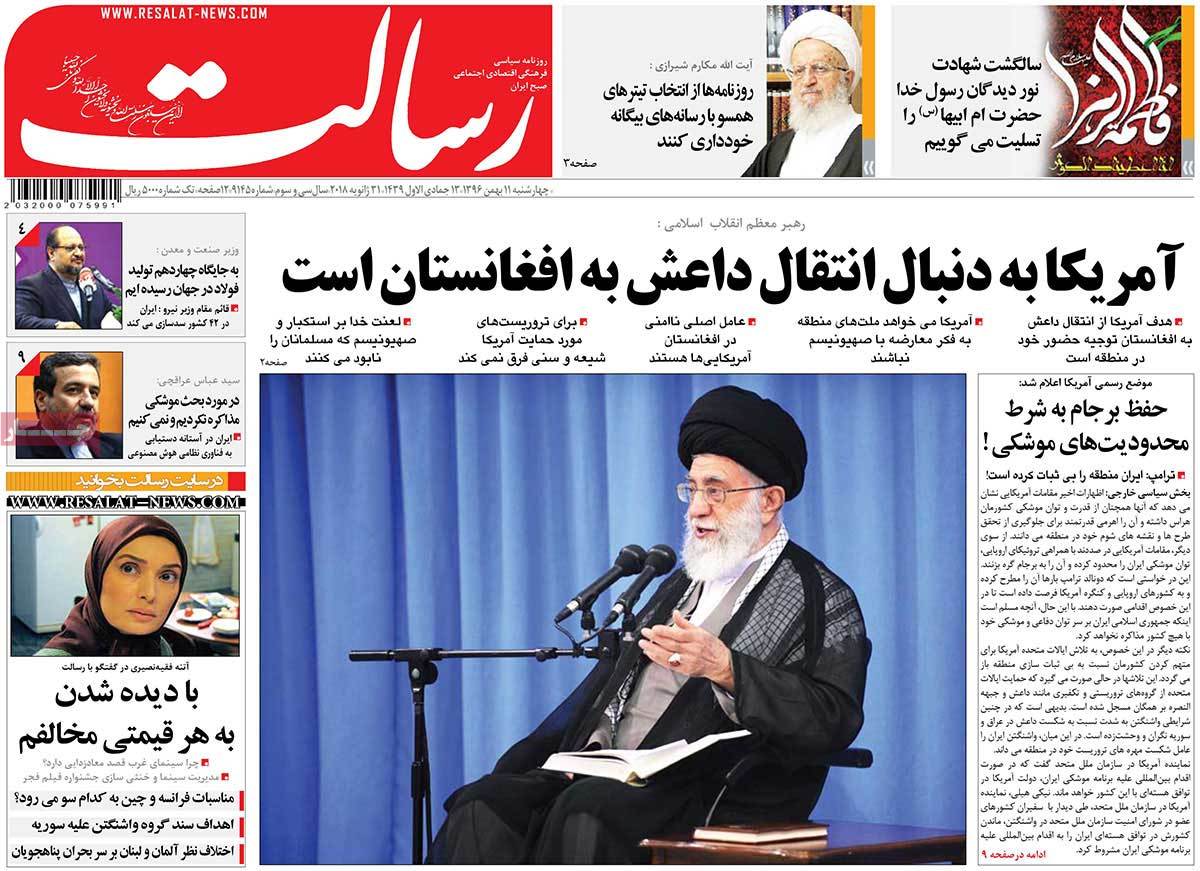
Almost all newspapers today covered the remarks made by the Leader of Iran’s Islamic Revolution Ayatollah Seyyed Ali Khamenei about the US plot to relocate ISIS terrorists to Afghanistan in a bid to justify its military presence in the region.

Also a top story was the Syrian National Dialogue Congress held in the Russian city of Sochi based on an initiative by Russia, Iran, and Turkey.

The comments by Iranian Deputy Foreign Minister Seyyed Abbas Araqchi about the nuclear deal and its benefits for the country also received great coverage.

The above issues, as well as many more, are highlighted in the following headlines and top stories:


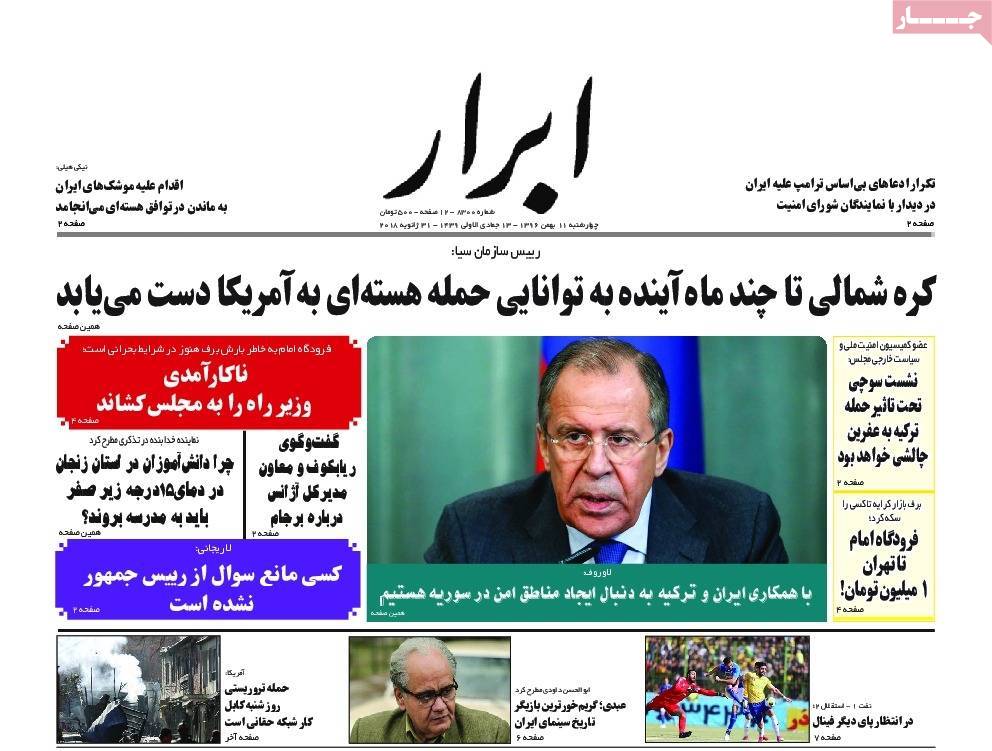
Abrar:

1- CIA Chief: N. Korea to Achieve Capability of Launching Nuclear Attack on US in Few Months

2- Lavrov: We Seek to Create Safe Zones in Syria in Cooperation with Iran, Turkey

3- Larijani: No One to Prevent MPs from Summoning Rouhani

4- Sochi Congress Challenging under Influence of Turkey’s Attack on Afrin: MP

A Look at Iranian Newspaper Front Pages on January 31


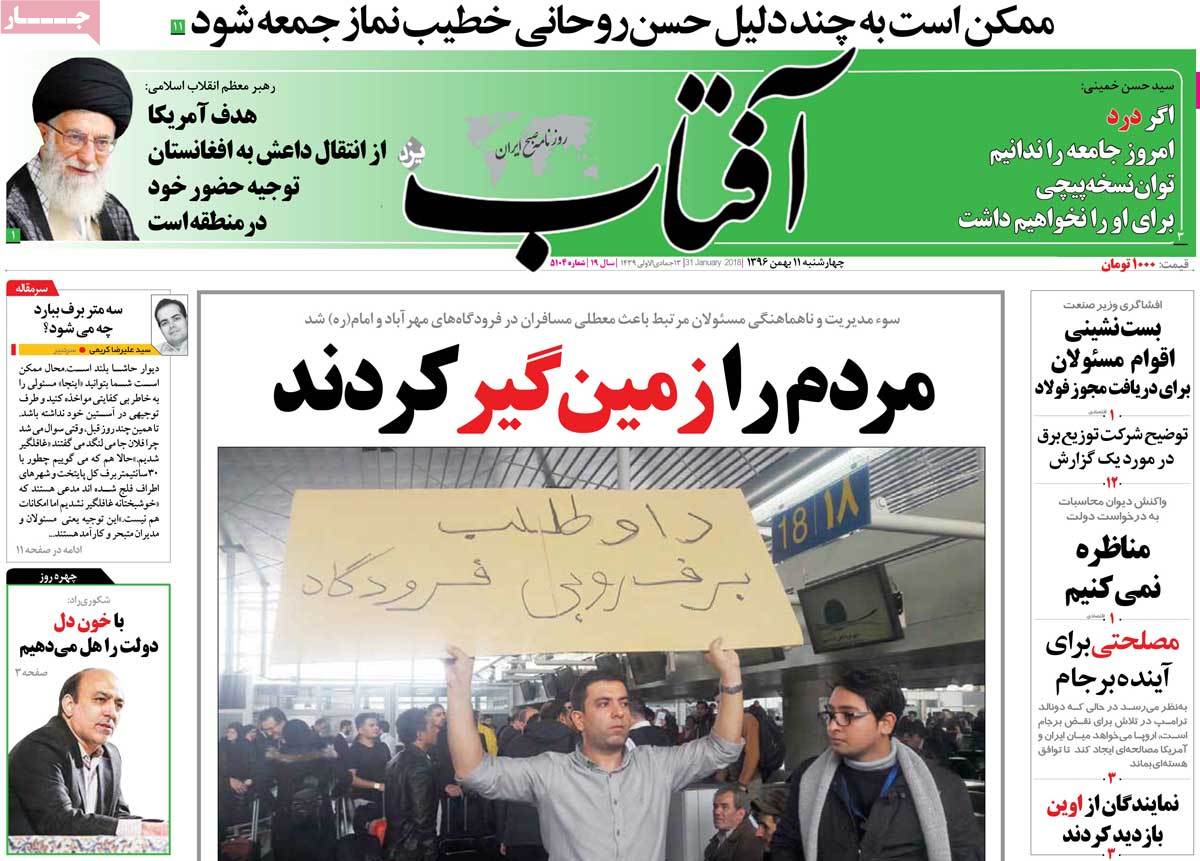
Aftab-e Yazd:

1- Iran Leader: US Relocating ISIS to Afghanistan to Justify Regional Presence

2- Mismanagement Caused Serious Troubles for Passengers in Tehran Airports

A Look at Iranian Newspaper Front Pages on January 31


Arman-e Emrooz:

1- Parliament Allows Gov’t to Cut Cash Subsidies

2- Iran Leader: US Trying to Relocate ISIS to Afghanistan

A Look at Iranian Newspaper Front Pages on January 31


Besharat-e Now:

1- Iran Leader: Shiites, Sunnis No Different to Terrorists

A Look at Iranian Newspaper Front Pages on January 31


Ettela’at:

1- ICT Minister: If We Fail to Provide People with Content in Cyberspace, Others Will Do So

A Look at Iranian Newspaper Front Pages on January 31


Iran:

1- Imam Khomeini’s Grandson: We Can’t Write Prescription for People If We Don’t Know Their Pains

2- Lawmakers Visit Evin Prison

  • MP: We’ll Brief People on Our Visit

A Look at Iranian Newspaper Front Pages on January 31


Ghanoon:

1- Only Female Conductor of Iran: I Don’t Earn Even as Much as Simple Worker

A Look at Iranian Newspaper Front Pages on January 31


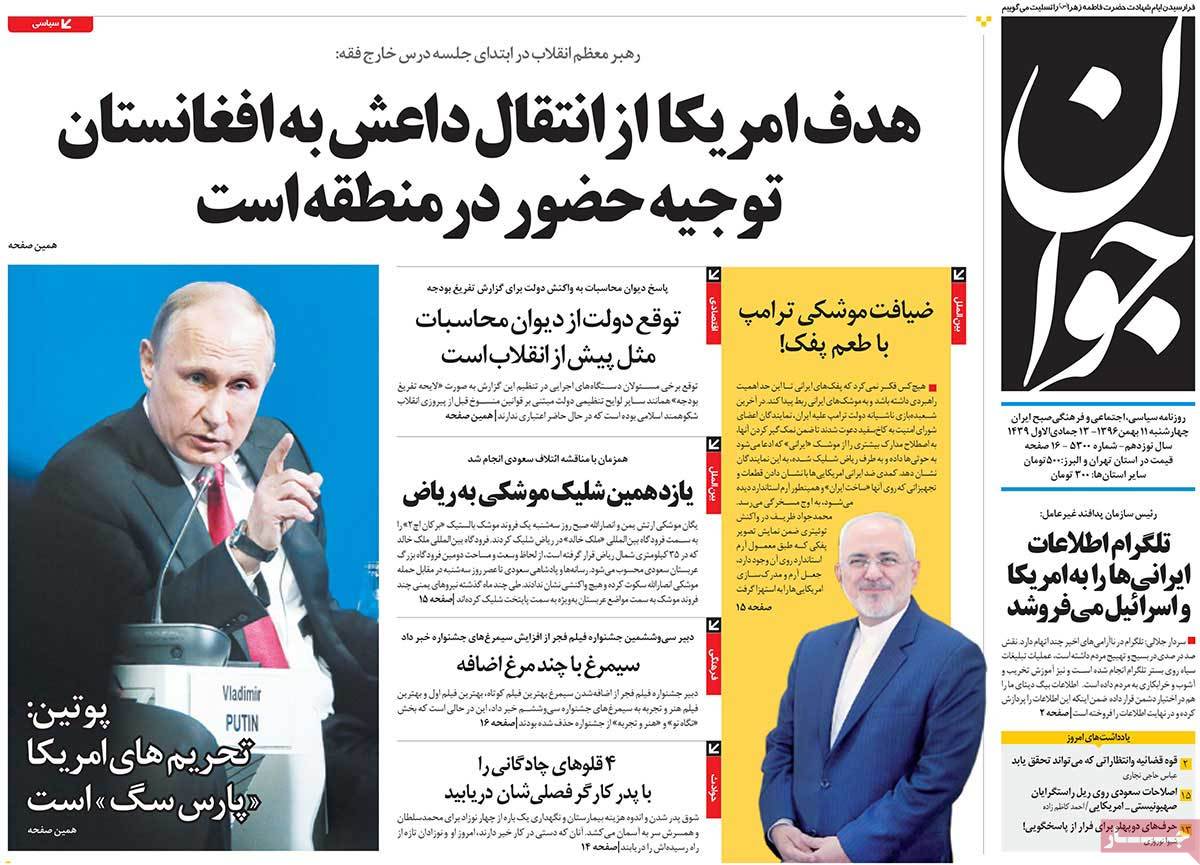
Javan:

1- Putin: US Sanctions Just Dog’s Barking

2- Yemen Fires 11th Missile at Riyadh amid Saudi Coalition’s Infighting

3- Telegram Selling Data of Iranians to US, Israel: Official

A Look at Iranian Newspaper Front Pages on January 31


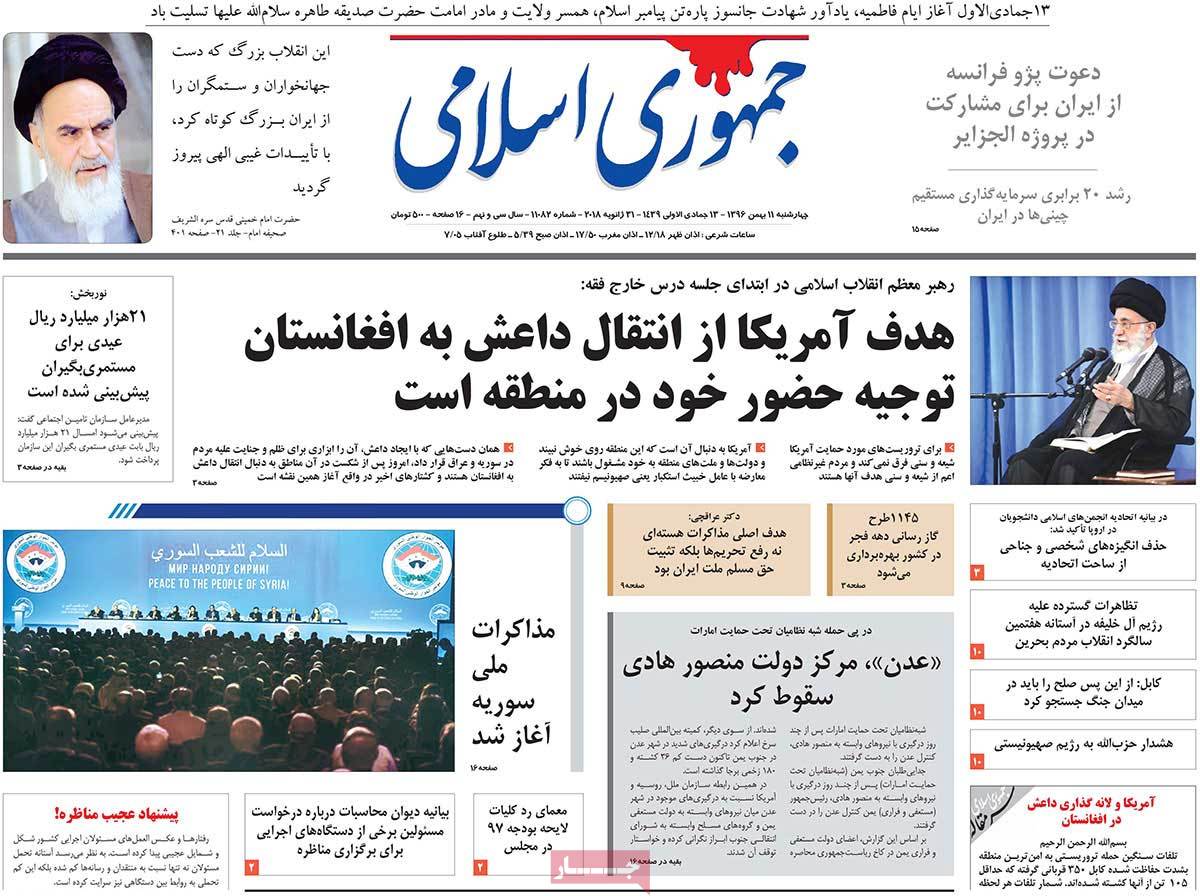
Jomhouri Eslami:

1- Peugeot Invites Iran to Participate in Algeria Project

2- Syria’s National Negotiations Begin

3- Recognition of Nuclear Rights, Not Sanctions Removal, Main Goal of Nuclear Talks

A Look at Iranian Newspaper Front Pages on January 31


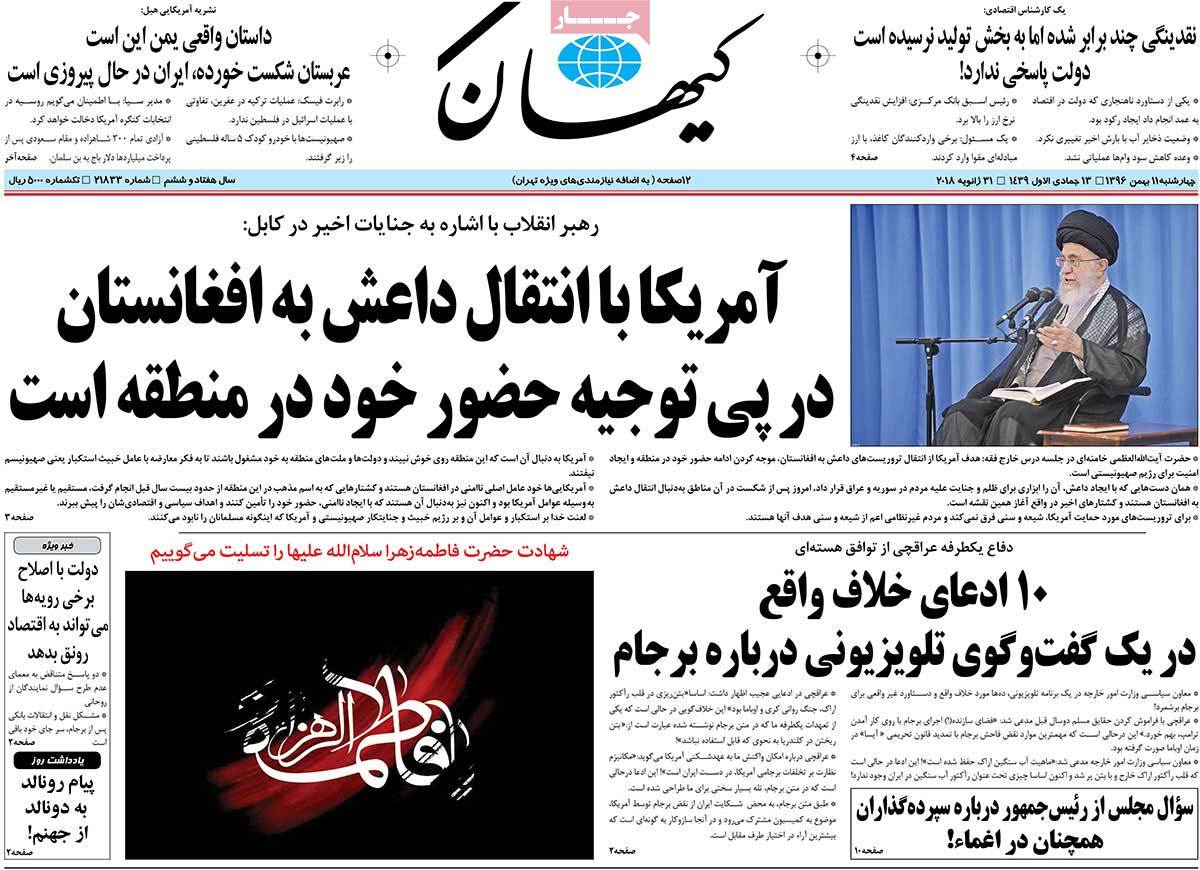
Kayhan:

1- The Hill: Real Story of Yemen Is Defeat of Saudi Arabia, Victory of Iran

2- Deputy FM Araqchi Unilaterally Defends Iran Nuclear Deal

  • 10 False Claims Raised by Araqchi about JCPOA in Live Interview

A Look at Iranian Newspaper Front Pages on January 31


Payam-e Ma:

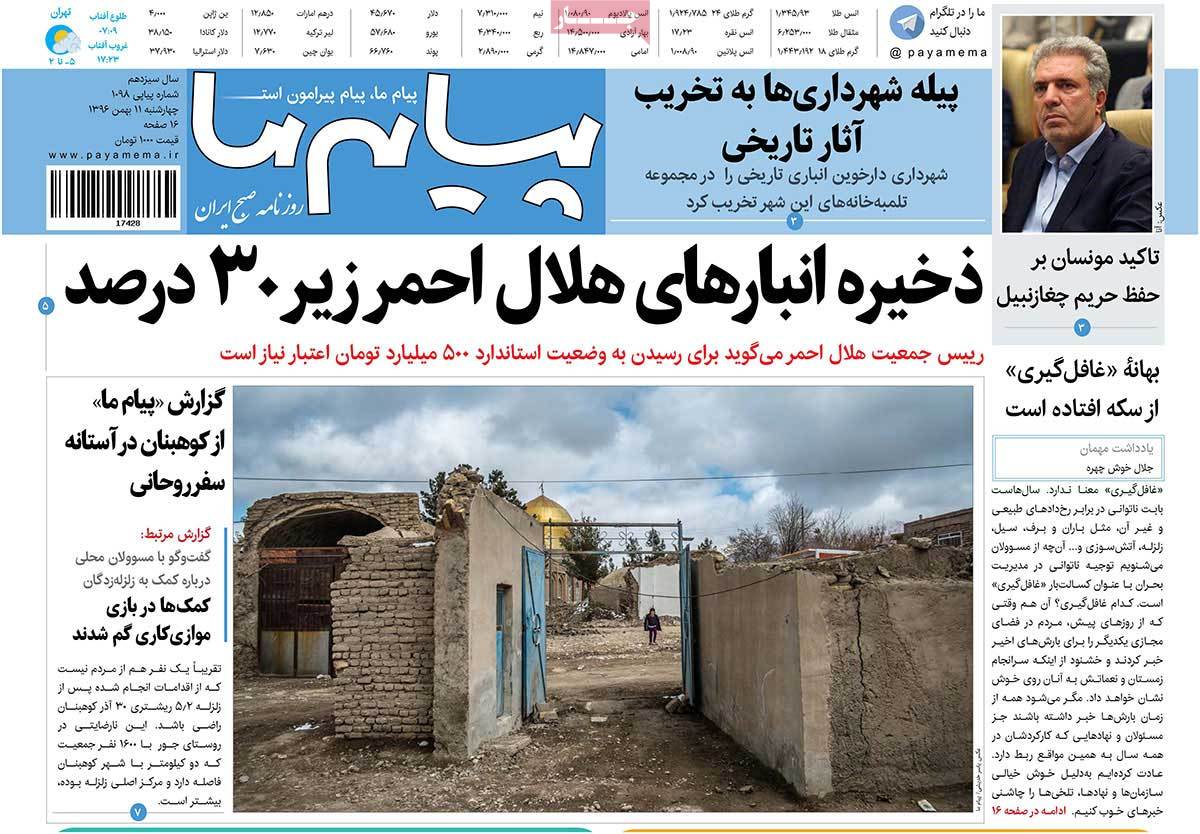
1- Iran’s Red Crescent Society Needs IRR 5,000 Billion [$111m] to Reach Standard Level

A Look at Iranian Newspaper Front Pages on January 31


Resalat:

1- Iran Leader: US after Transferring ISIS to Afghanistan

  • God Damn Arrogance, Zionism that Destroy Muslims

2- Industry Minister: Iran Stands at 14th Rank in World Steel Production

3- Araqchi: We Haven’t Held Talks on Missiles, Won’t Do So in Future

A Look at Iranian Newspaper Front Pages on January 31

3 Killed, 2 Wounded in California Chopper Crash (+Video)

Newport Beach Police said four people were believed to be onboard when the chopper went down.

CBS Los Angeles reported that one of the deceased was a person on the ground.

Residents of the home that was struck were inside the home at the time of the crash; however, police say none of the residents appeared to be hurt.

Two people were rushed to the hospital. Their conditions are unknown at this time.

There was no fire after the incident, but plenty of fluids on the ground. The helicopter is reportedly a Robinson R44 owned by Revolution Aviation, according to CBS Los Angeles.

The cause of the crash is under investigation.

Newport Beach is about 45 miles southeast of Los Angeles.

Iran Condemns CIA Chief’s Cheap, Meddlesome Allegations

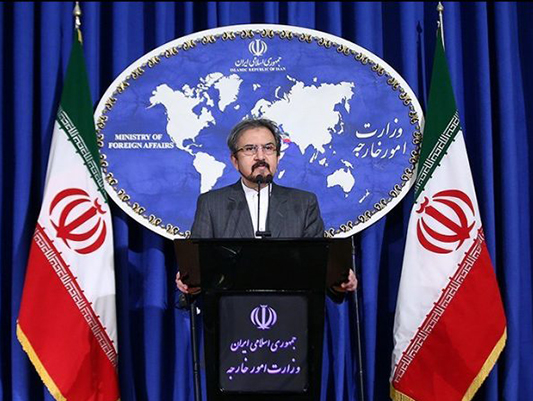
Bahram Qassemi

In a Wednesday statement, Qassemi condemned Pompeo’s remarks about Iran’s regional policies, saying, “The Islamic Republic has always given priority to its neighbours and will always do so in the future.”

“Iran has shaped its foreign policy on the basis of non-interference in the internal affairs of others and respect for the sovereignty and territorial integrity of all its neighbouring states,” he went on to say.

Qassemi stressed Iran’s foreign policy is based on the major principle that the security of neighbours is as important as our own security and that of the region.

Tehran is prepared to boost its cooperation, mutual understanding, and relations with all neighbours and surrounding countries, and to promote peaceful coexistence and ensure collective security in the region, he noted.

The Islamic Republic has taken long steps in this regard and raised constructive efforts to realize it, the Iranian spokesman added.

Qassemi referred to the CIA chief’s cheap and unjustifiable allegations as brazen example of Washington’s interfering and illegitimate policies, saying, “The repetition of such cheap accusations is solely aimed at causing rift among Muslim countries and nations in the region, and indicates the continuation of Washington’s excessive demands.”

“Despite what the American official is trying to suggest, the United States’ meddlesome and destabilizing presence in the Middle East and around the Iranian borders is what threatens the interests of all regional countries and obstructs the process of ending the crises through dialogue and diplomacy.

“The US is undoubtedly the main element behind instability and spread of extremism, hostility and terrorism in the Middle East and the world, he added.

Qassemi also pointed to the anniversary of the victory of Iran’s 1979 Islamic Revolution, and described it as a symbol of the great Iranian nation’s opposition to the US policies and decades of American interference in Iran’s internal affairs.

“The Iranian people and all regional nations consider the US as an aggressor whose presence in the region and overt and covert support for terrorist groups, occupiers, and tyrannical invaders have had no result for the Middle East but war, instability, and insecurity,” he added.

Qassemi’s remarks came after the CIA director repeated the claim that Iran fires missiles at Saudi Arabia through a proxy force in Yemen, saying the alleged move is “unacceptable” and constitutes “acts of war”.

Pompeo also told BBC in an interview that the best way of avoiding an escalation of conflict was to make sure the Iranian people understood the cost of such activities by their government.

Iran, UN Sign Deal on Disaster Management

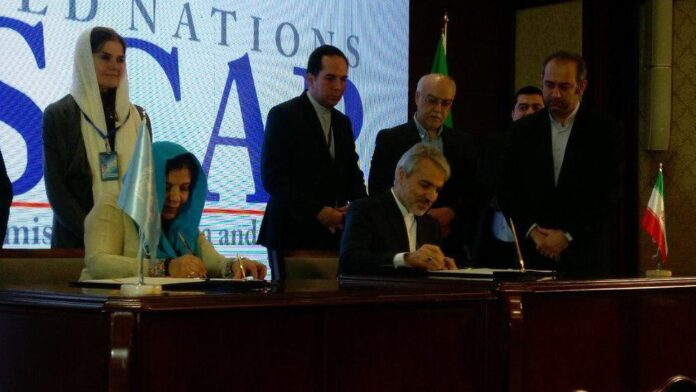
The Memorandum of Understanding was signed between the Head of Iran’s Planning and Budget Organization Mohammad-Baqer Nobakht and UN Under-Secretary General Shamshad Akhtar on Tuesday.

The APDIM is affiliated with the United Nations Economic and Social Commission for Asia and the Pacific known as ESCAP.

According to a Farsi report by Khabar Online, the centre which is going to be established in Tehran is tasked with providing ESCAP member states with information on disasters, especially quakes.

According to Nobakht, who is also a vice-president and the government’s spokesman, Iran has allocated a $3.3-million fund to the APDIM.

During the 2nd Session of the Governing Council of APDIM, Nobakht said that the country is ready to share its experience in the field of natural disasters with other countries and use such opportunities to promote national and international ideas.

He went on to say that Asia and Pacific is the world’s most dangerous region in terms of natural calamity.

40 representatives of the United Nations Economic and Social Commission for Asia and the Pacific (ESCAP) participated in the event.

The Economic and Social Commission for Asia and the Pacific (UNESCAP or ESCAP), located in the United Nations Building in in Bangkok, Thailand, is one of the five regional commissions of the United Nations Economic and Social Council, under the administrative direction of the United Nations headquarters. It was established in 1947 to encourage economic cooperation among its member states. ESCAP has 53 member States and nine Associate members, home to more than two-third of the world population. As well as countries in Asia and the Pacific, it includes France, the Netherlands, the United Kingdom and the United States.

ESCAP’s regional focus is managing globalization through programs in environmentally sustainable development, trade, and human rights.

One of the main environmental issues in Iran has been sandstorms which are said to originate in Iraq and Saudi Arabia, but a combination of events recently have brought Iran’s southern Khuzestan province to the brink of virtual collapse.

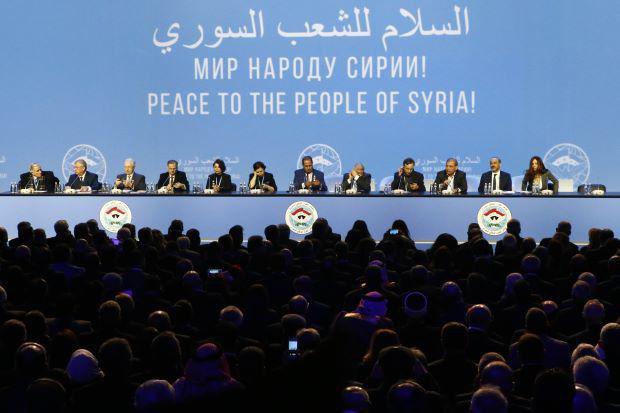
Sochi Congress Participants Agree on Drafting New Syria Constitution (+Video)

Syrian National Dialogue Congress wrapped up in Russia's Sochi / Photo retrieved from Reuters News Agency

The final statement endorsed the country’s territorial integrity and called for self-determination through “democratic” elections.

The statement further called for the maintenance of Syria’s security forces, but insisted they must “operate within the law.”

The members of the committee represented different Syrian groups, parties, and ethnicities.

At the end of the congress, participants also reached important agreements on the main principles for resolving the Syrian crisis in a three-hour meeting without the presence of political parties from other countries.

Russia hosted the Syrian National Dialogue Congress in the Black Sea resort of Sochi with the primary aim of establishing a mechanism for drafting a new Syrian constitution.

The talks were boycotted by the leadership of the Syrian opposition, while the United States, Britain, and France declined to attend because of what they said was Assad’s refusal to properly engage.

About 1,600 delegates representing organizations approved by the Syrian government had taken part in the conference.

Russia’s Foreign Minister Sergei Lavrov said in this Congress that the Russian-sponsored conference on reaching peace in Syria agreed to create constitutional committee which will work in Geneva.

He added that the committee will include those groups that were not attending the peace conference held in Sochi.

What follows is the full text of the statement of the Syrian National Dialogue Congress:

We, the delegates of the Congress of the Syrian national dialogue, representing all segments of Syrian society, its political and civil powers, ethnic, confessional and social groups, have assembled at the invitation of the friendly Russian Federation, in the city of Sochi, with the intention to put an end to seven years suffering of our people, through the achievement of a common understanding of the necessity for the salvation of our homeland from armed confrontation, social and economic ruin, the restoration of its dignity on the regional and world stage, the provision of fundamental rights and liberties for all its citizens, and most importantly, the right to a peaceful and free life without violence and terror. The only way to achieve this particular goal is the political settlement of the problems of our homeland on the basis of the following principles:

1. Respect of and full commitment to the sovereignty, independence, territorial integrity and unity of the [Syrian Arab Republic / state of Syria] as a land and a people. In this regard no part of the national territory shall be ceded. The people of Syria remain committed to the recovery of the occupied Syrian Golan by all lawful means in accordance with the UN Charter and international law;

2. Respect of and full commitment to Syria’s national sovereign equality and rights regarding non- intervention. Syria shall take its full role in the international community and the region, including as part of the Arab world, in conformity with the UN Charter, and its purposes and principles;

3. The Syrian people alone shall determine the future of their country by democratic means, through the ballot box, and shall have the exclusive right to choose their own political, economic and social system without external pressure or interference, in line with Syria’s international rights and obligations;

4. The [Syrian Arab Republic / state of Syria] shall be a democratic and non-sectarian state based on political pluralism and equal citizenship irrespective of religion, ethnicity and gender, with full respect for and protection of the rule of law, the separation of powers,judicial independence, the full equality of all citizens, the cultural diversity of the Syrian society, and public freedoms, including freedom of belief, featuring transparent, inclusive, accountable and answerable governance, including before the national law, with necessary effective measures to combat crime, corruption and mismanagement;

5. A state committed to national unity, social peace, and comprehensive and balanced development with fair representation in local administration;

6. Continuity and improved performance of state and public institutions, with reforms where necessary, including the protection of public infrastructure and property rights and provision of public services to all citizens without discrimination, in accordance with the highest standards of good governance and gender equality. Citizens shall benefit from effective mechanisms in their relations with all public authorities in such a way as to ensure full compliance with the rule of law and human rights and private and public property rights;

7. A strong, unified, meritocratic and national army that carries out its duties in accordance with the constitution and the highest standards. Its functions are to protect the national boundaries and the people from external threats and terrorism, with intelligence and security institutions to maintain national security subject to the rule of law, acting according to the constitution and the law and respecting human rights. The use of force shall be the exclusive prerogative of competent state institutions;

8. Unqualified rejection of – and active commitment to combat – terrorism, fanaticism, extremism and sectarianism in all its forms and to tackle conditions conducive to their spread;

9. Respect and protection of human rights and public freedoms, especially in times of crisis, including non-discrimination and equal rights

and opportunities for all without regard to race, religion, ethnicity, cultural or linguistic identity, gender or any other distinction, with effective mechanism for their protection, which give due regard to the political and equal rights and opportunities of women, including by the taking of active measures to ensure representation and participation in institutions and decision- making structures, with mechanisms aimed to achieve a level of representation of at least 30% for women, and the goal of parity;

10. A high value placed on Syria’s society and national identity, its history of diversity and the contributions and values that all religions, civilizations and traditions have brought to Syria, including the coexistence among its various components, along with the protection of the national cultural heritage of the nation and its diverse cultures;

11. Combatting and eliminating poverty and providing support for the elderly and other vulnerable groups, including persons with special needs, orphans and victims of war, which shall include ensuring the safety and refuge of all displaced persons and refugees, as well as protecting their right to voluntary and safe return to their homes and lands;

12. Preservation and protection of national heritage and the natural environment for future generations in accordance with environmental treaties and the UNESCO declaration concerning the intentional destruction of cultural heritage.

We, the representatives of the proud people of Syria, having lived through terrible misery and having found enough strength to fight against international terrorism, herewith declare our determination to restore the well-being and prosperity of our homeland and to make life decent and comfortable for each and every one of us.

To that end we agreed to form a constitutional committee comprising the Government of the Syrian Arab Republic delegation along with wide-represented opposition delegation for drafting of a constitutional reform as a contribution to the political settlement under the UN auspices in accordance with Security Council Resolution 2254.

The Constitutional Committee would at the very least comprise Government, Opposition representatives in the intra-Syrian talks, Syrian experts, civil society, independents, tribal leaders and women. Care would be taken to ensure adequate representation of Syria`s ethnic and religious components. Final agreement is to be reached in the UN-led Geneva process on the mandate and terms of reference, powers, rules of procedure, and selection criteria for the composition of the Constitutional Committee.

We appeal to the United Nations Secretary-General to assign the Special Envoy for Syria for the assistance of the Constitutional Committee work in Geneva.

Sochi, January 30, 2018

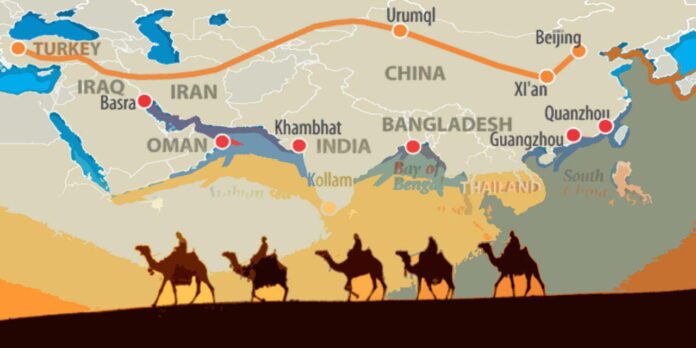
Iran, China to Boost Trade Ties via Silk Road

Silk Road

The head of Iran’s Chamber of Commerce says Iran and China can open a new chapter in mutual economic and trade cooperation by tapping into the potentialities of the Silk Road.

“The tourism industry, investment in transportation projects, energy, telecommunications and other industrial activities are among the areas of cooperation between Iran and China,” said Gholam-Hossein Shafei as quoted by the Persian-language Khabar Online website.

He said the Silk Road has been revived thanks to China’s efforts, and added 67 countries have joined the Silk Road International Chamber of Commerce so far.

“Iran is the vice-chair of the chamber,” he noted.

“Economic analysts have predicted that the world’s economic hub will centre on the China-India border after 2025, and one of the areas of trade transactions, until then, will be the Silk Road. Till that time, China, Iran and India can start new cooperation,” he said.

Shafei further said Tehran and Beijing are to work together in the field of halal food, as well.

He also pointed to the status of Iranians’ bank accounts in China, “Based on the latest news that we’ve heard, the problem of the freezing of [Iranian] natural and real persons’ bank accounts in China has been solved.”

He also underscored that Chinese companies can use the capacity of production units in Iran to produce brand-name products.

Iran, along with China and India as well as other countries, have set in motion plans to revive the old Silk Road to boost economic and trade cooperation.

China, for its part, has proposed the Silk Road Economic Belt plan also known as the One Belt and One Road Initiative, which is a development strategy that focuses on connectivity and cooperation between Eurasian countries.

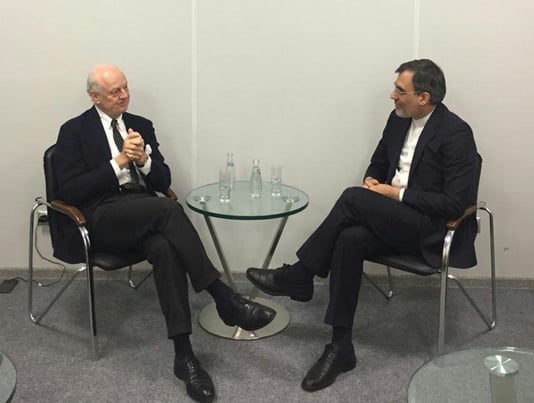
Iran’s Jaberi Ansari, UN’s De Mistura Discuss Syria Peace

During the Tuesday meeting, which was held on the sidelines of the Syrian National Dialogue Congress, the two sides emphasized the need for continuing consultations and cooperation to end the Syrian crisis.

They also reviewed the process of the Syrian National Dialogue Congress held in Sochi, as well as the actions and plans of the UN envoy for Syria.

The Syrian National Dialogue Congress kicked off in the Russian Black Sea resort of Sochi on Tuesday. The opening of the Congress was delayed as a group of armed opposition members arriving from Turkey had set preconditions for their participation.

Political delegations from Iran, Russia and Turkey, as the three countries which initiated the negotiations, as well as a UN delegation led by de Mistura attended the talks.

A number of documents, including a final declaration on the principles of resolving the Syria crisis, may be adopted at the Congress. Besides, permanent committees, including the one on the constitutional reform, may be established.

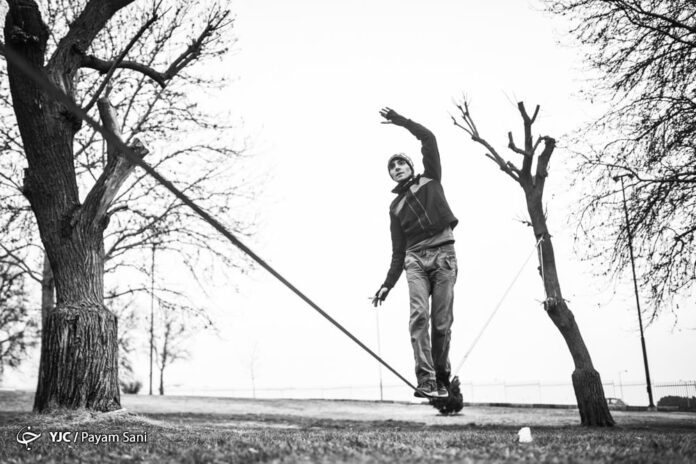
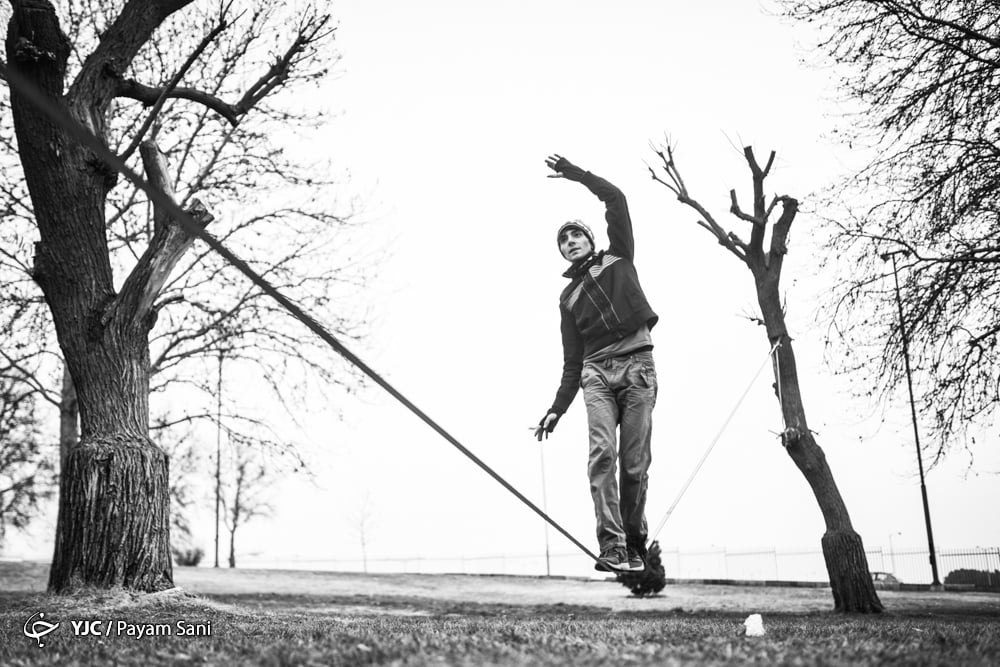
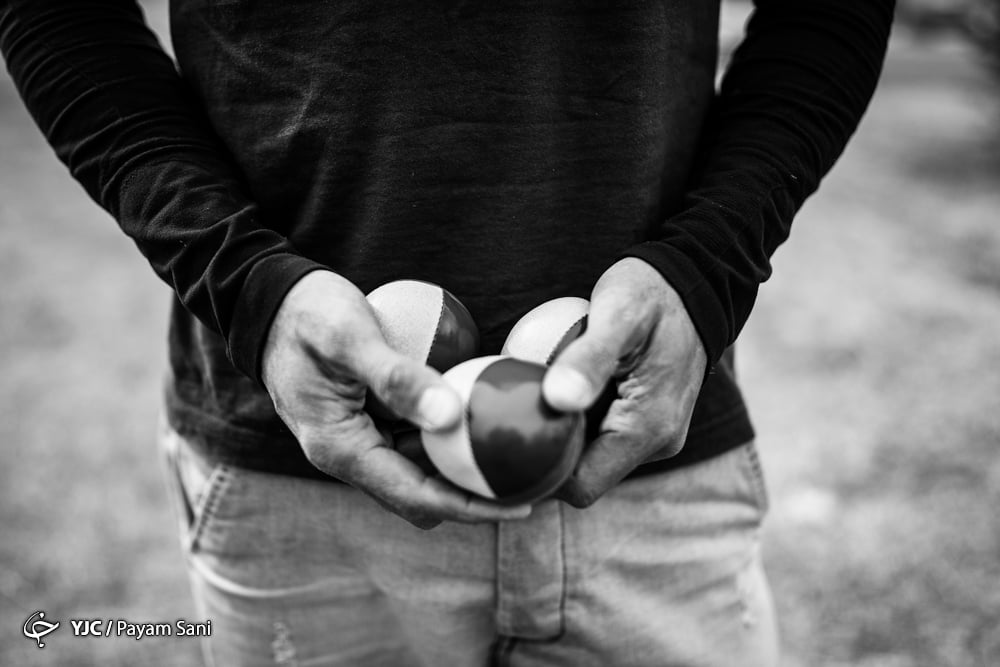
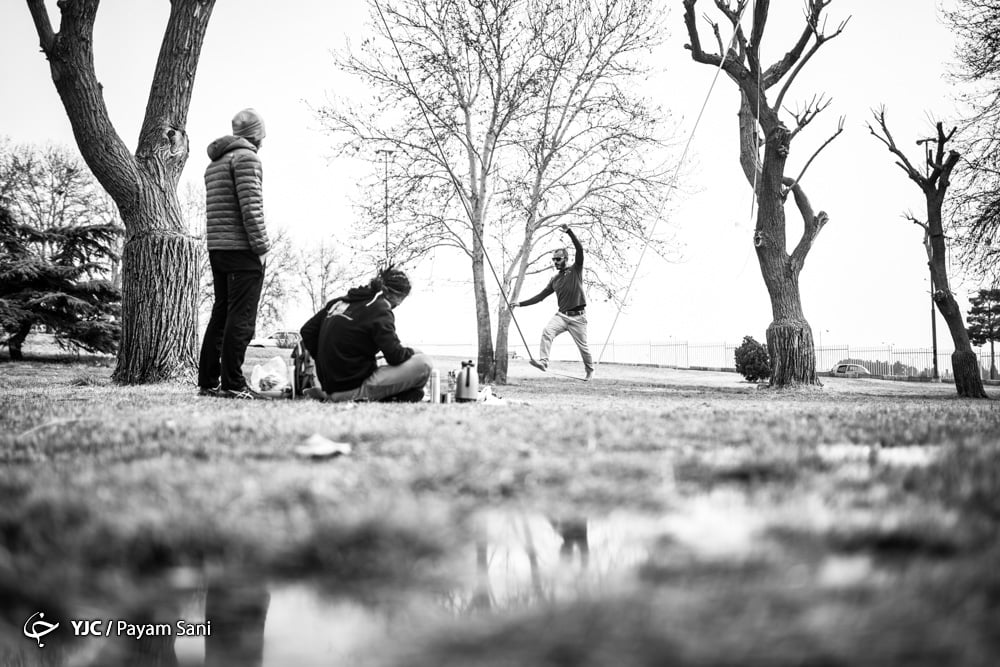
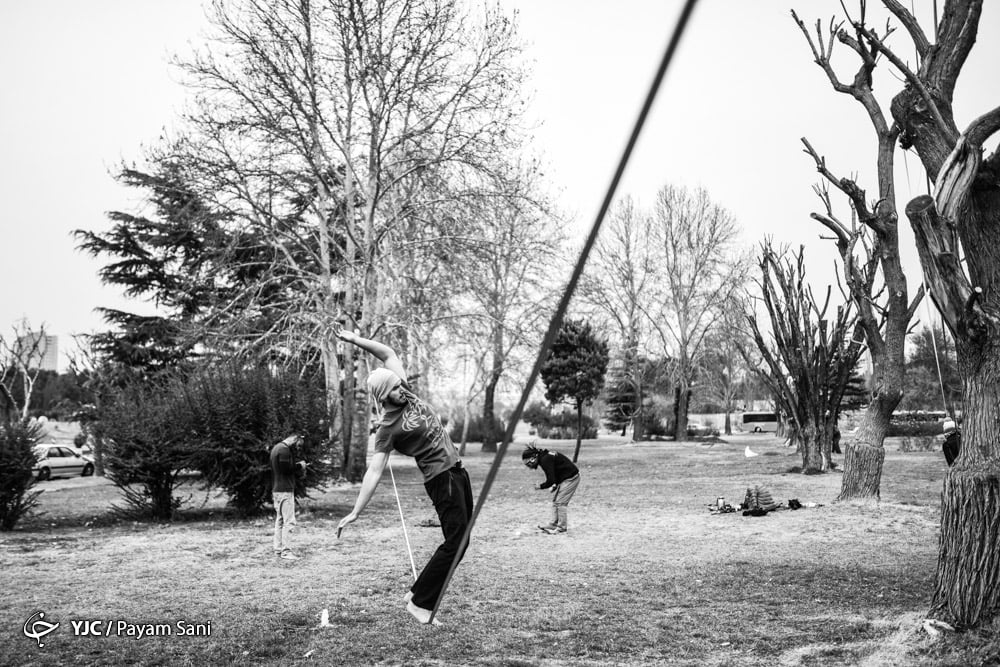
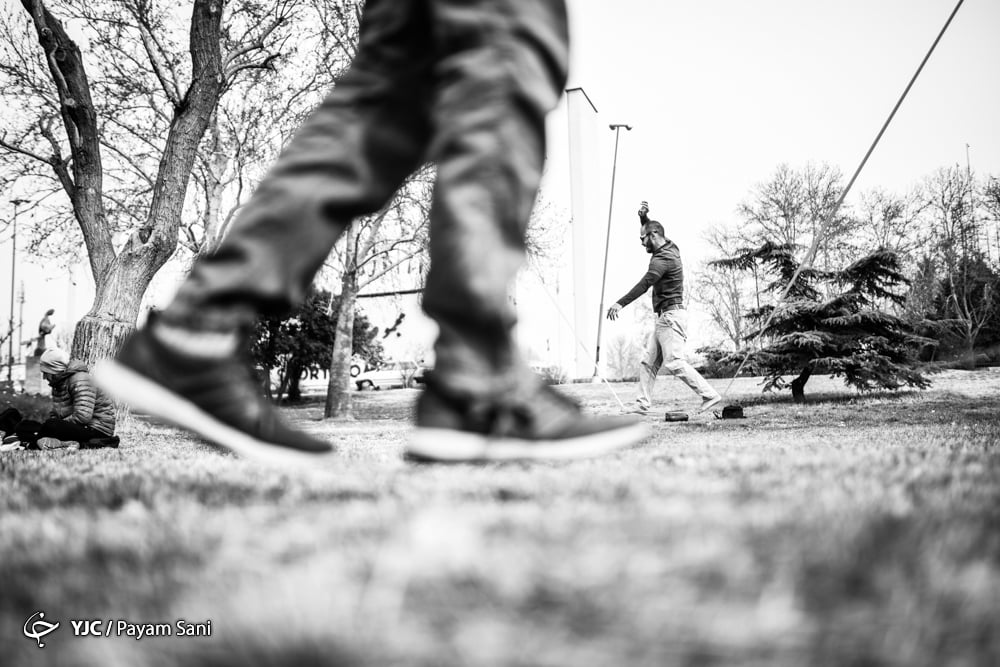
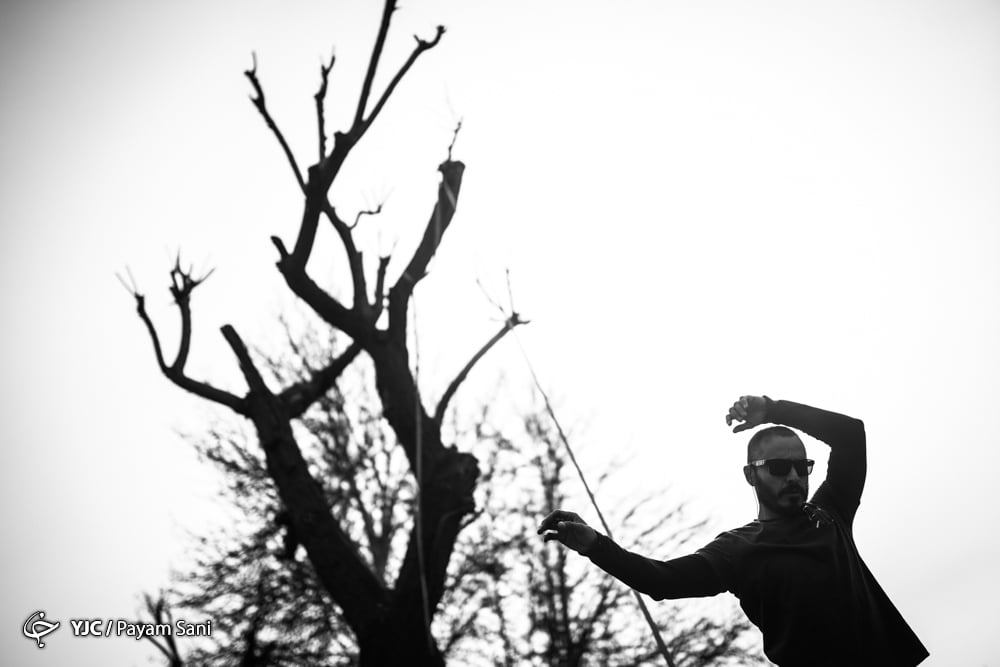
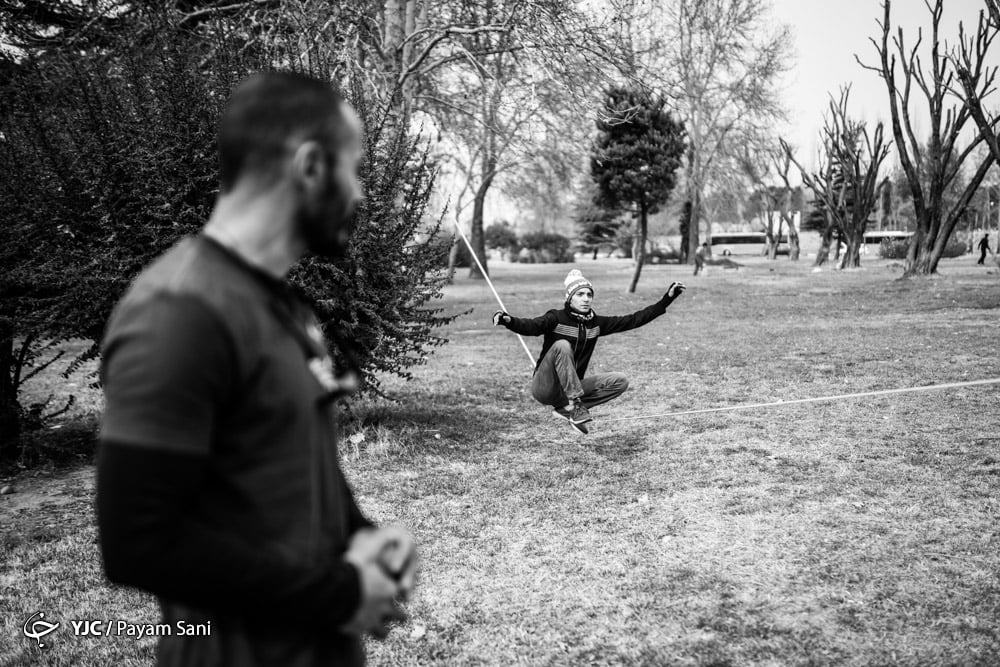
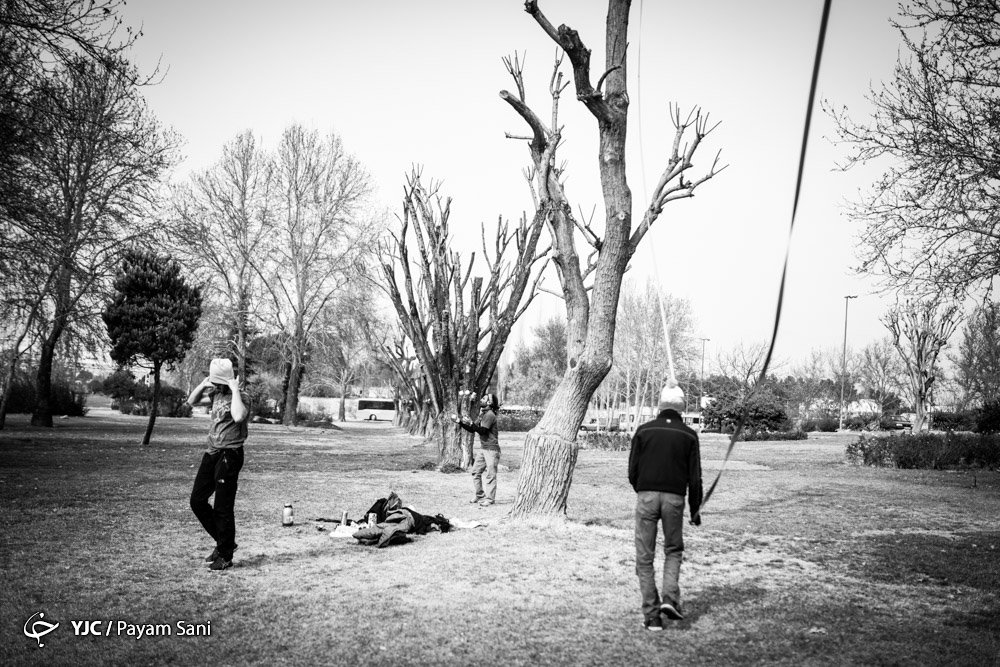
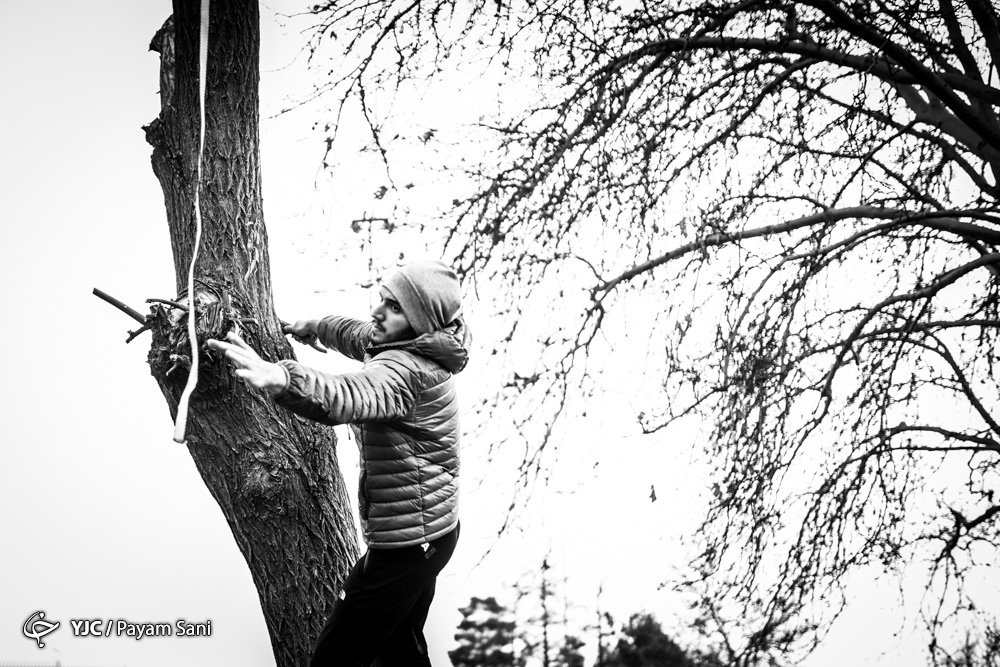
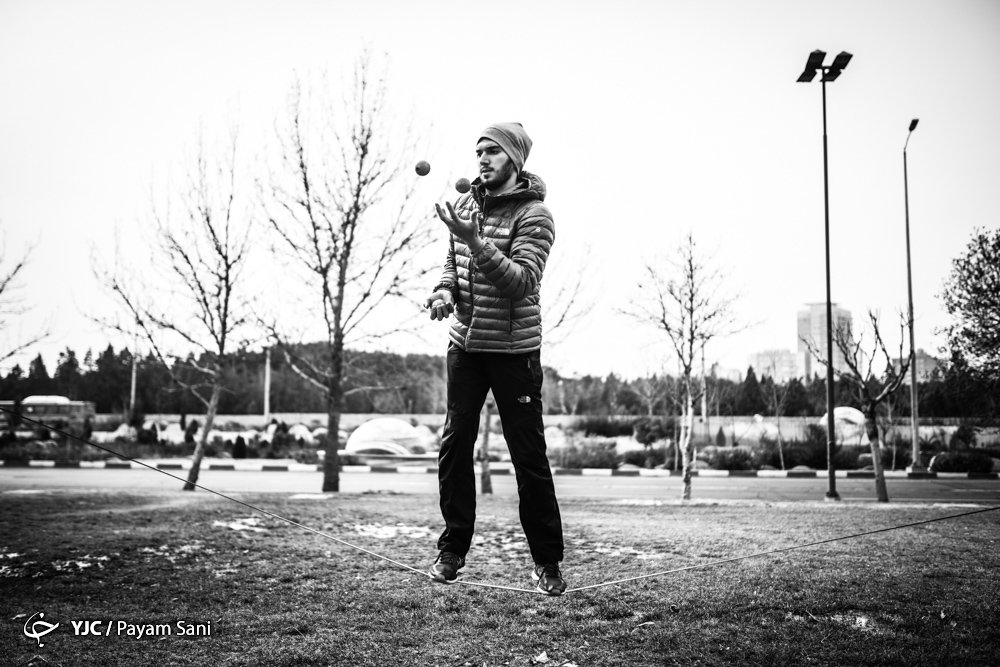
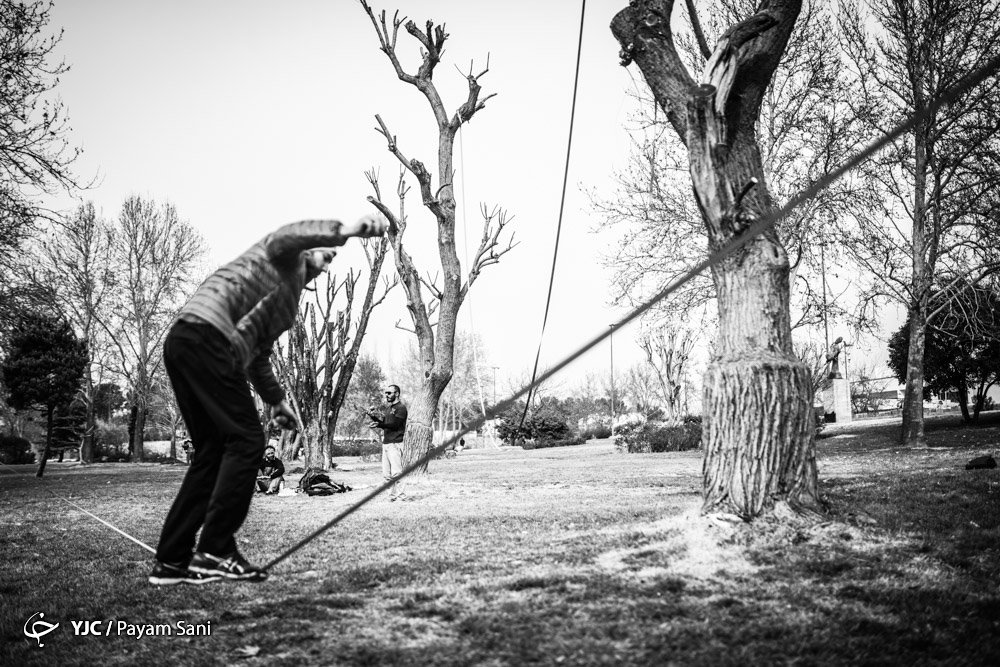
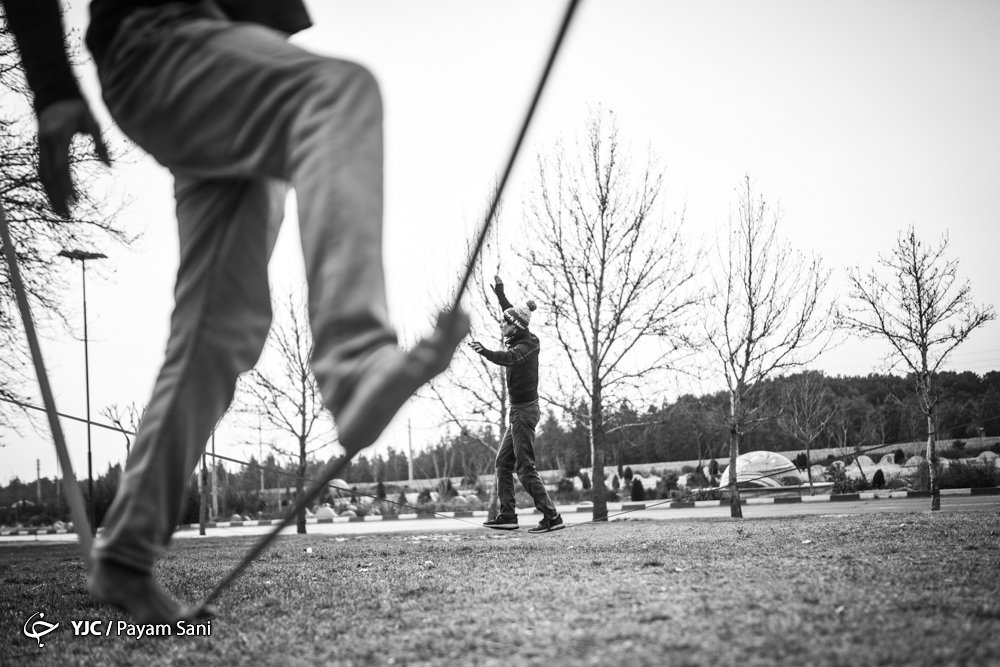
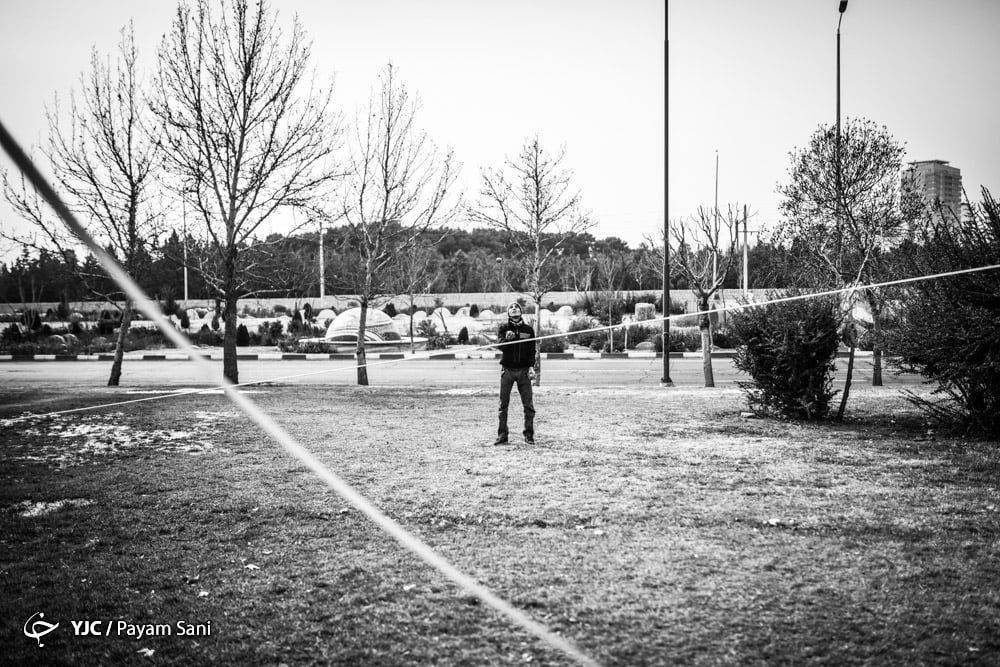
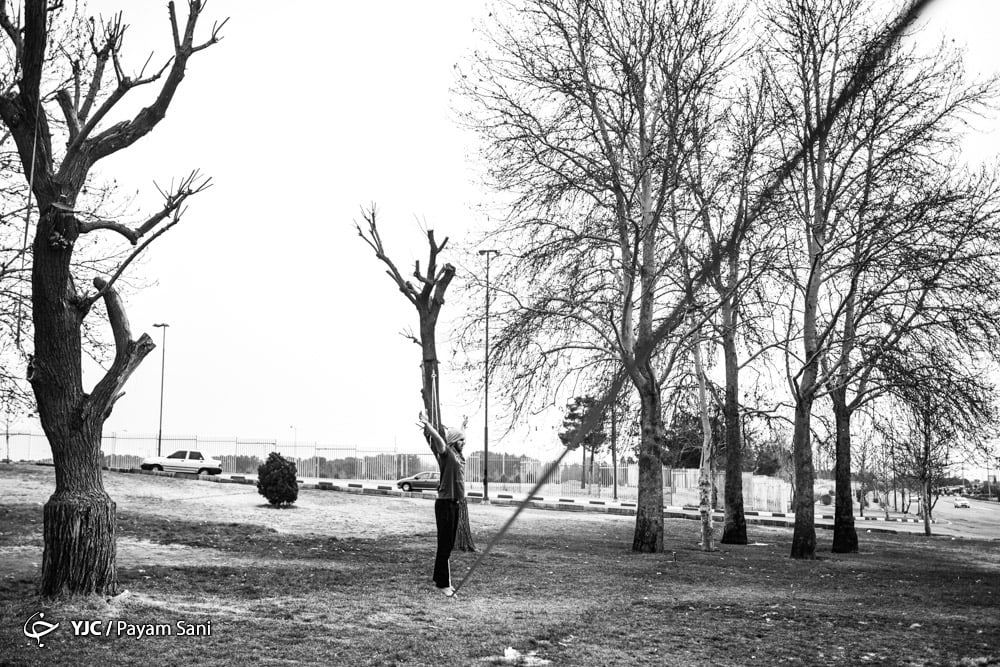
Slacklining Turning into Popular Sport in Iran

Slacklining is similar to slack rope walking and tightrope walking. Slacklines differ from tightwires and tightropes in the type of material used and the amount of tension applied during use.

Slacklines are tensioned significantly less than tightropes or tightwires in order to create a dynamic line which will stretch and bounce like a long and narrow trampoline. Slacklining is popular because of its simplicity and versatility; it can be used in various environments with few components.

Less than a decade ago, this sport entered Iran, and the Iranian youths have set two world records in slacklining while still not being supported by any of the sports federations.

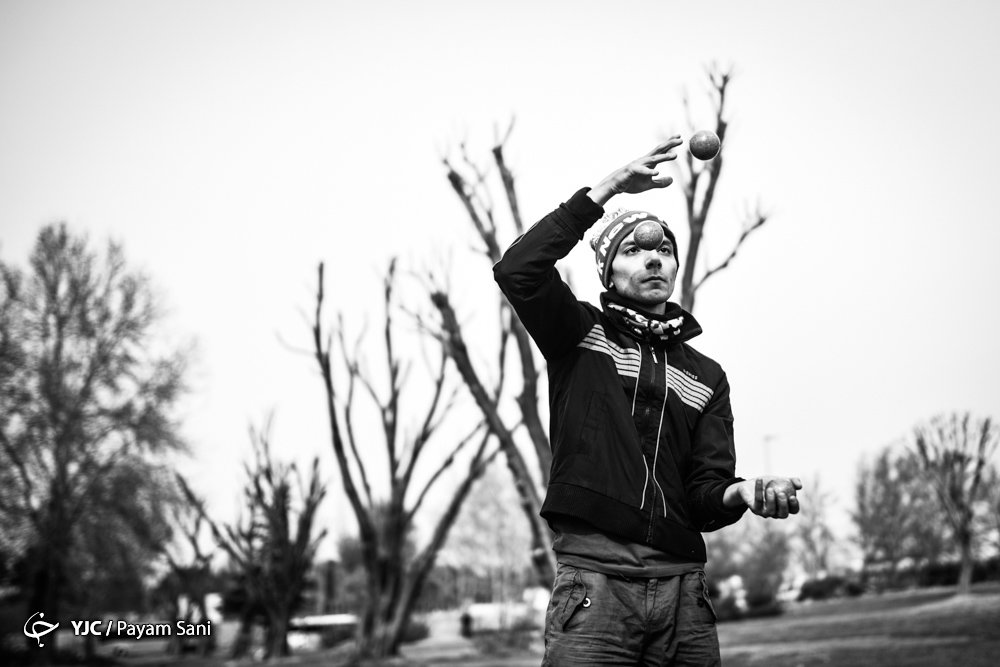
Following you can find the Young Journalists Club’s photos of the sport in Iran:

Life Expectancy in Iran Sharply Increased in Past 4 Decades

Speaking to reporters on Monday, Harirchi said before the Islamic Revolution in 1979, life expectancy in Iran was 54 years and the figure was even lower in the 1960s standing between 45 and 50 years.

“Today, I proudly announce that our life expectancy is relatively high mainly due to the improvement in the country’s economic and social infrastructure as well as measures adopted by the Iranian governments in the health section since the victory of Revolution,” he added.

According to a Farsi report by Sepid newspaper, the spokesman noted that “an interesting point about the figure is that the ideal figure of life expectancy in the world is 65 years.”

He added this means that Iranians enjoy a relatively longer lifetime compared with many other nations in the world. “In another word, our people can put more time into the development and progress of our country.”

Harirchi said life expectancy is highly important in make decisions on people’s retirement age and leisure time.

Elsewhere in his remarks, the spokesman said over the past decades, Iran ranked between 100 and 110 in terms of life expectancy but the grade has now promoted to 63.

He said one of the most significant goals of health section is decreasing premature deaths, adding till recent years, Iran defined any death under 50 as a premature death.

“Before the 1990s, over 80 percent of deaths in Iran occurred under 70 and only from 10 to 20 percent of the Iranians lived more than 70 years.”

“But today with the economic, social and health progresses made in Iran, 51 percent of women and 43 percent of men live more than 70 years.”

Harirchi also said out of the 360,000 people who died in Iran in 2016, 219,000 were men and 141,000 were women.

“Meanwhile, 193,000 deaths or about 53 percent of the whole deaths in Iran took place under the age of 70 with 124,000 deaths for men and 69,000 for women under 70. This means that we should do our best to decrease premature deaths before 70.”

Life expectancy is a statistical measure of the average time an organism is expected to live, based on the year of their birth, their current age and other demographic factors including gender.