Friday, December 26, 2025
Home Blog Page 3544

US’ Support for MKO Cult Shows American Lives Don’t Matter

US’ Support for MKO Cult Shows American Lives Don’t Matter
Iranian human rights activist and lawyer Emadeddin Baqi

The comments were made by Emadeddin Baqi, a senior human rights activist, lawyer, prisoners’ rights advocate, investigative journalist, theologian and writer, who has authored over a dozen books.

Baqi, who has spent several years in jail as a political prisoner, was awarded the Civil Courage Prize in 2004. The following year he won a human rights award from the French government, and in 2009, won the Martin Ennals Award for Human Rights Defenders.

In a recent article, he has weighed in on the activities of the terrorist Mujahedin-e Khalq Organization (MKO), including the thousands of terrorist attacks it has committed against Iranians as well as its collusion with the US and the former Iraqi strongman Saddam Hussein.

In his analytical piece, the rights activist says the MKO’s pipe dream of assuming power in Iran is an insult to Iranians’ intelligence, and that the US’ support for the cult is surprising given the dark record of MKO terrorists.

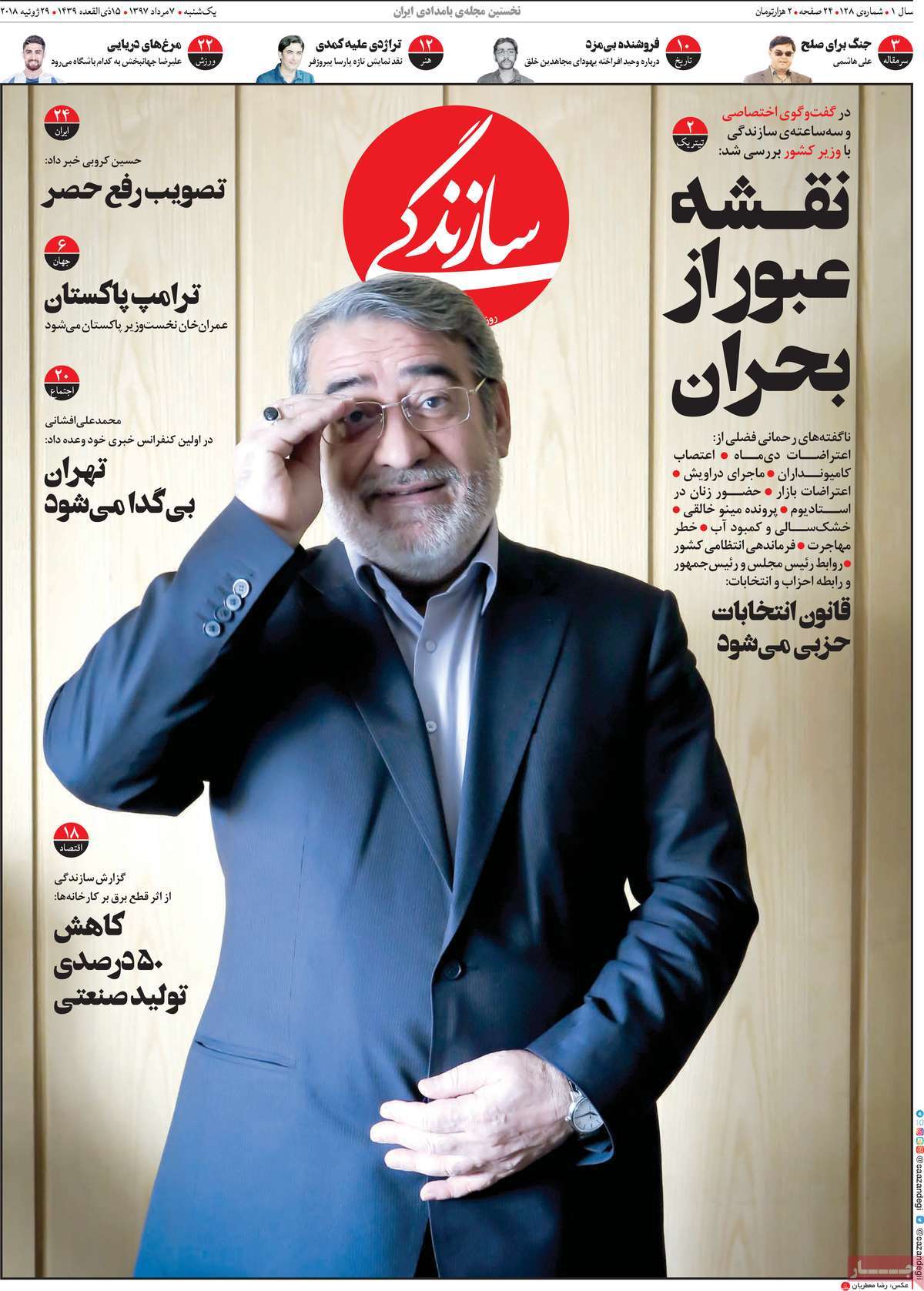
“Reports that the MKO terrorist group led by Maryam Rajavi held a meeting in the French capital, Paris, where US officials were also present, have drawn the ire of independent, patriotic and freedom-seeking people in Iran, who consider it an insult to see a terrorist group, which has a stained track record and functions as the pawn of a foreign power, entertains the idea of assuming power,” he noted in a recent piece published in Sazandegi newspaper.

“I, as a human rights activist, regard as a crime against humanity the group leader’s call for rebellion, which means fueling violence and chaos in Iran and giving rise to a situation like the one in Syria,” Baqi added.

He says the Iranian nation will never resort to a terrorist group even if they do not approve of the performance of the ruling system in their country.

“Even if we are fed up with the current ruling system, we will not turn to the worst option available. The MKO is a group which had set up a tiny rule in Camp Ashraf in Iraq, and 500 out of its 3000 members in a garrison were imprisoned. The Human Rights Watch, as an internationally recognized rights institution, conducted a field study and published a damning report on the situation in Camp Ashraf. The report reveals torture, sexual repression, breach of the freedom of expression and violation of human dignity,” he writes.

“It was unbelievable to find out that there exists such a horrendous ruling system where, as in North Korea, only their own radio and TV programs promoting their ideology and activities were allowed. All other media were forbidden. Every morning began with a ceremony where the same song in praise of Rajavi was recited. Now, they are going to develop the same model elsewhere? They and the Americans apparently do not believe in the intelligence and intellectual development of Iranians, who have weathered such models and styles. In fact, by promoting the MKO cult, they are insulting Iranians’ intelligence and dignity,” he further explains.

The human rights activist also touches upon the history of the MKO’s terrorist activities against Iranians. The group assassinated several Iranian officials and figures, and was working with the former Iraqi regime against Iran as well. The history of the MKO’s cooperation with the Iraqi Ba’th Party goes back to long before the victory of the Islamic Revolution in 1979. Two arrested members of the MKO, namely Ahmadreza Karimi and Fazel al-Bastam, had an interview with the former Pahlavi regime of Iran in 1973 in which they confessed that al-Bastam had been spying for the Ba’ath regime.

“Back in 1981, the MKO got involved in armed activities and acts of terror, preparing the ground for the violence-seeking current within the system to gain power. That entangled us in a cycle of violence for 30 years and set back Iran’s development. The MKO was working hand in glove with the former Iraqi dictator Saddam Hussein, who launched a war against Iran in the 1980s. After helping Saddam Hussein’s army during the war, the MKO has now joined Trump and Israel while being funded with Saudi money and is ratcheting up its anti-Iran rhetoric at the Paris meeting,” says the rights activist.

He also says the MKO has not officially apologized to the US for assassinating its authorities, but is working with them closely.

US’ Support for MKO Cult Shows American Lives Don’t MatterBaqi was referring to two separate operations in 1973 and 1975, in which MKO operatives assassinated several senior US officials and nationals in Tehran. In the 1975 operation, two top American military officials, Jack Turner and Air Force Colonel Paul Shaffer, were assassinated. Their briefcase, which contained invaluable information, fell into the hands of the MKO, which handed it over to the KGB, the main security agency for the Soviet Union.

“Surprising enough, the MKO has not yet officially apologized for the assassination of US officials and former Pahlavi regime’s authorities before the 1979 Islamic Revolution, as well as the assassinations following the revolution,” Baqi noted, while being surprised how senior American officials are still attending the MKO’s annual gatherings despite such a background.

“Moreover, the Americans launched a military invasion of Iraq and toppled Saddam Hussein, but now they have entered into an alliance with one of his allies. Now, how can one believe the claims about the human rights situation in Iran put forward by Trump’s Neanderthal team?” says the rights activist.

He says the MKO is a despicable terrorist group which violates human rights and has committed crimes against humanity anywhere and under any rule.

“I, as a person who has had the honour to receive several domestic and international human rights awards [from dissenters], hereby announce that I have defended the rights of prisoners regardless of their tendencies (even if they are MKO members) to the best of my ability whenever inmates’ rights have been trampled underfoot. I believe some of them are noble people who [were misled and] got integrated into this group and missed their chances. However, I regard the MKO as a group which is against human rights, as our defence for the rights of criminals does not mean we are approving of their crimes,” says Baqi.

He says Iranians definitely are against the MKO and do not approve of its actions, whatsoever.

“Everyone should know that Rajavi, due to his disgraceful track record, has no social base in Iran. He only cashes in on propaganda ploys and uses his skill in triggering controversies and brainwashing people to lure them and maybe he can deceive some naïve people, but the Iranian society will not fall for old tricks.”

In his article, Baqi has also criticised the performance of Iranian security forces during the post-election unrest in Iran in 2009. He says the Iranian government tried to create the impression that the widespread public protests in that year were a plot hatched by the MKO. In fact, the government’s move seemed to be well-intended; it wanted to keep the Iranian nation from falling into the trap of the terrorist group. Nevertheless, the terror group took advantage of the situation and aggrandized itself before foreign powers. The MKO tried to create the impression that it has the necessary potential to replace the Islamic establishment and rule the country.

Baqi says the MKO is one of the most hated opposition entities in the eyes of Iranian people, and a very small cult that is not capable of triggering such massive and widespread protests in Iran. He says the Iranian security forces and state media made a mistake in 2009 by attributing the unrest to the terrorist cult.

Package Proposed by EU to Salvage JCPOA Seems Practical: Zarif

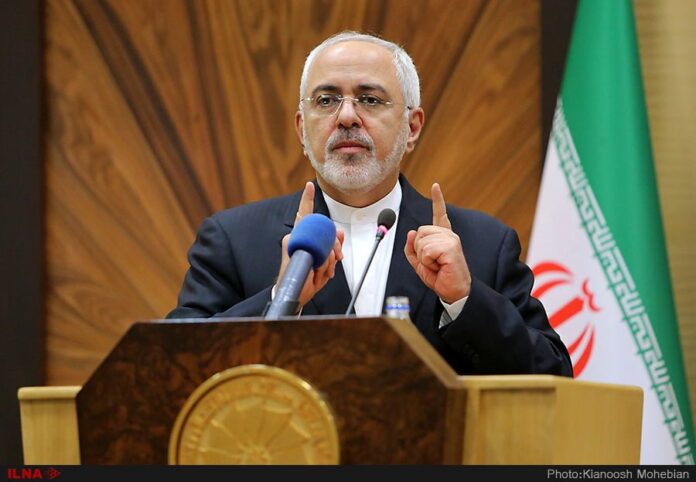
Speaking in Vienna on Friday evening, Zarif briefed reporters on the topics discussed in the ministerial meeting of the joint commission of the Joint Comprehensive Plan of Action.

Hailing the “serious and constructive” negotiations, Zarif said a final statement from the JCPOA joint commission, read out by EU Foreign Policy Chief Federica Mogherini at the conclusion of the talks, should come with “practical measures.”

“What matters now is that what has been mentioned as commitments and actions, which have not been necessarily made public in full, must be put into practice so that we could see its benefits,” Zarif noted.

As regards the EU efforts to update its “Blocking Statute” in order to protect European companies from US sanctions, Zarif said such exemptions must become operational before the implementation of the US sanctions against Iran.

Reiterating Iran’s commitment to the nuclear deal, Zarif added, “Under the JCPOA, we are allowed to take our own measures in response to the US breach if the country’s interests are not met.”

He also noted that the proposed plans for saving the JCPOAS will be relayed to Tehran, so that the senior authorities will make decisions on the issue.

“My conclusion was that all JCPOA parties indicated commitment in the meeting… to the political will to stand against such American move (to withdraw from the deal),” Zarif noted, saying he thinks the operational methods proposed in the Friday meeting seem to be “practical”.

On May 8, the US president pulled his country out of the JCPOA, which was achieved in 2015 after years of negotiations among Iran and the Group 5+1 (Russia, China, the US, Britain, France and Germany).

Following the US exit, Iran and the remaining parties launched talks to save the accord.

Meanwhile, Leader of the Islamic Revolution Ayatollah Seyed Ali Khamenei has underlined that any decision to keep the JCPOA running without the US should be conditional on “practical guarantees” from the Europeans.

World Powers Reaffirm Commitment to Continuation of Iran’s Oil Exports

A Friday meeting among senior diplomats from Iran, Russia, China, Britain, France, Germany and the European Union, held in Vienna to discuss the ways to save the Iran nuclear deal, came to an end with a statement from the JCPOA joint commission.

The high-profile meeting in the Austrian capital involved delegations from the remaining parties to the Joint Comprehensive Plan of Action and a team from the European Union, led by EU Foreign Policy Chief Federica Mogherini, who read out a communiqué after conclusion of the talks.

The full text of the statement which was read to the reporters at the end of the meeting by Mogherini is as follows: 

  1. ​Upon the request of the Islamic Republic of Iran, a meeting of the Joint Commission of the Joint Comprehensive Plan of Action (JCPOA) was held on 6 July in Vienna at ministerial level. The Joint Commission met to discuss the way forward to ensure the continued implementation of the nuclear deal in all its aspects and review unresolved issues arising from the unilateral withdrawal of the United States from the agreement and the announced re-imposition of sanctions lifted under the JCPOA and its Annex II, which they deeply regret. 
    2.​ The Joint Commission is responsible for overseeing the implementation of the JCPOA. 
    3.​ The Joint Commission was chaired by EU High Representative Federica Mogherini and was attended by Foreign Minister and State Councillor of the People’s Republic of China Wang Yi, Minister of Europe and Foreign Affairs of the French Republic Jean-Yves Le Drian, Minister of Foreign Affairs of the Federal Republic of Germany Heiko Maas, Minister of Foreign Affairs of the Russian Federation Sergey Lavrov, Minister of State for the Middle East at the Foreign and Commonwealth Office of the United Kingdom Alistair Burt, as well as Minister of Foreign Affairs of the Islamic Republic of Iran Mohammad Javad Zarif.
    4.​The participants in the JCPOA reconfirmed their commitment to the full and effective implementation of the nuclear deal. They recalled that the JCPOA is a key element of the global non-proliferation architecture and a significant achievement of multilateral diplomacy endorsed unanimously by the UN Security Council through Resolution 2231. The participants welcomed the 11th report by the International Atomic Energy Agency of 24 May confirming that Iran is abiding by its nuclear-related commitments.
    5.​ All participants reiterated the need to continue the full and effective implementation of all nuclear related commitments. They welcomed steady progress made on the modernisation of the Arak research reactor and took note with satisfaction that the United Kingdom will take over the function of co-chair of the Arak Working Group. Participants will continue to support the modernisation of the Arak research reactor as part of the JCPOA and the conversion of the Fordow facility in a nuclear, physics and technology centre. Participants also welcomed the significant projects in the area of civil nuclear co-operation carried out on the basis of Annex III of the JCPOA.
    6. ​The participants recognised that, in return for the implementation by Iran of its nuclear-related commitments, the lifting of sanctions, including the economic dividends arising from it, constitutes an essential part of the JCPOA. They also noted that economic operators pursuing legitimate business with Iran have been acting in good faith based on the commitments contained in the JCPOA and endorsed at the highest level by the UN Security Council. 
    7.​ The participants discussed their recent efforts aimed at providing practical solutions in order to maintain the normalisation of trade and economic relations with Iran. They welcomed the extensive work undertaken to-date, the intensification of technical dialogues and the mobilisation of considerable resources by all. 
    8.​ The participants affirmed their commitment regarding the following objectives in good faith and in a constructive atmosphere:
    – the maintenance and promotion of wider economic and sectoral relations with Iran;
    – the preservation and maintenance of effective financial channels with Iran;
    – the continuation of Iran’s export of oil and gas condensate, petroleum products and petrochemicals;
    – the continuation of sea (including shipping and insurance), land, air and rail transportation relations;
    – the promotion of export credit cover;
    – clear and effective support for economic operators trading with Iran, particularly small and medium sized enterprises which are the backbone of many economies;
    – the encouragement of further investments in Iran;
    – the protection of economic operators for their investment and other commercial and financial activities in or in relation to Iran;
    – the bringing together of private and public sector experts, including through the promotion of Business Councils;
    – the practical support for trade with and investment in Iran;
    – the protection of companies from the extraterritorial effects of US sanctions. 
    The participants noted that the EU is in the process of updating the EU “Blocking Statute” in order to protect EU Member States’ companies and of updating the European Investment Bank’s external lending mandate to cover Iran.
    The participants will work on the above issues through direct bilateral efforts and through engagement with international partners in order to encourage them to follow the same policies and to establish similar mechanisms in their economic relations with Iran.
    9. ​The participants recalled that these initiatives are aimed at preserving the nuclear deal which is in the security interest of all. 
    10. ​Participants agreed to keep progress under close review and to reconvene the Joint Commission, including at Ministerial level, as appropriate in order to advance common efforts. The participants stressed their determination to effectively develop and implement practical solutions concerning the above.


Vienna Hosts First Ministerial Meeting of JCPOA Joint Commission

The meeting kicked off on Friday in the Austrian capital as the first round of talks at the level of foreign ministers after the US’ withdrawal from the Iran nuclear deal.

British Foreign Secretary Boris Johnson is absent from the ministerial meeting in Vienna because of tight meetings on Brexit. UK Minister of State for the Middle East and North Africa Alistair Burt is attending the talks.

Before the beginning of the plenary meeting, Iranian Foreign Minister Mohammad Javaf Zarif held bilateral talks with EU’s Mogherini, Chinese Foreign Minister Wang Yi, and Russian top diplomat Sergei Lavrov.

Zarif, who is accompanied by Deputy Foreign Minister for Political Affairs Seyyed Abbas Araqchi and Vice-President for Legal Affairs Laya Joneidi, arrived in Vienna earlier in the day to attend the key talks aimed at exploring the path of future cooperation between Iran and the EU.

Vienna Hosts First Ministerial Meeting of JCPOA Joint CommissionIn comments before leaving Paris to Vienna on Friday, French Foreign Minister Jean-Yves Le Drian said it was unlikely that European powers would be able to put together an economic package for Iran for saving the JCPOA before November.

Earlier on Thursday, Iran’s President Hassan Rouhani said the country has received a package prepared by Europe to salvage the Iran nuclear deal, but described it as a disappointing proposal which only contained a series of general commitments.

“Unfortunately, there was no clear method or operational solution for the continuation of cooperation, and the package only contained a series of general commitments like in the EU’s previous statements,” said Rouhani in a phone conversation with German Chancellor Angela Merkel.

He said Tehran expected the European states to offer a clear and straightforward package.

The president told Merkel that Iran will continue to work with Europe only if the country is hopeful about the future.

“If the trend of work at the ministerial meeting of European countries in Vienna [on Friday] is promising enough to encourage Iran to continue its cooperation and joint work, we will continue to cooperate with Europe,” said President Rouhani.

IRGC Prepared to Put into Action Rouhani’s Threat on US Oil Bans

The IRGC commander’s remarks came after President Rouhani delivered a stern warning to the US during his recent European tour against any attempt to block Iranian oil exports in the light of its withdrawal in May from the 2015 nuclear deal.

Speaking at a joint press conference with his Swiss counterpart, Alain Berset, in the Swiss capital, Bern, on Tuesday, Rouhani said the US would never be able to carry out such a threat.

Rouhani said it was “incorrect and unwise” to think that “one day all oil producing countries would export their surplus oil and Iran would be the only country that cannot export its oil.”

On Thursday, IRGC Commander Major General Mohammad Ali Jafari hailed the Iranian president’s “decisive” stance against Washington’s threats, expressing hope that the president’s warning would be put into action “if the need arises” and in case the entire Iranian nation and authorities see eye to eye on such an action.

“Definitely, through the  implementation of the latest positions adopted by the country’s executive officials, under contingencies the enemies can be made understand…what the meaning of ‘either all or none can use Hormuz Strait, is'” Jafari emphasized.

The Strait of Hormuz, which sits at the mouth of the Persian Gulf, provides the only maritime passage from the Persian Gulf to the open ocean and is one of the world’s most strategically important choke points.

Through the strategic waterway, a large share of the world’s oil shipments pass. The strait also serves as a key maritime route for shipments of liquefied natural gas.

For countries that import oil or gas, including the US, normal operation of Hormuz is vital.

Rouhani’s warning prompted a reaction from the Pentagon, which pledged to keep the critical waterway open.

Captain Bill Urban, a spokesman for the US military’s Central Command, was quoted by Reuters as saying on Thursday that the American naval forces and their regional allies are prepared to “ensure the freedom of navigation and the free flow of commerce wherever international law allows.”

“The US and its partners provide, and promote security and stability in the region,” he added.

In May, President Donald Trump announced that Washington was leaving the 2015 multilateral nuclear deal, under which sanctions against Iran — particularly its energy sector — were lifted.

Besides the blow it dealt to the landmark nuclear agreement, Washington has been seeking to throw a wrench into efforts by the remaining parties to the deal to save the international pact, which has been endorsed by UN Security Council Resolution 2231.

Washington says it has told countries around the world that they would be hit with financial penalties should they fail to cut their oil imports from Iran to zero when the American bans against Tehran fully come into force on November 4.

State Department Director of Policy Planning Brian Hook said Monday that he planned to meet with European allies Britain, France and Germany at the end of the week to discuss Iran. He also said he and senior Treasury Department officials would visit Persian Gulf states “in the coming days.”

Washington’s goal, he said, is putting pressure on Iran “by reducing to zero its revenue on crude oil sales.”

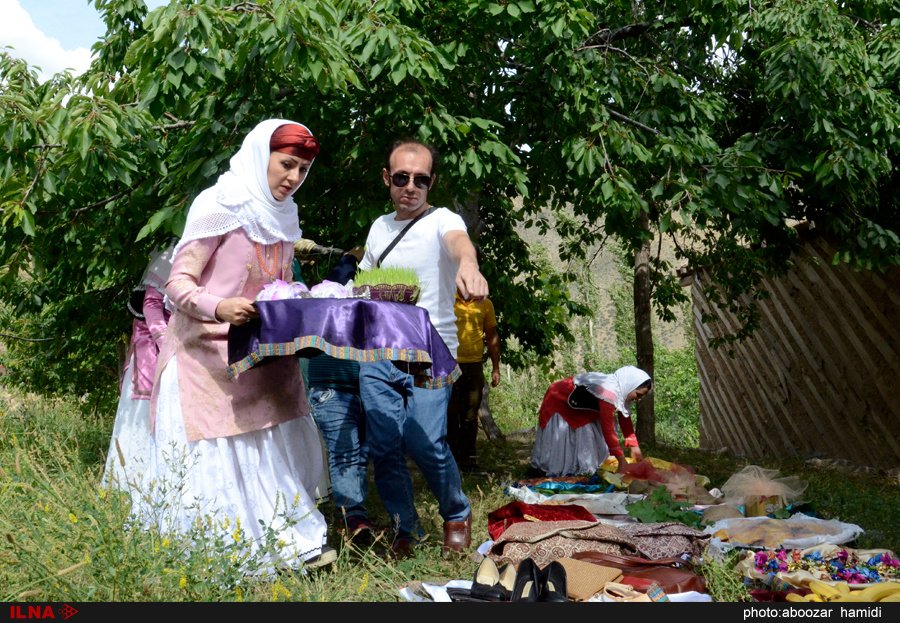
Fandoqloo Forest: Scenic Beauty in Northwestern Iran

Fandoqloo Forest: A Scenic Natural Beauty in Northwestern Iran

Fandoqloo forest is located 10 kilometres from the town of Namin. A large part of the forest in situated in Ardabil province and a small part of it in Gilan province.

Adjacent to Fandoqloo are expansive mayweed fields, which host a mayweed festival every spring.

The warm-water spa, cable cars and a grass ski piste can make your journey more enjoyable and more memorable. The area contains fruit trees such as hazel, wild apples, greengage, raspberries, strawberries, etc.

The forest is named Fandogloo because “Fandoq” means “hazel” and the area contains a lot of hazel trees. Around a quarter of the forest’s surface area is covered with hazel trees.

The forest measures 16,000 hectares in area, stretching all the way between two villages on either side. Fandoqloo is home to 19 species of flora and dozens of species of fauna such as foxes, wolves, the brown bear and otters as well as birds such as pheasants, crows and the golden eagle.

One of the country’s most famous warm-water spas is also located in this forest and is known as Mishe-Dashee or Ali-Dashee by locals. Many tourists do not miss the chance of taking a dip in the spa. Close to the spa lies a small waterfall which can make travellers’ joy complete.

The best season to visit Fandoqloo is spring and summer.

What follows are photos of the forest retrieved from Karnaval.ir:

Iran Says Package Proposed by EU to Save JCPOA Disappointing

Rouhani on Thursday said the package lacks a clear proposal on how to continue cooperation.

“Unfortunately, there was no clear method or operational solution for the continuation of cooperation, and the package only contained a series of general commitments like in the EU’s previous statements,” said Rouhani in a phone conversation with German Chancellor Angela Merkel.

He said Tehran expected the European states to offer a clear and straightforward package.

The president told Merkel that Iran will continue to work with Europe only if the country is hopeful about the future.

“If the trend of work at the ministerial meeting of European countries in Vienna [on Friday] is promising enough to encourage Iran to continue its cooperation and joint work, we will continue to cooperate with Europe,” said President Rouhani.

In the phone talk, President Rouhani touched upon Washington’s unilateral withdrawal from the JCPOA and the limited time given to Europe to announce its position on the Iran nuclear deal clearly and straightforwardly.

“After the United States’ pullout from the JCPOA, problems emerged in economic, banking relations and oil domains, which made companies investing in Iran doubtful about whether or not to continue their operations in the country,” he said, urging Europe to settle these issues.

Merkel, in turn, underlined that the package focuses on general and fundamental issues, and that negotiations should continue on the details.

She said what matters is that the European countries are determined to stay in the JCPOA and believe the talks should come to fruition in a calm atmosphere.

Also in a phone conversation with his French counterpart Emmanuel Macron, the Iranian president called on the five countries which are parties to the talks to make up for Washington’s pull-out from the JCPOA.

He described as positive France’s efforts over the past months to help preserve the JCPOA, but at the same time noted that Iran will continue its cooperation regarding the JCPOA only if its demands are met.

“Europe’s proposed package regarding the continuation of the trend of cooperation over the JCPOA does not meet all of our demands, and we hope the trend of talks between the ministers of the five countries tomorrow in Vienna will be able to fulfill Iran’s demands in order to continue cooperation over the JCPOA,” he said.

He further referred to the problems that Washington’s unilateral withdrawal from the JCPOA has created for certain European companies involved in Iranian projects.

“We expect Europe to offer a clear operational program with a specific timeframe in order to be able to compensate for the US pullout form the Iran nuclear deal,” he said.

The French president, in turn, said his country is set to remain committed to its obligations under the JCPA, and underlined the necessity of making attempts to continue cooperation and talks between the two sides.

Macron said Europe will keep making efforts to preserve the JCPOA.

“The meeting of foreign ministers of the five countries in Vienna can strike a balance between political and economic issues in order to continue the trend of cooperation,” he added.

Rouhani’s comments came as it was earlier reported the EU package would be offered to Iran during the Friday talks in Vienna.

A source had even said the package was not supposed to be opened before Iran’s top negotiator Mohammad Javad Zarif returns to Tehran. But it seems the EU has offered the package to Rouhani during his stay in Vienna.

‘Sultan of Gold Coins’ Arrested in Tehran

The man known as the ‘Sultan of Gold Coins” in Iran was detained in Tehran Monday night after being watched closely by police forces for at least three to four months.

“The man did whatever he wished in the gold market by manipulating the price of gold coins,” said Tehran Police Chief Brigadier General Hossein Rahimi in a press conference on Wednesday, a report by Fars News Agency said.

According to documents obtained by the Tehran police, the 58-year-old man purchased the gold coins in a period of ten months to hoard them, he noted.

“His agents began to purchase all gold coins in the market regardless of its price so that he could take all the market’s gold coins at his own hand. This enabled him to set the price of gold coins in the market,” he noted.

Elsewhere in his remarks, the Tehran Police Chief also said at least two other men have been arrested in northern Iran over hoarding a large amount of gold coins and jewelry.

“We confiscated at least 20 kg of gold coins and jewelry in their hideouts in a city north of Iran,” he noted.

He then added that a six-member band involved in publishing counterfeit dollar has been dismantled. According to the general, the band members were arrested about two weeks ago after a lengthy undercover operation.

“The police forces have confiscated about $160,000 in their hideout. Formed about two months ago, the band had distributed some of their counterfeit dollars in the currency market,” he noted.

General Rahimi also referred to the violation of law by some firms which received US dollars from the government at the exchange rate of 42000 Iranian rials, saying the police are making investigation into the violations and will deal with them seriously without any considerations.
According to the Tehran Police Chief, police have stepped into the fray to restore stability to the currency market since six months ago.

“Over the past months, police forces have conducted several operations to deal with violators in the currency market,” he added.

General Rahimi said 35 firms received US dollars from the government at the exchange rate of IRR 42000 to import cellphone, tablet and computer hardware.

“A sum of $220 million had been allocated to the firms but investigations show that all of the firms have committed violations.”

He added the firms also received 86 million euros, 41 million yuans and 18 million UAE dirhams at the official rate.

According to the Iranian police official, more than 12 police teams along with delegations from the related organizations including the Central Bank of Iran and Ministry of Industry, Mine and Trade are involved in the investigations into the violations committed by the firm.

He noted that the firms imported an overall 400,000 cell phones from four leading brands in the world.

“Unfortunately, the firms sold 300,000 of the imported cellphones at an unofficial rate but the police have managed to confiscate the remaining cellphones,” he noted.

The general also said during the recent operations, police forces also confiscated a large number of hoarded laptops and tablets and other computer hardware.
According to Rahimi, police have arrested a number of money exchangers who received foreign currencies from the government at the official rate but sold them at the free market.

A dramatic rise in the rate of foreign currencies has adversely affected Iranian markets. The fall of the national currency has provoked a public outcry over the quick rise of prices of imported consumer goods.

A crowd of businesspeople in Tehran Bazaar shut down their businesses last week in protest at the price hike.

Iranian President Hassan Rouhani said the exchange rate problems are part of an economic war launched by the US, vowing that the nation will be able to handle the economic plots hatched by Iran’s arch-foe.

US President Donald Trump pulled the country out of the 2015 nuclear deal early March, vowing to impose the “highest level” of economic bans on the Islamic Republic.

Some of the US sanctions against Iran take effect after a 90-day “wind-down” period ending on Aug. 6, and the rest, most notably on the petroleum sector, after a 180-day “wind-down” period ending on Nov. 4.

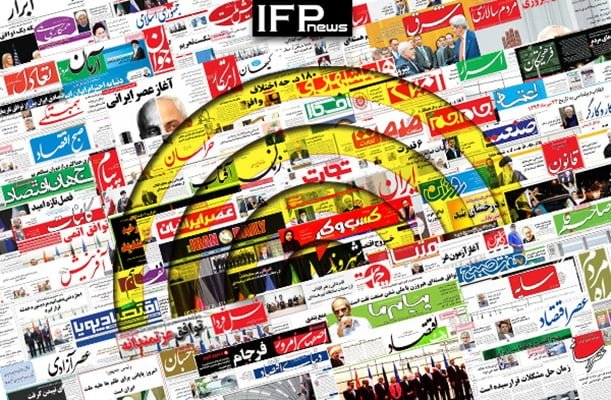
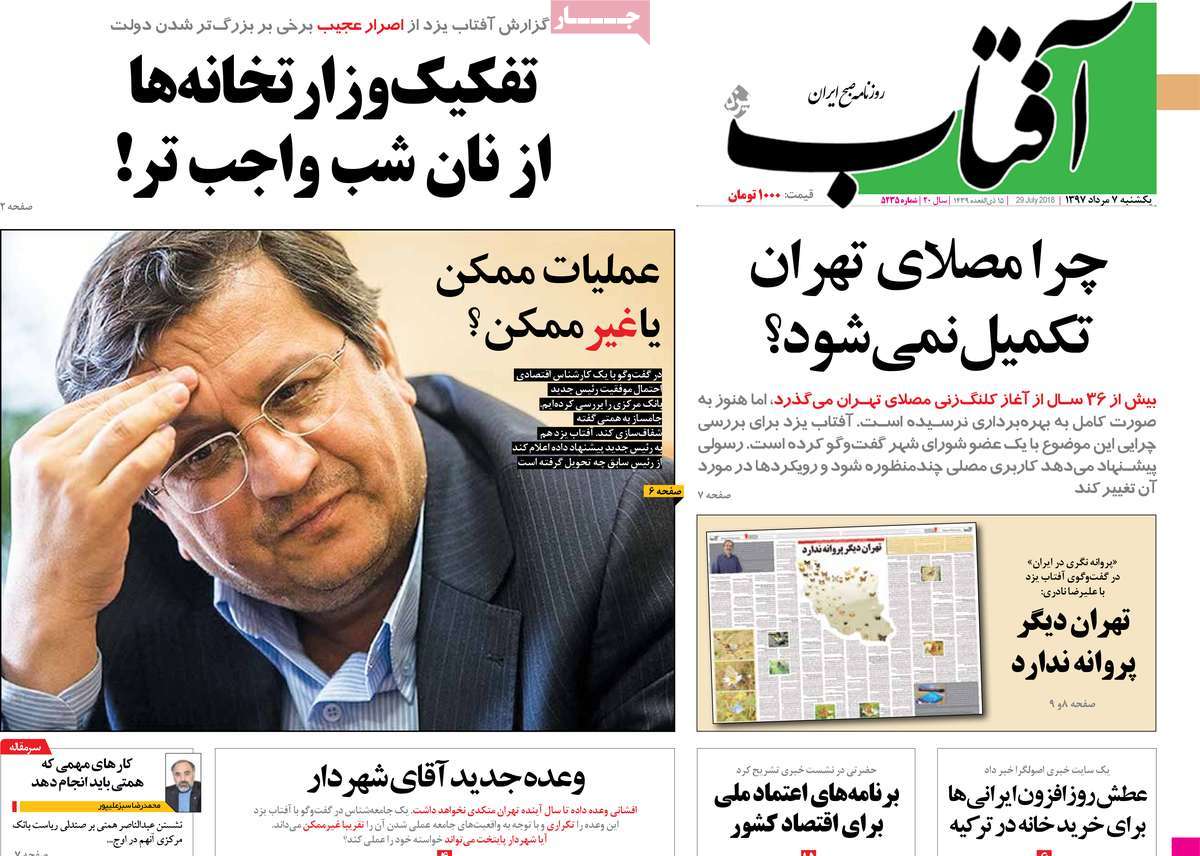
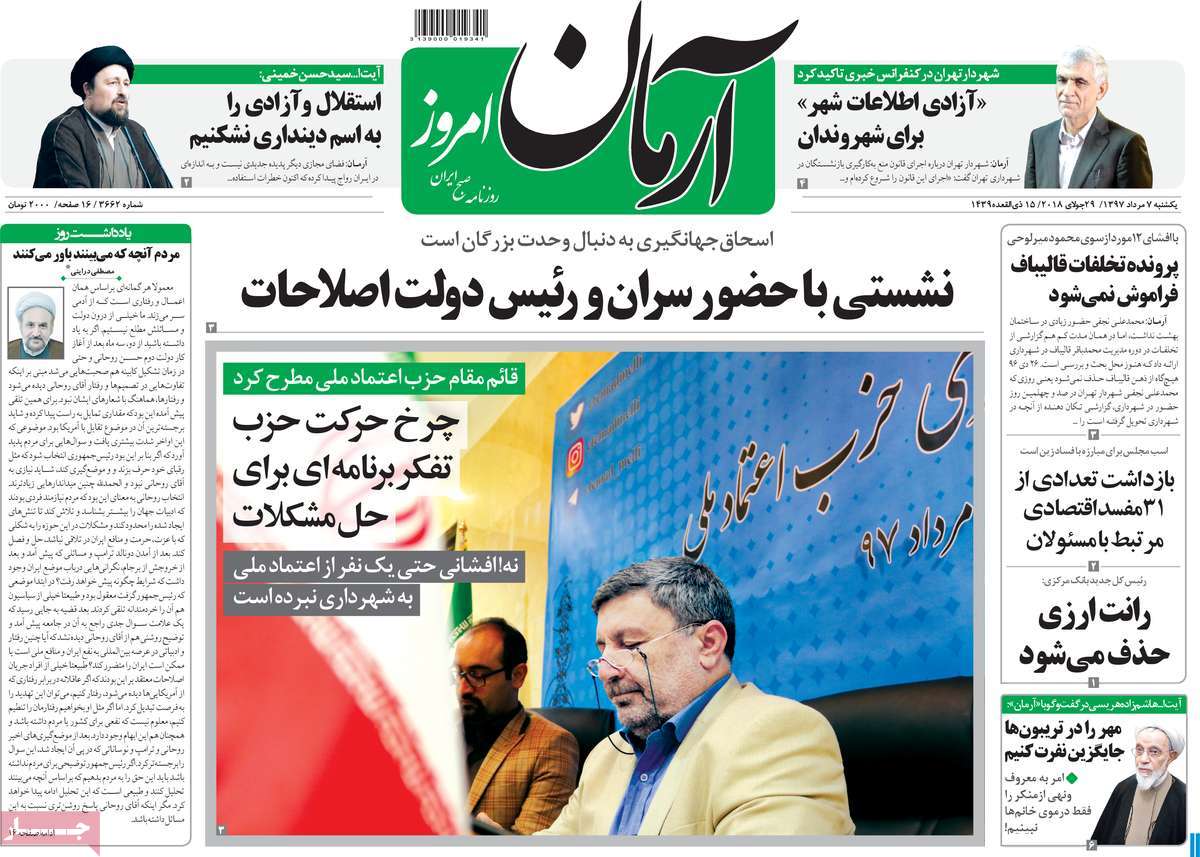
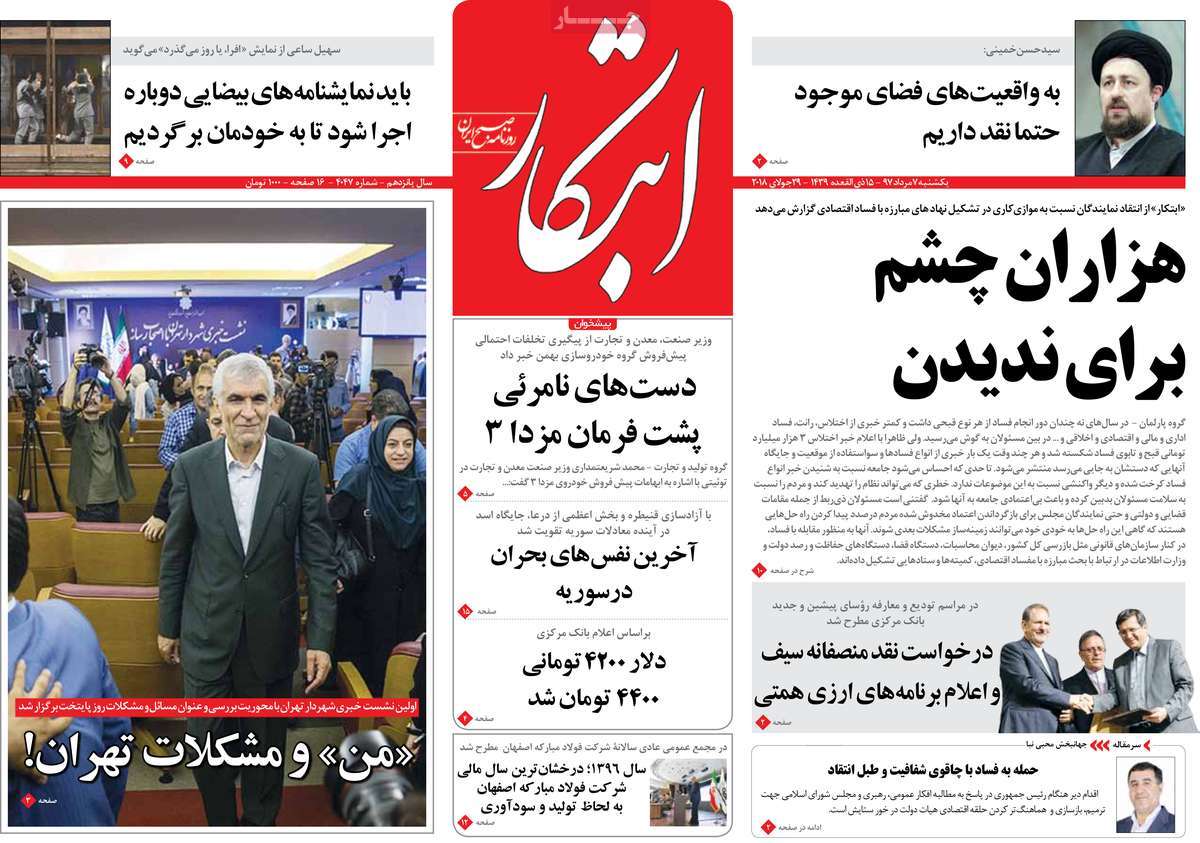
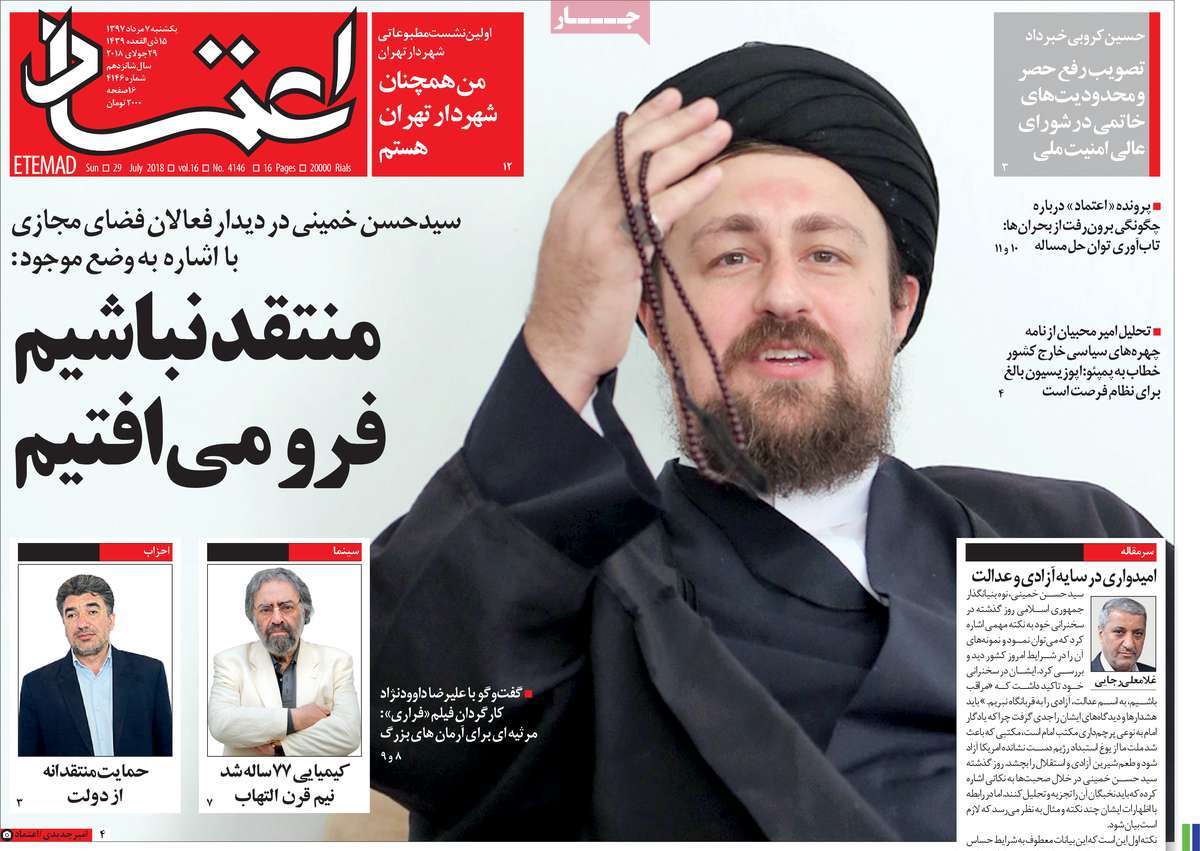
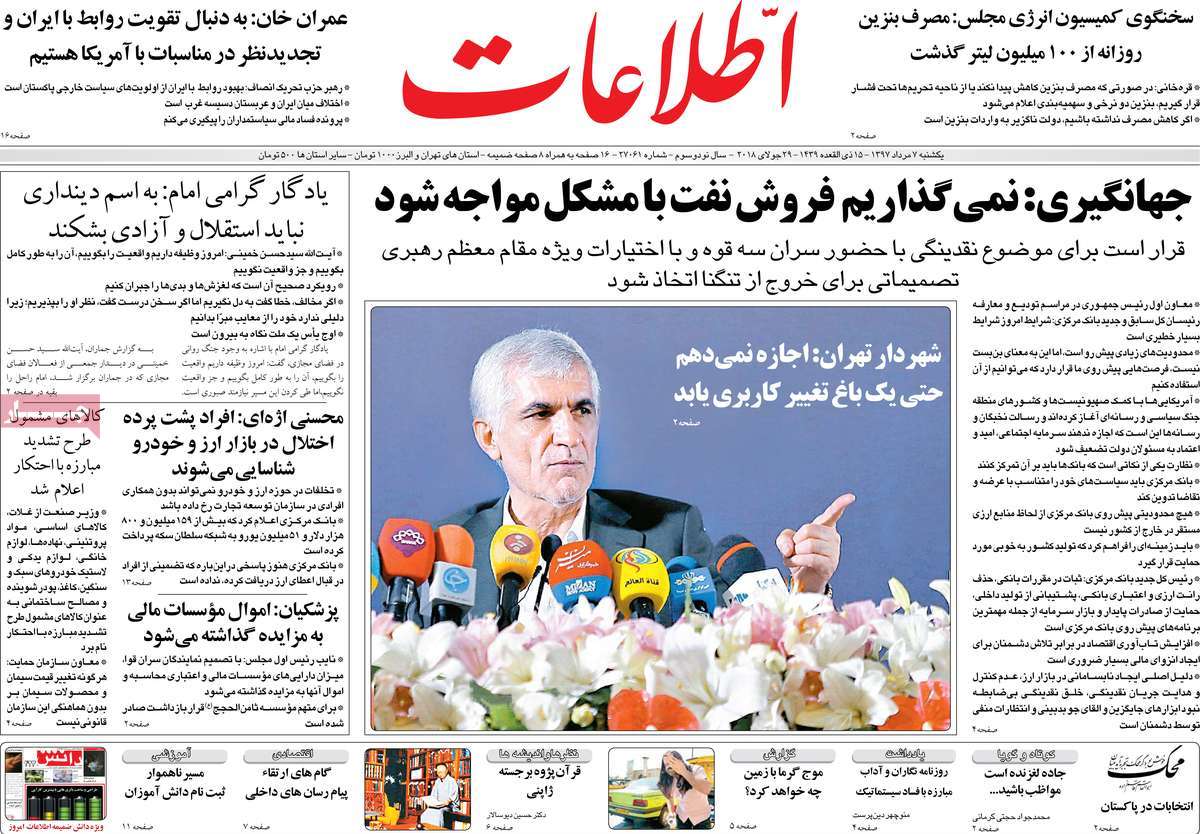
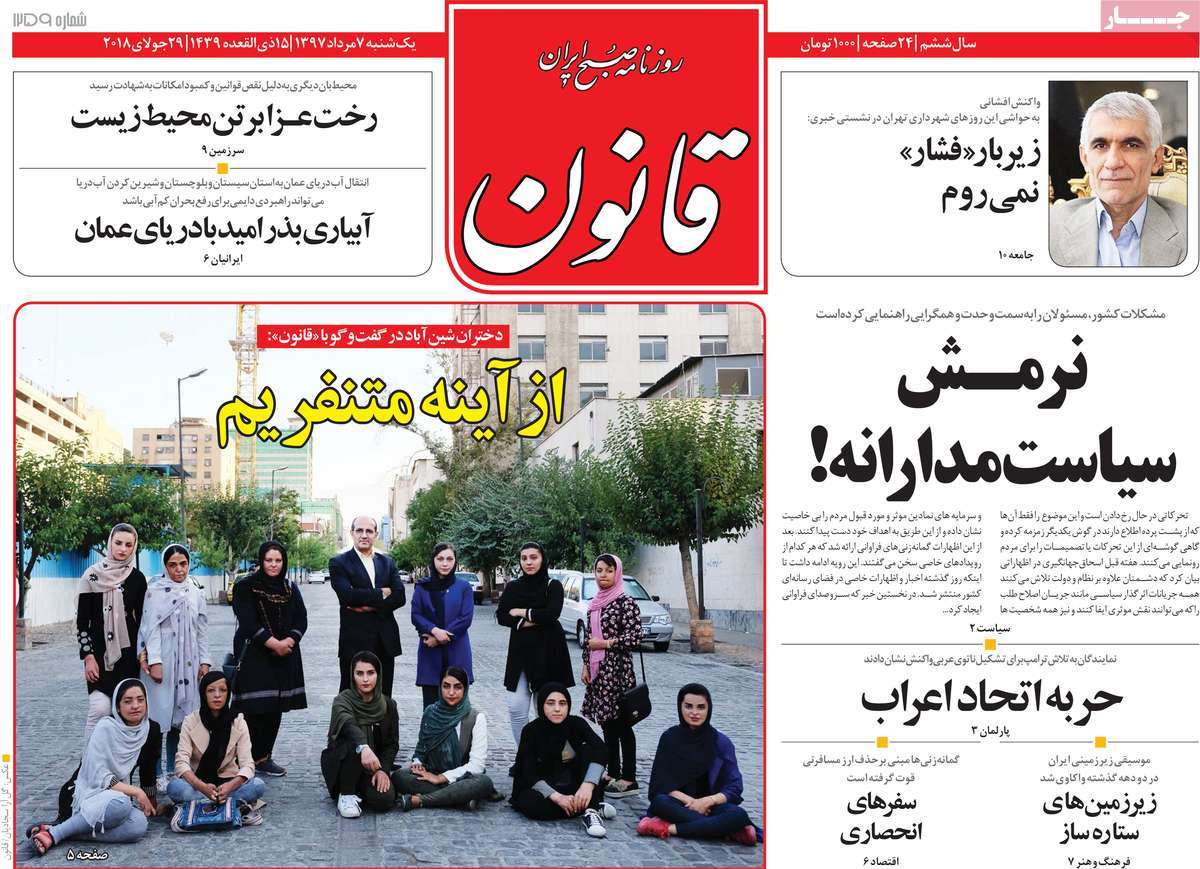
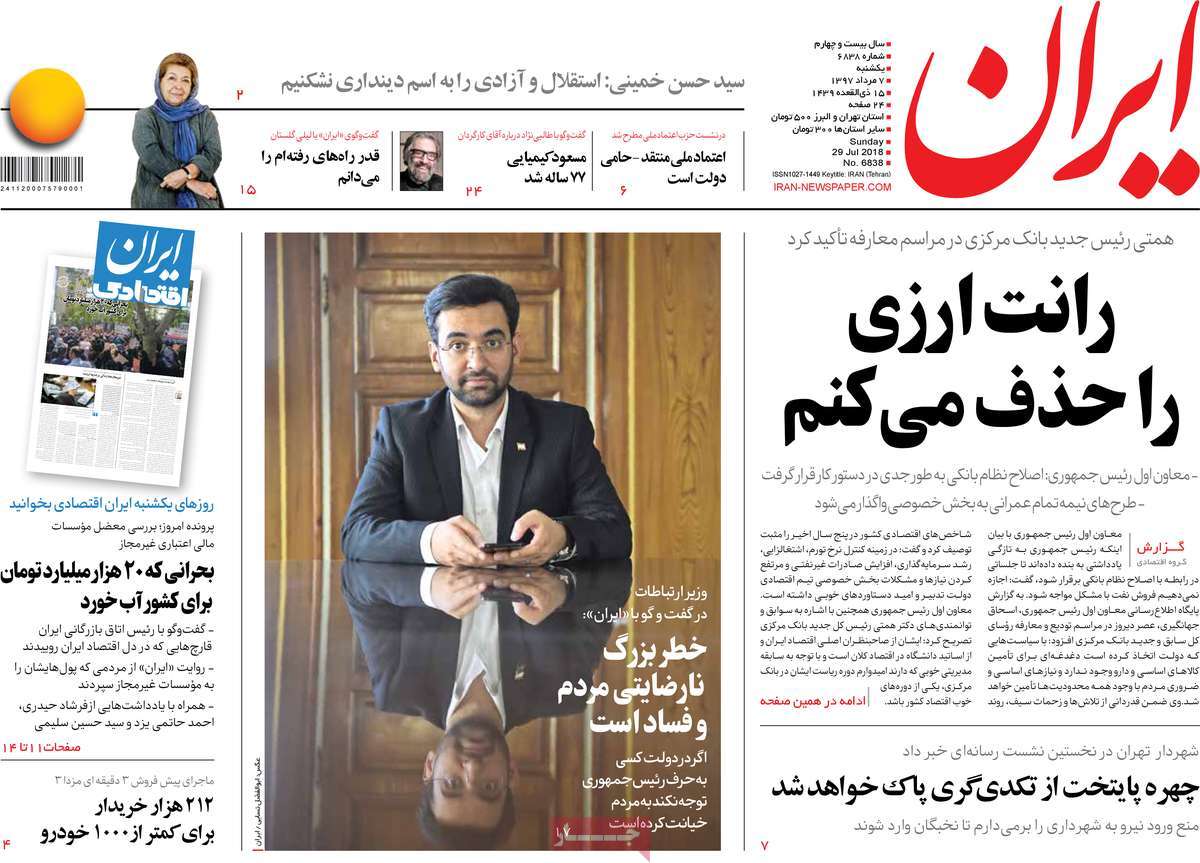
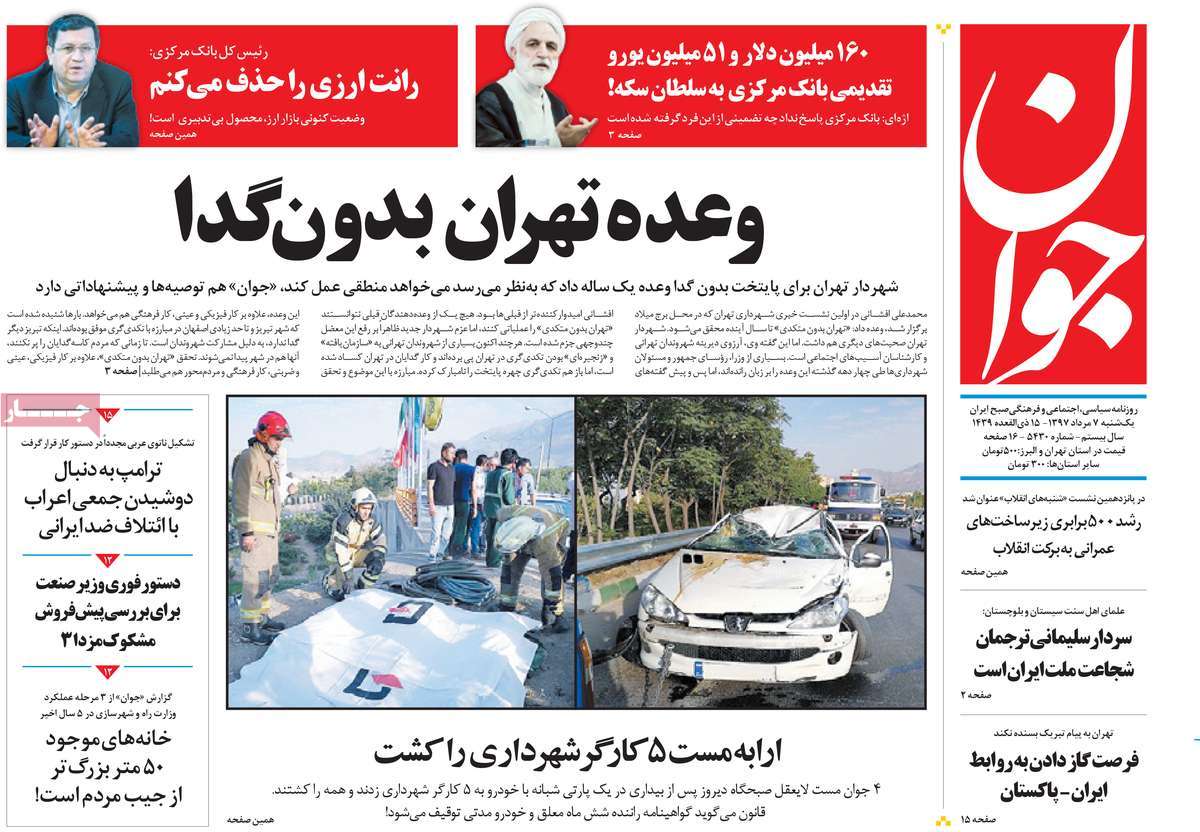
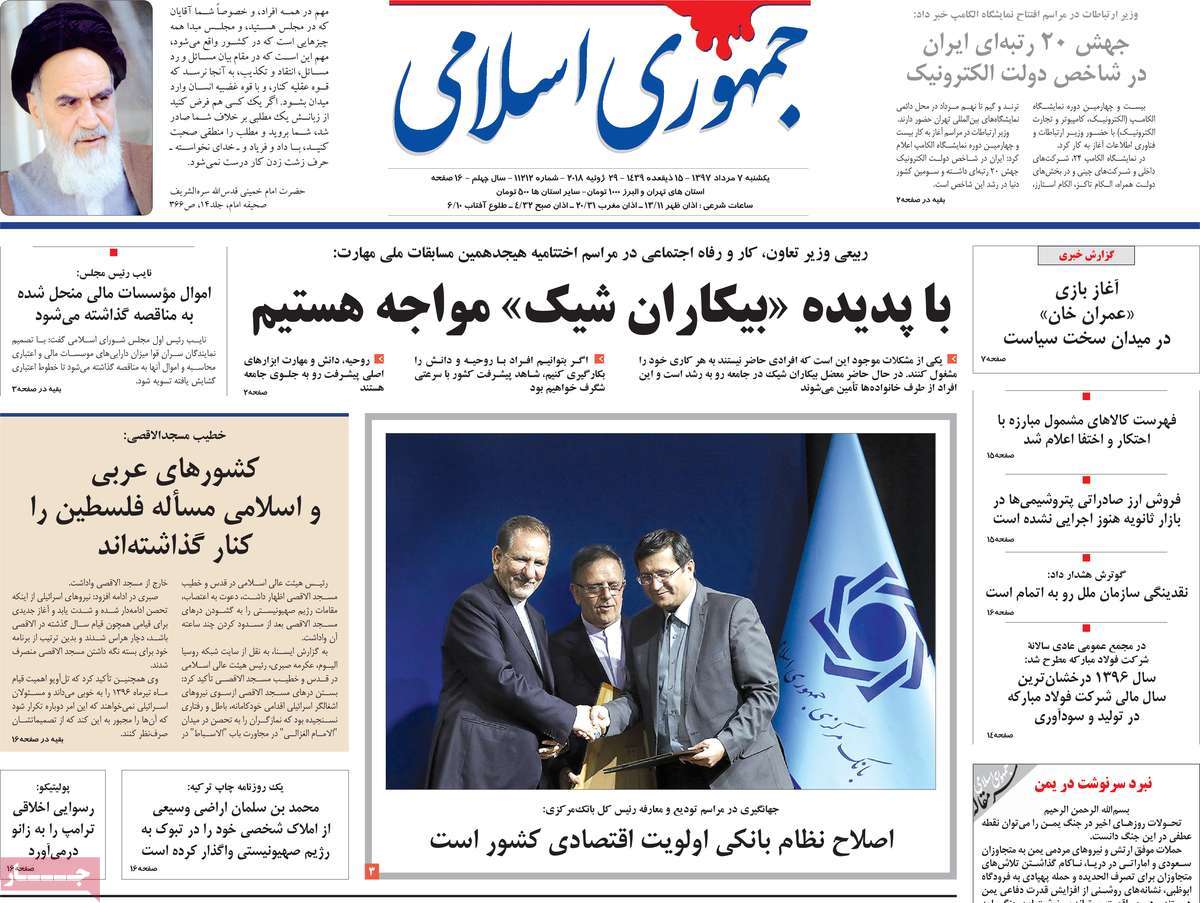
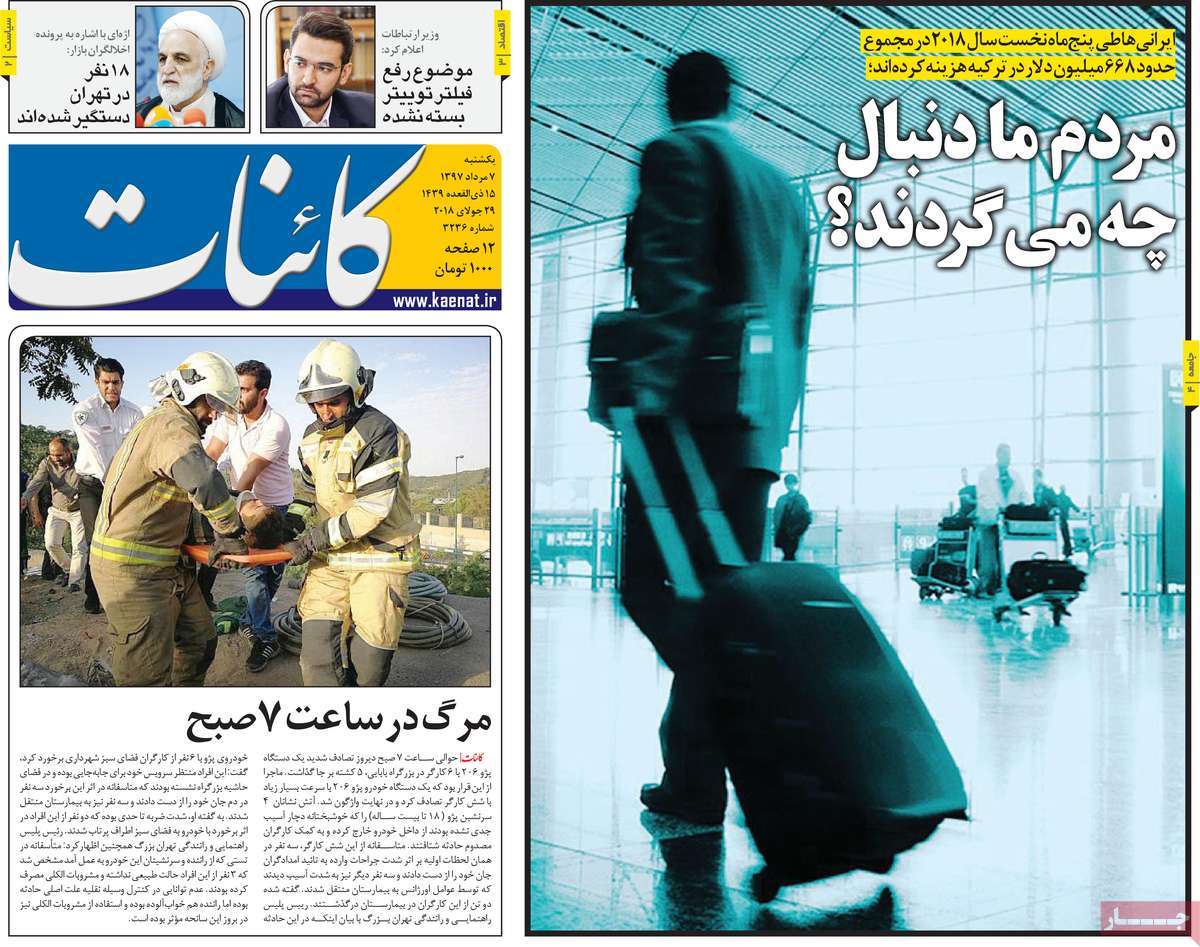
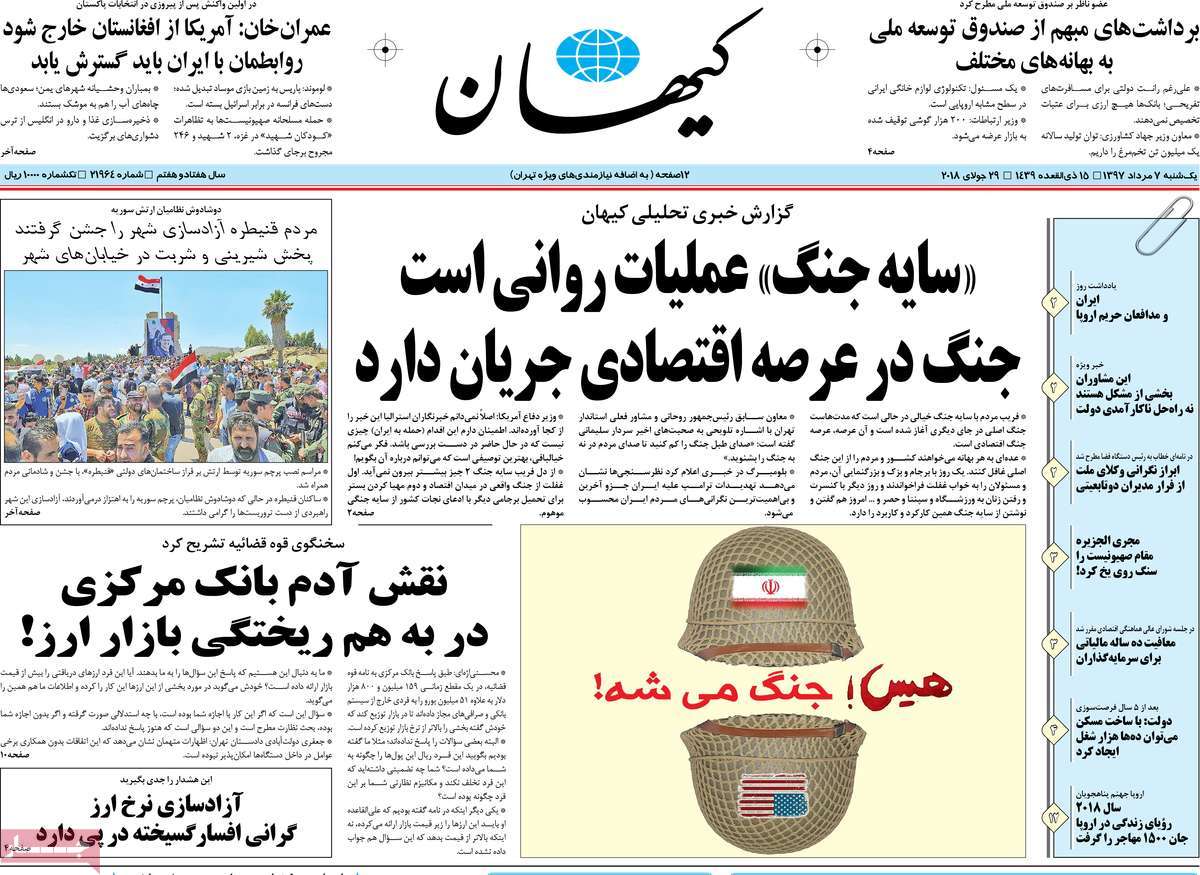
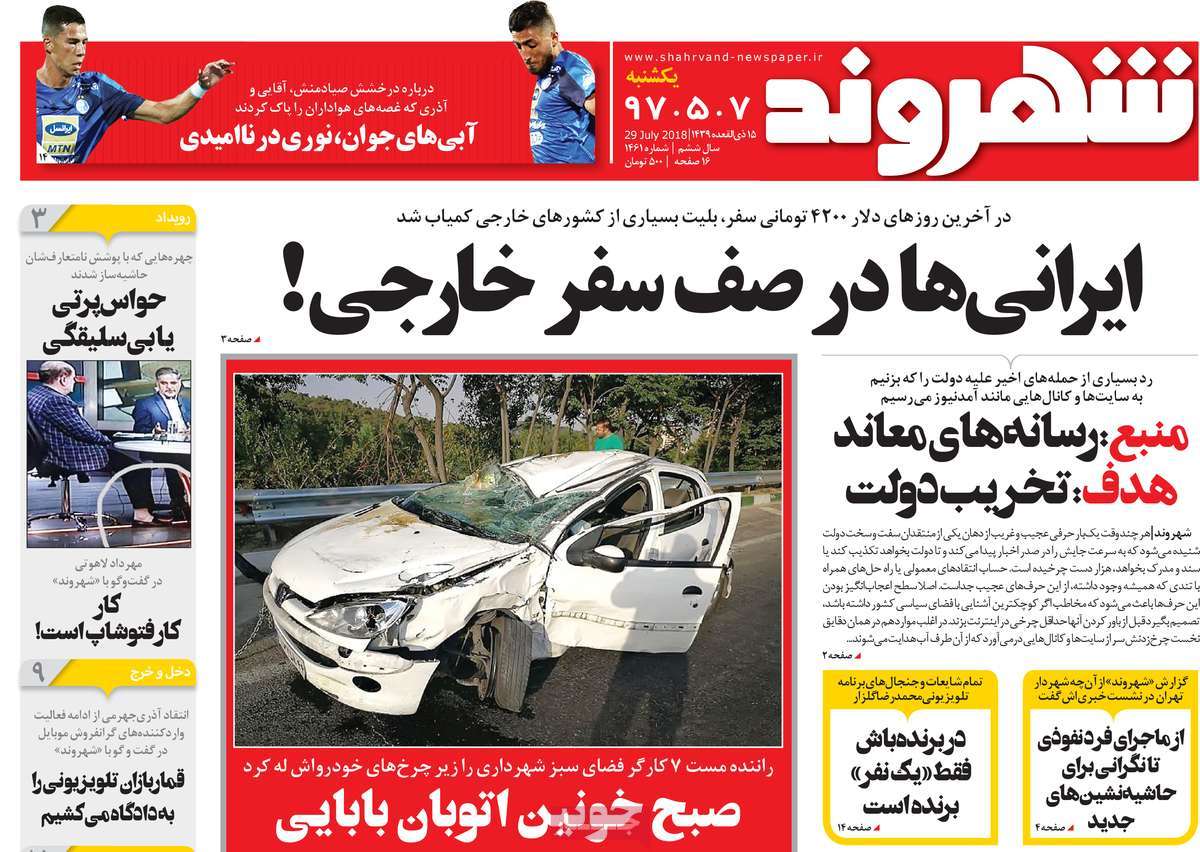
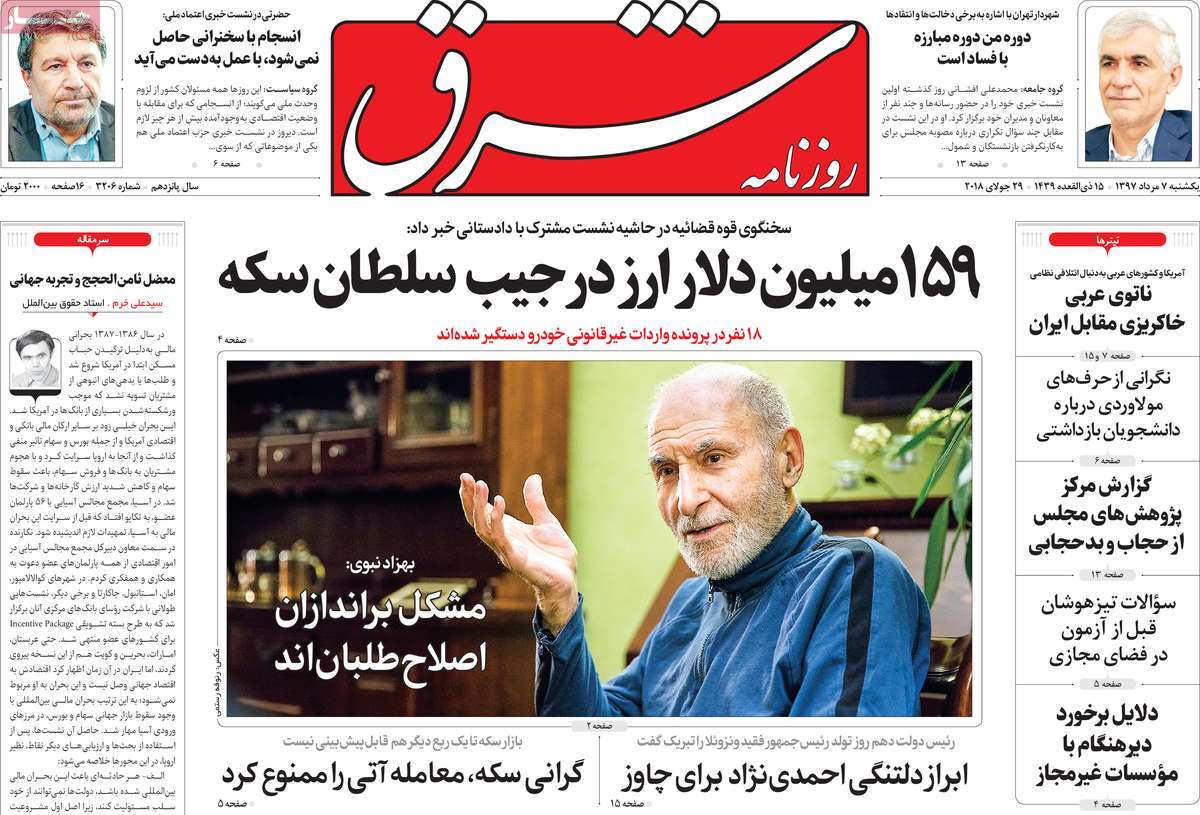
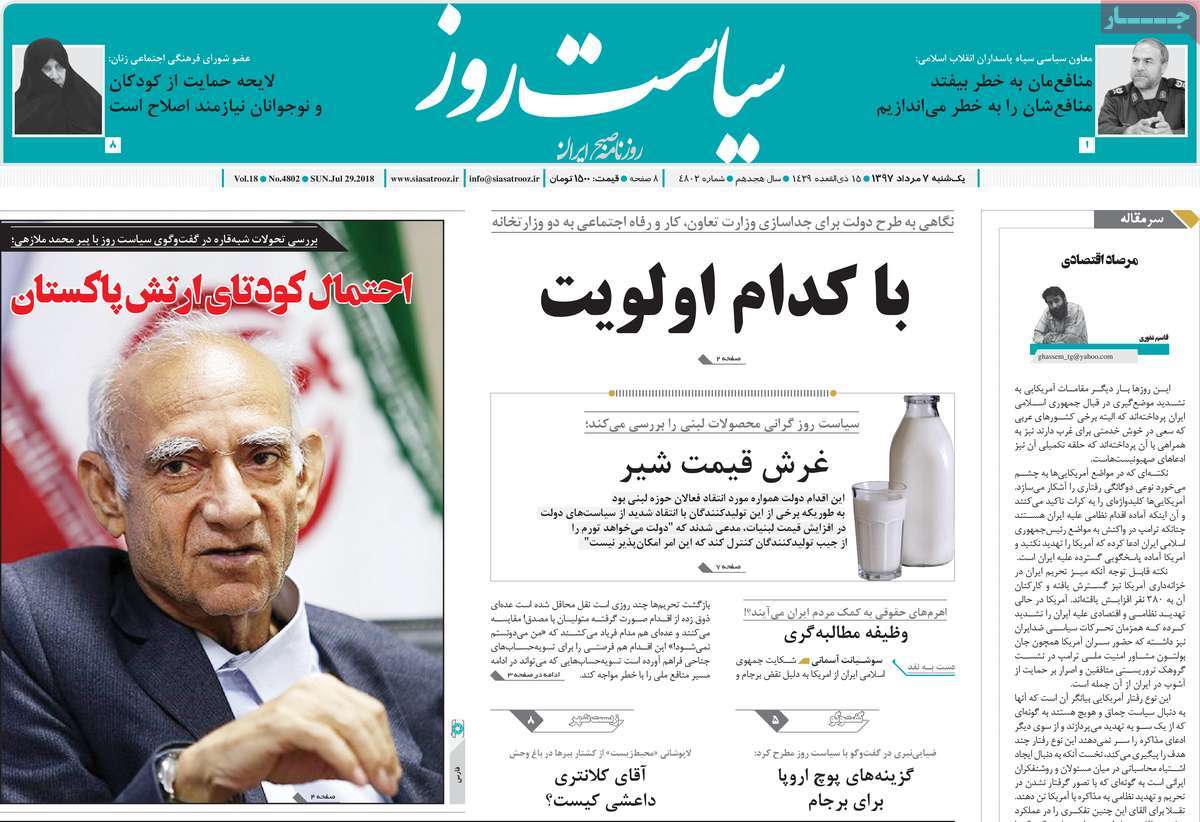
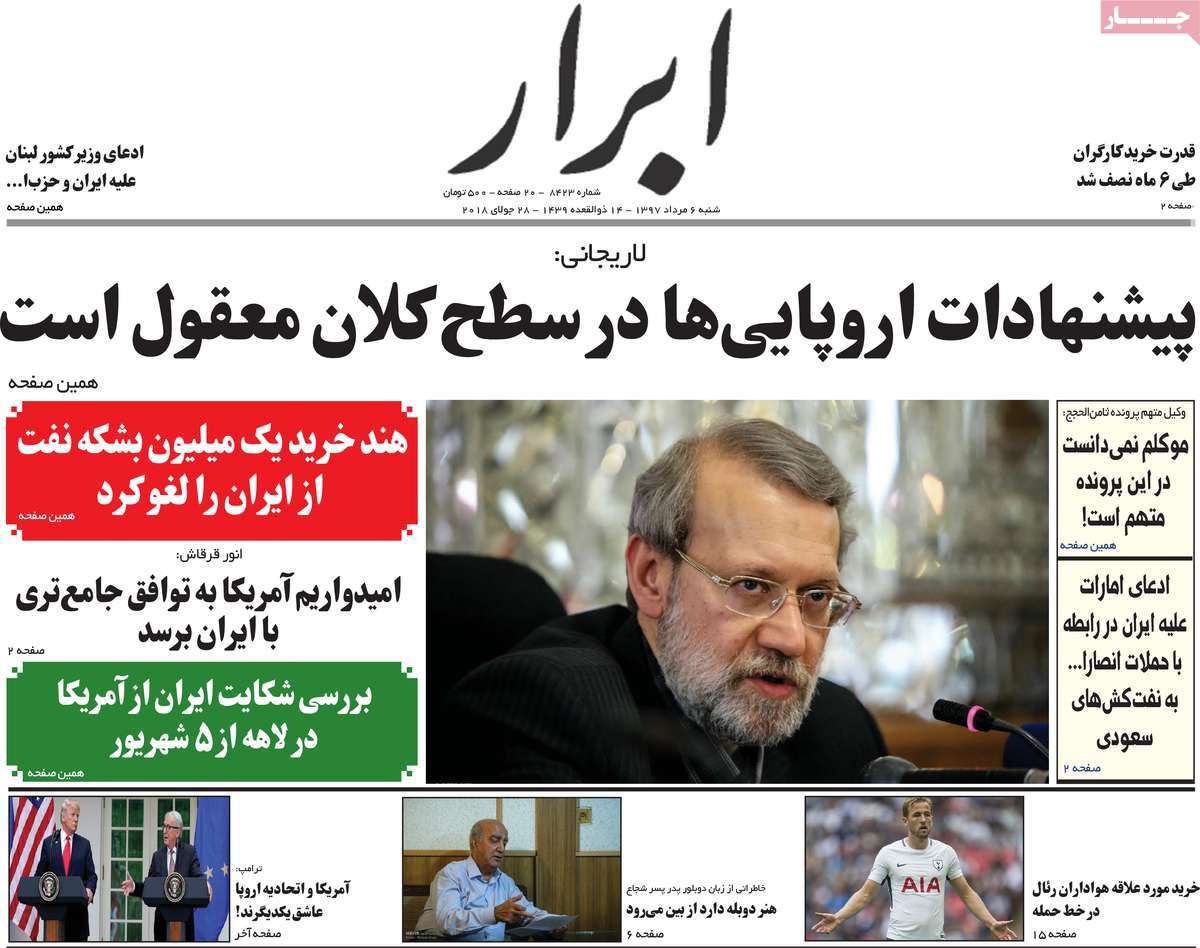
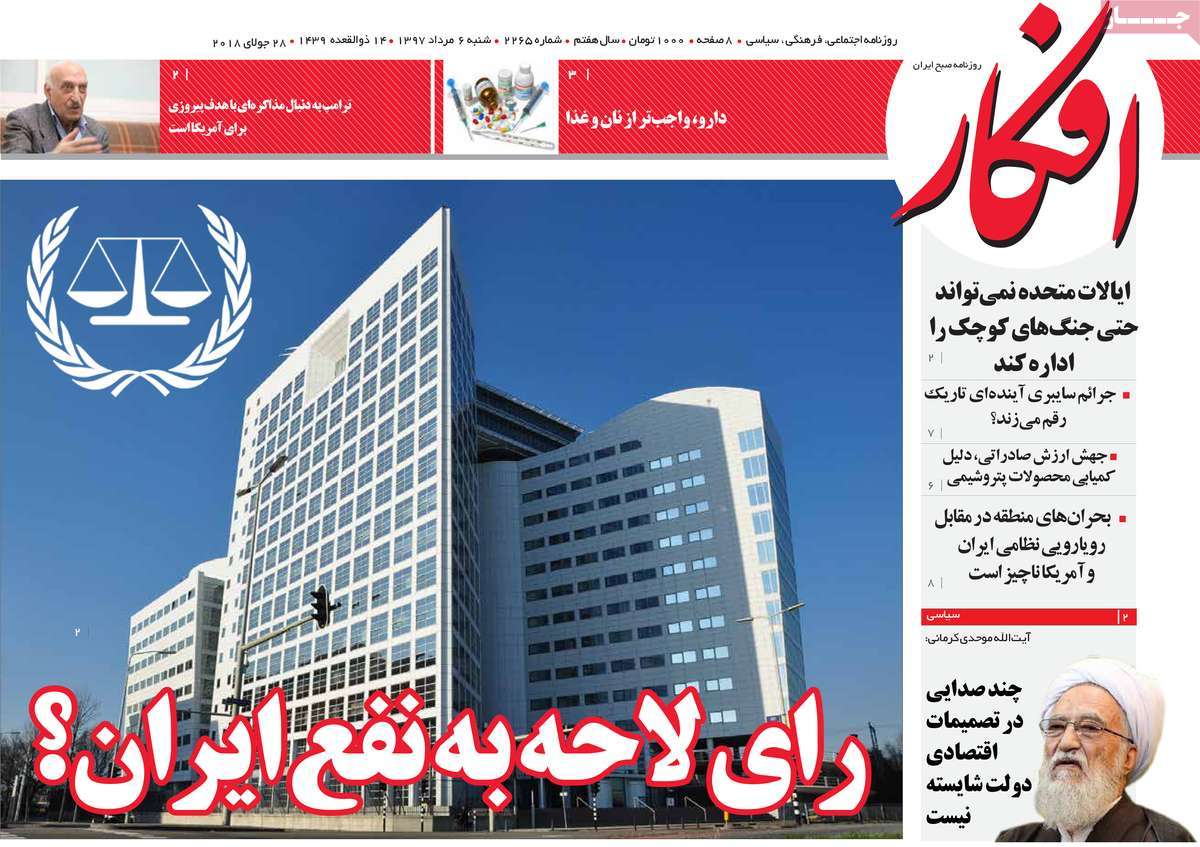
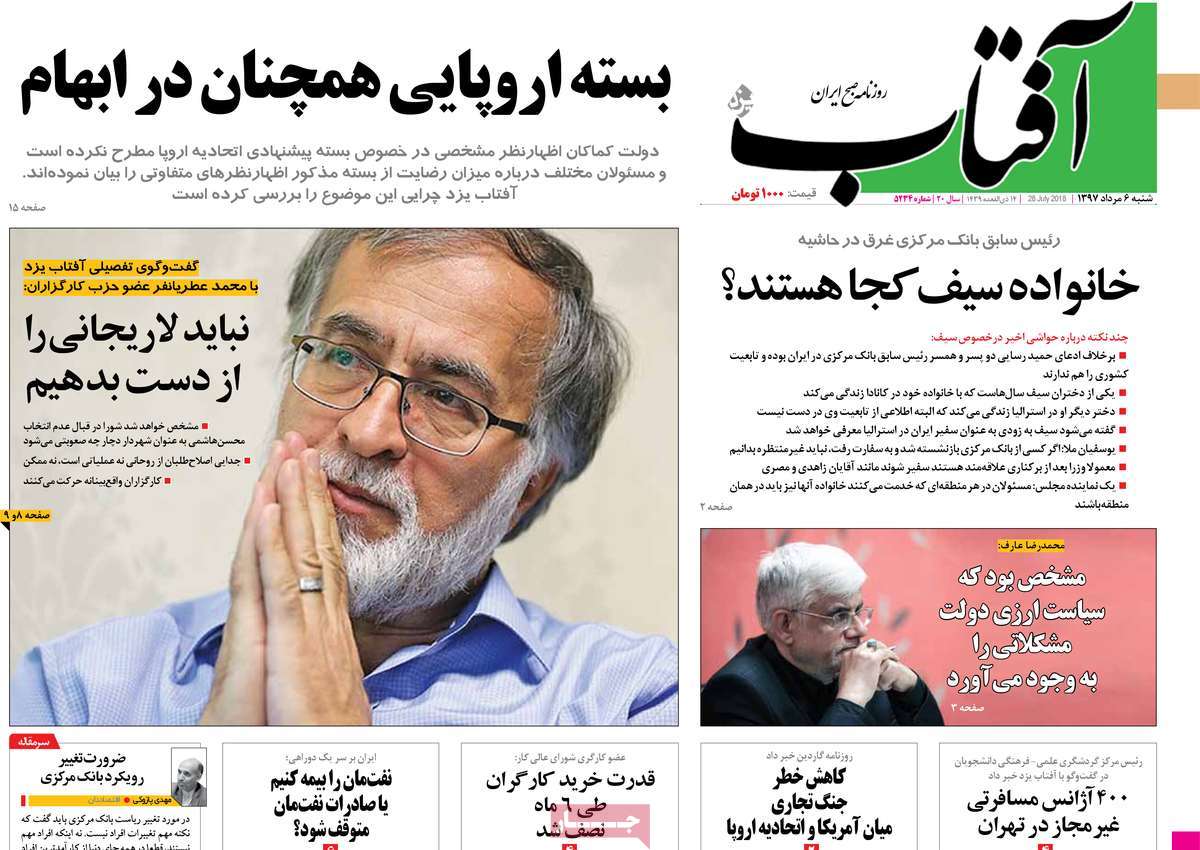
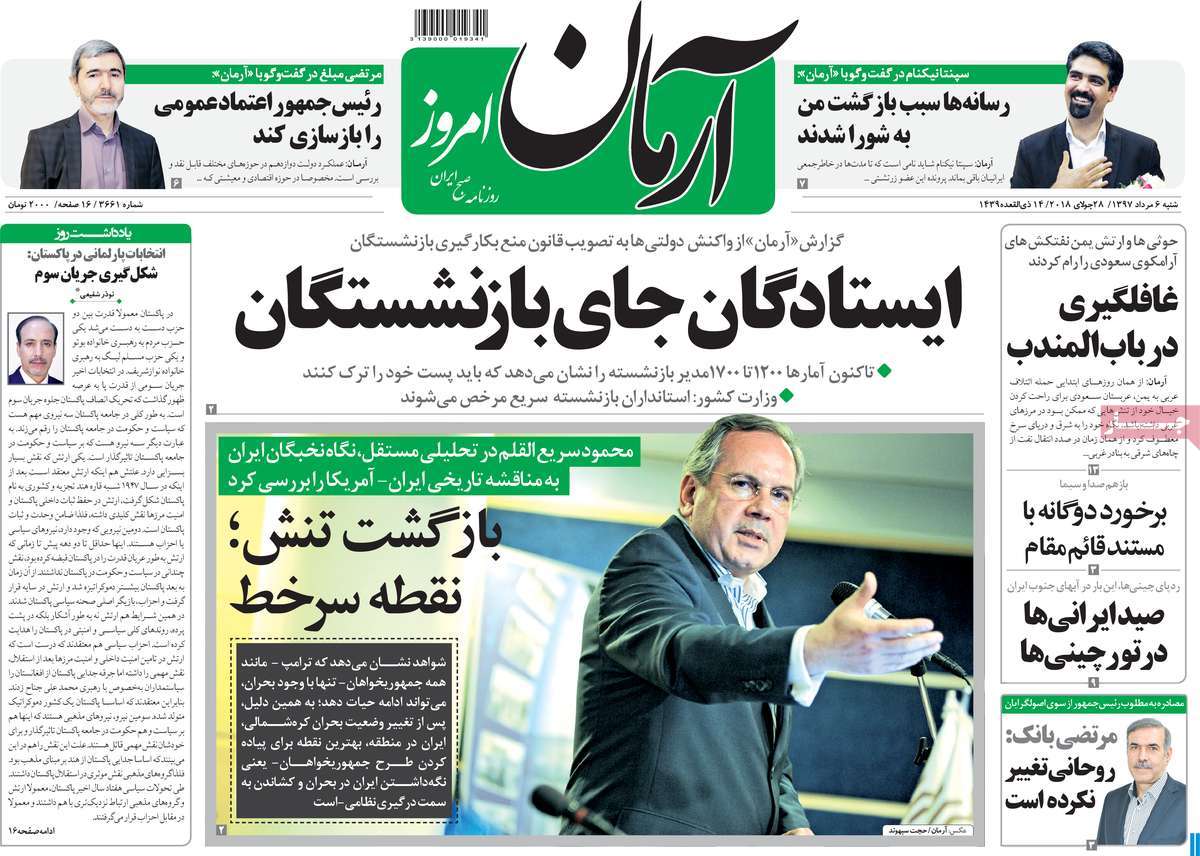
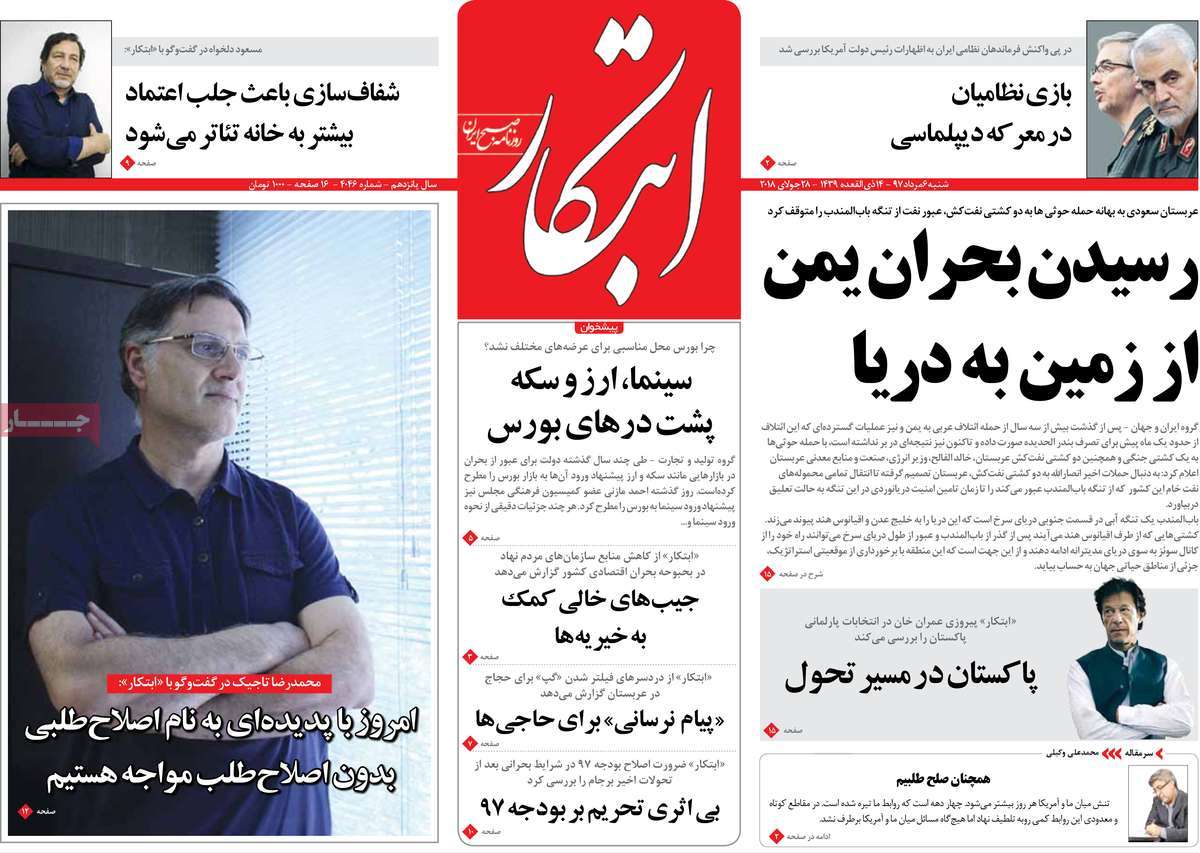
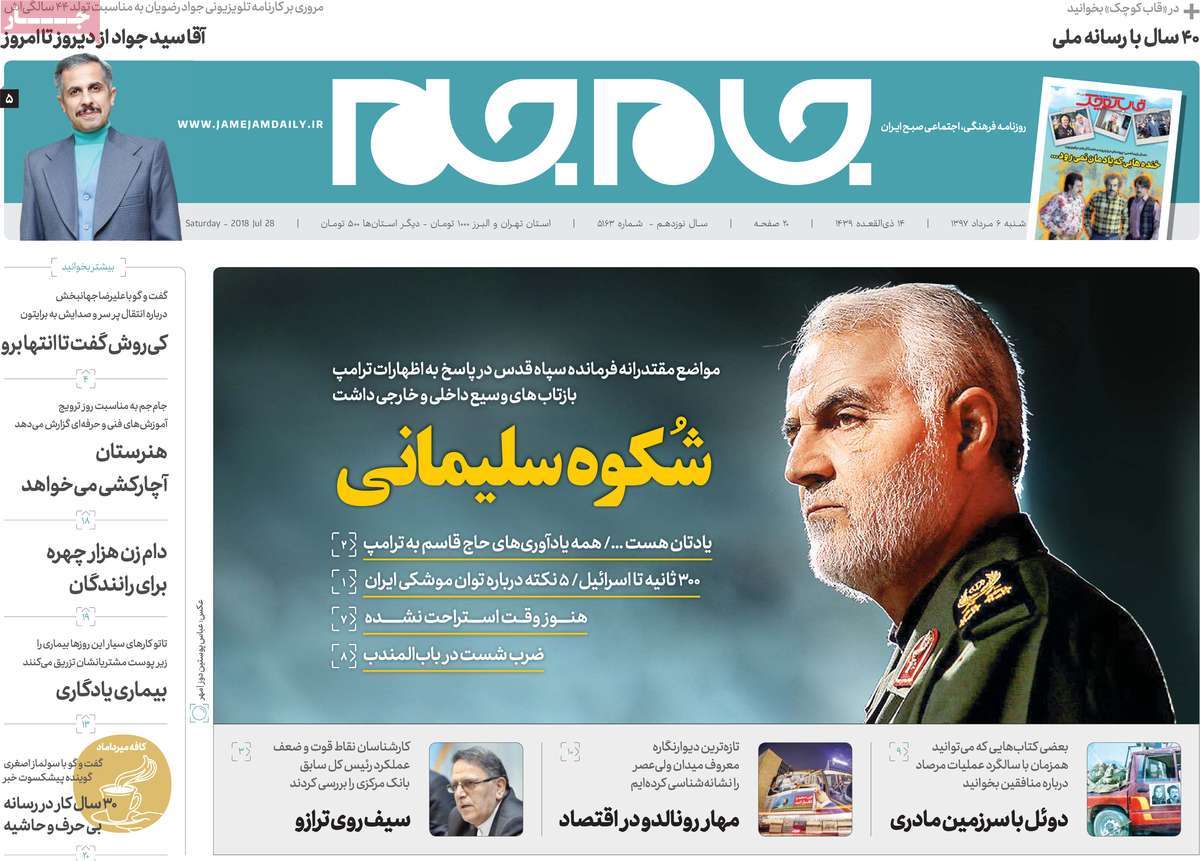
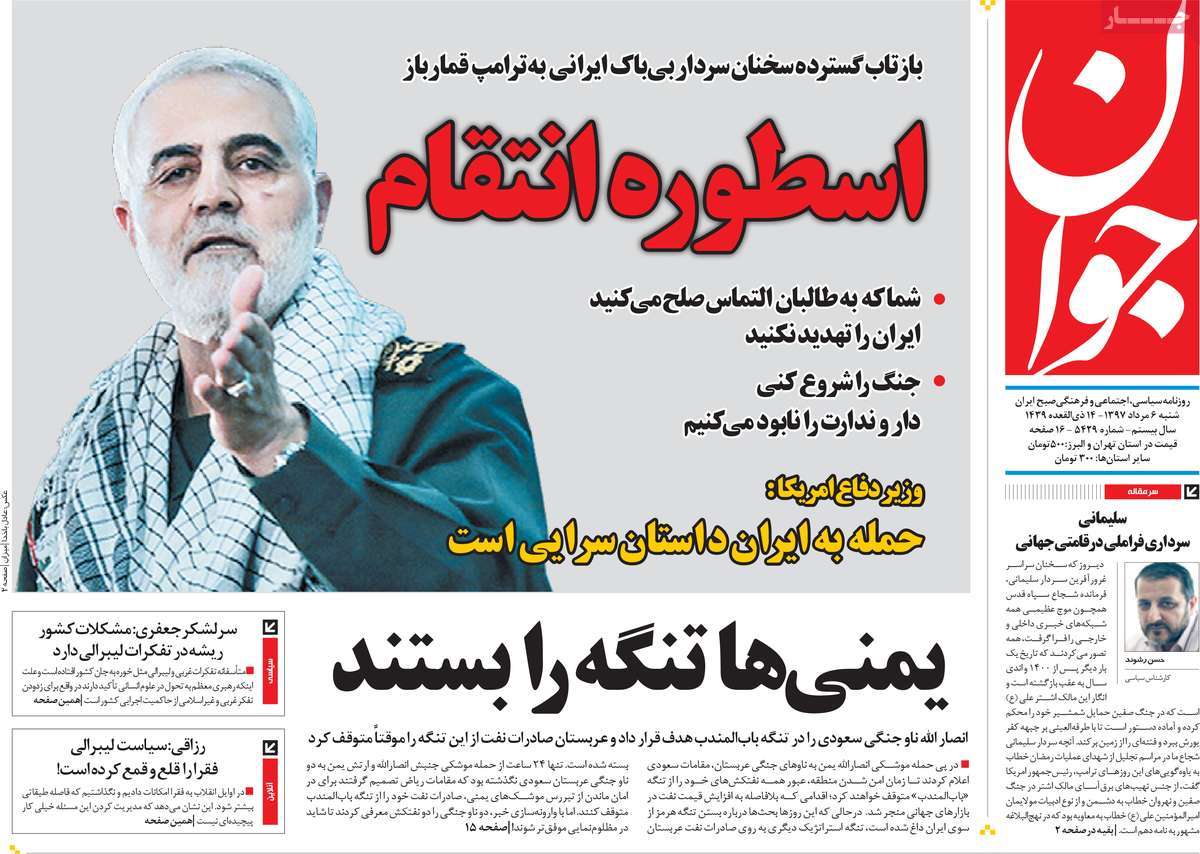
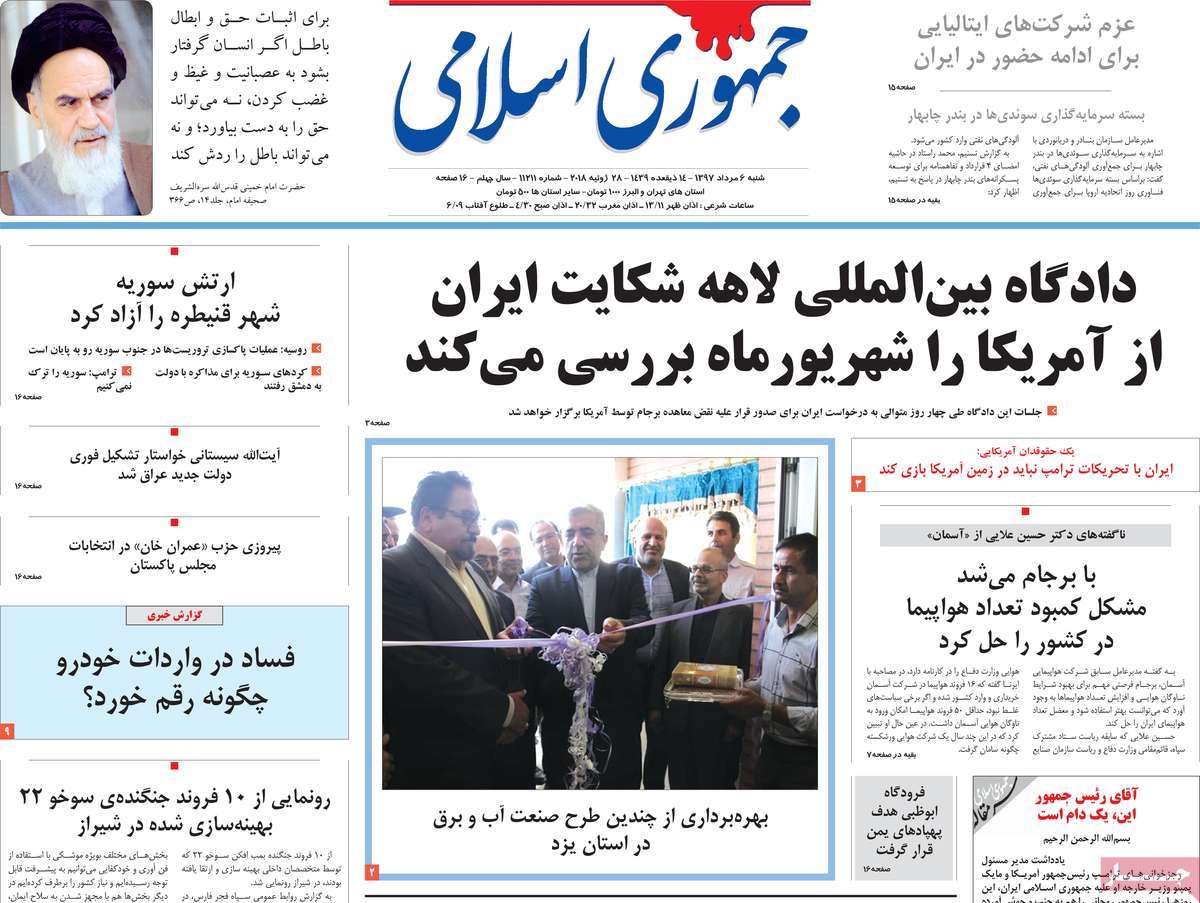
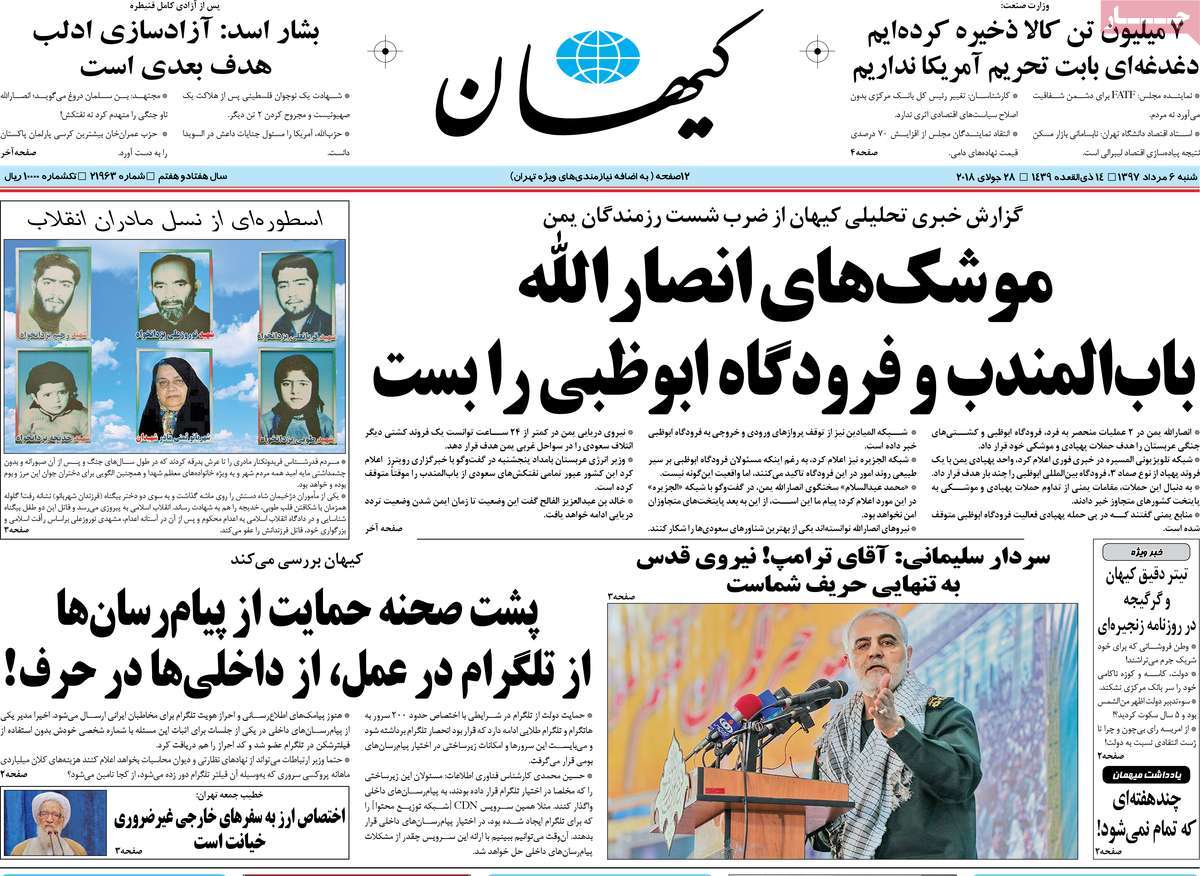
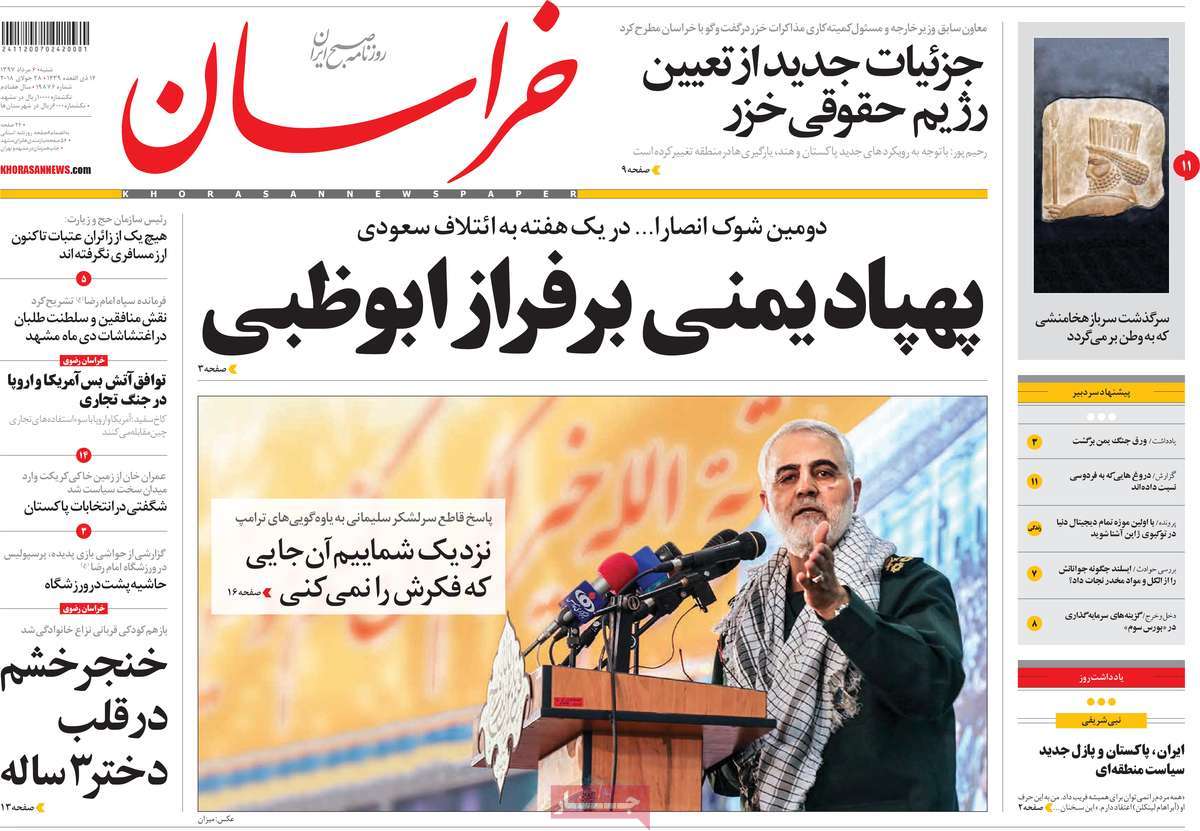
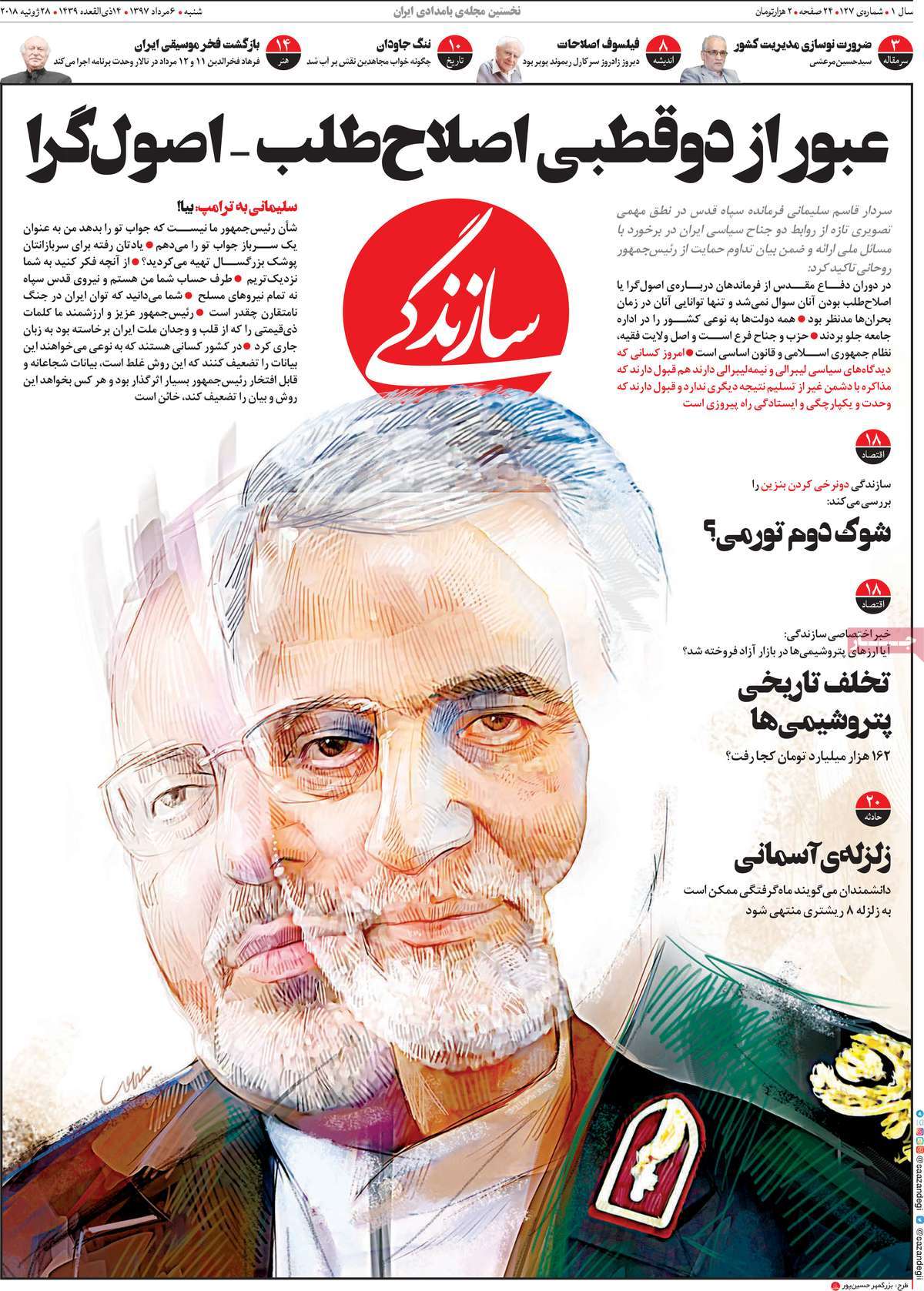
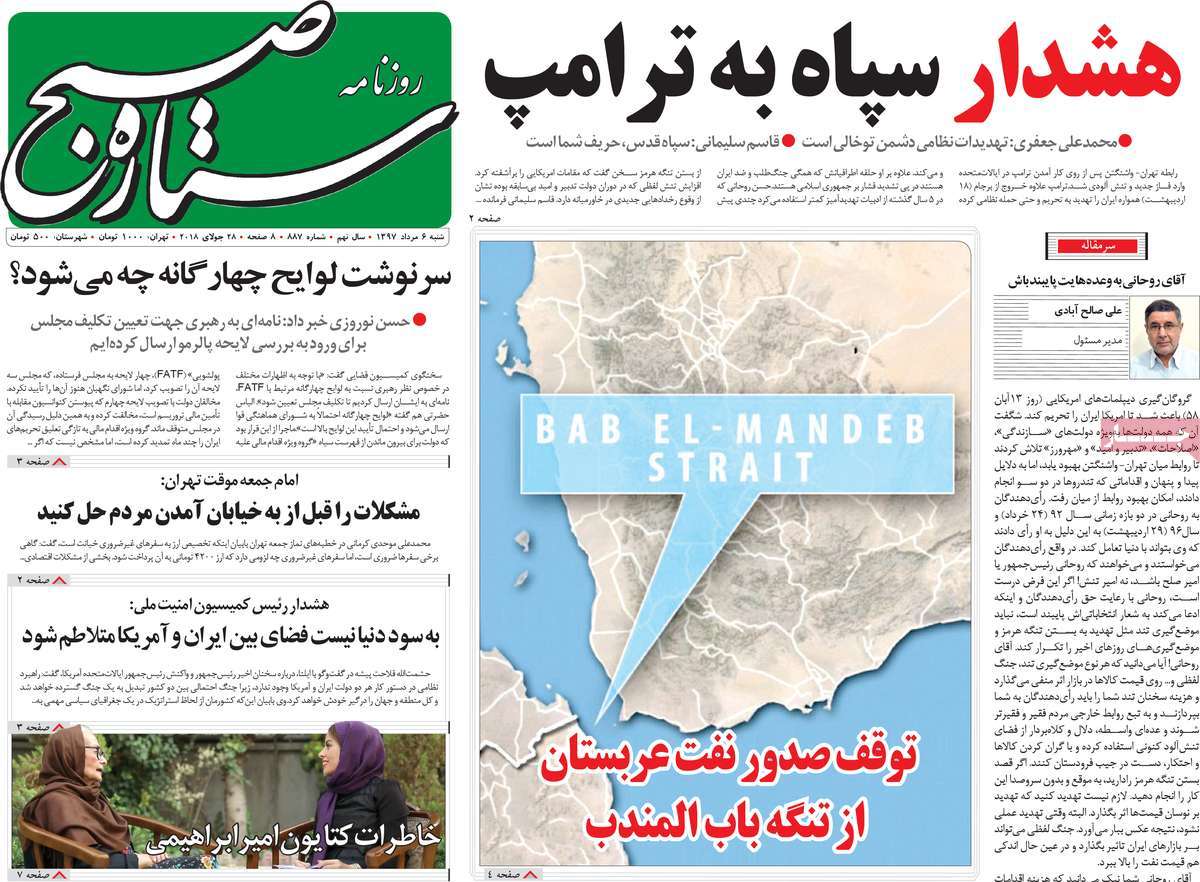
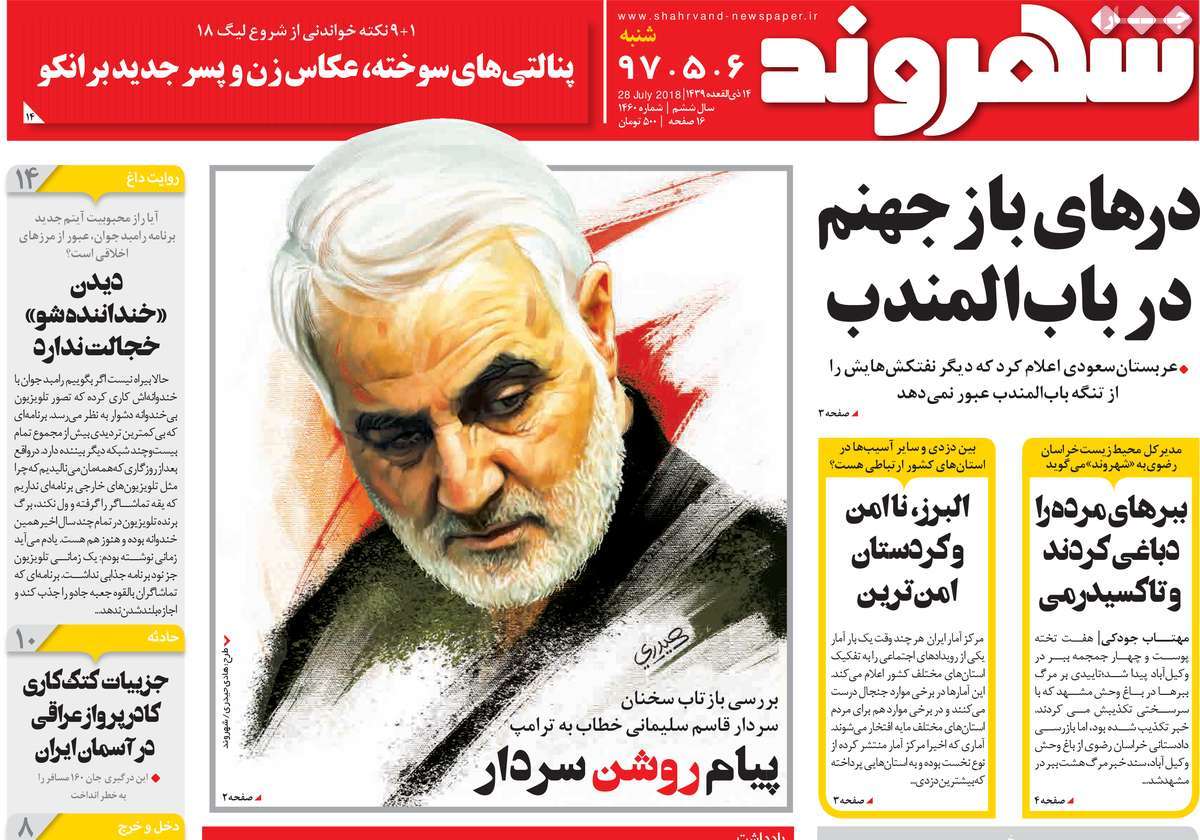
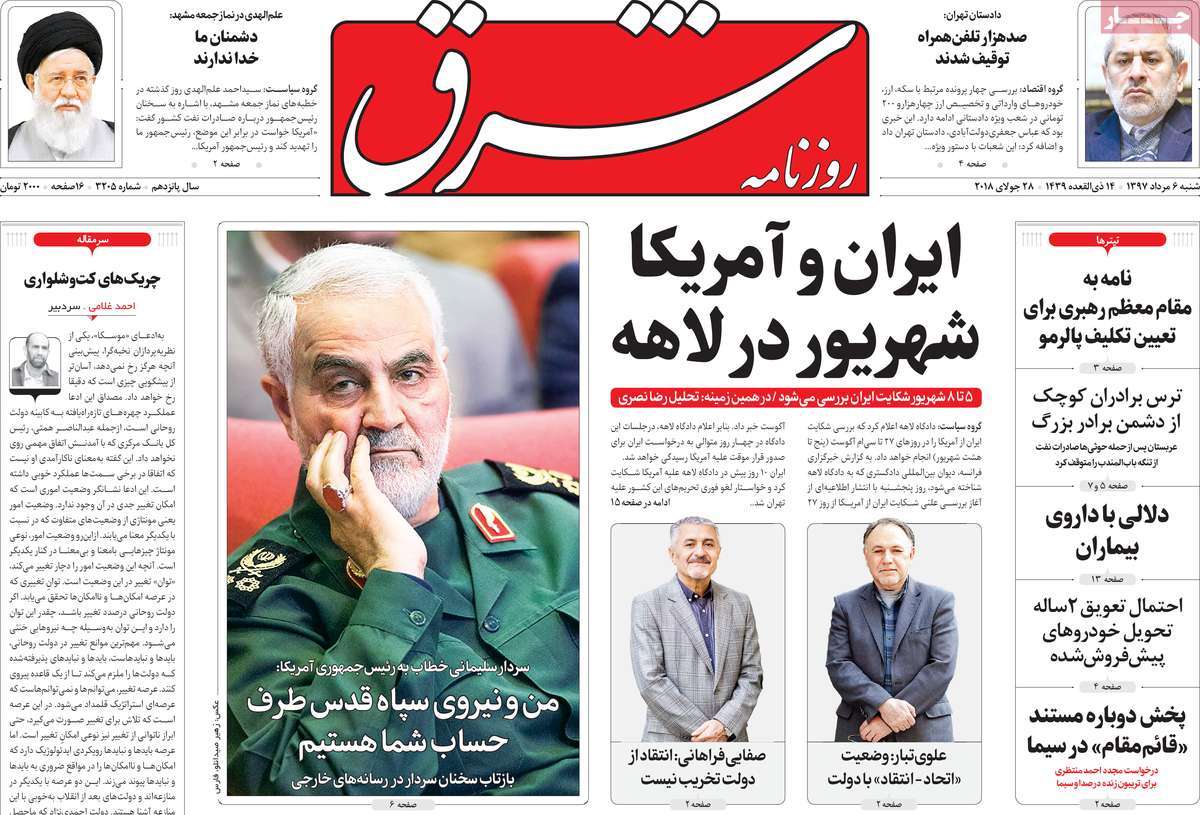
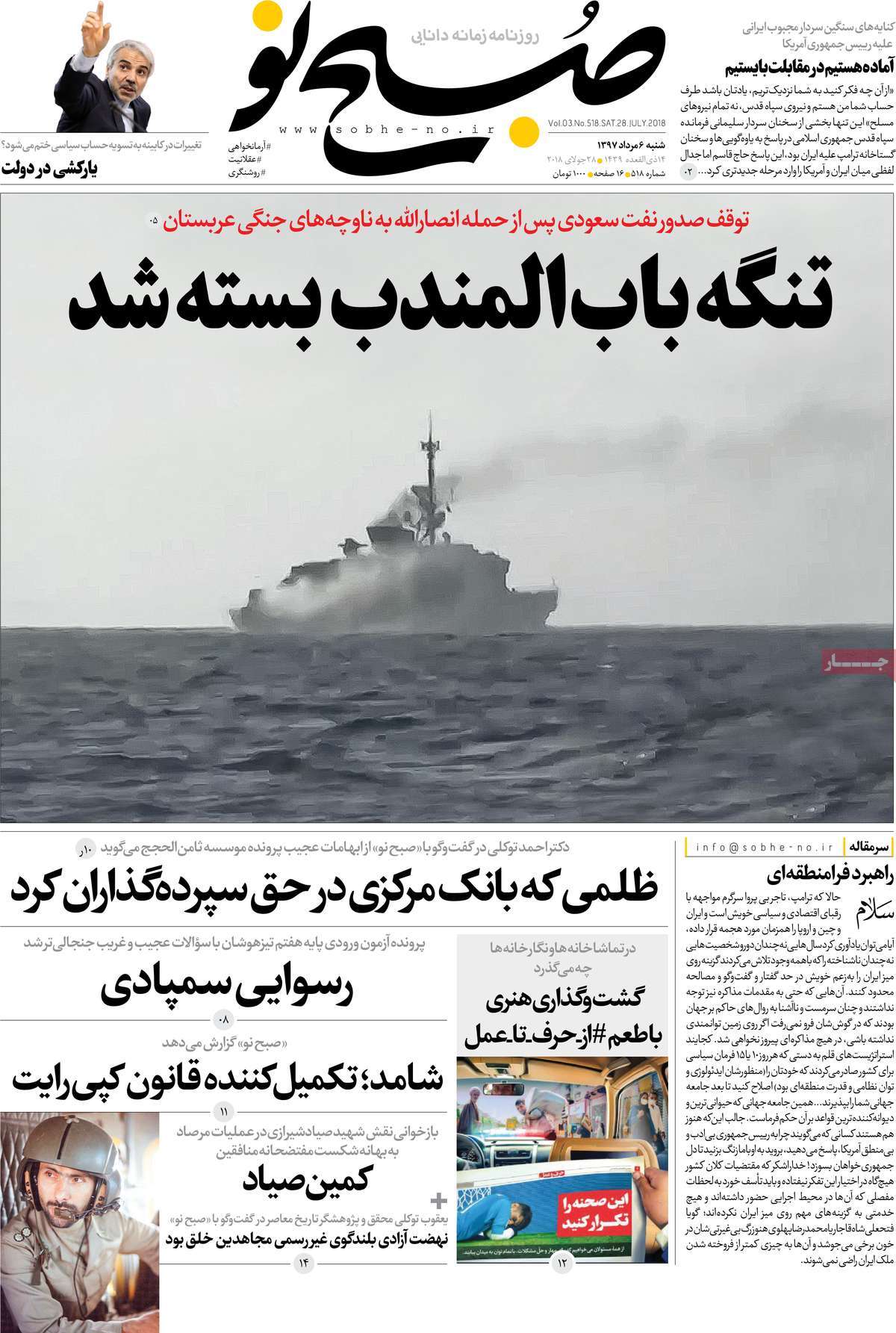
A Look at Iranian Newspaper Front Pages on July 5

A Look at Iranian Newspaper Front Pages on November 19

Several papers today covered the remarks by President Hassan Rouhani during his trips to Austria and Switzerland, particularly those regarding the EU’s efforts to save the Iran nuclear deal, which are expected to culminate on Friday when the bloc’s package to save the JCPOA is offered to Tehran.

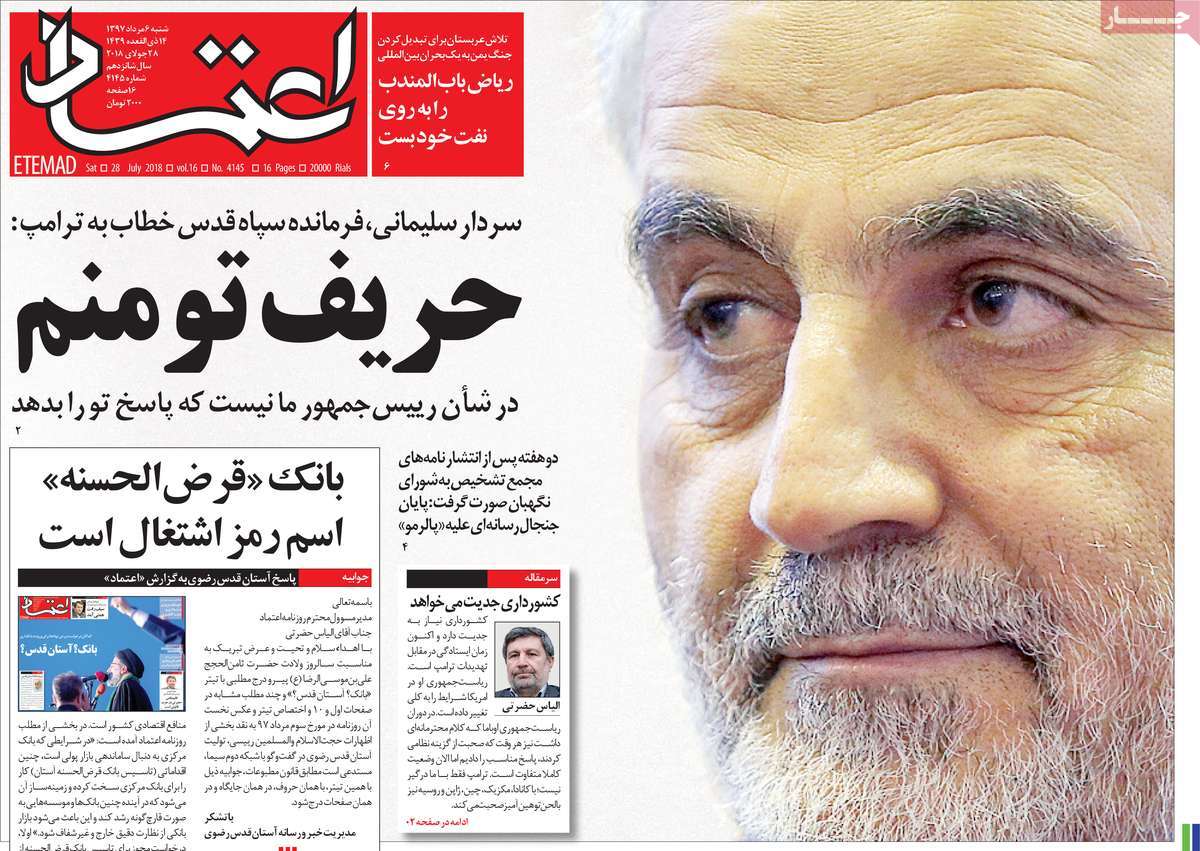
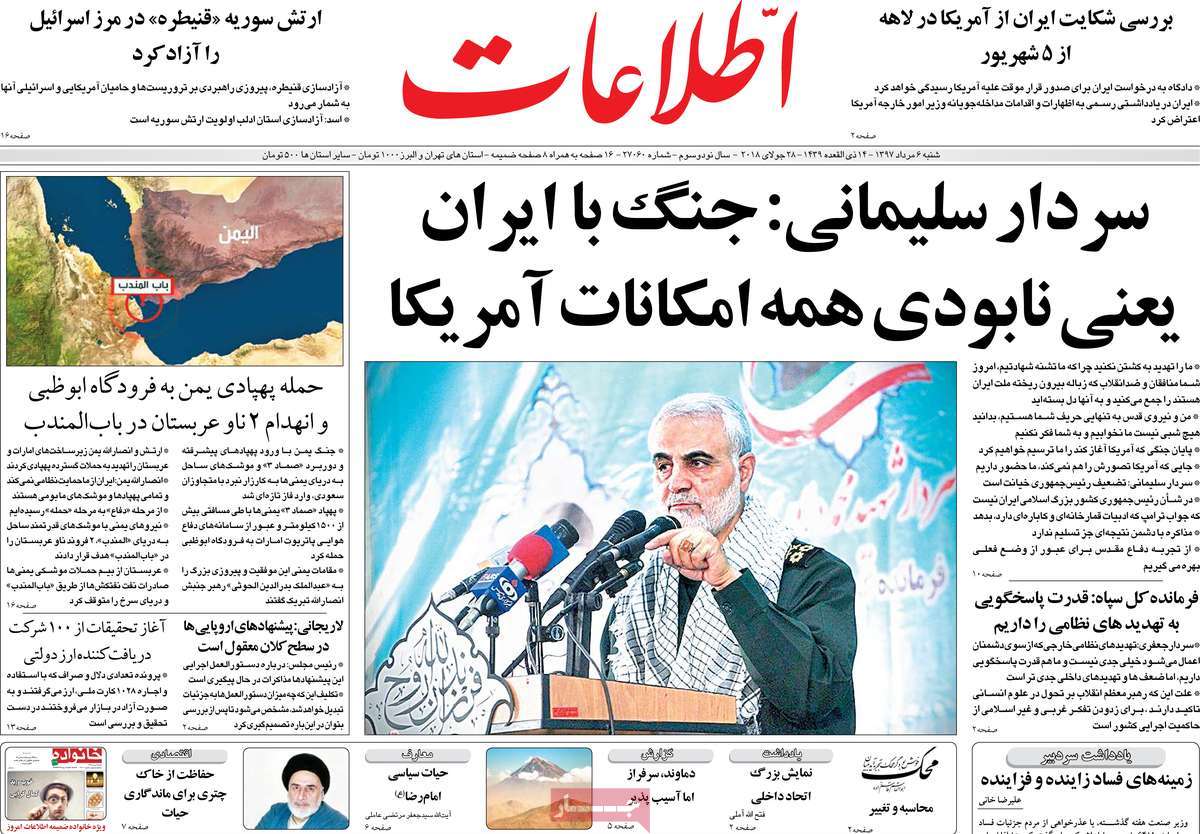
Also a top story was a letter by IRGC Quds Force Commander Major General Qassem Soleimani to President Rouhani, in which the former praised the latter’s “timely and wise” stances against the US and Israel.

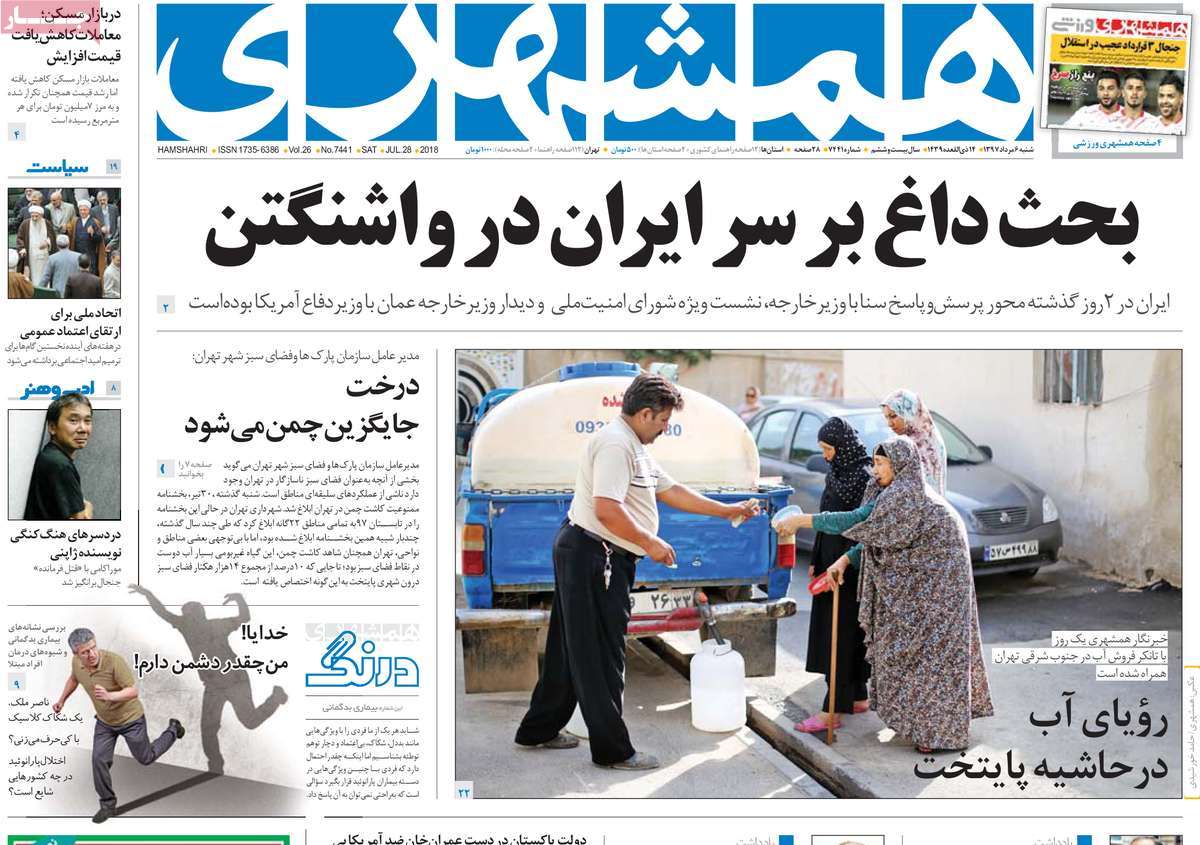
Efforts to end the water crisis in south-western Iran, particularly the city of Khorramshahr, also received great coverage.

The above issues, as well as many more, are highlighted in the following headlines and top stories:


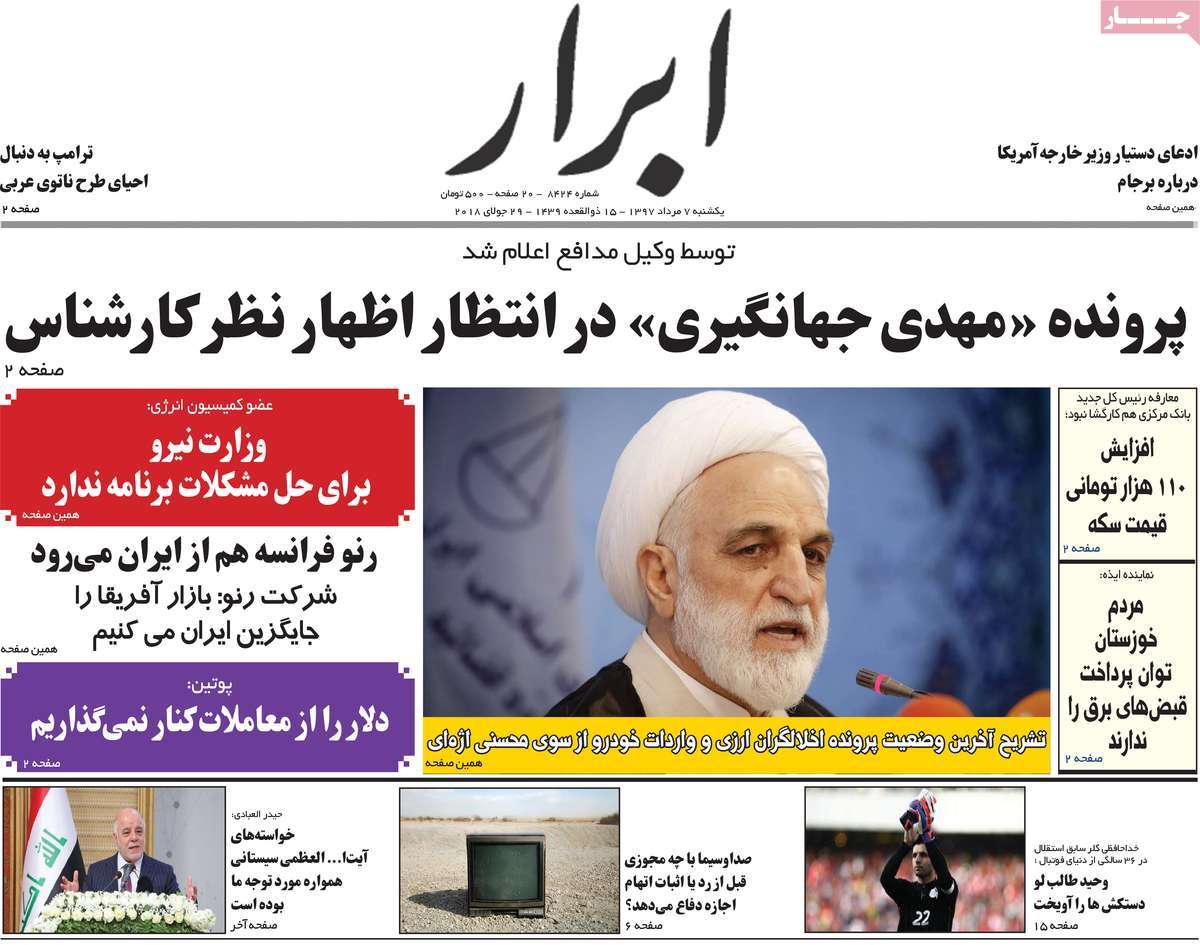
Abrar:

1- Rouhani: US’ Decision against Its Own, Others’ National Interests

2- MP Urges Gov’t to Expel French Ambassador over MKO Gathering

A Look at Iranian Newspaper Front Pages on July 5


Afkar:

1- Economy Minister: We Openly Accept All Criticisms

2- Zarif: We’ve Proved Diplomacy Works

A Look at Iranian Newspaper Front Pages on July 5


Aftab-e Yazd:

1- Iran’s Economy Affected by Temporary Decisions!

  • Consequences of Establishing Secondary Forex Market

A Look at Iranian Newspaper Front Pages on July 5


Arman-e Emrooz:

1- Rouhani: We’ll Remain in JCPOA without US If Europeans Live Up to Their Commitments

A Look at Iranian Newspaper Front Pages on July 5


Bahar:

1- Tehran Police Chief Explains How ‘Sultan of Gold Coin’ Arrested

A Look at Iranian Newspaper Front Pages on July 5


Ebtekar:

1- Big Test for Europeans to Save JCPOA: EU to Offer Its JCPOA Package to Iran Friday

A Look at Iranian Newspaper Front Pages on July 5


Etemad:

1- Austria Vows to Keep Its Trade, Political Ties with Iran

A Look at Iranian Newspaper Front Pages on July 5


Ettela’at:

1- General Soleimani Praises Rouhani’s Stance against US, Israel

2- Yemeni Forces Unveil Underground Platforms for Launching Missile

A Look at Iranian Newspaper Front Pages on July 5


Ghanoon:

1- Symphony of Diplomacy: A Report on President Rouhani’s Visit to Austria

A Look at Iranian Newspaper Front Pages on July 5


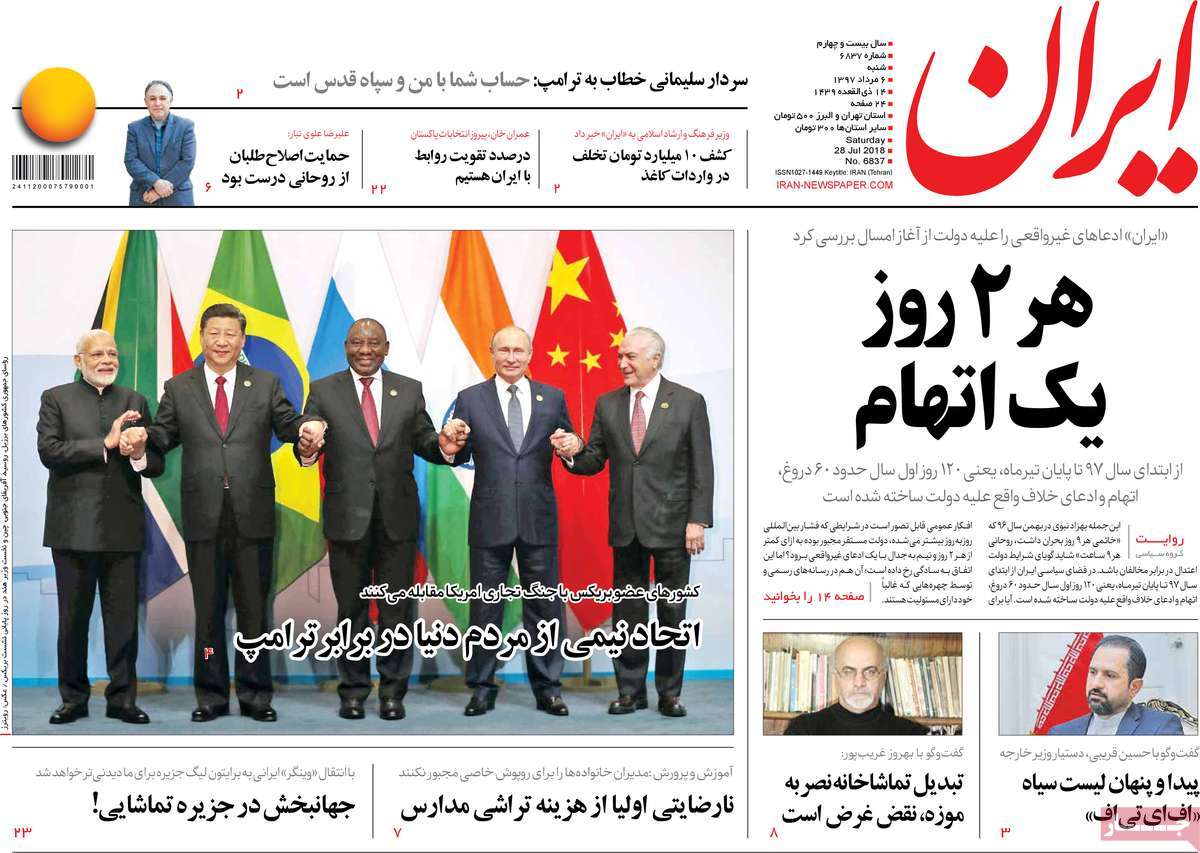
Iran:

1- Host of Nuclear Talks Defends Saving JCPOA

  • Young Austrian Chancellor Hopeful about Result of Friday Talks

A Look at Iranian Newspaper Front Pages on July 5


Jame Jam:

1- Iran Leader Thanks Friday Prayers Imam of Khorramshahr for Pursuing Resolution of Water Crisis

A Look at Iranian Newspaper Front Pages on July 5


Javan:

1- Rendezvous in Strait of Hormuz

  • General Soleimani: This Is How Rouhani Should [Always] Be

A Look at Iranian Newspaper Front Pages on July 5


Jomhouri Eslami:

1- Rouhani: We Won’t Let US Policies Impact Our Relations with the World

A Look at Iranian Newspaper Front Pages on July 5


Kayhan:

1- Israeli Army: Palestinians’ 1-euro Balloons Caused Millions of Euros in Damages on Us

2- China to Keep Friendly Ties with Iran, Rejects US Call for Cutting Oil Imports

A Look at Iranian Newspaper Front Pages on July 5


Resalat:

1- Mirsalim: They Put the Country’s Entire Focus on JCPOA for Five Years but to No Avail

A Look at Iranian Newspaper Front Pages on July 5


Rooyesh-e Mellat:

1- Labour Minister: Gov’t Still Resolved to Create 1 Million Job despite Economic Woes

A Look at Iranian Newspaper Front Pages on July 5


Sayeh:

1- ICT Minister: Instagram Won’t Be Blocked!

A Look at Iranian Newspaper Front Pages on July 5


Sepid:

1- Health Minister: Special Plans for Countering Pharmaceuticals Sanctions

A Look at Iranian Newspaper Front Pages on July 5


Shakhe-ye Sabz:

1- Bahonar: Constitution Must Be Revised, Senate Must Be Formed besides Parliament

A Look at Iranian Newspaper Front Pages on July 5


Shargh:

1- Rouhani’s Condition for Remaining in JCPOA: EU Must Fill US’ Gap

A Look at Iranian Newspaper Front Pages on July 5


Ta’adol:

1- Beijing’s Pressure on Brussels to Counter Washington

A Look at Iranian Newspaper Front Pages on July 5


Vatan-e Emrooz:

1- Erdogan Thinking of Leaving NATO

  • Purchase of S-400, US’ Failure to Deliver F-35 Affecting Ties with NATO

A Look at Iranian Newspaper Front Pages on July 5

EU Parliament Allows European Investment Bank to Work with Iran

The EIB, the European Union’s not-for-profit long term investment arm, is a key pillar of the bloc’s attempts to maintain business links with Iran in the face of Washington’s decision to re-impose sanctions on the Islamic Republic.

However, the EU lawmakers’ decision does not oblige the EIB to work with Iran, a move that could jeopardize its ability to raise money on US markets and so have far reaching consequences for its operations.
The European Parliament overwhelmingly blocked a motion by far-right lawmakers seeking to prevent the European Commission from lifting restrictions on the EIB in Iran, setting the stage for the measure to come into effect at the start of August.

The blocking motion, put forward by the far-right Europe of Freedom and Direct Democracy group (EFDD) that includes Britain’s euro-sceptic United Kingdom Independence Party (UKIP), failed with only 93 votes for, 573 against and 11 abstentions.
“We are granting the EIB the capacity to invest in Iran if suitable projects are found,” said Siegfried Muresan, a lawmaker from the centre-right European People’s Party (EPP), which led the preparatory discussions on the Commission’s proposal.

“The Iran deal is good for Europe’s security,” he told Reuters, referring to the accord signed by world powers in 2015.

EU governments can technically still block the Commission proposal but are not expected to do so given EU leaders publicly backed the EIB lending plan at a summit in May.

The parliament’s decision is likely to be a morale boost for EU Foreign Policy Chief Federica Mogherini, who will chair a meeting of the foreign ministers of Iran, China, France, Germany and Britain in Vienna on Friday to discuss progress on salvaging the nuclear deal.

Iran requested the meeting to discuss European efforts to protect the nuclear pact in the face of US President Donald Trump’s May 8 decision to pull out and revive Iran-related sanctions, after the expiry of 90- and 180-day periods.
The sanctions will start to come into effect in August but some European companies investing in Iran and with big operations in the United States have announced they will pull out of business deals with Tehran.
The pillars of the EU’s strategy are: EIB lending, a special measure to shield EU companies from US secondary sanctions and a Commission proposal that EU governments make direct money transfers to Iran’s central bank to avoid US penalties.
However, the Luxembourg-based EIB is concerned about the proposal that it do business in Iran, EU sources told Reuters in June, fearing the threat of US sanctions could imperil its ability to raise funds on US capital markets.
“Maintaining access to these markets is a quasi life-or-death issue for the EIB,” bank Director General Bertrand de Mazieres told a European Parliament budget committee hearing in late May, saying there were $120 billion of outstanding bonds issued by the EIB worldwide.

The EIB currently steers clear of engaging in jurisdictions listed as high-risk under the FATF, a global group of government anti-money-laundering agencies. That includes Iran.