Tuesday, December 23, 2025
Home Blog Page 3508

“Iranian Forces to Remain in Syria as Long as Assad Gov’t Want Them to”

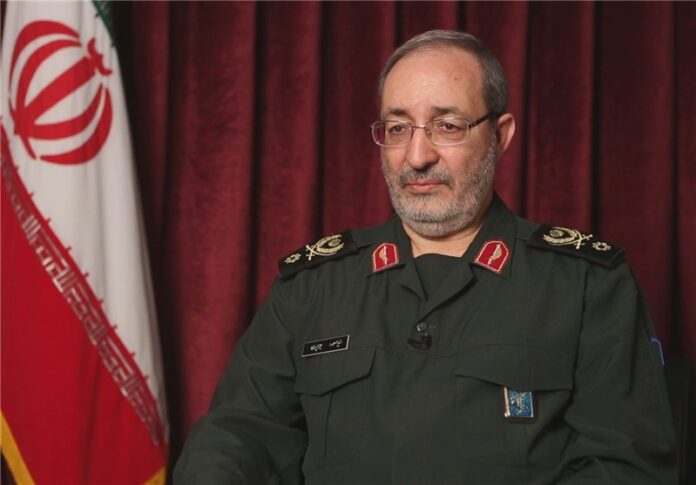
Brigadier General Massoud Jazayeri made the comment in reaction to media propaganda regarding the possibility of Iran’s withdrawal from Syria.

“Unlike American troops and the reactionaries in the region, Iranian [military] advisors are present in Syria at the request of the Syrian government and people,” said general Jazayeri, an advisor to the chairman of the general staff of the Iranian Armed Forces, as quoted by Tasnim News Agency.

“Iran and Syria enjoy deep-rooted relations, which will not be swayed by anyone’s propaganda attempts,” he said.

The top commander then touched upon Israel’s fear of proximity with resistance fighters.

“The Zionist regime [of Israel]’s biggest fear is to see the fighters of Islam close to its borders, and now that it has happened, the US and usurper Israel are doing whatever they can to change this situation, but they should know that this situation will not change,” he said.

The top general expressed hope a day will come when Syria and other regional countries will get rid of “intruding and trouble-making forces.”

He added the Israeli regime does not see a bright future for itself, and that the United States has no option, but to leave the region.

“Iran and Syria have age-old and strategic relations, and any kind of agreement will solely take place between the Iranian and Syrian governments,” he said.

Iran Urges Other States to Stand against US Bullying

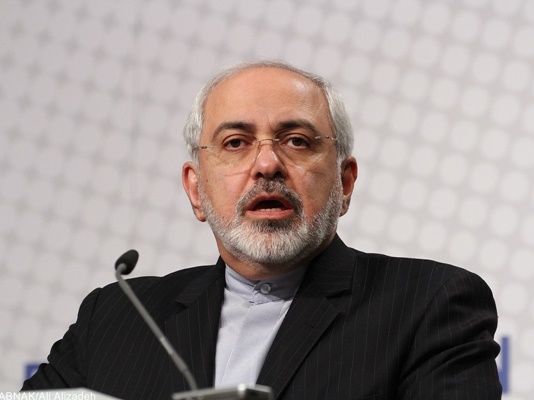
In line with the Iranian Foreign Ministry’s international negotiations on the US administration’s illegal and unilateral moves including its withdrawal from the Iran nuclear deal, FM Zarif recently sent a letter to his foreign counterparts, elaborating on the dangerous repercussions of the US withdrawal from the deal.

He urged his counterparts to condemn Washington’s excessive demands and illegal measures and to remain committed to their pledges under the nuclear deal as well as the United Nations Security Council Resolution 2231.

In the letter, the Iranian foreign minister described the US pullout of the JCPOA as the climax of the country’s earlier attempts to violate and undermine the Iran nuclear deal and the UNSC resolution.

Zarif said as in any other international treaty, all parties to the JCPOA must live up to their promises and mutual duties.

The scope, regulations and timeframe of the deal have been set after precise, sensitive and balanced multilateral negotiations, he said.

Therefore, Zarif added, making changes to the deal or renegotiating it is impossible.

He noted that the Iranian nation’s enjoyment of the benefits of this deal shouldn’t be subject to any condition other than voluntary measures linked to the nuclear issue – which have been specifically and exclusively mentioned in the JCPOA and its appendixes.

He pointed out that the US’ illegitimate withdrawal from the Iran nuclear deal and particularly its bullying behaviours to make other states side with it stand in stark violation of the principle of keeping promises and the rule of law.

Zarif said such behaviours also discredit international law at the global level and challenges the goals and principles of the UN charter as well as the efficiency of the international bodies.

The JCPOA put an end to an unnecessary crisis which lasted for over a decade, Zarif said, stressing that the nuclear deal was attached to and endorsed by the UNSC Resolution 2231.

“This means that the JCPOA does not belong only to its signatories, and thus the administration of one side cannot violate it irresponsibly and arbitrarily based on its domestic policies or political divisions with its predecessors,” he noted.

Zarif then stressed that despite Washington’s repeated violations and incomplete implementation of the nuclear deal since its early days, the Islamic Republic of Iran has remained completely committed to its pledges under the JCPOA.

“If the Iran nuclear deal is to be preserved, the remaining sides as well as other business partners should assure us that all damages inflicted on Iran because of the US pullout will be compensated unconditionally through national, regional and global measures,” he added.

Zarif also emphasised in this letter that the Islamic Republic has decided, with goodwill, to take steps to find the appropriate solution within the framework of the JCPOA, and discuss the possibility and the ways in which the parties to this agreement and other business partners can guarantee the Iranian nation’s full enjoyment of the nuclear deal’s benefits.

But if, after applying the existing solutions, the rights and benefits of the Iranian people are not protected, Iran, as mentioned in the JCPOA and the UNSC Resolution 2231, has the right to take appropriate measures in response to repeated and unlawful acts of the United States, in particular its withdrawal from the nuclear deal and its re-imposition of all unilateral sanctions against Iran, he added.

Referring to US Secretary of State Mike Pompeo’s recent remarks that, if Iran does not surrender to the United States’ illegal demands, Washington will target Tehran with the most severe sanctions in history, FM Zarif noted that such statements not only are in violation of the JCPOA, the UN Security Council Resolution 2231 and the rules of international law, but also are in direct contradiction to the US commitments under the 1981 Algeria Declaration.

“In this Declaration, the United States has pledged to refrain from intervening in Iran’s internal affairs,” he added.

Finally, the Iranian foreign minister remarked that each member of the international community is required to stand up to the United States’ violation of law, bullying and disregard for the rule of law.

The United States should not be allowed to threaten other countries or go against the contents of the Security Council resolution, Zarif said.

“The US cannot force other countries to violate a resolution issued under the Article 25 of the United Nations Charter.”

This article requires all states to “take appropriate measures to support the implementation of the JCPOA, including taking action in line with the implementation of the JCPOA and this resolution, as well as avoiding actions that undermine the fulfilment of the JCPOA-bound obligations,” Zarif added.

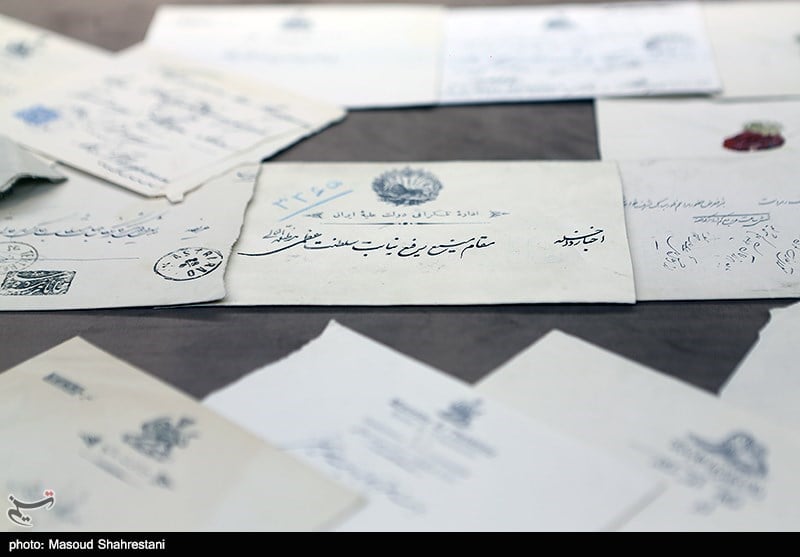
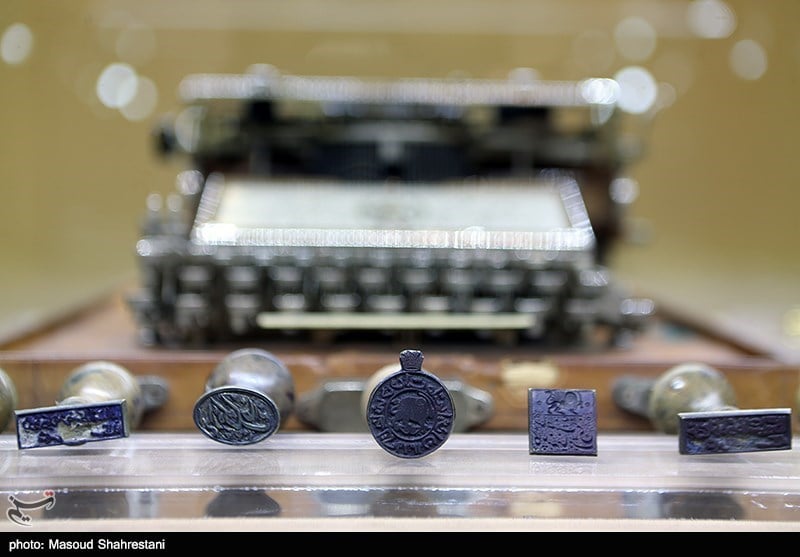
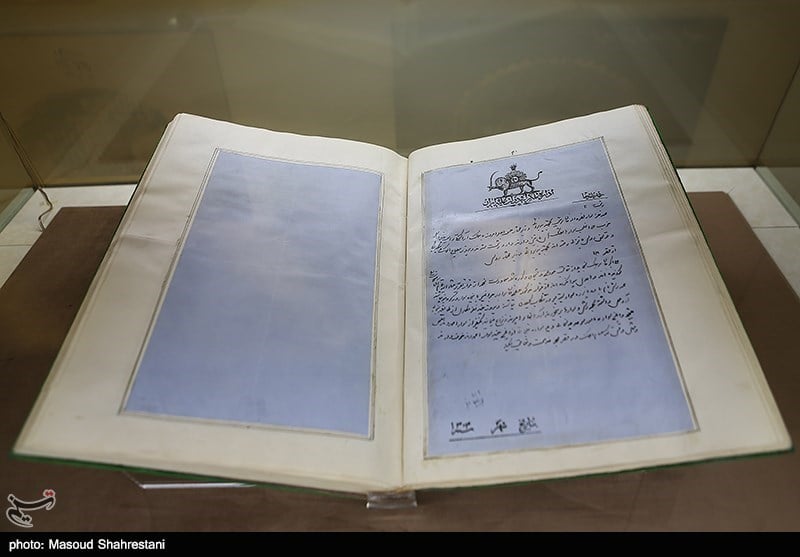
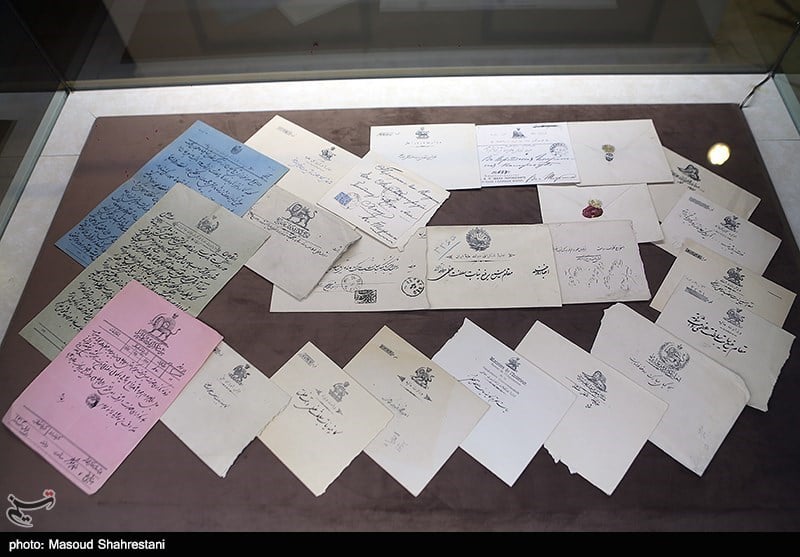
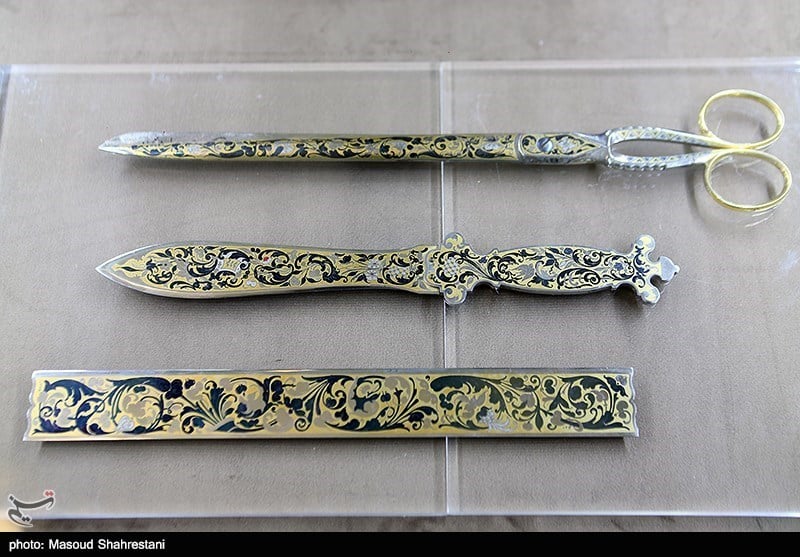
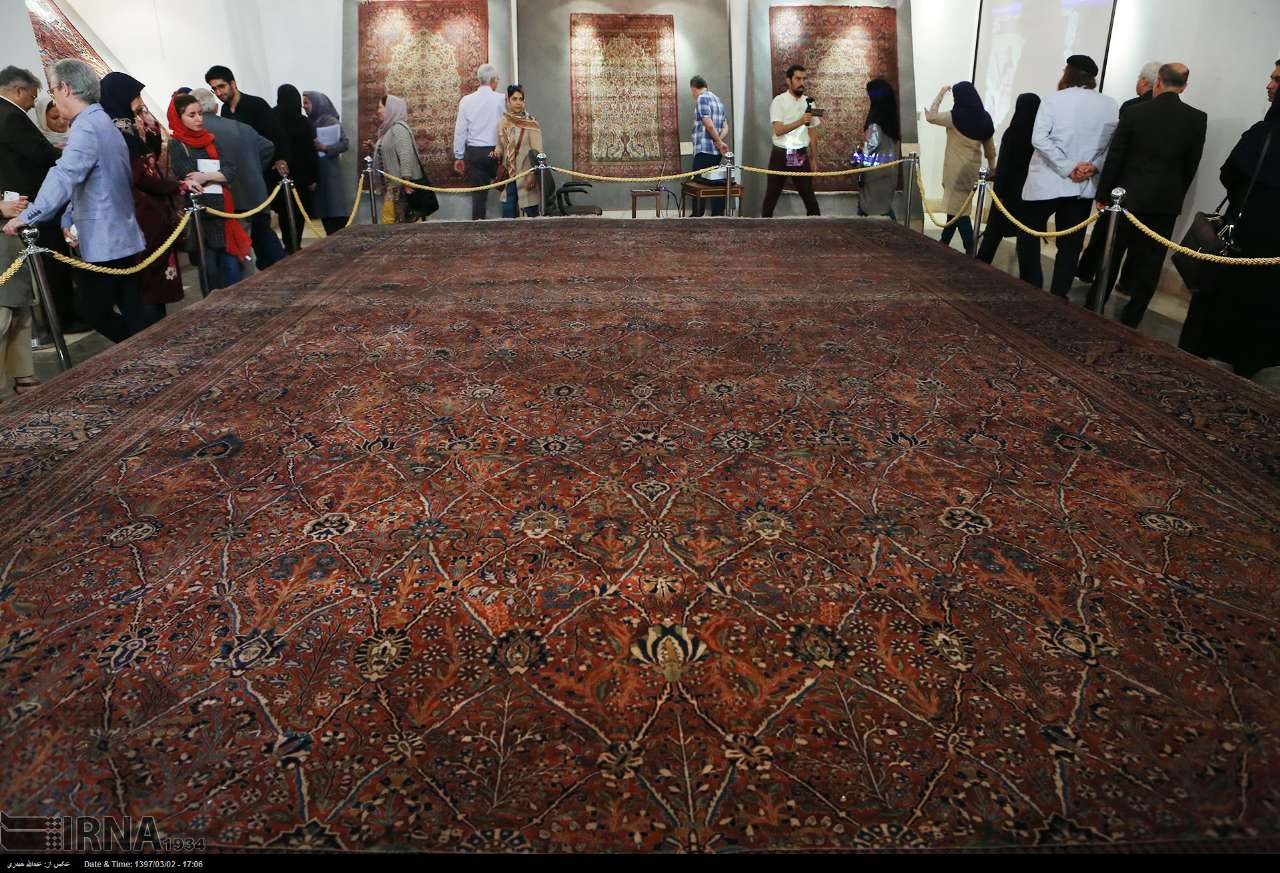
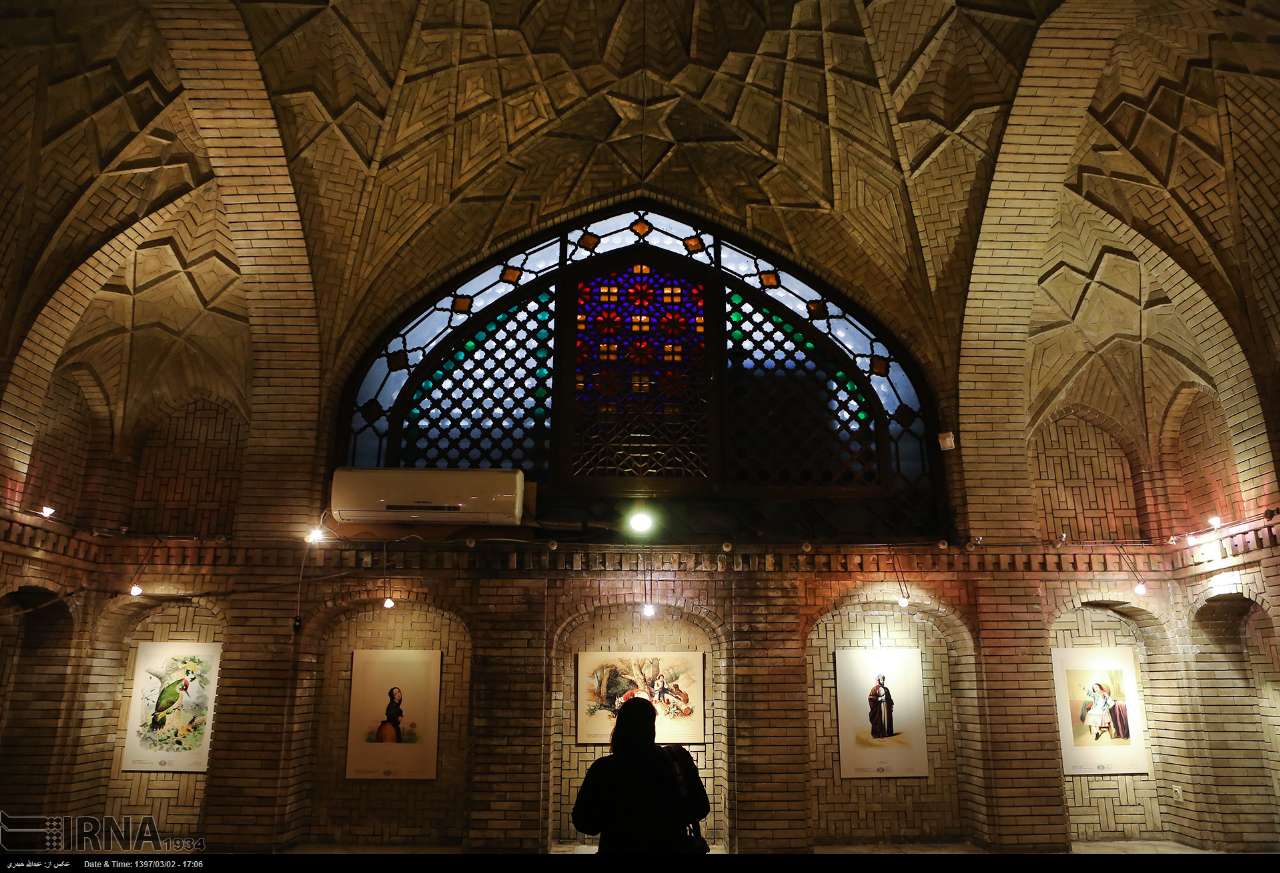
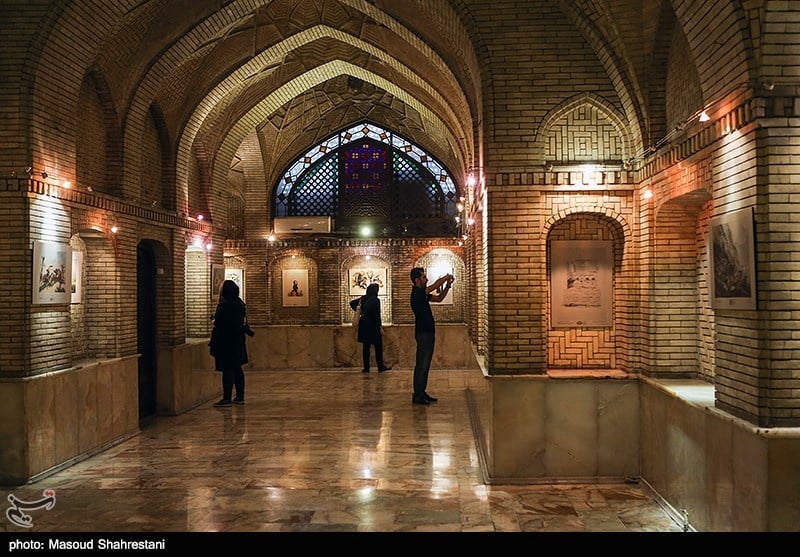
Qajar Relics on Show in Tehran’s Golestan Palace

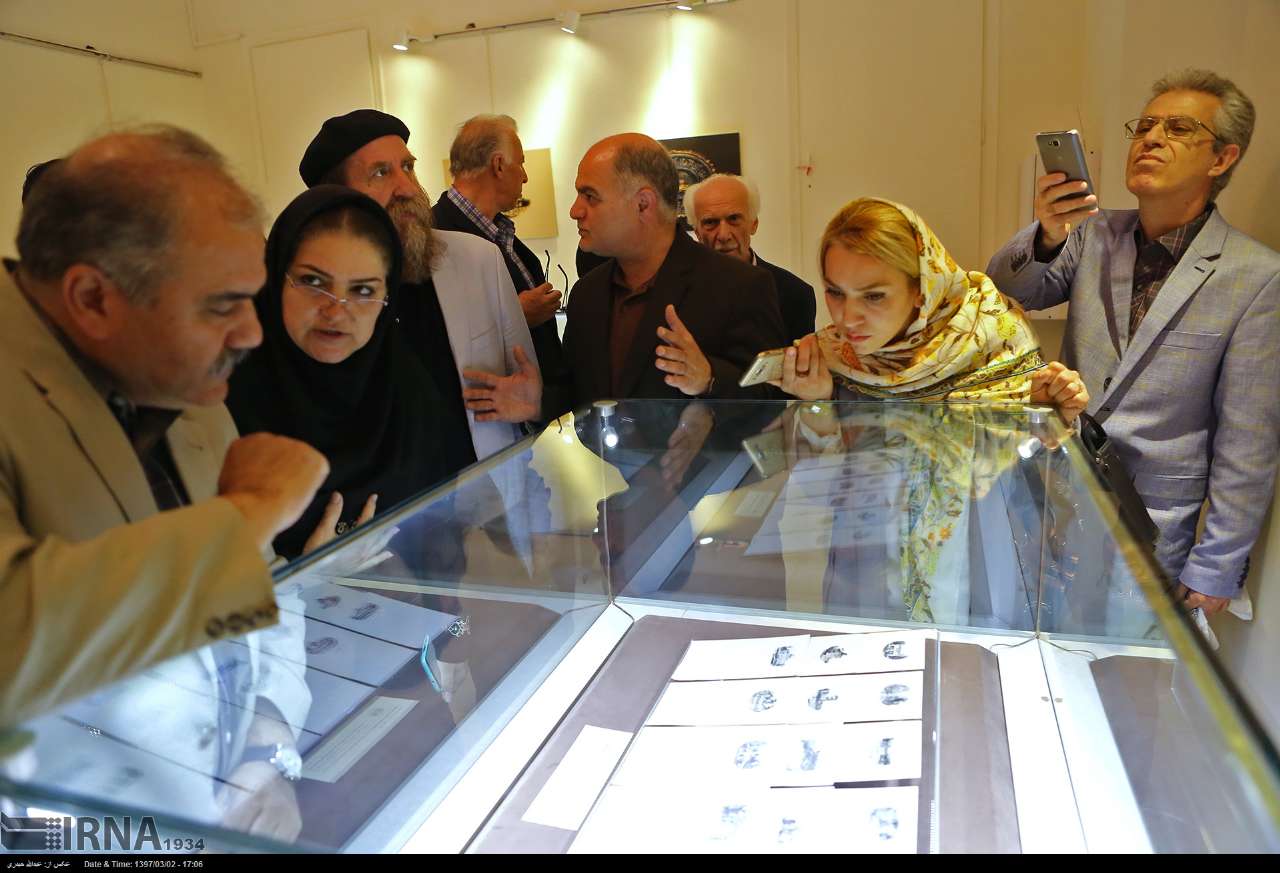
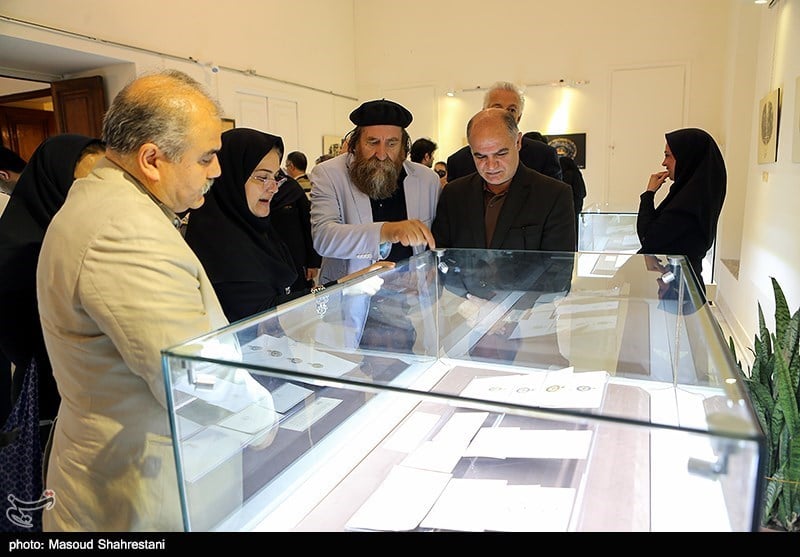
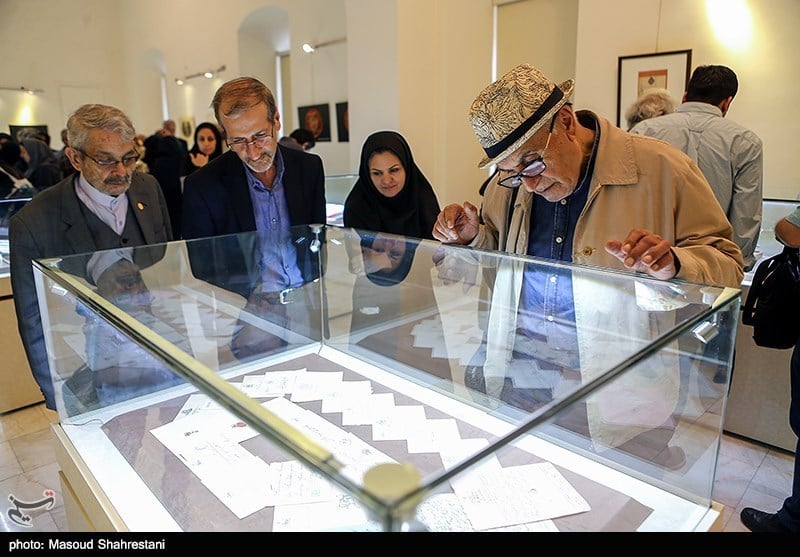
The three exhibitions started on the National Week of Cultural Heritage on May 24 and will be open to visitors until June 7, reports Tasnim News Agency.


Excerpts of Qajar Letters

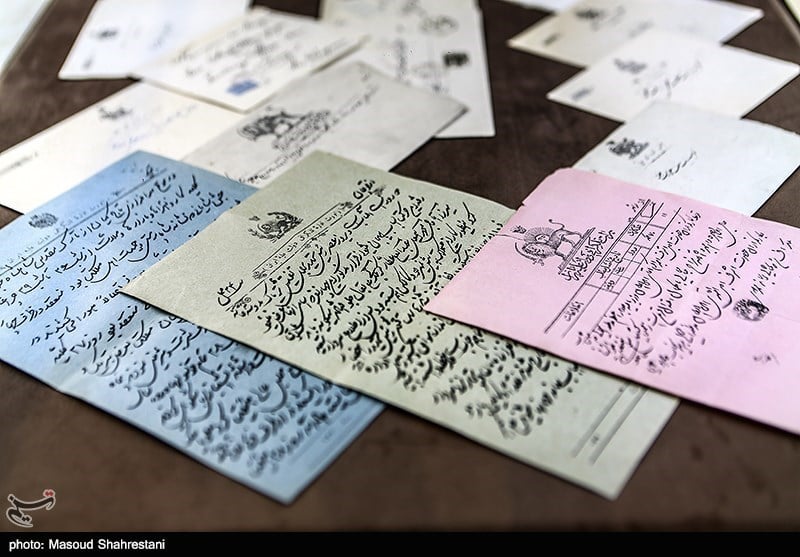
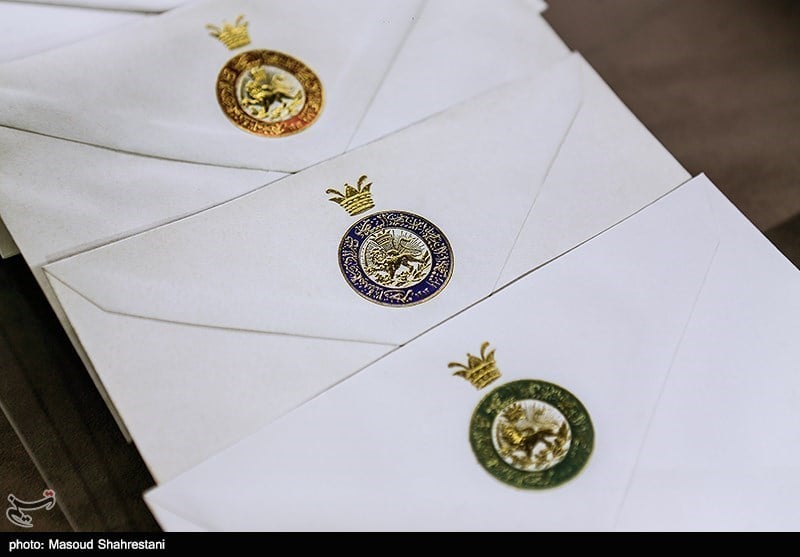
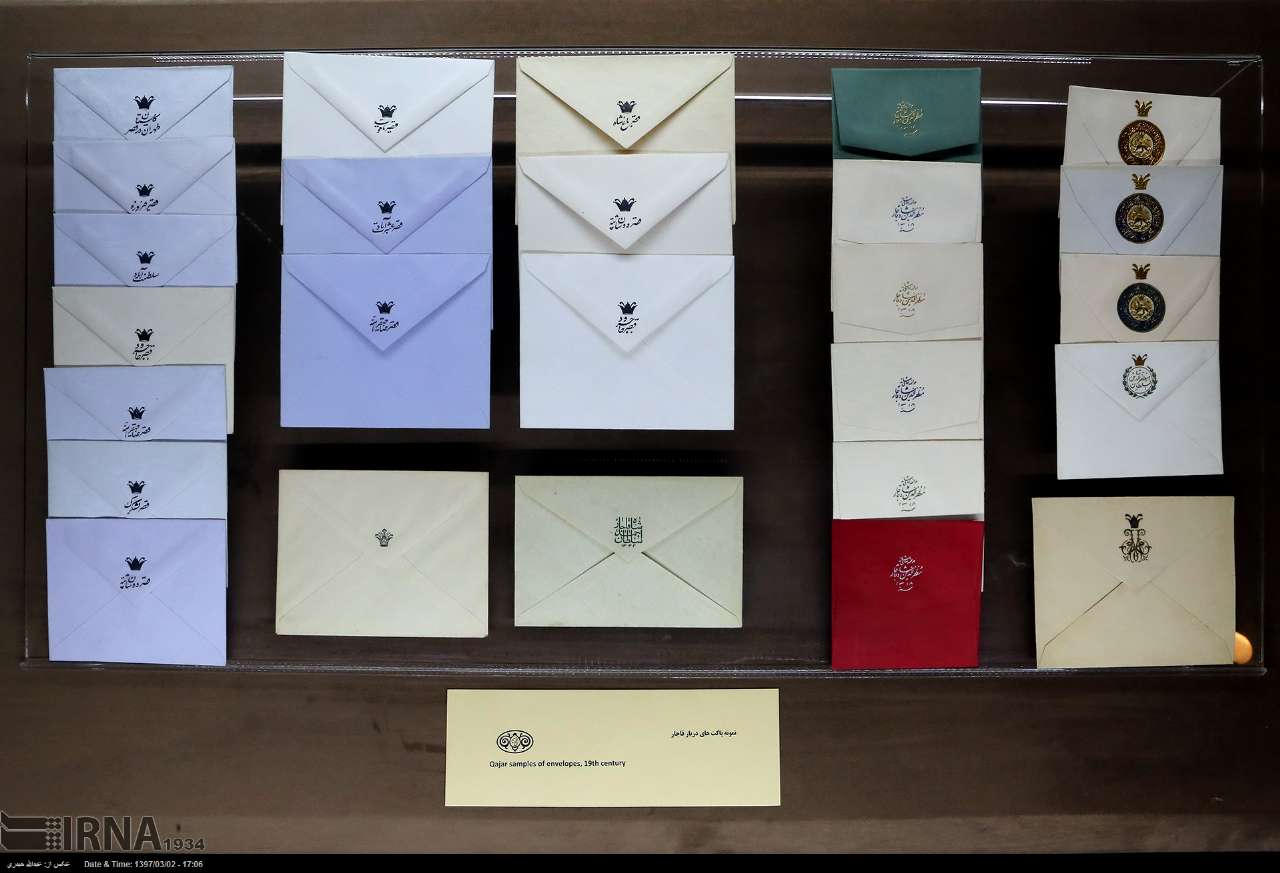
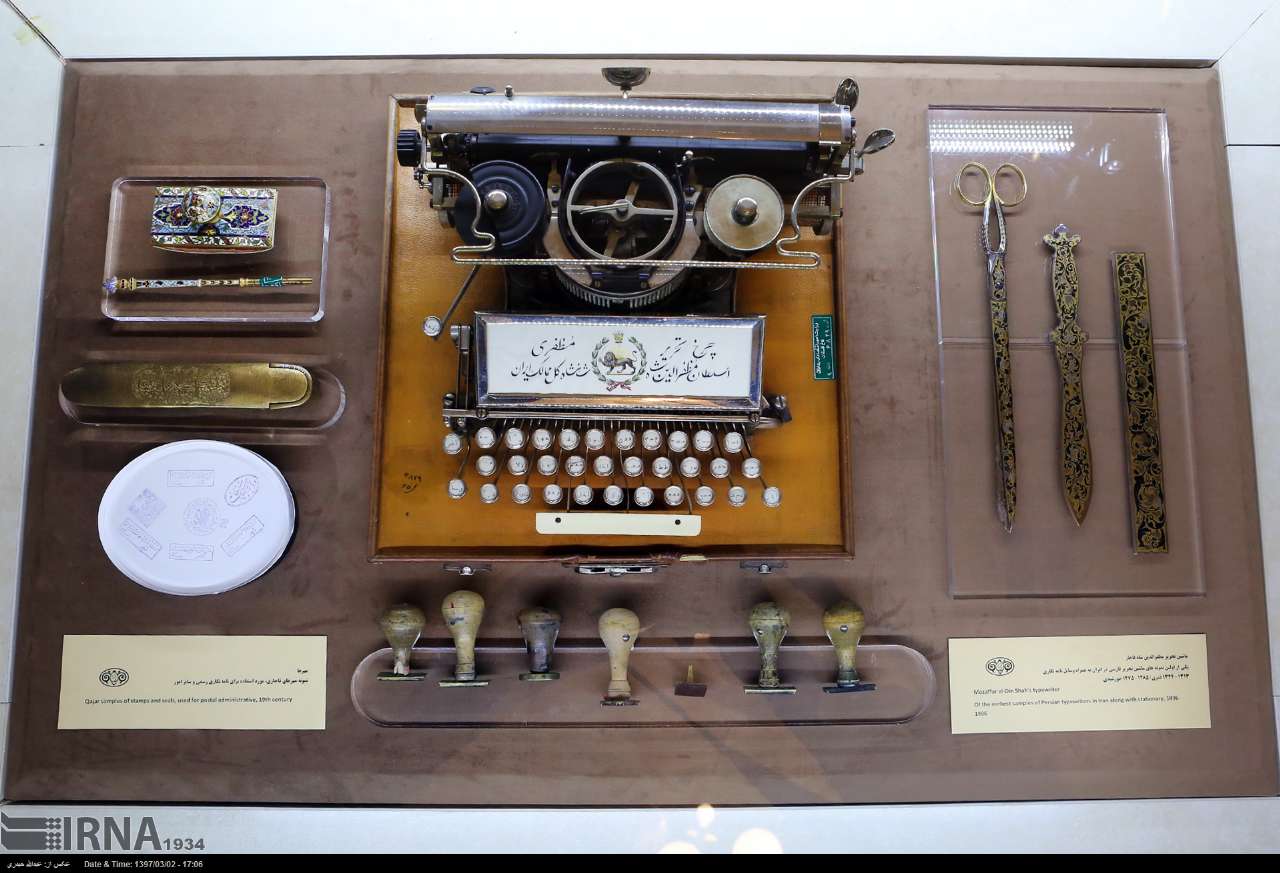
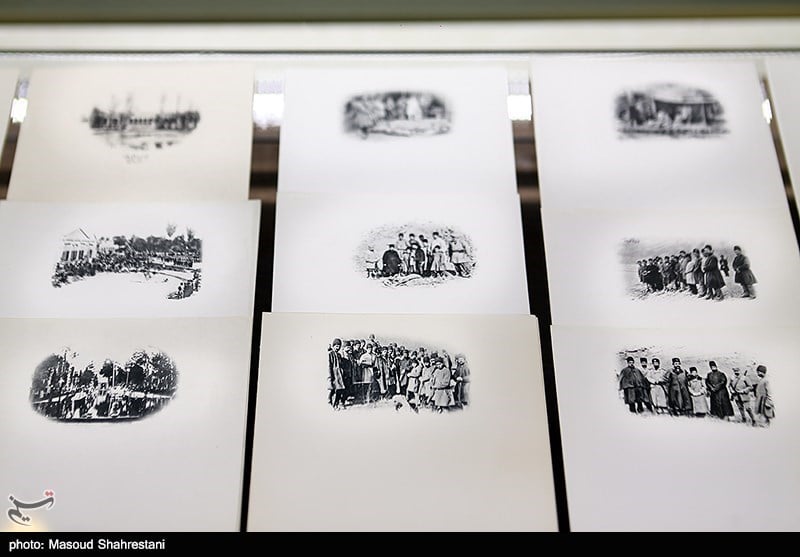
In the “Excerpts of Qajar Letters” exhibition, for the first time Qajar letterheads have been put on show.

Masoud Nosrati, the Head of Golestan Palace Complex, says, “The influence of European civilisation institutions during the Qajar period, its impact on the arts and culture of Iran on the one hand, and the taste, talent and innovations of Iranian artists and brokers on the other hand had significant effects on envelopes and letterheads.”

“The establishment of a post-modern European-style system started in Nasser al-Din Shah’s time, and one of the features of the Qajar period is the confrontation between tradition and modernity.”

“The oldest works are the envelopes and letterheads of Mozaffar ad-Din Shah and Nasser al-Din Shah eras’ labels along with about 60,000 envelopes and letterheads that have been used or not used in the Qajar period,” added Nosrati.

“The introduction and use of illustrated letterheads in the world dates back to the early 20th century,” he said, adding that the letterheads arrived in Iran with Mozaffar ad-Din Shah who used them in his letters.

“Of course, these labels were ordered according to the taste of Iranians.”

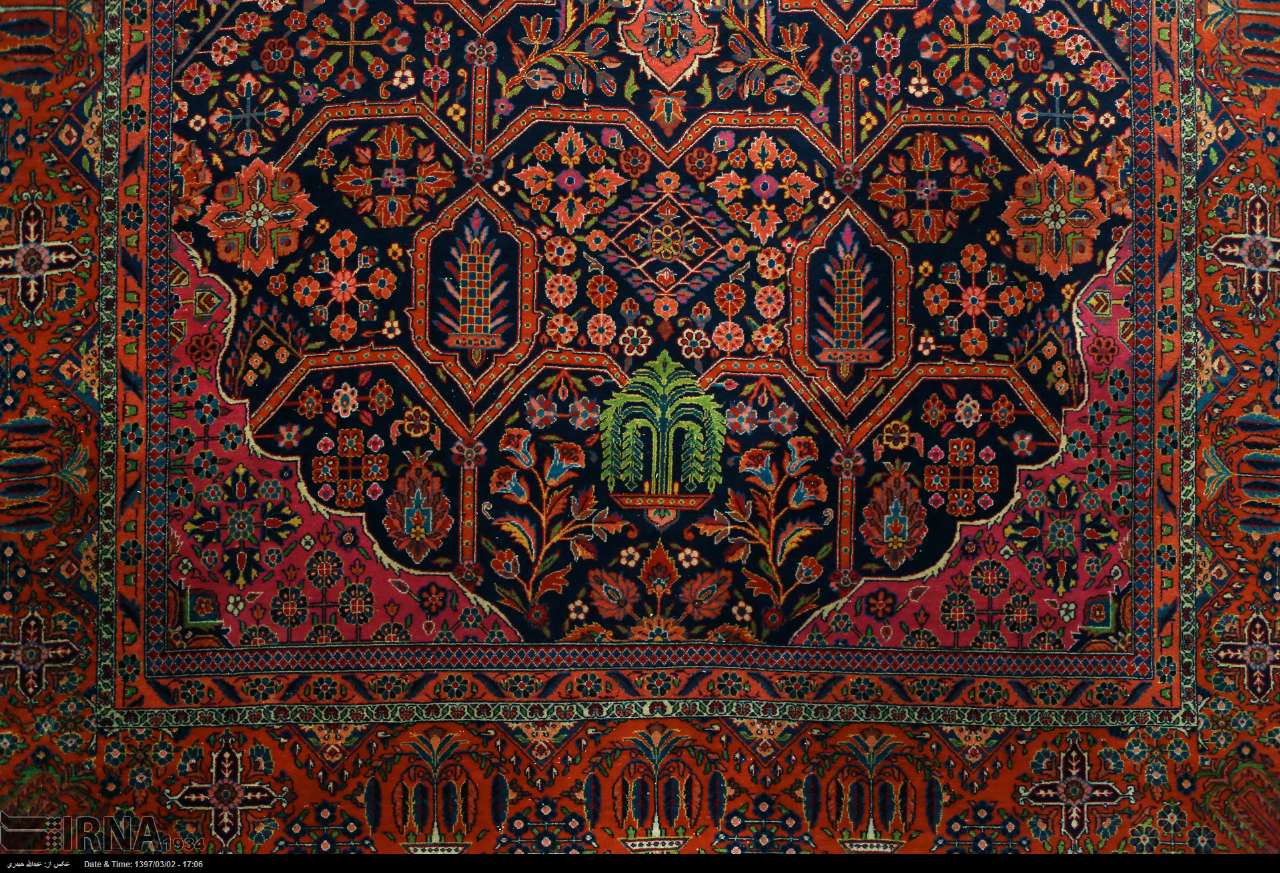
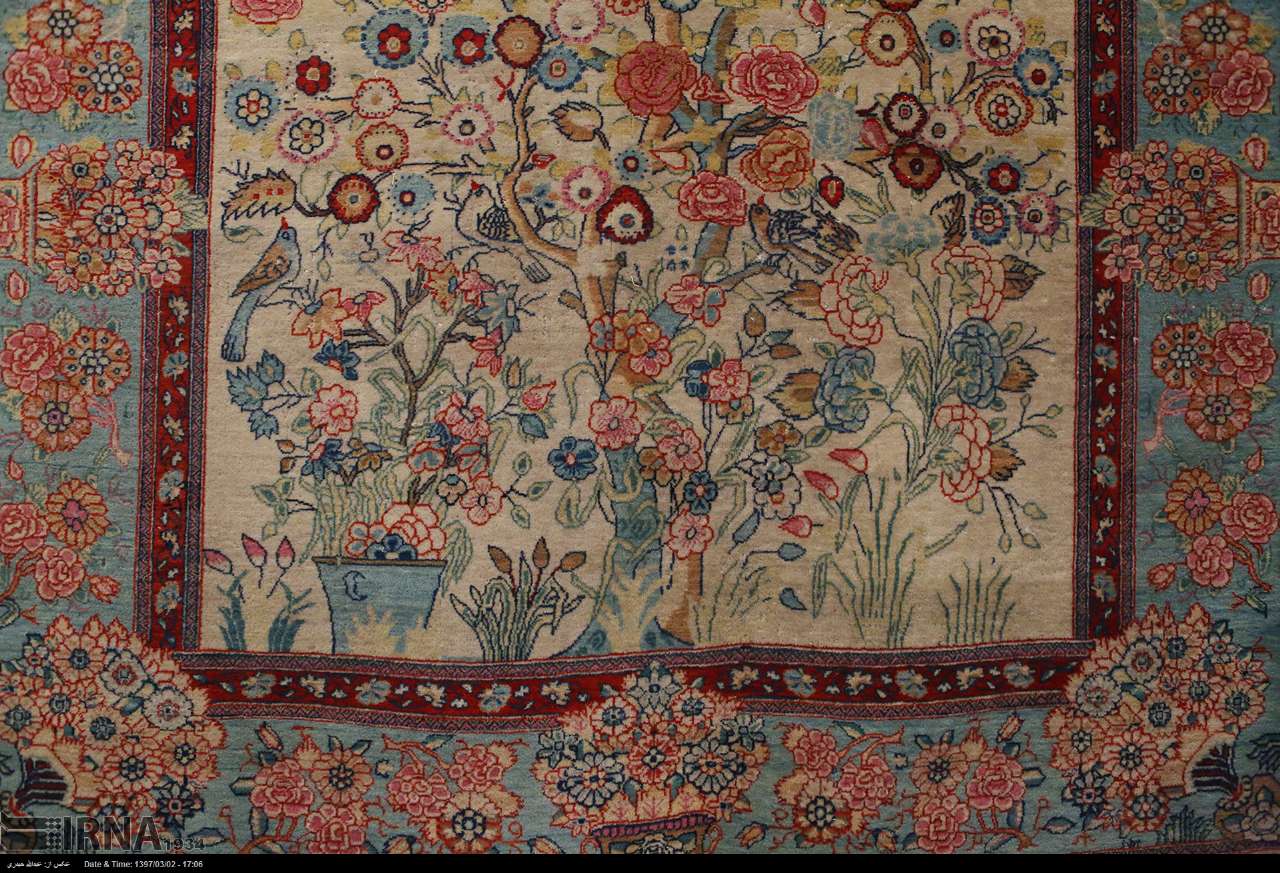
Kashan Rugs

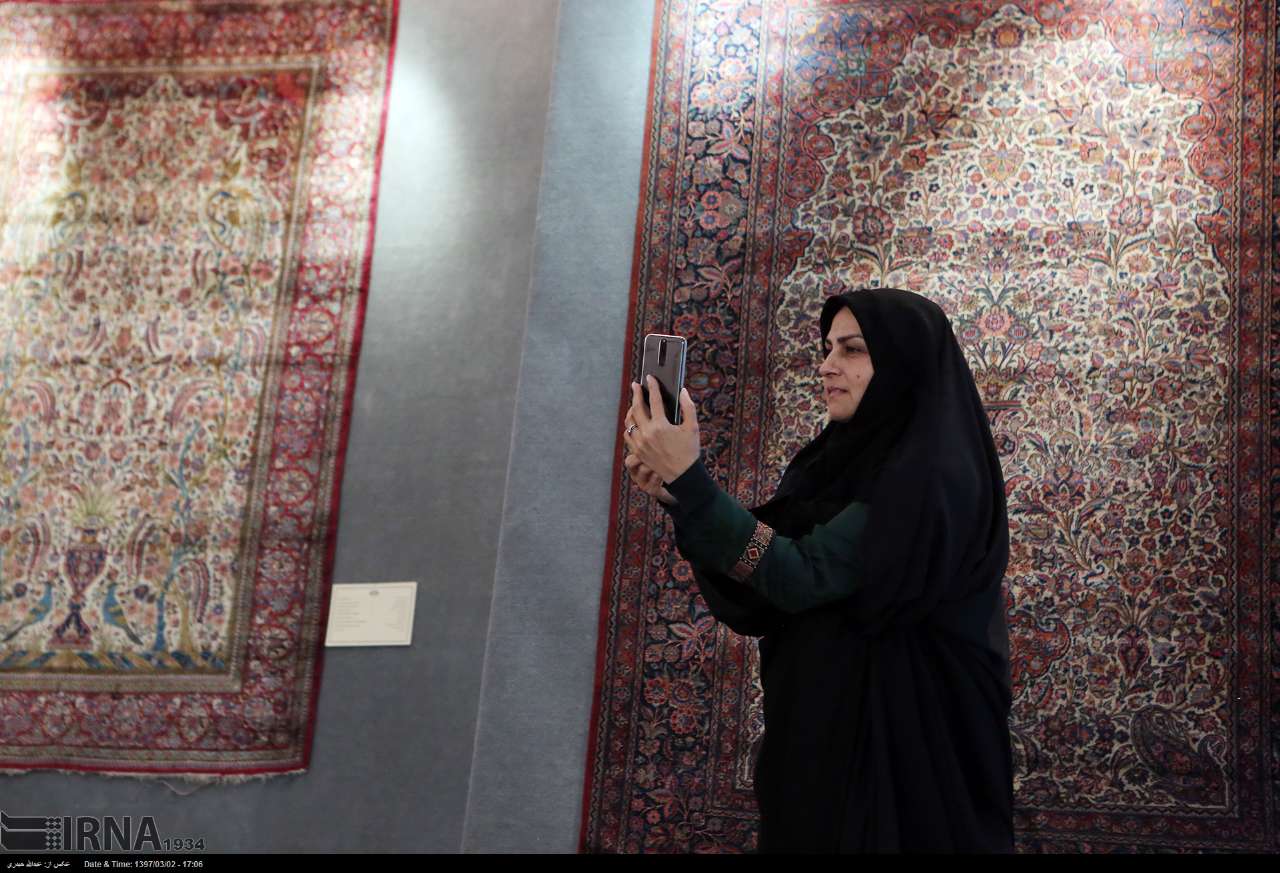
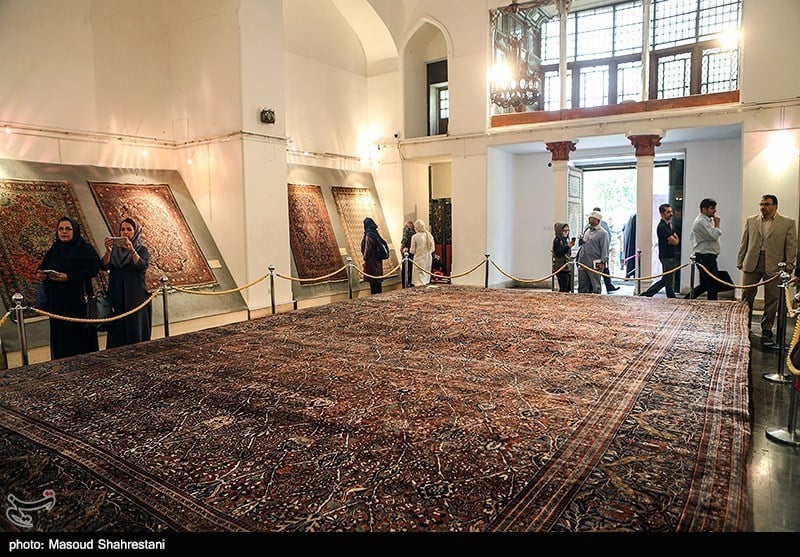
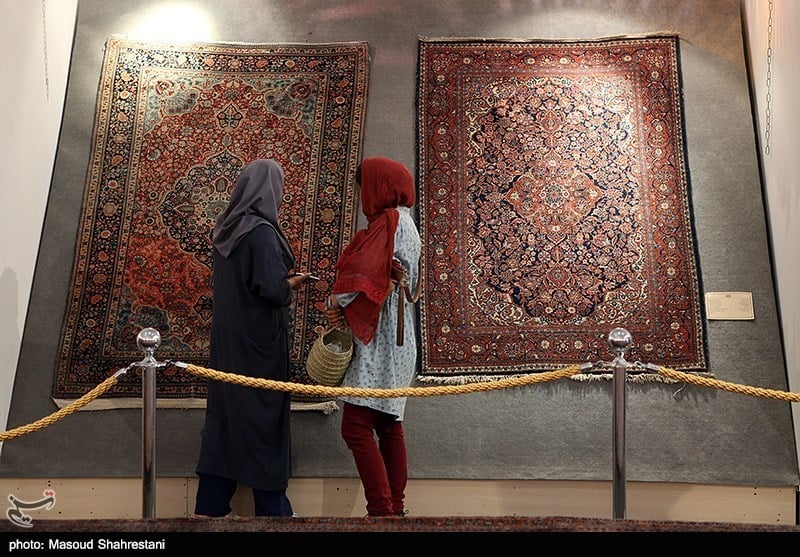
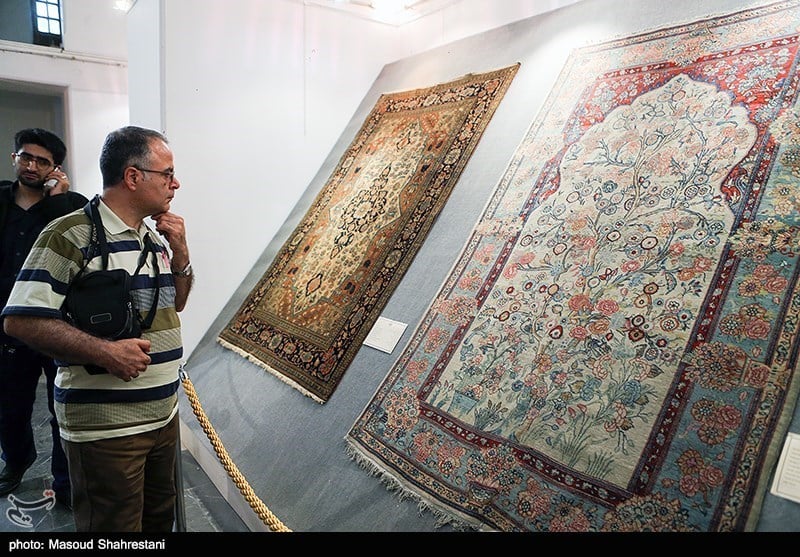
Another exhibition is called “Kashan Rugs in the Palace, Their Effect in Other Regions.” The city of Kashan, which has played a major role in restoring the art of carpet weaving in Iran, is one of the cities whose carpets have always been on the show in museums. Carpet weaving in this region is mostly practiced in Kashan and its suburbs Natanz and Joshaghan. The carpets of Kashan are distinguished by their delicate texture and gentle wool.

Kashan’s rug designs are influenced by the traditional designs of Isfahan and Iran. In the designs of these carpets, flowers and bouquets and simpler designs related to cloths are used more.

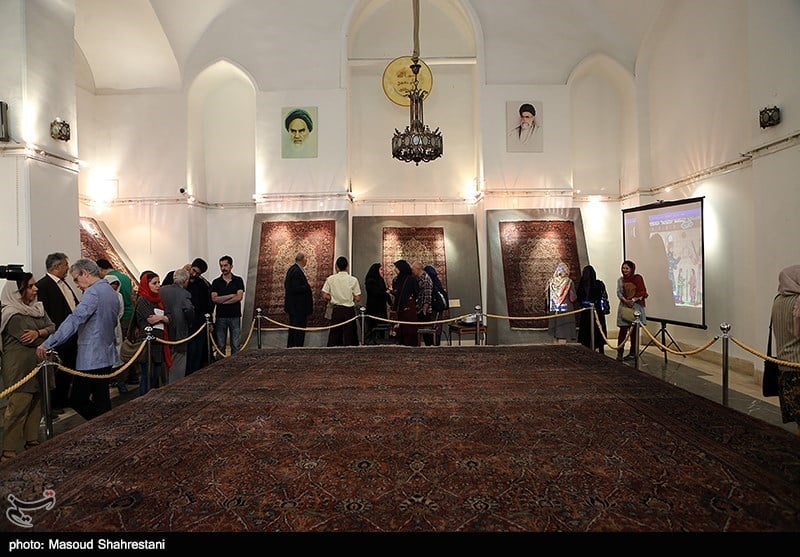
There are 13 carpets and rugs in this exhibition, among which there is a Mohtasham carpet and a rug woven from Manchester wool.

So far, three carpet exhibitions have been held in the palace on themes such as “Selections of Qajar Rugs”, “Garden Carpets” and “Malayer Carpets.”

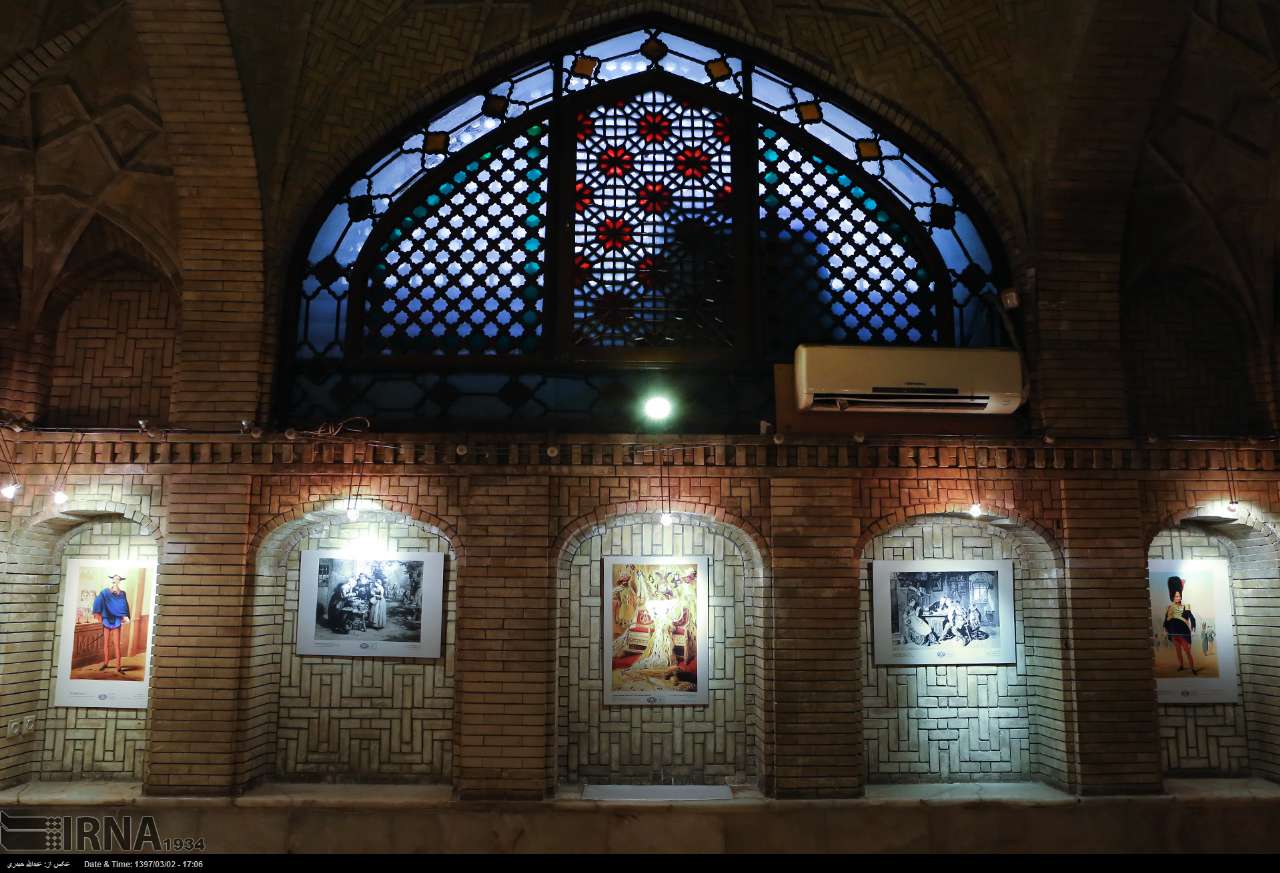
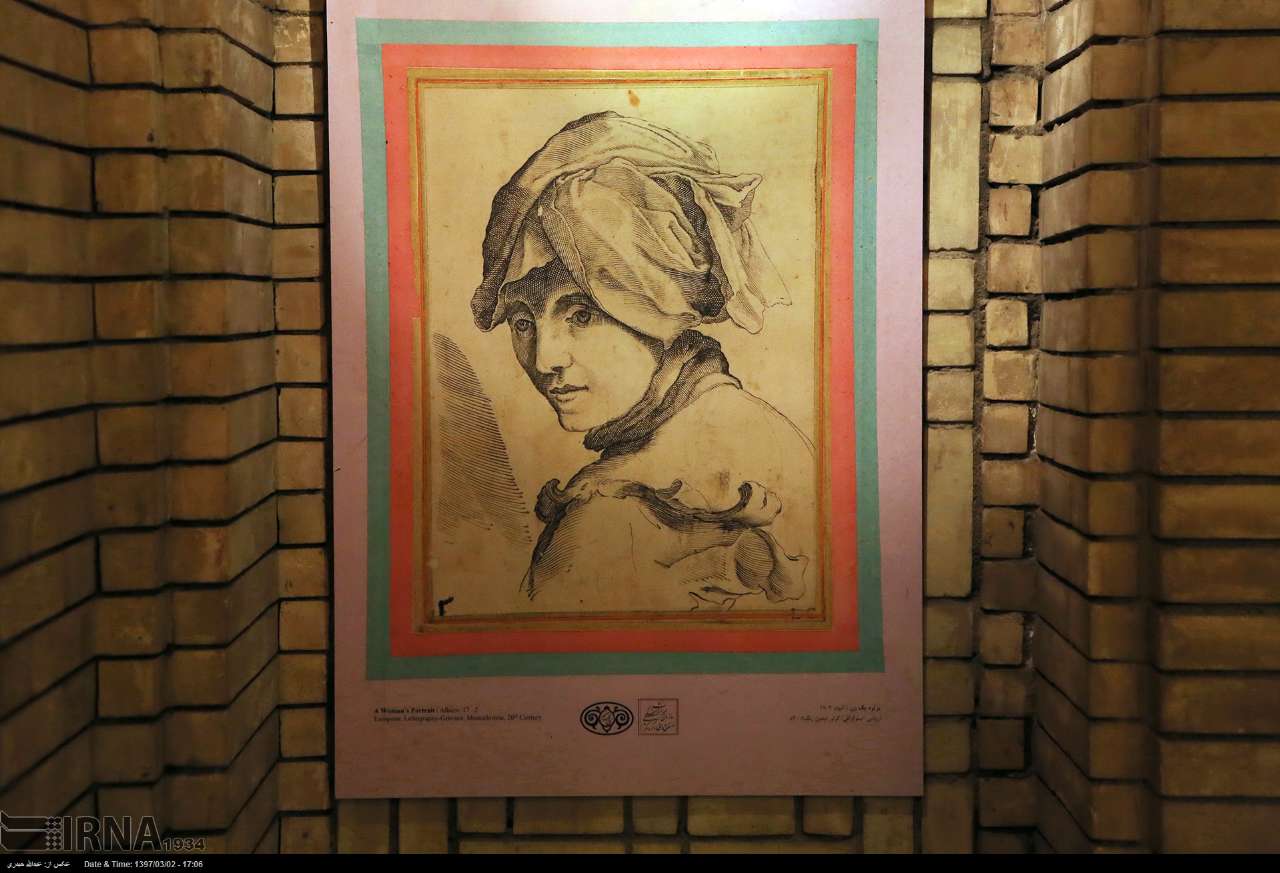
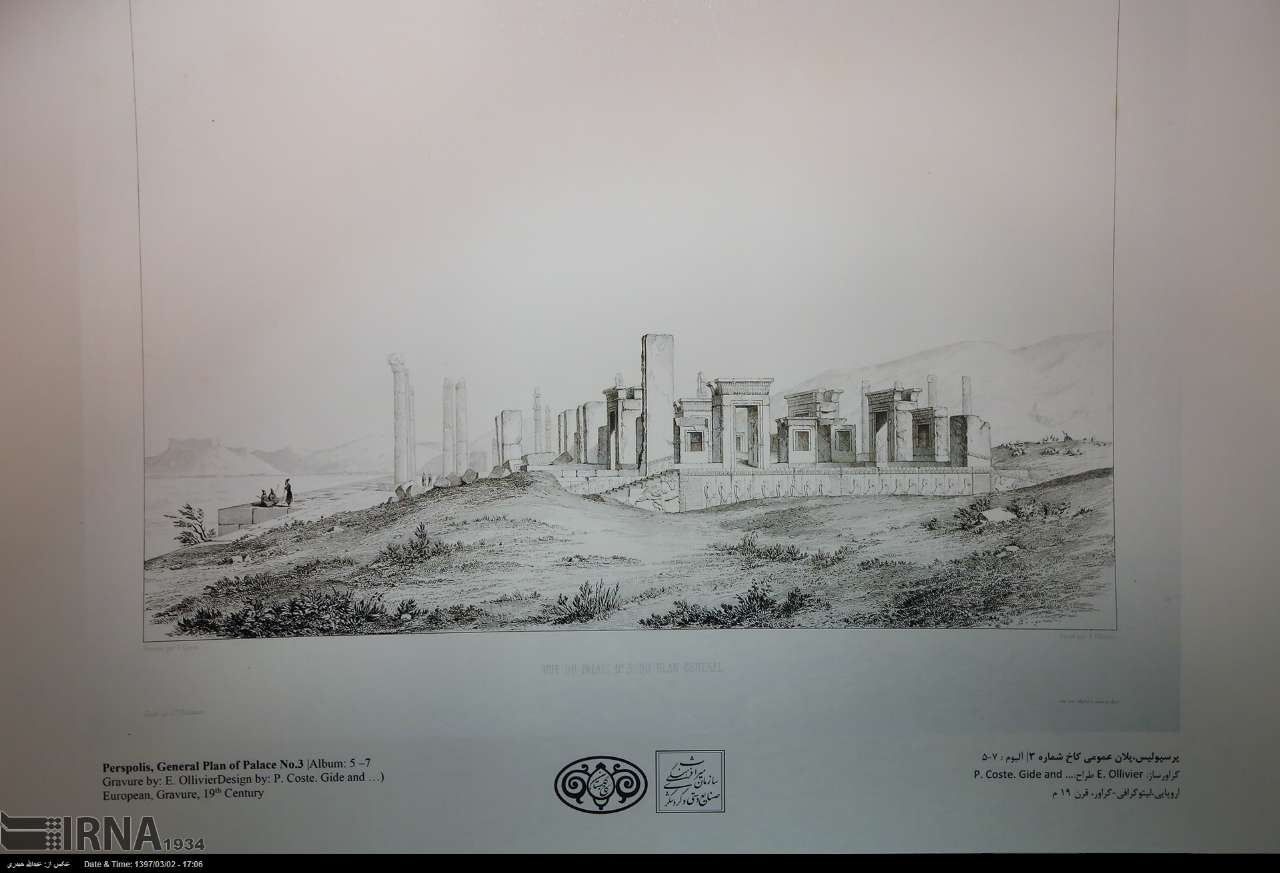
Exhibition of Printed Photos

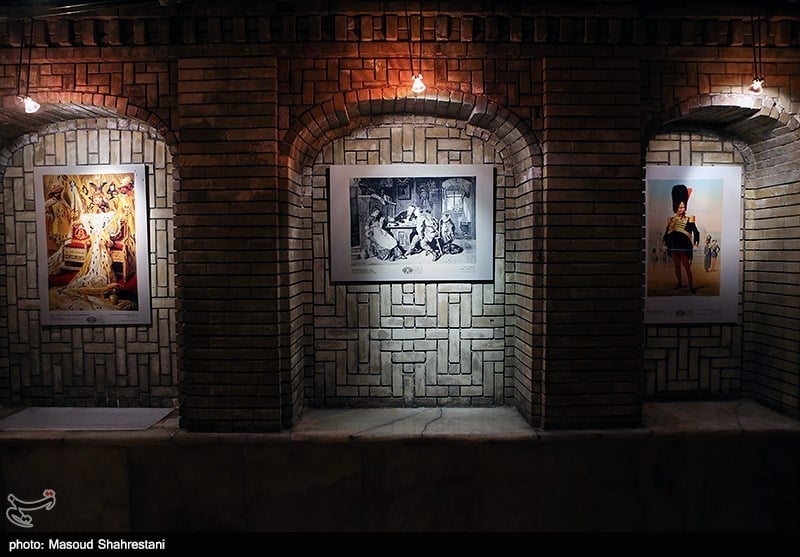
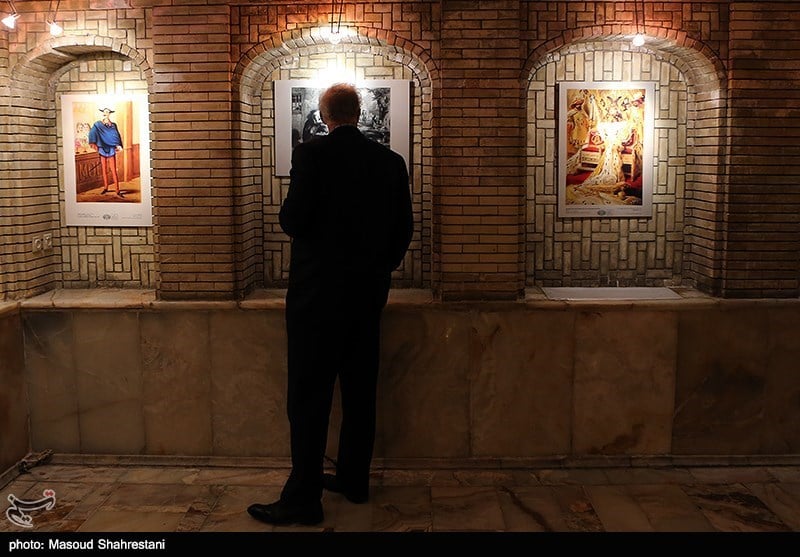
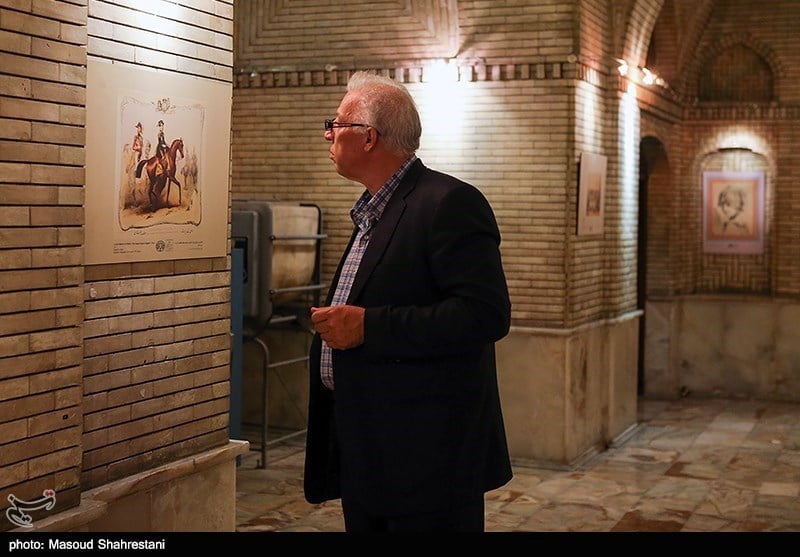
Another exhibition underway in Golestan Palace is called “Exhibition of Printed Photos.” The exhibit features 30 pieces of lithographs and techniques of printing. These techniques are European and belong to the late 18th and 20th centuries. The topics include the introduction of princes, Napoleon Bonaparte, an Ottoman woman, a French girl, a village celebration, an infantry unit, a church view in Moscow, some scenes of a fountain, various tribes and birds including parrots and woodpeckers.

The exhibitions are open to visitors from 9:00 am to 18:00 pm.

Return of Stability to Syria, Iraq Rings Alarm Bells in Israel

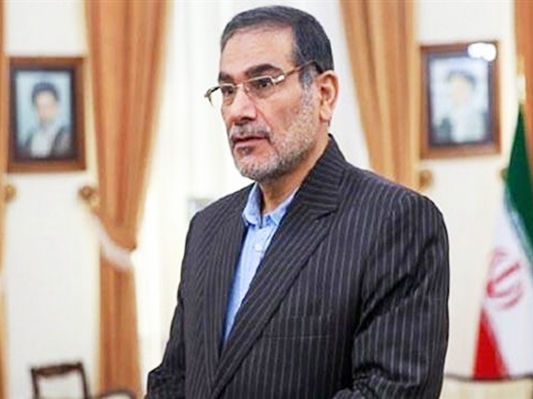
“The return of security to Syria and Iraq is an alarm that the golden security of the Zionist regime is about to end,” Secretary of Iran’s Supreme National Security Council Shamkhani said on Sunday.

This will once again turn the issue of Palestine into the top issue of the Muslim world, he was quoted as saying by Fars News Agency.

The official said the recent escalation in Israeli violence against Palestinians results from anger among Israeli leaders whose plans to provoke infighting among Muslim countries have failed.

Since March 30, at least 120 Palestinians have been killed and thousands more injured by the Israeli army’s gunfire near the Gaza-Israel border fence.

“The increase in Israeli violence against the oppressed people in Gaza and the West Bank is a reactive response to the defeat of the plan to use Takfiri terrorists to provoke clashes in the Muslim world and deplete resources of Muslim countries,” Shamkhani said.

Takfiri terrorists are hardliners inspired by Wahhabi ideology who believes followers of some Islamic sects, including Shiite, are apostates punishable by death.

Wahhabism is the trademark of lots of terrorist groups operating in the Middle East, including ISIS.

Iran says ISIS was created under a plot by Israel, the US and their allies to disintegrate West Asian countries and protect the Israeli regime.

The liberation of last cities under ISIS control in Syria and Iraq late last year effectively marked an end to the self-proclaimed ISIS “caliphate”, established in 2014, after the Syria-based terror group captured large swathes of Iraq in a lightning offensive.

The end of ISIS, along with a significant drop in violence in Syria thanks to a December 2016 ceasefire, has raised hopes that a solution to the conflict will be soon in sight.

Earlier this year, Syrian government forces managed to drive militants out of all territories near the capital Damascus.

Practicing Muslims Won’t Negotiate with Israel
Shamkhani further rejected media reports that Iranian officials have held a meeting with Israeli intelligence agents in the Jordanian capital Amman, describing it as a “baseless” rumour aimed at legitimatizing the Israeli regime and weakening the will of resistance movements fighting the regime.

“A believing Muslim who always sees himself before God will by no means be ready to sit for talks with Zionists who are a symbol of impurity and absolute evil,” he said.

On Sunday, London-based Arabic-language news outlet Elaph, which is owned by a Saudi businessman, quoted a “participant” at the alleged meeting as saying that Iran’s ambassador to Jordan, along with several Iranian security officials, had met with Israeli intelligence agents in Amman.

According to Elaph, the two sides agreed at the meeting that Hezbollah and other resistance forces would refrain from taking part in any future conflict between the Syrian government and militants near the Jordan-Syria border.

The report came amid calls by Israel that what it calls “Iranian forces’ should be kept away from its borders with Syria.

This is while Iran and Syria have denied the claim that Iranian forces are operating in the area.

Russia said last week that only Syrian army troops should be on the country’s southern border with Jordan and Israel.

Shamkhani said on Saturday Iran supports a Russian-led effort to impose Syrian government control over the south of Syria.

“We strongly support Russian efforts to drive terrorists out of the Syria-Jordan border and to bring the area under Syrian army control,” Shamkhani told the Shargh daily.

Qatar Blasts Efforts to Drag Regional States into War with Iran

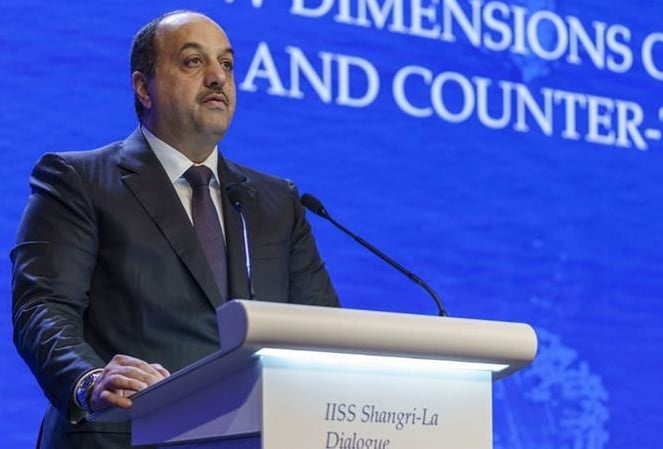
Deputy Prime Minister and Minister of Defence Khalid Al Attiyah told an international security conference in Singapore on Sunday that Qatar has “a lot of differences” with Iran but it does not mean “we go and fuel a war” in the region.

“Is it wise to call the United States and to call Israel to go and fight Iran? … Whether any third party is trying to push the region or some country in the region to start a war in Iran, this will be very dangerous,” he said, as reported by Fox News.

He did not name any party but could be referring to Iran’s rival Saudi Arabia, which has also led a blockade of Qatar with its Persian Gulf allies since June last year, accusing Doha of supporting extremists and refusing to cut ties with Tehran.

“Iran is next door. We should call Iran, put all the files on the table and start to discuss to bring peace rather than war,” he said in the speech.

Responding to a question whether Qatar’s air bases could be used to launch airstrikes on Iran, al-Attiyah said that his country was not a “fan of war” and supported engagement and dialogue.

Qatar is hosting 10,000 US troops stationed at sprawling al-Udeid Air Base as part of its so-called campaign against the ISIS group and the war in Afghanistan.

Al-Attiyah called for salvaging a 2015 nuclear accord between world powers and Iran that offered Tehran sanctions relief for curbs on its nuclear program. The US withdrew from the deal last month.

“Everyone should keep holding on to this and advance with this. In my own judgement, I think the United States is wiser than to enter in a war with Iran,” he said.

Iran, Saudi Arabia Reach Deal on Hajj 2018

Iran Officially Declares Cancellation of This Year's Hajj Pilgrimage

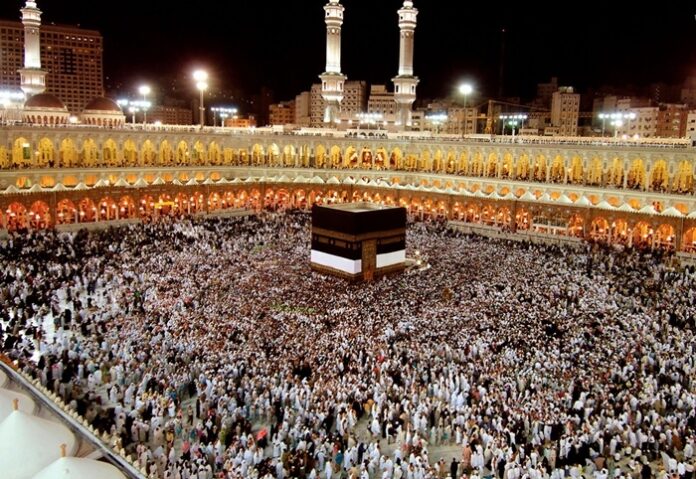
Salehi on Sunday noted Iran and Saudi Arabia have already signed an agreement on some terms of Hajj 2018.

To prepare the ground for this year’s Hajj, an Iranian delegation made several visits to Saudi Arabia for talks with Saudi officials on the terms of Hajj 2018, Salehi was quoted as saying in a report by Tasnim News Agency.

He said the delegation has prepared the ground for this year’s Hajj, adding the two sides held constructive negotiations over the past months.

“So far the talks have been going on smoothly without any serious problems. We hope they keep going on in the same manner in the future,” he said.

Salehi noted that the Iranian government is seeking to provide Iranian pilgrims with the greatest satisfaction and to achieve the goal, neither the Minister of Culture and Islamic Guidance nor other related organizations will leave no stone unturned.

Last year, about 85,000 Iranian pilgrims visited Saudi Arabia for Hajj rituals. According to Iranian officials the number will reach 90,000 this year.

The first group of Iranian pilgrims will leave for Saudi Arabia for Hajj rituals on June 17.

Iranian pilgrims couldn’t attend the great religious gathering in 2016 as the Saudi officials failed to ensure security for them based on provisions made by the Iranian officials after the tragic incident in 2015.

Hundreds of Iranian pilgrims were killed during a stampede in 2015 Hajj annual congregation when, according to reports, two large groups of pilgrims arrived together at a crossroads in Mina, a few kilometres east of Mecca, on their way to performing the ‘Stoning of the Devil’ ritual at Jamarat.

Foreign Investment in Iran Soared by 49 Percent in 2017

The UNCTAD, a permanent intergovernmental body established by the United Nations General Assembly in 1964, publishes an important annual report that details the latest developments and data concerning foreign direct investments (FDI) around the globe.

The report is considered highly credible among economy experts and academic circles.

According to the latest UNCTAD report seen by Tasnim News Agency, Iran has attracted $5.019 billion in direct investment in 2017.

This is while according to the UNCTAD’s assessment the volume of FDI Iran attracted in 2016 was more than $3.372 billion.

Despite the surge, the level of Iran’s FDI intake is minimal when compared with the total world figure, $1429 billion, particularly when taking into account that Iran is the 18th biggest economy across the globe.

The incumbent administration has worked hard in recent years to attract foreign investment, which is seen as indispensable to revitalizing the Iranian economy and weaning the country of heavy dependence on oil revenues.

However, a big question mark hangs over the future of foreign investment contracts in Iran, following the US withdrawal from the 2015 nuclear deal, which removed international sanctions on Iran in return for confidence-building curbs on its nuclear program.

Washington has also threatened to impose the “highest level” of economic bans on the country unless it agrees to a list of 12 demands.

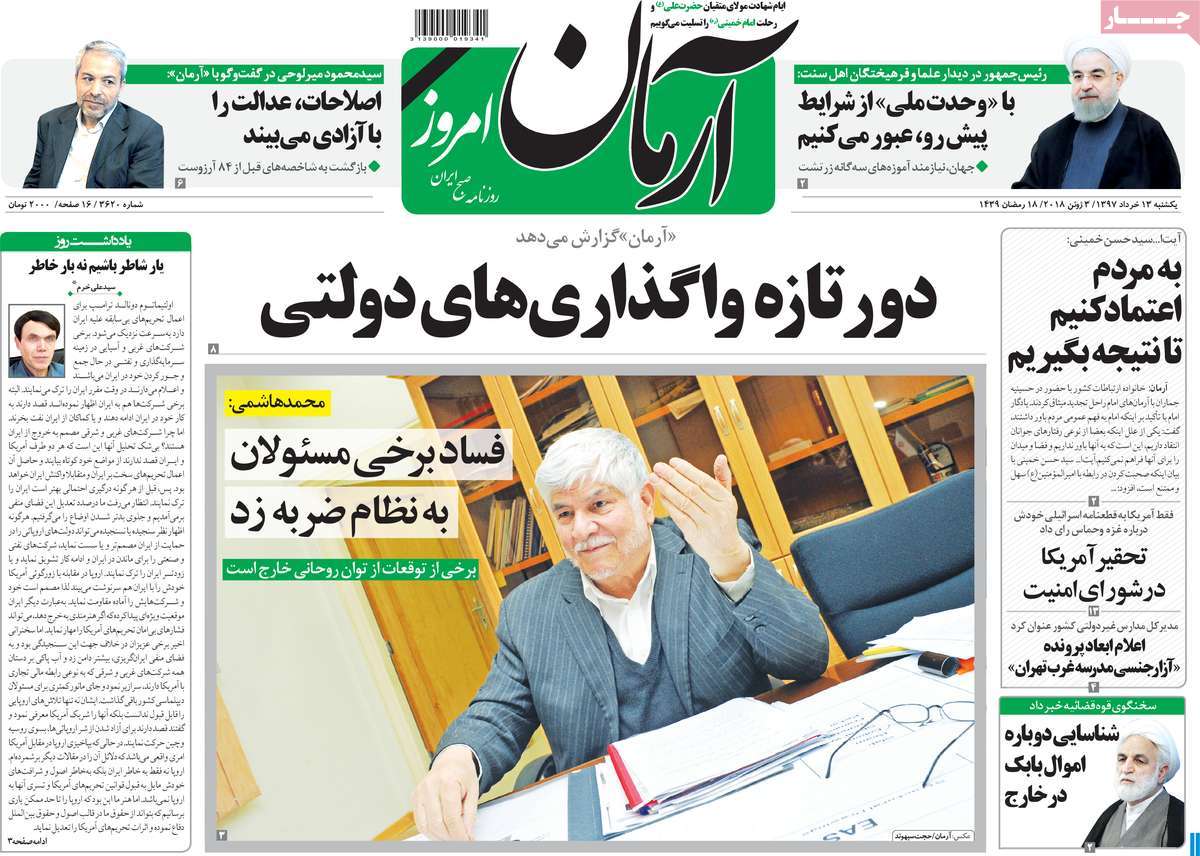
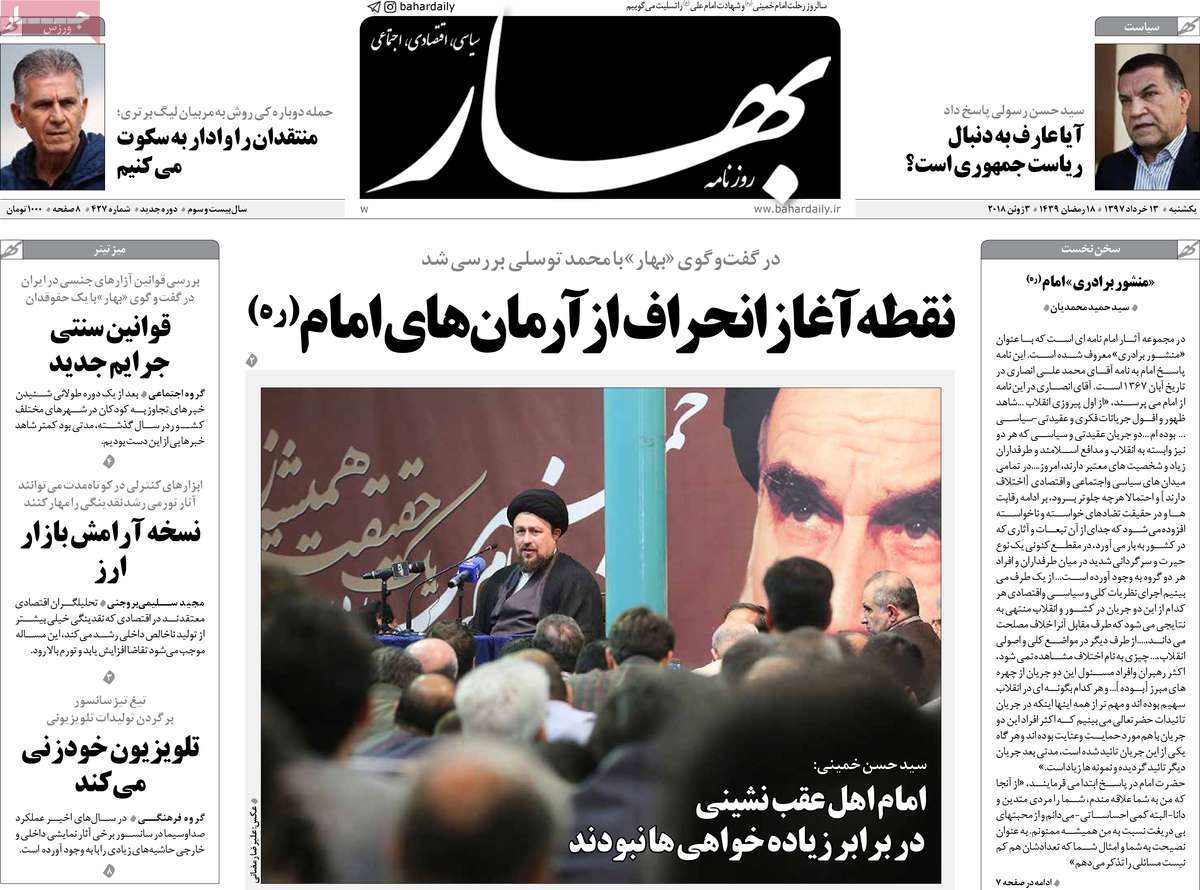
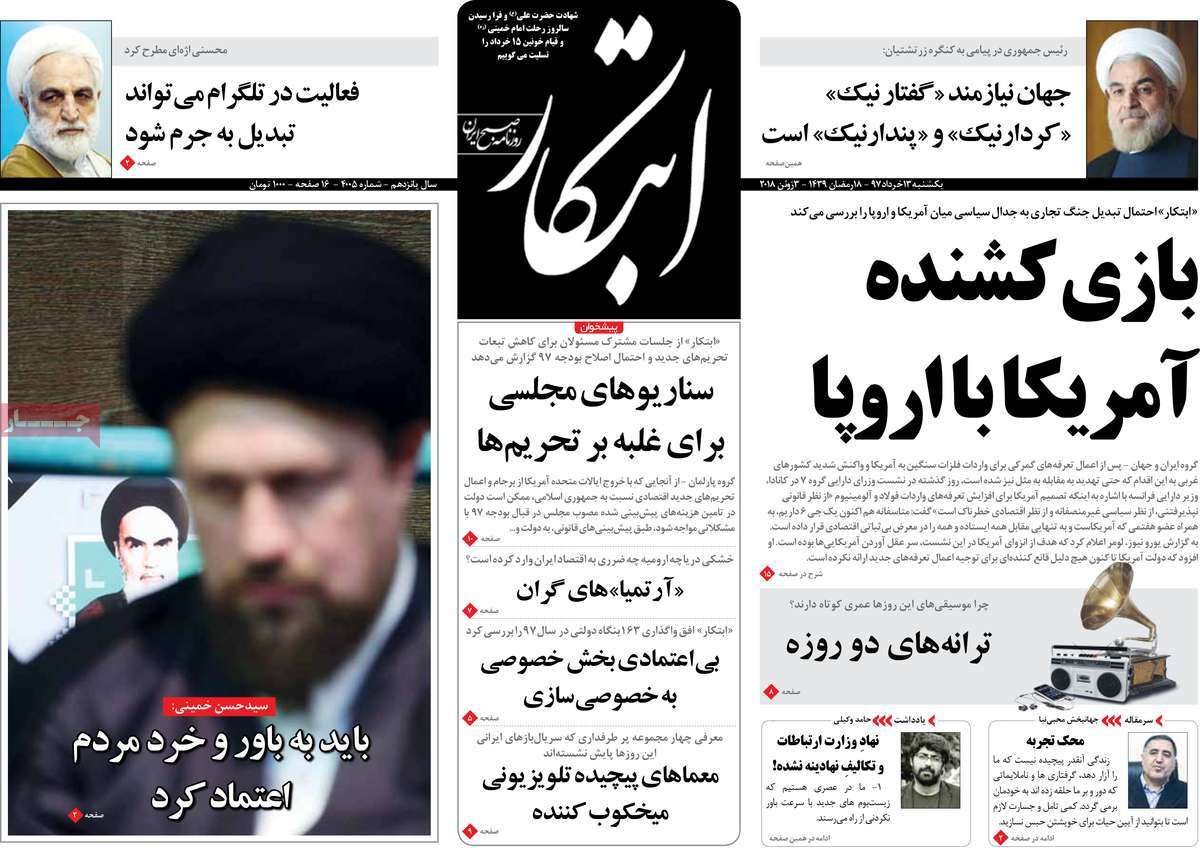
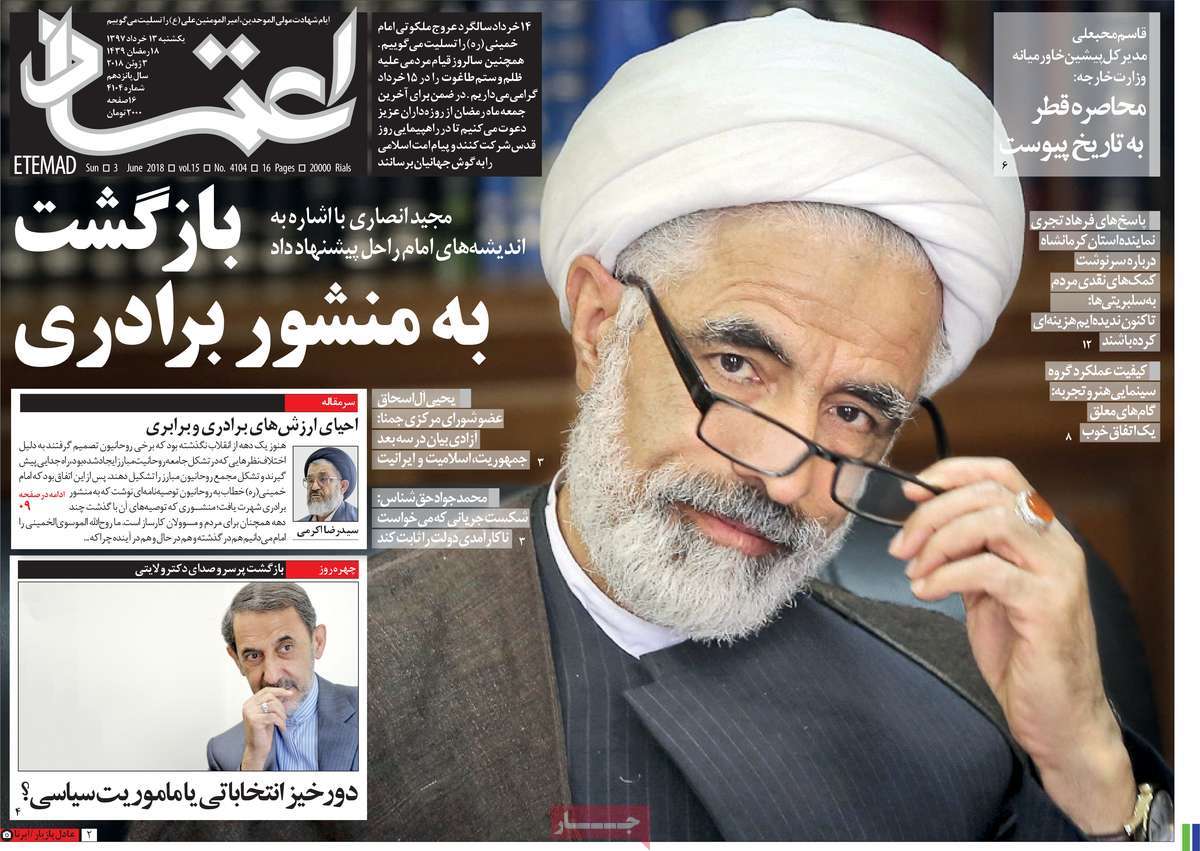
A Look at Iranian Newspaper Front Pages on June 3

A Look at Iranian Newspaper Front Pages on November 19

Several papers today continued to cover the imminent trade war between the US and the European Union, which will have to accept heavier tariffs to export its steel products to the US after a decision by President Donald Trump.

Also a top story today was the death anniversary of Imam Khomeini, the founder of the Islamic Republic, which will be marked on Monday in his mausoleum in southern Tehran.

Remarks by President Hassan Rouhani in a meeting with top Sunni clerics also received great coverage.

The above issues, as well as many more, are highlighted in the following headlines and top stories:


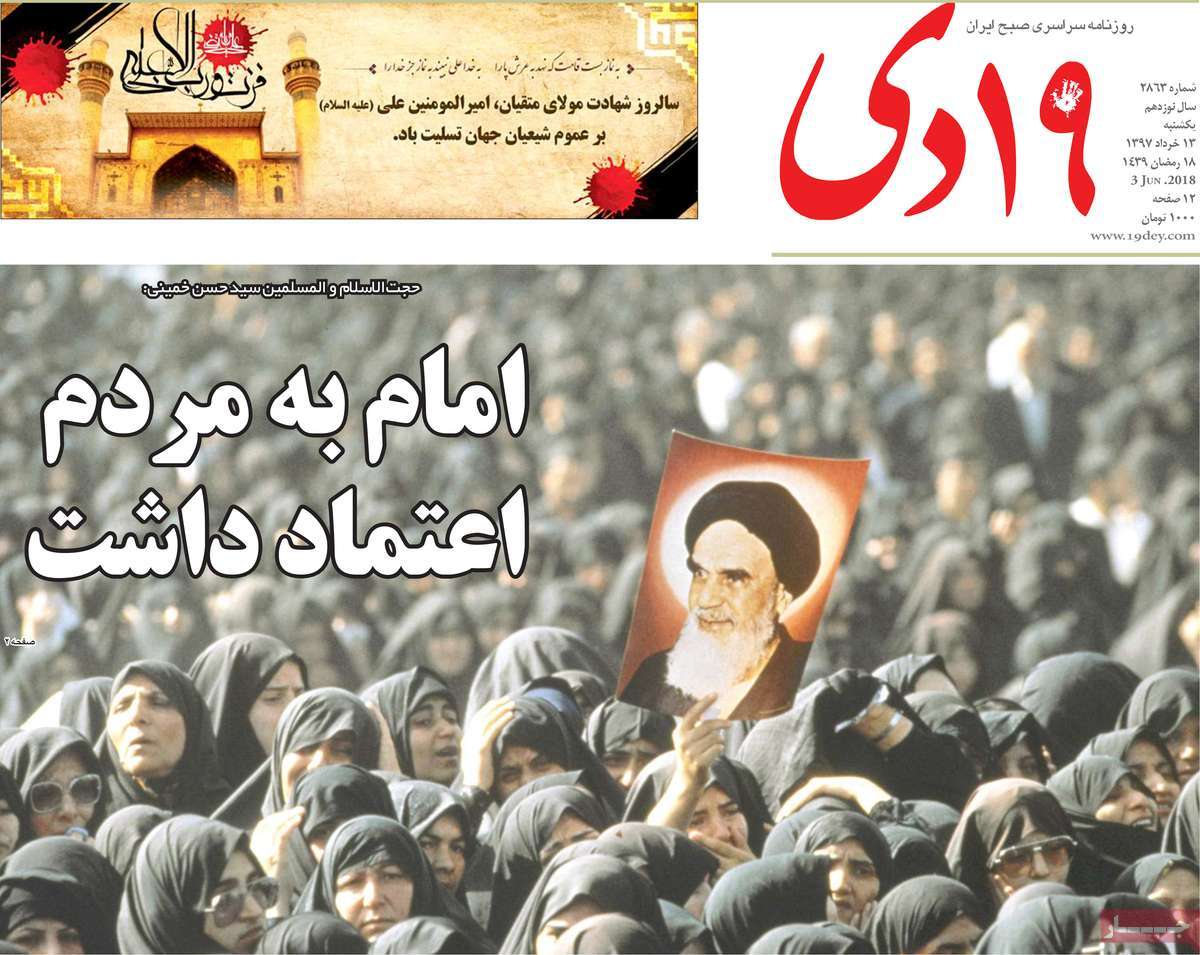
19 Dey:

1- Imam Khomeini’s Grandson: My Grandfather Trusted People

A Look at Iranian Newspaper Front Pages on June 3


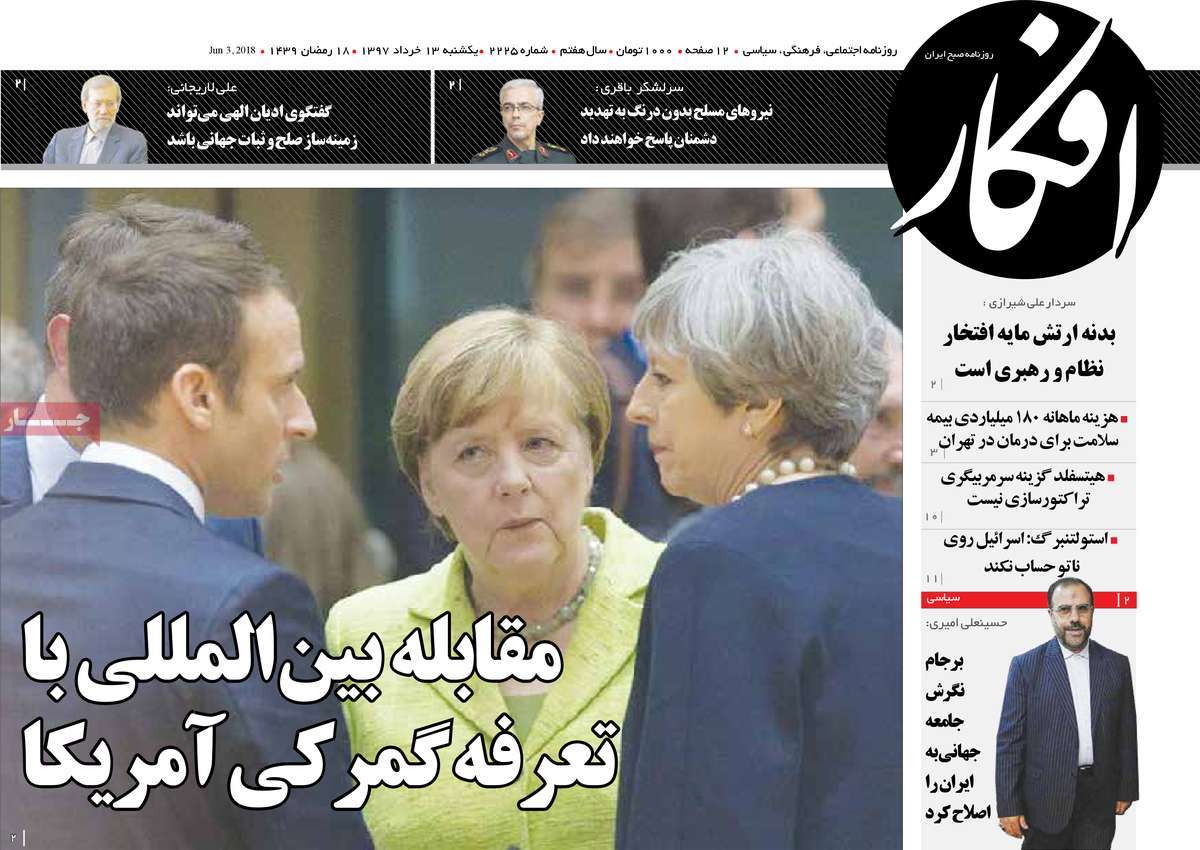
Afkar:

1- Larijani: Interfaith Dialogue Can Pave Way for Global Peace, Stability

A Look at Iranian Newspaper Front Pages on June 3


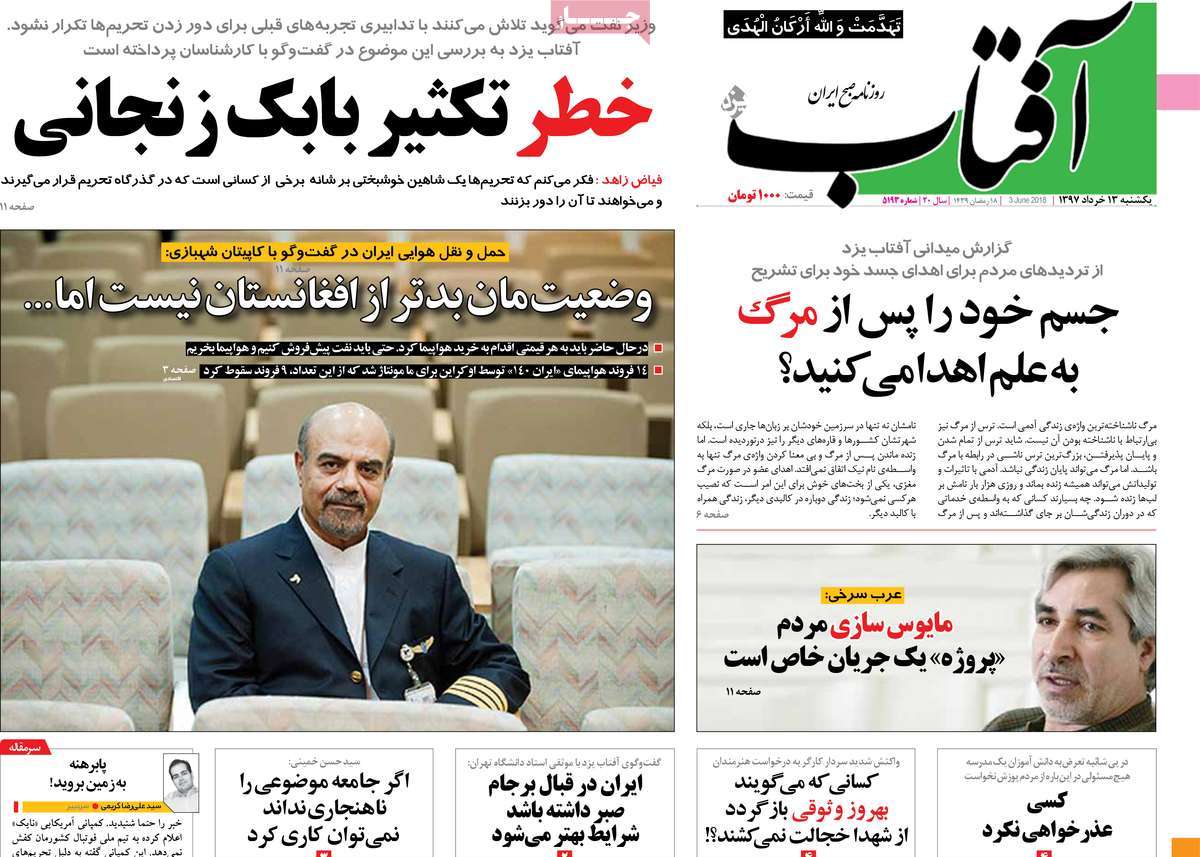
Aftab-e Yazd:

1- Academic: Things to Get Better If Iran Shows Patience on JCPOA

A Look at Iranian Newspaper Front Pages on June 3


Arman-e Emrooz:

1- Rouhani Underlines National Unity in Meeting with Top Sunni Clerics

A Look at Iranian Newspaper Front Pages on June 3


Bahar:

1- Imam Khomeini Wouldn’t Back Off When Faced with Excessive Demands: Grandson

A Look at Iranian Newspaper Front Pages on June 3


Ebtekar:

1- Washington’s Deadly Game with Europe

  • Can US-EU Trade War Turn into Political Conflict?

A Look at Iranian Newspaper Front Pages on June 3


Etemad:

1- Qatar Blockade Consigned to Oblivion: Former Iranian Diplomat

A Look at Iranian Newspaper Front Pages on June 3


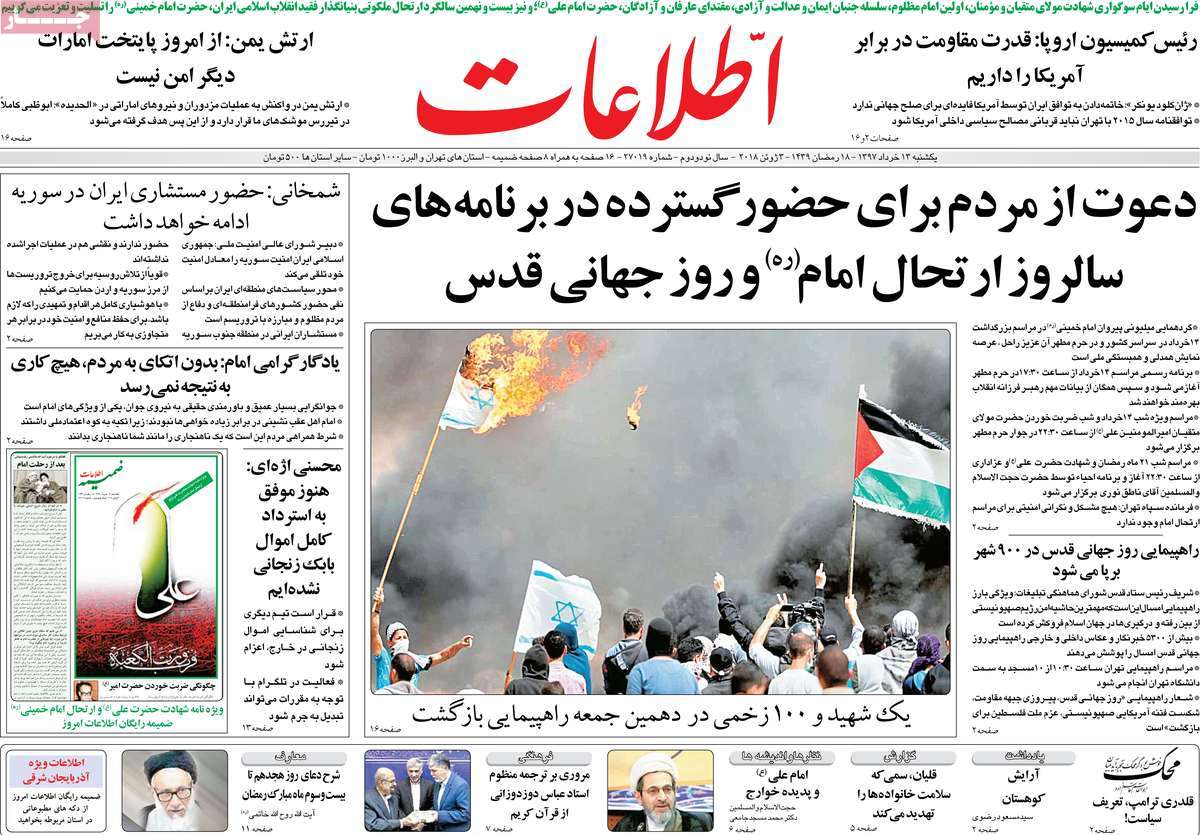
Ettela’at:

1- Shamkhani: Iran to Continue Advisory Presence in Syria

2- European Council’s Chief: We’re Strong Enough to Show Resistance against US

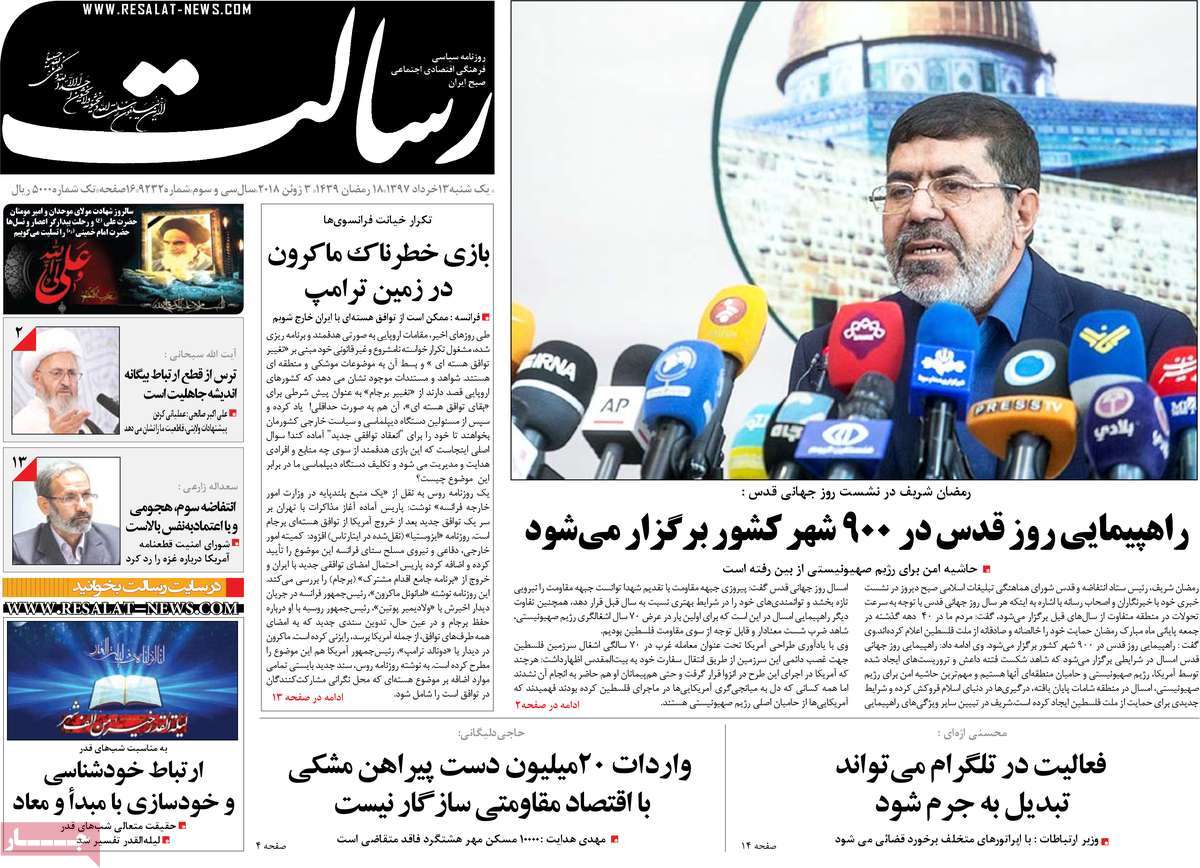
3- Quds Day Rallies to Be Held in 900 Iranian Cities

A Look at Iranian Newspaper Front Pages on June 3


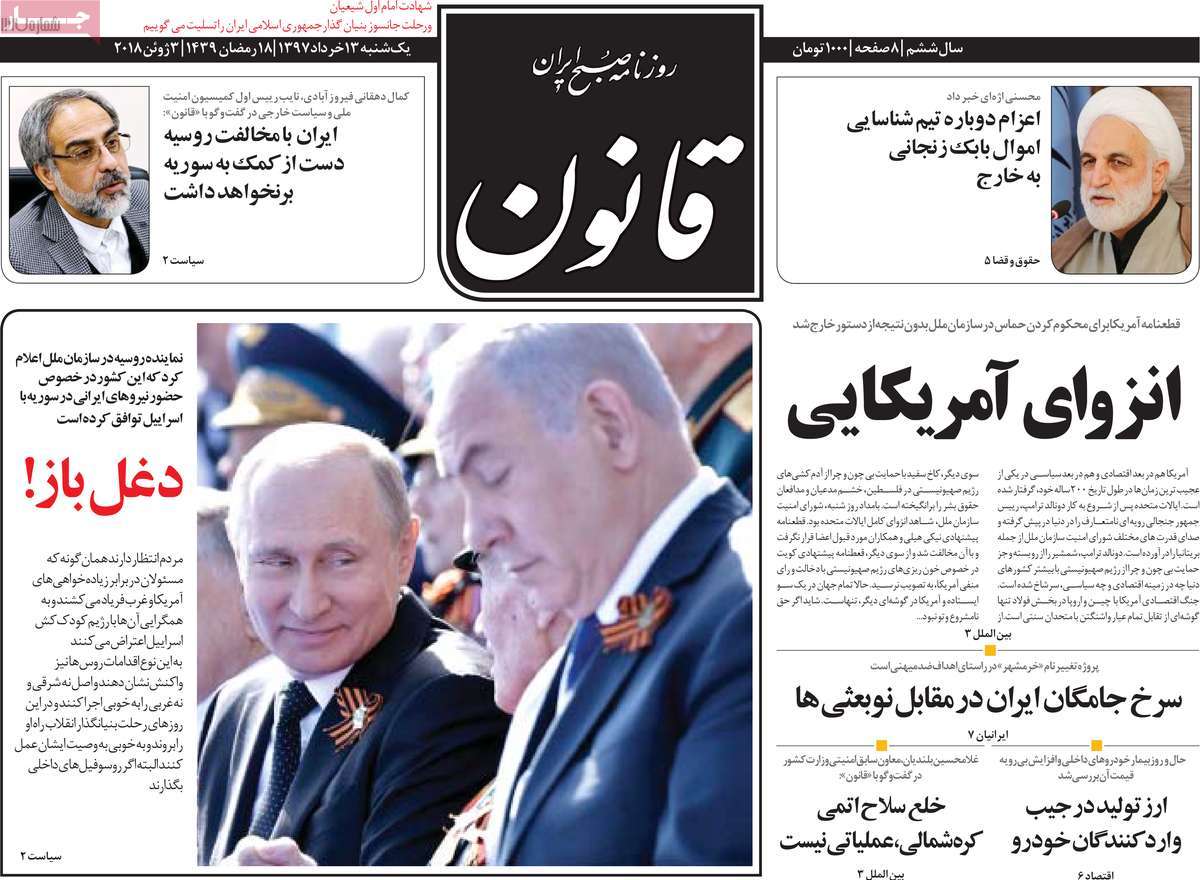
Ghanoon:

1- Senior MP: Iran Won’t Stop Helping Syria Even If Russia Is Opposed

A Look at Iranian Newspaper Front Pages on June 3


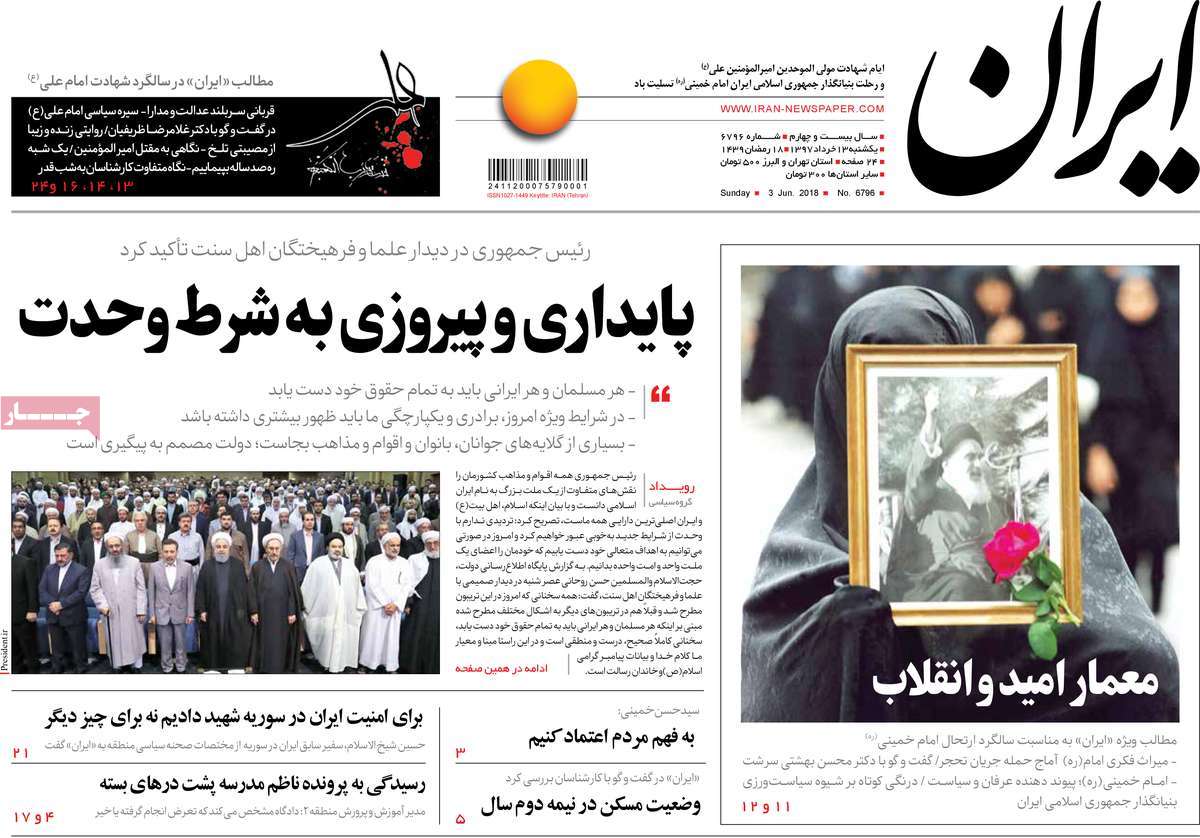
Iran:

1- Rouhani: Sustainability, Victory Achievable with Unity

  • Every Single Muslim, Iranian Must Enjoy All His / Her Rights

A Look at Iranian Newspaper Front Pages on June 3


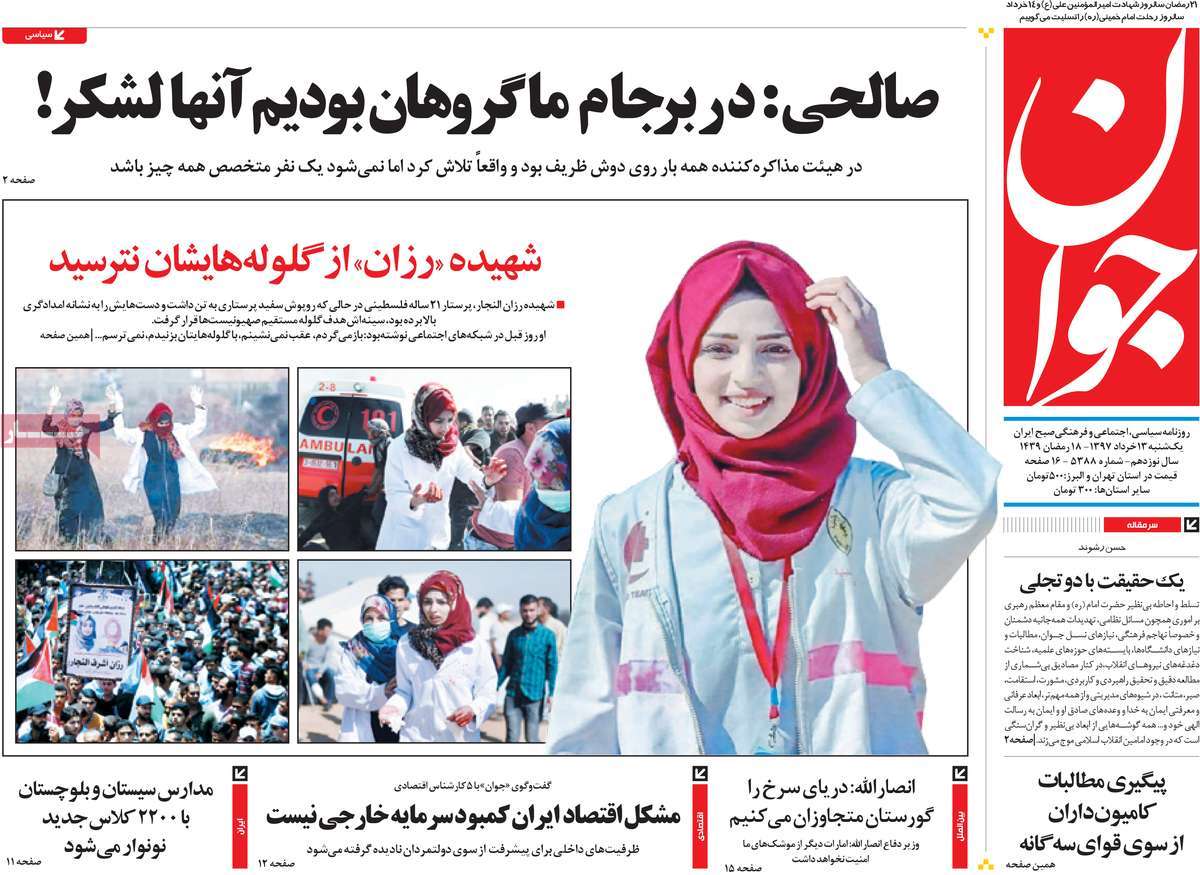
Javan:

1- Iran Nuclear Chief: In JCPOA, We Were a Company, They Were an Army!

  • In Iran’s Negotiating Team, All Burden Was on Zarif’s Shoulders
  • He Made Great Efforts, but One Cannot Be Expert on Everything

2- 2,200 New Classrooms to Be Built in Sistan and Baluchestan’s Schools

3- Young Nurse Killed by Israelis Didn’t Fear Their Bullets

4- Ansarullah: We’ll Turn Red Sea into Graveyard of Aggressors

A Look at Iranian Newspaper Front Pages on June 3


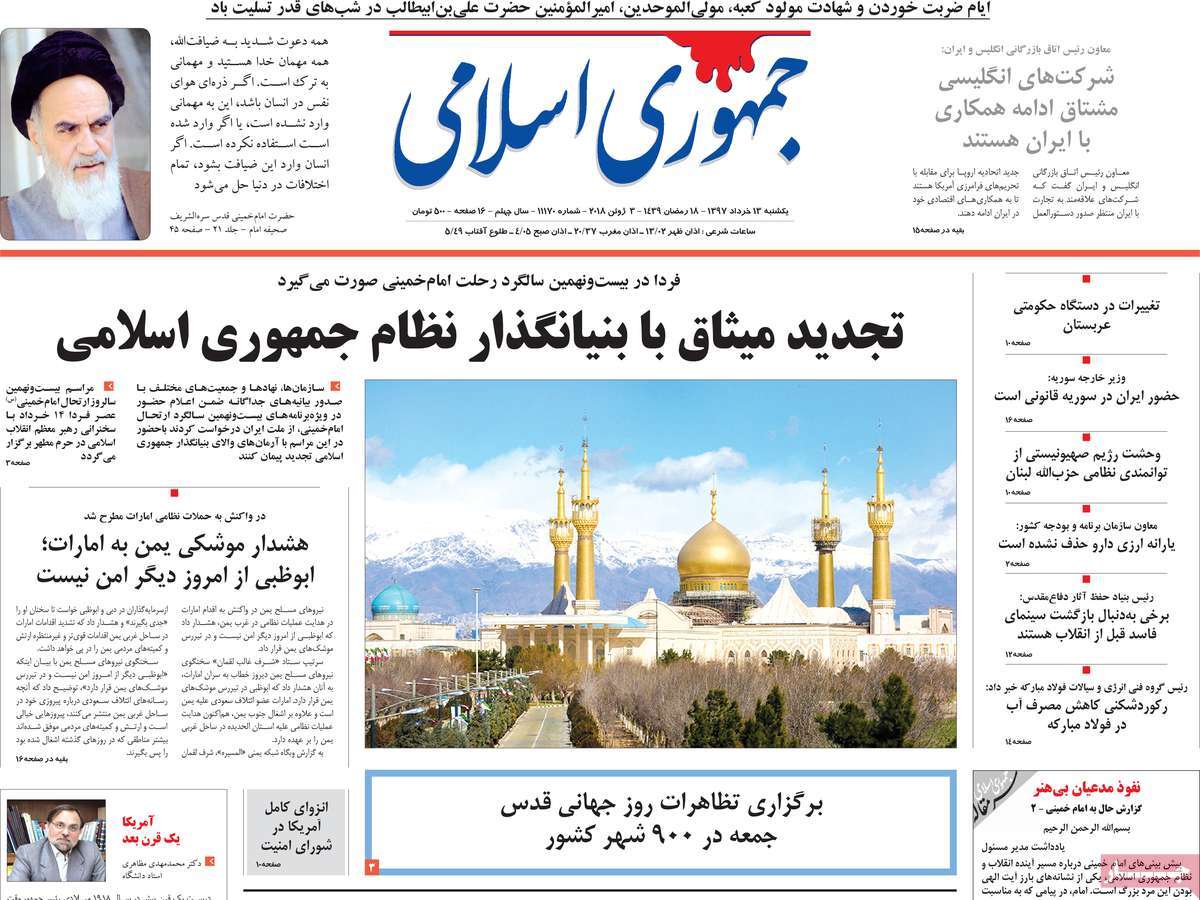
Jomhouri Eslami:

1- People to Renew Allegiance with Founder of Islamic Republic Tomorrow

A Look at Iranian Newspaper Front Pages on June 3


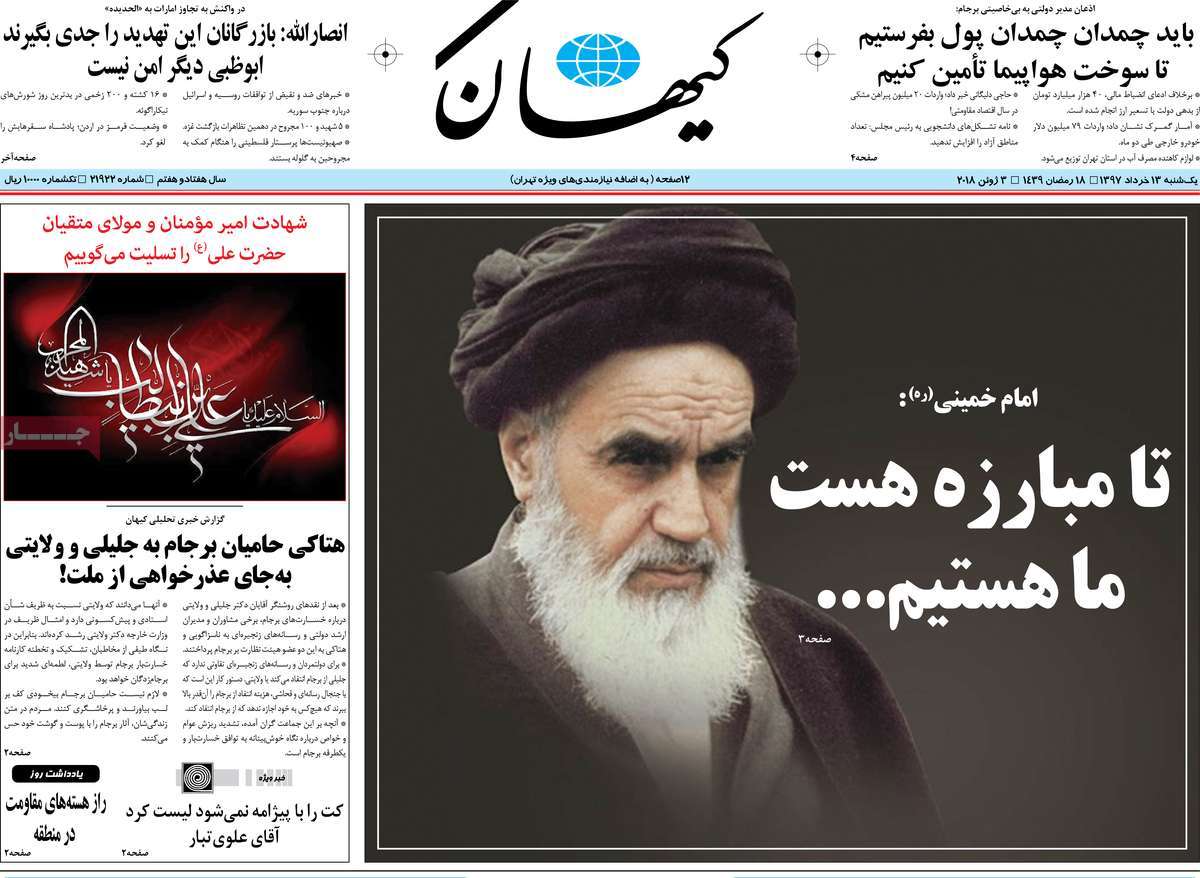
Kayhan:

1- Imam Khomeini: We’ll Be Standing Firmly as Long as Struggle Is Alive

2- Ansarullah: Businesspeople Must Take This Threat Seriously; Abu Dhabi Not Safe Anymore

3- Government Executive Admits JCPOA Useless

  • Iran Air CEO: We Must Send Suitcases Full of Cash to Supply Our Plane Fuel

A Look at Iranian Newspaper Front Pages on June 3


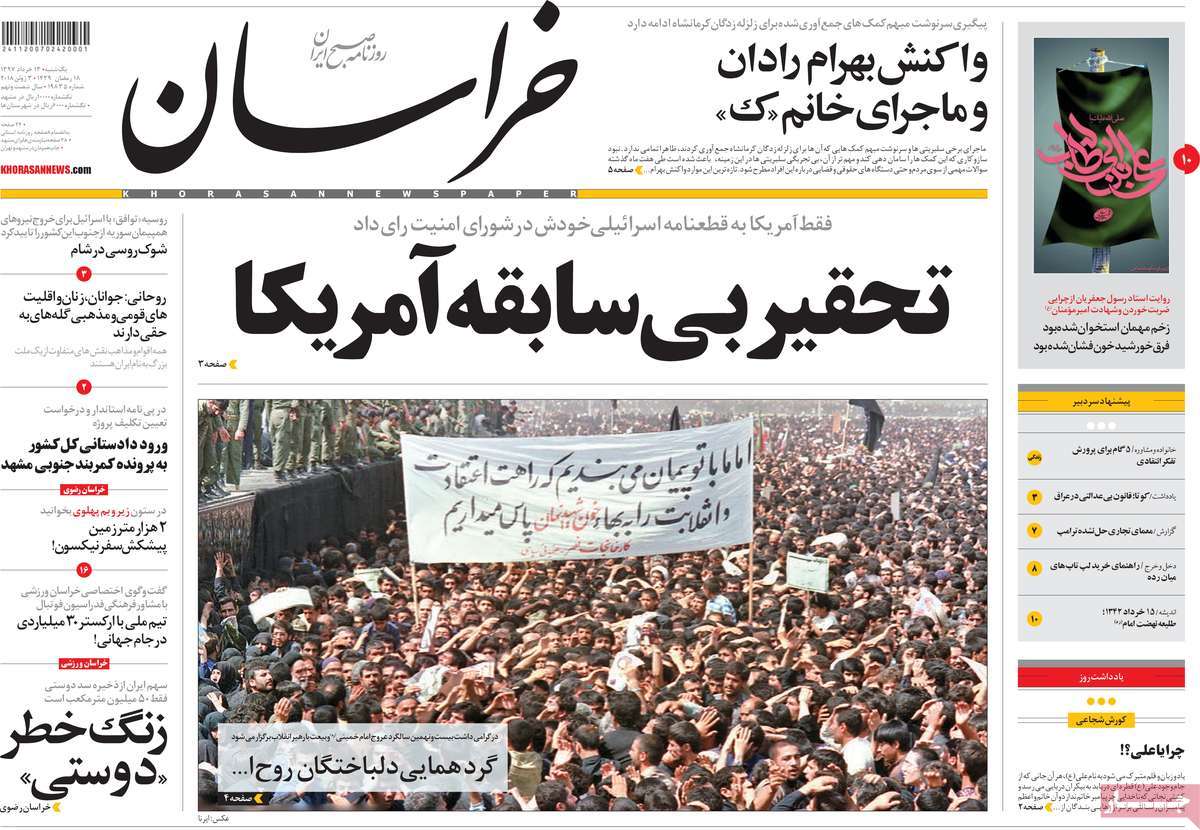
Khorasan:

1- Unprecedented Humiliation of US

  • US Only State to Vote for Its Pro-Israel Resolution at UN Security Council

A Look at Iranian Newspaper Front Pages on June 3


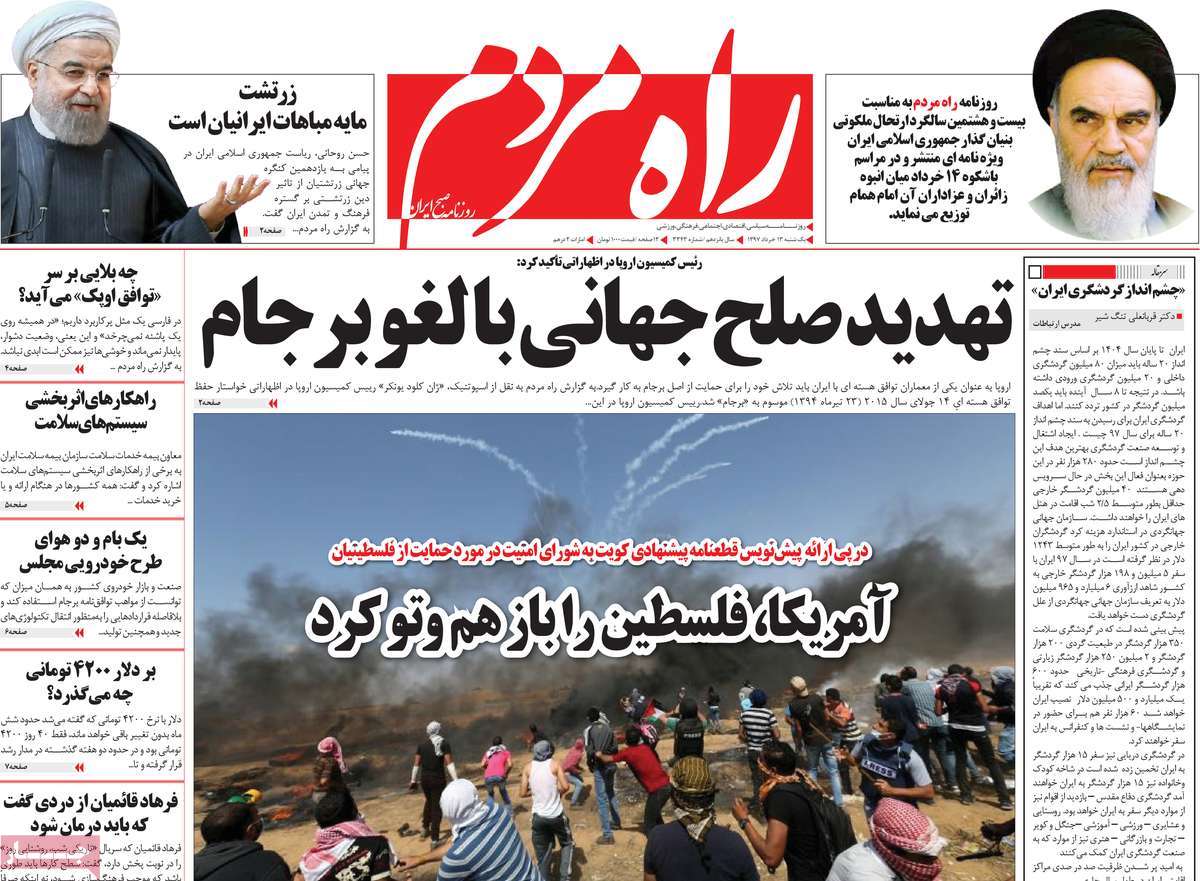
Rah-e Mardom:

1- European Council’s Chief: Global Peace in Danger If JCPOA Annulled

2- Rouhani: Zoroaster Source of Pride for Iranians

A Look at Iranian Newspaper Front Pages on June 3


Resalat:

1- France Once Again Betrays Iran

  • Macron’s Dangerous Game in Trump’s Court

A Look at Iranian Newspaper Front Pages on June 3


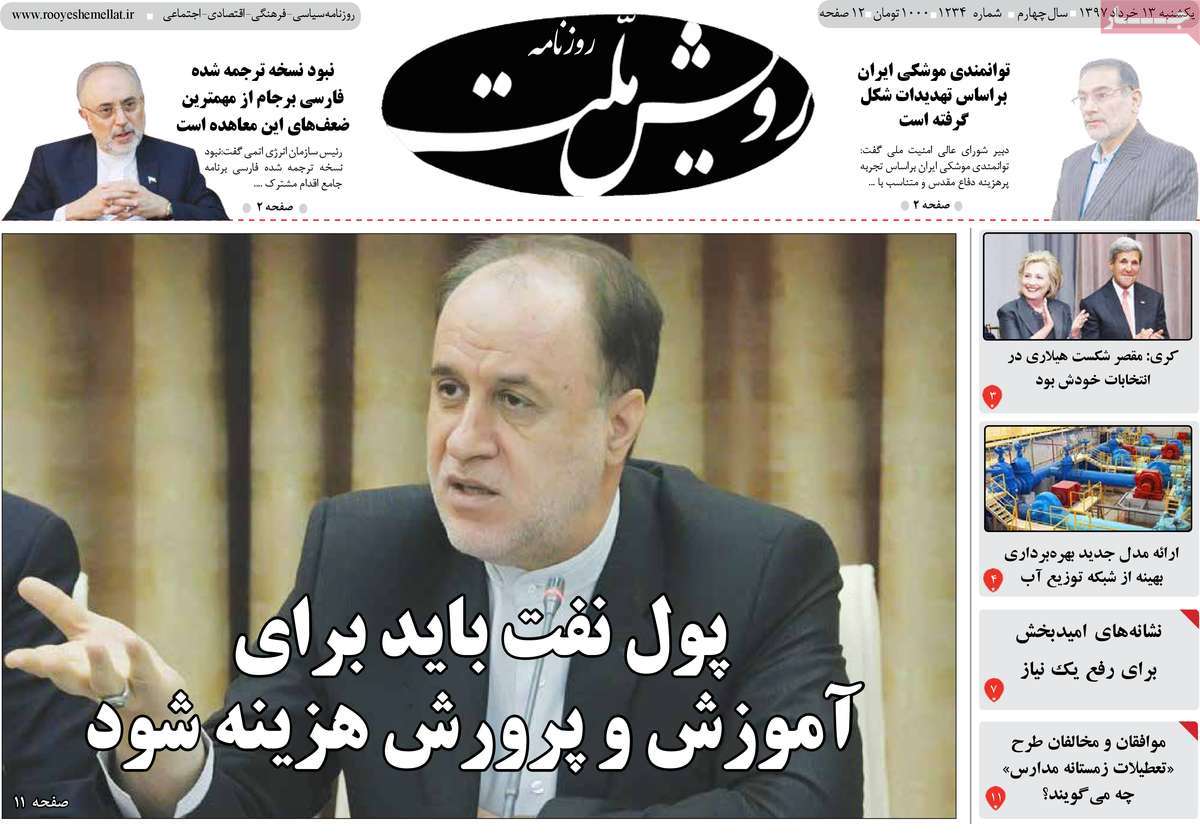
Rooyesh-e Mellat:

1- Iran Nuclear Chief: Lack of Persian Version among Most Important Weak Points of JCPOA

A Look at Iranian Newspaper Front Pages on June 3


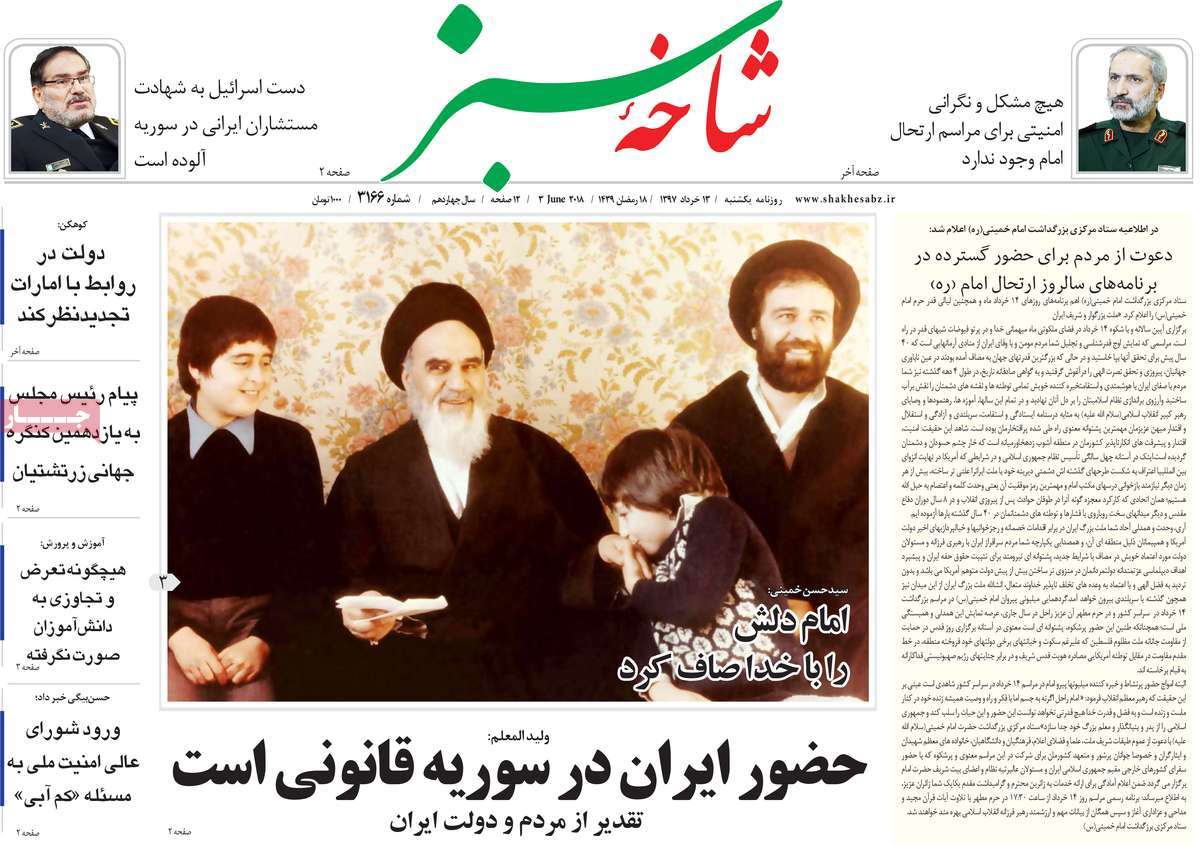
Shakhe-ye Sabz:

1- Syria FM: Iran’s Presence in Syria Legal

  • Syria Appreciates Iranian People, Government

A Look at Iranian Newspaper Front Pages on June 3


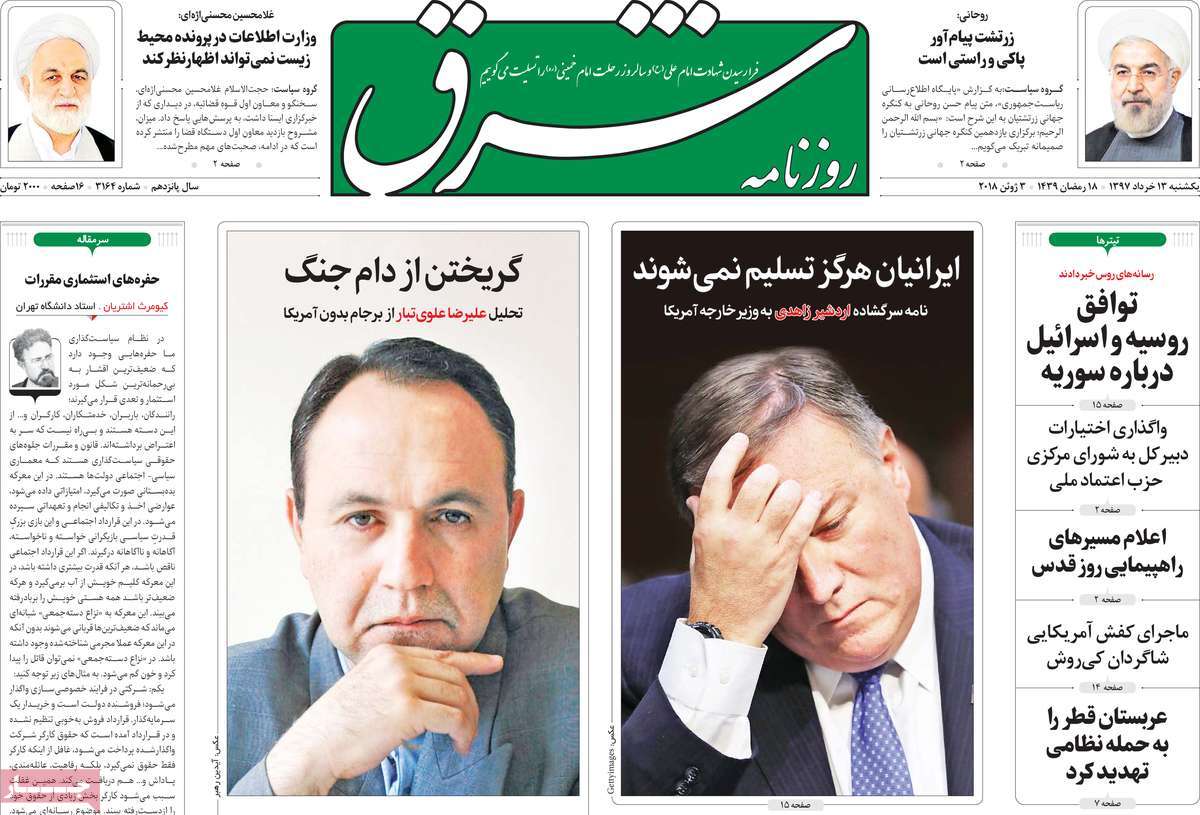
Shargh:

1- Son-in-Law of Former Shah of Iran to Pompeo: Iran Will Never Surrender

A Look at Iranian Newspaper Front Pages on June 3


Vatan-e Emrooz:

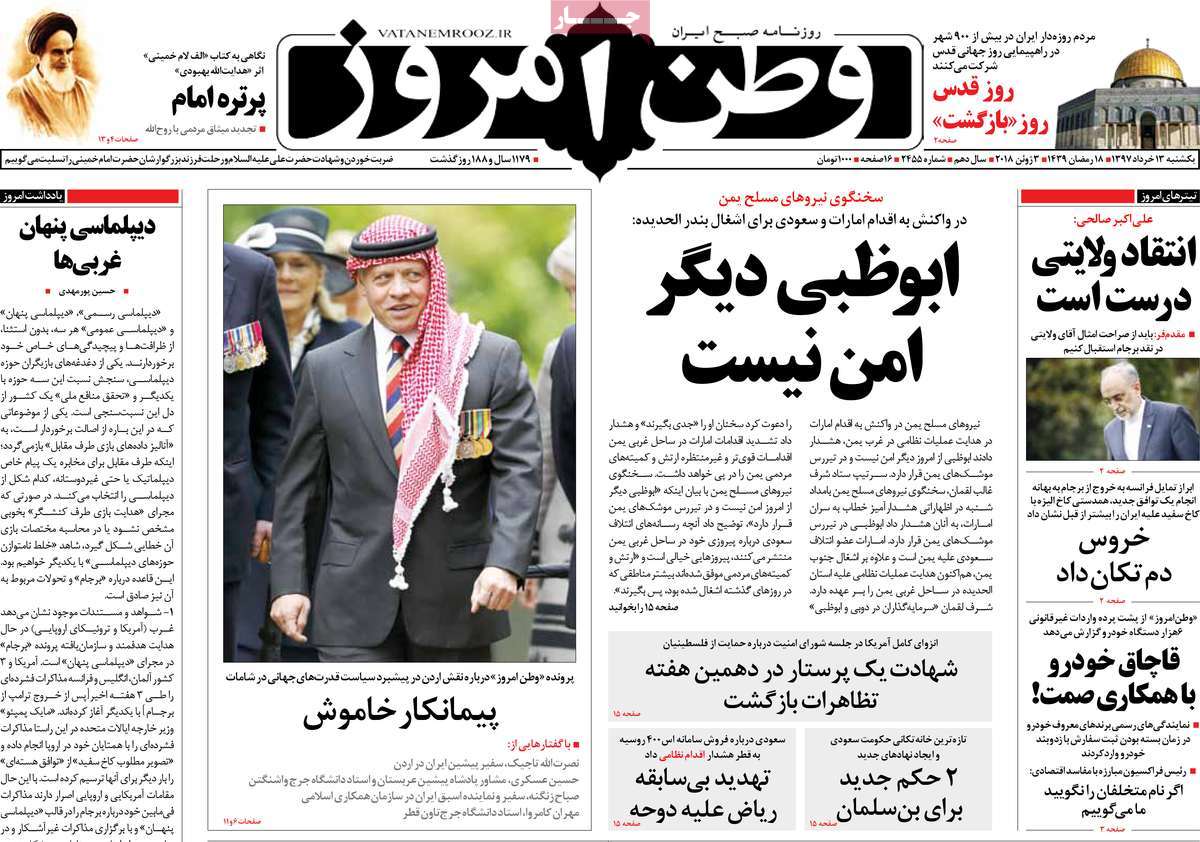
1- Silent Contractor: A Report on Jordan’s Role in Advancing World Powers’ Policies in Syria

2- Nurse Martyred in Tenth Day of “March of Return” Protest Rallies

A Look at Iranian Newspaper Front Pages on June 3

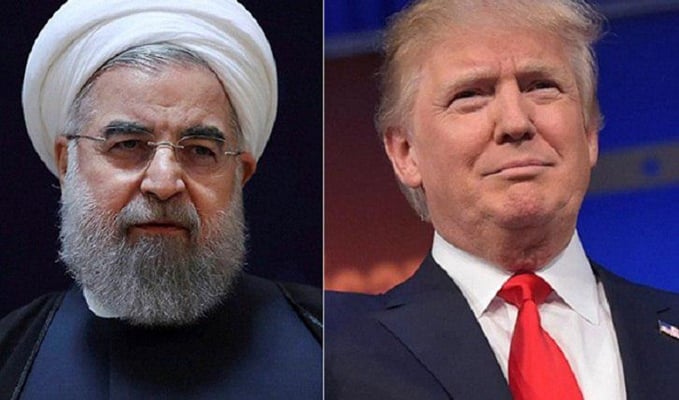
Trump Invited Rouhani to Dinner in September: Source

“US Undersecretary of State called [Iranian Deputy Foreign Minister Abbas] Araqchi and said Trump has invited Rouhani to dinner so that they could sit for talks and resolve their issues,” said Hossein Mousavian, a member of Iran’s nuclear negotiating team in 2000s who is currently a fellow at Princeton University.

Mousavian, speaking in an interview with the Iran newspaper, said the Iranian president rejected the offer as he knew the Iranian Establishment is against such a meeting, and he would face serious challenges inside the country if he meets Trump.

The US request for the meeting had been reported by Iranian Foreign Ministry Spokesman Bahram Qassemi in September.

Referring to the alleged meeting request, Qassemi said “an intention was expressed by the American side that was not accepted by President Rouhani.”

This is while US officials have denied any such requests have been made by Trump.

In 2013, shortly after Tehran and Washington engaged in nuclear talks that later led to the 2015 nuclear deal, then US President Barack Obama and Rouhani spoke by telephone.

The brief phone conversation was the highest-level contact between the two countries in decades, promising better days in US-Iran relations that was severed in 1979.

However, the new US president has hardened the US line on Iran, reviving a nearly-forgotten mantra that all options are on the table when it comes to Iran, including military ones.

Trump has also pulled the US out of the 2015 nuclear accord and has threatened to impose the highest level of economic sanctions on Iran.

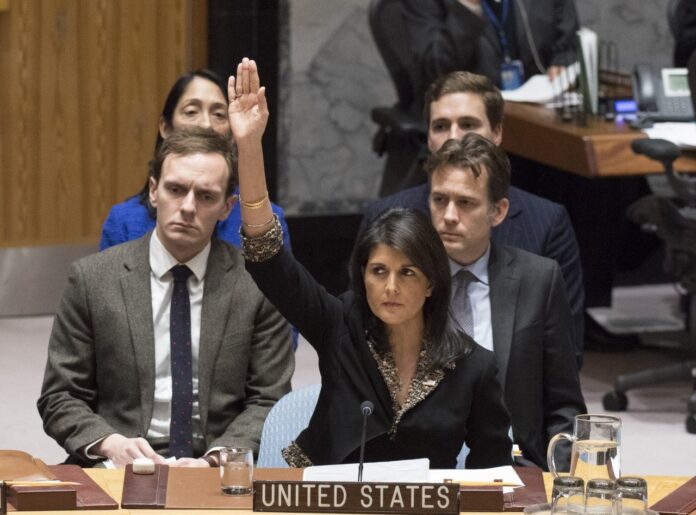
UNSC’s Latest Palestine Meeting “Stunning Display of US Isolation”

“The Friday UNSC meeting was a stunning display of US isolation. The US-drafted resolution on Palestine was firmly rejected,” Iranian ambassador to London Hamid Baeidinejad wrote on Twitter on Saturday.

“Then the US was forced to veto a Kuwait-sponsored resolution, which had been approved by most members including US allies, in a bid to support Israel,” he added.

The draft resolution blocked by the US was submitted by Kuwait, condemning Israeli violence and calling for protection of the Palestinian people in Gaza and the West Bank.

Ten countries voted in favour, while the UK, Poland, the Netherlands and Ethiopia abstained.
Later, a US-drafted resolution condemning Palestinian resistance movement Hamas for firing rockets at Israel was dismissed after it failed to attract any other country’s support.
Tension has mounted in the Palestinian territories since last December, when Trump announced a decision to recognize Jerusalem-Al Quds as the Israeli regime’s capital.

Since March 30, at least 118 Palestinians demanding their right to return to their lands have been killed and thousands more injured by Israeli army gunfire near the Gaza-Israel border fence.