Monday, April 20, 2026
Home Blog Page 3494

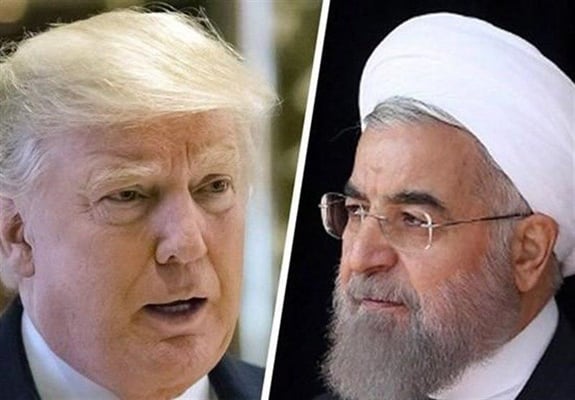
US Says Seeks to Sign ‘Treaty’ with Iran on Missile Program

US special envoy for Iran Brian Hook made the comments at an event at the Hudson Institute on Wednesday.

“The new deal that we hope to be able to sign with Iran, and it will not be a personal agreement between two governments like the last one, we seek a treaty,” he told the audience.

He further said that the nuclear deal, officially called the Joint Comprehensive Plan of Action (JCPOA), lacked support among members of the Republican-held Congress, when it was clichéd under former US President Barack Obama.

“They did not have the votes in the US Senate so they found the votes in the UN Security Council,” Hook said. “That is insufficient in our system of government if you want to have something enduring and sustainable.”

US President Donald Trump re-imposed anti-Iran sanctions, lifted as part of the 2015 nuclear deal, in August, after withdrawing the US of the agreement, also backed by the UK, Russia, Germany, Russia, and China.

Leader of the Islamic Revolution Ayatollah Seyyed Ali Khamenei has previously stressed that the Islamic Republic will not enter into new negotiations with the United States due to cheating and bullying nature of its government.

“In any negotiations, if the opposite side refrains from giving real concessions, Americans will launch such a propaganda and media rancor in the world that the other side feels at loss and becomes passive,” Ayatollah Khamenei added.

Under the JCPOA, Iran undertook to put limits on its nuclear program in exchange for the removal of nuclear-related sanctions imposed against Tehran.

Iran has repeatedly emphasized that its missile program is merely defensive and deterrent, thus non-negotiable.


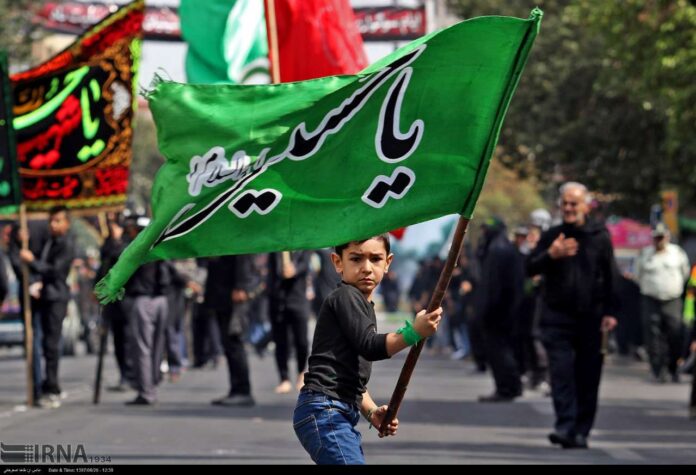
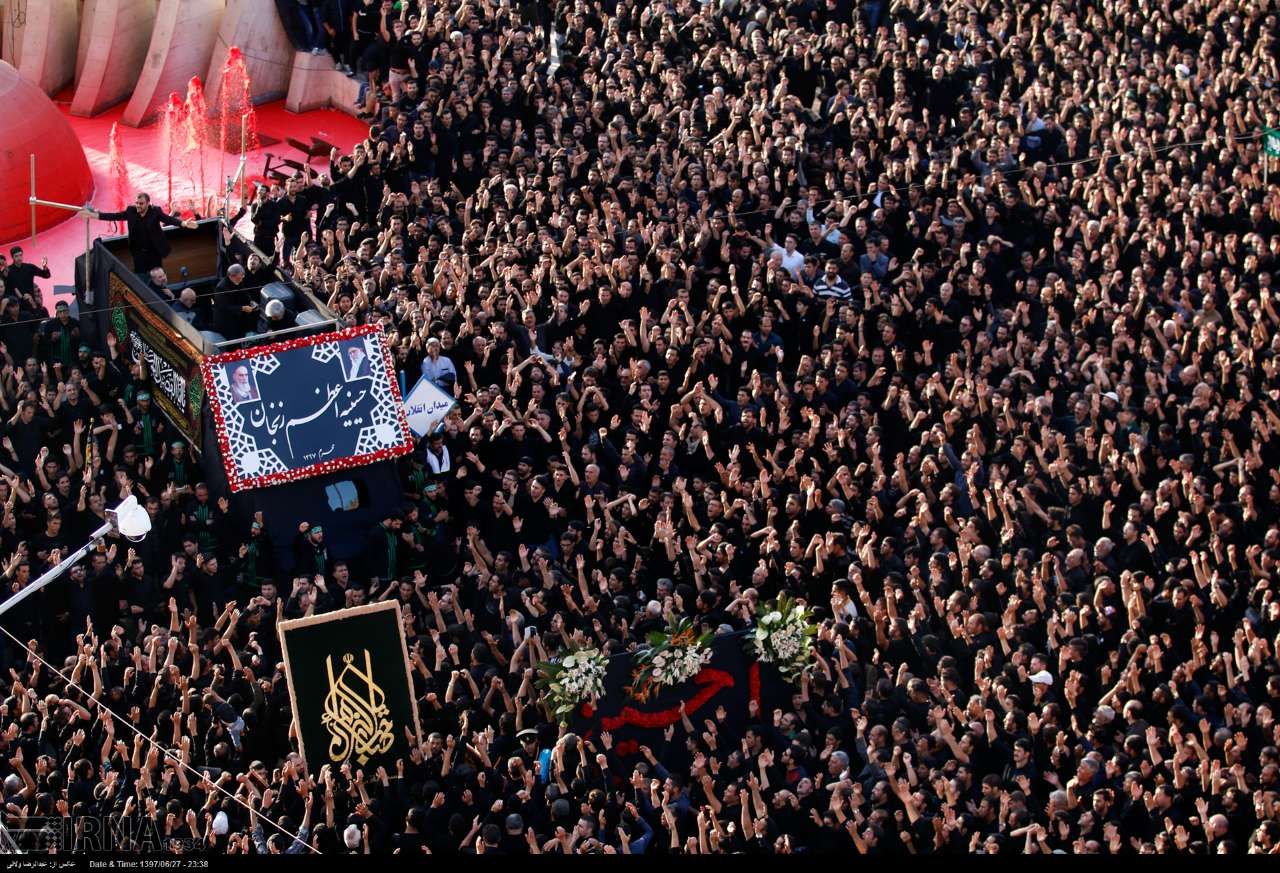
Muharram; A Phenomenon Affecting Various Aspects of Shiite Life

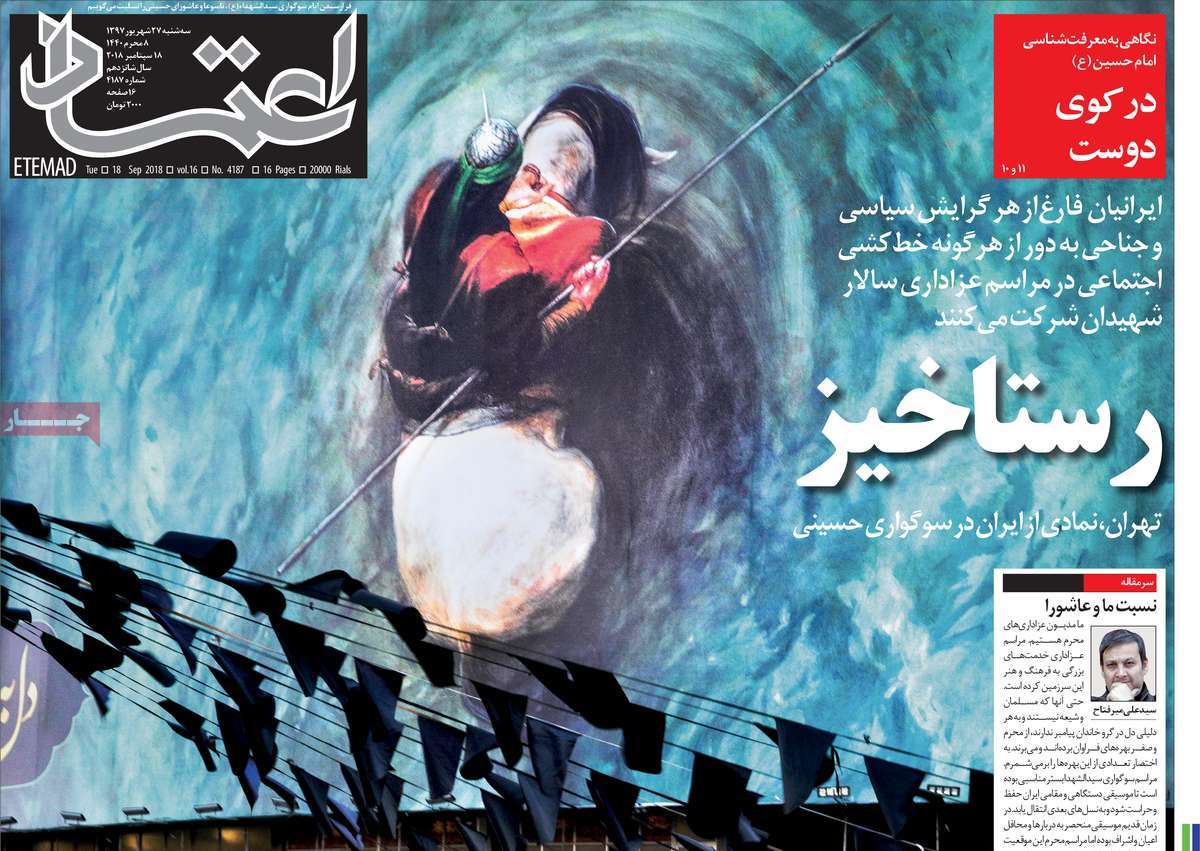
Senior journalist Seyyed Ali Mirfattah, in an editorial in E’temad daily, has briefly outlined the impact and benefits of organising the mourning ceremonies of Muharram on various cultural aspects of the Iranian society. Here is a summary of this article:

This religious ceremony has made contributions to the culture and art of the country. One of these contributions is helping to boost music among the people.

In ancient times music was exclusively performed at the courts and circles of the lords and nobles; however, the rituals of Muharram created this awesome opportunity to bring music to the people and be protected and more useful.

The performance of Ta’zieh has played a great role in promotion of drama. Indeed, if Muharram and Safar did not exist, we could not continue the Iranian drama tradition for centuries and bring it to contemporary times. In other words, the passion plays of Muharram have served as a perfect means to convey the national spirit and culture to later generations.

Mourning ceremony also made great contributions to literature. Barely can you find a culture and language that is as powerful as Persian culture and language in provoking or even controlling emotions.

The linguistic capacities of the phenomenon of death have managed to enrich the whole language and culture as well. No poet has talked of death in the way Sa’adi did. However, no poet is as happy as Sa’adi to appreciate life.

Parenthetically, mourning in the Iranian culture is different from mourning, for example, in Greece and Italy. As we deeply believe in the unseen world and in our post-mortem life, our emcounter with this phenomenon and its functions is totally different. This encounter is different thanks to monotheism and belief in the unseen.

Before Islam, the Iranians believed in the other world, and considered death as one of the stages of life. With the blessings of Tasua, Ashura and Arba’een (the ninth, tenth, and fortieth days after Imam Hussein’s martyrdom anniversary), we were able to blend the mournful literature with the passion of life. We cry, we hit our chests, we sigh, but we also strengthen our liveliness. Moreover, we publish many moral and doctrinal points through the lamentations and Ta’zieh.

Concepts such as dignity, fight against oppression, loyalty, insisting on the rights, struggle for justice, and the reform of religion were among the things the Iranians learned from the mourning ceremonies. I can say that Muharram could solve all our political and economic problems. We can evade any sanctions in light of Imam Hussein’s blessings. We can change our relationship with the universe and turn this piece of the world into a heaven on earth.

Do you know any culture, religion, and belief that in the 21th century could take all the old and young people out of homes and make them do good things? On Arba’een, it is said that around 20 million pilgrims go to Imam Hussein’s holy shrine on foot. This means that the existence of Imam Hussein (AS) can guarantee the political and social security of this inflamed region. This means that it can force all the terrorist and Takfiri groups to escape. This means it can elevate the status of the Shiites in the world. In my opinion, we are not dealing with a tradition, but rather we are facing a living creature that changes according to our conditions.

Muharram; A Phenomenon Affecting Various Aspects of Shiite Life

German Ambassador Inspiring Tourists to Spend Holidays with Iranian Nomads

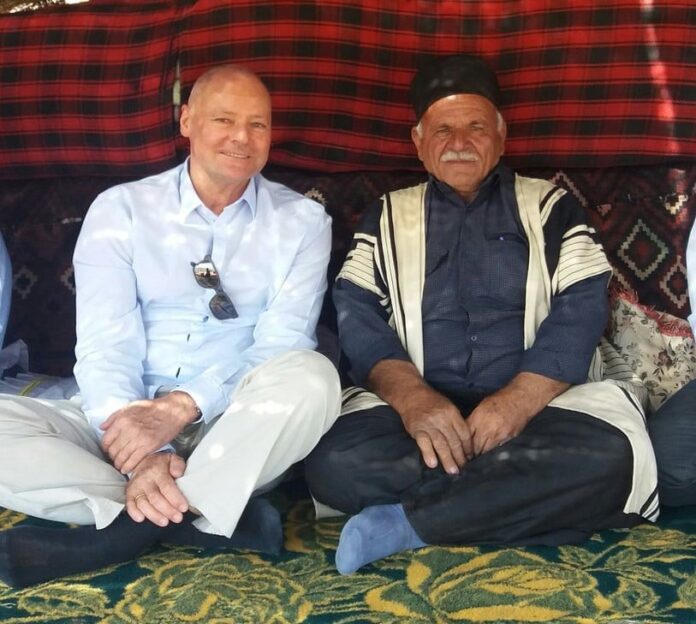
Michael Klor-Berchtold decided to spend holidays in Iran in recent weeks, an initiative which came under the media spotlight.

The news that the top German diplomat spent his holidays in Iran received much attention in Germany from media and all those interested in the Iranian culture. Klor-Berchtold accompanied Bahktiari nomads in Zagros mountains during his holidays in the Islamic Republic.

European tourists who cherish the idea of spending holidays in fabulous countries such as Iran are interested to see first-hand the cultures and traditions of different parts of the country. From a tourist’s perspective, a trip should include interesting experiences.

Among the issues which are very important to a tourist is to get familiar with the cuisine, customs, traditions and traditional costumes of certain localities in a country.

One of the main objectives of foreign visitors is to experience new and fantastic environments.

Accordingly, the German ambassador’s decision to spend holidays with nomads has received extensive coverage in his country. From a political and media point of view, too, Klor-Berchtold’s choosing Iran as a holiday destination is a testament to the existence of security in Iran as well as the beauties of this land rarely covered by Western media.

In addition to this news, Der Spiegel published another report on the presence of tourists and foreign travelers in Iran. The German weekly has also published an interview with the spokesperson for the Munich Tour Operator regarding European visitors’ interest in travelling to Iran and surrounding countries.

These are the answers given by the spokesperson to the weekly’s questions.
At a time when some European airlines have cut down the number of their flights, what impact have such moves had on passengers’ needs?
Spokesperson: It is right that this issue has eclipsed Europeans’ trips to Iran. However, when we hear a flight to Tehran is canceled, we offer other options to travelers.

In recent years, many Germans have shown an interest in visiting Iran. Tours of Iran are usually booked by Germans. But now, how has the issued mentioned above affected demand?

Spokesman: Demand has been at a normal level in the recent year. But demand for travelling to Iran had peaked in the years before, especially in 2015. At that time, we had exactly 2650 visitors who had booked tours of Iran. The situation remains the same in 2016, but the figure dropped to 2250 in 2017, which shows a slight drop compared to the two preceding years.

What keeps enthusiasts from spending their holidays in Iran?

Spokesman: The main thing is climatic changes, which have gripped the country for several years now. This has practically made travelling to the country a little difficult. Of course, travelling to certain countries have always been hampered by certain factors and this is not limited to Iran. For instance, we had people who were interested to visit Turkey. However, they have lost their interest due to Turkish President Recep Tayyip Erdoğan’s wrong policies.

However, as for Iran, one should note that most of those interested to visit the country have, despite climatic issues, always wanted to make a trip to the country because Iran is a good place for tourists. Iranians show special hospitality toward foreigners. Moreover, Iran’s political situation and its position on different issues have not changed, either. Given the drop in the value of the rial inside Iran, it would be very economical for foreign tourists to visit Iran. This issue along with the country’s climatic and cultural diversity seems to draw many European tourists to Iran in the coming years.

Iranian, Turkish FMs Discuss Idlib Deal

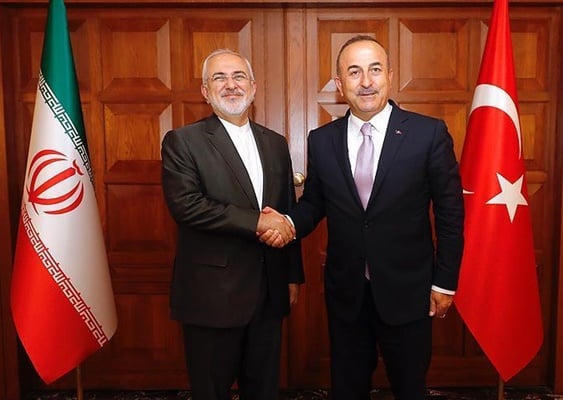
In the Tuesday night call, Mohammad Javad Zarif of Iran and his opposite number Mevlüt Çavuşoğlu exchanged views on the details of the Idilb agreement reached following negotiations in Ankara, Tehran and Sochi.

The two sides also agreed to follow up, in New York, on the details of the deal clinched at an Iran-Russia-Turkey foreign ministerial meeting.

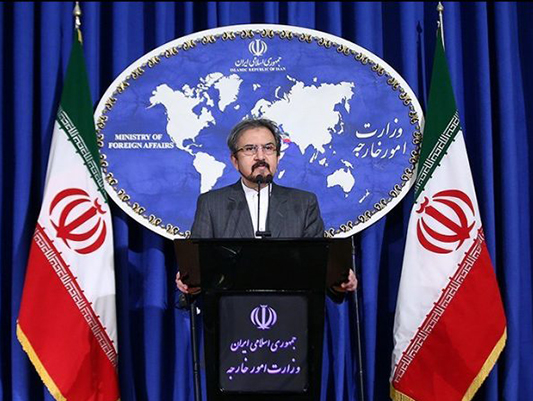
Iranian Foreign Ministry Spokesman Bahram Qassemi had earlier noted Tehran welcomes the Idlib agreement between Turkey and Russia reached in a meeting in the Russian city of Sochi, which was made following the trilateral meeting among presidents of the three countries in Tehran.

Russian President Vladimir Putin said on Monday after a meeting with his Turkish counterpart that an operation to retake the city of Idlib, which is controlled by opponents of the Syrian government and now home to about 3 million people, will not be carried out in the upcoming weeks.

Putin said Russian and Turkish troops are to enforce a new demilitarized zone in Syria’s Idlib region.

Iran Denies Claim It’s Trying to Expand Influence in Africa

Bahram Qassemi

Foreign Ministry Spokesman Bahram Qassemi said on Tuesday that the ties between Iran and the African states have always been based on mutual respect for the other side’s national sovereignty and the development of joint cooperation.

He further mentioned that good ties and the reciprocal visits of officials from Africa and Iran prove that the Islamic Republic is after cooperating with the important countries of this region.

In response to a question raised by Al-Manar Television, Qassemi said unfortunately, allegations made by the Moroccan foreign minister have been published in one of the most radical and racist media outlets of US neoconservatives.

The Iranian official noted that such stances are not based on a realistic view of African issues, and are mostly in line with the current anti-African policy of the White House rulers.

“Morocco has cut off its relations with Iran two times over a decade and it shows that the country does not have a stable conduct in its foreign relations. Instead of protecting the long-term interests of the country and the people of Morocco, the African country’s government makes rude allegations based on the dictated claims of others under the influence and pressures of the third parties.”

Qassemi stressed that there is no originality in such allegations, and they are just a rehash of the anti-Iran accusations raised by those who call for division in the Muslim world.

The remarks came after Morocco’s Foreign Minister Nasser Bourita, in an interview with Breitbart News, expressed his country’s concerns regarding Iran’s “destabilising” moves in North Africa, saying that Rabat needs the Trump administration’s support to block Tehran’s influence in the region.

Rabat cut off ties with Tehran in 2009, and renewed them in December 2016. The Kingdom cut its ties once again in May 2018, in protest against what it called the military support provided by the Iranian-backed Hezbollah movement to the Polisario separatists.

Crash of Passenger Bus, Fuel Tanker Leaves 21 People Dead

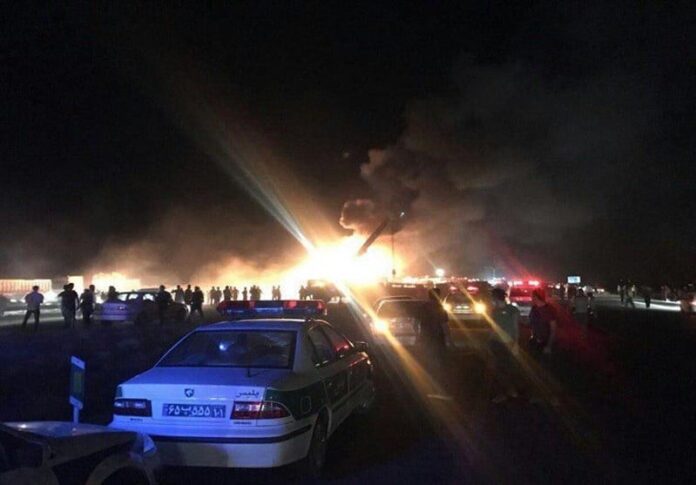
The doomed bus, travelling from capital Tehran to the southern city of Kerman, hit a fuel tanker from behind at a highway near the city of Badroud at around 23:30 local time on Monday night.

The bus burst into flames upon impact after a rollover in the opposite lane, causing deaths of 21 people aboard. At least 21 other passengers have been injured and hospitalized.

Initial reports blame the bus driver for careless driving.

Iran Sympathizes with Those Hit by Hurricane in US, Philippines

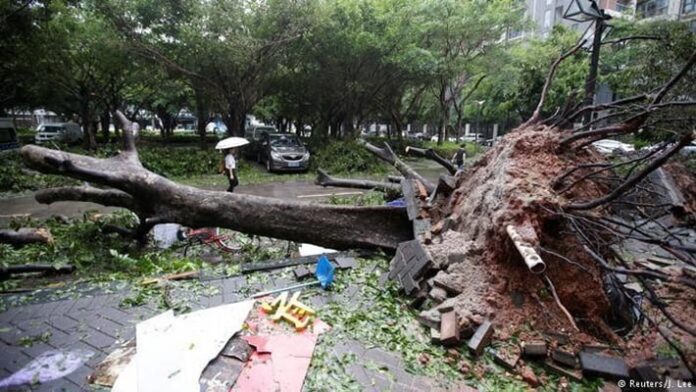
Qassemi on Tuesday expressed regret after Hurricane Florence in the United States and Typhoon Mangkhut in the Philippines and China took casualties and caused a lot of financial losses.

Hurricane Florence has brought immense flooding to many places in the US, particularly to the southeastern North Carolina.

The powerful storm Mangkhut also killed dozens of people in the Philippines and has moved towards southern China. It was one of the most powerful typhoons to hit the region in decades.

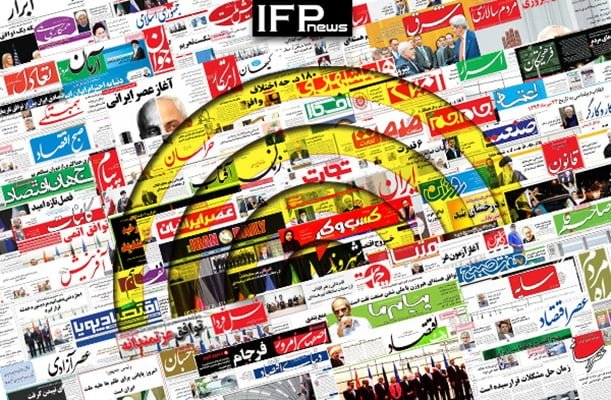
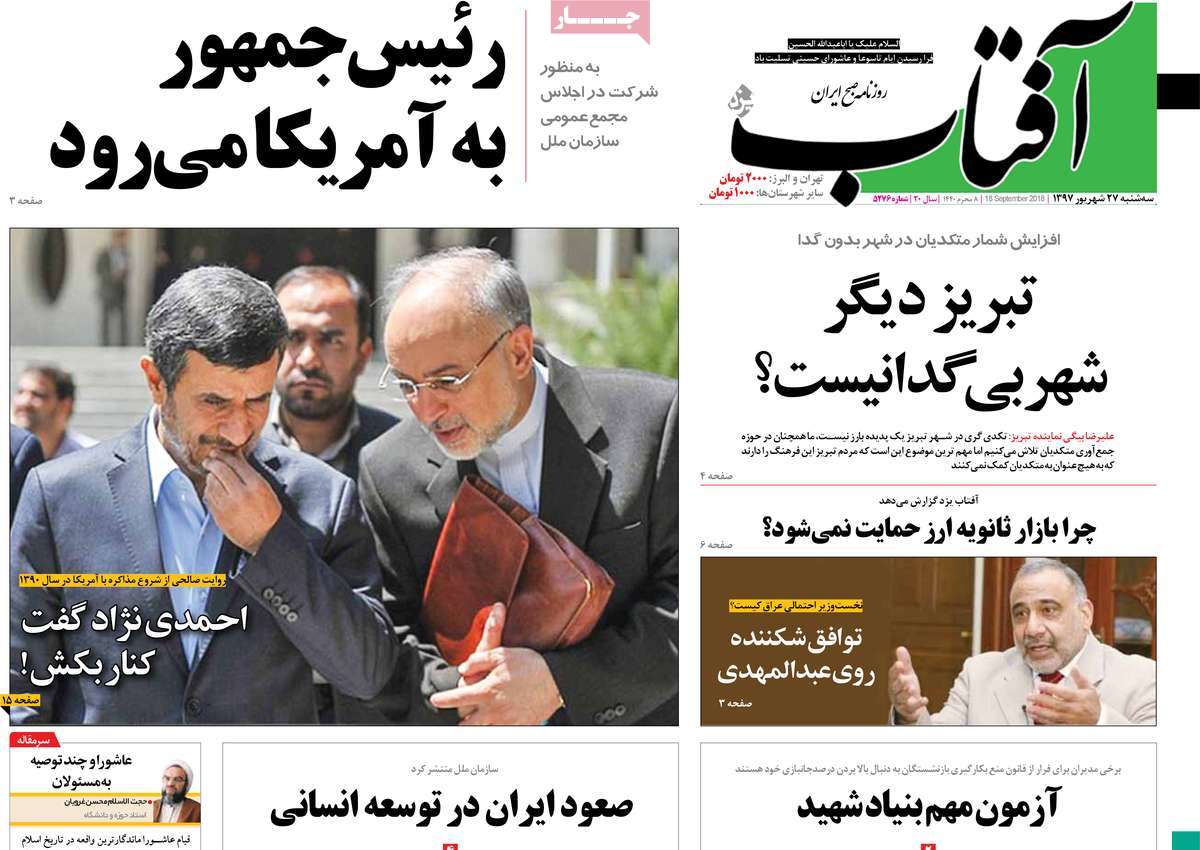
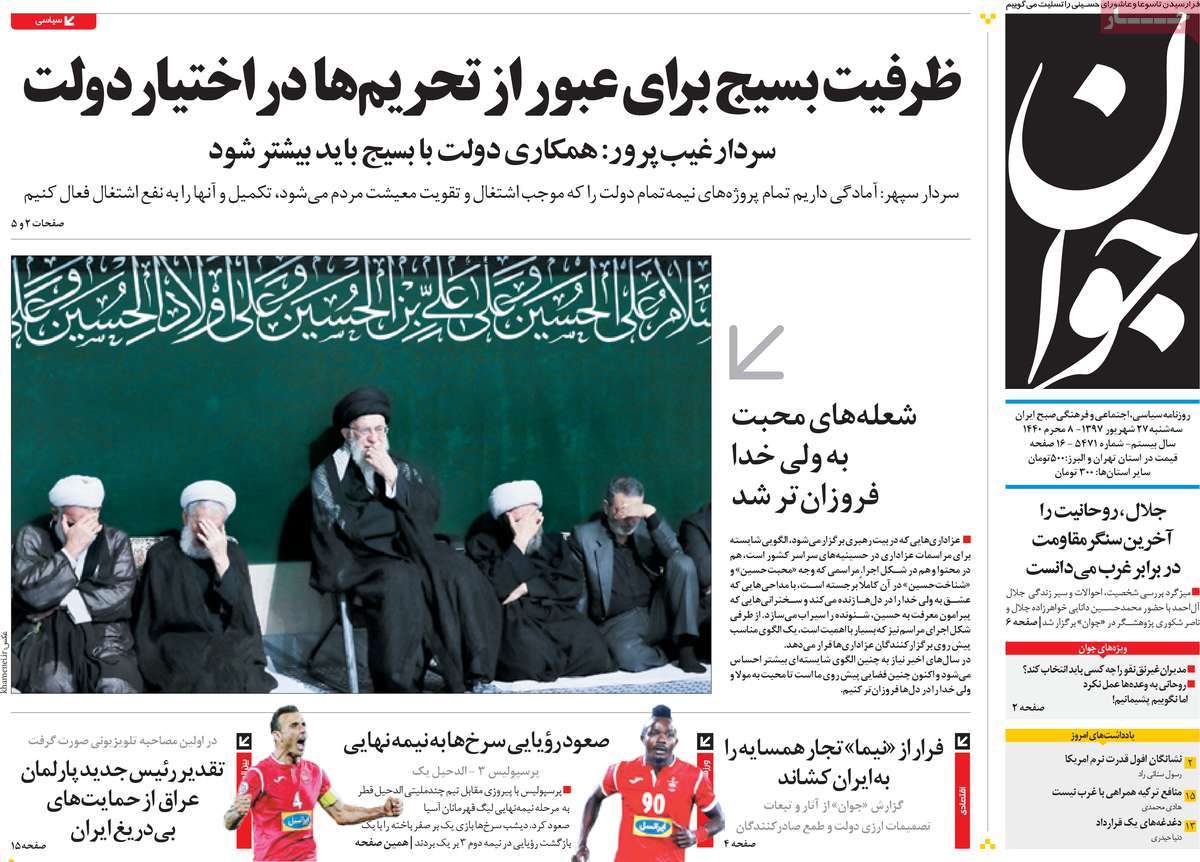
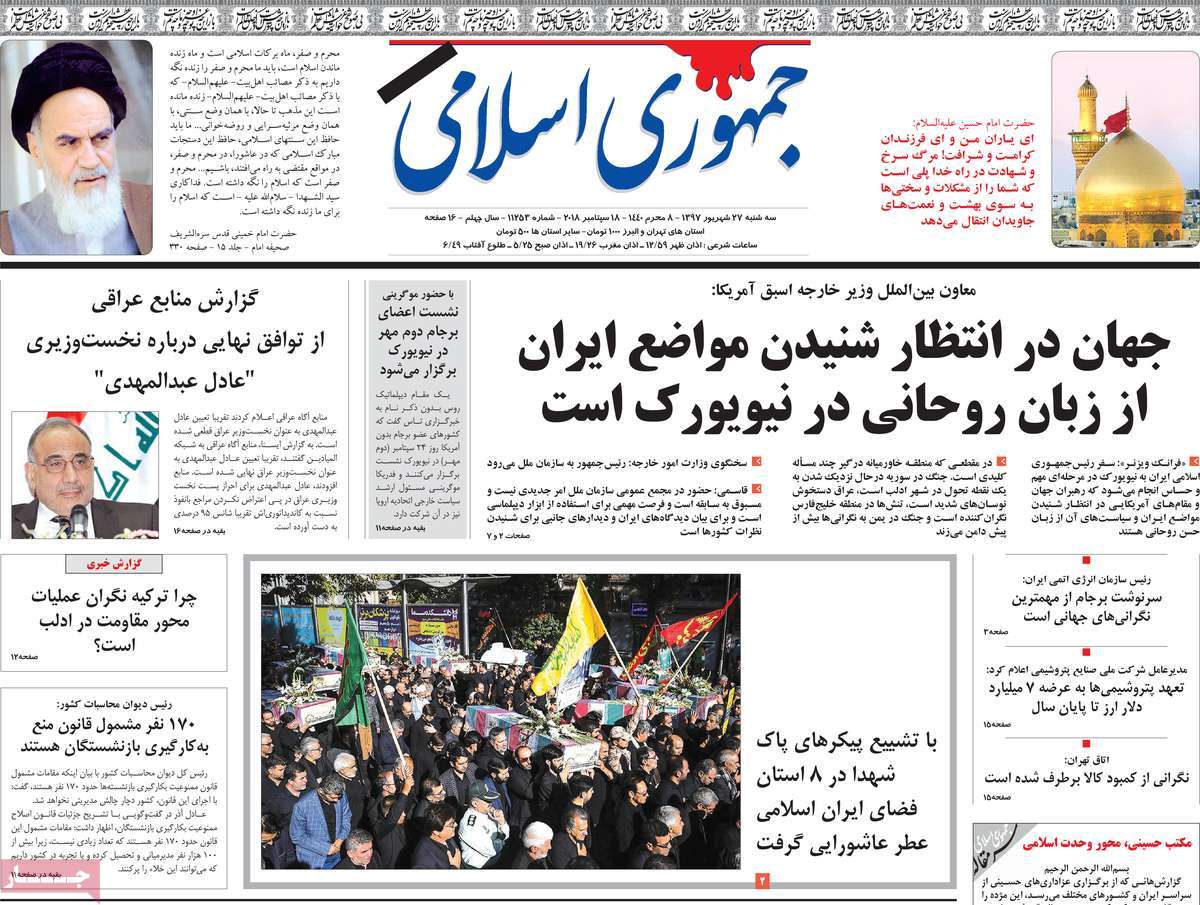
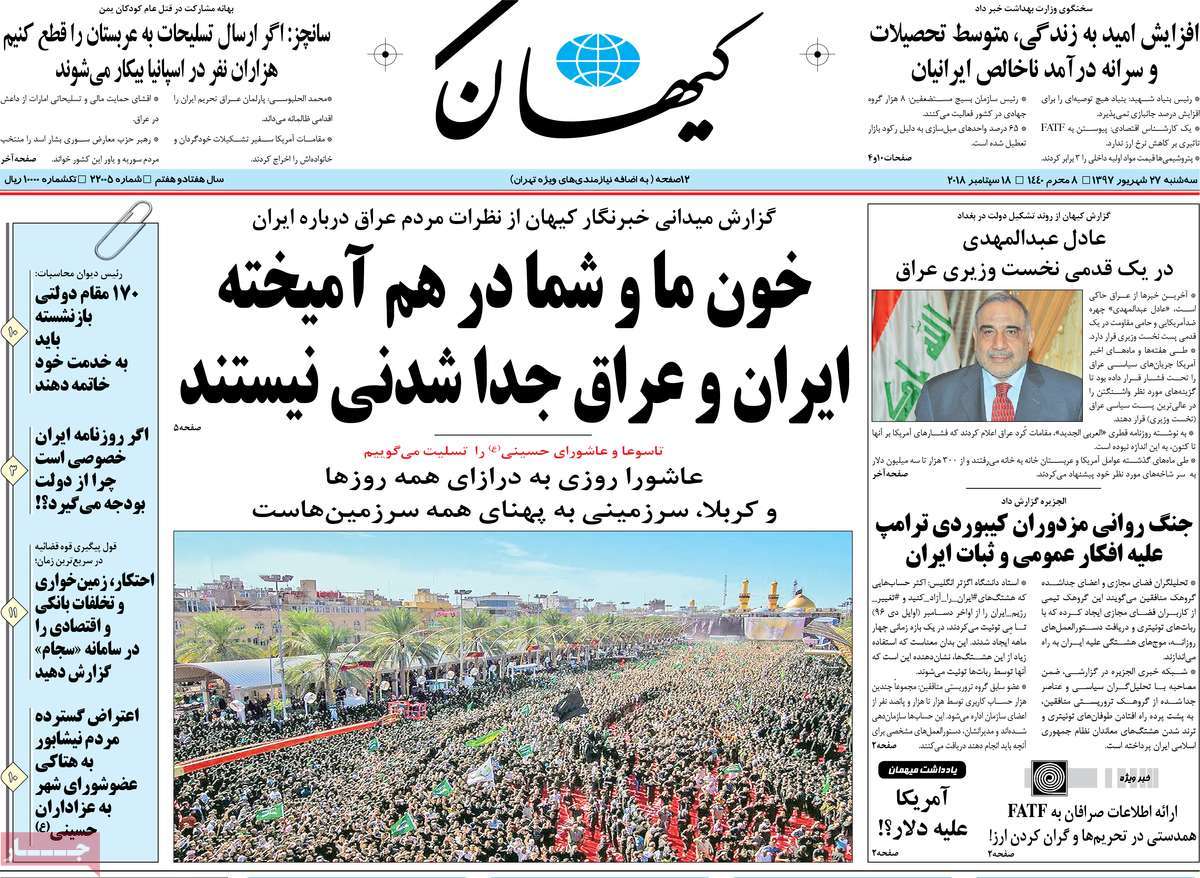
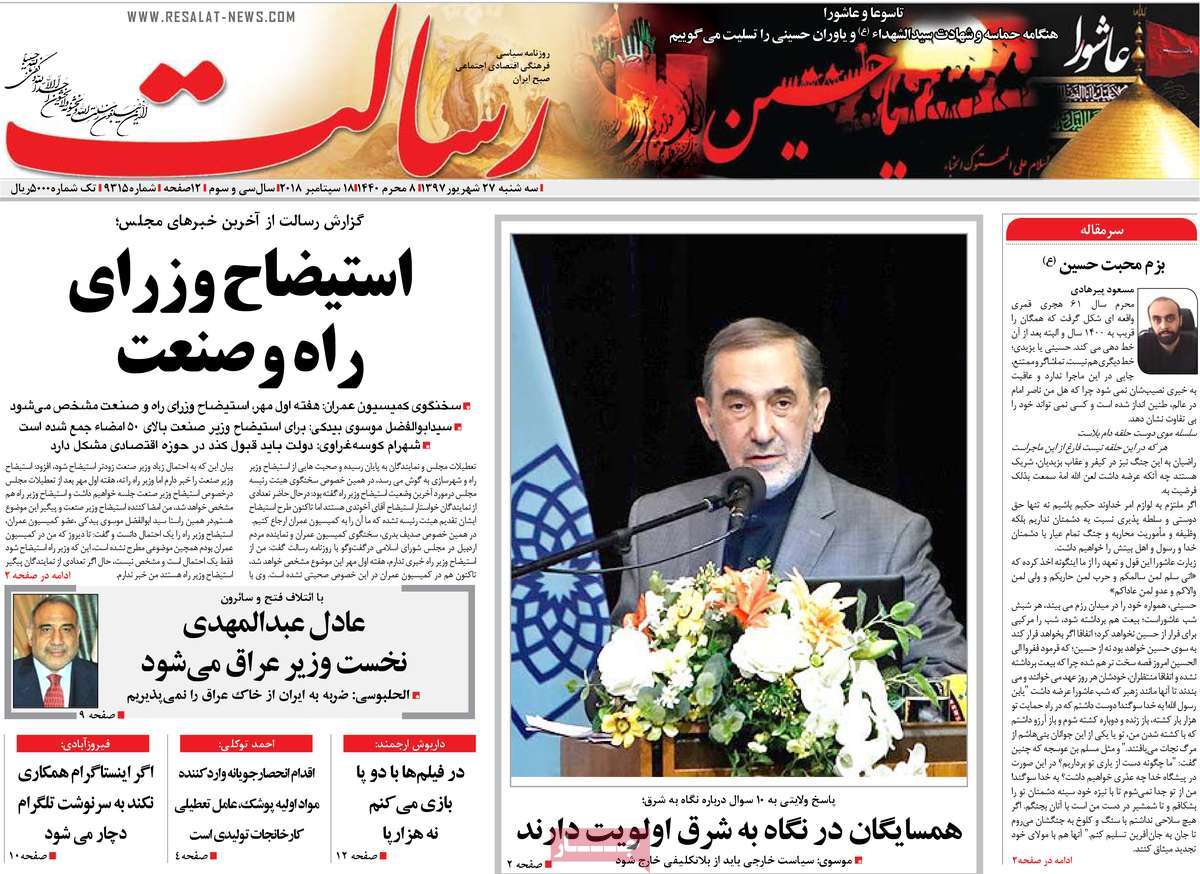
A Look at Iranian Newspaper Front Pages on September 18

A Look at Iranian Newspaper Front Pages on November 19

Several papers today covered the advent of Tasua and Ashura, the ninth and tenth days the holy month of Ramadan, when the Third Shiite Imam was martyred by the tyrant ruler of the time.

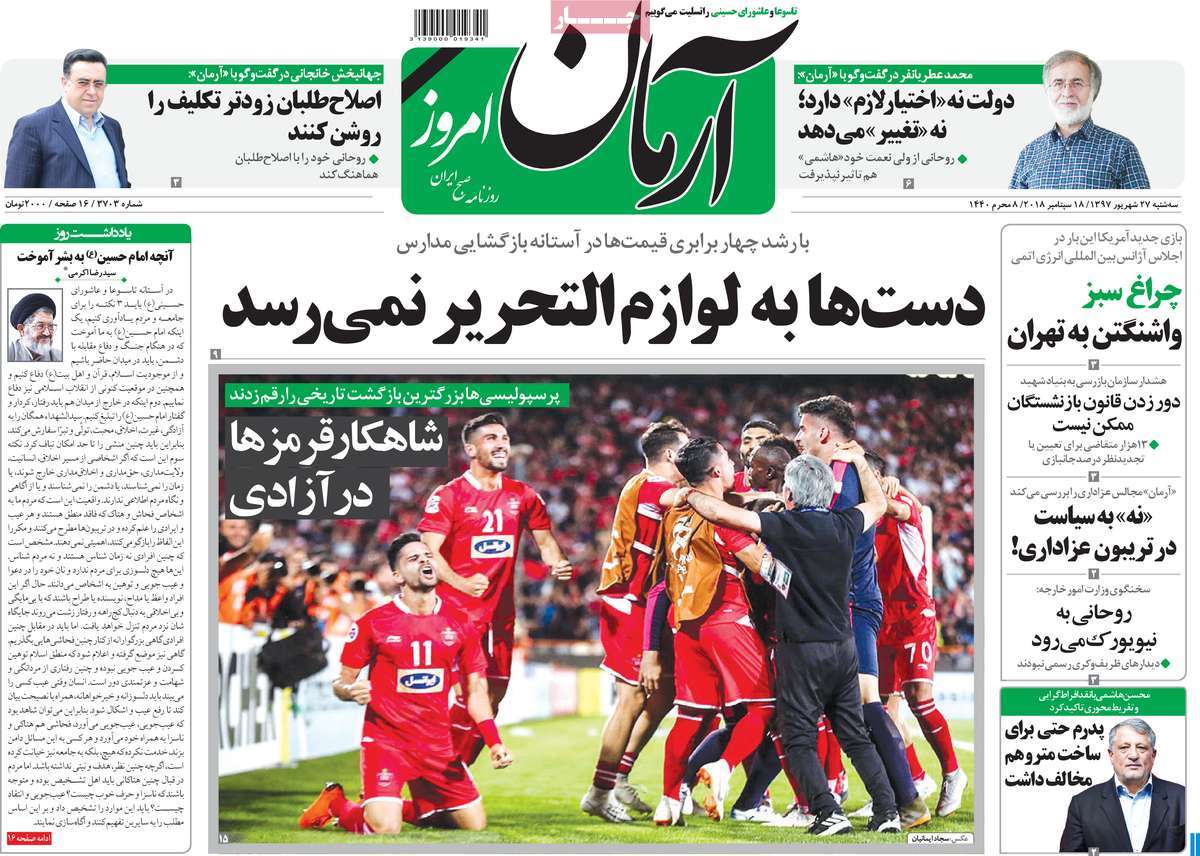
Also a top story was the historic win of Iran’s Persepolis against Qatar’s al-Duhail, which helped the former to advance to the semi-finals of the AFC Champions League.

The above issues, as well as many more, are highlighted in the following headlines and top stories:


Aftab-e Yazd:

1- Rouhani to Visit US to Attend UN General Assembly

2- Former FM Salehi Elaborates on the Way Iran-US Talks Started in 2011

3- UN: Iran’s Position in Human Development Improved

A Look at Iranian Newspaper Front Pages on September 18


Arman-e Emrooz:

1- Masterpiece of Persepolis in Azadi Stadium: Historic Comeback

2- Washington Gives Green Light to Tehran: US’ New Game, This Time at IAEA Summit

3- Rouhani to Visit New York: Foreign Ministry

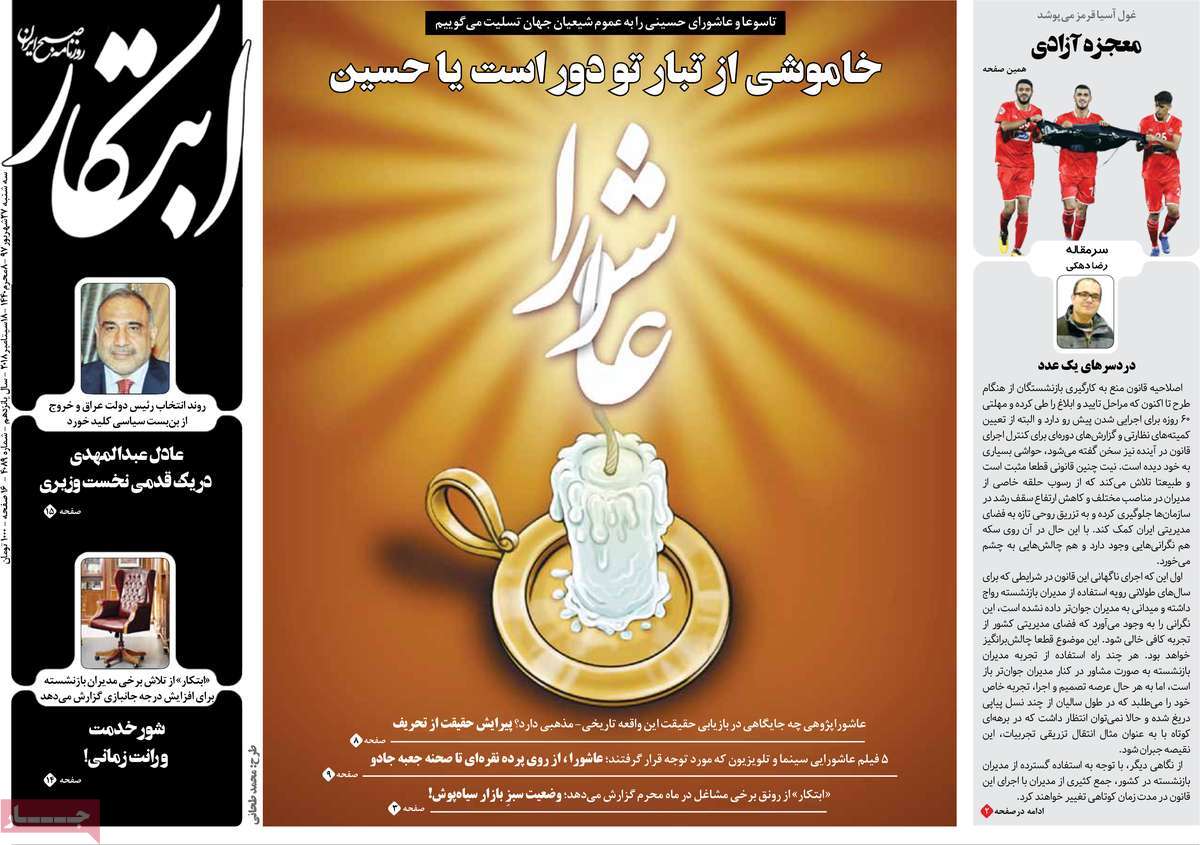
A Look at Iranian Newspaper Front Pages on September 18


Ebtekar:

1- Adil Abdul-Mahdi May Become Iraq’s New Prime Minister

  • Political Factions in Iraq Start Process of Choosing New President, PM

A Look at Iranian Newspaper Front Pages on September 18


Etemad:

1- Tehran, Symbol of Iran in Mourning Rituals for Imam Hussein

  • Iranians from All Walks of Life Mourning Martyrdom Anniversary of Prophet Muhammad’s Son

A Look at Iranian Newspaper Front Pages on September 18


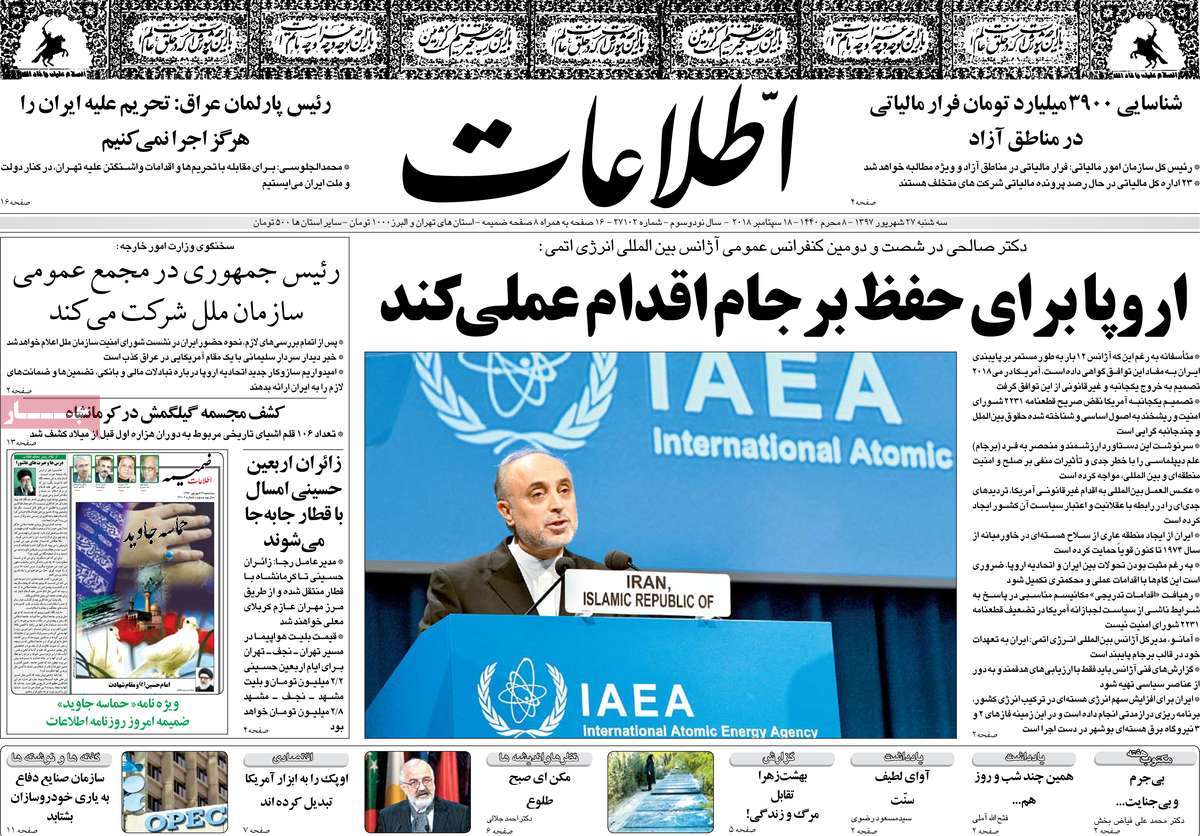
Ettela’at:

1- Iran Nuclear Chief: Europe Must Take Practical Measures to Save JCPOA

2- Iraqi Parliament Speaker: We’ll Never Implement US Sanctions on Iran

A Look at Iranian Newspaper Front Pages on September 18


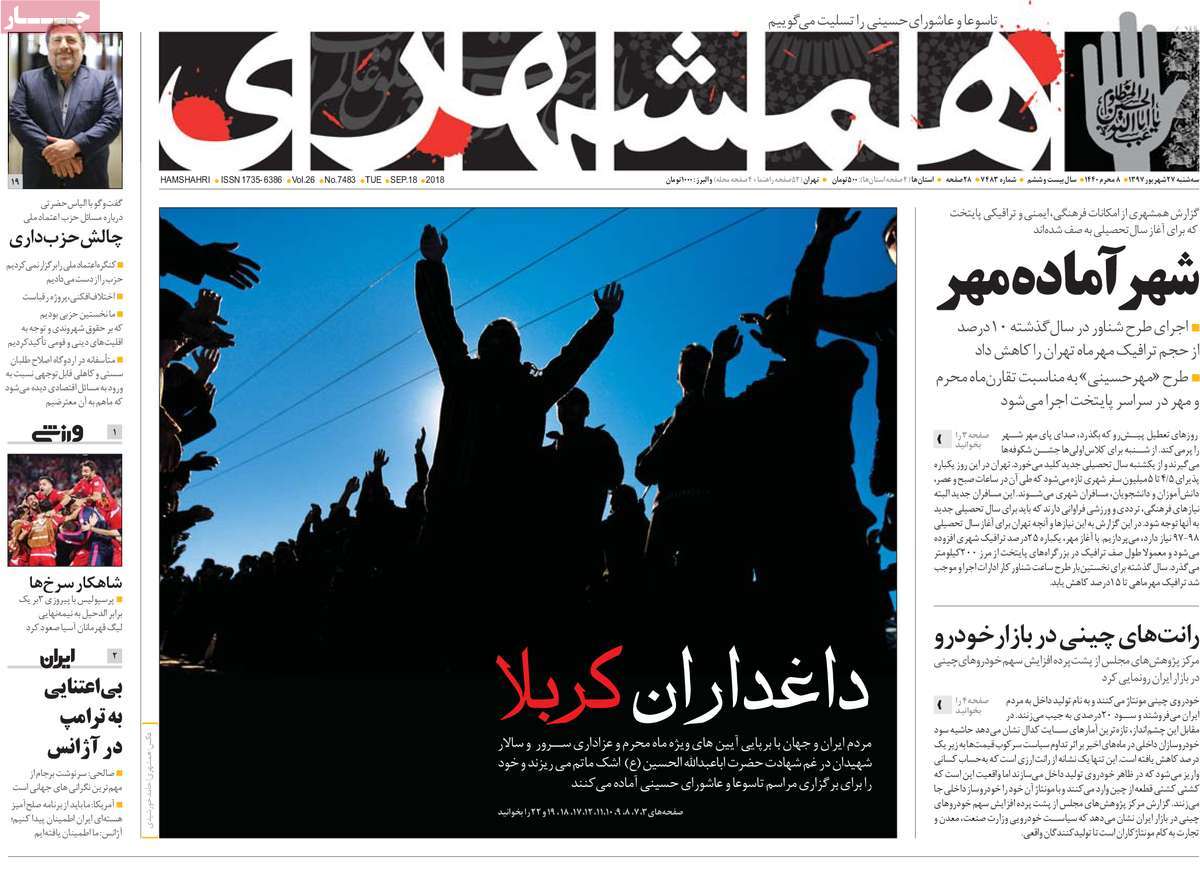
Hamshahri:

1- Mourners of Karbala: People in Iran, World Preparing for Muharram Rituals ahead of Ashura

A Look at Iranian Newspaper Front Pages on September 18


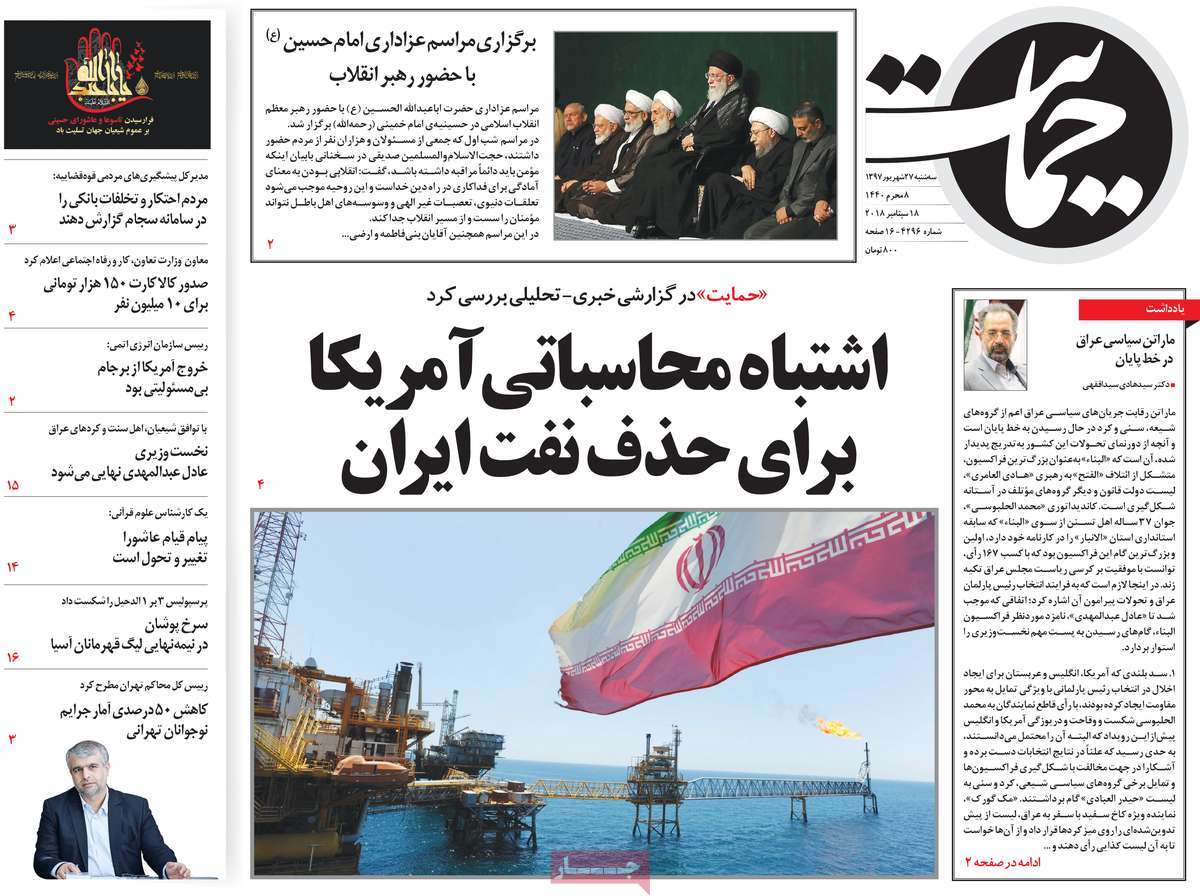
Hemayat:

1- US’ Making Mistake by Trying to Remove Iran’s Oil

A Look at Iranian Newspaper Front Pages on September 18


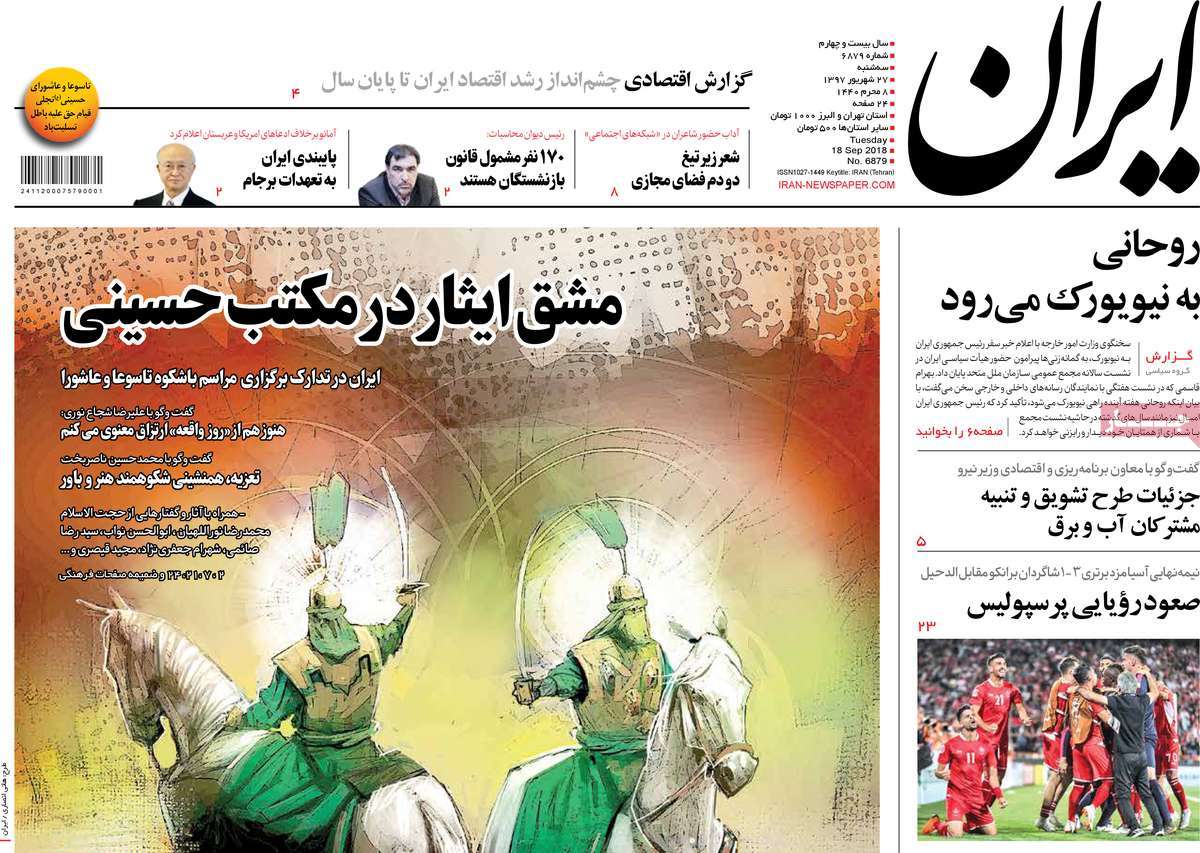
Iran:

1- Persepolis Advances to ACL Semi-Finals in Dreamy Match

  • Iranian Team Defeats Qatari Rival 3-1 to Book Place in Next Stage

2- Unlike Claims Raised by US, Saudi, Amano Once Again Confirms Iran’s Compliance with JCPOA

A Look at Iranian Newspaper Front Pages on September 18


Javan:

1- Government Can Use Potentialities of Basij Voluntary Forces to Bypass Sanctions

  • Basij Official: We’re Ready to Complete All Unfinished State Projects

2- New Iraqi Parliament Speaker Praises Iran’s Unwavering Support

A Look at Iranian Newspaper Front Pages on September 18


Jomhouri Eslami:

1- Former US Official: World Waiting to Hear Iran’s Stances from Rouhani in New York

2- Salehi: Fate of JCPOA Most Important Global Concern

A Look at Iranian Newspaper Front Pages on September 18


Kayhan:

1- A Field Report of Iraqi People’s Opinion about Iran

  • Our Blood Interwoven; Iran, Iraq Not Separable

2- Thousands of People to Lose Their Jobs If We Stop Exporting Arms to Saudi

A Look at Iranian Newspaper Front Pages on September 18


Resalat:

1- Velayati: Neighbours Top Priority of Iran’s East-Oriented Policy

2- Ministers of Roads, Industry to Be Impeached

A Look at Iranian Newspaper Front Pages on September 18


Sazandegi:

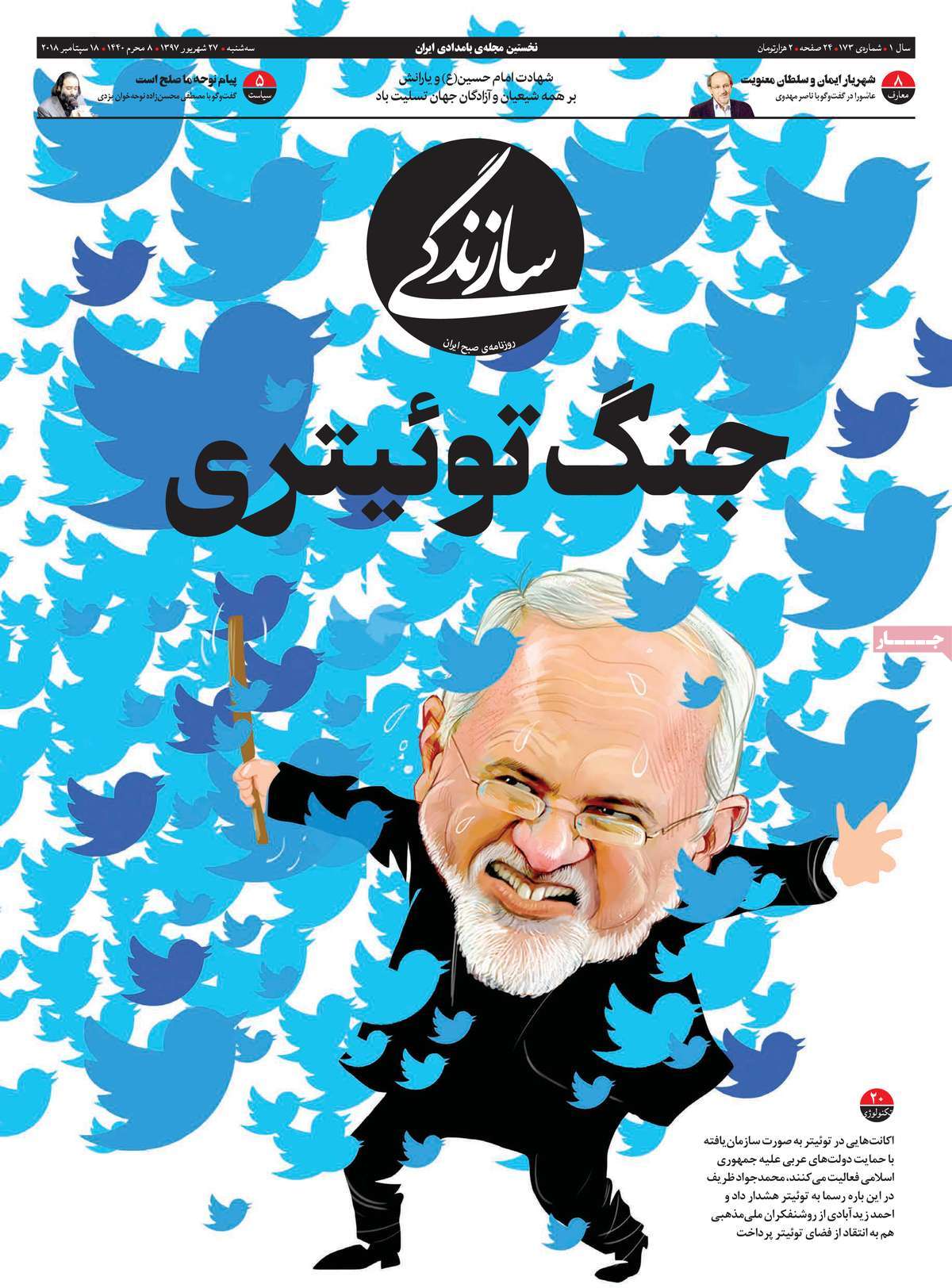
1- Twitter Conflict

  • Zarif Officially Warns Twitter about Support of Arab Governments for Anti-Iran Accounts

A Look at Iranian Newspaper Front Pages on September 18


Sepid:

1- Health Ministry Spokesman: Iranians’ Life Expectancy Increased to 76.2

2- 6,000 Inspectors Overseeing Muharram Mourning Ceremonies

A Look at Iranian Newspaper Front Pages on September 18


Setareh Sobh:

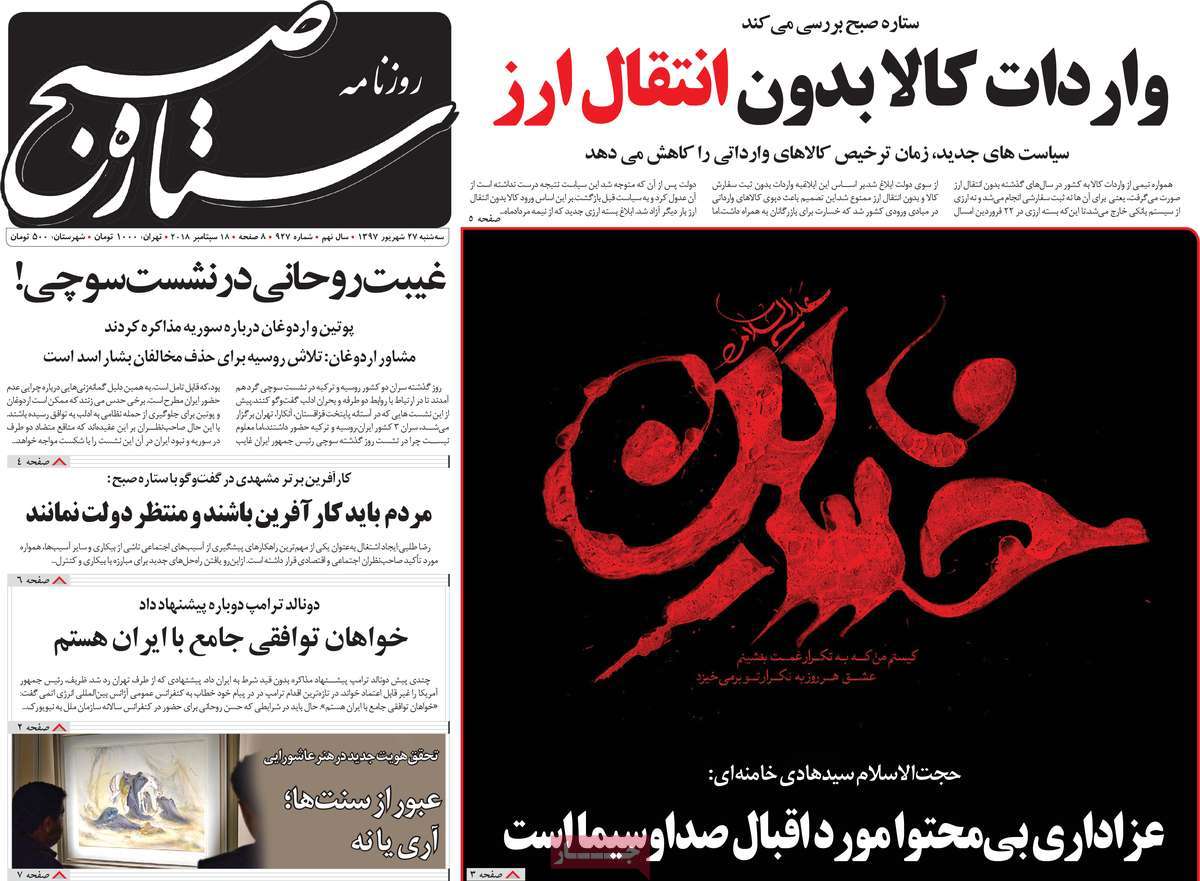
1- Rouhani Absent from Sochi Summit! Putin, Erdogan Discuss Syria

2- Trump Once Again Calls for Comprehensive Deal with Iran

A Look at Iranian Newspaper Front Pages on September 18


Shahrvand:

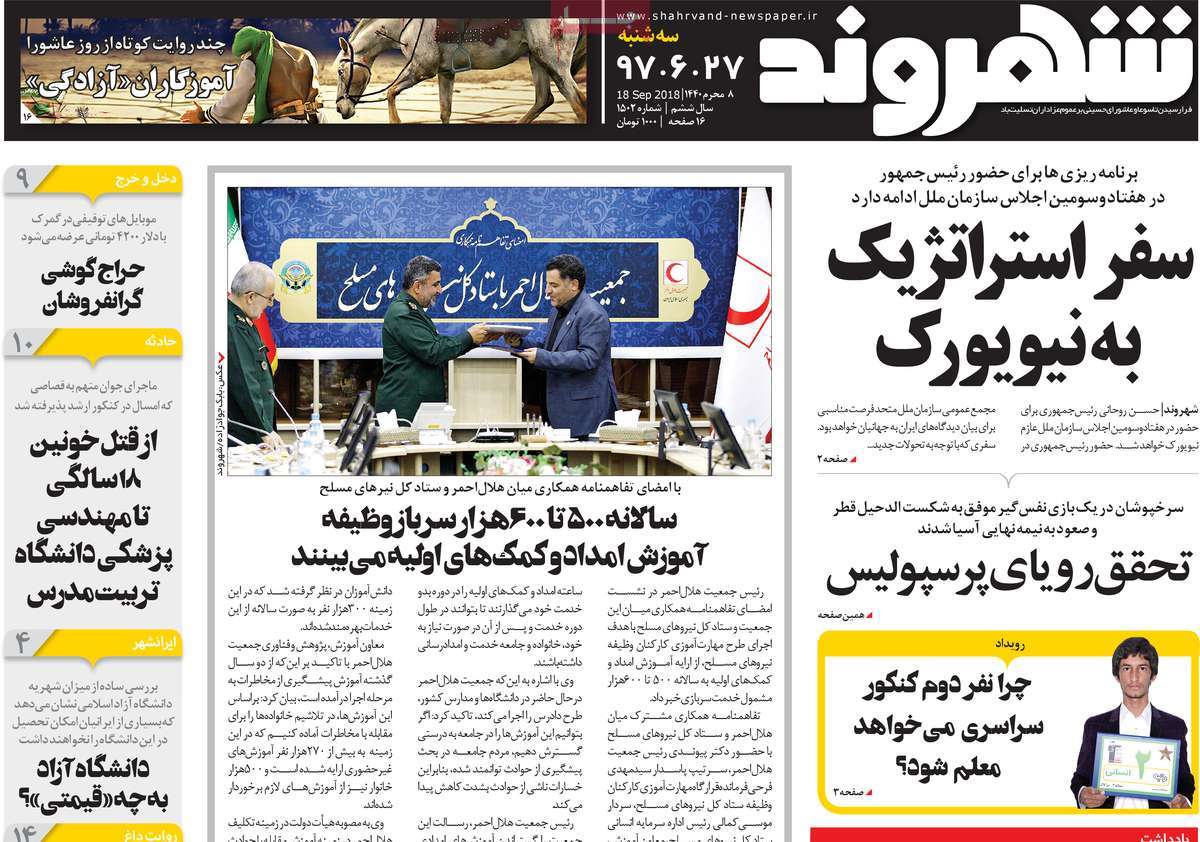
1- Strategic Trip to New York: Plans for Rouhani’s Participation in 73rd UNGA Meeting

2- Why Does Second Rank of Nationwide University Entrance Exam Want to Become a Teacher?

3- From Bloody Murder at Age of 18 to Medical Engineering at Top University

  • Young Man Sentenced to Death Admitted to Top Master’s Program

A Look at Iranian Newspaper Front Pages on September 18


Shargh:

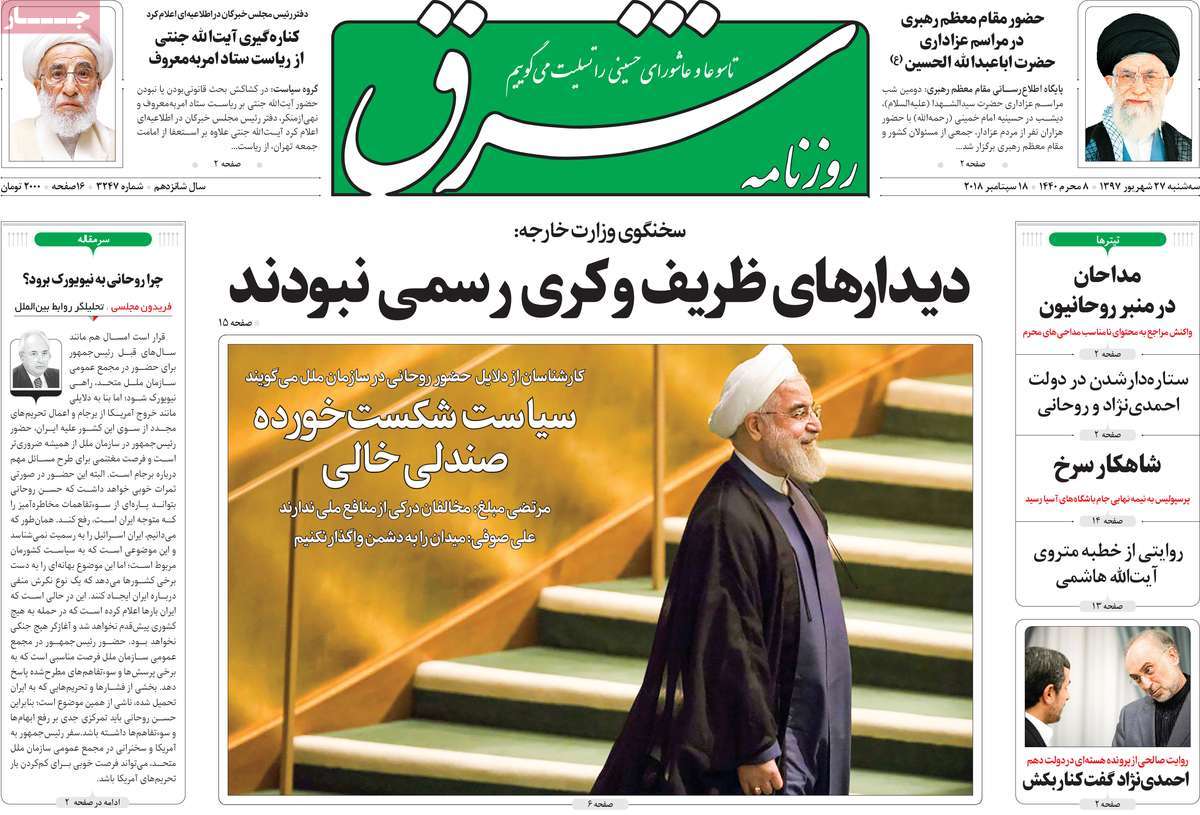
1- Zarif-Kerry Meetings Not Official: Spokesman

2- Failed Policy of Delivering Speech to Empty Seats

  • Why Iran President Rouhani Needs to Attend UNGA

3- Why Rouhani Must Go to New York [Editorial

A Look at Iranian Newspaper Front Pages on September 18

“Rouhani Should Turn UNSC Meeting into Trump’s Impeachment Session”

Majid Ansari, a senior reformist figure and a member of Iran’s Expediency Council, said President Rouhani can leave the meeting with victory, promoting the Iranian nation’s authority and honour across the world.

“President Rouhani should attend the meeting; but even if for any reason he fails to do so, it is our Foreign Minister Mohammad Javad Zarif who must take part in the meeting.”

However, President Rouhani’s attendance is preferable, a report by Jamaran website quoted him as saying.

In response to a question on whether or not the Iranian president and foreign minister should take part in the upcoming UNSC meeting, Ansrari said Iran’s absence from international arenas is against its national interests.

“In our absence, the enemies begin to unilaterally spread lies about us and as we saw in the past, they can tarnish our image in the world,” he noted.

Ansari underlined that President Rouhani should have a strong presence in the UNSC meeting with full legal and diplomatic preparedness.

“In our possible absence, the participants may decide to make a decision or issue a statement against us. So, the president should attend the meeting with full legal and diplomatic information to defend the Iranian nation’s rights,” he noted.

He went on to say that given Trump’s weird stances towards the European and some regional states and his threats against some international judiciary bodies, “time is now ripe for us to express our protest calmly at the presence of the UNSC members to the US unilateral and brutal sanctions.”

He added Iran can also highlight the US violation of the international treaties and the Iran nuclear deal.

Ansari then stressed that Iran’s legal capacities are strong enough to enable it to turn the UNSC meeting into the impeachment session of Trump.

“During the JCPOA talks, by its legal power and diplomacy, Iran managed to overcome all the obstacles in the way of the deal,” he said, adding Iranian negotiators could launch a legal fight with world powers during the talks.

The Iranian politician also said today the US, the Zionist regime and their allies feel inferior in legal terms against the Islamic Republic.

He blamed some political forces inside Iran for promoting self-censorship and self-isolation and said these features reveal weakness and fear.

“Iran is a strong country with a great and revolutionary nation,” he concluded.
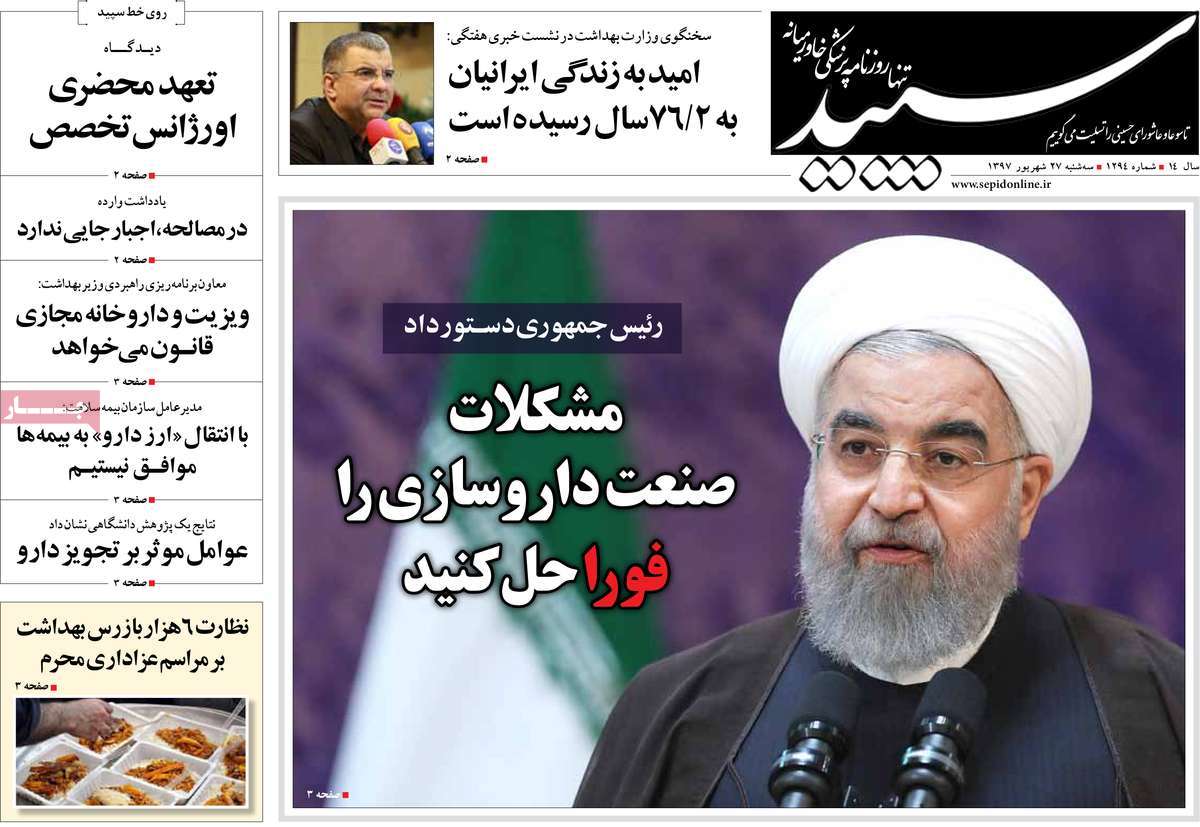
The participation of President Rouhani in the UNSC meeting, slated for later this month under the chairmanship of US President Trump, has sparked harsh debates in Iran.

Some politicians argue that Rouhani should not attend the meeting. On the other hand, there are many others who maintain that he should take part in the session and defend Iran’s rights.

Rial’s Depreciation Threatening Iran’s Border Markets

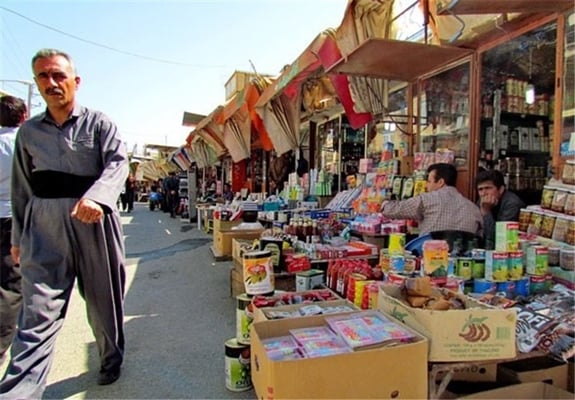
It’s been a while that the threats and challenges against Iranian border markets, particularly in the western and southern, areas have turned into a hot topic for discussions in various circles in Iran but as things stand, no measure has been adopted so far to tackle the serious problem .

Last month, the governor of the northwestern city of Marivan in Kurdistan province warned about the negative impacts of the massive purchase of basic commodities in the city’s market by foreigners arriving in through Iraqi borders saying this has turned the commodities into rare goods for the local residents over the past months.

“About 1100 Iraqis arrive in Marivan on a daily basis through Bashmaq border to purchase high amounts of basic commodities,” Mohammad Shafi’ee was quoted as saying in a report by Aftab-E Yazd newspaper.

He described the number of Iraqis arriving in Marivan as unprecedented and warned about a looming crisis in the region.

The fall of Iran’s Rial against other currencies over the past months is cited as the main reason behind the growing visits of Iraqis to Kurdistan and Khuzestan provinces to provide their basic commodities.

Earlier, Director of a Travel Agency, Mostafa Fathollazadeh said tens of thousands of Iraqis visit Khuzestan’s Arvand Free Zone daily to buy their basic commodities.

“The border markets are shrinking due to the visits of the Iraqis. The Iraqis mainly from southern regions of Iraq including Basra enter Arvand, Khorramshahr and Abadan to purchase their basic commodities like meat, chicken, bread and even salt. This is mainly due to the devaluation of Iran’s Rial against Iraq’s Dinar,” he said.

This comes as an Iranian lawmaker said angrily just recently that due to the devaluation of Iran’s national currency, Iran’s local markets have turned into an appealing destination for travelers from neighboring states.

“The reality on the ground is that as our fellow countrymen in the border areas gradually lose their purchasing power due to Ria’s depreciation, the residents of the neighbouring states enjoy the privilege to buy an increasing amount of goods in return for lower money,” Majid Kianpour said.

On the other hand, Gholam-Reza Sharafi, another Iranian lawmaker from Abadan province, touched on the new challenges against the border markets.

In an interview with Aftab-e Yazd, Sharafi elaborated on the recent volatile in the markets of the border areas and said based on an undeclared law, Iranian and neighboring border residents have been involved in exchanging commodities over past years.

“In our region, the exchanges used to be carried out mainly through the Persian Gulf states but recently due to Iran’s Rial devaluation, we see that the value of Iraq’s national currency has increased ten times against our currency. This, in turn, has significantly raised the purchasing power of Iraqis and since they suffer from lack of infrastructure to produce their basic commodities, naturally they flood to Iran to provide the commodities in Iranian markets,” he noted.

In response to a question on the possible impacts of such exchanges on Iran’s economy, the lawmaker added unfortunately Iran’s free zones along the border areas have turned into an appropriate destination for neighbouring residents for their basic goods.

“It goes without saying the new situation is threatening us because our goods easily become rare for our own people. This inevitably manipulates our markets,” Sharafi noted.

He then elaborated on a mechanism to overcome the problem and said Iran needs to establish balanced economic exchanges with the neighboring states and added to this end, Iranians have to stick to the law and exert further efforts to create jobs, attract tourists and foreign investors and promote our domestic goods.

“If we violate the law, such economic chaos in the border markets becomes inevitable. For example, at present, foreigners can empty parts of our markets with just a 100-dollar bill. Therefore, a high amount of Iranian goods are taken out in return for little money,” Sharafi said.

Touching on the necessary measures to overcome the challenges, the lawmaker said it’s not too late yet and the Islamic Republic can tackle the problem by relying on economic advisories from experts.

“Sanctions are not just threats even if they are challenging. Today, we can easily bypass the sanctions through adopting precise measures and establishing good relations with the outside world. This is a good chance for us to test ourselves at the economic field and prove our abilities to the world,” he concluded.