Friday, December 26, 2025
Home Blog Page 3393

Iran Rejects NATO Chief’s Remarks on Its Missile Program

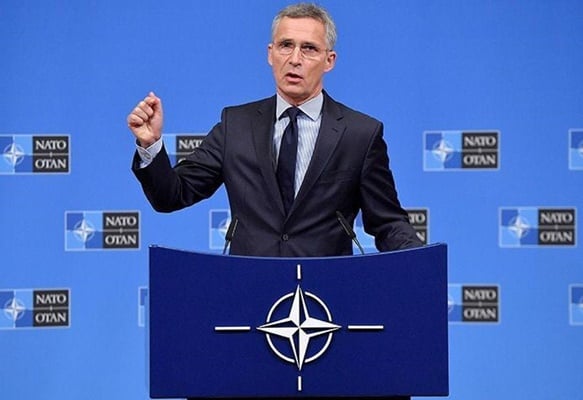
Nato Secretary General Jens Stoltenberg addressing a press conference ahead of a NATO defence ministerial meeting in Brussels on October 2, 2018. / Photo by AFP

In a Wednesday statement, Foreign Ministry Spokesman Bahram Qassemi said the Islamic Republic of Iran, which is itself a major victim of the terrible phenomenon of terrorism, has played the most effective role in ending the rule of terrorist groups, including ISIS, in the region.

He said Tehran’s fight against terrorism comes as certain countries and their allies have just been engaged in creating “fake” coalitions against the terrorist movements.

“Contrary to the statements of the NATO Secretary General, Iran’s constructive role in stabilising the Persian Gulf region and the Middle East has been acknowledged by a large part of the international community,” he added.

“If it was not for the massive struggle of Iran against these extremist terrorist groups, many European countries and cities would not have security today.”

Qassemi further underlined that undoubtedly, many European countries should be thankful for this sacred struggle to suppress the terrorists in the region, and they should not cast doubts on such policies that have been constructive and effective in providing them with security.

“The Islamic Republic of Iran has always sought dialogue and close cooperation with its neighbours, and believed in the strengthening of security in the Middle East by the regional countries. Tehran denies any presence and intervention of foreign military and security forces in the Middle East and Persian Gulf under the pretext of providing securing,” he added.

The foreign ministry spokesman also rejected the NATO chief’s statement regarding the missile program of Iran saying the program has a defensive and deterrent nature. He also underscored that Iran, like all independent countries of the world, has the right to use conventional military-defence programs to defend itself.

“Definitely, such an expression of concern will not have an effect on the policy of the Islamic Republic of Iran in maintaining, developing and strengthening its capabilities and missile defence program. We will never let other countries deprive us of the most basic defensive weapons, having experienced the devastating war of Saddam Hussein supported by the West and the East.”

Qassemi also pointed out that the International Atomic Energy Agency (IAEA) and the international community have for several times confirmed Iran’s adherence to its nuclear-related commitments under the Joint Comprehensive Plan of Action.

“The NATO Secretary General had better be more concerned about the unilateral and dangerous policies of Washington and the non-compliance of this NATO member with its international obligations,” stated Qassemi.

In a press conference on October 2 and ahead of the meetings of NATO Defence Ministers in Brussels, NATO Secretary General Stoltenberg said all allies are concerned about Iran destabilising activities in the wider Middle East region, and the NATO strongly condemns the financial support for terrorism, including Iran’s support to a variety of armed non-state actors.  “We are also, of course, concerned about their missile programme and we are committed to ensuring that Iran’s nuclear programme remains peaceful,” added Stoltenberg.

He further mentioned that “there are different views on the JCPOA, or the Iran nuclear deal, and that’s a fact, but despite the disagreement on the Iran nuclear deal, we all agree on the importance that any nuclear programme in Iran remains peaceful.  And we are also concerned about what they do when it comes to destabilising other countries in the region.”
Iran Blasts US’ Decision to Quit Amity of Treaty

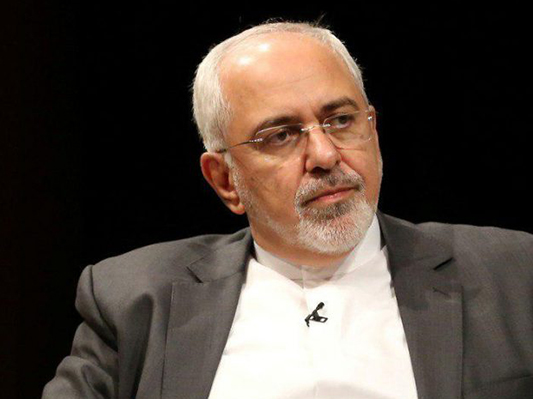
“US abrogated JCPOA -a multilateral accord enshrined in UNSC Resolution 2231- arguing that it seeks a bilateral treaty with Iran. Today US withdrew from an actual US-Iran treaty after the ICJ ordered it to stop violating that treaty in sanctioning Iranian people,” Zarif said in a Wednesday tweetm calling the Trump administration an “outlaw regime.”

His remarks came after US Secretary of State Mike Pompeo announced that the US was cancelling the 1955 Treaty of Amity with Iran, after the International Court of Justice (ICJ) ordered Washington to halt the unilateral sanctions it recently re-imposed on “humanitarian” exports to the Islamic Republic.

The treaty established economic relations and consular rights and was signed during the terms of former US President Dwight Eisenhower and former Iranian Prime Minister Hossein Ala.

Iran filed a complaint with the ICJ — the principal judicial organ of the United Nations — in July after US President Donald Trump’s decision in May to quit the 2015 nuclear deal with Tehran, known as the Joint Comprehensive Plan of Action (JCPOA).

Trump said back then that he would reinstate sanctions removed as a result of the multilateral accord while introducing tougher sanctions against the Islamic Republic.

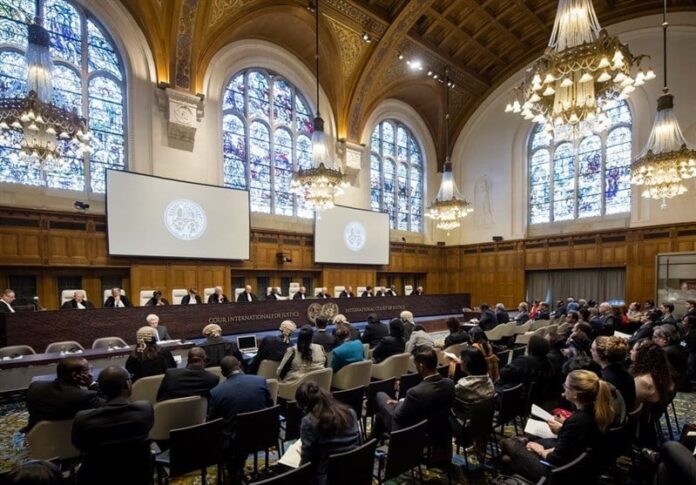
The ICJ’s top tribunal – known as the World Court — concluded Wednesday that US assurances that the sanctions won’t hurt humanitarian aid “were not adequate.”

The Hague-based court then ordered Washington to remove sanctions that impeded “the free exportation to Iran of medicines and medical devices, food and agricultural commodities” as well as airplane parts.

“Another failure for sanctions-addicted USG and victory for rule of law,” Zarif wrote in a tweet after the ruling.

Iran Praises EU’s Efforts to Save JCPOA, Defy US

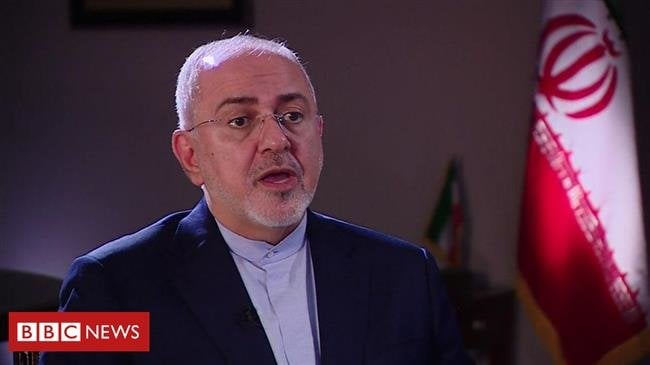
In an interview with the BBC on Tuesday, Zarif praised the European signatories to the nuclear agreement for defying US President Donald Trump’s pressure and standing by the Joint Comprehensive Plan of Action (JCPOA) — a binding international agreement.

Zarif said UK Prime Minister Theresa May, French President Emmanuel Macron “and everybody else said that we are committed” to the JCPOA and to making sure that “Iran enjoys the economic dividends of the deal.”

“The Europeans probably made better commitments than anybody expected,” said the minister.

Zarif, however, said, making commitments alone are not enough, and called on Iran’s European partners to put into action their political will to neutralize the anti-Iran bans re-imposed by Washington.

Europeans should work “to translate those political commitments into mechanisms and I believe those mechanisms are going to be in place. Now the next test — which is the most important and difficult test — is to see whether those mechanisms work,” he said.

“We are going to be a little bit more patient,” Zarif added.

Back in May, Trump pulled Washington out of the JCPOA despite objections from the other parties.

Besides re-imposing the anti-Iran sanctions it had lifted under the accord, the Trump administration has also been seeking to discourage the European firms from doing business with Iran by threatening them with penalties.

But the other signatories have vowed to try and protect their business links with Iran in the face of US sanctions and keep the JCPOA alive.

Months after scrapping the Iran deal, the US president offered to hold talks with President Hassan Rouhani. Tehran rejected that offer, saying it will not sit at the negotiating table with Washington under pressure and threats.

Intl. relations ‘not about falling in love’

Elsewhere in his interview, Zarif was asked whether a summit between President Trump and President Rouhani, would be impossible.

“Well, nothing is impossible,” he replied. “But the outcome of President Trump’s summit with President Rouhani would be a photo opportunity and a two-page document.”

“We have a 150-page document…which was negotiated word by word not only by Iran and the United States, but by six other powers. And having negotiated that deal and having been involved in this process for a very long time, I can assure President Trump that the US will not get a better deal,” he said.

Asked about Trump’s comments about falling “in love” with North Korean leader Kim Jong-un, Zarif said that international relations are not about falling in love, but about “respecting obligations.”

“The nuclear deal is not a personal deal between myself and John Kerry or president Obama and President Rouhani. It is an international agreement between seven countries and the European Union, which is included in a Security Council resolution,” he pointed out.

“The United States negotiated a deal. You know what happened in the United States when Trump came to office was not a revolution; it was simply a change of administration,” Zarif added.

Separately on Tuesday, the Iranian foreign minister addressed a UN meeting in New York on the JCPOA, where he highlighted the importance of multilateralism.

He emphasized that the Islamic Republic would never tolerate threats, and that pressure would not bring the country to the negotiating table.

Washington’s use of sanctions has undermined the US dollar in the international financial system, he added.

Trump’s November Sanctions to Have No Impact on Iran: Rouhani

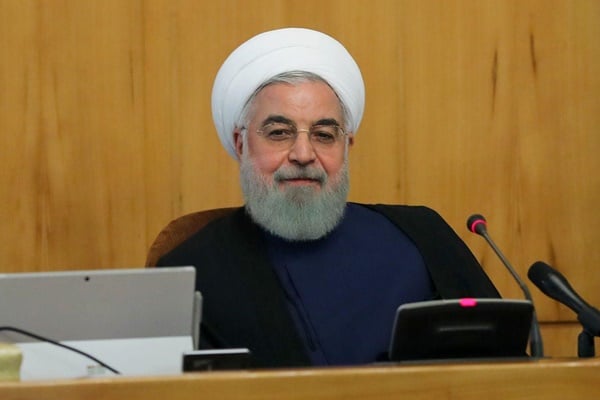
Speaking in a Wednesday session of the Cabinet, Hassan Rouhani said no one in Iran should even think of the negative impacts of the US’ November sanctions as nothing will happen then.

The Americans, in August and September, have done whatever they wanted to do in November, he said

Rouhani said in recent months Washington has spared no chance to boost its anti-Iran pressure, leaving no substantial steps for the country to take to further increase pressure on Iran in November.

The president said the US government’s measures have proven detrimental to the countries in Europe and Asia and even the US itself, and the new policy will bring nothing but failure for the country.

The US reinstated parts of anti-Iran sanctions suspended under the nuclear accord weeks ago and is set to restore sanctions on oil and transactions with the central bank of Iran in November.

Rouhani further described this year’s United Nations General Assembly as a great victory for Iran in its standoff with the bullying US, saying Washington was unprecedentedly sidelined in this year’s forum.

He said Americans were after advancing their anti-Iran policy in this year’s meeting, but they failed to score any goals.

The president said Iranians diplomats managed to push the US to the sidelines during this year’s UNGA.

“For the first time, Iran was seen as a country favouring law, honouring commitments, multilateral deals and multilateralism, and the US was known as a violator of international norms and a country that has stood against the world,” he said.

Rouhani said a majority of countries supported Iran’s position on JCPOA and censured the US reinstating anti-Iran sanctions.

“Today, the global public opinion sides with Iran and even inside the US, many politicians and people believe Iran is on the right path and they do not approve of US government’s measures,” he said.

ICJ Ruling Proves US Sanctions against Iran Cruel: Statement

ICJ Ruling Proves US Sanctions against Iran Cruel: Statement

In a statement on Wednesday, the foreign ministry said the ICJ’s unanimous decision is another clear testament to the truthfulness of Iran and the illegitimacy and unfairness of the United States’ sanctions against our country’s people and citizens.

What follows is the full text of the Iranian Foreign Ministry’s statement:


In the Name of God

The Islamic Republic of Iran welcomes the decision by the International Court of Justice (ICJ) as the only major judicial body of the UN and the tribunal’s issuing of an injunction against the US government’s illegal move to restore unilateral sanctions [against Iran] which came upon this country’s withdrawal from the Iran nuclear deal (known as the Joint Comprehensive Plan of Action, the JCPOA), and regards the court’s unanimous decision as another clear testament to the truthfulness of Iran and the illegitimacy and unfairness of the United States’ sanctions against our country’s people and citizens.

This global tribunal has reiterated that the verdict it has issued is binding and brings international obligations while announcing that the government of the United States is obliged, under its international commitments, to remove the obstacles created as a result of its actions and illegal decisions made upon its pullout from the JCPOA, including the impediments which have emerged on the path of Iran’s trade in certain domains.

In its ruling, the court has also obliged the United States to guarantee that it will give necessary permits for cases specified in the court order and will handle relevant payments and transactions. In the injunction, the International Court of Justice has also confirmed UN Security Council Resolution 2231, which approves the JCPOA.

The Islamic Republic of Iran’s Foreign Ministry sees eye to eye with the International Court of Justice with regards to its ruling, and the tribunal regards itself as having the preliminary jurisdiction to look into Iran’s lawsuit against the US and, hence, has foiled efforts by the US government and its lawyers to dismiss the court’s jurisdiction and shirk its legal responsibilities.

In its ruling, the tribunal has rejected the US government’s allegations and legal viewpoints, announcing straightforwardly that Iran’s demands are merely related to possible breaches of the agreement that Iran has mentioned, and that the [violation of] specific rights that the Islamic Republic of Iran has referred to in accordance with the agreement can have irreparable consequences.

As a result, and in light of the International Court of Justice’s reconfirmation of the Islamic Republic of Iran’s truthfulness and its confirmation that the US government’s approach is illegitimate and illegal, today the world public opinion and all independent countries have more assurance and are determined to show off their resolve to respect international agreements, observe international law and respect government’s responsibilities with regards to the preservation and implementation of the JCPOA.

The injunction issued by the International Court of Justice showed once again that it is the US government that is becoming more and more isolated due to its wrong and extremist policies and, as a result, excessive demands from other countries. Hence, the US should drop its wrong habit of, and inappropriate addiction to imposing unfair and illegal sanctions against people and citizens, and turn into a responsible member and an ordinary country of the international community. In this path, the international community and independent countries shoulder a heavier responsibility to foil the illegal attempts of this country, which has a long history of reneging on its commitments and non-compliance with its international obligations.

ICJ Orders US Not to Hamper Investment in Iran

In a verdict on Wednesday, the UN court said the US is ordered to refrain from taking measures that damage Iran’s aviation, drug, food and agriculture industries and issue necessary licenses for sending humanitarian aid and goods related to these industries to Iran.

The ICJ also ordered the two sides to refrain from taking measures that escalate tensions and make it more difficult to solve the Iran-US conflict, Iranian media reported.

The US pulled out of the 2015 nuclear deal early May and is restoring sanctions suspended under the accord afterwards.

In July, Iran filed a lawsuit with the ICJ claiming the US return of sanctions violates the 1955 Treaty of Amity, Economic Relations and Consular Rights between the two countries.

In its Wednesday ruling, the ICJ said the US must also keep honouring the treaty.

The ICJ, which is based in The Hague and is also known as the World Court, is the United Nations tribunal for resolving international disputes.

Although the ICJ’s decisions are binding, it has no power to enforce them, and countries, including the US, have occasionally ignored them.

A senior Iranian diplomat said last month Iran’s lawsuit against the return of US sanctions is aimed at placing pressure on Washington, as Tehran is not hopeful the US will abide by the verdict.

The temporary orders are valid until the court issues its final verdict.

“Drop in Oil Prices Hinges on Removal of US Sanctions on Iran”

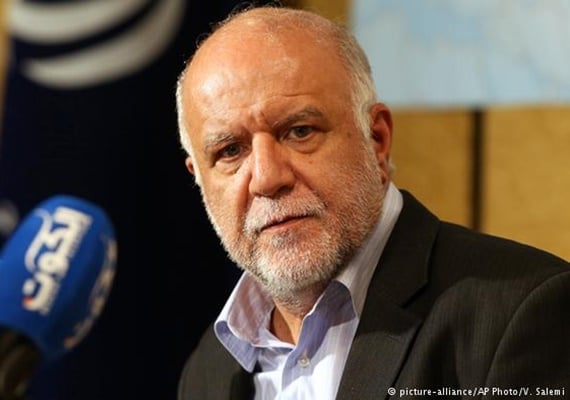
Speaking after a meeting with the parliament’s Energy Commission on Wednesday, Bijan Zanganeh said OPEC is producing oil at the maximum capacity.

“Trump wants oil prices not to rise and expects OPEC to boost production, but this organization has no power to increase production,” he added.

Trump, who has for a while been accusing OPEC of pushing oil prices too high, said last week that he wants the group to decrease prices.

“OPEC and OPEC nations, are, as usual, ripping off the rest of the world, and I don’t like it. We want them to stop raising prices,” Trump said in an address to the United Nations General Assembly in New York on September 25.

Zanganeh said the psychological effect of political tensions caused by the US is behind the surge in global oil prices, with China, Japan and Europeans being the main losers.

The oil market cannot tolerate Iran’s supply of oil-related products to be cut and prices will certainly rise even more in the future, Zanganeh warned.

“OPEC is not responsible for the oil price increase. He himself is responsible for the current conditions. For the prices to drop, he needs to forget about Iran sanctions,” Zanganeh said.

The US reinstated parts of anti-Iran sanctions suspended under the nuclear accord weeks ago and is set to restore sanctions on oil and transactions with the central bank of Iran in November.

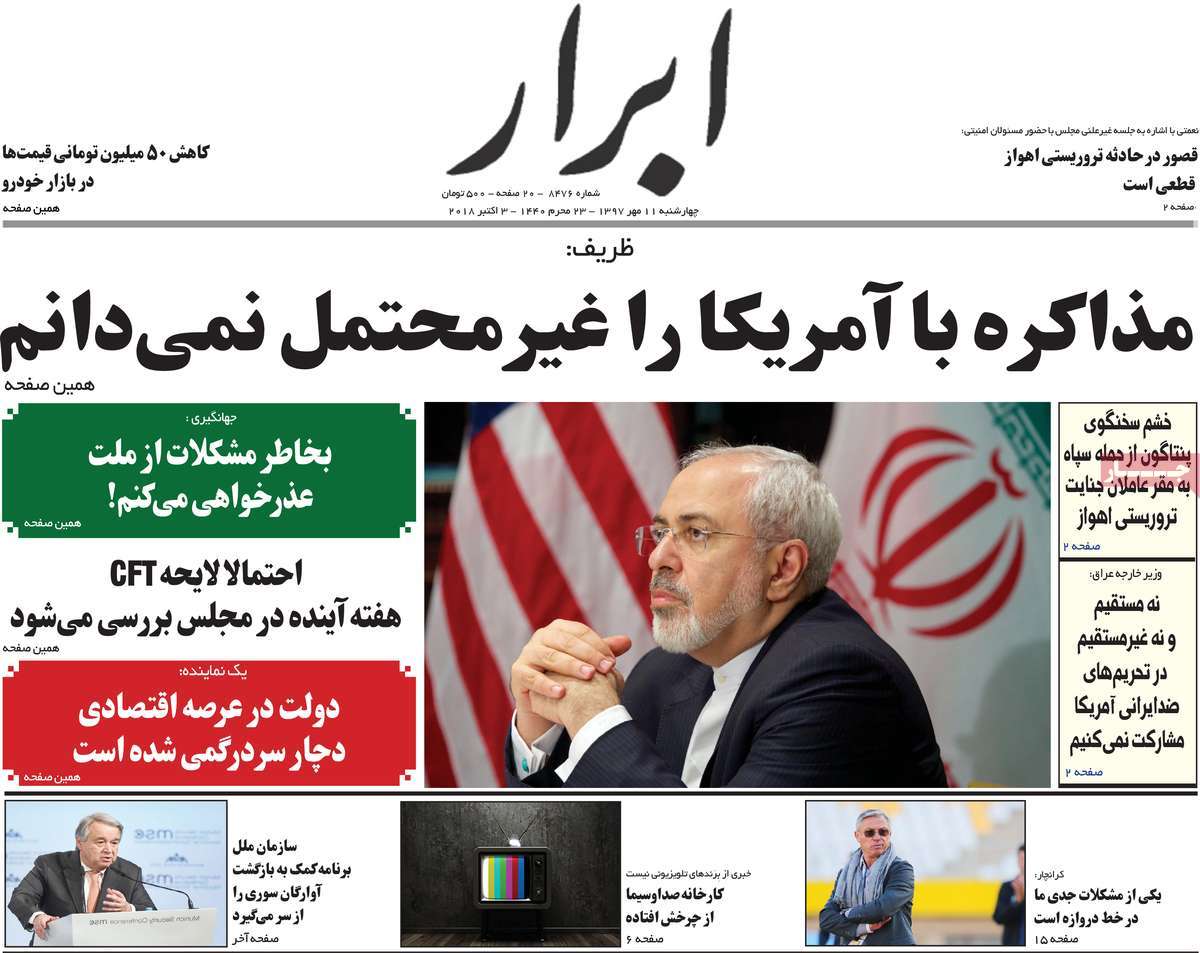
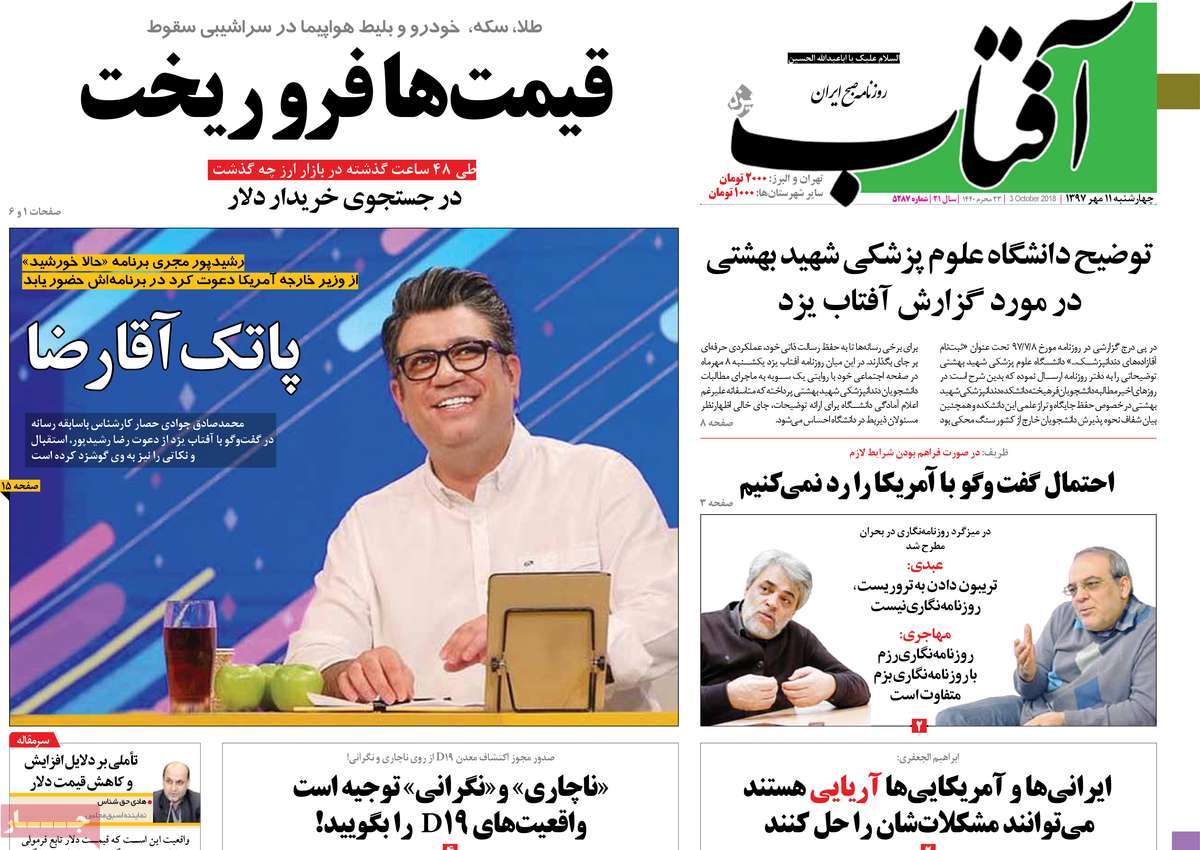
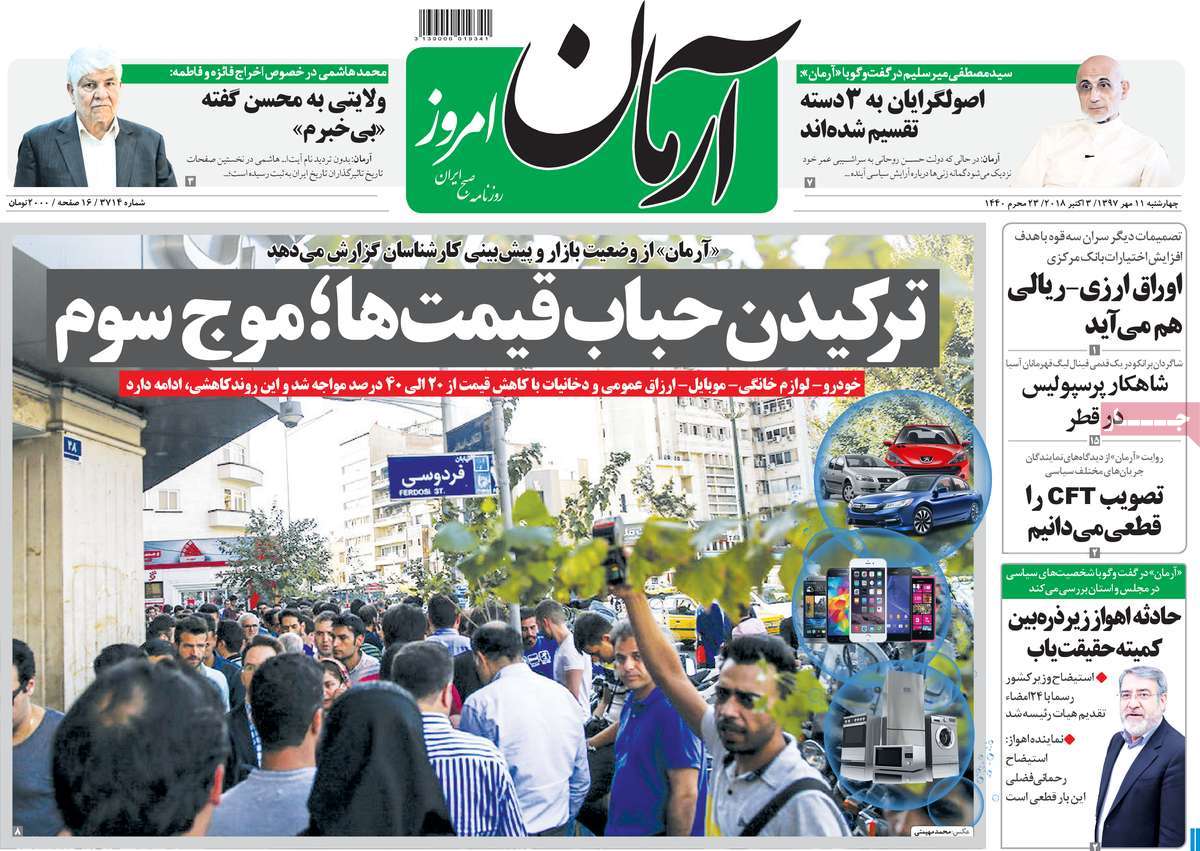
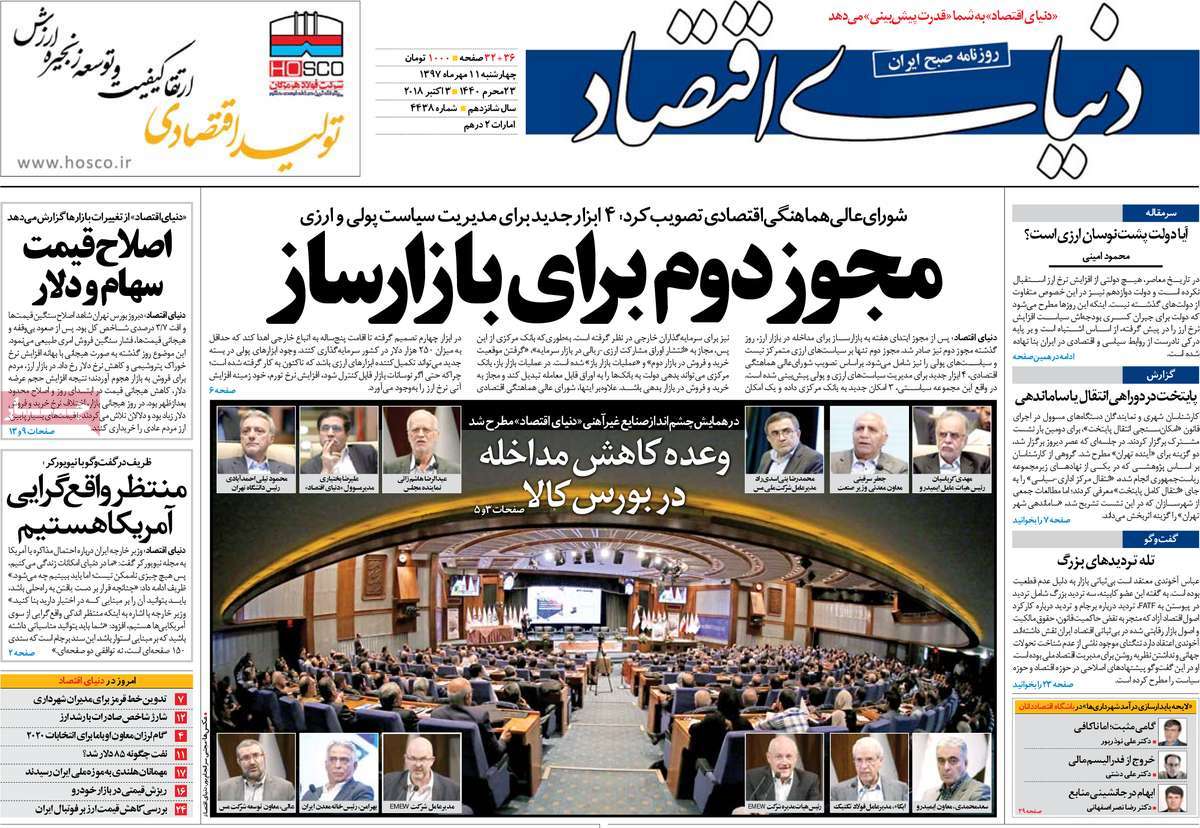
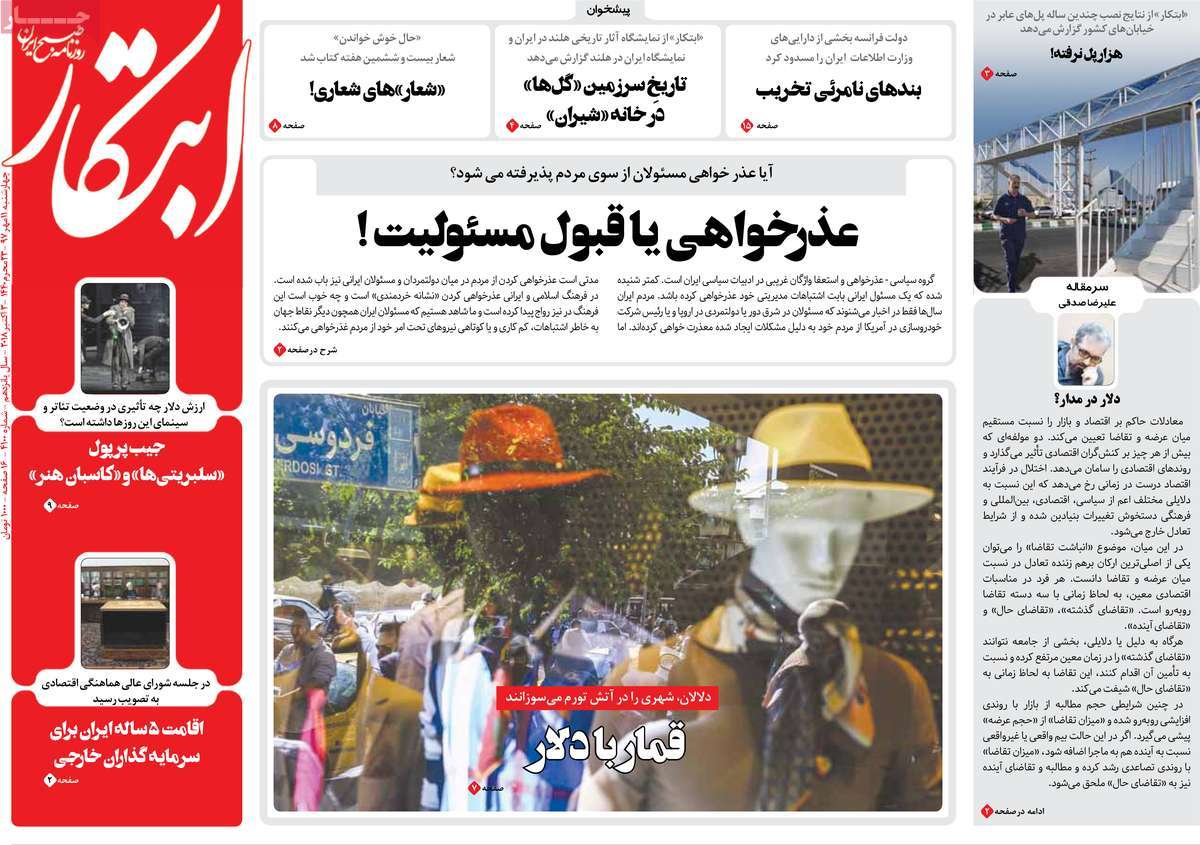
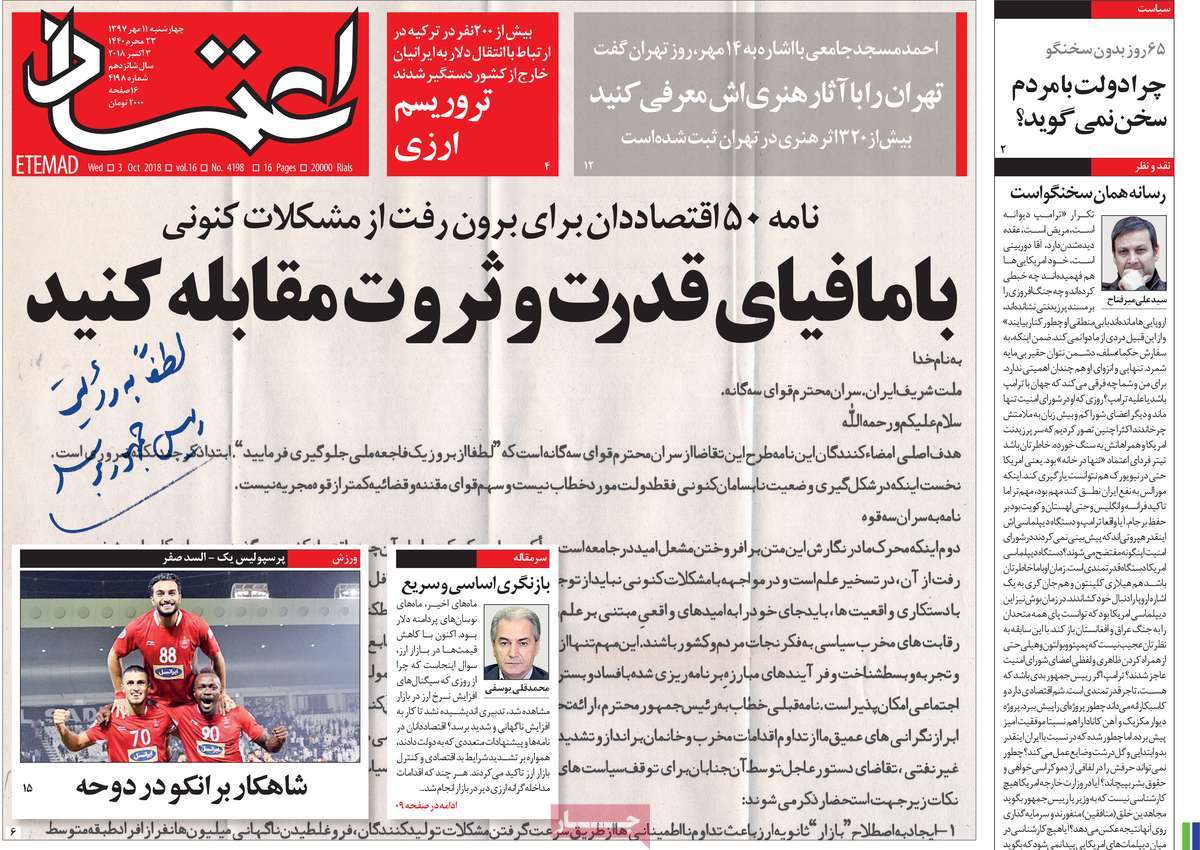
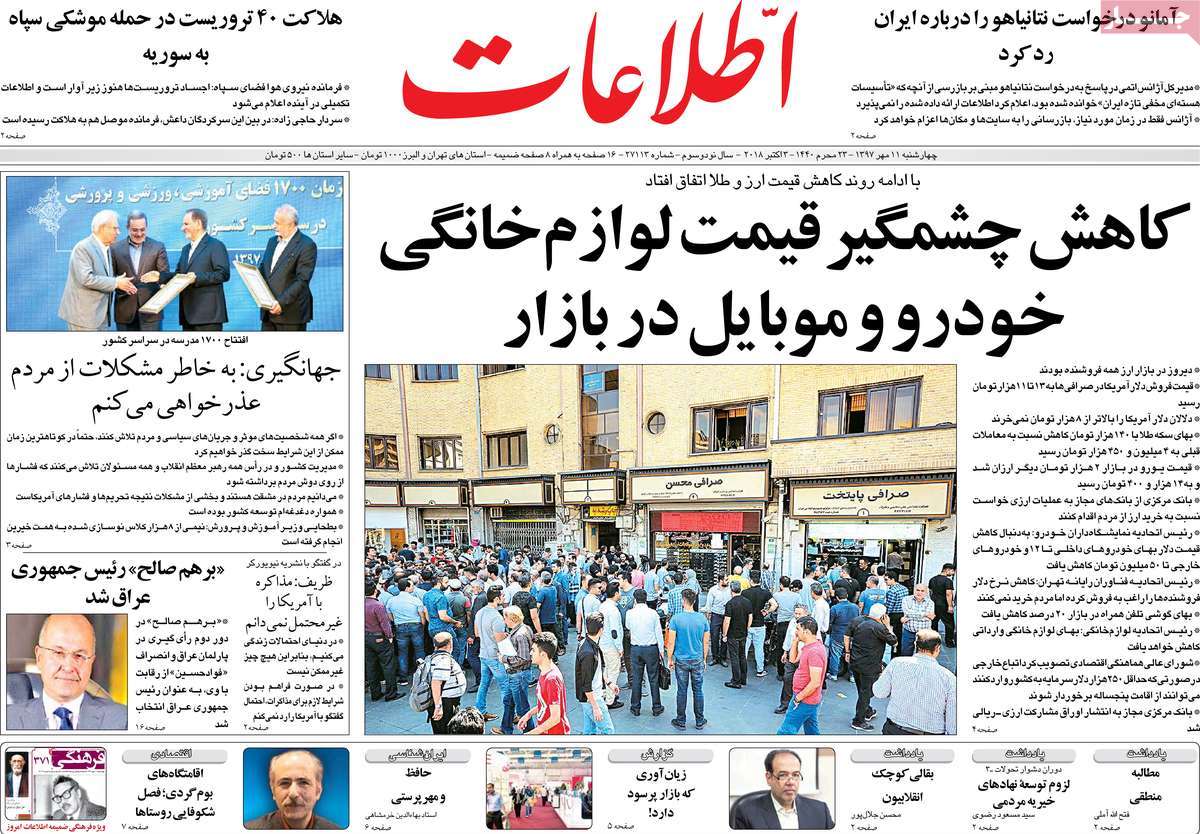
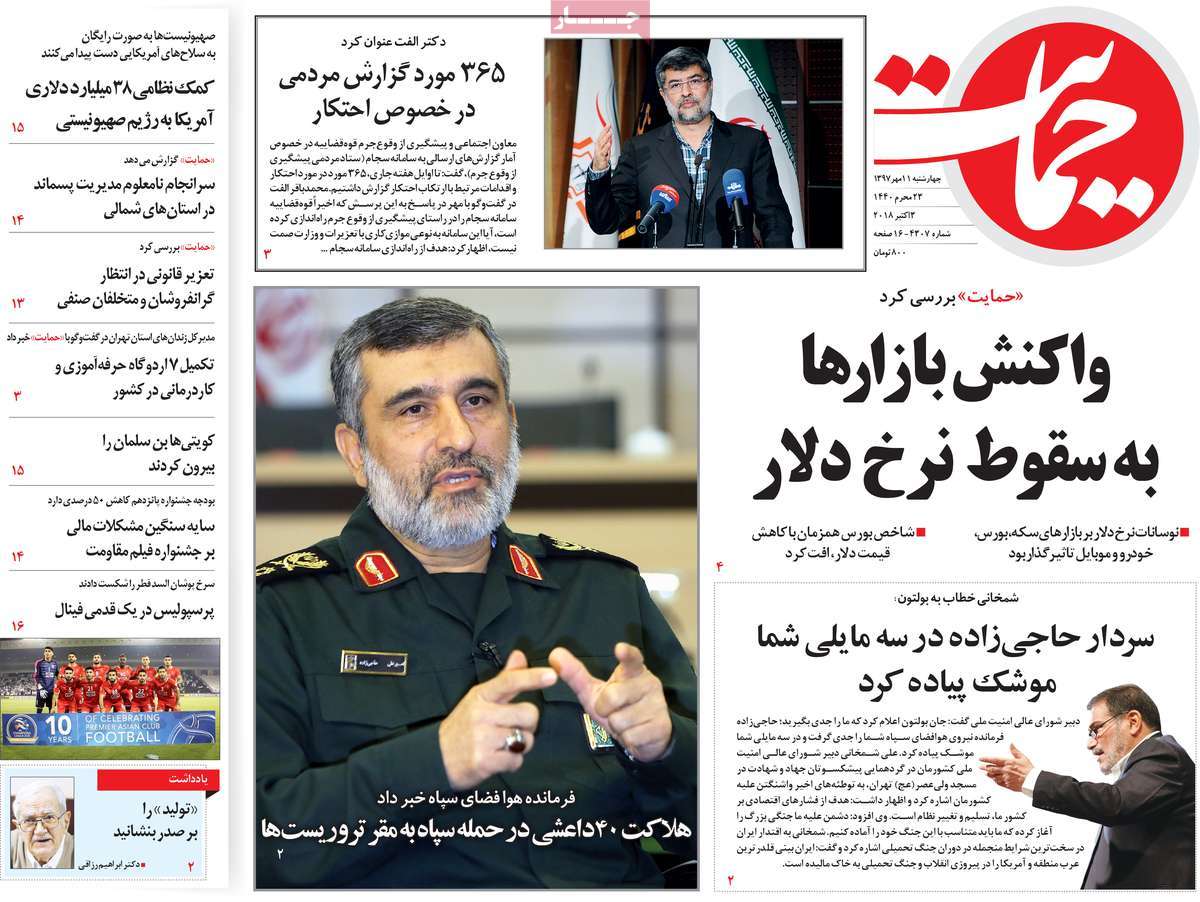
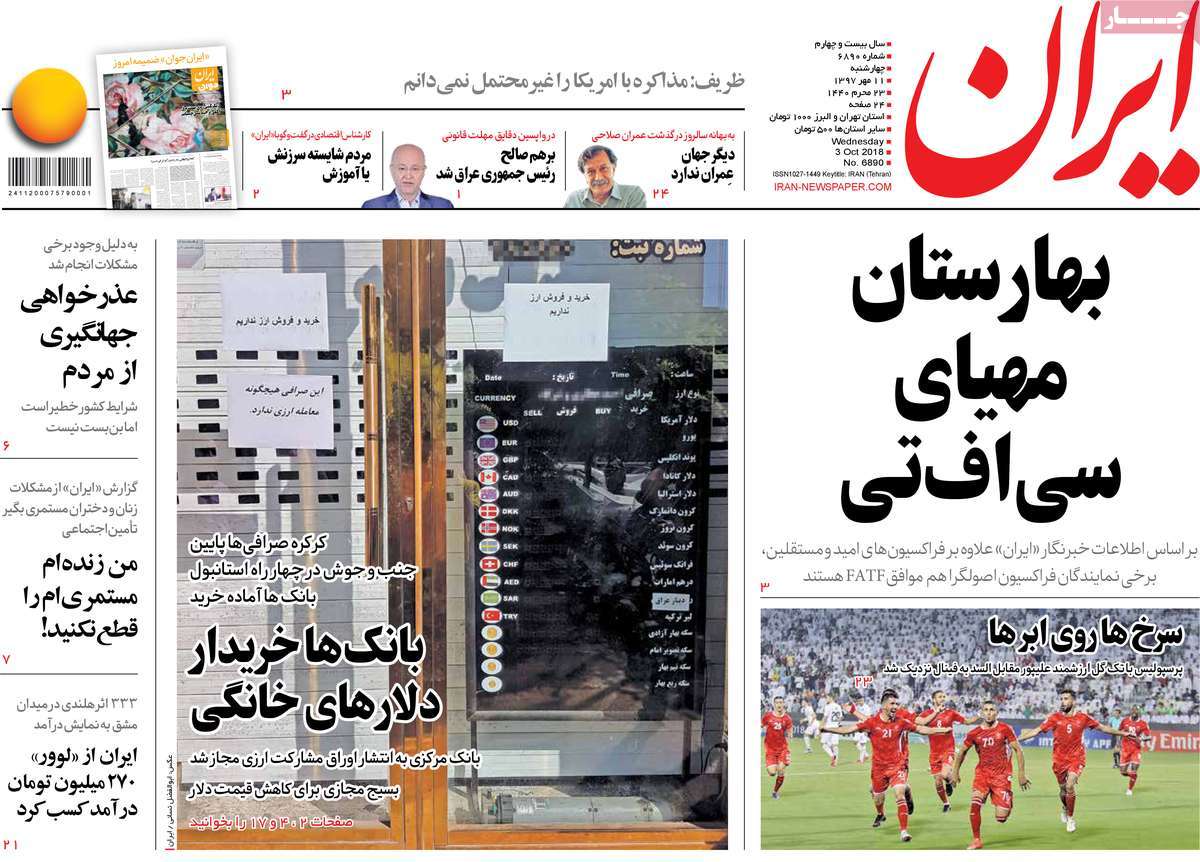
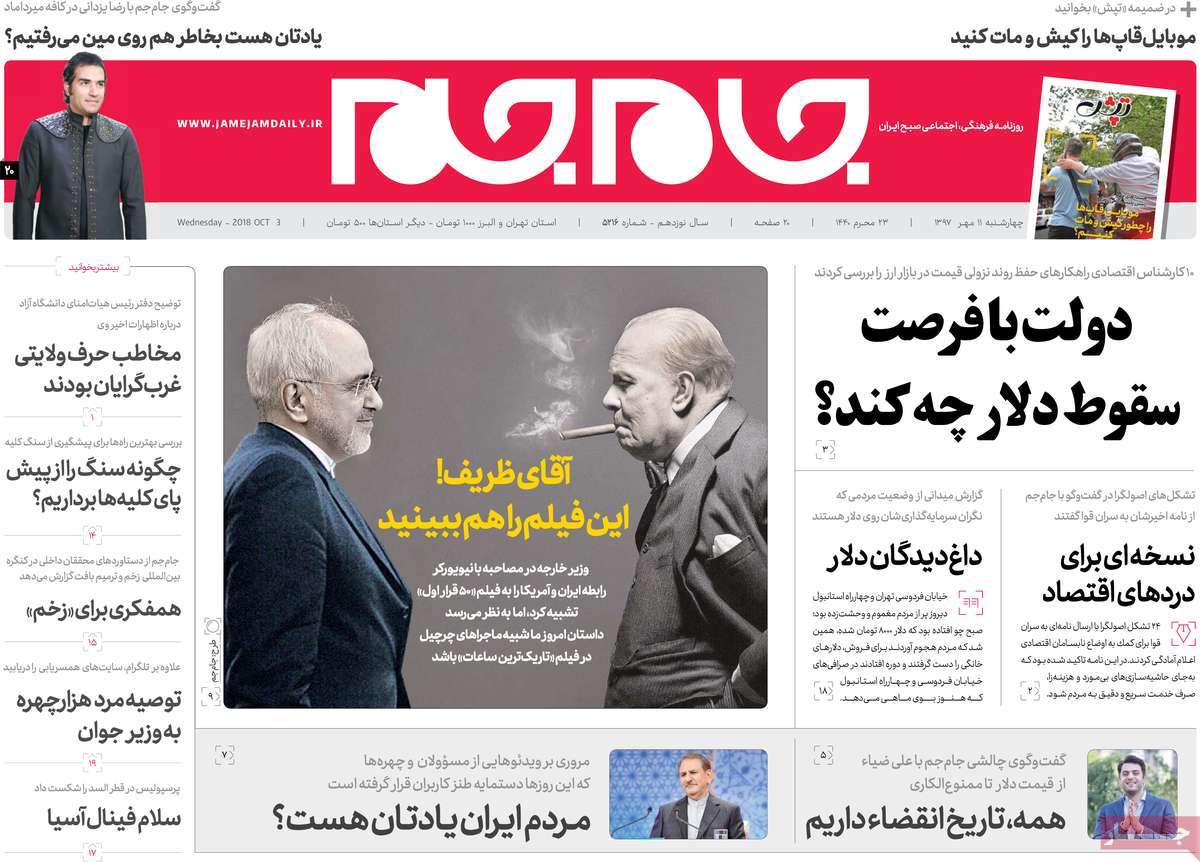
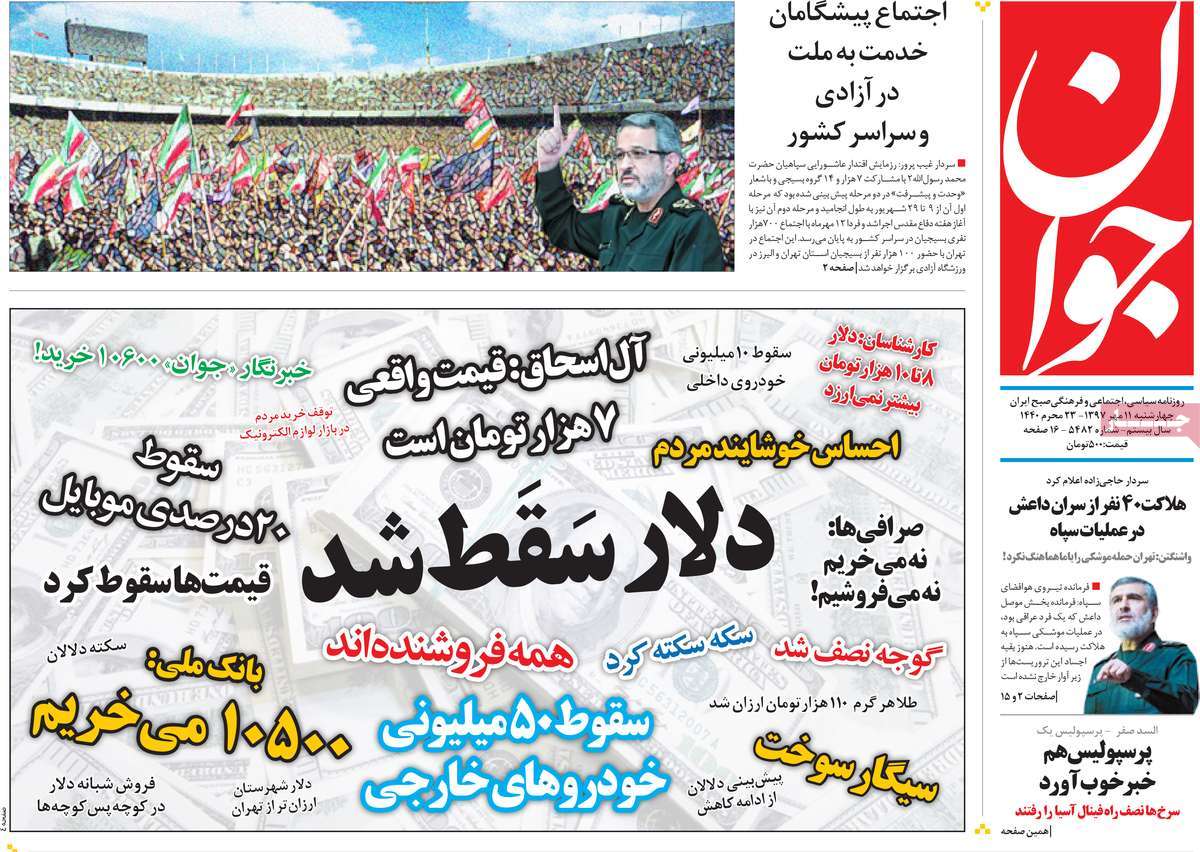
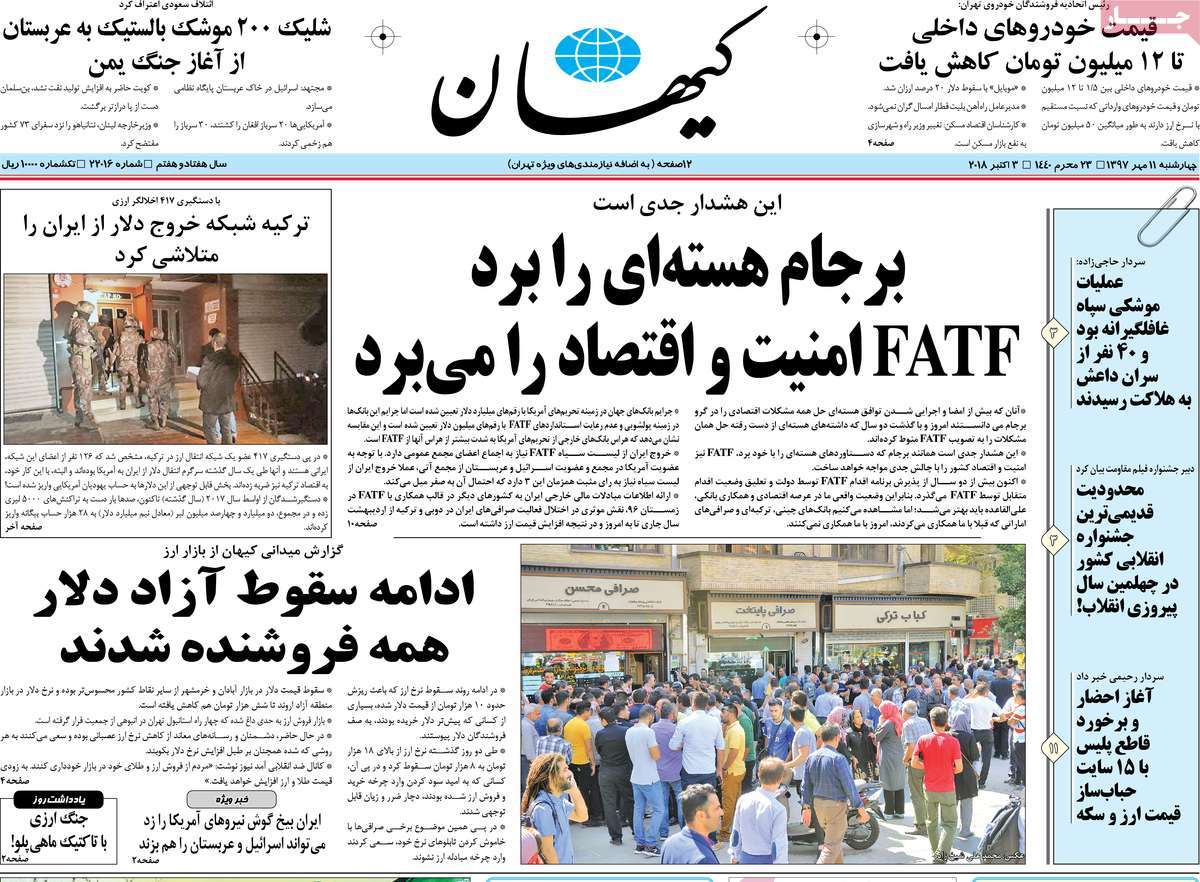
A Look at Iranian Newspaper Front Pages on October 3

A Look at Iranian Newspaper Front Pages on November 19

The surprising decrease in the US dollar rate, which started on Monday, continued to make headlines in Iran on Wednesday.

Several papers also highlighted the deaths of 40 ISIS ringleaders in the IRGC’s recent missile attack on their positions in Syria, which were 3 miles away from US forces.

The Iranian Parliament’s upcoming vote on a bill on Combating the Financing of Terrorism (CFT) also remained a top story, with many conservative papers expressing strong opposition to a possible yea vote.

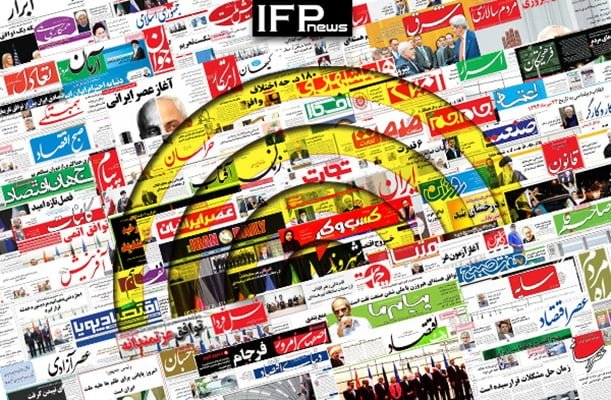
The above issues, as well as many more, are highlighted in the following headlines and top stories:


Abrar:

1- Pentagon Outraged by IRGC’s Attack on Terrorists’ Positions in Syria

2- Iraqi FM: We Won’t Cooperate with US Sanctions on Iran Either Directly or Indirectly

3- Araqchi: No Talks of Suspension of Sanctions

4- UN to Resume Plan on Return of Syrian Refugees

A Look at Iranian Newspaper Front Pages on October 3


Aftab-e Yazd:

1- Zarif: I Don’t Rule Out Possibility of Talks with US If Conditions Are Provided

2- Prices Go Down

A Look at Iranian Newspaper Front Pages on October 3


Arman-e Emrooz:

1- Third Wave: Price Bubbles Burst

2- CFT Bill Will Definitely Be Passed

A Look at Iranian Newspaper Front Pages on October 3


Donya-ye Eqtesad:

1- Zarif to New Yorker: We’re Waiting for US’ Realism

A Look at Iranian Newspaper Front Pages on October 3


Ebtekar:

1- Foreign Investors Can Receive 5-Year Residence in Iran

A Look at Iranian Newspaper Front Pages on October 3


Etemad:

1- Fight against Mafia of Power, Wealth: 50 Economists

A Look at Iranian Newspaper Front Pages on October 3


Ettela’at:

1- 40 Terrorists Killed in IRGC’s Attack on Syria

2- Barham Salih Elected as Iraqi President

3- IAEA Chief Rejects Netanyahu’s Call to Inspect Iran Site

A Look at Iranian Newspaper Front Pages on October 3


Hemayat:

1- Shamkhani to Bolton: IRGC Missiles Landed 3 Miles Away from You!

2- US Provides Israel with $38 Billion in Military Aid

A Look at Iranian Newspaper Front Pages on October 3


Iran:

1- First VP Jahangiri Apologizes to Iranian People

A Look at Iranian Newspaper Front Pages on October 3


Jame Jam:

1- Mr Zarif! You Should Watch “Darkest Hours” as Well

  • Zarif Compares Iran-US Ties to “50 First Dates” Movie in New Yorker Interview

2- What Should Government Do with Opportunity of Decreased Dollar Rates

A Look at Iranian Newspaper Front Pages on October 3


Javan:

1- 40 ISIS Ringleaders Killed in IRGC’s Operation

2- US Dollar Rate Plunges: Business Official Says Real Rate Is IRR 70,000

A Look at Iranian Newspaper Front Pages on October 3


Kayhan:

1- JCPOA Took Away Nuclear Energy from Iran, FATF Will Take Away Security, Economy

A Look at Iranian Newspaper Front Pages on October 3


Khorasan:

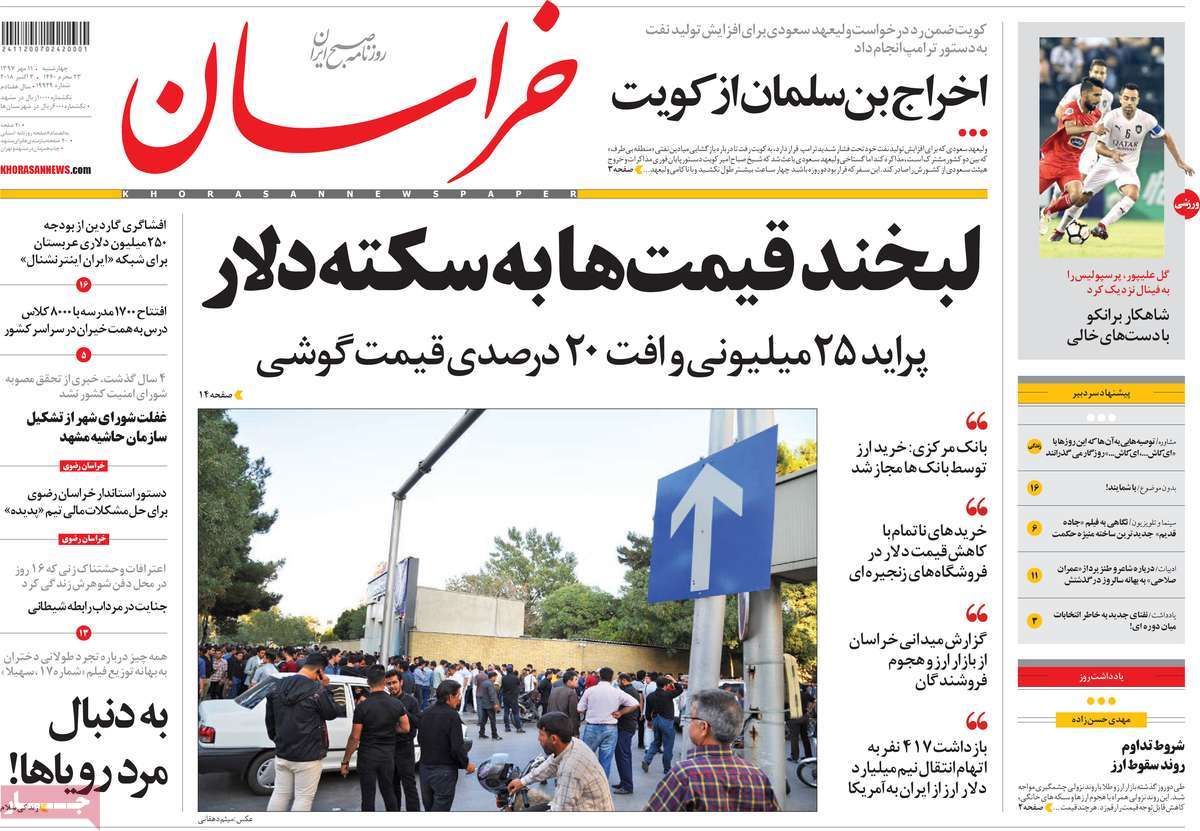
1- Bin Salman Expelled from Kuwait

2- 417 Arrested in Turkey on Charge of Transferring $500m from Iran to US

A Look at Iranian Newspaper Front Pages on October 3


Resalat:

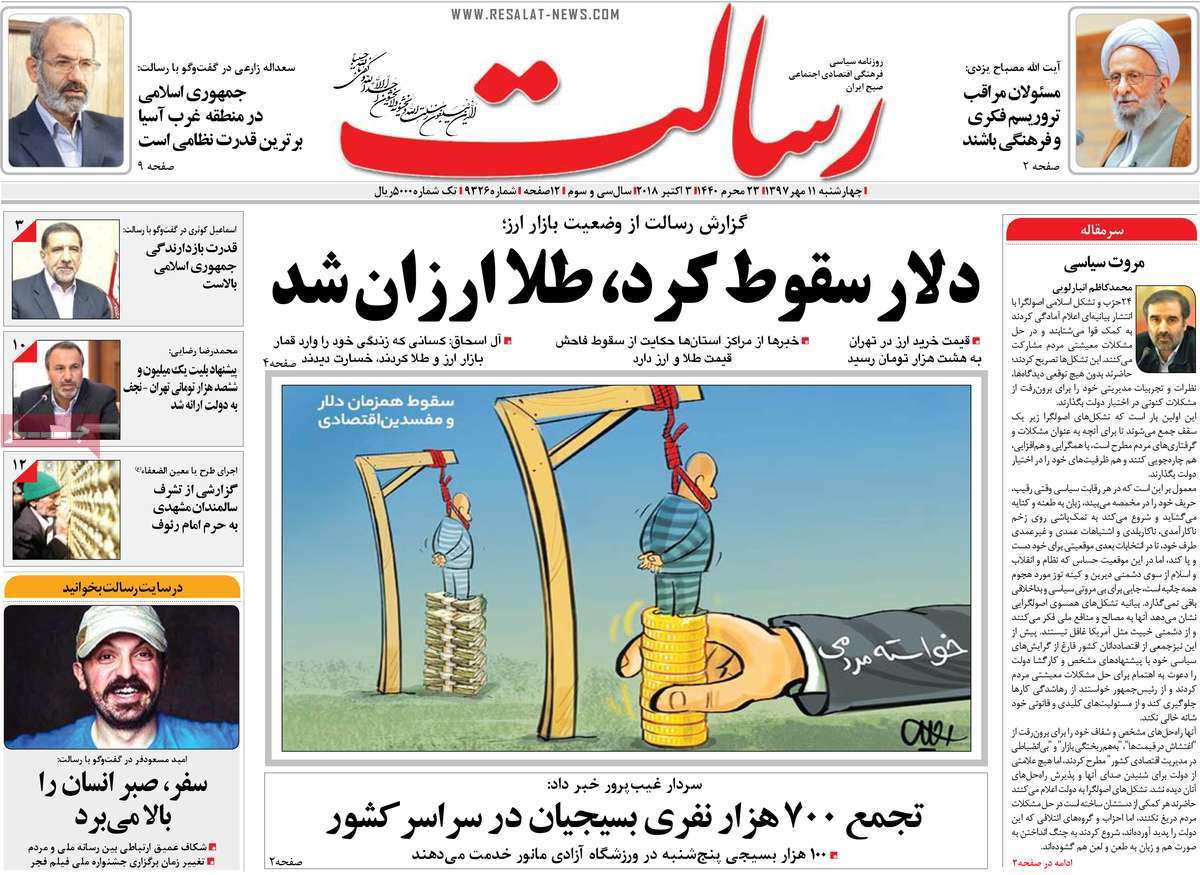
1- US Dollar Plunges, Gold Prices Go Down

2- Islamic Republic Top Military Power in Western Asia: Analyst

A Look at Iranian Newspaper Front Pages on October 3


Shargh:

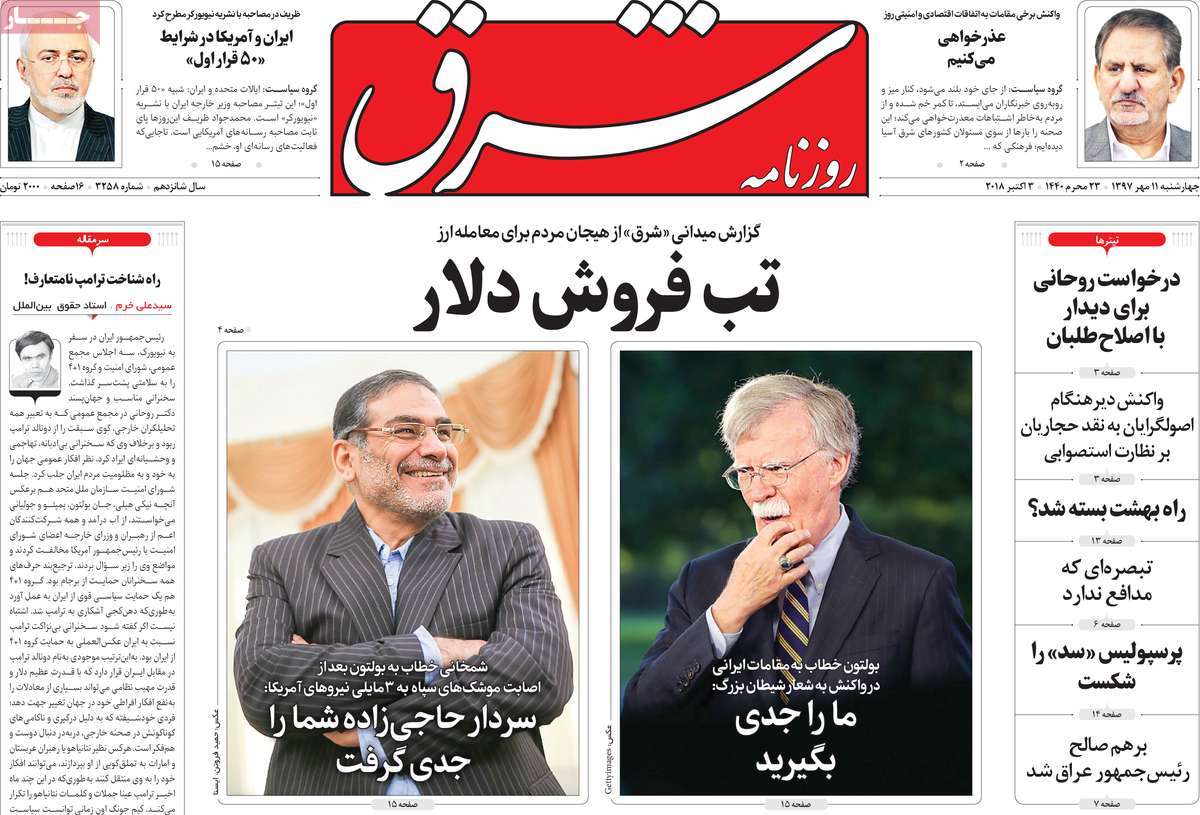
1- Best Way to Know the Unusual Character of Trump [Editorial]

2- Rouhani Invites Reformists for a Meeting

A Look at Iranian Newspaper Front Pages on October 3

“What’s ISIS Doing within Three Miles of US Forces in Syria,” Iran Asks

Extension of UN Arms Embargo to Sound Death Knell for JCPOA: Iran

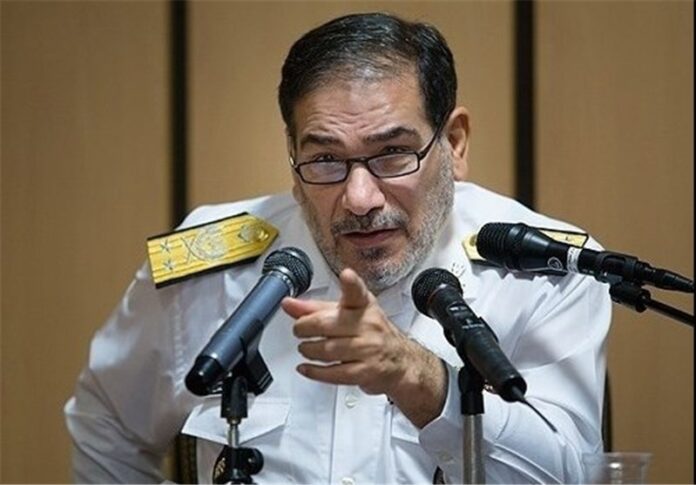
“What are ISIS and other terrorist groups doing within three miles of you?” Secretary of Supreme National Security Council Ali Shamkhani asked on Tuesday.

His comments came in reaction to a US defence official who told CNN that Iranian missiles that targeted Syria on Monday came within three miles of US troops in the country.

Pentagon spokesman Cmdr. Sean Robertson also said in a statement sent to VOA on Monday that “given the complex nature of the battle space, such strikes potentially jeopardize the forces who are actively fighting ISIS in Syria.”

The region, which lies east of the Euphrates River, is one of the last strongholds of ISIS in Syria.

The US says its presence in Syria is aimed at fighting ISIS, but Tehran says Washington is in fact using terrorists as a tool to advance its agenda.


Iran Wins Economic War

Shamkhani said Iran is capable of winning the intensive economic war imposed by the US and its allies.

“Iran enjoys unique opportunity in managing political, defence, security and economic threats and turning them into opportunities,” Shamkhani said.

The US, which is reinstating anti-Iran sanctions, has in recent months been pushing the world to cut trade with Iran and stop purchasing the country’s oil.

“I do not say sanctions have no effect, but our national capacity is so [high] that we can defeat them,” Shamkhani said.

The SNSC secretary said Trump’s repeated offers for talks are deceptions and Iran will not engage in talks until it strengthens its economy and pushes hostile forces back.

“We should stand against them with the revolutionary morale and we have no doubt we will defeat Trump just like his predecessors,” he said.

IAEA Rejects Netanyahu’s Call to Inspect Iranian Site

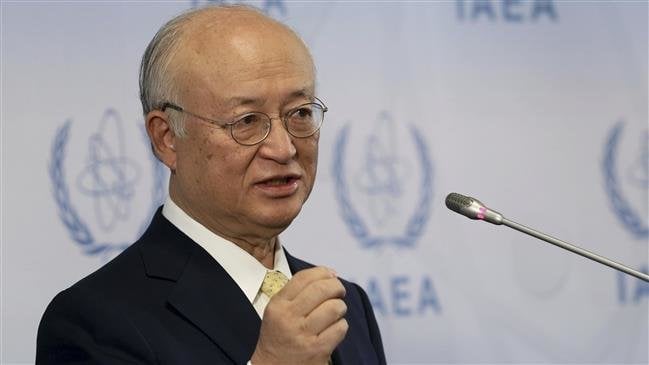
“The Agency uses all safeguards relevant information available to it but it does not take any information at face value,” IAEA Director General Yukiya Amano said in a statement released on Tuesday.

Although Amano did not make an explicit reference to Israeli Prime Minister Benjamin Netanyahu’s claim against Iran but it is his first public pronouncement since the premier’s speech.

“It should be noted that under the existing verification framework, the Agency sends inspectors to sites and locations only when needed,” he added.

During his speech on Thursday at the 73rd annual session of the UN General Assembly in New York, Netanyahu once again took the stage to bring out fresh theatrics against Iran, repeating his threadbare allegation that the country is working to develop nuclear weapons at a “secret” site and urged the IAEA to inspect it.

“In May, we exposed the site of Iran’s secret atomic archive. Today, I’m revealing the site of a second facility; Iran’s secret atomic warehouse,” claimed the Israeli PM, who added, “Iran has not abandoned its goal to develop nuclear weapons.”

Amano further emphasized that the IAEA’s work related to nuclear verification “must always be impartial, factual, and professional,” saying, “In order to maintain credibility, the Agency’s independence in relation to the implementation of verification activities is of paramount importance.”

The IAEA chief added that the agency is conducting verification and monitoring of Iran’s nuclear-related commitments under the 2015 nuclear agreement, officially known as the Joint Comprehensive Plan of Action (JCPOA), Iran signed with major world powers.

“These activities will continue to be carried out within the parameters of the relevant decisions and resolutions of the IAEA Board of Governors and the UN Security Council as appropriate,” he pointed out.

Pointing to his reports to the IAEA Board of Governors, Amano noted that the agency would continue its evaluations regarding the absence of “undeclared nuclear material and activities for Iran.”

“The Agency continues to evaluate Iran’s declarations under the Additional Protocol, and has conducted complementary accesses under the Additional Protocol to all the sites and locations in Iran which it needed to visit,” the head of the UN nuclear agency said.

In his introductory statement to the Board of Governors in Vienna on September 10, Amano said Iran is living up to all its commitments under the 2015 nuclear deal.

He added that the IAEA would continue to verify the non-diversion of nuclear material declared by Iran under its Safeguards Agreement.

Later in his opening address to the IAEA’s 62nd General Conference in Vienna on September 17, the IAEA director general reaffirmed that Iran is in compliance with the nuclear agreement.