Sunday, December 28, 2025
Home Blog Page 3288

Iran Agrees to Baghdad’s Mediation between Tehran, Riyadh: Source

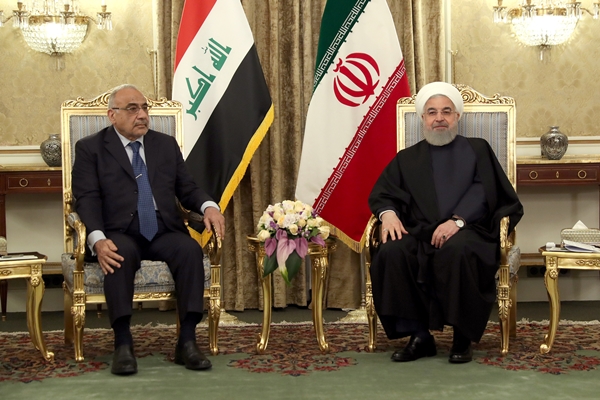
While Iraqi Prime Minister Adel Abdul Mahdi was on a trip to Iran, an informed Iraqi source claimed Tehran had asked the premier to help improve relations between Iran and Saudi Arabia.

Abdul Mahdi arrived in Tehran on his first trip to Iran as Prime Minister on April 6, 2019 and sat down with senior Iranian authorities, reported fararu webstie.

High on the agenda of the talks was the promotion of mutual economic cooperation. Still, certain Iraqi sources said there were discussions on Baghdad acting as an intermediary between Iran and Saudi Arabia.

After Abdul Mahdi’s arrival in Tehran, an Iraqi political source announced that the premier would present a solution to bring the viewpoints of Tehran and Riyadh closer together.

According to the same source, Abdul Mahdi’s trip to Iran was seemingly aimed at boosting mutual ties and discussing mechanisms to implement the agreements and memoranda of understanding already signed by the two countries, said the same source. However, the source added, the prime minister would also put forward a solution to ease tension between Iran and Saudi Arabia.

On day two of Abdul Mahdi’s trip to Iran on April 7, 2019, another Iraqi source privy to the details of the premier’s trip said in an interview with baghdadtoday.com that Iran had asked the Iraqi prime minister to rectify Iranian-Saudi relations through a three-way meeting attended by Iran, Saudi Arabia and Iraq.

Abdul Mahdi is to travel to Saudi Arabia in the coming days. According to Iraqi sources, the state of Baghdad’s mediation between Tehran and Riyadh will be clarified after the prime minister’s trip to Riyadh.

Iran Strongly Condemns Saudi Air Raid on Yemeni School

In a Monday statement, Qassemi offered sympathy to the survivors of the inhumane attack.

He also expressed deep regret over the international community’s continued silence and indifference over the aggressors’ crimes.

“The countries that created a humanitarian disaster in Yemen by providing arms support for the invaders are complicit in these crimes, and must be held accountable for their support,” Qassemi noted.

He also urged the United Nations and the countries that have influence on the Yemen crisis to boost their efforts to immediately stop the aggressors’ attacks, and adopt measures to protect civilians, especially women and children.

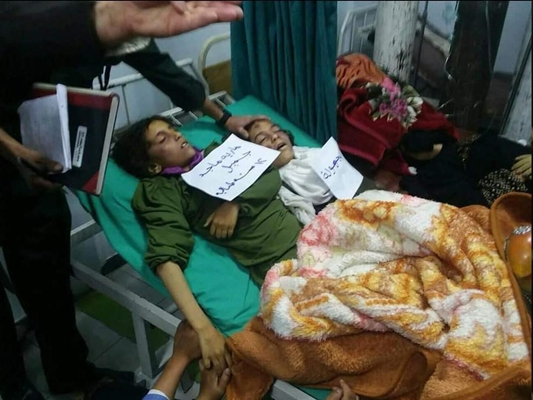
More than a dozen civilians, most of them schoolchildren, were killed in the latest round of airstrikes by Saudi warplanes on a school in Yemen’s west-central province of Sana’a.

Youssef al-Hazzari, a spokesman for the Yemeni Ministry of Public Health and Population, said at least 13 people lost their lives and 92 others sustained injuries after Saudi warplanes launched aerial assaults against an area in the Sa’wan district of Sana’a on Sunday evening. He said most of the victims were schoolchildren.

Hazzari also condemned the incident as a war crime, saying, “On the World Health Day, April 7, which carries the slogan ‘Health for All’, the Saudi-led coalition of aggression marked the event in its well-known manner.”

A Look at Iranian Newspaper Front Pages on April 8

A Look at Iranian Newspaper Front Pages on November 19

The top story in all papers today was the reaction of top Iranian officials to rumours of Washington’s bid to label the Islamic Revolution Guards Corps (IRGC) as a foreign terrorist organization.

The visit of Iraqi Prime Minister Adel Abdul Mahdi to Tehran, and the reports of his mission to mediate between Tehran and Riyadh also received great coverage.

Several papers also covered the negative impact of US sanctions on the delivery of international humanitarian aid to the flood-hit people of Iran.

The above issues, as well as many more, are highlighted in the following headlines and top stories:


Aftab-e Yazd:

1- US Troops Same as ISIS

2- Iran Blames US Government for Destructive Consequences of Floods
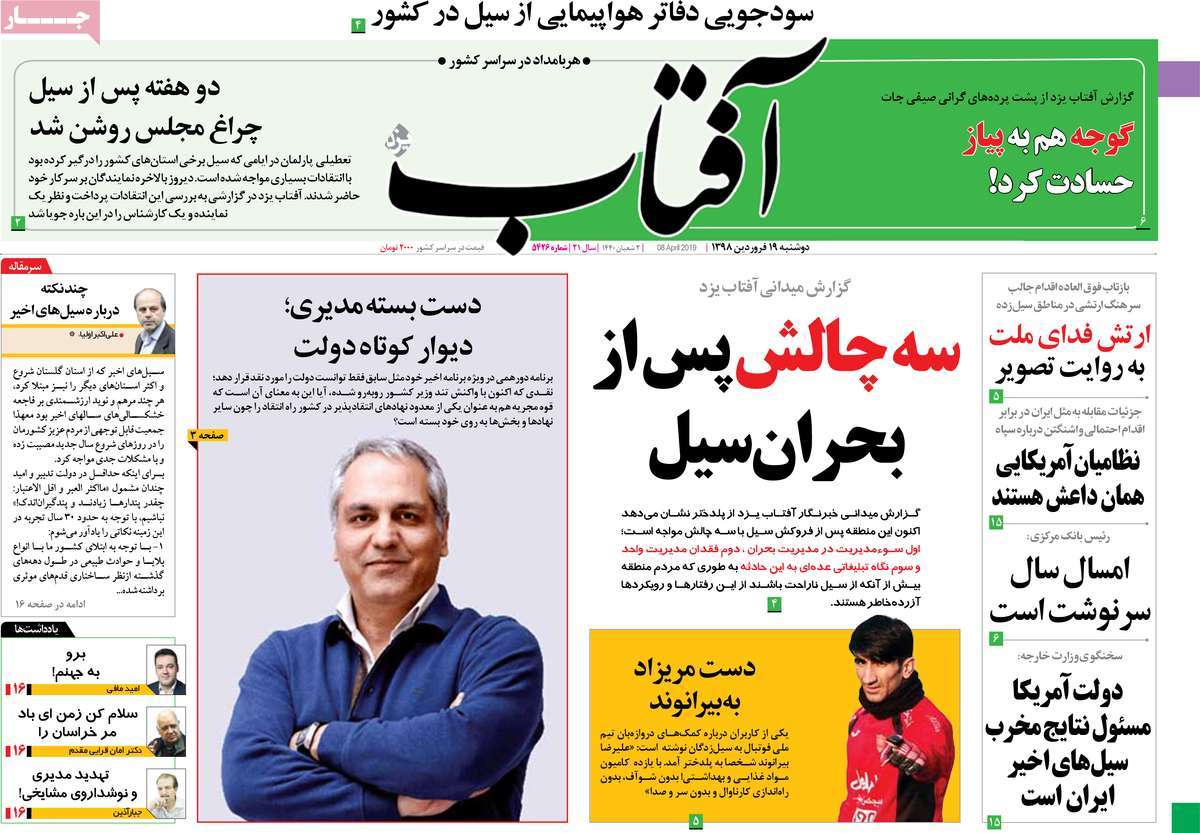
A Look at Iranian Newspaper Front Pages on April 8


Arman-e Emrooz:

1- Iraq to Mediate between Iran, Saudi

2- Rouhani: US Dollar Rate Would Be IRR 60,000 If Sanctions Removed

3- Possible Designation of IRGC as Terror Group Will Be Dangerous Decision [Editorial]
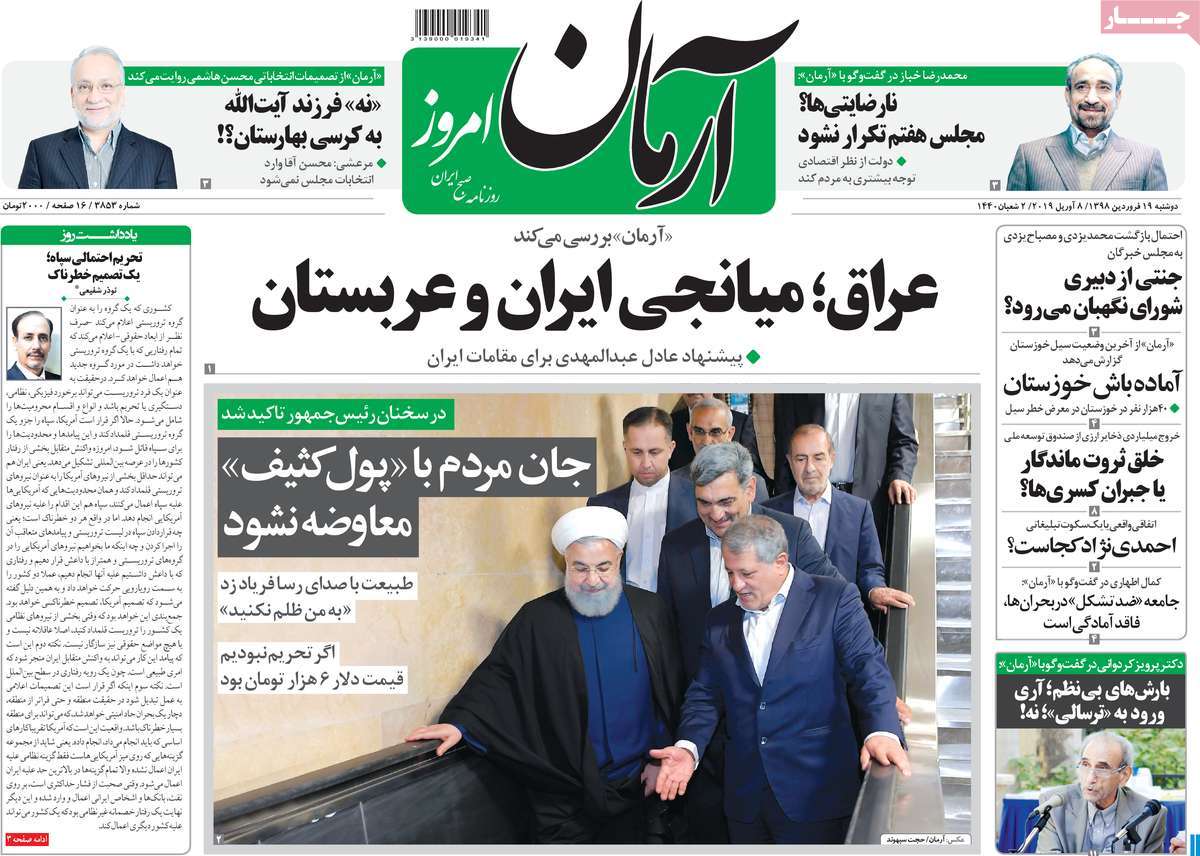
A Look at Iranian Newspaper Front Pages on April 8


Donya-ye Eqtesad:

1- New Institution Formed to Control Forex Market

2- Stock Exchange Market to Thrive Once Again
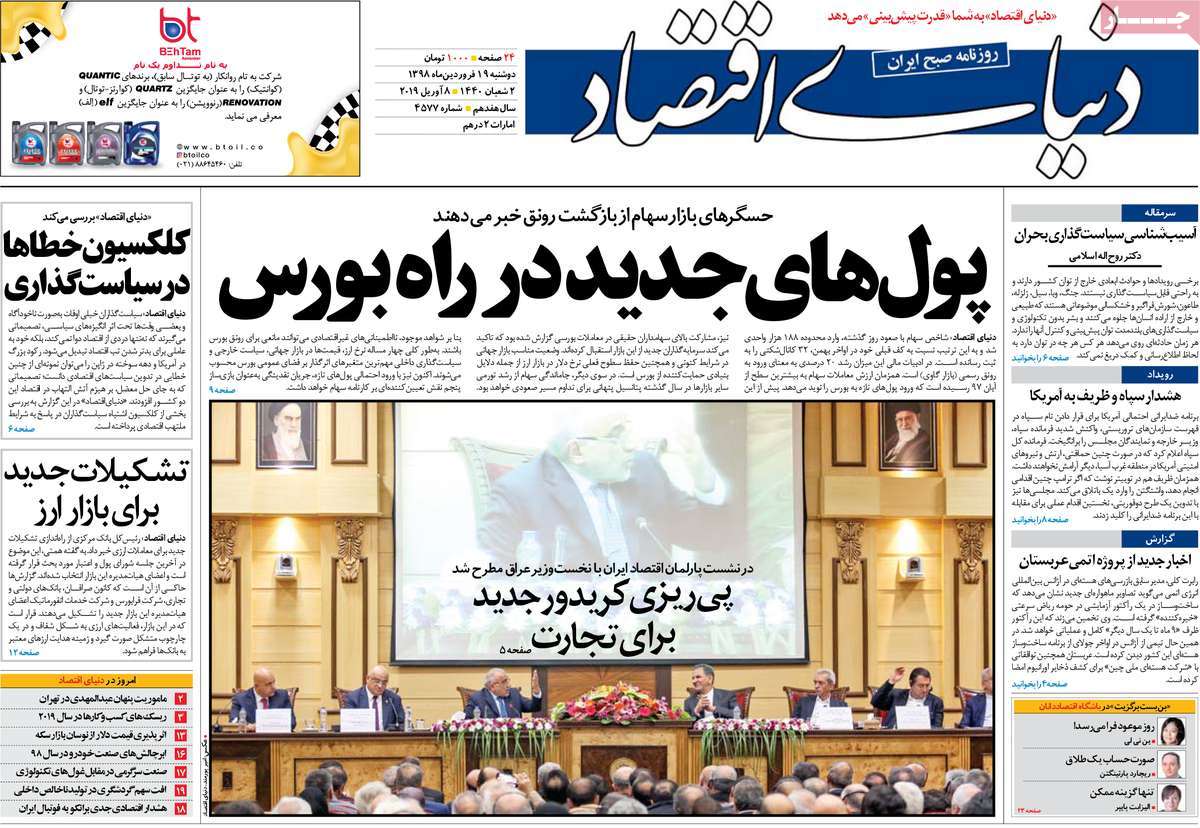
A Look at Iranian Newspaper Front Pages on April 8


Ebtekar:

1- Rouhani: Flood Was Voice of Nature Which Said ‘Don’t Oppress Me’

2- IRGC Chief Warns US Troops in West Asia: US Won’t See Calm Anymore
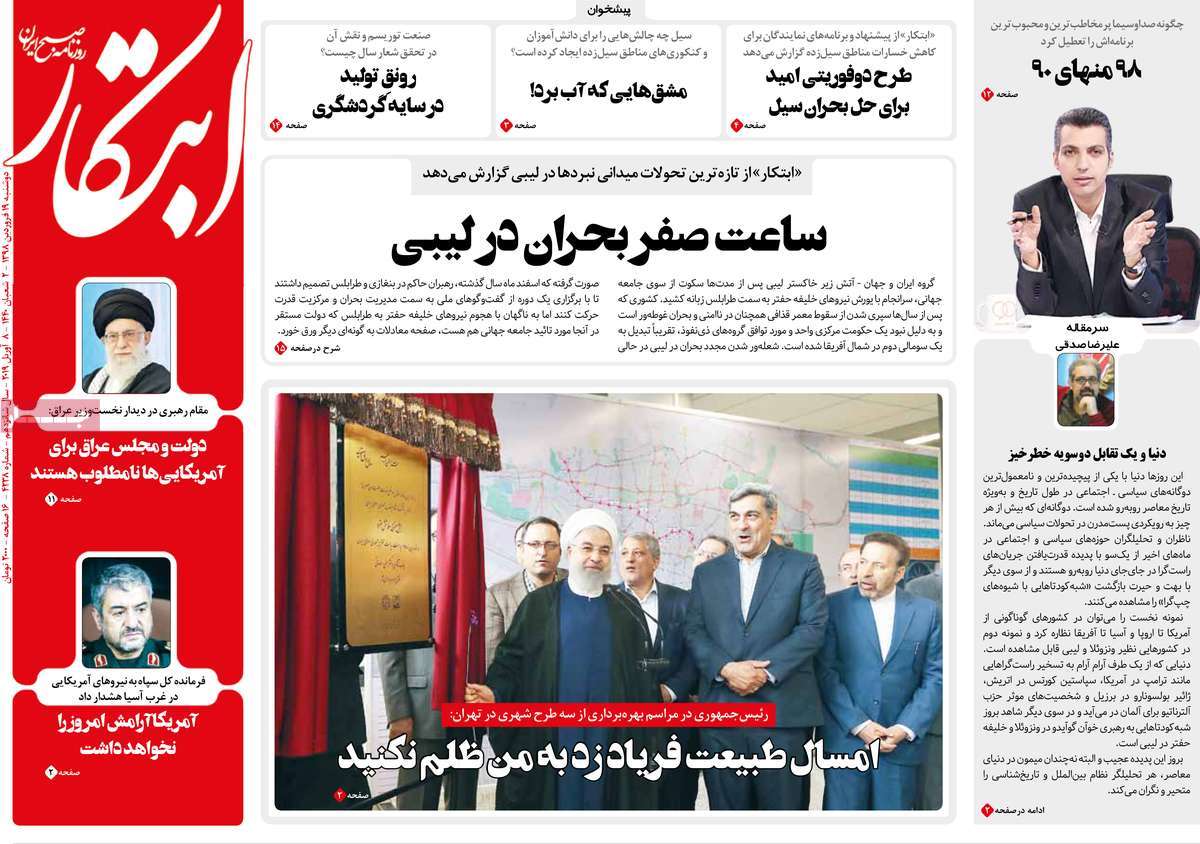
A Look at Iranian Newspaper Front Pages on April 8


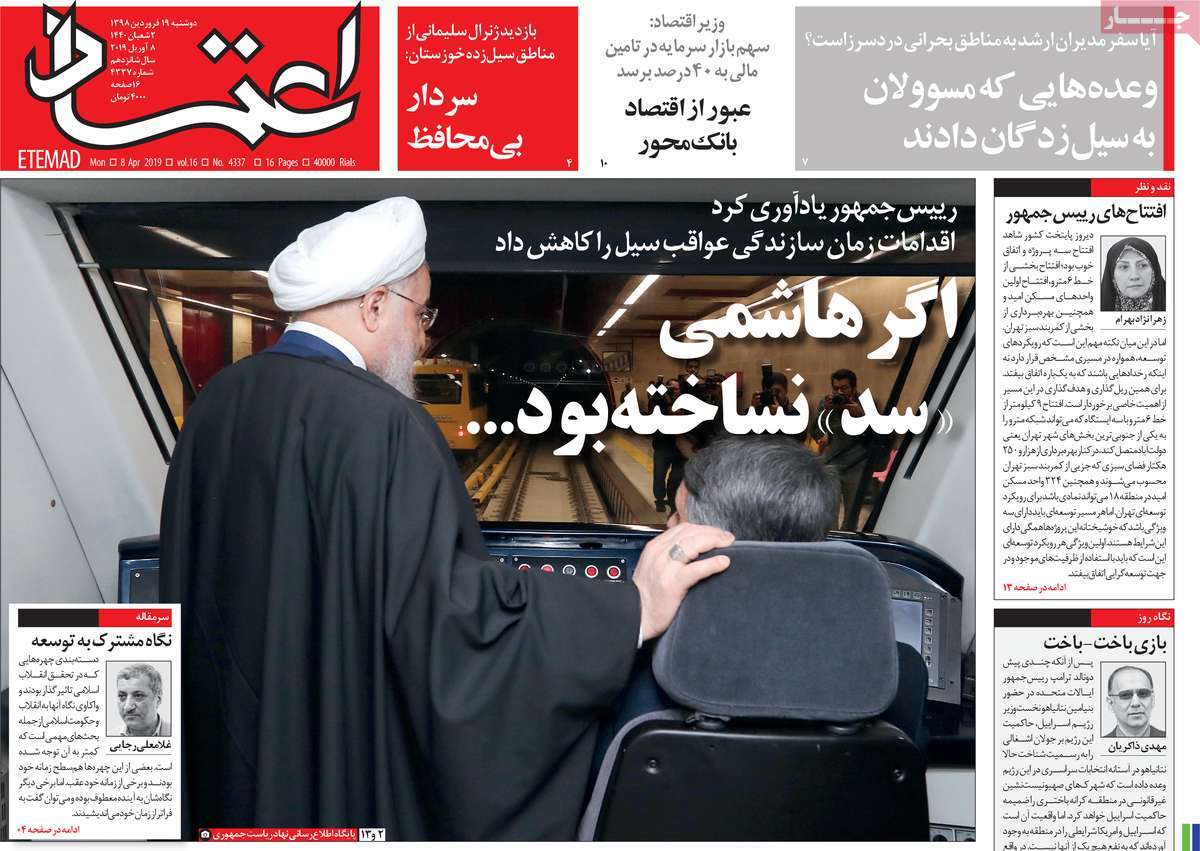
Etemad:

1- General Soleimani Visits Flood-Hit Areas without Bodyguards

2- Rouhani Highlights Key Role of Dams Constructed by Rafsanjani in Controlling Recent Floods
A Look at Iranian Newspaper Front Pages on April 8


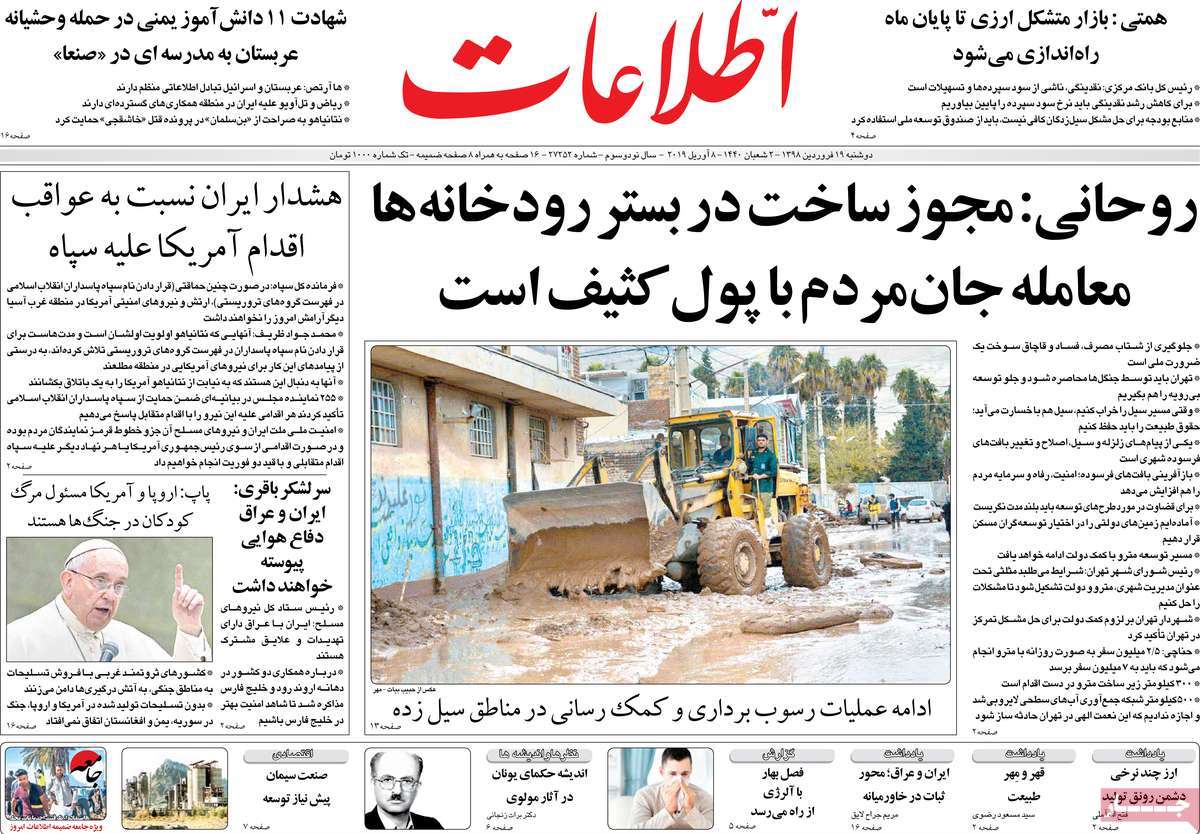
Ettela’at:

1- Rouhani: Giving Licence for Riverside Construction Is Doing Business with People’s Lives

2- Iran Warns US against Consequences of Blacklisting IRGC

3- Top General: Iran, Iraq to Expand Air Defence Cooperation
A Look at Iranian Newspaper Front Pages on April 8


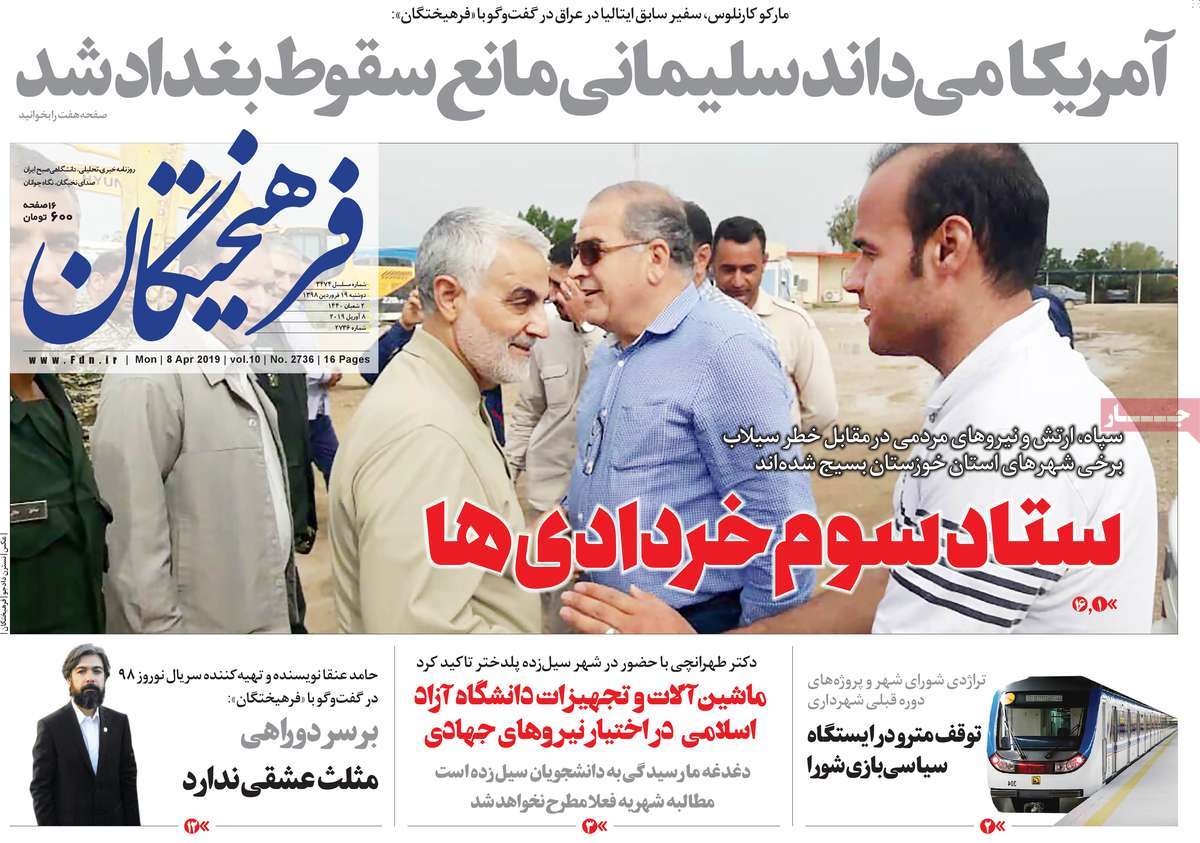
Farhikhtegan:

1- Former Italian Envoy to Iraq: US Knows Gen. Soleimani Prevented Fall of Baghdad to ISIS

2- IRGC, Army, Popular Forces Mobilized against Flood in Khuzestan
A Look at Iranian Newspaper Front Pages on April 8


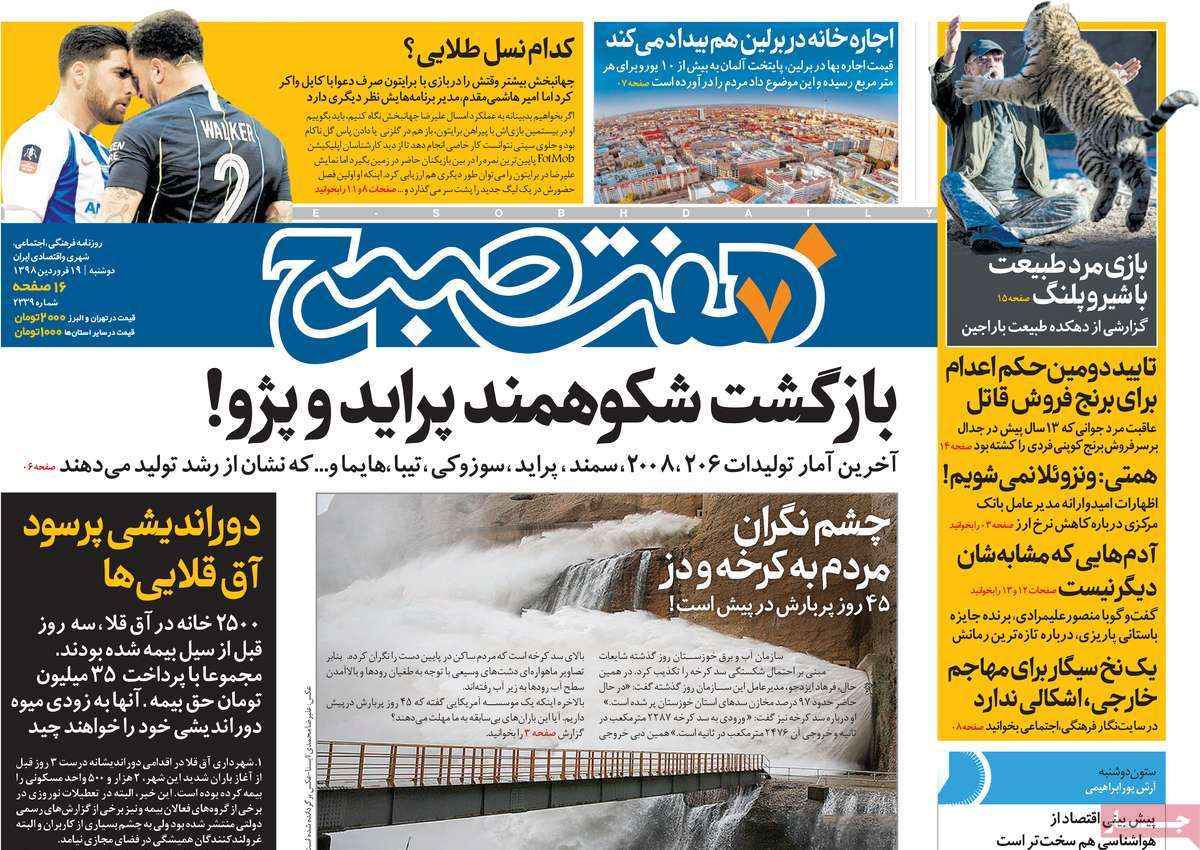
Haft-e Sobh:

1- People of Khuzestan Worried about Karkheh, Dez Dams

2- Iran Expecting 45 Days of Heavy Rainfall!
A Look at Iranian Newspaper Front Pages on April 8


Iran:

1- Iran’s Chief Banker: Enemy Plotting to Disturb Iran’s Forex Market

2- Iran Parliament, IRGC Chief Vow to Reciprocate US’ Blacklisting of IRGC
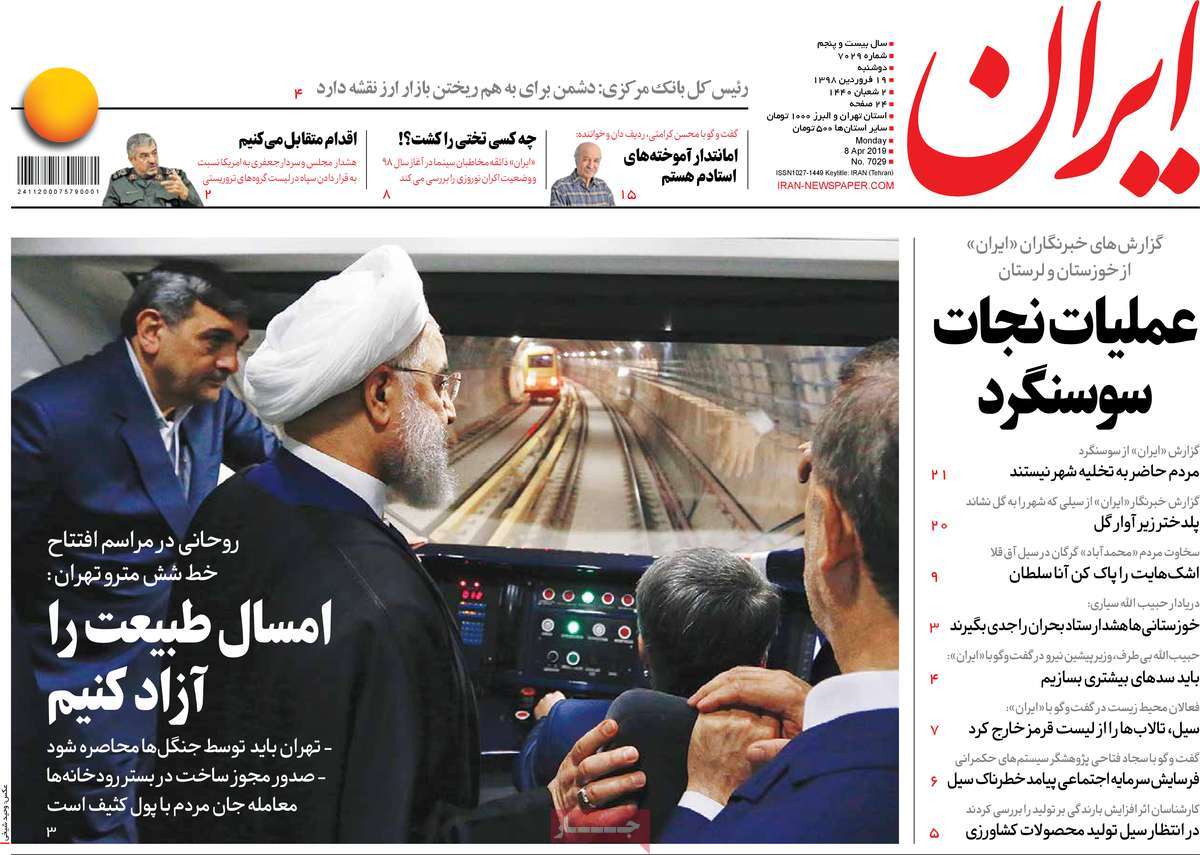
A Look at Iranian Newspaper Front Pages on April 8


Javan:

1- Number of Those Selling Foreign Currencies 10 Times More than Buyers

2- Temporary Accommodation for 150,000 Flood-Hit People of Khuzestan

3- IRGC Chief: No More Calm for US Troops If They Do Stupid Move

4- Iraq Doesn’t Want to Be Part of US Sanctions on Iran: PM
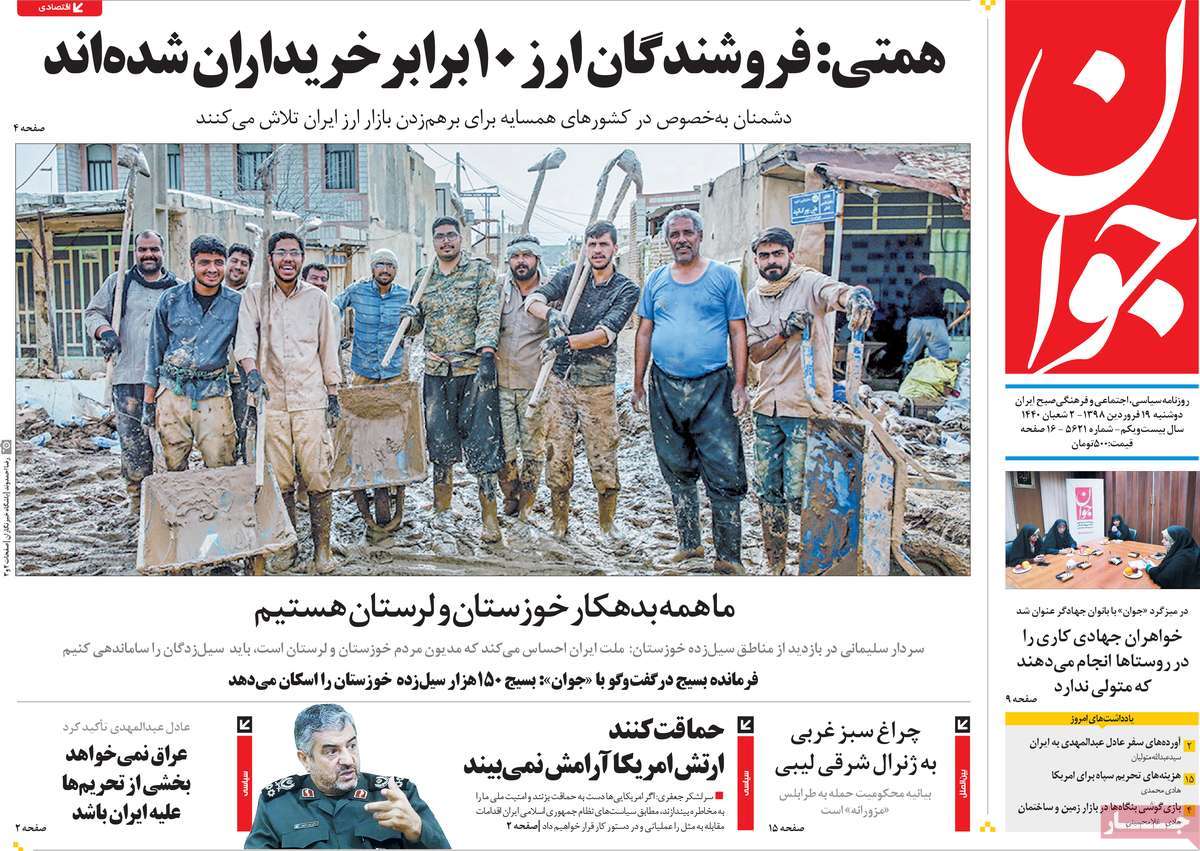
A Look at Iranian Newspaper Front Pages on April 8


Jomhouri Eslami:

1- Rouhani: Tehran Must Be Surrounded by Forests; Excessive Development Must Stop

2- Iran, Iraq Sign Preliminary Deal to Develop Two Joint Oilfields

3- Zarif Warns about Consequences of US’ Possible Move against IRGC
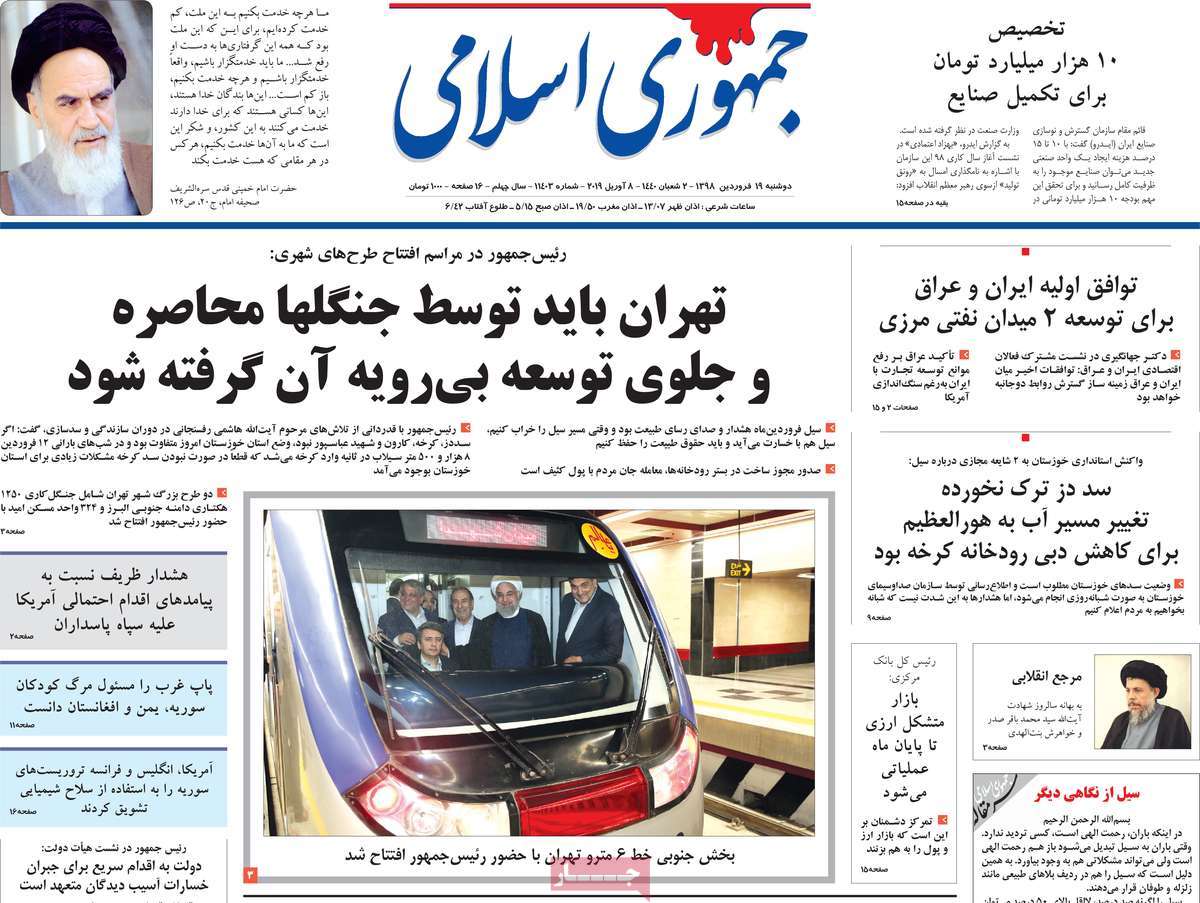
A Look at Iranian Newspaper Front Pages on April 8


Kayhan:

1- Iran’s Exports to Iraq 10 Times More than Exports to Europe

* US Sanctions Foiled

2- Pope: Kids in Yemen, Syria, Afghanistan Massacred with American, European Arms

3- 255 MPs Support IRGC against New US Plot
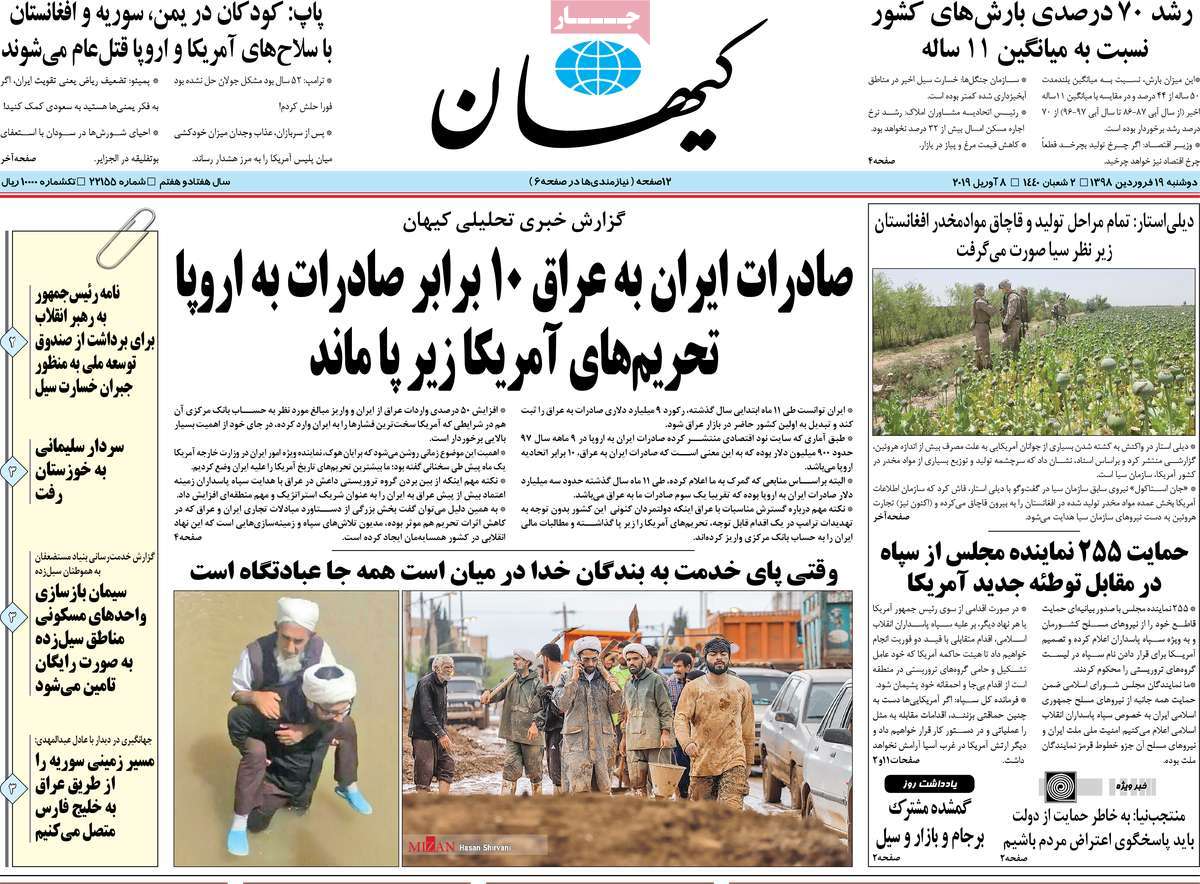
A Look at Iranian Newspaper Front Pages on April 8


Khorasan:

1- Iran Worried about Khuzestan

2- Government, Parliament, IRGC Give Strong Response to Trump’s Propaganda Show
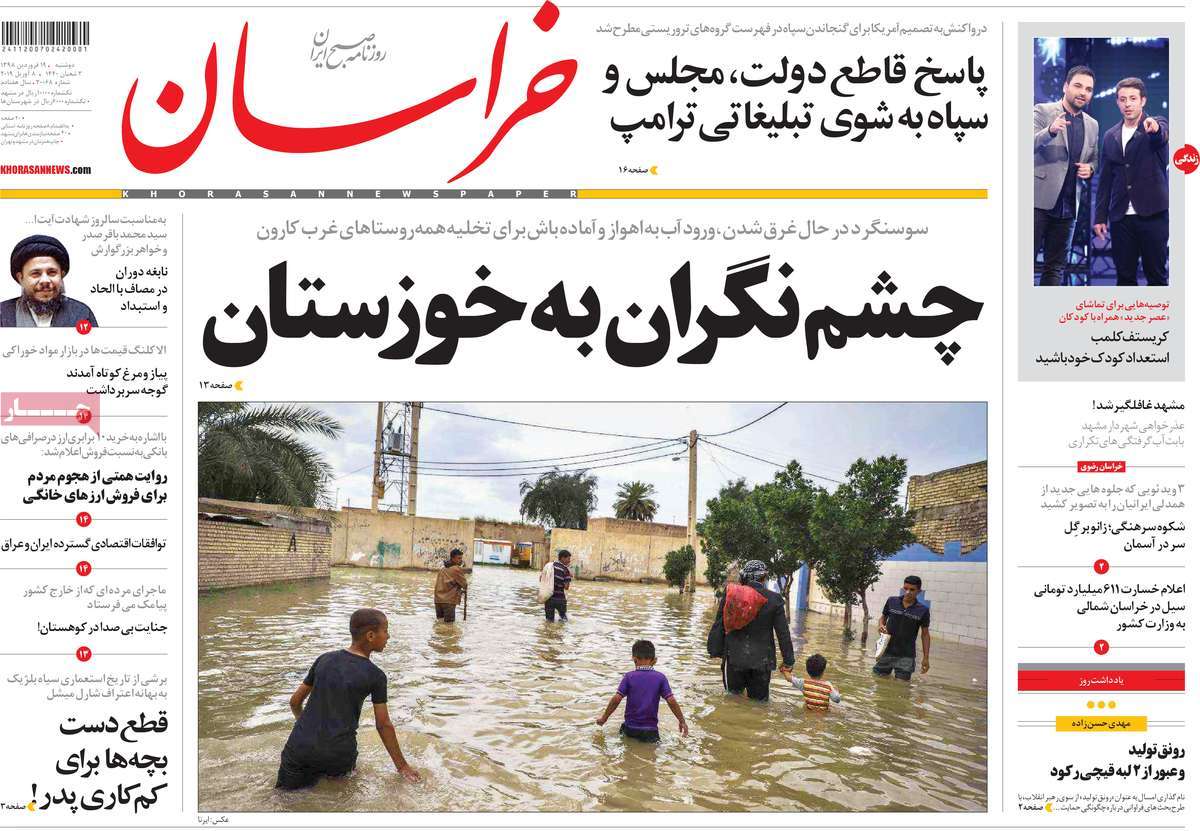
A Look at Iranian Newspaper Front Pages on April 8


Sazandegi:

1- IRGC, Army Standing by Flood-Hit People

2- US’ Double-Standard Behaviour towards Iran, Saudi Arabia

* Riyadh Government to Have Its First Nuclear Power Plant in One Year
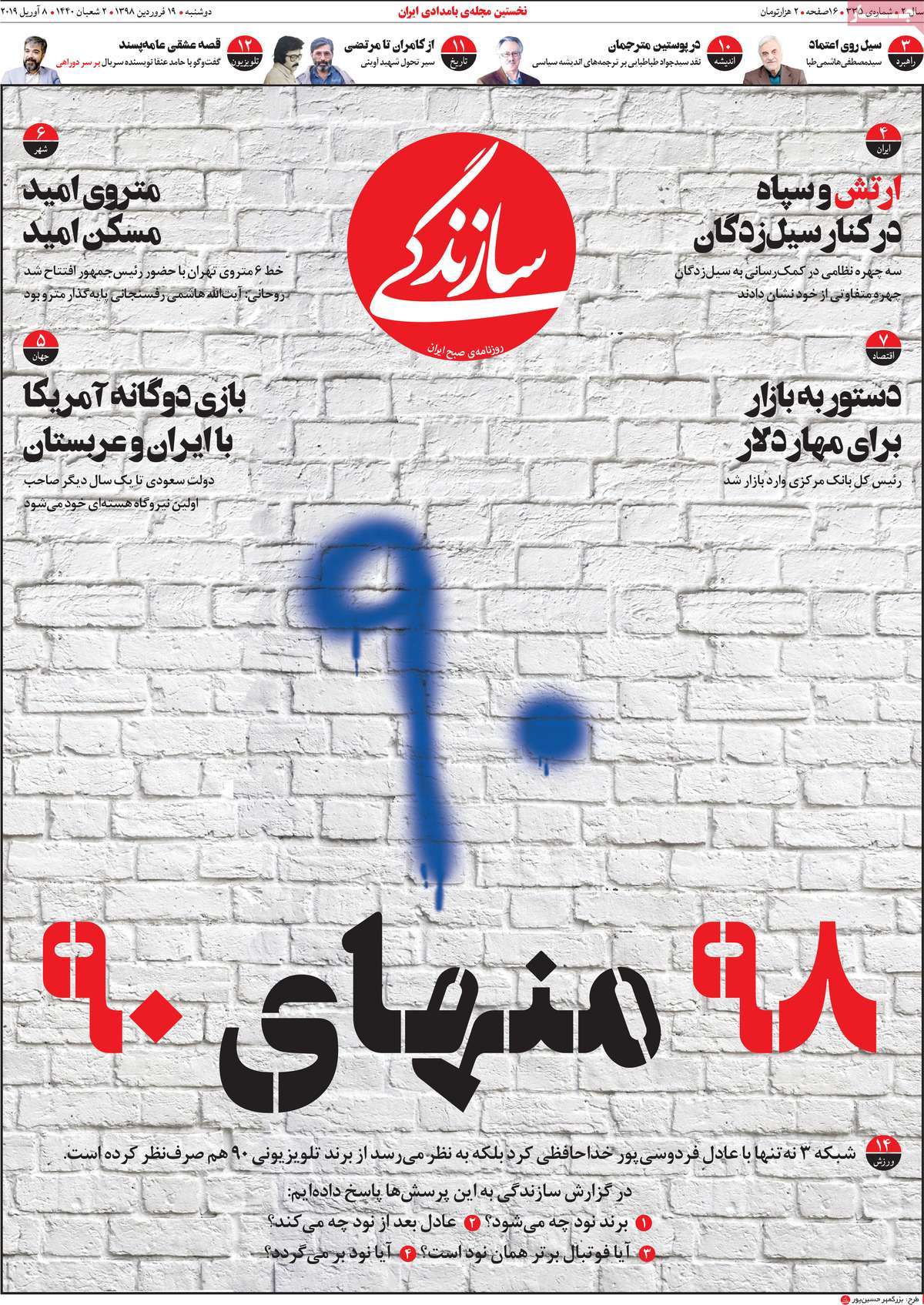
A Look at Iranian Newspaper Front Pages on April 8


Setareh Sobh:

1- New Forex Policies Coming: Iran Chief Banker

2- Iran, Iraq to Develop Economic, Trade Relations
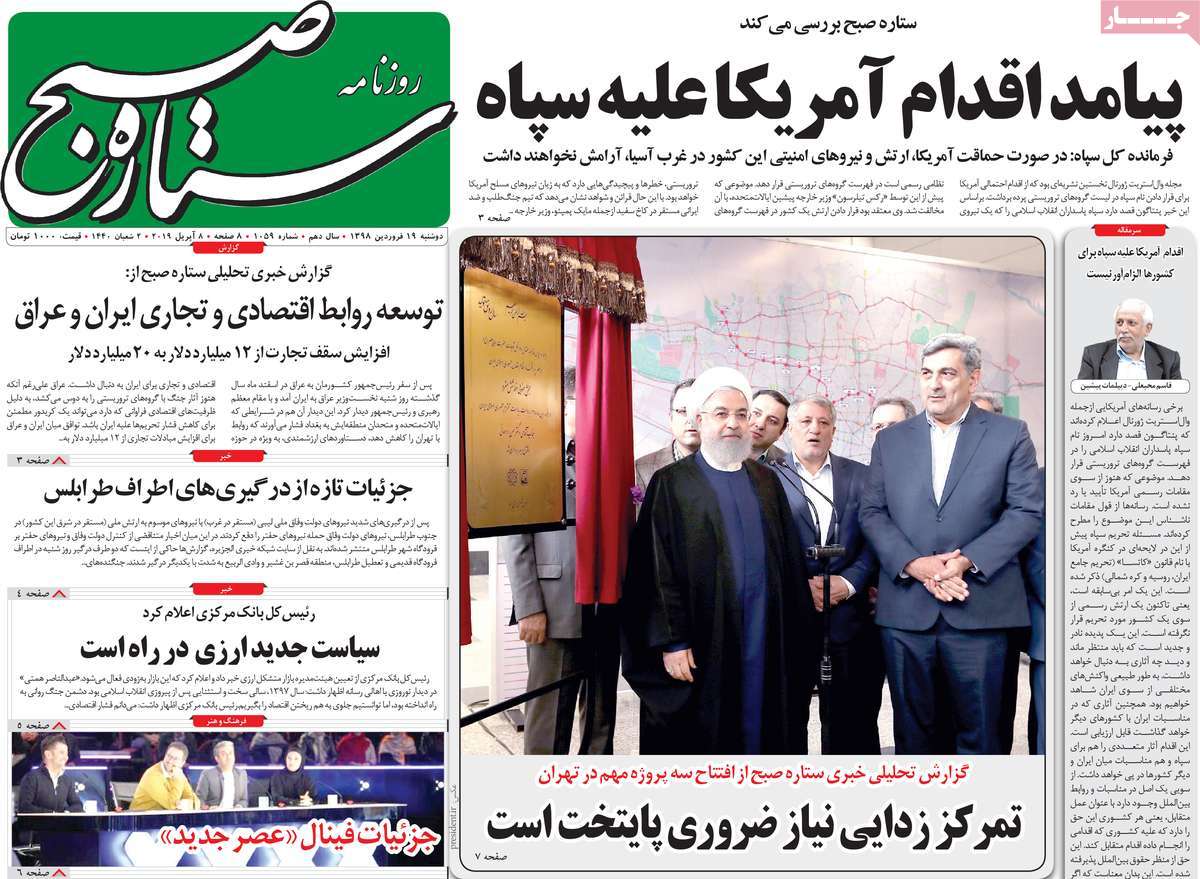
A Look at Iranian Newspaper Front Pages on April 8


Shahrvand:

1- Int’l Aid Blocked by Sanctions

2- International Federation of Red Cross and Red Crescent Concerned about Sending Aid to Iran

3- Donation Channel Opened by German Red Cross Only Way to Send Money to Iran’s Flood-Hit People
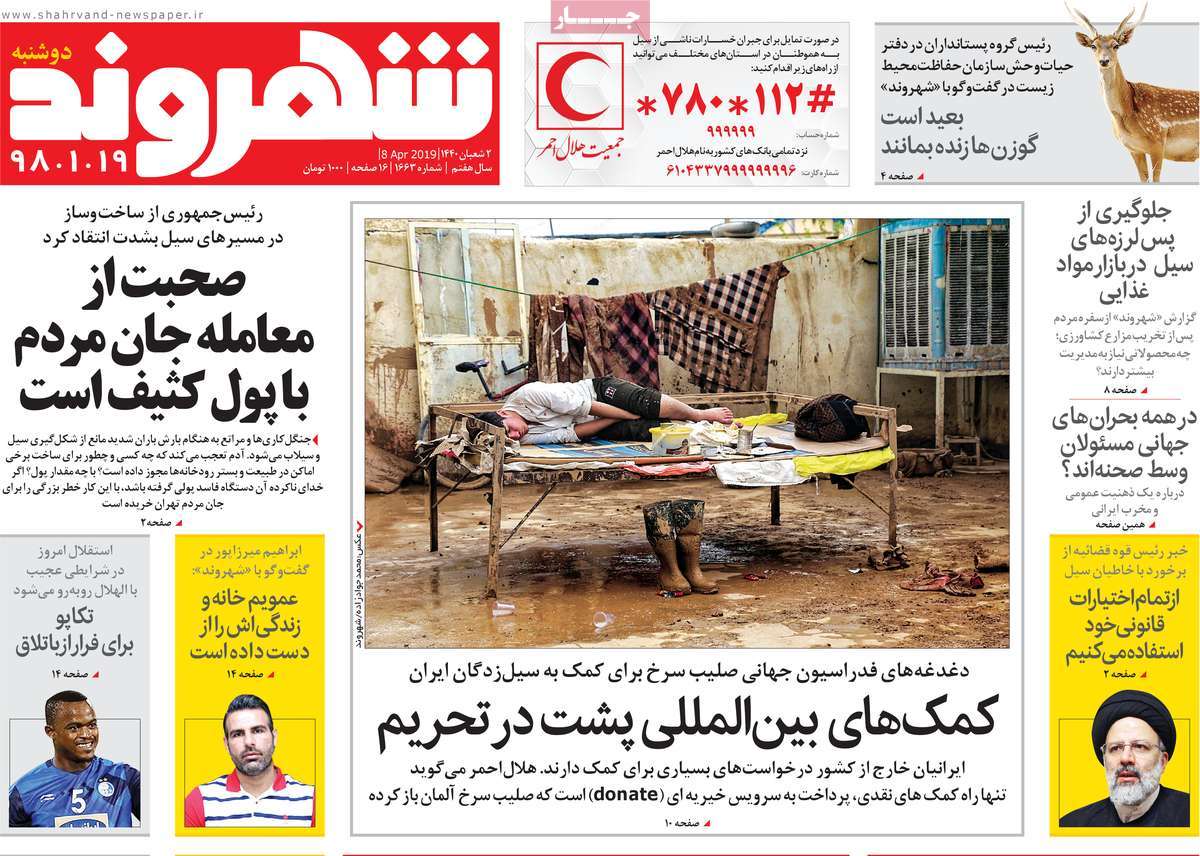
A Look at Iranian Newspaper Front Pages on April 8


Shargh:

1- Iraqi Guest Tasked with Mediating between Iran, Saudi

2- Subway, Dams of Khuzestan All Built with Efforts of Rafsanjani

3- Politicization of Flood to Deepen Crisis: Reformist Figure
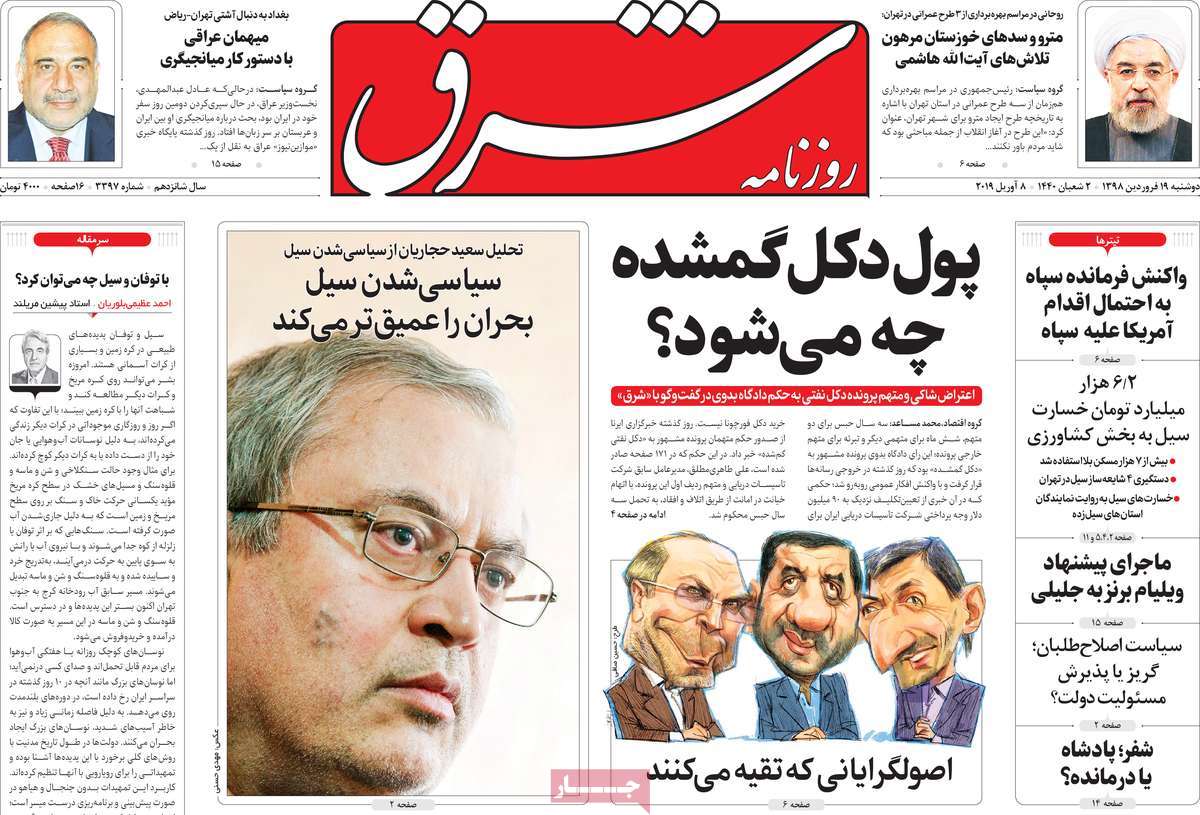
A Look at Iranian Newspaper Front Pages on April 8


Sobh-e Now:

1- Face to Face with America

* Iranian Military, Political Officials Threaten US Army Won’t Have Security Anymore
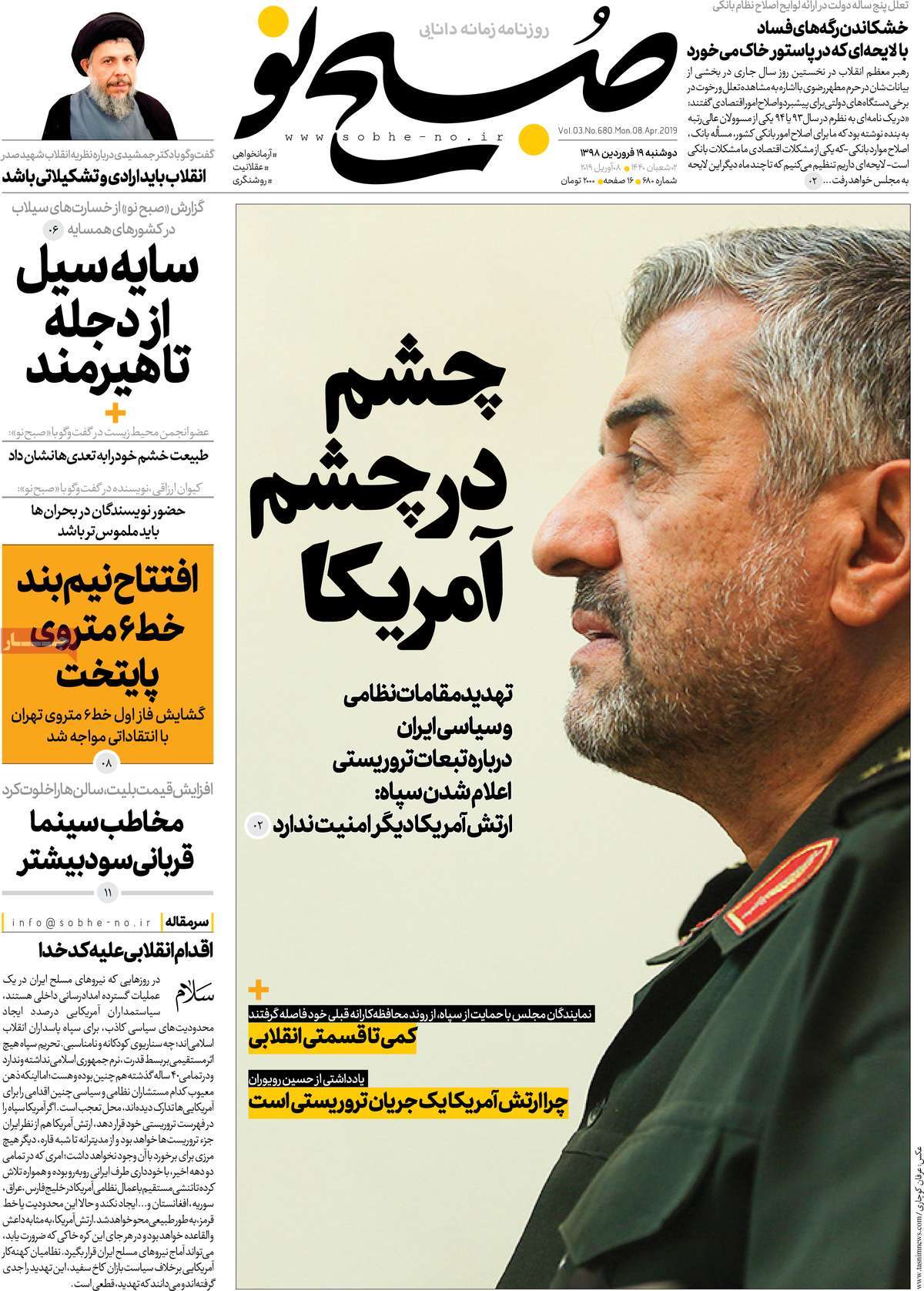
A Look at Iranian Newspaper Front Pages on April 8

Pakistani PM Offers Assistance to Iran after Deadly Floods

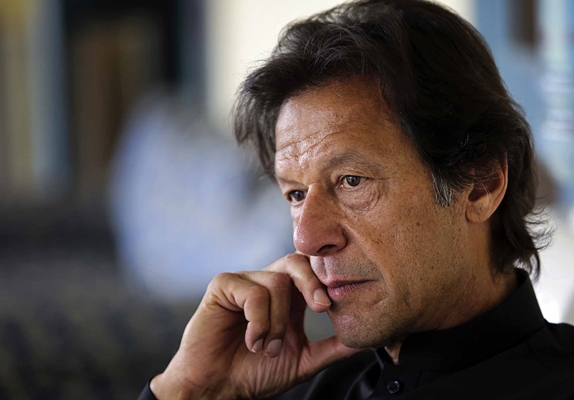
In a Tweet on Sunday, Imran Khan wrote that his prayers are with the Iranian people. He also expressed Pakistan’s readiness to provide any humanitarian assistance required.

Iran moved on Saturday to evacuate more towns and villages threatened by floods after continued rain in the southwest of the country as the nationwide toll from the flooding reached 70.
About 1,900 cities and villages have been affected by floods after exceptionally heavy rains since March 19.

Several countries and international humanitarian bodies have so far started dispatching their aid cargos to the crisis-hit areas of Iran.

International Aid Pouring in for Flood-Hit People of Iran

A high representative of the European Union Commission said the commission is set to donate €1.2 million for the flood-hit people.

Germany’s ambassador to Iran said on his Twitter account that a charter flight carrying humanitarian aid has landed in Tehran. The aid from Germany includes 40 rescue boats as well as other safety equipment.

The French embassy in Tehran said given the severity of the recent floods in Iran, France is determined to contribute to efforts to cope with the disaster by delivering rescue equipment to the Iranian Red Crescent Society in the coming days.

In a post on its twitter account, the embassy said the equipment includes 114 water pump, 300 cooking tools and 5,000 blankets.

Switzerland Foreign Ministry also said the country will dispatch two water purifiers to flood-hit areas in Iran. Each one of the purifiers enjoys the capacity to purify water for at least five thousand people.

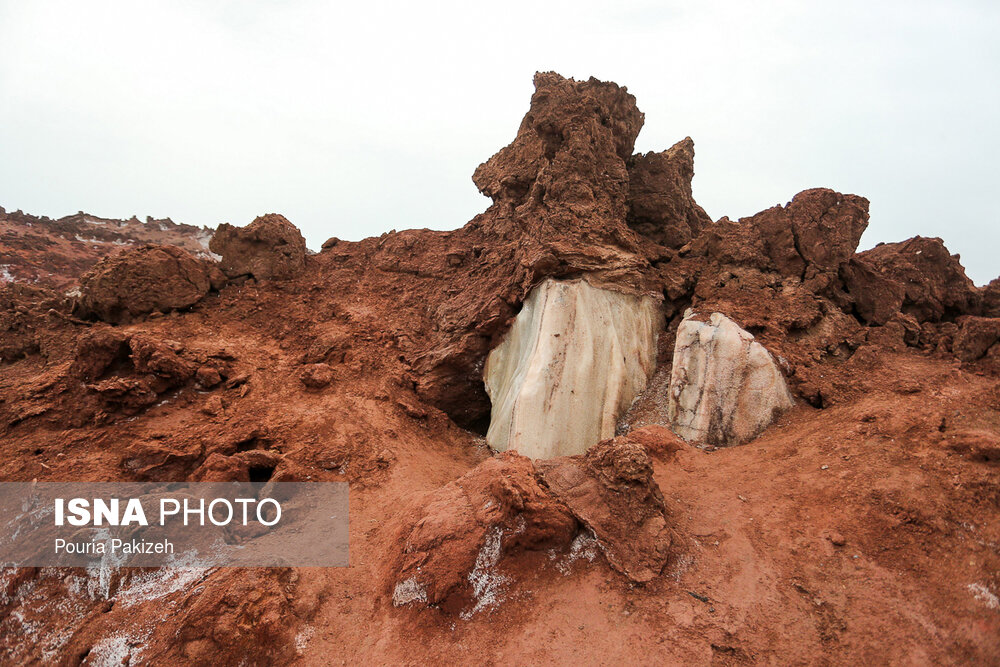
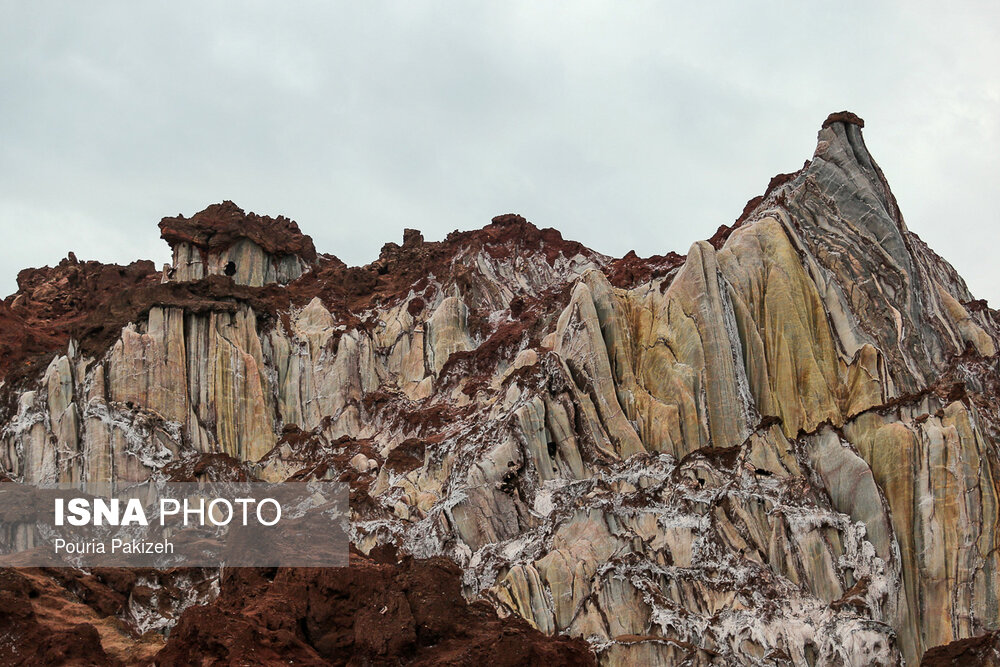
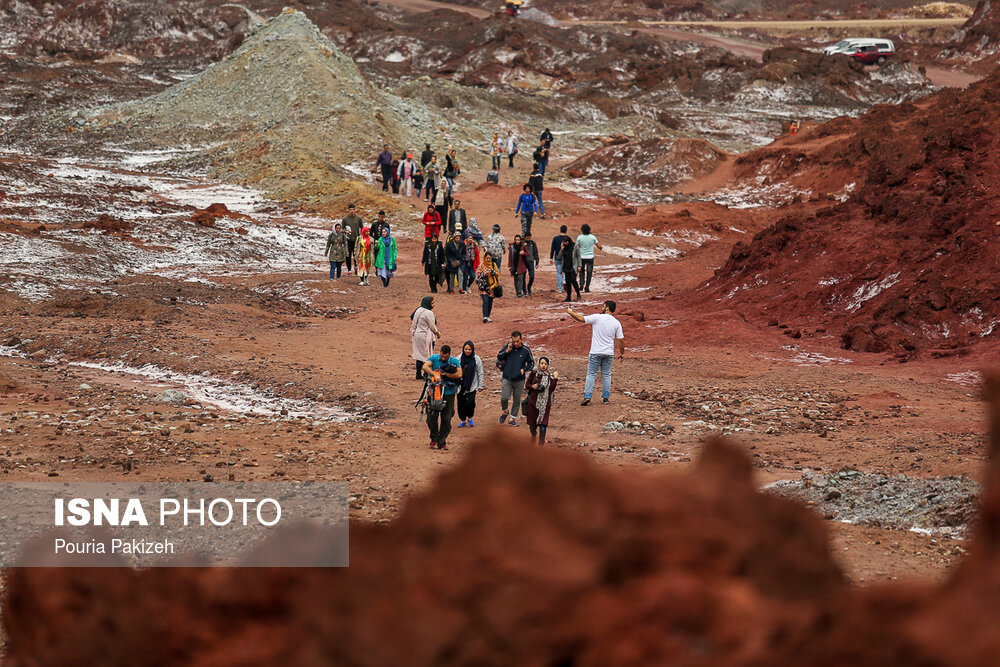
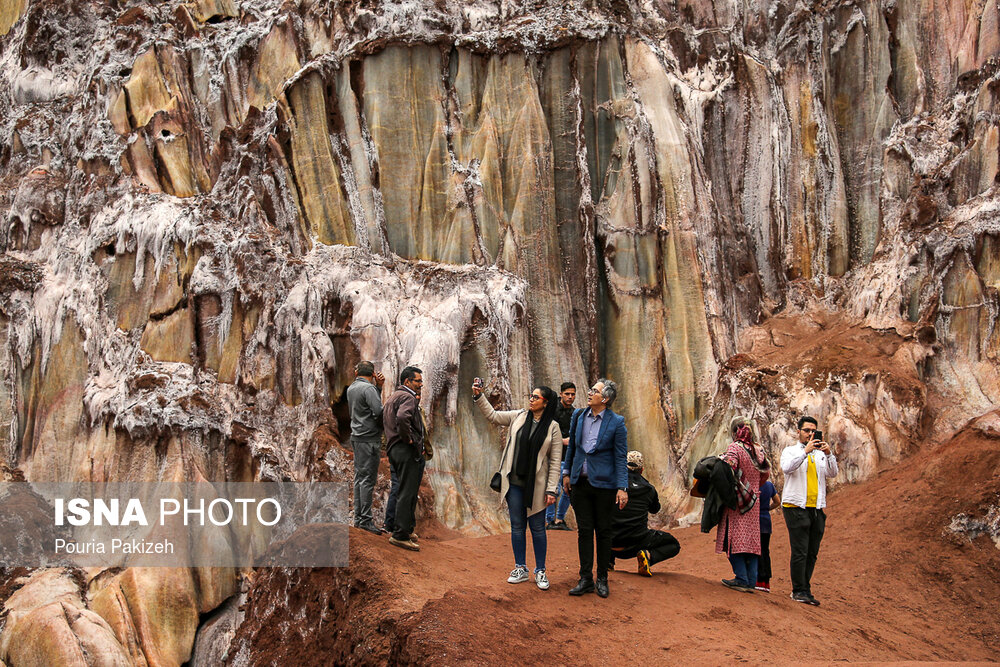
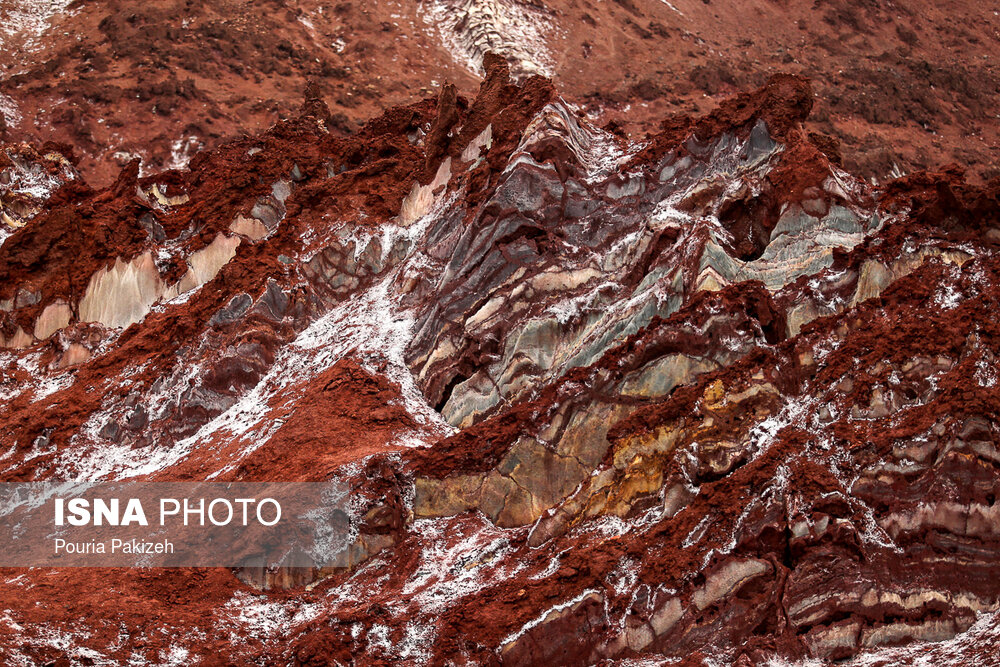
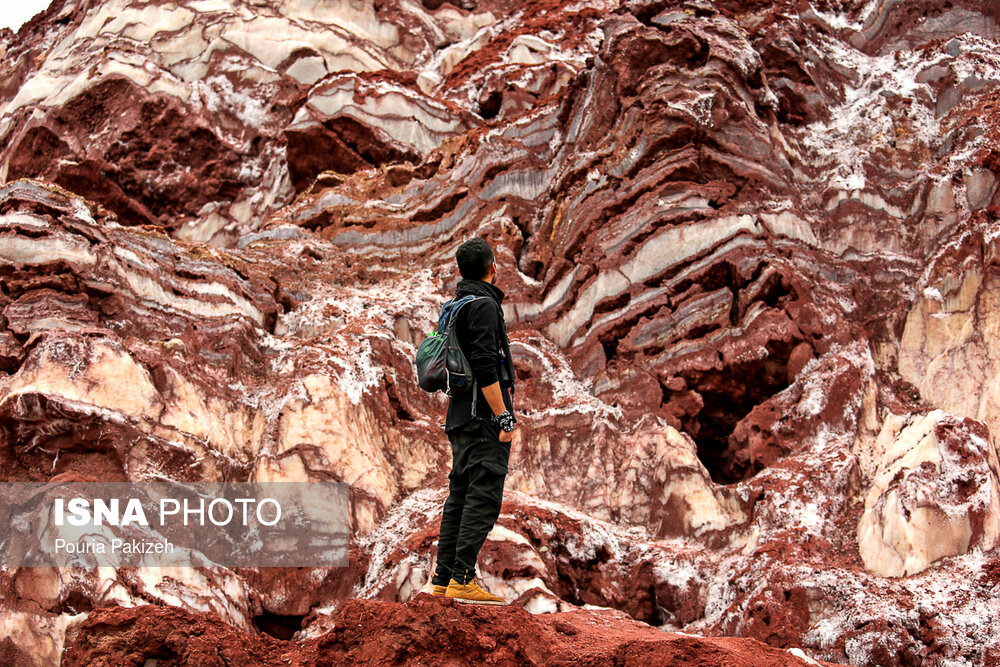
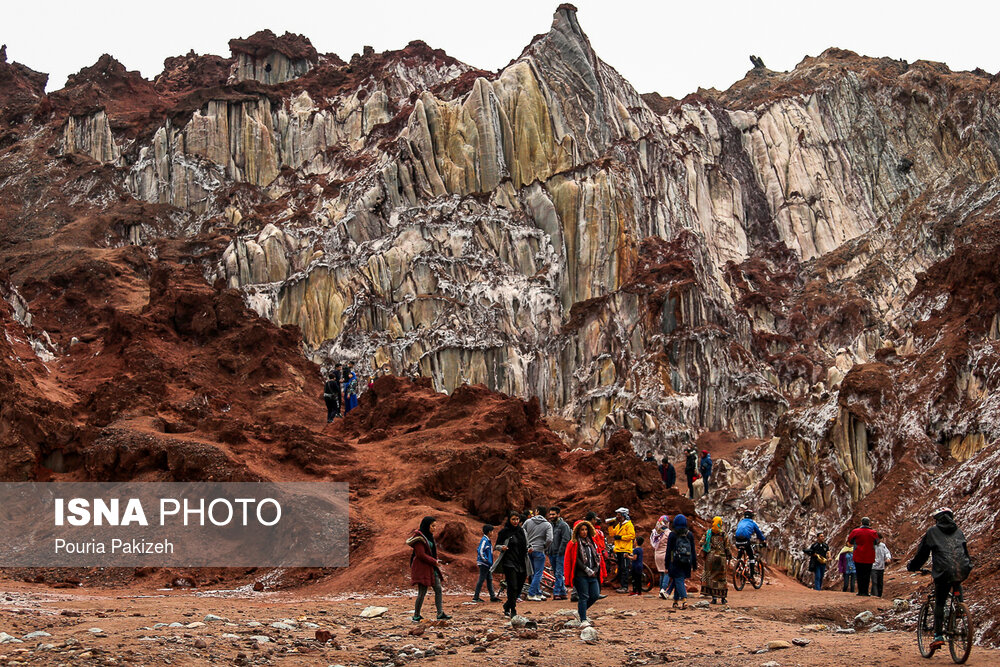
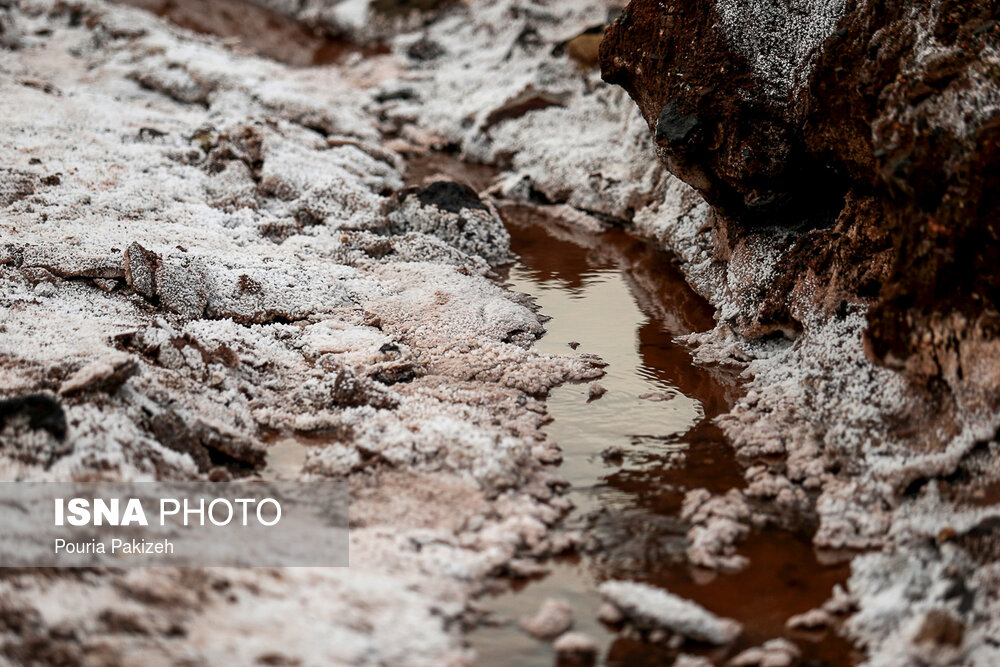
Goddess of Salt; Splendid Attraction of Hormuz Island

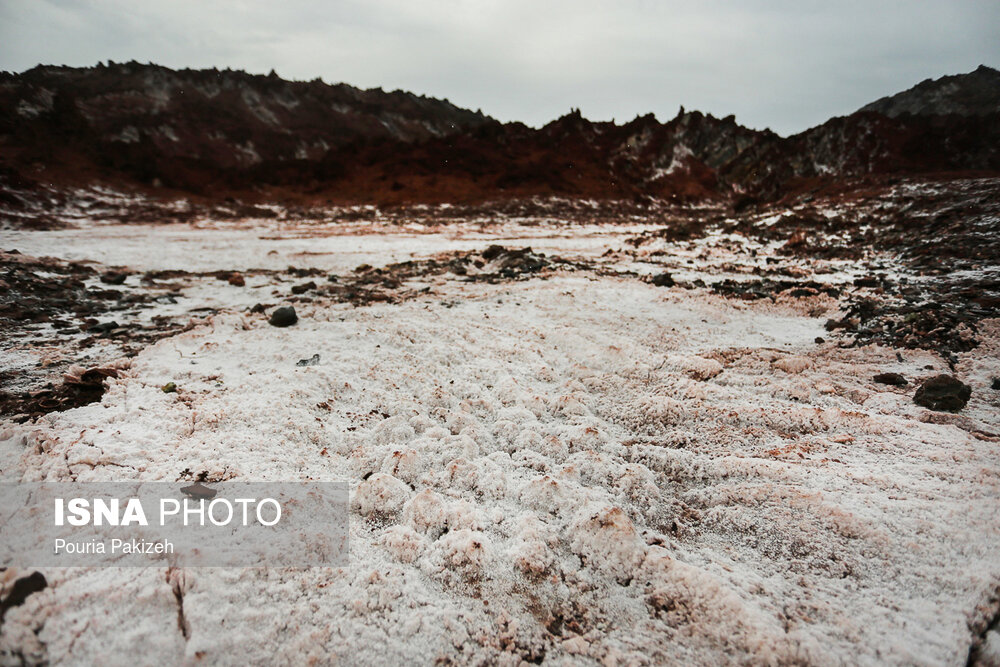
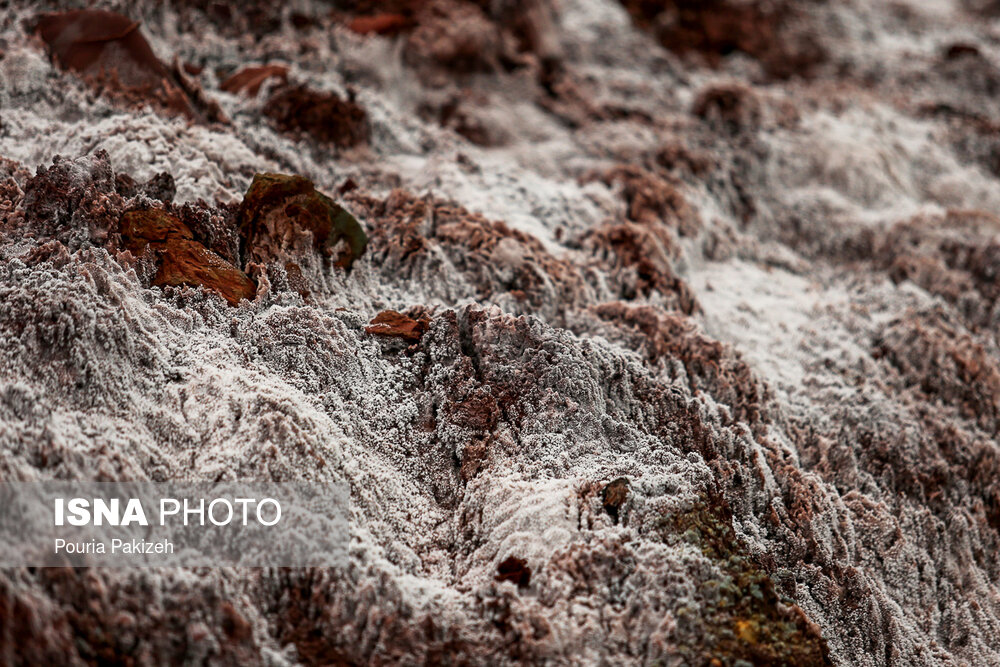
The jewel of geology of the Persian Gulf is located on a salt dome. The crystals of salt stone are scattered in most parts of the island.

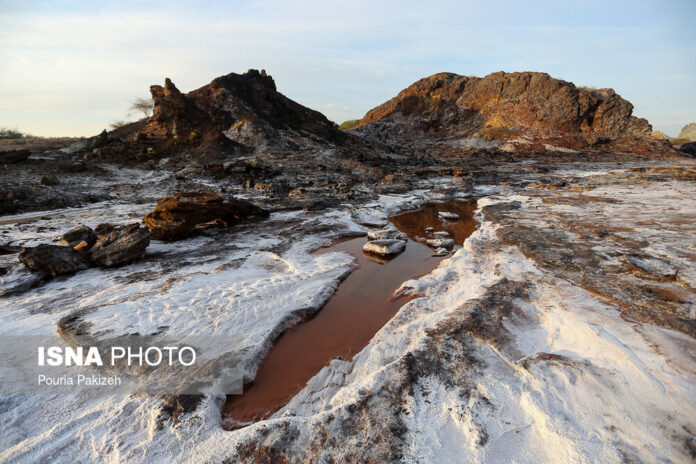
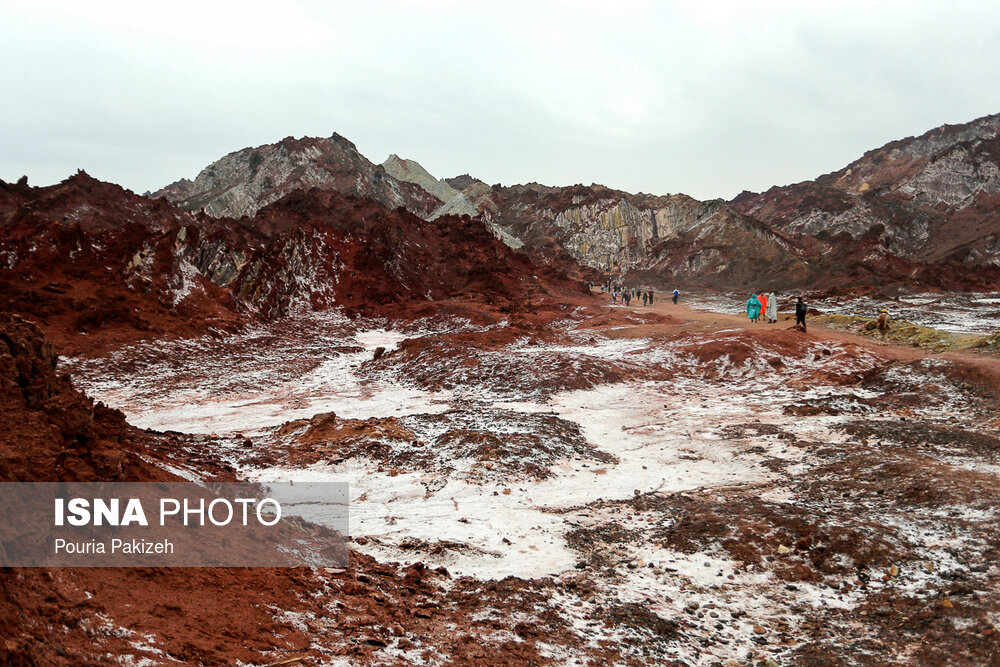
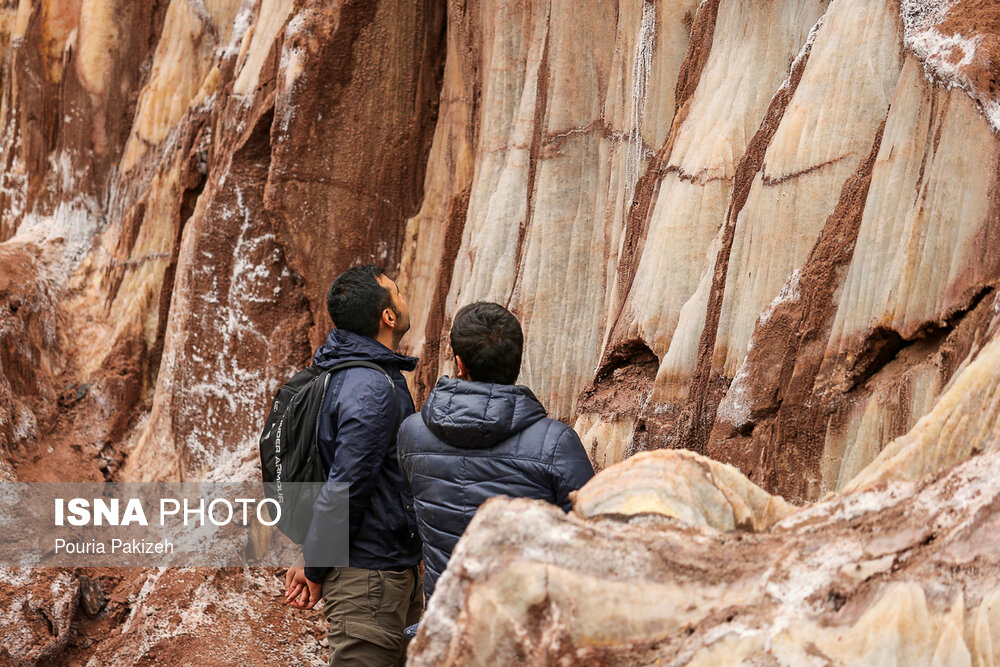
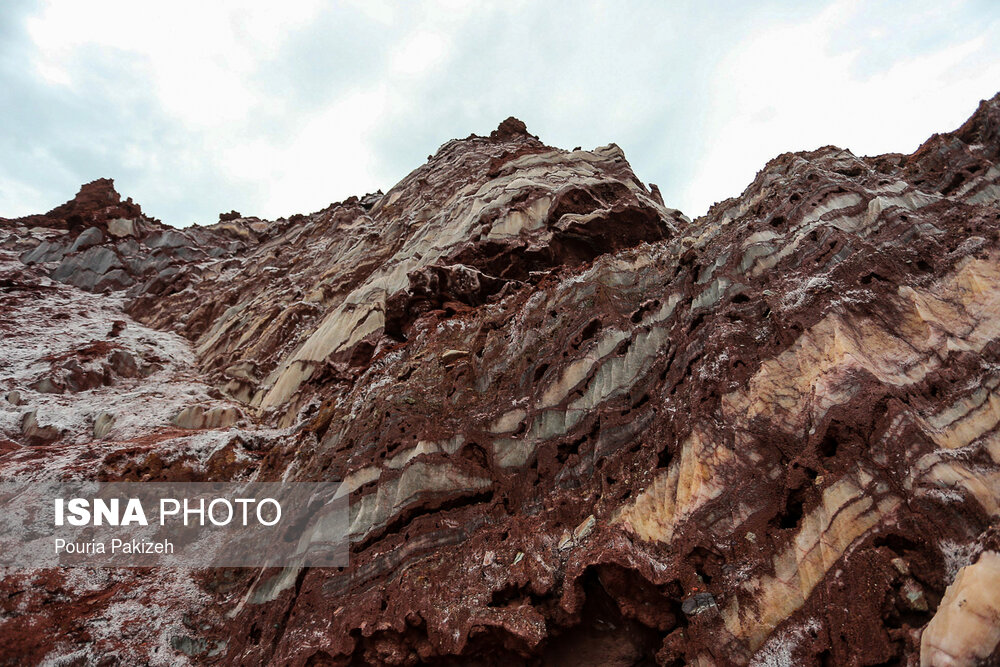
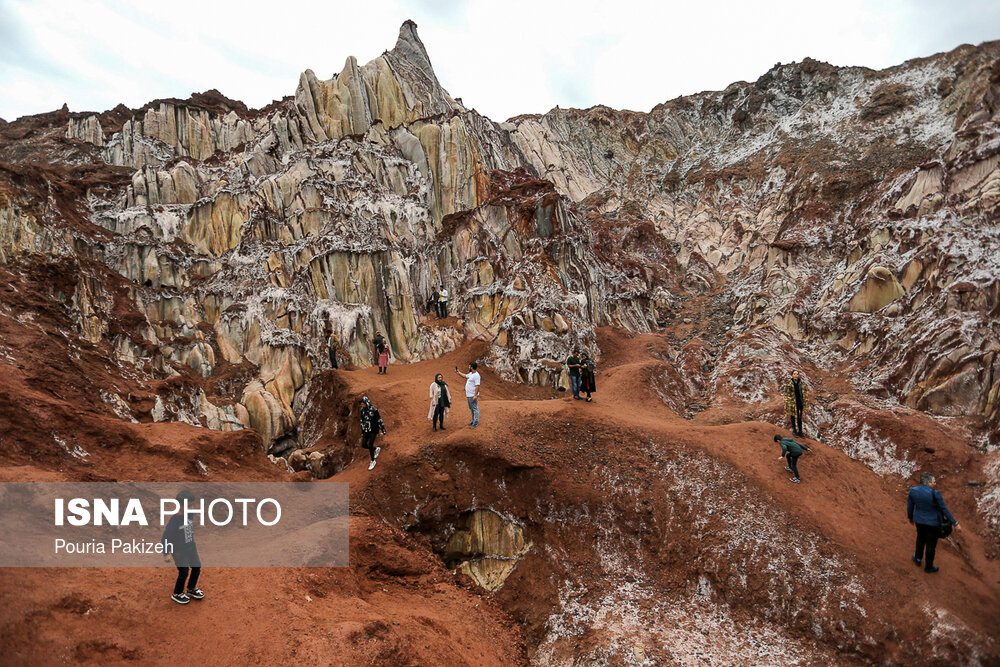
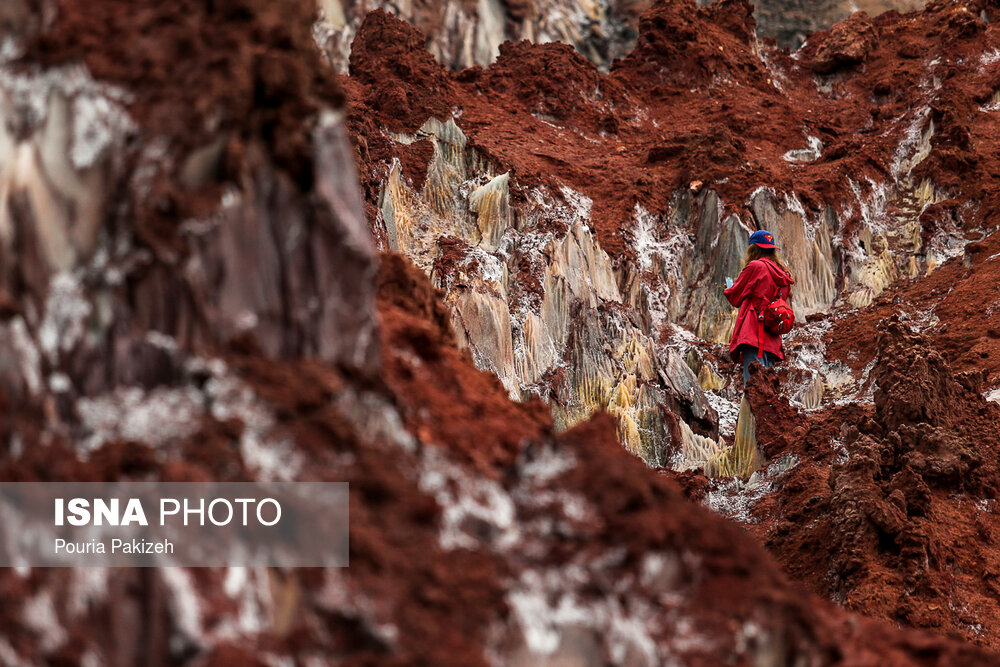
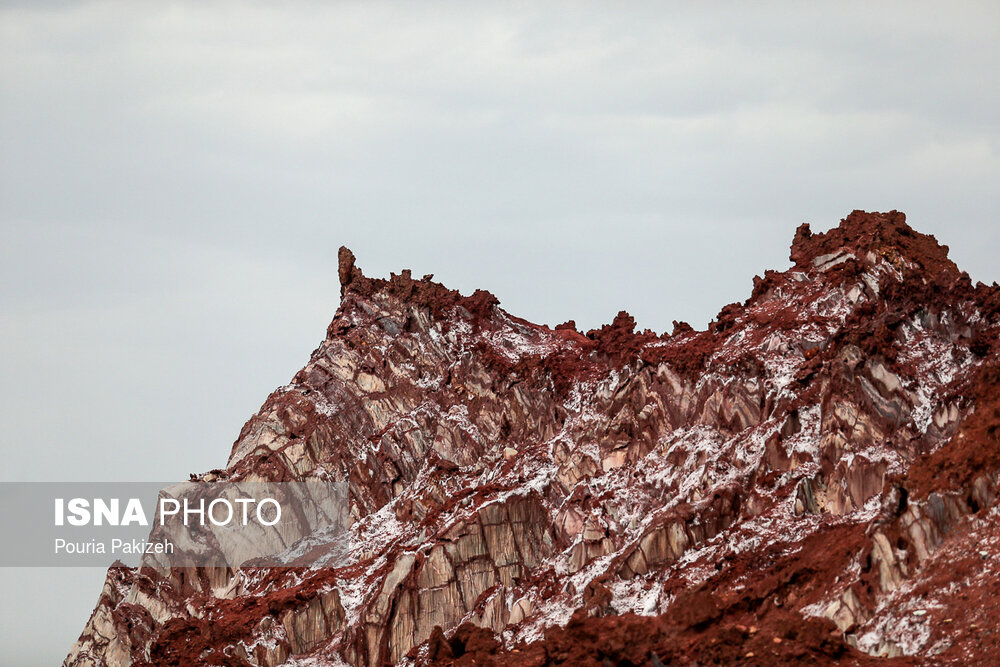
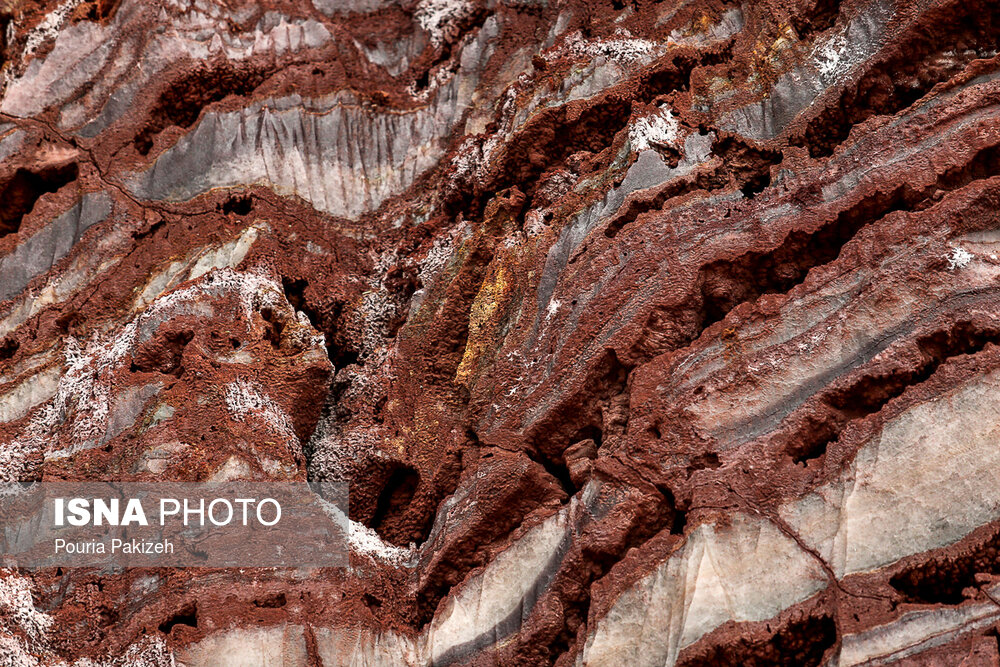
The southern swathe of Hormuz Island is covered with huge salt crystals. Among the main tourist attractions of the island, one can refer to the unsmooth surface of the earth caused by erosion over time. This has created some unique scenes.

The Goddess of Salt is one of these attractions. It is composed of a salt mountain with colourful textures, beautifully cut by nature over time.

Underneath the mountain, a stream is flowing against an orange backdrop. The stream’s nice sound creates a pleasant feeling amid the heavy silence of the island.

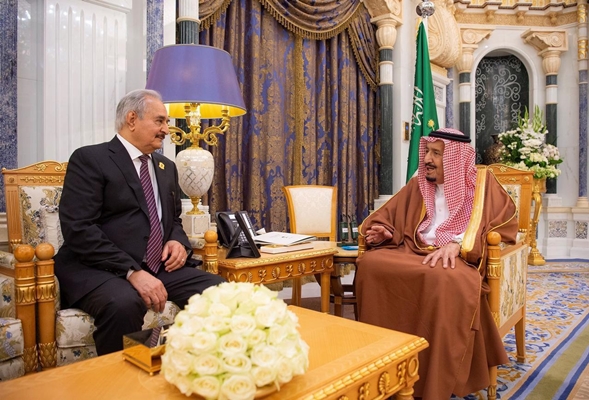
‘Saudi, UAE Backing Moves against Libya Legal Govt.’

Saudi Arabia's King Salman bin Abdulaziz meets with Libyan military commander Khalifa Haftar in Riyadh, Saudi Arabia March 27, 2019. / Photo by Reuters

The Mehr News Agency has, in an article, weighed in on the power struggle in Libya and the backing allegedly offered to Haftar by Riyadh and Abu Dhabi. The full text of the analytical piece follows.

After hopes grew that political efforts to work out a political solution to the Libya conflict on the international stage as well as on the domestic front would bear fruit, political analysts suffered a deep shock when commander of the Libyan National Army (LNA) General Khalifa Haftar, a major player in Libya’s political landscape, suddenly announced he would launch operations to, in his words, liberate the capital, Tripoli.

Eight years on since former Libyan dictator Muammar Gaddafi’s regime was ousted, the oil-rich country has not yet seen stability and security. It seems the interference of Arab countries such as Saudi Arabia and the United Arab Emirates (UAE) has contributed heavily to insecurity in Libya.

Tensions flared up suddenly in Libya at a time when Haftar and Fayez al-Sarraj, the Tripoli-based prime minister, had pressed each other’s hands in front of cameras and announced that the Libya crisis would be over soon. Both sides agreed over the past month to hold national elections in Libya and put an end to the conflict currently gripping the country.

Around a week ago and a few days before the Arab League summit, general Haftar was invited to Riyadh to meet Saudi King Salman bin Abdulaziz Al Saud. Some informed sources say the trip came at the request of US authorities.
Saudi Crown Prince Mohammed bin Salman also held a separate meeting with Haftar where the Saudi intelligence chief was also present. In the meeting, Salman gave Haftar the green light to go ahead with his new adventurism in Libya. One day before the Arab League summit, Haftar delivered a speech in the city of Benghazi where he announced that an integrated government would be established in Libya in the coming weeks. However, five days later, troops affiliated with Haftar said they were ready to advance toward western Libya and Tripoli. Their military hardware arrived in the city of Gharyan early on Thursday.
This move by Haftar-affiliated forces ran counter to all international efforts geared to settling the political crisis in Libya, so much so that most countries and international circles, including the United Nations Security Council, called for a halt to fighting in Libya. Haftar has tried time and again to gain control of oil-rich regions in Libya. His change of position on seeking dialogue with dissidents as well as moving to take military action in the country will once again fuel civil war in the country, decreasing the odds of an integrated government in the country represented by all Libyan groups.


Saudi, UAE Engineering Libya Fighting Scenario


The turnout of millions of Algerian people in demonstrations against Algerian President Abdelaziz Bouteflika as well as his dismissal led Riyadh and Abu Dhabi to become very much worried again over the possible spillover of that public anger and the possibility of seeking to bring about a regime change. Studying the developments in Libya and the stance adopted by Haftar towards holding talks with the opposition shows a surprise change has taken place in Libya only within a matter of days.

It seems that the Saudi king’s meeting with Haftar against the backdrop of popular protests in Algeria is not unrelated to Saudi Arabia and the UAE’s misgivings over a possible spillover of the protests into these two countries. Failure to realize democracy in countries such as Saudi Arabia and other monarchial Arab countries, the effectiveness of public anger and ousting a 20-year rule in Algeria have struck fear into Riyadh and Abu Dhabi, leading them to fabricate a scenario to deflect public attention from developments in Algeria. This scenario requires immediate action to stir up the security and military situation in Libya. The scenario has been financed with Saudi and UAE petro-dollars.

Reports indicate that Haftar has received from Saudi Arabia a financial support package worth $500 million which was sufficient to carry out operations against Tripoli and bribe some of the Libyan politicians and officers based in the city.

At the moment, there are two governments in Libya locked in a power struggle: One is the government in Tripoli led by Fayez al-Sarraj, which is recognized in international circles; the other one is the administration of Abdullah al-Thani in east of the country backed by Haftar. Generally, one can say that Khalifa Haftar gets all his power from foreign governments. In fact, he was able to make his presence felt on the back of this very foreign support. As a case in point, Emirati and Egyptian jet fighters targeted the bases of Haftar’s rivals and helped him gain control over oil installations.

We can say that Libya has presently turned into an arena for muscle-flexing and rivalry between Saudi Arabia, the UAE and Qatar as well. In fact, each of these countries support militia who secure their interests.

In the meantime, Emirati media outlets have gone into action and taken a swipe at Qatar, accusing the country of tampering with stability and security in Libya. These media have reported that the current conflict in Libya is seen as a proxy war between the UAE and Qatar, and also bears witness to the existence of rifts within the [Persian] Gulf Cooperation Council.

Libyan politicians believe the UAE, Saudi Arabia and even Egypt support Haftar’s actions with regards to Tripoli. They believe these three Arab countries seek to bring to power another Abdel Fattah al-Sisi in Libya as Haftar does not have enough money and weapons to conduct such extensive operations, and that the operations were carried out exactly one week after Haftar’s recent trip to Saudi Arabia. Accordingly, the UAE and Egypt have delivered arms and heavy military hardware to troops affiliated with Haftar.

Finally, we can say that Libya has turned into an arena for rivalry among Arab countries, especially Saudi Arabia and the UAE, on the one hand, and become a tool for those countries to realize their narrow-mined interests on the other. As long as the leaders of these countries remain puppets of foreign powers and feel beholden to them for their support, war and conflict will continue in Libya and this country will not enjoy stability and calm.

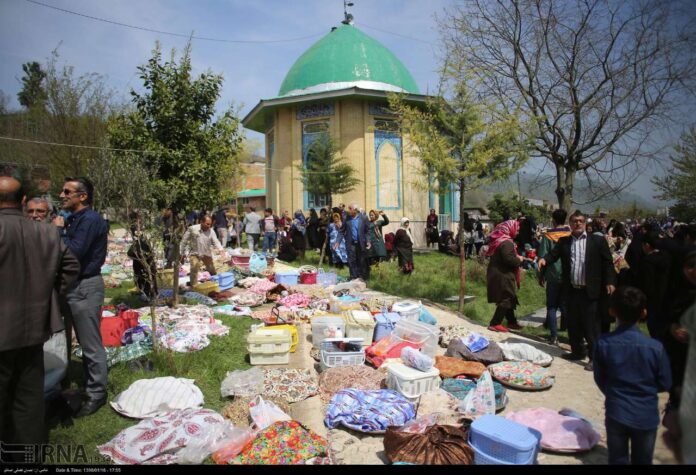
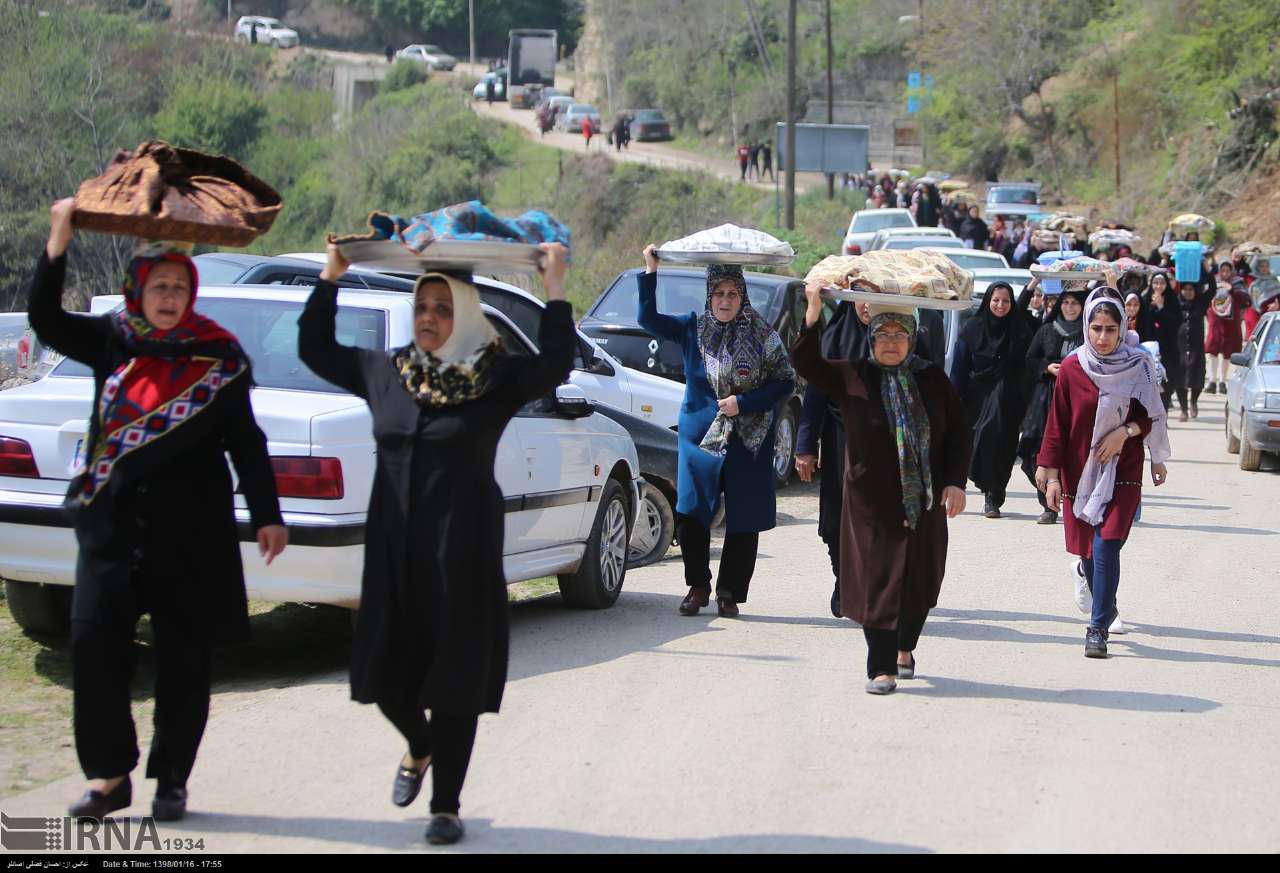
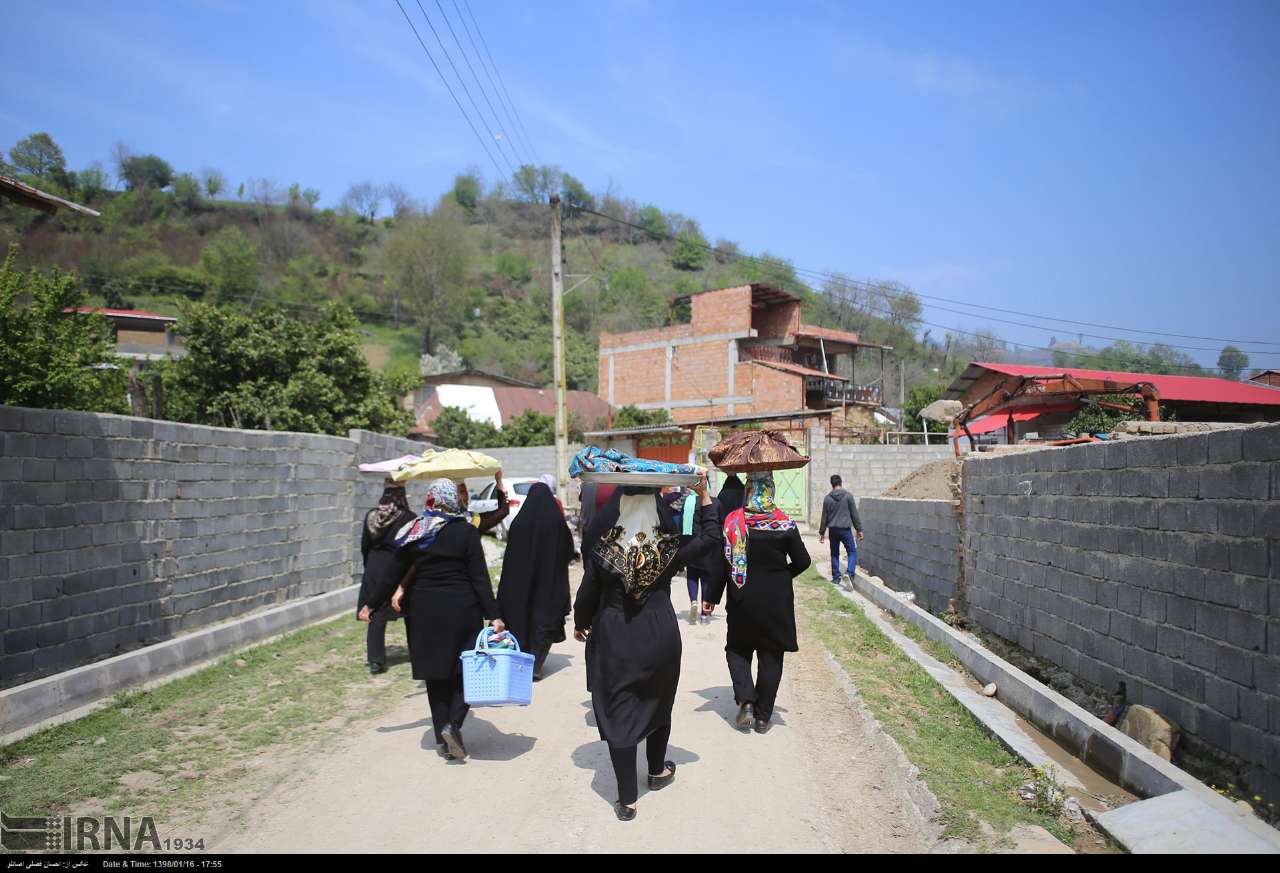
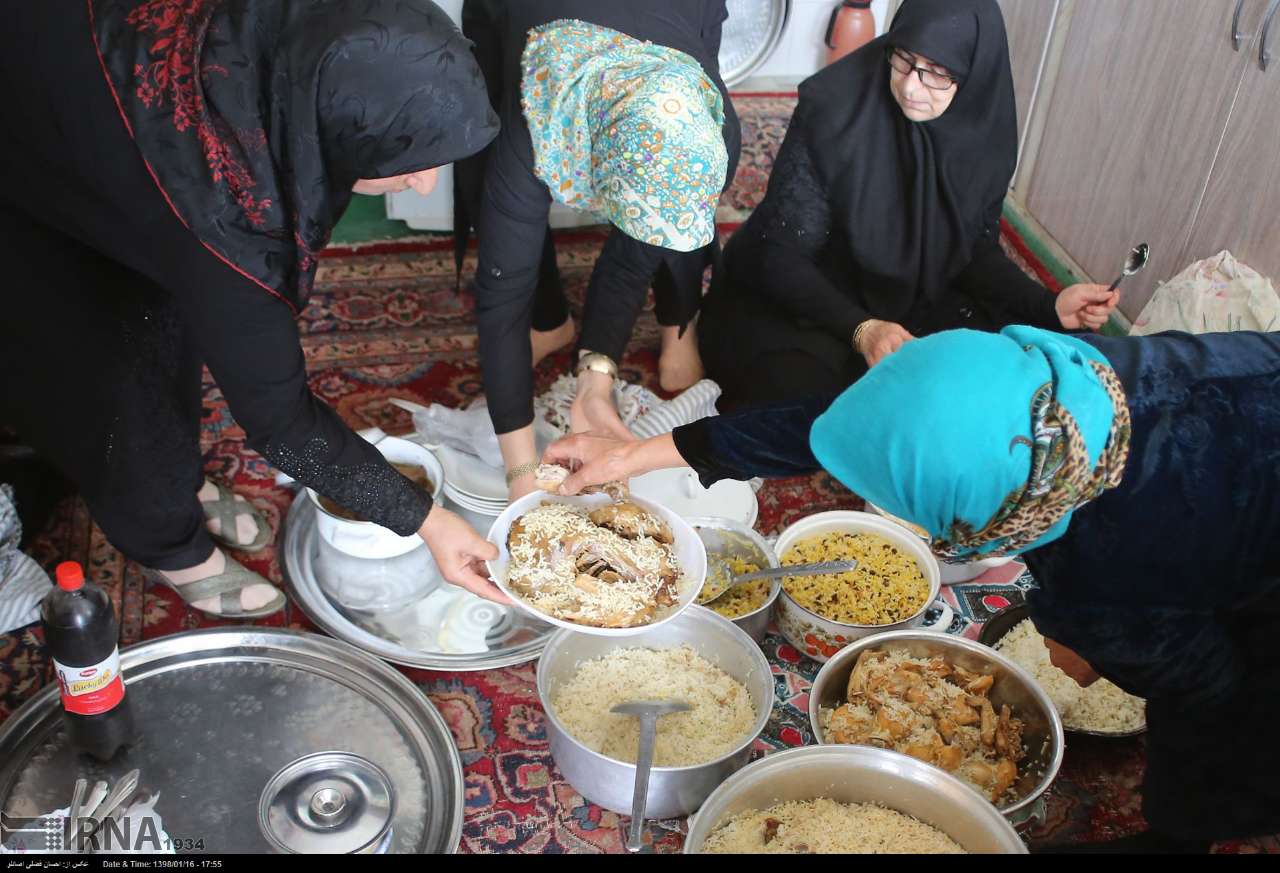
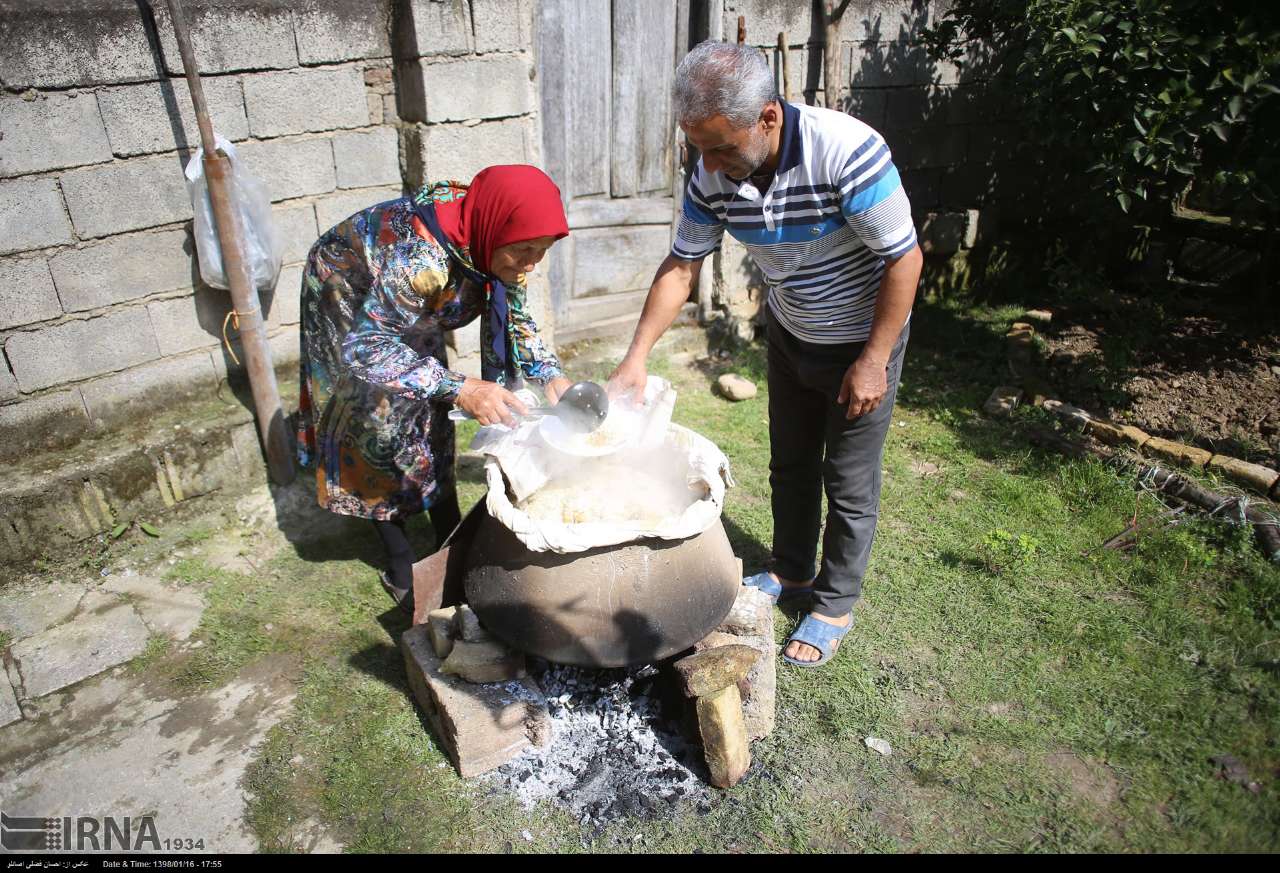
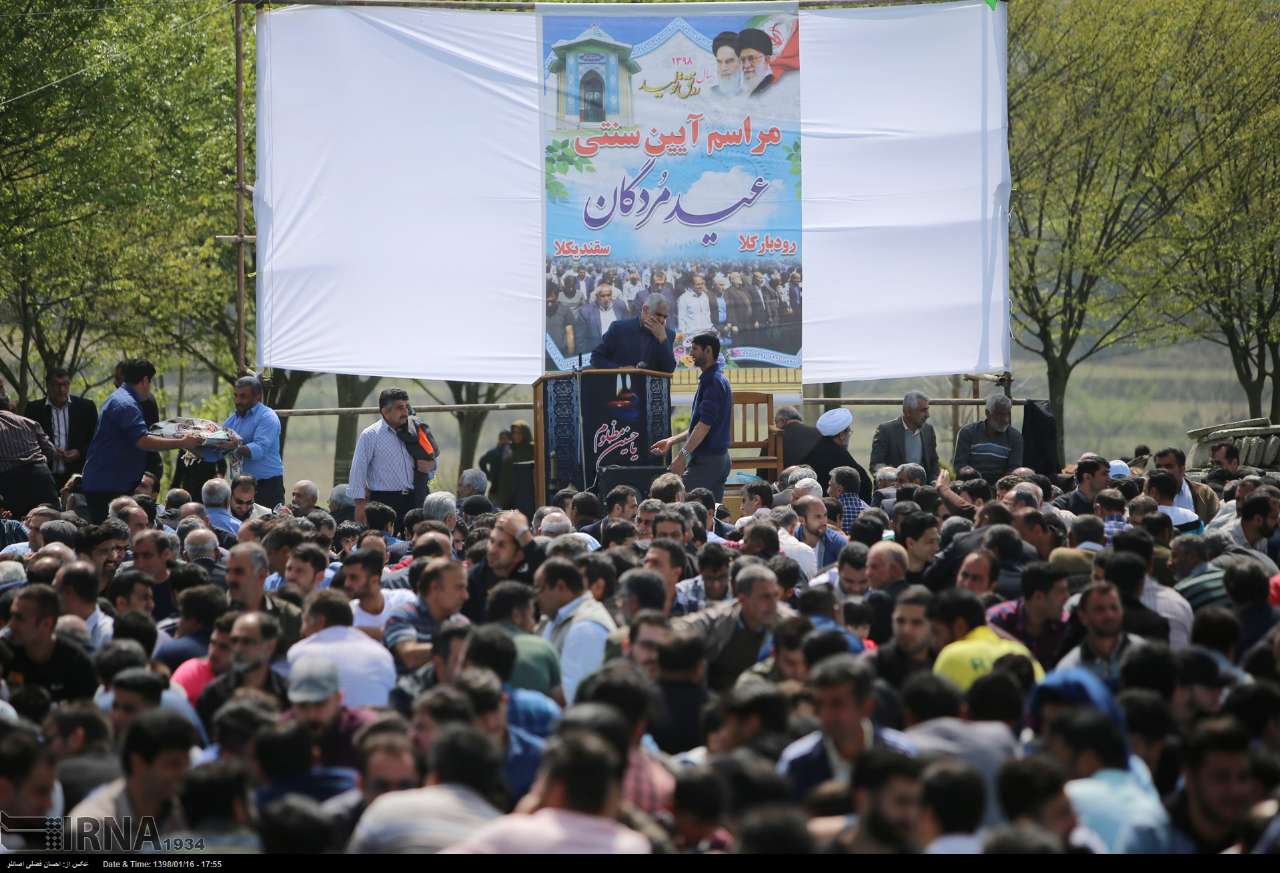
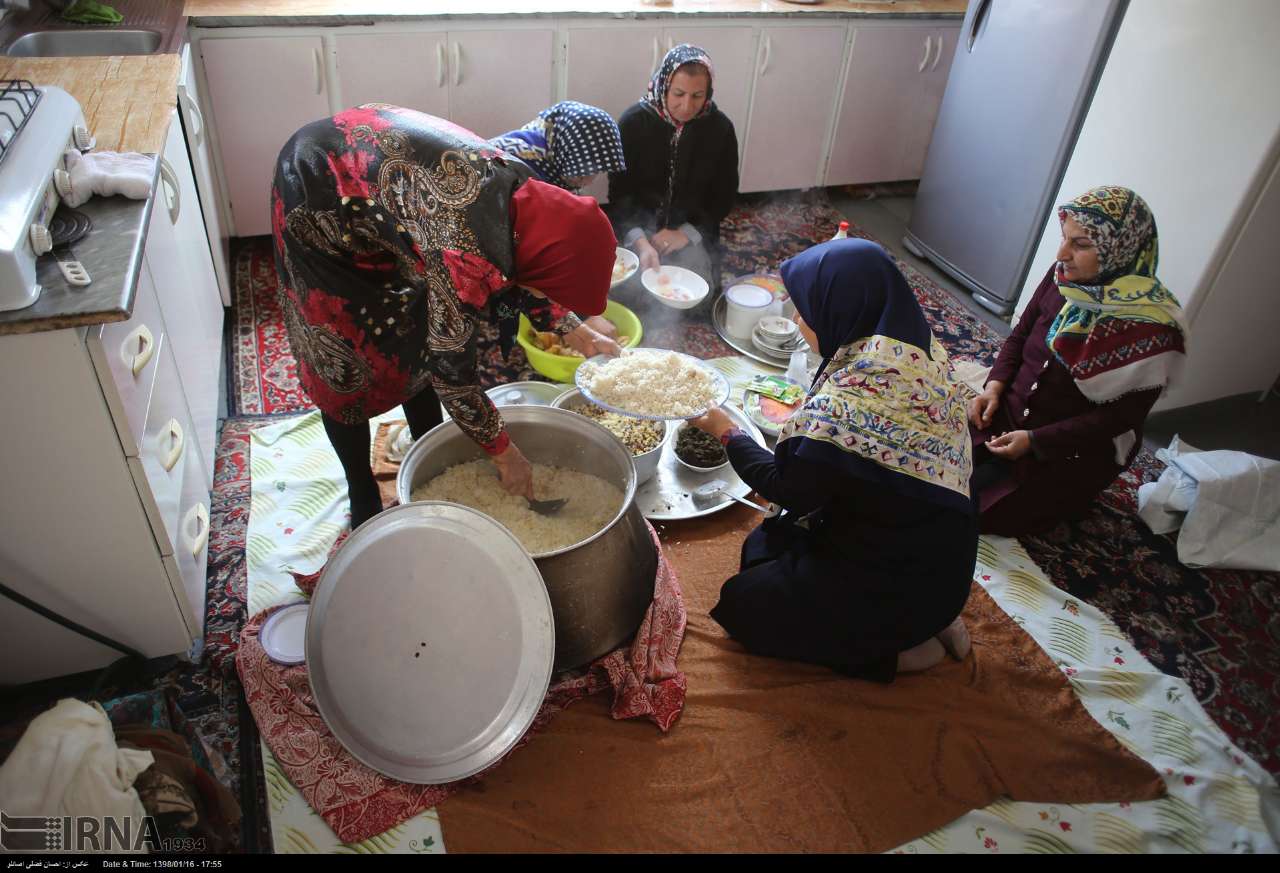
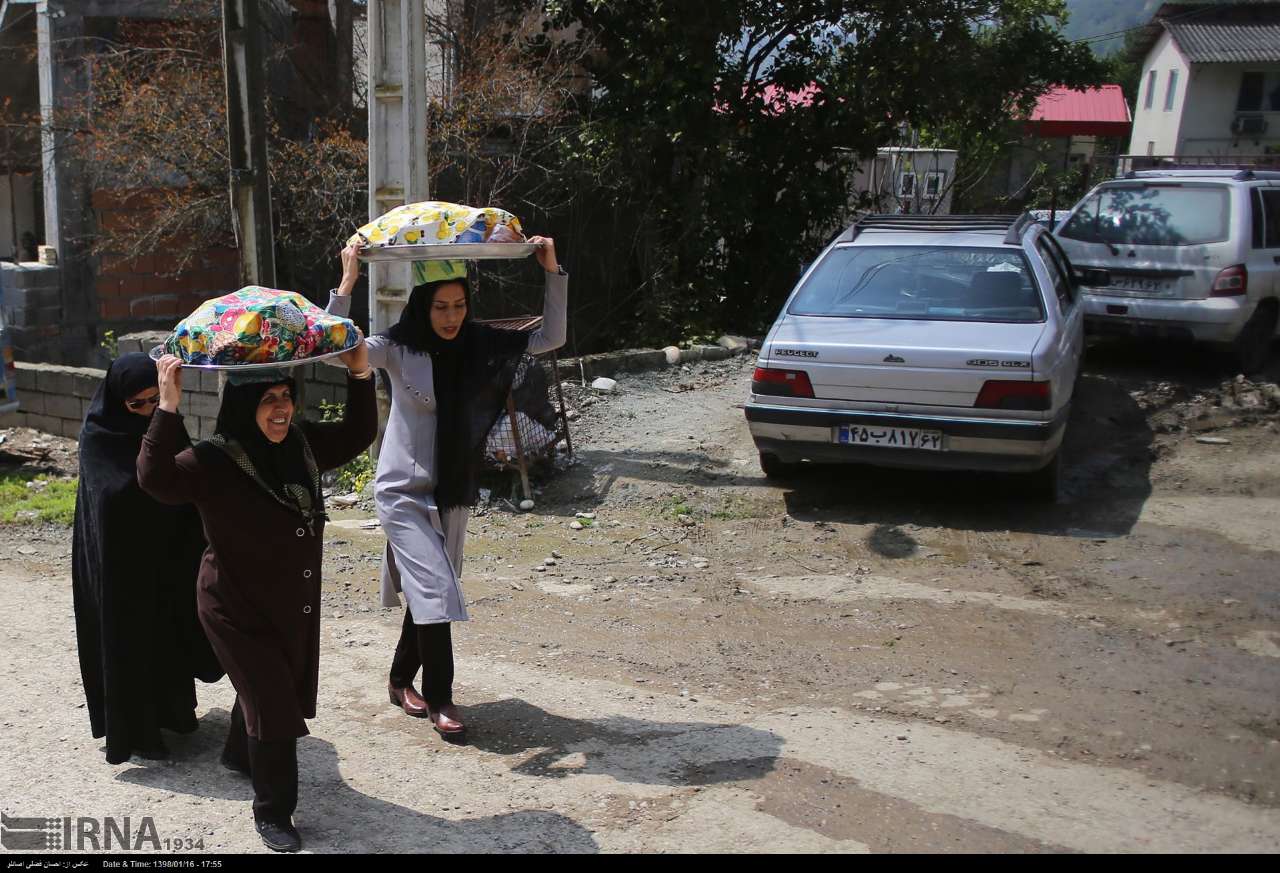
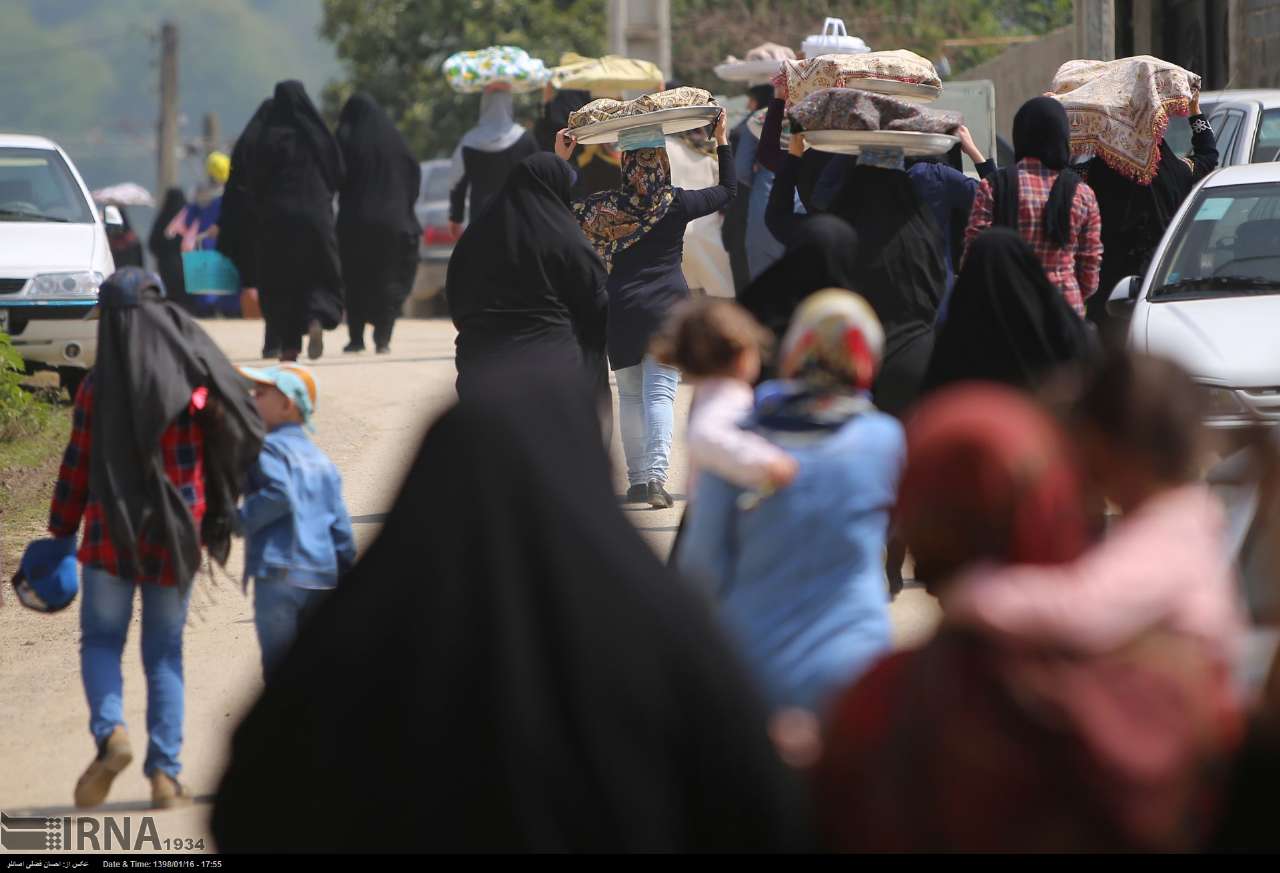
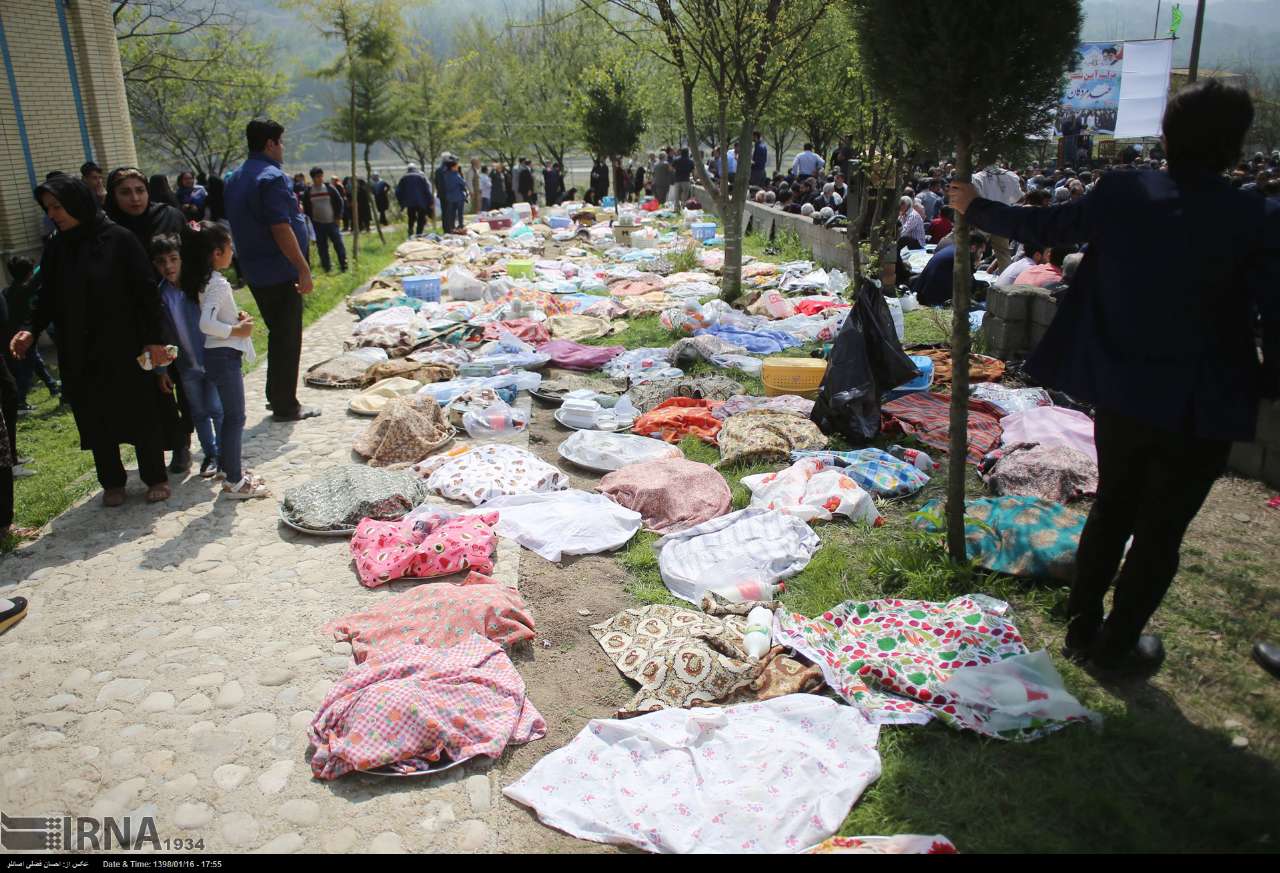
People in Northern Iran Celebrate Nowruz with the Dead

In this ritual, all the people of this village, even those who have emigrated, come to the local cemetery with flowers, sweets, and food.

Villagers believe holding this ritual leads to prosperity in their lives. Local sources say the ceremony has been held in the village since almost 100 years ago.

Here come photos of this ceremony retrieved from IRNA:

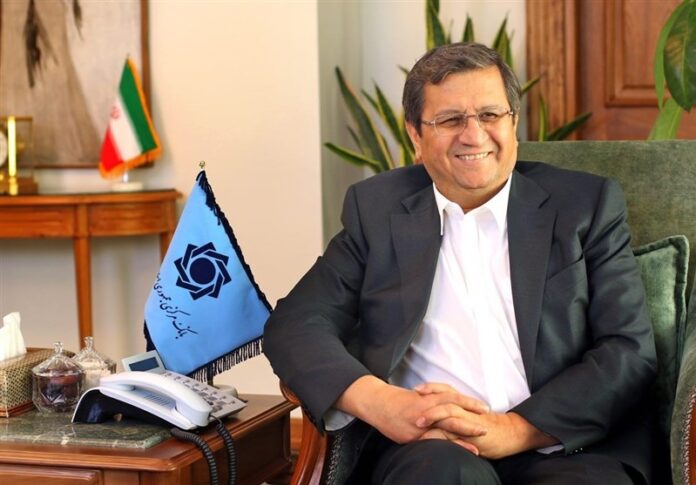
Enemies Plotting to Disrupt Iran’s Forex Market, Chief Banker Warns

Speaking to reporters on Sunday, Hemmati said the previous Iranian year (which ended on March 20) was an “exceptional year” in terms of economic pressures on the people by causing exchange rate fluctuations.

“Of course, the enemies’ goals were much more than (creating) economic problems but we did not allow them to reach their goals,” he added.

The CBI governor further said the enemies also have secret plots to disrupt the foreign exchange market in the beginning of this year, adding that they should not be allowed to gain their goals.

Back in January, Hemmati explicated the CBI’s plans to neutralize the economic pressures and psychological war waged by the US and its allies with the aim of destabilizing Iran’s foreign exchange market.

The market experienced a sharp rise in the value of foreign currencies and gold coin prices in summer 2018. The Iranian money plunged to a record low against the US dollar in August.

But the Iranian currency, rial, began to bounce back against US dollar later in the year after Hemmati unveiled a new package of regulations on foreign currency trade which lifted a ban on the activity of money exchange markets.

‘Russia Compromising Iran, Syria Interests by Tilting towards Israel’

‘Russia Compromising Iran, Syria Interests by Tilting towards Israel’

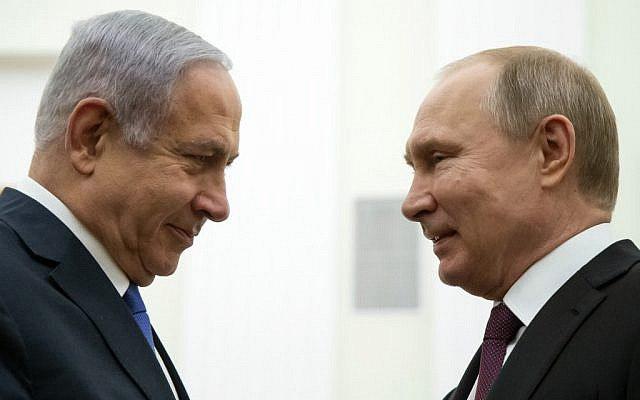
Political commentator Seyyed Hadi Borhani has, in an article, weighed in on Russia-Israel relations. He believes the cordial ties between Moscow and Tel Aviv come at the expense of Iranian and Syrian interests in the region.

He has particularly referred to Putin’s recent move to gift Netanyahu the body of a missing Israeli soldier killed in fighting with Syrian forces in 1982, and described it as a humiliation for Syria.

The full text of the opinion piece published on Khabar Online news website follows.

Only a few days before Israeli elections when campaigning was in full swing, Israeli Prime Minister Benjamin Netanyahu received a warm welcome at the Kremlin before sending back to Israel the body of missing Israeli soldier Zachary Baumel killed in fighting with Syrian forces in Lebanon back in 1982.

The images of Netanyahu standing next to the soldier’s coffin wrapped in the Israeli flag could possibly be the best subject for Bibi’s campaign posters in the last days of the election campaign in Israel. The pictures can portray Netanyahu as an Israeli hero and advocate of people’s interests.

Incontrovertibly, Netanyahu owes this victory to Russian President Vladimir Putin. Russian forces led by Putin transferred the soldier’s body from Syria to Moscow without the permission of Damascus officials, and handed it over to Syria’s arch-foe. In this development, Russia not only overlooked Syria’s sovereignty over its own territory, but also humiliated Syria and its government. This comes at a time when the Israeli occupation of Golan Heights in Syria is the subject of hot debate in international circles and Netanyahu takes pride in having carried out hundreds of illegal military attacks on Syrian soil. The latest such attacks occurred exactly a few days before the transfer of the soldier’s body.

This story clearly states Russia’s different position vis-a-vis Israel and its enemies, and is reminiscent of Moscow’s stance toward both sides of the conflict over the past decades. Moscow – which was long seen as an ally of Arabs and the resistance front by many anti-Israeli forces in the region – has, under the current sensitive juncture, given Israel the worst concessions the last of which was Putin’s gift to Netanyahu, a gift which could facilitate and reinforce Netanyahu’s victory in Israel’s elections. Netanyahu is exactly the same person that has led Israeli troops’ years-long offensives against Syrian soil and left no stone unturned to scuttle the Iran nuclear deal and exert pressure on Iran.

Netanyahu has probably broken the record with regards to the number of meetings with Putin. Netanyahu’s numerous trips to Moscow, the warm welcomes extended to him at the Kremlin and the many concessions given to him by Russia show the two sides have stepped into a special domain of friendship, so much so that the interests of Russia’s closest allies such and Iran and Syria are easily compromised in this friendship and dealings associated with it.

From the standpoint of realistic politics [which rule international relations], the stance adopted by Putin might seem justifiable. Putin is responsible for protecting Russia and its interests, and, to that end, would adopt whatever measure he deems fit, and Iran or Syria cannot expect Russia to design and plan its foreign policy in accordance with their interests. Having said that, one should bear in mind that Russia is not a reliable partner in fighting Israel’s expansionism and violations of law in the region despite some anti-Israeli positions it has adopted. Russia would like to have in its basket the eggs of regional nations’ struggles against Israel, so that it would be able to use that card in its major dealings with the West and Israel. Under such circumstances, one should not be surprised if these eggs are seen in Israel’s basket one day – eggs which have been gained through the resistance, sacrifice and struggles of the regional nations. Those at the Kremlin are an old hand at this!

US Blocking Humanitarian Aid to Flood-Hit Iranians: DM

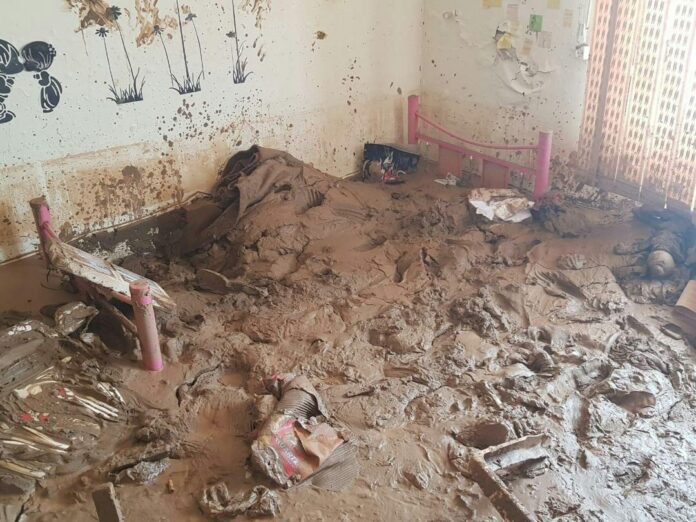
Flood-Hit Iranians in Pole Dokhtar

General Hatami said on Sunday the ban shows that Washington has problems not only with the Islamic Republic’s Establishment but also with the Iranian people.

“Despite their huge media campaign, the American officials impede the flow of even the most basic goods to Iran to save the lives of flood-hit Iranians,” he was quoted as saying in a report by Fars news agency.

The Iranian minister went on to say that despite the West’s earlier estimations that the latest floods in Iran would leave a huge amount of casualties, the Iranian government and nation, through sympathy and with their strong will, managed to significantly control the natural devastations.

Elsewhere in his remarks, he praised the defence achievements of Iran over the last Persian year and said the progresses were made despite the sanctions and restrictions.

The general also said the US failed in its project to isolate Iran, and the Islamic Republic managed to establish successful diplomacy in the world and make massive defence cooperation with other countries.

Iran has made major breakthroughs in its defence area over the past years by producing important military equipment and systems.

Meanwhile, the country has conducted major military drills to enhance the defence capabilities of its armed forces. Iran has repeatedly maintained that its military power poses no threat to other countries and is mainly based on deterrence.