Sunday, December 28, 2025
Home Blog Page 3284

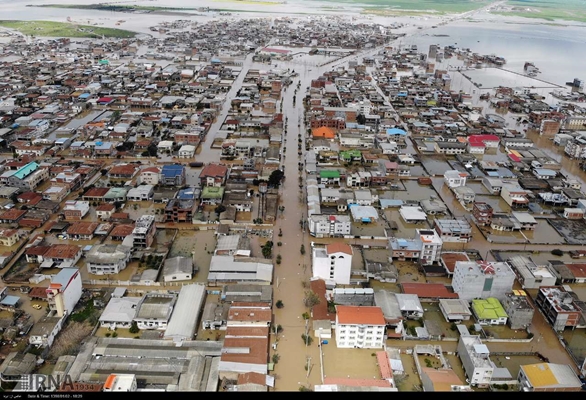
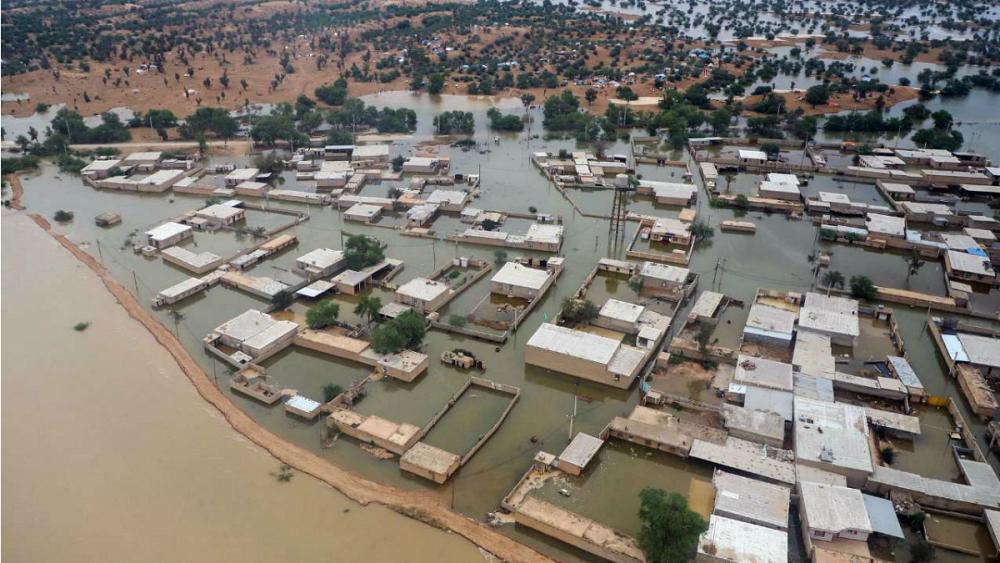
Why Iran Floods Inflicted Such Heavy Casualties, Damages

Evacuation orders have been issued to residents in many towns and cities in southern Iranian Khuzestan and Lorestan provinces, and there is the possibility of every eventuality. Considerable damage has been inflicted to flood-stricken areas, and over 70 of our compatriots have lost their lives in the natural disaster.

Still, the most obvious point with regards to the management of flood affairs was the confusion and bewilderment of authorities and a lack of coordination among different institutions. Indubitably, if the necessary measures to tackle possible floods had been adopted before the disaster hit, the extent of the damage and casualties would have decreased greatly.

To discuss and analyze the reasons and consequences of the recent floods which hit much of Iran, the Arman daily has had an interview with Professor Parviz Kordavani, a prominent Iranian geographer and environmental expert.

Experts from the interview summarized by the IFP follow.

There is much speculation that Iran has slipped into the rainfall period with the recent floods. Do you confirm this?

No. Such a thing has not happened and Iran has not entered the rainfall period. We are facing global warming nowadays, and this phenomenon has had several consequences. Global warming has increased rainfall in areas which receive rain. On the other hand, the amount of rainfall has dropped in areas with little rain. That is why there has not been much rainfall in Iran over the past 15 years, and there will not be much rain in the future, either.

Global warming has resulted in erratic rainfall in different parts of the earth. This erratic rainfall has, for example, resulted in locations like Iran getting as much rain in one day as other locations would get in a year. Moreover, there is no snow left as it has all melted as a result of global warming.

Some media had quoted me as saying that Iran has entered the rainy period. I don’t believe in such a thing at all. The recent rains in Iran have been temporary, and it is not a permanent phenomenon.

Why did the recent rain in Iran immediately become so destructive?

The precipitation could have been more of a blessing to us. However, they became destructive because there was no good management in that regard. Officials should have taken into account the fact that with the earth growing warmer, rainfalls would become erratic and might do more harm than good. The rainfall could have replenished subterranean water resources, whose levels have dropped by up to 400 metres in some parts of the country like Jahrom, and could have boosted farming.

Before the recent rainfall, farming was improving in different parts of the country, and provinces such as Khuzestan were in a good state with regards to agricultural activities. Still, because there was no good management, the recent rain and releasing water from dams have negatively affected agriculture in the province. The most important consequence of the recent rainfall was that it decreased the lifetime of dams in the country and put dams in serious danger.

Why has the lifetime of dams decreased?

The situation unfolded in such a way that if such rainfall occur in the future again, authorities will have to open dam discharge gates, which will both reduce the lifetime of dams and endanger areas near rivers. More importantly, the recent flash floods have carried with them mud and soil into dams. Undoubtedly, the existence of soil in dams will considerably reduce the lifetime of dams.

Unfortunately, authorities did not have an acceptable performance with regards to the management and construction of dams.
Why Iran Floods Inflicted Such Heavy Casualties, DamagesWhat consequences will the existence of mud in dams have?

The existence of mud in dams will not allow water to keep flowing easily in the reservoir behind the dam. Hence, when flooding occurs, officials say that dams are on the verge of collapse. Under such circumstances, they decide to open the upper discharge gates of dams, which would harm areas down the rivers. Some individuals, without giving any scientific evidence, regard dam building as harmful. Nevertheless, if dams are constructed on the path of floods, it will considerably decrease the extent of destruction.

Many pools and wells should be dug on the potential paths of floods, so that water will be absorbed into the ground at times of rain and the intensity of floods will decrease. Rain is a God-given blessing and should be used properly. Today when they open the discharge gates, all the water flows into the sea. The proper method is to manage the water just before it is going to flow onto agricultural fields by spreading it evenly all over the fields, so that it will both improve farming in the area and replenish underground water resources. The move will help rejuvenate nature in the future as well. However, the situation has forced officials to put all these things aside and only care for people’s lives.

Under the current circumstances when many people in flood-hit areas have lost their homes, what should be done to prevent this from happening again?

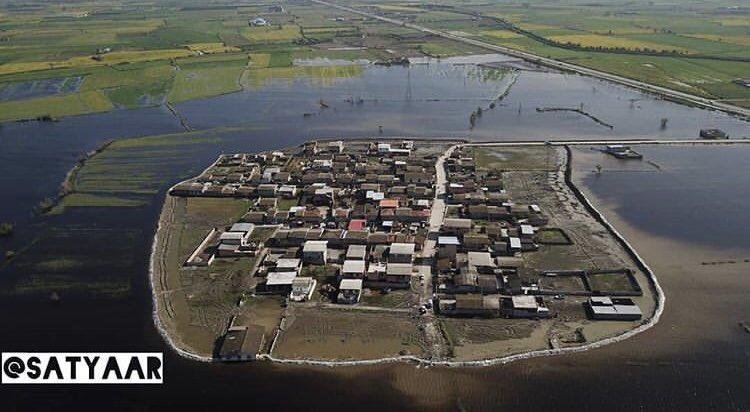
The Aq-Qala region in northern Golestan province is located at the far end of a plain and, hence, is the lowest point of the plain. So, even a small amount of rain could trigger floods there. The mistake made by authorities is that they dredge that area, not knowing that rain would bring mud into the area again. What people did was more appropriate. They set up fences on both sides of the river using bricks and rocks, managing to harness water to a great extent.

The dangerous thing is that officials say they are going to rebuild people’s homes. This is a big mistake and should not happen.

In the current situation, people should not enter their homes which have become wet all through as a result of flooding as roofs are apt to collapse any moment. The presence of mud also increases the odds of the ground caving in in flood-hit areas. So, construction of homes on such land is a mistake.
Why Iran Floods Inflicted Such Heavy Casualties, DamagesIn this situation, what should be done instead if flood-stricken people’s homes are not reconstructed?

The houses should be built in the air. In many foreign countries, multi-floor buildings are built on a structure similar to a large stool, so that floods would run from under the buildings and homes would sustain no damage. This action should be taken in areas in Iran where there is a chance of floods striking again. Another way is to make the foundation of buildings with cobblestone rather than cement and stone. If this happens, water would no longer make the walls of homes wet.

Orders have been issued for the evacuation of many towns, cities and village exposed to possible flooding. Can such evacuations be a logical solution to settle the current flooding crisis?

Those who are issuing evacuation orders today should not have allowed people to build homes in such areas in the first place. They should have taken all possibilities into consideration.

I, for one, am warning against the condition of dams in the country. If the current situation remains the same, and if every rainfall puts dams in danger of collapse forcing authorities to open discharge gates, most dams in the country will be destroyed over the next forty or fifty years. So, I’m raising the alarms. The recent flooding in the country does not mean Iran has entered the rainy period. Many a region that has increased its crops in spring, but suffered water shortage for irrigation in summer.

‘Trump Needs to Order Coffins, Diapers for US Forces in Western Asia’

In an op-ed published by Kayhan newspaper, Mohammad Sarrafi writes that the US decision about the IRGC is more like a hasty move deeply rooted in the US outrage and desperateness in the region.

American officials believe that every armed entity that resists the US’ bullying policies in the region, instead of kneeling down and bowing to them, is a terrorist entity, the article said, referring to Lebanon’s Hezbollah Movement, Palestinian resistance group of Hamas, Yemen’s Ansarullah, Iraq’s Popular Mobilization Units and Iran’s IRGC as examples of such entities.

“They have already received lots of slaps in the face by the IRGC. The American officials had lots of bizarre dreams for the Middle East. They had a special plan to create a new Middle East. The new region was born but not in the shape they wanted. The new Middle East has been created in a new format with a new nature completely against the plan they had in mind: The new region is based on a main pillar: Resistance,” it added.

US Secretary of State Mike Pompeo said Washington has a direct message for the Commander of the IRGC Quds Force, Major General Qassem Soleimani, adding, “America is determined each time we find an organization, institution or an individual that has taken the lives of individuals, it is our responsibility to reduce that risk.”

The main question, the op-ed said, is that which measure the US is determined to adopt and why the US top diplomat singled out the Iranian top commander, Major General Soleimani in his speech?

According to Sarrafi, the answer to the mentioned questions should be found in the remarks by the retired US General Stanley A. McChrystal, who led the US special operations in Iraq from 2003 to 2008, about Major General Soleimani.

In an article in Foreign Policy last year, the general put his focus on Soleimani saying, “His brilliance, effectiveness, and commitment to his country have been revered by his allies and denounced by his critics in equal measure. What all seem to agree on, however, is that the humble leader’s steady hand has helped guide Iranian foreign policy for decades—and there is no denying his successes on the battlefield.”

“Soleimani is arguably the most powerful and unconstrained actor in the Middle East today. US defence officials have reported that Soleimani is running the Syrian civil war (via Iran’s local proxies) all on his own…. His brilliance, effectiveness, and commitment to his country have been revered by his allies and denounced by his critics in equal measure. What all seem to agree on, however, is that the humble leader’s steady hand has helped guide Iranian foreign policy for decades – and there is no denying his successes on the battlefield. Soleimani is arguably the most powerful and unconstrained actor in the Middle East today. U.S. defense officials have reported that Soleimani is running the Syrian civil war (via Iran’s local proxies) all on his own,” McChrystal said.

Now, Kayhan says: where is the man who has disturbed the American officials’ dreams?

The answer is that he along with tens of other top commanders of Iran’s army and the IRGC have rushed to the flood-hit areas of Iran to contribute to collective efforts to cope with the floods which have hit the country over the past weeks.

According to the newspaper, the White House’s stupid decision has another side: The costs which will be inflicted on the US and particularly on its military forces in the region.

“As Iranian officials have rightly declared, designating American forces deployed in the Middle East as terrorist forces is the logical response of the Islamic Republic of Iran to the US’ nasty decision.”

In response to Washington’s decision to put Iran’s Islamic Revolution Guards Corps on the terrorist list, the Supreme National Security Council (SNSC) of Iran declared the US a “state sponsor of terrorism” while calling the US CENTCOM a terrorist group as well.

But, the move by the SNSC doesn’t relieve the burden of the parliament’s responsibility to immediately enlist the US army and its affiliated groups and firms like Blackwater as terrorist entities, the op-ed said.

According to Sarrafi, the parliament’s move will have severe repercussions for the US army. “Trump has practically endangered the lives of American forces in the region,” he added.

Sarrafi said it seems Trump has apparently forgotten that just some months ago, in what a humiliating situation he visited Iraq.

“The American officials sit idly in the White House, signing stupid documents which endanger the lives of thousands of poor forces in the region. Within the next week, the US Congress is set to declare its stance towards Trump’s decision. If the Congress approves the stupid decision, Trump needs to order thousands of diapers and coffins for American forces stationed in Western Asia,” the op-ed concluded.

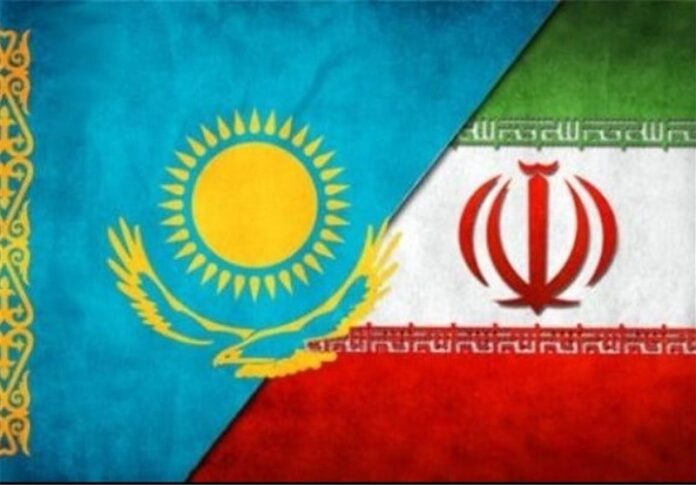
Iran, Kazakhstan Resolved to Expand Bilateral Ties

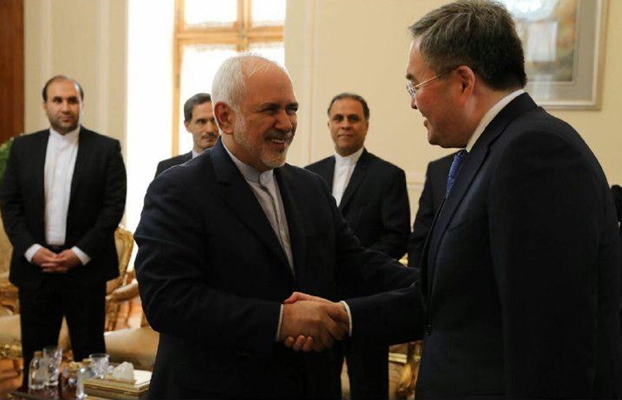
During the meeting, Iran’s top diplomat described Kazakhstan as a good friend of the Islamic Republic and said Iran attaches significance to its ties with Kazakhstan.

For his part, the Kazakh official expressed delight in his visit to Iran and said he held good talks with Iranian officials.

“In Kazakhstan’s multilateral politics, Iran has always been deemed as an important country and we are after expansion of our ties with the country,” he said.

During the meeting, the two sides also discussed mutual, regional, international issues, the legal regime of the Caspian Sea, creation of a joint economic and transit commission and expansion of consular cooperation.

They also exchanged views on the US’ illegal sanctions on Iran, dangerous aspects of the US’ recent move to designate Iran’s Islamic Revolution Guards Corps (IRGC) as a terrorist organization, building joint transportation corridors, the upcoming Conference on Interaction and Confidence-Building Measures in Asia (CICA) in Tajikistan, and Kazakhstan’s support for the Iran nuclear deal.

Tileuberdi is on an official visit to Iran to take part in the 16th round of political consolation between Iran and Kazakhstan.

World Condemns US for Designating IRGC as Terror Group

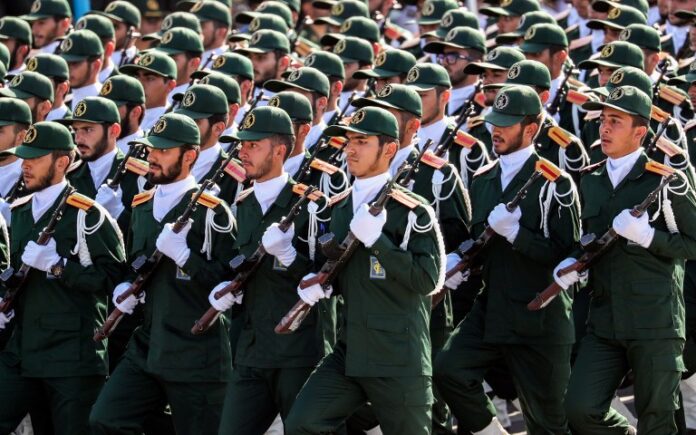
Islamic Revolution Guards Corps (IRGC)/ AFP PHOTO

Turkish Foreign Minister said the move will pave the way for instability in the region. Mevlut Cavusoglu, speaking alongside his Qatari counterpart in a joint press conference, added the measure was a step outside international law.

Doha’s top diplomat Mohammed al-Thani also denounced the US blacklisting of the Iranian military force, saying that disagreement with another country’s army should not be settled through sanctions.

Meanwhile, Chinese Foreign Ministry spokesman said Beijing is opposed to power politics and bullying.

Baghdad warned the US that its actions will have negative repercussions for Iraq and the region. Iraqi Prime Minister Abdul-Mahdi said that his country will maintain friendly ties with both parties to prevent tensions in the region.

The Iraqi Premier said that Baghdad has already told the American commander in the country that Iraq would not accept being used for any acts of aggression against other states.

The US move has also been condemned by Iraq’s Popular Mobilization Forces and political factions.

Jafar al-Hosseini, a spokesman for the Iraqi Hezbollah, said hours after the blacklisting of the Islamic Revolution Guards Corps that the Iraqi resistance will be next to the IRGC. He stated that “the Iraqi resistance will be next to the Revolution Guards to counteract any destructive developments in the region.”

The Iraqi Hezbollah military spokesman emphasised that “the IRGC is next to the nations of the region in their struggle against US scenarios.”

Following the recent US hostile act, the Popular Front for the Liberation of Palestine stressed that the US move would put the occupiers under fire and this action cannot save the mercenary regimes from the collapse.

The Palestinian Islamic Jihad condemned the blacklisting of the IRGC saying in a statement that the US is one of the main sponsors of terrorism, and its policies threaten peace in the world. The movement insisted that the US support for the Zionist terrorist crimes against the Palestinian people is an evidence of its crimes against humanity.

China’s Xinhua News Agency said in a statement that Trump’s decision to place a military on the terror list will worsen the situation in the region. “Many believe that the move by the US government will complicate the situation in the Middle East,” reads the statement.

Furthermore, Damascus strongly condemned the hostile decision of the US government against the Islamic Revolution Guards Corps and described it as an obvious violation of the sovereignty of the Islamic Republic of Iran.

An official source at the Syrian Foreign Ministry stated that the US government’s irresponsible act is in line with Washington’s covert anti-Iran war to serve Israelis.

The US action proves that it has admitted the important role of the IRGC in defending the sovereignty of the Islamic Republic of Iran and its important role in the resistance, the source added.

The UK and Japan also announced that they will not follow the United States in labeling Iran’s Islamic Revolution Guards Corps a terrorist organization.

Japanese Foreign Minister Taro Kono says Tokyo has maintained a close relationship with Iran, and that, it will continue working to solve problems through dialogue. Japan is the latest country joining a chorus of condemnation against the US move.

However, Bahraini Foreign Ministry welcomed the US decision to blacklist the IRGC.

Israeli Prime Minister Benjamin Netanyahu also welcomed the decision of the President of the United States and took it as a gift to get more votes from settlers. The Israeli prime minister, in a tweet, thanked Donald Trump and described him as a “dear friend.”

“Thank you, my dear friend, President Donald Trump,” Netanyahu tweeted in Hebrew, “for answering another one of my important requests.”

Experts say Netanyahu’s choice of words seemed to imply that Trump’s earlier decision to recognise Israeli sovereignty over the Golan Heights was also a gift given at the request of the embattled Israeli prime minister.

Senior Pentagon and CIA officials opposed Trump’s decision to impose sanctions on the military unit and affiliated companies and individuals, arguing that it would allow Iranian officials to justify deadly operations against Americans overseas.

Trita Parsi, founder of the National Iranian American Council, offered this as proof that Netanyahu now seems to have more sway over the president’s decisions than his own military and intelligence officials.

IRGC Vows to Give Unforgettable Lessons to Enemy

In a statement on Wednesday, the IRGC said it will utilize powerful tit-for-tat approaches against the enemy and defend Iran’s Islamic Revolution under the supervision of the Leader Ayatollah Seyyed Ali Khamenei. The IRGC said Washington’s move shows the foolish policies of the US and its allies in the region.

The statement also said that the United States designated the IRGC as a terrorist group following Washington’s defeat in the Middle East.

It reiterated that the decision will accelerate the country’s defensive and offensive capabilities and also its increasing regional power.

The statement added that the US move indicates the depth of their grudge and anger toward this revolutionary and popular organisation.

The IRGC also expressed gratitude to the Iranian nation, officials and armed forces for giving their all-out support to the military forces following the Trump administration’s decision.

IRGC Seizes Oil Tanker Smuggling Biggest Haul of Fuel at Hormuz Strait

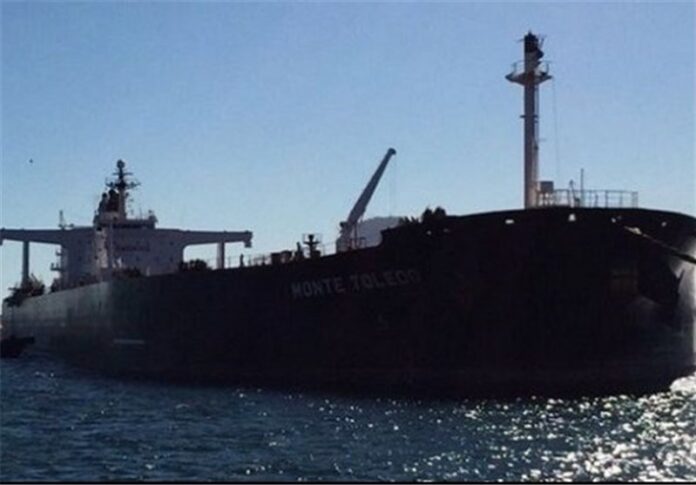
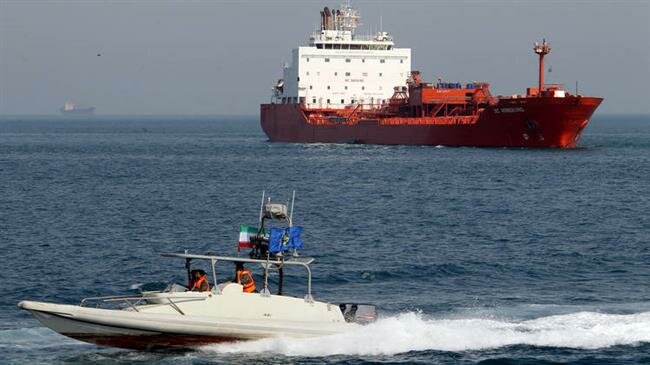
IRGC Navy Commander Rear Admiral Ali Reza Tangsiri said on Wednesday that his forces have seized a 131-meter-long oil tanker at the Strait of Hormuz that was smuggling more than 12.5 million liters of fuel out of the country.

He said it was the biggest ever haul of smuggled fuel confiscated in the Persian Gulf and the Strait of Hormuz.

The operation, which followed a series of intelligence activities, led to the detection of one of the leading networks involved in smuggling fuel in the Persian Gulf and dealt a hard blow to a main ring smuggling fuel in the province of Hormozgan, the commander added.

Rear Admiral Tangsiri said that in the operation, 21 people with different nationalities have been arrested and will face trial.

In comments on the first day of the Iranian year in March 2017, Leader of the Islamic Revolution Ayatollah Seyed Ali Khamenei called for efforts to combat smuggling and contraband goods as part of plans to stimulate domestic production and combat unemployment.

Last year, the IRGC, which has been assigned the task of tackling commodity smuggling in the Persian Gulf, said it will support the administration in the war on smuggling.

US, Observers Surprised by Increase in Iran’s Oil Exports

Iran exported 1.70 million barrels per day (bpd) of oil in March, the highest since October when shipments fell to 1.08 million bpd, data from shipping sources compiled by S&P Global Platts showed.

According to the energy and commodities information provider, Iran’s exports volumes have recovered by 60% since November, “surprising many on the market.”

That is because November was the month when US President Donald Trump’s most extensive sanctions ever went into effect against Iran’s oil industry.

The explanation could be that some key clients of Iranian oil which had either halted or significantly reduced their shipments before November scrambled to pick up more volumes as Trump decided that month to give waivers to eight importers.

Platts also cited data from geospatial analytics startup Ursa, saying Iran’s crude inventories for exports had fallen by 25% since early January. Kharg Island which is the country’s main export terminal had seen a 30% decline in inventories in March, it said.

“With the US granting exemptions to some of Iran’s biggest customers, exports seem to have fared better than anticipated,” Platts quoted Geoffrey Craig, an energy analyst at Ursa, as saying.

Iran’s inventories include floating storage where crude and condensates are held on tankers in the Persian Gulf. The drawdown of floating storage and other inventories means Iran is likely to ramp up production.

The country faces the 180-day US waiver expiring on May 3, with most importers saying they want to continue oil imports from Iran.

On Monday, Secretary of State Mike Pompeo left the world guessing on whether the United States will extend waivers for countries importing oil from Iran.

“We’ll make that decision in due course as we move towards May 2nd,” Pompeo said of the oil waivers.

However, a recent rally in oil prices means there is little room for maneuver for the United States, energy experts say.

US leaders have said Washington’s ultimate aim is to get oil exports from Iran down to zero, but Iranian officials and many international analysts have dismissed it as a bluff.

“We don’t expect Iran oil exports to reach to actual zero. Zero Iran oil export poses a serious threat against the security of oil flow, especially from the Persian Gulf,” said Sara Vakshouri, president of SVB Energy International.

President Hassan Rouhani has said no oil will be exported from the Persian Gulf if the United States decides to block Iran’s oil exports.

On Tuesday, Parliament speaker Ali Larijani stressed that the US was unable to zero out Iran’s oil exports.

“You thought you could bring Iran’s oil sales to zero last year, but you did not succeed,” he said at parliament as he addressed the US over its designation of the Islamic Revolution Guards Corps (IRGC) as a “terrorist organization”.

According to the Wall Street Journal, the US is most likely to extend waivers for South Korea, China, Japan, India and Turkey due to the potential impact on global oil supply from political unrest in Libya.

The oil market is already tightening amid US sanctions on Venezuela and Iran. Renewed fighting in Libya and fears of fresh supply outages are driving prices higher.

Libya is a significant supplier of oil to Europe which has cut imports of Iranian oil to zero, not including Turkey.

Oil prices reached their highest since November above $71 a barrel on Tuesday.

The Trump administration is under pressure after Republican losses in the midterm elections and is extremely wary of any threats to the economy, including higher gas prices.

Iran, Kazakhstan Hold 16th Round of Political Talks in Tehran

During the meeting, Iranian Deputy Foreign Minister for Political Affairs Seyyed Abbas Araqchi and his Kazakh counterpart Mukhtar Tileuberdi exchanged views on the latest developments in bilateral relations in the political and economic spheres.

Regional and international issues, in particular issues related to the Caspian Sea and the relevant convention, as well as the latest developments in Afghanistan and Syria, were also discussed by the parties.

The Kazakh official once again expressed his country’s support for the Iran nuclear deal and underscored the Central Asian state’s interest in expanding bilateral economic cooperation.

Referring to the transit capacities of the Islamic Republic of Iran, Tileuberdi called for accelerated use of this capacity in expansion of commercial and economic ties between the two countries.

In turn, Araqchi touched upon the willingness of the Islamic Republic of Iran to expand relations with Kazakhstan in all fields.

He condemned the unlawful policies of the United States such as its withdrawal from the JCPOA, the relocation of the Israeli capital to Jerusalem al-Quds, the recognition of Zionists’ “sovereignty” over the Golan Heights, and the blacklisting of the Islamic Revolution Guards Corps (IRGC) as a terrorist group, saying that these actions are in contradiction to all international rules and conventions, and the US is responsible for any possible consequences of its policies.

During the talks, the two sides also expressed their readiness to hold a new round of Iran-Kazakhstan Joint Economic Commission and finalise legal and consular agreements between the two countries.

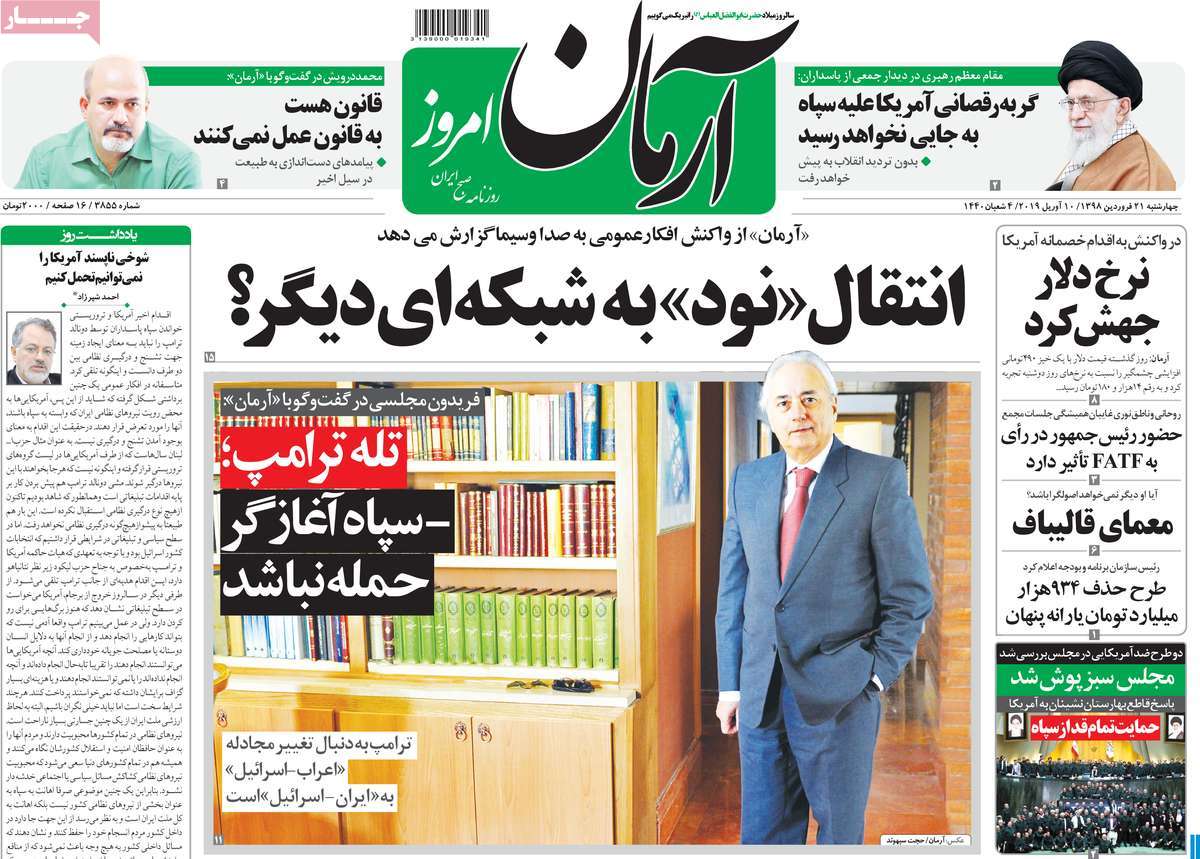
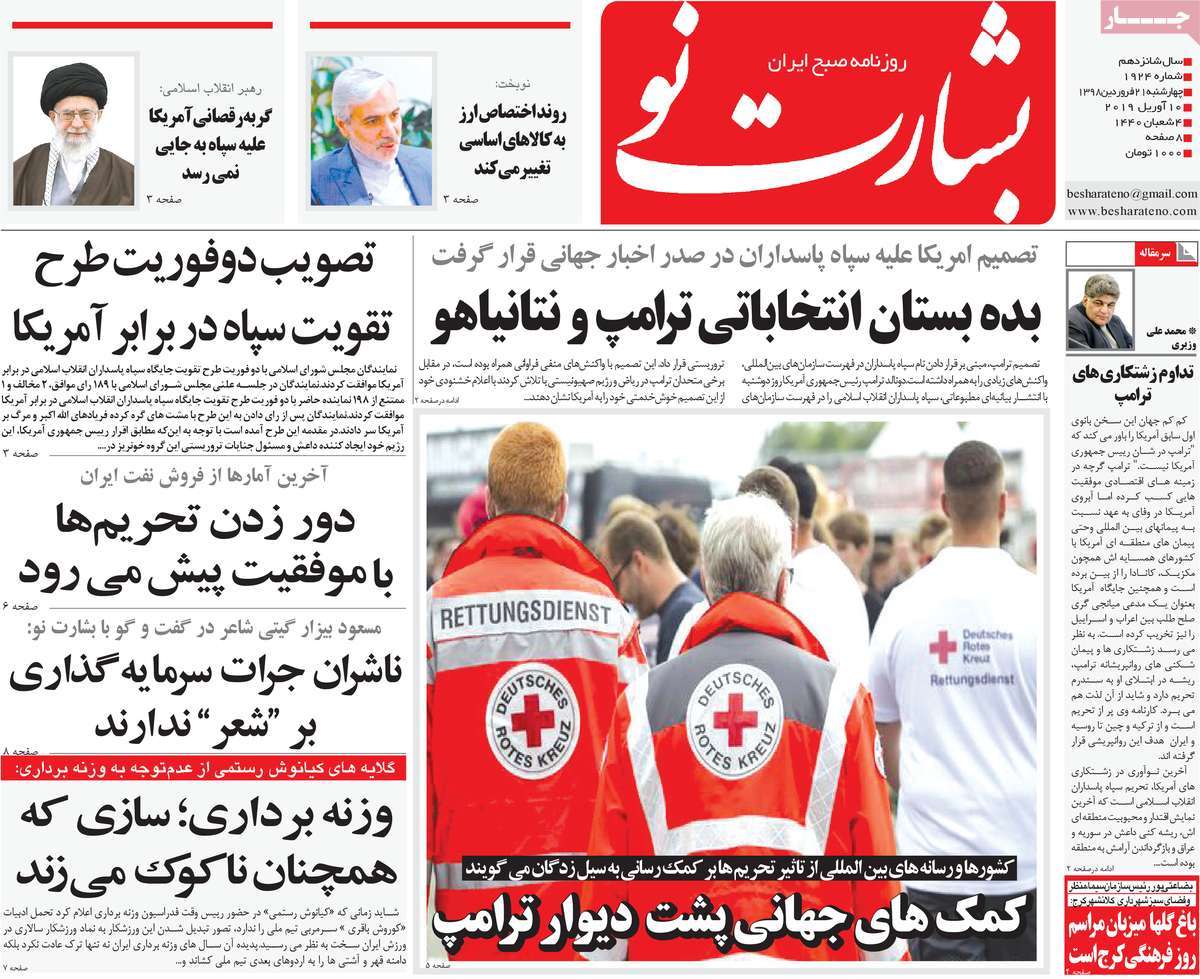
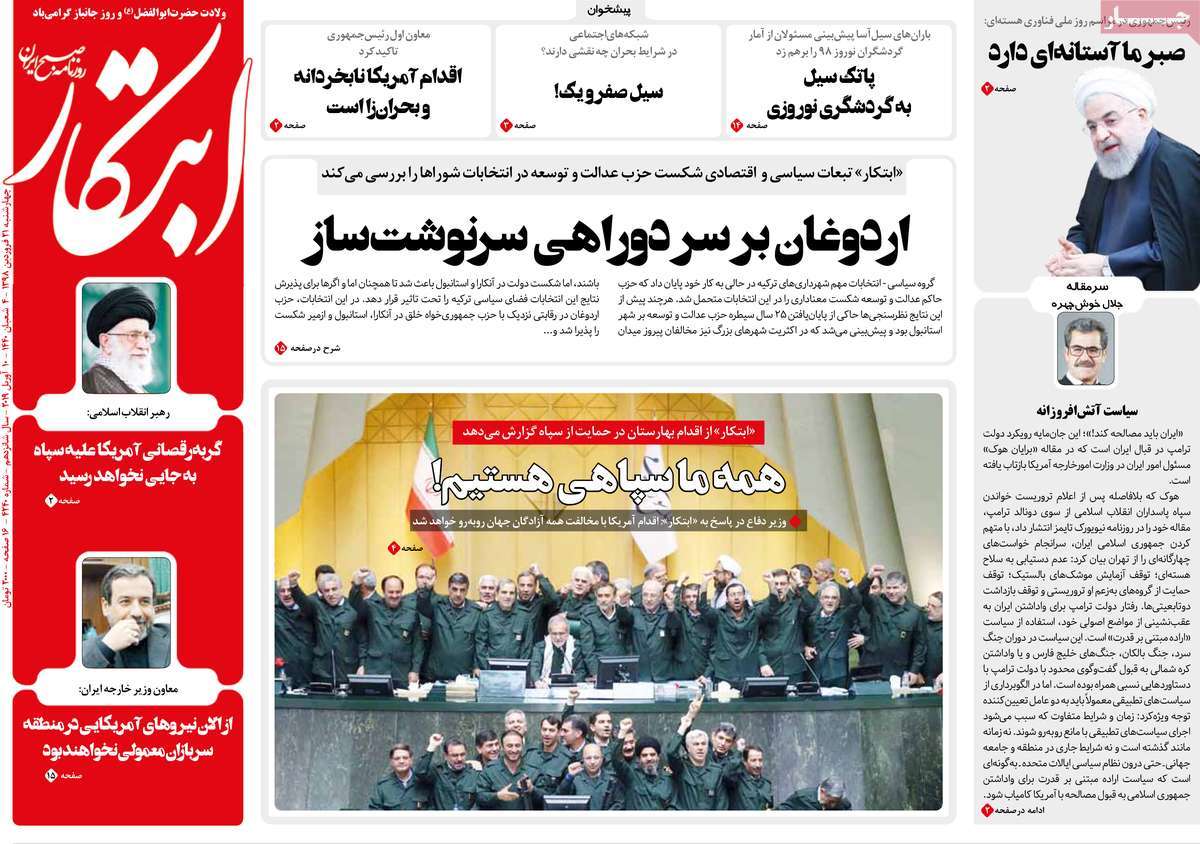
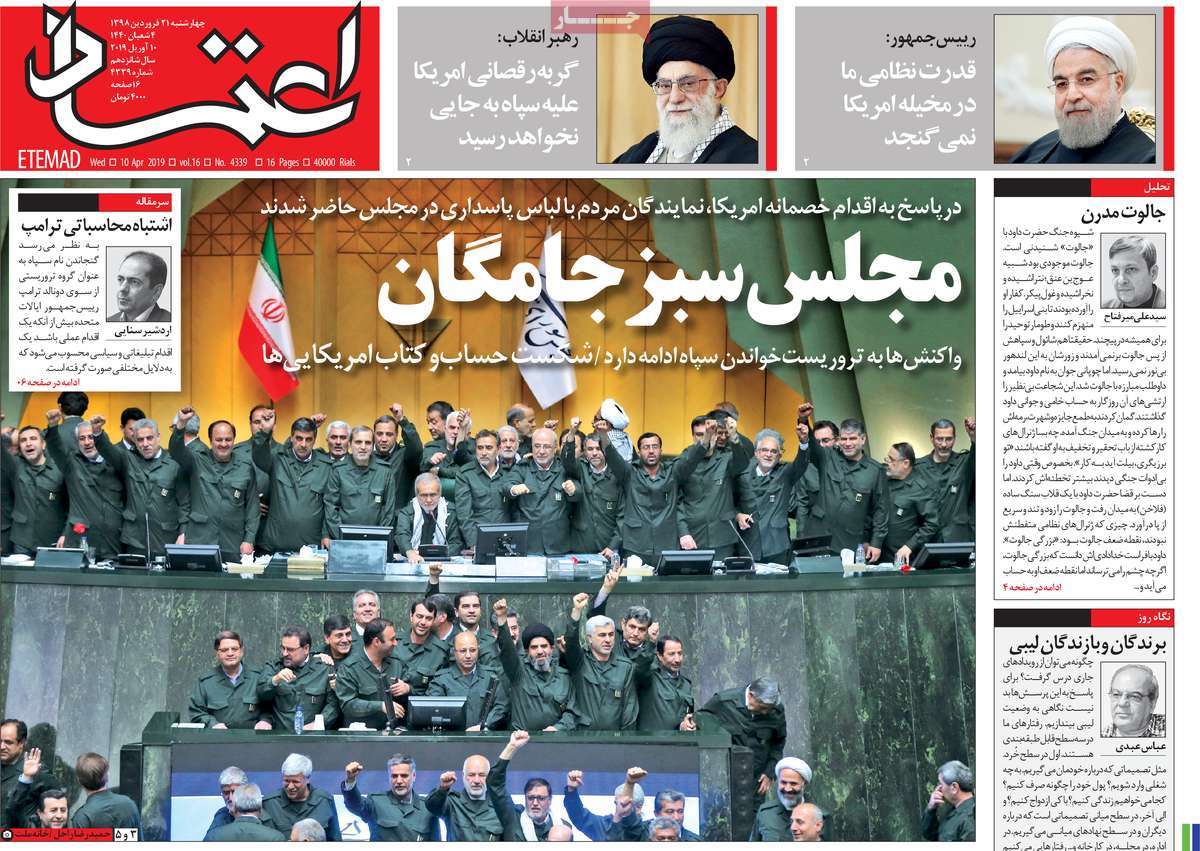
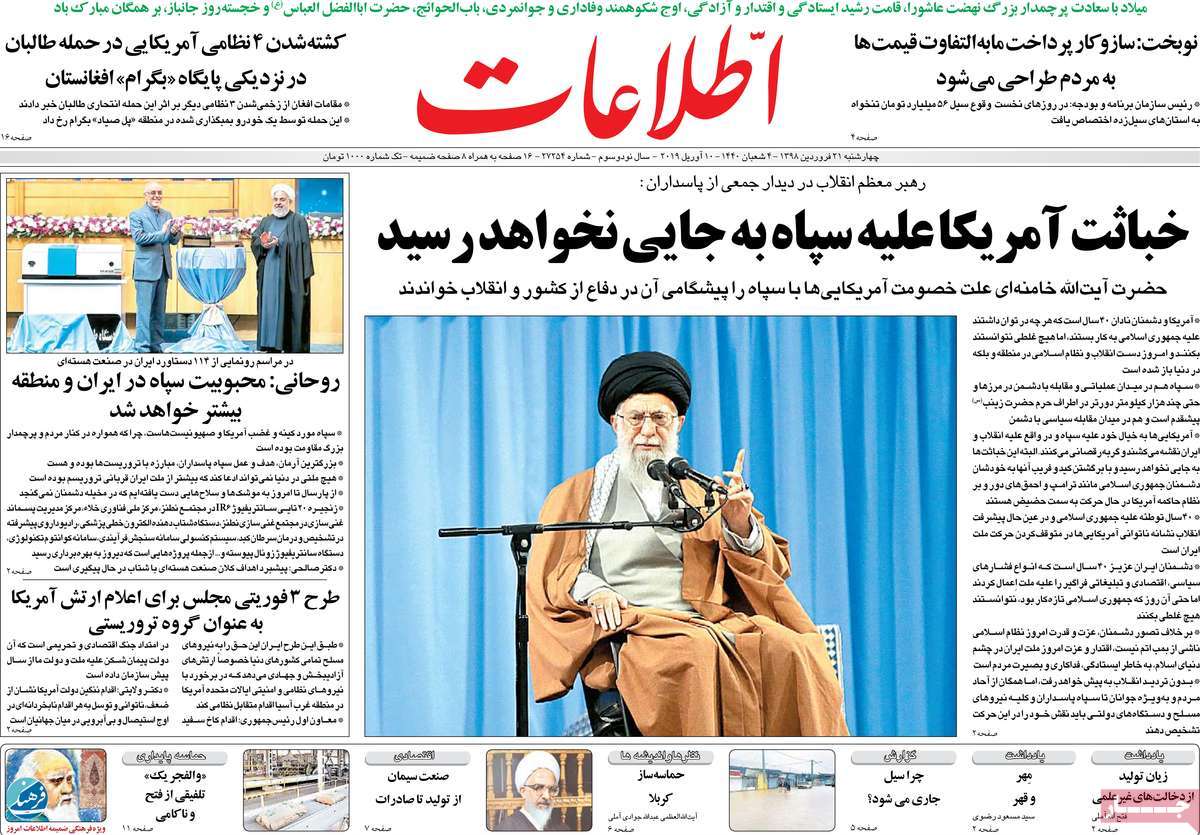
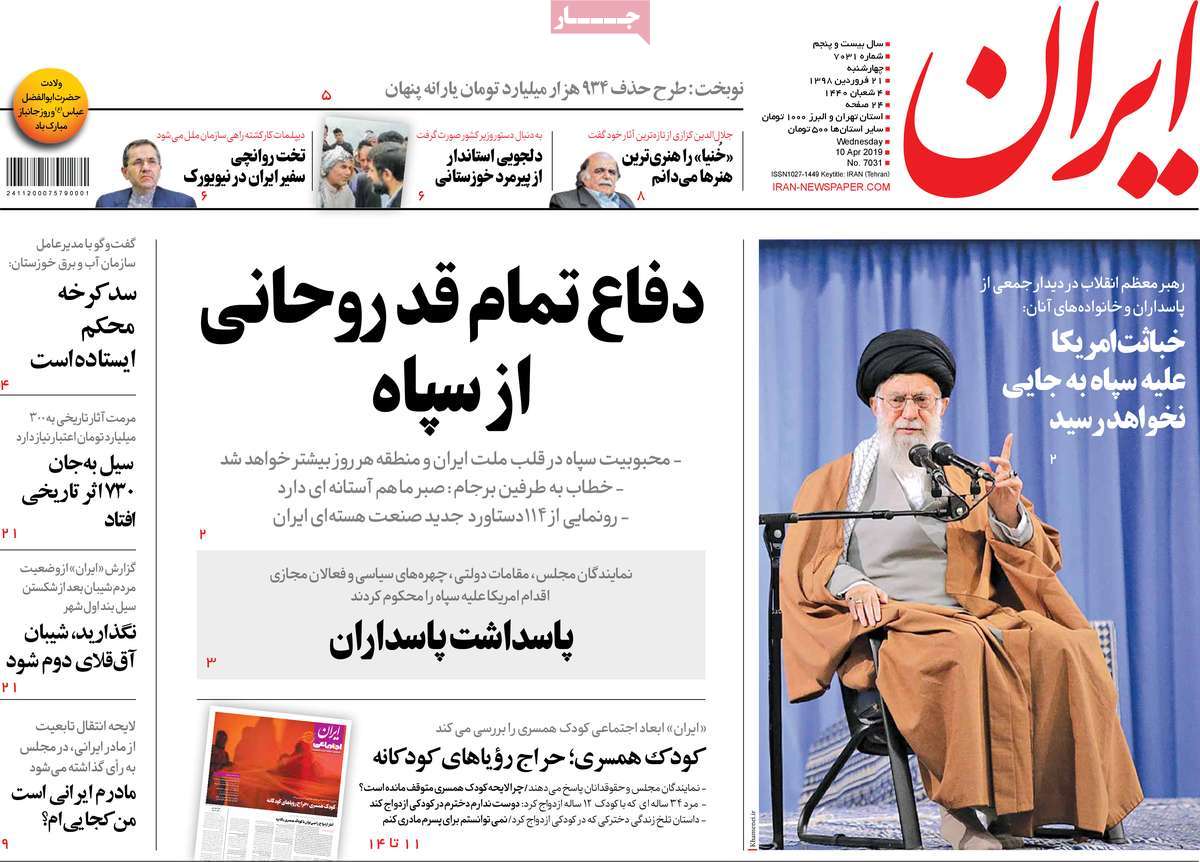
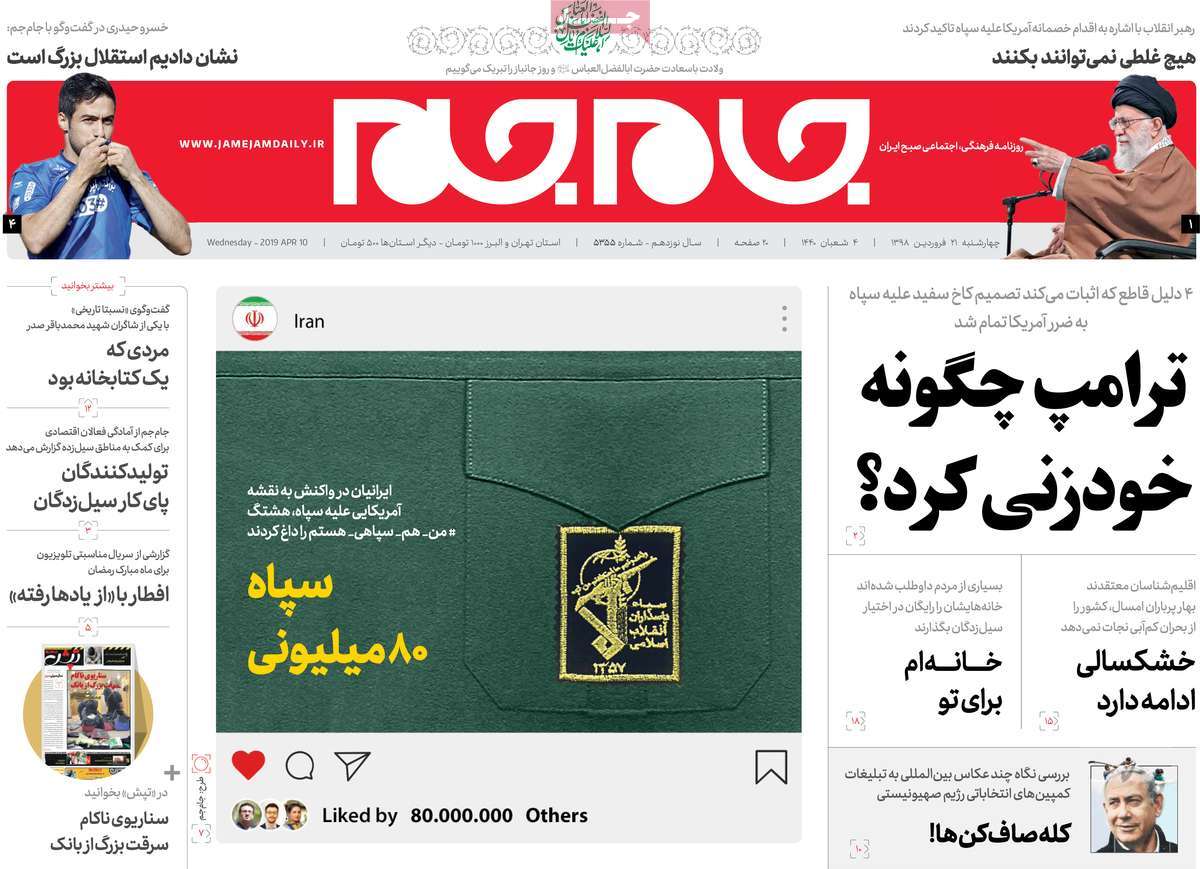
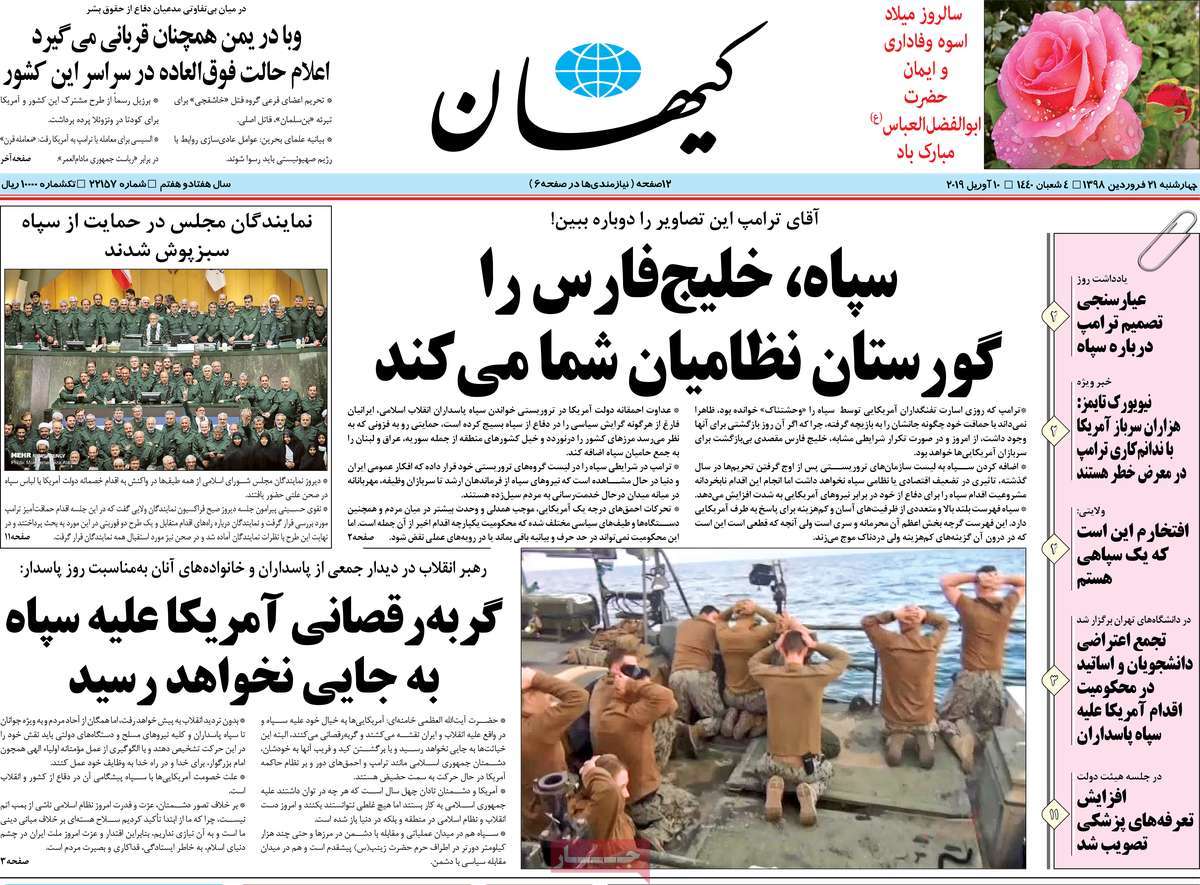
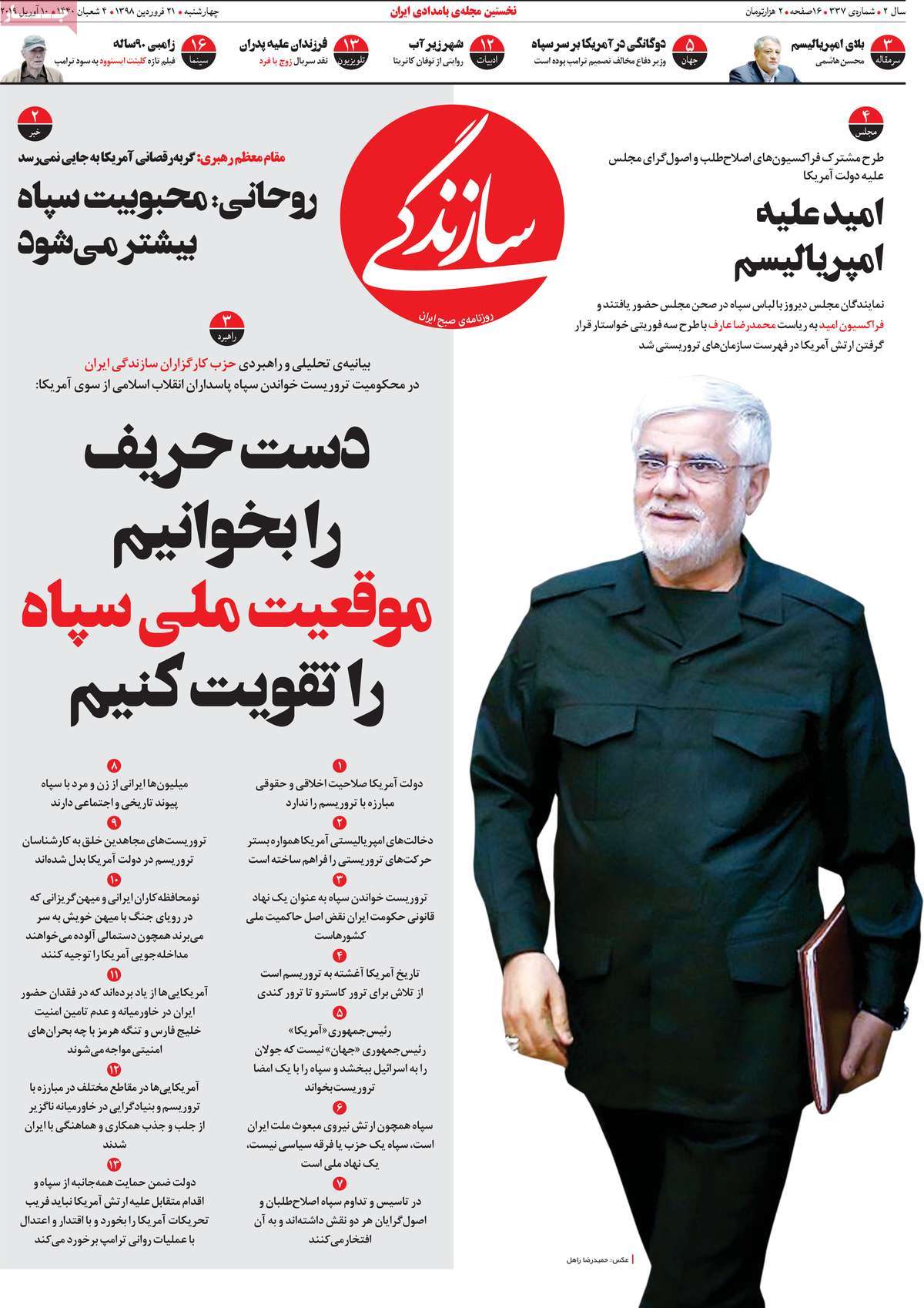
A Look at Iranian Newspaper Front Pages on April 10

A Look at Iranian Newspaper Front Pages on November 19

The US administration’s designation of the Islamic Revolution Guards Corps (IRGC) as a “foreign terrorist organization” and Iran’s reciprocal move to blacklist the US CENTCOM, and consider the US government as a “state sponsor of terrorism” remained the top stories today.

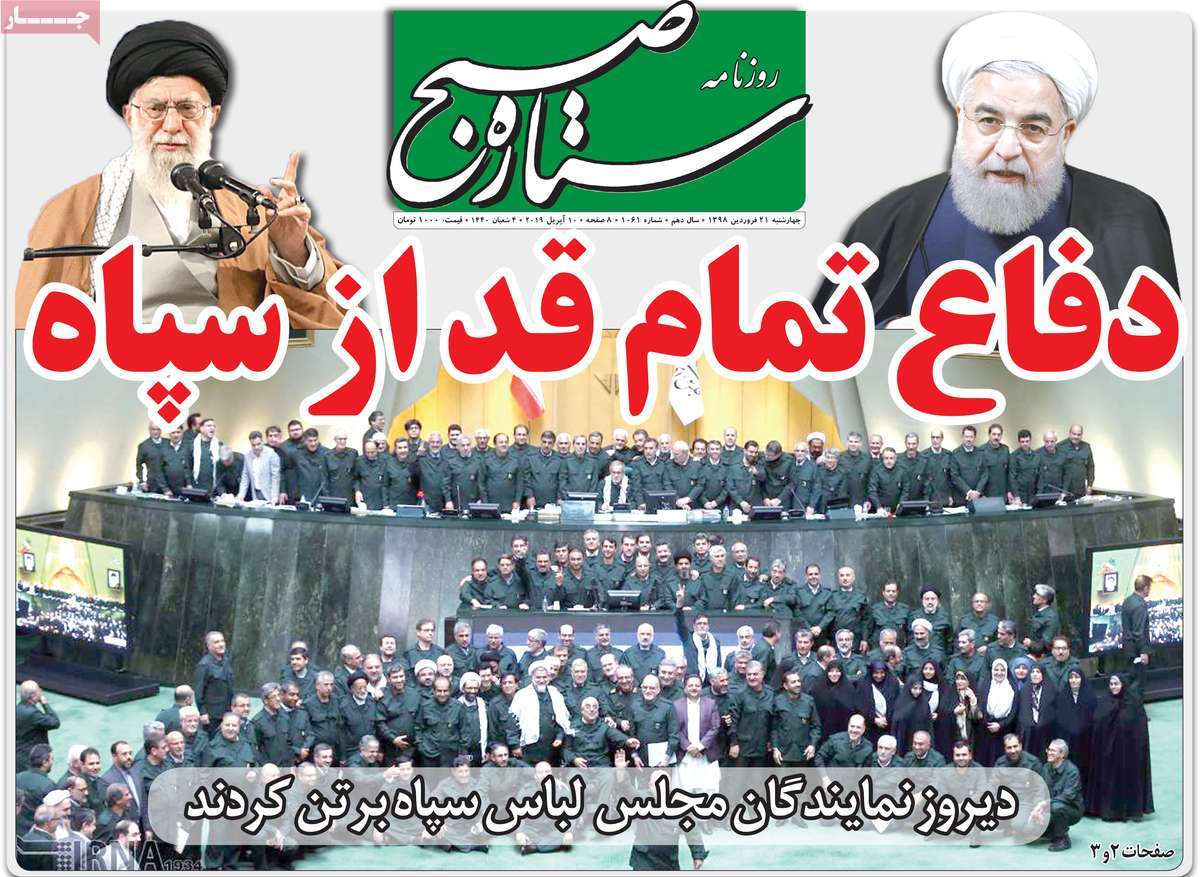
The remarks by the Leader of Iran’s Islamic Revolution Ayatollah Seyyed Ali Khamenei about the US’ move, and the Iranian parliament’s support for IRGC by wearing its uniforms also received great coverage.

The above issues, as well as many more, are highlighted in the following headlines and top stories:


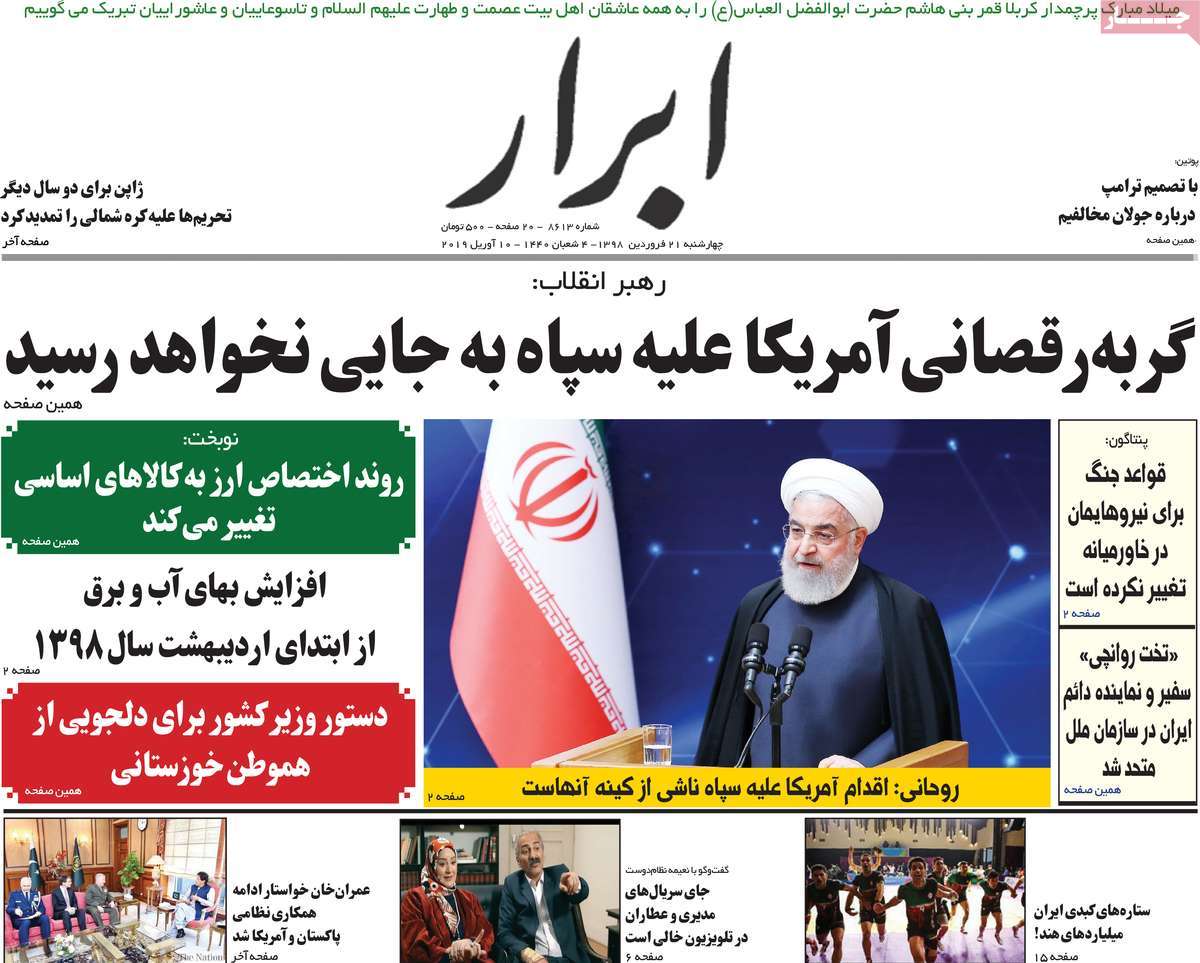
Abrar:

1- Putin: We’re against Trump’s Decision on Golan

2- Japan Extends N. Korea Sanctions for Two More Years

3- Rouhani: US’ Move against IRGC Rooted in Their Grudge

4- Pentagon: Rules of War Not Changed for Our Forces in Mideast

5- Takht-Ravanchi Appointed Iran’s New Ambassador to UN

A Look at Iranian Newspaper Front Pages on April 10


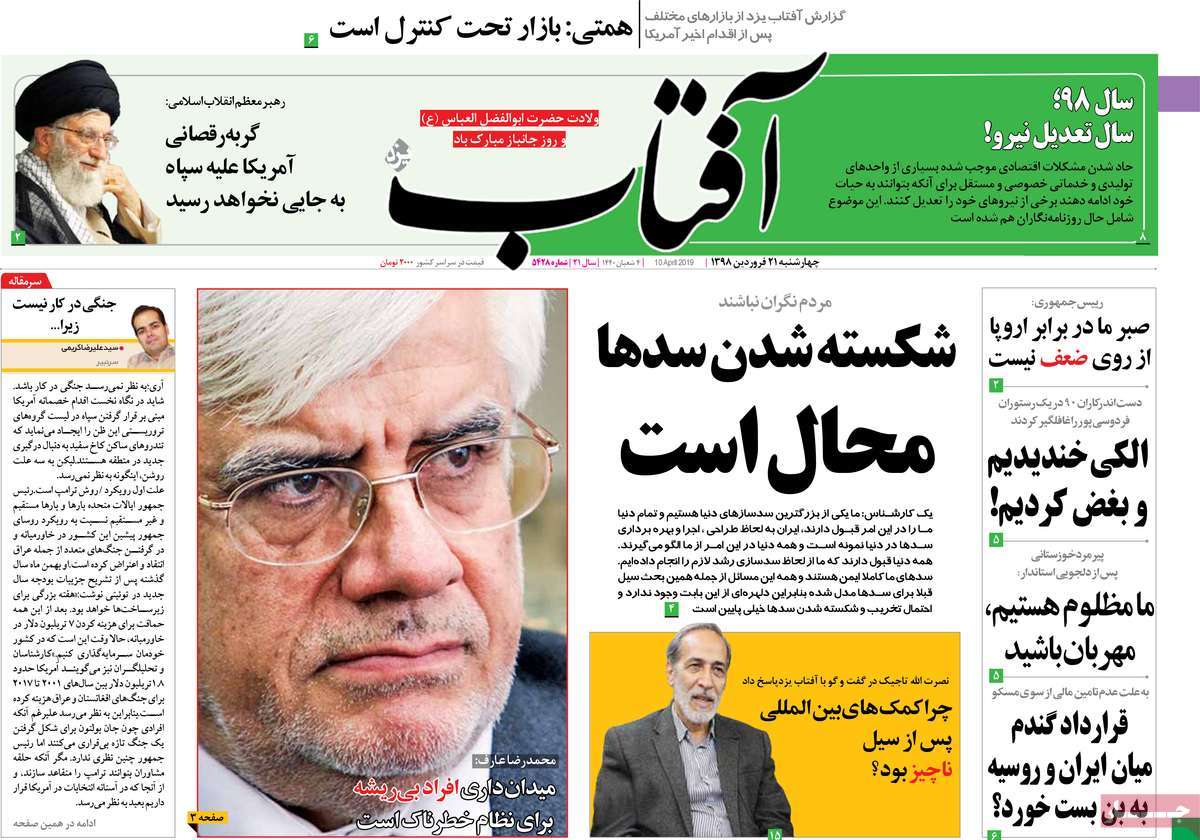
Aftab-e Yazd:

1- Rouhani: Our Patience towards Europe Not Out of Weakness

2- Iran Leader: US’ Move against IRGC Will Get Nowhere

A Look at Iranian Newspaper Front Pages on April 10


Arman-e Emrooz:

1- Trump’s Trap: IRGC Shouldn’t Start Any Attack

2- Trump Seeks to Change Arab-Israel Conflict into Iran-Israel Conflict

A Look at Iranian Newspaper Front Pages on April 10


Besharat-e Now:

1- Trump-Netanyahu Give and Take for Israeli Elections

2- US’ Decision against IRGC Grabs Headlines across the World

3- Iran Successfully Bypassing US Bans: Latest Statistics of Iran’s Oil Sales

A Look at Iranian Newspaper Front Pages on April 10


Ebtekar:

1- Iran’s Patience Not Permanent: Rouhani

2- Erdogan in Decisive Dilemma: A Report on Consequences of AK Parti’s Defeat

3- Official: US Forces in Region Won’t Be Treated as Normal Soldiers Anymore

4- US’ Unwise Move to Create Crisis: Rouhani’s First VP

A Look at Iranian Newspaper Front Pages on April 10


Etemad:

1- Rouhani: US Can’t Even Think of Our Defence Power

2- All Lawmakers in Iran Wear IRGC Uniforms at Parliament

A Look at Iranian Newspaper Front Pages on April 10


Ettela’at:

1- Parliament’s Triple-Urgency Plan to Declare US Army ‘Terrorist Organization’

2- 4 US Troops Killed in Taliban Attack near Bagram Airfield in Afghanistan

3- Iran Leader: US Wicked Move against IRGC Not to Get Anywhere

A Look at Iranian Newspaper Front Pages on April 10


Iran:

1- Iran’s Ambassador to New York: Veteran Diplomat in UN

2- Rouhani Shows All-Out Support for IRGC

* IRGC to Get More Popular in Iran, Mideast Day by Day

3- Iran President Unveils 114 New Nuclear Achievements

A Look at Iranian Newspaper Front Pages on April 10


Jame Jam:

1- How Trump Harmed Himself? 4 Reasons Why US Decision Will Finally Harm US

2- IRGC Has 80 Million Members: Iranians Post Comments with #I’m_IRGC_Member Hashtag

A Look at Iranian Newspaper Front Pages on April 10


Kayhan:

1- IRGC to Turn Persian Gulf into Graveyard of US Soldiers

2- How Much Serious Is Trump about His IRGC Decision?

3- New York Times: Thousands of US Soldiers in Danger after Trump’s Mistake

A Look at Iranian Newspaper Front Pages on April 10


Sazandegi:

1- Division in US over IRGC: Defence Secretary Was against Trump’s Decision

2- Hope against Imperialism: Reformists, Conservatives Working on Bill against US

3- Iran Leader: US Will Get Nowhere with Such Moves

4- Rouhani: IRGC’s Popularity to Grow

A Look at Iranian Newspaper Front Pages on April 10


Setareh Sobh:

1- MPs Wear IRGC Uniform, Express Full Support for It

A Look at Iranian Newspaper Front Pages on April 10


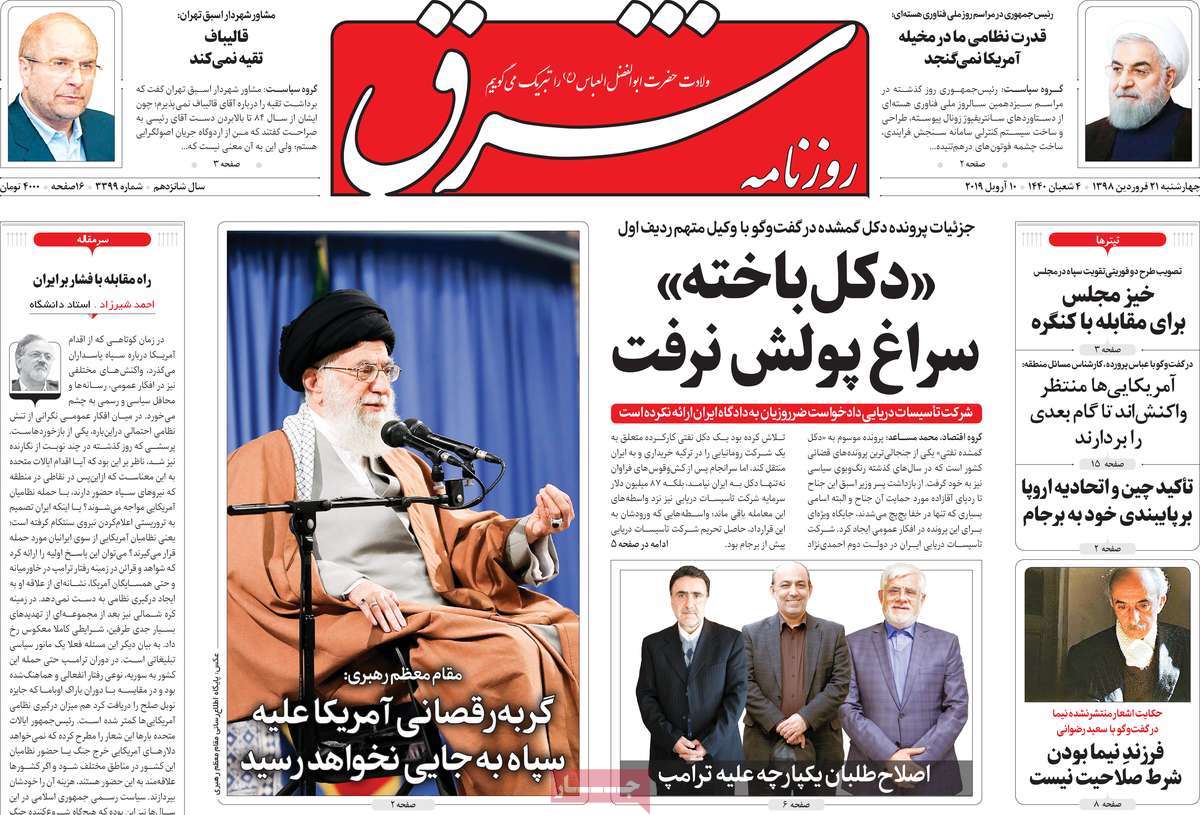
Shargh:

1- China, EU Stress Commitment to JCPOA

2- Iran Parliament to Counter US Congress by Passing Bill on Reinforcing IRGC

A Look at Iranian Newspaper Front Pages on April 10

Iran Condemns Saudi, Bahrain’s Support for Blacklisting IRGC

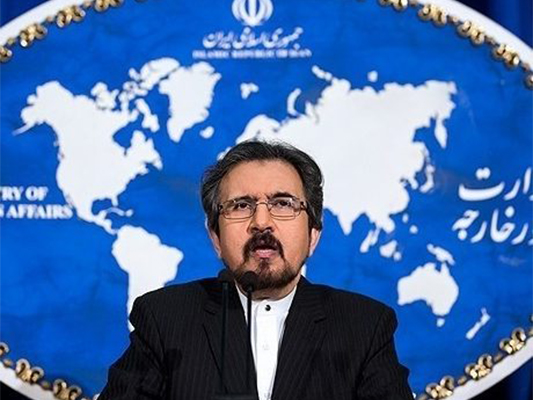
In a Wednesday statement, Foreign Ministry Spokesman Bahram Qassemi lashed out at Bahrain and Saudi Arabia for welcoming and supporting the US move against the IRGC adding that the inept and unwise positions of these two countries are in contravention of the principles of non-interference and respect for the sovereignty of other countries.

Qassemi described the Saudi and Bahraini positions as a despicable and passive acclamation of the US-backed anti-Iran measures, noting that the positions expressed by the two countries indicate their short-sightedness and lack of a true understanding of the realities of the region.

“It also shows they are not aware of the consequences of the US’ adventurism and strategic mistake for the stability and security of the region,” he maintained.

“Some countries in the region are accustomed to blindly agreeing with what their trans-regional bosses say. These countries themselves are the main propagators of the doctrines and ideas of terrorism in the region and the world, and have not missed any opportunity to help and support terrorist groups in recent decades.”

Qassemi said these countries have made undeniable investment in training terrorists and “are not in a position to express their stances against the Islamic Republic of Iran by playing a deceitful role.”

“Undoubtedly, they will fail to hide behind such worthless stances and deflect the world’s attention away from their responsibility in promoting terrorism across the region and the world,” he added.