Thursday, December 25, 2025
Home Blog Page 3242

‘US Claims of Iranian Threat in Iraq Part of Anti-Tehran Psy-War’

‘Pullout of US Employees from Iraq New Anti-Iran Psy-War’

Iran’s reaction came after the US ordered the departure of its non-emergency government employees from Iraq, citing concerns about what it called threats from Iran’s allies in the Arab country.

Iran’s mission said the move is the latest propaganda war launched by the US against the Islamic Republic based on “false intelligence reports.”

Iran’s mission said Washington’s claim is seen as a pretext for the start of a possible conflict.

“Iran poses no threat, whatsoever, to anybody in Iraq or in other places, and has no intention of attacking any location,” said the mission.

“As history testifies, Iran only defends itself and has had no strategy of aggression against any country,” the mission added.

It said Iranian people will not submit to “this new psychological warfare.”

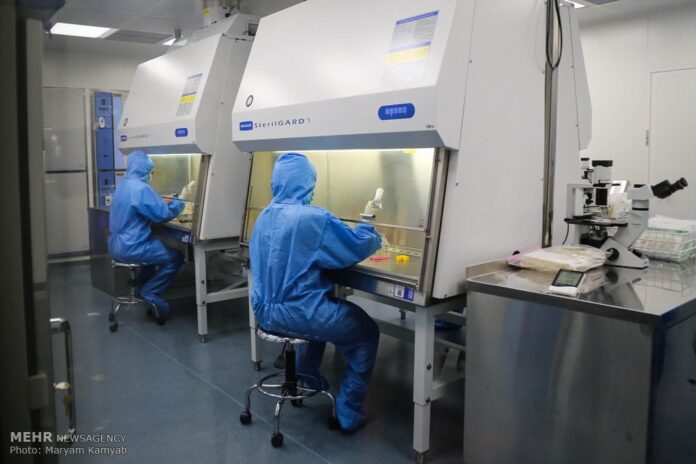
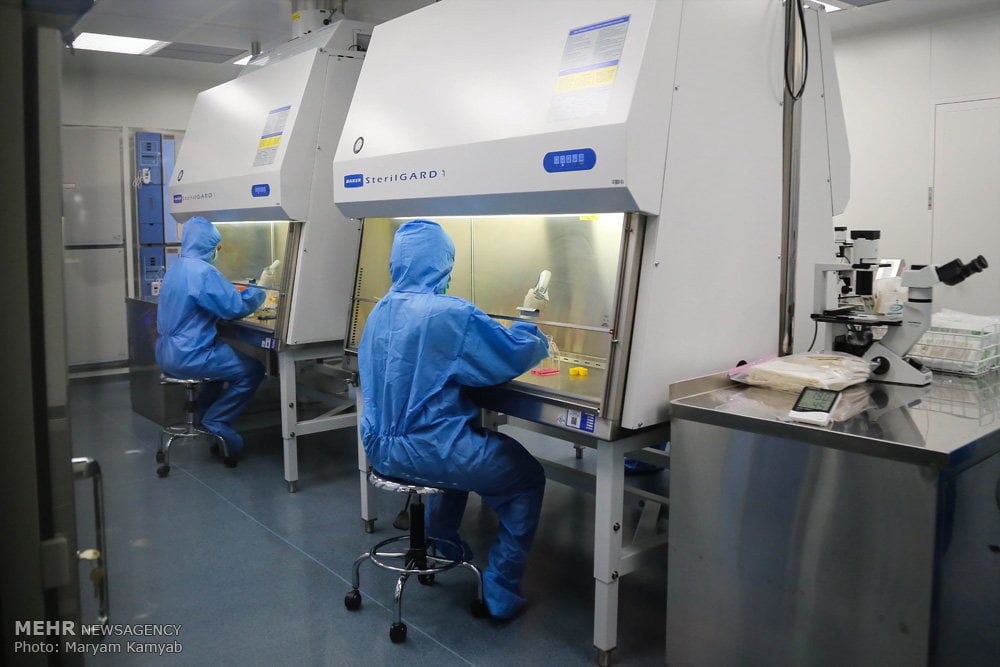
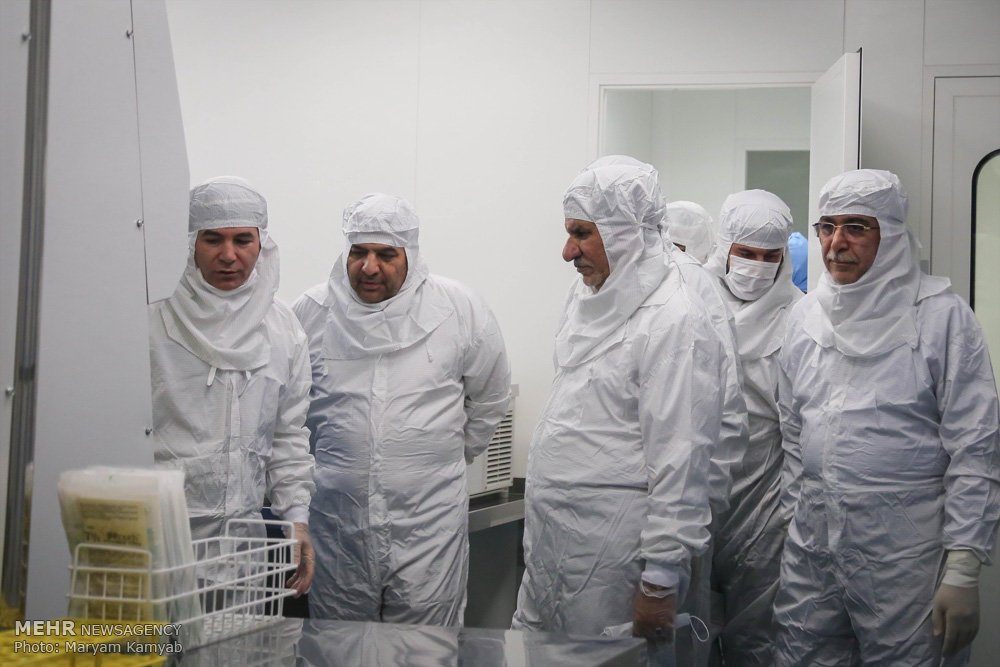
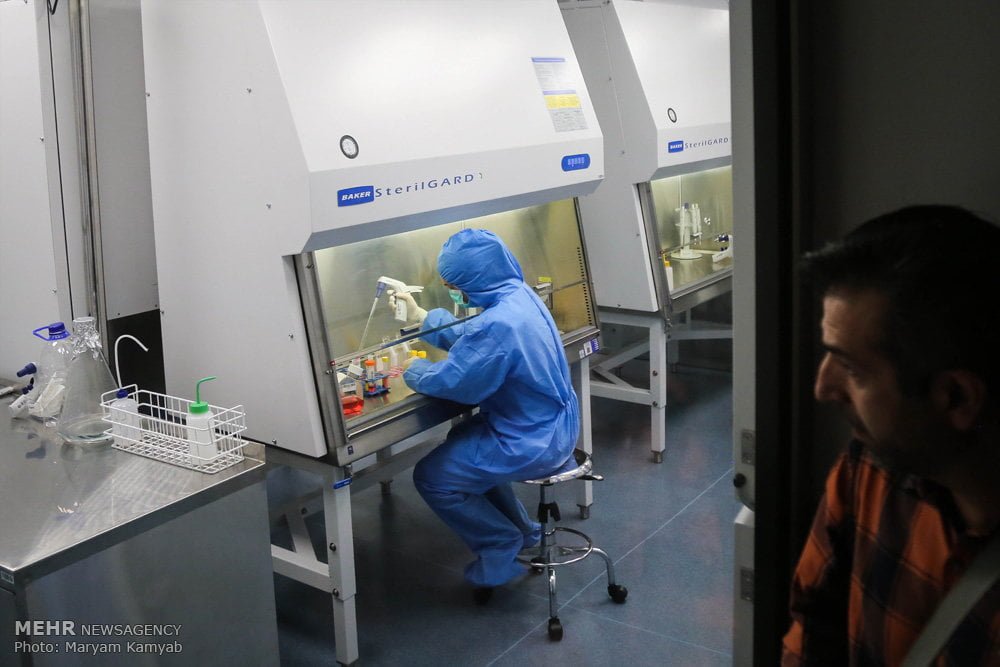
Iran Opens West Asia’s First Stem Cell Production Plant

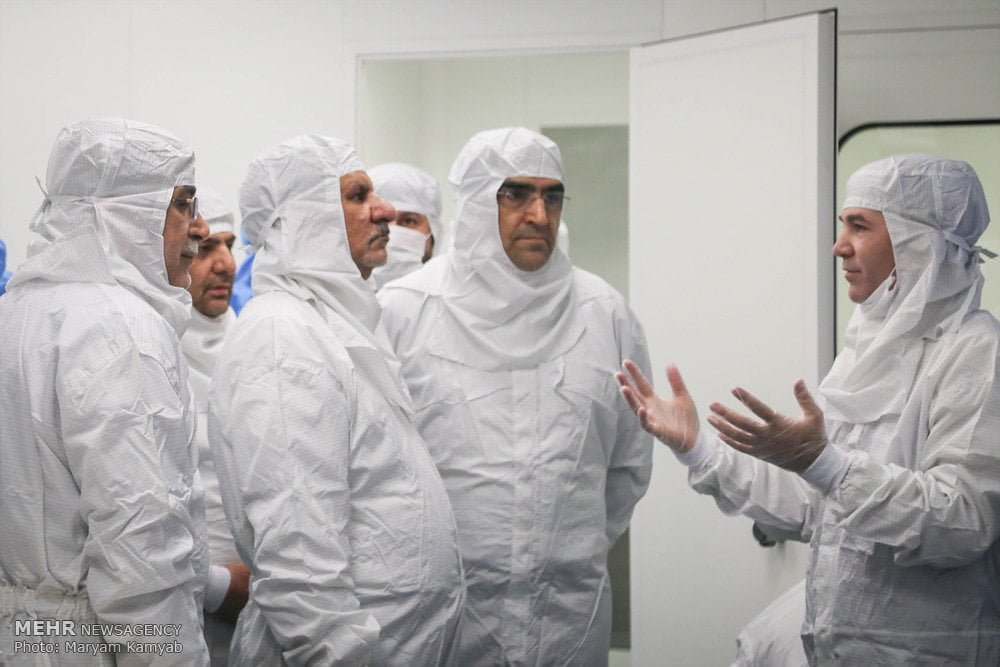
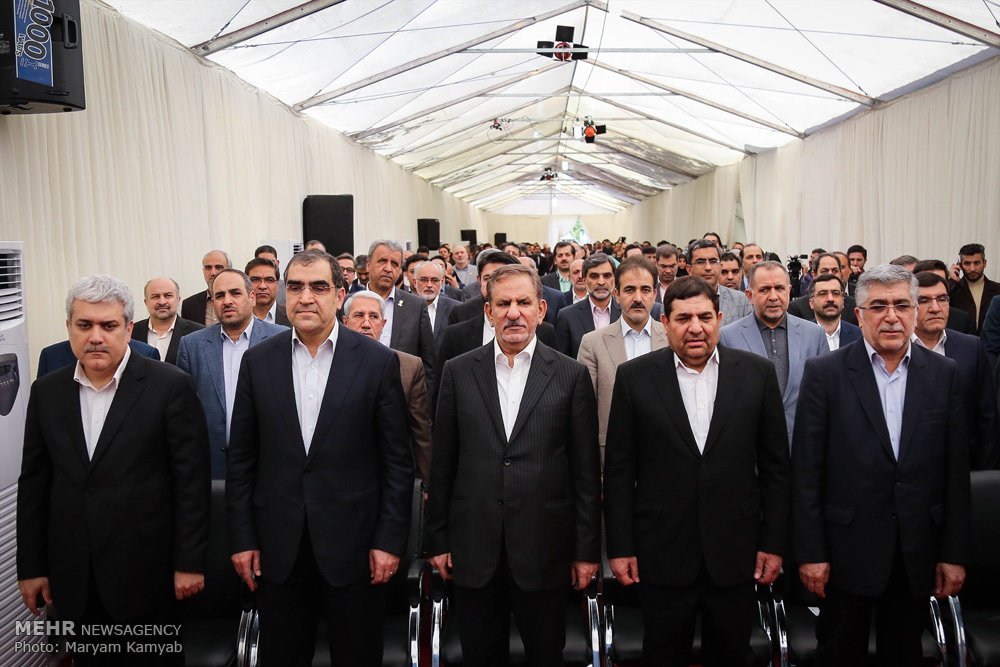
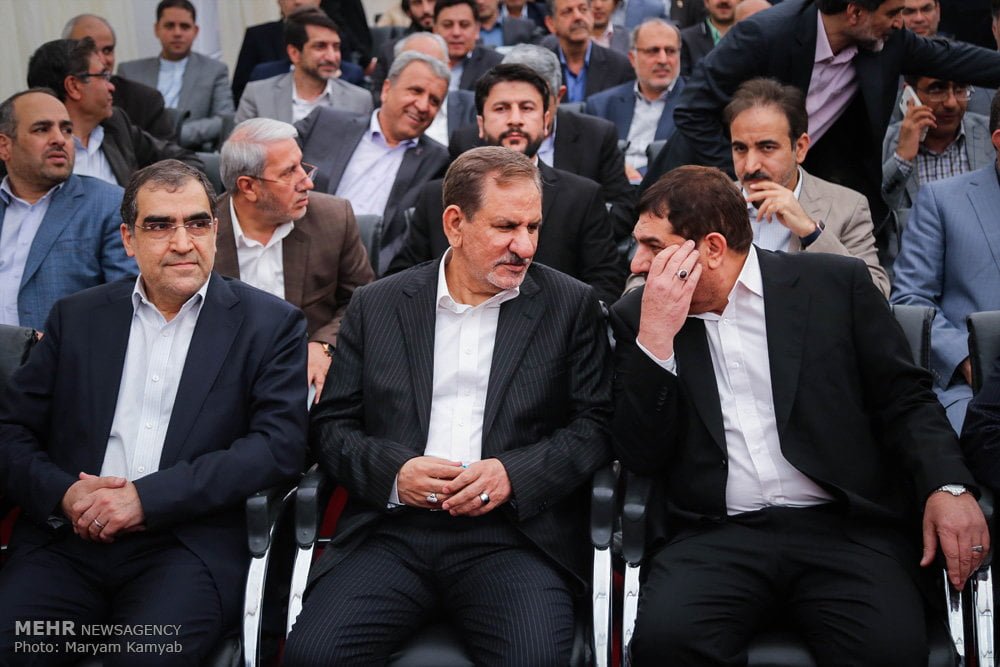
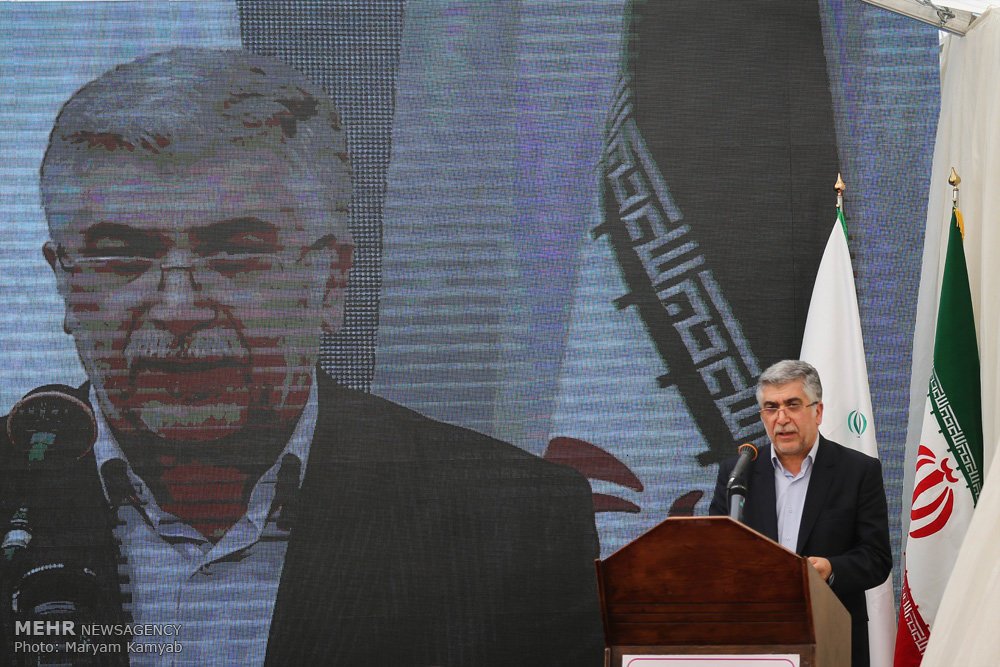
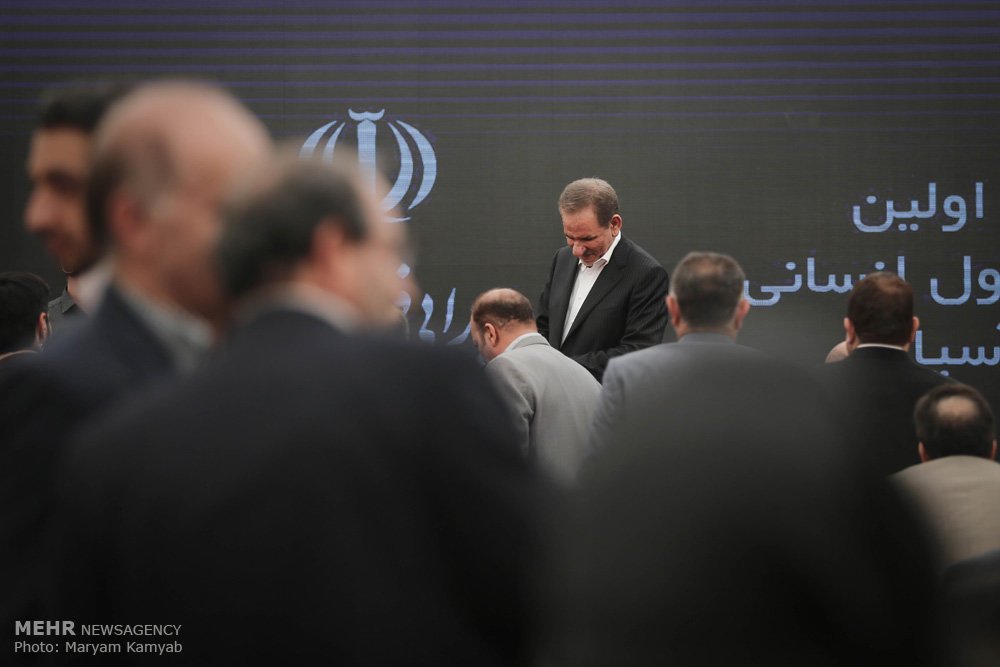
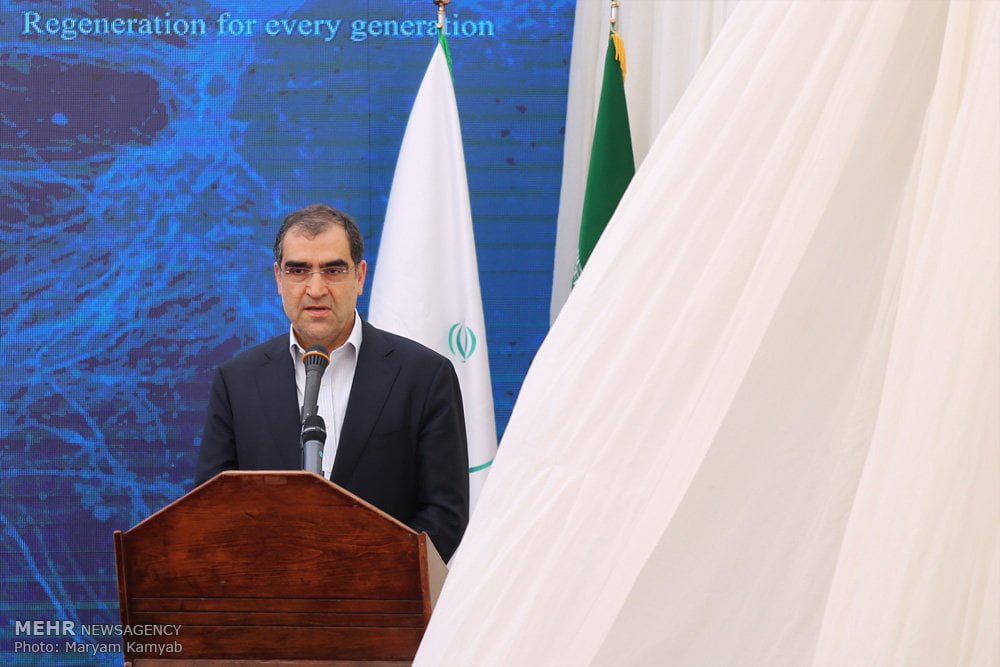
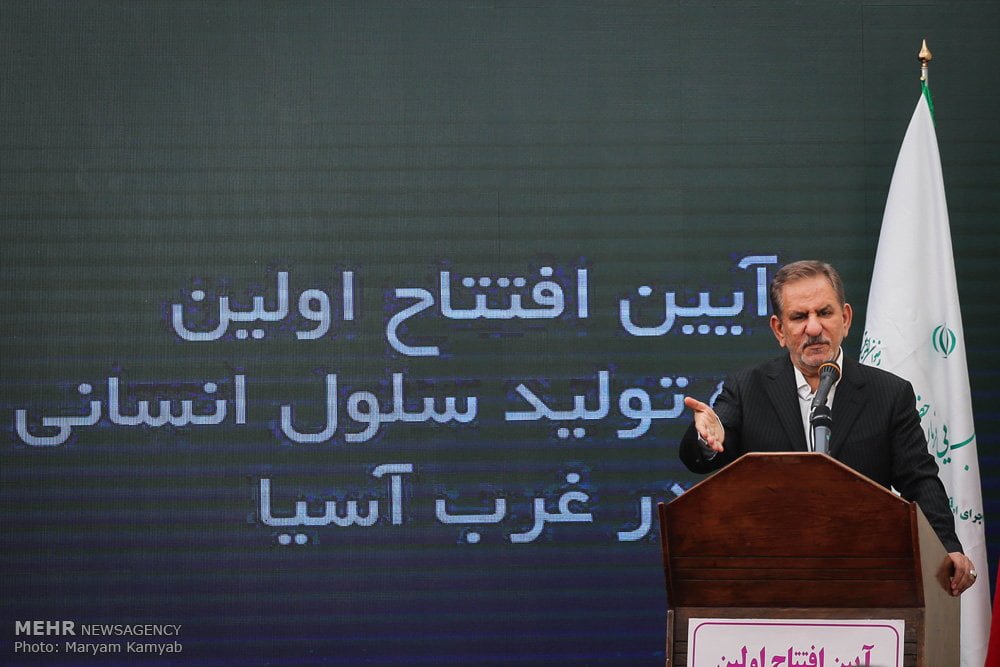
The plant was launched in a ceremony attended by First Vice-President Es’haq Jahangiri, Health Minister Hassan Qazizadeh Hashemi and Vice-President for Science and Technology Sorena Sattari, among other officials.

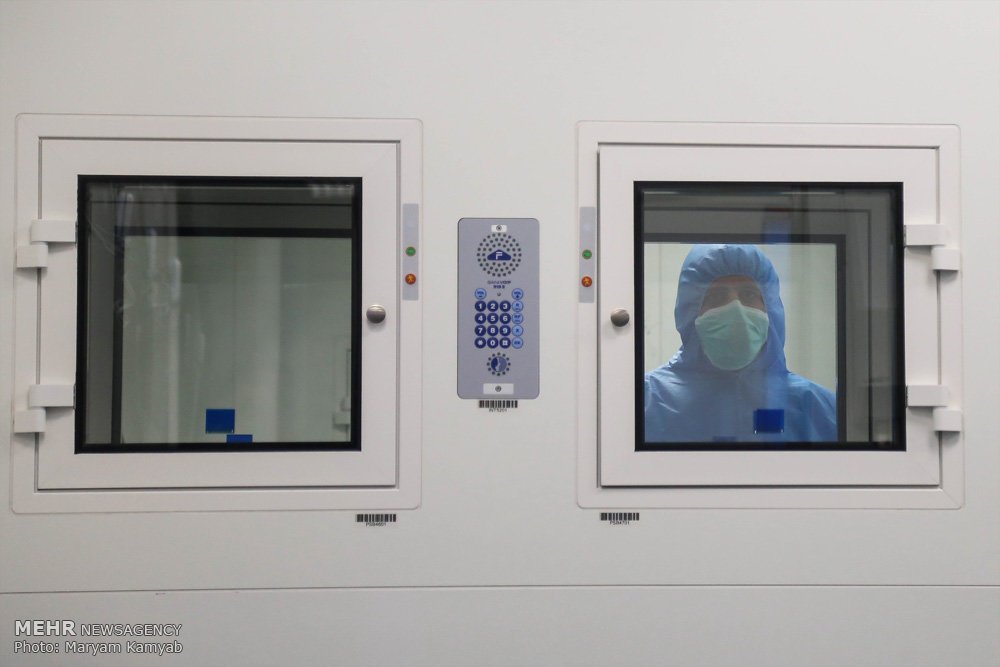
According to a report by IRINN, the plant, set up by Barakat Pharmaceutical Company and Royan Research Institute, is tasked with manufacturing products including Monocell, Ricollersal, Rhinooderm cell, etc. which are used to treat various cardiovascular, skin and skeletal diseases.

Speaking in the ceremony, Jahangiri said Iran has managed to overcome huge challenges and is determined to achieve great scientific progress.

“We dealt with hardships, including various sanctions, and managed to pass all these tests,” he said.

For a brief review of Iran’s achievements in various fields of science and technology, check the book “Science and Technology in Iran: A Brief Review

The factory is run by Celltech Pharmed, a company established in 2014 to work on stem cells, biotechnology, nanotechnology and pharmaceuticals.

Many scientists and researchers around the globe have been studying stem cells so that they can utilize their features in order to ensure the human health.

They have managed to use these cells to overcome certain challenges facing the prevention and treatment of complications.

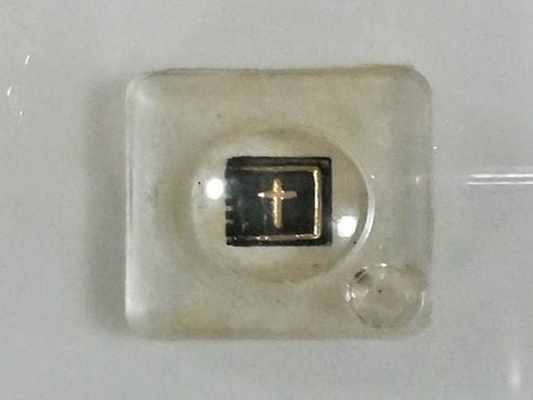
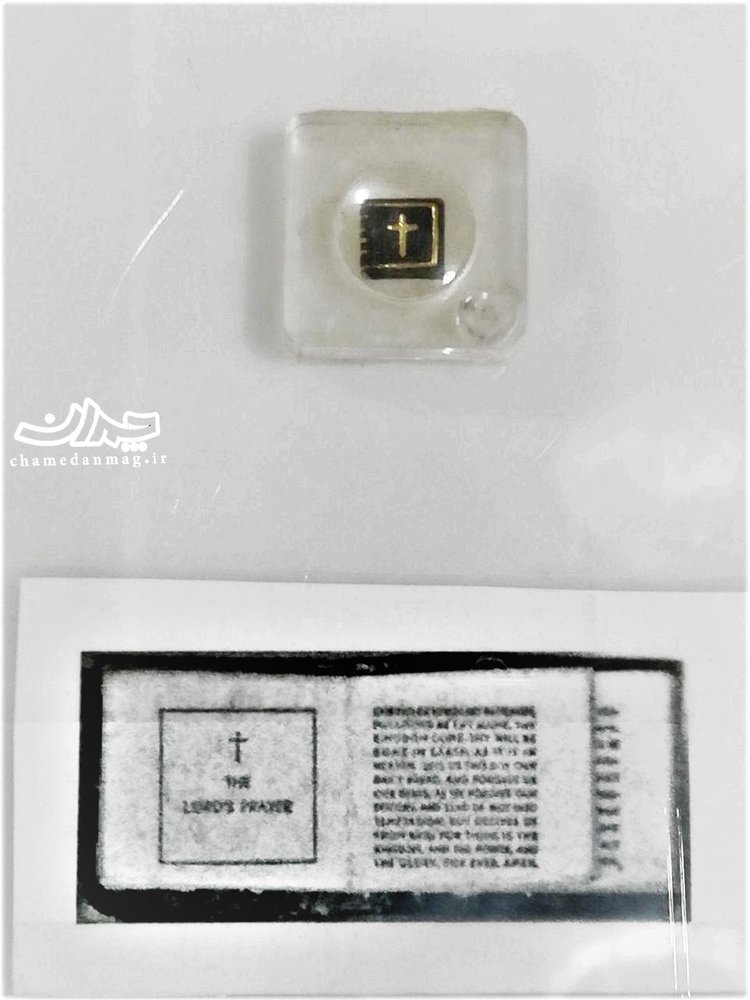
World’s Smallest Prayer Book Held in Iranian Cathedral

World’s Smallest Prayer Book Held in Iranian Cathedral

The Vank Cathedral is located in the New Julfa District of Isfahan. The church is considered to be one of the most beautiful in Iran, with historical paintings covering its ceilings and walls.

The Holy Saviour Cathedral, also known as the Church of the Saintly Sisters, was established in 1606, dedicated to hundreds of thousands of Armenian deportees that were resettled by Shah Abbas I during the Ottoman War. It was completed with major alterations between 1655 and 1664.

World’s Smallest Prayer Book Held in Iranian CathedralThe architecture of this historical Cathedral is unique in the world of Christianity, since it has been able to combine the beauty and the architecture of the Safavid era with the style of the long-vaulted churches of Christianity. The church’s dome and tiles have given it a special form, which is like the Safavid mosques,

A main attraction of Isfahan, the building attracts thousands of domestic and foreign tourists annually.

In the courtyard of the Vank Church, there is the museum and library building. The library has more than 700 manuscripts in Armenian and European languages that were common in the Middle Ages. This museum, which is built in 1871, is the place in which beautiful gospels are held.

One of these holy books is famous around the world. Armenian miniaturists have written this old scriptural book; that weighs only 0.7 grams, in 14 pages and into seven English, British, American, German, Dutch, Spanish, Swedish and French languages. This book actually contains the “Lord’s Prayer” section of the New Testament.

Iran Would Not Call Donald Trump: Leader’s Aide

Seyyed Kamal Kharrazi, who is also the head of Iran’s Strategic Council on Foreign Relations, made the remarks in a recent interview with France 24 in Paris.

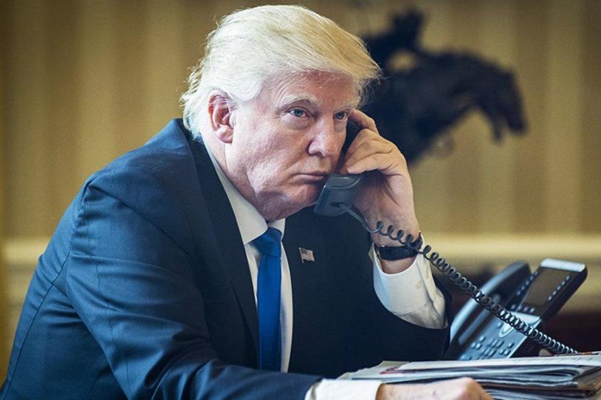
Regarding US president’s claim of readiness to negotiate with Iran, Kharrazi said his intention is to put more pressure on Iran, and thus calling Trump is no good, because his negotiations with North Korea did not bear any fruit either.

Pointing to the two-month deadline Iran has given Europe to fulfil its commitments, he expressed hope that the Europeans will do this in two months, so that Tehran does not have to go further.

We expect that Europe will act in such a way as to preserve the nuclear accord, and that Iran’s economy can function normally, highlighted Kharrazi.

He also pointed to the recent vessel incidents in Oman waters, and described them as ‘suspicious’. “It must be investigated to clarify the facts. In the current dangerous conditions, such events may be triggered by a third party to create tension and instability,” he noted.

Here is the full text of his interview:

Q: Tensions between Iran and the US are intensifying. The UK Foreign Secretary has confirmed he fears a serious situation. Are we close to a war between Iran and the US?

A: The fact is that there is a very dangerous situation and it is important that we all be careful to avoid any conflict. Out of hostility, the US blacklisted the Islamic Revolution Guards Corps as a terrorist group, and we also enlisted CENTCOM as a terrorist organisation. If they want to do something against us, there is a risk of conflict. Accordingly, the conditions are very sensitive and should be carefully acted upon.

Q: Given that tensions between the two countries have existed since many years ago, are you saying that we are currently witnessing one of the most difficult and dangerous times during the last 40 years of Iran-US relations?

A: Of course. It is clear that the United States has consistently put pressure on Iran. Let’s not forget that they even hit an Iranian airliner and attacked Iran after students stormed their embassy in the early days of the revolution, but their aircraft and helicopters were destroyed in the desert of Tabas. America’s hostility towards Iran is not new, but under the current circumstances, they are imposing severe economic pressures on Iran. As they themselves have said, they are seeking political regime change in Iran. However, they have not achieved this goal, because the Iranian people have very high political maturity and resist US pressures.

Q: Are you afraid of a direct US military intervention? Is there a serious discussion in Tehran at the power centre about this issue?

A: We are definitely ready, and if the US wants to intervene, Iran is fully prepared to respond to their military action. Americans are aware of this very well, and that’s why they say they do not want to engage in a conflict with Iran.

Q: Is Iran prepared to block the Strait of Hormuz, as some officials said, and is this a serious and practical step for you?

A: If the national interests of Iran require, we will be able to do so. In any case, it depends on the amount of Iranian oil exports and the interests of Iran.

Q: In recent days, an incident has occurred for several vessels in a port near the UAE, and the Saudis have said this has been a sabotage act. Are they pointing fingers at Iran? Is Iran behind the incident?

A: The incident is suspicious and must be investigated to clarify the facts. In the current dangerous situation, such events may be triggered by a third party to create tension and instability. For this reason, it is expected from everyone to be careful and investigate in order to clarify the truth and not to be trapped.

Q: So you reject Iran’s role in this event?

A: Definitely. Iran has obviously never been involved in such incidents and has nothing to do with what happened; therefore, it should be investigated in order to identify the parties involved in the incident.

Q: You talked about a third party. Who do you think is the third party who has an interest in this story? The US, or its regional allies like the UAE or Saudi Arabia? You must have a clear idea in this regard.

A: I still do not have any information about it, so I cannot talk about it. That’s why I emphasise probe must be started to identify the parties involved in the incident.

Q: Recently, the Trump administration has put a lot of economic pressure on the Islamic Republic and imposed new sanctions. And at the same time, US President Donald Trump, just a few days ago asked the Iranian leader to call him. Any glimpse of hope that a phone call would be made?

A: Of course this will not happen and he will not be called. Do not forget that President Trump is interested in meeting everyone at any cost to take a photo to advertise for himself. We cannot trust the United States. Do not forget that they withdrew from the nuclear deal. They violated international law because the nuclear deal had been approved by the United Nations Security Council resolution, and the Americans had also voted for.

Q: But why should he be rejected when he has extended a hand? He has already done this with North Korea. As Iran is in difficult conditions facing economic and military pressures, it may be a good option to respond positively and say let’s talk.

A: His goal is to put more pressure on Iran. Calling him is of no use because it did not produce any results with North Korea either.

Q: Do you think Donald Trump or his administration are basically trying to fight Iran? Do you really believe it?

A: They want to create a situation in which the political system of Iran would change, but they will not succeed. They also claimed that the Iranian “regime” would collapse on the 40th anniversary of the victory of the Islamic Revolution, but we saw it did not come true. They see that the Iranian people, despite all the economic pressures, have defended their country and maintained the independence of the country.

Q: Iran has recently announced it will make decisions in response to US pressures. You specifically stated that henceforth Iran will not consider any restriction in production of heavy water and enriched uranium. You gave two months’ time to Europeans to provide conditions for helping the Iranian banking and oil sectors get out of isolation. This is a general deadline that Europeans have already rejected. Do you think Tehran might end up withdrawing from the nuclear deal?

A: First of all, Iran’s right to do so is in accordance with the text of the nuclear deal. If the other party does not fulfil its obligations, Iran can reduce some of its obligations, this right has been recognised for the Islamic Republic in the nuclear accord. These are the two steps that can be the starting point for the withdrawal. Two months have been given to European countries. Unfortunately, despite their political stance in support of implementing the nuclear deal, these countries did not make any strenuous efforts to resolve banking and trade issues. During these two months, Europe must take an action. Europe has not yet run the INSTEX mechanism. I hope the Europeans will do something in these two months so that Iran does not have to go further. Of course, this does not mean we want to withdraw from the nuclear deal; on the contrary, it is an absolute right in the nuclear deal. We expect that Europe will act in such a way as to maintain the nuclear accord, and Iran’s economy can function like normal.

Q: If Iran’s demands are not met at the end of these 60 days, will Iran withdraw from the nuclear deal?

A: No, Iran will take further measures to reduce its other commitments. This does not mean leaving the nuclear deal.

Q: You are disappointed with Europeans. The French Foreign Minister has criticised Tehran for “bad reaction” and invited you to show your political maturity and prove it. Do you think the Europeans, who say want to support the agreement and preserve it, have finally come to this conclusion that this deal will survive, of course without articulating it directly?

A: Yes, in fact, we are disappointed with the behaviour of the Europeans. We expected that European countries would honestly meet commitments made in the form of nuclear accord and try to do so. But several years after the nuclear deal, we see that banking relationships have not been established. Trade ties between Iran and Europe have not been launched, and as a result, this has created a lot of frustration in Iran. What we want and expect is that Europe compensate for this delay with new measures.

Q: Isn’t it late for this? Do you think there is still time for Europe?

A: No, undoubtedly there is still time for Europe to do something tangible. The first step is to make INSTEX operational. In fact, it is a mechanism that allows some degree of trade between Iran and Europe.

Q: We heard the news that an Iranian female employee at the British Council was sentenced to 10 years in prison for espionage. There are many tense cases between Tehran and Europe. Is this a message for Europeans?

A: Not at all. Naturally, if the citizens of any country commit a crime, including espionage, that country has the right to prosecute them. Currently, this case is being investigated at the court. I emphasise that these are the ordinary rights of every country. In France as well, if you see someone is working for a foreign power, you will certainly arrest him/her. This is the right of every country, and we expect that others do not interfere in the internal affairs of Iran.

How Used Tesla’s Could Skyrocket in Value to over $250,000

Almost all cars depreciate rapidly, with some models losing as much as 30% of their new car price the very first year. There are only a few vehicles that appreciate, and those are almost always collectibles or exotic sports cars that cost a fortune. This includes vintage vehicles like old Ferrari’s or Porsche’s.

Tesla hopes to change all of that. Elon Musk has recently made some very bold claims. One statement that drew attention from media around the world was his assertion that used Tesla’s will be worth $150,000 to $250,000 in just a few years. How could a $35,000 electric car possibly appreciate to a worth of a quarter of a million dollars? According to Elon Musk, it’s all about the software the company is developing. In a recent call with anxious investors, Musk laid out his vision for the volatile manufacturer of electric cars.

Elon Musk Claims Tesla Will Be Worth over $500 Billion in the Next Several Years 

With his company needing to raise an additional $2 billion to stay afloat, the renegade CEO assured investors that someday the company will be worth over half a trillion dollars. The main basis for these positive claims is Tesla’s autonomous technology. The company has developed “over-the-air” software updates. These instant updates will constantly improve the self-driving abilities, thus giving Tesla a wide lead over its rivals.

This is the main reason why musk is so optimistic about the future of Tesla. He believes a cheap Model 3 that starts at just $35,000 could make a small fortune for the owner as a robot taxi.

There are also the gasoline savings, which amount to several thousand dollars per year for the average driver. Musk has a vision of Tesla on the road serving as so-called “robo-taxis” that work tirelessly 100 hours or more per week. This could potentially make their owner some serious change.

Robo Taxis are Coming
A Tesla doing ride-sharing making $18 per hour, could mean $1,800 in gross earnings weekly. Of course, you have to factor in auto insurance and repair costs. Auto insurance comparison site GoodtoGoInsurance.org claims Tesla vehicles cost more than the national average to insure. However, with owners potentially making more than $7,000 per month, those high car insurance premiums would be money well spent. This potential earning income alone is a reason Tesla’s value could surge. The idea an owner would not need to drive and could sit back and watch their Tesla make money day and night is an intriguing prospect that might be more fact than fiction.

This is one of the main reasons why Musk believes Tesla’s company value will boom in value to over $500 billion. That is a long way from its current market value of just $43 billion. To many market experts, they view Elon’s ideas as wishful thinking. A lot of people seem to be skeptical of Musk’s vision and financial proclamations. Elon has been a true visionary, but he is facing increased competition from some of the most formidable competitors in the world. This includes Google, Uber, and even Chinese companies like Baidu.

Tesla Has Three Competitive Advantages
While most cars depreciate by 50% or more in just five years, Tesla wants to be the first automobile manufacturer to produce vehicles that appreciate. There are three strategic plans the company will implement to do just that. These are:

Instant Software Updates
Tesla wants to be the first automobile company to deliver software updates over the air. This will allow the company to develop autonomous technology faster than competitors and add value to Tesla. In addition, because there is no combustion engine, Tesla cars will last much longer and hold their performance metrics. Tesla wants fully autonomous robot taxis in the next two years.

Advanced Chips
Tesla has developed proprietary chips, which make up its Hardware 3 suite. Tesla chips are the brains that allow autonomous driving. These chips are replacing Nvidia Drive PX2, which previously delivered a performance of 20 frames each second. The new Tesla chip built “in-house” processes a whopping 2,000 frames each second. This speed will help Tesla’s react much faster to driving conditions. It should be noted that Nvidia is not sitting on their hands. They are close to finalizing a chip that will outperform Tesla’s and should set the industry standard.

More Electric Vehicles on the Road than Competitors
By having more Tesla’s on the road, each car is constantly streaming data back and helping improve driverless technology. Elon Musk thinks this is a key advantage competitor won’t be able to match. This is also a big selling point for customers that their vehicles will get smarter over time.

Elon Musk has bold plans to dominate the world of autonomous cars. Only time will tell if his dreams become a reality.

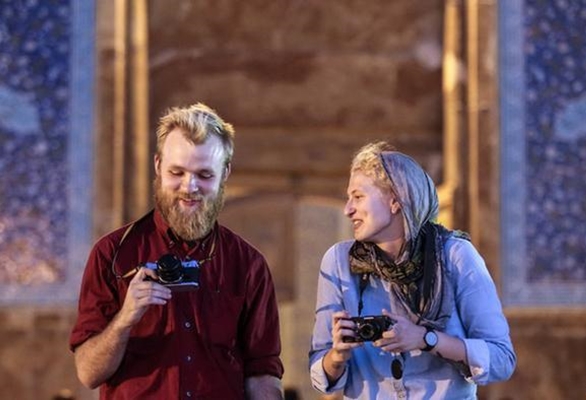
‘Younger Tourists Coming to Iran despite US Propaganda’

Seyyed Mohammad-Ali Ashraf Vaqefi says the age range of cultural tourists visiting Iran remains high, but “we have recently witnessed a drop in the age of cultural tourists visiting Iran.”

“This age range is lower among nature tourists,” said Vaqefi, the deputy head of Iran’s tour operators’ community.

“Of course, the age range is different depending on the visitors coming from different countries,” he said.

“European tourists travelling to Iran as cultural visitors are mostly old while the ages of tourists coming from other countries are lower,” said the official.

He touched upon the financial status and occupations of the tourists coming to Iran.
“Most European tourists are from the middle class of society, but if tourists from other continents such the Americas and Australia want to travel to Iran, they should be well-off because in most cases they do not travel to another continent just to visit one country; rather, they usually visit several countries,” he said.

Although Iran has turned into an inexpensive destination for foreign tourists given the devaluation of the Iranian current, visitors from other countries are going to have an expensive trip ahead as they have to travel long distances and transportation costs have increased. So, they usually plan to visit several countries during one trip.

Elsewhere in his remarks, Vaqefi underlined that a major propaganda campaign has been launched against Iran.
“This propaganda has painted another picture of Iran in the minds of people around the world,” he said.

“But an overwhelming majority of tourists change their minds completely when they come to Iran, and they leave Iran with satisfaction,” he said.

With regard to the current situation, he added, the number of tours organized for visiting Iran is satisfactory.

“Some travel agencies have seen a drop in the number of foreign tourists, and some others (agencies) are in a better situation,” he noted.

“But on the whole, we can say although we have seen a drop in the number of incoming tours, the decrease has not been large enough to be seen as a major decline because people around the world are now aware of US policies,” he said.

Vaqefi notes there has been a rise in the number of visitors with special interests such as tourists who would like to get more familiar with Iran’s agriculture, cuisine, nature and even deserts.

The official said it has been quite some time that Iran has been organizing joint tours with neighbouring countries. For example, he added, joint Iran-Uzbekistan tours have been organized for visitors from most European countries as well as Australia and even China. The official said these tours are becoming more and more popular.

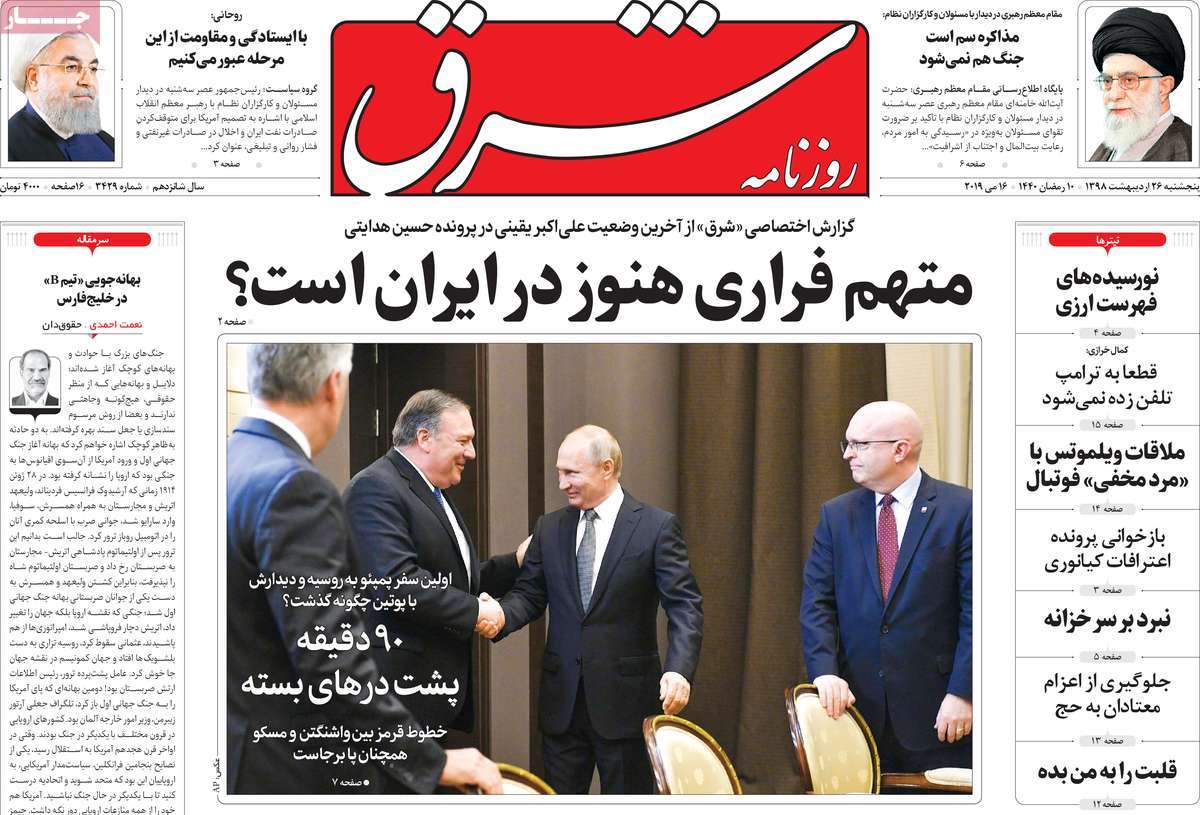
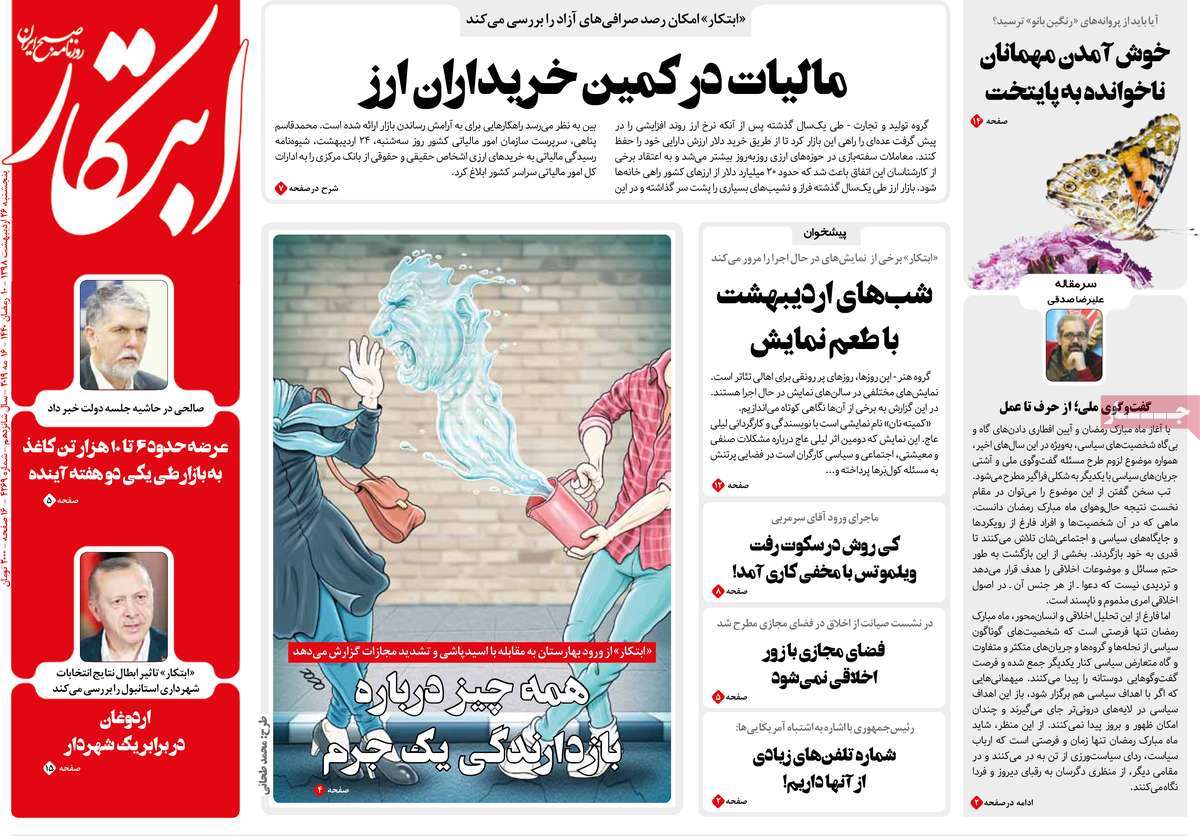
A Look at Iranian Newspaper Front Pages on May 16

A Look at Iranian Newspaper Front Pages on November 19

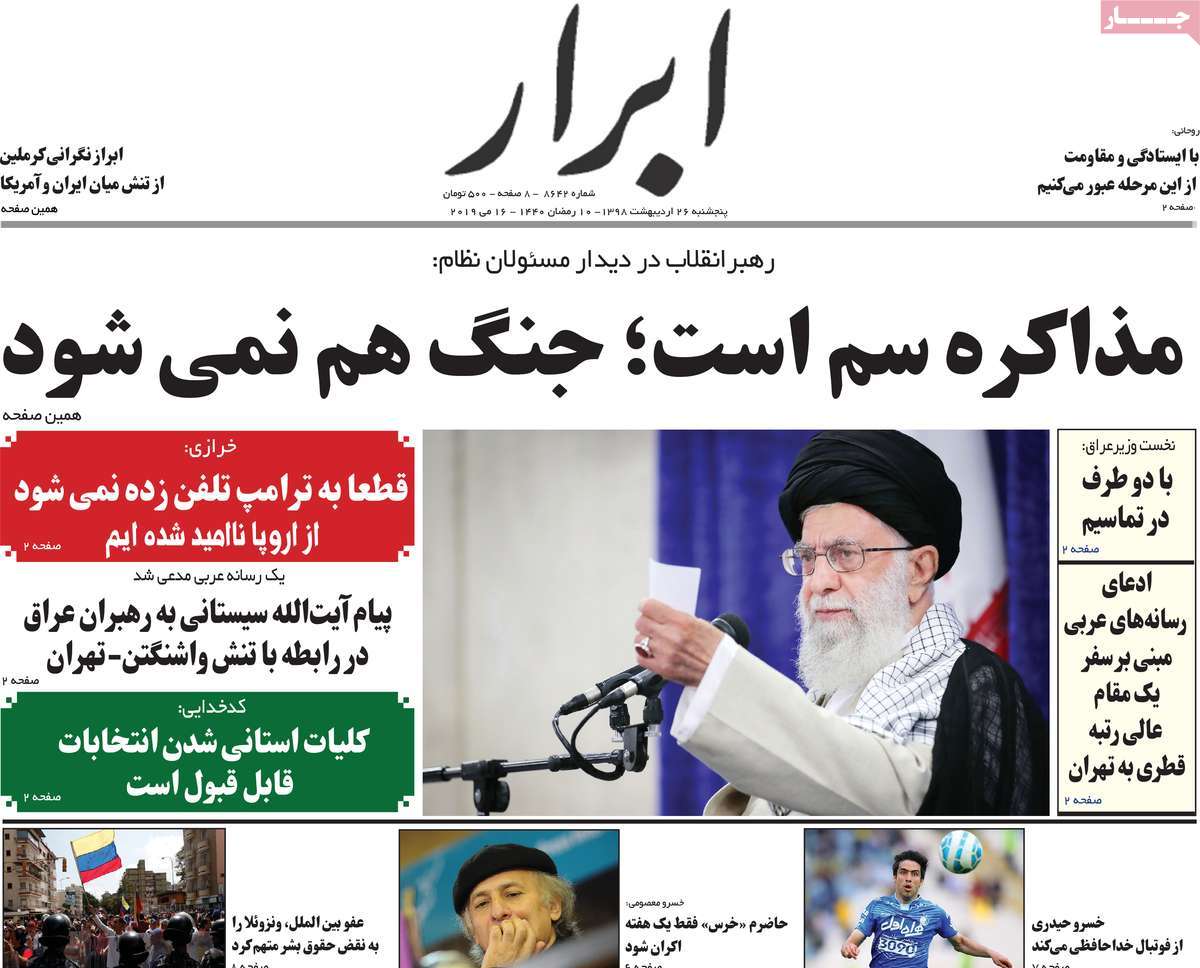
Abrar:

1- Rouhani: We’ll Overcome This Stage through Resistance

2- Kremlin Concerned about Iran-US Tension

3- Iran Disappointed with Europe, Won’t Call Trump

4- Arab Media: Ayatollah Sistani Sends Message to Iraq Leaders on Iran-US Tension

5- Top Qatari Official Has Visited Tehran: Source

A Look at Iranian Newspaper Front Pages on May 16


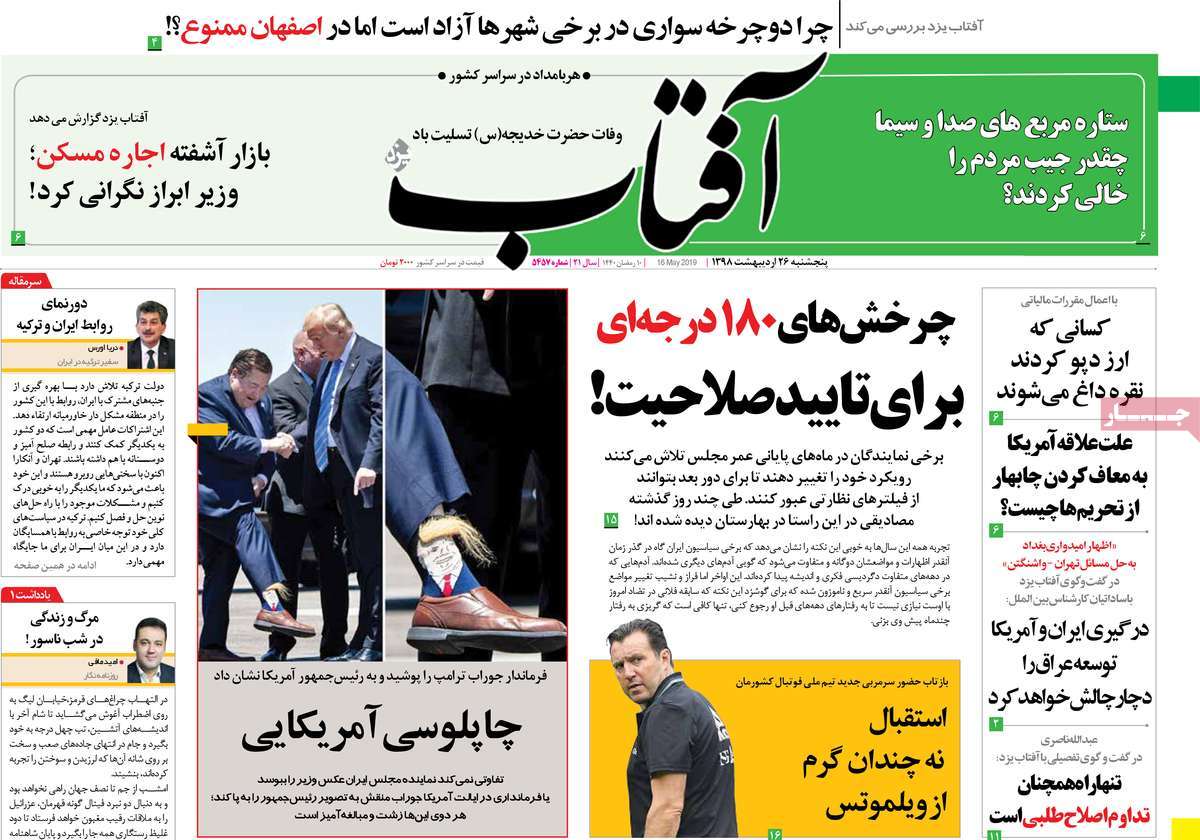
Aftab-e Yazd:

1- Why US Interested in Exempting Chabahar from Sanctions

2- Iran-US Conflict to Challenge Iraq’s Development

3- American Flattery: US Governor Shows His Trump Socks to President

A Look at Iranian Newspaper Front Pages on May 16


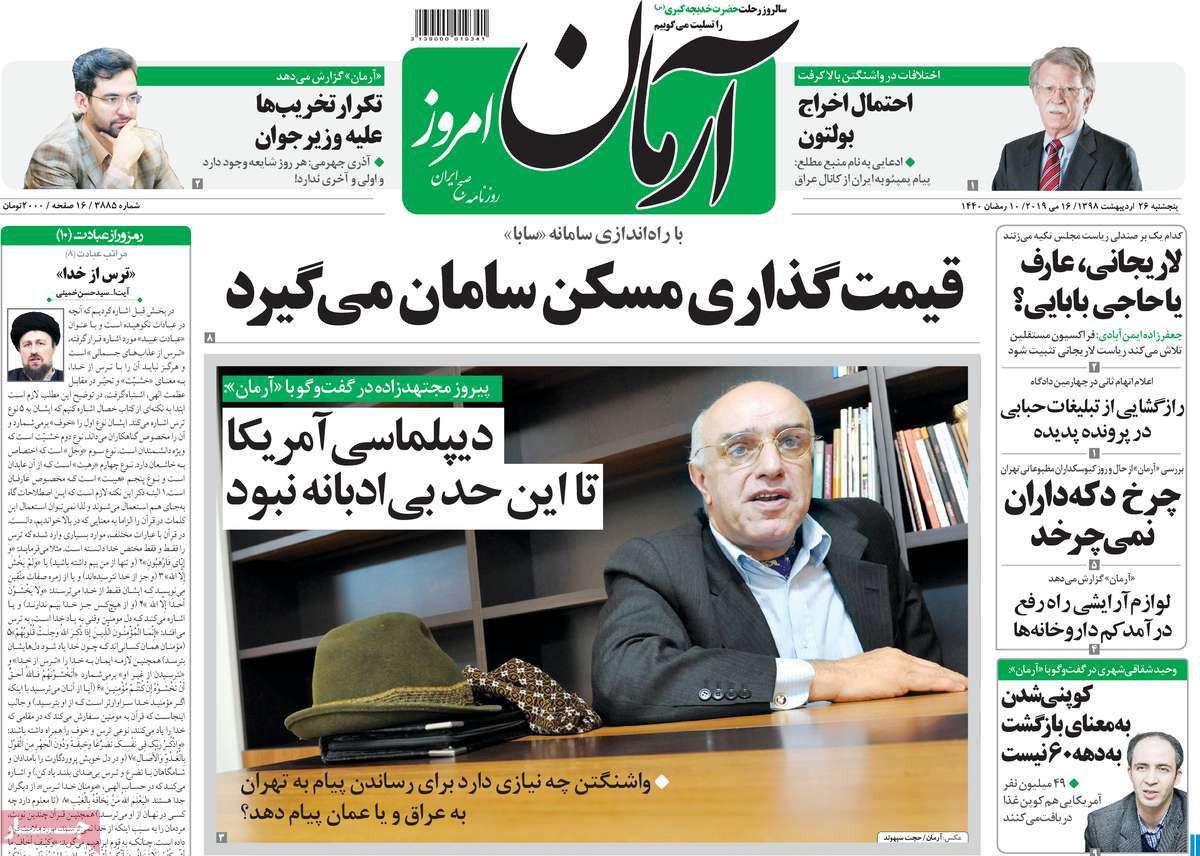
Arman-e Emrooz:

1- Bolton May Be Fired: Infighting in Washington

2- Why Washington Needs to Send Its Message to Iran through Iraq, Oman

A Look at Iranian Newspaper Front Pages on May 16


Ebtekar:

1- Rouhani: We Have Many Phone Numbers from US

2- Erdogan vs Istanbul Mayor: A Report on Impact of Annulling Mayorship Elections of Istanbul

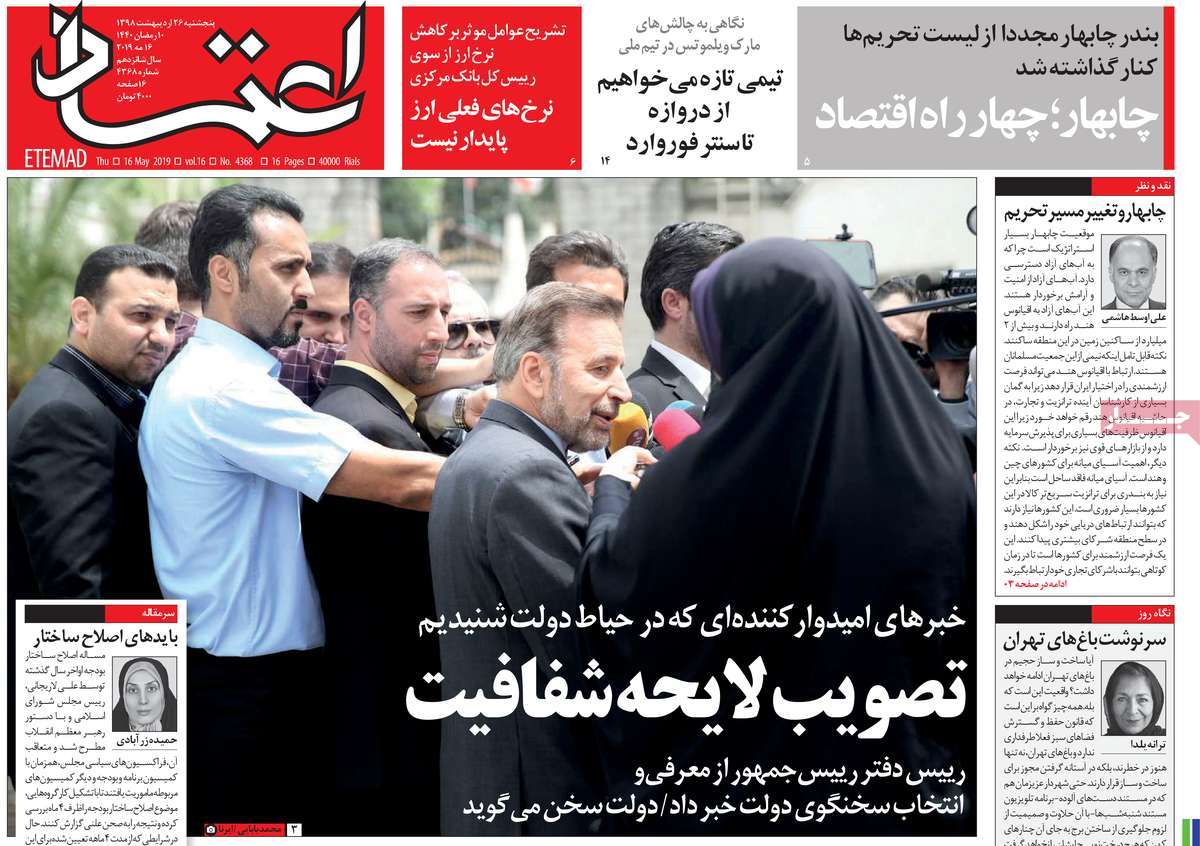
A Look at Iranian Newspaper Front Pages on May 16


Etemad:

1- Chabahar Crossroads of Economy: Iranian Port Once Again Exempted from Sanctions

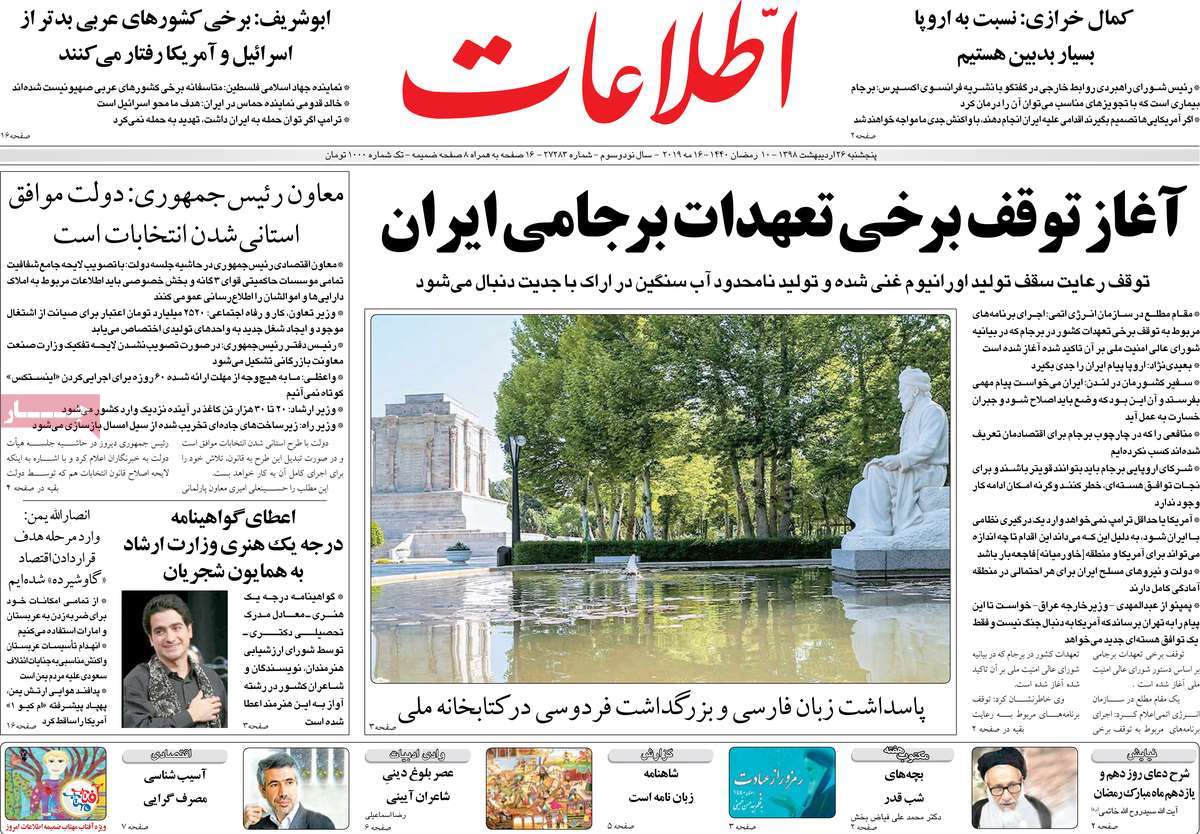
A Look at Iranian Newspaper Front Pages on May 16


Ettela’at:

1- Iran’s Kharrazi: We’re Very Pessimistic about Europe

2- Iran Starts Unlimited Production of Enriched Uranium, Heavywater

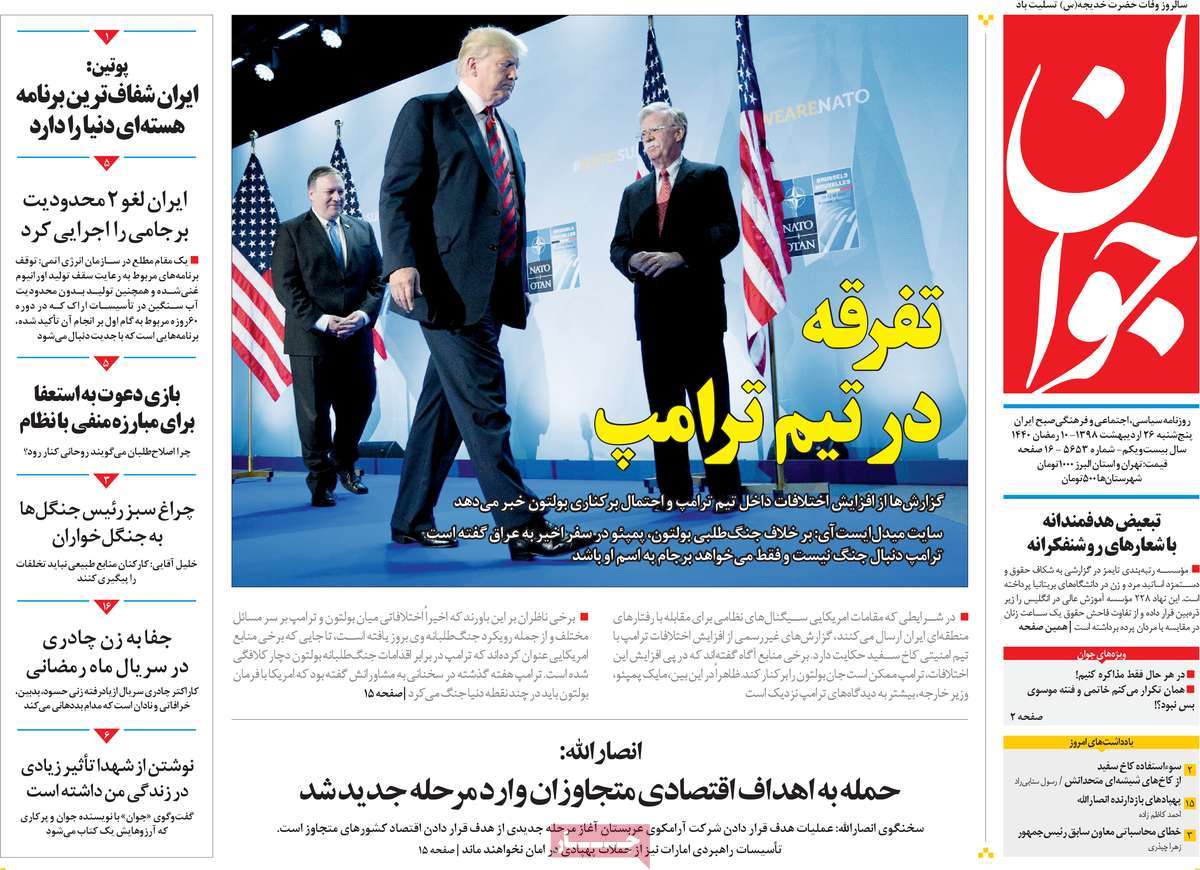
A Look at Iranian Newspaper Front Pages on May 16


Javan:

1- Increased Differences among Trump Administration: Bolton May Be Sacked

2- Putin: Iran Has Most Transparent Nuclear Program in World

3- Iran Stops Implementing Two JCPOA Commitments


A Look at Iranian Newspaper Front Pages on May 16


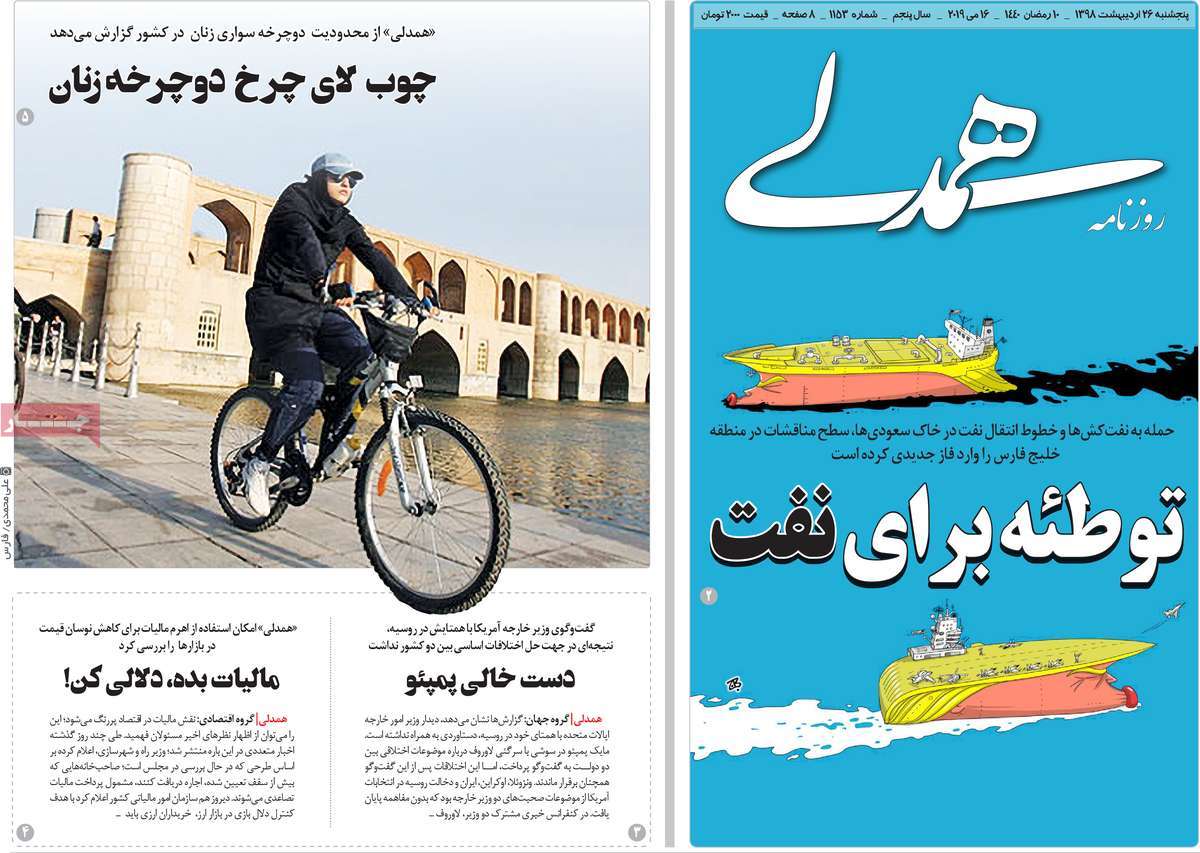
Hamdeli:

1- Conspiracy for Oil: Persian Gulf Conflict in New Phase after Attacks on Oil Tankers, Pipelines

2- Pompeo’s Empty Hands: Talks with Lavrov End with No Result

A Look at Iranian Newspaper Front Pages on May 16


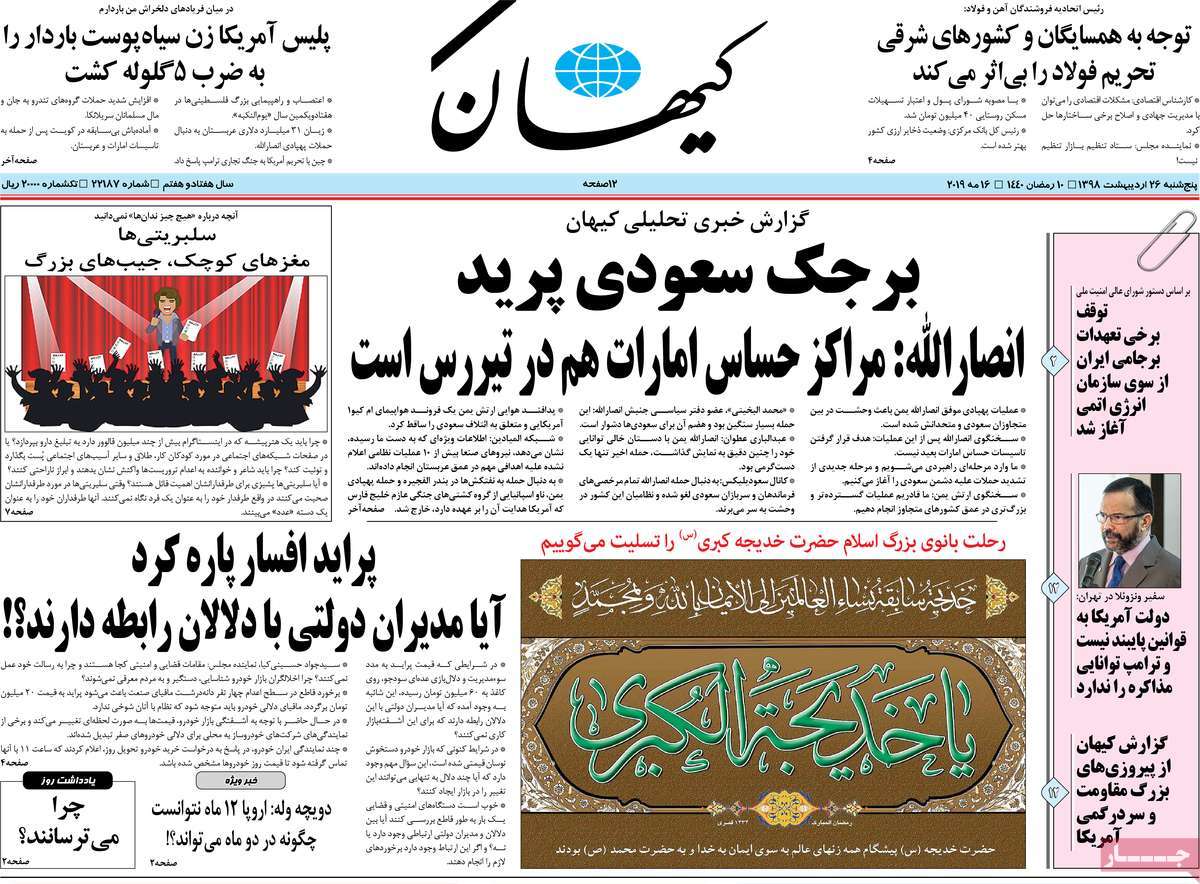
Kayhan:

1- Iran Declares End of Implementing Some JCPOA Commitments

2- Venezuela Ambassador to Tehran: US Gov’t Not Committed to Law, Trump Not Capable of Negotiating

3- Saudis Frightened: Yemen Says UAE Sensitive Centres Also within Range

A Look at Iranian Newspaper Front Pages on May 16


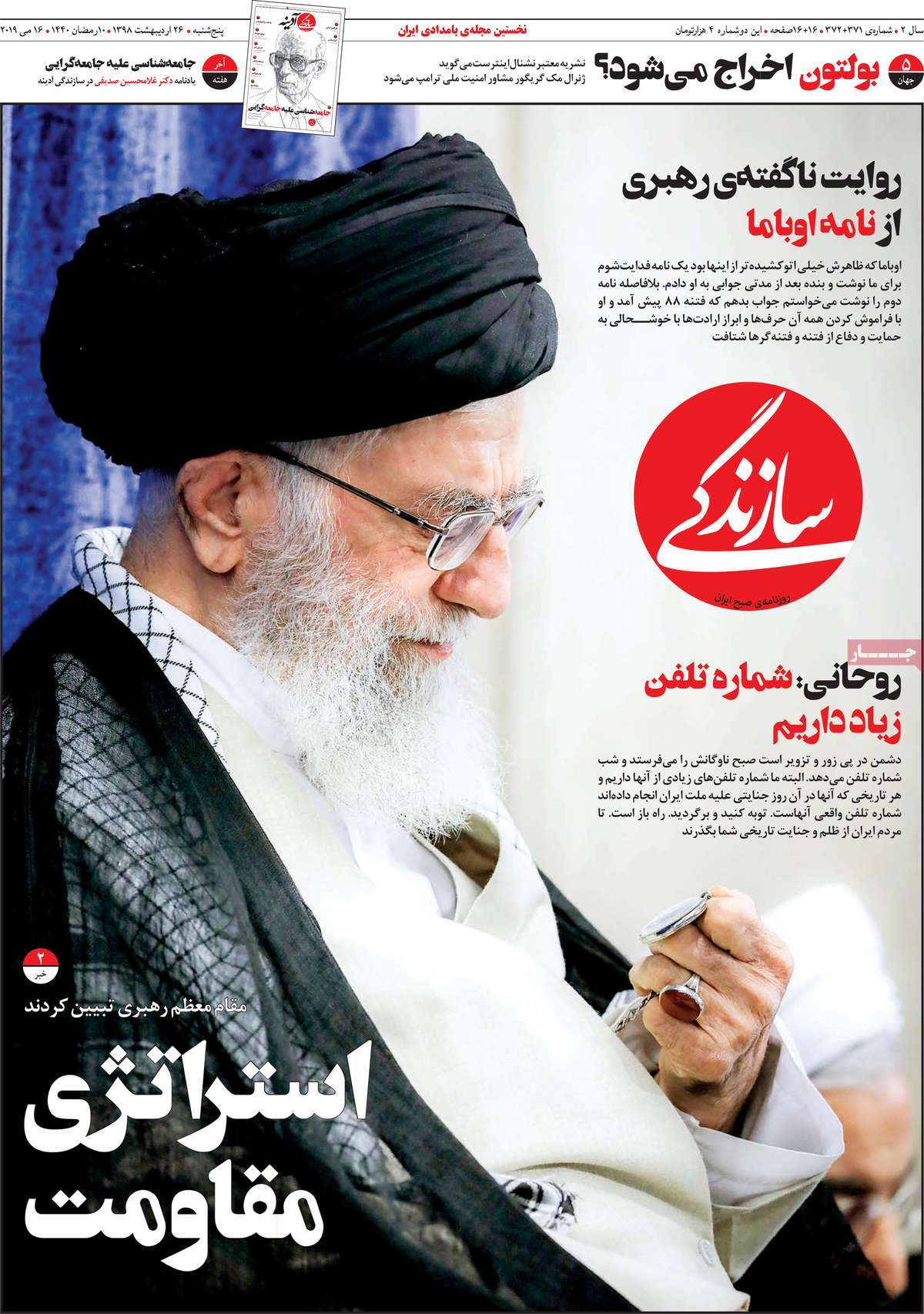
Sazandegi:

1- Will Bolton Be Fired?

2- Iran Leader’s Account of Obama’s ‘Love’ Letters to Him before 2009

3- Rouhani: We Have Many Phone Numbers

* Hypocrite Enemy Sends Its Fleet in Morning, Gives Phone Number at Night

4- Iran Leader Explains Strategy of Resistance

A Look at Iranian Newspaper Front Pages on May 16


Shargh:

1- Rouhani: We’ll Overcome This Phase with Resistance

2- 90 Minutes behind Closed Doors: Pompeo’s First Visit to Russia

* Red Lines between US, Russia Still in Place

A Look at Iranian Newspaper Front Pages on May 16


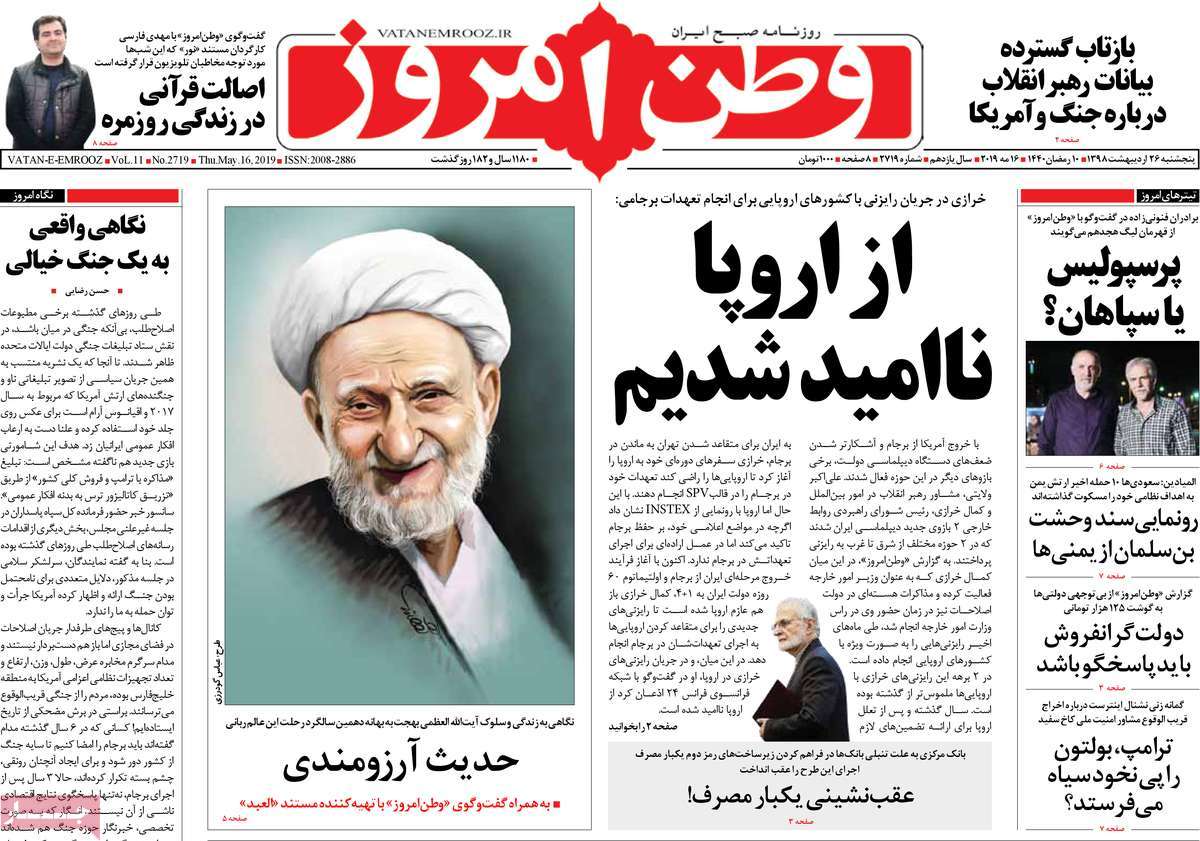
Vatan-e Emrooz:

1- Iran Leader’s Remarks about War, US Widely Covered in World Media

2- Leader’s Aide Says Iran Disappointed with Europe

3- Will Trump Sack John Bolton?

A Look at Iranian Newspaper Front Pages on May 16

Iran Nuclear Deal Must Be Preserved: Japan PM

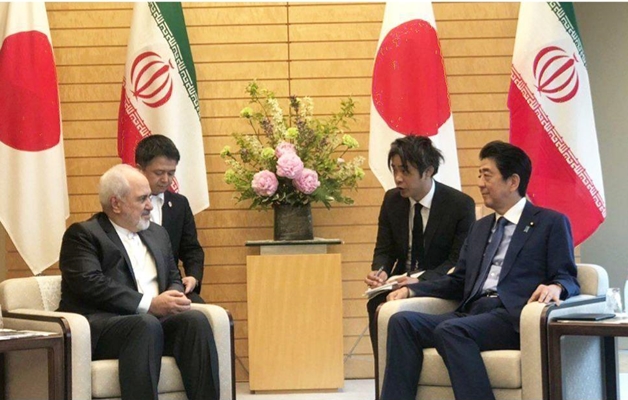
Japanese Prime Minister Shinzo Abe meets Iranian Foreign Minister Mohammad Javad Zarif in Tokyo on May 16, 2019. / Photo by Iran's Foriegn Ministry

Shinzo Abe made the comment in a Thursday meeting with visiting Iranian Foreign Minister Mohammad Javad Zarif.

The Japanese premier also described Iran’s role in ensuring stability and security in the region as very significant and positive.

He said Toyo is set to maintain and further enhance its age-old relations with Tehran.
In addition to the Iran nuclear deal, key regional and international issues also came up for discussion during the talks.

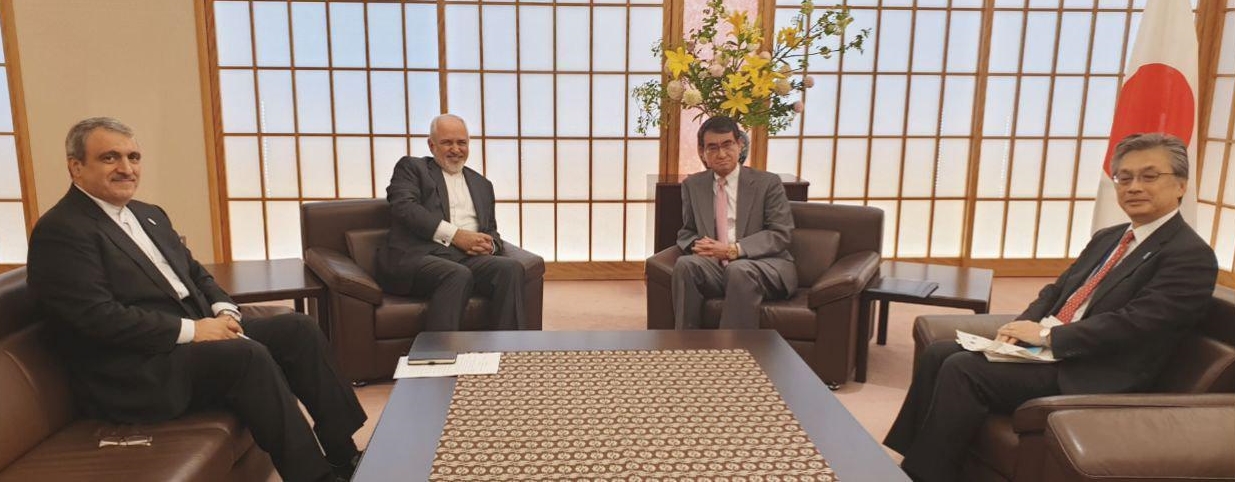
Earlier in the day, Zarif also discussed the nuclear deal, known as the Joint Comprehensive Plan of Action (JCPOA), in a meeting with his Japanese counterpart Taro Kono.

The two sides conferred on the latest developments regarding the Iran nuclear deal, the Islamic Republic of Iran’s legal measures to counter the US government’s breach of commitments under the agreement and violations of law, and the Europeans’ failure to take proper action with regards to the implementation of the nuclear deal.

During the talks, FM Zarif elaborated on the Islamic Republic’s stance on those issues.

The two sides also discussed different dimensions of mutual ties as well as key regional and international issues.

The two top diplomats further recalled historical Iran-Japan relations and underlined the necessity of further promoting reciprocal ties and continuing consultations between political officials of both countries.

The two foreign ministers held the second round of their talks behind closed door.

A few days ago, Tokyo had expressed its preparedness to mediate between Iran and the US amid the recent escalation of tension.

Iran Nuclear Deal Must Be Preserved: Japan PM

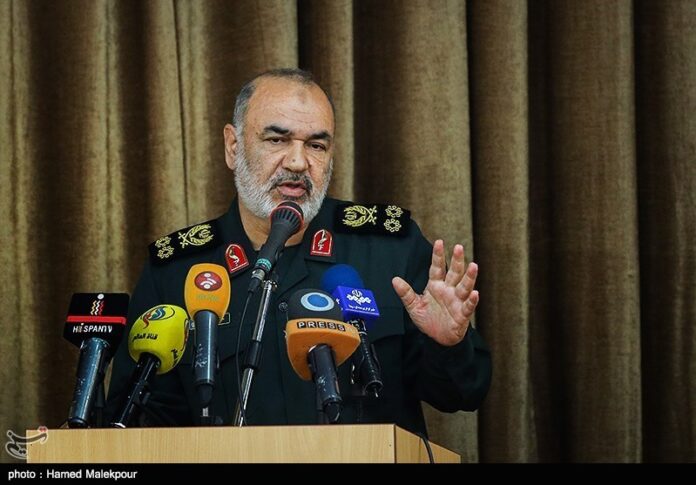
Iran at Most Decisive Moment in Face of Enemy Threats: IRGC Chief

General Hossein Salami

Speaking on Wednesday, General Salami said it is the most decisive moment of the Islamic Revolution as the enemy has stepped into the field of confrontation with Iran with all the possible capacity.

“Today, our enemies by applying the maximum pressure strategy and using all their capacities are trying to break the steadfastness of the Iranian nation, but they will fail.”

He went on to say that the conditions of the Islamic Revolution today are more sensitive than ever.

Salami also stressed that the enemies have reached the end of the line, and despite their strong appearance, their bones are brittle.

Earlier in the day, Iranian Defence Minister Brigadier General Amir Hatami had noted that the Islamic Republic currently has the highest level of defence preparedness to counter any threat against the country.

“Today the Islamic Republic of Iran stands at the peak of defence-military preparedness to counter any threat or act of aggression,” Hatami said on Wednesday.

The IRGC chief’s comments come as the United States has sent further military forces to the Middle East, including an aircraft carrier, B-52 bombers and Patriot missiles. US officials claim Iran is threatening its troops and interests in the region.

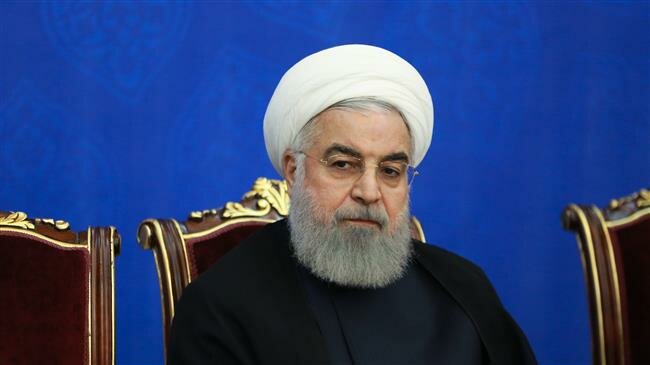
Rouhani Calls US Sanctions ‘Crime against Humanity’

Hassan Rouhani - President of the Islamic Republic of Iran

“The hard days and the problems created by the US’ economic war have started,” Rouhani said in a Wednesday meeting with a group of Iranian lawyers in Tehran.
The Iranian president described the war as a “crime against humanity,” saying the sanctions have created troubles for the people’s livelihood and made it more difficult for them to access food and medication.
“This is not a war against the government of the Islamic Republic of Iran, but a war against the Iranian nation,” he added.
The US government re-imposed its sanctions against Iran after it unilaterally withdrew from the nuclear deal with Tehran in May 2018. Washington recently stopped issuing sanctions waivers for Iran’s eight largest oil clients in a bid to cut down the country’s oil exports to zero. It has also threatened the buyers of Iranian oil with sanctions if they fail to stop their purchases.

US President Donald Trump also imposed sanctions on Iran’s export of industrial metals in a bid to cut all sources of revenue for the Islamic Republic.

Despite the US’ claim that the sanctions are merely aimed at changing the Iranian government’s behavior, they have practically endangered the lives of many Iranian patients.

“Despite the illegality of sanctioning food and medicine, the US government is preventing access to these vital resources and has therefore put in danger the lives of many patients from small children to the elderly who are in urgent need of medicine and medical equipment,” President of the Academy of Medical Sciences of the Islamic Republic of Iran Alireza Marandi said in a letter to United Nations Secretary General António Guterres back in November.

He pointed to the clear detrimental effects of these sanctions on Iranian children suffering from cancer and said, “The US sanctions policy on the Islamic Republic of Iran has been devised in such a way that prevents all banking exchanges including access to essential medicines and medical equipment which are now virtually impossible.”

A photo recently went viral on the Iranian social media, showing a long line of patients in front of Tehran’s Rajaei Heart Hospital, waiting to receive pacemakers, whose prices have reportedly increased by more than five times following the Trump administration’s cruel sanctions.