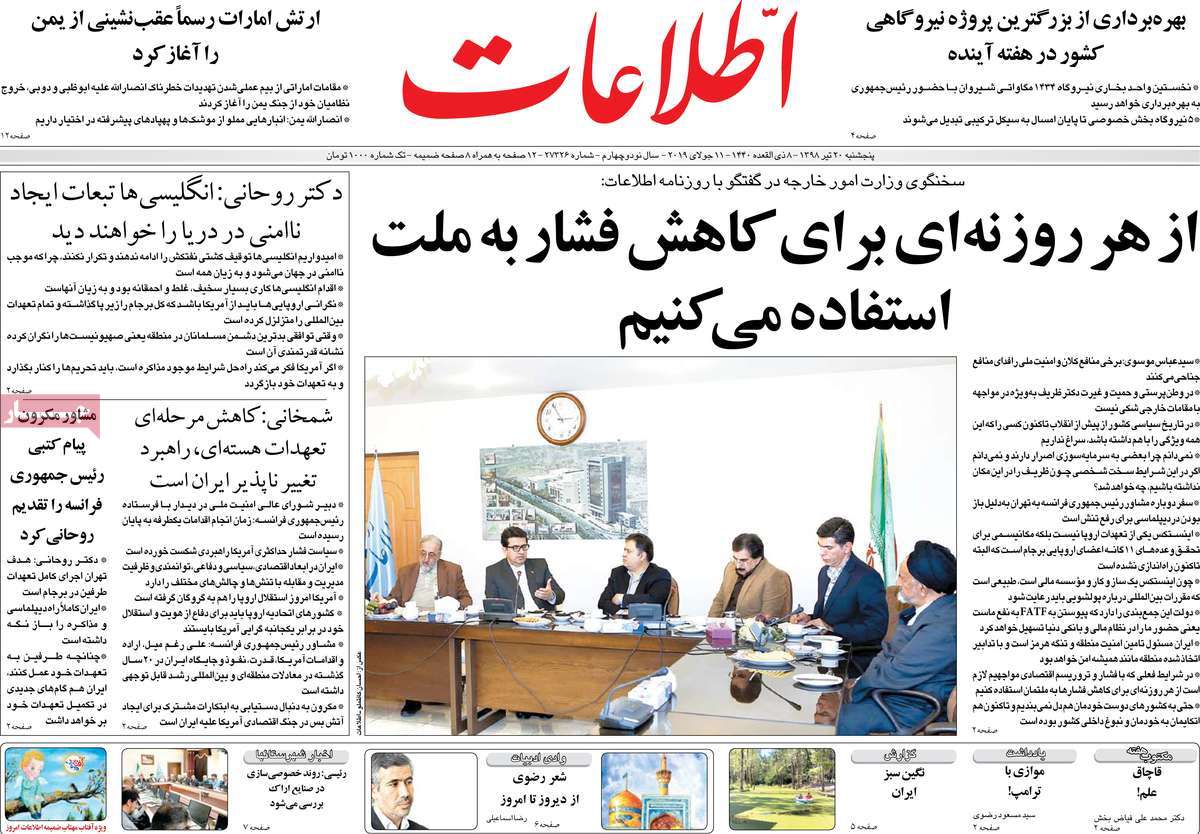
In comments on Wednesday, Lieutenant Commander of the Iranian Police Brigadier General Ayyoub Soleimani said aerial imaging disproves speculation about the existence of opium poppy farms in Iran.
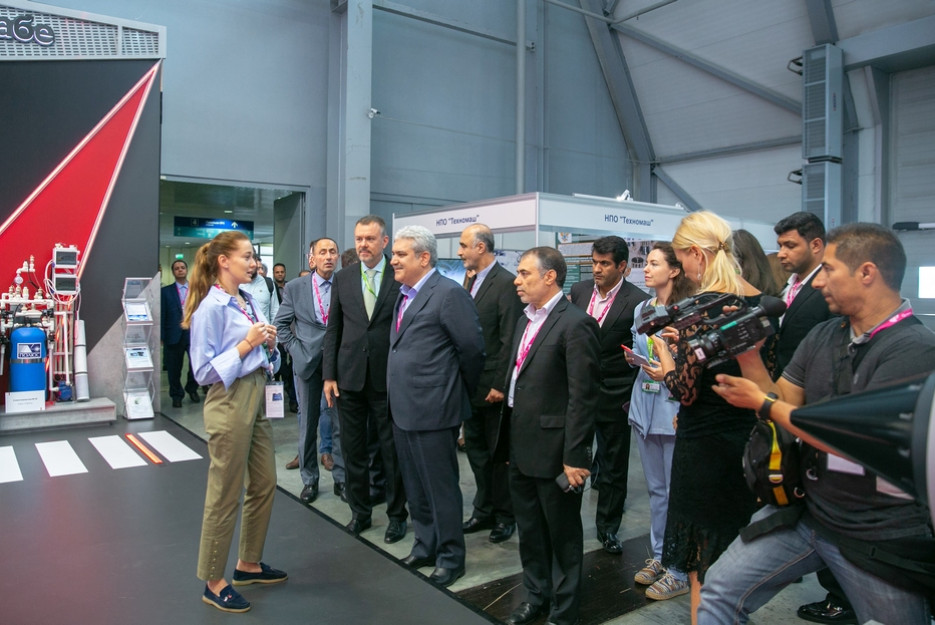
The Iranian Anti-Narcotics Police use satellites, provided by the Ministry of Information and Communications Technology, to monitor the territories, he added.
Reaching a formal conclusion about the satellite images comes within the purview of the Police, the commander emphasized.
Pointing to the Anti-Narcotics Police’s employment of heavy drones, armed choppers and advanced optical and electronic devices, the general said more than 75 percent of the narcotics seized worldwide are being found in Iran.
He also noted that the volume of narcotics seized in Iran in the first quarter of the current Iranian year has increased by 4 percent compared to the corresponding period last year.
Iran shares a 900-kilometer border with Afghanistan and has been used as a main conduit for smuggling Afghan drugs to narcotics kingpins in Europe.
Despite high economic and human costs, the Islamic Republic has been actively fighting drug-trafficking over the past decades.
The country has spent more than $700 million on sealing its borders and preventing the transit of narcotics destined for European, Arab and Central Asian countries.
The war on drug trade originating from Afghanistan has claimed the lives of nearly 4,000 Iranian police officers over the past four decades.
Speaking during a meeting with Ali Asghar Khaji, a senior assistant on special political affairs to Iranian Foreign Minister Mohammad Javad Zarif, in Damascus on Tuesday, Assad underscored his country’s backing for Iran and its leadership, stating that Syria defends Iranians’ strive for their rights and stands by them against all threats and acts that violate the basis of the international law.
Assad was then briefed on the developments concerning the Iran nuclear deal, formally known as the Joint Comprehensive Plan of Action (JCPOA), following the US departure from the 2015 agreement, and Washington’s latest escalatory moves in the Middle East region.
The two sides also exchanged viewpoints on Syria’s counter-terrorism campaign, counterattacks to assaults being carried out by foreign-sponsored Takfiri terrorist groups positioned in Syria’s embattled northwestern province of Idlib, initiatives for a political solution to Syria’s crisis, the next round of Syria peace talks in Kazakhstan, as well as the latest regional and international developments.
Khaji, for his part, pointed to the deeply-rooted relations between Tehran and Damascus, emphasizing that Iran is determined to bolster such ties in all areas in order to serve the interests of both nations.
The Iranian nation and government will continue to support Syria until it liberates all its territory and rebuilds what has been destroyed by the war, he pointed out.
Separately, the Iranian official met and held talks with Syrian Foreign Minister Walid al-Muallem.
They stressed the need for enhanced coordination and consultations between the two countries regarding upcoming international meetings on the political process in Syria, and all-out promotion of bilateral relations.
The two officials then discussed the recent regional developments, and the US economic terrorism against Syria and Iran.
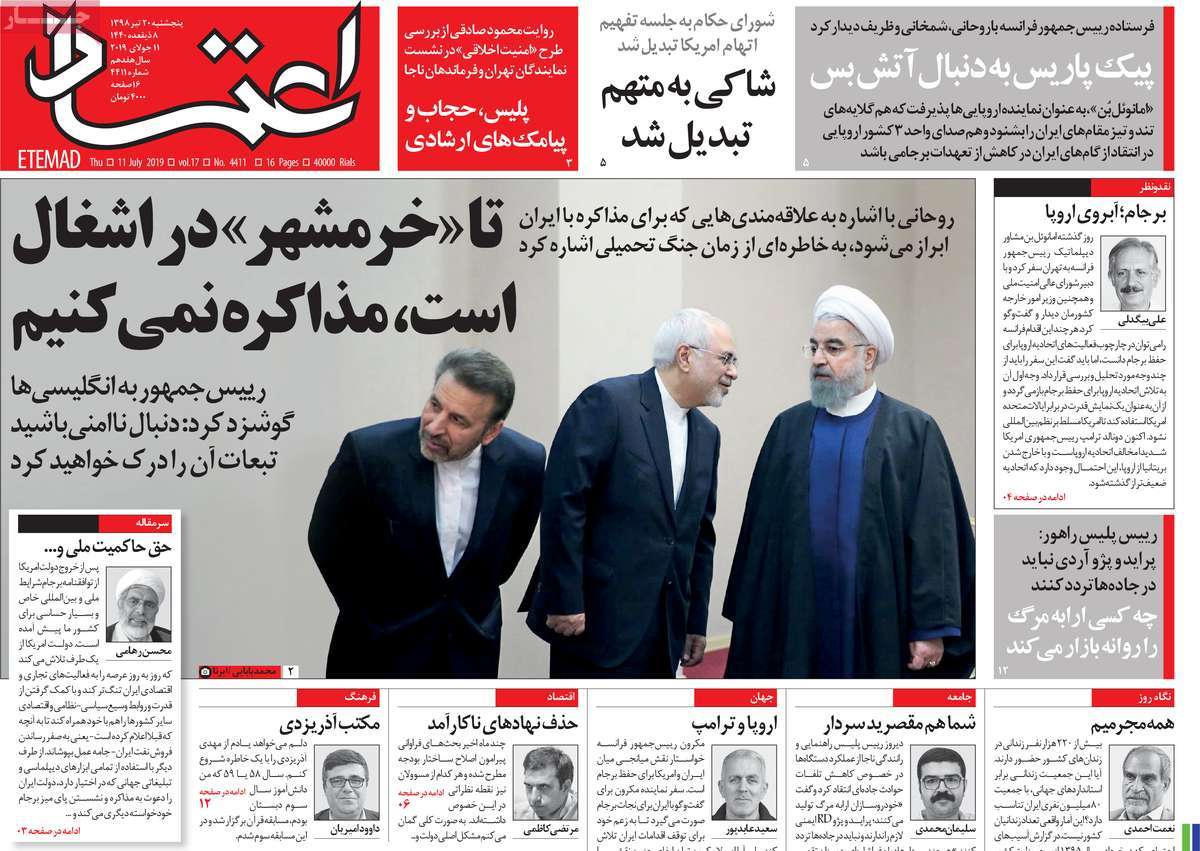
Zarif on Wednesday stressed that Iran will live up to its pledges under the nuclear accord as far as the Europeans do so.
He then referred to the ministerial meeting held between Iran and the three European countries following the US withdrawal from the Iran nuclear deal in May last year and also a subsequent meeting and said during the meetings, the Europeans vowed to observe eleven commitments regarding Iran.
According to Zarif, the commitments included returning Iran’s oil money and making investment in Iran in transportation, aviation and shipping sectors.
“They made the commitments during the meetings. In none of these commitments, there is no reference to the Instrument in Support of Trade Exchanges (INSTEX). There are only 11 commitments,” he said.
Iran’s top diplomat then added having become operational, INSTEX serves only as a prerequisite for the implementation of the mentioned 11 commitments.
“The Europeans must live up to the commitments. If you make a review of the appendix 2 of the JCPOA and go through article one to three, you will find out the deal makes it clear that it is not enough to say that the Europeans have violated a law. The repercussions of the violation should also be clarified,” he concluded.
Addressing a cabinet session on Wednesday, Rouhani blasted the US government’s official account that the USS Vincennes had mistaken the Iranian passenger plane with a jet fighter.
“One cannot believe and even imagine that a warship has mistaken a huge plane like the Airbus airliner with a jet fighter. The state of the passenger plane in its flight route and the way it took off are totally different from the way a jet fighter flies. Any individual with the most rudimentary knowledge of the basics and alphabet of military affairs would understand that the doomed plane was going up in a specified direction. A jet fighter doesn’t move like that,” he noted.
“Let’s even suppose they’ve made a mistake and thought it was an F-14 jet fighter. Why did you attack an F-14? F-14 is not a bomber plane, is it? If you had mistaken it with a Phantom, that could be justified; you’d have said it was a Phantom that could bombard us,” Rouhani said.
However, he added, “an F-14 is a jet fighter used for interception and dogfight. Was an American plane in front of this F-14? The warship was down there; what could the Tomcat do from that altitude? F-14 doesn’t have any air-to-surface missile and doesn’t carry any bomb. Its missiles are air-to-air. This is a baseless justification [that they mistook the airliner with an F-14].”
“Scientifically speaking, it is not at all acceptable to say they’ve made a mistake. Even if they had made a mistake, they never apologized to the Iranian nation or punished the warship’s captain. On the contrary, they rewarded them and gave them medals,” Rouhani noted, referring to the fact that the warship’s captain was awarded the prestigious medal of Legion of Merit for his so-called outstanding service.
“This shows it is quite easy for Americans to commit crimes. They can easily mutilate 290 passengers and crew members in the air in cold blood, and then try to get over it by making a delusional statement,” Rouhani said.
In a ceremony on Wednesday, the international airport of Bandar Abbas, the city where the Airbus A300-B2 plane belonging to Iran’s flag carrier Iran Air had just taken off from at 10:17 am, was renamed to “Flight 655 Martyrs Airport”.
The idea was first raised and promoted by famous Iranian actor Parviz Parastouei.
Iranian actor Parviz Parastouei – BandarAbbas flight 655 martyrs international airport
Back in 1988, the plane with 274 passengers and 16 crew members on board was climbing inside an internationally recognized route to Dubai when the US cruiser, the USS Vincennes, fired two SM-2MR surface-to-air missiles at it, one of which hit the plane and killed all the people on board.
US officials claimed their warship had mistaken the airliner for a supersonic and variable-sweep wing Grumman F-14 Tomcat fighter jet.
The allegation was made even as the warship was equipped with highly sophisticated radar systems and electronic battle gear, and the passenger plane was transmitting Mode III 6760 squawk code, typical of a civilian aircraft, and maintained radio contact in English with appropriate air traffic control facilities.
IR6555
The USS Vincennes had entered Iranian territorial waters after one of its helicopters drew warning fire from Iranian speedboats operating within Iranian territorial limits.
Washington later paid some 95 million dollars in compensation for the Iranian victims and the aircraft.
The money, however, failed to placate the anti-US sentiments in Iran, where people expected the USS Vincennes’ captain, William Rogers, to be held responsible for his criminal act. Rogers was instead awarded the prestigious medal of Legion of Merit for his so-called outstanding service.
In this file photo taken on Thursday, Jan. 1, 1998, Decommissioned Russian nuclear submarines are shown in their Arctic base of Severomorsk, the Kola Peninsula, Russia. / Photo by AP
In his Wednesday statement, Mousavi offered condolences and sympathy to the Russian nation and government, particularly the families of the victims, over the tragic incident.
At least 14 sailors died Monday after a Russian navy deep-sea submersible caught fire under water during a research mission, officials said.
The vessel caught fire unexpectedly while the submersible was measuring sea depths in Russia’s territorial waters, the Defence Ministry announced.
The fire was put out thanks to the self-sacrifice of crew members although officials did not say how many sailors were aboard the vessel at the time of the blaze or how many, if any, survived.
Russian President Vladimir Putin cancelled a scheduled appearance Tuesday and summoned his defence minister to get briefed on the situation.
The vessel, which has only been identified by the ministry as one intended for studying the seabed, has since been docked at the Arctic port of Severomorsk, the main base of Russia’s Northern Fleet.
Russia’s RBC online news outlet reported the fire took place on the nuclear-powered AS-12 Losharik.
The Losharik, a relatively new ship which entered service in 2010, is the most advanced and most obscure Russian submarine. It’s named after a Soviet-era cartoon character, a toy horse made of small spheres.
In 2012, the vessel was involved in research intended to prove Russia’s claim on the vast Arctic seabed. It collected samples from the depth of 8,202 feet, according to official statements at the time. Regular submarines can typically dive to depths of up to 2,000 feet.
Some Russian officials have speculated that the sub can travel as deep as 19,685 feet, although this has yet to be independently verified, Fox News reported.
The fire marks one of the more serious Russian naval incidents since 2000, when 118 men died after the Kursk nuclear submarine exploded and sank on August 12 during naval manoeuvres in the Barents Sea.
The tragedy, which took place soon after Putin assumed office, drew attention to the state of the Russian military which had been subject to underfunding and neglect following the collapse of the Soviet Union.
It subsequently led to a massive increase in military funding.
The Leader made the comment while addressing a host of local officials in charge of the Hajj pilgrimage on Wednesday.
“The creation of unity is a political move. Defending and supporting the Palestinian nation and the oppressed in the Muslim world like in Yemen is a political move. Defending the oppressed fully conforms to Islamic teachings and is a [religious] duty. Disavowal of pagans is a duty, too. All of these are stipulated in religion,” said Ayatollah Khamenei.
He then drew a comparison between “religious” political moves and “non-religious, diabolical” ones.
The Leader said an example of non-religious political moves is when some say pilgrims should not express their protest at the US and should not express their disavowal of pagans during Hajj rituals.
The Leader underlined that Hajj is a social factor which contributes to unity and brotherhood, and at the same time, is a show of morality.
The Leader further noted that the Saudi government is duty-bound to respect and ensure the safety and dignity of Hajj pilgrims.
“Those who are in charge of the Hajj pilgrimage, shoulder heavy responsibilities,” said the Leader.
“Among their (officials) duties is to ensure the security of pilgrims, but they shouldn’t create a police state. They should preserve pilgrims’ respect and dignity,” Ayatollah Khamenei said.
In September 2015, a deadly human crush occurred during Hajj rituals in Mina, near Mecca.
Days into the incident, Saudi Arabia published a death toll of 770 but refused to update it despite gradually surging fatality figures from individual countries whose nationals had been among the victims of the crush.
Unofficial sources put the death toll at almost 7,000 people. Iran said about 465 of its nationals lost their lives in the incident.
Earlier that same month, a massive construction crane had collapsed into Mecca’s Grand Mosque, killing more than 100 pilgrims, including 11 Iranians, and injuring over 200 others, including 32 nationals from Iran.
Serious questions were raised about the competence of Saudi authorities to manage the Hajj rituals in the wake of the incidents, and, facing Saudi intransigence to cooperate and refusal to guarantee the safety of Iranian pilgrims, officials in the Islamic Republic subsequently decided to halt pilgrimages over security concerns.
Saudi Arabia also unilaterally severed its diplomatic ties with Iran in January 2016 after protests in front of its diplomatic premises in Tehran and Mashhad against the execution by Riyadh of eminent Saudi Shiite cleric Sheikh Nimr al-Nimr.
Addressing a cabinet session on Tuesday, Rouhani said as of Sunday, Iran will no longer remain committed to the 3.67% uranium enrichment level set by the Joint Comprehensive Plan of Action (JCPOA).
“On July 7, our enrichment level will no longer be 3.67 percent. We will put aside this commitment. We will increase (the enrichment level) beyond 3.67 percent to as much as we want, as much as is necessary, as much as we need,” he noted.
“We will adopt our next measures as of July 7. If you want to express regret, please express it right now. If you are going to issue a statement, issue it today,” the Iranian president added.
Rouhani also warned that “after July 7, if you don’t live up to the commitments you have made within an agreed timetable, we will restore Arak reactor to its earlier status, the very status which you once referred to as dangerous and capable of producing Plutonium.”
“We recommend the Europeans and the US get back to logic, to sit behind the negotiating table, return to understanding and rule of law and respect the United Nations Security Council’s approvals and let’s live up to our commitments under the JCPOA,” he noted.
Rouhani said Iran “will remain committed to the nuclear deal as long as the other sides remain committed.”
“We observe JCPOA’s commitments one hundred percent but only if the other sides respect it one hundred percent,” he said.
Iran Not after Killing JCPOA
Rouhani further noted that if Iran wants to get back to its previous status, it can do it immediately.
“We can do this simply through selling the [surplus] heavy water to another country and get back to lower percentage of enrichment. All the move we have made so far can get back to their previous status just within one hour. Why are you concerned? We had told you that we will get back to the square one but only if you remain committed to your pledges. We don’t want to make a tit-for-tat. We are not after destroying the deal.”
Rouhani said the Europeans failed to do their commitments even though they had a lot of time.
After two and half months, “they called me again and begged to give them another one month. What happened after the one month? You didn’t even remain committed to what you yourselves had advised us to do and the very commitments you had vowed to make and even the commitments you had explicitly told me on the phone to do.”
He also lashed out at the Europeans for their silence towards the US’ brutal sanctions, which have hit ordinary people in Iran, blocking their access to basic humanitarian goods.
“The Europeans remained silent amid the suffering of the 82-mn-population nation of Iran who are struggling to have access to basic goods. These countries are self-proclaimed defenders of human rights.”
“Why do such countries which proclaim themselves supporter of innocent people including men and women, the elderly and the youths, teenagers and children, have remained silent for one year? Why don’t they openly condemn the US and why don’t they make up for the losses that the US has inflicted on Iran. We decided to do something against their silence,” he said.
The work of art will be displayed at the 11th edition of Tehran Auction, which is dedicated to Modern and Classic Iranian Art.
Farshchian is indubitably Iran’s most prominent contemporary miniaturist. His works are very popular not only among connoisseurs, but among ordinary people as well. His famous painting called “The Ashura Evening” is highly praised by all those who love Imam Hossein, the third Shia Imam, and are touched by the struggles of Imam Hossein and his faithful followers against the tyranny of the time. Farshchian has donated “The Ashura Evening” painting along with 16 other precious works with religious concepts to the museum of the Imam Reza Holy Shrine in northeastern Khorasan Razavi province.
Moreover, he has designed the metal lattice frames installed on the tombs of Imam Reza, Imam Hossein and Hazrat Abdulazim without expecting any material gain.
Now, one of his most invaluable paintings illustrating the crucifixion of Jesus has entered the Tehran auction and will be put up for sale along with other works of modern and classic Iranian art.
The starting bid for the painting is estimated at between 15 and 20 billion rials. The painting, which has not been given any name, was created with watercolour and gouache in 2006.
The painting depicts the crucifixion and ascension of Jesus. In most Western works of art, the crucified body of Jesus on the cross is illustrated. However, Farshchian says the way he has depicted Christ is different from how his crucifixion is normally illustrated. In Farshchian’s work, the only members of Jesus’ body which can be seen are his legs drawn at the top of the painting. The cross is seen at the centre of the painting like a vertical column stretching from bottom to top. Here, the vertical dimension is accentuated.
In his painting, Farshchian depicts ascension from the earth to the heavens. The torso of Jesus is not illustrated in the painting, which highlights two spiritual points: First, it refers to what God Almighty says in the Holy Quran: “They said they had killed Jesus Christ, but they had neither killed nor hanged him. They only erroneously believe it happened. They are those who are divided on how Jesus was murdered, and they are in doubt, and they are not aware of what happened, and they only rely on guessing, and they definitely did not kill Jesus; rather, God made Jesus ascend toward Him, and God is omnipotent and wise.” And the second point is that the painting underscores the status of Jesus Christ, who has a status higher than that of angels. Reaching such a high position is one of key mystic issues. Renowned Iranian poet Rumi also elaborates on this point in his poems.
Farshchian’s painting depicts angels spiraling around Jesus’ feet, and nothing else can be seen. The reason is that the artist has focused on Christ’s ascension to the heavens and the experience of Jesus’ presence before God. The painter illustrates a scene where the audience see angels on the ground and Jesus in the skies.
Farshchian has established his own school in the domain of miniature painting. His style conforms to the principles of basic traditional Iranian painting while drawing on new techniques. He has combined all of those techniques with the Western 3-D techniques, contributing heavily to the progress of painting in Iran.
Farshchian’s works have been showcased in hundreds of individual and collective exhibitions both in Iran and abroad, bringing him worldwide fame. Museums, libraries, personal collectors and art lovers take pride in being in possession of his works.
Major General Hossein Salami, the chief commander of Iran’s Islamic Revolution Guards Corps (IRGC), noted that Iran has completely blocked the enemy’s path in the military domain and “reversed the balance.”
“Maybe until some time ago, some individuals believed that if we do not succumb to the enemy’s demand for talks, the option of war will be inevitable. However, the situation played out in such a way that the enemy was even afraid of the thought of the outbreak of a war,” he said.
“At this juncture, it is the enemy that is worried about the outbreak of war, and this worry is evident in their physical and tactical behaviour,” he said.
The IRGC commander underlined that Iran should formulate mechanisms to tackle the enemy’s machinations.
“We have a duty to work out formulas to tackle all of the enemy’s formulas,” he said.
“Today, out global power is well-known and enjoys an extraordinary deterrence capability, and in reality, we managed to shatter the United States’ fabricated and artificial power created through psychological warfare,” he said.
General Salami the enemy has now got engaged in an economic ear against Iran.
Brigadier General Alireza Sabahifard further said Iran’s deterrence power holds the enemy back.
“If the enemy has stopped at a distance 200 miles from the Strait of Hormuz, it is due to our deterrence capability. Iran’s combat preparedness should not be put to the test, and their first mistake will be their last one,” said General Sahabifard, who is the commander of the Air Defence Force of the Iranian Army.
“The enemy is rattling sabres through its military presence in the Persian Gulf and exerting maximum pressure, and wants to impose its sinister intentions on the steely resolve of the Iranian nation,” he noted.
“On the one hand, the enemy bangs the drum of war, and on the other, it ratchets up sanctions. Still, the enemy offers to hold talks. This shows the enemy is not reliable,” he said.
He said the US and its cronies in the region should know that they are no able to confront Iran as the Islamic Republic is in possession of “unique secret weapons.”