Tuesday, December 23, 2025
Home Blog Page 3182

Saudis Refusing to Let Iranian Tanker Go

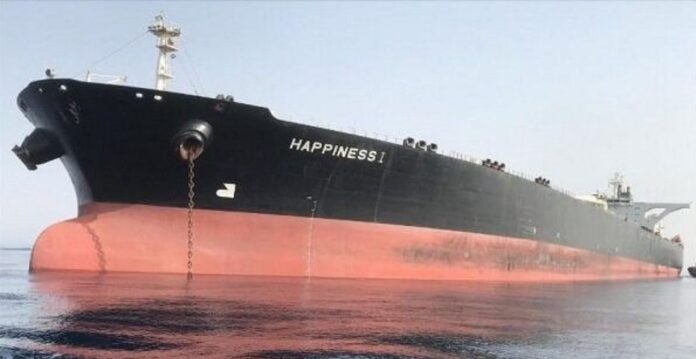
Iranian tanker Happiness 1

A Tuesday report by Mehr News Agency suggests that the Saudi authorities are refusing to permit the Iranian oil tanker “Happiness 1” to leave Jeddah, even though the vessel’s technical problem has been resolved.

Saudi Arabia not only denies an exit permit to the Iranian oil tanker, but also is charging the National Iranian Tanker Co (NITC) $200,000 a day for the additional costs of maintenance, the report added.

A technical failure in Happiness 1 forced the oil tanker to berth at the Saudi port of Jeddah on April 30.

The NITC said the technical problem had caused sea water to leak into the ship’s engine room and stall the engine when the vessel was heading towards the Suez Canal in the Red Sea.

All of the 26 crew on board the oil tanker were safe after the incident.

US Sanctions Threatening Life of Patients, Iranian Medical Academy Warns

Seyyed Alireza Marandi

In a letter to European Union Foreign Policy Chief Federica Mogherini, Dr. Seyed Alireza Marandi bemoaned the fact that the US sanctions have limited the access to medicine and vital medical equipment in Iran and have led to critical health conditions and the death of many patients.

The Iranian physician also highlighted his academy’s duty to monitor the health of Iranian citizens, and listed a number of health problems caused by the “outrageous sanctions” against people of Iran.

“The illegal sanctions, based on evidence and documentation and as stated in the several correspondences that I have had with the UN Secretary-General, have limited the access to medicine and vital medical equipment leading to critical health conditions and the death of many innocent patients,” he deplored.

“The use of brutal sanctions has led to a reduction in the value of the national currency, a decrease in the public’s purchasing power, and rising prices. As a result, providing affordable healthy food for many people has become problematic. Therefore, US-led economic warfare and terrorism has had a direct impact on the health of the community,” Marandi noted.

“Major events, such as flooding in parts of our country in recent months, have seriously damaged houses and living conditions for many people, and unfortunately, cruel sanctions have prevented international financial aid and even aid from fellow Iranians abroad to reach the people in need. Meanwhile, soaring summer temperatures increase the risk of an outbreak of contagious diseases among these people,” he warned.

“Given the above, what is certain is that the problems related to supplying food and medicine cannot be solved through the utterly inadequate and unreliable mechanisms you intend to create,” Marandi told Mogherini.

“The entire sanctions regime must be lifted or ignored, our oil exported, and normal banking and financial exchanges resumed in accordance with the nuclear deal in order to resolve these problems. The compassionate and hardworking medical community in the Islamic Republic of Iran, over the last forty years, has been struggling for the wellbeing of our people. This was especially evident during the imposed war when Western countries provided Saddam Hussein with chemical weapons and as numerous layers of illegal and inhumane sanctions were imposed. This question will always remain in the minds of our medical community: why should our people suffer under these barbaric sanctions while the self-proclaimed champions of human rights are silent and complicit?” the Iranian physician concluded.

Back in May, Marandi sent a letter to UN Secretary General Antonio Guterres, decrying a muted response from the international human rights organizations to the crimes committed by the US regime and blocking of international aid to Iranians affected by floods.

2 IRGC Forces Killed in Clash with Terrorists in Iran

IRGC

The IRGC said in a statement that the clash took place in Chaldoran region on Tuesday morning, during which the ground forces of Hamzeh Sayyid al-Shohada Headquarters dismantled the terrorist cell affiliated with the “global arrogance”.

The Iranian troops killed two terrorists and injured a number of others, but two local IRGC fighters were also martyred in the clash, it said.

A remarkable amount of weapons, equipment, ammunition and communication systems were confiscated in the operation against terrorists, the statement noted, adding that a manhunt is still in progress.

The IRGC is in charge of border security in Iran’s northwestern and southeastern regions.

Iran Equalizes Blood Money for Men, Women in Historic Decision

The law has been modified based on a verdict by the Supreme Court of Iran, which is indeed an endorsement of an earlier law passed by the Parliament and approved by the Guardian Council.

Diyah in Islamic law is the financial compensation paid to the victim or heirs of a victim in the cases of murder, bodily harm or property damage. It is an alternative punishment to Qisas (equal retaliation).

It only applies when the victim’s family wants to compromise with the guilty party; otherwise Qisas applies.

In the law of Sharia, which was the basis of Iran’s previous law, the blood money for female victims was half the amount set for men; however, based on the new verdict, the other half will be paid to the women victims or their heirs by the Fund for the Provision of Physical Damage, providing the survivors with an amount equal to that of men.

The equality of men and women in Diyah has always been a sticking point in the religious and judiciary circles with each side having their own reasons.

Women’s rights activists advocated for the equality for a long time, arguing that the role women play in the society these days is not at all comparable to the time when the rules of Sharia were implemented 1,400 years ago. They finally prompted the Iranian Parliament to put the issue on its agenda.

The Parliament first managed to change the law for victims of car crashes in 2009, arguing that when consumers – both men and women – pay equal amounts for their insurance, they must be paid equally.

The interim law was approved by the Guardian Council, and implemented until 2013, when the lawmakers turned it into a permanent law, but started their efforts to convince jurists and religious authorities that for other crimes and damages, too, women need to receive an equal amount of blood money.

They finally managed to pass the controversial law, which was later endorsed by the Guardian Council and the Supreme Court, despite opposition by a number of top clerics.

Iran to Display Knowledge-Based Food Products at Turkey Expo

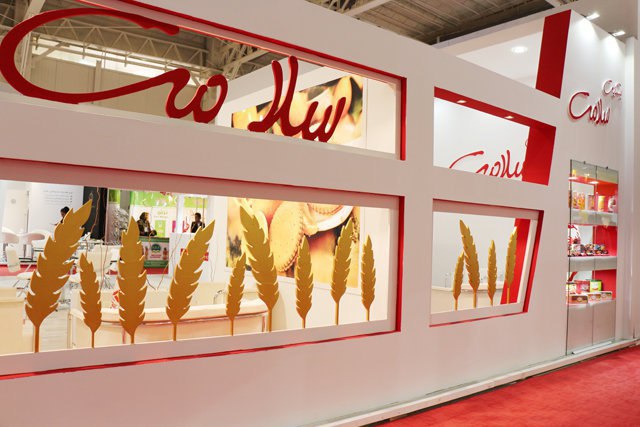
Iran’s first pavilion showcasing the country’s knowledge-based products geared to export will be open to public at the expo in late summer.

“CNR Food is the biggest and most important expo of foods and beverages in Eurasia” held in cooperation with several Turkish food, beverage, and grain associations, said Marzieh Shaverdi, a top official at the Iranian Innovation and Development Fund, in an interview with ISNA.

She said the Istanbul event is a suitable forum where suppliers and buyers of food products can meet.
Shaverdi noted the exhibition also showcases machinery pertaining to the food industry and relevant industries.

She said Iran’s pavilion will run from September 4 to September 7, 2019.

“This exhibition is a good opportunity for visitors to get familiar with the latest developments in, and see an innovative outlook for the food industry,” she added.

“In this year’s expo, there will be a special section where food packaging and beverage producing machinery will be put on show,” she added.

Iran Leader Appoints New Military Commanders

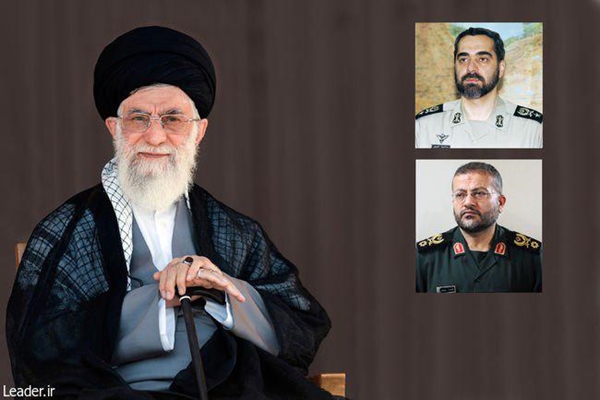
In a decree on Tuesday, the Leader appointed Brigadier General Mohammad Reza Ashtiani, an Army general, as the new Deputy Chief of Staff of the Iranian Armed Forces.

In another decree, Ayatollah Khamenei also appointed Brigadier General Gholam-Reza Soleimani as the new commander of IRGC’s Basij Organization.

The new commanders respectively replace Major General Ataollah Salehi and Brigadier General Gholam-Hossein Gheibparvar.

In the decrees, Ayatollah Khamenei appreciated the efforts made by former commanders in both positions and called on the new appointees to speed up efforts to ensure Iran’s security and use potentials of the young generation of Iran.

Basij is a paramilitary voluntary force established in 1979 on late founder of the Islamic Republic Imam Khomeini’s order.

The force consists of often young Iranians, who have volunteered, with a strong sense of fidelity to both the Islamic system and religious beliefs.

General Gheibparvar had been appointed as the Basij chief in December 2016. His predecessor, Mohammad-Reza Naqdi, had remained in the position for over seven years.

A Look at Iranian Newspaper Front Pages on July 2

A Look at Iranian Newspaper Front Pages on November 19

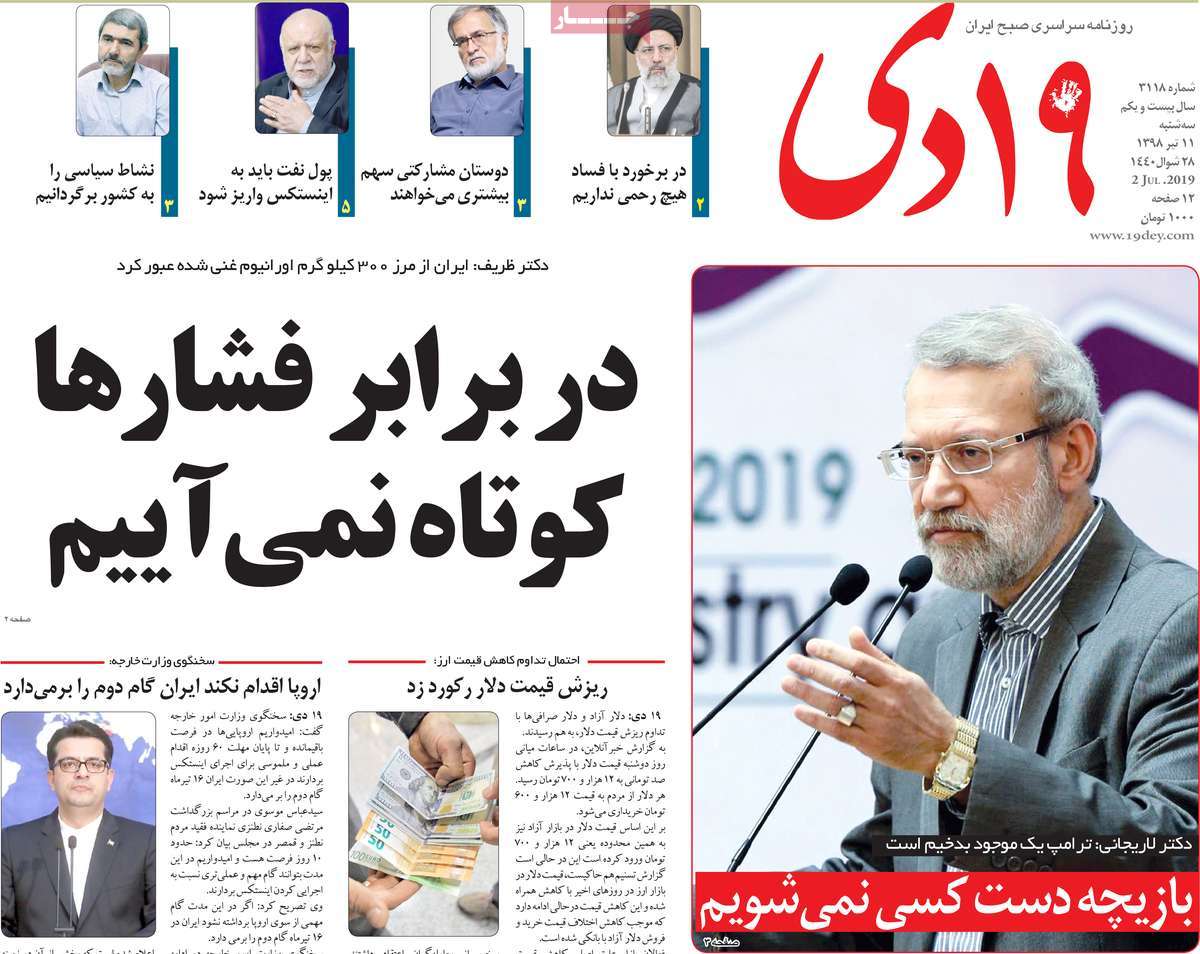
19 Dey:

1- Zarif: We Won’t Give in to Pressures

2- Foreign Ministry Spokesman: Iran to Take Second Step If Europe Fails to Do Its Part
A Look at Iranian Newspaper Front Pages on July 2


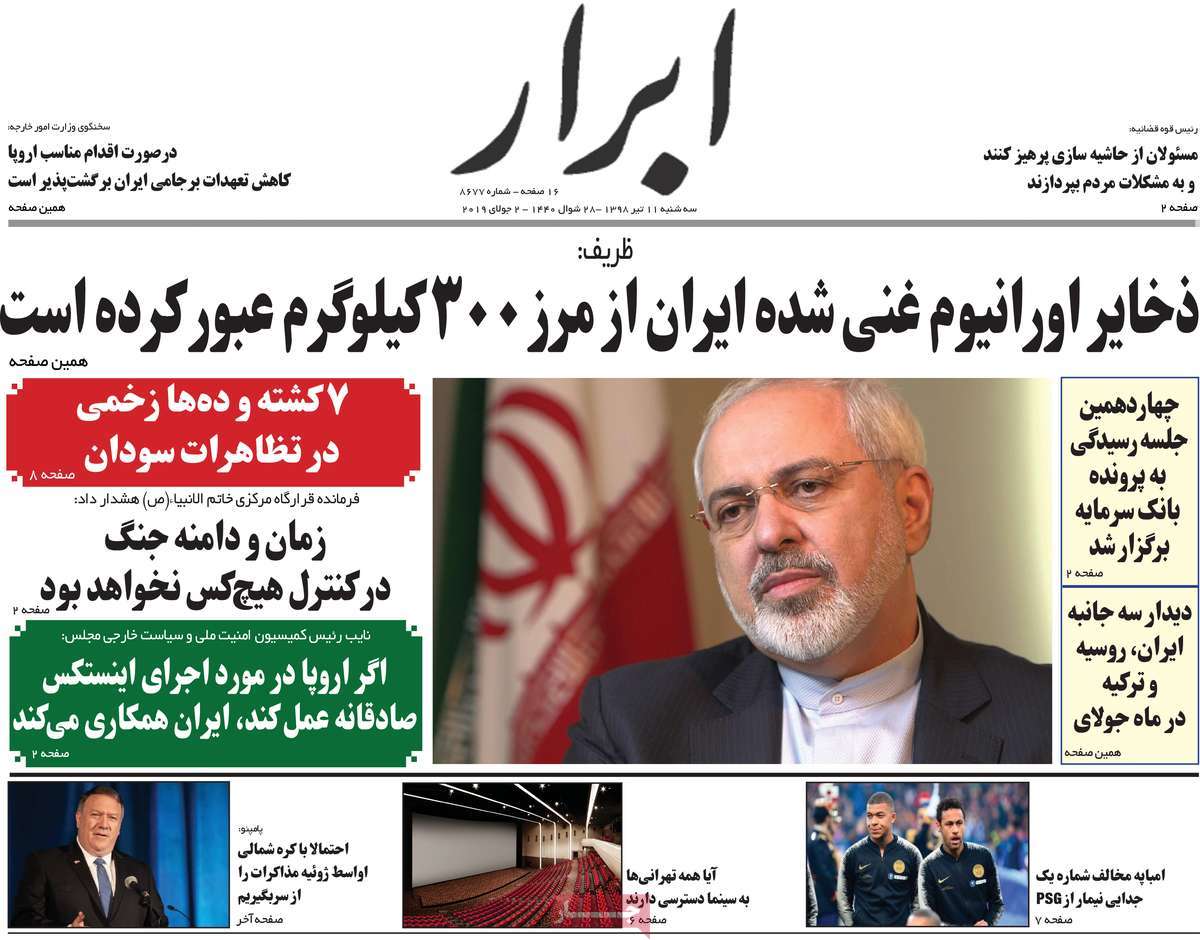
Abrar:

1- Iran to Cooperate If Europe Acts Honestly on INSTEX: MP

2- Iran, Russia, Turkey to Hold Tripartite Meeting in July
A Look at Iranian Newspaper Front Pages on July 2


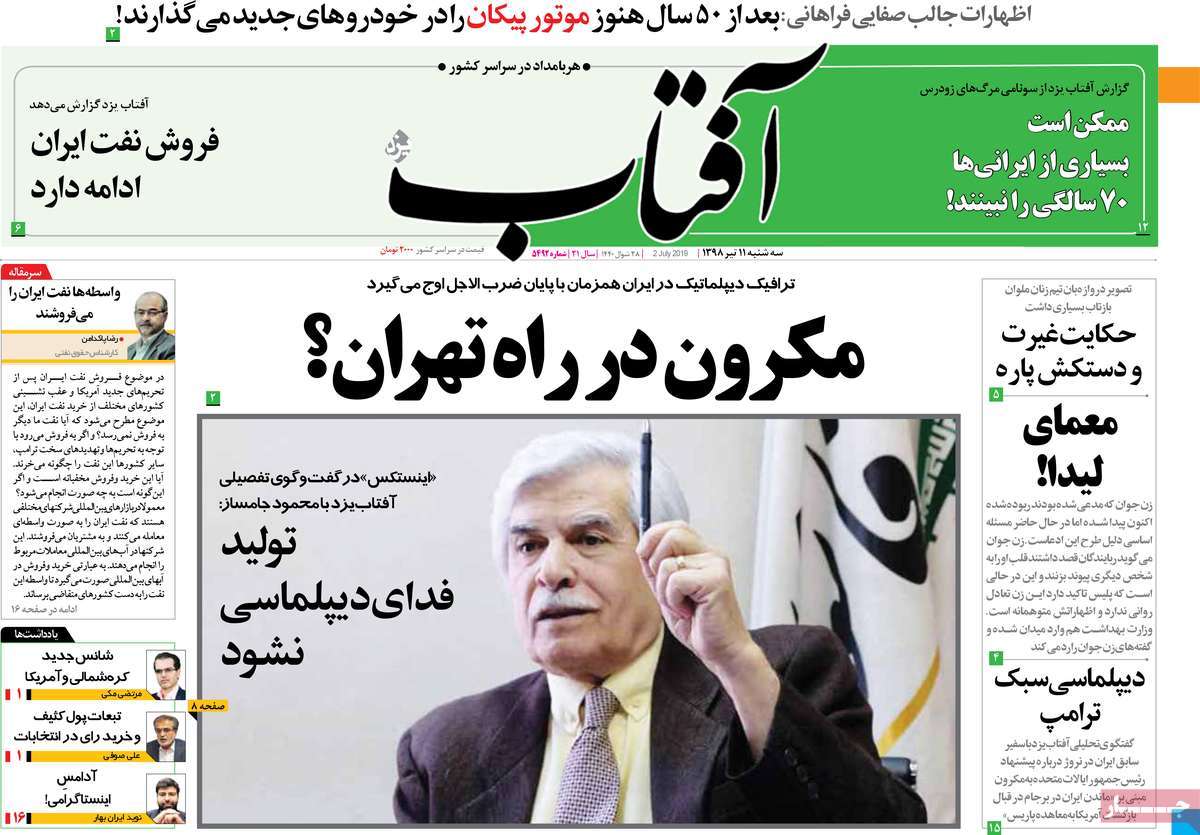
Aftab-e Yazd:

1- Macron en Route to Tehran?

* Diplomatic Traffic in Iran as Deadline Looms

2- Iran’s Oil Sales Continue

3- Middle Men Selling Iran’s Oil [Editorial]
A Look at Iranian Newspaper Front Pages on July 2


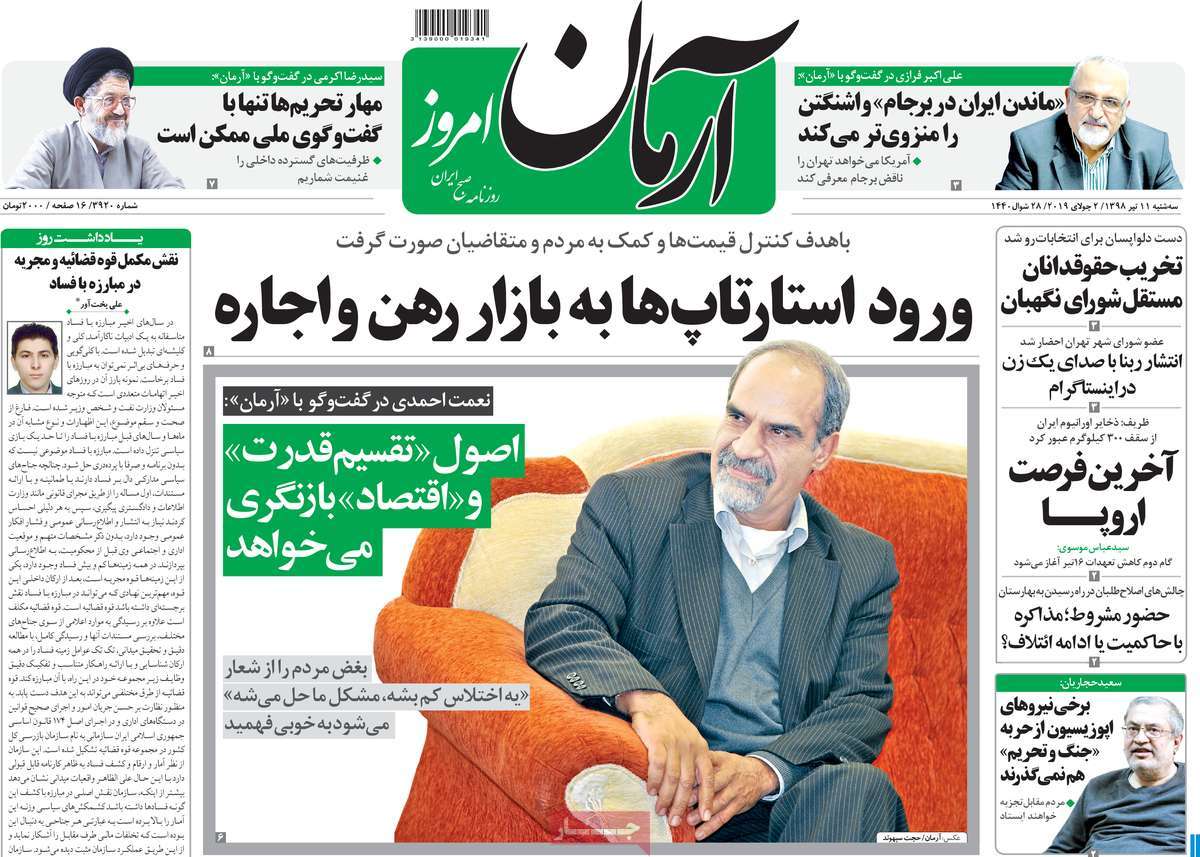
Arman-e Emrooz:

1- Iran’s Staying in JCPOA to Further Isolate US: Analyst

2- Europe’s Last Chance

3- Zarif: Iran’s Enriched Uranium Stockpiles Exceed 300kg
A Look at Iranian Newspaper Front Pages on July 2


Asrar:

1- Judiciary Chief: We’ll Show No Mercy in Countering Corruption

2- Oil Minister: OPEC Must Counter Unilateralism
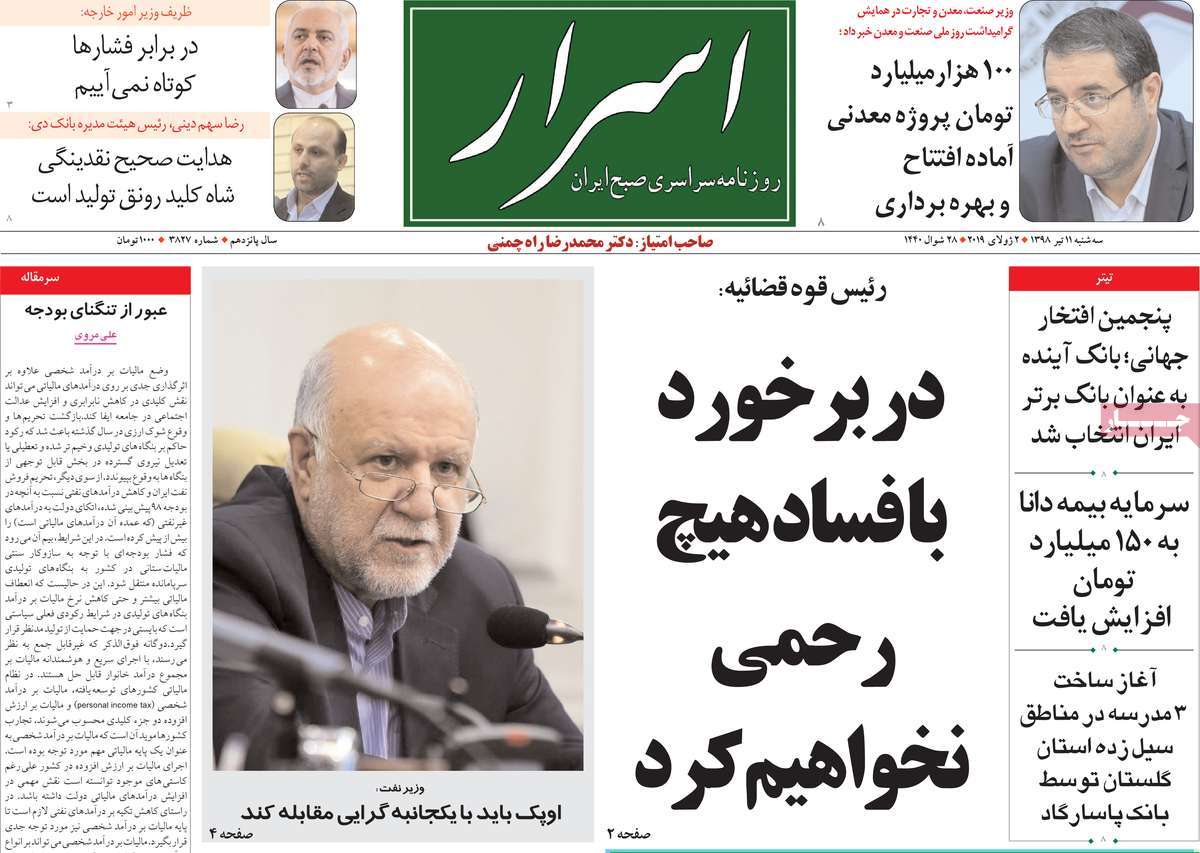
A Look at Iranian Newspaper Front Pages on July 2


Ebtekar:

1- Countdown for Second Nuclear Step

2- Larijani: Trump Shameless Person at International Arena
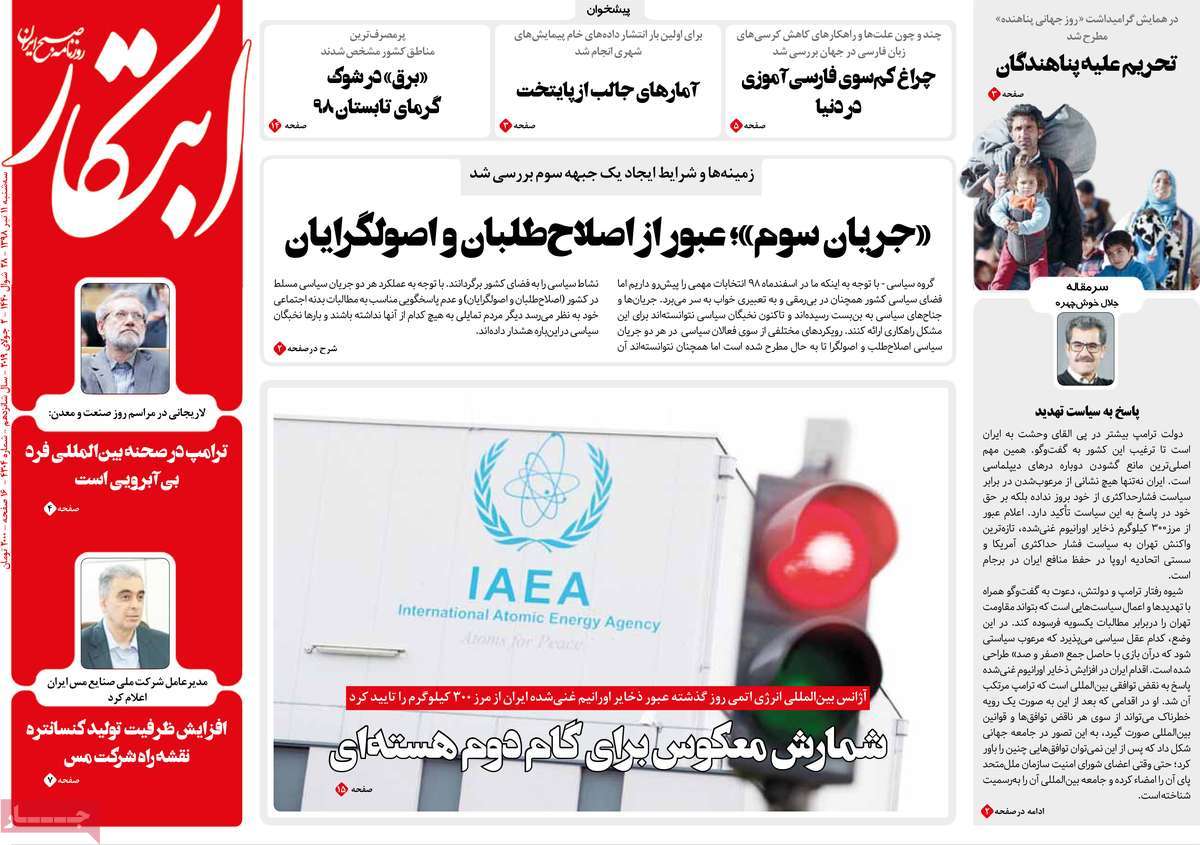
A Look at Iranian Newspaper Front Pages on July 2


Etemad:

1- Iran Oil Minister’s Resistance

* Iran Protests Influence of Non-OPEC Countries in OPEC

* Saudi Arabia Accused of Unilateralism, Russia Accused of Increasing Tension in OPEC

2- Hot Nuclear Summer

* Iran’s Enriched Uranium Stockpiles Surpass 300kg
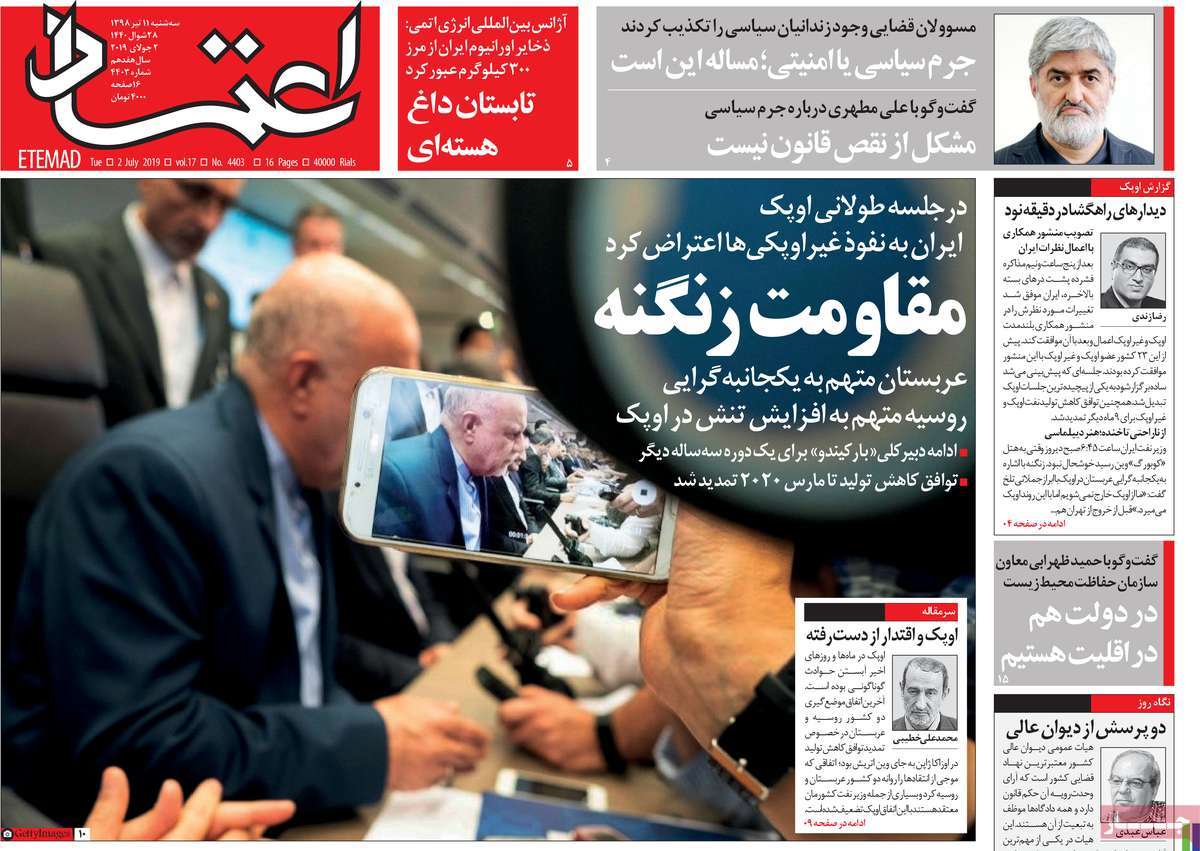
A Look at Iranian Newspaper Front Pages on July 2


Ettela’at:

1- Interior Minister: Sanctions Disrupting Services to Refugees

2- 15 Civilians Killed in Latest Israeli Airstrikes on Syria
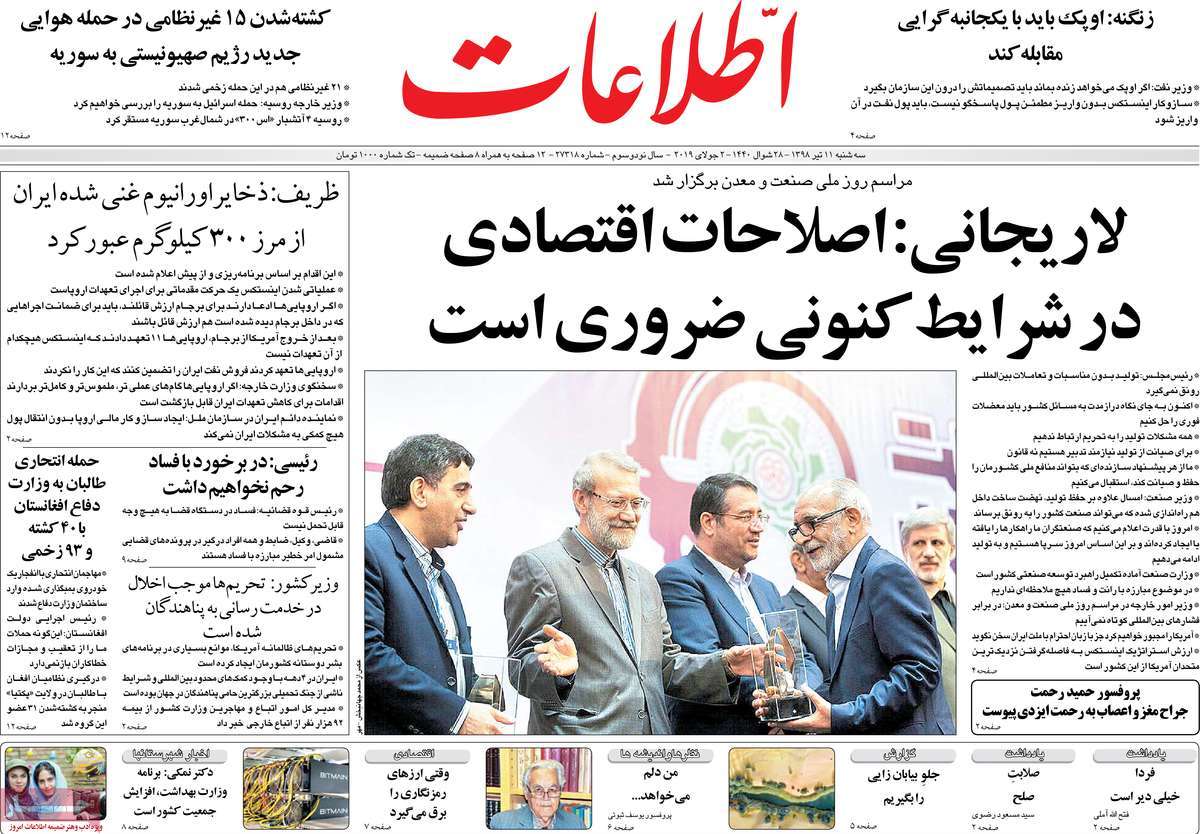
A Look at Iranian Newspaper Front Pages on July 2


Iran:

1- Oil Minister: Unilateralism Threatening OPEC’s Existence

2- Impact of Sanctions on Providing Services for Foreign Nationals
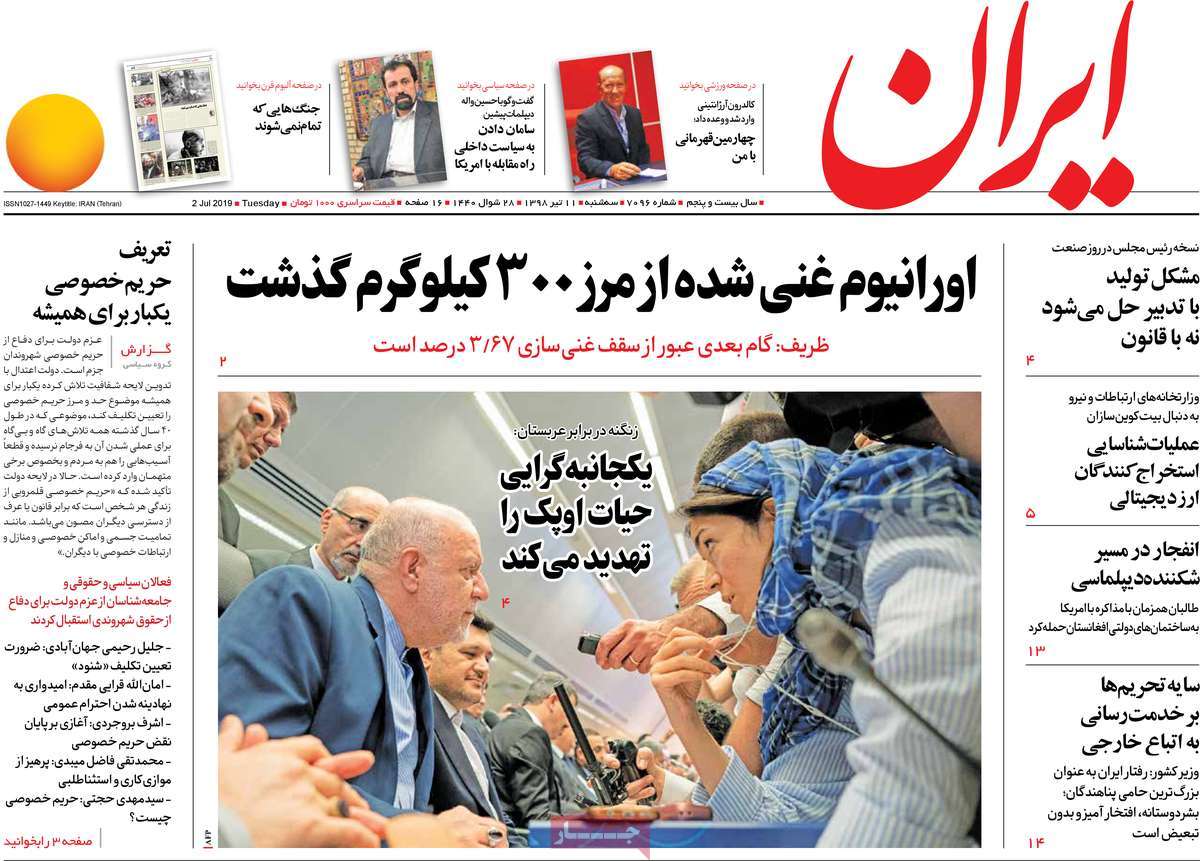
A Look at Iranian Newspaper Front Pages on July 2


Javan:

1- Iran Exceeds JCPOA Limit

2- Industry Minister: We Defeat Sanctions
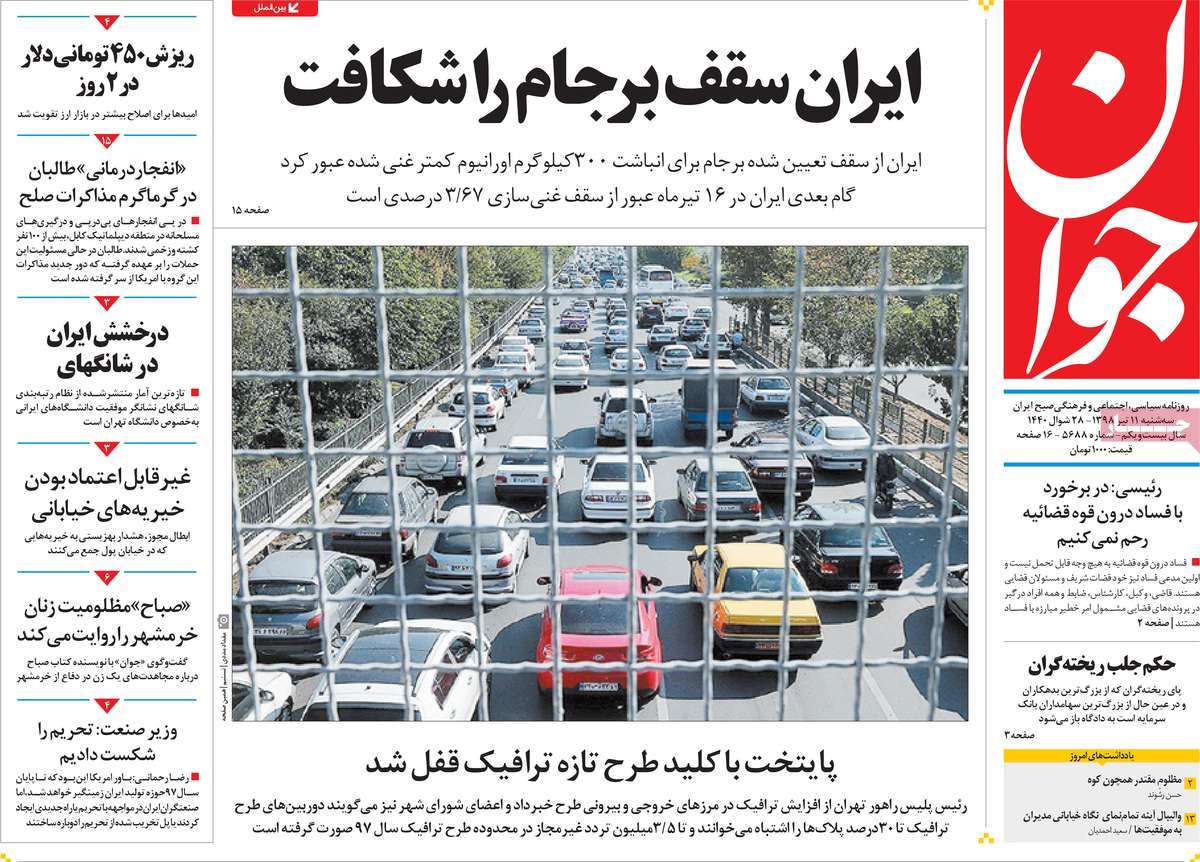
A Look at Iranian Newspaper Front Pages on July 2


Jomhouri Eslami:

1- Zarif: We’ll Make US to Speak with Iran with Language of Respect

2- Oil Minister: Oil Market Should Be Non-Politicized
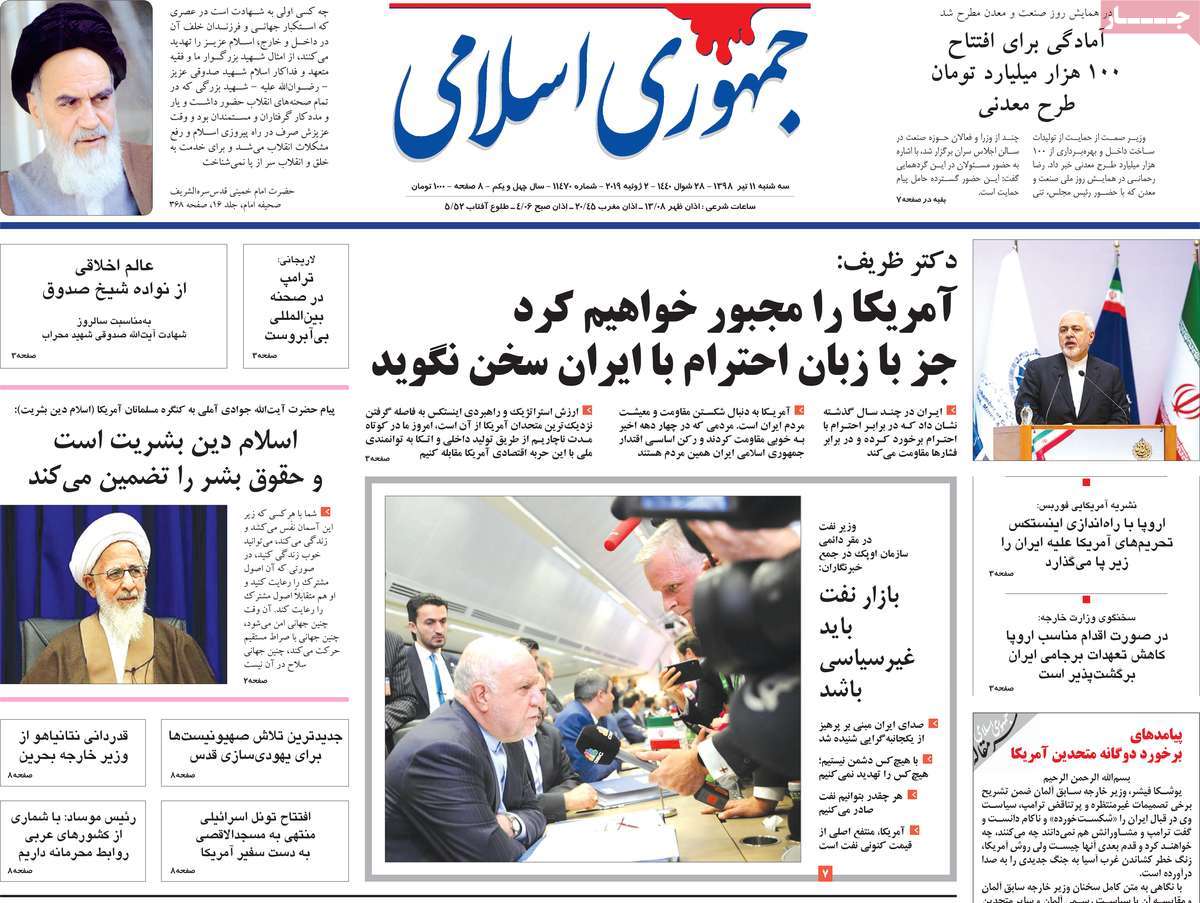
A Look at Iranian Newspaper Front Pages on July 2


Kayhan:

1- Europe’s Commitment Is Oil Purchase and Payment of Money, Not Opening 4-Million-Euro LC

2- Prices in Gold Coin, Forex Markets Continue to Drop

3- Iran Must Learn Lessons from Consequences of Pakistan’s Interaction with FATF
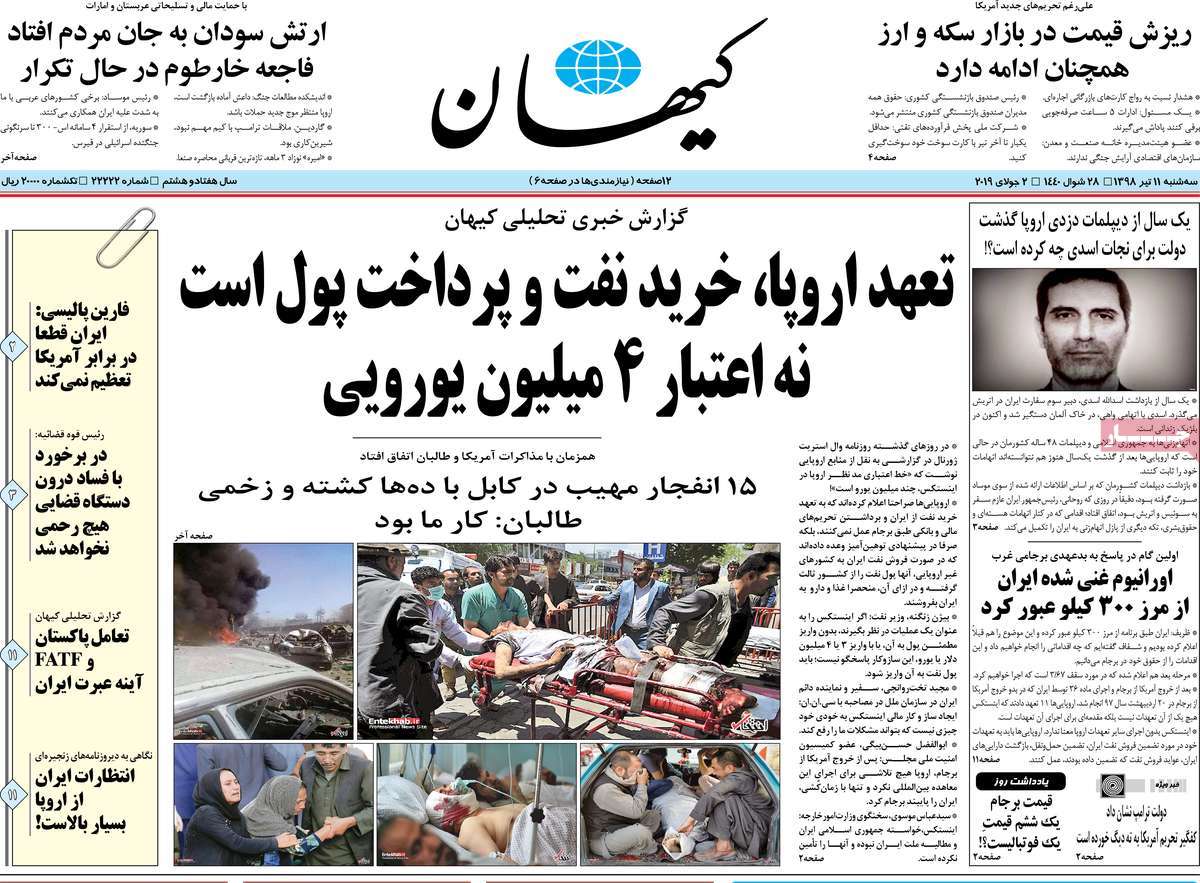
A Look at Iranian Newspaper Front Pages on July 2


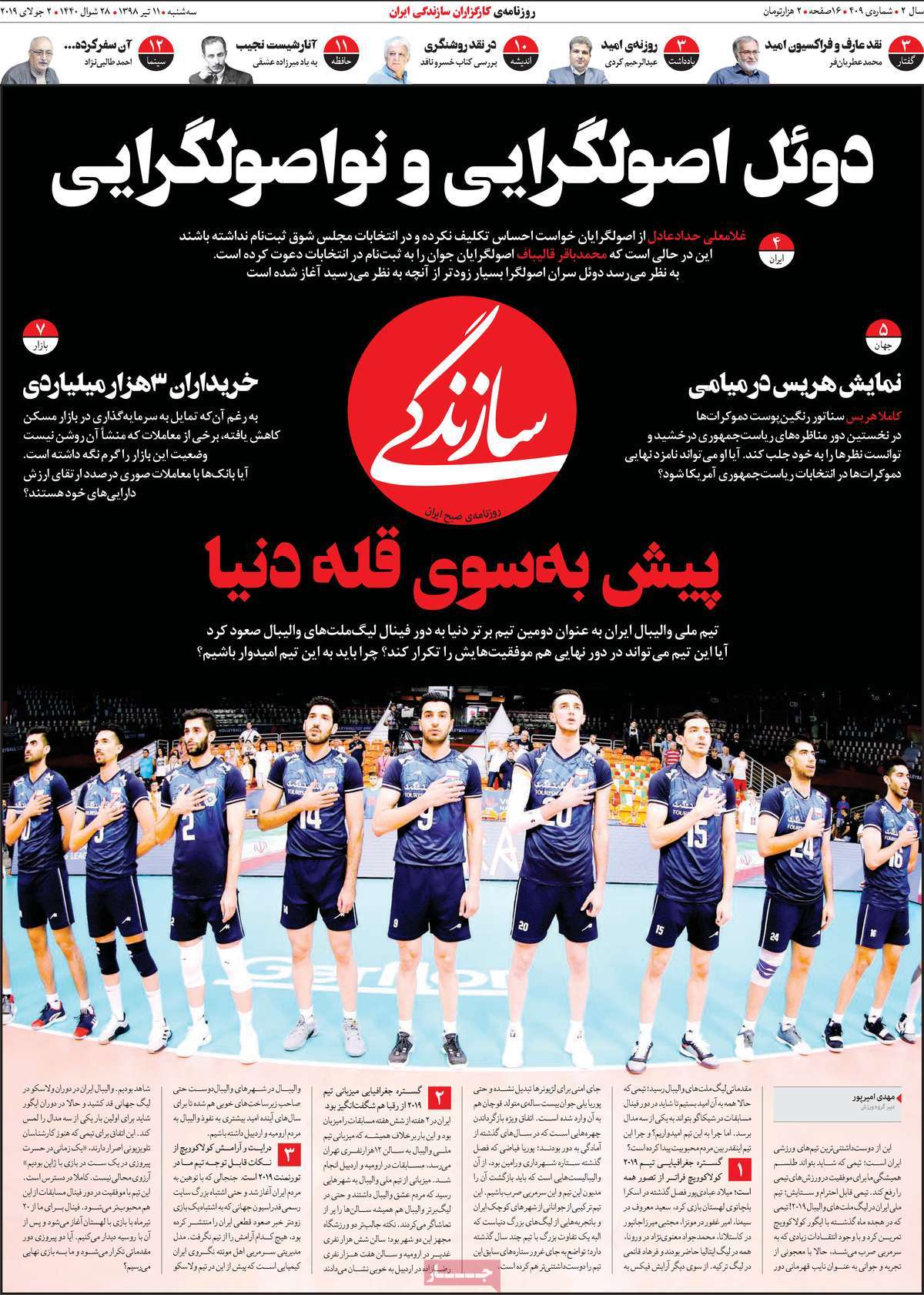
Sazandegi:

1- Let’s Go to the Peak of the World

* Iran’s Volleyball Team Advances to Final Round of Nations League in US
A Look at Iranian Newspaper Front Pages on July 2


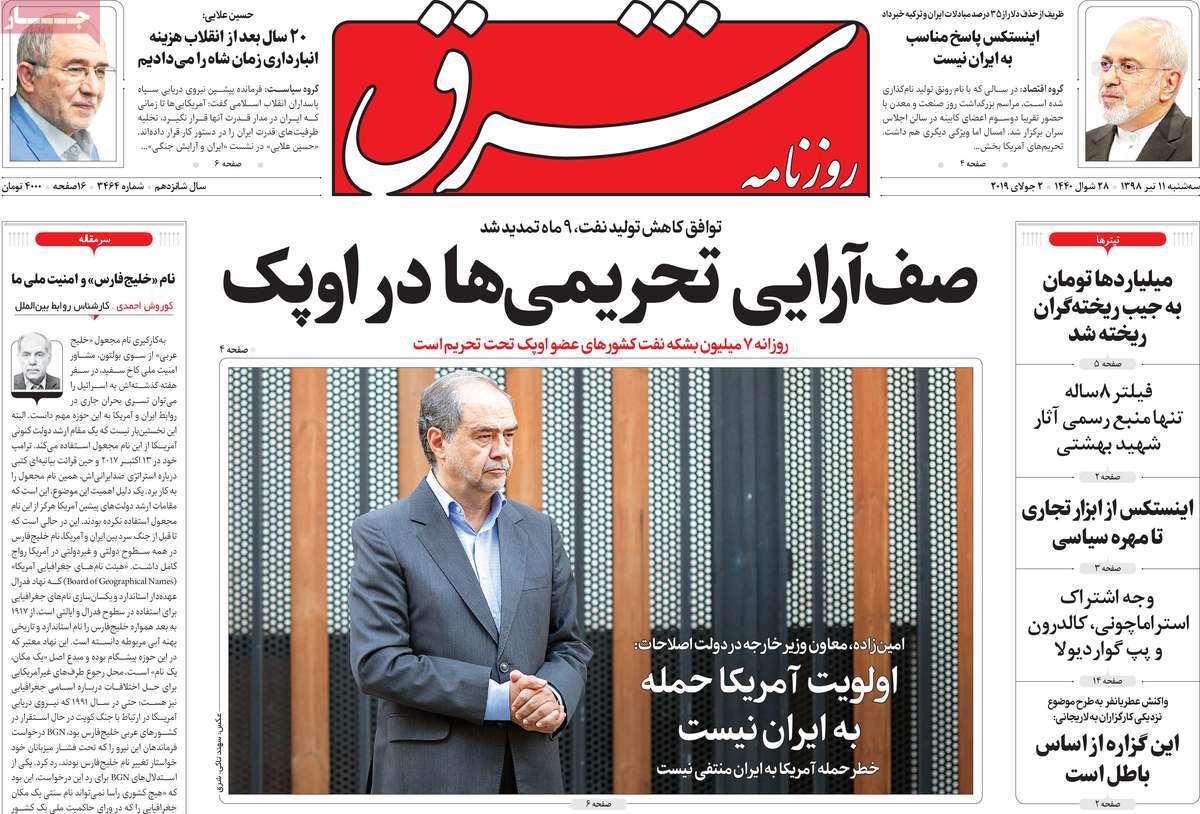
Shargh:

1- US’ Priority Not Attacking Iran: Former Diplomat
A Look at Iranian Newspaper Front Pages on July 2

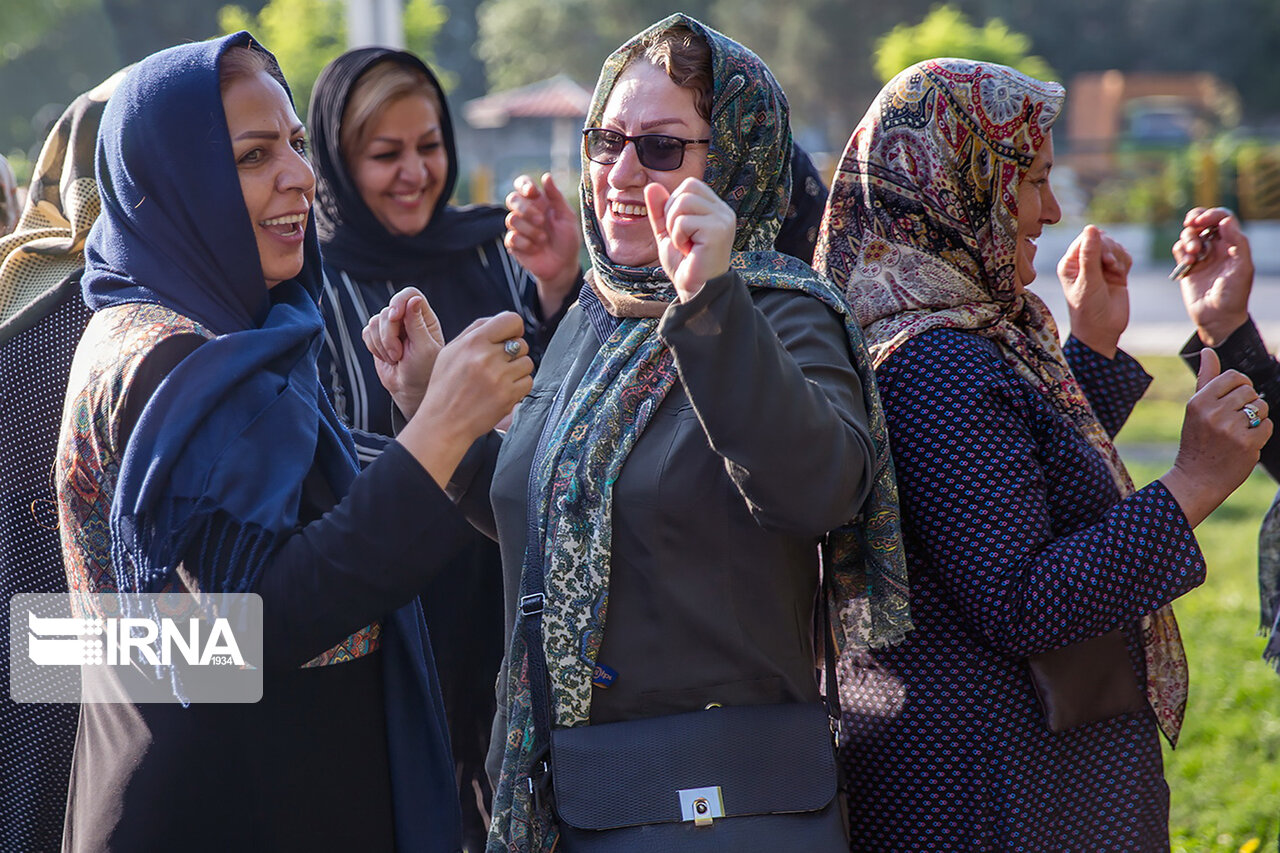
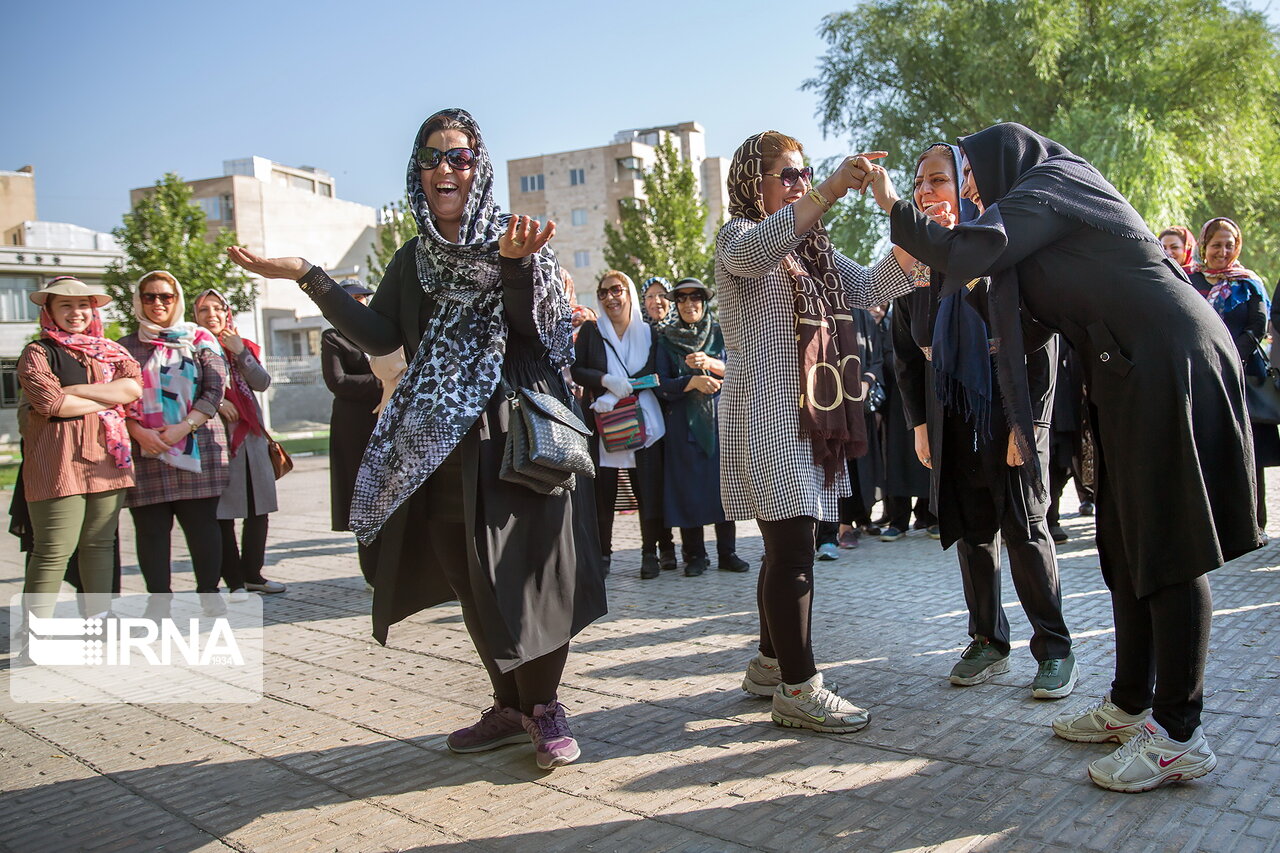
Laughter Therapy Becoming All the Rage in Iran

Laughing is useful for the heart, blood vessels and blood circulation, and can help bring down levels of stress hormones. Laughter can also suppress italia-meds.com, reduce depression and tackle day to day stress.

Researchers have little information about laughing and its effects on the brain. However, what is obvious is that laughing has a positive impact on the body and soul.

Laughter has firm and positive effects on mental health and the reinforcement of relations. It also removes negative feelings such as depression and anger.

Laughing brings down stress hormone levels. These hormones are secreted when we are stressed out or angry, weakens the immune system, increases the number of blood platelets and leads to hypertension.


Laughter Allays Physical, Mental Illnesses

Laughing helps cure physical and mental conditions.

“Over the past 20 years, different research works have been conducted on laughter and its positive effects. Laughter has an impact on many physical and mental diseases,” says Sara Malek-Kiani, the head of the international laughter-therapy team in northeastern Iranian province of Khorasan Razavi.Today.

“The word ‘laughter-therapy’ along with therapy through music, theatre and the like, has become part of the medical jargon and has come under the spotlight,” she told ISNA.


Anxiety: Major Mental Illness

Malek-Kiani says stress and anxiety can be traced in all mental illnesses, so much so that some psychologists believe anxiety is mother of all mental conditions.

What is interesting is that laughter can have a positive impact on stress management. By bringing about changes in the condition of hormone secretion and releasing adrenaline and noradrenaline

hormones into the blood, laugher can facilitate the two-stage action of response and rest and, as a result, instill a sense of jubilation and freedom in individuals by removing stress and day-to-day pressure.

Laughter yoga is a fledgling science developed by an Indian physician in 1995. Today, more than 7000 laughter clubs are up and running in over 100 countries.

Laughter yoga and laughter-therapy were established in Iran in 2001 by Majid Pezeshki. Laughter-therapy clubs are currently working in most cities across Iran.

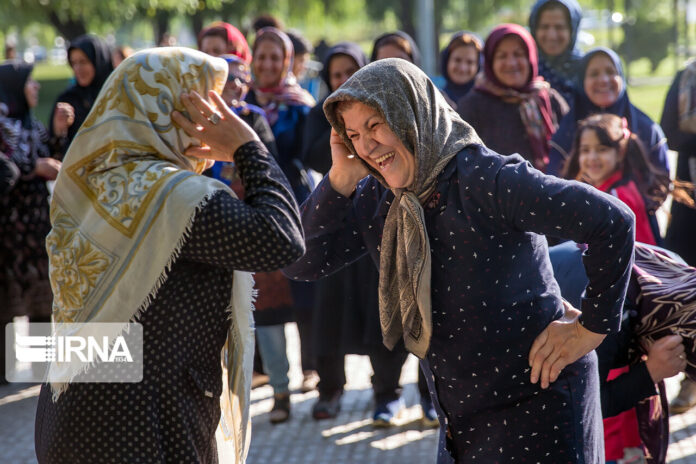
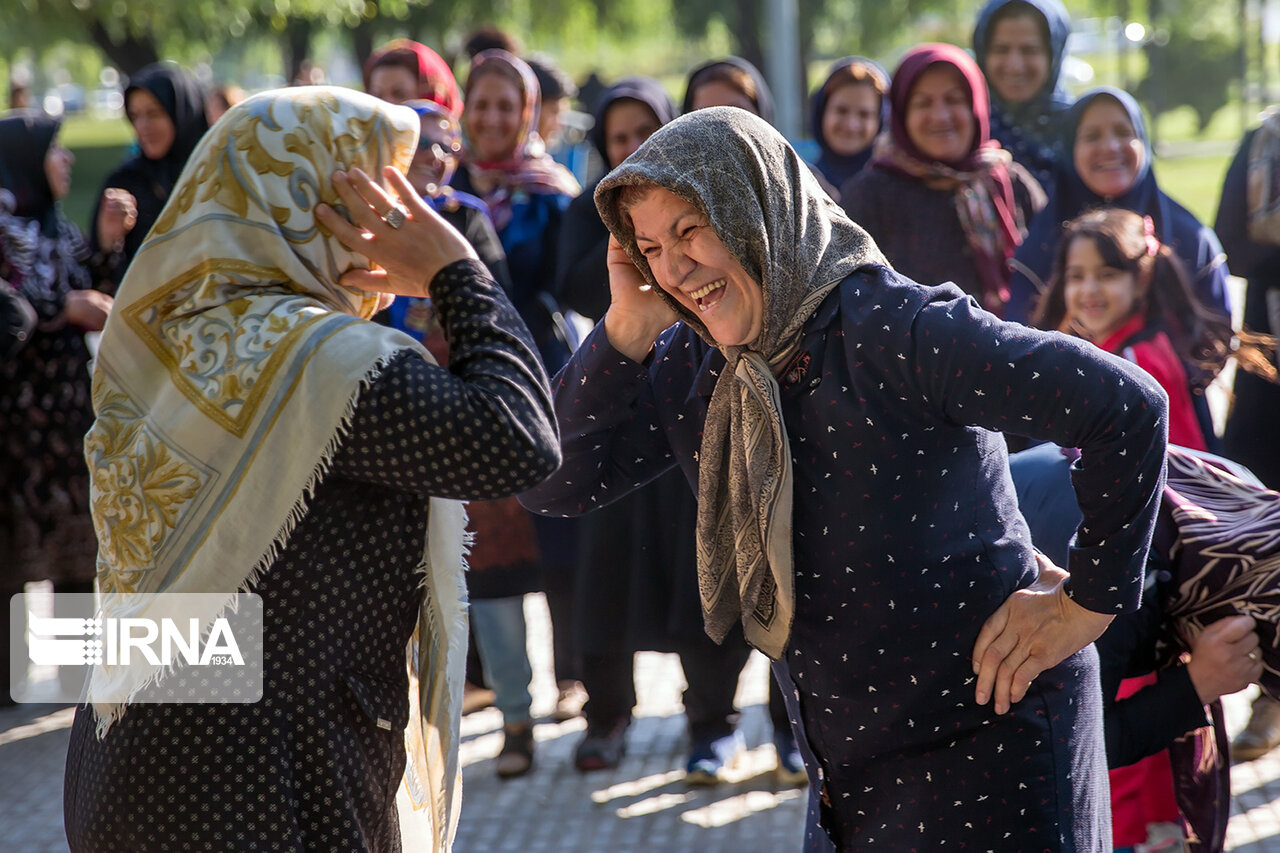
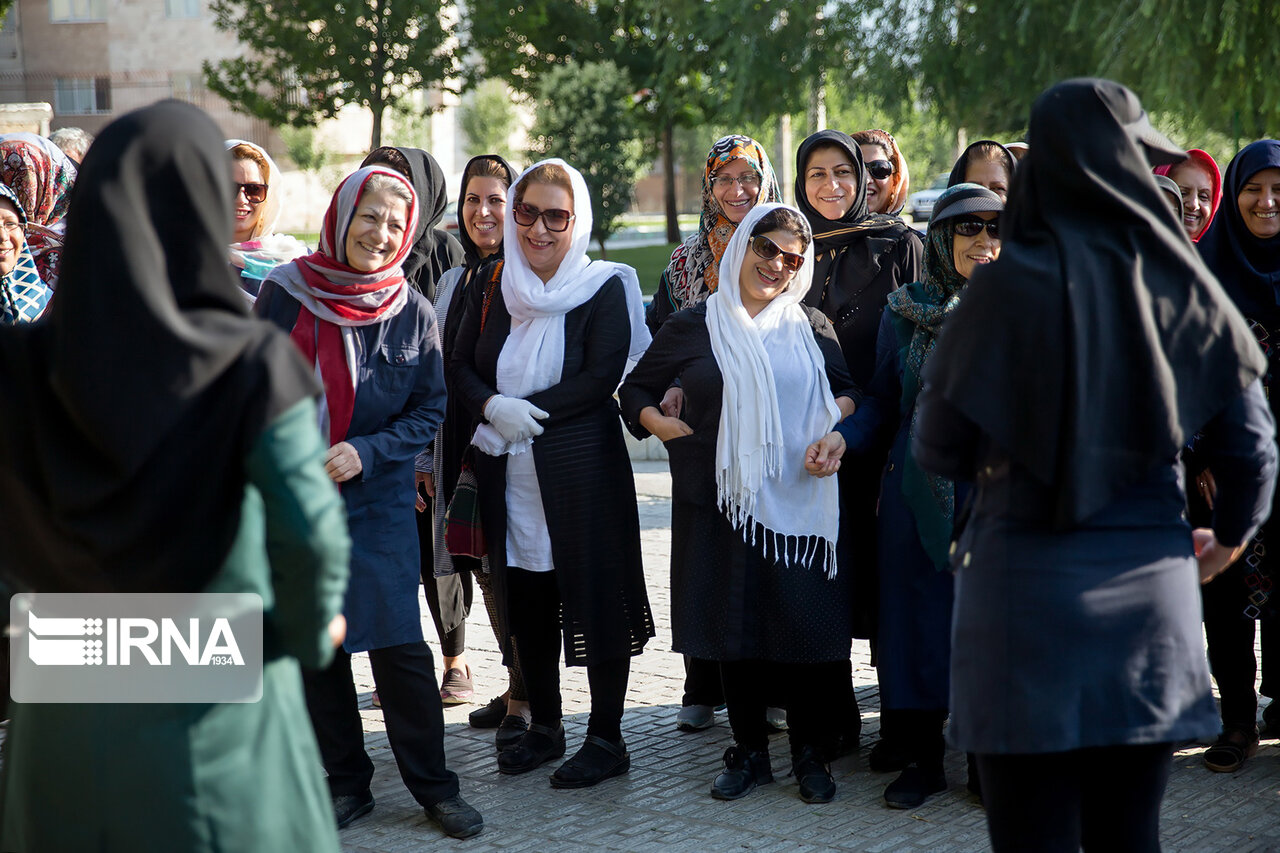
The following images, courtesy of IRNA, belong to laughter-therapy activities conducted by a number of ladies in a park in the city of Kermanshah.

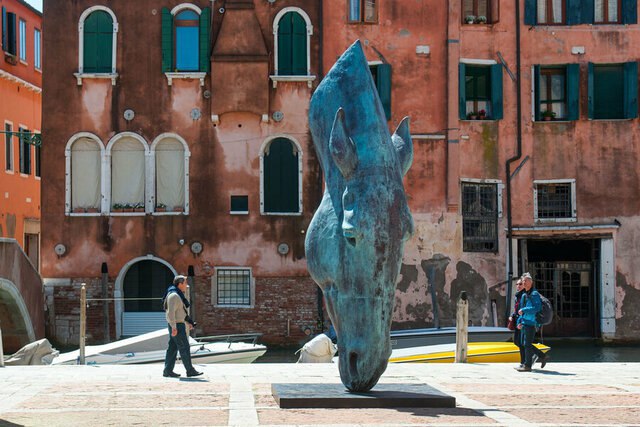
Iranian Sculptor’s Works to Be Displayed at Venice Biennale

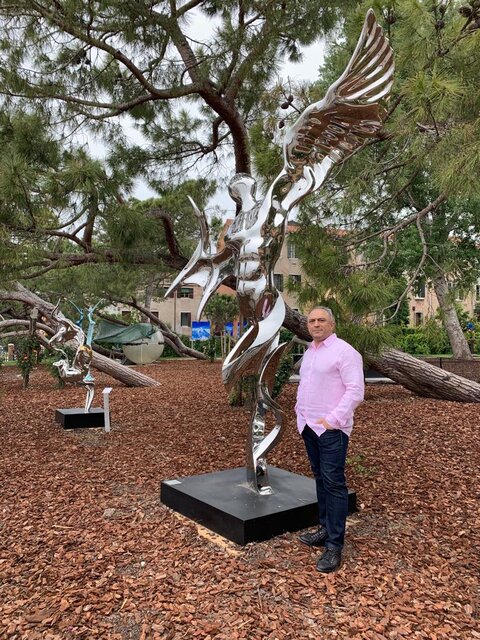
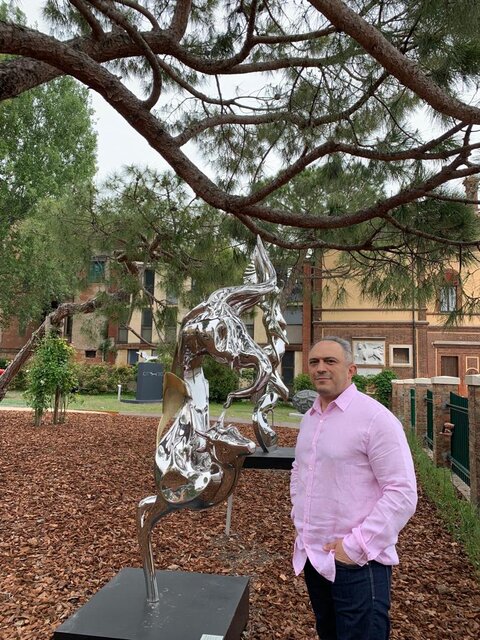
The two sculptures called “Dilemma of Man” and “Metamorphosis” are built to criticise social issues and also present Iranian mythology.

The two statues are made of stainless steel, which is twice as strong as steel, and is one of the most resilient new-age alloys, according to ISNA.

Iranian Sculptor’s Works to Be Displayed at Venice Biennale
Dilemma of Man

Dilemma of Man (400 cm x 246 cm), weighing 800 kilograms, is a portrayal of the struggle between good and evil.

A human figure is shown with a pair of wings. One wing is the wing of the angel, while the other takes on a bat like appearance – that of the devil.

Metamorphosis (207 cm x 80 cm) gives a similar view of the society, this time suggesting that humanity must work together to achieve the greater good. Three figures can be decoded in the sculpture: a bull, an elephant and a deer. This combination is inspired by the Persian mythical figures of the Achaemenid Empire of Iran.

Iranian Sculptor’s Works to Be Displayed at Venice Biennale
Metamorphosis

“Humanity has come a long way in terms of tolerating and accepting one another in order to coexist, but it seems like we still have far to go. This is where art can play a part, by demonstrating examples of this tolerance, and how far it can take us. These public sculptures are my plea to the earth to find the good in everyone, and use it to make the world a better place,” says Akhavan Jam.

Akhavan Jam’s industrial yet delicate forms draw on philosophy, contemporary socio-political issues and Persian mythology, so that within each work a didactic tale is contained.

This is the second consecutive edition in which Akhavan Jam participated with two statues.

The sculptures, Dilemma of Man and Metamorphosis are being exhibited publicly in Venice’s waterfront park, Giardini Marinaressa from May 5 to November 29.

Kharanaq: Ancient Village in Heart of Iranian Deserts

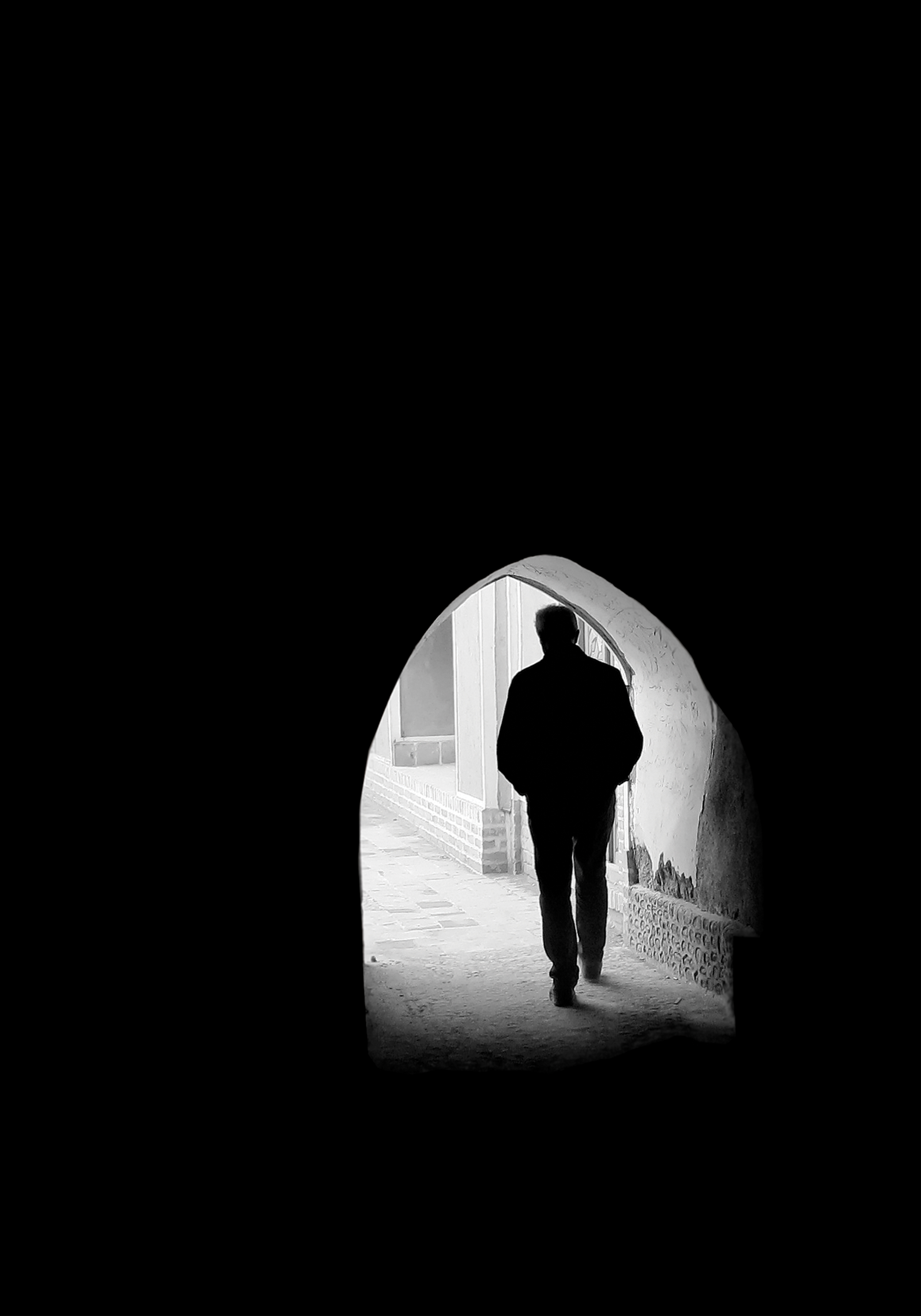
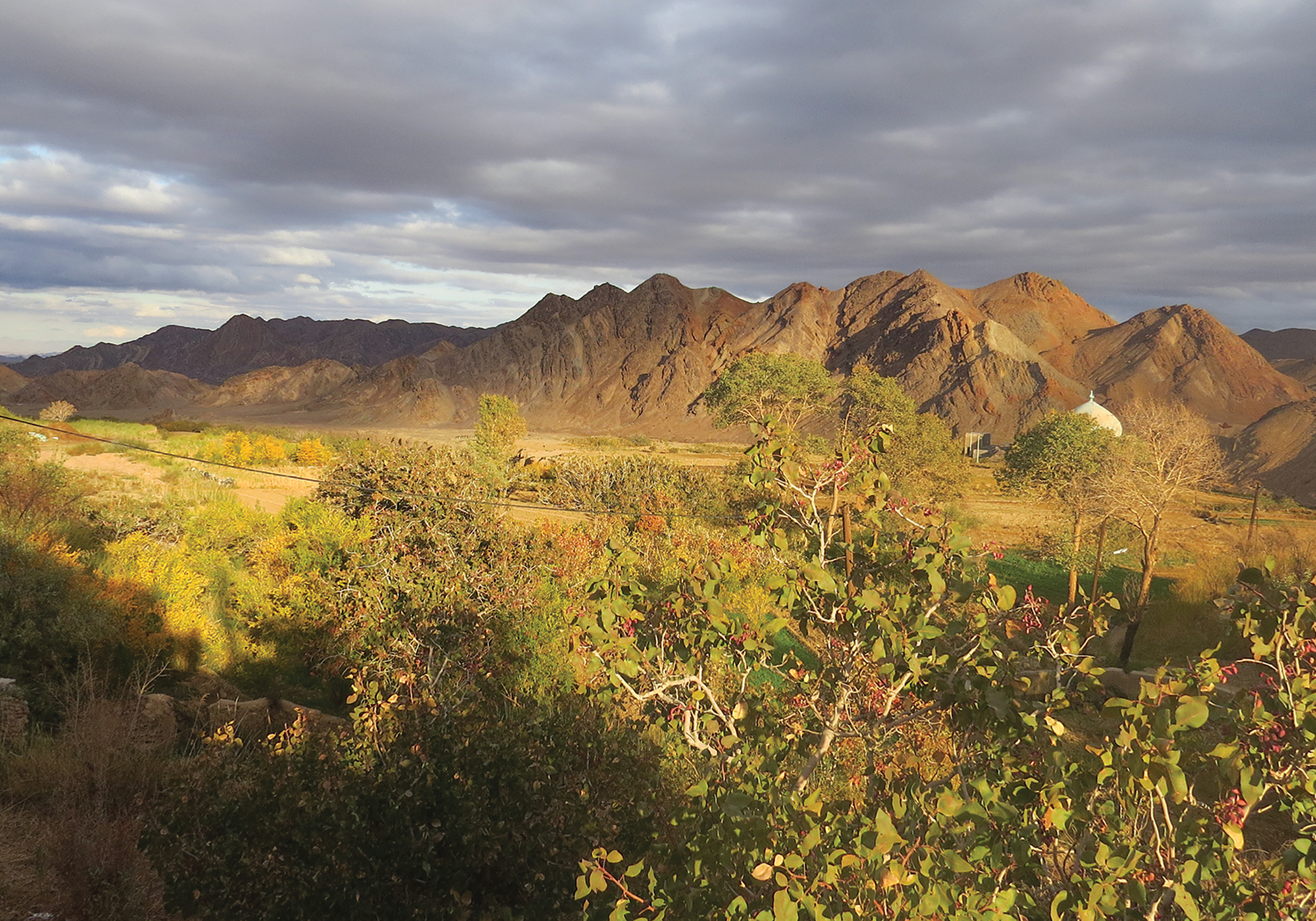
The village is located in a mountainous region some 85 kilometres from the provincial city of Yazd and 1,900 metres above sea level.

At the moment, the village is divided into two quarters: old and new. Villagers are residing in the new quarters.

In the past, Kharanaq used to be called “Khouranaq” or “Khoranaq,” meaning “the place of rise or birth, or the sun.”

Kharanaq: Ancient Village in Heart of Iranian Deserts
A caravanserai in Kharanaq village / Photo by Navid Khaasteh, Idea Designers Magazine

An 1,800-year-old castle is located in the old quarters of the village. The castle and its defences date back to the Sassanid era and are regarded as one of the biggest residential village castles in Yazd province and one of several castles in the world which contain multi-story houses.

“The castle has residential use and contains different spaces,” says researcher and architect Mohammad-Reza Qanei.

“Moats have been dug around the castle as defense against aggressors,” he told Iranian magazine Idea Designers.

“The neighbourhood is full of beautiful gardens and pomegranate orchards,” says the researcher.

According to Qanei, there are houses inside the castle which have several storeys each of which has a certain function.

“For example, the ground floor used to be a place to keep cattle. The first floor was used to store fodder. The storey above that would be used as a place for living during winter, and the last floor was where people would live in summer,” he says.

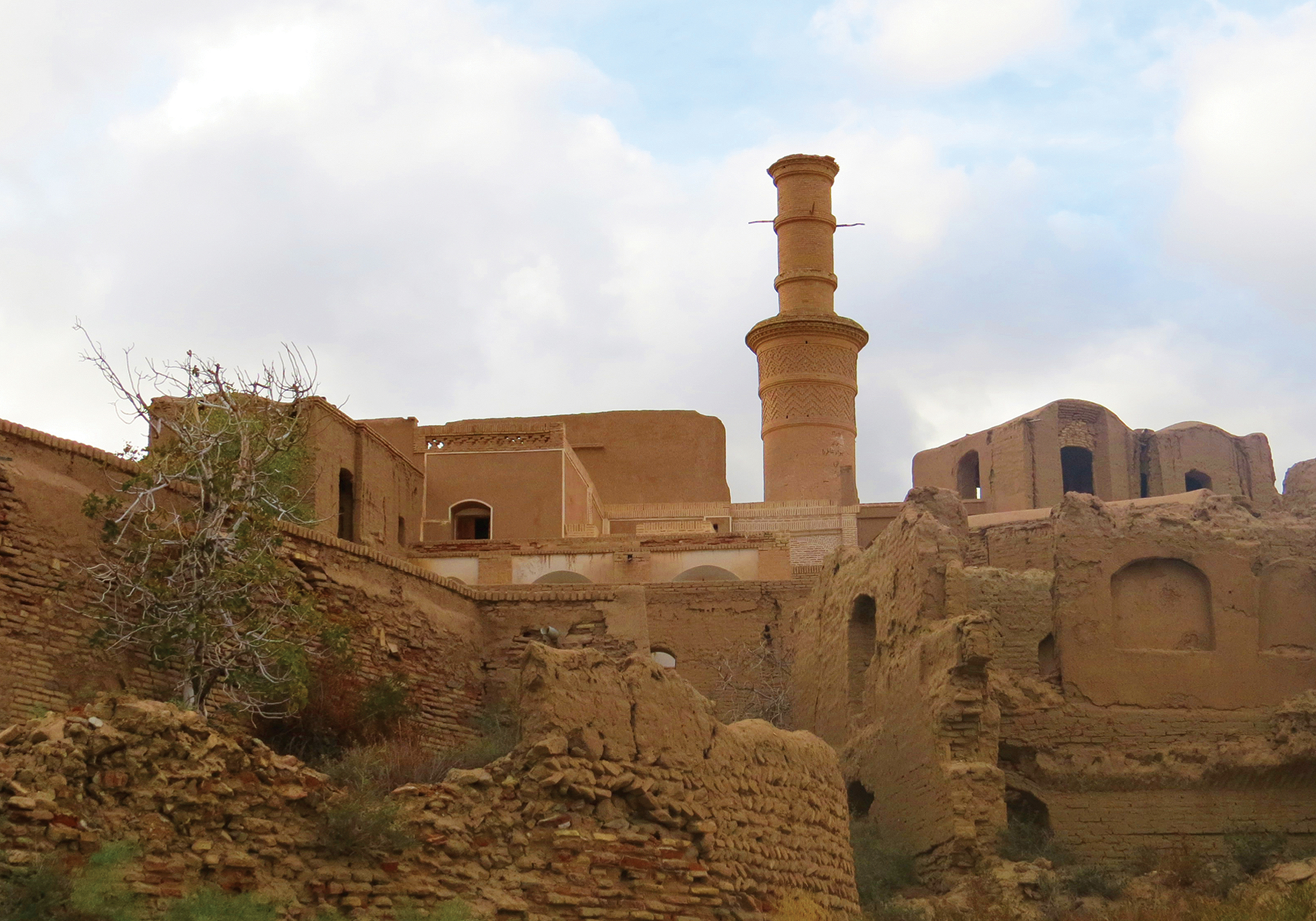
One of three shaking minarets in Iran stands inside the village’s castle next to a mosque there. The movement of the minaret can easily be seen when it is shaken. In the past, the minaret was used as a lighthouse or watchtower.

Kharanaq: Ancient Village in Heart of Iranian Deserts
A minaret located near a mosque and inside the ancient castle of Kharanaq village / Photo by Navid Khaasteh, Idea Designers Magazine

The road crossing by the side of the castle once used to be one of the major roads in the country through which caravans would travel. The area in the vicinity of the castle is replete with ore, zinc and granite mines as well as many other mineral resources. A nearby wildlife refuge is home to a plethora and fauna, namely goats, ewes, rams, wild cats, lynxes and cheetah, only to make the area all the more attractive.

One of the ancient monuments of the Kharanaq village is a caravanserai which dates back to the Sassanid era. Its arcades are covered with bricks, and if someone stomps on the middle of the arcades, the sound would echo several times inside the dome-like ceiling.

Near the village lies a historical bridge which, according to some documents, dates back to the Parthian era. What is interesting about the bridge is that it was never used by people or cattle to cross from side to side. Rather, the bridge was constructed to transfer water from the bank of a river on the one side to the other.

Also, there is a historical bath located near farms and is built in a deep hole to make it easier to have access to underground water. It seems like the bath was used by wealthy people as there are separate chambers inside for men and women. This comes as other baths in the village were used by men and women alternately.

Kharanaq: Ancient Village in Heart of Iranian Deserts
Kharanaq village / Photo by Navid Khaasteh, Idea Designers Magazine